Through the Ages: A New Story of Civilization
2015
Develop technologies, lead a growing nation, build wonders, and balance culture with military strength across four ages of civilization.
120
minutes
2 - 4
player(s)
14+
Heavy


About this board game
Through the Ages: A New Story of Civilization is a civilization-building game for 2–4 players, with games lasting about 120 minutes. Guide your nation from antiquity to the modern age through careful resource management, technological progress, leadership, wonders, and military development.
At the heart of the game is card drafting. Technologies, leaders, and wonders enter play and become easier to draft the longer they remain available. Each decision helps shape your civilization, but every area demands resources that could be needed elsewhere.
- Discover technologies by spending science.
- Use food to create population and staff your developments.
- Spend resources, or ore, to build the structures that use your technologies.
- Elect leaders and construct wonders to strengthen your civilization.
- Develop a military alongside your civilian achievements.
Military units are built in the same manner as civilian buildings, making defense an essential part of your overall plan. A weak military can leave your nation vulnerable to opponents, while a stronger rival may steal resources or science, kill leaders, take population, or claim culture.
There is no map, so military conflict does not involve losing territory. Even so, military strength can have a major impact on the developing civilizations around you. Building a powerful military makes it difficult to win, but failing to maintain one can make it easy to lose.
Across the game’s four ages, balance growth and protection while pursuing the culture that will define your legacy. In Through the Ages, the player whose nation has the most culture at the end of the modern age wins.
/pic7182955.jpg)
Board Game Rules for
Through the Ages: A New Story of Civilization
Code of Laws
This rulebook presents all the rules for Through the Ages in a point-by-point format. It is especially useful for players who need to find a rule quickly. Players who are learning the game should not start with this rulebook. Instead, they should learn from the Handbook, which provides thematic background and detailed examples.
The first half of this book describes what happens during the game. The second half defines terms and concepts.
Game Flow
- Set up the game.
- Players take turns, beginning with the starting player and continuing clockwise.
- Turns are organized into rounds. Each round begins with the starting player’s turn.
- The first round is different from the others.
- Note: Most of the time, nothing special happens at the beginning or end of a round.
- During the game, the current age gradually changes through Ages A, I, II, III, and finally IV.
- If Age III ends during the starting player’s turn, that is the last round.
- If Age III ends during any other player’s turn, then the following round is the last round.
- The game ends when the last round is over. Every player will have had an equal number of turns. Then it is time for the final scoring.
Game Boards
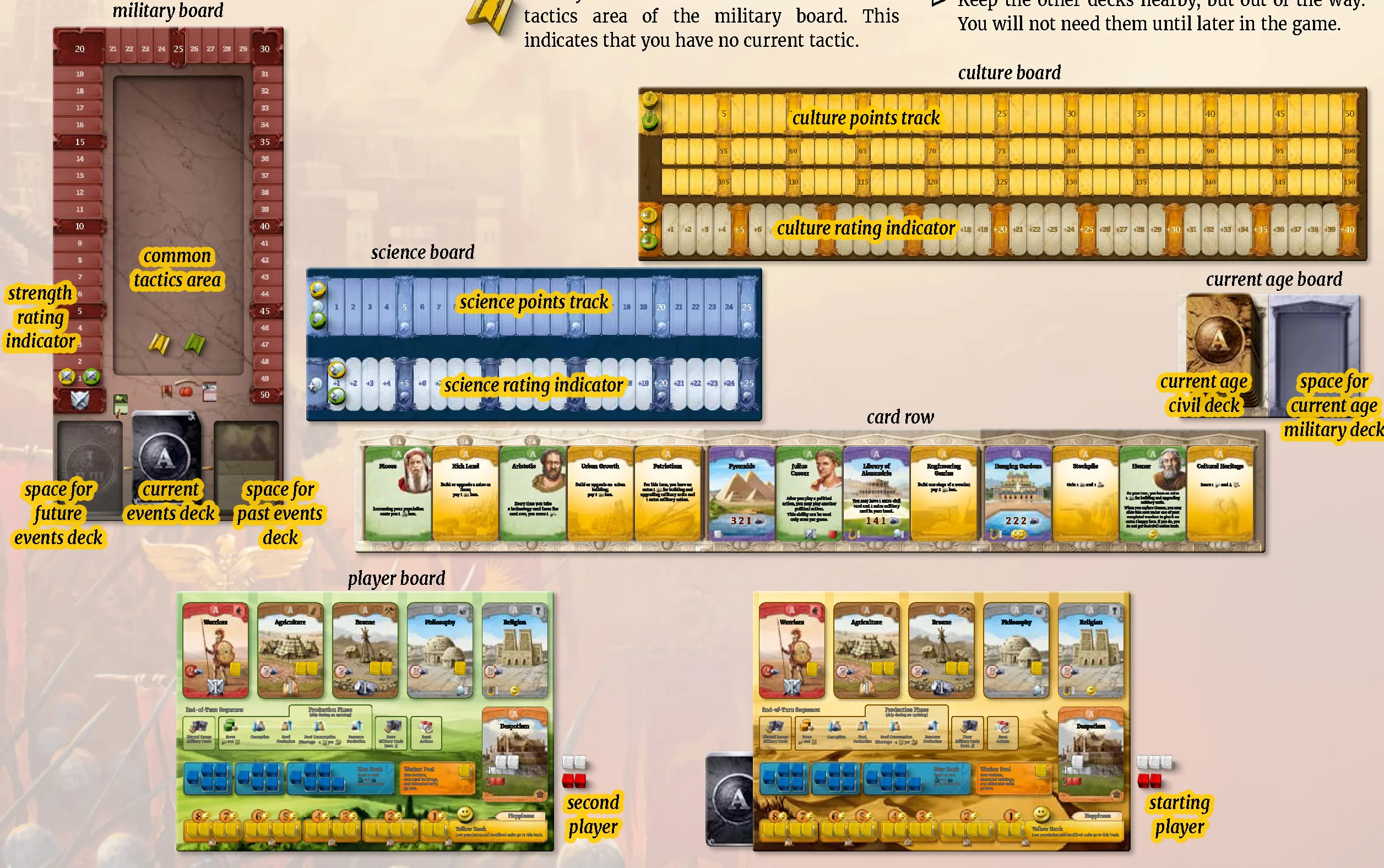
Place the game boards in the center of the table, in any suitable configuration.
Deck Setup
Ages A, I, II, and III each have their own civil and military decks. So there are 8 separate decks, each with a different back.
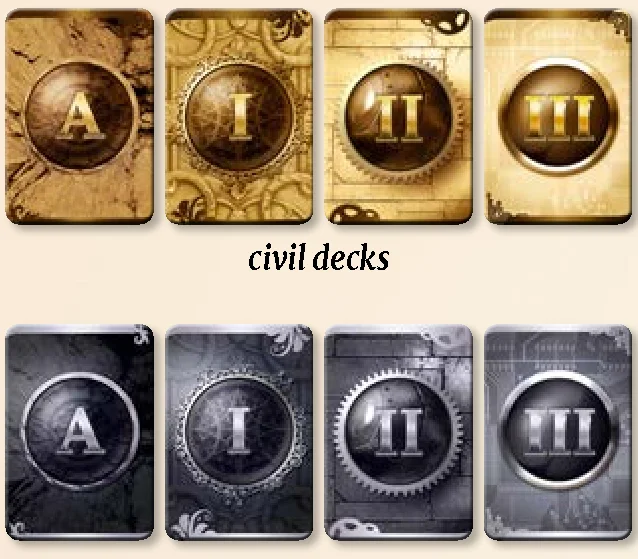
In a 2- or 3-player game, you must remove certain cards. These cards will not be used.
- Before a 3-player game: Civil decks I, II, and III each have three cards with the “4” marking (such as Republic). Remove these cards from these decks.
- Before a 2-player game: Civil decks I, II and III each have nine cards with a “3+” or “4” marking (such as Monarchy or Republic). Remove these cards from these decks. Military deck I has two pact cards, and military decks II and III each have four. Remove all pact cards from these decks.

Preparing the Event Deck
Shuffle the Age A military deck.
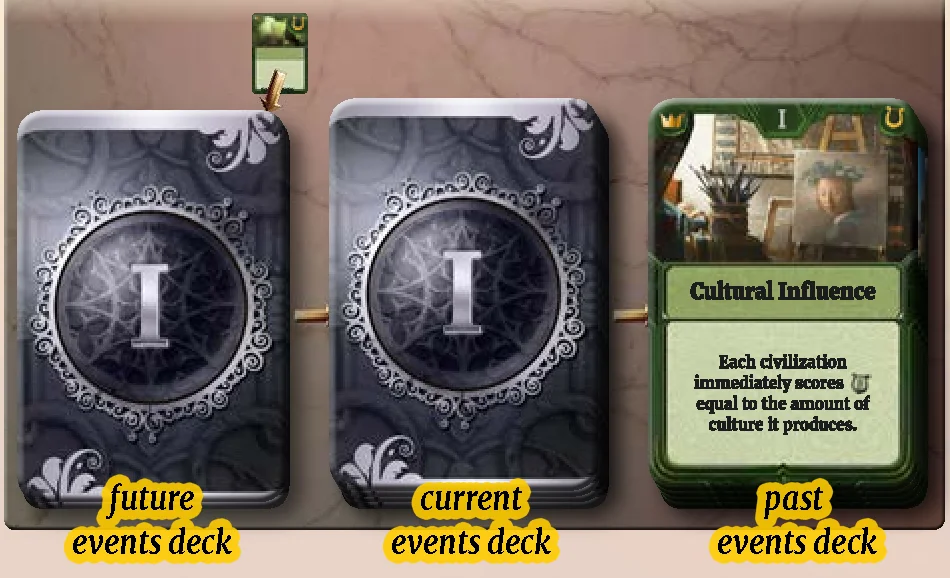
- Take a number of cards equal to the number of players plus 2. Place these face down on the military board as the current events deck.
- Return the rest of the cards to the box without looking at them.
Preparing the Card Row
Shuffle the Age A civil deck.
- Deal 13 cards face up to the spaces of the card row.
- Put the rest of the deck on the light half of the current age board.
Keep the other decks nearby, but out of the way. You will not need them until later in the game.
Player Components
Each player chooses a color and takes the components in that color:
Player Board
The player board depicts 6 initial technologies: Warriors, Agriculture, Bronze, Philosophy, Religion, and Despotism. These count as technology cards.
- Put a blue token on each of the 16 squares in the blue bank.
- Put a yellow token on each of the 18 squares in the yellow bank, on each of the 6 squares on the technology cards, and on the square in the worker pool.
- Your initial government card, Despotism, depicts 4 civil actions and 2 military actions. Place 4 white tokens and 2 red tokens next to the card (but not on it).
Rating Markers
You have 4 rating markers in your color.
- Place your science rating marker on space 1 of the science rating indicator.
- Place your culture rating marker on space 0 of the culture rating indicator.
- Place your strength rating marker on space 1 of the strength rating indicator.
- Place your happiness rating marker on space 0 of the happiness rating indicator on your player board.
Note: These settings are determined by the workers on your initial technology cards.
Points Counters
- Place your science points counter on space 0 of the science points track.
- Place your culture points counter on space 0 of the culture points track.
Tactics Standard
Place your tactics standard in the common tactics area of the military board. This indicates that you have no current tactic.
In the Box
Some blue, yellow, red, and white tokens will be left over after setup. They will be needed during the game, but only rarely. They are said to be “in the box”.
Starting Player & Initial Actions
Choose the starting player however you like. The starting player will not change during the game. You may mark this by sliding one of the unused Age A military cards face down under the starting player’s board.
- The starting player will have 1 unspent civil action on his or her first turn. Indicate this by placing one of the starting player’s white tokens on his or her Despotism card.
- In clockwise order, each player begins with one more civil action than the previous player. They indicate this with 2, 3, or 4 white tokens on their Despotism cards.
- Players have no military actions on their first turn. All red tokens remain beside the player boards.
Your Cards
Level of a Card
The level of the card is a numerical value that corresponds to the age of the card: Age A = 0, Age I = 1, Age II = 2, and Age III = 3.
The level of a military unit, farm, mine, or urban building is the level of the technology it is on. If a card refers to your best mine, lab, library, etc. it means one with the highest level among all workers of that type.
Your Hand
You may hold both civil and military cards in your hand.
Civil Cards
Civil cards are drawn from the card row. Because civil cards are never drawn secretly, the players may decide that civil cards in hand are public at all times.
The number of civil cards in your hand is limited by your civil action total. When you are at or above the limit, you may not add another civil card to your hand. You do not have to discard excess civil cards if already held.
Military Cards
Military cards are drawn secretly from the current age military deck.
The number of military cards in your hand is limited by your military action total. Discard excess during End-of-Turn Sequence.
Cards in Play
A card in play is face up on the table, either as part of a civilization’s play area or as a common tactic on the military board. Other cards are not in play.
Discard or Remove from Play
- Discard usually means to discard a card from hand.
- Remove from play means to discard a card that was in play.
- If a civil card is discarded or removed, it will not enter the game again.
- Military cards go to a face down discard pile of the corresponding age.
- Resolved events go to the past events pile, not the military discard pile.
Types of Cards in Play
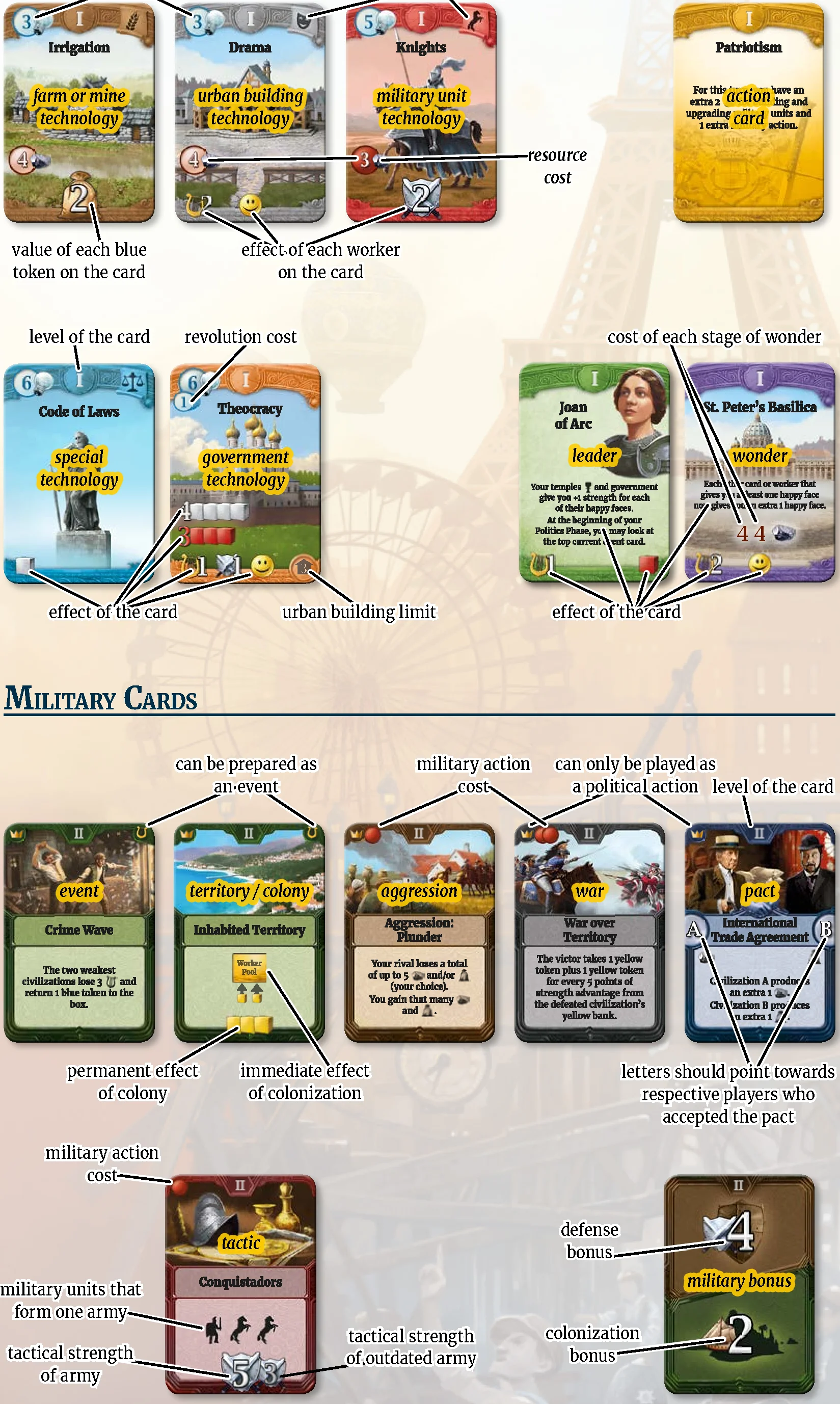
Technology Cards in Play
Most cards in play are technology cards:
- Any civil card with a science cost in its upper left corner.
- Your initial technologies printed on your player board.
Farm or Mine Technologies
Each worker represents one farm or mine. They produce food or resources during Production Phase. Each blue token stored on the card is worth the depicted amount.
Urban Building Technologies
Each worker represents an urban building. Your government defines your urban building limit per type. Urban buildings contribute to ratings (science, culture, happiness, strength).
Military Unit Technologies
Each worker represents a military unit (infantry, cavalry, artillery, air force). Contributes printed strength rating and can be grouped into armies.
Special Technologies
Provide effects without workers (law, warfare, exploration, construction). Limitation: You can never be affected by two special technologies of the same type; keep only the higher-level card.
Governments
Provide civil and military actions, urban building limit, and special abilities. Workers cannot be placed on government cards. You always have exactly one government in play.
Other Civil Cards in Play
Wonders
Built in stages. Unfinished wonders enter rotated sideways (maximum 1 unfinished wonder). When completed, turned right side up and effects apply.
Leaders
Give unique abilities. Maximum 1 leader in play. Taking a leader prevents taking another leader from that same age.
Action Cards
Never put into play; resolved for a one-time effect and discarded.
Military Cards in Play
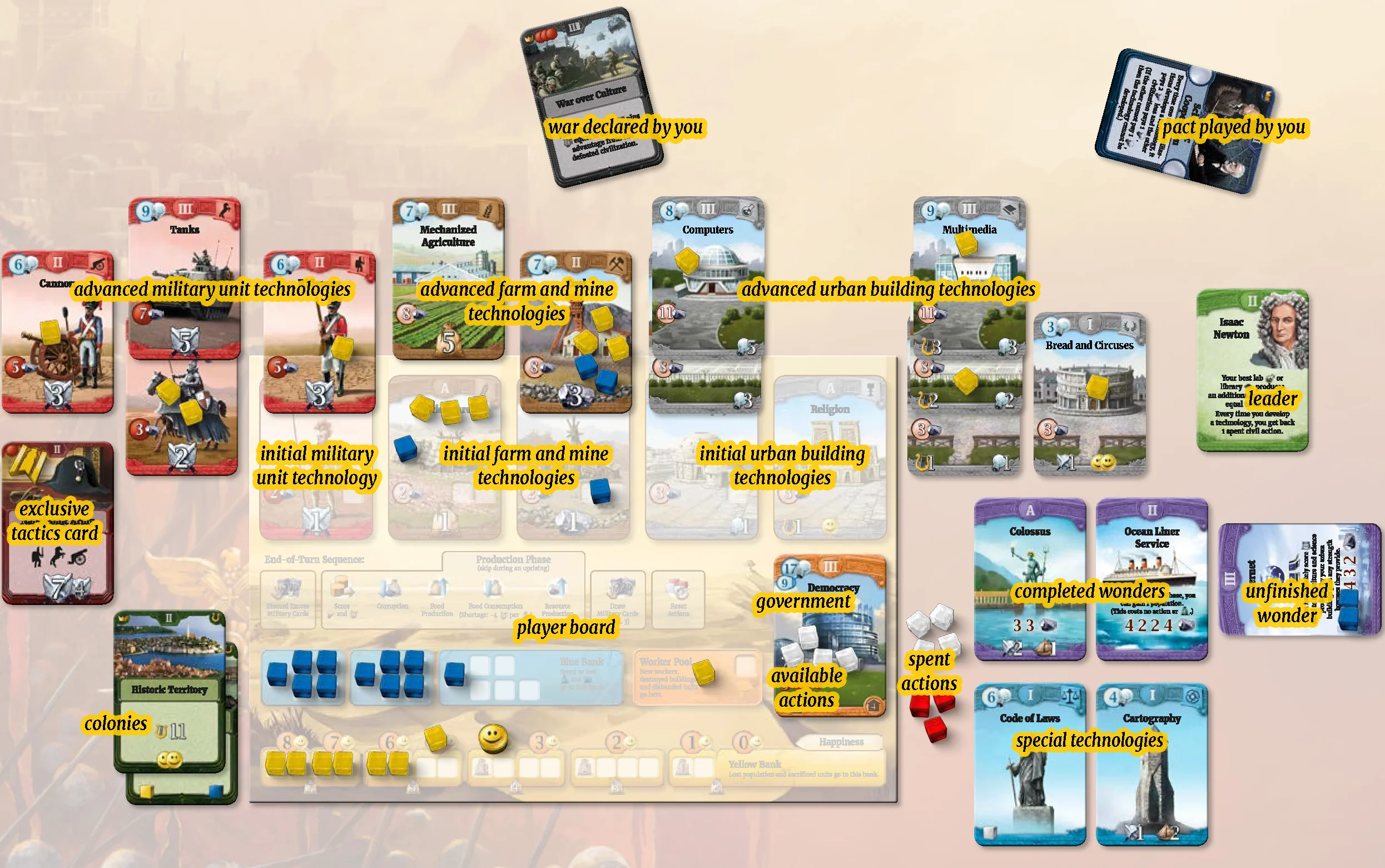
Colonies
Entered into play after colonization. Immediate effect triggers once when colonized. Permanent effect remains with colony if stolen/lost.
Tactics Cards
Allow players to form armies from specific unit types. Contributes tactical strength to civilization strength rating. Air force doubles tactical strength. Older units make an army outdated (lesser tactical strength). Armies automatically form to maximize strength.
Pacts
Cooperation between two players. Maximum 1 pact in your play area (can be affected by others’ pacts).
Wars
Have a one-time effect resolved one round later at the start of your next turn.
Other Military Cards
Aggressions, Events, and Military Bonus Cards are never put into play; they have one-time effects.
Your Statistics & Economy
Tracked on indicators and calculated from cards and tokens.
Ratings
- Science Rating: Science produced each turn.
- Culture Rating: Culture produced each turn.
- Strength Rating: Total military strength of units, tactics, and modifiers.
- Happiness Rating: Total happy faces minus unhappy faces (capped between 0 and 8).
Colonization Modifier
Applies only during colonization auctions.
Civil and Military Actions
Totals equal the sum of symbols on government and active cards. White tokens = civil actions; red tokens = military actions.
Blue and Yellow Tokens
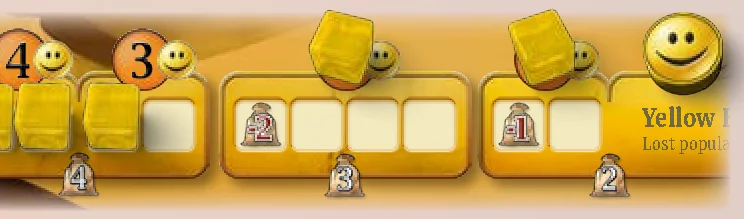
Stored in blue bank (resources/food) and yellow bank (population). Banks fill left to right. Gaining/losing tokens adjusts banks and production.
Workers and Population
Yellow tokens not in bank are workers. Unused workers reside in worker pool.
Discontent Workers
Determined by the leftmost empty subsection of the yellow bank compared to your happiness rating. If discontent workers outnumber unused workers at the end of turn, an uprising occurs (skips Production Phase).
Food and Resources
Represented by blue tokens on farm and mine technology cards.
- Gaining Food or Resources: Move blue tokens from blue bank to farm/mine cards.
- Losing Food or Resources: Return tokens to blue bank or make change with lower-value cards. Overpaying is only allowed if blue bank is empty.
Science and Culture Points
Tracked on science and culture tracks. Scored during Production Phase or from card effects. Cannot go below zero.
Course of the Turn
Your turn consists of these phases and steps:
- Start-of-Turn Sequence:
- Replenish the card row.
- Resolve a war, if necessary.
- Make exclusive tactics available, if necessary.
- Politics Phase
- Action Phase
- End-of-Turn Sequence:
- Discard excess military cards.
- Production Phase. (Skip during an uprising.)
- Draw military cards.
- Reset civil and military actions.
First Turn
Your first turn is different:
- You begin with a limited number of civil actions.
- You skip the Start-of-Turn Sequence and the Politics Phase.
- During your Action Phase you are not allowed to do anything except:
- Take a non-wonder from the card row.
- Take a wonder from the card row and put it into play as an unfinished wonder.
Start-of-Turn Sequence
Replenish the Card Row
Note: The card row is not replenished during the first round.
You begin your turn by replenishing the card row:
- Discard any cards remaining in the leftmost spaces:
- The first three spaces if there are 2 players in the game.
- The first two spaces if there are 3 players in the game.
- Only the leftmost space if there are 4 players in the game.
- If someone has resigned count only those players remaining in the game, not the initial number of players.
- Shift all remaining cards to the far left, leaving no empty spaces between them.
- Deal cards from the current age civil deck into the empty spaces, from left to right. (Skip this in Age IV, which has no deck.)
End of an Age
Replenishing the card row sometimes triggers the end of an age:
Age A ends
Age A ends when the card row is replenished for the first time.
- Note: This occurs on the starting player’s second turn.
- After dealing Age A civil cards to the empty spaces, remove the rest of the Age A deck from the game.
- Shuffle the Age I civil and military decks and place them on the current age board. They are now the current civil and military decks.
- If all the Age A civil cards were dealt and there are still empty spaces in the card row, continue filling the row from the Age I civil deck.
Ages I, II, and III end
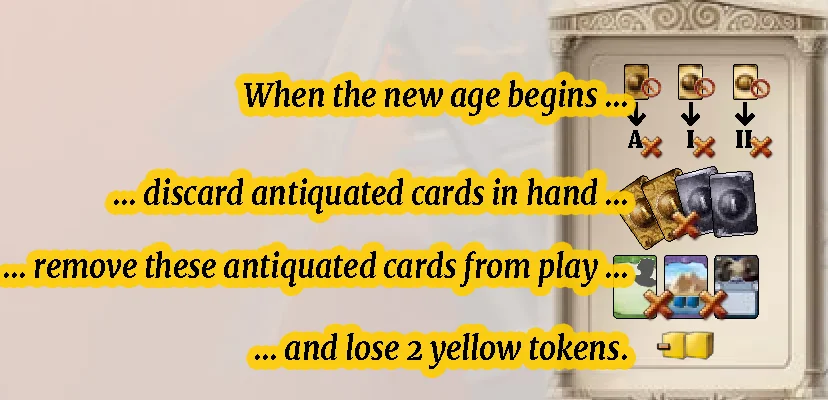
Ages I, II, and III end when the last card of the current civil deck is dealt to the card row. The next age begins immediately:
- Cards from ages older than the one that just ended (but not cards from the age that just ended) become antiquated:
- Players discard all antiquated cards from their hands.
- All antiquated leaders are removed from play.
- All antiquated unfinished wonders are removed from play. (Blue tokens on them are returned to the players’ blue banks.)
- All antiquated pacts are removed from play.
- Note: Other cards in play (technologies, colonies, completed wonders, exclusive and common tactics, declared wars) remain in play even if they are antiquated.
- Each player loses 2 yellow tokens.
- Shuffle the civil deck for the age that has begun. Place it on the current age board. It is now the current civil deck.
- Continue filling the card row if there are still empty spaces.
- If Age IV has begun, there is no new civil deck and the empty spaces will remain empty.
- Remove the military deck from the previous age. Shuffle the new age’s military deck and place it on the current age board.
- If Age IV has begun, there is no new military deck. Drawing military cards is not possible in Age IV.
- Age IV is the game-ending age. If Age IV starts, determine which round will be the last:
- This round is the last if Age IV begins during the starting player’s turn.
- The next round will be the last if Age IV begins during any other player’s turn.
Resolve a War
If you have no war in play, skip this step. But if you have a war card in your play area, you must resolve the war at this time.
- Compare your strength with the strength of the opponent on whom you declared war.
- If a card in play gives you a bonus when you attack this opponent, include that bonus.
- If one player has a higher strength than the other, that player is the victor and the other player is the defeated civilization. The difference between their strengths is the strength advantage. Follow the text on the card.
- If the victor steals a special technology, the victor takes the card from the defeated civilization’s play area and puts it into his or her own play area.
- A player cannot steal a special technology that is the same as one he or she already has in play or in hand.
- If you steal a special technology of the same type as one that you have in play, you keep the higher level card in play and discard the other.
- If the players have same strength, the war resolves with no effect.
- Either way, discard the war card.
Note: Neither side can use military bonus cards to augment their strength in a war.
Make Tactics Available
If you have an exclusive tactics card in play, you must make it available at this time.
Move your tactics card to the common tactics area of the military board.
- There is no limit to the number of cards that can be in the common tactics area.
- If the same card is already in the common tactics area, you may merge the cards by putting one under the other or by removing one from the game. However, do not discard it to the discard pile.
- Note: Your tactics standard remains on the card and it continues to be your current tactic.
During your Politics Phase, you may perform at most one political action, if you wish:
- Prepare an Event
- Play an Aggression
- Declare a War (not during the last round)
- Offer a Pact (not in a 2-player game)
- Cancel a Pact (not in a 2-player game)
- Resign (not in Age IV)
The crown symbol on a military card means it is played as a political action.
Prepare an Event
An event is a green military card marked with the event symbol in the upper right corner. To prepare an event, do the following:
- Put your event card face down on top of the future events deck (or on the space, if it is empty).
- Score culture equal to the level of the card.
- Reveal the top card from the current events deck and resolve its effect. If it is a territory, resolve colonization.
- If this was the last card in the current events deck:
- Shuffle the future events deck.
- Sort it face down, so that cards from earlier ages are above cards from later ages.
- Place it on the current events space. It is now the current events deck.
Note: An event you prepare now will be revealed and resolved on a later turn.
Play an Aggression
An aggression is a brown military card. It has the word “Aggression:” in its name. To play one, do the following:
- Reveal the card.
- Pay the military action cost depicted next to the crown symbol.
- Declare which player you are attacking. That player is your rival.
- You cannot attack a player if the two of you have a pact that says you cannot attack.
- You cannot attack a player whose strength equals or exceeds yours. Remember to include bonuses that trigger when attacking, but not bonuses from pacts that end upon attack.
- If you and your rival have a pact that says it ends if you attack, remove that pact from play.
- Your rival may defend against the aggression by adding temporary strength bonuses to match or exceed your strength:
- Your rival can play one or more military bonus cards. The defense value in the upper half of the card is added to strength (discarded after use).
- Your rival can gain a +1 strength bonus for each military card discarded face down.
- Limitation: The total number of cards your rival plays or discards for bonuses cannot exceed his or her military action total.
- If your rival matches or exceeds your strength, the aggression is unsuccessful. Discard it with no effect.
- If your rival cannot or does not wish to match or exceed your strength, your rival does not play or discard any cards for bonuses and the aggression is successful:
- Resolve the effect stated on the card (use printed cost if cost is referenced, ignoring modifiers).
- Discard the aggression card.
Declare a War
A war is a gray military card with the words “War over” in its title. To declare a war, do the following:
- Reveal the card.
- Pay the military action cost depicted next to the crown symbol.
- Declare which player you are attacking. That player is your rival:
- If a card says you cannot attack a player, you cannot declare war against that player.
- If you and your rival have a pact that says it ends if you attack, remove that pact from play.
- Place the war in your play area, with the top of the card toward your rival.
- The war will be resolved at the beginning of your next turn.
Limitation: You cannot declare a war during the last round.
Offer a Pact
A pact is a blue military card with a shaking-hands symbol above its name. Two-player games do not have pacts. To offer a pact, do the following:
- Reveal the card.
- Declare which player you are offering the pact to.
- If the pact has sides labeled A and B, declare whether you are taking the role of side A or side B.
- Then, your fellow player decides whether to accept the offer or not.
- If your fellow player refuses the offer, return the pact to your hand. It still uses up your political action for this turn.
- If your fellow player accepts the offer, the pact enters play:
- Any other pact in your play area ends, whether it was with this player or a different player. Remove the old pact from play. (You may still be party to pacts in other players’ play areas.)
- Place the newly accepted pact in your play area rotated so that the corresponding side (A, B, or either side if not labeled) faces your opponent.
- The new pact applies immediately. A pact that prevents attacks does not cancel wars already declared.
Cancel a Pact
This action allows you to cancel a pact to which you are a party. To cancel a pact, do the following:
- Choose a pact in play to which you are a party. It does not have to be a pact in your play area.
- Remove the pact from play. It ceases to affect you and your fellow player.
Resign
You may use your political action to resign.
- Your civilization immediately leaves play. You have lost.
- Discard your hand and remove all cards in your play area from play. If you are party to any pact in someone else’s play area, remove that pact from play.
- If there are any wars declared against you, the players who declared them remove their war cards from play and score 7 culture points.
- If there is only one player left in the game, the game ends and that player wins.
- If there are still two or more players, they continue without you:
- They do not change the current decks.
- Before switching to Age II or Age III, they adjust the decks for the new ages as if setting up the game for the new number of players.
- If only two players are left, they use rules for two players when evaluating events.
Exception: You cannot resign in Age IV.
During the Action Phase, you may spend your civil and military actions to perform any combination of the actions described in this section in any order.
- On your first turn, you are not allowed to do anything except take cards from the card row. (If you take a wonder, you do put it into play.)
- You cannot perform an action unless you are able to perform all the required steps and pay all the required costs.
- You may choose to end your Action Phase even if you have available civil or military actions.
Some of the actions described in this section may also be performed as effects of certain cards. If the action is an effect of a card:
- The action costs you no civil or military actions unless the card says so. (Exception: Declare a Revolution.)
- The action may have other costs (usually food, resources, or science points) which you must pay unless the card says you perform the action for free.
Card Row Actions
Take a Non-Wonder Card from the Card Row
- Choose any card in the card row that is not a wonder.
- Pay 1, 2, or 3 civil actions, as depicted at the bottom of that space of the card row.
- Add the card to your hand.
Limitations:
- You cannot take any non-wonder card if the number of civil cards in your hand is equal to or greater than your civil action total.
- You cannot take a technology card if you already have a card with the same name in your hand or in play.
- If you have taken a leader, you cannot take another leader from that age. This applies even if the leader you took has already left play.
Take a Wonder from the Card Row
A wonder is a purple card with a row of numbers at the bottom of the illustration depicting the cost of building each stage of the wonder. It enters play when you take it:
- Choose a wonder in the card row.
- Pay civil actions equal to the number of civil actions depicted under that space plus one extra civil action for each wonder you have completed (including crumbled wonders).
- Put the wonder in play, rotated by 90 degrees to indicate that it is your unfinished wonder.
Limitation: You cannot take a wonder if you currently have an unfinished wonder in play.
Note: You can take a wonder even if your hand is full. The wonder’s effects do not apply while it is unfinished.
Civil Actions
Increase Population
- Pay 1 civil action.
- Pay food equal to the white number depicted under the rightmost occupied section of your yellow bank.
- Take the rightmost yellow token from your yellow bank and add it to your worker pool. (It becomes an unused worker.)
Note: You cannot increase your population if there is no yellow token left in your yellow bank.
Build a Farm, Mine, or Urban Building
- Pay 1 civil action.
- Choose one of your farm, mine, or urban building technology cards in play.
- Pay the resource cost depicted on the card. (Construction special technologies reduce the cost of urban buildings only.)
- Move one of your unused workers to the card.
- Update your ratings, if necessary.
Limitation: The lower right corner of your government card depicts your urban building limit. If you already have that many or more urban buildings of a particular type, you cannot build a new urban building of that type.
Upgrade a Farm, Mine, or Urban Building
- Pay 1 civil action.
- Choose one of your farms, mines, or urban buildings (as represented by a worker on the corresponding technology card).
- Choose another technology card you have in play of the same type and higher level.
- Pay resources equal to the difference between the resource costs depicted on these two cards (apply modifiers before calculating the difference).
- Move the worker to the higher level card.
- Update your ratings, if necessary.
Destroy a Farm, Mine, or Urban Building
- Pay 1 civil action.
- Choose one of your farms, mines, or urban buildings (worker on the corresponding technology card).
- Move the worker from the card to your worker pool. (It becomes an unused worker.)
- Update your ratings, if necessary.
Play a Leader
A leader is a green civil card with a portrait of a famous historical figure in the upper right corner.
- Pay 1 civil action.
- Choose a leader from your hand.
- Put the leader in play.
- If you already have a leader in play, it is replaced: Discard the old leader and get one civil action back.
The leader’s effects apply immediately. Update your statistics, if necessary.
Build a Stage of a Wonder
You can do this only if you already have an unfinished wonder in play.
- Pay 1 civil action.
- Pay resources indicated by the leftmost uncovered cost depicted on the wonder.
- Cover that cost with a blue token from your blue bank. (If no tokens in blue bank, use one from your technology cards.)
- If all costs on the wonder are now covered, the wonder becomes completed:
- Return all blue tokens from the wonder to your blue bank.
- Turn the card so that its name is right side up.
- The wonder’s effects now apply. Update your statistics, if necessary.
If a card allows you to build multiple stages of a wonder as a single action, the procedure is the same: add up all costs, pay them at once, and cover with blue tokens.
Develop a Technology
The technology cards in your hand are distinguished by a science point cost in the upper left corner.
- Pay 1 civil action.
- Choose a technology card from your hand.
- Pay the science cost depicted on the card. (For government technologies, pay the higher depicted cost.)
- Put the technology card into play:
- If the card is a special (blue) technology of the same type as one you already have in play, only the higher-level card stays in play. Usually the older card is replaced.
- If the technology is a government, the previous government is replaced. Remove the old one from the game or put the new one on top of it.
Effects of special technologies and governments apply immediately. Update your statistics, if necessary.
Declare a Revolution
Declaring a revolution is a special way of developing a government technology.
- Choose a government technology card from your hand.
- Pay civil actions equal to your civil action total.
- Pay the lower science cost depicted on the government card.
- Put the government into play. Replace your previous government by removing it from the game or covering it with the new card.
- Apply all effects of the new government:
- Update your statistics, if necessary.
- If you increased your civil action total, move the new white tokens off the card so that you still have no civil actions available.
Effects that trigger when you develop a technology (Da Vinci, Newton, Einstein) are resolved at this time. (In the case of Newton, you will end up with 1 available civil action.)
Play an Action Card
An action card is a yellow civil card.
- Pay 1 civil action.
- Choose an action card from your hand, but not one that you took during this Action Phase.
- Reveal the card and resolve its effect:
- If the card orders an action, follow usual rules without paying civil or military actions for it.
- If it reduces a cost below 0, that cost is 0.
- If it says “develop a technology”, you may declare a revolution by paying the revolution cost instead.
- If it says “build one stage of a wonder”, you can only build one stage.
- If you cannot perform the action the card specifies, it cannot be played.
- “For this turn” bonuses do not count toward statistics and are not physical components. (An extra military action can be used to draw a military card.)
- Discard the card after playing.
Military Actions
Build a Military Unit
- Pay 1 military action.
- Choose one of your military unit technology cards in play.
- Pay the resource cost depicted on the card.
- Move one of your unused workers to the card.
- Update your ratings.
Upgrade a Military Unit
- Pay 1 military action.
- Choose one of your military units.
- Choose one of your military unit technologies of the same type and higher level.
- Pay resources equal to the difference between the resource costs.
- Move the worker to the higher level card.
- Update your ratings.
Disband a Military Unit
- Choose one of your military units.
- Pay 1 military action.
- Move the worker to your worker pool. (It becomes an unused worker.)
- Update your ratings.
Play a Tactic
A tactic is a red military card with icons of military units in the bottom half.
- Pay 1 military action.
- Choose a tactics card in your hand.
- Put it into play in your area as your exclusive tactics card.
- Place your tactics standard on it. It is now your current tactic.
- Update your strength rating.
Limitations: You can play or copy a tactic only once per turn.
Copy a Tactic
- Choose a common tactics card on the military board.
- Pay 2 military actions.
- Place your tactics standard on it. It is now your current tactic.
- Update your strength rating.
Limitation: You can play or copy a tactic only once per turn.
Once you declare the end of your Action Phase, follow the End-of-Turn Sequence in order. Only the first step requires a player decision; the rest is automatic.
1. Discard Excess Military Cards
If the number of military cards in your hand exceeds your military action total, discard any excess cards, face down.
2. Check for an Uprising
If your discontent workers outnumber your unused workers, you face an uprising and skip the Production Phase.
3. Production Phase
If you are not facing an uprising, perform these steps in order:
- Score Science and Culture:
- Score science points equal to your science rating.
- Score culture points equal to your culture rating.
- Corruption:
- The leftmost square in each section of your blue bank is marked with a negative number. If all covered, no corruption. Otherwise, the leftmost uncovered negative number is your corruption.
- Lose resources equal to your corruption.
- If you lost all resources but still owe corruption, lose food to cover the difference.
- Food Production:
- For each worker on your farm technology cards, move one blue token from the blue bank to that card (highest level first if not enough tokens).
- Food Consumption:
- The leftmost square in each section of your yellow bank is marked with a negative number. If uncovered, lose food equal to consumption.
- If you cannot cover all consumption, lose 4 culture points for each unit of food short.
- Resource Production:
- For each worker on your mine technology cards, move one blue token from the blue bank to that card (highest level first if not enough tokens).
4. Draw Military Cards
For every available military action you have left, draw one military card from the current age military deck.
- Limitation: You may draw at most 3 cards this way.
- In Age IV, there is no military deck and you draw no cards.
- Note: On the first round, players have no available military actions and thus draw no cards.
- If you draw the last military card, shuffle the current age’s military card discard pile and place it on the current age board as the new deck.
5. Reset Your Actions
Move the red and white tokens back to your government card. All your military and civil actions are available again.
When a player puts an event in the future events deck as his or her political action, the top card of the current events deck is revealed and evaluated. Some events represent the discovery of new territories. Other events have an effect that is written out on the card.
- If the current event has a written effect, evaluate it as written.
- If it is the discovery of a new territory, then players may attempt to colonize it.
Evaluating an Event
- Follow the text on the card.
- If multiple players must make a decision, they decide in clockwise order, beginning with the player who revealed the event.
- If the card requires players to compare a statistic, ties are resolved this way:
- The current player, or the player who is closer to the current player in clockwise order, is considered to have the higher value.
- If an event is evaluated at the end of the game, the starting player is considered to be the current player when breaking ties.
- If the card applies to “all civilizations” with the most or least of something, ties remain unbroken.
- For a two player game: whenever a card says it applies to 2 civilizations with the most or least of something, it should actually be applied to only one.
- If the effect enables an Action Phase action, normal rules apply without action cost (revolution still costs all actions).
- Once resolved, place the card in the past events pile.
Colonization
If a territory is discovered as the current event, all players bid to see who will send the largest colonization force:
- A bid is always a whole number higher than zero and higher than the previous bid. No player may bid more than they can actually send.
- Players bid in turn clockwise, starting with the player who revealed the territory. Players may bid or pass (passing drops out).
- If no one bids, the territory is placed on the past events pile.
- Bidding continues until all but one player has dropped out. That player must colonize the territory.
The winner must form a colonization force equal to or greater than the bid:
- Send one or more military units (base strength).
- Armies may be formed according to current tactic for tactical strength bonus.
- Add civilization’s colonization modifier.
- May play any number of military bonus cards (colonization value in lower half).
- Note: Must send at least one military unit. Strength-modifying leaders do not apply.
Once announced:
- Sacrifice the units sent (yellow tokens return to yellow bank). Discard military bonus cards used.
- Take the territory into play area as a colony. Update statistics (permanent effects, recalculate strength rating).
- Resolve immediate effects depicted in the middle of the card (resources, food, science, culture, population, military cards). Order is important.
Game End
The game ends when the last round is over. Every player will have had an equal number of turns.
Final Scoring
When the last round is over, it is time for the final scoring:
- All Age III events in the current and next events decks are evaluated in any order.
- Any end-of-game bonuses are scored (the Bill Gates card).
- The player with the most culture points is the winner.
- If there is a tie, the tied players share the victory.
Leaders
- Homer: Treat the wonder with Homer’s happy face as though there was one extra happy face printed on it. If the wonder is flipped face down because of Ravages of Time, Homer’s happy face continues to produce.
- Genghis Khan: In a two-player game, “one of the two strongest” should be read as “the strongest”. When forming armies, each infantry unit can be either cavalry or infantry. Ability does not affect culture rating.
- Maximilien Robespierre: Revolution must be paid for with military actions equal to military action total. Actions gained from new government become spent.
- Isaac Newton: Gives you back a spent civil action even if developed via a card like Breakthrough. Revolution counts as developing a technology.
- Johann Sebastian Bach: Urban buildings upgraded do not have to be of the same type and may be of the same level. Upgrade cost cannot be below 0.
- Bill Gates: Age I+ labs produce resources like mines during production. Production does not count for Impact of Industry.
Wonders
- St. Peter’s Basilica: Treat each of your other cards in play with one or more happy faces as though it had one more happy face printed on it.
- Hollywood: Effects that modify culture production of theaters and libraries apply too.
- Internet: Effects that modify culture or science production of theaters and libraries apply too.
Events
- Development of Civilization: Pay no civil action, pay other costs reduced by one. May declare revolution for one science less.
- Ravages of Time: The destroyed wonder counts as a completed wonder of the corresponding age for all purposes.
- International Agreement: Usual rules for taking cards apply; cards may be played on the same turn. The strongest player may use this option even in the last round.
Overview & Game Flow
Code of Laws
This rulebook presents all the rules for Through the Ages in a point-by-point format. It is especially useful for players who need to find a rule quickly. Players who are learning the game should not start with this rulebook. Instead, they should learn from the Handbook, which provides thematic background and detailed examples.
The first half of this book describes what happens during the game. The second half defines terms and concepts.
Game Flow
- Set up the game.
- Players take turns, beginning with the starting player and continuing clockwise.
- Turns are organized into rounds. Each round begins with the starting player’s turn.
- The first round is different from the others.
- Note: Most of the time, nothing special happens at the beginning or end of a round.
- During the game, the current age gradually changes through Ages A, I, II, III, and finally IV.
- If Age III ends during the starting player’s turn, that is the last round.
- If Age III ends during any other player’s turn, then the following round is the last round.
- The game ends when the last round is over. Every player will have had an equal number of turns. Then it is time for the final scoring.
Setup
Game Boards
Place the game boards in the center of the table, in any suitable configuration.
Deck Setup
Ages A, I, II, and III each have their own civil and military decks. So there are 8 separate decks, each with a different back.
In a 2- or 3-player game, you must remove certain cards. These cards will not be used.
- Before a 3-player game: Civil decks I, II, and III each have three cards with the “4” marking (such as Republic). Remove these cards from these decks.
- Before a 2-player game: Civil decks I, II and III each have nine cards with a “3+” or “4” marking (such as Monarchy or Republic). Remove these cards from these decks. Military deck I has two pact cards, and military decks II and III each have four. Remove all pact cards from these decks.
Preparing the Event Deck
Shuffle the Age A military deck.
- Take a number of cards equal to the number of players plus 2. Place these face down on the military board as the current events deck.
- Return the rest of the cards to the box without looking at them.
Preparing the Card Row
Shuffle the Age A civil deck.
- Deal 13 cards face up to the spaces of the card row.
- Put the rest of the deck on the light half of the current age board.
Keep the other decks nearby, but out of the way. You will not need them until later in the game.
Player Components
Each player chooses a color and takes the components in that color:
Player Board
The player board depicts 6 initial technologies: Warriors, Agriculture, Bronze, Philosophy, Religion, and Despotism. These count as technology cards.
- Put a blue token on each of the 16 squares in the blue bank.
- Put a yellow token on each of the 18 squares in the yellow bank, on each of the 6 squares on the technology cards, and on the square in the worker pool.
- Your initial government card, Despotism, depicts 4 civil actions and 2 military actions. Place 4 white tokens and 2 red tokens next to the card (but not on it).
Rating Markers
You have 4 rating markers in your color.
- Place your science rating marker on space 1 of the science rating indicator.
- Place your culture rating marker on space 0 of the culture rating indicator.
- Place your strength rating marker on space 1 of the strength rating indicator.
- Place your happiness rating marker on space 0 of the happiness rating indicator on your player board.
Note: These settings are determined by the workers on your initial technology cards.
Points Counters
- Place your science points counter on space 0 of the science points track.
- Place your culture points counter on space 0 of the culture points track.
Tactics Standard
Place your tactics standard in the common tactics area of the military board. This indicates that you have no current tactic.
In the Box
Some blue, yellow, red, and white tokens will be left over after setup. They will be needed during the game, but only rarely. They are said to be “in the box”.
Starting Player & Initial Actions
Choose the starting player however you like. The starting player will not change during the game. You may mark this by sliding one of the unused Age A military cards face down under the starting player’s board.
- The starting player will have 1 unspent civil action on his or her first turn. Indicate this by placing one of the starting player’s white tokens on his or her Despotism card.
- In clockwise order, each player begins with one more civil action than the previous player. They indicate this with 2, 3, or 4 white tokens on their Despotism cards.
- Players have no military actions on their first turn. All red tokens remain beside the player boards.
Civilization Components & Concepts
Your Cards
Level of a Card
The level of the card is a numerical value that corresponds to the age of the card: Age A = 0, Age I = 1, Age II = 2, and Age III = 3.
The level of a military unit, farm, mine, or urban building is the level of the technology it is on. If a card refers to your best mine, lab, library, etc. it means one with the highest level among all workers of that type.
Your Hand
You may hold both civil and military cards in your hand.
Civil Cards
Civil cards are drawn from the card row. Because civil cards are never drawn secretly, the players may decide that civil cards in hand are public at all times.
The number of civil cards in your hand is limited by your civil action total. When you are at or above the limit, you may not add another civil card to your hand. You do not have to discard excess civil cards if already held.
Military Cards
Military cards are drawn secretly from the current age military deck.
The number of military cards in your hand is limited by your military action total. Discard excess during End-of-Turn Sequence.
Cards in Play
A card in play is face up on the table, either as part of a civilization’s play area or as a common tactic on the military board. Other cards are not in play.
Discard or Remove from Play
- Discard usually means to discard a card from hand.
- Remove from play means to discard a card that was in play.
- If a civil card is discarded or removed, it will not enter the game again.
- Military cards go to a face down discard pile of the corresponding age.
- Resolved events go to the past events pile, not the military discard pile.
Types of Cards in Play
Technology Cards in Play
Most cards in play are technology cards:
- Any civil card with a science cost in its upper left corner.
- Your initial technologies printed on your player board.
Farm or Mine Technologies
Each worker represents one farm or mine. They produce food or resources during Production Phase. Each blue token stored on the card is worth the depicted amount.
Urban Building Technologies
Each worker represents an urban building. Your government defines your urban building limit per type. Urban buildings contribute to ratings (science, culture, happiness, strength).
Military Unit Technologies
Each worker represents a military unit (infantry, cavalry, artillery, air force). Contributes printed strength rating and can be grouped into armies.
Special Technologies
Provide effects without workers (law, warfare, exploration, construction). Limitation: You can never be affected by two special technologies of the same type; keep only the higher-level card.
Governments
Provide civil and military actions, urban building limit, and special abilities. Workers cannot be placed on government cards. You always have exactly one government in play.
Other Civil Cards in Play
Wonders
Built in stages. Unfinished wonders enter rotated sideways (maximum 1 unfinished wonder). When completed, turned right side up and effects apply.
Leaders
Give unique abilities. Maximum 1 leader in play. Taking a leader prevents taking another leader from that same age.
Action Cards
Never put into play; resolved for a one-time effect and discarded.
Military Cards in Play
Colonies
Entered into play after colonization. Immediate effect triggers once when colonized. Permanent effect remains with colony if stolen/lost.
Tactics Cards
Allow players to form armies from specific unit types. Contributes tactical strength to civilization strength rating. Air force doubles tactical strength. Older units make an army outdated (lesser tactical strength). Armies automatically form to maximize strength.
Pacts
Cooperation between two players. Maximum 1 pact in your play area (can be affected by others’ pacts).
Wars
Have a one-time effect resolved one round later at the start of your next turn.
Other Military Cards
Aggressions, Events, and Military Bonus Cards are never put into play; they have one-time effects.
Your Statistics & Economy
Tracked on indicators and calculated from cards and tokens.
Ratings
- Science Rating: Science produced each turn.
- Culture Rating: Culture produced each turn.
- Strength Rating: Total military strength of units, tactics, and modifiers.
- Happiness Rating: Total happy faces minus unhappy faces (capped between 0 and 8).
Colonization Modifier
Applies only during colonization auctions.
Civil and Military Actions
Totals equal the sum of symbols on government and active cards. White tokens = civil actions; red tokens = military actions.
Blue and Yellow Tokens
Stored in blue bank (resources/food) and yellow bank (population). Banks fill left to right. Gaining/losing tokens adjusts banks and production.
Workers and Population
Yellow tokens not in bank are workers. Unused workers reside in worker pool.
Discontent Workers
Determined by the leftmost empty subsection of the yellow bank compared to your happiness rating. If discontent workers outnumber unused workers at the end of turn, an uprising occurs (skips Production Phase).
Food and Resources
Represented by blue tokens on farm and mine technology cards.
- Gaining Food or Resources: Move blue tokens from blue bank to farm/mine cards.
- Losing Food or Resources: Return tokens to blue bank or make change with lower-value cards. Overpaying is only allowed if blue bank is empty.
Science and Culture Points
Tracked on science and culture tracks. Scored during Production Phase or from card effects. Cannot go below zero.
Turn Structure & Start-of-Turn
Course of the Turn
Your turn consists of these phases and steps:
- Start-of-Turn Sequence:
- Replenish the card row.
- Resolve a war, if necessary.
- Make exclusive tactics available, if necessary.
- Politics Phase
- Action Phase
- End-of-Turn Sequence:
- Discard excess military cards.
- Production Phase. (Skip during an uprising.)
- Draw military cards.
- Reset civil and military actions.
First Turn
Your first turn is different:
- You begin with a limited number of civil actions.
- You skip the Start-of-Turn Sequence and the Politics Phase.
- During your Action Phase you are not allowed to do anything except:
- Take a non-wonder from the card row.
- Take a wonder from the card row and put it into play as an unfinished wonder.
Start-of-Turn Sequence
Replenish the Card Row
Note: The card row is not replenished during the first round.
You begin your turn by replenishing the card row:
- Discard any cards remaining in the leftmost spaces:
- The first three spaces if there are 2 players in the game.
- The first two spaces if there are 3 players in the game.
- Only the leftmost space if there are 4 players in the game.
- If someone has resigned count only those players remaining in the game, not the initial number of players.
- Shift all remaining cards to the far left, leaving no empty spaces between them.
- Deal cards from the current age civil deck into the empty spaces, from left to right. (Skip this in Age IV, which has no deck.)
End of an Age
Replenishing the card row sometimes triggers the end of an age:
Age A ends
Age A ends when the card row is replenished for the first time.
- Note: This occurs on the starting player’s second turn.
- After dealing Age A civil cards to the empty spaces, remove the rest of the Age A deck from the game.
- Shuffle the Age I civil and military decks and place them on the current age board. They are now the current civil and military decks.
- If all the Age A civil cards were dealt and there are still empty spaces in the card row, continue filling the row from the Age I civil deck.
Ages I, II, and III end
Ages I, II, and III end when the last card of the current civil deck is dealt to the card row. The next age begins immediately:
- Cards from ages older than the one that just ended (but not cards from the age that just ended) become antiquated:
- Players discard all antiquated cards from their hands.
- All antiquated leaders are removed from play.
- All antiquated unfinished wonders are removed from play. (Blue tokens on them are returned to the players’ blue banks.)
- All antiquated pacts are removed from play.
- Note: Other cards in play (technologies, colonies, completed wonders, exclusive and common tactics, declared wars) remain in play even if they are antiquated.
- Each player loses 2 yellow tokens.
- Shuffle the civil deck for the age that has begun. Place it on the current age board. It is now the current civil deck.
- Continue filling the card row if there are still empty spaces.
- If Age IV has begun, there is no new civil deck and the empty spaces will remain empty.
- Remove the military deck from the previous age. Shuffle the new age’s military deck and place it on the current age board.
- If Age IV has begun, there is no new military deck. Drawing military cards is not possible in Age IV.
- Age IV is the game-ending age. If Age IV starts, determine which round will be the last:
- This round is the last if Age IV begins during the starting player’s turn.
- The next round will be the last if Age IV begins during any other player’s turn.
Resolve a War
If you have no war in play, skip this step. But if you have a war card in your play area, you must resolve the war at this time.
- Compare your strength with the strength of the opponent on whom you declared war.
- If a card in play gives you a bonus when you attack this opponent, include that bonus.
- If one player has a higher strength than the other, that player is the victor and the other player is the defeated civilization. The difference between their strengths is the strength advantage. Follow the text on the card.
- If the victor steals a special technology, the victor takes the card from the defeated civilization’s play area and puts it into his or her own play area.
- A player cannot steal a special technology that is the same as one he or she already has in play or in hand.
- If you steal a special technology of the same type as one that you have in play, you keep the higher level card in play and discard the other.
- If the players have same strength, the war resolves with no effect.
- Either way, discard the war card.
Note: Neither side can use military bonus cards to augment their strength in a war.
Make Tactics Available
If you have an exclusive tactics card in play, you must make it available at this time.
Move your tactics card to the common tactics area of the military board.
- There is no limit to the number of cards that can be in the common tactics area.
- If the same card is already in the common tactics area, you may merge the cards by putting one under the other or by removing one from the game. However, do not discard it to the discard pile.
- Note: Your tactics standard remains on the card and it continues to be your current tactic.
Politics Phase
During your Politics Phase, you may perform at most one political action, if you wish:
- Prepare an Event
- Play an Aggression
- Declare a War (not during the last round)
- Offer a Pact (not in a 2-player game)
- Cancel a Pact (not in a 2-player game)
- Resign (not in Age IV)
The crown symbol on a military card means it is played as a political action.
Prepare an Event
An event is a green military card marked with the event symbol in the upper right corner. To prepare an event, do the following:
- Put your event card face down on top of the future events deck (or on the space, if it is empty).
- Score culture equal to the level of the card.
- Reveal the top card from the current events deck and resolve its effect. If it is a territory, resolve colonization.
- If this was the last card in the current events deck:
- Shuffle the future events deck.
- Sort it face down, so that cards from earlier ages are above cards from later ages.
- Place it on the current events space. It is now the current events deck.
Note: An event you prepare now will be revealed and resolved on a later turn.
Play an Aggression
An aggression is a brown military card. It has the word “Aggression:” in its name. To play one, do the following:
- Reveal the card.
- Pay the military action cost depicted next to the crown symbol.
- Declare which player you are attacking. That player is your rival.
- You cannot attack a player if the two of you have a pact that says you cannot attack.
- You cannot attack a player whose strength equals or exceeds yours. Remember to include bonuses that trigger when attacking, but not bonuses from pacts that end upon attack.
- If you and your rival have a pact that says it ends if you attack, remove that pact from play.
- Your rival may defend against the aggression by adding temporary strength bonuses to match or exceed your strength:
- Your rival can play one or more military bonus cards. The defense value in the upper half of the card is added to strength (discarded after use).
- Your rival can gain a +1 strength bonus for each military card discarded face down.
- Limitation: The total number of cards your rival plays or discards for bonuses cannot exceed his or her military action total.
- If your rival matches or exceeds your strength, the aggression is unsuccessful. Discard it with no effect.
- If your rival cannot or does not wish to match or exceed your strength, your rival does not play or discard any cards for bonuses and the aggression is successful:
- Resolve the effect stated on the card (use printed cost if cost is referenced, ignoring modifiers).
- Discard the aggression card.
Declare a War
A war is a gray military card with the words “War over” in its title. To declare a war, do the following:
- Reveal the card.
- Pay the military action cost depicted next to the crown symbol.
- Declare which player you are attacking. That player is your rival:
- If a card says you cannot attack a player, you cannot declare war against that player.
- If you and your rival have a pact that says it ends if you attack, remove that pact from play.
- Place the war in your play area, with the top of the card toward your rival.
- The war will be resolved at the beginning of your next turn.
Limitation: You cannot declare a war during the last round.
Offer a Pact
A pact is a blue military card with a shaking-hands symbol above its name. Two-player games do not have pacts. To offer a pact, do the following:
- Reveal the card.
- Declare which player you are offering the pact to.
- If the pact has sides labeled A and B, declare whether you are taking the role of side A or side B.
- Then, your fellow player decides whether to accept the offer or not.
- If your fellow player refuses the offer, return the pact to your hand. It still uses up your political action for this turn.
- If your fellow player accepts the offer, the pact enters play:
- Any other pact in your play area ends, whether it was with this player or a different player. Remove the old pact from play. (You may still be party to pacts in other players’ play areas.)
- Place the newly accepted pact in your play area rotated so that the corresponding side (A, B, or either side if not labeled) faces your opponent.
- The new pact applies immediately. A pact that prevents attacks does not cancel wars already declared.
Cancel a Pact
This action allows you to cancel a pact to which you are a party. To cancel a pact, do the following:
- Choose a pact in play to which you are a party. It does not have to be a pact in your play area.
- Remove the pact from play. It ceases to affect you and your fellow player.
Resign
You may use your political action to resign.
- Your civilization immediately leaves play. You have lost.
- Discard your hand and remove all cards in your play area from play. If you are party to any pact in someone else’s play area, remove that pact from play.
- If there are any wars declared against you, the players who declared them remove their war cards from play and score 7 culture points.
- If there is only one player left in the game, the game ends and that player wins.
- If there are still two or more players, they continue without you:
- They do not change the current decks.
- Before switching to Age II or Age III, they adjust the decks for the new ages as if setting up the game for the new number of players.
- If only two players are left, they use rules for two players when evaluating events.
Exception: You cannot resign in Age IV.
Action Phase
During the Action Phase, you may spend your civil and military actions to perform any combination of the actions described in this section in any order.
- On your first turn, you are not allowed to do anything except take cards from the card row. (If you take a wonder, you do put it into play.)
- You cannot perform an action unless you are able to perform all the required steps and pay all the required costs.
- You may choose to end your Action Phase even if you have available civil or military actions.
Some of the actions described in this section may also be performed as effects of certain cards. If the action is an effect of a card:
- The action costs you no civil or military actions unless the card says so. (Exception: Declare a Revolution.)
- The action may have other costs (usually food, resources, or science points) which you must pay unless the card says you perform the action for free.
Card Row Actions
Take a Non-Wonder Card from the Card Row
- Choose any card in the card row that is not a wonder.
- Pay 1, 2, or 3 civil actions, as depicted at the bottom of that space of the card row.
- Add the card to your hand.
Limitations:
- You cannot take any non-wonder card if the number of civil cards in your hand is equal to or greater than your civil action total.
- You cannot take a technology card if you already have a card with the same name in your hand or in play.
- If you have taken a leader, you cannot take another leader from that age. This applies even if the leader you took has already left play.
Take a Wonder from the Card Row
A wonder is a purple card with a row of numbers at the bottom of the illustration depicting the cost of building each stage of the wonder. It enters play when you take it:
- Choose a wonder in the card row.
- Pay civil actions equal to the number of civil actions depicted under that space plus one extra civil action for each wonder you have completed (including crumbled wonders).
- Put the wonder in play, rotated by 90 degrees to indicate that it is your unfinished wonder.
Limitation: You cannot take a wonder if you currently have an unfinished wonder in play.
Note: You can take a wonder even if your hand is full. The wonder’s effects do not apply while it is unfinished.
Civil Actions
Increase Population
- Pay 1 civil action.
- Pay food equal to the white number depicted under the rightmost occupied section of your yellow bank.
- Take the rightmost yellow token from your yellow bank and add it to your worker pool. (It becomes an unused worker.)
Note: You cannot increase your population if there is no yellow token left in your yellow bank.
Build a Farm, Mine, or Urban Building
- Pay 1 civil action.
- Choose one of your farm, mine, or urban building technology cards in play.
- Pay the resource cost depicted on the card. (Construction special technologies reduce the cost of urban buildings only.)
- Move one of your unused workers to the card.
- Update your ratings, if necessary.
Limitation: The lower right corner of your government card depicts your urban building limit. If you already have that many or more urban buildings of a particular type, you cannot build a new urban building of that type.
Upgrade a Farm, Mine, or Urban Building
- Pay 1 civil action.
- Choose one of your farms, mines, or urban buildings (as represented by a worker on the corresponding technology card).
- Choose another technology card you have in play of the same type and higher level.
- Pay resources equal to the difference between the resource costs depicted on these two cards (apply modifiers before calculating the difference).
- Move the worker to the higher level card.
- Update your ratings, if necessary.
Destroy a Farm, Mine, or Urban Building
- Pay 1 civil action.
- Choose one of your farms, mines, or urban buildings (worker on the corresponding technology card).
- Move the worker from the card to your worker pool. (It becomes an unused worker.)
- Update your ratings, if necessary.
Play a Leader
A leader is a green civil card with a portrait of a famous historical figure in the upper right corner.
- Pay 1 civil action.
- Choose a leader from your hand.
- Put the leader in play.
- If you already have a leader in play, it is replaced: Discard the old leader and get one civil action back.
The leader’s effects apply immediately. Update your statistics, if necessary.
Build a Stage of a Wonder
You can do this only if you already have an unfinished wonder in play.
- Pay 1 civil action.
- Pay resources indicated by the leftmost uncovered cost depicted on the wonder.
- Cover that cost with a blue token from your blue bank. (If no tokens in blue bank, use one from your technology cards.)
- If all costs on the wonder are now covered, the wonder becomes completed:
- Return all blue tokens from the wonder to your blue bank.
- Turn the card so that its name is right side up.
- The wonder’s effects now apply. Update your statistics, if necessary.
If a card allows you to build multiple stages of a wonder as a single action, the procedure is the same: add up all costs, pay them at once, and cover with blue tokens.
Develop a Technology
The technology cards in your hand are distinguished by a science point cost in the upper left corner.
- Pay 1 civil action.
- Choose a technology card from your hand.
- Pay the science cost depicted on the card. (For government technologies, pay the higher depicted cost.)
- Put the technology card into play:
- If the card is a special (blue) technology of the same type as one you already have in play, only the higher-level card stays in play. Usually the older card is replaced.
- If the technology is a government, the previous government is replaced. Remove the old one from the game or put the new one on top of it.
Effects of special technologies and governments apply immediately. Update your statistics, if necessary.
Declare a Revolution
Declaring a revolution is a special way of developing a government technology.
- Choose a government technology card from your hand.
- Pay civil actions equal to your civil action total.
- Pay the lower science cost depicted on the government card.
- Put the government into play. Replace your previous government by removing it from the game or covering it with the new card.
- Apply all effects of the new government:
- Update your statistics, if necessary.
- If you increased your civil action total, move the new white tokens off the card so that you still have no civil actions available.
Effects that trigger when you develop a technology (Da Vinci, Newton, Einstein) are resolved at this time. (In the case of Newton, you will end up with 1 available civil action.)
Play an Action Card
An action card is a yellow civil card.
- Pay 1 civil action.
- Choose an action card from your hand, but not one that you took during this Action Phase.
- Reveal the card and resolve its effect:
- If the card orders an action, follow usual rules without paying civil or military actions for it.
- If it reduces a cost below 0, that cost is 0.
- If it says “develop a technology”, you may declare a revolution by paying the revolution cost instead.
- If it says “build one stage of a wonder”, you can only build one stage.
- If you cannot perform the action the card specifies, it cannot be played.
- “For this turn” bonuses do not count toward statistics and are not physical components. (An extra military action can be used to draw a military card.)
- Discard the card after playing.
Military Actions
Build a Military Unit
- Pay 1 military action.
- Choose one of your military unit technology cards in play.
- Pay the resource cost depicted on the card.
- Move one of your unused workers to the card.
- Update your ratings.
Upgrade a Military Unit
- Pay 1 military action.
- Choose one of your military units.
- Choose one of your military unit technologies of the same type and higher level.
- Pay resources equal to the difference between the resource costs.
- Move the worker to the higher level card.
- Update your ratings.
Disband a Military Unit
- Choose one of your military units.
- Pay 1 military action.
- Move the worker to your worker pool. (It becomes an unused worker.)
- Update your ratings.
Play a Tactic
A tactic is a red military card with icons of military units in the bottom half.
- Pay 1 military action.
- Choose a tactics card in your hand.
- Put it into play in your area as your exclusive tactics card.
- Place your tactics standard on it. It is now your current tactic.
- Update your strength rating.
Limitations: You can play or copy a tactic only once per turn.
Copy a Tactic
- Choose a common tactics card on the military board.
- Pay 2 military actions.
- Place your tactics standard on it. It is now your current tactic.
- Update your strength rating.
Limitation: You can play or copy a tactic only once per turn.
End-of-Turn Sequence & Production
Once you declare the end of your Action Phase, follow the End-of-Turn Sequence in order. Only the first step requires a player decision; the rest is automatic.
1. Discard Excess Military Cards
If the number of military cards in your hand exceeds your military action total, discard any excess cards, face down.
2. Check for an Uprising
If your discontent workers outnumber your unused workers, you face an uprising and skip the Production Phase.
3. Production Phase
If you are not facing an uprising, perform these steps in order:
- Score Science and Culture:
- Score science points equal to your science rating.
- Score culture points equal to your culture rating.
- Corruption:
- The leftmost square in each section of your blue bank is marked with a negative number. If all covered, no corruption. Otherwise, the leftmost uncovered negative number is your corruption.
- Lose resources equal to your corruption.
- If you lost all resources but still owe corruption, lose food to cover the difference.
- Food Production:
- For each worker on your farm technology cards, move one blue token from the blue bank to that card (highest level first if not enough tokens).
- Food Consumption:
- The leftmost square in each section of your yellow bank is marked with a negative number. If uncovered, lose food equal to consumption.
- If you cannot cover all consumption, lose 4 culture points for each unit of food short.
- Resource Production:
- For each worker on your mine technology cards, move one blue token from the blue bank to that card (highest level first if not enough tokens).
4. Draw Military Cards
For every available military action you have left, draw one military card from the current age military deck.
- Limitation: You may draw at most 3 cards this way.
- In Age IV, there is no military deck and you draw no cards.
- Note: On the first round, players have no available military actions and thus draw no cards.
- If you draw the last military card, shuffle the current age’s military card discard pile and place it on the current age board as the new deck.
5. Reset Your Actions
Move the red and white tokens back to your government card. All your military and civil actions are available again.
Current Events & Colonization
When a player puts an event in the future events deck as his or her political action, the top card of the current events deck is revealed and evaluated. Some events represent the discovery of new territories. Other events have an effect that is written out on the card.
- If the current event has a written effect, evaluate it as written.
- If it is the discovery of a new territory, then players may attempt to colonize it.
Evaluating an Event
- Follow the text on the card.
- If multiple players must make a decision, they decide in clockwise order, beginning with the player who revealed the event.
- If the card requires players to compare a statistic, ties are resolved this way:
- The current player, or the player who is closer to the current player in clockwise order, is considered to have the higher value.
- If an event is evaluated at the end of the game, the starting player is considered to be the current player when breaking ties.
- If the card applies to “all civilizations” with the most or least of something, ties remain unbroken.
- For a two player game: whenever a card says it applies to 2 civilizations with the most or least of something, it should actually be applied to only one.
- If the effect enables an Action Phase action, normal rules apply without action cost (revolution still costs all actions).
- Once resolved, place the card in the past events pile.
Colonization
If a territory is discovered as the current event, all players bid to see who will send the largest colonization force:
- A bid is always a whole number higher than zero and higher than the previous bid. No player may bid more than they can actually send.
- Players bid in turn clockwise, starting with the player who revealed the territory. Players may bid or pass (passing drops out).
- If no one bids, the territory is placed on the past events pile.
- Bidding continues until all but one player has dropped out. That player must colonize the territory.
The winner must form a colonization force equal to or greater than the bid:
- Send one or more military units (base strength).
- Armies may be formed according to current tactic for tactical strength bonus.
- Add civilization’s colonization modifier.
- May play any number of military bonus cards (colonization value in lower half).
- Note: Must send at least one military unit. Strength-modifying leaders do not apply.
Once announced:
- Sacrifice the units sent (yellow tokens return to yellow bank). Discard military bonus cards used.
- Take the territory into play area as a colony. Update statistics (permanent effects, recalculate strength rating).
- Resolve immediate effects depicted in the middle of the card (resources, food, science, culture, population, military cards). Order is important.
End of Game & Final Scoring
Game End
The game ends when the last round is over. Every player will have had an equal number of turns.
Final Scoring
When the last round is over, it is time for the final scoring:
- All Age III events in the current and next events decks are evaluated in any order.
- Any end-of-game bonuses are scored (the Bill Gates card).
- The player with the most culture points is the winner.
- If there is a tie, the tied players share the victory.
Appendix: Card Clarifications
Leaders
- Homer: Treat the wonder with Homer’s happy face as though there was one extra happy face printed on it. If the wonder is flipped face down because of Ravages of Time, Homer’s happy face continues to produce.
- Genghis Khan: In a two-player game, “one of the two strongest” should be read as “the strongest”. When forming armies, each infantry unit can be either cavalry or infantry. Ability does not affect culture rating.
- Maximilien Robespierre: Revolution must be paid for with military actions equal to military action total. Actions gained from new government become spent.
- Isaac Newton: Gives you back a spent civil action even if developed via a card like Breakthrough. Revolution counts as developing a technology.
- Johann Sebastian Bach: Urban buildings upgraded do not have to be of the same type and may be of the same level. Upgrade cost cannot be below 0.
- Bill Gates: Age I+ labs produce resources like mines during production. Production does not count for Impact of Industry.
Wonders
- St. Peter’s Basilica: Treat each of your other cards in play with one or more happy faces as though it had one more happy face printed on it.
- Hollywood: Effects that modify culture production of theaters and libraries apply too.
- Internet: Effects that modify culture or science production of theaters and libraries apply too.
Events
- Development of Civilization: Pay no civil action, pay other costs reduced by one. May declare revolution for one science less.
- Ravages of Time: The destroyed wonder counts as a completed wonder of the corresponding age for all purposes.
- International Agreement: Usual rules for taking cards apply; cards may be played on the same turn. The strongest player may use this option even in the last round.