Watergate
2019
Take the role of a Washington Post journalist or the Nixon administration in a focused struggle to uncover evidence or survive the term.
60
minutes
2 - 2
player(s)
12+
Medium

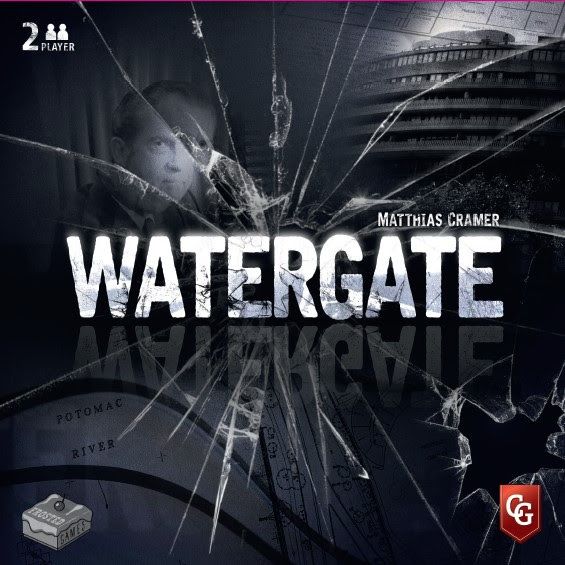
About this board game
Watergate is a two-player board game that plays in about 60 minutes, placing one player in the role of a Washington Post journalist and the other in control of the Nixon administration.
Each side has a unique set of cards and a distinct objective. The Nixon administration must build enough momentum to make it to the end of the presidential term. The journalist, meanwhile, must gather enough evidence to connect two informants directly to the President.
This creates a focused contest between uncovering the truth and suppressing it. As the journalist works to assemble a convincing chain of evidence, the administration will do everything in its power to smother any evidence that could lead back to the President.
- Players: 2
- Play time: about 60 minutes
- Release year: 2019
- Roles: Washington Post journalist and Nixon administration
Watergate turns the events of a major political scandal into a direct head-to-head struggle, with both players pursuing an opposing path to victory. One side seeks the connections needed to expose the administration, while the other aims to endure until the end of the presidential term.
A history of Watergate is included with the game, providing additional context for this competition. With its two contrasting roles, card-driven conflict, and clear opposing objectives, Watergate offers a concentrated game about evidence, pressure, and political survival.
Thematics
Mechanics
Designer
Illustrators


Board Game Rules for
Watergate
Watergate
A card-driven 2-player game about the most notorious of all political scandals
by Matthias Cramer
History
In June 1972, five men are arrested in Washington’s Watergate Building. What looks like a third-rate burglary attempt on the headquarters of the Democratic National Committee induces journalists Bob Woodward and Carl Bernstein of the Washington Post to start a thorough investigation. Over the following two years, they discover that the five men were directed from within the White House to spy on political opponents. As a consequence, in 1974 President Richard Nixon resigns from office to avoid impeachment.
Object of the Game
In WATERGATE, one player assumes the role of a Newspaper Editor, while the other embodies the Nixon Administration – each with a unique set of cards. To win, the Nixon Administration must build up enough momentum to make it to the end of the term, whereas the Editor must gather enough evidence to connect two informants directly to the President. Of course, the administration will do all in its power to smother that evidence. Can the secret source known as “Deep Throat” tip the scales? A thrilling race against time begins…
Components
- 1 game board
- 20 player cards “Nixon Administration”
- 1 momentum card “Nixon Administration”
- 20 player cards “Editor”
- 1 momentum card “Editor”
- 1 initiative card
- 1 End of round overview card
- 9 momentum tokens
- 1 initiative token
- 36 evidence tokens
- 7 picture tiles
- 1 bag

Game Setup
- Determine roles: Determine who will play the Editor and who will play the Nixon Administration (from now on referred to as “Nixon”).
- Board placement: Place the game board [A] between you so that the Editor can see the board the right way up, while Nixon looks at it upside down.
- Cards: Take the 21 cards of your role.
- Momentum card: Place your momentum card [B] face up next to the research track on your side of the board.
- Draw deck: Shuffle your 20 player cards and place them as your personal draw deck [C] face down in front of you.
- Initiative & overview cards: Beside the 0 space of the research track, place the initiative card [D] face up between the two momentum cards so that its arrows point towards the Editor. Place the End of round overview card [E] next to it.
- Tokens on track: Place the initiative token [F] and 1 momentum token [G] on the 0 space of the research track. Beside the board, form a supply for the remaining 8 momentum tokens [H].
- Informant supply: Create a supply for the 7 picture tiles [I]. This supply is called the “potential informant supply”.
- Evidence bag: Put the 30 evidence tokens [J] in the bag [K] and place the bag nearby.

Round Structure Overview
WATERGATE is played over a series of rounds. Each round comprises the following 3 phases:
- A) Initial phase: Players draw their hand cards for the round and new evidence tokens are placed onto the research track.
- B) Card phase: Players alternate playing and resolving 1 card at a time until they have no cards left in hand.
- C) Evaluation phase: The initiative, momentum, and evidence tokens on the research track are awarded depending on whose side they are on.
Immediate Win Conditions Overview
- The game ends immediately with a win for Nixon if: Nixon has managed to place a total of 5 momentum tokens on their momentum card.
- The game ends immediately with a win for the Editor if: At least 2 informants (face-up picture tiles) on the evidence board are connected via face-up evidence tokens to Nixon’s picture in the center.


Phase A: Initial Phase
Carry out the following 2 steps:
- Both players: Look at the side of the initiative card that points towards you and draw that many cards from your personal draw deck: either 4 or 5 cards. Put these cards in your hand, concealing them from your opponent. If your personal draw deck runs out, shuffle your discard pile (formed during the game) and place it as the new face-down draw deck in front of you.
- Nixon only: Draw 3 evidence tokens from the bag and look at them in secret. Then place them face down onto the 0 space of the research track.
Nixon may look at face-down evidence tokens on the research track at any time. The Editor may not.

Playing Cards
Starting with the player who has the initiative (the player that the arrows on the initiative card are pointing towards), the two of you take alternating turns until neither of you has any cards left in hand.
On your turn, you must play ONE card from your hand.
Each card consists of two parts:
- a value part
- an action part
Of these two parts, you must choose ONE to use.
Note: Each card also shows a quote at the bottom that has no relevance to the gameplay.

Value Part
If you choose to use the value part, move 1 token on the research track as many spaces towards your side as that value states (1 to 4). You can choose either the initiative token  , the momentum token
 , or an evidence token.
If you move an evidence token, bear the following rules in mind:
There are 3 basic types of evidence token, each with a specific color:
- Blue (represents checks for Nixon’s re-election campaign)
- Yellow (represents ground-plans of the Watergate complex)
- Green (represents transcripts of the Nixon White House tapes)
There are also two-colored evidence tokens that can be used as either of their colors.
When you use the value part of your card to move an evidence token, it must be a token of the color shown on that card [A] or a two-colored evidence token that includes that color.
If your card shows a joker (with all 3 colors) [B], you can move 1 evidence token of any color.

Moving Face-Down Evidence Tokens
To move a face-down evidence token, also note the following:
- As Nixon: To move a face-down evidence token with the color shown on your card, simply flip the token face up and move it accordingly. (Remember that you can always look at face-down evidence tokens.)
- As the Editor: If you want to move a face-down evidence token, ask Nixon if there is any with the color on your card (if the card shows a joker, name a color). If there is a face-down token with that color, Nixon must flip it face up and move it the appropriate number of spaces towards your side. If there are more than one such tokens, Nixon chooses which of them to flip and move. If there is no face-down evidence token with that color (and Nixon tells you so), you may instead move either the initiative token, the momentum token, or an already face-up evidence token with that color (or – in the case of a joker – any color).


Value Movement Example
The Editor uses the value part of this card and so moves one of the following tokens 2 spaces towards their side of the research track:
- the initiative token [A],
- the momentum token [B],
- the yellow evidence token [C] (because it matches the color shown on the card), or
- the yellow/blue evidence token [D] (because one of its two parts matches the color shown on the card).
If the Editor wants to move the face-down evidence token [E], the Editor would have to ask Nixon first if that token includes yellow. If it does, Nixon must flip it and move it two spaces towards the Editor’s side. If it doesn’t, the Editor must choose one of the other options above.
IMPORTANT: After you use a card’s value part, discard it face up to your personal discard pile. (If it is your first discarded card, place it face up beside your draw deck to create your discard pile.)
Moving a Token to Space 5 on Your Side
Whenever you manage to move a token to space 5 on your side of the research track, any extra steps are forfeited and you gain that token immediately. If you gain a token this way, follow the instructions in the green box of that token’s type on pages 9 and 10.
Attention: As soon as a token has been gained, it is gone from the research track and thus can’t be moved anymore.

Action Part
If you choose to use the action part of your card, follow the printed instructions.
There are 3 types:
- EVENTS: Most cards in the game feature an event. Events must be removed from the game (e.g. to the box) after you use their action part. Only the event “Gambit” provides an alternative (see page 15).
- CONSPIRATORS: Only Nixon has conspirators. After Nixon uses the action part of a conspirator card, it goes to Nixon’s discard pile.
- JOURNALISTS: Only the Editor has journalists. After the Editor uses the action part of a journalist card, it goes to the Editor’s discard pile.
Attention:
- Requirements: Some cards state requirements which must be met in order to use their action part.
- Reaction cards: Some cards are reaction cards. You can only use their action part as a direct reaction to a specific card played by your opponent. (For details, see “Card overview” on pages 11 to 16.)
Important: When following a card’s instructions, you have to fully carry out all instructions that are possible. Instructions that cannot be carried out (because, for example, a token that you are supposed to move is not present) can be ignored.
The instructions on most cards should be self-evident. However, on the next page, you can find explanations of the most common instructions. Also, in the appendix of this rule book (starting on page 11), you can find an overview that provides historical background and rules clarifications where necessary.


Common Card Instructions & General Rules
- Moving specific tokens X steps: If an instruction tells you to move a specific token “X steps”, move that token on the research track that many spaces towards your side.
- Moving to a specific space: If an instruction states a space of the research track, move the token to that space.
- Moving evidence tokens: If an instruction tells you to move evidence tokens, you can choose among all those on the research track, whether they are face up or face down (unless the instruction clearly states otherwise).
Attention: Whenever you move a face-down evidence token, you must flip it face up. - Pinning a picture to the evidence board: If an instruction tells you to “pin a picture to the evidence board”, it means that you must take the picture tile of the person named from the potential informant supply and place it onto that person’s informant space (which is marked with that person’s last name). The Editor always places picture tiles face up (as recruited informants), while Nixon places them face down.
- Pinning an evidence token: If an instruction tells you to “pin an evidence token to the evidence board”, follow the rules described in the green box “Pinning an evidence token to the evidence board” on page 10.
Further notes:
- At any time, both of you may look at face-down evidence tokens that are already on the evidence board.
- At any time, both of you may look at the cards of either discard pile and any cards already removed from the game (but never those of the face-down draw decks).

Evaluation Phase Steps
Once neither player has any cards left in hand, carry out the evaluation phase by following these 5 steps in order:
1) Return neutral evidence tokens to the bag
If there are any evidence tokens left on the 0 space of the research track (face up or face down), return them to the bag.

2) Award this round’s initiative token
Give the initiative token to the player whose side of the research track it’s on.
- If the initiative token is on the 0 space of the research track, it is gained by the player that did not have the initiative this round.
- If the initiative token was gained earlier this round (see page 6), skip this step.
Gaining the initiative token
When you gain the initiative token, take it from the research track and place it onto the initiative card. Then turn the initiative card (if necessary) so that its arrows point towards you. This indicates that you have the initiative now.

3) Award this round’s momentum token
Give this round’s momentum token to the player whose side of the research track it’s on.
- If the momentum token is on the 0 space of the research track, it is not gained by either player but returned to the supply instead.
- If the momentum token was gained earlier this round (see page 6), skip this step.
Gaining the momentum token
When you gain this round’s momentum token, take it from the research track and place it onto your momentum card on the empty space with the lowest number. If there is an instruction text next to that space, carry it out now.
If the Editor gains the momentum token but has no free space on the momentum card, remove that momentum token from the game!

4) Place the initiative token and 1 new momentum token onto the 0 space
Take the initiative token from the initiative card and place it onto the 0 space of the research track.
Then take 1 momentum token from the supply and also place it onto the 0 space of the research track. If you can’t do so because there is none left in the supply, Nixon wins the game immediately.

5) Award this round’s evidence tokens
Finally, each player gains any evidence tokens that are on their side of the research track. The player with the initiative begins and pins all evidence tokens from their side (if any) to the evidence board (see the green box below). Then the other player does the same for any evidence tokens from their side.
Pinning an evidence token to the evidence board
Whenever you gain an evidence token (or are instructed by a card to pin one to the evidence board), place it onto any empty evidence space that is marked with a slip of that token’s color (or – in the case of a two-colored token – one of its two colors). If you are the Editor, place it face up (to create connections). If you are Nixon, place it face down (to disrupt connections).
Attention: If the evidence token shows this symbol  , also move the momentum token on the research track 1 space towards your side.
If no player has won the game yet (see below), start a new round.

Victory Conditions
- The game ends immediately with a win for Nixon:
- as soon as Nixon places a fifth momentum token onto their momentum card
- or, in rare cases, if no momentum token is left in the supply to be placed on the research track during step 4 of the evaluation phase (see above).
- The game ends immediately with a win for the Editor:
- as soon as the Editor has connected Nixon to at least 2 informants on the evidence board. An informant is considered connected to Nixon if a thread coming from that informant’s face-up picture tile runs all the way through face-up evidence tokens to Nixon’s picture in the center (empty spaces and face-down evidence tokens disrupt connections).


Card Overview and Background Information
The Informants
Rose Mary Woods
Woods served as Richard Nixon’s secretary from 1951 through the end of his political career. Woods was loyal and one of Nixon’s closest confidants, both personally and professionally. It is believed by historians that this loyalty led to Woods testifying before a grand jury that she was responsible for inadvertently erasing parts of an audio tape from a recording dated June 20, 1972. Her description of how this occurred became referred to as “the Rose Mary Stretch.”
Alexander Butterfield
A recipient of the Distinguished Flying Cross for his experience in Vietnam, Butterfield’s ambition saw him become deputy assistant to the President when he asked his friend, Bob Haldeman, for a position in the administration where he could advance his career. Though not involved directly in the Watergate scandal, Butterfield instigated Nixon’s downfall when he revealed that he had installed a taping system in the oval office pursuant to direct orders from Nixon. Butterfield acknowledged the taping system under questioning by senate staffers.
Hugh Sloan
Sloan was treasurer of the Committee for the Re-election of the President (CRP). Described by Woodward and Bernstein as one of the few honest persons they interviewed, Sloan was reported not to have had knowledge of the Watergate break-in and resigned from the committee due to his ethical concerns. Sloan served as an important source for the Washington Post. After leaving Washington, Sloan settled down in Michigan with his wife, Deborah, where they raised their family together.
Martha Mitchell
Wife of Nixon’s Attorney General, John Mitchell, Martha was one of the victims of the Watergate scandal. Martha was an outgoing public figure referred to pejoratively as “the mouth of the south.” Mitchell was known to eavesdrop on her husband’s business and was a common source for reporters even prior to the Watergate break-ins. After discovering that associates of her husband had been involved in the break-in, Martha reached out to one of her contacts, a reporter named Helen Thomas. Martha’s husband, aware of the risks of her talking, ordered a former FBI agent, Stephen King, to keep her from talking. While on the phone with Thomas, King ripped the phone from the wall. Martha was then held against her will and sedated by a psychiatrist. She was discredited by Nixon aides as having a drinking problem.

John Dean
As White House Counsel from 1970 through 1973, Dean was a major player in both the run up to the Watergate scandal and one of the key figures in the eventual downfall of Nixon and others. Dean became White House counsel after John Ehrlichman was promoted to the president’s chief domestic advisor. Dean was involved with others in the intelligence gathering operations that eventually led to the Watergate scandal. After the failed burglary, Dean was instrumental in the cover-up, including involvement with the destruction of evidence by the acting director of the FBI, Patrick Gray. It was his activities with Gray that led to Dean being directly implicated in the cover-up. Worried that he would be made the scapegoat, Dean began cooperating with government officials while still serving as counsel to Nixon. He pleaded guilty to a single felony count in exchange for his testimony before the grand jury. His testimony was crucial to the convictions of others involved in the cover-up.
Alfred Baldwin
On May 26, 1972, Alfred Baldwin, a former FBI agent, met with James McCord, Gordon Liddy, and Howard Hunt, in room 419 of the Howard Johnson hotel, across the street from the Watergate. On the night of the Watergate break-in, Baldwin served as the “shadow man” who communicated with the burglars via walkie-talkie. Following their arrest, Baldwin was purportedly deeply involved in the cover-up of physical evidence from the night of the burglary, though he was never charged with any crime. In October 1972, an interview of Baldwin was published in the Los Angeles Times, which led to further investigations.
James McCord
At the time of the Watergate scandal, James McCord was a former CIA agent who had an expertise in electronic listening devices. After leaving the CIA, McCord was hired by the Republican National Committee and the Committee for the Re-election of the President (CRP) for security work in January of 1972. McCord was one of the five burglars arrested on June 17, 1972. He pleaded guilty to charges of conspiracy, burglary, and wiretapping, but later claimed that he had been coerced into pleading guilty by John Dean and John Mitchell. In a letter to U.S. District Judge John Sirica, McCord implicated senior administration officials in a cover-up. The letter led to McCord becoming a cooperating witness against the administration and his twenty-five year prison sentence was reduced to time served.
Deep Throat
Deep Throat was an alias given to Mark Felt, a special agent and Associate Director of the FBI from May 1942 through June 1973. Felt was widely considered the most important source in the reporting done by Bob Woodward and Carl Bernstein. His identity was known to Woodward and Bernstein, but remained anonymous to the public for thirty years until he confirmed his identity in 2005. During the Watergate investigation, Felt was in a critical position within the FBI and had access to the entirety of the FBI’s findings. Felt had met Woodward around 1970 and had acted as an anonymous informant for stories before Watergate. After the burglary, Woodward contacted Felt and the two developed protocols for setting up clandestine meetings where Felt would share information learned during the course of the FBI investigation. Though Nixon and others suspected Felt’s leaking, they were unable to confirm the suspicions and likewise unable to prevent him from further leaks. His most famous phrase “Follow the money!“ (card 42) that supposedly pushed Woodward into a fertile direction and was made popular by the movie “All the President’s Men“ (1976), however, was probably never uttered by Felt in reality.

The Conspirators
Howard Hunt
E. Howard Hunt was an author as well as officer with the CIA where he served for over thirty years before leaving in 1970. Before leaving the CIA, Hunt forged a relationship with Chuck Colson, who was working on Nixon’s presidential campaign. He was later hired by Colson, who was then serving as Special Counsel to President Nixon, to serve in the White House Special Investigations Unit. Hunt led a burglary of a psychiatrist’s office to seek information on Daniel Ellsberg (who had leaked the Pentagon Papers), used disguises and other tools to attempt to obtain damaging information about Edward Kennedy, and eventually organized the bugging of the Democratic National Committee at the Watergate. Hunt, along with Liddy, and the five burglars, were the first persons indicted by a grand jury on September 15, 1972. The payments for his and the other burglar’s silence was part of the key information found by The Washington Post that exposed the cover-up of the conspiracy.
Attention: When you use the action part of this card, move the momentum token first. If the momentum token was already claimed earlier during this round, draw and play the top card from your draw deck anyway.
Gordon Liddy
As a former FBI agent, G. Gordon Liddy served as the chief operative of the White House Plumbers and was hired by Hunt. Liddy organized the burglary of the Watergate Hotel with Howard Hunt and was arrested after admitting that he had supervised the break-in. He was convicted of conspiracy, burglary, and illegal wiretapping. He was sentenced to twenty years in prison but his sentence was commuted by President Jimmy Carter, serving only a total of approximately four and a half years. Although initially loyal, Liddy “spilled his guts” in 1980 with his autobiography “Will.”
Chuck Colson
Charles Colson served as special counsel to President Richard Nixon from 1969 through 1973. Colson has been described as an evil genius of the administration and a hit man for President Nixon. In 1971, he authored the memo that came to be known as “Nixon’s Enemies List.” Colson helped instigate riots against Vietnam War protesters and was responsible for various other nefarious activities. Colson hired Howard Hunt who later organized the Watergate break-in. Colson was eventually indicted for covering up the Watergate burglaries. Later in life, he became an evangelical Christian and became influential in both prison outreach efforts and prison reform.
Bob Haldeman
Harry Robins “Bob” Haldeman was White House Chief of Staff to President Richard Nixon from 1969 through 1973. Haldeman was a republican political operative and managed Nixon’s 1962 run for Governor of California. Haldeman was instrumental in the cover-up efforts after Watergate. In what is known as the “Smoking Gun” tape from June 23, 1972, Nixon conspired with Haldeman to obstruct justice by planning to contact the CIA to pressure the FBI into halting the Watergate investigation on the ground that it was a matter of national security. This conspiracy formed one of the bases for the articles of impeachment against Nixon and led to Haldeman serving eighteen months in prison.

John Ehrlichman
John Ehrlichman was counsel to the President and Assistant for Domestic Affairs. He served as an important figure in developing Nixon’s domestic policy. Ehrlichman worked for Nixon from 1960 until he joined the Nixon administration in 1969. Ehrlichman was one of the key figures involved in the creation of “The Plumbers,” the group that eventually organized the Watergate burglary. Ehrlichman was also an active participant in the cover-up of the Watergate scandal. He was eventually convicted of conspiracy, perjury, and obstruction of justice for his role.
John Mitchell
John Mitchell served as the Attorney General of the United States under Richard Nixon from 1969 through 1972. He had previously worked as director of Nixon’s 1968 presidential campaign and was a close personal friend of the President. He also acted as director of Nixon’s re-election campaign in 1972. Immediately after the Watergate burglary, Mitchell enlisted the aid of a former FBI agent, Stephen King, to keep Mitchell’s wife, Martha, from learning about the incident and from talking to reporters. Mitchell was personally involved in planning the meetings to break into the Democratic National Committee. He met with the President on at least three occasions to conspire to cover-up the investigation. He was found guilty of conspiracy, obstruction of justice, and perjury and served nineteen months in prison.
Attention: This card is a reaction card. You can only use its action part as a direct response when the Editor uses the action part of an EVENT card. Play John Mitchell right away to cancel that action entirely. Then the Editor must discard their card unused to their discard pile. You may play John Mitchell as a re-reaction to the EVENT card “Mass demonstration” (to perform the action blocked by “Mass demonstration”), but not to JOURNALIST Ben Bradlee.
The Journalists
Bob Woodward
Born in Geneva, Illinois, Bob Woodward attended Yale College where he studied history and English literature. He graduated in 1965 and then served for five years in the United States Navy, earning the rank of lieutenant. After his discharge, he was hired as a reporter by the Washington Post in 1971. Woodward, along with Carl Bernstein, was assigned to report on the Watergate burglary on June 17, 1972. Woodward’s investigative reporting, including the use of a confidential anonymous informant nicknamed “Deep Throat” proved indispensable in holding the Nixon White House accountable for its actions and ending the administration.
Carl Bernstein
Carl Bernstein grew up in Silver Spring, Maryland where he started his journalism career at the age of sixteen as a copy-boy for the Washington Star. Though never completing college, Bernstein’s journalism career flourished early when he won an award for investigative journalism while working for the Elizabeth Daily Journal in New Jersey. In 1966, he joined The Washington Post as a local news reporter. Bernstein, along with Bob Woodward, was assigned the Watergate burglary investigation the day after the arrests. Bernstein’s investigative reporting, particularly the tracing of funds paid to the burglars to Nixon’s re-election campaign, tied the campaign to the burglary and informed the public of the administration’s role in the conspiracy.

Ben Bradlee
Bradlee was the executive editor of the Washington Post from 1968 to 1991. Though born to a wealthy family in Boston, much of their fortune was lost as a result of the Great Depression. Bradlee attended Harvard College and thereafter served in the Office of Naval Intelligence. He fought in WWII, primarily in the Pacific theater. After returning home from WWII, he began working as a reporter for the Washington Post in 1948. Bradlee worked briefly in the government before returning as a reporter for Newsweek and later becoming the executive editor of the Washington Post. Bradlee was the editor responsible for supervising Woodward and Bernstein in their investigation of the Nixon administration. His work helped ensure that the reporting was completed, despite intense overt and covert pressure by the Nixon administration and others.
Attention: This card is a reaction card. You can only use its action part as a direct response when Nixon plays a CONSPIRATOR card and uses that CONSPIRATOR’s action part. Play Ben Bradlee right away to cancel that action entirely. Also Nixon must remove that CONSPIRATOR card from the game. You may play Bradlee as a re-reaction to CONSPIRATOR John Mitchell (to perform the EVENT blocked by Mitchell).
Other Cards
Operation Gemstone
Operation Gemstone was a proposed series of clandestine or illegal acts in order to subvert the opposition. It was first outlined by Gordon Liddy together with John Mitchell, John Dean, and Jeb Magruder.
Gambit
Attention: When played for its action part, this card has an alternative to being removed from the game afterwards: If, at the same time, you happen to hold a CONSPIRATOR card in hand, you may remove this CONSPIRATOR from the game to discard the “Gambit” card to your discard pile. Note that if you do, you’ll have one card fewer in hand to play this round.
A brilliant mood
Attention: You cannot use the action part of this card on your first turn of a round. Once you play the card and use its action part (on your second or a later turn), for the rest of the round, the Editor can play their EVENT cards only for their value part (not their action part). JOURNALISTS may still be played for their action part.

Mass demonstration
Attention: This card is a reaction card. You can only use its action part as a direct response when Nixon plays a CONSPIRATOR card and uses that CONSPIRATOR’s action part. Play “Mass demonstration” right away to cancel that action entirely. Also, Nixon must remove that CONSPIRATOR card from the game. You may play “Mass demonstration” as a re-reaction to CONSPIRATOR John Mitchell (to perform the EVENT blocked by Mitchell).
The system works
Attention: When you use the action part of this card, look through all of YOUR cards that you have removed from the game. Choose one of them and use that card’s action part now as if you had played it normally (it cannot be a reaction card). Afterwards, remove that card from the game again along with the “The system works” card.
“Follow the money!”
Attention: This card is a reaction card. You can only use its action part as a direct response when Nixon uses the value part of a card to move an evidence token. As soon as Nixon moves that evidence token, play “Follow the money” to cancel the movement. Then, move that same evidence token from its initial position as many spaces towards your side as the value part of Nixon’s card states. Then, Nixon must discard their card to their discard pile unused.

The History Behind the Watergate Scandal
Introduction
Watergate, which has come to be associated with arguably the most consequential political scandal in the history of the United States, is a building complex with apartments, offices, and a hotel. It was built on the site of the old Washington Gas Light Company property from 1963 to 1971 along the banks of the Potomac River. In 1972, the Watergate was a beacon of new development in a city that had been dealing with the aftermath of the 1968 race riots and the continued protests of the war in Vietnam. No one at the beginning of 1972 would suspect that Watergate would become synonymous with corruption, political dirty tricks, election tampering, and a resignation of a United States President.

Prelude
The Watergate scandal1 had its root in the public release of the Pentagon Papers2. Officially titled “Report of the Office of the Secretary of Defense Vietnam Task Force,” the Pentagon Papers were a detailed history of the United States’ political and military involvement in Vietnam from World War II to the start of the Vietnam War. The authors had access to top secret3 documents and wrote a thorough analysis without pulling any punches. One of the contributing analysts was Daniel Ellsberg, a former US Marine officer with a Harvard PhD. He was working at the Rand corporation as a military analyst when he became dissatisfied with the Vietnam War. Specifically, he was dismayed how the United States, from the Eisenhower to the Johnson administrations used its power to raise Ngo Dinh Diem into a position of power and kept him there, until he was eventually overthrown and assassinated in 1963. Diem’s assassination was only possible with the help of the United States. Ellsberg and his friend, Anthony Russo, painstakingly photocopied the entire report in 1969. Eighteen months later, the papers were published by several American newspapers.
While President Nixon initially enjoyed the embarrassment the Pentagon Papers caused the Democrats (specifically Kennedy and Johnson), he became concerned that further release of classified materials could hurt his standing on the world stage and the delicate negotiations going on with China at that time. Concurrently, the Nixon administration was also dealing with a significant number of leaks, therefore the release of the Pentagon Papers added to the concern. In an effort to discredit Ellsberg, Nixon’s counsel, John Ehrlichman first attempted to get a psychiatric write up by the Federal Bureau of Investigation, but when the FBI produced an unhelpful report, the Plumbers were called in.
Plumbers
The Plumbers4 were a group led by former CIA agents acting as covert political operatives, whose job was stopping leaks at the White House and conducting clandestine political actions known as “dirty tricks.” The Plumbers were funded through the President’s re-election fund. During the presidential election of 1972, they had found ways to embarrass two democratic presidential candidates who eventually dropped out the race, leaving an unremarkable Senator McGovern of South Dakota as Nixon’s Democratic opponent.
The Plumbers decided to break into Ellsberg’s psychiatrist’s office to get more information on Ellsberg. After several botched attempts during the Labor Day weekend of 1971, the Plumbers were finally able to break into the Los Angeles medical offices, crowbarring open the file cabinet to discover Ellsberg’s medical files were not there.
The Break-In
1972 was an election year, and President Nixon had told his re-election team, “Do whatever it takes.” to win the election. Charles Colson, who was Nixon’s hatchet-man, brought in E. Howard Hunt. Ehrlichman brought in G. Gordon Liddy. Liddy was a lawyer, Army veteran, and former FBI field agent who so believed in Nixon’s conservatism that he had no moral qualms about breaking the law to secure the president a second term. Liddy had been reckless during his FBI days, including getting caught using FBI resources to provide a background check on his future wife. No one in the White House knew about Liddy’s recklessness, but they were well aware of his achievements in catching a top ten most wanted fugitive and being the youngest FBI bureau chief in history.


Howard Hunt and Gordon Liddy were the go-betweens between the Plumbers and the White House senior staff. Liddy developed several covert political operations, called Operation Gemstone, to embarrass the Democrats, including kidnapping anti-war protesters, luring the opposition onto boats with prostitutes to get compromising pictures, etc. Those operations were never approved. One plan the administration did approve was the attempt to discover embarrassing information about what they were sure to be Democratic Party covert operations. Liddy and Hunt had come up with the idea5 of breaking into the Democratic National Committee (DNC)’s headquarters in the Watergate complex.
In early May of 1972, Liddy tasked Hunt and James McCord to set up the operation to wiretap the DNC’s phones and photograph campaign operations materials. Through money siphoned from campaign contributions, these men along with several others (including Miami based anti-Castro Cubans), purchased equipment, rented a hotel room in the former Howard Johnson’s across the street, and began running reconnaissance missions to create a plan of action. The plan included taping the door locks and posting a look out from the Howard Johnson Hotel across the street.
The burglars successfully broke into the DNC’s office on May 28, 1972 and planted electronic listening devices on the phones of DNC chairman Larry O’Brien and executive director Robert Oliver. Liddy and Hunt thought the operation was a success until they realized that the electronic bug on O’Brien’s phone wasn’t working. Additionally, Oliver’s phone wasn’t producing effective intelligence. Former US Attorney General and Nixon re-election campaign manager, John Mitchell, reviewed the files produced by the initial break-in and told Liddy “it is worthless and not worth the money he [Nixon] paid for it.” In that meeting, Liddy told Mitchell6 that he would “correct matters.”
Hunt initially did not want to return to the Watergate, claiming the risk was too great. Liddy persisted, even telling Hunt “the Big Man [Mitchell] says he wants the operation.” Hunt acquiesced, and they planned the next break-in. Like the first one, the men were going to tape up the doors with picked locks to make sure they had an easy and timely escape route. Alfred C. Baldwin was the lookout in the Howard Johnson hotel with two-way radios, one to McCord and one to Hunt. McCord had told the team that he had taped the doors and the team was waiting for the all clear. The break-in team had to wait until after 1 am on June 18th, 1972 for the DNC offices to clear7.
A few minutes after the operation started, the team members came back to the hotel room, saying the tape on the doors had been taken off. After a few minutes of discussions, Liddy decided to restart the operation with the Cuban-born locksmith Virgilio Gonzalez re-picking the locks with US-born Cuban freedom fighter Frank Sturgis protecting him. McCord’s radio was producing too much static and was turned off, thereby preventing Baldwin from warning the men inside Watergate. Within a few minutes, the burglary team was at the back door of the DNC office to photograph documents and add additional electronic listening devices to the phones. The back door lock proved to be too difficult to pick so the burglars removed the door from its hinges. Although accounts differ on what actually happened, at some point McCord re-taped the doors. A security guard by the name of Frank Wills noticed that the doors had been taped a second time and called the police8.
Three plain clothes policemen9 responded to the call. Baldwin10 probably didn’t recognize the three hippies as officers. As Gonzalez was opening the door to O’Brien’s offices, the other men were photographing pictures. Around 2 am, the officers caught the five men, and Baldwin radioed to Liddy and Hunt that the men had been arrested and they need to run. Hunt and Liddy departed the area. Hunt made a U-turn and went to the Howard Johnson to start making phone calls to line up lawyers and bail money. Baldwin then took McCord’s van, with bugging devices and incriminating files, to McCord’s house in Rockville, Maryland11. The break-in was over and the cover-up was about to begin.


The Cover-Up
The Washington DC police, realizing they weren’t dealing with ordinary thieves, called in the FBI to help them identify the strange devices the men were carrying. The FBI agent immediately recognized the devices as electronic bugs, discovered Hunt’s name in the burglar’s address books, and, as someone had seen McCord at the Howard Johnson’s, searched the rooms rented by Hunt and gathered their phone records. At the same time, John Dean, White House Counsel, had just returned from the Philippines, President Nixon was waiting to fly back to Washington from his house in Key Biscayne, and DNC’s O’Brien was telling anyone who would listen that this break-in must have a full investigation.
On June 23, 1972, Nixon and his top two advisors, Ehrlichman and Chief of Staff Bob Haldeman, debated how to cover up the administration’s involvement. Dean, realizing the negative publicity implications of the break-in, discussed the issue with Ehrlichman, who ordered him to destroy all the documents in Hunt’s safe at the Plumbers’ offices. Dean, with FBI Acting Director Patrick Gray, did eventually destroy all the documents. While Nixon didn’t initially know about the break-in, he did order the CIA to impede (if not block) the FBI investigation12.
In the meantime, the Washington Post reported that a GOP security aide, McCord, was a security officer for the GOP re-election committee. Mitchell denied any connection between the White House and the burglars. A day later Press Secretary Ziegler utters the famous phrase “a third-rate burglary” in his press conference in refusing to talk about it. Furthermore, on August 29, 1972, Nixon held a news conference saying “I can say categorically that … no one in the White House staff, no one in this administration, presently employed, was involved in this very bizarre incident” because John Dean had conducted a thorough investigation. No evidence has ever been found that Dean conducted an investigation of this matter.
Follow the Money
Once the cover-up had been fully established and the press had moved on to other targets, Dean, Ehrlichman, and Colson started to work on paying off the burglars so that they wouldn’t talk and implicate the Committee to Re-elect the President (CRP) or the White House. The Administration kept lying to the investigators at every turn. Nixon was so far ahead in the polls that everyone knew Nixon would be the President for the next four years, and the investigation would be limited shortly after the elections. Acting FBI Director Gray kept Dean abreast of how the investigation was proceeding, including providing copies of the investigator’s notes and next planned actions. The administration knew exactly what was going on and was able to prepare for it.
However, Liddy, Hunt, and the burglars needed money for their legal defense and living expenses. So Colson and the CRP bookkeeper Hugh Sloan funneled money from legitimate campaign contributions to the burglars through various banks and Liddy. Sloan later testified that Magruder and finance director Maurice Stans had directed him to give the money to Liddy. Unbeknownst to them, the banks kept a record of all the transactions for six months, which came to light during the investigation and trials of the burglars. At some point during the investigation, Liddy, Hunt, and the five burglars were tied to the CRP.


The Watergate burglars, having been indicted, were now under the jurisdiction of United States District Court Judge John Sirica, who had the habit of giving out lengthy court sentences and had the nickname of “Maximum John.” With money running out and no effective help from his employers, Hunt began asking for more and more money, telling his friend Colson “We’re protecting the guys who are really responsible … This is a two-way street.” On December 8, Hunt’s wife Dorothy died in an airplane crash, and authorities recovered $10,000 in $100 bills from her purse. Moreover, McCord had started to provide information to the CIA in exchange for help in reducing the charges against him.
But the re-election rolled on. On July 1, Mitchell resigned from the Nixon re-election campaign due to “family reasons.” On September 29, the press ran stories about how Mitchell controlled a slush fund for political dirty tricks. On October 10, the FBI announced the connection between the burglary and political spying. On November 7, Nixon won the re-election by winning every state except Massachusetts and the District of Columbia. In the White House, there was a sense of great relief, and Nixon felt emboldened to start working on his plan to reshape the government to his ideals. Nixon left Washington for Camp David, a presidential retreat, to work out his next four years, but the troubles were just starting.
Scandal Widens
Judge Sirica and the press were starting to get wind of just how big of a scandal the Watergate break-in was to become. Just before Christmas, Judge Sirica said in a pre-trial hearing that he wanted the Jury to know how these men were paid, what were the motives of those paying them, and who came up with this plan. At the start of the trial, Sirica still did not know the answers to these questions.
Just as the trial started, the New York Times published a story that the Cuban Americans involved in the break-in reported they had been on the salary of the CRP and that there was a $900,000 slush fund for their activities. The story even mentioned the chain of command going from Barker to Hunt to Liddy to Colson to Mitchell. The administration and Mitchell flatly denied the story outright. After the story broke, all the defendants pleaded guilty. Judge Sirica was furious and delayed their sentencing to see if more information about the conspiracy could be obtained.
At the same time, the Democrats who controlled both houses of Congress were eager to embarrass the administration. The senate voted 77-0 to convene a special investigation that was headed by Senator Sam Ervin of North Carolina. Nixon worried about the Senate investigation, but knew testimony would start in several months. Nixon was hopeful of using his usual tactics of intimidation and discrediting his opponents to further reduce his political problems. Sensing an opportunity to distract the public, Nixon nominated Gray to be FBI director. Little did Nixon realize the opportunity he was giving the Democrats in the Senate.
Gray lacked the ruthlessness and intelligence that typified members of Nixon’s administration. On February 28th, Gray told the Senators that he had been providing John Dean constant updates on the FBI’s Watergate investigation. The Senators couldn’t believe what they were hearing and subpoenaed Dean to testify, but President Nixon refused to allow it on the grounds of attorney-client and executive privileges. On March 8th, Gray informed the Senators that Ehrlichman also knew about the FBI investigation.
On March 20th, Sirica held court to sentence the seven men arrested for the Watergate break-in. Judge Sirica theatrically told those assembled that he’d like to read a letter from McCord. The letter stated that the seven defendants felt political pressure to plead guilty, several of those that testified had committed perjury and others that were involved in the planning and financing the break-in have not testified in this case, including White House staff. The judge then called a recess to allow all the reporters to call in their stories. Judge Sirica had scooped both the White House and the press corp.
When the break was over, Sirica sentenced all the men to maximum sentences with a provision that it would be re-evaluated in three months, with the exception of Liddy. Judge Sirica said the sentences could be shortened based on the testimony the defendants gave the Ervin commission.
Prior to Sirica’s reading of McCord’s letter, Woodward and Bernstein of the Washington Post were almost alone in publishing articles about the cover up and conspiracy. They relied heavily on a source called Deep Throat. Papers like the Chicago Tribune would print articles relying on the administration’s version of events which specifically contradicted the Post. In fact, much of the press had not been paying attention to the Watergate break-in due to the basic belief that a sitting President would not break the law in such a crass amateur way. Despite President Nixon’s constant battle with the press, the press was reluctant to take on a sitting President. However, once McCord’s letter was read into the public record, the press was fully committed to investigating the administration. The relationship between the press and Nixon, which had never been cordial, had gotten much worse.
The Ervin commission now had McCord’s admission and Gray’s confirmation of the administration’s oversight of the FBI investigation. The administration felt the need to get ahead of the Senate and on March 28th, Nixon had Ehrlichman tell Attorney General Richard Kleindienst that no one in the administration had any foreknowledge of the break-in. Nixon hadn’t realized that his time to get ahead of the situation had passed. On April 13th, Magruder told the US Attorney that he had perjured himself. Four days later, Dean told Nixon that he too was cooperating with the US Attorneys. After a couple of weeks of indecision, Nixon fired his three most important advisors: Ehrlichman, Haldeman, and Dean, and asked for the resignation of the Attorney General. On the same day, Nixon appointed Elliott Richardson as Acting Attorney General and gave him the ability to hire a special counsel to investigate the Watergate break-in. Richardson hired Archibald Cox.
The Ervin commission televised all the proceedings from May 17 through August 7, 1973. Nielsen ratings estimated that 85% of Americans with televisions watched part of the hearing. Dean was the commission’s star witness. He told the world about the recording devices, senior administration knowledge of the cover-up, and perjury of its members. The biggest news was the admission of the recording devices in the Oval Office. The Senate and the American public were stunned by the admission. Immediately both the commission and Special Counsel subpoenaed the tapes. Nixon refused, invoking executive privilege. Cox and the commission sued. Now the release of the most explosive evidence was in the hands of the court.
Saturday Night Massacre and Resignations
In midst of the Watergate scandal, Nixon was forced to deal with growing legal problems of his Vice President, Spiro Agnew of Baltimore, Maryland. The Wall Street Journal published an article describing the secret investigation of Agnew when he was Governor of Maryland. Shortly thereafter, allegations arose of Agnew taking bribes as Vice President. The Baltimore federal prosecutor obtained significant evidence against the Vice President. Agnew fought the charges and conducted a public messaging announcing, “I will not resign if indicted!” Eventually, Agnew agreed to resign on October 10, 1973 to avoid jail time and became the first Vice President to do so because of criminal behavior13.
Nixon and Cox quarreled over the subpoena and Nixon demanded that Cox drop it. Cox refused. Nixon ordered Attorney General Richardson to fire Cox on October 20, 1973. Richardson resigned rather than fire him. Nixon then ordered Richardson’s number two to fire Cox and he resigned too. Finally, Nixon found a senior enough person who was willing to fire Cox in the person of Solicitor General Robert Bork. The press and the Democrats were outraged by the firing and Nixon’s poll numbers continued to plummet.
In attempt to restore some credibility, Nixon allowed for the hiring of Leon Jaworski, a GOP stalwart, to take over the investigation. Much to Nixon’s chagrin, Jaworski took his duties seriously and became an even bigger problem for Nixon.
The End
On July 20, 1974, the United States Supreme Court ruled unanimously that Nixon must release the tapes, and he complied. As the tapes became public record, Nixon and his advisors, Alexander Haig and Henry Kissinger, started to talk about which strategy to pursue in light of the Articles of Impeachment having passed the House Judiciary Committee in February. Nixon was truly conflicted.
The release of the Nixon Tapes created a firestorm in the press and with the public. Most notably, there was an 18 ½ minute gap in the June 20, 1972 tape. Nixon’s personal secretary, Rose Mary Woods, took responsibility for the erasure. Woods testified that the deletion was an accident. She demonstrated the “stretch” for photographers that might have caused the gap. Many experts and Nixon opponents were skeptical of Ms. Woods assertions and felt the erasure to be deliberate.
The final nail in the Nixon Administration was the August 5, 1974 release of the June 23, 1972 recording which became the “Smoking Gun” tape. Nixon had recorded the entire conversation between himself and Haldeman talking about the Watergate break-in and how they were going to cover it up. All of Nixon’s lies were laid out, and the public was demanding his impeachment. Two Republican Senators and a Republican Congressman visited Nixon two days later and told him that his impeachment would pass the House of Representatives, and the conviction proceedings in the Senate would ruin the administration. They encouraged him to resign to save the GOP and himself from the ultimate embarrassment of impeachment.
August 7, 1974, President Nixon became the only person to resign as President of the United States.


Footnotes
- Even though we use the singular “scandal” here, the plural “scandals” would be more appropriate because the avalanche of scandals include more than a break-in of a political rival’s office.
- The Pentagon Papers have been declassified and can be found on the US Archives website: https://www.archives.gov/research/pentagon-papers
- The US Military has many security classifications. We use the generic “Top Secret” to mean an unspecified security clearance was necessary to review the documents.
- The name reportedly comes from a conversation David Young had with his grandmother. She asked “What do you do at the White House?” He responded “I am helping the president stop some leaks.” So she said “You’re a plumber.” The name stuck.
- Liddy in his book “Will” contends that the plan came from Jeb McGruder, Deputy Director of the Committee for the Re-Election of the President (CRP). McGruder denied the creation of the plan, but did authorize it.
- Mitchell denied being told about the bugging of the DNC offices, but McGruder and Liddy say otherwise.
- Liddy and team thought the DNC was working late when it was a volunteer using the DNC’s WATS line to call his friends around the country. Long distance calls were very expensive in 1972.
- In an amusing turn of events, Wills had called his supervisor the first time about taped doors. His supervisor told him to recheck and call back if he found any other taped doors. Wills ran into the DNC volunteer who had been making phone calls and they decided to grab a meal at Howard Johnson’s across the street. Wills remembered an hour later to check the doors. If he had done so immediately, the second break-in might not ever been mentioned to the police.
- Their names were Sergeant Paul Leeper, Officer John Barrett, and Officer Carl Shoffler.
- Baldwin testified and was the only member of the Watergate break-in not to be charged.
- The FBI never searched McCord’s van and thereby lost many months and potentially important documents about the White House’s involvement in the Watergate break-in.
- Nixon and the late FBI director Hoover did not get along and were deeply suspicious of each other. It was only after Hoover’s death that Nixon started to exert control, but it was limited at best.
- Vice President John C. Calhoun resigned on December 28, 1832 due to deep policy disagreements with President Andrew Jackson.
Recommended sources for more information
Watergate is a fascinating subject which can be studied for years. Here are the sources relied upon for this historical feature:
- John Dean, Blind Ambition: The White House Years New York, Simon & Schuster 1976 (Updated forward 2006)
- Fred Emery, Watergate: The Corruption of American Politics and the Fall of Richard Nixon London, Random House 1994
- Bob Woodward and Carl Bernstein, All the President’s Men New York, Simon & Schuster 1974
- Richard Nixon et al, Transcripts of the White House tapes Washington DC, National Archives: https://www.archives.gov/open/nixon/37-wht-dataset-conversationlist.html
- Select Committee on Presidential Campaign Activities, Gavel-to-Gavel Televised sessions Washington DC, American Archive of Public Broadcasting: http://americanarchive.org/exhibits/watergate
Credits
- Game Design: Matthias Cramer
- Graphic Design: atelier 198
- Development and rulebook: Viktor Kobilke
- Rulebook revision: Neil Crowley and Travis Hill
- Biographies (p. 11-15): Andrew Ranks
- Historical outline (p. 16-23): Phillip Millman
© 2019 Frosted Games, Matthias Nagy, Sieglindestr. 7, 12159 Berlin, Germany.
© 2019 CAPSTONE GAMES, 339 Smith Drive, Clayton, OH 45315.
All rights reserved.
For more information, visit us at: www.capstone-games.com

Introduction & Components
Watergate
A card-driven 2-player game about the most notorious of all political scandals
by Matthias Cramer
History
In June 1972, five men are arrested in Washington’s Watergate Building. What looks like a third-rate burglary attempt on the headquarters of the Democratic National Committee induces journalists Bob Woodward and Carl Bernstein of the Washington Post to start a thorough investigation. Over the following two years, they discover that the five men were directed from within the White House to spy on political opponents. As a consequence, in 1974 President Richard Nixon resigns from office to avoid impeachment.
Object of the Game
In WATERGATE, one player assumes the role of a Newspaper Editor, while the other embodies the Nixon Administration – each with a unique set of cards. To win, the Nixon Administration must build up enough momentum to make it to the end of the term, whereas the Editor must gather enough evidence to connect two informants directly to the President. Of course, the administration will do all in its power to smother that evidence. Can the secret source known as “Deep Throat” tip the scales? A thrilling race against time begins…
Components
- 1 game board
- 20 player cards “Nixon Administration”
- 1 momentum card “Nixon Administration”
- 20 player cards “Editor”
- 1 momentum card “Editor”
- 1 initiative card
- 1 End of round overview card
- 9 momentum tokens
- 1 initiative token
- 36 evidence tokens
- 7 picture tiles
- 1 bag
Setup
Game Setup
- Determine roles: Determine who will play the Editor and who will play the Nixon Administration (from now on referred to as “Nixon”).
- Board placement: Place the game board [A] between you so that the Editor can see the board the right way up, while Nixon looks at it upside down.
- Cards: Take the 21 cards of your role.
- Momentum card: Place your momentum card [B] face up next to the research track on your side of the board.
- Draw deck: Shuffle your 20 player cards and place them as your personal draw deck [C] face down in front of you.
- Initiative & overview cards: Beside the 0 space of the research track, place the initiative card [D] face up between the two momentum cards so that its arrows point towards the Editor. Place the End of round overview card [E] next to it.
- Tokens on track: Place the initiative token [F] and 1 momentum token [G] on the 0 space of the research track. Beside the board, form a supply for the remaining 8 momentum tokens [H].
- Informant supply: Create a supply for the 7 picture tiles [I]. This supply is called the “potential informant supply”.
- Evidence bag: Put the 30 evidence tokens [J] in the bag [K] and place the bag nearby.
Game Overview & Initial Phase
Round Structure Overview
WATERGATE is played over a series of rounds. Each round comprises the following 3 phases:
- A) Initial phase: Players draw their hand cards for the round and new evidence tokens are placed onto the research track.
- B) Card phase: Players alternate playing and resolving 1 card at a time until they have no cards left in hand.
- C) Evaluation phase: The initiative, momentum, and evidence tokens on the research track are awarded depending on whose side they are on.
Immediate Win Conditions Overview
- The game ends immediately with a win for Nixon if: Nixon has managed to place a total of 5 momentum tokens on their momentum card.
- The game ends immediately with a win for the Editor if: At least 2 informants (face-up picture tiles) on the evidence board are connected via face-up evidence tokens to Nixon’s picture in the center.
Phase A: Initial Phase
Carry out the following 2 steps:
- Both players: Look at the side of the initiative card that points towards you and draw that many cards from your personal draw deck: either 4 or 5 cards. Put these cards in your hand, concealing them from your opponent. If your personal draw deck runs out, shuffle your discard pile (formed during the game) and place it as the new face-down draw deck in front of you.
- Nixon only: Draw 3 evidence tokens from the bag and look at them in secret. Then place them face down onto the 0 space of the research track.
Nixon may look at face-down evidence tokens on the research track at any time. The Editor may not.
Phase B: Card Phase
Playing Cards
Starting with the player who has the initiative (the player that the arrows on the initiative card are pointing towards), the two of you take alternating turns until neither of you has any cards left in hand.
On your turn, you must play ONE card from your hand.
Each card consists of two parts:
- a value part
- an action part
Of these two parts, you must choose ONE to use.
Note: Each card also shows a quote at the bottom that has no relevance to the gameplay.
Value Part
If you choose to use the value part, move 1 token on the research track as many spaces towards your side as that value states (1 to 4). You can choose either the initiative token , the momentum token , or an evidence token.
If you move an evidence token, bear the following rules in mind:
There are 3 basic types of evidence token, each with a specific color:
- Blue (represents checks for Nixon’s re-election campaign)
- Yellow (represents ground-plans of the Watergate complex)
- Green (represents transcripts of the Nixon White House tapes)
There are also two-colored evidence tokens that can be used as either of their colors.
When you use the value part of your card to move an evidence token, it must be a token of the color shown on that card [A] or a two-colored evidence token that includes that color.
If your card shows a joker (with all 3 colors) [B], you can move 1 evidence token of any color.
Moving Face-Down Evidence Tokens
To move a face-down evidence token, also note the following:
- As Nixon: To move a face-down evidence token with the color shown on your card, simply flip the token face up and move it accordingly. (Remember that you can always look at face-down evidence tokens.)
- As the Editor: If you want to move a face-down evidence token, ask Nixon if there is any with the color on your card (if the card shows a joker, name a color). If there is a face-down token with that color, Nixon must flip it face up and move it the appropriate number of spaces towards your side. If there are more than one such tokens, Nixon chooses which of them to flip and move. If there is no face-down evidence token with that color (and Nixon tells you so), you may instead move either the initiative token, the momentum token, or an already face-up evidence token with that color (or – in the case of a joker – any color).
Value Movement Example
The Editor uses the value part of this card and so moves one of the following tokens 2 spaces towards their side of the research track:
- the initiative token [A],
- the momentum token [B],
- the yellow evidence token [C] (because it matches the color shown on the card), or
- the yellow/blue evidence token [D] (because one of its two parts matches the color shown on the card).
If the Editor wants to move the face-down evidence token [E], the Editor would have to ask Nixon first if that token includes yellow. If it does, Nixon must flip it and move it two spaces towards the Editor’s side. If it doesn’t, the Editor must choose one of the other options above.
IMPORTANT: After you use a card’s value part, discard it face up to your personal discard pile. (If it is your first discarded card, place it face up beside your draw deck to create your discard pile.)
Moving a Token to Space 5 on Your Side
Whenever you manage to move a token to space 5 on your side of the research track, any extra steps are forfeited and you gain that token immediately. If you gain a token this way, follow the instructions in the green box of that token’s type on pages 9 and 10.
Attention: As soon as a token has been gained, it is gone from the research track and thus can’t be moved anymore.
Action Part
If you choose to use the action part of your card, follow the printed instructions.
There are 3 types:
- EVENTS: Most cards in the game feature an event. Events must be removed from the game (e.g. to the box) after you use their action part. Only the event “Gambit” provides an alternative (see page 15).
- CONSPIRATORS: Only Nixon has conspirators. After Nixon uses the action part of a conspirator card, it goes to Nixon’s discard pile.
- JOURNALISTS: Only the Editor has journalists. After the Editor uses the action part of a journalist card, it goes to the Editor’s discard pile.
Attention:
- Requirements: Some cards state requirements which must be met in order to use their action part.
- Reaction cards: Some cards are reaction cards. You can only use their action part as a direct reaction to a specific card played by your opponent. (For details, see “Card overview” on pages 11 to 16.)
Important: When following a card’s instructions, you have to fully carry out all instructions that are possible. Instructions that cannot be carried out (because, for example, a token that you are supposed to move is not present) can be ignored.
The instructions on most cards should be self-evident. However, on the next page, you can find explanations of the most common instructions. Also, in the appendix of this rule book (starting on page 11), you can find an overview that provides historical background and rules clarifications where necessary.
Common Card Instructions & General Rules
- Moving specific tokens X steps: If an instruction tells you to move a specific token “X steps”, move that token on the research track that many spaces towards your side.
- Moving to a specific space: If an instruction states a space of the research track, move the token to that space.
- Moving evidence tokens: If an instruction tells you to move evidence tokens, you can choose among all those on the research track, whether they are face up or face down (unless the instruction clearly states otherwise).
Attention: Whenever you move a face-down evidence token, you must flip it face up. - Pinning a picture to the evidence board: If an instruction tells you to “pin a picture to the evidence board”, it means that you must take the picture tile of the person named from the potential informant supply and place it onto that person’s informant space (which is marked with that person’s last name). The Editor always places picture tiles face up (as recruited informants), while Nixon places them face down.
- Pinning an evidence token: If an instruction tells you to “pin an evidence token to the evidence board”, follow the rules described in the green box “Pinning an evidence token to the evidence board” on page 10.
Further notes:
- At any time, both of you may look at face-down evidence tokens that are already on the evidence board.
- At any time, both of you may look at the cards of either discard pile and any cards already removed from the game (but never those of the face-down draw decks).
Phase C: Evaluation Phase
Evaluation Phase Steps
Once neither player has any cards left in hand, carry out the evaluation phase by following these 5 steps in order:
1) Return neutral evidence tokens to the bag
If there are any evidence tokens left on the 0 space of the research track (face up or face down), return them to the bag.
2) Award this round’s initiative token
Give the initiative token to the player whose side of the research track it’s on.
- If the initiative token is on the 0 space of the research track, it is gained by the player that did not have the initiative this round.
- If the initiative token was gained earlier this round (see page 6), skip this step.
Gaining the initiative token
When you gain the initiative token, take it from the research track and place it onto the initiative card. Then turn the initiative card (if necessary) so that its arrows point towards you. This indicates that you have the initiative now.
3) Award this round’s momentum token
Give this round’s momentum token to the player whose side of the research track it’s on.
- If the momentum token is on the 0 space of the research track, it is not gained by either player but returned to the supply instead.
- If the momentum token was gained earlier this round (see page 6), skip this step.
Gaining the momentum token
When you gain this round’s momentum token, take it from the research track and place it onto your momentum card on the empty space with the lowest number. If there is an instruction text next to that space, carry it out now.
If the Editor gains the momentum token but has no free space on the momentum card, remove that momentum token from the game!
4) Place the initiative token and 1 new momentum token onto the 0 space
Take the initiative token from the initiative card and place it onto the 0 space of the research track.
Then take 1 momentum token from the supply and also place it onto the 0 space of the research track. If you can’t do so because there is none left in the supply, Nixon wins the game immediately.
5) Award this round’s evidence tokens
Finally, each player gains any evidence tokens that are on their side of the research track. The player with the initiative begins and pins all evidence tokens from their side (if any) to the evidence board (see the green box below). Then the other player does the same for any evidence tokens from their side.
Pinning an evidence token to the evidence board
Whenever you gain an evidence token (or are instructed by a card to pin one to the evidence board), place it onto any empty evidence space that is marked with a slip of that token’s color (or – in the case of a two-colored token – one of its two colors). If you are the Editor, place it face up (to create connections). If you are Nixon, place it face down (to disrupt connections).
Attention: If the evidence token shows this symbol , also move the momentum token on the research track 1 space towards your side.
If no player has won the game yet (see below), start a new round.
End of the Game
Victory Conditions
- The game ends immediately with a win for Nixon:
- as soon as Nixon places a fifth momentum token onto their momentum card
- or, in rare cases, if no momentum token is left in the supply to be placed on the research track during step 4 of the evaluation phase (see above).
- The game ends immediately with a win for the Editor:
- as soon as the Editor has connected Nixon to at least 2 informants on the evidence board. An informant is considered connected to Nixon if a thread coming from that informant’s face-up picture tile runs all the way through face-up evidence tokens to Nixon’s picture in the center (empty spaces and face-down evidence tokens disrupt connections).
Card Overview & Clarifications
Card Overview and Background Information
The Informants
Rose Mary Woods
Woods served as Richard Nixon’s secretary from 1951 through the end of his political career. Woods was loyal and one of Nixon’s closest confidants, both personally and professionally. It is believed by historians that this loyalty led to Woods testifying before a grand jury that she was responsible for inadvertently erasing parts of an audio tape from a recording dated June 20, 1972. Her description of how this occurred became referred to as “the Rose Mary Stretch.”
Alexander Butterfield
A recipient of the Distinguished Flying Cross for his experience in Vietnam, Butterfield’s ambition saw him become deputy assistant to the President when he asked his friend, Bob Haldeman, for a position in the administration where he could advance his career. Though not involved directly in the Watergate scandal, Butterfield instigated Nixon’s downfall when he revealed that he had installed a taping system in the oval office pursuant to direct orders from Nixon. Butterfield acknowledged the taping system under questioning by senate staffers.
Hugh Sloan
Sloan was treasurer of the Committee for the Re-election of the President (CRP). Described by Woodward and Bernstein as one of the few honest persons they interviewed, Sloan was reported not to have had knowledge of the Watergate break-in and resigned from the committee due to his ethical concerns. Sloan served as an important source for the Washington Post. After leaving Washington, Sloan settled down in Michigan with his wife, Deborah, where they raised their family together.
Martha Mitchell
Wife of Nixon’s Attorney General, John Mitchell, Martha was one of the victims of the Watergate scandal. Martha was an outgoing public figure referred to pejoratively as “the mouth of the south.” Mitchell was known to eavesdrop on her husband’s business and was a common source for reporters even prior to the Watergate break-ins. After discovering that associates of her husband had been involved in the break-in, Martha reached out to one of her contacts, a reporter named Helen Thomas. Martha’s husband, aware of the risks of her talking, ordered a former FBI agent, Stephen King, to keep her from talking. While on the phone with Thomas, King ripped the phone from the wall. Martha was then held against her will and sedated by a psychiatrist. She was discredited by Nixon aides as having a drinking problem.
John Dean
As White House Counsel from 1970 through 1973, Dean was a major player in both the run up to the Watergate scandal and one of the key figures in the eventual downfall of Nixon and others. Dean became White House counsel after John Ehrlichman was promoted to the president’s chief domestic advisor. Dean was involved with others in the intelligence gathering operations that eventually led to the Watergate scandal. After the failed burglary, Dean was instrumental in the cover-up, including involvement with the destruction of evidence by the acting director of the FBI, Patrick Gray. It was his activities with Gray that led to Dean being directly implicated in the cover-up. Worried that he would be made the scapegoat, Dean began cooperating with government officials while still serving as counsel to Nixon. He pleaded guilty to a single felony count in exchange for his testimony before the grand jury. His testimony was crucial to the convictions of others involved in the cover-up.
Alfred Baldwin
On May 26, 1972, Alfred Baldwin, a former FBI agent, met with James McCord, Gordon Liddy, and Howard Hunt, in room 419 of the Howard Johnson hotel, across the street from the Watergate. On the night of the Watergate break-in, Baldwin served as the “shadow man” who communicated with the burglars via walkie-talkie. Following their arrest, Baldwin was purportedly deeply involved in the cover-up of physical evidence from the night of the burglary, though he was never charged with any crime. In October 1972, an interview of Baldwin was published in the Los Angeles Times, which led to further investigations.
James McCord
At the time of the Watergate scandal, James McCord was a former CIA agent who had an expertise in electronic listening devices. After leaving the CIA, McCord was hired by the Republican National Committee and the Committee for the Re-election of the President (CRP) for security work in January of 1972. McCord was one of the five burglars arrested on June 17, 1972. He pleaded guilty to charges of conspiracy, burglary, and wiretapping, but later claimed that he had been coerced into pleading guilty by John Dean and John Mitchell. In a letter to U.S. District Judge John Sirica, McCord implicated senior administration officials in a cover-up. The letter led to McCord becoming a cooperating witness against the administration and his twenty-five year prison sentence was reduced to time served.
Deep Throat
Deep Throat was an alias given to Mark Felt, a special agent and Associate Director of the FBI from May 1942 through June 1973. Felt was widely considered the most important source in the reporting done by Bob Woodward and Carl Bernstein. His identity was known to Woodward and Bernstein, but remained anonymous to the public for thirty years until he confirmed his identity in 2005. During the Watergate investigation, Felt was in a critical position within the FBI and had access to the entirety of the FBI’s findings. Felt had met Woodward around 1970 and had acted as an anonymous informant for stories before Watergate. After the burglary, Woodward contacted Felt and the two developed protocols for setting up clandestine meetings where Felt would share information learned during the course of the FBI investigation. Though Nixon and others suspected Felt’s leaking, they were unable to confirm the suspicions and likewise unable to prevent him from further leaks. His most famous phrase “Follow the money!“ (card 42) that supposedly pushed Woodward into a fertile direction and was made popular by the movie “All the President’s Men“ (1976), however, was probably never uttered by Felt in reality.
The Conspirators
Howard Hunt
E. Howard Hunt was an author as well as officer with the CIA where he served for over thirty years before leaving in 1970. Before leaving the CIA, Hunt forged a relationship with Chuck Colson, who was working on Nixon’s presidential campaign. He was later hired by Colson, who was then serving as Special Counsel to President Nixon, to serve in the White House Special Investigations Unit. Hunt led a burglary of a psychiatrist’s office to seek information on Daniel Ellsberg (who had leaked the Pentagon Papers), used disguises and other tools to attempt to obtain damaging information about Edward Kennedy, and eventually organized the bugging of the Democratic National Committee at the Watergate. Hunt, along with Liddy, and the five burglars, were the first persons indicted by a grand jury on September 15, 1972. The payments for his and the other burglar’s silence was part of the key information found by The Washington Post that exposed the cover-up of the conspiracy.
Attention: When you use the action part of this card, move the momentum token first. If the momentum token was already claimed earlier during this round, draw and play the top card from your draw deck anyway.
Gordon Liddy
As a former FBI agent, G. Gordon Liddy served as the chief operative of the White House Plumbers and was hired by Hunt. Liddy organized the burglary of the Watergate Hotel with Howard Hunt and was arrested after admitting that he had supervised the break-in. He was convicted of conspiracy, burglary, and illegal wiretapping. He was sentenced to twenty years in prison but his sentence was commuted by President Jimmy Carter, serving only a total of approximately four and a half years. Although initially loyal, Liddy “spilled his guts” in 1980 with his autobiography “Will.”
Chuck Colson
Charles Colson served as special counsel to President Richard Nixon from 1969 through 1973. Colson has been described as an evil genius of the administration and a hit man for President Nixon. In 1971, he authored the memo that came to be known as “Nixon’s Enemies List.” Colson helped instigate riots against Vietnam War protesters and was responsible for various other nefarious activities. Colson hired Howard Hunt who later organized the Watergate break-in. Colson was eventually indicted for covering up the Watergate burglaries. Later in life, he became an evangelical Christian and became influential in both prison outreach efforts and prison reform.
Bob Haldeman
Harry Robins “Bob” Haldeman was White House Chief of Staff to President Richard Nixon from 1969 through 1973. Haldeman was a republican political operative and managed Nixon’s 1962 run for Governor of California. Haldeman was instrumental in the cover-up efforts after Watergate. In what is known as the “Smoking Gun” tape from June 23, 1972, Nixon conspired with Haldeman to obstruct justice by planning to contact the CIA to pressure the FBI into halting the Watergate investigation on the ground that it was a matter of national security. This conspiracy formed one of the bases for the articles of impeachment against Nixon and led to Haldeman serving eighteen months in prison.
John Ehrlichman
John Ehrlichman was counsel to the President and Assistant for Domestic Affairs. He served as an important figure in developing Nixon’s domestic policy. Ehrlichman worked for Nixon from 1960 until he joined the Nixon administration in 1969. Ehrlichman was one of the key figures involved in the creation of “The Plumbers,” the group that eventually organized the Watergate burglary. Ehrlichman was also an active participant in the cover-up of the Watergate scandal. He was eventually convicted of conspiracy, perjury, and obstruction of justice for his role.
John Mitchell
John Mitchell served as the Attorney General of the United States under Richard Nixon from 1969 through 1972. He had previously worked as director of Nixon’s 1968 presidential campaign and was a close personal friend of the President. He also acted as director of Nixon’s re-election campaign in 1972. Immediately after the Watergate burglary, Mitchell enlisted the aid of a former FBI agent, Stephen King, to keep Mitchell’s wife, Martha, from learning about the incident and from talking to reporters. Mitchell was personally involved in planning the meetings to break into the Democratic National Committee. He met with the President on at least three occasions to conspire to cover-up the investigation. He was found guilty of conspiracy, obstruction of justice, and perjury and served nineteen months in prison.
Attention: This card is a reaction card. You can only use its action part as a direct response when the Editor uses the action part of an EVENT card. Play John Mitchell right away to cancel that action entirely. Then the Editor must discard their card unused to their discard pile. You may play John Mitchell as a re-reaction to the EVENT card “Mass demonstration” (to perform the action blocked by “Mass demonstration”), but not to JOURNALIST Ben Bradlee.
The Journalists
Bob Woodward
Born in Geneva, Illinois, Bob Woodward attended Yale College where he studied history and English literature. He graduated in 1965 and then served for five years in the United States Navy, earning the rank of lieutenant. After his discharge, he was hired as a reporter by the Washington Post in 1971. Woodward, along with Carl Bernstein, was assigned to report on the Watergate burglary on June 17, 1972. Woodward’s investigative reporting, including the use of a confidential anonymous informant nicknamed “Deep Throat” proved indispensable in holding the Nixon White House accountable for its actions and ending the administration.
Carl Bernstein
Carl Bernstein grew up in Silver Spring, Maryland where he started his journalism career at the age of sixteen as a copy-boy for the Washington Star. Though never completing college, Bernstein’s journalism career flourished early when he won an award for investigative journalism while working for the Elizabeth Daily Journal in New Jersey. In 1966, he joined The Washington Post as a local news reporter. Bernstein, along with Bob Woodward, was assigned the Watergate burglary investigation the day after the arrests. Bernstein’s investigative reporting, particularly the tracing of funds paid to the burglars to Nixon’s re-election campaign, tied the campaign to the burglary and informed the public of the administration’s role in the conspiracy.
Ben Bradlee
Bradlee was the executive editor of the Washington Post from 1968 to 1991. Though born to a wealthy family in Boston, much of their fortune was lost as a result of the Great Depression. Bradlee attended Harvard College and thereafter served in the Office of Naval Intelligence. He fought in WWII, primarily in the Pacific theater. After returning home from WWII, he began working as a reporter for the Washington Post in 1948. Bradlee worked briefly in the government before returning as a reporter for Newsweek and later becoming the executive editor of the Washington Post. Bradlee was the editor responsible for supervising Woodward and Bernstein in their investigation of the Nixon administration. His work helped ensure that the reporting was completed, despite intense overt and covert pressure by the Nixon administration and others.
Attention: This card is a reaction card. You can only use its action part as a direct response when Nixon plays a CONSPIRATOR card and uses that CONSPIRATOR’s action part. Play Ben Bradlee right away to cancel that action entirely. Also Nixon must remove that CONSPIRATOR card from the game. You may play Bradlee as a re-reaction to CONSPIRATOR John Mitchell (to perform the EVENT blocked by Mitchell).
Other Cards
Operation Gemstone
Operation Gemstone was a proposed series of clandestine or illegal acts in order to subvert the opposition. It was first outlined by Gordon Liddy together with John Mitchell, John Dean, and Jeb Magruder.
Gambit
Attention: When played for its action part, this card has an alternative to being removed from the game afterwards: If, at the same time, you happen to hold a CONSPIRATOR card in hand, you may remove this CONSPIRATOR from the game to discard the “Gambit” card to your discard pile. Note that if you do, you’ll have one card fewer in hand to play this round.
A brilliant mood
Attention: You cannot use the action part of this card on your first turn of a round. Once you play the card and use its action part (on your second or a later turn), for the rest of the round, the Editor can play their EVENT cards only for their value part (not their action part). JOURNALISTS may still be played for their action part.
Mass demonstration
Attention: This card is a reaction card. You can only use its action part as a direct response when Nixon plays a CONSPIRATOR card and uses that CONSPIRATOR’s action part. Play “Mass demonstration” right away to cancel that action entirely. Also, Nixon must remove that CONSPIRATOR card from the game. You may play “Mass demonstration” as a re-reaction to CONSPIRATOR John Mitchell (to perform the EVENT blocked by Mitchell).
The system works
Attention: When you use the action part of this card, look through all of YOUR cards that you have removed from the game. Choose one of them and use that card’s action part now as if you had played it normally (it cannot be a reaction card). Afterwards, remove that card from the game again along with the “The system works” card.
“Follow the money!”
Attention: This card is a reaction card. You can only use its action part as a direct response when Nixon uses the value part of a card to move an evidence token. As soon as Nixon moves that evidence token, play “Follow the money” to cancel the movement. Then, move that same evidence token from its initial position as many spaces towards your side as the value part of Nixon’s card states. Then, Nixon must discard their card to their discard pile unused.
Historical Background: “A Third-Rate Burglary”
The History Behind the Watergate Scandal
Introduction
Watergate, which has come to be associated with arguably the most consequential political scandal in the history of the United States, is a building complex with apartments, offices, and a hotel. It was built on the site of the old Washington Gas Light Company property from 1963 to 1971 along the banks of the Potomac River. In 1972, the Watergate was a beacon of new development in a city that had been dealing with the aftermath of the 1968 race riots and the continued protests of the war in Vietnam. No one at the beginning of 1972 would suspect that Watergate would become synonymous with corruption, political dirty tricks, election tampering, and a resignation of a United States President.
Prelude
The Watergate scandal1 had its root in the public release of the Pentagon Papers2. Officially titled “Report of the Office of the Secretary of Defense Vietnam Task Force,” the Pentagon Papers were a detailed history of the United States’ political and military involvement in Vietnam from World War II to the start of the Vietnam War. The authors had access to top secret3 documents and wrote a thorough analysis without pulling any punches. One of the contributing analysts was Daniel Ellsberg, a former US Marine officer with a Harvard PhD. He was working at the Rand corporation as a military analyst when he became dissatisfied with the Vietnam War. Specifically, he was dismayed how the United States, from the Eisenhower to the Johnson administrations used its power to raise Ngo Dinh Diem into a position of power and kept him there, until he was eventually overthrown and assassinated in 1963. Diem’s assassination was only possible with the help of the United States. Ellsberg and his friend, Anthony Russo, painstakingly photocopied the entire report in 1969. Eighteen months later, the papers were published by several American newspapers.
While President Nixon initially enjoyed the embarrassment the Pentagon Papers caused the Democrats (specifically Kennedy and Johnson), he became concerned that further release of classified materials could hurt his standing on the world stage and the delicate negotiations going on with China at that time. Concurrently, the Nixon administration was also dealing with a significant number of leaks, therefore the release of the Pentagon Papers added to the concern. In an effort to discredit Ellsberg, Nixon’s counsel, John Ehrlichman first attempted to get a psychiatric write up by the Federal Bureau of Investigation, but when the FBI produced an unhelpful report, the Plumbers were called in.
Plumbers
The Plumbers4 were a group led by former CIA agents acting as covert political operatives, whose job was stopping leaks at the White House and conducting clandestine political actions known as “dirty tricks.” The Plumbers were funded through the President’s re-election fund. During the presidential election of 1972, they had found ways to embarrass two democratic presidential candidates who eventually dropped out the race, leaving an unremarkable Senator McGovern of South Dakota as Nixon’s Democratic opponent.
The Plumbers decided to break into Ellsberg’s psychiatrist’s office to get more information on Ellsberg. After several botched attempts during the Labor Day weekend of 1971, the Plumbers were finally able to break into the Los Angeles medical offices, crowbarring open the file cabinet to discover Ellsberg’s medical files were not there.
The Break-In
1972 was an election year, and President Nixon had told his re-election team, “Do whatever it takes.” to win the election. Charles Colson, who was Nixon’s hatchet-man, brought in E. Howard Hunt. Ehrlichman brought in G. Gordon Liddy. Liddy was a lawyer, Army veteran, and former FBI field agent who so believed in Nixon’s conservatism that he had no moral qualms about breaking the law to secure the president a second term. Liddy had been reckless during his FBI days, including getting caught using FBI resources to provide a background check on his future wife. No one in the White House knew about Liddy’s recklessness, but they were well aware of his achievements in catching a top ten most wanted fugitive and being the youngest FBI bureau chief in history.
Howard Hunt and Gordon Liddy were the go-betweens between the Plumbers and the White House senior staff. Liddy developed several covert political operations, called Operation Gemstone, to embarrass the Democrats, including kidnapping anti-war protesters, luring the opposition onto boats with prostitutes to get compromising pictures, etc. Those operations were never approved. One plan the administration did approve was the attempt to discover embarrassing information about what they were sure to be Democratic Party covert operations. Liddy and Hunt had come up with the idea5 of breaking into the Democratic National Committee (DNC)’s headquarters in the Watergate complex.
In early May of 1972, Liddy tasked Hunt and James McCord to set up the operation to wiretap the DNC’s phones and photograph campaign operations materials. Through money siphoned from campaign contributions, these men along with several others (including Miami based anti-Castro Cubans), purchased equipment, rented a hotel room in the former Howard Johnson’s across the street, and began running reconnaissance missions to create a plan of action. The plan included taping the door locks and posting a look out from the Howard Johnson Hotel across the street.
The burglars successfully broke into the DNC’s office on May 28, 1972 and planted electronic listening devices on the phones of DNC chairman Larry O’Brien and executive director Robert Oliver. Liddy and Hunt thought the operation was a success until they realized that the electronic bug on O’Brien’s phone wasn’t working. Additionally, Oliver’s phone wasn’t producing effective intelligence. Former US Attorney General and Nixon re-election campaign manager, John Mitchell, reviewed the files produced by the initial break-in and told Liddy “it is worthless and not worth the money he [Nixon] paid for it.” In that meeting, Liddy told Mitchell6 that he would “correct matters.”
Hunt initially did not want to return to the Watergate, claiming the risk was too great. Liddy persisted, even telling Hunt “the Big Man [Mitchell] says he wants the operation.” Hunt acquiesced, and they planned the next break-in. Like the first one, the men were going to tape up the doors with picked locks to make sure they had an easy and timely escape route. Alfred C. Baldwin was the lookout in the Howard Johnson hotel with two-way radios, one to McCord and one to Hunt. McCord had told the team that he had taped the doors and the team was waiting for the all clear. The break-in team had to wait until after 1 am on June 18th, 1972 for the DNC offices to clear7.
A few minutes after the operation started, the team members came back to the hotel room, saying the tape on the doors had been taken off. After a few minutes of discussions, Liddy decided to restart the operation with the Cuban-born locksmith Virgilio Gonzalez re-picking the locks with US-born Cuban freedom fighter Frank Sturgis protecting him. McCord’s radio was producing too much static and was turned off, thereby preventing Baldwin from warning the men inside Watergate. Within a few minutes, the burglary team was at the back door of the DNC office to photograph documents and add additional electronic listening devices to the phones. The back door lock proved to be too difficult to pick so the burglars removed the door from its hinges. Although accounts differ on what actually happened, at some point McCord re-taped the doors. A security guard by the name of Frank Wills noticed that the doors had been taped a second time and called the police8.
Three plain clothes policemen9 responded to the call. Baldwin10 probably didn’t recognize the three hippies as officers. As Gonzalez was opening the door to O’Brien’s offices, the other men were photographing pictures. Around 2 am, the officers caught the five men, and Baldwin radioed to Liddy and Hunt that the men had been arrested and they need to run. Hunt and Liddy departed the area. Hunt made a U-turn and went to the Howard Johnson to start making phone calls to line up lawyers and bail money. Baldwin then took McCord’s van, with bugging devices and incriminating files, to McCord’s house in Rockville, Maryland11. The break-in was over and the cover-up was about to begin.
The Cover-Up
The Washington DC police, realizing they weren’t dealing with ordinary thieves, called in the FBI to help them identify the strange devices the men were carrying. The FBI agent immediately recognized the devices as electronic bugs, discovered Hunt’s name in the burglar’s address books, and, as someone had seen McCord at the Howard Johnson’s, searched the rooms rented by Hunt and gathered their phone records. At the same time, John Dean, White House Counsel, had just returned from the Philippines, President Nixon was waiting to fly back to Washington from his house in Key Biscayne, and DNC’s O’Brien was telling anyone who would listen that this break-in must have a full investigation.
On June 23, 1972, Nixon and his top two advisors, Ehrlichman and Chief of Staff Bob Haldeman, debated how to cover up the administration’s involvement. Dean, realizing the negative publicity implications of the break-in, discussed the issue with Ehrlichman, who ordered him to destroy all the documents in Hunt’s safe at the Plumbers’ offices. Dean, with FBI Acting Director Patrick Gray, did eventually destroy all the documents. While Nixon didn’t initially know about the break-in, he did order the CIA to impede (if not block) the FBI investigation12.
In the meantime, the Washington Post reported that a GOP security aide, McCord, was a security officer for the GOP re-election committee. Mitchell denied any connection between the White House and the burglars. A day later Press Secretary Ziegler utters the famous phrase “a third-rate burglary” in his press conference in refusing to talk about it. Furthermore, on August 29, 1972, Nixon held a news conference saying “I can say categorically that … no one in the White House staff, no one in this administration, presently employed, was involved in this very bizarre incident” because John Dean had conducted a thorough investigation. No evidence has ever been found that Dean conducted an investigation of this matter.
Follow the Money
Once the cover-up had been fully established and the press had moved on to other targets, Dean, Ehrlichman, and Colson started to work on paying off the burglars so that they wouldn’t talk and implicate the Committee to Re-elect the President (CRP) or the White House. The Administration kept lying to the investigators at every turn. Nixon was so far ahead in the polls that everyone knew Nixon would be the President for the next four years, and the investigation would be limited shortly after the elections. Acting FBI Director Gray kept Dean abreast of how the investigation was proceeding, including providing copies of the investigator’s notes and next planned actions. The administration knew exactly what was going on and was able to prepare for it.
However, Liddy, Hunt, and the burglars needed money for their legal defense and living expenses. So Colson and the CRP bookkeeper Hugh Sloan funneled money from legitimate campaign contributions to the burglars through various banks and Liddy. Sloan later testified that Magruder and finance director Maurice Stans had directed him to give the money to Liddy. Unbeknownst to them, the banks kept a record of all the transactions for six months, which came to light during the investigation and trials of the burglars. At some point during the investigation, Liddy, Hunt, and the five burglars were tied to the CRP.
The Watergate burglars, having been indicted, were now under the jurisdiction of United States District Court Judge John Sirica, who had the habit of giving out lengthy court sentences and had the nickname of “Maximum John.” With money running out and no effective help from his employers, Hunt began asking for more and more money, telling his friend Colson “We’re protecting the guys who are really responsible … This is a two-way street.” On December 8, Hunt’s wife Dorothy died in an airplane crash, and authorities recovered $10,000 in $100 bills from her purse. Moreover, McCord had started to provide information to the CIA in exchange for help in reducing the charges against him.
But the re-election rolled on. On July 1, Mitchell resigned from the Nixon re-election campaign due to “family reasons.” On September 29, the press ran stories about how Mitchell controlled a slush fund for political dirty tricks. On October 10, the FBI announced the connection between the burglary and political spying. On November 7, Nixon won the re-election by winning every state except Massachusetts and the District of Columbia. In the White House, there was a sense of great relief, and Nixon felt emboldened to start working on his plan to reshape the government to his ideals. Nixon left Washington for Camp David, a presidential retreat, to work out his next four years, but the troubles were just starting.
Scandal Widens
Judge Sirica and the press were starting to get wind of just how big of a scandal the Watergate break-in was to become. Just before Christmas, Judge Sirica said in a pre-trial hearing that he wanted the Jury to know how these men were paid, what were the motives of those paying them, and who came up with this plan. At the start of the trial, Sirica still did not know the answers to these questions.
Just as the trial started, the New York Times published a story that the Cuban Americans involved in the break-in reported they had been on the salary of the CRP and that there was a $900,000 slush fund for their activities. The story even mentioned the chain of command going from Barker to Hunt to Liddy to Colson to Mitchell. The administration and Mitchell flatly denied the story outright. After the story broke, all the defendants pleaded guilty. Judge Sirica was furious and delayed their sentencing to see if more information about the conspiracy could be obtained.
At the same time, the Democrats who controlled both houses of Congress were eager to embarrass the administration. The senate voted 77-0 to convene a special investigation that was headed by Senator Sam Ervin of North Carolina. Nixon worried about the Senate investigation, but knew testimony would start in several months. Nixon was hopeful of using his usual tactics of intimidation and discrediting his opponents to further reduce his political problems. Sensing an opportunity to distract the public, Nixon nominated Gray to be FBI director. Little did Nixon realize the opportunity he was giving the Democrats in the Senate.
Gray lacked the ruthlessness and intelligence that typified members of Nixon’s administration. On February 28th, Gray told the Senators that he had been providing John Dean constant updates on the FBI’s Watergate investigation. The Senators couldn’t believe what they were hearing and subpoenaed Dean to testify, but President Nixon refused to allow it on the grounds of attorney-client and executive privileges. On March 8th, Gray informed the Senators that Ehrlichman also knew about the FBI investigation.
On March 20th, Sirica held court to sentence the seven men arrested for the Watergate break-in. Judge Sirica theatrically told those assembled that he’d like to read a letter from McCord. The letter stated that the seven defendants felt political pressure to plead guilty, several of those that testified had committed perjury and others that were involved in the planning and financing the break-in have not testified in this case, including White House staff. The judge then called a recess to allow all the reporters to call in their stories. Judge Sirica had scooped both the White House and the press corp.
When the break was over, Sirica sentenced all the men to maximum sentences with a provision that it would be re-evaluated in three months, with the exception of Liddy. Judge Sirica said the sentences could be shortened based on the testimony the defendants gave the Ervin commission.
Prior to Sirica’s reading of McCord’s letter, Woodward and Bernstein of the Washington Post were almost alone in publishing articles about the cover up and conspiracy. They relied heavily on a source called Deep Throat. Papers like the Chicago Tribune would print articles relying on the administration’s version of events which specifically contradicted the Post. In fact, much of the press had not been paying attention to the Watergate break-in due to the basic belief that a sitting President would not break the law in such a crass amateur way. Despite President Nixon’s constant battle with the press, the press was reluctant to take on a sitting President. However, once McCord’s letter was read into the public record, the press was fully committed to investigating the administration. The relationship between the press and Nixon, which had never been cordial, had gotten much worse.
The Ervin commission now had McCord’s admission and Gray’s confirmation of the administration’s oversight of the FBI investigation. The administration felt the need to get ahead of the Senate and on March 28th, Nixon had Ehrlichman tell Attorney General Richard Kleindienst that no one in the administration had any foreknowledge of the break-in. Nixon hadn’t realized that his time to get ahead of the situation had passed. On April 13th, Magruder told the US Attorney that he had perjured himself. Four days later, Dean told Nixon that he too was cooperating with the US Attorneys. After a couple of weeks of indecision, Nixon fired his three most important advisors: Ehrlichman, Haldeman, and Dean, and asked for the resignation of the Attorney General. On the same day, Nixon appointed Elliott Richardson as Acting Attorney General and gave him the ability to hire a special counsel to investigate the Watergate break-in. Richardson hired Archibald Cox.
The Ervin commission televised all the proceedings from May 17 through August 7, 1973. Nielsen ratings estimated that 85% of Americans with televisions watched part of the hearing. Dean was the commission’s star witness. He told the world about the recording devices, senior administration knowledge of the cover-up, and perjury of its members. The biggest news was the admission of the recording devices in the Oval Office. The Senate and the American public were stunned by the admission. Immediately both the commission and Special Counsel subpoenaed the tapes. Nixon refused, invoking executive privilege. Cox and the commission sued. Now the release of the most explosive evidence was in the hands of the court.
Saturday Night Massacre and Resignations
In midst of the Watergate scandal, Nixon was forced to deal with growing legal problems of his Vice President, Spiro Agnew of Baltimore, Maryland. The Wall Street Journal published an article describing the secret investigation of Agnew when he was Governor of Maryland. Shortly thereafter, allegations arose of Agnew taking bribes as Vice President. The Baltimore federal prosecutor obtained significant evidence against the Vice President. Agnew fought the charges and conducted a public messaging announcing, “I will not resign if indicted!” Eventually, Agnew agreed to resign on October 10, 1973 to avoid jail time and became the first Vice President to do so because of criminal behavior13.
Nixon and Cox quarreled over the subpoena and Nixon demanded that Cox drop it. Cox refused. Nixon ordered Attorney General Richardson to fire Cox on October 20, 1973. Richardson resigned rather than fire him. Nixon then ordered Richardson’s number two to fire Cox and he resigned too. Finally, Nixon found a senior enough person who was willing to fire Cox in the person of Solicitor General Robert Bork. The press and the Democrats were outraged by the firing and Nixon’s poll numbers continued to plummet.
In attempt to restore some credibility, Nixon allowed for the hiring of Leon Jaworski, a GOP stalwart, to take over the investigation. Much to Nixon’s chagrin, Jaworski took his duties seriously and became an even bigger problem for Nixon.
The End
On July 20, 1974, the United States Supreme Court ruled unanimously that Nixon must release the tapes, and he complied. As the tapes became public record, Nixon and his advisors, Alexander Haig and Henry Kissinger, started to talk about which strategy to pursue in light of the Articles of Impeachment having passed the House Judiciary Committee in February. Nixon was truly conflicted.
The release of the Nixon Tapes created a firestorm in the press and with the public. Most notably, there was an 18 ½ minute gap in the June 20, 1972 tape. Nixon’s personal secretary, Rose Mary Woods, took responsibility for the erasure. Woods testified that the deletion was an accident. She demonstrated the “stretch” for photographers that might have caused the gap. Many experts and Nixon opponents were skeptical of Ms. Woods assertions and felt the erasure to be deliberate.
The final nail in the Nixon Administration was the August 5, 1974 release of the June 23, 1972 recording which became the “Smoking Gun” tape. Nixon had recorded the entire conversation between himself and Haldeman talking about the Watergate break-in and how they were going to cover it up. All of Nixon’s lies were laid out, and the public was demanding his impeachment. Two Republican Senators and a Republican Congressman visited Nixon two days later and told him that his impeachment would pass the House of Representatives, and the conviction proceedings in the Senate would ruin the administration. They encouraged him to resign to save the GOP and himself from the ultimate embarrassment of impeachment.
August 7, 1974, President Nixon became the only person to resign as President of the United States.
Footnotes
- Even though we use the singular “scandal” here, the plural “scandals” would be more appropriate because the avalanche of scandals include more than a break-in of a political rival’s office.
- The Pentagon Papers have been declassified and can be found on the US Archives website: https://www.archives.gov/research/pentagon-papers
- The US Military has many security classifications. We use the generic “Top Secret” to mean an unspecified security clearance was necessary to review the documents.
- The name reportedly comes from a conversation David Young had with his grandmother. She asked “What do you do at the White House?” He responded “I am helping the president stop some leaks.” So she said “You’re a plumber.” The name stuck.
- Liddy in his book “Will” contends that the plan came from Jeb McGruder, Deputy Director of the Committee for the Re-Election of the President (CRP). McGruder denied the creation of the plan, but did authorize it.
- Mitchell denied being told about the bugging of the DNC offices, but McGruder and Liddy say otherwise.
- Liddy and team thought the DNC was working late when it was a volunteer using the DNC’s WATS line to call his friends around the country. Long distance calls were very expensive in 1972.
- In an amusing turn of events, Wills had called his supervisor the first time about taped doors. His supervisor told him to recheck and call back if he found any other taped doors. Wills ran into the DNC volunteer who had been making phone calls and they decided to grab a meal at Howard Johnson’s across the street. Wills remembered an hour later to check the doors. If he had done so immediately, the second break-in might not ever been mentioned to the police.
- Their names were Sergeant Paul Leeper, Officer John Barrett, and Officer Carl Shoffler.
- Baldwin testified and was the only member of the Watergate break-in not to be charged.
- The FBI never searched McCord’s van and thereby lost many months and potentially important documents about the White House’s involvement in the Watergate break-in.
- Nixon and the late FBI director Hoover did not get along and were deeply suspicious of each other. It was only after Hoover’s death that Nixon started to exert control, but it was limited at best.
- Vice President John C. Calhoun resigned on December 28, 1832 due to deep policy disagreements with President Andrew Jackson.
Recommended sources for more information
Watergate is a fascinating subject which can be studied for years. Here are the sources relied upon for this historical feature:
- John Dean, Blind Ambition: The White House Years New York, Simon & Schuster 1976 (Updated forward 2006)
- Fred Emery, Watergate: The Corruption of American Politics and the Fall of Richard Nixon London, Random House 1994
- Bob Woodward and Carl Bernstein, All the President’s Men New York, Simon & Schuster 1974
- Richard Nixon et al, Transcripts of the White House tapes Washington DC, National Archives: https://www.archives.gov/open/nixon/37-wht-dataset-conversationlist.html
- Select Committee on Presidential Campaign Activities, Gavel-to-Gavel Televised sessions Washington DC, American Archive of Public Broadcasting: http://americanarchive.org/exhibits/watergate
Credits
Credits
- Game Design: Matthias Cramer
- Graphic Design: atelier 198
- Development and rulebook: Viktor Kobilke
- Rulebook revision: Neil Crowley and Travis Hill
- Biographies (p. 11-15): Andrew Ranks
- Historical outline (p. 16-23): Phillip Millman
© 2019 Frosted Games, Matthias Nagy, Sieglindestr. 7, 12159 Berlin, Germany.
© 2019 CAPSTONE GAMES, 339 Smith Drive, Clayton, OH 45315.
All rights reserved.
For more information, visit us at: www.capstone-games.com