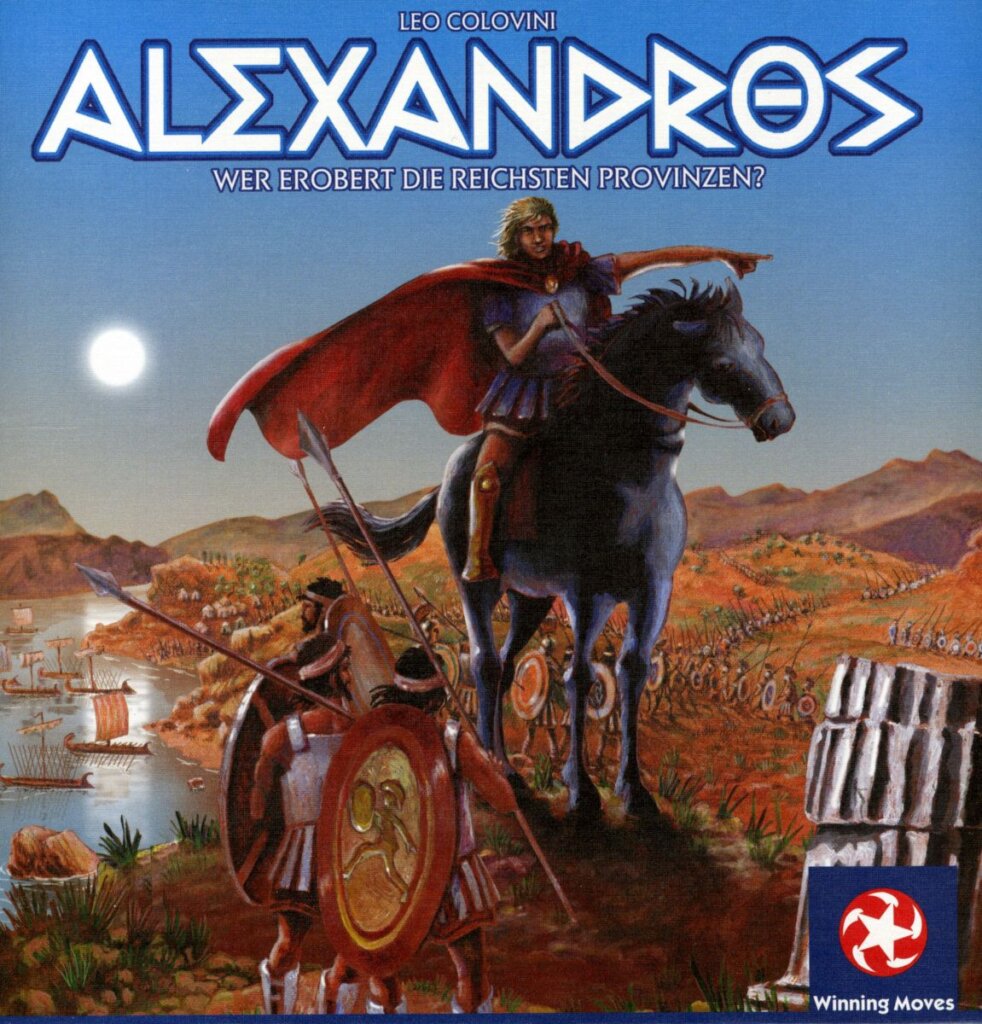
Alexandros
2003
Guide Alexandros across a triangular grid, create provinces, and use careful card management to claim points before the game ends.
45
minutes
2 - 4
player(s)
12+
Medium

About this board game
Alexandros is an abstract strategy game for 2–4 players, with sessions lasting about 45 minutes. Inspired by the military expansion of Alexander the Great, it challenges players to build valuable provinces, manage a limited hand of cards, and score more points than their opponents.
Cards drive every action in the game. On each turn, players must first move the figure representing Alexandros across a triangular grid by playing cards whose symbols match the destination spaces. As Alexandros moves, he leaves a trail of borders that gradually divides the board into provinces made from triangular spaces, some marked with symbols and others empty.
After moving Alexandros, a player may draw cards to build their hand, take over provinces, or trigger scoring when the board position is favorable. Provinces can be occupied by playing cards and placing leader tokens on spaces with matching symbols. Players may claim empty provinces or seize provinces controlled by other players, making timing and point-to-point movement central to the game.
- Card-driven gameplay: Use cards for movement, expansion, and placing leaders.
- Growing provinces: Alexandros’s trail creates borders and shapes the scoring opportunities on the board.
- Triggered scoring for all: Evaluate your actions in relation to what every player can gain.
- Limited generals: Each player has only four, and placing them costs valuable cards.
When scoring is triggered, provinces earn points equal to the number of empty spaces they contain. This creates a constant balance between creating worthwhile provinces, protecting control, and deciding when to make scoring happen. The game ends when the trail or border markers are depleted or when someone reaches 100 points; the player with the most points wins.
Released in 2003, Alexandros was awarded “Best Family Strategy Game” by Games Magazine in 2005. Its combination of abstract planning, shifting borders, and shared scoring makes every movement matter.
/pic7182955.jpg)
