Lancaster
2011
Compete for England's counties, build your knighthood, influence Parliament, and join the struggle for France in a contest for power.
60
minutes
2 - 5
player(s)
10+
Medium

About this board game
Lancaster is a strategy board game for 2–5 players, played in about 60 minutes, in which ambitious aristocratic families compete to become the most powerful ally of England’s young King Henry V.
Set in 1413, the game follows Henry V’s plans to unify England and pursue the French crown. Each player develops their own knighthood while deploying individual knights throughout England, at their castle, and into conflicts with France.
Every turn, players send knights to important locations. Their choices determine which rewards they receive, how their personal resources develop, and how much influence their family can gain. In the counties, players compete directly with rival knights and seek the favor of the nobles.
- Counties: Compete for rewards and noble favor, with stronger knights able to remove opposing knights from the same location.
- The castle: Gain income or recruit new knights to strengthen your family.
- Conflicts with France: Combine the power of all players and strive to gain power points.
- Parliament: Attempt to push through laws that benefit your family most.
Strength matters in county contests, but success also depends on clever deployment and deciding where your knights can make the greatest difference. Players must balance competition at home with the collective effort against France while pursuing advantages in Parliament.
At the end of the game, the family with the most power points wins. With its combination of knight placement, rivalry for locations, parliamentary influence, and shared conflicts, Lancaster presents a focused contest to determine who will become the most powerful lord of the time.
/pic7182955.jpg)
Board Game Rules for
Lancaster
A game by Matthias Cramer for 2 – 5 players aged 12 years and up
In the year of 1413 – the new King of England, Henry V of Lancaster, pursues ambitious plans: the unification of England and the conquest of the French Crown! Each player is the leader of their own aspiring noble family. Who will become a true supporter of the young King and thus the most powerful Lord of their time?
Object of the game
The players want to proceed from simply being a Lord to the most powerful ally of the king. They may achieve this by developing their own knighthood as well as by clever deployment of individual knights in the counties of England, at their own castle and to conflicts with France. In parliament, they try to push laws from which they will benefit themselves most. The player with the most power points at the end of the game is the winner.
Round Structure
Randomly determine a start player, give them the start player marker. The players take their turns in clockwise direction.

The game is played over five game rounds.
Each round consists of 3 Phases:
 1: Place knights
 2: Parliament
 3: Rewards
Please note: There are special rules for a 2-player-game, please see page 7.
Phase 1: Place knights
The active player takes one of their own knights from their court and places him on a knight’s space. Then, the next player does likewise, etc., until the players have placed all their knights. If a player has no more knights at their court, their turn is skipped. If only one player remains with knights at their court, they place them successively one after another.
There are possible 3 locations for placing knights:
- County
- Castle
- Conflict
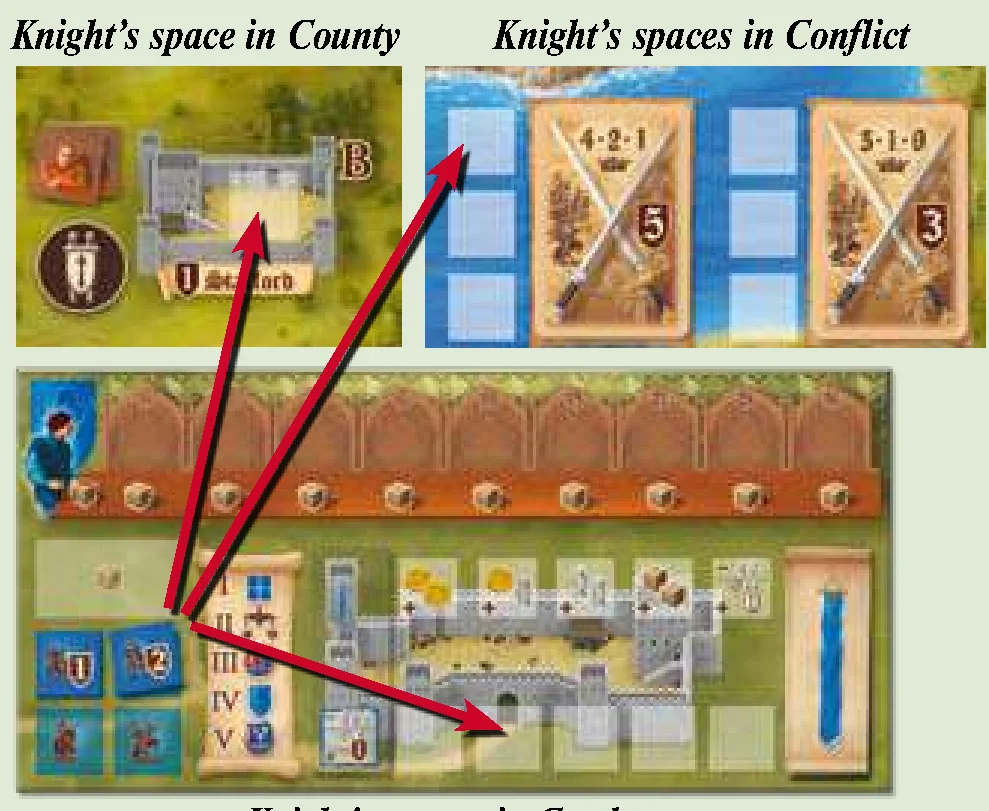
Please note: The knights gain various kinds of rewards for their players, either immediately or later during phase 3.
County
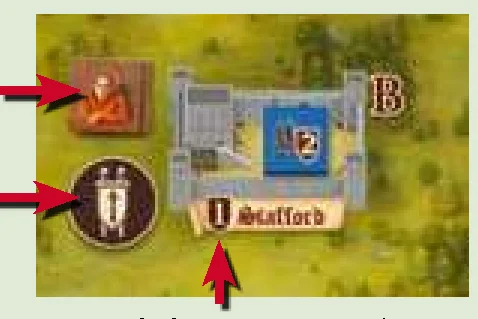
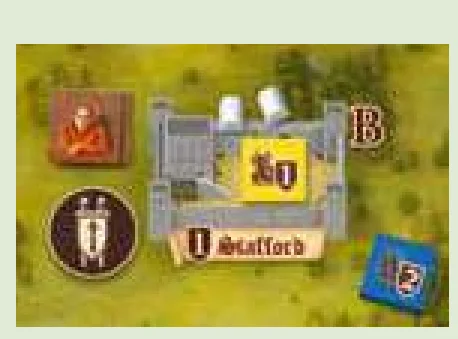
In counties, a knight can be placed on an empty or an occupied space. In both cases, the knight himself must match or exceed the demanded minimum strength.
Additionally, the player may place as many squires as they wish along with their knight.
Each squire adds 1 strength point, which does not count against the demanded minimum strength.
In case the space is occupied by another player’s knight, that knight can be expelled if the strength of the active player’s knight or the combined strength of the knight and his squires exceeds the former occupant’s strength. A player can never expel their own knight.
The expelled knight goes back to the court of his owner and is placed again on the board in turn order; put any accompanying squires back to the general supply.
Please note: A knight and his squires must be placed at the same time, later reinforcements are not allowed.
Castle
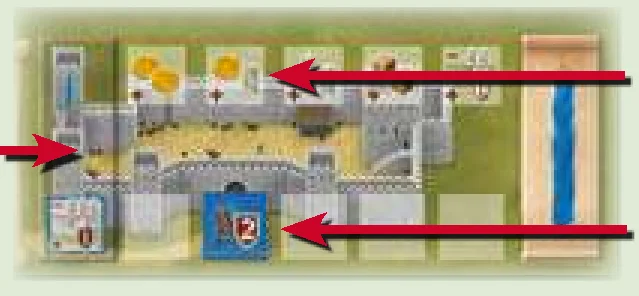
The player places their knight on an empty knight’s space in their own castle. Each space can hold only one knight.
Conflict
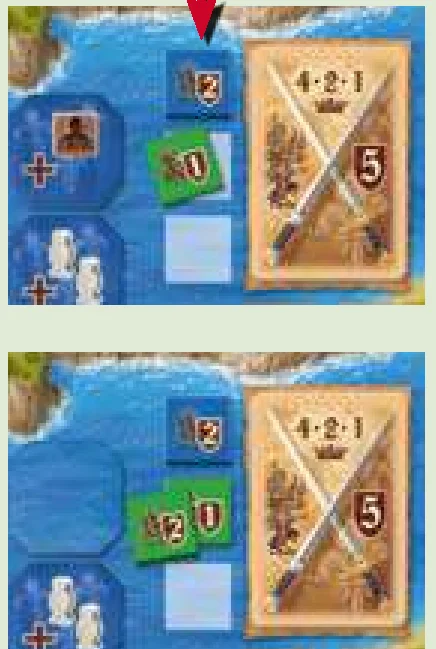
A player may engage in as many conflicts as they wish. The player selects a conflict and places their knight on the topmost empty knight’s space. Each player may occupy only one of the three spaces of each single conflict.
A player already engaged in a certain conflict may reinforce their strength by stacking their knights.
Immediate reward:
The first 6 knights earn the “king’s favor” for their players. The player selects one favor tile from the open display and receives the shown reward. Next, reverse the tile; it cannot be selected during this round again.
Please see the extra sheet for a detailed summary of rewards.
Please note: Knights may be stacked upon each other only at a conflict. No squires are used in a conflict
Phase 2: Parliament
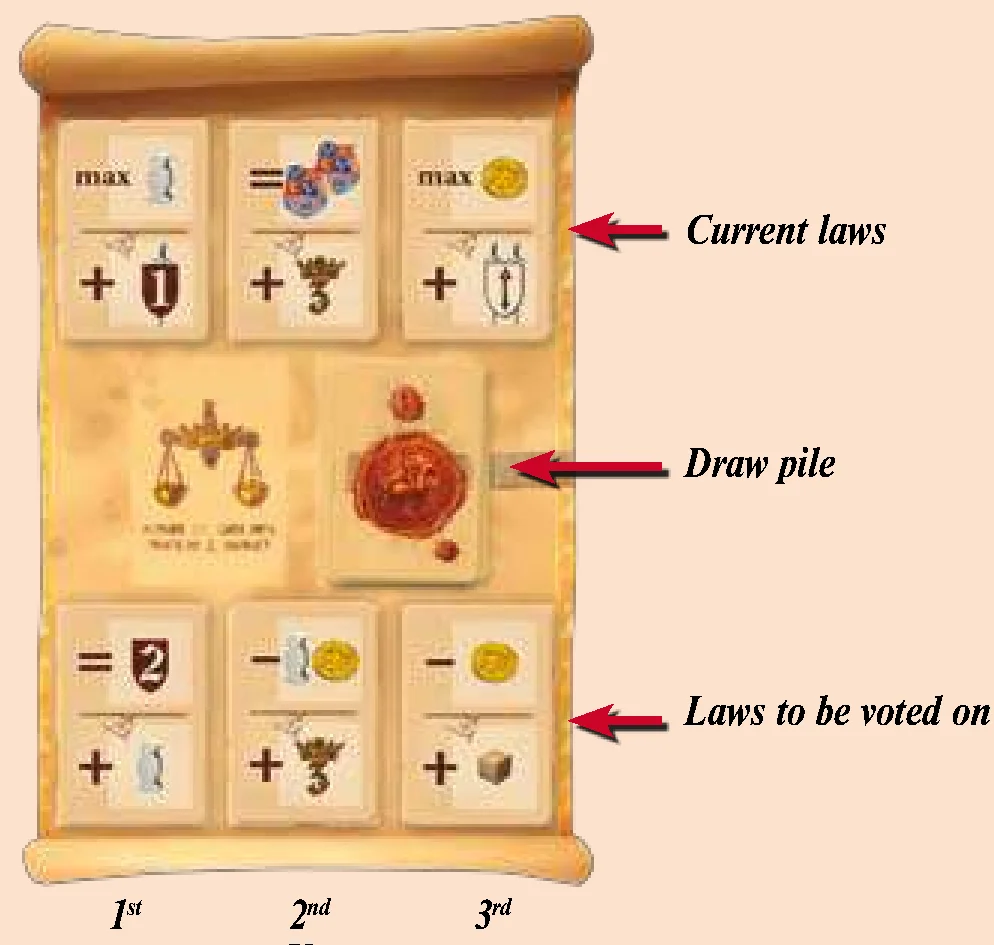
After the last knight has been placed, the English Parliament is gathering. The players must vote on the 3 new laws, one after the other. They begin with the law of space 1, bottom row left.
Voting procedure
- All players vote simultaneously and secretly. They decide for or against the law and place the appropriate voting tile face down in front of themselves.
- Next, all players may enforce their decision secretly by using as many voting markers as they like.
- After all players have taken their enforcements in their hand, they simultaneously put the markers on the table and reveal their voting tiles.

Voting result
The players now tally all votes for and against the law. Each voting tile and each voting marker counts as 1 vote.
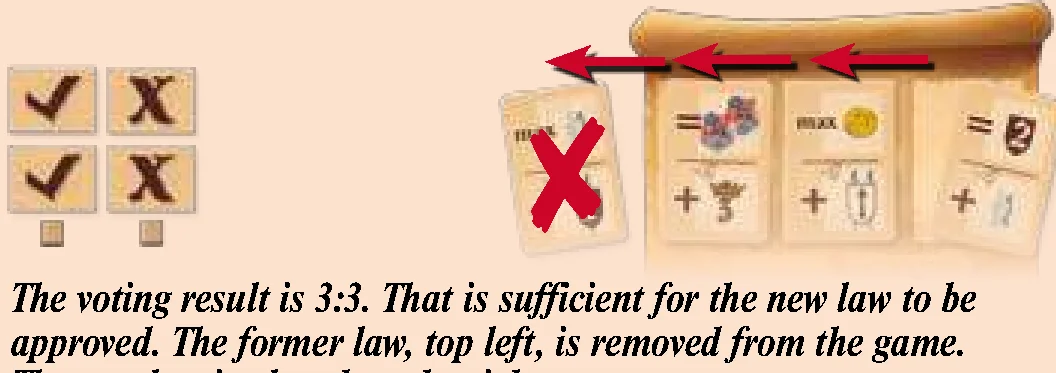
The majority wins. In case of a draw, the law is approved.
Put all used voting markers back to the general supply.
The new law is approved
Remove the former law (top left, upper row) from the Parliament display. Then, slide both other laws one position from left to right and place the new law on the empty space to the right.
The new law is rejected
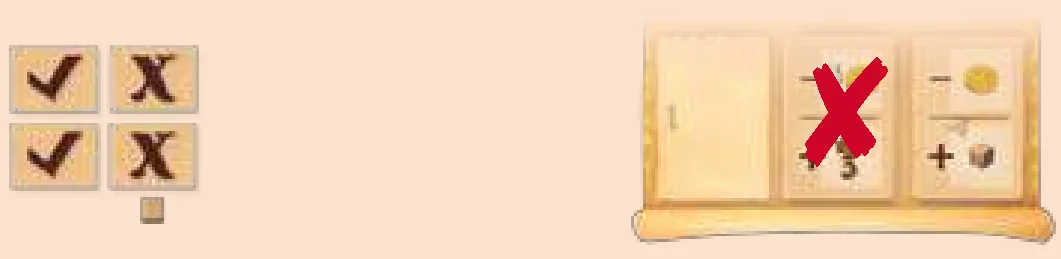
Remove the rejected law from the game and leave the former laws unchanged.
Use the same procedure for voting on the 2nd and 3rd new law.
Players still holding voting markers after the completion of all three votes return them to the general supply.
Implementation of the 3 applicable laws
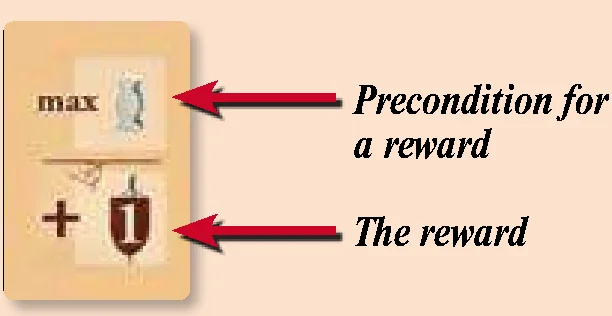
After all voting has been done, there are always three applicable laws. They are applied from left to right and the players gain rewards. Please see page 8 for a detailed summary of laws.
Phase 3: Rewards
Counties, castles and conflicts are evaluated in this order.
Please see extra sheet for a detailed summary of rewards.
Counties
All 9 counties yield their rewards from A to I, in this order. The concerned player always must choose one of three options:
- Take one nobleman tile from that county.
- Take the other shown reward of that county.
- Pay 3 gold (into the general supply) and take both – first the nobleman tile, then the other reward shown.
After the player has collected their reward, they take their knight back to their court. If the knight was supported by squires, put them back to the general supply.
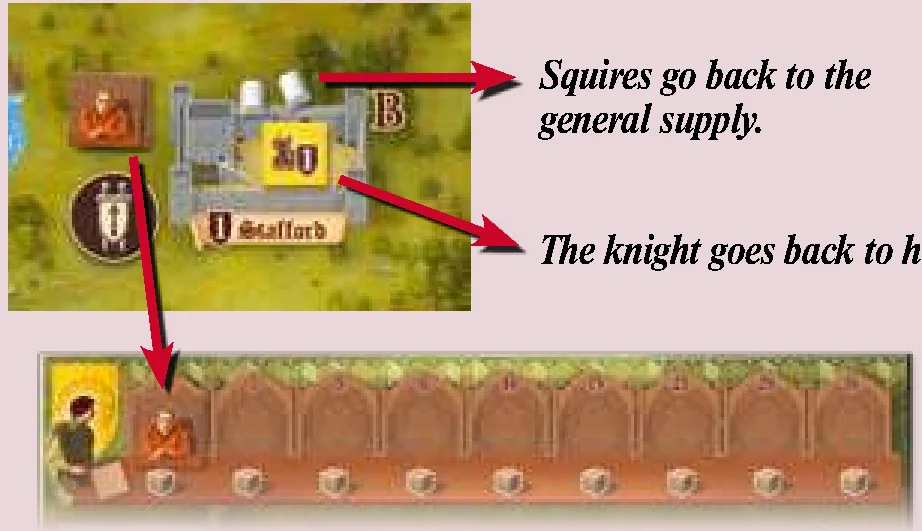
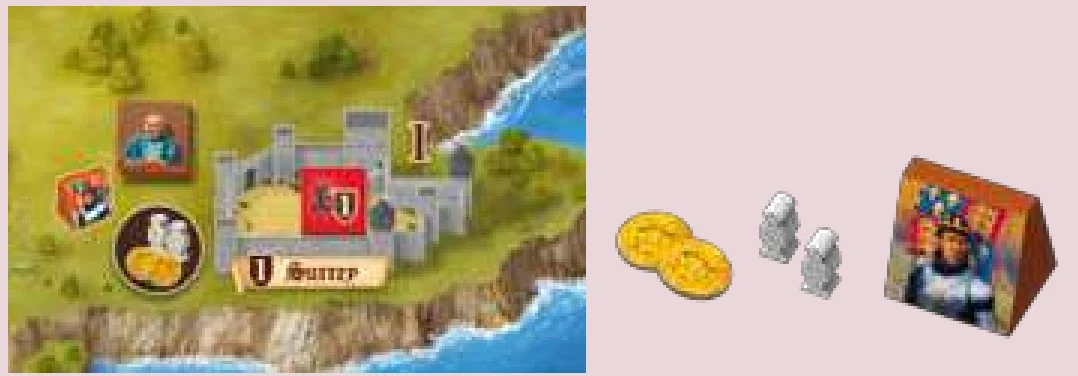
Special in Surrey (I): Determine the start player
In Surrey, the player additionally determines the start player, besides collecting their reward. They may determine any player, including themselves. The start player takes the start player marker (or retains it) and the new (or former) player order is effective immediately. If no knight was placed in Surrey, the current start player retains the marker.
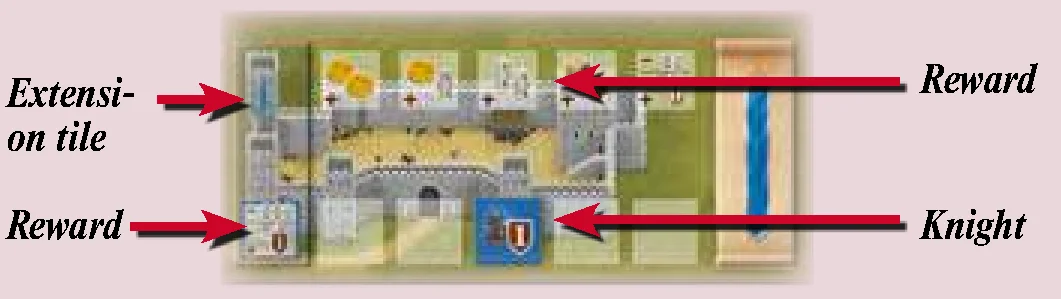
Castles
First, the start player scores their complete castle, followed by the other players in clockwise direction.
Each player receives the shown rewards for:
- Knights placed in their castle
- Existing extensions
- Company at table
The player decides about the order to evaluate their knights and extensions any way they like.
After scoring a knight, the player takes the knight back to their court, scored extension tiles remain at the castle.
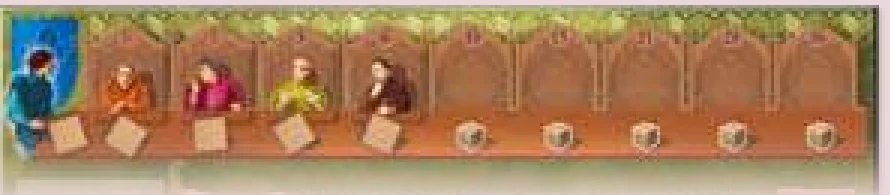
Next, the player scores their company at table. For each present nobleman, including themselves, the player receives 1 voting marker. Voting markers are placed on the player’s castle tableau visible for all players. The players do not receive voting markers in the fifth, final game round.
Please note: The nobleman tiles are worth additional power points during final scoring.
Conflicts
Finally, the conflicts in France are resolved one after the other and the players gain power points.
Please note: If there are any conflict cards in the lower row these should be scored first, followed by the conflict cards in the upper row.
Resolving a conflict is done in 2 steps:
- Winner of conflict: England or France
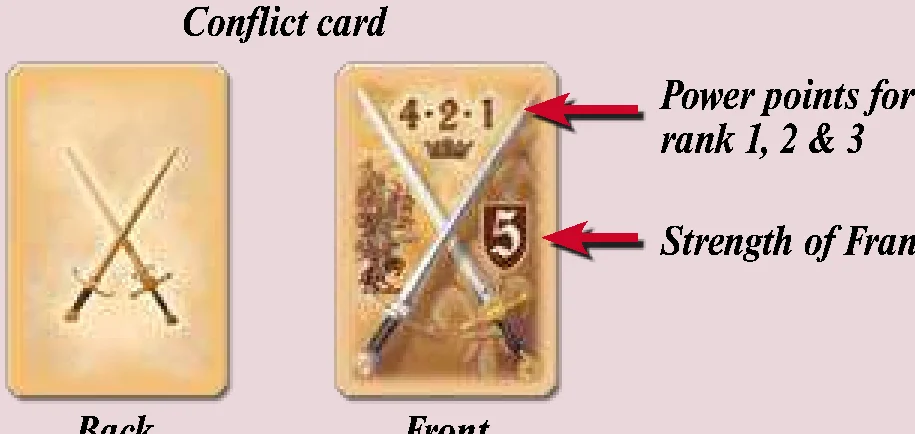
Add the strength of all knights involved in this conflict. If their combined strength is equal to or exceeds the strength of France, the winner is England. If their combined strength is less than the strength of France, the winner is France. - Each player’s contribution:
Determine a player ranking by totaling the strength of each player’s knights involved in this conflict. In case of a draw, that player who entered the conflict later ranks higher, i. e. the player whose knights are at a lower position of the 3 knight’s spaces.
Assigning power points:
- England wins the conflict: The three power point scores are awarded to the players. The highest-ranking player receives the highest score, the second highest-ranking player receives the next score and the lowest ranking player receives the lowest score. Remove the conflict card and the players take their knights back to their courts.
Please note: If no player occupies rank 2 or 3, nobody gains the corresponding power points.
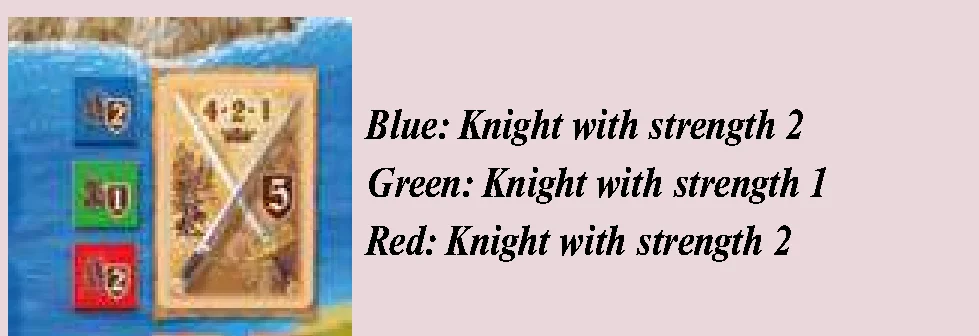
- France wins the conflict: Even if France wins the conflict, the players score power points. The highest score is not awarded; the second score is awarded for rank 1 and the lowest score for rank 2. All knights remain on their spaces.
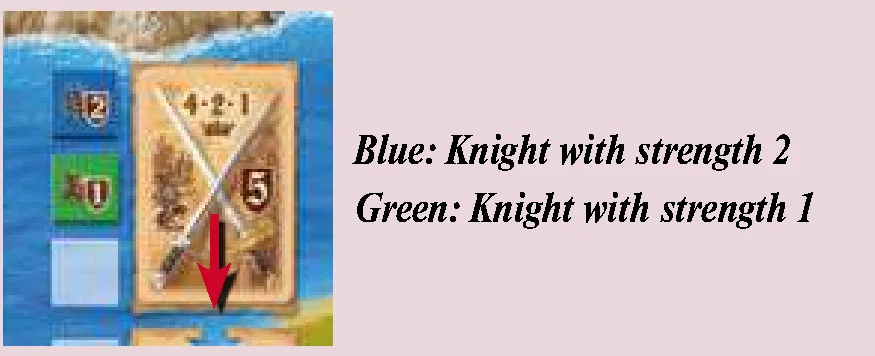
This conflict lingers on and there will be a second battle. Move the conflict card and the associated knights down to the lower row, without changing the order of the knights. - England wins the second battle: The same rules apply as for the first battle.
- France wins the second battle: Again, power points are awarded as for the first battle, but the involved knights are being captured. The players may ransom their knights by paying 1 gold per strength level; this is done in given player order. If a player pays for their knights, they return home to their court, otherwise they are placed on the corresponding reserve area of the game board. Remove the conflict card from the game.
Please note: If no knights were deployed to a conflict, this conflict is lost for England and the card is moved down to the lower row.
Preparing the next game round
Prepare the next game round after scoring of all conflicts is complete.
- Conflict: Reveal two new conflict cards and place them in the upper row. All face down tiles “king’s favor” are flipped face open.
- Parliament: Reveal 3 new laws from the top of the draw pile, one after the other, and place them on the 3 spaces for new laws, from left to right.
End of the game and final scoring
A final scoring takes place after the fifth game round. Power points are awarded as follows:
- 8 power points for the player with the highest strength total of their knighthood. The runner-up gains 4 power points. In case of a draw the player with more squires wins the power points.
- 8 power points for the player with the most extension tiles in their castle. The runner-up gains 4 power points. In case of a draw the player with more gold wins the power points.
- Power points are awarded to all players with more than 1 nobleman tile attending their company of table.
Please note: Knights in the reserve area do not belong to the knighthood.
Hint: If a there is still a draw for the first position after considering the number of squires, divide the 12 power points (8 + 4) by the number of tied players and award them accordingly.
If 1 player holds the first position and several players tie for second position, divide the 4 power points by the number of tied players and award them accordingly. Any indivisible points are lost.

The game ends now. The player with the most power points is the winner of the game.
In case of a draw, the concerned players share the victory.
Rules for a 2-player-game
Use the rules for 4 players, with following amendments:
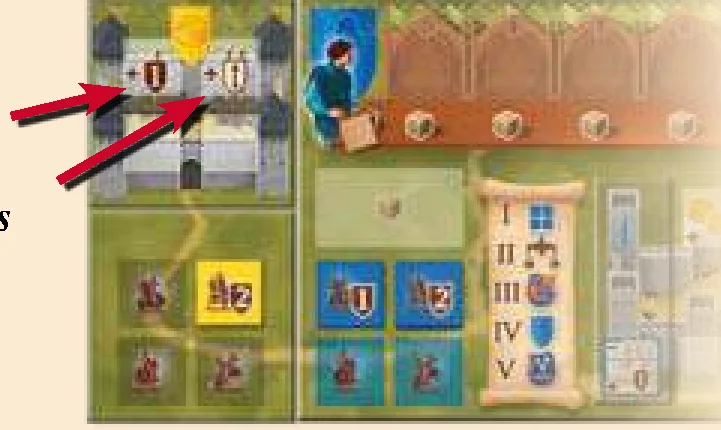
Both players have an ally. The allies have a small castle of their own, which cannot be extended. Each player takes the decisions for their ally and places their knights.
They do not receive power points, voting markers, gold, or squires. Special rules concerning other rewards are explained below. The players may not use their gold or their squires for their ally’s knights.
Setup
- Leave the screens in the box, they are not used. A player’s gold and squires are visible for their opponent.
- Place 2 nobleman tiles in each county.
- Each player selects the color of their ally and receives additionally:
- 2 ally boards (1 x front “castle”/ 1 x back court)
- 7 knights of their ally. Place 1 knight with strength 2 at the court, the 6 remaining knights go to the reserve.
Sequence of Play
Phase 1: Place knights
The active player places either one of their own knights or one of their ally’s knight.
The players may deploy their ally’s knights to all counties, all conflicts and to the ally’s own castle.
- County: The ally’s knights cannot be supported by squires. A player may not expel any knights of their own or of their ally.
- Castle: A player may not place their own knights in the castle of their ally and vice versa.
- Conflict: A player may place their own knights and those of their ally on the same conflict card, but they may not share the same knight’s space.
If an ally gains the king’s favor, the reward is handled as follows:
- Gold/squires: The reward is obsolete.
- Upgrade: Upgrade the level of one ally’s knight by 1.
- Nobleman tile: Any nobleman tile of the player’s choice is removed from the game.
Phase 2: Parliament
Allies are not allowed to vote. Regarding the laws, the ally’s knights are not considered the player’s own knights. Allies do not receive any rewards from laws.
Phase 3: Rewards
- County: An ally may make use of the following rewards:
- A new knight with strength 1 for themselves
- Upgrade one of their own knights
- Nobleman tile – remove from the game
- Passage to France
Any other rewards are obsolete.
- Special Surrey: If an ally is placed in Surrey, the allied player determines the start player.
- The ally’s castle: No squires must be expended for new knights and upgrades.
- Conflict: When checking the contribution of each player, the allies are considered players of their own. According to their strength, each player and ally has their own rank. Forfeit any power points for an ally. An ally’s captured knights cannot be ransomed, place them in the reserve.
End of the game for 2 players
- The allies are not considered during the final scoring.
- Only the 8 power points for the first position are awarded when evaluating the strength of the knighthood and the amount of extensions.
Summary of laws
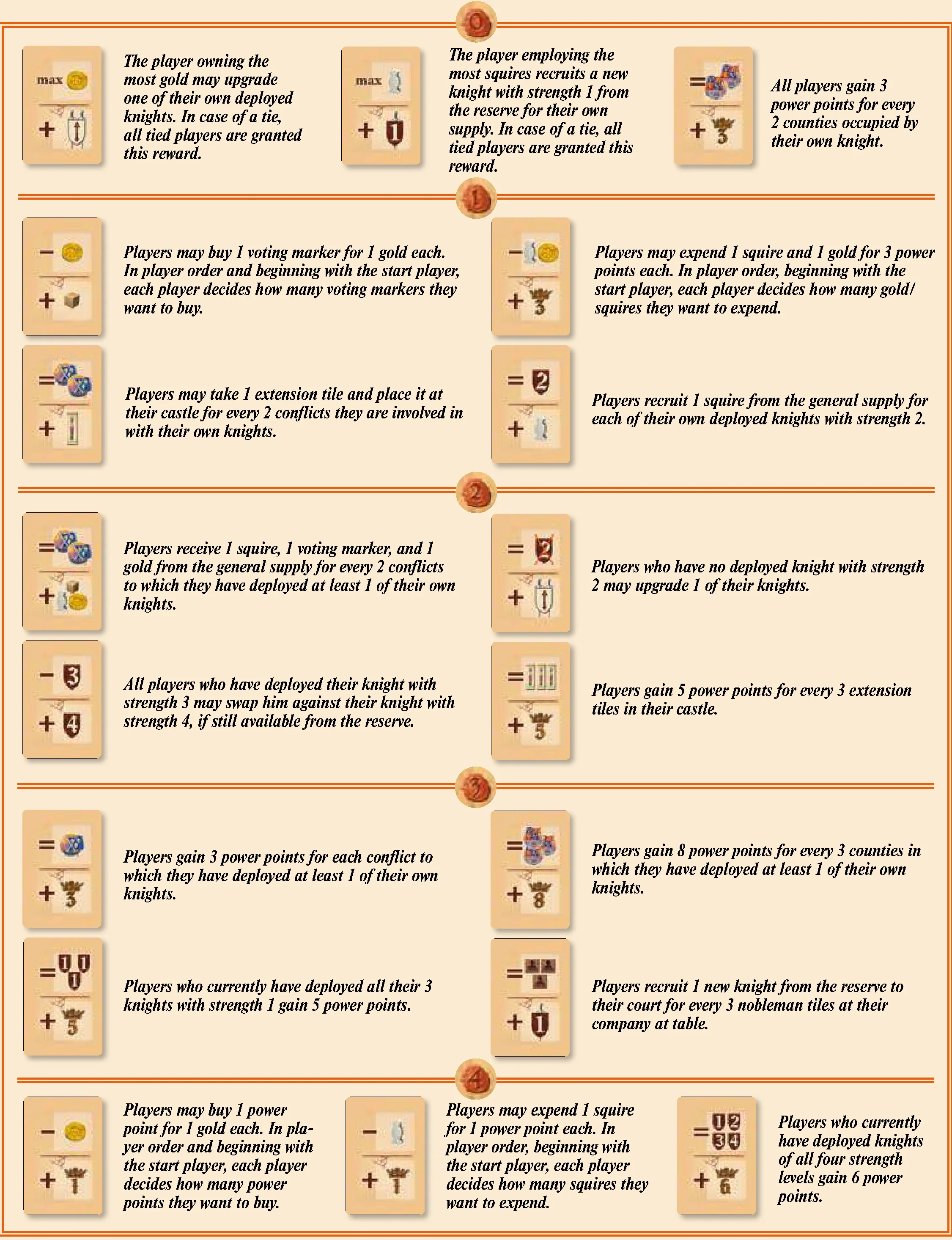
- The player owning the most gold may upgrade one of their own deployed knights. In case of a tie, all tied players are granted this reward.
- The player employing the most squires recruits a new knight with strength 1 from the reserve for their own supply. In case of a tie, all tied players are granted this reward.
- All players gain 3 power points for every 2 counties occupied by their own knight.
- Players may buy 1 voting marker for 1 gold each. In player order and beginning with the start player, each player decides how many voting markers they want to buy.
- Players may expend 1 squire and 1 gold for 3 power points each. In player order, beginning with the start player, each player decides how many gold/squires they want to expend.
- Players may take 1 extension tile and place it at their castle for every 2 conflicts they are involved in with their own knights.
- Players recruit 1 squire from the general supply for each of their own deployed knights with strength 2.
- Players receive 1 squire, 1 voting marker, and 1 gold from the general supply for every 2 conflicts to which they have deployed at least 1 of their own knights.
- Players who have no deployed knight with strength 2 may upgrade 1 of their knights.
- All players who have deployed their knight with strength 3 may swap him against their knight with strength 4, if still available from the reserve.
- Players gain 5 power points for every 3 extension tiles in their castle.
- Players gain 3 power points for each conflict to which they have deployed at least 1 of their own knights.
- Players gain 8 power points for every 3 counties in which they have deployed at least 1 of their own knights.
- Players who currently have deployed all their 3 knights with strength 1 gain 5 power points.
- Players recruit 1 new knight from the reserve to their court for every 3 nobleman tiles at their company at table.
- Players may buy 1 power point for 1 gold each. In player order and beginning with the start player, each player decides how many power points they want to buy.
- Players may expend 1 squire for 1 power point each. In player order, beginning with the start player, each player decides how many squires they want to expend.
- Players who currently have deployed knights of all four strength levels gain 6 power points.
Introduction & Object of the Game
A game by Matthias Cramer for 2 – 5 players aged 12 years and up
In the year of 1413 – the new King of England, Henry V of Lancaster, pursues ambitious plans: the unification of England and the conquest of the French Crown! Each player is the leader of their own aspiring noble family. Who will become a true supporter of the young King and thus the most powerful Lord of their time?
Object of the game
The players want to proceed from simply being a Lord to the most powerful ally of the king. They may achieve this by developing their own knighthood as well as by clever deployment of individual knights in the counties of England, at their own castle and to conflicts with France. In parliament, they try to push laws from which they will benefit themselves most. The player with the most power points at the end of the game is the winner.
Sequence of Play Overview
Round Structure
Randomly determine a start player, give them the start player marker. The players take their turns in clockwise direction.
The game is played over five game rounds.
Each round consists of 3 Phases:
- 1: Place knights
- 2: Parliament
- 3: Rewards
Please note: There are special rules for a 2-player-game, please see page 7.
Phase 1: Place Knights
Phase 1: Place knights
The active player takes one of their own knights from their court and places him on a knight’s space. Then, the next player does likewise, etc., until the players have placed all their knights. If a player has no more knights at their court, their turn is skipped. If only one player remains with knights at their court, they place them successively one after another.
There are possible 3 locations for placing knights:
- County
- Castle
- Conflict
Please note: The knights gain various kinds of rewards for their players, either immediately or later during phase 3.
County
In counties, a knight can be placed on an empty or an occupied space. In both cases, the knight himself must match or exceed the demanded minimum strength.
Additionally, the player may place as many squires as they wish along with their knight.
Each squire adds 1 strength point, which does not count against the demanded minimum strength.
In case the space is occupied by another player’s knight, that knight can be expelled if the strength of the active player’s knight or the combined strength of the knight and his squires exceeds the former occupant’s strength. A player can never expel their own knight.
The expelled knight goes back to the court of his owner and is placed again on the board in turn order; put any accompanying squires back to the general supply.
Please note: A knight and his squires must be placed at the same time, later reinforcements are not allowed.
Castle
The player places their knight on an empty knight’s space in their own castle. Each space can hold only one knight.
Conflict
A player may engage in as many conflicts as they wish. The player selects a conflict and places their knight on the topmost empty knight’s space. Each player may occupy only one of the three spaces of each single conflict.
A player already engaged in a certain conflict may reinforce their strength by stacking their knights.
Immediate reward:
The first 6 knights earn the “king’s favor” for their players. The player selects one favor tile from the open display and receives the shown reward. Next, reverse the tile; it cannot be selected during this round again.
Please see the extra sheet for a detailed summary of rewards.
Please note: Knights may be stacked upon each other only at a conflict. No squires are used in a conflict
Phase 2: Parliament
Phase 2: Parliament
After the last knight has been placed, the English Parliament is gathering. The players must vote on the 3 new laws, one after the other. They begin with the law of space 1, bottom row left.
Voting procedure
- All players vote simultaneously and secretly. They decide for or against the law and place the appropriate voting tile face down in front of themselves.
- Next, all players may enforce their decision secretly by using as many voting markers as they like.
- After all players have taken their enforcements in their hand, they simultaneously put the markers on the table and reveal their voting tiles.
Voting result
The players now tally all votes for and against the law. Each voting tile and each voting marker counts as 1 vote.
The majority wins. In case of a draw, the law is approved.
Put all used voting markers back to the general supply.
The new law is approved
Remove the former law (top left, upper row) from the Parliament display. Then, slide both other laws one position from left to right and place the new law on the empty space to the right.
The new law is rejected
Remove the rejected law from the game and leave the former laws unchanged.
Use the same procedure for voting on the 2nd and 3rd new law.
Players still holding voting markers after the completion of all three votes return them to the general supply.
Implementation of the 3 applicable laws
After all voting has been done, there are always three applicable laws. They are applied from left to right and the players gain rewards. Please see page 8 for a detailed summary of laws.
Phase 3: Rewards & Round End
Phase 3: Rewards
Counties, castles and conflicts are evaluated in this order.
Please see extra sheet for a detailed summary of rewards.
Counties
All 9 counties yield their rewards from A to I, in this order. The concerned player always must choose one of three options:
- Take one nobleman tile from that county.
- Take the other shown reward of that county.
- Pay 3 gold (into the general supply) and take both – first the nobleman tile, then the other reward shown.
After the player has collected their reward, they take their knight back to their court. If the knight was supported by squires, put them back to the general supply.
Special in Surrey (I): Determine the start player
In Surrey, the player additionally determines the start player, besides collecting their reward. They may determine any player, including themselves. The start player takes the start player marker (or retains it) and the new (or former) player order is effective immediately. If no knight was placed in Surrey, the current start player retains the marker.
Castles
First, the start player scores their complete castle, followed by the other players in clockwise direction.
Each player receives the shown rewards for:
- Knights placed in their castle
- Existing extensions
- Company at table
The player decides about the order to evaluate their knights and extensions any way they like.
After scoring a knight, the player takes the knight back to their court, scored extension tiles remain at the castle.
Next, the player scores their company at table. For each present nobleman, including themselves, the player receives 1 voting marker. Voting markers are placed on the player’s castle tableau visible for all players. The players do not receive voting markers in the fifth, final game round.
Please note: The nobleman tiles are worth additional power points during final scoring.
Conflicts
Finally, the conflicts in France are resolved one after the other and the players gain power points.
Please note: If there are any conflict cards in the lower row these should be scored first, followed by the conflict cards in the upper row.
Resolving a conflict is done in 2 steps:
- Winner of conflict: England or France
Add the strength of all knights involved in this conflict. If their combined strength is equal to or exceeds the strength of France, the winner is England. If their combined strength is less than the strength of France, the winner is France. - Each player’s contribution:
Determine a player ranking by totaling the strength of each player’s knights involved in this conflict. In case of a draw, that player who entered the conflict later ranks higher, i. e. the player whose knights are at a lower position of the 3 knight’s spaces.
Assigning power points:
- England wins the conflict: The three power point scores are awarded to the players. The highest-ranking player receives the highest score, the second highest-ranking player receives the next score and the lowest ranking player receives the lowest score. Remove the conflict card and the players take their knights back to their courts.
Please note: If no player occupies rank 2 or 3, nobody gains the corresponding power points.
- France wins the conflict: Even if France wins the conflict, the players score power points. The highest score is not awarded; the second score is awarded for rank 1 and the lowest score for rank 2. All knights remain on their spaces.
This conflict lingers on and there will be a second battle. Move the conflict card and the associated knights down to the lower row, without changing the order of the knights. - England wins the second battle: The same rules apply as for the first battle.
- France wins the second battle: Again, power points are awarded as for the first battle, but the involved knights are being captured. The players may ransom their knights by paying 1 gold per strength level; this is done in given player order. If a player pays for their knights, they return home to their court, otherwise they are placed on the corresponding reserve area of the game board. Remove the conflict card from the game.
Please note: If no knights were deployed to a conflict, this conflict is lost for England and the card is moved down to the lower row.
Preparing the next game round
Prepare the next game round after scoring of all conflicts is complete.
- Conflict: Reveal two new conflict cards and place them in the upper row. All face down tiles “king’s favor” are flipped face open.
- Parliament: Reveal 3 new laws from the top of the draw pile, one after the other, and place them on the 3 spaces for new laws, from left to right.
End of the Game & Final Scoring
End of the game and final scoring
A final scoring takes place after the fifth game round. Power points are awarded as follows:
- 8 power points for the player with the highest strength total of their knighthood. The runner-up gains 4 power points. In case of a draw the player with more squires wins the power points.
- 8 power points for the player with the most extension tiles in their castle. The runner-up gains 4 power points. In case of a draw the player with more gold wins the power points.
- Power points are awarded to all players with more than 1 nobleman tile attending their company of table.
Please note: Knights in the reserve area do not belong to the knighthood.
Hint: If a there is still a draw for the first position after considering the number of squires, divide the 12 power points (8 + 4) by the number of tied players and award them accordingly.
If 1 player holds the first position and several players tie for second position, divide the 4 power points by the number of tied players and award them accordingly. Any indivisible points are lost.
The game ends now. The player with the most power points is the winner of the game.
In case of a draw, the concerned players share the victory.
Rules for a 2-Player Game
Rules for a 2-player-game
Use the rules for 4 players, with following amendments:
Both players have an ally. The allies have a small castle of their own, which cannot be extended. Each player takes the decisions for their ally and places their knights.
They do not receive power points, voting markers, gold, or squires. Special rules concerning other rewards are explained below. The players may not use their gold or their squires for their ally’s knights.
Setup
- Leave the screens in the box, they are not used. A player’s gold and squires are visible for their opponent.
- Place 2 nobleman tiles in each county.
- Each player selects the color of their ally and receives additionally:
- 2 ally boards (1 x front “castle”/ 1 x back court)
- 7 knights of their ally. Place 1 knight with strength 2 at the court, the 6 remaining knights go to the reserve.
Sequence of Play
Phase 1: Place knights
The active player places either one of their own knights or one of their ally’s knight.
The players may deploy their ally’s knights to all counties, all conflicts and to the ally’s own castle.
- County: The ally’s knights cannot be supported by squires. A player may not expel any knights of their own or of their ally.
- Castle: A player may not place their own knights in the castle of their ally and vice versa.
- Conflict: A player may place their own knights and those of their ally on the same conflict card, but they may not share the same knight’s space.
If an ally gains the king’s favor, the reward is handled as follows:
- Gold/squires: The reward is obsolete.
- Upgrade: Upgrade the level of one ally’s knight by 1.
- Nobleman tile: Any nobleman tile of the player’s choice is removed from the game.
Phase 2: Parliament
Allies are not allowed to vote. Regarding the laws, the ally’s knights are not considered the player’s own knights. Allies do not receive any rewards from laws.
Phase 3: Rewards
- County: An ally may make use of the following rewards:
- A new knight with strength 1 for themselves
- Upgrade one of their own knights
- Nobleman tile – remove from the game
- Passage to France
Any other rewards are obsolete.
- Special Surrey: If an ally is placed in Surrey, the allied player determines the start player.
- The ally’s castle: No squires must be expended for new knights and upgrades.
- Conflict: When checking the contribution of each player, the allies are considered players of their own. According to their strength, each player and ally has their own rank. Forfeit any power points for an ally. An ally’s captured knights cannot be ransomed, place them in the reserve.
End of the game for 2 players
- The allies are not considered during the final scoring.
- Only the 8 power points for the first position are awarded when evaluating the strength of the knighthood and the amount of extensions.
Summary of Laws
Summary of laws
- The player owning the most gold may upgrade one of their own deployed knights. In case of a tie, all tied players are granted this reward.
- The player employing the most squires recruits a new knight with strength 1 from the reserve for their own supply. In case of a tie, all tied players are granted this reward.
- All players gain 3 power points for every 2 counties occupied by their own knight.
- Players may buy 1 voting marker for 1 gold each. In player order and beginning with the start player, each player decides how many voting markers they want to buy.
- Players may expend 1 squire and 1 gold for 3 power points each. In player order, beginning with the start player, each player decides how many gold/squires they want to expend.
- Players may take 1 extension tile and place it at their castle for every 2 conflicts they are involved in with their own knights.
- Players recruit 1 squire from the general supply for each of their own deployed knights with strength 2.
- Players receive 1 squire, 1 voting marker, and 1 gold from the general supply for every 2 conflicts to which they have deployed at least 1 of their own knights.
- Players who have no deployed knight with strength 2 may upgrade 1 of their knights.
- All players who have deployed their knight with strength 3 may swap him against their knight with strength 4, if still available from the reserve.
- Players gain 5 power points for every 3 extension tiles in their castle.
- Players gain 3 power points for each conflict to which they have deployed at least 1 of their own knights.
- Players gain 8 power points for every 3 counties in which they have deployed at least 1 of their own knights.
- Players who currently have deployed all their 3 knights with strength 1 gain 5 power points.
- Players recruit 1 new knight from the reserve to their court for every 3 nobleman tiles at their company at table.
- Players may buy 1 power point for 1 gold each. In player order and beginning with the start player, each player decides how many power points they want to buy.
- Players may expend 1 squire for 1 power point each. In player order, beginning with the start player, each player decides how many squires they want to expend.
- Players who currently have deployed knights of all four strength levels gain 6 power points.