Kitchen Rush
2017
A real-time cooperative kitchen challenge where hourglass workers race to serve customers, manage ingredients, and keep the restaurant profitable.
45
minutes
1 - 4
player(s)
12+
Medium

About this board game
Kitchen Rush is a real-time cooperative board game for 1–4 players that simulates the pressure of running a busy restaurant in about 45 minutes. Released in 2017, it challenges players to turn an old inherited restaurant into a successful business.
Across four rounds, each lasting four minutes, players use hourglasses as workers. Assigning an hourglass to an action space commits that worker until its sand runs out, so every placement matters and time is always limited.
Players must work together to keep the kitchen running efficiently. Their responsibilities include:
- Taking orders from customers
- Ordering the right ingredients and buying groceries
- Preparing dishes and serving them on time
- Cleaning plates
- Managing money for wages, expenses, and upgrades
The restaurant’s success depends on coordination and efficiency. Players need to judge which tasks require immediate attention, place their available workers wisely, and make sure enough money is earned during each round to cover the business’s costs while hopefully leaving a profit.
The hourglass worker-placement system gives Kitchen Rush its distinctive real-time character. Instead of waiting calmly for turns, players share the excitement of a high-pressure kitchen environment, where several jobs compete for limited time and attention.
Designed to appeal to gamers and family members alike, Kitchen Rush offers a full cooperative challenge in a compact four-round structure. Whether managing orders, ingredients, dishes, or finances, the team must stay focused from the first order to the final service.
/pic7182955.jpg)
Board Game Rules for
Kitchen Rush
Kitchen Rush
Dávid Turczi with Vangelis Bagiartakis
You’ve just inherited an old restaurant and you must turn it into a successful business! Hire personnel, order the right ingredients and be ready to serve the customers that enter your restaurant. The success will depend entirely on your efficiency in the kitchen!
Kitchen Rush is a real-time cooperative game in which you run a restaurant kitchen using hourglasses as workers. You need to take orders from customers, prepare their dishes, serve them on time and make sure enough money is made to cover wages, expenses, upgrades and hopefully, make a profit.
Components
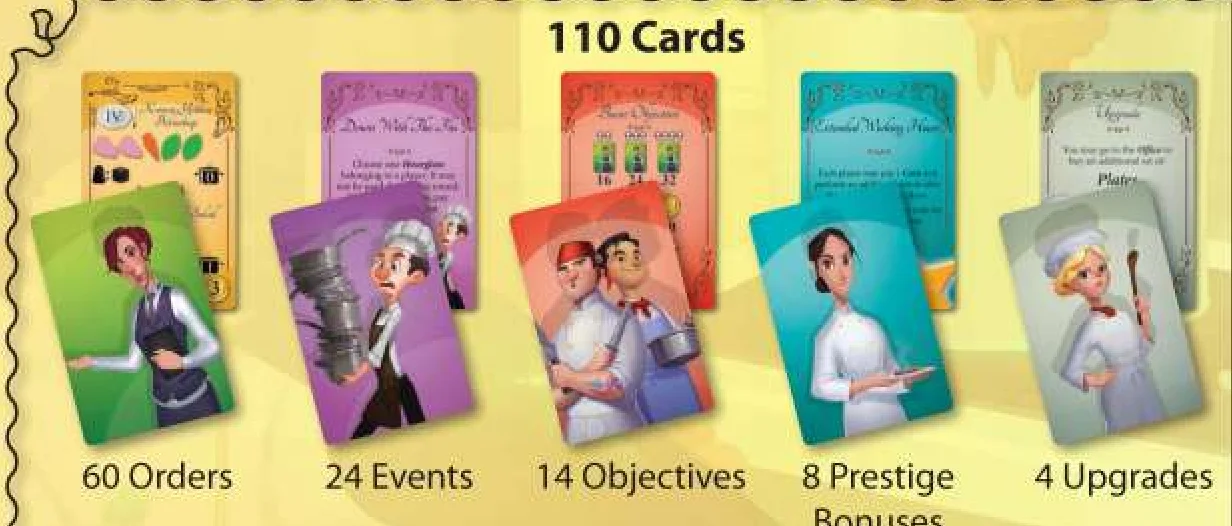
- 110 Cards:
- 60 Orders
- 24 Events
- 14 Objectives
- 8 Prestige Bonuses
- 4 Upgrades
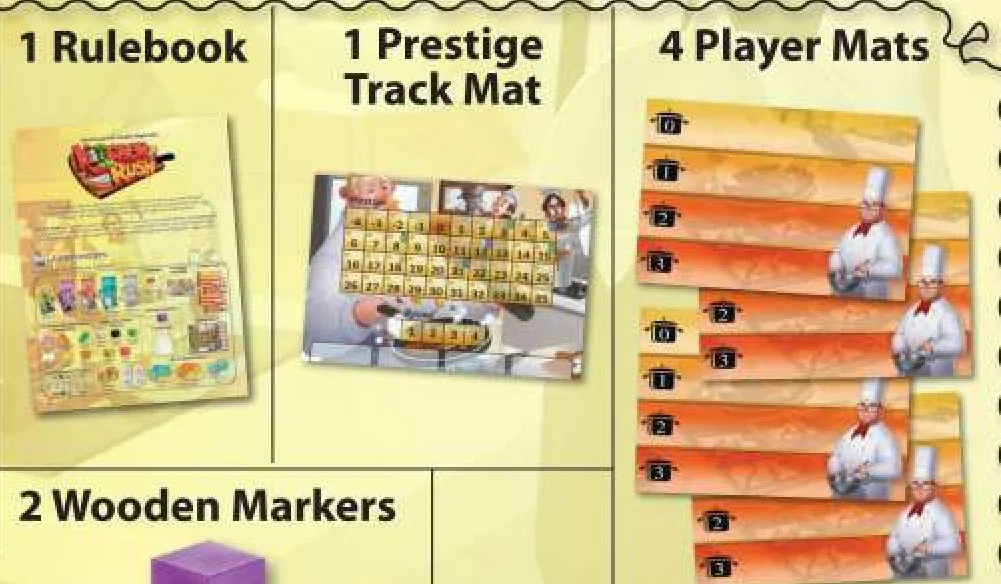
- 1 Rulebook
- 1 Prestige Track Mat
- 4 Player Mats
- 1 Game Board
- 2 Wooden Markers
- 1 Cloth Bag
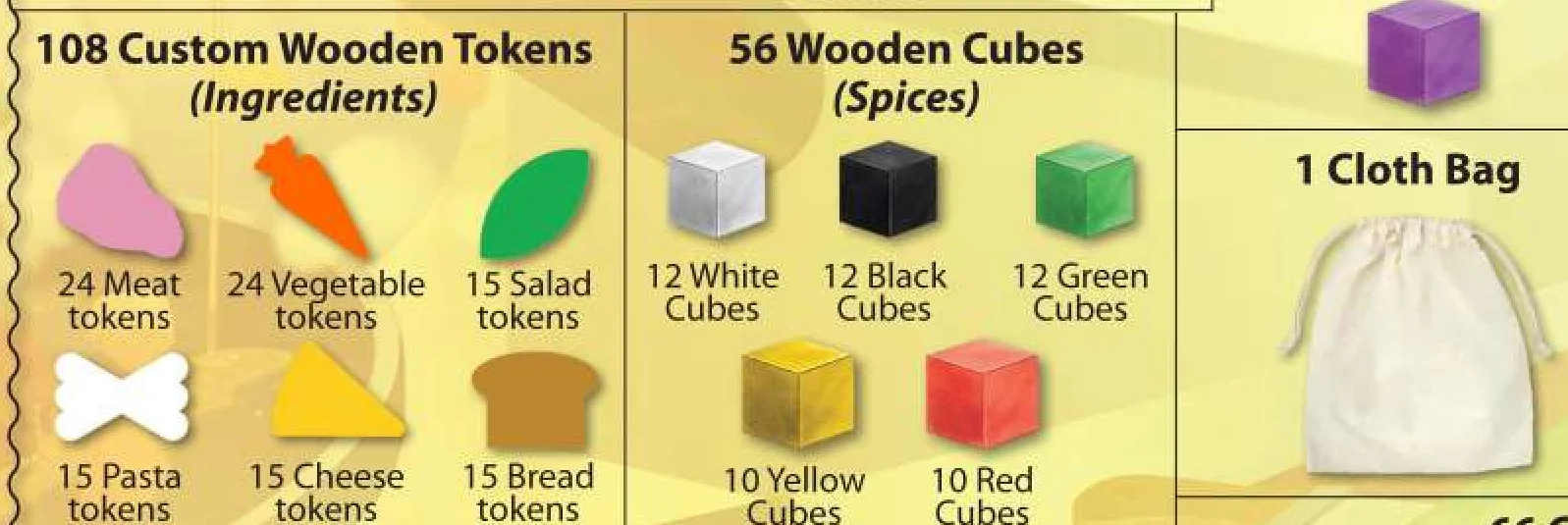
- 108 Custom Wooden Tokens (Ingredients):
- 24 Meat tokens
- 24 Vegetable tokens
- 15 Salad tokens
- 15 Pasta tokens
- 15 Cheese tokens
- 15 Bread tokens
- 56 Wooden Cubes (Spices):
- 12 White Cubes
- 12 Black Cubes
- 12 Green Cubes
- 10 Yellow Cubes
- 10 Red Cubes
- 10 Hourglasses (Workers)
- 66 Cardboard Tokens:
- 28 Money tokens (1s and 5s)
- 22 Plates (I, II, III, IV)
- 4 Locked tokens
- 7 Unavailable Action tokens
- 5 Malfunction tokens

Component Anatomy
Orders
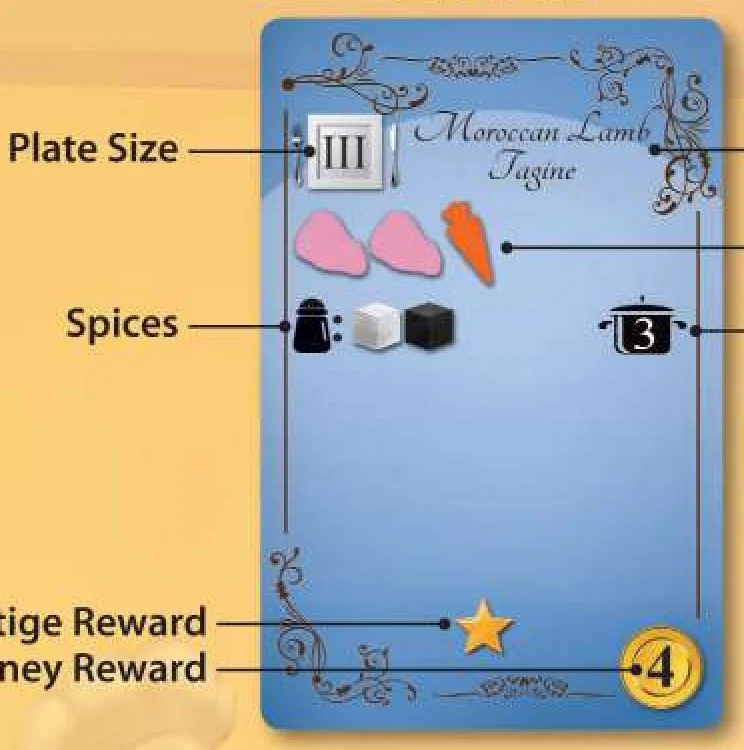
Orders feature a different background color based on their Prestige Reward (from 1 to 5 stars).
- Plate Size: Indicates the minimum plate size required (I, II, III, IV).
- Name of the Dish: Flavor name of the ordered meal.
- Ingredients: Required ingredient tokens to be placed on the plate.
- Spices: Required spice cubes to season the dish.
- Cooking Time: Number of times the dish must be cooked in the Oven.
- Prestige Reward: Stars gained if the order is successfully served.
- Money Reward: Coins earned upon completing the order.
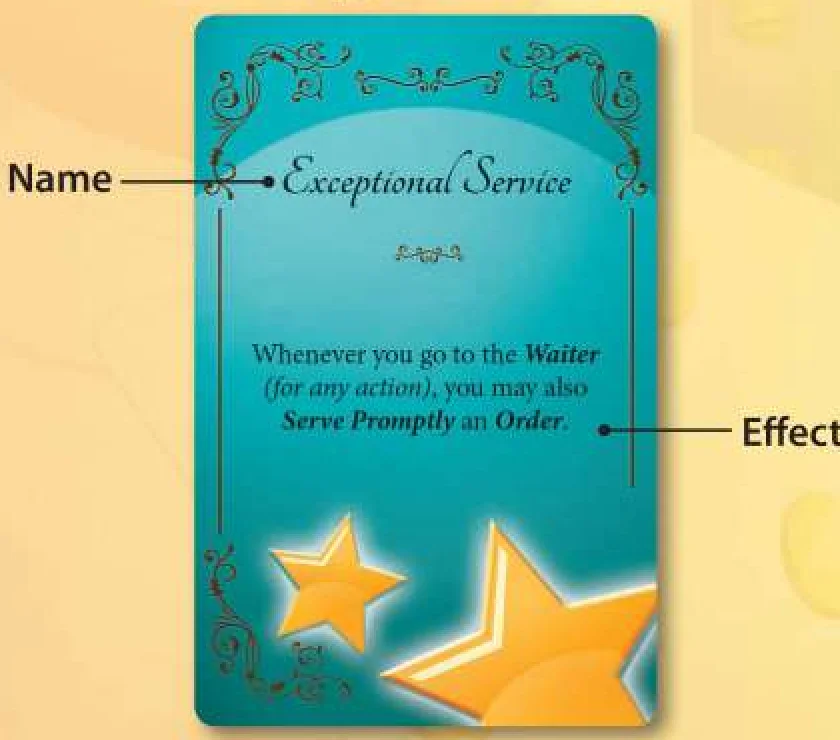
Upgrades
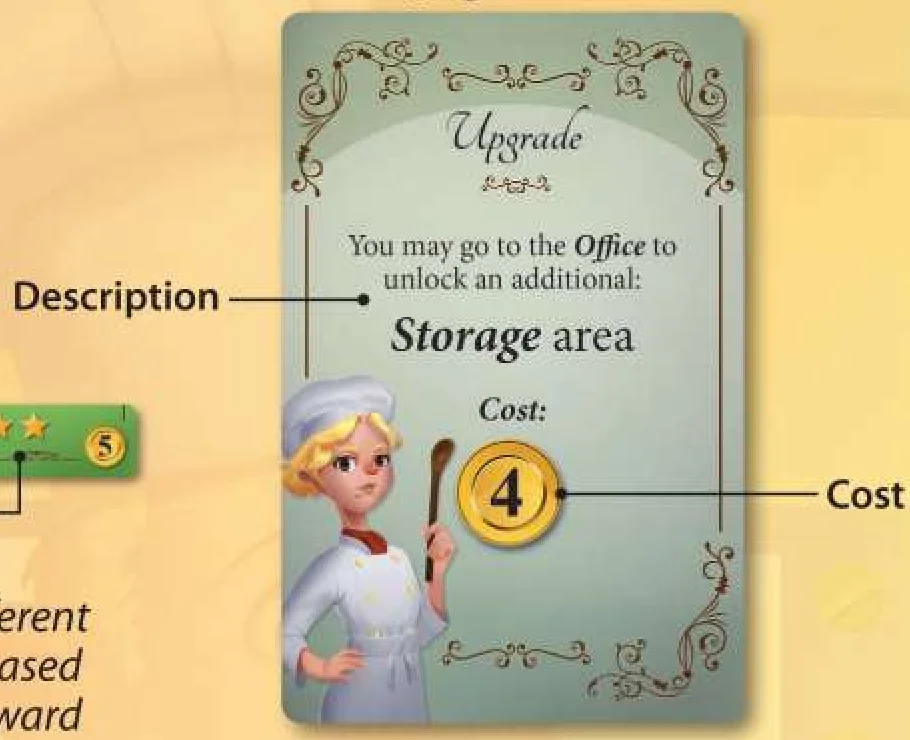
- Description: Special restaurant improvements or additional areas that can be unlocked.
- Cost: Amount of coins needed to purchase the upgrade at the Office.
Events
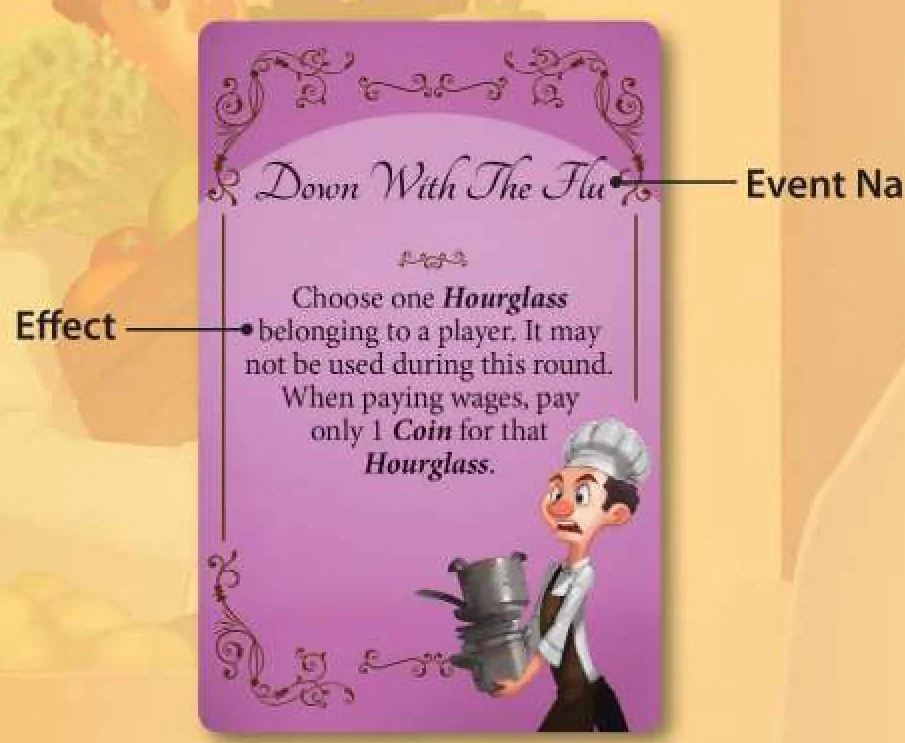
- Event Name: Title of the event.
- Effect: Special condition or restriction applied during that round.
Prestige Bonuses
- Name: The title of the bonus.
- Effect: A helpful benefit granted once reached on the Prestige Track.
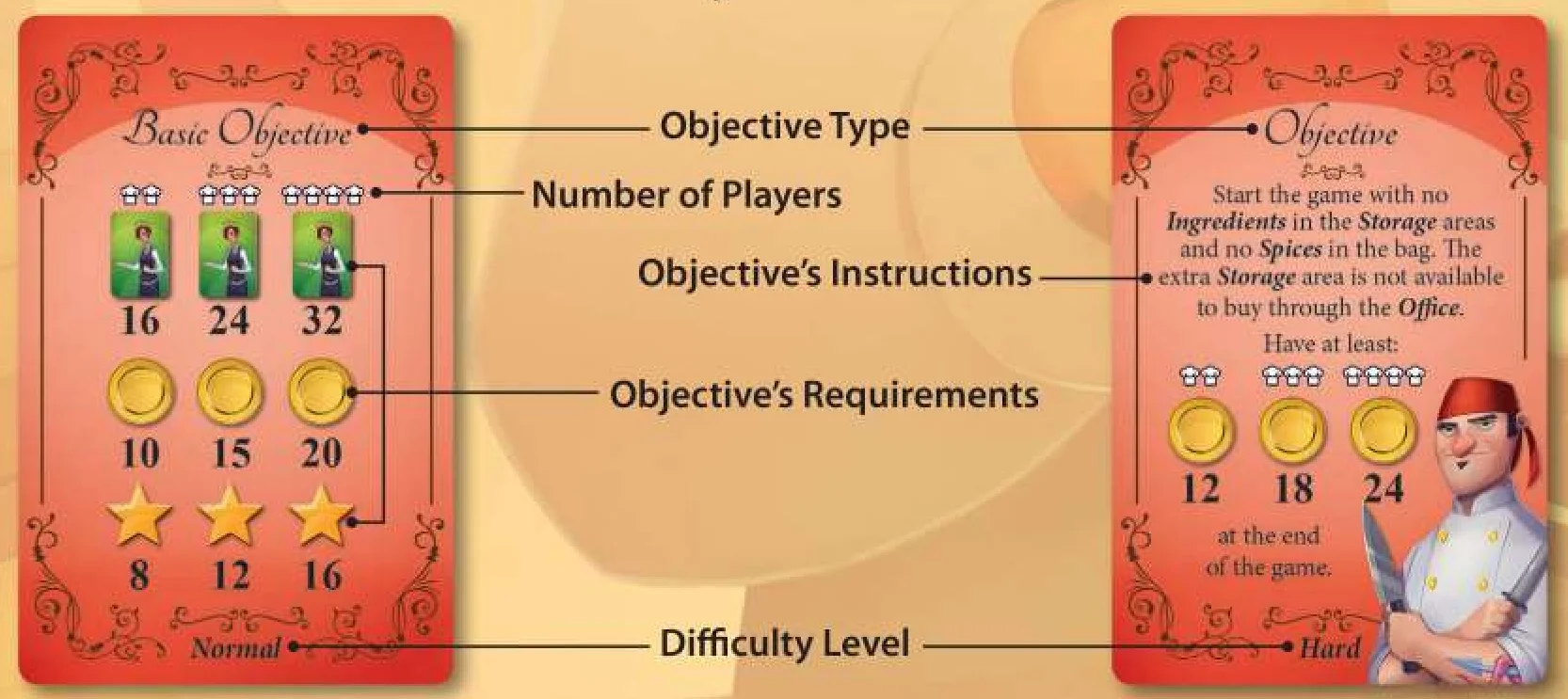
Objectives
There are 4 Basic Objectives corresponding to the 4 difficulty levels and 10 specialized Objectives (of either Normal or Hard difficulty) that give you more specific requirements to meet.
- Objective Type: Basic Objective or specialized Objective.
- Number of Players: Specific target values tailored to player count.
- Objective’s Instructions: Special setup rules, constraints, or scoring conditions.
- Objective’s Requirements: Targets that must be achieved by game end (Orders served, Money, Prestige).
- Difficulty Level: Easy, Normal, Hard, or Very Hard.
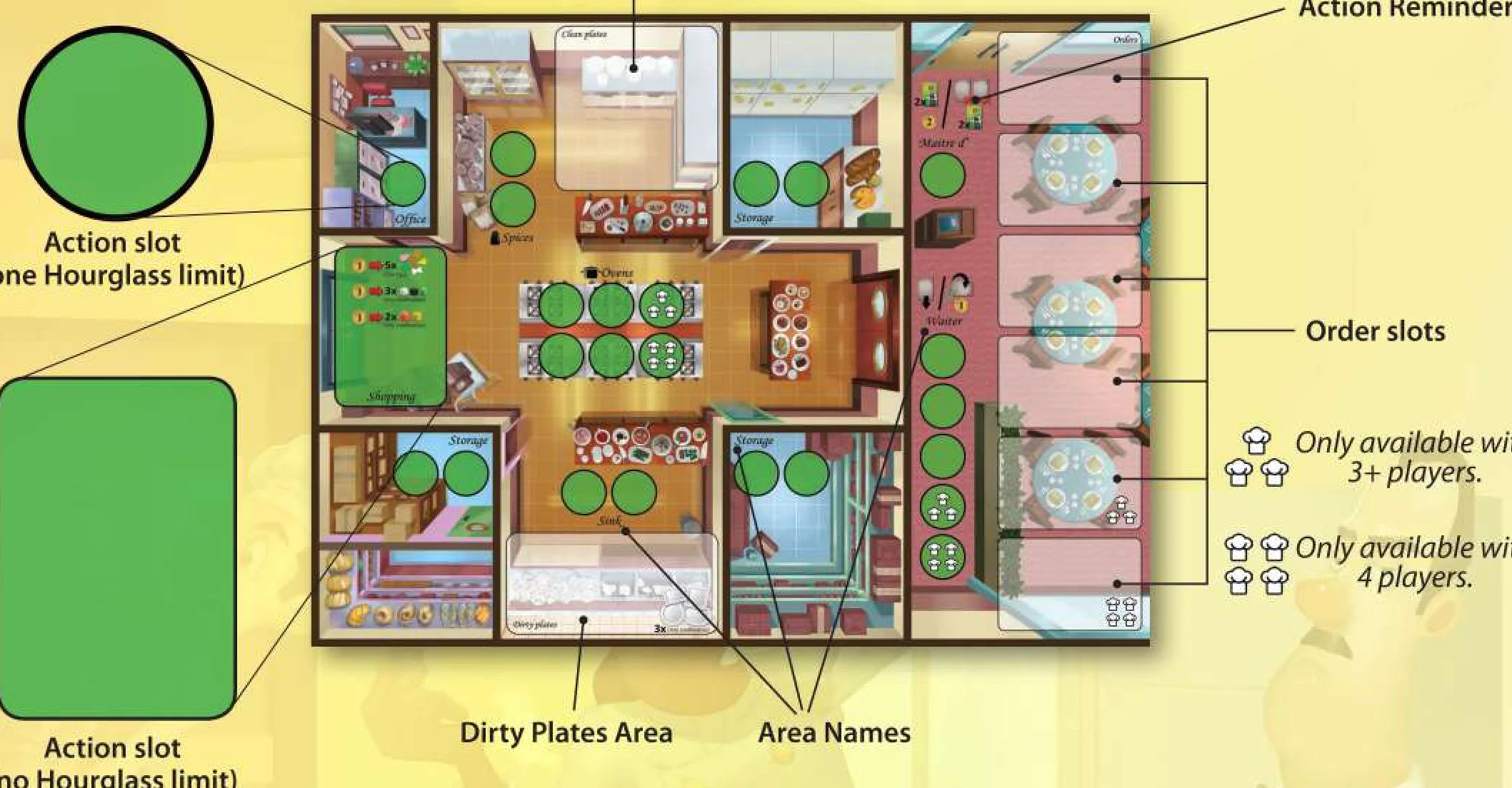
Game Board
The game board consists of various areas (like Storage, Ovens, Spices, Waiter etc) with each one containing one or more action spaces.
- Action slot (one Hourglass limit): Indicated by a circular slot. Only one hourglass may occupy this space at a time.
- Action slot (no Hourglass limit): Indicated by a rectangular slot (such as Shopping). Any number of hourglasses can be placed here simultaneously.
- Clean Plates Area: Holds clean plates available for new orders.
- Dirty Plates Area: Holds dirty plates waiting to be washed.
- Area Names: Marked clearly across the board.
- Order slots: Displays available order cards waiting to be taken by Waiters (some slots are only available with 3+ or 4 players).
- Action Reminder: Quick reference icons for actions.
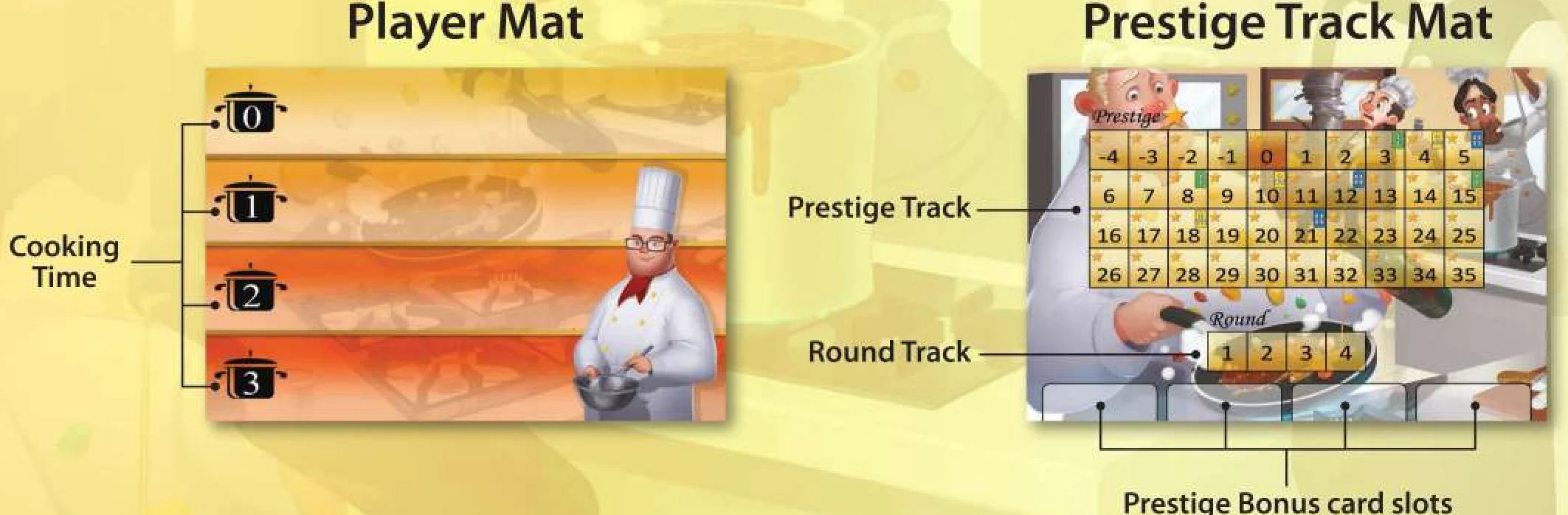
Player Mat & Prestige Track Mat
- Player Mat: Features rows marked 0, 1, 2, 3 tracking the Cooking Time of plates currently being prepared.
- Prestige Track Mat: Contains the Prestige Track (ranging from -4 to 35), the Round Track (rounds 1 to 4), and slots for Prestige Bonus cards.
Ingredients
The Ingredients in the game represent many different types of ingredients used in actual cooking:
- Meat: All types of meat (pork, chicken etc).
- Vegetables: Most of the vegetables used in cooking (potatoes, carrots, onions etc).
- Salad: Leafy and salad vegetables (lettuce, spinach etc).
- Pasta: Pasta or rice.
- Cheese: All types of cheese (yellow, white, creamy etc).
- Bread: Various types of bread and other dough products.
Spices
The colored cubes represent various spices and herbs:
- Common Spices:
- White: Salt or sugar.
- Black: Pepper or other black seeds.
- Green: Various herbs like parsley and oregano.
- Special Spices:
- Yellow: Curry or mustard seeds.
- Red: Chilli or saffron.
Setup
Note: For 1 player see also 6. Solo Game on page 14 for the necessary adjustments.
- Game Board: Place the game board in the middle of the table.
- Supply Piles: Place piles of all the Ingredients, Spices and money near the game board, within reach of all the players. We recommend you place them in the order they are shown in the image (which is also the order they appear on the Order cards).
- Spices Bag: Fill the cloth bag with Spices based on the number of players, then place the bag next to the game board, near the Spices area:
- 1-2 Players: 1 White, 1 Black, 1 Green, 1 Yellow, 1 Red
- 3 Players: 2 White, 2 Black, 2 Green, 1 Yellow, 2 Red
- 4 Players: 3 White, 3 Black, 3 Green, 2 Yellow, 2 Red
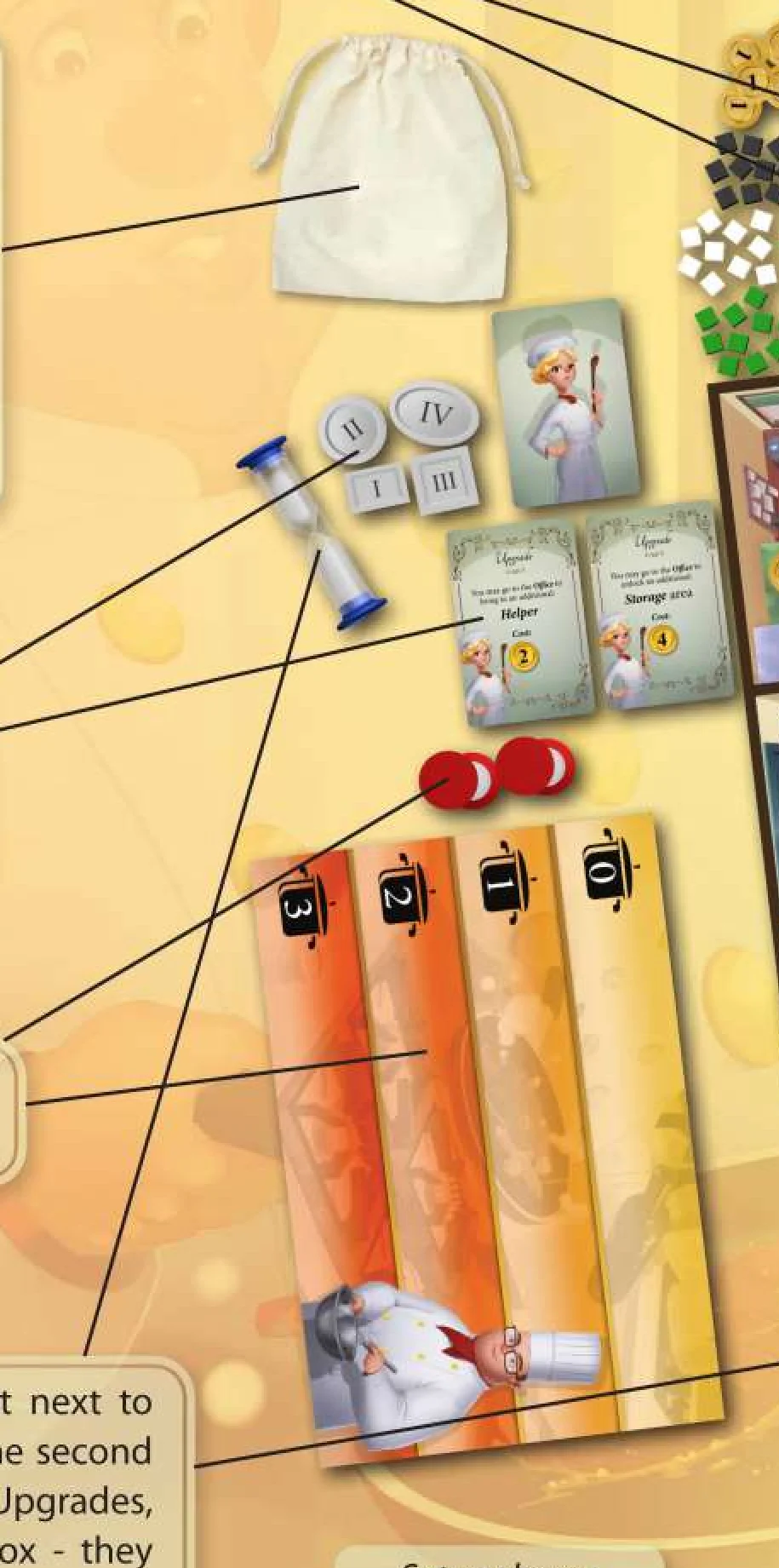
- Upgrades: Shuffle the Upgrades, place them in a face down pile next to the game board, near the Office area, and reveal the first 2 cards. Place next to them one plate of each size (to be used with one of the Upgrades).
- Player Mats & Workers: Give each player a Player Mat and 2 Hourglasses of the same color – these will be their workers.
- Helpers: Choose one of the remaining Hourglasses and place it next to the game board. This will be the players’ Helper. Take the second Hourglass of the Helper’s color and place it next to the Upgrades, laid down. Return any remaining hourglasses to the box – they won’t be used.
- Prestige Track Mat: Place the Prestige Track Mat on the side of the playing area. Put a marker on the starting space of the track (numbered 0, it is indicated with a different color) and one on the first space of the Round track (round 1). Shuffle the Prestige Bonuses and place them in a face down pile on the first card slot.
- Objective: Decide on the difficulty level you want to play (Easy, Normal, Hard, Very Hard), get a corresponding Objective and inform everyone of the requirements that you will have to meet (see 5. Game End on page 14).
- Orders Deck: Shuffle the Orders and place them in a face-down deck next to the game board, near the Maitre d’ space.
- Timer: Use a digital timer or a cell phone with a countdown feature and set it to 4 minutes.
- Game Board Items: Add items to the game board (see details below).
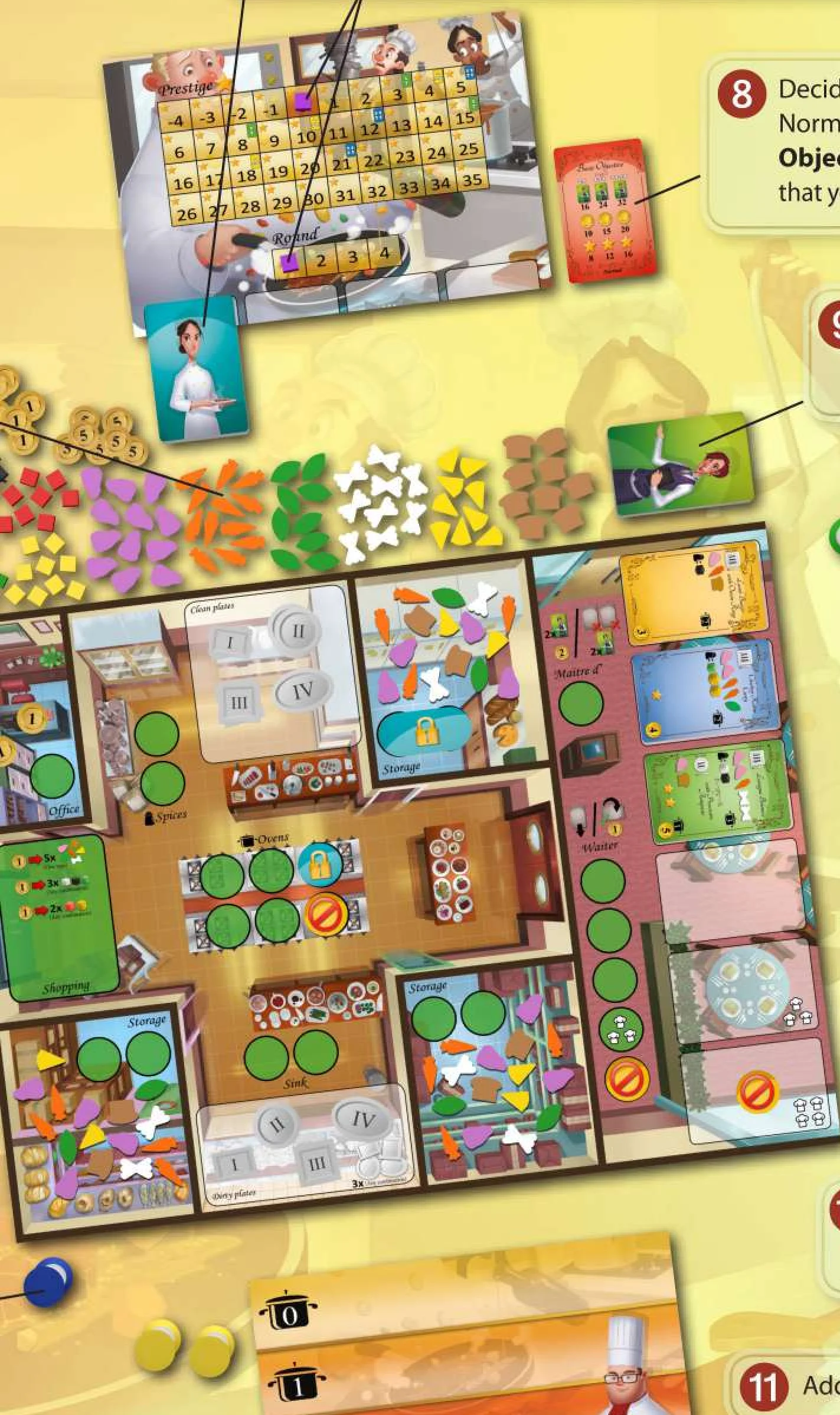
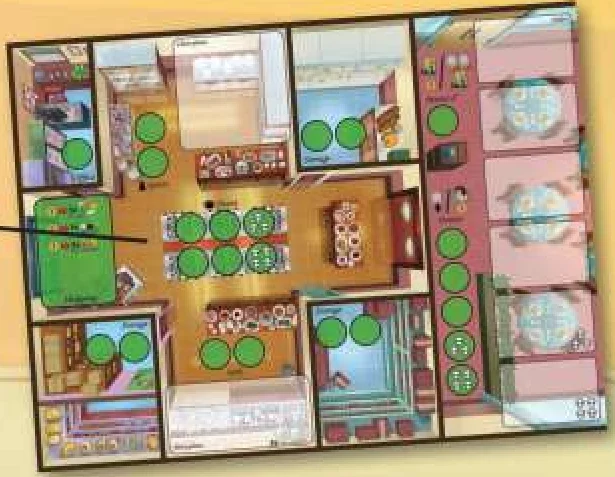
Step 11: Setup by Player Count
Place Ingredients, plates, tokens and Orders on the game board based on the number of players:
1-2 Players
- Place circular Unavailable Action tokens on two of the Oven spaces, two of the Waiter spaces and two of the Order slots (those marked with 3 or 4 Chef hats).
- Place the long Unavailable Action token on any one of the Storage areas (covering both spaces). These spaces won’t be used during the game.
- Place a circular Locked token on one of the Oven spaces. Place the long Locked token on one of the two Storage areas (covering both spaces).
- Place 2 of each plate sized I-III and 1 plate sized IV on the Clean Plates area. Also place one of each plate size on the Dirty Plates area. Return any remaining plates to the box – they won’t be used.
- Place 1 coin on the Office area (this is where the players’ money is stored).
- Draw 2 Orders and place them face-up on the Order slots.
- Place ingredients on the two Storage areas (one Active, one Locked), based on the table below:
- Active Storage: 5 Meat, 5 Vegetables, 3 Salad, 3 Pasta, 3 Cheese, 3 Bread
- Locked Storage: 4 Meat, 4 Vegetables, 2 Salad, 2 Pasta, 2 Cheese, 2 Bread
3 Players
- Place circular Unavailable Action tokens on one of the Oven spaces, one of the Waiter spaces and one of the Order slots (those marked with 4 Chef hats).
- Place a circular Locked token on one of the Oven spaces. Place the long Locked token on one of the Storage areas (covering both spaces).
- Place 3 of each plate sized I-III and 1 plate sized IV on the Clean Plates area. Also place one of each plate size on the Dirty Plates area. Return any remaining plates to the box – they won’t be used.
- Place 2 coins on the Office area (this is where the players’ money is stored).
- Draw 3 Orders and place them face-up on the Order slots.
- Place ingredients on the three Storage areas (two Active, one Locked), based on the table below:
- Active Storages (combined): 4 Meat, 4 Vegetables, 2 Salad, 2 Pasta, 2 Cheese, 2 Bread
- Locked Storage: 4 Meat, 4 Vegetables, 2 Salad, 2 Pasta, 2 Cheese, 2 Bread
4 Players
- Place the long Locked token on one of the Storage areas (covering both spaces).
- Place 4 of each plate sized I-III and 2 plates sized IV on the Clean Plates area. Also place one of each plate size on the Dirty Plates area.
- Place 3 coins on the Office area (this is where the players’ money is stored).
- Draw 4 Orders and place them face-up on the Order slots.
- Place ingredients on the three Storage areas (two Active, one Locked), based on the table below:
- Active Storages (combined): 5 Meat, 5 Vegetables, 3 Salad, 3 Pasta, 3 Cheese, 3 Bread
- Locked Storage: 4 Meat, 4 Vegetables, 2 Salad, 2 Pasta, 2 Cheese, 2 Bread
Round Structure
Kitchen Rush is a cooperative game. This means that all players work together against the game and you win or lose as a team.
The game is played in a series of 4 rounds. Each round new Orders come in, you prepare the dishes and you serve them to the customers. At the end of the 4th round you check to see if you managed to accomplish the goal you had.
Round Overview
Each round consists of the following phases:
- Preparation Phase
- Action Phase
- Cleanup Phase
1. Preparation Phase
- Move the marker on the Round track to the next space (skip this during the first round).
- If playing with Events, draw the first one from the Events pile and apply its effect.
- Any other effect that needs to take place before the players’ actions, also happens during this phase.
- During this phase, you may freely discuss on what each of you should do during the upcoming Action phase and form a plan for the round. When you are ready, proceed to the next phase.
2. Action Phase Overview
This phase is played in real-time.
When the Action phase starts, start the timer.
During this phase you perform actions with your workers:
- Take one of your Hourglasses, turn it over and place it on the action space you want to use. You can immediately then perform the action – you don’t have to wait until the sand runs out.
- As long as there is sand running inside the Hourglass, you may not move it. As soon as the sand runs out, the Hourglass becomes available again and you may use it to perform a new action.
- You are only allowed to use your own Hourglasses to perform actions or the Helper, who may be used by everyone.
- You may only perform an action if one of its action spaces is available – in other words, you cannot place an Hourglass in an action space where there is already another one. You are also not allowed to use an action space if there is a token there (Locked, Unavailable Action, Malfunction etc) and you may never move another player’s Hourglass out of an action space, even if the sand inside it has run out.
- As soon as you move an Hourglass on an action space, any previous action that you were performing (either with the same or with another one) is considered to be complete. You cannot go back and continue performing it. However, you are allowed to move one of your Hourglasses (if the sand inside of it has run out) out of an action space and place it in front of you to free it for another player, without penalty.
- If during this phase you accidentally drop an Hourglass, you must immediately pause what you are doing, put the Hourglass back in the position it was and continue as normal.
- When the timer ends, you are no longer allowed to move your Hourglasses – the Action phase has ended for the round. However, if you had already placed your Hourglass on an action space before the time ran out, you are allowed to complete the action you had begun.
Actions You May Perform
Maitre D’
You welcome new customers in your restaurant, show them their tables, suggest dishes, or offer alternatives if something is not available.
When performing this action, choose one of the following options:
- Bring New Orders: Draw up to 2 Orders and place them face-up on the game board on the available slots. For each card drawn, get 1 coin and place it in the Office area (if an effect would cause you to draw more or less cards, you get more or less coins accordingly). Keep in mind that you may not draw more cards than the number of available slots.
- Replace Orders: Discard up to 2 Orders from the game board and draw new ones to replace them. In this case, you do not get any coins.
Example: Mike, Jim and Irene just started the second round. Mike uses the Maitre d’ action and draws 2 new Orders. He then adds 2 coins to their money. Later in the same round the players are in need of money. Jim decides to use the Maitre d’ action even though there is only one empty Order slot on the game board. As a result, he draws only one card and gets just a single coin. At the beginning of the next round, the players want to increase their Prestige but they don’t see any Orders that will help them do that. Since all the Order slots on the game board are filled with cards, they decide to replace some of the existing Orders. Mike uses the Maitre d’ action, discards 2 of the Orders and draws 2 new ones in their place, without getting any coins.
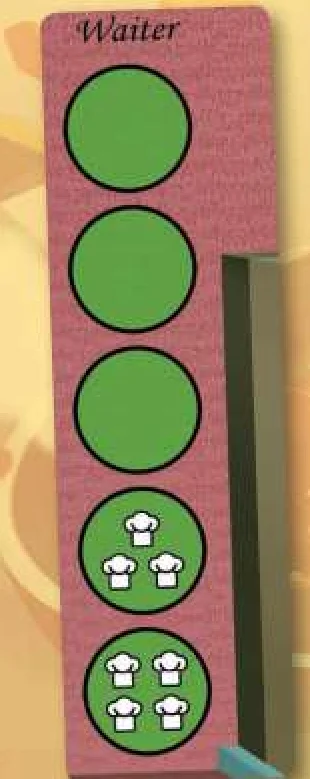
Waiter
You go to the customer’s table to take their order or you make sure to serve their dishes as quickly as possible.
When performing this action, choose one of the following options:
- Take Order: Take one of the Orders on the game board and place it face-up in front of you. Take the plate(s) that it requires from the Clean Plates area and place them on your Player Mat, on the first row (
 ). If the plate required by the Order is not available, you are allowed to use one that is 1 size higher without any penalty (for example a IV instead of a III). If there is still no plate available, you may still take the Order and add the plate to your Player Mat later (whenever it becomes available) without having to perform another action.
 - Serve Promptly: All the Orders that have been prepared by the players will be served in the Cleanup phase. If you wish however, you may serve it promptly during the Action phase. Turn the card sideways and get 1 coin as a tip. Keep in mind that after an Order has been Served Promptly, you can no longer apply any action on it (ie you cannot add Ingredients and Spices or cook it more times).
Example: Irene wants to take a new Order so she uses the Waiter action. She takes one of the Orders on the game board, places it in front of her, finds the matching plate on the Clean Plates area and puts it on the first row of her Player Mat. Later in the round, she has finished preparing it and she decides to serve the Order promptly. She uses the Waiter action once again, turns her Order sideways and gets 1 coin.
Shopping
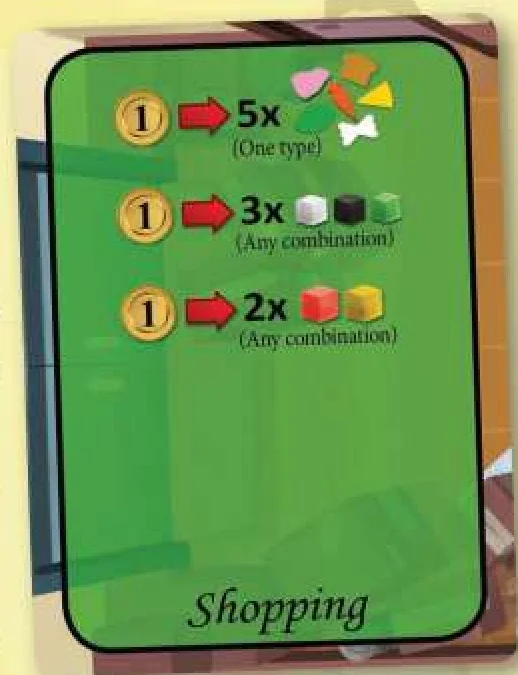
A constant supply of new ingredients is imperative for a restaurant to work properly.
This action may be performed by any number of Hourglasses at the same time – there is no limit.
When performing this action, pay 1 coin and choose one of the following:
- Get 5 tokens of a single Ingredient and distribute them among the active Storage areas.
- Get 3 common Spices (white, black or green cubes) in any combination and put them in the cloth bag.
- Get 2 special Spices (yellow or red) in any combination and put them in the cloth bag.
When adding Ingredients, you must take 5 tokens from a single Ingredient – you may not combine them. However, you may spread those 5 tokens in any way you want among the active Storage areas (but not in the locked one).
In the rare case that you go Shopping and there are not enough tokens or cubes available to add, add as many as you can. Do not use a substitute for the remaining ones – you are limited to the quantities included in the game.
Example: Jim notices that there is only one Meat token in all Storage areas so he uses the Shopping action to get some more. He spends 1 coin from their money, takes 5 Meat tokens from the pile outside the game board and places 2 tokens in one Storage and 3 tokens in another one. Then, he looks at the cloth bag and notices there are no white, black or red Spices inside it. With his other Hourglass he uses the Shopping action again. He pays 1 coin, takes 2 white and 1 black cubes from the piles outside the game board and puts them in the cloth bag. He would like to be able to get a red cube as well but he cannot get both common and special Spices in the same action.
Storage
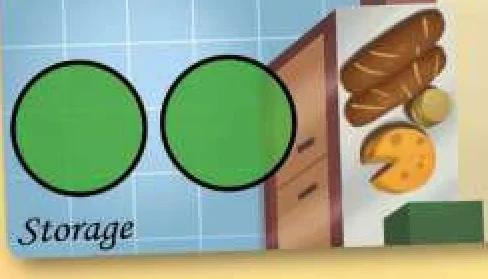
You gather the required ingredients from the Storages to prepare the customers’ orders.
When performing this action, you may take any Ingredients from that Storage area and place them on plates on your Player Mat that are still in the first row (). You may add Ingredients to any number of plates on your Player Mat but you may not take Ingredients from another Storage area, you cannot take Ingredients without placing them on a plate and you cannot place Ingredients on a plate that is being cooked (see Ovens below).
As long as you are in a Storage, you may continue taking Ingredients even if the sand in the hourglass you used runs out. However, if you perform any other action (regardless if the sand ran out or not), you are immediately considered to be out of the Storage and will have to use an Hourglass again to take more Ingredients.
If, while you are in a Storage performing this action, another player adds more Ingredients to the area (using the Shopping action, see below), you are allowed to take them as normal.
Example: Mike has 3 plates on his Player Mat. He uses the Storage action to get the Ingredients he needs. He takes the ones required by the first 2 plates but realizes that the Storage has 2 Vegetable tokens less than he needs. If he uses his other Hourglass to get them, he will have to use the Storage action again to be able to take them. To avoid doing that, he asks the other players to help him. Jim has an Hourglass available so he uses it to go Shopping, making sure to add 2 Vegetables to the Storage area where Mike already is. Mike gets them, making sure to thank Jim.
Ovens
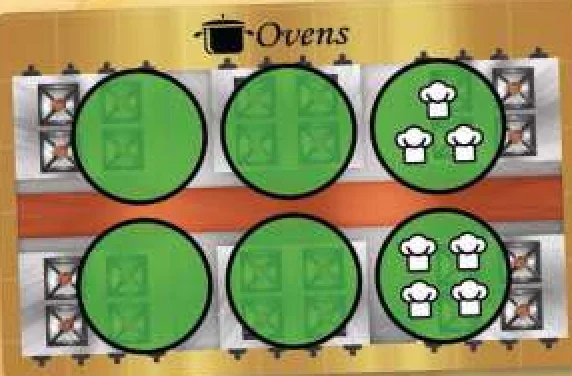
After you’ve gathered all the necessary ingredients, it is time to cook the food you have been preparing.
When performing this action, choose one of the plates on your Player Mat and move it one space downwards, indicating that you have cooked the food in it 1 time. Keep in mind that after you’ve started cooking the food on a plate, you are not allowed to add any ingredients to it.
You need to use the Ovens action as many times as it is indicated on the Order card (moving the plate on your Player Mat one step downwards each time) to fully cook it.
You may not move multiple plates with a single use of the Ovens action. Even if an Order contains 2 plates, separate uses of the Ovens action are required for each of the plates.
Example: Irene has 2 dishes in front of her that need to be cooked, the first one 2 times and the other one 3 times. She takes her Hourglass and uses the Ovens action, sliding the first plate one row downwards. She immediately takes her other Hourglass, uses it on another Ovens action space and slides the first plate once again to reach the third row. It is now cooked 2 times so she only has to worry about the other plate.
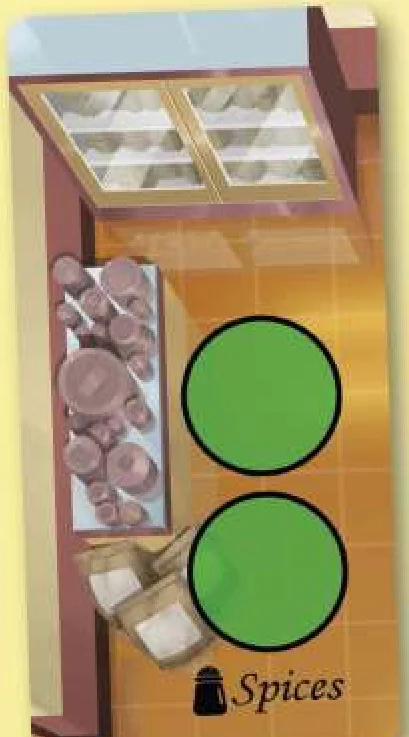
Spices
You add a touch of spice to bring out the flavor in the dish.
When performing this action, take the cloth bag, look inside of it, and take out any number of Spices, placing them on your plates. You may not take any cubes without placing them on a plate but you may spread the cubes you take in multiple plates. Also, contrary to the Ingredients, you are allowed to add Spices to a plate, even while (or even after) it is cooked.
As long as you are in the Spices you may continue taking cubes even if the sand in the Hourglass runs out. However, if you perform any other action (regardless if the sand ran out or not), you are considered to be out of the Spices and will have to use an Hourglass again to take more Spices.
If, while you are in the Spices and performing this action, another player adds more Spices to the cloth bag (using the Shopping action, see below), you are allowed to take them as normal.
Keep in mind that you are allowed at all times to check inside the cloth bag and see what is available – you don’t need to perform the action to do so.
Example: Jim has 3 plates on his Player Mat, one fully cooked and the other two on the first row, that all require Spices. He uses the Spices action, takes the cloth bag and searches inside. He finds the Spices he needs (2 green, 1 white and 2 yellow) takes them all out, and places each one on the plate that requires it.
Office
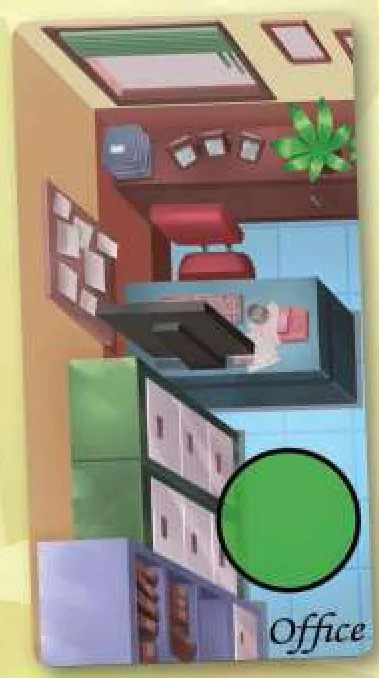
A good manager takes care of their restaurant’s needs before they emerge.
You can spend money to hire back Hourglasses, upgrade the kitchen, or fix equipment that has malfunctioned. When performing this action, choose one of the following:
- Hire Back Workers: Spend 2 money and hire back an Hourglass who wasn’t paid their wages in the previous round (see Cleanup Phase below). When doing so, take that hourglass, turn it over and place it anywhere on the Office area. As soon as the sand runs out, it will be available for use by its owner.
- Upgrade Kitchen: Spend money to buy what is available in the face-up Upgrade cards next to the game board. This may include a new Oven, a new Storage area with Ingredients in it, an additional set of plates or even hiring a second Helper. As soon as you use one of the Upgrades, remove it from the game and reveal a new one.
- Repair Equipment: Some of the Events, place Malfunction tokens (
 ) in one or more action spaces. Spend the amount listed on the token and remove it, making the action space available again.
Sink
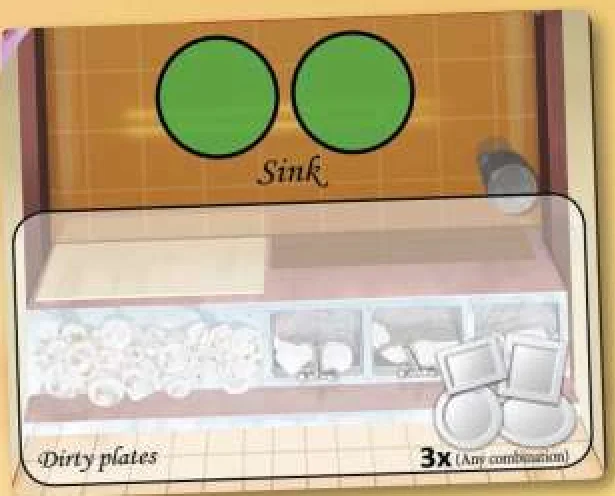
Someone has to do the dirty job and wash those dishes.
When performing this action, take up to 3 plates from the Dirty Plates area and put them in the Clean Plates area.
Keep in mind that in the Cleanup phase all plates, after being used in an Order, go to the Dirty Plates area. The Sink action must be used to make them available again.
Cleanup Phase
The Cleanup Phase consists of 3 separate steps:
- Check Orders
- Pay Wages
- Prestige Bonuses
Step 1: Check Orders
Examine the Orders you have in front of you to see if they have been successfully completed. For each Order make sure to check the following:
- Does the plate have the correct size (either the one listed or one size higher)?
- Are all the required Ingredients included (and no more)?
- Have all the required Spices been added (and no more)?
- Has it been cooked the required number of times (no more, no less)?
- Have all the dishes in the Order been prepared?
If everything is correct, then the Order is served and you get the reward listed on the bottom of the card:
- Add the appropriate amount of money to the Office area.
- Move the marker on the Prestige track as many spaces to the right as the number of stars shown.
- Place the Order card on the side.
- Discard all the ingredients and Spices on their respective piles outside the game board (NOT on the Storage areas or the cloth bag).
- Put the Order’s plate(s) on the Dirty Plates area of the game board.
If one or more Orders on any Players’ Mats were not completed, the customers are kept waiting and you lose 1 Prestige for each such Order, moving the marker on the Prestige track to the left. These Orders remain in front of you and you check if they can be completed with additional actions in the following rounds or if mistakes have been made:
- If an Order can still be completed (for example a dish wasn’t cooked enough times or not all Spices were added): the plate(s) remain on your Player Mat. Next round, you will be able to continue working on them to successfully complete the Order.
- If a mistake was made (for example a dish was cooked but an Ingredient was missing or you cooked it more times than required): the whole plate is discarded and needs to be prepared again. Return all Ingredients and Spices on their respective piles outside the game board (NOT on the Storage areas or the cloth bag) and put the plate on the Dirty Plates area of the game board.
Keep in mind that if there are more Ingredients or Spices on a plate than those required, it always counts as a mistake. You may never remove an Ingredient or a cube from a plate – the whole plate will have to be discarded and made anew.
In case of an Order with multiple plates in it, if only one of them has a mistake on it, you only need to prepare that plate again. If the other plate was successfully prepared, it stays on your Player Mat as normal.
If an Order was not completed but was Served Promptly during the Action phase, you lose 1 additional Prestige (since it was wrongly served to the customer).
Example: It is the Cleanup Phase and the players need to check their Orders. Mike has 2 Orders in front of him. He checks them and sees that everything has been done correctly. He places the Orders on the side, discards all the Ingredients and Spices to their piles next to the game board and puts the plates in the Dirty Plates area. He also gets the 7 coins and 1 Prestige they reward for successfully completing them, adjusting the marker on the Prestige track. Jim also has 2 Orders he needs to check, both of which were Served Promptly during the round. The first one was completed successfully so he gets the 5 coins and 2 Prestige listed and returns the components to the appropriate places. Unfortunately, the second Order has an extra Ingredient. Since this is a mistake, the plate, the Ingredients and the Spices it contained get discarded and Jim will have to prepare it all again next round. Normally that would also mean the loss of 1 Prestige but since the Order was Served Promptly during the round, the players lose 1 additional Prestige. Irene has 3 Orders in front of her. She checks and sees that the first 2 were successfully completed so she gets 7 coins and 1 Prestige from them, returning the components to their place. Unfortunately, the third Order wasn’t completed – it still needs to be cooked 2 more times. Since a mistake has not been made, Irene keeps the card in front of her (she will be able to complete it next round) and the players lose 1 Prestige.
Step 2: Pay Wages
After all Orders have been checked, the workers’ wages need to be paid:
- For each Hourglass that was used in the Action phase, including the Helper(s), pay 3 coins and return it to its owner.
- If you are unable to pay the whole amount, pay for as many Hourglasses as possible, starting with the Helper(s). Then, set all the Hourglasses that were not paid aside and lose 1 Prestige for each one of them. These Hourglasses will not be available for use for the rest of the game unless a player uses the Office action space to rehire them, or their wages are paid in the Cleanup phase of a following round.
- Keep in mind that paying wages is not optional. If in a future round’s Pay Wages step you have enough money, you must pay for previous rounds’ unpaid Hourglasses.
Example: The players ended the Action phase with a single coin in the Office. With the 19 coins they made from the Orders they completed they have a total of 20 coins. Since they used 7 Hourglasses during the round (2 for each player and the Helper) they need to pay 21 coins. They pay 18 coins, enough to cover the wages for 6 of the Hourglasses, and have to leave one out for the next round. Jim volunteers to be the one left with one Hourglass less so he sets aside one of his own.
Step 3: Prestige Bonuses
Depending on your place on the Prestige track you may gain (or lose) bonuses due to the reputation you accumulate:
- If you increased your Prestige this round and you passed or landed on a space with a card icon (with Chef hats equal to the number of players on it:
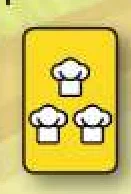
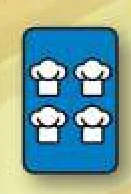 ), draw a new Prestige Bonus and place it on the next available slot on the Prestige Track Mat. Its effect will be applied at the beginning of the next round and it will provide you with a bonus (and maybe an obligation). If you end up passing more than one such space in the same round, draw that many Prestige Bonuses.
 - If you lost Prestige this round and by doing so you ended up behind a space with a card icon, return the latest Prestige Bonus to the top of the pile. If, when losing Prestige you passed more than one spaces with such card icons, return that many Prestige Bonuses to the top of the pile.
If at any time your Prestige goes less than -4, you immediately lose the game.
Game End & Victory
At the end of the 4th round, the game ends. Count all the Orders that you served in the game, the money you are left with and your space on the Prestige track, and check your Objective.
To win the game you must meet all the requirements listed on your Objective, as well the following ones:
- You must have no unpaid Hourglasses
- You must have at least 1 coin
- You must have at least 1 Prestige
If all the above are true, then congratulations, you win the game!
Solo Game
To play the game with one player apply the following changes to the setup:
- Play with a total of 4 Hourglasses
- Keep an Hourglass in an unused color near the Upgrades as the Helper available for hire
- The Action phase lasts 30 seconds more (4′ 30″ instead of 4 minutes)
Your goals are the same as in the 2-player game. If a card (like an Event or a Prestige Bonus) mentions the number of players, treat it as if it were 2.
Please remember that even when playing solo, you must finish one action first before proceeding to the next one. If for example you are in a Storage area and you are missing an Ingredient, if you go Shopping to get it, you will have to spend another action on the Storage to get it.
Events Variant
If you want a more challenging experience, you can add Events to your game. To play with Events, randomly draw one at the beginning of each round and apply its effect. However, since all the effects are negative ones, this will result in a much higher challenge.
We recommend you play without Events for your first games and add them only after you are more familiar with the game.
Notes on Cards
Events
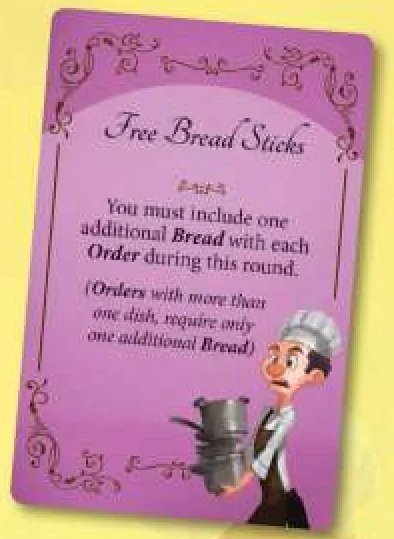
- Free Bread Sticks: If an Order is not completed during the round but has the additional Bread in one of its plates, next round it will count as a mistake. Thus, the plate will have to be discarded and prepared again.
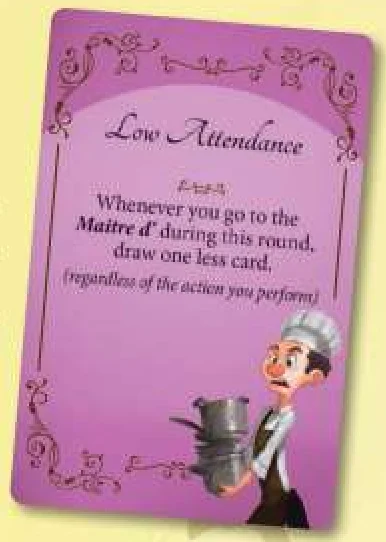
- Low Attendance: While this is in effect, when you Bring New Orders, draw one less card and get one less coin. When you Replace Orders, replace one less Order.
Prestige Bonuses
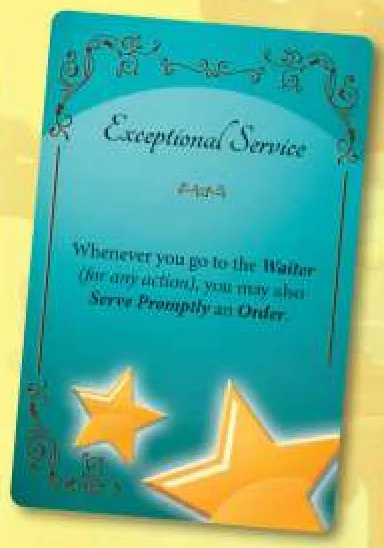
- Exceptional Service: While this is in effect, when you go to the Waiter you can either Serve Promptly 2 Orders, or take a new Order and Serve Promptly another one.
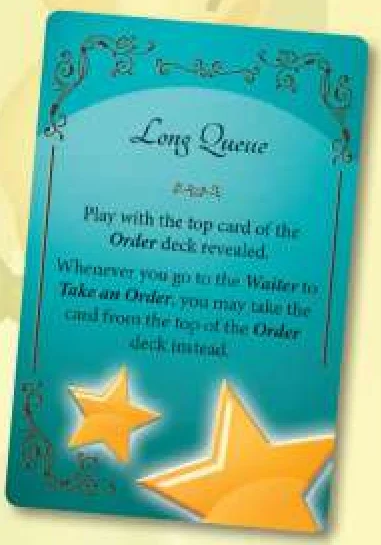
- Long Queue: If you take the face-up Order from the top of the Order deck, immediately turn the next Order (that is now on top) face-up.
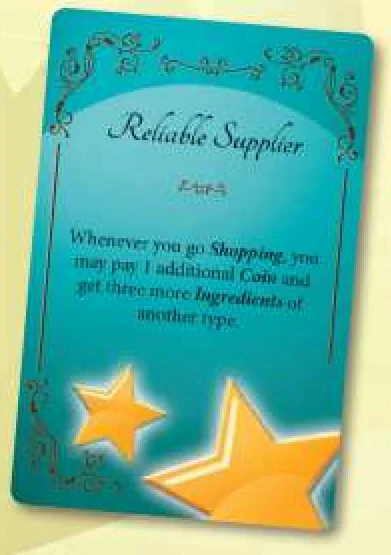
- Reliable Supplier: The bonus can be applied even when Shopping for Spices.
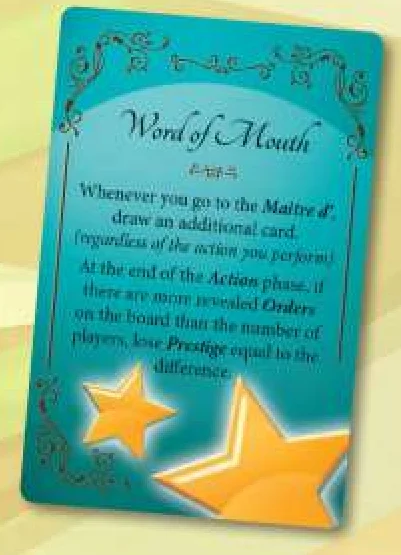
- Word of Mouth: While this is in effect, when you Bring New Orders, you may draw an additional card and get an additional coin. When you Replace Orders, you may discard an additional Order and draw a new one.
Credits
- Lead Design: Dávid Turczi
- Additional Design & Development: Vangelis Bagiartakis
- Illustration: Gong Studios
- Graphic Design: Konstantinos Kokkinis
- Playtesters: Nikos Argyros, Dimitris Siakambenis, Theo K Mavraganis, Akis Tsakliotis, Alexandros Kouris, Spyros Koronis, Mike Georgiou, Orestis Leontaritis, Dionisis Poriotis, Nikos Chondropoulos, Yiannis Thomopoulos, Sotiris Drokalos, John Vidalis, Vangelis Velles, Sotiris Tsantilas
Artipia Games
19 Nikou Xilouri str.
Zografou, 15773
Athens, Greece
www.artipiagames.com
Note: Kitchen Rush is a product of fiction. Any relation to actual names or characters is purely coincidental.
© 2017 Artipia Games. All rights reserved.
Should you have any comments or questions, please contact us at [email protected]
Introduction & Components
Kitchen Rush
Dávid Turczi with Vangelis Bagiartakis
You’ve just inherited an old restaurant and you must turn it into a successful business! Hire personnel, order the right ingredients and be ready to serve the customers that enter your restaurant. The success will depend entirely on your efficiency in the kitchen!
Kitchen Rush is a real-time cooperative game in which you run a restaurant kitchen using hourglasses as workers. You need to take orders from customers, prepare their dishes, serve them on time and make sure enough money is made to cover wages, expenses, upgrades and hopefully, make a profit.
Components
- 110 Cards:
- 60 Orders
- 24 Events
- 14 Objectives
- 8 Prestige Bonuses
- 4 Upgrades
- 1 Rulebook
- 1 Prestige Track Mat
- 4 Player Mats
- 1 Game Board
- 2 Wooden Markers
- 1 Cloth Bag
- 108 Custom Wooden Tokens (Ingredients):
- 24 Meat tokens
- 24 Vegetable tokens
- 15 Salad tokens
- 15 Pasta tokens
- 15 Cheese tokens
- 15 Bread tokens
- 56 Wooden Cubes (Spices):
- 12 White Cubes
- 12 Black Cubes
- 12 Green Cubes
- 10 Yellow Cubes
- 10 Red Cubes
- 10 Hourglasses (Workers)
- 66 Cardboard Tokens:
- 28 Money tokens (1s and 5s)
- 22 Plates (I, II, III, IV)
- 4 Locked tokens
- 7 Unavailable Action tokens
- 5 Malfunction tokens
Component Anatomy
Component Anatomy
Orders
Orders feature a different background color based on their Prestige Reward (from 1 to 5 stars).
- Plate Size: Indicates the minimum plate size required (I, II, III, IV).
- Name of the Dish: Flavor name of the ordered meal.
- Ingredients: Required ingredient tokens to be placed on the plate.
- Spices: Required spice cubes to season the dish.
- Cooking Time: Number of times the dish must be cooked in the Oven.
- Prestige Reward: Stars gained if the order is successfully served.
- Money Reward: Coins earned upon completing the order.
Upgrades
- Description: Special restaurant improvements or additional areas that can be unlocked.
- Cost: Amount of coins needed to purchase the upgrade at the Office.
Events
- Event Name: Title of the event.
- Effect: Special condition or restriction applied during that round.
Prestige Bonuses
- Name: The title of the bonus.
- Effect: A helpful benefit granted once reached on the Prestige Track.
Objectives
There are 4 Basic Objectives corresponding to the 4 difficulty levels and 10 specialized Objectives (of either Normal or Hard difficulty) that give you more specific requirements to meet.
- Objective Type: Basic Objective or specialized Objective.
- Number of Players: Specific target values tailored to player count.
- Objective’s Instructions: Special setup rules, constraints, or scoring conditions.
- Objective’s Requirements: Targets that must be achieved by game end (Orders served, Money, Prestige).
- Difficulty Level: Easy, Normal, Hard, or Very Hard.
Game Board
The game board consists of various areas (like Storage, Ovens, Spices, Waiter etc) with each one containing one or more action spaces.
- Action slot (one Hourglass limit): Indicated by a circular slot. Only one hourglass may occupy this space at a time.
- Action slot (no Hourglass limit): Indicated by a rectangular slot (such as Shopping). Any number of hourglasses can be placed here simultaneously.
- Clean Plates Area: Holds clean plates available for new orders.
- Dirty Plates Area: Holds dirty plates waiting to be washed.
- Area Names: Marked clearly across the board.
- Order slots: Displays available order cards waiting to be taken by Waiters (some slots are only available with 3+ or 4 players).
- Action Reminder: Quick reference icons for actions.
Player Mat & Prestige Track Mat
- Player Mat: Features rows marked 0, 1, 2, 3 tracking the Cooking Time of plates currently being prepared.
- Prestige Track Mat: Contains the Prestige Track (ranging from -4 to 35), the Round Track (rounds 1 to 4), and slots for Prestige Bonus cards.
Ingredients
The Ingredients in the game represent many different types of ingredients used in actual cooking:
- Meat: All types of meat (pork, chicken etc).
- Vegetables: Most of the vegetables used in cooking (potatoes, carrots, onions etc).
- Salad: Leafy and salad vegetables (lettuce, spinach etc).
- Pasta: Pasta or rice.
- Cheese: All types of cheese (yellow, white, creamy etc).
- Bread: Various types of bread and other dough products.
Spices
The colored cubes represent various spices and herbs:
- Common Spices:
- White: Salt or sugar.
- Black: Pepper or other black seeds.
- Green: Various herbs like parsley and oregano.
- Special Spices:
- Yellow: Curry or mustard seeds.
- Red: Chilli or saffron.
Setup
Setup
Note: For 1 player see also 6. Solo Game on page 14 for the necessary adjustments.
- Game Board: Place the game board in the middle of the table.
- Supply Piles: Place piles of all the Ingredients, Spices and money near the game board, within reach of all the players. We recommend you place them in the order they are shown in the image (which is also the order they appear on the Order cards).
- Spices Bag: Fill the cloth bag with Spices based on the number of players, then place the bag next to the game board, near the Spices area:
- 1-2 Players: 1 White, 1 Black, 1 Green, 1 Yellow, 1 Red
- 3 Players: 2 White, 2 Black, 2 Green, 1 Yellow, 2 Red
- 4 Players: 3 White, 3 Black, 3 Green, 2 Yellow, 2 Red
- Upgrades: Shuffle the Upgrades, place them in a face down pile next to the game board, near the Office area, and reveal the first 2 cards. Place next to them one plate of each size (to be used with one of the Upgrades).
- Player Mats & Workers: Give each player a Player Mat and 2 Hourglasses of the same color – these will be their workers.
- Helpers: Choose one of the remaining Hourglasses and place it next to the game board. This will be the players’ Helper. Take the second Hourglass of the Helper’s color and place it next to the Upgrades, laid down. Return any remaining hourglasses to the box – they won’t be used.
- Prestige Track Mat: Place the Prestige Track Mat on the side of the playing area. Put a marker on the starting space of the track (numbered 0, it is indicated with a different color) and one on the first space of the Round track (round 1). Shuffle the Prestige Bonuses and place them in a face down pile on the first card slot.
- Objective: Decide on the difficulty level you want to play (Easy, Normal, Hard, Very Hard), get a corresponding Objective and inform everyone of the requirements that you will have to meet (see 5. Game End on page 14).
- Orders Deck: Shuffle the Orders and place them in a face-down deck next to the game board, near the Maitre d’ space.
- Timer: Use a digital timer or a cell phone with a countdown feature and set it to 4 minutes.
- Game Board Items: Add items to the game board (see details below).
Step 11: Setup by Player Count
Place Ingredients, plates, tokens and Orders on the game board based on the number of players:
1-2 Players
- Place circular Unavailable Action tokens on two of the Oven spaces, two of the Waiter spaces and two of the Order slots (those marked with 3 or 4 Chef hats).
- Place the long Unavailable Action token on any one of the Storage areas (covering both spaces). These spaces won’t be used during the game.
- Place a circular Locked token on one of the Oven spaces. Place the long Locked token on one of the two Storage areas (covering both spaces).
- Place 2 of each plate sized I-III and 1 plate sized IV on the Clean Plates area. Also place one of each plate size on the Dirty Plates area. Return any remaining plates to the box – they won’t be used.
- Place 1 coin on the Office area (this is where the players’ money is stored).
- Draw 2 Orders and place them face-up on the Order slots.
- Place ingredients on the two Storage areas (one Active, one Locked), based on the table below:
- Active Storage: 5 Meat, 5 Vegetables, 3 Salad, 3 Pasta, 3 Cheese, 3 Bread
- Locked Storage: 4 Meat, 4 Vegetables, 2 Salad, 2 Pasta, 2 Cheese, 2 Bread
3 Players
- Place circular Unavailable Action tokens on one of the Oven spaces, one of the Waiter spaces and one of the Order slots (those marked with 4 Chef hats).
- Place a circular Locked token on one of the Oven spaces. Place the long Locked token on one of the Storage areas (covering both spaces).
- Place 3 of each plate sized I-III and 1 plate sized IV on the Clean Plates area. Also place one of each plate size on the Dirty Plates area. Return any remaining plates to the box – they won’t be used.
- Place 2 coins on the Office area (this is where the players’ money is stored).
- Draw 3 Orders and place them face-up on the Order slots.
- Place ingredients on the three Storage areas (two Active, one Locked), based on the table below:
- Active Storages (combined): 4 Meat, 4 Vegetables, 2 Salad, 2 Pasta, 2 Cheese, 2 Bread
- Locked Storage: 4 Meat, 4 Vegetables, 2 Salad, 2 Pasta, 2 Cheese, 2 Bread
4 Players
- Place the long Locked token on one of the Storage areas (covering both spaces).
- Place 4 of each plate sized I-III and 2 plates sized IV on the Clean Plates area. Also place one of each plate size on the Dirty Plates area.
- Place 3 coins on the Office area (this is where the players’ money is stored).
- Draw 4 Orders and place them face-up on the Order slots.
- Place ingredients on the three Storage areas (two Active, one Locked), based on the table below:
- Active Storages (combined): 5 Meat, 5 Vegetables, 3 Salad, 3 Pasta, 3 Cheese, 3 Bread
- Locked Storage: 4 Meat, 4 Vegetables, 2 Salad, 2 Pasta, 2 Cheese, 2 Bread
How to Play: Round Structure
Round Structure
Kitchen Rush is a cooperative game. This means that all players work together against the game and you win or lose as a team.
The game is played in a series of 4 rounds. Each round new Orders come in, you prepare the dishes and you serve them to the customers. At the end of the 4th round you check to see if you managed to accomplish the goal you had.
Round Overview
Each round consists of the following phases:
- Preparation Phase
- Action Phase
- Cleanup Phase
1. Preparation Phase
- Move the marker on the Round track to the next space (skip this during the first round).
- If playing with Events, draw the first one from the Events pile and apply its effect.
- Any other effect that needs to take place before the players’ actions, also happens during this phase.
- During this phase, you may freely discuss on what each of you should do during the upcoming Action phase and form a plan for the round. When you are ready, proceed to the next phase.
2. Action Phase Overview
This phase is played in real-time.
When the Action phase starts, start the timer.
During this phase you perform actions with your workers:
- Take one of your Hourglasses, turn it over and place it on the action space you want to use. You can immediately then perform the action – you don’t have to wait until the sand runs out.
- As long as there is sand running inside the Hourglass, you may not move it. As soon as the sand runs out, the Hourglass becomes available again and you may use it to perform a new action.
- You are only allowed to use your own Hourglasses to perform actions or the Helper, who may be used by everyone.
- You may only perform an action if one of its action spaces is available – in other words, you cannot place an Hourglass in an action space where there is already another one. You are also not allowed to use an action space if there is a token there (Locked, Unavailable Action, Malfunction etc) and you may never move another player’s Hourglass out of an action space, even if the sand inside it has run out.
- As soon as you move an Hourglass on an action space, any previous action that you were performing (either with the same or with another one) is considered to be complete. You cannot go back and continue performing it. However, you are allowed to move one of your Hourglasses (if the sand inside of it has run out) out of an action space and place it in front of you to free it for another player, without penalty.
- If during this phase you accidentally drop an Hourglass, you must immediately pause what you are doing, put the Hourglass back in the position it was and continue as normal.
- When the timer ends, you are no longer allowed to move your Hourglasses – the Action phase has ended for the round. However, if you had already placed your Hourglass on an action space before the time ran out, you are allowed to complete the action you had begun.
Actions Reference
Actions You May Perform
Maitre D’
You welcome new customers in your restaurant, show them their tables, suggest dishes, or offer alternatives if something is not available.
When performing this action, choose one of the following options:
- Bring New Orders: Draw up to 2 Orders and place them face-up on the game board on the available slots. For each card drawn, get 1 coin and place it in the Office area (if an effect would cause you to draw more or less cards, you get more or less coins accordingly). Keep in mind that you may not draw more cards than the number of available slots.
- Replace Orders: Discard up to 2 Orders from the game board and draw new ones to replace them. In this case, you do not get any coins.
Example: Mike, Jim and Irene just started the second round. Mike uses the Maitre d’ action and draws 2 new Orders. He then adds 2 coins to their money. Later in the same round the players are in need of money. Jim decides to use the Maitre d’ action even though there is only one empty Order slot on the game board. As a result, he draws only one card and gets just a single coin. At the beginning of the next round, the players want to increase their Prestige but they don’t see any Orders that will help them do that. Since all the Order slots on the game board are filled with cards, they decide to replace some of the existing Orders. Mike uses the Maitre d’ action, discards 2 of the Orders and draws 2 new ones in their place, without getting any coins.
Waiter
You go to the customer’s table to take their order or you make sure to serve their dishes as quickly as possible.
When performing this action, choose one of the following options:
- Take Order: Take one of the Orders on the game board and place it face-up in front of you. Take the plate(s) that it requires from the Clean Plates area and place them on your Player Mat, on the first row (). If the plate required by the Order is not available, you are allowed to use one that is 1 size higher without any penalty (for example a IV instead of a III). If there is still no plate available, you may still take the Order and add the plate to your Player Mat later (whenever it becomes available) without having to perform another action.
- Serve Promptly: All the Orders that have been prepared by the players will be served in the Cleanup phase. If you wish however, you may serve it promptly during the Action phase. Turn the card sideways and get 1 coin as a tip. Keep in mind that after an Order has been Served Promptly, you can no longer apply any action on it (ie you cannot add Ingredients and Spices or cook it more times).
Example: Irene wants to take a new Order so she uses the Waiter action. She takes one of the Orders on the game board, places it in front of her, finds the matching plate on the Clean Plates area and puts it on the first row of her Player Mat. Later in the round, she has finished preparing it and she decides to serve the Order promptly. She uses the Waiter action once again, turns her Order sideways and gets 1 coin.
Shopping
A constant supply of new ingredients is imperative for a restaurant to work properly.
This action may be performed by any number of Hourglasses at the same time – there is no limit.
When performing this action, pay 1 coin and choose one of the following:
- Get 5 tokens of a single Ingredient and distribute them among the active Storage areas.
- Get 3 common Spices (white, black or green cubes) in any combination and put them in the cloth bag.
- Get 2 special Spices (yellow or red) in any combination and put them in the cloth bag.
When adding Ingredients, you must take 5 tokens from a single Ingredient – you may not combine them. However, you may spread those 5 tokens in any way you want among the active Storage areas (but not in the locked one).
In the rare case that you go Shopping and there are not enough tokens or cubes available to add, add as many as you can. Do not use a substitute for the remaining ones – you are limited to the quantities included in the game.
Example: Jim notices that there is only one Meat token in all Storage areas so he uses the Shopping action to get some more. He spends 1 coin from their money, takes 5 Meat tokens from the pile outside the game board and places 2 tokens in one Storage and 3 tokens in another one. Then, he looks at the cloth bag and notices there are no white, black or red Spices inside it. With his other Hourglass he uses the Shopping action again. He pays 1 coin, takes 2 white and 1 black cubes from the piles outside the game board and puts them in the cloth bag. He would like to be able to get a red cube as well but he cannot get both common and special Spices in the same action.
Storage
You gather the required ingredients from the Storages to prepare the customers’ orders.
When performing this action, you may take any Ingredients from that Storage area and place them on plates on your Player Mat that are still in the first row (). You may add Ingredients to any number of plates on your Player Mat but you may not take Ingredients from another Storage area, you cannot take Ingredients without placing them on a plate and you cannot place Ingredients on a plate that is being cooked (see Ovens below).
As long as you are in a Storage, you may continue taking Ingredients even if the sand in the hourglass you used runs out. However, if you perform any other action (regardless if the sand ran out or not), you are immediately considered to be out of the Storage and will have to use an Hourglass again to take more Ingredients.
If, while you are in a Storage performing this action, another player adds more Ingredients to the area (using the Shopping action, see below), you are allowed to take them as normal.
Example: Mike has 3 plates on his Player Mat. He uses the Storage action to get the Ingredients he needs. He takes the ones required by the first 2 plates but realizes that the Storage has 2 Vegetable tokens less than he needs. If he uses his other Hourglass to get them, he will have to use the Storage action again to be able to take them. To avoid doing that, he asks the other players to help him. Jim has an Hourglass available so he uses it to go Shopping, making sure to add 2 Vegetables to the Storage area where Mike already is. Mike gets them, making sure to thank Jim.
Ovens
After you’ve gathered all the necessary ingredients, it is time to cook the food you have been preparing.
When performing this action, choose one of the plates on your Player Mat and move it one space downwards, indicating that you have cooked the food in it 1 time. Keep in mind that after you’ve started cooking the food on a plate, you are not allowed to add any ingredients to it.
You need to use the Ovens action as many times as it is indicated on the Order card (moving the plate on your Player Mat one step downwards each time) to fully cook it.
You may not move multiple plates with a single use of the Ovens action. Even if an Order contains 2 plates, separate uses of the Ovens action are required for each of the plates.
Example: Irene has 2 dishes in front of her that need to be cooked, the first one 2 times and the other one 3 times. She takes her Hourglass and uses the Ovens action, sliding the first plate one row downwards. She immediately takes her other Hourglass, uses it on another Ovens action space and slides the first plate once again to reach the third row. It is now cooked 2 times so she only has to worry about the other plate.
Spices
You add a touch of spice to bring out the flavor in the dish.
When performing this action, take the cloth bag, look inside of it, and take out any number of Spices, placing them on your plates. You may not take any cubes without placing them on a plate but you may spread the cubes you take in multiple plates. Also, contrary to the Ingredients, you are allowed to add Spices to a plate, even while (or even after) it is cooked.
As long as you are in the Spices you may continue taking cubes even if the sand in the Hourglass runs out. However, if you perform any other action (regardless if the sand ran out or not), you are considered to be out of the Spices and will have to use an Hourglass again to take more Spices.
If, while you are in the Spices and performing this action, another player adds more Spices to the cloth bag (using the Shopping action, see below), you are allowed to take them as normal.
Keep in mind that you are allowed at all times to check inside the cloth bag and see what is available – you don’t need to perform the action to do so.
Example: Jim has 3 plates on his Player Mat, one fully cooked and the other two on the first row, that all require Spices. He uses the Spices action, takes the cloth bag and searches inside. He finds the Spices he needs (2 green, 1 white and 2 yellow) takes them all out, and places each one on the plate that requires it.
Office
A good manager takes care of their restaurant’s needs before they emerge.
You can spend money to hire back Hourglasses, upgrade the kitchen, or fix equipment that has malfunctioned. When performing this action, choose one of the following:
- Hire Back Workers: Spend 2 money and hire back an Hourglass who wasn’t paid their wages in the previous round (see Cleanup Phase below). When doing so, take that hourglass, turn it over and place it anywhere on the Office area. As soon as the sand runs out, it will be available for use by its owner.
- Upgrade Kitchen: Spend money to buy what is available in the face-up Upgrade cards next to the game board. This may include a new Oven, a new Storage area with Ingredients in it, an additional set of plates or even hiring a second Helper. As soon as you use one of the Upgrades, remove it from the game and reveal a new one.
- Repair Equipment: Some of the Events, place Malfunction tokens () in one or more action spaces. Spend the amount listed on the token and remove it, making the action space available again.
Sink
Someone has to do the dirty job and wash those dishes.
When performing this action, take up to 3 plates from the Dirty Plates area and put them in the Clean Plates area.
Keep in mind that in the Cleanup phase all plates, after being used in an Order, go to the Dirty Plates area. The Sink action must be used to make them available again.
Cleanup Phase
Cleanup Phase
The Cleanup Phase consists of 3 separate steps:
- Check Orders
- Pay Wages
- Prestige Bonuses
Step 1: Check Orders
Examine the Orders you have in front of you to see if they have been successfully completed. For each Order make sure to check the following:
- Does the plate have the correct size (either the one listed or one size higher)?
- Are all the required Ingredients included (and no more)?
- Have all the required Spices been added (and no more)?
- Has it been cooked the required number of times (no more, no less)?
- Have all the dishes in the Order been prepared?
If everything is correct, then the Order is served and you get the reward listed on the bottom of the card:
- Add the appropriate amount of money to the Office area.
- Move the marker on the Prestige track as many spaces to the right as the number of stars shown.
- Place the Order card on the side.
- Discard all the ingredients and Spices on their respective piles outside the game board (NOT on the Storage areas or the cloth bag).
- Put the Order’s plate(s) on the Dirty Plates area of the game board.
If one or more Orders on any Players’ Mats were not completed, the customers are kept waiting and you lose 1 Prestige for each such Order, moving the marker on the Prestige track to the left. These Orders remain in front of you and you check if they can be completed with additional actions in the following rounds or if mistakes have been made:
- If an Order can still be completed (for example a dish wasn’t cooked enough times or not all Spices were added): the plate(s) remain on your Player Mat. Next round, you will be able to continue working on them to successfully complete the Order.
- If a mistake was made (for example a dish was cooked but an Ingredient was missing or you cooked it more times than required): the whole plate is discarded and needs to be prepared again. Return all Ingredients and Spices on their respective piles outside the game board (NOT on the Storage areas or the cloth bag) and put the plate on the Dirty Plates area of the game board.
Keep in mind that if there are more Ingredients or Spices on a plate than those required, it always counts as a mistake. You may never remove an Ingredient or a cube from a plate – the whole plate will have to be discarded and made anew.
In case of an Order with multiple plates in it, if only one of them has a mistake on it, you only need to prepare that plate again. If the other plate was successfully prepared, it stays on your Player Mat as normal.
If an Order was not completed but was Served Promptly during the Action phase, you lose 1 additional Prestige (since it was wrongly served to the customer).
Example: It is the Cleanup Phase and the players need to check their Orders. Mike has 2 Orders in front of him. He checks them and sees that everything has been done correctly. He places the Orders on the side, discards all the Ingredients and Spices to their piles next to the game board and puts the plates in the Dirty Plates area. He also gets the 7 coins and 1 Prestige they reward for successfully completing them, adjusting the marker on the Prestige track. Jim also has 2 Orders he needs to check, both of which were Served Promptly during the round. The first one was completed successfully so he gets the 5 coins and 2 Prestige listed and returns the components to the appropriate places. Unfortunately, the second Order has an extra Ingredient. Since this is a mistake, the plate, the Ingredients and the Spices it contained get discarded and Jim will have to prepare it all again next round. Normally that would also mean the loss of 1 Prestige but since the Order was Served Promptly during the round, the players lose 1 additional Prestige. Irene has 3 Orders in front of her. She checks and sees that the first 2 were successfully completed so she gets 7 coins and 1 Prestige from them, returning the components to their place. Unfortunately, the third Order wasn’t completed – it still needs to be cooked 2 more times. Since a mistake has not been made, Irene keeps the card in front of her (she will be able to complete it next round) and the players lose 1 Prestige.
Step 2: Pay Wages
After all Orders have been checked, the workers’ wages need to be paid:
- For each Hourglass that was used in the Action phase, including the Helper(s), pay 3 coins and return it to its owner.
- If you are unable to pay the whole amount, pay for as many Hourglasses as possible, starting with the Helper(s). Then, set all the Hourglasses that were not paid aside and lose 1 Prestige for each one of them. These Hourglasses will not be available for use for the rest of the game unless a player uses the Office action space to rehire them, or their wages are paid in the Cleanup phase of a following round.
- Keep in mind that paying wages is not optional. If in a future round’s Pay Wages step you have enough money, you must pay for previous rounds’ unpaid Hourglasses.
Example: The players ended the Action phase with a single coin in the Office. With the 19 coins they made from the Orders they completed they have a total of 20 coins. Since they used 7 Hourglasses during the round (2 for each player and the Helper) they need to pay 21 coins. They pay 18 coins, enough to cover the wages for 6 of the Hourglasses, and have to leave one out for the next round. Jim volunteers to be the one left with one Hourglass less so he sets aside one of his own.
Step 3: Prestige Bonuses
Depending on your place on the Prestige track you may gain (or lose) bonuses due to the reputation you accumulate:
- If you increased your Prestige this round and you passed or landed on a space with a card icon (with Chef hats equal to the number of players on it: ), draw a new Prestige Bonus and place it on the next available slot on the Prestige Track Mat. Its effect will be applied at the beginning of the next round and it will provide you with a bonus (and maybe an obligation). If you end up passing more than one such space in the same round, draw that many Prestige Bonuses.
- If you lost Prestige this round and by doing so you ended up behind a space with a card icon, return the latest Prestige Bonus to the top of the pile. If, when losing Prestige you passed more than one spaces with such card icons, return that many Prestige Bonuses to the top of the pile.
If at any time your Prestige goes less than -4, you immediately lose the game.
Game End & Victory
Game End & Victory
At the end of the 4th round, the game ends. Count all the Orders that you served in the game, the money you are left with and your space on the Prestige track, and check your Objective.
To win the game you must meet all the requirements listed on your Objective, as well the following ones:
- You must have no unpaid Hourglasses
- You must have at least 1 coin
- You must have at least 1 Prestige
If all the above are true, then congratulations, you win the game!
Game Modes & Card Clarifications
Solo Game
To play the game with one player apply the following changes to the setup:
- Play with a total of 4 Hourglasses
- Keep an Hourglass in an unused color near the Upgrades as the Helper available for hire
- The Action phase lasts 30 seconds more (4′ 30″ instead of 4 minutes)
Your goals are the same as in the 2-player game. If a card (like an Event or a Prestige Bonus) mentions the number of players, treat it as if it were 2.
Please remember that even when playing solo, you must finish one action first before proceeding to the next one. If for example you are in a Storage area and you are missing an Ingredient, if you go Shopping to get it, you will have to spend another action on the Storage to get it.
Events Variant
If you want a more challenging experience, you can add Events to your game. To play with Events, randomly draw one at the beginning of each round and apply its effect. However, since all the effects are negative ones, this will result in a much higher challenge.
We recommend you play without Events for your first games and add them only after you are more familiar with the game.
Notes on Cards
Events
- Free Bread Sticks: If an Order is not completed during the round but has the additional Bread in one of its plates, next round it will count as a mistake. Thus, the plate will have to be discarded and prepared again.
- Low Attendance: While this is in effect, when you Bring New Orders, draw one less card and get one less coin. When you Replace Orders, replace one less Order.
Prestige Bonuses
- Exceptional Service: While this is in effect, when you go to the Waiter you can either Serve Promptly 2 Orders, or take a new Order and Serve Promptly another one.
- Long Queue: If you take the face-up Order from the top of the Order deck, immediately turn the next Order (that is now on top) face-up.
- Reliable Supplier: The bonus can be applied even when Shopping for Spices.
- Word of Mouth: While this is in effect, when you Bring New Orders, you may draw an additional card and get an additional coin. When you Replace Orders, you may discard an additional Order and draw a new one.
Credits
Credits
- Lead Design: Dávid Turczi
- Additional Design & Development: Vangelis Bagiartakis
- Illustration: Gong Studios
- Graphic Design: Konstantinos Kokkinis
- Playtesters: Nikos Argyros, Dimitris Siakambenis, Theo K Mavraganis, Akis Tsakliotis, Alexandros Kouris, Spyros Koronis, Mike Georgiou, Orestis Leontaritis, Dionisis Poriotis, Nikos Chondropoulos, Yiannis Thomopoulos, Sotiris Drokalos, John Vidalis, Vangelis Velles, Sotiris Tsantilas
Artipia Games
19 Nikou Xilouri str.
Zografou, 15773
Athens, Greece
www.artipiagames.com
Note: Kitchen Rush is a product of fiction. Any relation to actual names or characters is purely coincidental.
© 2017 Artipia Games. All rights reserved.
Should you have any comments or questions, please contact us at [email protected]