
The Civil War 1861-1865
1983
A detailed two-player Civil War strategy game of theaters, leaders, naval warfare, supply, and shifting command priorities.
1200
minutes
1 - 2
player(s)
12+
Medium Heavy

About this board game
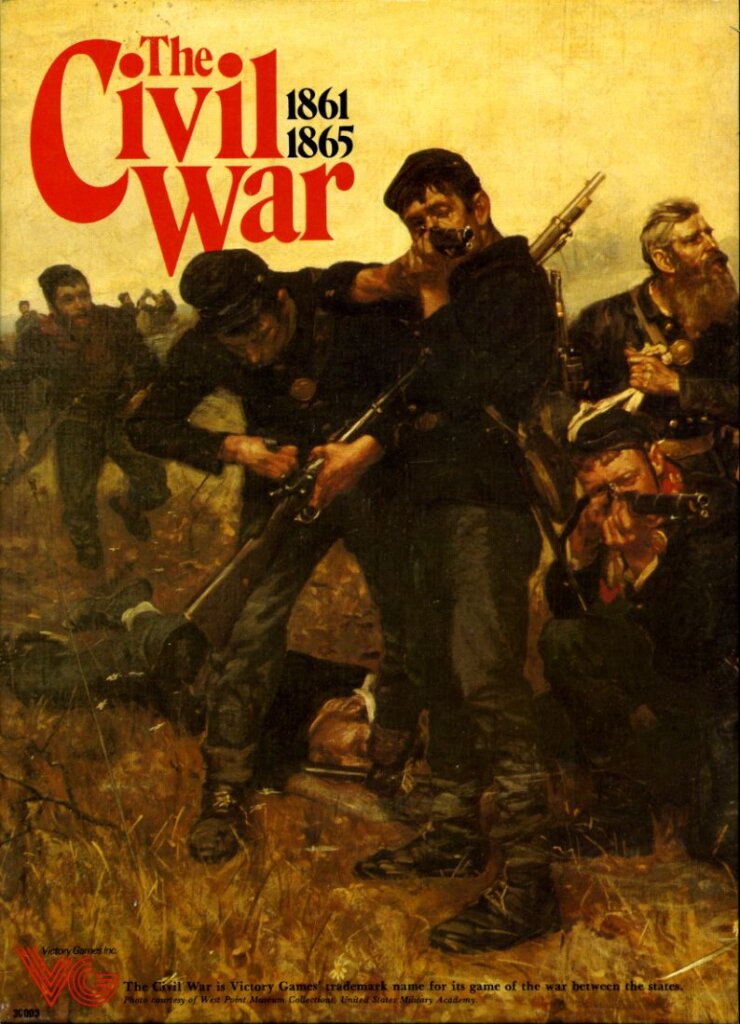
The Civil War 1861-1865 is a sprawling American Civil War strategy game for 1-2 players, with a listed playing time of 1200 minutes and a 1983 release year.
Covering the conflict from the Eastern seaboard to the middle of Texas, the game uses a 25-mile-per-hex map, with an optional extension reaching New Mexico. Five turns represent each year, while every turn unfolds through an indefinite number of dice-driven pulses.
Players must prioritize the East, West, and Trans-Mississippi Theaters in advance as primary, secondary, and tertiary. This determines how many Command Points each Theater receives, creating an ongoing need to balance competing fronts and anticipate the next turn.
- Move and consolidate Strength Points, build fortifications, add naval forces, and manage leaders with Command Points.
- Use more than 60 historical leaders, each with ratings for Initiative, Tactical Combat, and Army Command.
- Handle armies, cavalry, railroads, militia, supply, neutral states, and an extensive naval and riverine warfare system.
Strength Points are abstract, representing roughly 5,000 men each, while naval Strength Points represent ironclads and escorting vessels. Leaders make movement more economical, and larger Armies require three- or four-star commanders. Promotions are not entirely under player control, and a leader’s rank affects the force he can command.
Victory Points primarily come from capturing major enemy and neutral cities and winning neutral states. The South can also gain points through commerce raiding or by isolating or capturing Washington, D.C.; victory is checked in November 1864 and April 1865 unless Washington falls under the specified conditions.
For shorter campaigns, The Civil War 1861-1865 includes scenarios beginning in 1862, 1863, and 1864, along with 520 counters.
/pic7182955.jpg)
