Dominion: Second Edition
2016
Construct a deck on the fly, buy powerful cards, and expand your kingdom in a fast, highly varied race for victory points.
30
minutes
2 - 4
player(s)
14+
Medium


About this board game
Dominion: Second Edition is a deck-building game for 2–4 players, with each game lasting about 30 minutes. Every player begins with an identical, very small deck and competes to create the most efficient route to victory points.
At the center of the table, a selection of cards is available to buy. As you draw and play your hand, you decide which cards to add to your deck and how to use them, gradually shaping your strategy during the game rather than before it begins.
You are a monarch seeking to build a bigger and more pleasant dominion. Recruit minions, construct buildings, improve your castle, and fill your treasury while racing other monarchs to claim as much unclaimed land as possible.
- Start with an identical small deck, then expand it through card purchases.
- Choose 10 Kingdom card types from the 26 included types for each game.
- Use hand management and deck construction to pursue the most valuable path to victory points.
- Play with a set of 500 cards offering immense variety between games.
Dominion is not a collectible card game, although its play resembles constructing and using a deck in a CCG. The changing selection of Kingdom cards ensures that different combinations can produce fresh challenges and opportunities each time you play.
This Second Edition replaces six Kingdom card types from the first edition with six new types and replaces the blank cards with a seventh new Kingdom card. It also includes a rewritten rulebook, mild functional changes to Moneylender, Mine, and Throne Room, and several rephrased cards that remain functionally the same.
/pic7182955.jpg)
Dominion: Second Edition
Board Game Rules
You are a monarch, like your parents before you – a ruler of a small pleasant kingdom of rivers and evergreens. Unlike your parents, however, you have hopes…dreams! You want a bigger and more pleasant kingdom, with more rivers, and a wider variety of trees. You want a Dominion! In all directions lie fiefs, freeholds, and feodums – all small bits of land, controlled by petty lords and verging on anarchy. You will bring civilization to these unfortunates, uniting them under your banner.
But wait. It must be something in the air; several other monarchs have had the exact same idea. You must race to get as much of the unclaimed land as possible while you can, fending them off along the way. To do this you will hire minions, construct buildings, spruce up your castle, and fill the coffers of your treasury. Your parents wouldn’t be proud, but your grandparents, on your mother’s side, would be delighted.
This is a game of building a deck of cards. The deck represents your Dominion. It contains your resources, victory points, and the things you can do. It starts out a small sad collection of Estates and Coppers, but you hope that by the end of the game it will be brimming with Gold, Provinces, and the inhabitants and structures of your castle and kingdom. You win by having the most  in your deck when the game ends.
Game Overview
Dominion is a game of building a deck of cards. Each player has their own deck, their own discard pile, their own hand of cards and play area. Players start with a weak initial deck and gradually acquire better cards over the course of the game.
Players take turns. Each turn has three phases: Action, then Buy, then Clean-up, which you can remember as ABC:
- Action phase: You can play one Action card from your hand.
- Buy phase: You can play any number of Treasure cards and then buy one card to add to your deck.
- Clean-up: You sweep up all of your cards from play and from your hand and discard them, then draw a new hand of 5 cards, shuffling as needed.
The game ends after 3 piles are empty or the Province pile is empty; then players count up the on all of their cards, and the player with the most wins.
- 500 cards:
- 130 basic Treasure cards: 60 Copper, 40 Silver, 30 Gold
- 48 basic Victory cards: 24 Estate, 12 Duchy, 12 Province
- 30 Curse cards
- 262 Kingdom cards:
- 10 each of Artisan, Bandit, Bureaucrat, Cellar, Chapel, Council Room, Festival, Harbinger, Laboratory, Library, Market, Merchant, Militia, Mine, Moat, Moneylender, Poacher, Remodel, Sentry, Smithy, Throne Room, Vassal, Village, Witch, Workshop
- 12 Gardens
- 26 Randomizer cards (one of each Kingdom card with a different card back)
- 4 blank cards (unused)
- 1 Trash mat
- 1 Plastic organizer tray
- 1 Organizing Inlay
- 1 Rule booklet
Card Identification & Storage
Before the first game, carefully place the cards in the organizer tray – do not shuffle them!
Please note that some cards have different backs than others. The playing cards (Treasure cards, Victory cards, Curse cards, and Kingdom cards) all have a back with a tan border.
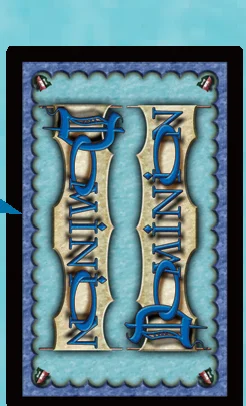
The Randomizer cards all have blue borders:
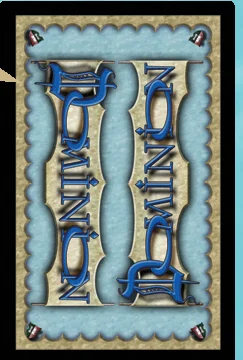
Do not mix the playing cards with the Randomizer cards. Place the Organizing Inlay in the middle of the Plastic organizer tray (placed such that the largest storage space is on the left) with Artisan at the top of the plastic tray.
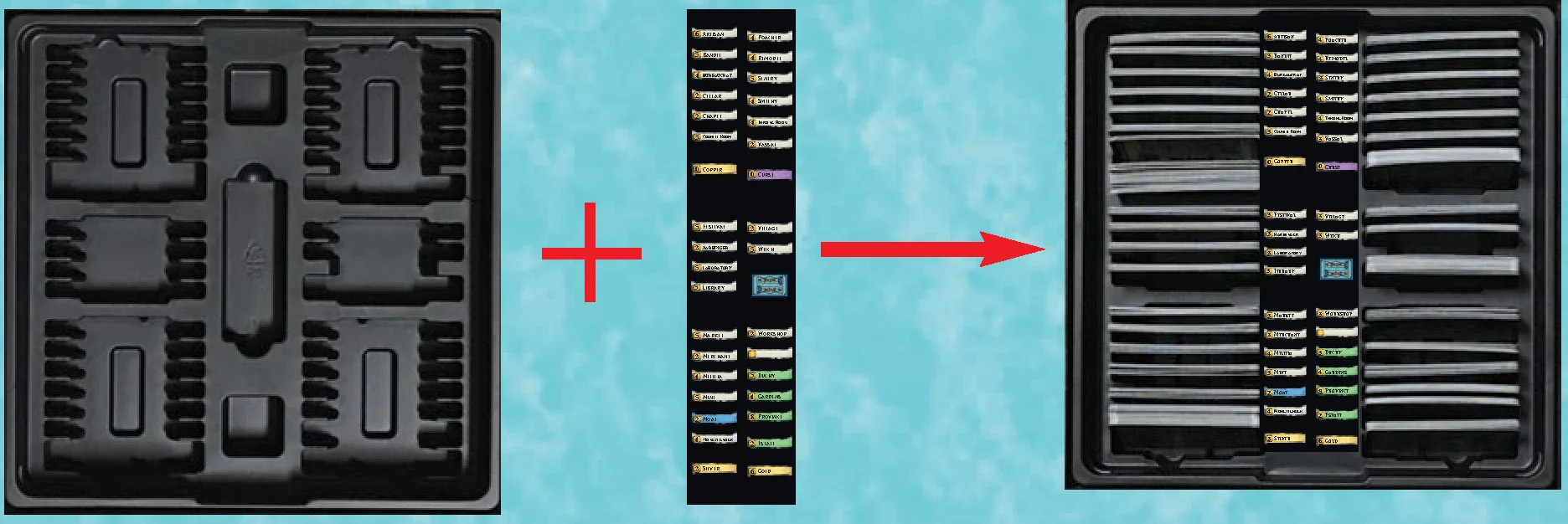
Now unwrap the card decks and place the cards in the slots of the Plastic organizer tray next to the matching names on the Organizing Inlay. When playing a game, you will remove only the cards used in that game and then return them to their appropriate slots after each game. By doing so, you will always be able to easily and quickly set up a new game.
Starting Decks
Each player takes 3 Estates and 7 Coppers and shuffles them face down as a starting deck.
Randomly choose a starting player. If you have just played a game of Dominion and it was not a tie, have the player who won the previous game go last (the player to their left goes first).
Each player draws an initial hand of 5 cards.
The Supply
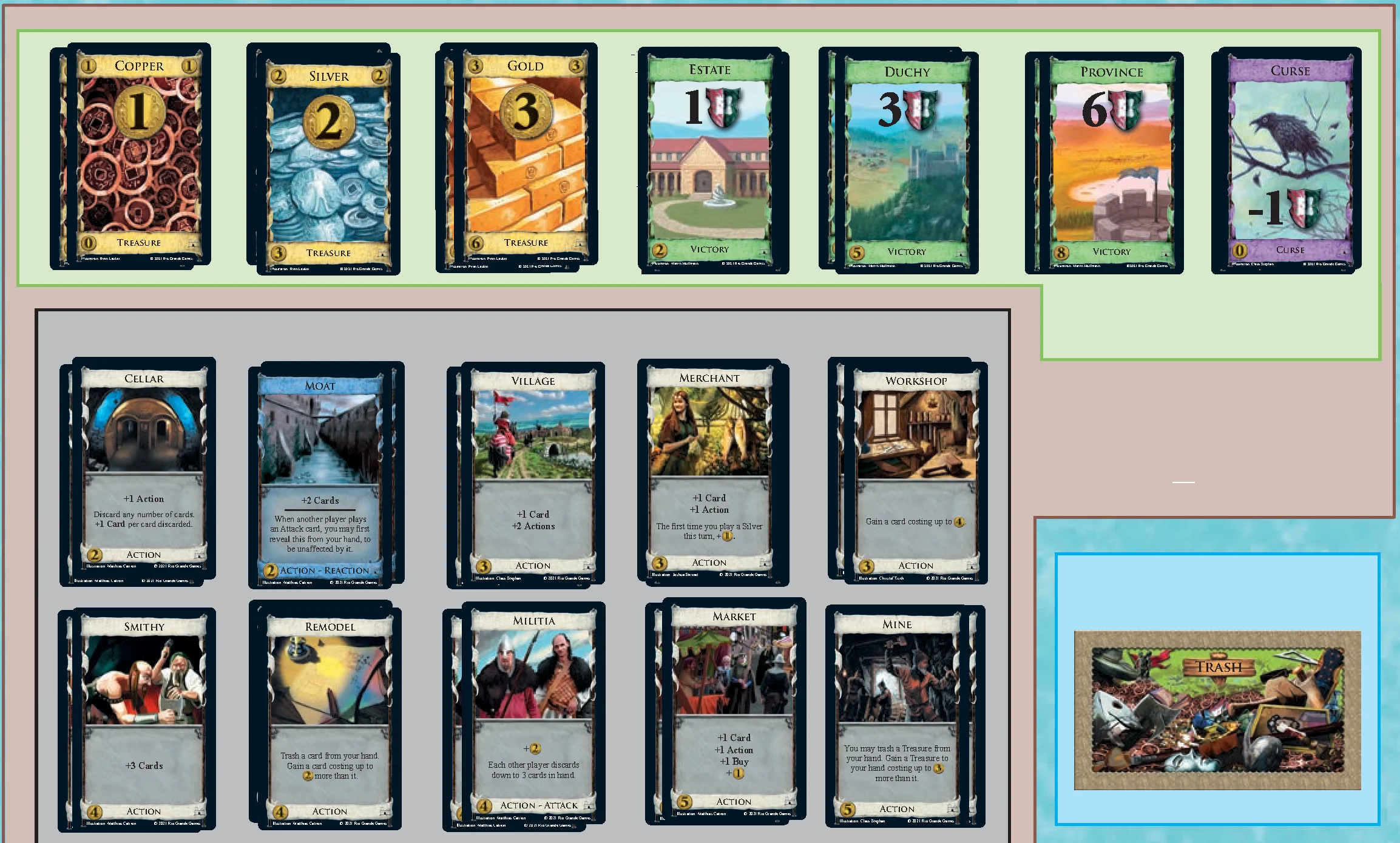
Place 17 face-up piles of cards on the table: the 7 Base card piles, which are always used, and always the same, and 10 Kingdom card piles, which vary from game to game. The full set of cards available this game is called the Supply.
Base Card Piles
The Base cards are Copper, Silver, Gold, Estate, Duchy, Province, and Curse.
- Copper, Silver, Gold: Use every copy you have of these (except Coppers players already have).
- Estate, Duchy, Province: Use 8 copies of each for a 2-player game, 12 copies for 3-4 players.
- Curse: Use 10 with 2 players, 20 with 3 players, all 30 with 4 players.
Kingdom Card Piles
There are 26 Kingdom cards. If you have expansions, you can use those Kingdom cards as well. Choose 10 Kingdom cards to use, however you like; the others will not be used this game. You can pick the Kingdom cards randomly by shuffling the randomizer cards – the cards with the blue framed backs – and turning over 10 of them. There are a few pre-made sets of 10 cards in the Recommended Sets section that you can try. For your very first game of Dominion, use these cards: Cellar, Market, Merchant, Militia, Mine, Moat, Remodel, Smithy, Village, Workshop.
Whichever 10 cards you pick, get out those piles – 10 copies of each card (do not put the randomizer card in the pile). When a Victory Kingdom card is used (e.g. Gardens), it gets 8 copies for 2 players, 12 copies for 3-4 players, as with the other Victory cards.
Trash Mat
Put the Trash mat near the piles.
Action Phase
In your Action phase, you can play one Action card from your hand. Those are cards that say “Action” on the bottom, and by default have a white banner (some are other colors due to additional types). Playing an Action card has three steps:
- Announcing it;
- Moving it to the “in play” area – the table space in front of you;
- Following the instructions on it, in order, top to bottom.
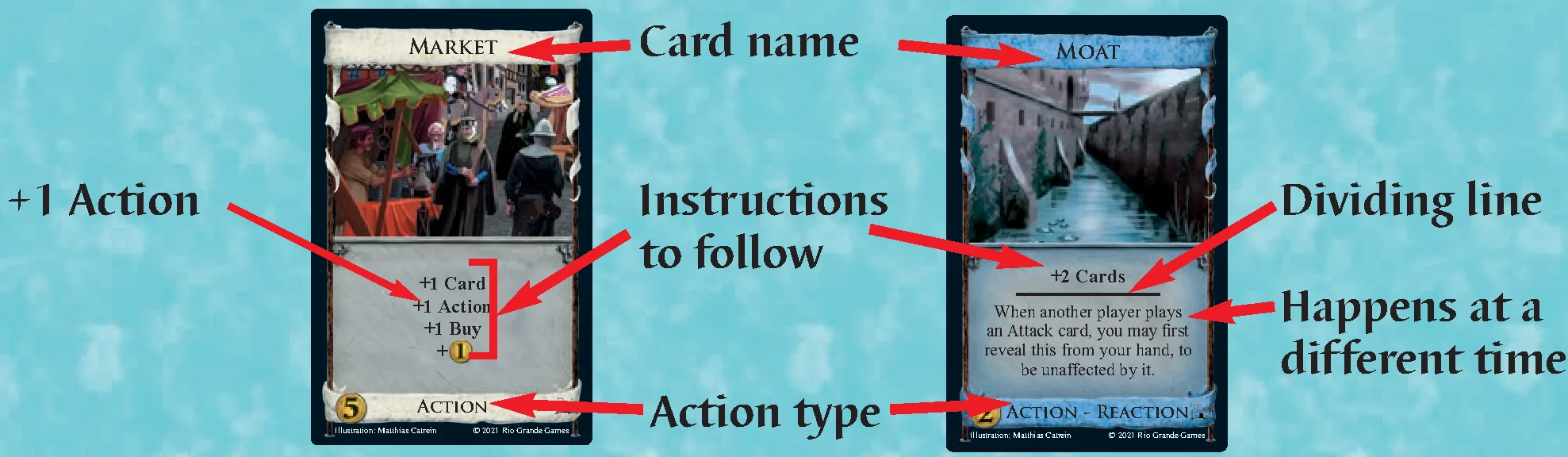
If the card has a dividing line (e.g. Moat), you stop there; instructions below the line happen at some other time (indicated). If you cannot do everything a card tells you to do, you do as much as you can; you can still play a card even if you know you will not be able to do everything it tells you to.
Some cards give “+1 Action.” This increases how many Action cards you can play in a turn. The increase happens right then, but you do not play the next Action card until completely finishing the first one. Some cards give “+2 Actions”; that means you can play two more Action cards that turn.
So, for example, if you play Militia, which does not give +Actions, you resolve Militia and are done with your Action phase. But you could instead play a Market, then another Market, then a Militia; each Market gives you +1 Action, which lets you keep playing Actions.
Using up your Actions is optional; you can have an Action card left in hand that you can play, and decide not to play it.
Buy Phase
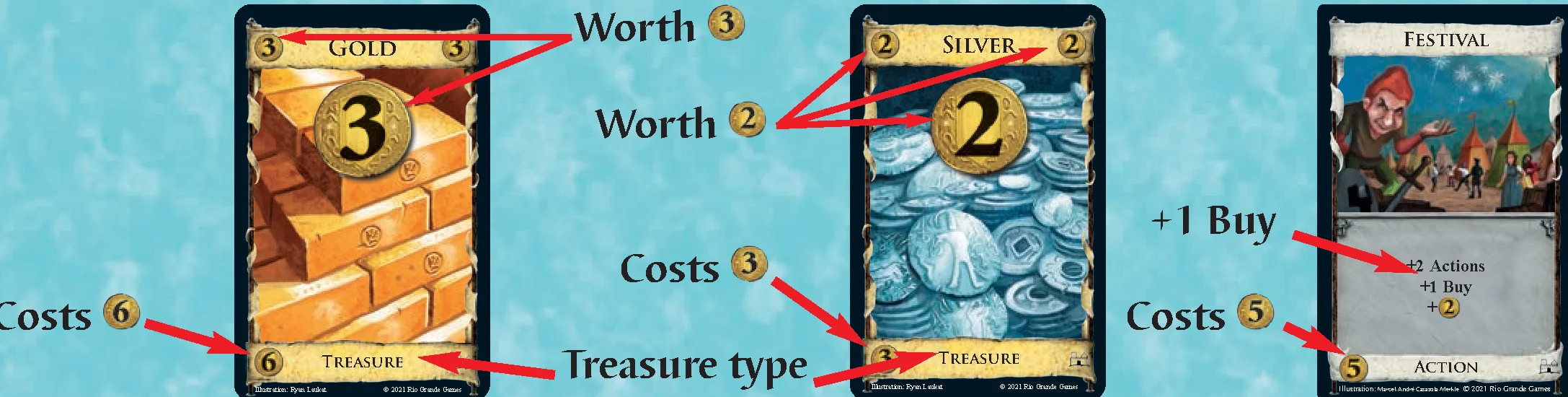
First you can play any number of Treasure cards from your hand, in any order. Treasure cards say “Treasure” on the bottom and have a yellow banner. You play one by moving it to the “in play” area; you probably will not announce your Treasures, though you can if you want. The Treasures have no text, just a big coin with a number on it. You get that many coins to spend this turn – one coin for a Copper, two for a Silver, three for a Gold, indicated as  ,
,  ,
,  . The amount is also in the corners at the top of Treasures. You do not have to play every Treasure in your hand (but only get
  this turn for the Treasures you play).
Then, you can buy one card, costing as much as you have or less. Costs are indicated in the lower left corner of cards. You buy a card by choosing it from the Supply, and then “gaining” it. “Gaining” a card means moving it from the Supply to your discard pile. Your total amount of coins available to spend goes down by the cost of the card. For example if you played four Coppers and a Silver, that makes  total; if you bought a Market, that costs
  , so you would move a Market from the Supply to your discard pile and have left.
Buying cards does not use up Treasure cards; you still have the cards. The Treasures produce income usable every time you draw them. Buying cards just uses up the you have available this turn.
Some cards give “+1 Buy.” This increases how many cards you can buy in a turn in your Buy phase. For example with and an extra Buy, you could buy two Silvers, which each cost . Using up your Buys is optional. You can have two Buys but just buy one card, or skip buying entirely. As Copper costs  , you could use a Buy with no to buy a Copper.
You cannot go back and play more Treasures after buying a card; first play Treasures, then buy.
Clean-Up Phase
- Take all of the cards you have in play (both Actions and Treasures), and any remaining cards in your hand, and put them all into your discard pile. The order does not matter; you can hide the cards from your hand under the played cards if you want to.
- Draw a new hand of 5 cards. If your deck has fewer than 5 cards, first shuffle your discard pile and put it under your deck, then draw.
Play passes to the player to your left. Any unused +Actions, unused +Buys, or unspent that you had left are gone; you start each turn fresh.
Shuffling
If you have to do anything with your deck – for example draw, look at, reveal, set aside, discard, or trash cards – and you need more cards than are left in your deck, first shuffle your discard pile and put it under your deck, then do the thing. If there are still not enough cards, you do the thing with however many cards you can. If when shuffling there are no cards in your deck, the shuffled discard pile simply becomes your new deck.
When your deck is empty, you do not shuffle until you need to do something with cards from your deck. If you have to put a card on top of your deck when it is empty, that card becomes the only card in your deck.
Card Anatomy & Types
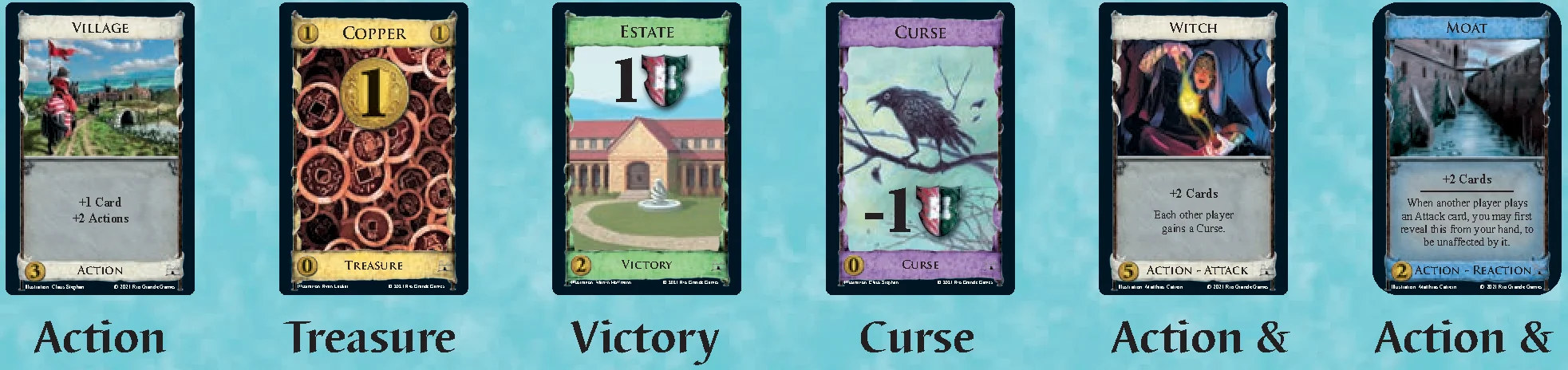
Every card has types, listed on the bottom; a color, which helps indicate certain types; and a cost, in the lower left corner. Action cards all have a text box with instructions; sometimes other cards do.
Cards can have multiple types. A card has all of its types for all purposes. For example, Throne Room lets you play an Action card twice; that Action could be Witch, which is an Action – Attack, or Moat, an Action – Reaction, or Smithy, an Action.
These are the card types present in the main set (expansions add some):
- Action: These can be played in your Action phase to do what they say to do in the text box.
- Treasure: These can be played in your Buy phase to produce used to buy cards. The amount of is indicated in the top corners and on a big symbol. Treasures in expansions may have rules on them like Action cards.
- Victory: These are generally not useful during the game, but are worth at the end indicated by a number next to a big symbol.
- Curse: These are bad cards worth -1 . Normally they have no use and you will not choose to buy them, though you can; however you may receive them from other players via Witch.
- Attack: These are cards that hurt other players directly somehow.
- Reaction: These are cards that can be used in some way at an unusual time. Any such use is spelled out on the Reaction card; for example Moat says it can be revealed when another player plays an Attack card. Reactions are used one at a time (which matters for expansion Reactions).
Terminology
Some special terms are used in card text.
Numeric Modifiers
Four terms involve a number after a + symbol. +2 is the same as +1 twice, and so on.
- “+1 Action” – You may play an additional Action card this turn.
- When this happens, it just adds to the number of Action cards you can play; you finish resolving the current card before actually playing more Action cards.
- Actions are only usable in the Action phase.
- When you have multiple Actions, it can be helpful to say the number out loud to remember it. Some players like to form a “tree” on the table, putting two played Actions on a Village or Festival to show its Actions being used up.
- “+1 Buy” – You may buy an additional card in your Buy phase this turn.
- You do not have to use extra Buys.
- You split up your among your Buys.
- “+1 Card” – Draw a card.
- You draw the card immediately.
- If you have to draw more cards than are left in your deck, you shuffle your discard pile, put it under your deck, and then draw. If there still are not enough cards to draw, you just draw as many as you can.
- “+“ – You have an extra to spend in your Buy phase this turn.
- + does not give you a Copper card; it just adds to how much you can spend this turn.
- +
Card Actions and Locations
Other terms involve moving cards, seeing cards, and where cards are.
- “Discard a card” – Move a card from your hand to your discard pile.
- Sometimes a card will tell you to discard a card from another location, but by default discarded cards come from hands.
- You place the discarded card on top of your discard pile, face up.
- If you discard multiple cards at once, you do not need to reveal them all, just the one you put on top.
- “Gain a card” – Take a card from the Supply and put it into your discard pile.
- Sometimes a card will let you gain a card from a place other than the Supply, but by default gained cards come from the Supply.
- Sometimes a card will let you gain a card to a location other than your discard pile, but by default all gained cards are put into your discard pile.
- You do not play a card when you gain it; it just goes to your discard pile.
- “In play” – Being in a player’s play area.
- Cards become “in play” when played, and usually stay there until discarded from play in Clean-up.
- Only played cards are in play; set aside cards, cards in the trash, in the Supply, in hands, etc., are not in play.
- “Look at a card” – You get to see the card; other players do not.
- After looking at it, return it to wherever it was (unless otherwise instructed).
- “Play a card” – Put a card into play, and follow the instructions on it.
- When a card tells you to play a card, that does not use up an Action play for the turn.
- As with playing a card normally, you follow the instructions in order, stopping at a dividing line when there is one.
- As always, played cards go into play, not directly into the discard pile.
- “Reveal a card” – All players get to see the card.
- After revealing it, return it to wherever it was (unless otherwise instructed).
- “Set aside a card” – Put the card on the table, outside of the play area.
- Set aside cards are not “in play.”
- Set aside cards are face up unless otherwise specified.
- A card that sets a card aside will say when to move it somewhere else.
- “Trash a card” – Put a card into the Trash pile.
- This is a way of getting rid of a card; a trashed card is no longer one of your cards.
- The Trash pile is on the Trash mat, face up; players may look through the Trash at any time.
- The order of the Trash pile does not matter; players can reorder it.
- Cards in the Trash are essentially out of the game, though some expansion cards can get them.
Card Symbols
Finally there are three symbols used in text boxes:
- – Victory points: The player with the most wins.
- – The coin symbol: This indicates costs of cards, and amounts of money produced.
- Dividing line: Some cards have the text box divided with a line (e.g. Moat). This separates abilities that happen at different times. When playing the card, you follow instructions above the line only; the text below the line will say when it applies.
- You can count the number of cards in your deck at any time (without looking at the card fronts), but cannot look through or count your discard pile or another player’s deck or discard pile. The number of cards in each player’s hand is public, as is the top card of each discard pile. All cards in play are public; set aside cards are normally public but are sometimes face down. Players can look through the Trash pile at any time.
- When interacting with a discard pile (e.g. with Harbinger), it is not necessary to keep it in the same order. The only thing that ever matters about that order is that the top card is public. It is also never necessary to keep the Trash pile in a particular order.
- When two things happen to different players at the same time, go in turn order starting with the player whose turn it is. For example, when a player plays Witch, the other players gain Curses in turn order, which may matter if the Curses run out.
- When two things happen to one player at the same time, that player picks the order to do them, even if some are mandatory and some are not. This can come up with expansions.
- When a card gives you a choice (“choose one…”), you can pick any option, without considering whether or not you will be able to do it. This comes up with expansions.
End of the Game
The game ends at the end of a turn, if either the Province pile is empty, or any three or more Supply piles are empty (any piles at all, including Kingdom cards, Curses, Copper, etc.).
Scoring & Winning
Take all of your cards – from your hand, deck, discard pile, play area, and even set aside cards – and sort them for putting them back in their piles. Count up your .
The player with the most wins. If players tie for , a player who tied but had fewer turns wins. If players tie and had the same number of turns, they rejoice in their shared victory.
Before the game
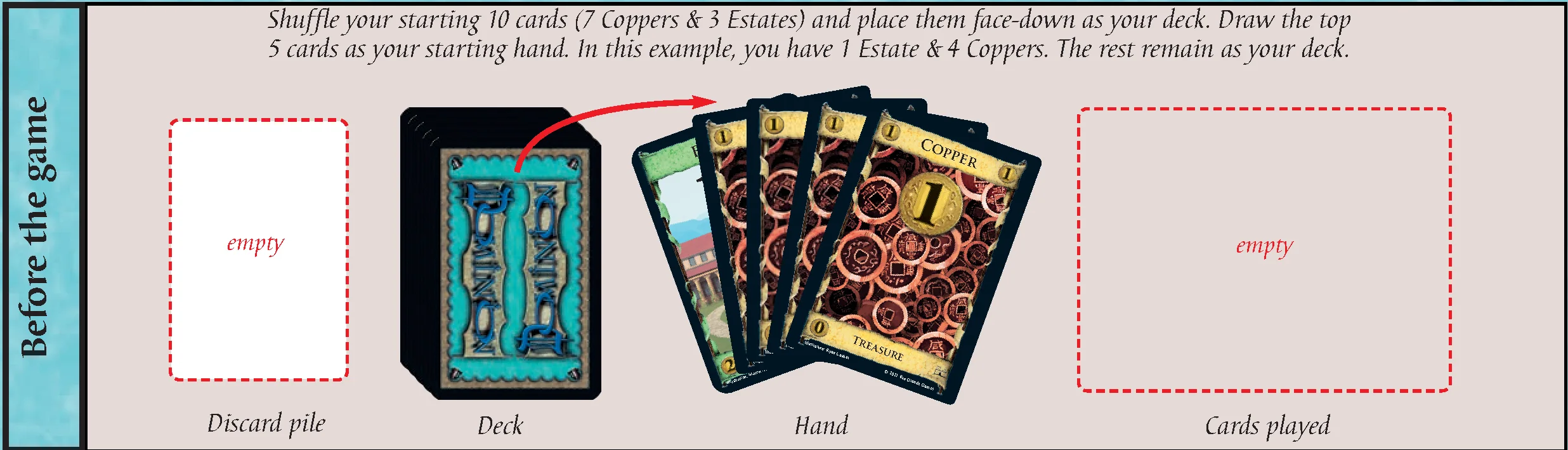
Shuffle your starting 10 cards (7 Coppers & 3 Estates) and place them face-down as your deck. Draw the top 5 cards as your starting hand. In this example, you have 1 Estate & 4 Coppers. The rest remain as your deck.
1st turn
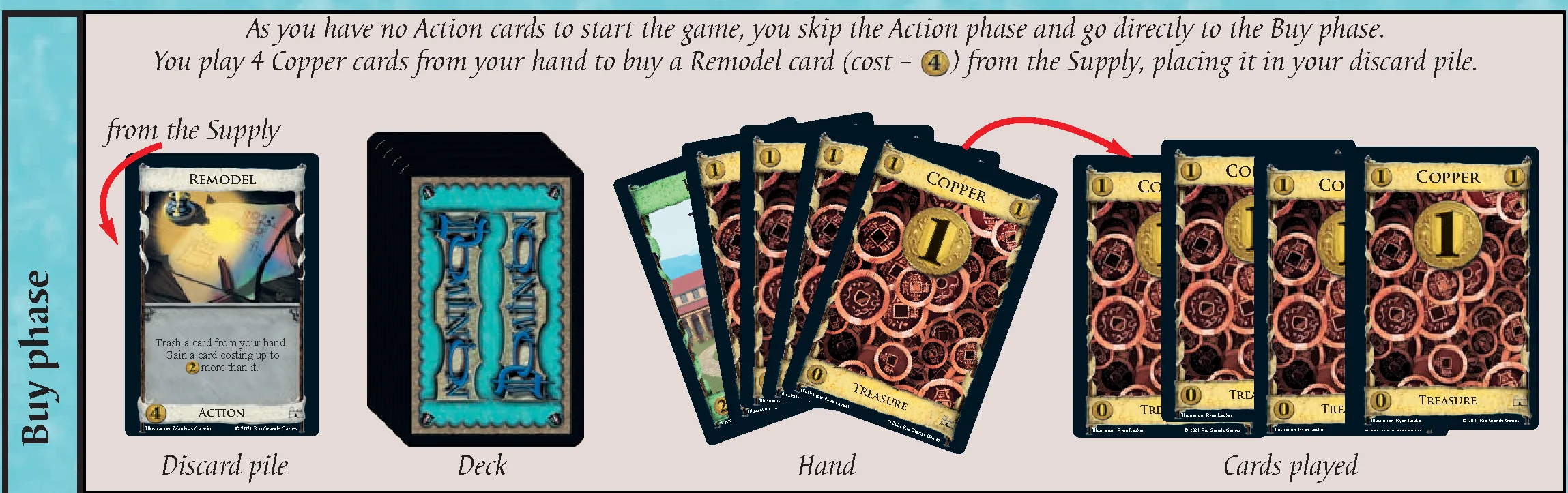
Buy phase: As you have no Action cards to start the game, you skip the Action phase and go directly to the Buy phase. You play 4 Copper cards from your hand to buy a Remodel card (cost =  ) from the Supply, placing it in your discard pile.
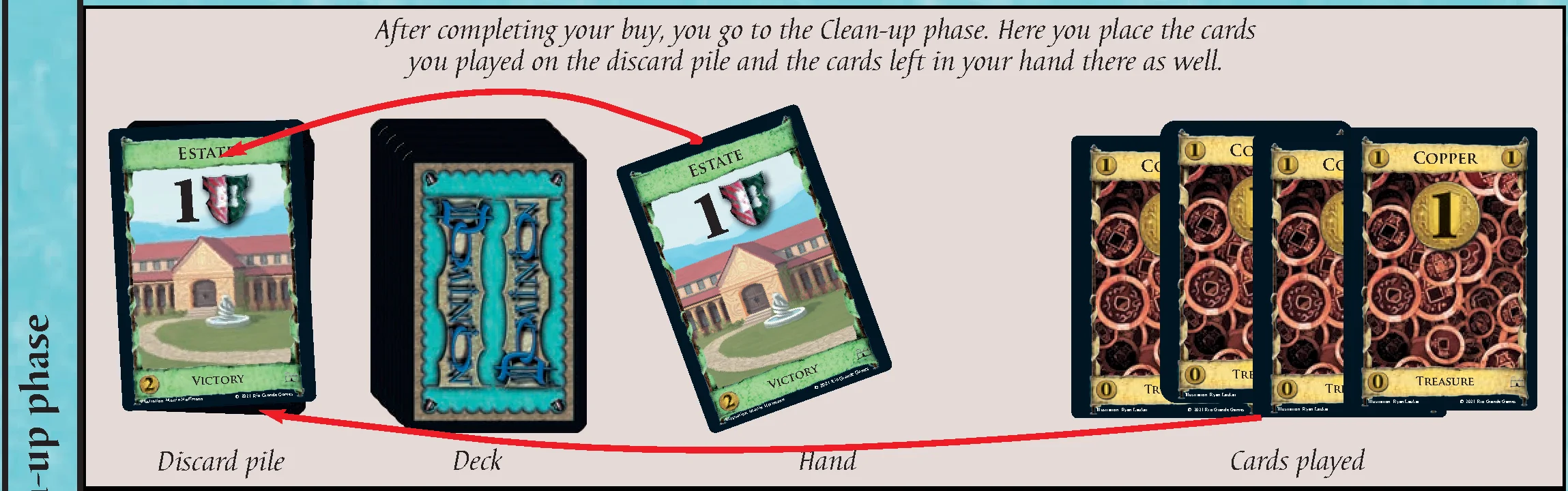
Clean-up phase: After completing your buy, you go to the Clean-up phase. Here you place the cards you played on the discard pile and the cards left in your hand there as well.
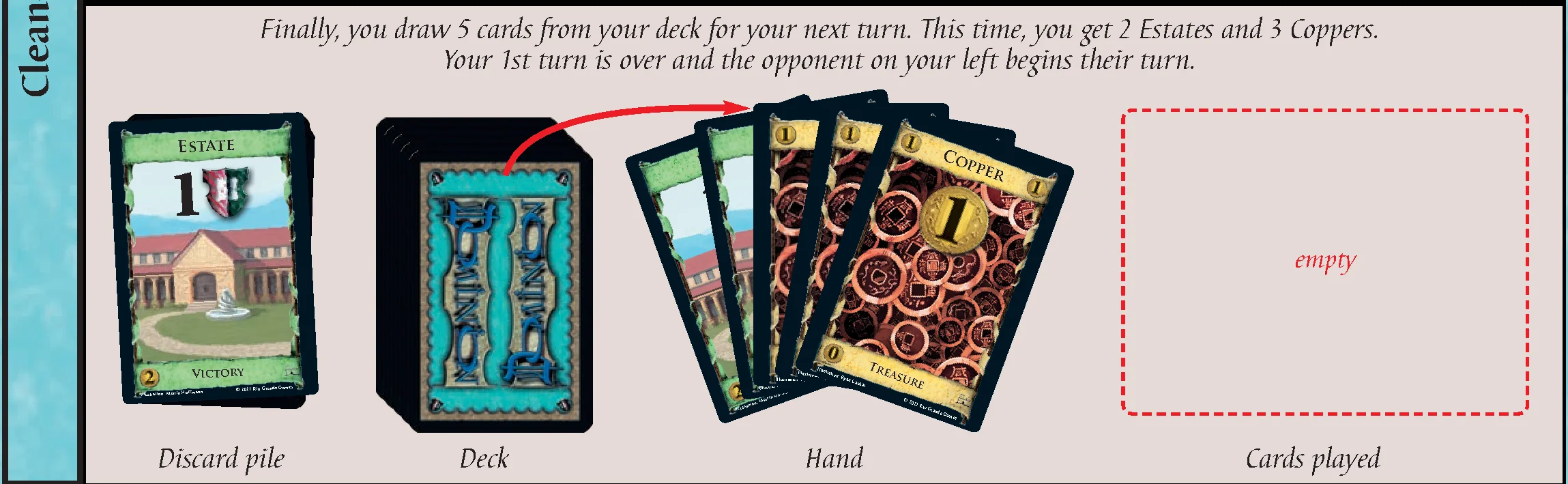
Finally, you draw 5 cards from your deck for your next turn. This time, you get 2 Estates and 3 Coppers. Your 1st turn is over and the opponent on your left begins their turn.
2nd turn
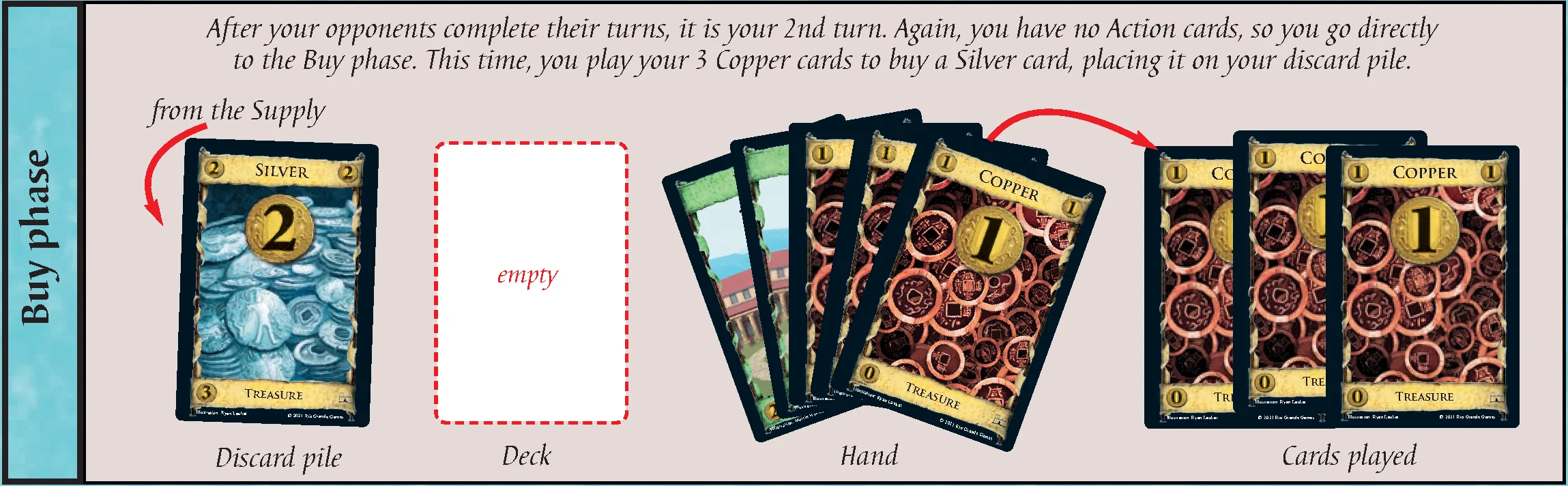
Buy phase: After your opponents complete their turns, it is your 2nd turn. Again, you have no Action cards, so you go directly to the Buy phase. This time, you play your 3 Copper cards to buy a Silver card, placing it on your discard pile.
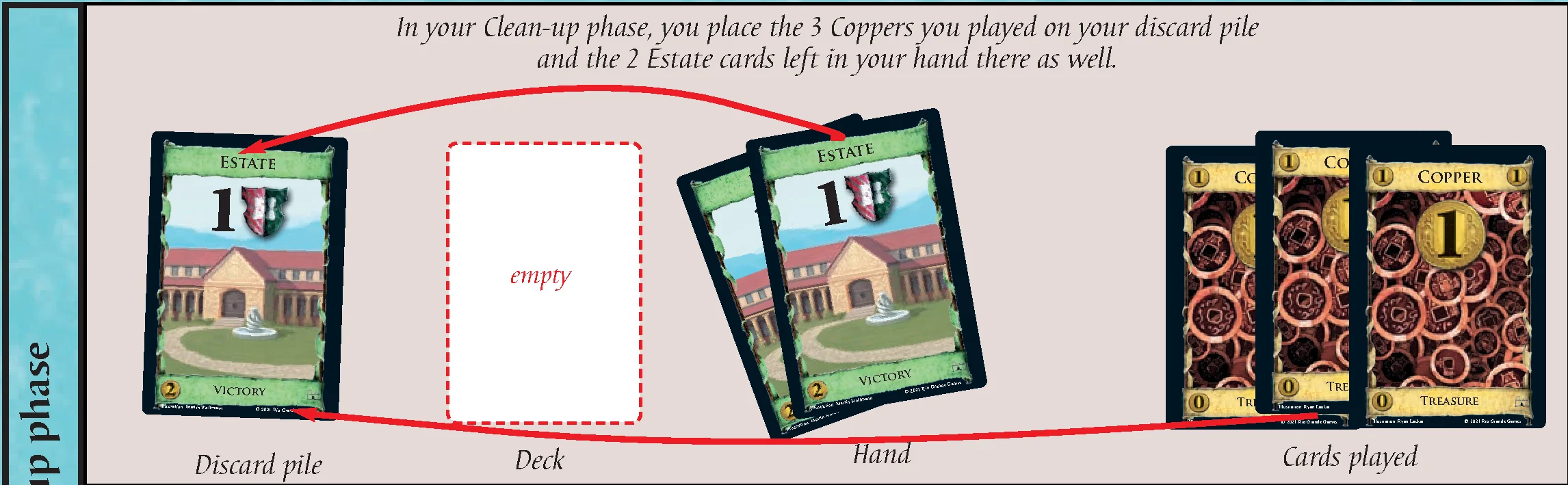
Clean-up phase: In your Clean-up phase, you place the 3 Coppers you played on your discard pile and the 2 Estate cards left in your hand there as well.
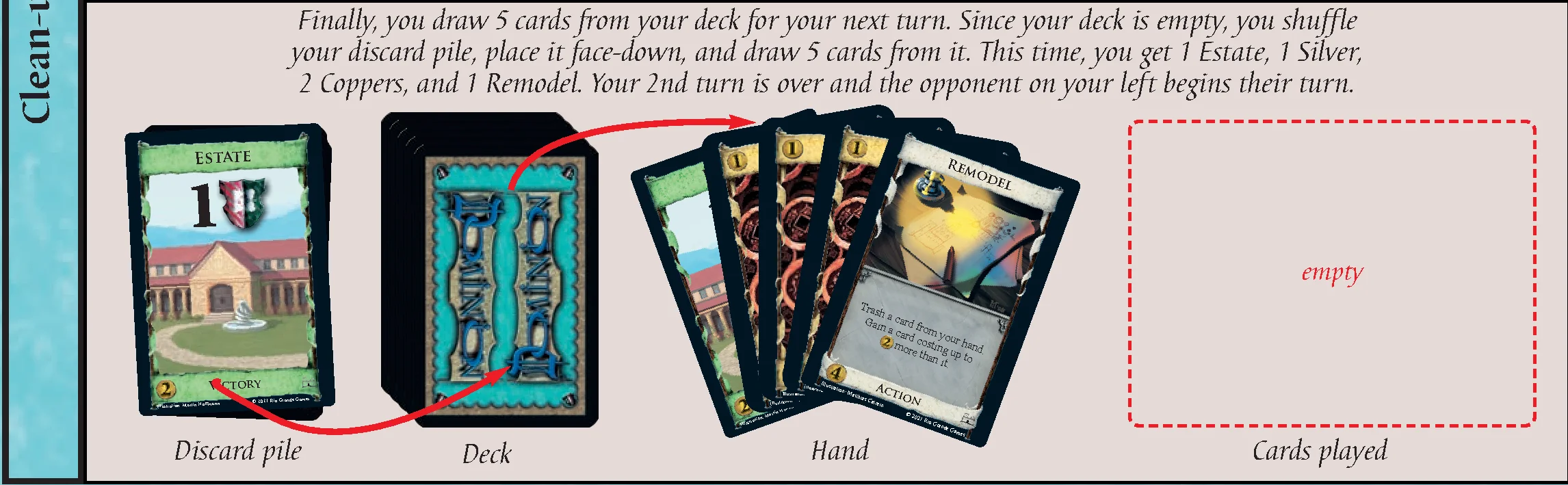
Finally, you draw 5 cards from your deck for your next turn. Since your deck is empty, you shuffle your discard pile, place it face-down, and draw 5 cards from it. This time, you get 1 Estate, 1 Silver, 2 Coppers, and 1 Remodel. Your 2nd turn is over and the opponent on your left begins their turn.
3rd turn
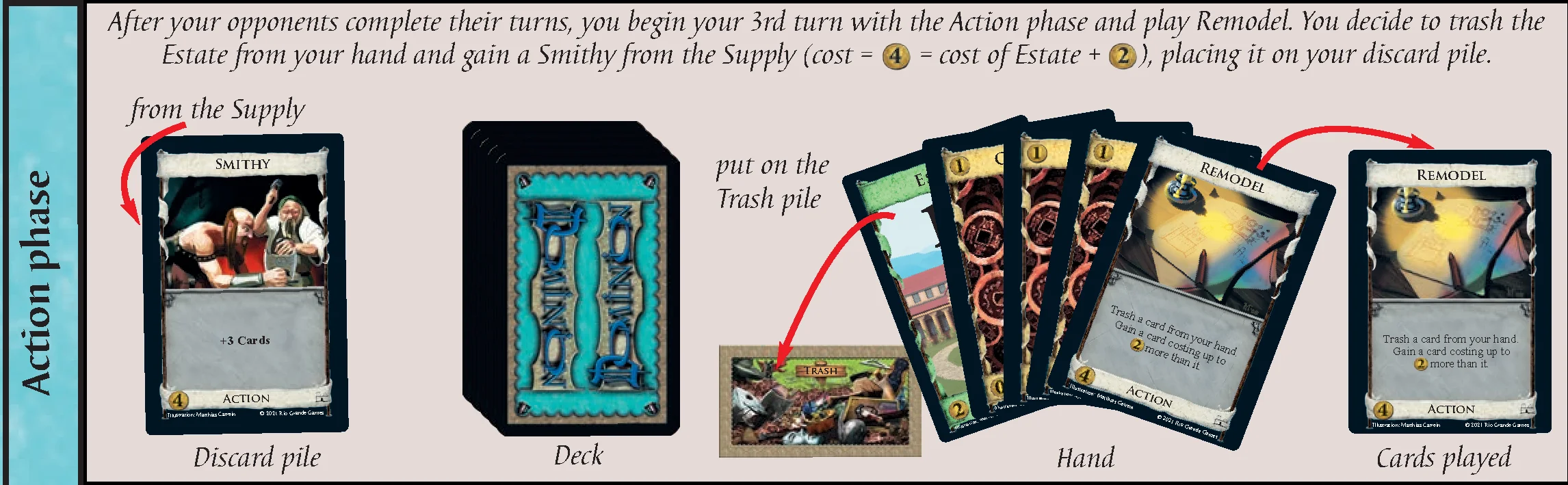
Action phase: After your opponents complete their turns, you begin your 3rd turn with the Action phase and play Remodel. You decide to trash the Estate from your hand and gain a Smithy from the Supply (cost = = cost of Estate + ), placing it on your discard pile.
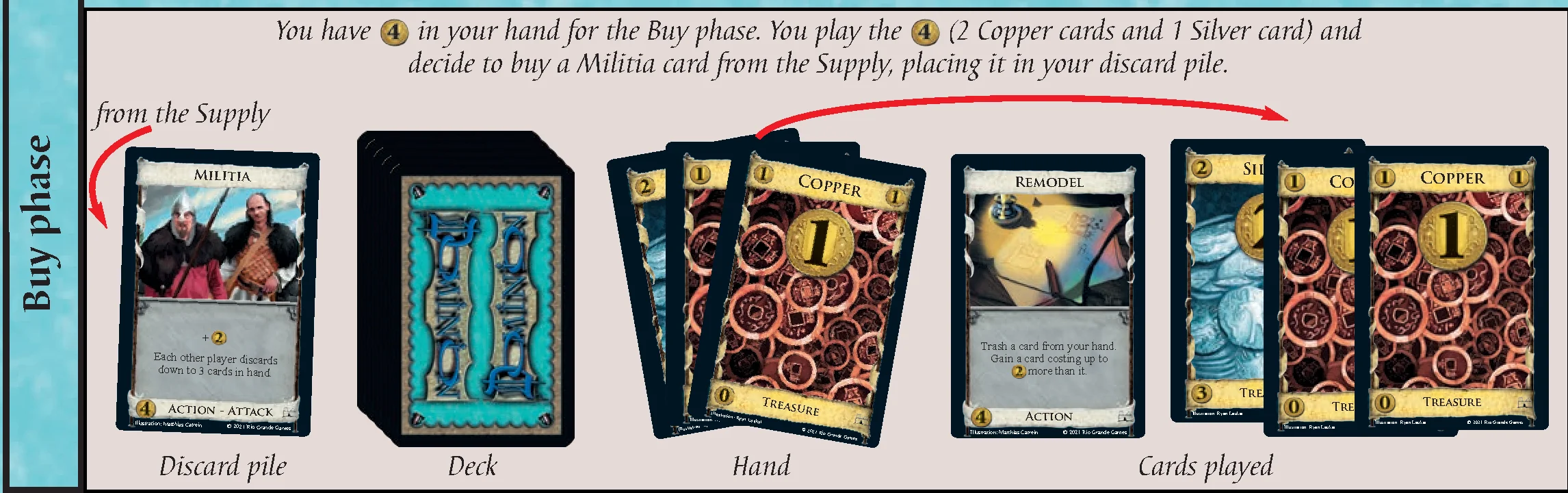
Buy phase: You have in your hand for the Buy phase. You play the (2 Copper cards and 1 Silver card) and decide to buy a Militia card from the Supply, placing it in your discard pile.
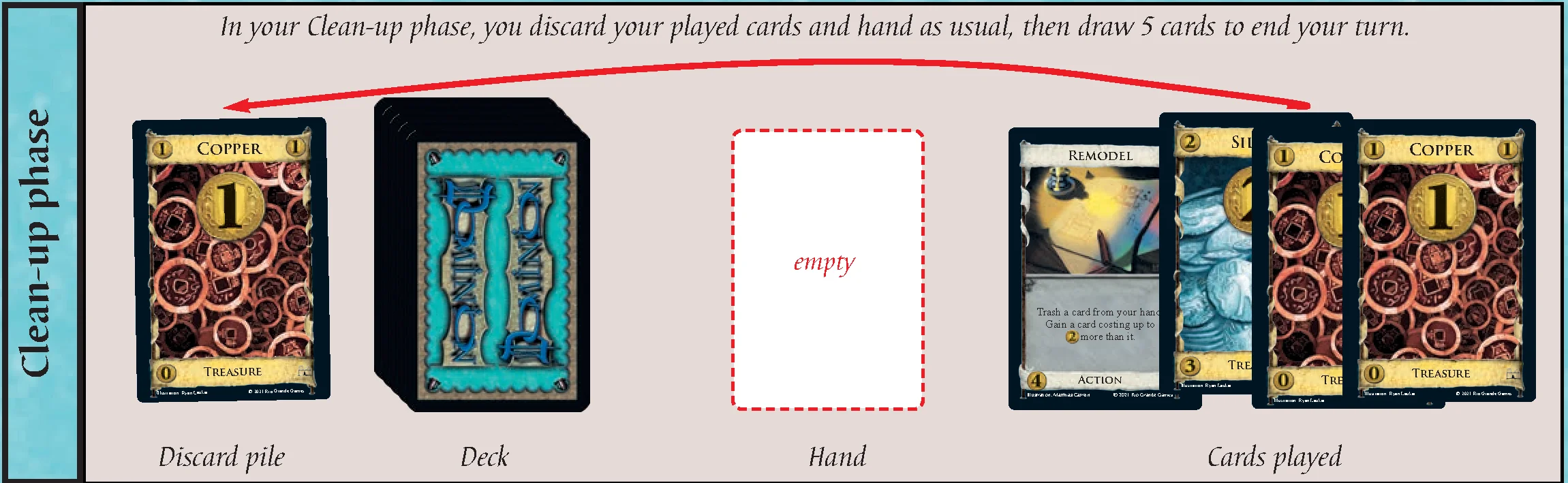
Clean-up phase: In your Clean-up phase, you discard your played cards and hand as usual, then draw 5 cards to end your turn.
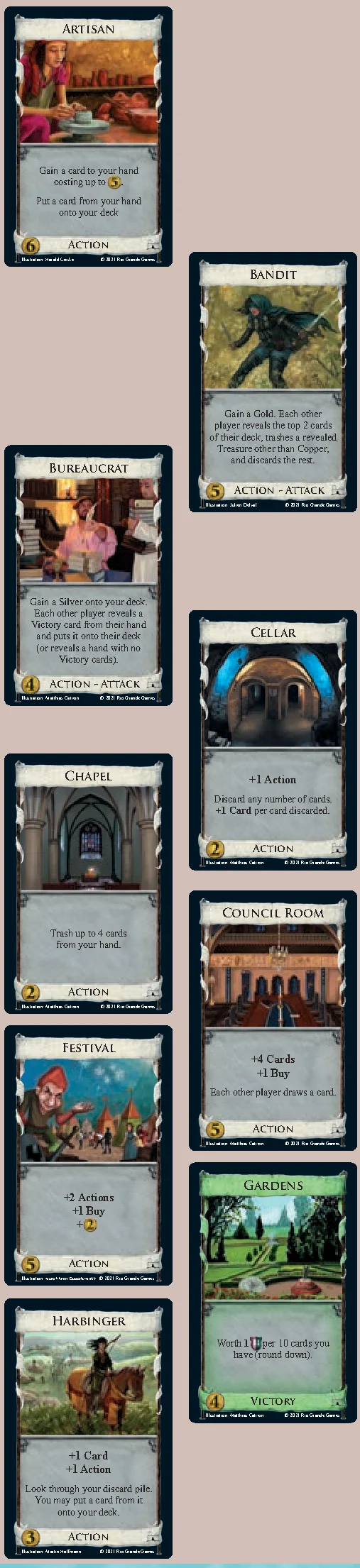
- Artisan: The card you gain comes from the Supply and is put into your hand. You cannot use to increase how expensive of a card you gain; it always costs from to . After gaining the card, you put a card from your hand onto your deck; that can be the card you just gained, or a different card.
- Bandit: First you gain a Gold from the Supply, putting it into your discard pile. Then each other player, in turn order, reveals their top 2 cards, trashes one they choose that is a Treasure other than Copper (e.g. Silver or Gold), and discards the other revealed cards. A player who did not reveal a Treasure card other than Copper simply discards both cards.
- Bureaucrat: A player with no cards in their deck will have the card they put on top become the only card in their deck.
- Cellar: Choose any number of cards from your hand; discard them all at once; then draw as many cards as you actually discarded. If this causes you to shuffle, you will shuffle in the cards you discarded. You do not have to let players see any but the top card discarded; however the number of cards you discard is public.
- Chapel: You cannot trash the Chapel itself, since it is not in your hand after you play it.
- Council Room: The other players draw a card whether they want to or not.
- Festival: You get +2 Actions, +1 Buy, and +.
- Gardens: For example, if you have 37 cards at the end of the game, each copy of Gardens you have is worth 3 . Use 8 copies of Gardens in a 2-player game, 12 copies for 3 or more players.
- Harbinger: First draw a card and get +1 Action; then look through your discard pile, and you may put a card from it on top of your deck. Putting a card on top is optional.
- Laboratory: You draw 2 cards and get +1 Action.
- Library: You look at cards one at a time, putting each one into your hand or setting it aside, until you have 7 cards in hand; then you discard the set aside cards. If you shuffle in the middle of doing this, you do not shuffle in the set aside cards. Only Action cards can be set aside. You are not forced to set aside Action cards; that is just an option. If you already have 7 cards in hand to start, you do not draw any cards.
- Market: You draw a card and get +1 Action, +, and +1 Buy.
- Merchant: When you play Merchant, you draw a card and get +1 Action. If you end up playing a Silver later in the turn, it comes with +. If you play more than one Merchant, each gives you + when you play that first Silver; but if you play more than one Silver, you only get the + for the first Silver.
- Militia: Players with 3 or fewer cards in hand do not discard any cards. Players with more cards discard until they only have 3.
- Mine: You can, for example, trash a Copper to gain a Silver, or trash a Silver to gain a Gold. The Treasure you gain comes from the Supply and is put into your hand; you can play it for the same turn. If you do not have a Treasure to trash, you do not gain one.
- Moat: An Attack card says “Attack” on the bottom line; in this set, Bandit, Bureaucrat, Militia, and Witch are Attacks. When another player plays an Attack card, you may reveal a Moat from your hand, before the Attack does anything, to be unaffected by the Attack – you do not reveal cards to Bandit, or put a Victory card on your deck for Bureaucrat, or discard for Militia, or gain a Curse for Witch. Moat stays in your hand, and can still be played on your next turn. Moat does not stop anything an Attack does to other players, or for the player who played it; it just protects you personally. Moat can also be played on your turn for +2 Cards. If multiple Attacks are played on a turn or in a round of turns, you may reveal Moat for as many of them as you want.
- Moneylender: You only get the + if you actually trashed a Copper.
- Poacher: You draw your one card before discarding. If there are no empty piles, you do not discard. If there is one empty pile, you discard one card; if there are two empty piles, you discard two cards, and so on. This includes all Supply piles, including Curses, Coppers, Poacher itself, etc. If you do not have enough cards to discard, just discard the rest of your hand.

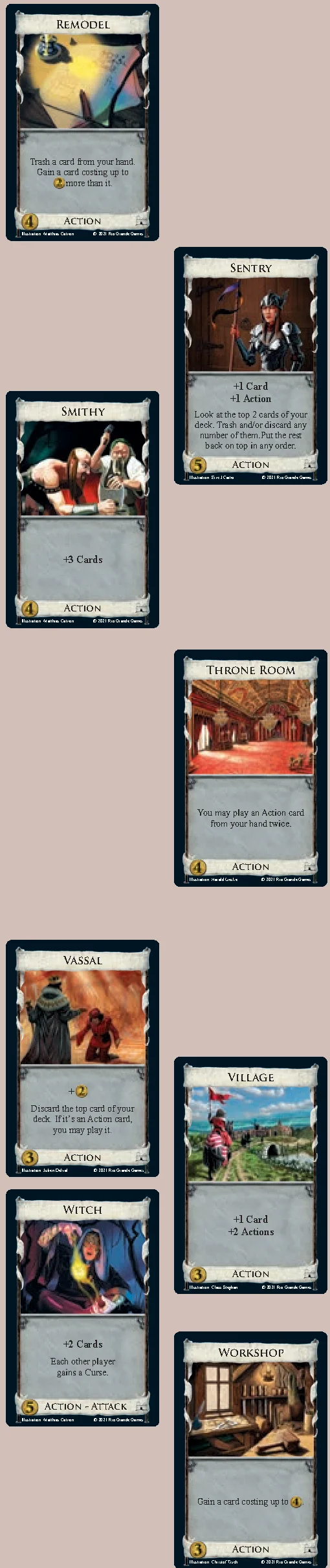
- Remodel: You cannot trash the Remodel itself, since it is not in your hand after you play it. If you do not have a card to trash, you do not gain one. If you do gain a card, it comes from the Supply and is put into your discard pile. The gained card does not need to cost exactly more than the trashed card; it can cost that much or less, and can even be another copy of the trashed card. You cannot use to increase how expensive of a card you gain.
- Sentry: First you draw a card and get +1 Action. Then you look at the top 2 cards of your deck. You can trash both, or discard both, or put both back in either order; or you can trash one and discard one, or trash one and put one back, or discard one and put one back.
- Smithy: You draw 3 cards.
- Throne Room: Playing an Action card from your hand is optional. If you do play one, you resolve it completely, then play it a second time. You cannot play other cards in-between (unless told to by the card, such as with Vassal or Throne Room itself). Playing Action cards with Throne Room is just like playing Action cards normally, except it does not use up Action plays for the turn. For example if you start a turn by playing Throne Room on Village, you would draw a card, get +2 Actions, draw another card, and get +2 Actions again, leaving you with 4 Actions. If you Throne Room a Throne Room, you may play an Action card twice, then may play another Action card twice; you do not play one Action card four times.
- Vassal: If the card is an Action card, you can play it, but do not have to. If you do play it, you move it into your play area and follow its instructions; this does not use up one of your Action plays for the turn.
- Village: You draw a card and get +2 Actions.
- Witch: The Curses come from the Supply and are put into discard piles. They are given out in turn order, which can matter when the Curse pile is low. When the Curses are gone, you can still play Witch for +2 Cards.
- Workshop: The card you gain comes from the Supply and is put into your discard pile. You cannot use to increase how expensive of a card you gain; it always costs from to .
Players can play Dominion with any set of 10 Kingdom cards, but these sets have been specially picked out to be entertaining and show off card interactions and strategies. Dominion now has a large number of expansions with which you can add to your fun. We have included recommended sets for those expansions as well.
Dominion alone
- First Game: Cellar, Market, Merchant, Militia, Mine, Moat, Remodel, Smithy, Village, Workshop
- Size Distortion: Artisan, Bandit, Bureaucrat, Chapel, Festival, Gardens, Sentry, Throne Room, Witch, Workshop
- Deck Top: Artisan, Bureaucrat, Council Room, Festival, Harbinger, Laboratory, Moneylender, Sentry, Vassal, Village
- Sleight of Hand: Cellar, Council Room, Festival, Gardens, Library, Harbinger, Militia, Poacher, Smithy, Throne Room
- Improvements: Artisan, Cellar, Market, Merchant, Mine, Moat, Moneylender, Poacher, Remodel, Witch
- Silver & Gold: Bandit, Bureaucrat, Chapel, Harbinger, Laboratory, Merchant, Mine, Moneylender, Throne Room, Vassal
Dominion & Intrigue
- Underlings: Cellar, Festival, Library, Sentry, Vassal • Courtier, Diplomat, Minion, Nobles, Pawn
- Grand Scheme: Artisan, Council Room, Market, Militia, Workshop • Bridge, Mill, Mining Village, Patrol, Shanty Town
- Deconstruction: Bandit, Mine, Remodel, Throne Room, Village • Diplomat, Harem, Lurker, Replace, Swindler
Dominion & Seaside
- Reach for Tomorrow: Artisan, Cellar, Council Room, Vassal, Village • Cutpurse, Ghost Ship, Lookout, Sea Hag, Treasure Map
- Repetition: Festival, Harbinger, Militia, Workshop • Caravan, Explorer, Outpost, Pearl Diver, Pirate Ship, Treasury
- Give and Take: Library, Market, Moneylender, Witch • Ambassador, Fishing Village, Haven, Island, Salvager, Smugglers
Dominion & Alchemy
- Forbidden Arts: Bandit, Cellar, Council Room, Gardens, Laboratory, Throne Room • Apprentice, Familiar, Possession, University
- Potion Mixers: Cellar, Festival, Militia, Poacher, Smithy • Alchemist, Apothecary, Golem, Herbalist, Transmute
- Chemistry Lesson: Bureaucrat, Market, Moat, Remodel, Vassal, Witch • Alchemist, Golem, Philosopher’s Stone, University
Dominion & Prosperity
- Biggest Money: Artisan, Harbinger, Laboratory, Mine, Moneylender • Bank, Grand Market, Mint, Royal Seal, Venture
- The King’s Army: Bureaucrat, Council Room, Merchant, Moat, Village • Expand, Goons, King’s Court, Rabble, Vault
- The Good Life: Artisan, Bureaucrat, Cellar, Gardens, Village • Contraband, Counting House, Hoard, Monument, Mountebank
Dominion & Cornucopia/Guilds
- Bounty of the Hunt: Cellar, Festival, Militia, Moneylender, Smithy • Harvest, Horn of Plenty, Hunting Party, Menagerie, Tournament
- Bad Omens: Bureaucrat, Laboratory, Merchant, Poacher, Throne Room • Fortune Teller, Hamlet, Horn of Plenty, Jester, Remake
- The Jester’s Workshop: Artisan, Laboratory, Market, Remodel, Workshop • Fairgrounds, Farming Village, Horse Traders, Jester, Young Witch • Bane: Merchant
- Arts and Crafts: Laboratory, Cellar, Workshop, Festival, Moneylender • Stonemason, Advisor, Baker, Journeyman, Merchant Guild
- Clean Living: Bandit, Militia, Moneylender, Gardens, Village • Butcher, Baker, Candlestick Maker, Doctor, Soothsayer
- Gilding the Lily: Library, Merchant, Remodel, Market, Sentry • Plaza, Masterpiece, Candlestick Maker, Taxman, Herald
Dominion & Hinterlands
- Highway Robbery: Cellar, Library, Moneylender, Throne Room, Workshop • Highway, Inn, Margrave, Noble Brigand, Oasis
- Adventures Abroad: Festival, Laboratory, Remodel, Sentry, Vassal • Crossroads, Farmland, Fool’s Gold, Oracle, Spice Merchant
Dominion & Dark Ages
- High and Low: Cellar, Moneylender, Throne Room, Witch, Workshop • Hermit, Hunting Grounds, Mystic, Poor House, Wandering Minstrel
- Chivalry and Revelry: Festival, Gardens, Laboratory, Library, Remodel • Altar, Knights, Rats, Scavenger, Squire
Dominion & Adventures
- Level Up: Training • Market, Merchant, Militia, Throne Room, Workshop • Dungeon, Gear, Guide, Lost City, Miser
- Son of Size Distortion: Bonfire, Raid • Bandit, Bureaucrat, Gardens, Moneylender, Witch • Amulet, Duplicate, Giant, Messenger, Treasure Trove
Dominion & Empires
- Everything in Moderation: Orchard, Windfall • Cellar, Library, Remodel, Village, Workshop • Enchantress, Forum, Legionary, Overlord, Temple
- Silver Bullets: Aqueduct, Conquest • Bureaucrat, Gardens, Laboratory, Market, Moneylender • Catapult/Rocks, Charm, Farmers’ Market, Groundskeeper, Patrician/Emporium
Dominion & Nocturne
- Night Shift: Bandit, Gardens, Mine, Poacher, Smithy • Druid (The Earth’s Gift, The Flame’s Gift, The Forest’s Gift), Exorcist, Ghost Town, Idol, Night Watchman
- Idle Hands: Cellar, Harbinger, Market, Merchant, Moneylender • Bard, Conclave, Cursed Village, Devil’s Workshop, Tragic Hero
Dominion & Renaissance
- It Takes a Villager: Road Network • Market, Merchant, Mine, Smithy, Vassal • Acting Troupe, Cargo Ship, Recruiter, Seer, Treasurer
- Capture the Flag: Barracks, Pageant • Cellar, Festival, Harbinger, Remodel, Workshop • Flag Bearer, Lackeys, Scholar, Swashbuckler, Villain
Dominion & Menagerie
- Pony Express: Way of the Seal, Stampede • Artisan, Cellar, Market, Mine, Village • Barge, Destrier, Paddock, Stockpile, Supplies
- Garden of Cats: Way of the Mole, Toil • Bandit, Gardens, Harbinger, Merchant, Moat • Black Cat, Displace, Sanctuary, Scrap, Snowy Village
To play with 5 or 6 players, you need additional base cards. These are available in the Base Cards product and in the Big Box, or you could have two copies of Dominion.
- Most Victory piles still have 12 cards, as with 3-4 player games. However use 15 Provinces for 5 players, and use 18 Provinces for 6 players.
- Use 40 Curses for 5 players, 50 Curses for 6 players.
- Add all of the extra Coppers, Silvers, and Golds to those piles.
- The game end condition for 5-6 players is: any four piles are empty, or the Province pile is empty.
1st Edition Developers: Dale Yu and Valerie Putman
1st Edition Playtesters: Kelly Bailey, Dan Brees, Josephine Burns, Max Crowe, Ray Dennis, David Fair, Lucas Hedgren, Michael M. Landers, W. Eric Martin, Destry Miller, Miikka Notkola, Molly Sherwin, Chris West, Sir Shufflesalot, P. Colin Street, the 6am Gamers, the Cincygamers, and the Columbus Area Boardgaming Society.
2nd Edition Playtesters: Tyler Babcock, Jeff Boschen, Kent Bunn, Josephine Burns, Bryan Doughty, Matthew Engel, Dibson T Hoffweiler, Jen Huang, Destry Miller, Kevin White, and Jeff Wolfe.
© 2009 – 2021 Rio Grande Games; All Rights Reserved. If you have any comments, questions, or suggestions, please contact us at: PO Box 1033, Placitas, NM 87043, USA or by email at: [email protected]. Please visit our web site www.riograndegames.com.

Introduction & Overview
You are a monarch, like your parents before you – a ruler of a small pleasant kingdom of rivers and evergreens. Unlike your parents, however, you have hopes…dreams! You want a bigger and more pleasant kingdom, with more rivers, and a wider variety of trees. You want a Dominion! In all directions lie fiefs, freeholds, and feodums – all small bits of land, controlled by petty lords and verging on anarchy. You will bring civilization to these unfortunates, uniting them under your banner.
But wait. It must be something in the air; several other monarchs have had the exact same idea. You must race to get as much of the unclaimed land as possible while you can, fending them off along the way. To do this you will hire minions, construct buildings, spruce up your castle, and fill the coffers of your treasury. Your parents wouldn’t be proud, but your grandparents, on your mother’s side, would be delighted.
This is a game of building a deck of cards. The deck represents your Dominion. It contains your resources, victory points, and the things you can do. It starts out a small sad collection of Estates and Coppers, but you hope that by the end of the game it will be brimming with Gold, Provinces, and the inhabitants and structures of your castle and kingdom. You win by having the most in your deck when the game ends.
Game Overview
Dominion is a game of building a deck of cards. Each player has their own deck, their own discard pile, their own hand of cards and play area. Players start with a weak initial deck and gradually acquire better cards over the course of the game.
Players take turns. Each turn has three phases: Action, then Buy, then Clean-up, which you can remember as ABC:
- Action phase: You can play one Action card from your hand.
- Buy phase: You can play any number of Treasure cards and then buy one card to add to your deck.
- Clean-up: You sweep up all of your cards from play and from your hand and discard them, then draw a new hand of 5 cards, shuffling as needed.
The game ends after 3 piles are empty or the Province pile is empty; then players count up the on all of their cards, and the player with the most wins.
Components & Storage
- 500 cards:
- 130 basic Treasure cards: 60 Copper, 40 Silver, 30 Gold
- 48 basic Victory cards: 24 Estate, 12 Duchy, 12 Province
- 30 Curse cards
- 262 Kingdom cards:
- 10 each of Artisan, Bandit, Bureaucrat, Cellar, Chapel, Council Room, Festival, Harbinger, Laboratory, Library, Market, Merchant, Militia, Mine, Moat, Moneylender, Poacher, Remodel, Sentry, Smithy, Throne Room, Vassal, Village, Witch, Workshop
- 12 Gardens
- 26 Randomizer cards (one of each Kingdom card with a different card back)
- 4 blank cards (unused)
- 1 Trash mat
- 1 Plastic organizer tray
- 1 Organizing Inlay
- 1 Rule booklet
Card Identification & Storage
Before the first game, carefully place the cards in the organizer tray – do not shuffle them!
Please note that some cards have different backs than others. The playing cards (Treasure cards, Victory cards, Curse cards, and Kingdom cards) all have a back with a tan border.
The Randomizer cards all have blue borders:
Do not mix the playing cards with the Randomizer cards. Place the Organizing Inlay in the middle of the Plastic organizer tray (placed such that the largest storage space is on the left) with Artisan at the top of the plastic tray.
Now unwrap the card decks and place the cards in the slots of the Plastic organizer tray next to the matching names on the Organizing Inlay. When playing a game, you will remove only the cards used in that game and then return them to their appropriate slots after each game. By doing so, you will always be able to easily and quickly set up a new game.
Setup
Starting Decks
Each player takes 3 Estates and 7 Coppers and shuffles them face down as a starting deck.
Randomly choose a starting player. If you have just played a game of Dominion and it was not a tie, have the player who won the previous game go last (the player to their left goes first).
Each player draws an initial hand of 5 cards.
The Supply
Place 17 face-up piles of cards on the table: the 7 Base card piles, which are always used, and always the same, and 10 Kingdom card piles, which vary from game to game. The full set of cards available this game is called the Supply.
Base Card Piles
The Base cards are Copper, Silver, Gold, Estate, Duchy, Province, and Curse.
- Copper, Silver, Gold: Use every copy you have of these (except Coppers players already have).
- Estate, Duchy, Province: Use 8 copies of each for a 2-player game, 12 copies for 3-4 players.
- Curse: Use 10 with 2 players, 20 with 3 players, all 30 with 4 players.
Kingdom Card Piles
There are 26 Kingdom cards. If you have expansions, you can use those Kingdom cards as well. Choose 10 Kingdom cards to use, however you like; the others will not be used this game. You can pick the Kingdom cards randomly by shuffling the randomizer cards – the cards with the blue framed backs – and turning over 10 of them. There are a few pre-made sets of 10 cards in the Recommended Sets section that you can try. For your very first game of Dominion, use these cards: Cellar, Market, Merchant, Militia, Mine, Moat, Remodel, Smithy, Village, Workshop.
Whichever 10 cards you pick, get out those piles – 10 copies of each card (do not put the randomizer card in the pile). When a Victory Kingdom card is used (e.g. Gardens), it gets 8 copies for 2 players, 12 copies for 3-4 players, as with the other Victory cards.
Trash Mat
Put the Trash mat near the piles.
How to Play
Action Phase
In your Action phase, you can play one Action card from your hand. Those are cards that say “Action” on the bottom, and by default have a white banner (some are other colors due to additional types). Playing an Action card has three steps:
- Announcing it;
- Moving it to the “in play” area – the table space in front of you;
- Following the instructions on it, in order, top to bottom.
If the card has a dividing line (e.g. Moat), you stop there; instructions below the line happen at some other time (indicated). If you cannot do everything a card tells you to do, you do as much as you can; you can still play a card even if you know you will not be able to do everything it tells you to.
Some cards give “+1 Action.” This increases how many Action cards you can play in a turn. The increase happens right then, but you do not play the next Action card until completely finishing the first one. Some cards give “+2 Actions”; that means you can play two more Action cards that turn.
So, for example, if you play Militia, which does not give +Actions, you resolve Militia and are done with your Action phase. But you could instead play a Market, then another Market, then a Militia; each Market gives you +1 Action, which lets you keep playing Actions.
Using up your Actions is optional; you can have an Action card left in hand that you can play, and decide not to play it.
Buy Phase
First you can play any number of Treasure cards from your hand, in any order. Treasure cards say “Treasure” on the bottom and have a yellow banner. You play one by moving it to the “in play” area; you probably will not announce your Treasures, though you can if you want. The Treasures have no text, just a big coin with a number on it. You get that many coins to spend this turn – one coin for a Copper, two for a Silver, three for a Gold, indicated as , , . The amount is also in the corners at the top of Treasures. You do not have to play every Treasure in your hand (but only get this turn for the Treasures you play).
Then, you can buy one card, costing as much as you have or less. Costs are indicated in the lower left corner of cards. You buy a card by choosing it from the Supply, and then “gaining” it. “Gaining” a card means moving it from the Supply to your discard pile. Your total amount of coins available to spend goes down by the cost of the card. For example if you played four Coppers and a Silver, that makes total; if you bought a Market, that costs , so you would move a Market from the Supply to your discard pile and have left.
Buying cards does not use up Treasure cards; you still have the cards. The Treasures produce income usable every time you draw them. Buying cards just uses up the you have available this turn.
Some cards give “+1 Buy.” This increases how many cards you can buy in a turn in your Buy phase. For example with and an extra Buy, you could buy two Silvers, which each cost . Using up your Buys is optional. You can have two Buys but just buy one card, or skip buying entirely. As Copper costs , you could use a Buy with no to buy a Copper.
You cannot go back and play more Treasures after buying a card; first play Treasures, then buy.
Clean-Up Phase
- Take all of the cards you have in play (both Actions and Treasures), and any remaining cards in your hand, and put them all into your discard pile. The order does not matter; you can hide the cards from your hand under the played cards if you want to.
- Draw a new hand of 5 cards. If your deck has fewer than 5 cards, first shuffle your discard pile and put it under your deck, then draw.
Play passes to the player to your left. Any unused +Actions, unused +Buys, or unspent that you had left are gone; you start each turn fresh.
Shuffling
If you have to do anything with your deck – for example draw, look at, reveal, set aside, discard, or trash cards – and you need more cards than are left in your deck, first shuffle your discard pile and put it under your deck, then do the thing. If there are still not enough cards, you do the thing with however many cards you can. If when shuffling there are no cards in your deck, the shuffled discard pile simply becomes your new deck.
When your deck is empty, you do not shuffle until you need to do something with cards from your deck. If you have to put a card on top of your deck when it is empty, that card becomes the only card in your deck.
Card Types & Terminology
Card Anatomy & Types
Every card has types, listed on the bottom; a color, which helps indicate certain types; and a cost, in the lower left corner. Action cards all have a text box with instructions; sometimes other cards do.
Cards can have multiple types. A card has all of its types for all purposes. For example, Throne Room lets you play an Action card twice; that Action could be Witch, which is an Action – Attack, or Moat, an Action – Reaction, or Smithy, an Action.
These are the card types present in the main set (expansions add some):
- Action: These can be played in your Action phase to do what they say to do in the text box.
- Treasure: These can be played in your Buy phase to produce used to buy cards. The amount of is indicated in the top corners and on a big symbol. Treasures in expansions may have rules on them like Action cards.
- Victory: These are generally not useful during the game, but are worth at the end indicated by a number next to a big symbol.
- Curse: These are bad cards worth -1 . Normally they have no use and you will not choose to buy them, though you can; however you may receive them from other players via Witch.
- Attack: These are cards that hurt other players directly somehow.
- Reaction: These are cards that can be used in some way at an unusual time. Any such use is spelled out on the Reaction card; for example Moat says it can be revealed when another player plays an Attack card. Reactions are used one at a time (which matters for expansion Reactions).
Terminology
Some special terms are used in card text.
Numeric Modifiers
Four terms involve a number after a + symbol. +2 is the same as +1 twice, and so on.
- “+1 Action” – You may play an additional Action card this turn.
- When this happens, it just adds to the number of Action cards you can play; you finish resolving the current card before actually playing more Action cards.
- Actions are only usable in the Action phase.
- When you have multiple Actions, it can be helpful to say the number out loud to remember it. Some players like to form a “tree” on the table, putting two played Actions on a Village or Festival to show its Actions being used up.
- “+1 Buy” – You may buy an additional card in your Buy phase this turn.
- You do not have to use extra Buys.
- You split up your among your Buys.
- “+1 Card” – Draw a card.
- You draw the card immediately.
- If you have to draw more cards than are left in your deck, you shuffle your discard pile, put it under your deck, and then draw. If there still are not enough cards to draw, you just draw as many as you can.
- “+“ – You have an extra to spend in your Buy phase this turn.
- + does not give you a Copper card; it just adds to how much you can spend this turn.
- +
Card Actions and Locations
Other terms involve moving cards, seeing cards, and where cards are.
- “Discard a card” – Move a card from your hand to your discard pile.
- Sometimes a card will tell you to discard a card from another location, but by default discarded cards come from hands.
- You place the discarded card on top of your discard pile, face up.
- If you discard multiple cards at once, you do not need to reveal them all, just the one you put on top.
- “Gain a card” – Take a card from the Supply and put it into your discard pile.
- Sometimes a card will let you gain a card from a place other than the Supply, but by default gained cards come from the Supply.
- Sometimes a card will let you gain a card to a location other than your discard pile, but by default all gained cards are put into your discard pile.
- You do not play a card when you gain it; it just goes to your discard pile.
- “In play” – Being in a player’s play area.
- Cards become “in play” when played, and usually stay there until discarded from play in Clean-up.
- Only played cards are in play; set aside cards, cards in the trash, in the Supply, in hands, etc., are not in play.
- “Look at a card” – You get to see the card; other players do not.
- After looking at it, return it to wherever it was (unless otherwise instructed).
- “Play a card” – Put a card into play, and follow the instructions on it.
- When a card tells you to play a card, that does not use up an Action play for the turn.
- As with playing a card normally, you follow the instructions in order, stopping at a dividing line when there is one.
- As always, played cards go into play, not directly into the discard pile.
- “Reveal a card” – All players get to see the card.
- After revealing it, return it to wherever it was (unless otherwise instructed).
- “Set aside a card” – Put the card on the table, outside of the play area.
- Set aside cards are not “in play.”
- Set aside cards are face up unless otherwise specified.
- A card that sets a card aside will say when to move it somewhere else.
- “Trash a card” – Put a card into the Trash pile.
- This is a way of getting rid of a card; a trashed card is no longer one of your cards.
- The Trash pile is on the Trash mat, face up; players may look through the Trash at any time.
- The order of the Trash pile does not matter; players can reorder it.
- Cards in the Trash are essentially out of the game, though some expansion cards can get them.
Card Symbols
Finally there are three symbols used in text boxes:
- – Victory points: The player with the most wins.
- – The coin symbol: This indicates costs of cards, and amounts of money produced.
- Dividing line: Some cards have the text box divided with a line (e.g. Moat). This separates abilities that happen at different times. When playing the card, you follow instructions above the line only; the text below the line will say when it applies.
Additional Rules
- You can count the number of cards in your deck at any time (without looking at the card fronts), but cannot look through or count your discard pile or another player’s deck or discard pile. The number of cards in each player’s hand is public, as is the top card of each discard pile. All cards in play are public; set aside cards are normally public but are sometimes face down. Players can look through the Trash pile at any time.
- When interacting with a discard pile (e.g. with Harbinger), it is not necessary to keep it in the same order. The only thing that ever matters about that order is that the top card is public. It is also never necessary to keep the Trash pile in a particular order.
- When two things happen to different players at the same time, go in turn order starting with the player whose turn it is. For example, when a player plays Witch, the other players gain Curses in turn order, which may matter if the Curses run out.
- When two things happen to one player at the same time, that player picks the order to do them, even if some are mandatory and some are not. This can come up with expansions.
- When a card gives you a choice (“choose one…”), you can pick any option, without considering whether or not you will be able to do it. This comes up with expansions.
Game End & Scoring
End of the Game
The game ends at the end of a turn, if either the Province pile is empty, or any three or more Supply piles are empty (any piles at all, including Kingdom cards, Curses, Copper, etc.).
Scoring & Winning
Take all of your cards – from your hand, deck, discard pile, play area, and even set aside cards – and sort them for putting them back in their piles. Count up your .
The player with the most wins. If players tie for , a player who tied but had fewer turns wins. If players tie and had the same number of turns, they rejoice in their shared victory.
Sample Turns
Before the game
Shuffle your starting 10 cards (7 Coppers & 3 Estates) and place them face-down as your deck. Draw the top 5 cards as your starting hand. In this example, you have 1 Estate & 4 Coppers. The rest remain as your deck.
1st turn
Buy phase: As you have no Action cards to start the game, you skip the Action phase and go directly to the Buy phase. You play 4 Copper cards from your hand to buy a Remodel card (cost = ) from the Supply, placing it in your discard pile.
Clean-up phase: After completing your buy, you go to the Clean-up phase. Here you place the cards you played on the discard pile and the cards left in your hand there as well.
Finally, you draw 5 cards from your deck for your next turn. This time, you get 2 Estates and 3 Coppers. Your 1st turn is over and the opponent on your left begins their turn.
2nd turn
Buy phase: After your opponents complete their turns, it is your 2nd turn. Again, you have no Action cards, so you go directly to the Buy phase. This time, you play your 3 Copper cards to buy a Silver card, placing it on your discard pile.
Clean-up phase: In your Clean-up phase, you place the 3 Coppers you played on your discard pile and the 2 Estate cards left in your hand there as well.
Finally, you draw 5 cards from your deck for your next turn. Since your deck is empty, you shuffle your discard pile, place it face-down, and draw 5 cards from it. This time, you get 1 Estate, 1 Silver, 2 Coppers, and 1 Remodel. Your 2nd turn is over and the opponent on your left begins their turn.
3rd turn
Action phase: After your opponents complete their turns, you begin your 3rd turn with the Action phase and play Remodel. You decide to trash the Estate from your hand and gain a Smithy from the Supply (cost = = cost of Estate + ), placing it on your discard pile.
Buy phase: You have in your hand for the Buy phase. You play the (2 Copper cards and 1 Silver card) and decide to buy a Militia card from the Supply, placing it in your discard pile.
Clean-up phase: In your Clean-up phase, you discard your played cards and hand as usual, then draw 5 cards to end your turn.
Kingdom Card Notes
- Artisan: The card you gain comes from the Supply and is put into your hand. You cannot use to increase how expensive of a card you gain; it always costs from to . After gaining the card, you put a card from your hand onto your deck; that can be the card you just gained, or a different card.
- Bandit: First you gain a Gold from the Supply, putting it into your discard pile. Then each other player, in turn order, reveals their top 2 cards, trashes one they choose that is a Treasure other than Copper (e.g. Silver or Gold), and discards the other revealed cards. A player who did not reveal a Treasure card other than Copper simply discards both cards.
- Bureaucrat: A player with no cards in their deck will have the card they put on top become the only card in their deck.
- Cellar: Choose any number of cards from your hand; discard them all at once; then draw as many cards as you actually discarded. If this causes you to shuffle, you will shuffle in the cards you discarded. You do not have to let players see any but the top card discarded; however the number of cards you discard is public.
- Chapel: You cannot trash the Chapel itself, since it is not in your hand after you play it.
- Council Room: The other players draw a card whether they want to or not.
- Festival: You get +2 Actions, +1 Buy, and +.
- Gardens: For example, if you have 37 cards at the end of the game, each copy of Gardens you have is worth 3 . Use 8 copies of Gardens in a 2-player game, 12 copies for 3 or more players.
- Harbinger: First draw a card and get +1 Action; then look through your discard pile, and you may put a card from it on top of your deck. Putting a card on top is optional.
- Laboratory: You draw 2 cards and get +1 Action.
- Library: You look at cards one at a time, putting each one into your hand or setting it aside, until you have 7 cards in hand; then you discard the set aside cards. If you shuffle in the middle of doing this, you do not shuffle in the set aside cards. Only Action cards can be set aside. You are not forced to set aside Action cards; that is just an option. If you already have 7 cards in hand to start, you do not draw any cards.
- Market: You draw a card and get +1 Action, +, and +1 Buy.
- Merchant: When you play Merchant, you draw a card and get +1 Action. If you end up playing a Silver later in the turn, it comes with +. If you play more than one Merchant, each gives you + when you play that first Silver; but if you play more than one Silver, you only get the + for the first Silver.
- Militia: Players with 3 or fewer cards in hand do not discard any cards. Players with more cards discard until they only have 3.
- Mine: You can, for example, trash a Copper to gain a Silver, or trash a Silver to gain a Gold. The Treasure you gain comes from the Supply and is put into your hand; you can play it for the same turn. If you do not have a Treasure to trash, you do not gain one.
- Moat: An Attack card says “Attack” on the bottom line; in this set, Bandit, Bureaucrat, Militia, and Witch are Attacks. When another player plays an Attack card, you may reveal a Moat from your hand, before the Attack does anything, to be unaffected by the Attack – you do not reveal cards to Bandit, or put a Victory card on your deck for Bureaucrat, or discard for Militia, or gain a Curse for Witch. Moat stays in your hand, and can still be played on your next turn. Moat does not stop anything an Attack does to other players, or for the player who played it; it just protects you personally. Moat can also be played on your turn for +2 Cards. If multiple Attacks are played on a turn or in a round of turns, you may reveal Moat for as many of them as you want.
- Moneylender: You only get the + if you actually trashed a Copper.
- Poacher: You draw your one card before discarding. If there are no empty piles, you do not discard. If there is one empty pile, you discard one card; if there are two empty piles, you discard two cards, and so on. This includes all Supply piles, including Curses, Coppers, Poacher itself, etc. If you do not have enough cards to discard, just discard the rest of your hand.
- Remodel: You cannot trash the Remodel itself, since it is not in your hand after you play it. If you do not have a card to trash, you do not gain one. If you do gain a card, it comes from the Supply and is put into your discard pile. The gained card does not need to cost exactly more than the trashed card; it can cost that much or less, and can even be another copy of the trashed card. You cannot use to increase how expensive of a card you gain.
- Sentry: First you draw a card and get +1 Action. Then you look at the top 2 cards of your deck. You can trash both, or discard both, or put both back in either order; or you can trash one and discard one, or trash one and put one back, or discard one and put one back.
- Smithy: You draw 3 cards.
- Throne Room: Playing an Action card from your hand is optional. If you do play one, you resolve it completely, then play it a second time. You cannot play other cards in-between (unless told to by the card, such as with Vassal or Throne Room itself). Playing Action cards with Throne Room is just like playing Action cards normally, except it does not use up Action plays for the turn. For example if you start a turn by playing Throne Room on Village, you would draw a card, get +2 Actions, draw another card, and get +2 Actions again, leaving you with 4 Actions. If you Throne Room a Throne Room, you may play an Action card twice, then may play another Action card twice; you do not play one Action card four times.
- Vassal: If the card is an Action card, you can play it, but do not have to. If you do play it, you move it into your play area and follow its instructions; this does not use up one of your Action plays for the turn.
- Village: You draw a card and get +2 Actions.
- Witch: The Curses come from the Supply and are put into discard piles. They are given out in turn order, which can matter when the Curse pile is low. When the Curses are gone, you can still play Witch for +2 Cards.
- Workshop: The card you gain comes from the Supply and is put into your discard pile. You cannot use to increase how expensive of a card you gain; it always costs from to .
Recommended Sets of 10
Players can play Dominion with any set of 10 Kingdom cards, but these sets have been specially picked out to be entertaining and show off card interactions and strategies. Dominion now has a large number of expansions with which you can add to your fun. We have included recommended sets for those expansions as well.
Dominion alone
- First Game: Cellar, Market, Merchant, Militia, Mine, Moat, Remodel, Smithy, Village, Workshop
- Size Distortion: Artisan, Bandit, Bureaucrat, Chapel, Festival, Gardens, Sentry, Throne Room, Witch, Workshop
- Deck Top: Artisan, Bureaucrat, Council Room, Festival, Harbinger, Laboratory, Moneylender, Sentry, Vassal, Village
- Sleight of Hand: Cellar, Council Room, Festival, Gardens, Library, Harbinger, Militia, Poacher, Smithy, Throne Room
- Improvements: Artisan, Cellar, Market, Merchant, Mine, Moat, Moneylender, Poacher, Remodel, Witch
- Silver & Gold: Bandit, Bureaucrat, Chapel, Harbinger, Laboratory, Merchant, Mine, Moneylender, Throne Room, Vassal
Dominion & Intrigue
- Underlings: Cellar, Festival, Library, Sentry, Vassal • Courtier, Diplomat, Minion, Nobles, Pawn
- Grand Scheme: Artisan, Council Room, Market, Militia, Workshop • Bridge, Mill, Mining Village, Patrol, Shanty Town
- Deconstruction: Bandit, Mine, Remodel, Throne Room, Village • Diplomat, Harem, Lurker, Replace, Swindler
Dominion & Seaside
- Reach for Tomorrow: Artisan, Cellar, Council Room, Vassal, Village • Cutpurse, Ghost Ship, Lookout, Sea Hag, Treasure Map
- Repetition: Festival, Harbinger, Militia, Workshop • Caravan, Explorer, Outpost, Pearl Diver, Pirate Ship, Treasury
- Give and Take: Library, Market, Moneylender, Witch • Ambassador, Fishing Village, Haven, Island, Salvager, Smugglers
Dominion & Alchemy
- Forbidden Arts: Bandit, Cellar, Council Room, Gardens, Laboratory, Throne Room • Apprentice, Familiar, Possession, University
- Potion Mixers: Cellar, Festival, Militia, Poacher, Smithy • Alchemist, Apothecary, Golem, Herbalist, Transmute
- Chemistry Lesson: Bureaucrat, Market, Moat, Remodel, Vassal, Witch • Alchemist, Golem, Philosopher’s Stone, University
Dominion & Prosperity
- Biggest Money: Artisan, Harbinger, Laboratory, Mine, Moneylender • Bank, Grand Market, Mint, Royal Seal, Venture
- The King’s Army: Bureaucrat, Council Room, Merchant, Moat, Village • Expand, Goons, King’s Court, Rabble, Vault
- The Good Life: Artisan, Bureaucrat, Cellar, Gardens, Village • Contraband, Counting House, Hoard, Monument, Mountebank
Dominion & Cornucopia/Guilds
- Bounty of the Hunt: Cellar, Festival, Militia, Moneylender, Smithy • Harvest, Horn of Plenty, Hunting Party, Menagerie, Tournament
- Bad Omens: Bureaucrat, Laboratory, Merchant, Poacher, Throne Room • Fortune Teller, Hamlet, Horn of Plenty, Jester, Remake
- The Jester’s Workshop: Artisan, Laboratory, Market, Remodel, Workshop • Fairgrounds, Farming Village, Horse Traders, Jester, Young Witch • Bane: Merchant
- Arts and Crafts: Laboratory, Cellar, Workshop, Festival, Moneylender • Stonemason, Advisor, Baker, Journeyman, Merchant Guild
- Clean Living: Bandit, Militia, Moneylender, Gardens, Village • Butcher, Baker, Candlestick Maker, Doctor, Soothsayer
- Gilding the Lily: Library, Merchant, Remodel, Market, Sentry • Plaza, Masterpiece, Candlestick Maker, Taxman, Herald
Dominion & Hinterlands
- Highway Robbery: Cellar, Library, Moneylender, Throne Room, Workshop • Highway, Inn, Margrave, Noble Brigand, Oasis
- Adventures Abroad: Festival, Laboratory, Remodel, Sentry, Vassal • Crossroads, Farmland, Fool’s Gold, Oracle, Spice Merchant
Dominion & Dark Ages
- High and Low: Cellar, Moneylender, Throne Room, Witch, Workshop • Hermit, Hunting Grounds, Mystic, Poor House, Wandering Minstrel
- Chivalry and Revelry: Festival, Gardens, Laboratory, Library, Remodel • Altar, Knights, Rats, Scavenger, Squire
Dominion & Adventures
- Level Up: Training • Market, Merchant, Militia, Throne Room, Workshop • Dungeon, Gear, Guide, Lost City, Miser
- Son of Size Distortion: Bonfire, Raid • Bandit, Bureaucrat, Gardens, Moneylender, Witch • Amulet, Duplicate, Giant, Messenger, Treasure Trove
Dominion & Empires
- Everything in Moderation: Orchard, Windfall • Cellar, Library, Remodel, Village, Workshop • Enchantress, Forum, Legionary, Overlord, Temple
- Silver Bullets: Aqueduct, Conquest • Bureaucrat, Gardens, Laboratory, Market, Moneylender • Catapult/Rocks, Charm, Farmers’ Market, Groundskeeper, Patrician/Emporium
Dominion & Nocturne
- Night Shift: Bandit, Gardens, Mine, Poacher, Smithy • Druid (The Earth’s Gift, The Flame’s Gift, The Forest’s Gift), Exorcist, Ghost Town, Idol, Night Watchman
- Idle Hands: Cellar, Harbinger, Market, Merchant, Moneylender • Bard, Conclave, Cursed Village, Devil’s Workshop, Tragic Hero
Dominion & Renaissance
- It Takes a Villager: Road Network • Market, Merchant, Mine, Smithy, Vassal • Acting Troupe, Cargo Ship, Recruiter, Seer, Treasurer
- Capture the Flag: Barracks, Pageant • Cellar, Festival, Harbinger, Remodel, Workshop • Flag Bearer, Lackeys, Scholar, Swashbuckler, Villain
Dominion & Menagerie
- Pony Express: Way of the Seal, Stampede • Artisan, Cellar, Market, Mine, Village • Barge, Destrier, Paddock, Stockpile, Supplies
- Garden of Cats: Way of the Mole, Toil • Bandit, Gardens, Harbinger, Merchant, Moat • Black Cat, Displace, Sanctuary, Scrap, Snowy Village
5-6 Player Rules
To play with 5 or 6 players, you need additional base cards. These are available in the Base Cards product and in the Big Box, or you could have two copies of Dominion.
- Most Victory piles still have 12 cards, as with 3-4 player games. However use 15 Provinces for 5 players, and use 18 Provinces for 6 players.
- Use 40 Curses for 5 players, 50 Curses for 6 players.
- Add all of the extra Coppers, Silvers, and Golds to those piles.
- The game end condition for 5-6 players is: any four piles are empty, or the Province pile is empty.
Credits & Contact
1st Edition Developers: Dale Yu and Valerie Putman
1st Edition Playtesters: Kelly Bailey, Dan Brees, Josephine Burns, Max Crowe, Ray Dennis, David Fair, Lucas Hedgren, Michael M. Landers, W. Eric Martin, Destry Miller, Miikka Notkola, Molly Sherwin, Chris West, Sir Shufflesalot, P. Colin Street, the 6am Gamers, the Cincygamers, and the Columbus Area Boardgaming Society.
2nd Edition Playtesters: Tyler Babcock, Jeff Boschen, Kent Bunn, Josephine Burns, Bryan Doughty, Matthew Engel, Dibson T Hoffweiler, Jen Huang, Destry Miller, Kevin White, and Jeff Wolfe.
© 2009 – 2021 Rio Grande Games; All Rights Reserved. If you have any comments, questions, or suggestions, please contact us at: PO Box 1033, Placitas, NM 87043, USA or by email at: [email protected]. Please visit our web site www.riograndegames.com.
Board game expansions
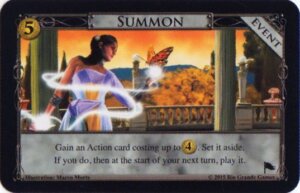
Dominion: Summon Promo Card
2015
A Dominion Event that sets an Action card up for your next turn.
Medium
View game
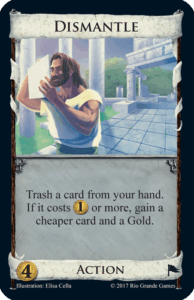
Dominion: Dismantle Promo Card
2017
Trash a card, gain a cheaper card and Gold with this Dominion promo.
30
minutes
Medium
View game
Dominion: Rising Sun
2024
Welcome an unpredictable imperial age of Shadows, Prophecies, Debt, and Events.
30
minutes
Medium
View game
Dominion: Plunder
2022
Set sail for treasure, loot, and salty adventures across the sea.
30
minutes
Medium
View game
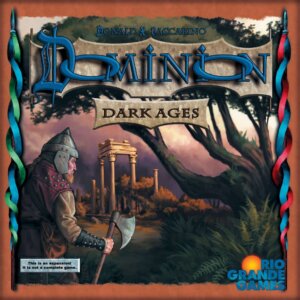
Dominion: Dark Ages
2012
A gritty Dominion expansion built around trashing, ruins, and upgrades.
30
minutes
Medium
View game
