A Study in Emerald (Second Edition)
2015
A secret war, deadly assassins, and uncertain loyalties collide in a streamlined Victorian-era struggle for humanity’s freedom.
60
minutes
2 - 5
player(s)
13+
Medium

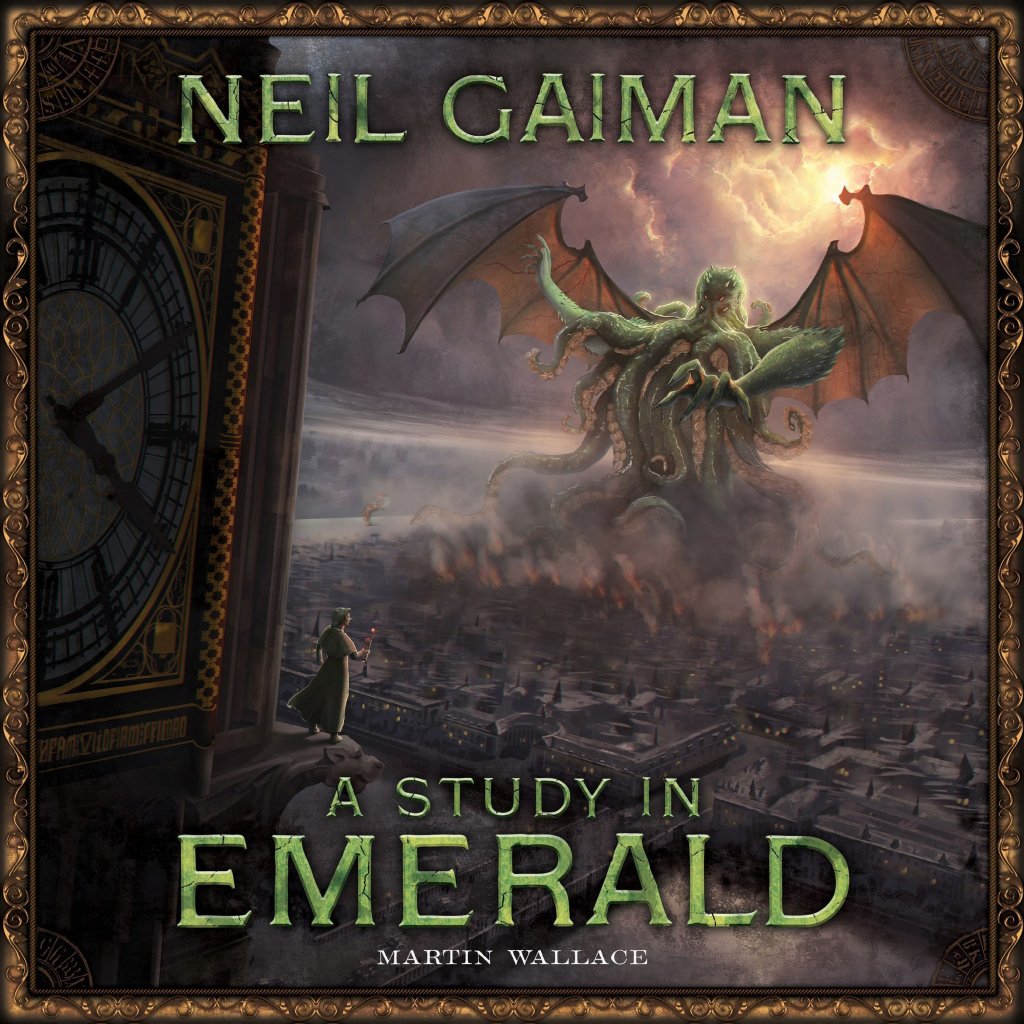
About this board game
A Study in Emerald (Second Edition) is a board game for 2–5 players that plays in around 60 minutes, set in an alternate 1882 where the Old Ones have ruled Earth for seven hundred years.
Most people accept their monstrous rulers, but a growing resistance movement called the Restorationists is determined to free humanity. Their secret war against the forces loyal to the Old Ones unfolds through a world of assassins, informers, police agents, and anarchists.
Nobody is quite sure who is who—or which side they truly serve. The invention of dynamite has shifted the balance of power, giving a lone assassin the ability to destroy an Old One and intensifying the atmosphere of suspicion.
- A hidden conflict between the Restorationists and the Old Ones’ loyalists
- A dark alternate-history setting combining the worlds of Sherlock Holmes and H.P. Lovecraft
- A story enriched by real nineteenth-century history and its unrest
- Streamlined rules designed to reduce complexity while preserving paranoia
The game’s central plot draws from Neil Gaiman’s award-winning short story, while its broader setting merges fictional worlds with colorful historical figures and the turmoil of the nineteenth century. This creates a shadowy contest in which allegiance is never entirely clear.
This second edition of A Study in Emerald features new artwork by Ian O’Toole and Tatiana Kuzilova. It also removes inconsistencies and reduces the number of available actions to the minimum, making the rules more streamlined while retaining the mood of paranoia from the first edition.

Board Game Rules for
A Study in Emerald (Second Edition)
Introduction and Overview
It is 1882 and the Old Ones are already here. They arrived seven hundred years ago and have been ruling the planet ever since. The majority of people just get on with their lives, accepting their monstrous rulers. However, there is a growing band of revolutionaries who wish to free mankind from slavery. These freedom fighters call themselves the Restorationists. A secret war has already broken out between the Restorationists and forces loyal to the Old Ones. The invention of dynamite has changed the balance of power and a lone assassin now has the capacity to destroy an Old One. In this shadow world of assassins, informers, police agents and anarchists nobody is quite sure who is who and which side they fight for.
The game ‘A Study in Emerald’ draws its central plot from the award winning short story penned by Neil Gaiman, in which the worlds of Sherlock Holmes and H.P. Lovecraft are combined to telling effect. Additional details have been drawn from the history of the time. The nineteenth century was a time of unrest, with many colourful characters fighting both for and against the authorities. ‘A Study in Emerald’ is the outcome of the merging of these three worlds.
Each player will be assigned a secret identity, either Restorationist or Loyalist. Who you are determines what you will score points for in the game:
- Restorationists score points for assassinating the Old Ones (called Royalty in the game).
- Loyalists are aiming to identify and eliminate the Restorationists.
You will begin the game with your own deck of cards, from which you will draw a hand of five. These cards allow you to perform a range of actions, many of which are associated with the placing and removal of Influence cubes. Influence is the means by which you gain more cards from the board. Your cards cycle so you will get to use them repeatedly.
Your strategy will be shaped by the cards you gain. Some will give you additional agents, while others grant special powers. You need to be careful not to give your identity away too quickly, as this will allow your opponents to target you.
At the end of the game players reveal which side they are on. The player with the lowest number of victory points inflicts a penalty on all of the players on the same side. Thus you must make the effort to work out each player’s identity, otherwise you could lose the game through the incompetency of a fellow player.
‘A Study in Emerald’ is for two to five players and should take around sixty minutes to play.
Game Components
As well as this rule book, A Study in Emerald also contains the pieces and cards outlined below.
Player Pieces
There are five sets of player pieces in different colours. Each set is comprised of:
- One Victory Point Disc
- 10 Influence Cubes
- 10 Agents
- 10 Starting Cards

Cards
- 6 Secret Identity Cards
- 66 Game Cards
- 9 City Cards
- 9 Royalty Cards

Other Pieces
- Two Track Markers
- 15 Sanity Tokens
- One Sanity Die
- Six Zombie Pieces

Game Board
The game board features spaces for Royalty cards, Game card decks for each city, city boxes for cubes and agents, the Loyalist and Restorationist tracks, Limbo, and the Victory Point track.

Starting the Game
- Place the board in the centre of the table.
- Take the nine City cards and place one in each Game Card space on the board, so that the name on the card matches the name of the city, i.e. place the Berlin card in the Berlin Game Card space. For the moment the cards remain face-up.
- Take the nine Royalty cards and place one in each Game Card space on the board, as indicated on the card, i.e. Gloriana is placed in the London Game Card space. Once again, for the moment the cards remain face-up.
- Now shuffle the Game cards. Draw and place a number of cards in each Game Card space on the board according to the number of players:
- Three or two players: three cards per space.
- Four players: four cards per space.
- Five players: five cards per space.
These cards should be placed face-down. In each Game Card space you need to take the City card, the Royalty card and the Game cards and shuffle them together, making sure they are all face-down. Once you have shuffled them place them face-down in the space. Finally, turn the top card of each stack face-up.
- If you turn over a Royalty card then slide it to the top/bottom of the space, so that it lies in the Royalty Slot. You then turn over the next card.
- Place one Track marker on the zero space of the Restorationist track and one marker on the zero space of the Loyalist track.
- Each player now selects a colour and takes the set of matching pieces and cards. You should have ten Agent pieces, ten Influence cubes, one Victory Point disc and ten Starting cards.
- Take five of your Influence cubes and place them in the area on the board known as ‘Limbo’. The remaining five cubes stay with you. Your ten Agent pieces and five Influence cubes form your available stock.
- Place your Victory Point disc on the zero space of the Victory Point track.
- Each player starts with a set of ten Starting cards. You shuffle your cards and place them in front of you, forming your own personal draw deck. You then draw the top five cards to make your starting hand.

Secret Identities & Final Setup
- Shuffle the six Secret Identity cards and deal out one to each player. You should look at the card you have been dealt but keep it secret from your fellow players. This card tells you which side you are on, which will either be Restorationist or Loyalist. Place the remaining Secret Identity cards to one side without examining them.
- Each player takes three Sanity tokens and places them on top of their Secret Identity card.
- Randomly determine who will be the first player. Going clockwise from the first player each player places one of his or her Agents in one of the City spaces. Once each player has done this repeat the process so that all players start with two Agent pieces on the board. You can have an agent in the same City space as another agent. You can have more than one of your agents in the same city.
- Place the six Zombie pieces and the Sanity die within easy reach.
You are now ready to start playing ‘A Study in Emerald’.

A Short Interlude About Cards
There are a lot of cards in this game, marked with a range of symbols and text. Before embarking on learning how to play the game it is useful to know a little bit about these cards and symbols.
In all circumstances a card can only ever be played for one type of symbol on it or the text effect described in the text box.
Any symbols relating to actions are found on the left-hand side of the card. Symbols on the right-hand side relate to victory points, Bomb points and sanity. Some cards will have an agent symbol at the top. Many cards will have a text box at the bottom, which will describe a special action.

Text Box Sub-headings
Those cards that have text at the bottom will also have a sub-heading, as explained below:
- Action: playing the card counts as one of your two actions.
- Free action: playing the card does not count as one of your actions. You can play as many ‘Free action’ cards as you wish during your turn, including before performing your first action.
- Interrupt: this card can be played during another player’s turn to block an action against you. If you do play an ‘Interrupt’ card then you draw a replacement card after doing so (you always start your turn with five cards in hand).
- Benefit: this card is played to modify an action in some manner.
- One-use: the card is removed from the game after being played, i.e. it can only ever be used once. Please note that this restriction only occurs if you use the card for the text effect on it. Any one-use card that scores you victory points in any manner should be placed close to your Secret Identity card after playing, so you have a means of checking your final victory point total.
Card Symbols Glossary
- Place one Influence cube
- Claim one card
- Retrieve one Influence cube
- Move agent
- Perform assassination
- Move Restorationist marker
- Move Loyalist marker
- Place one of your Agent pieces
- Bomb point
- Insanity – check sanity by rolling the Sanity die
- Neutral victory points
- Restorationist victory points
- Loyalist victory points
- Relates to assassination of agents
- Bomb points required to assassinate
Playing the Game
Play commences with the first player and continues clockwise. When it is your turn you perform two actions. Once you have completed your two actions you draw cards from your own draw deck to bring your hand of cards back to five. If you have exhausted your draw deck and you need to draw cards then you shuffle your discard pile to make a new draw deck.
In most cases the cards you play are placed on to your own discard pile, which will be next to your draw deck. There are some cards which are removed from the game after play or are placed on your Secret Identity card. The rules and information on the cards will make it clear whether a card has to be treated differently.
There are nine actions for you to choose from. You can choose any two actions to perform and, with one exception, can perform them in any order you choose:
- Place Influence cubes
- Claim one card (can only be performed as your first action)
- Retrieve Influence cubes
- Move agents
- Move markers
- Perform an assassination
- Discard cards
- Card action
- Pass
Action: Place Influence Cubes
This action allows you to place Influence cubes on the board. The main reason for wishing to do so is to allow you to claim cards (although in some cases it may also be to allow you to carry out or block an assassination).
To perform this action you must play one or more cards from your hand that are marked with the symbol.
You must then take a number of Influence cubes from your Available stock equal to the number of such symbols played and place them in ONE City space of your choice. There is no limit to the number of Influence cubes that can be placed in a City space, and cubes belonging to different players may exist in the same box.
You cannot deliberately play more cards than you need to. The only time you can play fewer cubes than the number indicated is if you play a card with two symbols on it and you only have one available.

Action: Claim One Card
This action allows you to take one of the cards from the board and place it on to your discard pile. You will eventually draw the card into your hand once you have shuffled your discard pile to make a new draw deck.
To perform this action you must play one card marked with the symbol.
Important: You can only claim cards with your first action. You may perform free actions beforehand.
- You can claim a card from a Game Card space if you have MORE pieces in the associated City space than any other single player AND at least one of those pieces is an Influence cube. You cannot claim a card with only agents, you have to have some influence in the city you are performing this action in. You cannot claim a card where you are tied with another player, even if all of the pieces belonging to that other player are agents.
- You take the card in question from the Game Card space and place it on your discard pile.
- You take all of your Influence cubes from the City space and place them in Limbo.
- Any Influence cubes belonging to other players in the City space are removed and returned to their Available stock.
- If the card you have just claimed is marked with the symbol then you take one of your Agent pieces and place it in the City space you took the card from (in the case of Peter Rachkovsky you would place two Agent pieces).
- If the card is marked with victory point symbols (, , ) then you score the victory points indicated as soon as you claim the card.
- If the card is marked with the symbol then you take the Sanity die and roll it. If the result is an Insanity symbol then you remove and discard one Sanity token from your Secret Identity card.
- It is possible for you to claim more than one card in this action. You can play multiple cards marked with the symbol and claim cards from each city where circumstances, as described above, allow. This is still counted as one action, even though you are taking more than one card.


Action: Retrieve Influence Cubes
As the game goes on the number of Influence cubes in your Available stock will decline. This action allows you to return cubes back into your Available stock.
To perform this action you must play one or more cards marked with the symbol. For each such symbol played you can take one of your Influence cubes from the board and place it back in your Available stock. You can take any of your cubes from the board, whether they be in Limbo or in a City space. Note that unlike placing Influence cubes you can retrieve cubes from multiple places on the board in a single action.
As with placing cubes you cannot deliberately overpay cards. The number of cubes you retrieve must match the number of symbols on the cards you played.

Action: Move Agents
Your agents are useful in helping to claim cards and performing assassinations. Thus you want to be able to move them to where they may be most effective.
To perform this action you must play one or more cards marked with the symbol. For each such symbol played you can move one of your Agent pieces from one City space to any other City space on the board. You can only move your agents and only those that are on the board (not those in your Available stock).
There is no limit to the number of Agent pieces that can be in a City space. As with the previous actions, you cannot deliberately overpay cards to use more cards than required. Having said that, you may move fewer agents than the number of symbols played (given that some cards have multiple Move symbols on them).

Action: Move Markers
There are two tracks along the centre of the board, one marked ‘Loyalist’ and the other ‘Restorationist’. The Loyalist track represents the efforts of the authorities to foment a war, which in turn will feed their unnatural masters and mistresses with psychic energy. The Restorationists are busy inciting the population to throw off their shackles and revolt against the authorities. To some observers the difference between the two aims is difficult to discern.
As an action you can play one or more cards with these symbols on. You then move the markers accordingly on each track. There is nothing to stop you playing cards to move both markers, or move a marker more than once. Neither marker can be moved higher than ’10’ on the track (the moment that this happens will automatically trigger the end of the game). Please note that in this case all movements of the markers are resolved before the game ends.
After moving the markers victory points should be adjusted to reflect their new positions. ALL players score whatever the difference is between the positions of the two markers (it does not matter which side a player is on). This may mean players’ victory point scores being reduced rather than increased, depending on how the markers are moved.

Action: Perform Assassination
No game about anarchists, secret agents and unholy creatures from another dimension would be complete without the ability to assassinate the aforementioned.
To perform this action you must play a card with the symbol on. You can then target either another agent or a Royalty card in a city where you have at least one Agent piece. You can only target a Royalty card that is in the Royalty slot in the city you wish to perform the action in.
You can only perform the assassination action in a City space where you have more pieces (including Influence cubes) than any other single player. In this sense the action is similar to that of claiming a card.
To complete the action you must show that you have the correct number of Bomb points required:
- Each Agent piece you have in the City box in question is worth one Bomb point.
- Each card that you play that has symbols on is worth Bomb points equal to the number of such symbols on the card. You do not include any Bomb point symbols on the card you played to allow you to perform the assassination action.
- To assassinate another Agent piece you must match with Bomb points the value indicated above the City space.
- To assassinate a Royalty card you must match with Bomb points the value indicated on the Royalty card.
You cannot deliberately overpay cards to meet the Bomb point total.
The card you played that allowed you to perform the assassination action is removed from play, it is NOT discarded to your discard pile. Thus, all cards used to perform assassinations are one-use only. All other cards played to support this action, i.e. for their Bomb points, are placed on your discard pile UNLESS explicitly stated otherwise.

Resolving the Assassination
- Assassinating an Agent: Select an agent belonging to another player in the city where you are performing this action and remove it from the board. If the card you played has the agent icon box on the bottom, place the card near your Secret Identity card and place the Agent piece on top of the agent symbol. You then score the victory points indicated on the card. If the card you played does not have this box on then you hand the Agent piece back to the owning player, who places it in their Available stock. Note: If you assassinate a player’s last remaining Agent piece on the board then that player is obliged to reveal their secret identity.
- Assassinating Royalty: Take the Royalty card from the Royalty slot in the city where you performed the action and place it near your Secret Identity card (do not place the Royalty card on your discard pile). You then roll the Sanity die. If you have to lose one Sanity token then you also remove one of your Agent pieces from the city in question and return it to your Available stock.
- Removing Cubes: Finally, remove all of your Influence cubes from the city where you performed this action and place them in Limbo. All Influence cubes belonging to other players are removed and returned to their owning players’ Available stock.
- Multiple Assassinations: You may perform more than one assassination in a single action. Each assassination requires you to play a card with the symbol on. You must resolve each assassination in order, choosing that order. An agent piece can be used in multiple assassinations, both to allow such an assassination to occur and to contribute its bomb point value.

Action: Discard Cards
If you have a hand of, what you consider to be, useless cards then as an action you can discard one or more cards from your hand to your discard pile. Please note that you do not pick up any more cards until the end of your turn, when you draw back to five cards.
Action: Card Action
Many of the cards in this game allow you to carry out special actions. The card will state on it ‘Action’ indicating that it costs one of your two actions to perform. If the card is just marked ‘Action’ then you place it on your discard pile after use. If the card is marked ‘One-use action’ then you remove the card from play after playing it (place it to one side).
If the card gained you victory points in any manner, either when you claimed it or because you have just played it, then you place it near your Secret Identity card. You do not lose points marked on a card just because you have used its one-use function.
Action: Pass
Not something you would like to do but once in a while you may find yourself with no other option than to pass.
Your Secret Identity
At the start of the game you will have received a Secret Identity card. On to this you will have placed three Sanity tokens. You must reveal your secret identity if:
- your last remaining Agent piece on the board is assassinated, or
- you lose your last remaining Sanity token from the card.
- If you reveal your identity to be that of a Loyalist: You immediately add Agent pieces to the board to bring your total up to three. You may place these agents in any City spaces of your choice. The game then continues as normal.
- If you reveal your identity to be that of a Restorationist: The game ends immediately (see ‘Ending the Game’ below).
Explanatory note: When a Restorationist goes mad he or she shoots herself. When a Loyalist goes mad people are hard pressed to tell the difference.

Scoring Victory Points
During the course of the game you will score victory points in a number of ways. Victory points come in three types: Loyalist, Restorationist and neutral. This distinction is only important at the end of the game and during the course of the game your total victory point score should reflect ALL of the victory points you have acquired.
You adjust your victory points total when:
- You claim a card with victory points marked on the upper part of the card.
- When markers are moved on the Loyalist/Restorationist tracks.
- You play a card that has victory points marked in the text box – this card should be placed near your Secret Identity card.
- You assassinate an agent using a card that awards victory points for doing so.
Ending the Game
The game ends when one of the following conditions has been met:
- A player reaches or exceeds a set number of victory points:
- two players: 28 victory points
- three players: 24 victory points
- four players: 22 victory points
- five players: 20 victory points
- One or both markers on the Loyalist/Restorationist tracks reaches the ’10’ space.
- As soon as one Restorationist player is forced to reveal his Secret Identity, which will occur if they lose all of their Agent pieces from the board or their last Sanity token.
Once the game ends all players reveal their secret identities.
Adjusting Final Scores
All players now adjust their victory point scores to take into account their identity. (If the game end was triggered due to reaching the VP target, the game still ends even if all adjusted scores fall below it.)
- Loyalists: Retain all Loyalist and neutral victory points. Lose any Restorationist victory points. Retain victory points on cards used for assassinating other agents only if the Agent piece belongs to a Restorationist player; otherwise these points are lost.
- Restorationists: Retain all Restorationist and neutral victory points. Lose any Loyalist victory points.
- Track Difference: The highest marker determines which side retains track points. If the Restorationist marker was two points higher than the Loyalist marker, all Loyalist players lose two victory points, while Restorationist players retain those points (and vice versa).
- Lowest Score Penalty: Look at which player has the lowest victory point score. All players on the same side (Loyalist or Restorationist) lose five victory points. In the case of a tie for the lowest score, a Loyalist player will be regarded as having a lower score than a Restorationist player.
Winning: The player with the highest victory point score is declared the winner. If there is a tie between two or more players, a Restorationist player is regarded as having the higher score. If there is still a tie, the tied players are declared joint winners.

End of Game Scoring Walkthrough
Example: Tuesday (yellow) at the end of the game has 16 points before adjusting (8 from cities, 1 from Louise Michel, 4 from Sebastian Moran, and 3 from the tracks). Tuesday is a Loyalist. Monday (red) is a Restorationist. Tuesday must reduce his score by 4 points because he does not count pink points (Louise Michel and the tracks). Because Monday was a Restorationist, Tuesday keeps the 4 points on Sebastian Moran. Tuesday’s adjusted victory point score is 12 points.

Detailed Card Descriptions
- The Black Hand: You immediately score two victory points for each Royalty card you have gained by assassination. If you gain more Royalty cards in this manner later on then you score two additional points for each one gained. These are regarded as Restorationist points.
- Change of Heart: You play this card on top of your Secret Identity card. When you reveal your identity you are considered to be on the other side, i.e. if you started the game as a Loyalist then you would now be a Restorationist. Note that you can play this card after you have been forced to reveal your identity (which would mean you were a Loyalist). Doing so would end the game immediately, as you would now be a Restorationist with a revealed identity.
- Cthulhu: Select one city to target with this card. You then remove all cards from that city’s Game Card space. All Agent and Zombie pieces are removed from the City space and returned to their owners’ Available stock. All Influence cubes in the City space, including your own, are moved to Limbo. If a player has the Zombie card he can still use it to place Zombie pieces that have been removed from the board.
- The Diogenes Club: Draw two cards from your draw deck. If you exhaust your deck then shuffle your discard pile BEFORE discarding this card.
- Doctor Watson: Draw two cards from your draw deck. If you exhaust your deck then shuffle your discard pile BEFORE discarding the Doctor Watson card.
- Duchess D Uzes: You may claim a card from a Game Card space where you have the most pieces, but without any of them having to be Influence cubes (so they could all be Agent pieces). Note that you cannot combine this action with the Claim one card action, it must be performed separately. You can perform this action as your first or second action.
- Fenians: You play this card when carrying out an assassination. All of your Agent pieces in the city where you are performing the action are regarded as being worth two Bomb points each. You cannot play two Fenian cards to quadruple their value.
- The Freemasons: Discard as many cards as you wish from your hand. You then draw the same number of cards from your draw deck, including one for this card. If you exhaust your deck then you shuffle your discard pile BEFORE discarding this card.
- Hide Royalty: You claim one Royalty card from a Royalty slot. You must have the most pieces in the associated City space. You place this card on top of the Royalty card. The victory points on the Royalty card are now regarded as being Loyalist points. You remove any Influence cubes you have in the city and place them in Limbo. All other cubes are removed and returned to their owning players’ Available stock. You also make a Sanity die roll, as if you had performed an assassination. If you lose sanity then you also lose one agent, but only if one was present.
- Hired Assassin: Use in the same way as any other card that allows you to carry out an assassination.
- The Holy Brotherhood: You retrieve a number of your Influence cubes from Limbo equal to the number of Agent pieces you have on the board, or as close as you can to this number.
- Infernal Machine: Worth three Bomb points but one-use only.
- Inspector Lestrade: Remove all of the Influence cubes belonging to one player from a City space of your choice and return them to their Available stock.
- Irene Adler: You replace any Agent piece on the board with one of your own from your Available stock. Return the other Agent piece to the owning player’s Available stock.
- Matvei Golovinski: Move the Loyalist marker two spaces up the Loyalist track. The marker cannot move higher than ten points, so if on nine points you would only move it one space.
- Mi-Go: Remove one or two of your Agent pieces from the board and place on this card. This card should be placed close to your Secret Identity card. In a later turn, as a free action, you can place the agents back on the board, in any City space. If you have removed two agents then both must be placed at the same time in the same City space. Note that Agent pieces on this card are considered to be on the board, so even if you have no other agents on the board you would not reveal your secret identity.
- Mrs. Hudson: Discard as many cards as you wish from your hand. You then draw the same number of cards from your draw deck, including one for this card. If you exhaust your deck then you shuffle your discard pile BEFORE discarding this card.
- Okhrana: Move one or two Influence cubes from City spaces of your choice to Limbo. You may choose cubes belonging to different players and from different cities.
- The Peoples’ Will: You retrieve all of your Influence cubes from Limbo.
- Pinkerton Agents: Take one of your Agent pieces from your Available stock and place it in a City space of your choice.
- Sherlock Holmes: You can play this card as an interrupt to stop another player from eliminating one of your agents. This card is effective against assassinations, Shoggoth, vampires, zombies, and Cthulhu. In the case of Cthulhu no effect is registered by the card, i.e. Sherlock has destroyed Cthulhu before it can do any real damage. The player carrying out the original action still has to lose/discard the cards played as if they had carried out the action. If you use this card to stop another player killing one of your agents with one of their zombies then the other player continues to use his remaining zombies. He cannot target the agent you protected with another zombie in the same city.
- Shoggoth: You select one Agent piece to remove from the board. You cannot select one of your own agents. You treat the removed piece as if you had assassinated it – note that the bottom of the card will give you victory points for the agent. Also note that you do not need a presence in the city where this event takes place.
- Sigmund Freud: Take Sanity tokens from the stock to bring you back to your full complement of three. At the same time you must move the Restorationist marker two spaces up the Restorationist track.
- Society of Leopold: When you play this card you remove all Zombie pieces from the board. These are permanently out of the game. The Zombie and Vampire cards are now regarded as being ineffective. The owners of those cards should find them and remove them from their hand, deck, discard pile or Secret Identity card. If they had to remove them from their hand then they draw a replacement card. The victory points for these cards are now lost. This is the only situation where you can lose points for a card before the end of the game.
- Terrors of the Night: Choose another player and force them to roll the Sanity die. If they roll an Insanity symbol then they lose one of their Sanity tokens.
- The Third Section: You discard the top card from one City Card space of your choice. The card is removed from the game. You cannot use this card to remove a Royalty card from play.
- Vampires: This card has two possible uses. You can use it as a one-use action to replace one Agent piece belonging to another player with one of your own from your Available stock. You must have at least one agent in the City box where you carry out this action. The other Agent piece is returned to the owning player’s Available stock. The second use is to play the card as an interrupt to stop another player from assassinating one of your agents. The other player is still regarded as having performed the action and must discard all of the cards associated with it, including permanently losing the card that allowed the assassination.
- Vladimir Burtsev: You may look at the Secret Identity card of a player of your choice. You must keep this information secret from other players.
- Yog-Sothoth: Play this card near your Secret Identity card. You can then take some or all of your Agent pieces from the board and place them on this card. For each agent you place you score one victory point. Note that if you remove all of your agents then you must reveal your Secret Identity card. You would then follow the standard rules for doing this, i.e. if you are a Loyalist then you would place three Agent pieces on the board. The points you score are regarded as being Loyalist points.
- Zombies: This action has two parts. You first MAY remove ONE agent of your choice from each City space that you have one or more zombies in. You cannot remove your own Agent pieces. The removed agents should be returned to the owning players’ Available stock. You then place two Zombie pieces on the board, in any City boxes of your choice. More than one zombie can be placed in a city. Zombie pieces can only be removed from the board by the play of the Cthulhu card or the Society of Leopold card.
Play Aid
Setup Quick Reference
- Starting cards in each city: Along with the corresponding City and Royalty cards, place:
- 2/3 players: 3 cards per city
- 4 players: 4 cards per city
- 5 players: 5 cards per city
- Player starting pieces: Players start with two Agents on the board and five Influence cubes in Limbo.
- Start with five cards in hand.
Game Play Summary
In player order each player performs two actions and then refills their hand to five cards.
Actions
- Place one Influence cube: Each symbol you play allows you to place one Influence cube. All cubes must be placed in the same city space.
- Claim one card: Each symbol you play allows you to claim one card where you have the most pieces, of which at least one must be an Influence cube. MUST be the first of your two actions. Your cubes go to Limbo, rest returned to owning players.
- Retrieve one Influence cube: Each symbol you play allows you to retrieve one of your Influence cubes from anywhere on the board.
- Move Agent: Each symbol you play allows you to move one agent from any city to any other city.
- Perform Assassination: May assassinate another agent or Royalty. Must expend Bomb points indicated in city or on card. One-use action, so card removed from play afterwards.
- Move Restorationist marker
- Move Loyalist marker
Other Symbols
- Place one of your Agent pieces
- Bomb point
- Insanity – check sanity by rolling the Sanity die
- Neutral victory points
- Restorationist victory points
- Loyalist victory points
- Place assassinated piece on this card and score VPs
- Bomb points required to assassinate
Easy to Forget Rules
- You can only take cards from the board as the FIRST of your two actions. You can still perform free actions beforehand.
- Slide Royalty cards down to their slot as soon as they are revealed, then turn over the next card.
- Remember to place an Agent if you take a card with the ‘Place Agent’ symbol on.
- You must have more pieces than any other single player to carry out an assassination.
Game End Triggers
- Player reaches target score on the Victory Point track.
- Marker reaches the end of the Restorationist/Loyalist track.
- Player is forced to reveal card AND they are a Restorationist.
Credits
- Game design: Martin Wallace
- Cover artwork: Tatiana Kuzilova
- Board and card artwork: Ian O’Toole
- Graphic design: Ian O’Toole
- Thanks: Sarah Nagel, Shane Myerscough and CSI, David Taylor.
- Special thanks: Neil Gaiman, Merrilee Heifetz, and Julia Wallace.
- Playtesters: Simon Bracegirdle, Andy Odgen, Christopher Dearlove, Kirstin Donaldson, Nikolaj Wendt, Gordon Lewis, Brad Thompson, Nathan Grange, Katherine Boag, Glenn Patel, Antonia Brown, Lee Griffiths and many others at Board Games by the Bay.
Introduction & Overview
Introduction and Overview
It is 1882 and the Old Ones are already here. They arrived seven hundred years ago and have been ruling the planet ever since. The majority of people just get on with their lives, accepting their monstrous rulers. However, there is a growing band of revolutionaries who wish to free mankind from slavery. These freedom fighters call themselves the Restorationists. A secret war has already broken out between the Restorationists and forces loyal to the Old Ones. The invention of dynamite has changed the balance of power and a lone assassin now has the capacity to destroy an Old One. In this shadow world of assassins, informers, police agents and anarchists nobody is quite sure who is who and which side they fight for.
The game ‘A Study in Emerald’ draws its central plot from the award winning short story penned by Neil Gaiman, in which the worlds of Sherlock Holmes and H.P. Lovecraft are combined to telling effect. Additional details have been drawn from the history of the time. The nineteenth century was a time of unrest, with many colourful characters fighting both for and against the authorities. ‘A Study in Emerald’ is the outcome of the merging of these three worlds.
Each player will be assigned a secret identity, either Restorationist or Loyalist. Who you are determines what you will score points for in the game:
- Restorationists score points for assassinating the Old Ones (called Royalty in the game).
- Loyalists are aiming to identify and eliminate the Restorationists.
You will begin the game with your own deck of cards, from which you will draw a hand of five. These cards allow you to perform a range of actions, many of which are associated with the placing and removal of Influence cubes. Influence is the means by which you gain more cards from the board. Your cards cycle so you will get to use them repeatedly.
Your strategy will be shaped by the cards you gain. Some will give you additional agents, while others grant special powers. You need to be careful not to give your identity away too quickly, as this will allow your opponents to target you.
At the end of the game players reveal which side they are on. The player with the lowest number of victory points inflicts a penalty on all of the players on the same side. Thus you must make the effort to work out each player’s identity, otherwise you could lose the game through the incompetency of a fellow player.
‘A Study in Emerald’ is for two to five players and should take around sixty minutes to play.
Game Components
Game Components
As well as this rule book, A Study in Emerald also contains the pieces and cards outlined below.
Player Pieces
There are five sets of player pieces in different colours. Each set is comprised of:
- One Victory Point Disc
- 10 Influence Cubes
- 10 Agents
- 10 Starting Cards
Cards
- 6 Secret Identity Cards
- 66 Game Cards
- 9 City Cards
- 9 Royalty Cards
Other Pieces
- Two Track Markers
- 15 Sanity Tokens
- One Sanity Die
- Six Zombie Pieces
Game Board
The game board features spaces for Royalty cards, Game card decks for each city, city boxes for cubes and agents, the Loyalist and Restorationist tracks, Limbo, and the Victory Point track.
Setup
Starting the Game
- Place the board in the centre of the table.
- Take the nine City cards and place one in each Game Card space on the board, so that the name on the card matches the name of the city, i.e. place the Berlin card in the Berlin Game Card space. For the moment the cards remain face-up.
- Take the nine Royalty cards and place one in each Game Card space on the board, as indicated on the card, i.e. Gloriana is placed in the London Game Card space. Once again, for the moment the cards remain face-up.
- Now shuffle the Game cards. Draw and place a number of cards in each Game Card space on the board according to the number of players:
- Three or two players: three cards per space.
- Four players: four cards per space.
- Five players: five cards per space.
These cards should be placed face-down. In each Game Card space you need to take the City card, the Royalty card and the Game cards and shuffle them together, making sure they are all face-down. Once you have shuffled them place them face-down in the space. Finally, turn the top card of each stack face-up.
- If you turn over a Royalty card then slide it to the top/bottom of the space, so that it lies in the Royalty Slot. You then turn over the next card.
- Place one Track marker on the zero space of the Restorationist track and one marker on the zero space of the Loyalist track.
- Each player now selects a colour and takes the set of matching pieces and cards. You should have ten Agent pieces, ten Influence cubes, one Victory Point disc and ten Starting cards.
- Take five of your Influence cubes and place them in the area on the board known as ‘Limbo’. The remaining five cubes stay with you. Your ten Agent pieces and five Influence cubes form your available stock.
- Place your Victory Point disc on the zero space of the Victory Point track.
- Each player starts with a set of ten Starting cards. You shuffle your cards and place them in front of you, forming your own personal draw deck. You then draw the top five cards to make your starting hand.
Secret Identities & Final Setup
- Shuffle the six Secret Identity cards and deal out one to each player. You should look at the card you have been dealt but keep it secret from your fellow players. This card tells you which side you are on, which will either be Restorationist or Loyalist. Place the remaining Secret Identity cards to one side without examining them.
- Each player takes three Sanity tokens and places them on top of their Secret Identity card.
- Randomly determine who will be the first player. Going clockwise from the first player each player places one of his or her Agents in one of the City spaces. Once each player has done this repeat the process so that all players start with two Agent pieces on the board. You can have an agent in the same City space as another agent. You can have more than one of your agents in the same city.
- Place the six Zombie pieces and the Sanity die within easy reach.
You are now ready to start playing ‘A Study in Emerald’.
Card Rules & Anatomy
A Short Interlude About Cards
There are a lot of cards in this game, marked with a range of symbols and text. Before embarking on learning how to play the game it is useful to know a little bit about these cards and symbols.
In all circumstances a card can only ever be played for one type of symbol on it or the text effect described in the text box.
Any symbols relating to actions are found on the left-hand side of the card. Symbols on the right-hand side relate to victory points, Bomb points and sanity. Some cards will have an agent symbol at the top. Many cards will have a text box at the bottom, which will describe a special action.
Text Box Sub-headings
Those cards that have text at the bottom will also have a sub-heading, as explained below:
- Action: playing the card counts as one of your two actions.
- Free action: playing the card does not count as one of your actions. You can play as many ‘Free action’ cards as you wish during your turn, including before performing your first action.
- Interrupt: this card can be played during another player’s turn to block an action against you. If you do play an ‘Interrupt’ card then you draw a replacement card after doing so (you always start your turn with five cards in hand).
- Benefit: this card is played to modify an action in some manner.
- One-use: the card is removed from the game after being played, i.e. it can only ever be used once. Please note that this restriction only occurs if you use the card for the text effect on it. Any one-use card that scores you victory points in any manner should be placed close to your Secret Identity card after playing, so you have a means of checking your final victory point total.
Card Symbols Glossary
- Place one Influence cube
- Claim one card
- Retrieve one Influence cube
- Move agent
- Perform assassination
- Move Restorationist marker
- Move Loyalist marker
- Place one of your Agent pieces
- Bomb point
- Insanity – check sanity by rolling the Sanity die
- Neutral victory points
- Restorationist victory points
- Loyalist victory points
- Relates to assassination of agents
- Bomb points required to assassinate
How to Play & Actions
Playing the Game
Play commences with the first player and continues clockwise. When it is your turn you perform two actions. Once you have completed your two actions you draw cards from your own draw deck to bring your hand of cards back to five. If you have exhausted your draw deck and you need to draw cards then you shuffle your discard pile to make a new draw deck.
In most cases the cards you play are placed on to your own discard pile, which will be next to your draw deck. There are some cards which are removed from the game after play or are placed on your Secret Identity card. The rules and information on the cards will make it clear whether a card has to be treated differently.
There are nine actions for you to choose from. You can choose any two actions to perform and, with one exception, can perform them in any order you choose:
- Place Influence cubes
- Claim one card (can only be performed as your first action)
- Retrieve Influence cubes
- Move agents
- Move markers
- Perform an assassination
- Discard cards
- Card action
- Pass
Action: Place Influence Cubes
This action allows you to place Influence cubes on the board. The main reason for wishing to do so is to allow you to claim cards (although in some cases it may also be to allow you to carry out or block an assassination).
To perform this action you must play one or more cards from your hand that are marked with the symbol.
You must then take a number of Influence cubes from your Available stock equal to the number of such symbols played and place them in ONE City space of your choice. There is no limit to the number of Influence cubes that can be placed in a City space, and cubes belonging to different players may exist in the same box.
You cannot deliberately play more cards than you need to. The only time you can play fewer cubes than the number indicated is if you play a card with two symbols on it and you only have one available.
Action: Claim One Card
This action allows you to take one of the cards from the board and place it on to your discard pile. You will eventually draw the card into your hand once you have shuffled your discard pile to make a new draw deck.
To perform this action you must play one card marked with the symbol.
Important: You can only claim cards with your first action. You may perform free actions beforehand.
- You can claim a card from a Game Card space if you have MORE pieces in the associated City space than any other single player AND at least one of those pieces is an Influence cube. You cannot claim a card with only agents, you have to have some influence in the city you are performing this action in. You cannot claim a card where you are tied with another player, even if all of the pieces belonging to that other player are agents.
- You take the card in question from the Game Card space and place it on your discard pile.
- You take all of your Influence cubes from the City space and place them in Limbo.
- Any Influence cubes belonging to other players in the City space are removed and returned to their Available stock.
- If the card you have just claimed is marked with the symbol then you take one of your Agent pieces and place it in the City space you took the card from (in the case of Peter Rachkovsky you would place two Agent pieces).
- If the card is marked with victory point symbols (, , ) then you score the victory points indicated as soon as you claim the card.
- If the card is marked with the symbol then you take the Sanity die and roll it. If the result is an Insanity symbol then you remove and discard one Sanity token from your Secret Identity card.
- It is possible for you to claim more than one card in this action. You can play multiple cards marked with the symbol and claim cards from each city where circumstances, as described above, allow. This is still counted as one action, even though you are taking more than one card.
Action: Retrieve Influence Cubes
As the game goes on the number of Influence cubes in your Available stock will decline. This action allows you to return cubes back into your Available stock.
To perform this action you must play one or more cards marked with the symbol. For each such symbol played you can take one of your Influence cubes from the board and place it back in your Available stock. You can take any of your cubes from the board, whether they be in Limbo or in a City space. Note that unlike placing Influence cubes you can retrieve cubes from multiple places on the board in a single action.
As with placing cubes you cannot deliberately overpay cards. The number of cubes you retrieve must match the number of symbols on the cards you played.
Action: Move Agents
Your agents are useful in helping to claim cards and performing assassinations. Thus you want to be able to move them to where they may be most effective.
To perform this action you must play one or more cards marked with the symbol. For each such symbol played you can move one of your Agent pieces from one City space to any other City space on the board. You can only move your agents and only those that are on the board (not those in your Available stock).
There is no limit to the number of Agent pieces that can be in a City space. As with the previous actions, you cannot deliberately overpay cards to use more cards than required. Having said that, you may move fewer agents than the number of symbols played (given that some cards have multiple Move symbols on them).
Action: Move Markers
There are two tracks along the centre of the board, one marked ‘Loyalist’ and the other ‘Restorationist’. The Loyalist track represents the efforts of the authorities to foment a war, which in turn will feed their unnatural masters and mistresses with psychic energy. The Restorationists are busy inciting the population to throw off their shackles and revolt against the authorities. To some observers the difference between the two aims is difficult to discern.
As an action you can play one or more cards with these symbols on. You then move the markers accordingly on each track. There is nothing to stop you playing cards to move both markers, or move a marker more than once. Neither marker can be moved higher than ’10’ on the track (the moment that this happens will automatically trigger the end of the game). Please note that in this case all movements of the markers are resolved before the game ends.
After moving the markers victory points should be adjusted to reflect their new positions. ALL players score whatever the difference is between the positions of the two markers (it does not matter which side a player is on). This may mean players’ victory point scores being reduced rather than increased, depending on how the markers are moved.
Action: Perform Assassination
No game about anarchists, secret agents and unholy creatures from another dimension would be complete without the ability to assassinate the aforementioned.
To perform this action you must play a card with the symbol on. You can then target either another agent or a Royalty card in a city where you have at least one Agent piece. You can only target a Royalty card that is in the Royalty slot in the city you wish to perform the action in.
You can only perform the assassination action in a City space where you have more pieces (including Influence cubes) than any other single player. In this sense the action is similar to that of claiming a card.
To complete the action you must show that you have the correct number of Bomb points required:
- Each Agent piece you have in the City box in question is worth one Bomb point.
- Each card that you play that has symbols on is worth Bomb points equal to the number of such symbols on the card. You do not include any Bomb point symbols on the card you played to allow you to perform the assassination action.
- To assassinate another Agent piece you must match with Bomb points the value indicated above the City space.
- To assassinate a Royalty card you must match with Bomb points the value indicated on the Royalty card.
You cannot deliberately overpay cards to meet the Bomb point total.
The card you played that allowed you to perform the assassination action is removed from play, it is NOT discarded to your discard pile. Thus, all cards used to perform assassinations are one-use only. All other cards played to support this action, i.e. for their Bomb points, are placed on your discard pile UNLESS explicitly stated otherwise.
Resolving the Assassination
- Assassinating an Agent: Select an agent belonging to another player in the city where you are performing this action and remove it from the board. If the card you played has the agent icon box on the bottom, place the card near your Secret Identity card and place the Agent piece on top of the agent symbol. You then score the victory points indicated on the card. If the card you played does not have this box on then you hand the Agent piece back to the owning player, who places it in their Available stock. Note: If you assassinate a player’s last remaining Agent piece on the board then that player is obliged to reveal their secret identity.
- Assassinating Royalty: Take the Royalty card from the Royalty slot in the city where you performed the action and place it near your Secret Identity card (do not place the Royalty card on your discard pile). You then roll the Sanity die. If you have to lose one Sanity token then you also remove one of your Agent pieces from the city in question and return it to your Available stock.
- Removing Cubes: Finally, remove all of your Influence cubes from the city where you performed this action and place them in Limbo. All Influence cubes belonging to other players are removed and returned to their owning players’ Available stock.
- Multiple Assassinations: You may perform more than one assassination in a single action. Each assassination requires you to play a card with the symbol on. You must resolve each assassination in order, choosing that order. An agent piece can be used in multiple assassinations, both to allow such an assassination to occur and to contribute its bomb point value.
Action: Discard Cards
If you have a hand of, what you consider to be, useless cards then as an action you can discard one or more cards from your hand to your discard pile. Please note that you do not pick up any more cards until the end of your turn, when you draw back to five cards.
Action: Card Action
Many of the cards in this game allow you to carry out special actions. The card will state on it ‘Action’ indicating that it costs one of your two actions to perform. If the card is just marked ‘Action’ then you place it on your discard pile after use. If the card is marked ‘One-use action’ then you remove the card from play after playing it (place it to one side).
If the card gained you victory points in any manner, either when you claimed it or because you have just played it, then you place it near your Secret Identity card. You do not lose points marked on a card just because you have used its one-use function.
Action: Pass
Not something you would like to do but once in a while you may find yourself with no other option than to pass.
Secret Identities & Sanity
Your Secret Identity
At the start of the game you will have received a Secret Identity card. On to this you will have placed three Sanity tokens. You must reveal your secret identity if:
- your last remaining Agent piece on the board is assassinated, or
- you lose your last remaining Sanity token from the card.
- If you reveal your identity to be that of a Loyalist: You immediately add Agent pieces to the board to bring your total up to three. You may place these agents in any City spaces of your choice. The game then continues as normal.
- If you reveal your identity to be that of a Restorationist: The game ends immediately (see ‘Ending the Game’ below).
Explanatory note: When a Restorationist goes mad he or she shoots herself. When a Loyalist goes mad people are hard pressed to tell the difference.
Scoring & Game End
Scoring Victory Points
During the course of the game you will score victory points in a number of ways. Victory points come in three types: Loyalist, Restorationist and neutral. This distinction is only important at the end of the game and during the course of the game your total victory point score should reflect ALL of the victory points you have acquired.
You adjust your victory points total when:
- You claim a card with victory points marked on the upper part of the card.
- When markers are moved on the Loyalist/Restorationist tracks.
- You play a card that has victory points marked in the text box – this card should be placed near your Secret Identity card.
- You assassinate an agent using a card that awards victory points for doing so.
Ending the Game
The game ends when one of the following conditions has been met:
- A player reaches or exceeds a set number of victory points:
- two players: 28 victory points
- three players: 24 victory points
- four players: 22 victory points
- five players: 20 victory points
- One or both markers on the Loyalist/Restorationist tracks reaches the ’10’ space.
- As soon as one Restorationist player is forced to reveal his Secret Identity, which will occur if they lose all of their Agent pieces from the board or their last Sanity token.
Once the game ends all players reveal their secret identities.
Adjusting Final Scores
All players now adjust their victory point scores to take into account their identity. (If the game end was triggered due to reaching the VP target, the game still ends even if all adjusted scores fall below it.)
- Loyalists: Retain all Loyalist and neutral victory points. Lose any Restorationist victory points. Retain victory points on cards used for assassinating other agents only if the Agent piece belongs to a Restorationist player; otherwise these points are lost.
- Restorationists: Retain all Restorationist and neutral victory points. Lose any Loyalist victory points.
- Track Difference: The highest marker determines which side retains track points. If the Restorationist marker was two points higher than the Loyalist marker, all Loyalist players lose two victory points, while Restorationist players retain those points (and vice versa).
- Lowest Score Penalty: Look at which player has the lowest victory point score. All players on the same side (Loyalist or Restorationist) lose five victory points. In the case of a tie for the lowest score, a Loyalist player will be regarded as having a lower score than a Restorationist player.
Winning: The player with the highest victory point score is declared the winner. If there is a tie between two or more players, a Restorationist player is regarded as having the higher score. If there is still a tie, the tied players are declared joint winners.
End of Game Scoring Walkthrough
Example: Tuesday (yellow) at the end of the game has 16 points before adjusting (8 from cities, 1 from Louise Michel, 4 from Sebastian Moran, and 3 from the tracks). Tuesday is a Loyalist. Monday (red) is a Restorationist. Tuesday must reduce his score by 4 points because he does not count pink points (Louise Michel and the tracks). Because Monday was a Restorationist, Tuesday keeps the 4 points on Sebastian Moran. Tuesday’s adjusted victory point score is 12 points.
Detailed Card Descriptions
Detailed Card Descriptions
- The Black Hand: You immediately score two victory points for each Royalty card you have gained by assassination. If you gain more Royalty cards in this manner later on then you score two additional points for each one gained. These are regarded as Restorationist points.
- Change of Heart: You play this card on top of your Secret Identity card. When you reveal your identity you are considered to be on the other side, i.e. if you started the game as a Loyalist then you would now be a Restorationist. Note that you can play this card after you have been forced to reveal your identity (which would mean you were a Loyalist). Doing so would end the game immediately, as you would now be a Restorationist with a revealed identity.
- Cthulhu: Select one city to target with this card. You then remove all cards from that city’s Game Card space. All Agent and Zombie pieces are removed from the City space and returned to their owners’ Available stock. All Influence cubes in the City space, including your own, are moved to Limbo. If a player has the Zombie card he can still use it to place Zombie pieces that have been removed from the board.
- The Diogenes Club: Draw two cards from your draw deck. If you exhaust your deck then shuffle your discard pile BEFORE discarding this card.
- Doctor Watson: Draw two cards from your draw deck. If you exhaust your deck then shuffle your discard pile BEFORE discarding the Doctor Watson card.
- Duchess D Uzes: You may claim a card from a Game Card space where you have the most pieces, but without any of them having to be Influence cubes (so they could all be Agent pieces). Note that you cannot combine this action with the Claim one card action, it must be performed separately. You can perform this action as your first or second action.
- Fenians: You play this card when carrying out an assassination. All of your Agent pieces in the city where you are performing the action are regarded as being worth two Bomb points each. You cannot play two Fenian cards to quadruple their value.
- The Freemasons: Discard as many cards as you wish from your hand. You then draw the same number of cards from your draw deck, including one for this card. If you exhaust your deck then you shuffle your discard pile BEFORE discarding this card.
- Hide Royalty: You claim one Royalty card from a Royalty slot. You must have the most pieces in the associated City space. You place this card on top of the Royalty card. The victory points on the Royalty card are now regarded as being Loyalist points. You remove any Influence cubes you have in the city and place them in Limbo. All other cubes are removed and returned to their owning players’ Available stock. You also make a Sanity die roll, as if you had performed an assassination. If you lose sanity then you also lose one agent, but only if one was present.
- Hired Assassin: Use in the same way as any other card that allows you to carry out an assassination.
- The Holy Brotherhood: You retrieve a number of your Influence cubes from Limbo equal to the number of Agent pieces you have on the board, or as close as you can to this number.
- Infernal Machine: Worth three Bomb points but one-use only.
- Inspector Lestrade: Remove all of the Influence cubes belonging to one player from a City space of your choice and return them to their Available stock.
- Irene Adler: You replace any Agent piece on the board with one of your own from your Available stock. Return the other Agent piece to the owning player’s Available stock.
- Matvei Golovinski: Move the Loyalist marker two spaces up the Loyalist track. The marker cannot move higher than ten points, so if on nine points you would only move it one space.
- Mi-Go: Remove one or two of your Agent pieces from the board and place on this card. This card should be placed close to your Secret Identity card. In a later turn, as a free action, you can place the agents back on the board, in any City space. If you have removed two agents then both must be placed at the same time in the same City space. Note that Agent pieces on this card are considered to be on the board, so even if you have no other agents on the board you would not reveal your secret identity.
- Mrs. Hudson: Discard as many cards as you wish from your hand. You then draw the same number of cards from your draw deck, including one for this card. If you exhaust your deck then you shuffle your discard pile BEFORE discarding this card.
- Okhrana: Move one or two Influence cubes from City spaces of your choice to Limbo. You may choose cubes belonging to different players and from different cities.
- The Peoples’ Will: You retrieve all of your Influence cubes from Limbo.
- Pinkerton Agents: Take one of your Agent pieces from your Available stock and place it in a City space of your choice.
- Sherlock Holmes: You can play this card as an interrupt to stop another player from eliminating one of your agents. This card is effective against assassinations, Shoggoth, vampires, zombies, and Cthulhu. In the case of Cthulhu no effect is registered by the card, i.e. Sherlock has destroyed Cthulhu before it can do any real damage. The player carrying out the original action still has to lose/discard the cards played as if they had carried out the action. If you use this card to stop another player killing one of your agents with one of their zombies then the other player continues to use his remaining zombies. He cannot target the agent you protected with another zombie in the same city.
- Shoggoth: You select one Agent piece to remove from the board. You cannot select one of your own agents. You treat the removed piece as if you had assassinated it – note that the bottom of the card will give you victory points for the agent. Also note that you do not need a presence in the city where this event takes place.
- Sigmund Freud: Take Sanity tokens from the stock to bring you back to your full complement of three. At the same time you must move the Restorationist marker two spaces up the Restorationist track.
- Society of Leopold: When you play this card you remove all Zombie pieces from the board. These are permanently out of the game. The Zombie and Vampire cards are now regarded as being ineffective. The owners of those cards should find them and remove them from their hand, deck, discard pile or Secret Identity card. If they had to remove them from their hand then they draw a replacement card. The victory points for these cards are now lost. This is the only situation where you can lose points for a card before the end of the game.
- Terrors of the Night: Choose another player and force them to roll the Sanity die. If they roll an Insanity symbol then they lose one of their Sanity tokens.
- The Third Section: You discard the top card from one City Card space of your choice. The card is removed from the game. You cannot use this card to remove a Royalty card from play.
- Vampires: This card has two possible uses. You can use it as a one-use action to replace one Agent piece belonging to another player with one of your own from your Available stock. You must have at least one agent in the City box where you carry out this action. The other Agent piece is returned to the owning player’s Available stock. The second use is to play the card as an interrupt to stop another player from assassinating one of your agents. The other player is still regarded as having performed the action and must discard all of the cards associated with it, including permanently losing the card that allowed the assassination.
- Vladimir Burtsev: You may look at the Secret Identity card of a player of your choice. You must keep this information secret from other players.
- Yog-Sothoth: Play this card near your Secret Identity card. You can then take some or all of your Agent pieces from the board and place them on this card. For each agent you place you score one victory point. Note that if you remove all of your agents then you must reveal your Secret Identity card. You would then follow the standard rules for doing this, i.e. if you are a Loyalist then you would place three Agent pieces on the board. The points you score are regarded as being Loyalist points.
- Zombies: This action has two parts. You first MAY remove ONE agent of your choice from each City space that you have one or more zombies in. You cannot remove your own Agent pieces. The removed agents should be returned to the owning players’ Available stock. You then place two Zombie pieces on the board, in any City boxes of your choice. More than one zombie can be placed in a city. Zombie pieces can only be removed from the board by the play of the Cthulhu card or the Society of Leopold card.
Play Aid & Quick Reference
Play Aid
Setup Quick Reference
- Starting cards in each city: Along with the corresponding City and Royalty cards, place:
- 2/3 players: 3 cards per city
- 4 players: 4 cards per city
- 5 players: 5 cards per city
- Player starting pieces: Players start with two Agents on the board and five Influence cubes in Limbo.
- Start with five cards in hand.
Game Play Summary
In player order each player performs two actions and then refills their hand to five cards.
Actions
- Place one Influence cube: Each symbol you play allows you to place one Influence cube. All cubes must be placed in the same city space.
- Claim one card: Each symbol you play allows you to claim one card where you have the most pieces, of which at least one must be an Influence cube. MUST be the first of your two actions. Your cubes go to Limbo, rest returned to owning players.
- Retrieve one Influence cube: Each symbol you play allows you to retrieve one of your Influence cubes from anywhere on the board.
- Move Agent: Each symbol you play allows you to move one agent from any city to any other city.
- Perform Assassination: May assassinate another agent or Royalty. Must expend Bomb points indicated in city or on card. One-use action, so card removed from play afterwards.
- Move Restorationist marker
- Move Loyalist marker
Other Symbols
- Place one of your Agent pieces
- Bomb point
- Insanity – check sanity by rolling the Sanity die
- Neutral victory points
- Restorationist victory points
- Loyalist victory points
- Place assassinated piece on this card and score VPs
- Bomb points required to assassinate
Easy to Forget Rules
- You can only take cards from the board as the FIRST of your two actions. You can still perform free actions beforehand.
- Slide Royalty cards down to their slot as soon as they are revealed, then turn over the next card.
- Remember to place an Agent if you take a card with the ‘Place Agent’ symbol on.
- You must have more pieces than any other single player to carry out an assassination.
Game End Triggers
- Player reaches target score on the Victory Point track.
- Marker reaches the end of the Restorationist/Loyalist track.
- Player is forced to reveal card AND they are a Restorationist.
Credits
Credits
- Game design: Martin Wallace
- Cover artwork: Tatiana Kuzilova
- Board and card artwork: Ian O’Toole
- Graphic design: Ian O’Toole
- Thanks: Sarah Nagel, Shane Myerscough and CSI, David Taylor.
- Special thanks: Neil Gaiman, Merrilee Heifetz, and Julia Wallace.
- Playtesters: Simon Bracegirdle, Andy Odgen, Christopher Dearlove, Kirstin Donaldson, Nikolaj Wendt, Gordon Lewis, Brad Thompson, Nathan Grange, Katherine Boag, Glenn Patel, Antonia Brown, Lee Griffiths and many others at Board Games by the Bay.