
Alchemists
2014
Experiment with mysterious ingredients, test potions, buy artifacts, and publish correct theories to become the most respected alchemist.
120
minutes
2 - 4
player(s)
12+
Medium Heavy


About this board game
Alchemists is a game for 2–4 players that plays in about 120 minutes, challenging aspiring scholars to uncover mystical secrets and build the greatest reputation.
Across six rounds, players choose their play order before declaring actions by placing cubes on available spaces. Those who choose to act later receive greater rewards, while each action space is then evaluated in sequence. The race for knowledge, wealth, and academic respect unfolds through carefully timed decisions.
Players gain knowledge by mixing strange ingredients and testing the resulting potions with a smartphone app. Available for iOS, Android, and Windows, the app randomizes the rules of alchemy for every new game, giving each investigation a different set of secrets to uncover.
- Mix ingredients to create potions and test their effects.
- Sell potions to wandering adventurers to earn money.
- Purchase powerful, costly magical artifacts for extra advantages and reputation.
- Publish theories and gain points when those theories prove correct.
Money is useful, but it is not the ultimate goal. Players seek respect by publishing theories, while their reputations rise and fall throughout the game. The nine available artifacts differ from game to game, offering another way to gain reputation as well as powerful assistance.
After the six rounds, a final exhibition takes place. Reputation is converted into points, with additional scoring for artifacts and grants. The secrets of alchemy are then revealed, and players gain or lose points according to the accuracy of their published theories.
In Alchemists, every potion test can advance your understanding—or challenge your assumptions. When the final scores are calculated, the player with the most points earns victory and the respect of the alchemical community.
/pic7182955.jpg)
Board Game Rules for
Alchemists
I received my new cauldron today. Finally, my laboratory is complete!
For days, I have been gathering and drying ingredients in anticipation. What shall I mix first? I have a strong hunch about raven’s feather and mandrake root. And they say you can never go wrong with a toad.
But then, what do they know? This is my laboratory, my research! Once I have published my theories, the others will be coming to me! I am determined to prove that I have the greatest mind that ever studied alchemy.
So now, I shall light my fire, for it is time to get to work. Knowledge, wealth, and fame can all be found in the murky depths of the cauldron.
Overview
Two to four players take the role of alchemists competing to discover the secrets of their mystical art. Points can be earned in various ways, but most points are earned by publishing theories – correct theories. Therein lies the problem.
Players gain knowledge by mixing ingredients and testing the results using a card-scanning app on a tablet or smartphone. They deduce how to make potions that they can sell to adventurers. Gold pieces can be spent on magical artifacts, which are very powerful but also very expensive.
Players’ reputations go up and down as their theories are published or disproven. At the end of the game, reputation is converted to points. Points are also scored for artifacts and grants. The player with the most points wins.
Basic Principles of Alchemy
Ah! A new student. How delightful! I’m always glad to meet someone whose heart burns with the fire of science. Are you ready to uncover nature’s mysteries? Ready to make discoveries that will earn respect and admiration? Well, my young friend, this is a long journey. It will require perseverance and a keen mind. Let us begin simply, by mixing a potion from ingredients we can find on a walk through the forest. See? Here is a mushroom. And here is a toad. Now all you need is a fully equipped alchemical laboratory. I’ll wait while you set one up.
Mixing Potions
Ready? Wonderful! Now toss these ingredients into your cauldron and stir until the substance changes color.
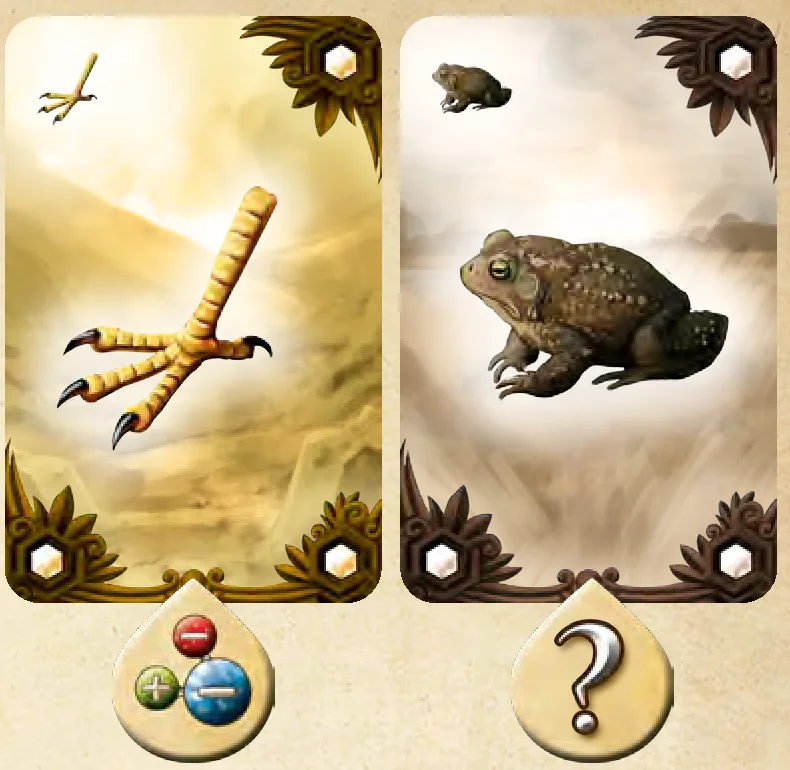
Alchemists mix potions by combining two different ingredients. Tap the Drink Potion button and scan these two cards with the camera:
You may have to adjust your angle to get both cards in the picture. When the app recognizes the cards, they show up in the bottom half of the screen. When the app displays the correct ingredients, tap Confirm.
Congratulations on mixing your first potion! If you followed my instructions correctly, you mixed  , which is a healing potion.
How is it possible that two seemingly ordinary ingredients could combine to make something extraordinary? Well, it’s time for you to learn a little theory.
Alchemicals
Each ingredient corresponds to exactly 1 alchemical. An alchemical has a red aspect, a green aspect, and a blue aspect, and each aspect can be positive or negative.
When two alchemicals combine, matching aspects amplify, and they make one of these potions:
- HEALING
 POISON
 SPEED
SPEED PARALYSIS
 WISDOM
 INSANITY
To figure out what potion is created, look for a match in sign and color between a big circle on one alchemical and a little circle on the other:
Examples:
Pop Quiz:
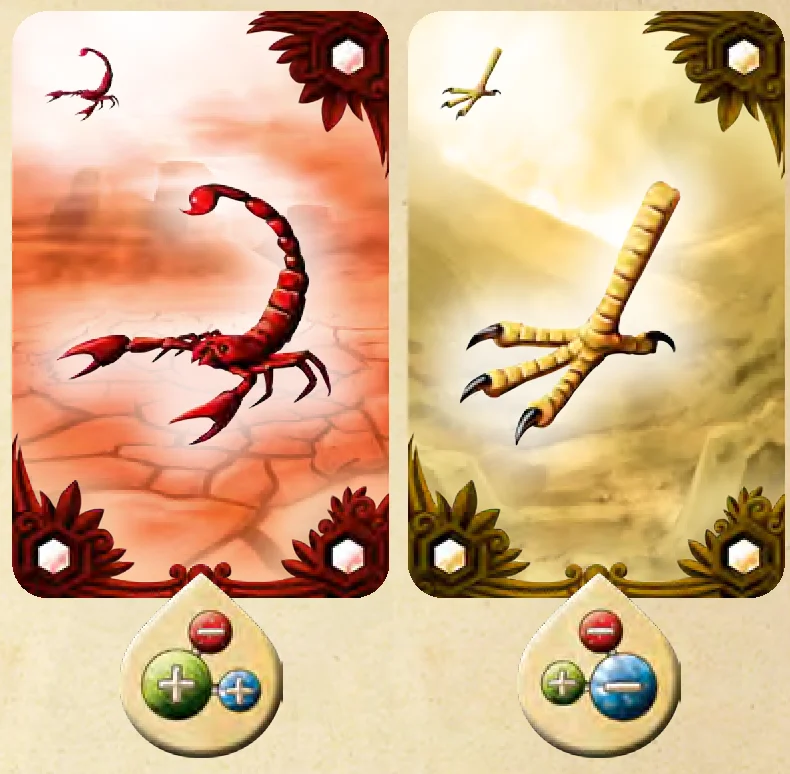
I shall reveal the true nature of scorpion and bird claw. Now, can you tell me what potion you will get when you combine the two?
To check your answer, scan this picture in the app.
Deduction
Mixing potions is easy once you know which alchemical corresponds to which ingredient. But we don’t know! Isn’t that wonderful? So many mysteries waiting to be solved. And so much grant money available for our research.
In your first experiment, you discovered that mushroom and toad combine to make . What does this tell you about their alchemicals?
There are only 4 ways to make :
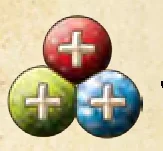 +
+ 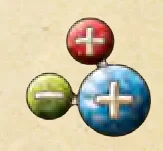 =
= 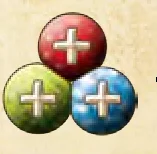 +
+ 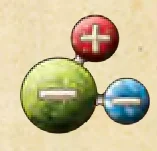 =
= 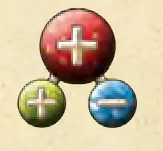 +
+ 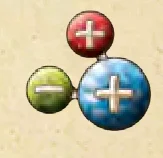 =
= 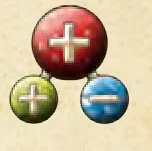 +
+ 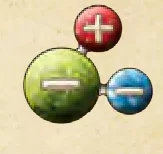 =
=
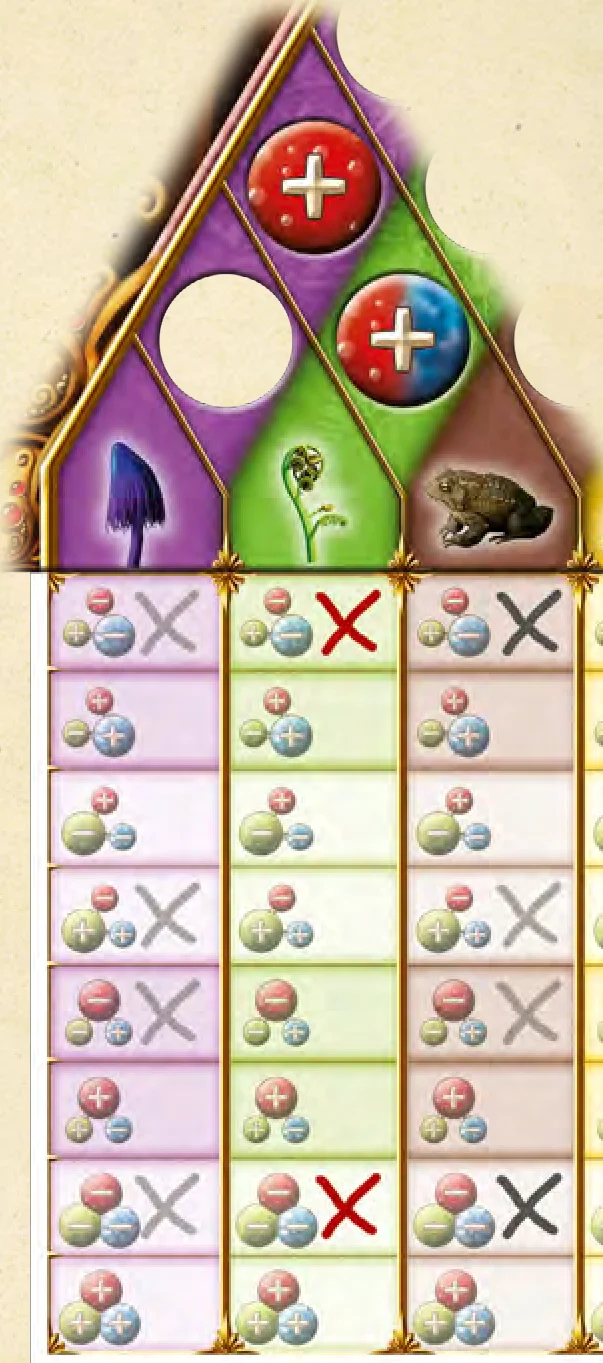
We don’t know which pair of alchemicals we have, and we don’t know which ingredient corresponds to which half of the pair. But we do know that mushroom and toad cannot be any of these four alchemicals because these do not have the  symbol. Their red aspect is negative.
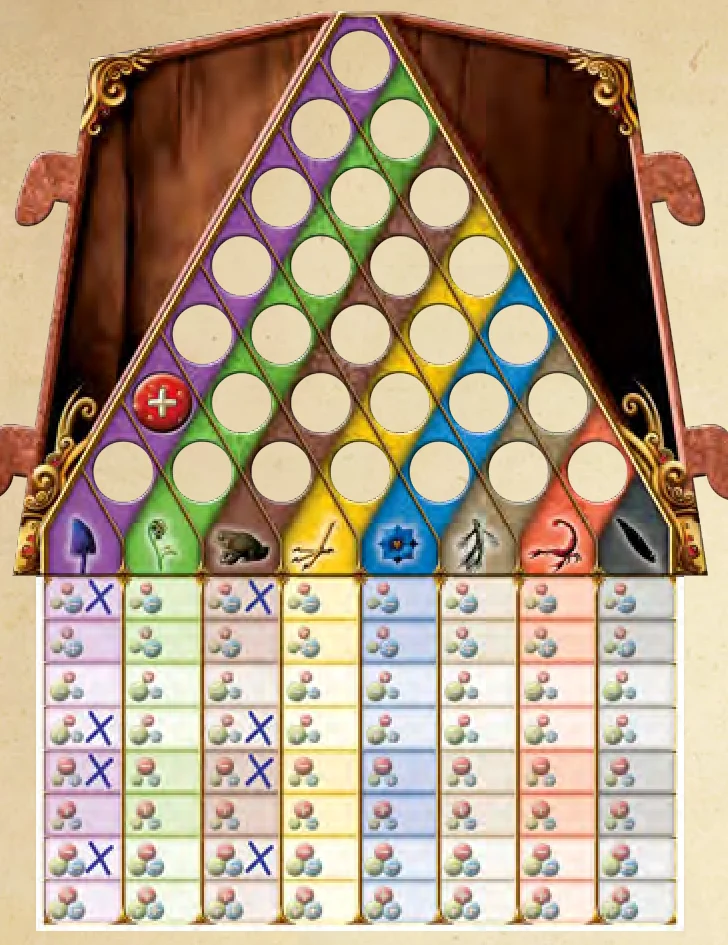
To be a successful alchemist, you need to keep an orderly notebook.
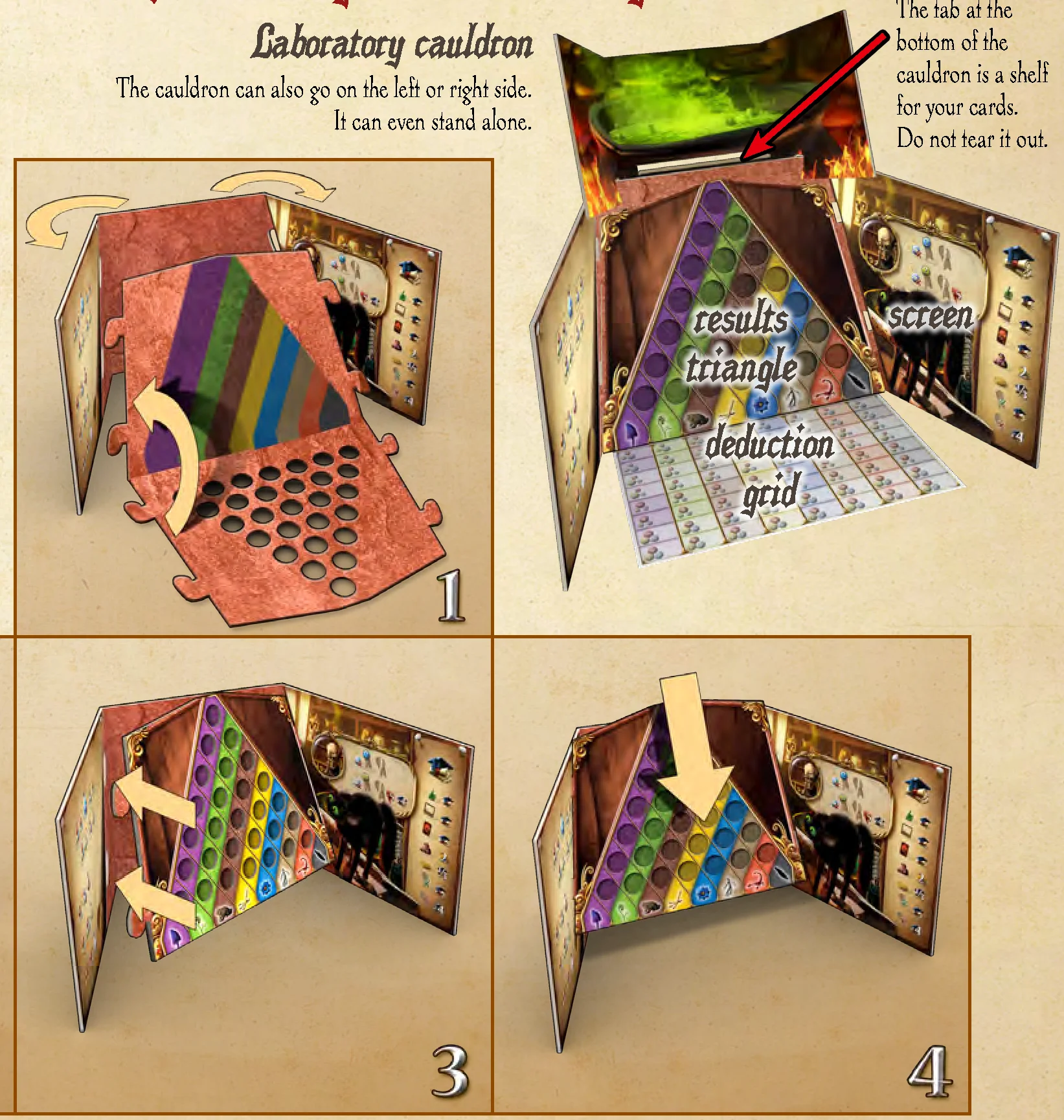
- The results triangle is for recording the results of your experiment. Take a token and put it at the intersection of mushroom and toad.
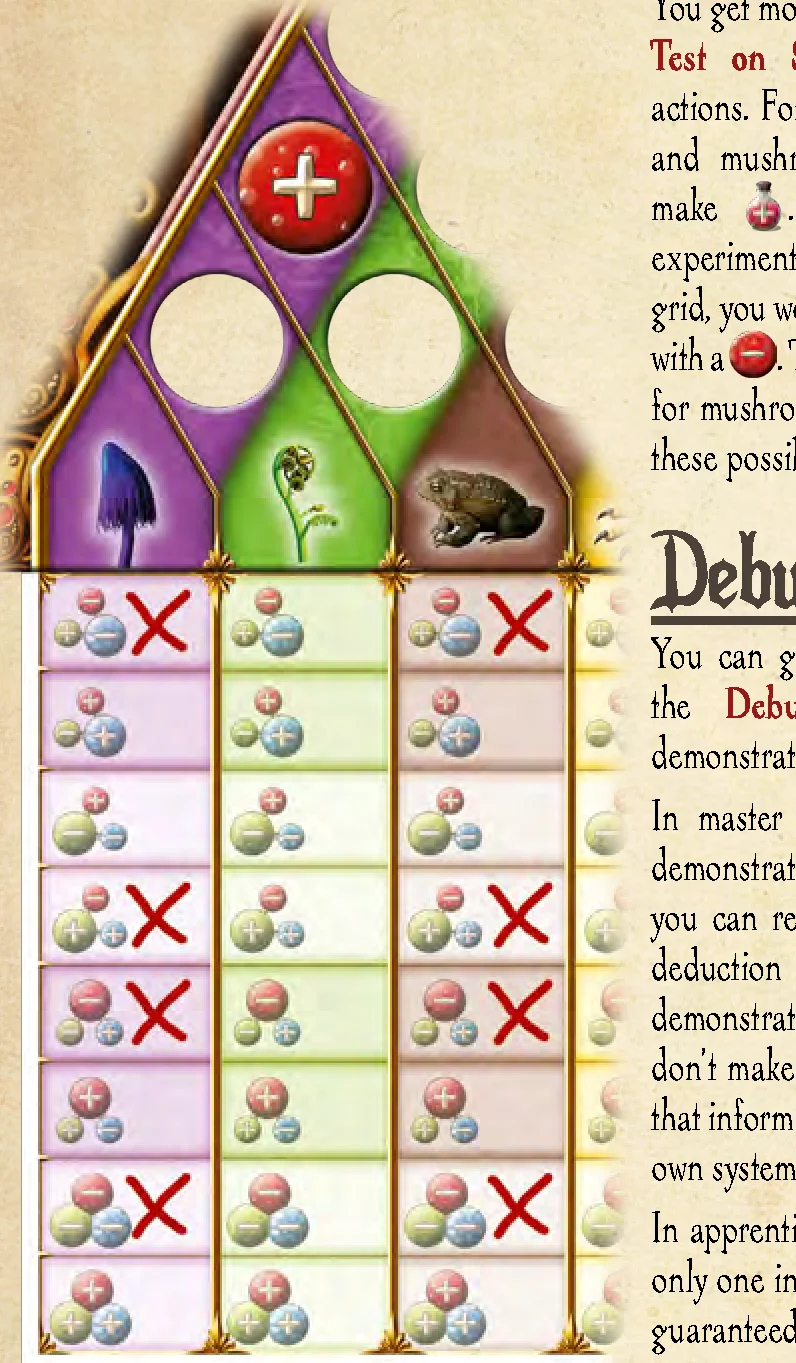
- The deduction grid is for recording what your experiment tells you. Your experiment eliminates 4 possibilities for mushroom and toad, as shown. In general, you will have to proceed by eliminating possibilities until only one possibility remains.
Your deduction grid is for your personal use. You can make notes using any system you want.
The Neutral Potion
Each alchemical has exactly one alchemical that neutralizes it. When you combine a neutralizing pair, you get a potion that has no magical effects, although it does make a tasty soup.
If two alchemicals have no matching aspects, they neutralize each other to make a neutral potion  .
.
Do not become discouraged when you mix a neutral potion. Your experiment has actually given you a lot of information. Now you just need to figure out how to use it.
Things to know:
- Each alchemical has exactly one alchemical that neutralizes it (It makes a red, blue, or green potion with any other alchemical.).
- An alchemical’s neutralizer has the opposite sign for each aspect (each color).
- On your deduction grid, alchemicals that neutralize each other are in adjacent rows. Note the horizontal bands of light and dark shading.
Pop Quiz:
I have already revealed the alchemical for bird claw. Find out what happens when you mix bird claw and toad. Then tell me: What alchemical must correspond to toad?
And now, my young alchemist, your fundamental training is complete. Well, complete enough. I have to get back to work. I wish you much success in all your endeavors, and if you should ever happen to publish an important discovery, be sure to give proper credit to the alchemist who taught you everything you know.
The Card Reader
To play Alchemists, you will need the Alchemists app on your smartphone or tablet. To get the app, scan this QR code or enter cge.as/ald into your web browser. The app is free. You’ve already paid for the game.
(To play without the app, see the facing page.)
Only one device is necessary. Players can share.
Once you have downloaded the app, launch it and tap the Enter Game Code button. Please enter this four-letter code: DEMO.

Selection by Hand
The card reader gives you the option to select ingredients by hand. Instead of scanning cards, you will hide the card reader from the other players and tap on the two ingredients you are mixing. Everything else works the same.
Web-Based Card Reader
At alchemists.czechgames.com, you can find a web-based version of the app. On the web, cards are selected by hand.
The Gamemaster Board
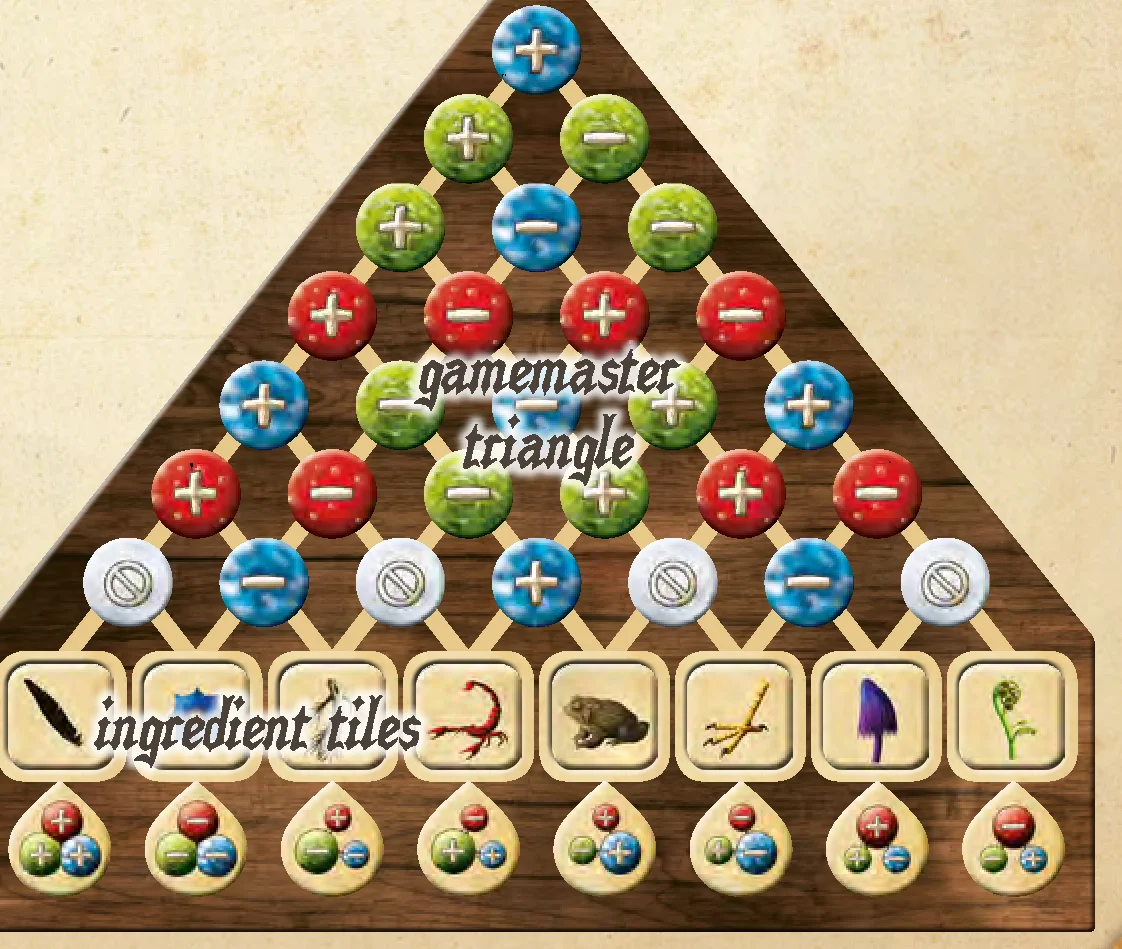
If for some reason you want to play Alchemists without an electronic device, one person can play gamemaster and act as the card reader. The gamemaster can use the box lid to keep the gamemaster triangle hidden from the other players.
The gamemaster mixes up the 8 ingredient tiles and inserts them secretly and randomly into the 8 slots. The gamemaster does not need to worry about the actual alchemicals. The result of mixing any two ingredients is given by the triangle.
The gamemaster handles every situation that normally requires the card reader. For example, whenever a player needs to “scan” ingredient cards, the player passes the cards face down to the gamemaster. The gamemaster looks up the resulting potion and then gives the answer that the card reader would give in that situation. The gamemaster can then put the ingredients in the discard pile.
If the battery on your smartphone dies and you want to use the gamemaster triangle to finish your game: someone who isn’t playing can take the role of gamemaster by peeking at the answers in the app and setting up the gamemaster triangle accordingly.
Gamemaster Exam: This gamemaster triangle is set up so you can “scan” all three examples on this page and give the same answers that the card reader would.
Game Setup
Ah, but the craft of alchemy is about more than mixing potions. Alchemists seek knowledge, of course, but what they truly value is prestige. Making your mark on the world will not be easy. You need to publish before your colleagues do, expose the flaws in their theories, and get the powerful artifacts before they are all sold out. You see, you are not the only alchemist in town.
Master or Apprentice?
You can play Alchemists either as masters or apprentices. For your first game, we recommend you play the apprentice variant. A few of the rules are simpler, and the academic conferences are more forgiving. Even so, it offers the full range of possibilities.
A few details of setup depend on which variant you are playing.
Two, Three, or Four Players?
This side of the board is for a four-player game. The setup for two or three players is the same, except you use the other side of the board.
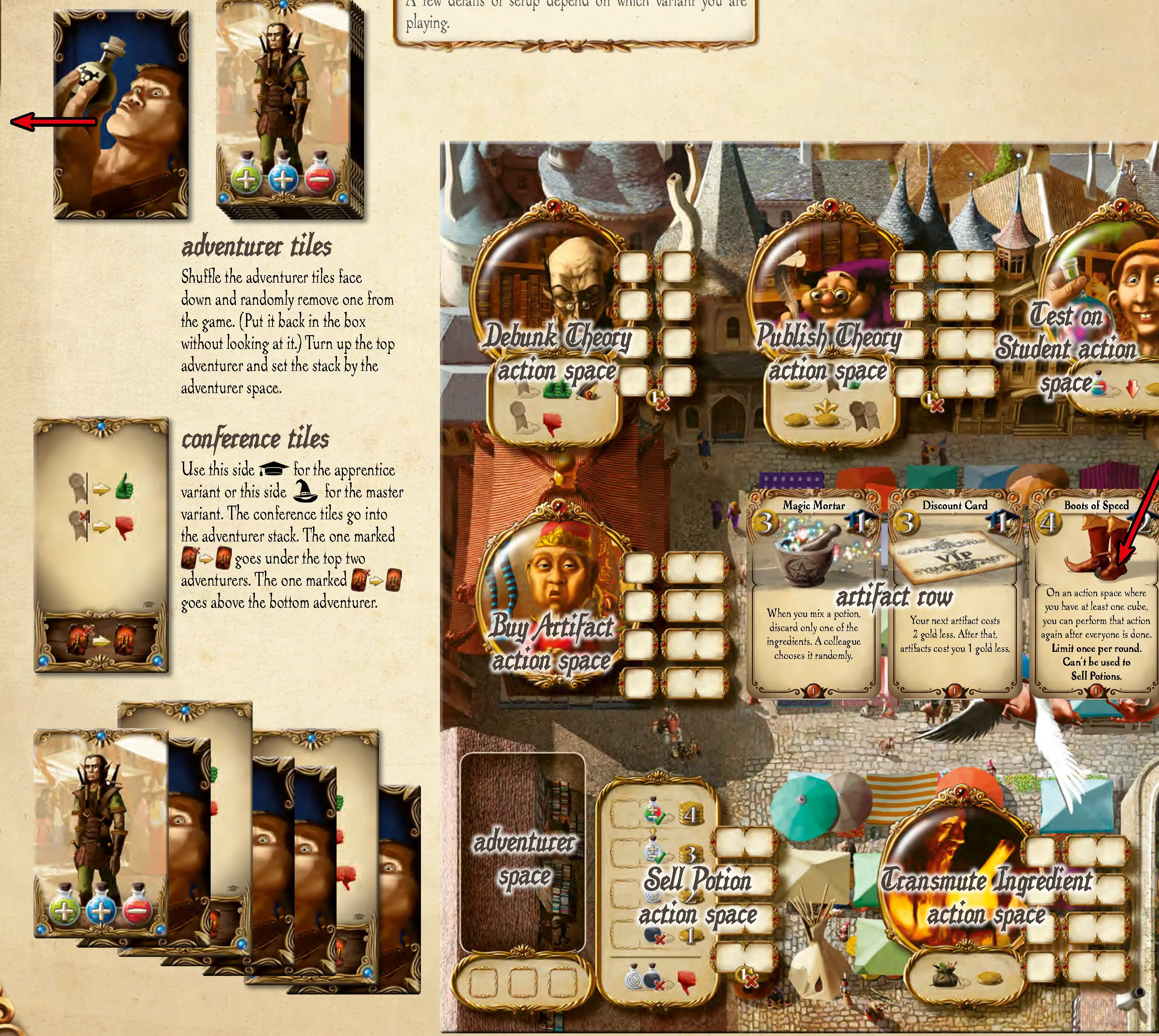
- Adventurer tiles: Shuffle the adventurer tiles face down and randomly remove one from the game. (Put it back in the box without looking at it.) Turn up the top adventurer and set the stack by the adventurer space.
- Conference tiles: Use the indicated side for the apprentice variant or for the master variant. The conference tiles go into the adventurer stack:
- The one marked
 goes under the top two adventurers.
 - The one marked goes above the bottom adventurer.
- The one marked
Board Setup (Continued)
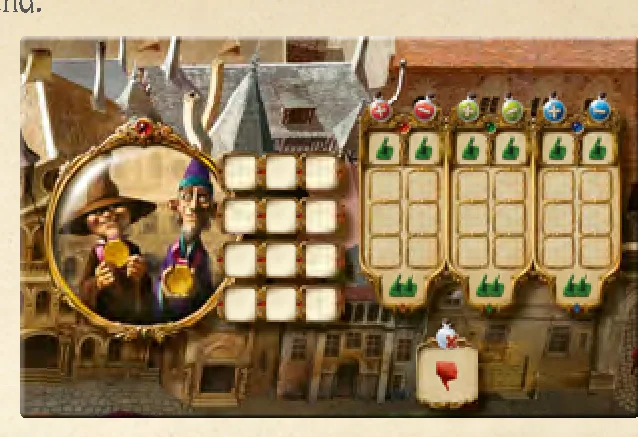
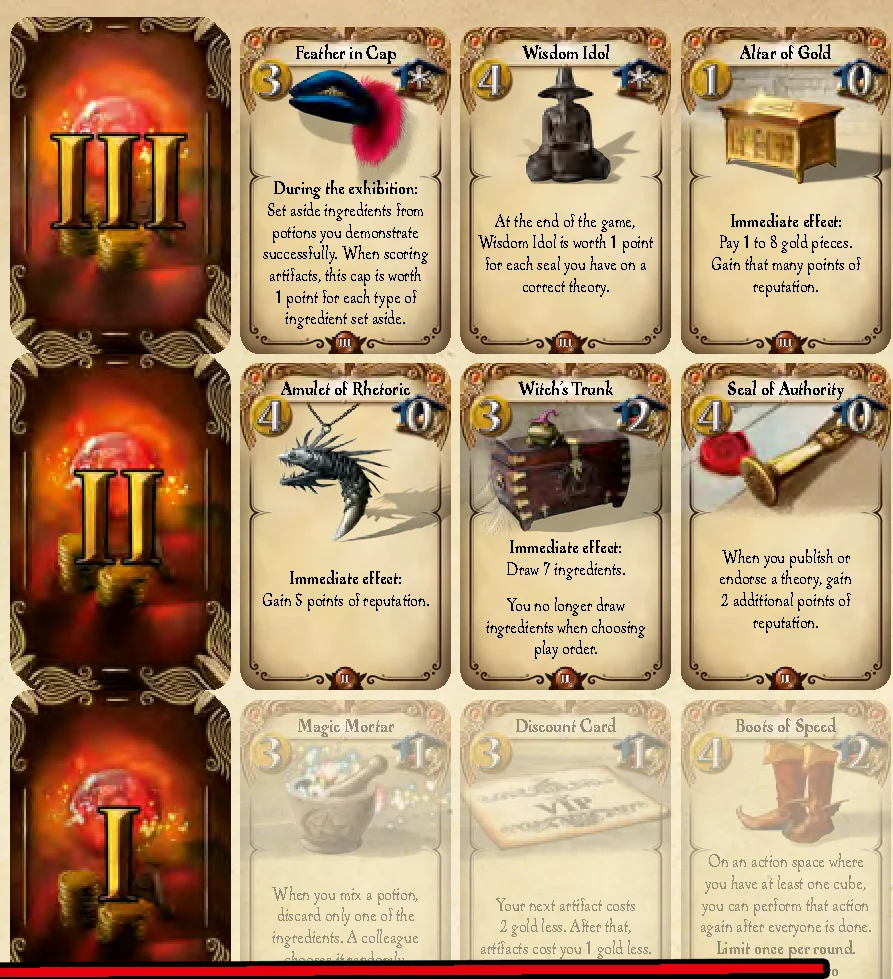
- Artifact cards: Divide the cards into decks I, II, and III. Shuffle each deck independently. Draw 3 cards at random from deck I and place them in the artifact row. Draw 3 cards at random from decks II and III and place them in rows beside the game board. The selected artifacts are all face up. Players may look at them at any time. Return the rest of the artifact cards to the box. They will not be needed this game.
- Exhibition Board: Set this board aside for now. You will use it in the final round.
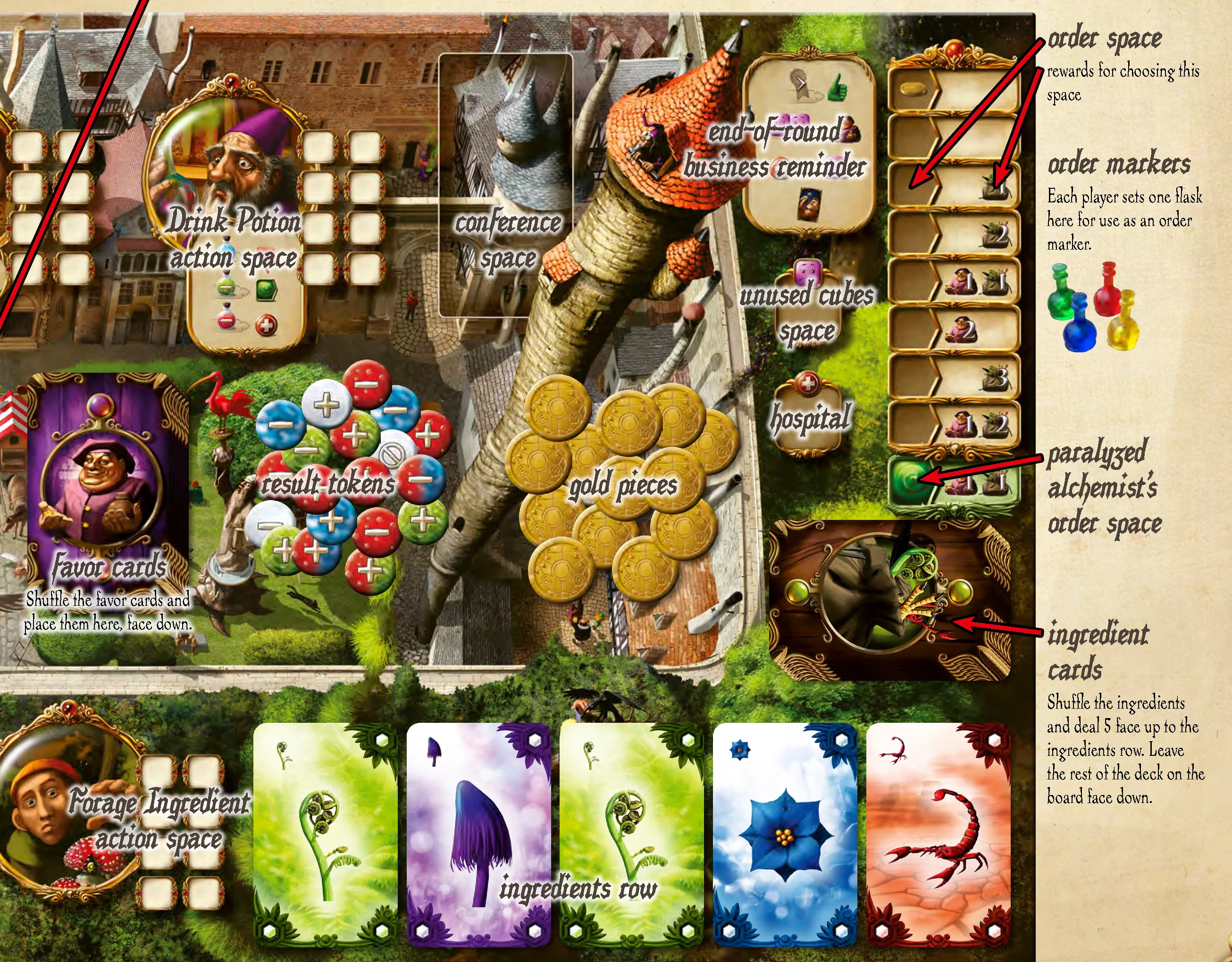
- Ingredient cards: Shuffle the ingredients and deal 5 face up to the ingredients row. Leave the rest of the deck on the board face down.
- Favor cards: Shuffle the favor cards and place them face down on their space.
- Order markers: Each player sets one flask on the order space for use as an order marker.
- Tokens and Gold: Place result tokens and gold pieces in their designated supply areas on the board.
Player’s Laboratory Setup
Public Section
The types of potions you have already made, your grants, your artifacts, your number of gold pieces, and the number and types of cards in your hand are always public knowledge.
Private Section
The types of ingredients and favor cards in your hand, the types of seals you play, the ingredients in your experiments, and your deductions from results are always kept secret from the other players. This information can be hidden behind your laboratory screen.
Initial Player Components
- Player board: Displays spaces for grants, 2 starting gold pieces, and potions you have made.
- Ingredient cards:
- Apprentice Variant: Each player draws 3 ingredients from the top of the deck.
- Master Variant: Each player draws 2 ingredients from the top of the deck.
- Favor Cards: Each player draws 2 favor cards, chooses one to keep, and one to discard.
- Bid cards: Each player takes a set of bid cards (0, -1, -2, -3).
- Seals: Each player receives a set of seals (starred and unstarred).
- Action Cubes: The number of action cubes depends on the number of players:
- Two players: 6 cubes.
- Three players: 5 cubes.
- Four players: 4 cubes.
Leave extra cubes in the box.
Important: In all cases, you use only 3 action cubes in the first round. Put your remaining cube or cubes on the adventurer stack. This reminds you to take the full complement at the end of the first round.
Assembling Your Laboratory
Assemble the cardboard screen and cauldron as illustrated. The cauldron can go on the left or right side, or it can even stand alone. The tab at the bottom of the cauldron is a shelf for your cards—do not tear it out.
Theory Board Setup
- Grants: Arrange the 5 grant tiles in the center of the theory board as shown.
- Reputation markers: Each player puts one flask on the 10 space of the reputation track to mark initial reputation.
- Starting Player Token: Give the starting player token to the player who was most recently in a laboratory.
- Conflict tokens: Used only in the master variant. For the apprentice variant, leave these in the box.
- Alchemical tokens: Place the tokens near the theory board.
Initializing the Card Reader
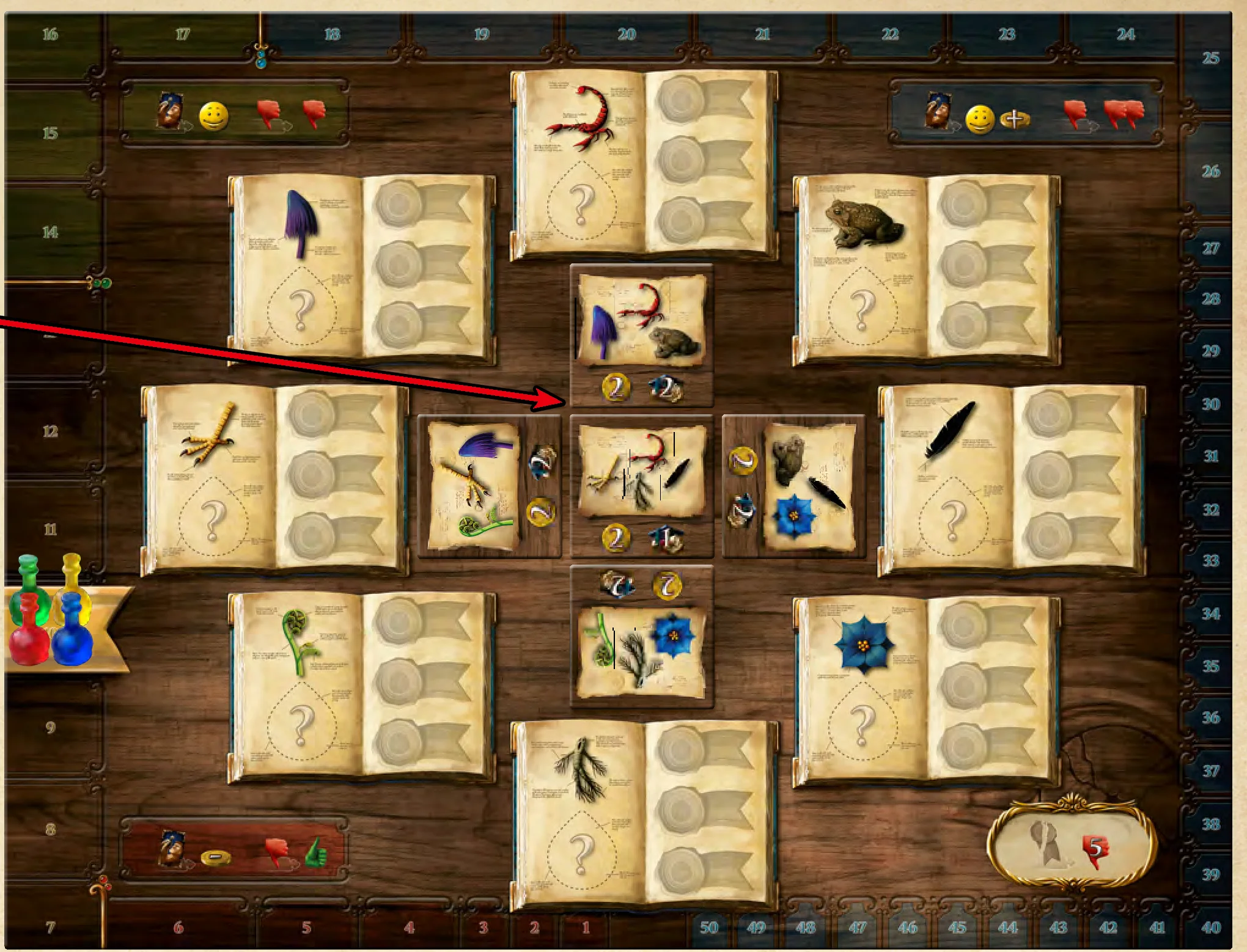
At the start of the game, launch the app, select the master or apprentice variant, and tap the Start New Game button. The app will randomly assign each ingredient a different alchemical.
Each randomization has a four-letter code. Write this down. If you need to complete the game on a different device (for example, if your first card reader runs out of power), just tap Enter Game Code and type the code into the new device. It will use the same randomization as the first device. This system also enables you to play with two or more card readers if you wish.
Round Overview
The game is played in six rounds. At the beginning of each round, players choose their play order. Then players declare all their actions for the round. During the round, actions are evaluated in order, clockwise around the board.
Choosing Play Order
Beginning with the player with the starting player marker and proceeding clockwise around the table, each player chooses an order space. Lower spaces give you more cards but leave you at a disadvantage when resolving actions. When it is your turn to choose, place your order marker on one of the unoccupied order spaces and draw the indicated cards.
Two players cannot choose the same space, and no one can choose the green space at the very bottom (reserved for alchemists who drank a paralysis potion on the previous round). In a 2-player game, you cannot choose the space labeled with the 3-4 player icon.
- Drawing Ingredients: Draw the indicated number of ingredients from the top of the deck. Do not take any face-up cards.
- Drawing Favor Cards: Draw the indicated number of favor cards from the top of the deck. (If either deck runs out of cards, shuffle its discard pile.)
- Getting Nothing: If you choose this space, you draw no cards, but you will get to go first … or second.
- Paying Gold: To choose this space, you must pay 1 gold piece. You draw no cards, but you are guaranteed to go first.
Play Order: For the rest of the round, play order will be determined by the order of the markers on the order spaces. The starting player marker will have no further effect this round; at the end of the round, it will be passed to the left.
Declaring Actions
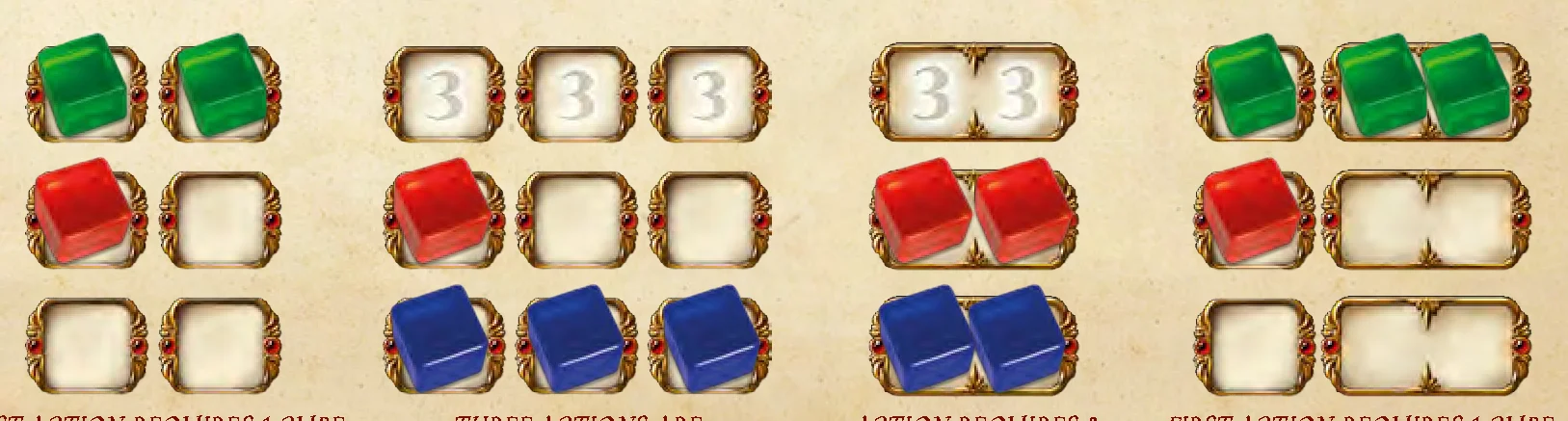
Once all players have chosen an order space, it is time to declare actions. The player lowest on the order spaces must declare his or her actions first, followed by the next lowest player, and so on. Players who chose higher spaces have the advantage of seeing what other players are doing before declaring their own actions. When it is your turn, declare all your actions at once by placing your action cubes on the actions you want to take.
Each player has their own row corresponding to their position on the order spaces (lowest player in the bottom row, highest player in the top row). In a 2-player game, rows marked 3 or 4 are not used.
First Round Exceptions
- In the first round, you are allowed only 3 action cubes. In later rounds, you may use your full set of cubes.
- The three actions marked with the crossed-out beaker symbol (Sell Potion, Publish Theory, Debunk Theory) are not available in the first round.
Resolving Action Spaces
Each action space is resolved in order, clockwise around the board:
- Forage Ingredient
- Transmute Ingredient
- Buy Artifact
- Sell Potion (round 2+)
- Publish Theory (round 2+)
- Debunk Theory (round 2+)
- Test on Student
- Drink Potion
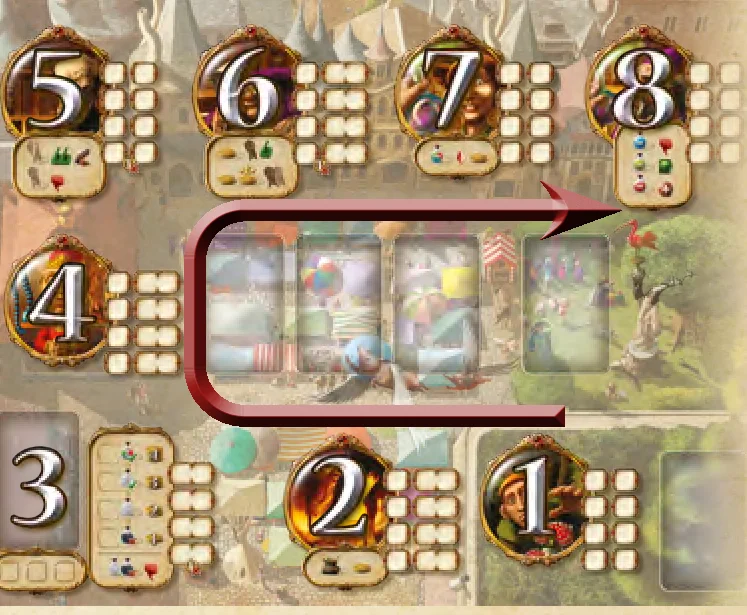
On each action space, players take their actions in order, beginning with the player on the highest occupied row. When you take your action, remove your cube (or both cubes if the action requires 2). Once everyone on the action space has taken their first action, players with two actions may take their second, in the same order.
Declining Your Action
When it is your turn to perform an action, you may change your mind and decline your action instead. Pick up your cube (or cubes) and put it on the unused cubes space. At the end of the round, every pair of unused cubes will allow you to draw 1 favor card.
Actions Available in the First Round
Forage for Ingredient
When it is your turn to forage for an ingredient, you may take either 1 face-up ingredient from the row or draw 1 random ingredient from the top of the deck. Cards in the row are not replaced immediately. Once all face-up cards are gone, your only choice is to draw from the top of the deck (or decline the action).
Once all players have finished their actions here, discard any remaining face-up ingredients face down. A new set of 5 face-up ingredients will be dealt at the beginning of the next round.
Transmute Ingredient
When you play this action, discard 1 ingredient face down and take 1 gold piece from the bank. On this space, going first does not give you any advantage.
Buy Artifact
When you buy an artifact, take one of the cards in the artifact row and pay the cost in the upper left corner. Keep your artifacts face up in front of you. The artifact row is not replenished immediately; new artifacts arrive after academic conferences.
Experiments
The final two actions of the round allow you to mix two ingredients and test the result. The procedure for mixing a potion is identical whether Testing on a Student or Drinking the Potion yourself:
- Choose 2 of your ingredient cards to mix.
- Place them in your cauldron so that no one else can see them.
- Tap Test on Student or Drink Potion on the card reader.
- Scan the cards and tap Confirm when recognized.
- Show the result to the other players. (They learn the potion made, but not the ingredients used.)
- Put the corresponding result token in your results triangle.
- Put the corresponding result token on your player board (potions you have mixed are public knowledge).
- Discard the ingredients used face down.
Test on Student
The first player to use this action tests for free. However, once the student drinks a negative potion (, , or ), for everyone playing after that player, the action costs 1 gold piece. If you cannot or do not wish to pay, you must decline the action.
Every round you get a new student, so the first experiments of each round are always free until a negative potion is brewed.
Drink Potion
Experimenting on yourself is always free, but negative potions directly affect you:
- Potion of Insanity (): You lose 1 point of reputation.
- Potion of Paralysis (): Move your order marker to the special paralysis order space. Next round, you will not choose an order space; you will draw the indicated cards and play last.
- Poison (): Put your action cube on the hospital space instead of returning it to your player board. For the next round, you will have 1 less cube to use.
No negative potion can affect you twice in the same round. Positive and neutral potions have no harmful effect.
Other Fun Things That Can Happen To You When You Are Paralyzed
- If multiple players drink a paralysis potion, they will all place order markers on the green space; earlier arrivals play ahead of later ones.
- If the starting player marker is passed to a paralyzed player, it is immediately passed along to the next unparalyzed player to the left.
Actions Available in the Second Round
Sell Potion
At the beginning of each round (except the first), a new adventurer tile is revealed, showing three potions they wish to buy. This action requires 2 action cubes and can be used only once per round.
Offering a Potion
When it is your turn to sell a potion, place one cube under one of the three potions the adventurer wants. That potion is now blocked for subsequent players.
- 4-player game: 3 players max can sell.
- 3-player game: 2 players max can sell.
- 2-player game: Only 1 player can sell.
Offering a Guarantee
Place your second action cube next to a level of quality guarantee:
- Exact match (4 gold): Correct sign and correct color.
- Correct sign (3 gold): Correct sign, wrong color acceptable.
- Neutral (2 gold): Any potion that does not have the wrong sign (includes the neutral potion).
- Wrong sign / Anything (1 gold): You get paid 1 gold no matter what potion is brewed.
If you mix a potion worse than guaranteed, you do not get paid. If you mix better, you only get paid the guaranteed amount.
Mixing the Potion
Tap Sell Potion, choose the potion the adventurer wants, scan your 2 ingredient cards, and tap Confirm. The card reader reveals only the quality level achieved, keeping the exact potion secret unless it was an exact match or neutral. Ambiguous results are marked with bicolored or uncolored tokens on your deduction grid.
Reputation penalty: Regardless of your guarantee, brewing a wrong-sign potion or a neutral potion always causes you to lose 1 point of reputation.
Offering a Discount
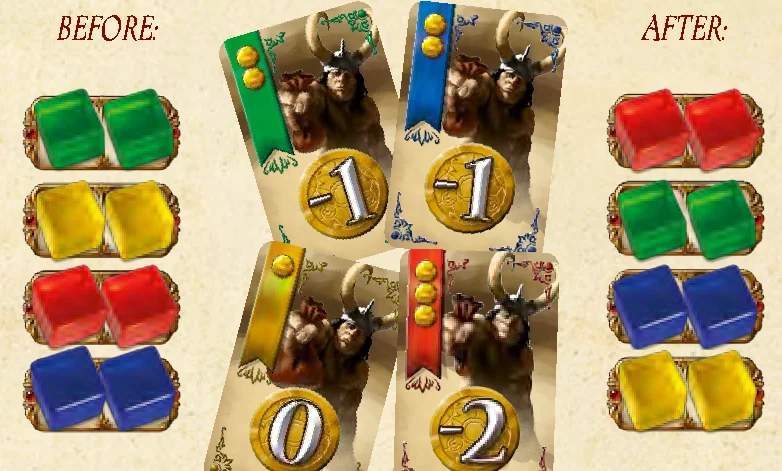
Before any potion is chosen, all players on the Sell Potion space simultaneously reveal a secret bid card (values: 0, -1, -2, -3). The card with the most smiley faces  sells first. Normal play order breaks ties.
Your discount reduces your selling price and limits your guarantee options: you cannot offer a guarantee whose discounted price would be zero or less.
Effects of Reputation
Your position on the reputation track alters game effects:
- Green Zone (14 to 17 Points): Gain +1 smiley face on your discount bid. Whenever you lose reputation, you lose 1 additional point.
- Blue Zone (18 or More Points): Gain +1 smiley face on your bid, charge +1 gold for guarantees, but whenever you lose reputation, you lose 2 additional points.
- Red Zone (6 Points or Less): You must charge 1 less gold for guarantees. However, whenever you lose reputation, you lose 1 point less. (Reputation can never drop below 1.)
Publish Theory
Publishing allows you to claim the identity of an ingredient by placing an alchemical token on the theory board and sealing it with one of your seals face down. You must pay 1 gold piece to the bank and immediately gain 1 reputation point.
Seals
- Starred seals (Gold: 5 VP, Silver: 3 VP): Scored at game end if the theory is correct. Penalized if incorrect (-4 VP or -5 reputation if debunked).
- Unstarred seals (Hedging): Feature a colored question mark. If the theory is debunked on that specific aspect, you suffer no penalty. Unstarred seals grant 0 VP at end of game.
Available Tokens and Ingredients
You may only publish about an ingredient that has no published theory, using an alchemical token that has not yet been placed.
Endorsing a Theory
You can endorse another player’s published theory by placing your seal on it. You must pay 1 gold piece to the bank plus 1 gold piece to each player who already has a seal on that theory. You gain no reputation for endorsing.
Grants
When you have seals on theories covering the requirements of a grant tile in the center of the board, you immediately claim the grant tile and take 2 gold pieces from the bank. Your first grant requires 2 matching ingredients; subsequent grants require 3.
Debunk Theory
Available from round 2 onward once theories are published. If you prove a theory wrong, you gain 2 points of reputation, and anyone with a seal on it risks losing reputation.
Apprentice Debunking
Tap Debunk Theory in the app, select the ingredient and the aspect you wish to test, and confirm. The app reveals the true sign of that aspect:
- If it matches the token, you fail and lose 1 reputation.
- If it is opposite, the theory is debunked!
Consequences of Debunking
- You gain 2 reputation.
- Remove the alchemical token from the board.
- Reveal all seals on that theory. Starred seals and incorrectly hedged unstarred seals lose 5 reputation. Correctly hedged seals lose nothing.
- All seals from that theory are removed from play permanently.
- If you have a cube on Publish Theory, you may immediately publish a replacement theory for that ingredient or token.
Debunking Your Own Theory
You can debunk your own theory; gains and losses resolve simultaneously.
Master Debunking
In master debunking, you must specify two ingredients and a potion, demonstrating via an actual mixing experiment why a theory cannot be true:
- Debunking 1 Theory: Shows one aspect of an ingredient contradicts its published theory (+2 reputation to you, penalties to seal holders).
- Debunking 2 Theories: Both ingredients in the test contradict their published theories simultaneously.
- Demonstrating a Conflict: If the experiment proves two published theories cannot both be true simultaneously without pinpointing which one is wrong, place matching conflict tokens on both theories. You gain 2 reputation; no seal penalties are assessed yet.
- Invalid Demonstrations: If your demonstration fails to debunk a theory or demonstrate a new conflict, you lose 1 reputation.
End of the Round
At the end of each round, resolve the following in order:
- Conference (Rounds 3 and 5): Players with enough published/endorsed theories gain 1 reputation; those lacking lose reputation as indicated on the conference tile. New artifact cards are dealt.
- Top Alchemist Award: The player with the most seals on the theory board gains 1 reputation (ties: all tied players gain 1).
- Unused Cubes: For each pair of unused cubes, draw 1 favor card.
- Hospital: Move cubes from the hospital to the unused cubes space.
- New Adventurer: Reveal the next adventurer for the upcoming round.
- Setup for Next Round: Discard remaining face-up ingredients and deal 5 new ones; reset order markers; pass the starting player token to the left.
The Final Round & Exhibition
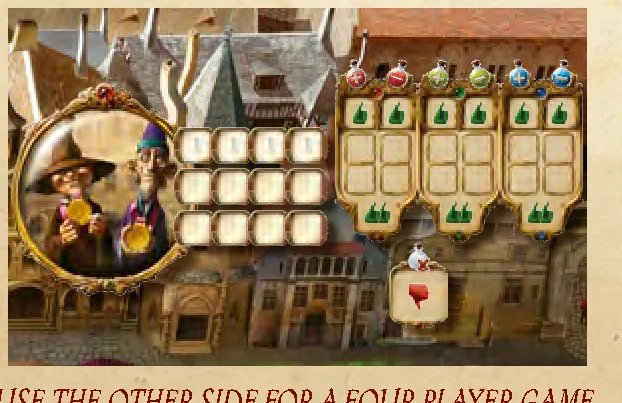
In round 6, the Test on Student and Drink Potion spaces are covered by the Exhibition Board. Players declare actions on the Exhibit Potion space to publicly demonstrate potions:
- The first player to successfully exhibit a potion gains 1 reputation. Subsequent successes gain 0 reputation.
- Failing an exhibition loses 1 reputation.
- Exhibiting both the positive and negative versions of the same color awards a bonus of 2 reputation (mastery of that color).
Final Scoring
Follow these steps to determine victory points (VP):
- Reputation: Convert all current reputation points directly into victory points (1:1).
- Artifacts: Score victory points from artifact cards (evaluate Magic Mirror first).
- Grants: Score VP depicted on claimed grant tiles.
- Leftover Cards and Gold: Exchange remaining favor cards for 2 gold each. Then buy 1 victory point per 3 gold pieces (leftover gold serves as tiebreaker).
- The Big Revelation: Tap Show Answers in the app to reveal the true alchemical of each ingredient. Reveal all seals on all theories:
- Correct theory: Gold star = +5 VP, Silver star = +3 VP, Unstarred = 0 VP.
- Incorrect theory: Starred seal = -4 VP; Unstarred seal improperly hedged = -4 VP; Unstarred seal properly hedged = 0 VP.
- Wisdom Idol: Score extra points now if owned.
The Winner: The player with the most victory points wins! Ties are broken by leftover gold pieces.
Using Your Deduction Grid
Experimenting & Debunking
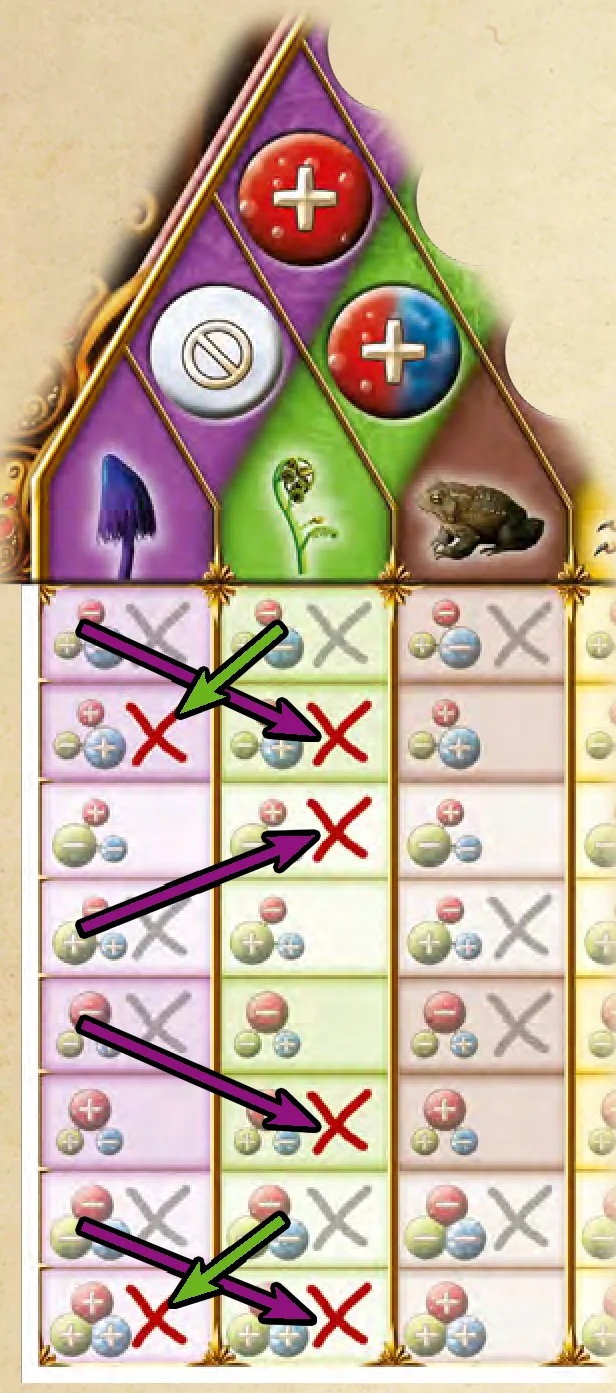
When you brew a potion, you eliminate all alchemicals that could not possibly create that result. For example, brewing a positive red potion eliminates all alchemicals whose red aspect is negative.
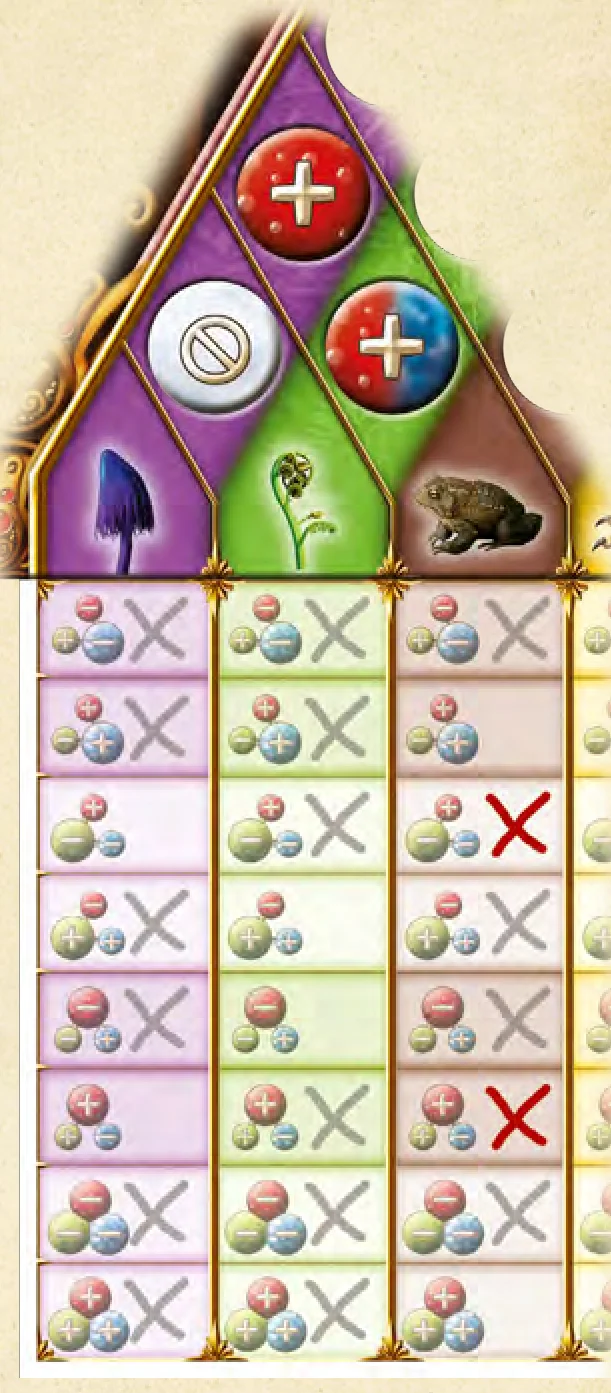
Ambiguous Results
Selling potions often yields ambiguous feedback (e.g., correct sign but unknown color), allowing you to eliminate impossible combinations on your grid.
Neutralizing Pairs & Advanced Deductions
A neutral potion reveals that two ingredients are exact opposites across all three aspects. Eliminating a possibility for one immediately eliminates its opposite for the other!
Notes on Selected Artifacts
- Feather in Cap: Scored during exhibition; earns 1 point per ingredient type set aside from successful demonstrations.
- Magic Mirror: Counted first in scoring; gives extra victory points based purely on your end-of-game reputation points (14 reputation = 2 VP, 15 = 3 VP).
- Magic Mortar: When discarding ingredients for a potion, another player picks 1 card at random to discard; you keep the other.
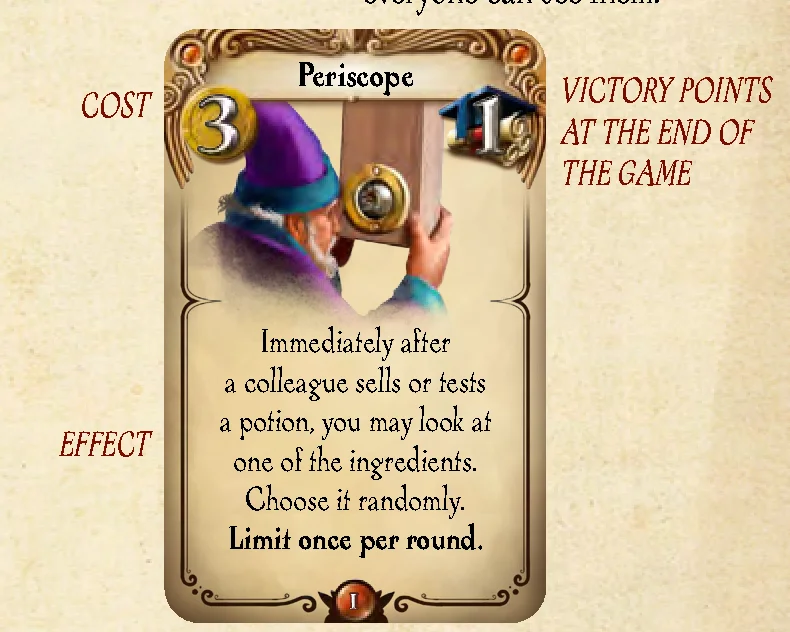
- Periscope: Immediately inspect 1 random ingredient used by an opponent when they sell or test a potion (once per round).
- Printing Press: Publish new theories without paying 1 gold to the bank.
- Robe of Respect: Each reputation gain is increased by 1 point.
- Seal of Authority: Gain +2 additional reputation whenever you publish (+3 total) or endorse (+2 total) a theory.
- Thinking Cap: Test two potions at once using Test on Student with no penalties for negative potions.
- Wisdom Idol: Scored after the Big Revelation; adds +1 VP for each seal on a correct theory.
- Witch’s Trunk: Gives 7 ingredients immediately; you no longer draw ingredients when choosing play order.
Favor Cards
- Assistant: Gain an extra action cube for the current round.
- Associate: Place your cubes at the very top of an action space, pushing other players down.
- Barmaid: Improves the perceived quality of a sold potion by one step.
- Custodian: Creates an early Drink Potion space before Sell Potions.
- Herbalist: Played immediately upon drawing: draw 3 ingredients and discard any 2.
- Merchant: Sell a potion even if the slot is blocked, or gain extra gold if already first.
- Shopkeeper: Provides discounts on artifact purchases.
- Sage: Transmute an ingredient into 2 gold pieces instead of 1.
Overview & Basic Principles of Alchemy
I received my new cauldron today. Finally, my laboratory is complete!
For days, I have been gathering and drying ingredients in anticipation. What shall I mix first? I have a strong hunch about raven’s feather and mandrake root. And they say you can never go wrong with a toad.
But then, what do they know? This is my laboratory, my research! Once I have published my theories, the others will be coming to me! I am determined to prove that I have the greatest mind that ever studied alchemy.
So now, I shall light my fire, for it is time to get to work. Knowledge, wealth, and fame can all be found in the murky depths of the cauldron.
Overview
Two to four players take the role of alchemists competing to discover the secrets of their mystical art. Points can be earned in various ways, but most points are earned by publishing theories – correct theories. Therein lies the problem.
Players gain knowledge by mixing ingredients and testing the results using a card-scanning app on a tablet or smartphone. They deduce how to make potions that they can sell to adventurers. Gold pieces can be spent on magical artifacts, which are very powerful but also very expensive.
Players’ reputations go up and down as their theories are published or disproven. At the end of the game, reputation is converted to points. Points are also scored for artifacts and grants. The player with the most points wins.
Basic Principles of Alchemy
Ah! A new student. How delightful! I’m always glad to meet someone whose heart burns with the fire of science. Are you ready to uncover nature’s mysteries? Ready to make discoveries that will earn respect and admiration? Well, my young friend, this is a long journey. It will require perseverance and a keen mind. Let us begin simply, by mixing a potion from ingredients we can find on a walk through the forest. See? Here is a mushroom. And here is a toad. Now all you need is a fully equipped alchemical laboratory. I’ll wait while you set one up.
Mixing Potions
Ready? Wonderful! Now toss these ingredients into your cauldron and stir until the substance changes color.
Alchemists mix potions by combining two different ingredients. Tap the Drink Potion button and scan these two cards with the camera:
You may have to adjust your angle to get both cards in the picture. When the app recognizes the cards, they show up in the bottom half of the screen. When the app displays the correct ingredients, tap Confirm.
Congratulations on mixing your first potion! If you followed my instructions correctly, you mixed , which is a healing potion.
How is it possible that two seemingly ordinary ingredients could combine to make something extraordinary? Well, it’s time for you to learn a little theory.
Alchemicals
Each ingredient corresponds to exactly 1 alchemical. An alchemical has a red aspect, a green aspect, and a blue aspect, and each aspect can be positive or negative.
When two alchemicals combine, matching aspects amplify, and they make one of these potions:
- HEALING
- POISON
- SPEED
- PARALYSIS
- WISDOM
- INSANITY
To figure out what potion is created, look for a match in sign and color between a big circle on one alchemical and a little circle on the other:
Examples:
Pop Quiz:
I shall reveal the true nature of scorpion and bird claw. Now, can you tell me what potion you will get when you combine the two?
To check your answer, scan this picture in the app.
Deduction
Mixing potions is easy once you know which alchemical corresponds to which ingredient. But we don’t know! Isn’t that wonderful? So many mysteries waiting to be solved. And so much grant money available for our research.
In your first experiment, you discovered that mushroom and toad combine to make . What does this tell you about their alchemicals?
There are only 4 ways to make :
- + =
- + =
- + =
- + =
We don’t know which pair of alchemicals we have, and we don’t know which ingredient corresponds to which half of the pair. But we do know that mushroom and toad cannot be any of these four alchemicals because these do not have the symbol. Their red aspect is negative.
To be a successful alchemist, you need to keep an orderly notebook.
- The results triangle is for recording the results of your experiment. Take a token and put it at the intersection of mushroom and toad.
- The deduction grid is for recording what your experiment tells you. Your experiment eliminates 4 possibilities for mushroom and toad, as shown. In general, you will have to proceed by eliminating possibilities until only one possibility remains.
Your deduction grid is for your personal use. You can make notes using any system you want.
The Neutral Potion
Each alchemical has exactly one alchemical that neutralizes it. When you combine a neutralizing pair, you get a potion that has no magical effects, although it does make a tasty soup.
If two alchemicals have no matching aspects, they neutralize each other to make a neutral potion .
Do not become discouraged when you mix a neutral potion. Your experiment has actually given you a lot of information. Now you just need to figure out how to use it.
Things to know:
- Each alchemical has exactly one alchemical that neutralizes it (It makes a red, blue, or green potion with any other alchemical.).
- An alchemical’s neutralizer has the opposite sign for each aspect (each color).
- On your deduction grid, alchemicals that neutralize each other are in adjacent rows. Note the horizontal bands of light and dark shading.
Pop Quiz:
I have already revealed the alchemical for bird claw. Find out what happens when you mix bird claw and toad. Then tell me: What alchemical must correspond to toad?
And now, my young alchemist, your fundamental training is complete. Well, complete enough. I have to get back to work. I wish you much success in all your endeavors, and if you should ever happen to publish an important discovery, be sure to give proper credit to the alchemist who taught you everything you know.
The Card Reader & Gamemaster Options
The Card Reader
To play Alchemists, you will need the Alchemists app on your smartphone or tablet. To get the app, scan this QR code or enter cge.as/ald into your web browser. The app is free. You’ve already paid for the game.
(To play without the app, see the facing page.)
Only one device is necessary. Players can share.
Once you have downloaded the app, launch it and tap the Enter Game Code button. Please enter this four-letter code: DEMO.
Selection by Hand
The card reader gives you the option to select ingredients by hand. Instead of scanning cards, you will hide the card reader from the other players and tap on the two ingredients you are mixing. Everything else works the same.
Web-Based Card Reader
At alchemists.czechgames.com, you can find a web-based version of the app. On the web, cards are selected by hand.
The Gamemaster Board
If for some reason you want to play Alchemists without an electronic device, one person can play gamemaster and act as the card reader. The gamemaster can use the box lid to keep the gamemaster triangle hidden from the other players.
The gamemaster mixes up the 8 ingredient tiles and inserts them secretly and randomly into the 8 slots. The gamemaster does not need to worry about the actual alchemicals. The result of mixing any two ingredients is given by the triangle.
The gamemaster handles every situation that normally requires the card reader. For example, whenever a player needs to “scan” ingredient cards, the player passes the cards face down to the gamemaster. The gamemaster looks up the resulting potion and then gives the answer that the card reader would give in that situation. The gamemaster can then put the ingredients in the discard pile.
If the battery on your smartphone dies and you want to use the gamemaster triangle to finish your game: someone who isn’t playing can take the role of gamemaster by peeking at the answers in the app and setting up the gamemaster triangle accordingly.
Gamemaster Exam: This gamemaster triangle is set up so you can “scan” all three examples on this page and give the same answers that the card reader would.
Setup
Game Setup
Ah, but the craft of alchemy is about more than mixing potions. Alchemists seek knowledge, of course, but what they truly value is prestige. Making your mark on the world will not be easy. You need to publish before your colleagues do, expose the flaws in their theories, and get the powerful artifacts before they are all sold out. You see, you are not the only alchemist in town.
Master or Apprentice?
You can play Alchemists either as masters or apprentices. For your first game, we recommend you play the apprentice variant. A few of the rules are simpler, and the academic conferences are more forgiving. Even so, it offers the full range of possibilities.
A few details of setup depend on which variant you are playing.
Two, Three, or Four Players?
This side of the board is for a four-player game. The setup for two or three players is the same, except you use the other side of the board.
- Adventurer tiles: Shuffle the adventurer tiles face down and randomly remove one from the game. (Put it back in the box without looking at it.) Turn up the top adventurer and set the stack by the adventurer space.
- Conference tiles: Use the indicated side for the apprentice variant or for the master variant. The conference tiles go into the adventurer stack:
- The one marked goes under the top two adventurers.
- The one marked goes above the bottom adventurer.
- The one marked
Board Setup (Continued)
- Artifact cards: Divide the cards into decks I, II, and III. Shuffle each deck independently. Draw 3 cards at random from deck I and place them in the artifact row. Draw 3 cards at random from decks II and III and place them in rows beside the game board. The selected artifacts are all face up. Players may look at them at any time. Return the rest of the artifact cards to the box. They will not be needed this game.
- Exhibition Board: Set this board aside for now. You will use it in the final round.
- Ingredient cards: Shuffle the ingredients and deal 5 face up to the ingredients row. Leave the rest of the deck on the board face down.
- Favor cards: Shuffle the favor cards and place them face down on their space.
- Order markers: Each player sets one flask on the order space for use as an order marker.
- Tokens and Gold: Place result tokens and gold pieces in their designated supply areas on the board.
Player’s Laboratory Setup
Public Section
The types of potions you have already made, your grants, your artifacts, your number of gold pieces, and the number and types of cards in your hand are always public knowledge.
Private Section
The types of ingredients and favor cards in your hand, the types of seals you play, the ingredients in your experiments, and your deductions from results are always kept secret from the other players. This information can be hidden behind your laboratory screen.
Initial Player Components
- Player board: Displays spaces for grants, 2 starting gold pieces, and potions you have made.
- Ingredient cards:
- Apprentice Variant: Each player draws 3 ingredients from the top of the deck.
- Master Variant: Each player draws 2 ingredients from the top of the deck.
- Favor Cards: Each player draws 2 favor cards, chooses one to keep, and one to discard.
- Bid cards: Each player takes a set of bid cards (0, -1, -2, -3).
- Seals: Each player receives a set of seals (starred and unstarred).
- Action Cubes: The number of action cubes depends on the number of players:
- Two players: 6 cubes.
- Three players: 5 cubes.
- Four players: 4 cubes.
Leave extra cubes in the box.
Important: In all cases, you use only 3 action cubes in the first round. Put your remaining cube or cubes on the adventurer stack. This reminds you to take the full complement at the end of the first round.
Assembling Your Laboratory
Assemble the cardboard screen and cauldron as illustrated. The cauldron can go on the left or right side, or it can even stand alone. The tab at the bottom of the cauldron is a shelf for your cards—do not tear it out.
Theory Board Setup
- Grants: Arrange the 5 grant tiles in the center of the theory board as shown.
- Reputation markers: Each player puts one flask on the 10 space of the reputation track to mark initial reputation.
- Starting Player Token: Give the starting player token to the player who was most recently in a laboratory.
- Conflict tokens: Used only in the master variant. For the apprentice variant, leave these in the box.
- Alchemical tokens: Place the tokens near the theory board.
Initializing the Card Reader
At the start of the game, launch the app, select the master or apprentice variant, and tap the Start New Game button. The app will randomly assign each ingredient a different alchemical.
Each randomization has a four-letter code. Write this down. If you need to complete the game on a different device (for example, if your first card reader runs out of power), just tap Enter Game Code and type the code into the new device. It will use the same randomization as the first device. This system also enables you to play with two or more card readers if you wish.
Structure of a Round
Round Overview
The game is played in six rounds. At the beginning of each round, players choose their play order. Then players declare all their actions for the round. During the round, actions are evaluated in order, clockwise around the board.
Choosing Play Order
Beginning with the player with the starting player marker and proceeding clockwise around the table, each player chooses an order space. Lower spaces give you more cards but leave you at a disadvantage when resolving actions. When it is your turn to choose, place your order marker on one of the unoccupied order spaces and draw the indicated cards.
Two players cannot choose the same space, and no one can choose the green space at the very bottom (reserved for alchemists who drank a paralysis potion on the previous round). In a 2-player game, you cannot choose the space labeled with the 3-4 player icon.
- Drawing Ingredients: Draw the indicated number of ingredients from the top of the deck. Do not take any face-up cards.
- Drawing Favor Cards: Draw the indicated number of favor cards from the top of the deck. (If either deck runs out of cards, shuffle its discard pile.)
- Getting Nothing: If you choose this space, you draw no cards, but you will get to go first … or second.
- Paying Gold: To choose this space, you must pay 1 gold piece. You draw no cards, but you are guaranteed to go first.
Play Order: For the rest of the round, play order will be determined by the order of the markers on the order spaces. The starting player marker will have no further effect this round; at the end of the round, it will be passed to the left.
Declaring Actions
Once all players have chosen an order space, it is time to declare actions. The player lowest on the order spaces must declare his or her actions first, followed by the next lowest player, and so on. Players who chose higher spaces have the advantage of seeing what other players are doing before declaring their own actions. When it is your turn, declare all your actions at once by placing your action cubes on the actions you want to take.
Each player has their own row corresponding to their position on the order spaces (lowest player in the bottom row, highest player in the top row). In a 2-player game, rows marked 3 or 4 are not used.
First Round Exceptions
- In the first round, you are allowed only 3 action cubes. In later rounds, you may use your full set of cubes.
- The three actions marked with the crossed-out beaker symbol (Sell Potion, Publish Theory, Debunk Theory) are not available in the first round.
Resolving Action Spaces
Each action space is resolved in order, clockwise around the board:
- Forage Ingredient
- Transmute Ingredient
- Buy Artifact
- Sell Potion (round 2+)
- Publish Theory (round 2+)
- Debunk Theory (round 2+)
- Test on Student
- Drink Potion
On each action space, players take their actions in order, beginning with the player on the highest occupied row. When you take your action, remove your cube (or both cubes if the action requires 2). Once everyone on the action space has taken their first action, players with two actions may take their second, in the same order.
Declining Your Action
When it is your turn to perform an action, you may change your mind and decline your action instead. Pick up your cube (or cubes) and put it on the unused cubes space. At the end of the round, every pair of unused cubes will allow you to draw 1 favor card.
First Round Actions
Actions Available in the First Round
Forage for Ingredient
When it is your turn to forage for an ingredient, you may take either 1 face-up ingredient from the row or draw 1 random ingredient from the top of the deck. Cards in the row are not replaced immediately. Once all face-up cards are gone, your only choice is to draw from the top of the deck (or decline the action).
Once all players have finished their actions here, discard any remaining face-up ingredients face down. A new set of 5 face-up ingredients will be dealt at the beginning of the next round.
Transmute Ingredient
When you play this action, discard 1 ingredient face down and take 1 gold piece from the bank. On this space, going first does not give you any advantage.
Buy Artifact
When you buy an artifact, take one of the cards in the artifact row and pay the cost in the upper left corner. Keep your artifacts face up in front of you. The artifact row is not replenished immediately; new artifacts arrive after academic conferences.
Experiments
The final two actions of the round allow you to mix two ingredients and test the result. The procedure for mixing a potion is identical whether Testing on a Student or Drinking the Potion yourself:
- Choose 2 of your ingredient cards to mix.
- Place them in your cauldron so that no one else can see them.
- Tap Test on Student or Drink Potion on the card reader.
- Scan the cards and tap Confirm when recognized.
- Show the result to the other players. (They learn the potion made, but not the ingredients used.)
- Put the corresponding result token in your results triangle.
- Put the corresponding result token on your player board (potions you have mixed are public knowledge).
- Discard the ingredients used face down.
Test on Student
The first player to use this action tests for free. However, once the student drinks a negative potion (, , or ), for everyone playing after that player, the action costs 1 gold piece. If you cannot or do not wish to pay, you must decline the action.
Every round you get a new student, so the first experiments of each round are always free until a negative potion is brewed.
Drink Potion
Experimenting on yourself is always free, but negative potions directly affect you:
- Potion of Insanity (): You lose 1 point of reputation.
- Potion of Paralysis (): Move your order marker to the special paralysis order space. Next round, you will not choose an order space; you will draw the indicated cards and play last.
- Poison (): Put your action cube on the hospital space instead of returning it to your player board. For the next round, you will have 1 less cube to use.
No negative potion can affect you twice in the same round. Positive and neutral potions have no harmful effect.
Other Fun Things That Can Happen To You When You Are Paralyzed
- If multiple players drink a paralysis potion, they will all place order markers on the green space; earlier arrivals play ahead of later ones.
- If the starting player marker is passed to a paralyzed player, it is immediately passed along to the next unparalyzed player to the left.
Second Round & Later Actions
Actions Available in the Second Round
Sell Potion
At the beginning of each round (except the first), a new adventurer tile is revealed, showing three potions they wish to buy. This action requires 2 action cubes and can be used only once per round.
Offering a Potion
When it is your turn to sell a potion, place one cube under one of the three potions the adventurer wants. That potion is now blocked for subsequent players.
- 4-player game: 3 players max can sell.
- 3-player game: 2 players max can sell.
- 2-player game: Only 1 player can sell.
Offering a Guarantee
Place your second action cube next to a level of quality guarantee:
- Exact match (4 gold): Correct sign and correct color.
- Correct sign (3 gold): Correct sign, wrong color acceptable.
- Neutral (2 gold): Any potion that does not have the wrong sign (includes the neutral potion).
- Wrong sign / Anything (1 gold): You get paid 1 gold no matter what potion is brewed.
If you mix a potion worse than guaranteed, you do not get paid. If you mix better, you only get paid the guaranteed amount.
Mixing the Potion
Tap Sell Potion, choose the potion the adventurer wants, scan your 2 ingredient cards, and tap Confirm. The card reader reveals only the quality level achieved, keeping the exact potion secret unless it was an exact match or neutral. Ambiguous results are marked with bicolored or uncolored tokens on your deduction grid.
Reputation penalty: Regardless of your guarantee, brewing a wrong-sign potion or a neutral potion always causes you to lose 1 point of reputation.
Offering a Discount
Before any potion is chosen, all players on the Sell Potion space simultaneously reveal a secret bid card (values: 0, -1, -2, -3). The card with the most smiley faces sells first. Normal play order breaks ties.
Your discount reduces your selling price and limits your guarantee options: you cannot offer a guarantee whose discounted price would be zero or less.
Effects of Reputation
Your position on the reputation track alters game effects:
- Green Zone (14 to 17 Points): Gain +1 smiley face on your discount bid. Whenever you lose reputation, you lose 1 additional point.
- Blue Zone (18 or More Points): Gain +1 smiley face on your bid, charge +1 gold for guarantees, but whenever you lose reputation, you lose 2 additional points.
- Red Zone (6 Points or Less): You must charge 1 less gold for guarantees. However, whenever you lose reputation, you lose 1 point less. (Reputation can never drop below 1.)
Publish Theory
Publishing allows you to claim the identity of an ingredient by placing an alchemical token on the theory board and sealing it with one of your seals face down. You must pay 1 gold piece to the bank and immediately gain 1 reputation point.
Seals
- Starred seals (Gold: 5 VP, Silver: 3 VP): Scored at game end if the theory is correct. Penalized if incorrect (-4 VP or -5 reputation if debunked).
- Unstarred seals (Hedging): Feature a colored question mark. If the theory is debunked on that specific aspect, you suffer no penalty. Unstarred seals grant 0 VP at end of game.
Available Tokens and Ingredients
You may only publish about an ingredient that has no published theory, using an alchemical token that has not yet been placed.
Endorsing a Theory
You can endorse another player’s published theory by placing your seal on it. You must pay 1 gold piece to the bank plus 1 gold piece to each player who already has a seal on that theory. You gain no reputation for endorsing.
Grants
When you have seals on theories covering the requirements of a grant tile in the center of the board, you immediately claim the grant tile and take 2 gold pieces from the bank. Your first grant requires 2 matching ingredients; subsequent grants require 3.
Debunk Theory
Available from round 2 onward once theories are published. If you prove a theory wrong, you gain 2 points of reputation, and anyone with a seal on it risks losing reputation.
Apprentice Debunking
Tap Debunk Theory in the app, select the ingredient and the aspect you wish to test, and confirm. The app reveals the true sign of that aspect:
- If it matches the token, you fail and lose 1 reputation.
- If it is opposite, the theory is debunked!
Consequences of Debunking
- You gain 2 reputation.
- Remove the alchemical token from the board.
- Reveal all seals on that theory. Starred seals and incorrectly hedged unstarred seals lose 5 reputation. Correctly hedged seals lose nothing.
- All seals from that theory are removed from play permanently.
- If you have a cube on Publish Theory, you may immediately publish a replacement theory for that ingredient or token.
Debunking Your Own Theory
You can debunk your own theory; gains and losses resolve simultaneously.
Master Debunking
In master debunking, you must specify two ingredients and a potion, demonstrating via an actual mixing experiment why a theory cannot be true:
- Debunking 1 Theory: Shows one aspect of an ingredient contradicts its published theory (+2 reputation to you, penalties to seal holders).
- Debunking 2 Theories: Both ingredients in the test contradict their published theories simultaneously.
- Demonstrating a Conflict: If the experiment proves two published theories cannot both be true simultaneously without pinpointing which one is wrong, place matching conflict tokens on both theories. You gain 2 reputation; no seal penalties are assessed yet.
- Invalid Demonstrations: If your demonstration fails to debunk a theory or demonstrate a new conflict, you lose 1 reputation.
End of Round, The Exhibition & Final Scoring
End of the Round
At the end of each round, resolve the following in order:
- Conference (Rounds 3 and 5): Players with enough published/endorsed theories gain 1 reputation; those lacking lose reputation as indicated on the conference tile. New artifact cards are dealt.
- Top Alchemist Award: The player with the most seals on the theory board gains 1 reputation (ties: all tied players gain 1).
- Unused Cubes: For each pair of unused cubes, draw 1 favor card.
- Hospital: Move cubes from the hospital to the unused cubes space.
- New Adventurer: Reveal the next adventurer for the upcoming round.
- Setup for Next Round: Discard remaining face-up ingredients and deal 5 new ones; reset order markers; pass the starting player token to the left.
The Final Round & Exhibition
In round 6, the Test on Student and Drink Potion spaces are covered by the Exhibition Board. Players declare actions on the Exhibit Potion space to publicly demonstrate potions:
- The first player to successfully exhibit a potion gains 1 reputation. Subsequent successes gain 0 reputation.
- Failing an exhibition loses 1 reputation.
- Exhibiting both the positive and negative versions of the same color awards a bonus of 2 reputation (mastery of that color).
Final Scoring
Follow these steps to determine victory points (VP):
- Reputation: Convert all current reputation points directly into victory points (1:1).
- Artifacts: Score victory points from artifact cards (evaluate Magic Mirror first).
- Grants: Score VP depicted on claimed grant tiles.
- Leftover Cards and Gold: Exchange remaining favor cards for 2 gold each. Then buy 1 victory point per 3 gold pieces (leftover gold serves as tiebreaker).
- The Big Revelation: Tap Show Answers in the app to reveal the true alchemical of each ingredient. Reveal all seals on all theories:
- Correct theory: Gold star = +5 VP, Silver star = +3 VP, Unstarred = 0 VP.
- Incorrect theory: Starred seal = -4 VP; Unstarred seal improperly hedged = -4 VP; Unstarred seal properly hedged = 0 VP.
- Wisdom Idol: Score extra points now if owned.
The Winner: The player with the most victory points wins! Ties are broken by leftover gold pieces.
Deduction Guide
Using Your Deduction Grid
Experimenting & Debunking
When you brew a potion, you eliminate all alchemicals that could not possibly create that result. For example, brewing a positive red potion eliminates all alchemicals whose red aspect is negative.
Ambiguous Results
Selling potions often yields ambiguous feedback (e.g., correct sign but unknown color), allowing you to eliminate impossible combinations on your grid.
Neutralizing Pairs & Advanced Deductions
A neutral potion reveals that two ingredients are exact opposites across all three aspects. Eliminating a possibility for one immediately eliminates its opposite for the other!
Card Reference: Artifacts & Favor Cards
Notes on Selected Artifacts
- Feather in Cap: Scored during exhibition; earns 1 point per ingredient type set aside from successful demonstrations.
- Magic Mirror: Counted first in scoring; gives extra victory points based purely on your end-of-game reputation points (14 reputation = 2 VP, 15 = 3 VP).
- Magic Mortar: When discarding ingredients for a potion, another player picks 1 card at random to discard; you keep the other.
- Periscope: Immediately inspect 1 random ingredient used by an opponent when they sell or test a potion (once per round).
- Printing Press: Publish new theories without paying 1 gold to the bank.
- Robe of Respect: Each reputation gain is increased by 1 point.
- Seal of Authority: Gain +2 additional reputation whenever you publish (+3 total) or endorse (+2 total) a theory.
- Thinking Cap: Test two potions at once using Test on Student with no penalties for negative potions.
- Wisdom Idol: Scored after the Big Revelation; adds +1 VP for each seal on a correct theory.
- Witch’s Trunk: Gives 7 ingredients immediately; you no longer draw ingredients when choosing play order.
Favor Cards
- Assistant: Gain an extra action cube for the current round.
- Associate: Place your cubes at the very top of an action space, pushing other players down.
- Barmaid: Improves the perceived quality of a sold potion by one step.
- Custodian: Creates an early Drink Potion space before Sell Potions.
- Herbalist: Played immediately upon drawing: draw 3 ingredients and discard any 2.
- Merchant: Sell a potion even if the slot is blocked, or gain extra gold if already first.
- Shopkeeper: Provides discounts on artifact purchases.
- Sage: Transmute an ingredient into 2 gold pieces instead of 1.
Expansions for
Alchemists
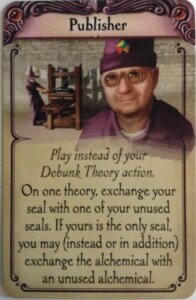
Alchemists: Publisher
2015
A special Publisher promo card from the 2015 Spielbox magazine
120
minutes
Medium Heavy
View expansion
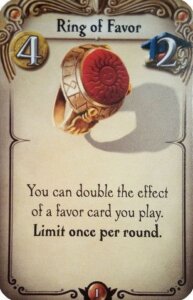
Alchemists: Ring of Favor
2014
A single artifact card that doubles one favor card effect each round.
90
minutes
Medium Heavy
View expansion
Alchemists: The King’s Golem
2016
Take on a new deduction challenge and prove your progress to the king.
120
minutes
Heavy

View expansion
