
Beer & Bread
2022
A clever two-player card game of drafting, resource management, production, and balancing beer with bread across six alternating years.
45
minutes
2 - 2
player(s)
10+
Medium

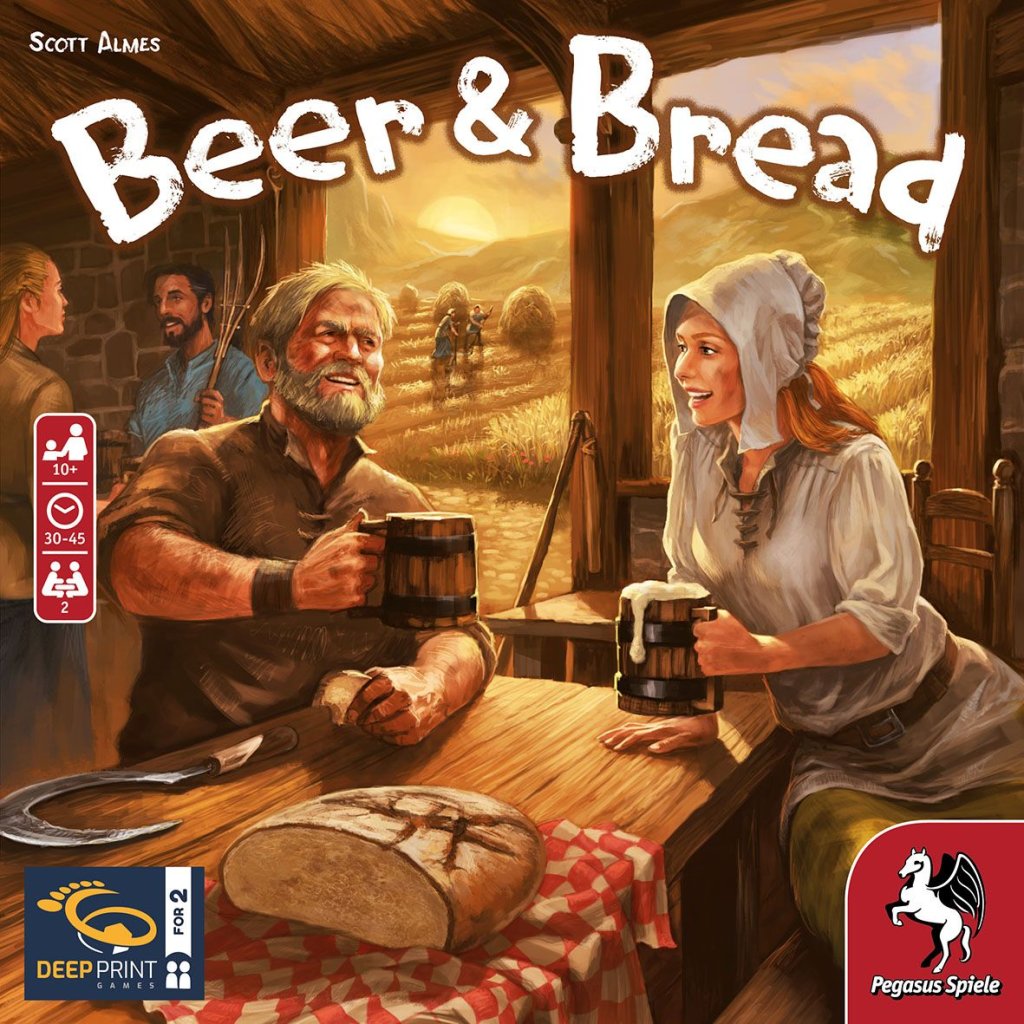
About this board game
Beer & Bread is a multi-use card game for two players that plays in about 45 minutes. Released in 2022, it challenges rival villages to manage shared fields and resources while producing the finest beer and bread.
Set on the fruitful lands of an erstwhile monastery, the game follows two villages preserving a dual tradition of brewing and baking. Each player represents one village in a friendly rivalry focused on harvesting, production, sales, and improvements.
The game lasts for six years, with years alternating between fruitful and dry conditions. Across this changing cycle, you must carefully coordinate your village’s duties and make effective use of the cards available to you.
- Harvest and store resources
- Produce beer and bread
- Sell goods for coins
- Upgrade your facilities
Beer & Bread uses a clever multi-use card system that combines card drafting, resource management, and player interaction. The alternating-round structure gives the competition a distinctive rhythm as both players work with shared fields and resources.
Success depends on more than producing a large quantity of one good. You must maintain balance between your baked and liquid goods throughout the six years, since the final score focuses on the coins collected from the type of good—beer or bread—for which you earned less.
The village with the higher score wins. With its tight two-player format and emphasis on balancing production, sales, storage, and development, Beer & Bread turns a friendly rivalry into a carefully managed contest between beer and bread.
Mechanics
Designer
Illustrator
/pic7182955.jpg)

Board Game Rules for
Beer & Bread
Theme and Object of the Game
Founded on the fruitful lands of an erstwhile monastery, two villages have held up the dual tradition of brewing beer and baking bread. While sharing fields and resources, they still find pride in their friendly rivalry of besting each other’s produce.
Each of you represents one of these villages. Over the course of six years – which alternate between fruitful and dry – you must harmonize your duties of harvesting and storing resources, producing beer and bread, selling them for coins and upgrading your facilities. However, in order to win, you must maintain the balance between your baked and liquid goods. Because, after the sixth year, you only score the coins collected from the type of good – beer or bread – for which you earned less. The village with the higher score wins.
Components
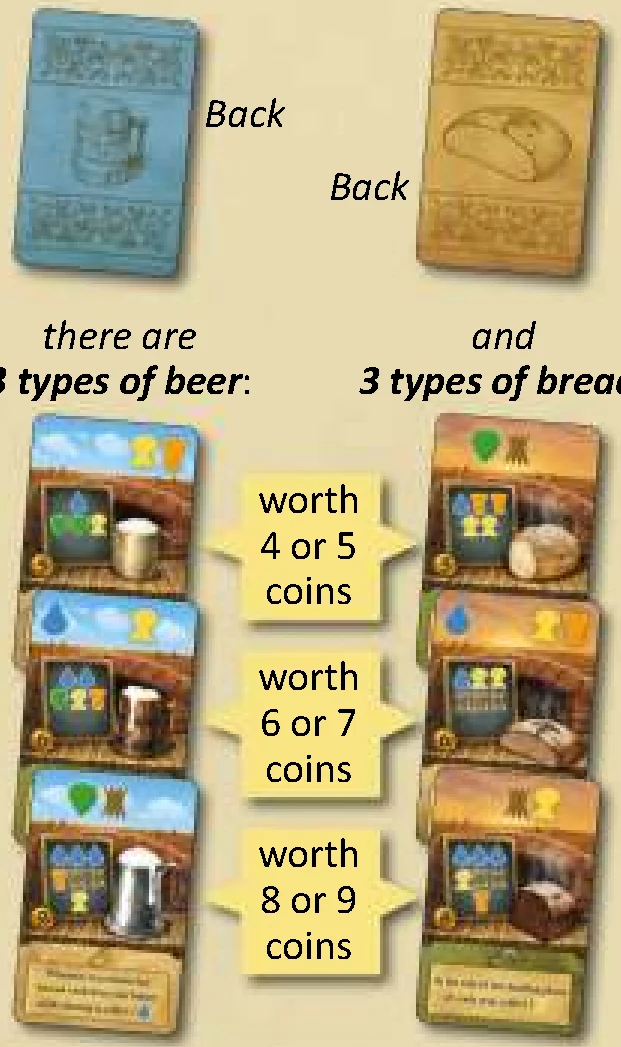
- 60 cards:
- 30 beer cards (3 types of beer: worth 4 or 5 coins, worth 6 or 7 coins, worth 8 or 9 coins)
- 30 bread cards (3 types of bread: worth 4 or 5 coins, worth 6 or 7 coins, worth 8 or 9 coins)
- 1 board


- 84 resource tokens:
- 18 water tokens
- 18 wheat tokens
- 18 barley tokens
- 15 rye tokens
- 15 hops tokens
- 1 year marker
- 1 scoring pad

- 1 windmill (The windmill serves as the starting player marker.)
Game Setup
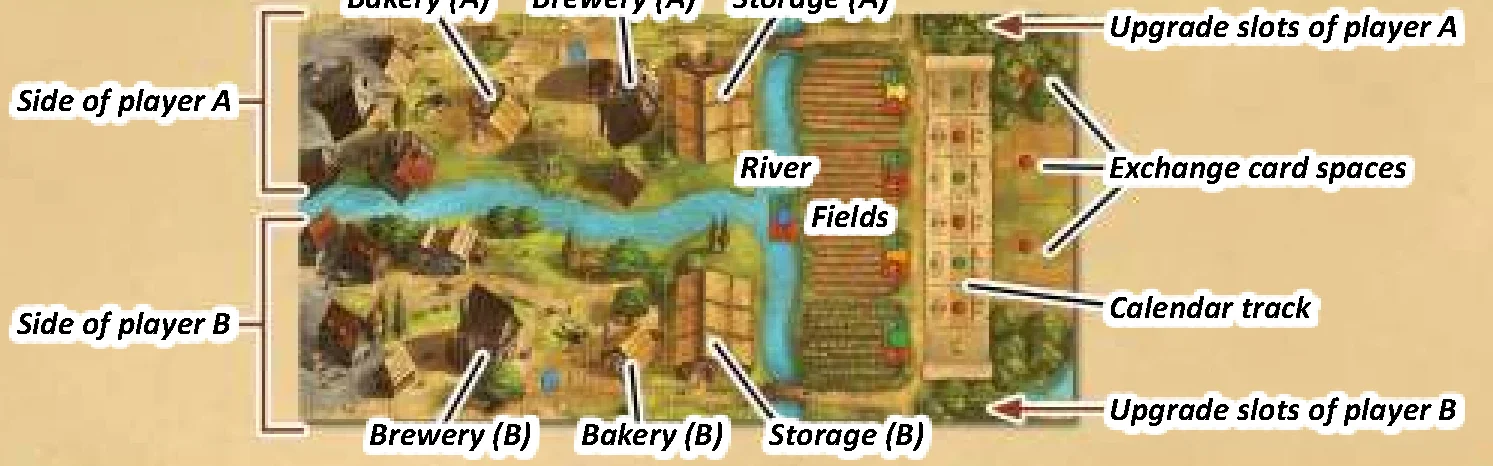
- Place the board horizontally between the players. Each player has their own side of the board, which includes their own storage, bakery, brewery and upgrade slots. The fields and river are shared by both players.
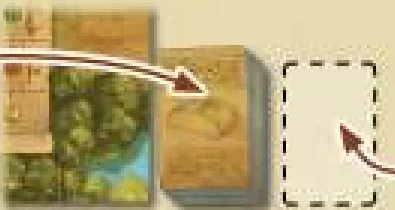
- Shuffle all 60 cards and place them as a single draw deck beside the board, next to the forest with the lake on player B’s side. Beside the draw deck, leave room for a discard pile.
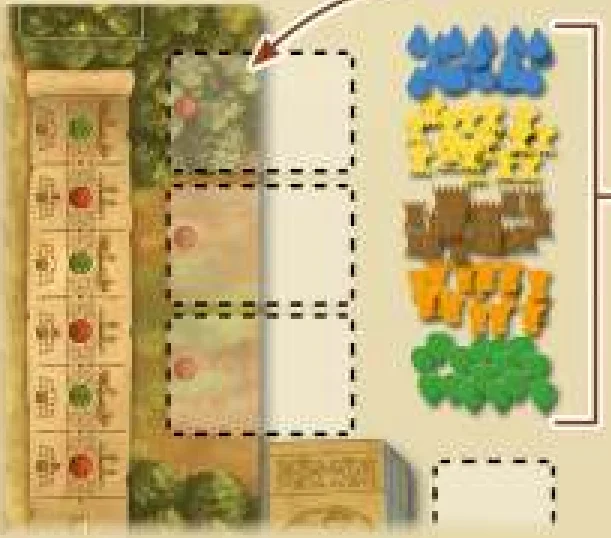
- At the 3 exchange card spaces, make sure to leave room for cards that can be placed there during the game.
Next to it, create a common supply for the 5 types of resource:- the blue water tokens
- the yellow wheat tokens
- the brown barley tokens
- the orange rye tokens
- and the green hops tokens
- Place the year marker onto the first space of the calendar track. (Here, the rounds of the game will be marked.)
- Choose a starting player and give them the windmill.

Playing the Game
The game is played over six rounds (years). These alternate between fruitful years and dry years: Rounds 1, 3 and 5 are fruitful years, whereas rounds 2, 4 and 6 are dry years.
Fruitful and dry years comprise the same 4 phases but differ slightly in the way these phases are carried out:
Fruitful years:
- a) Seeding phase: The fields are seeded with many resource tokens
- b) Card phase: Each player is dealt 5 cards from the draw deck
- c) Action phase: Players play one card each, then swap their hands – this is repeated until all hand cards are played
- d) Windmill phase: The player with fewer stored resources gets the windmill
Dry years:
- a) Seeding phase: The fields are seeded with few resource tokens
- b) Card phase: Players pick up the cards they played for harvest in the previous round and replenish their hands to 5; also 3 exchange cards are placed on the board
- c) Action phase: Players play one card each until all hand cards are played (without swapping hands)
- d) Windmill phase: The player with fewer stored resources gets the windmill; also the exchange cards on the board and all cards played for harvest are discarded
General Card Rules
- If the draw deck runs out, shuffle the discard pile to form a new draw deck.
- You can look at the backs of any cards whenever you like, including the ones of the draw deck, but you cannot change their order or look at their fronts.
- You may look at the fronts of your own sold cards (in your brewery/bakery and beside the board) and the ones in your own harvest column (but never the ones of the other player).
a) Seeding phase
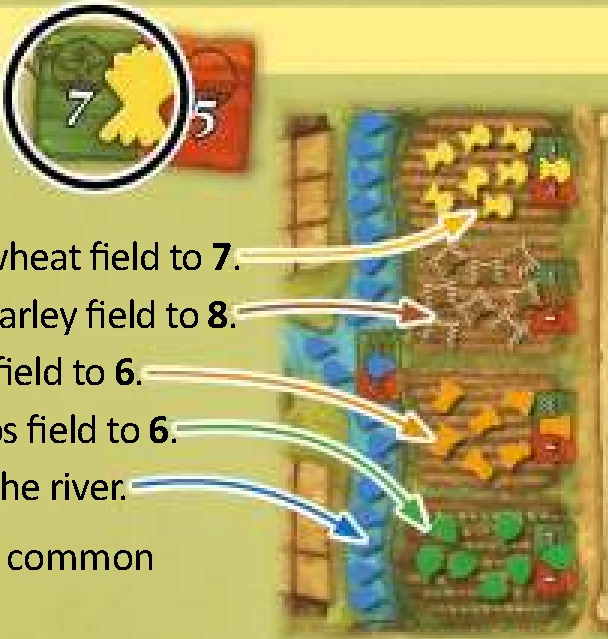
To seed the fields on the board, add resource tokens from the common supply to them according to the green part of their wooden signs:
- Bring the number of yellow wheat tokens on the wheat field to 7.
- Bring the number of brown barley tokens on the barley field to 8.
- Bring the number of orange rye tokens on the rye field to 6.
- Bring the number of green hops tokens on the hops field to 6.
- Also add all blue water tokens from the supply to the river.
If there are not enough tokens of a resource in the common supply, only add as many as there are.
b) Card phase
- Deal 5 face-down cards from the draw deck to the player with the windmill.
- Then deal 5 face-down cards from the draw deck to the other player.
- Put your cards into you hand and proceed with the Action phase.
c) Action phase
Repeat the following 3-step sequence until all hand cards have been played:
- The player with the windmill takes one turn (by playing a card and performing an action).
- Then the other player takes one turn (also by playing a card and performing an action).
- Then both players swap their hands (by exchanging their remaining hand cards with each other).
To take your turn, choose one card from your current hand and use it immediately to perform one of the actions (Harvest and Store, Produce and Sell, or Upgrade and Clean).
After each of you has played your last hand card, proceed with the Windmill phase.
d) Windmill phase
Give the windmill to the player who has fewer resource tokens in their storage units. In the case of a tie, the windmill goes to the player that did not have it this round.
Then move the year marker one space forward on the calendar track and continue with the following dry year.
a) Seeding phase
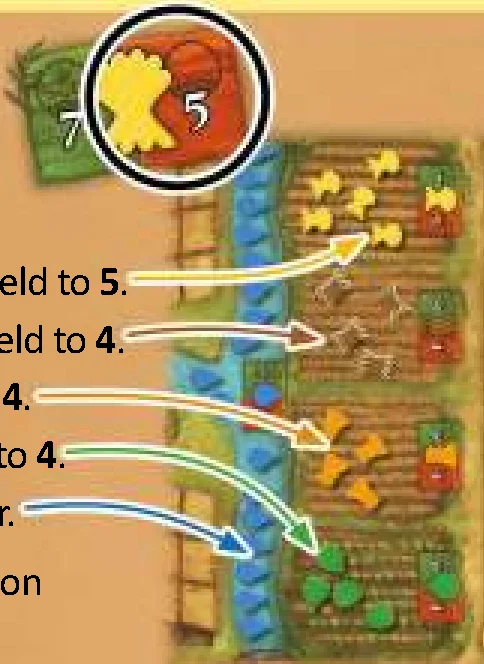
According to the red part of their wooden signs, adjust the number of resource tokens on the fields (either by adding tokens to them from the common supply or removing tokens and placing them back in the common supply):
- Bring the number of yellow wheat tokens on the wheat field to 5.
- Bring the number of brown barley tokens on the barley field to 4.
- Bring the number of orange rye tokens on the rye field to 4.
- Bring the number of green hops tokens on the hops field to 4.
- Also add all blue water tokens from the supply to the river.
If there are not enough tokens of a resource in the common supply, only add as many as there are.
b) Card phase
- Each player: Pick up the cards you played for harvest in the last round and add them to your hand.
- Then draw as many cards from the draw deck as it takes to bring your hand to a total of 5 (the player with the windmill does this first).
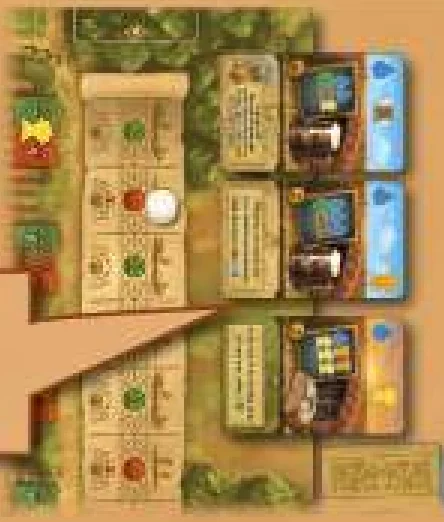
- Afterwards, place 3 cards from the draw deck face up on the 3 exchange card spaces of the board. These 3 cards are called exchange cards.
c) Action phase
Starting with the player who has the windmill, take alternating turns (by playing a card and performing an action) until all hand cards have been played. In this phase, you do not swap hands.
To take your turn, choose one card from your hand and use it immediately to perform one of the usual actions (see Card Actions).
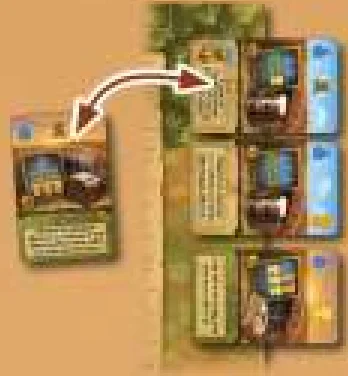
Attention: Instead of playing a card from your hand, you can swap it for one of the exchange cards on the board and play that card instead. To do so, take any of the 3 displayed exchange cards and place your chosen hand card face up on its space (thus it becomes an exchange card itself). Then immediately play the taken exchange card to perform one of the usual actions (you may not add it to your hand).
d) Windmill phase
- Give the windmill to the player who has fewer resource tokens in their storage units. In the case of a tie, the windmill goes to the player that did not have it this round.
- Discard the 3 exchange cards from the exchange spaces and all cards that were played for harvest this round by putting them face up on the discard pile.
- Then move the year marker one space forward on the calendar track and continue with the next fruitful year.
- If the year marker moves to the space with the
 icon, the game ends.
Action Options
To take your turn, choose one card from your hand and use it immediately to perform one of the following actions:
A) Harvest and Store
Play the chosen card face up in front of you. If you already have cards there, place this new card slightly offset on top of them, creating a harvest column, in which the harvest section of each card is still visible. Then check which types of resource are shown in the harvest section of the newly played card. Of these types, you must now collect as many tokens from the board as are shown in all harvest sections of your harvest column combined.
You can only collect resource tokens that are on the board’s fields and river.
If there are fewer tokens of a resource on the fields/river than you are supposed to collect, take as many as there are and forfeit the rest (unless you have upgrades that say otherwise).
After taking all harvested resource tokens, store them in your storage. Your storage consists of storage units. Each of your initial 9 storage units can hold one token of any type.
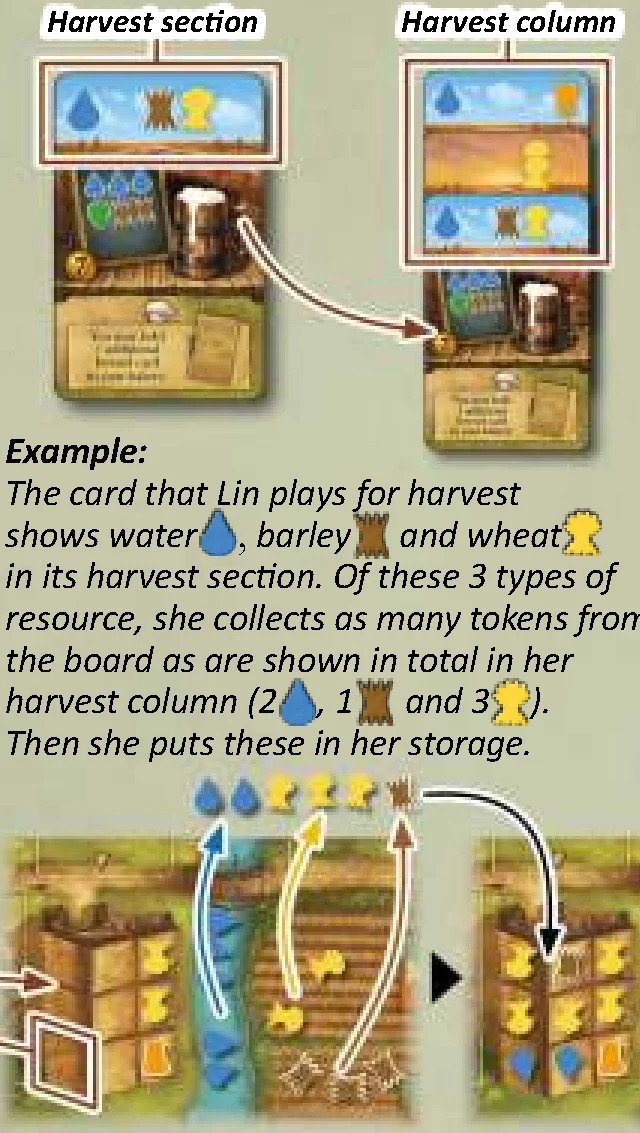
Example: The card that Lin plays for harvest shows water  , barley
  and wheat
  in its harvest section. Of these 3 types of resource, she collects as many tokens from the board as are shown in total in her harvest column (2 , 1 and 3 ). Then she puts these in her storage.
Not enough storage?
Whenever you collect more resource tokens than you can store, choose from among all your tokens (the ones in your storage and the new ones) which to store – the rest you must offer to the other player now.
Of these offered tokens, the other player may take and store as many of their choice as they want and have free storage units for (they may not exchange them for any of their already stored tokens). Any excess tokens are returned to the common supply.
B) Produce and Sell
Play the chosen card to brew its beer or bake its bread by placing it face up onto your brewery space on the board (if it is a beer card) or onto your bakery space (if it is a bread card).
Then spend all resource tokens shown in the card’s recipe section by returning them from your storage to the common supply.
If you cannot do so, you cannot play the card into your bakery/brewery.
After you’ve spent all necessary resource tokens, flip the played card face down. It has been sold now. However, it remains in its space until you clean the space up (see below).
Attention: In general, your bakery and your brewery can each only hold 1 card. So you cannot play another card onto such a space if there is already a card on it (unless you have upgrades that say otherwise).
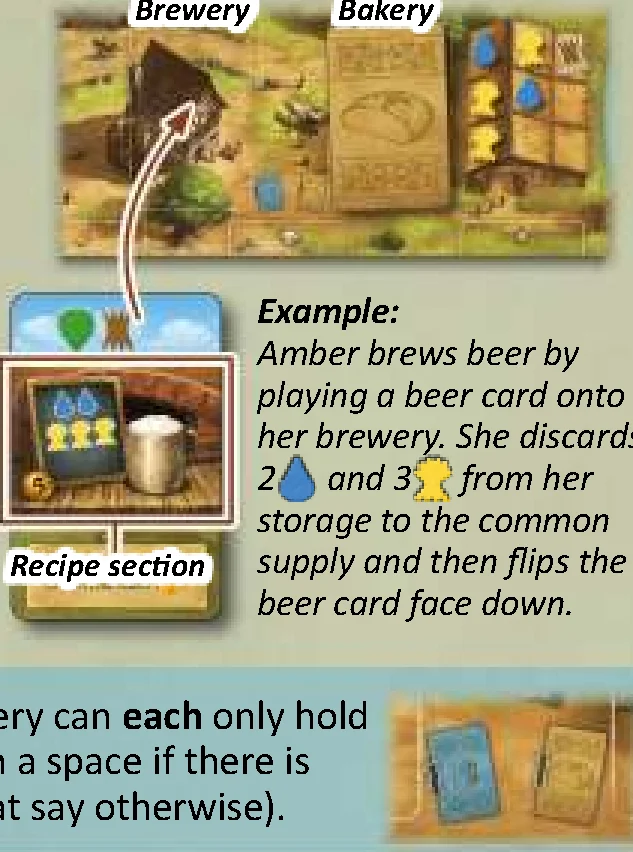
Example: Amber brews beer by playing a beer card onto her brewery. She discards 2 and 3 from her storage to the common supply and then flips the beer card face down.
C) Upgrade and Clean
Play the chosen card as an upgrade by sliding it face up under the board so that only its upgrade section is visible. The icon on top of the card’s upgrade section shows which upgrade slot on your side of the board it should be slid under. The 6 slots correspond to the ability of the upgrades as each of them provides an continuous benefit in a certain aspect of the game. (For an overview of the upgrades, see pages 10 and 11.)
There is no limit to the number of upgrades that you can have at any slot. If you have more than one at the same slot, just arrange their cards in an overlapping column, in which the upgrade section of each is visible.
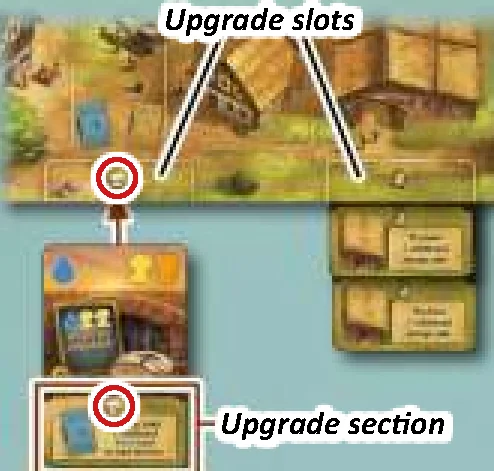
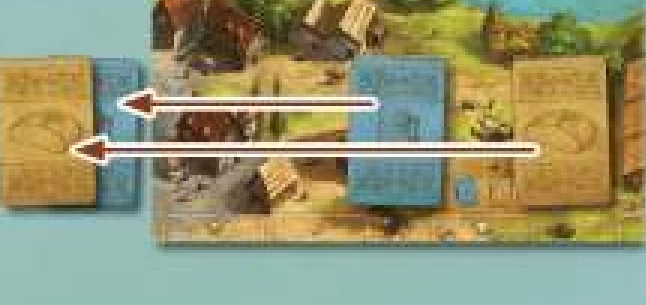
Right after playing a card as an upgrade, also clean your brewery and bakery by removing all sold cards (if you have any) from their spaces and placing them face down beside the board: right next to your town square with the well.
Fan the cards beside the board out to show how many you’ve sold. You may look at the fronts of your sold cards at any time (but not the ones of the other player).
Overview of the Upgrades
The upgrades provide benefits in different aspects of the game. Most of them should be self-explanatory. For some of them, you’ll find additional clarifications below.
General notes:
- If you have multiple copies of the same upgrade, their benefits add up if applicable.
- “Collect” a resource always means that you must take it from the fields or river and put it in your storage. If all tokens of a resource type are gone from its field, you cannot collect it any more. If you do not have enough storage for all your collected tokens, you must offer any excess to the other player.
Upgrades pertaining to rules regarding the different types of year and/or the Card phase:
- Exchange a card at the end of the Card phase: If you want to do this, wait until the other player has their 5 hand cards for the round. Then put one of your hand cards face up on the discard pile and put the top card from the draw deck in your hand.
- Discard harvest cards in dry years: This means that you do not have to keep all the cards you played for harvest during the previous round. Just put the ones you do not want face up on the discard pile before replenishing your hand to 5 cards.
- Draw extra card in fruitful year: Do this at the start of your last turn in the Action phase of a fruitful year. First put the top card from the draw deck in your hand. Then play one card and put the other face up on the discard pile.
- Inverted card: Do this on your first turn in the Action phase of a fruitful year. Thus, when the first swap happens, you give the other player 3 normal cards + the inverted card. That card must remain inverted until you decide to play it on a turn in which you have it in your hand.
Upgrades pertaining to collecting resources from the fields and river:
- At the end of the Seeding phase, collect 1 resource. If both of you have such upgrades, the player with the windmill collects first.
- Whenever you collect a resource type and it’s gone from its field, you collect it from the common supply instead (if it is available there). These upgrades are also available for wheat, barley, and rye.
- Collect additional resources during Harvest and Store action: These only apply when the resource type is collected during a Harvest and Store action.
- Whenever the other player collects a resource during their Harvest and Store action, collect 1: Collect your water token after the other player has finished their Harvest and Store action.
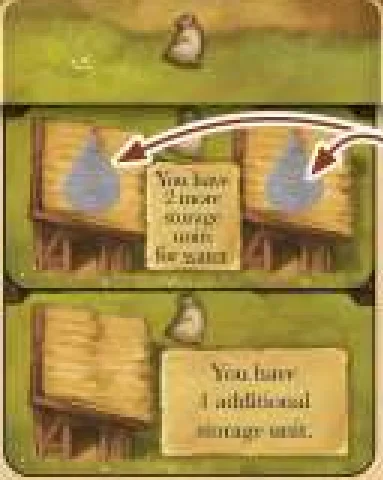
Upgrades that give you additional storage units:
- Water storage units: In these 2 storage units, you can only store water. If a water storage unit is vacant, you may move a water token to it from any of your other storage units at any time.
- General additional storage unit: Provides additional storage capacity.
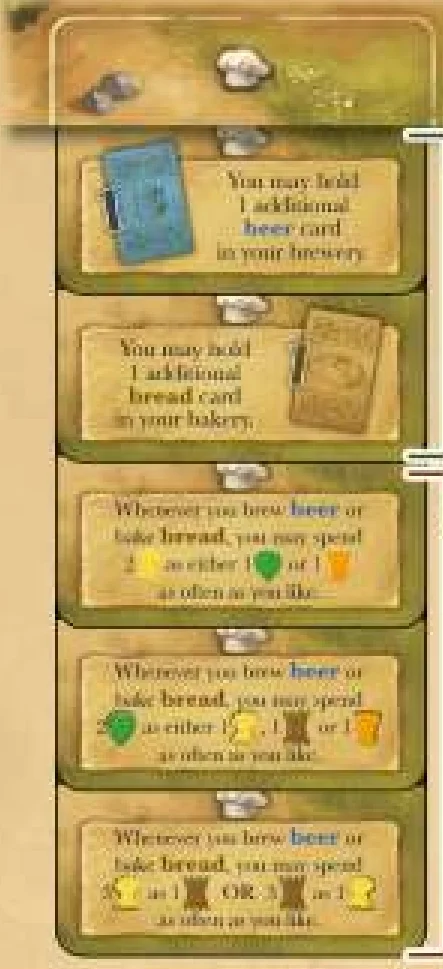
Upgrades pertaining to brewing beer and baking bread:
- Hold additional cards: Usually you can only have a maximum of 1 card in your brewery and 1 card in your bakery. Each of these upgrades increases that card limit by 1 for the corresponding type.
- Resource substitution: You can use these benefits multiple times during the same action and even combine them: For example, if you have these upgrades, you could spend 4 wheat to replace 2 hops, then use these 2 hops to replace 1 rye in a recipe. Be aware, though, that this is not a trade: You only substitute needed resources virtually, never actually take them from the fields.
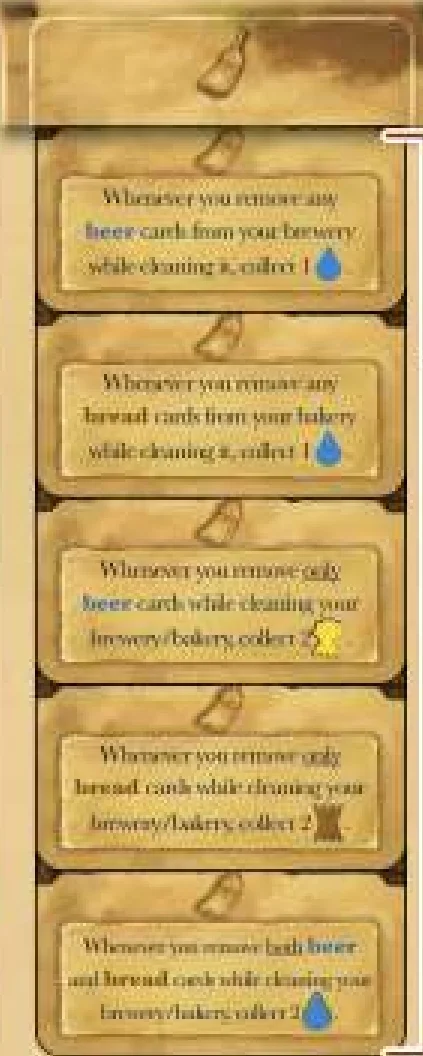
Upgrades pertaining to cleaning your brewery/bakery:
- These take immediate effect (and even apply to sold cards that you clean up during the same action as you placed the upgrade).
- They do not apply to cards that you take from the brewery/bakery at the end of the game.
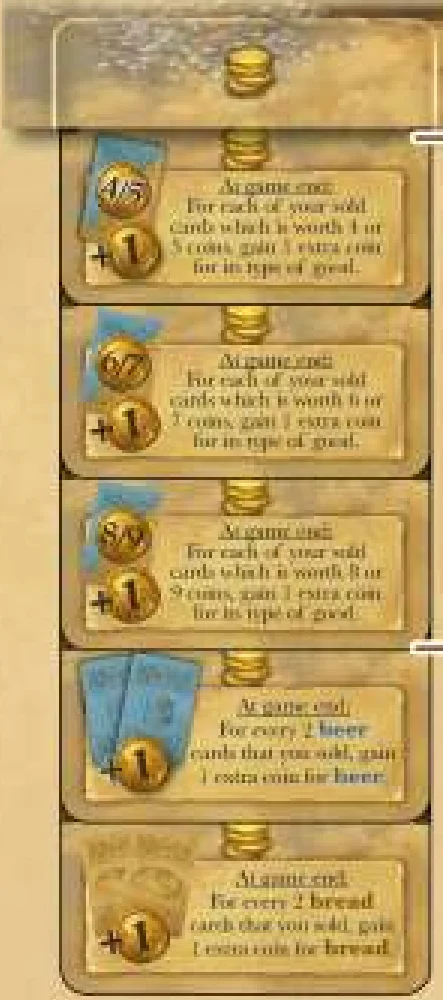
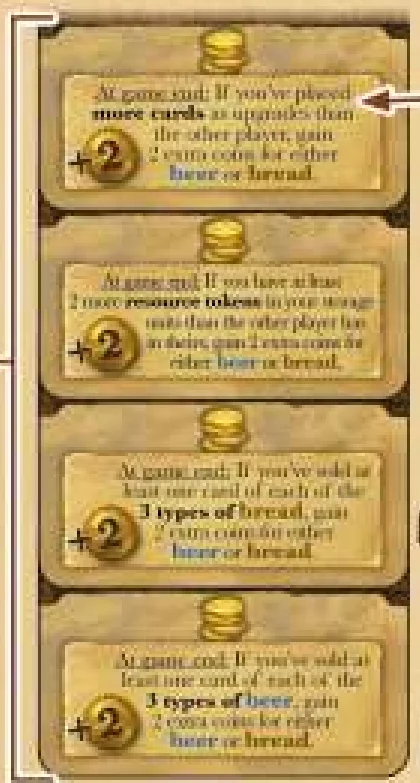
Upgrades pertaining to the scoring at the end of the game:
- “Its type of good” means: If the sold card is a beer card, gain 1 coin for beer; if it is a bread card, gain 1 coin for bread.
- If you meet the mentioned requirement, you can choose for which type of good you want to gain the 2 extra coins (naturally, the one that increases your final score). You cannot split the 2 coins between the types of good.
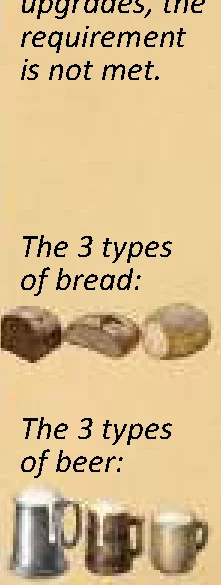
- If both of you have the same number of upgrades / resource tokens, the requirement is not met.
End of the Game
After the 6th round, the game ends.
Now, each player does the following:
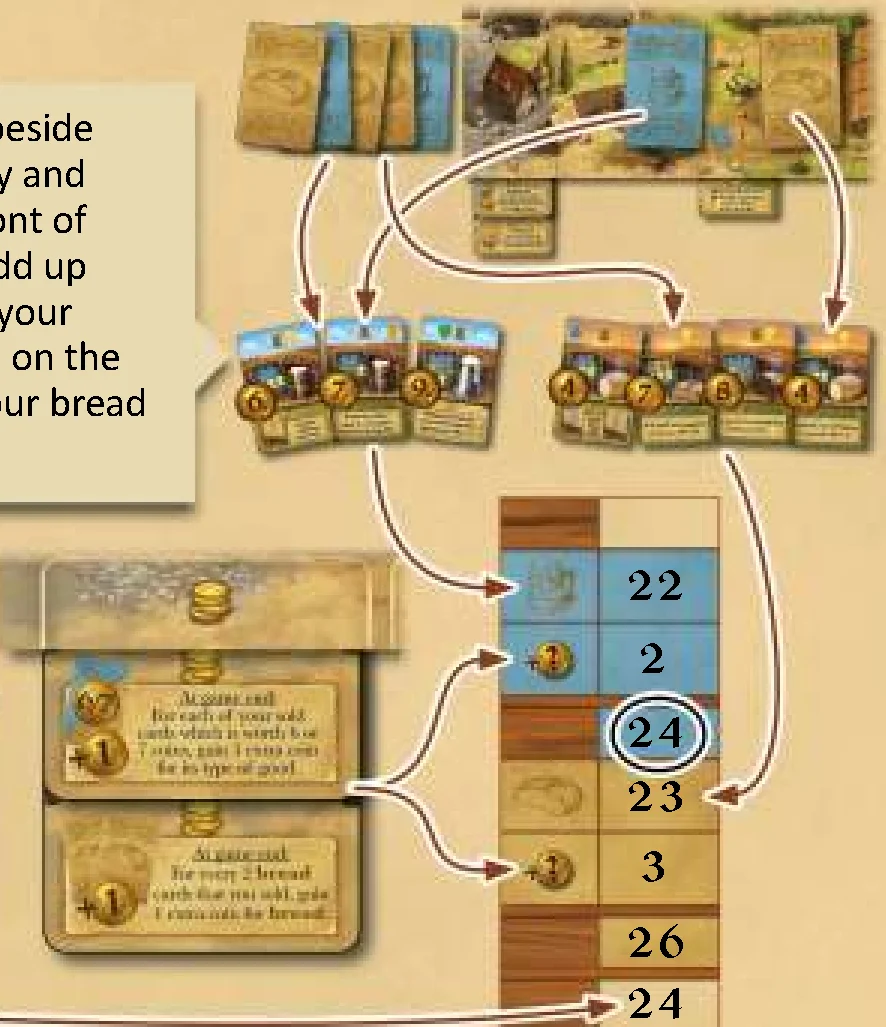
- Take all your sold cards (those from beside the board and any from your brewery and bakery) and place them face up in front of you, separated by beer and bread. Add up the numbers printed on the coins of your beer cards and write the result down on the scoring pad. Then do the same for your bread cards.
- Afterwards, check the upgrades (if any) that you placed at your upgrade slot and write down any extra coins that you gain for beer and bread.
Now you have a total score for beer and a total score for bread. The lower of the two is your final score.
Whoever has the higher final score wins the game. In the case of a tie, the player who has the higher total score for their other type of good wins.
If this does not break the tie, the player who does not have the windmill wins.
Overview of the Game
The game is played over six rounds (years), alternating between fruitful and dry years.
Fruitful years (see pages 4 to 7)
- a) Seeding phase: Seed the fields and river with resource tokens from the common supply.
- b) Card phase: Deal 5 cards from the draw deck to the player with the windmill. Then deal 5 cards to the other player.
- c) Action phase: The player with the windmill takes one turn. Then the other player takes one turn. Then swap hands with each other. Repeat until all hand cards are played.
- d) Windmill phase: The player with fewer stored resource tokens gets the windmill.
Dry years (see pages 7 and 8)
- a) Seeding phase: Seed the fields and river with resource tokens from the common supply.
- b) Card phase: Each player picks up their cards played for harvest, then replenishes their hand to 5 cards. Place 3 exchange cards from the draw deck on the board.
- c) Action phase: The player with the windmill takes one turn, then the other player. Repeat until all hand cards are played (do not swap hands with each other).
- d) Windmill phase: The player with fewer stored resource tokens gets the windmill. Discard the 3 exchange cards from the board and any cards played for harvest.
Action phase actions (play 1 card to perform one of these):
- A) Harvest and Store (see pages 5 and 6)
- B) Produce and Sell (see page 6)
- C) Upgrade and Clean (see pages 6 and 7)
The game ends when the 6th year has been completed.
Each player reveals their sold cards (including any on their brewery/bakery) and calculates their total score for beer and their total score for bread – the lower of the two is that player’s final score. The player with the higher final score wins.
Resource Key:
- = water
- = wheat
- = barley
 = rye
= rye = hops
Introduction & Components
Theme and Object of the Game
Founded on the fruitful lands of an erstwhile monastery, two villages have held up the dual tradition of brewing beer and baking bread. While sharing fields and resources, they still find pride in their friendly rivalry of besting each other’s produce.
Each of you represents one of these villages. Over the course of six years – which alternate between fruitful and dry – you must harmonize your duties of harvesting and storing resources, producing beer and bread, selling them for coins and upgrading your facilities. However, in order to win, you must maintain the balance between your baked and liquid goods. Because, after the sixth year, you only score the coins collected from the type of good – beer or bread – for which you earned less. The village with the higher score wins.
Components
- 60 cards:
- 30 beer cards (3 types of beer: worth 4 or 5 coins, worth 6 or 7 coins, worth 8 or 9 coins)
- 30 bread cards (3 types of bread: worth 4 or 5 coins, worth 6 or 7 coins, worth 8 or 9 coins)
- 1 board
- 84 resource tokens:
- 18 water tokens
- 18 wheat tokens
- 18 barley tokens
- 15 rye tokens
- 15 hops tokens
- 1 year marker
- 1 scoring pad
- 1 windmill (The windmill serves as the starting player marker.)
Setup
Game Setup
- Place the board horizontally between the players. Each player has their own side of the board, which includes their own storage, bakery, brewery and upgrade slots. The fields and river are shared by both players.
- Shuffle all 60 cards and place them as a single draw deck beside the board, next to the forest with the lake on player B’s side. Beside the draw deck, leave room for a discard pile.
- At the 3 exchange card spaces, make sure to leave room for cards that can be placed there during the game.
Next to it, create a common supply for the 5 types of resource:- the blue water tokens
- the yellow wheat tokens
- the brown barley tokens
- the orange rye tokens
- and the green hops tokens
- Place the year marker onto the first space of the calendar track. (Here, the rounds of the game will be marked.)
- Choose a starting player and give them the windmill.
Game Overview & General Rules
Playing the Game
The game is played over six rounds (years). These alternate between fruitful years and dry years: Rounds 1, 3 and 5 are fruitful years, whereas rounds 2, 4 and 6 are dry years.
Fruitful and dry years comprise the same 4 phases but differ slightly in the way these phases are carried out:
Fruitful years:
- a) Seeding phase: The fields are seeded with many resource tokens
- b) Card phase: Each player is dealt 5 cards from the draw deck
- c) Action phase: Players play one card each, then swap their hands – this is repeated until all hand cards are played
- d) Windmill phase: The player with fewer stored resources gets the windmill
Dry years:
- a) Seeding phase: The fields are seeded with few resource tokens
- b) Card phase: Players pick up the cards they played for harvest in the previous round and replenish their hands to 5; also 3 exchange cards are placed on the board
- c) Action phase: Players play one card each until all hand cards are played (without swapping hands)
- d) Windmill phase: The player with fewer stored resources gets the windmill; also the exchange cards on the board and all cards played for harvest are discarded
General Card Rules
- If the draw deck runs out, shuffle the discard pile to form a new draw deck.
- You can look at the backs of any cards whenever you like, including the ones of the draw deck, but you cannot change their order or look at their fronts.
- You may look at the fronts of your own sold cards (in your brewery/bakery and beside the board) and the ones in your own harvest column (but never the ones of the other player).
Fruitful Years
a) Seeding phase
To seed the fields on the board, add resource tokens from the common supply to them according to the green part of their wooden signs:
- Bring the number of yellow wheat tokens on the wheat field to 7.
- Bring the number of brown barley tokens on the barley field to 8.
- Bring the number of orange rye tokens on the rye field to 6.
- Bring the number of green hops tokens on the hops field to 6.
- Also add all blue water tokens from the supply to the river.
If there are not enough tokens of a resource in the common supply, only add as many as there are.
b) Card phase
- Deal 5 face-down cards from the draw deck to the player with the windmill.
- Then deal 5 face-down cards from the draw deck to the other player.
- Put your cards into you hand and proceed with the Action phase.
c) Action phase
Repeat the following 3-step sequence until all hand cards have been played:
- The player with the windmill takes one turn (by playing a card and performing an action).
- Then the other player takes one turn (also by playing a card and performing an action).
- Then both players swap their hands (by exchanging their remaining hand cards with each other).
To take your turn, choose one card from your current hand and use it immediately to perform one of the actions (Harvest and Store, Produce and Sell, or Upgrade and Clean).
After each of you has played your last hand card, proceed with the Windmill phase.
d) Windmill phase
Give the windmill to the player who has fewer resource tokens in their storage units. In the case of a tie, the windmill goes to the player that did not have it this round.
Then move the year marker one space forward on the calendar track and continue with the following dry year.
Dry Years
a) Seeding phase
According to the red part of their wooden signs, adjust the number of resource tokens on the fields (either by adding tokens to them from the common supply or removing tokens and placing them back in the common supply):
- Bring the number of yellow wheat tokens on the wheat field to 5.
- Bring the number of brown barley tokens on the barley field to 4.
- Bring the number of orange rye tokens on the rye field to 4.
- Bring the number of green hops tokens on the hops field to 4.
- Also add all blue water tokens from the supply to the river.
If there are not enough tokens of a resource in the common supply, only add as many as there are.
b) Card phase
- Each player: Pick up the cards you played for harvest in the last round and add them to your hand.
- Then draw as many cards from the draw deck as it takes to bring your hand to a total of 5 (the player with the windmill does this first).
- Afterwards, place 3 cards from the draw deck face up on the 3 exchange card spaces of the board. These 3 cards are called exchange cards.
c) Action phase
Starting with the player who has the windmill, take alternating turns (by playing a card and performing an action) until all hand cards have been played. In this phase, you do not swap hands.
To take your turn, choose one card from your hand and use it immediately to perform one of the usual actions (see Card Actions).
Attention: Instead of playing a card from your hand, you can swap it for one of the exchange cards on the board and play that card instead. To do so, take any of the 3 displayed exchange cards and place your chosen hand card face up on its space (thus it becomes an exchange card itself). Then immediately play the taken exchange card to perform one of the usual actions (you may not add it to your hand).
d) Windmill phase
- Give the windmill to the player who has fewer resource tokens in their storage units. In the case of a tie, the windmill goes to the player that did not have it this round.
- Discard the 3 exchange cards from the exchange spaces and all cards that were played for harvest this round by putting them face up on the discard pile.
- Then move the year marker one space forward on the calendar track and continue with the next fruitful year.
- If the year marker moves to the space with the icon, the game ends.
Card Actions
Action Options
To take your turn, choose one card from your hand and use it immediately to perform one of the following actions:
A) Harvest and Store
Play the chosen card face up in front of you. If you already have cards there, place this new card slightly offset on top of them, creating a harvest column, in which the harvest section of each card is still visible. Then check which types of resource are shown in the harvest section of the newly played card. Of these types, you must now collect as many tokens from the board as are shown in all harvest sections of your harvest column combined.
You can only collect resource tokens that are on the board’s fields and river.
If there are fewer tokens of a resource on the fields/river than you are supposed to collect, take as many as there are and forfeit the rest (unless you have upgrades that say otherwise).
After taking all harvested resource tokens, store them in your storage. Your storage consists of storage units. Each of your initial 9 storage units can hold one token of any type.
Example: The card that Lin plays for harvest shows water , barley and wheat in its harvest section. Of these 3 types of resource, she collects as many tokens from the board as are shown in total in her harvest column (2 , 1 and 3 ). Then she puts these in her storage.
Not enough storage?
Whenever you collect more resource tokens than you can store, choose from among all your tokens (the ones in your storage and the new ones) which to store – the rest you must offer to the other player now.
Of these offered tokens, the other player may take and store as many of their choice as they want and have free storage units for (they may not exchange them for any of their already stored tokens). Any excess tokens are returned to the common supply.
B) Produce and Sell
Play the chosen card to brew its beer or bake its bread by placing it face up onto your brewery space on the board (if it is a beer card) or onto your bakery space (if it is a bread card).
Then spend all resource tokens shown in the card’s recipe section by returning them from your storage to the common supply.
If you cannot do so, you cannot play the card into your bakery/brewery.
After you’ve spent all necessary resource tokens, flip the played card face down. It has been sold now. However, it remains in its space until you clean the space up (see below).
Attention: In general, your bakery and your brewery can each only hold 1 card. So you cannot play another card onto such a space if there is already a card on it (unless you have upgrades that say otherwise).
Example: Amber brews beer by playing a beer card onto her brewery. She discards 2 and 3 from her storage to the common supply and then flips the beer card face down.
C) Upgrade and Clean
Play the chosen card as an upgrade by sliding it face up under the board so that only its upgrade section is visible. The icon on top of the card’s upgrade section shows which upgrade slot on your side of the board it should be slid under. The 6 slots correspond to the ability of the upgrades as each of them provides an continuous benefit in a certain aspect of the game. (For an overview of the upgrades, see pages 10 and 11.)
There is no limit to the number of upgrades that you can have at any slot. If you have more than one at the same slot, just arrange their cards in an overlapping column, in which the upgrade section of each is visible.
Right after playing a card as an upgrade, also clean your brewery and bakery by removing all sold cards (if you have any) from their spaces and placing them face down beside the board: right next to your town square with the well.
Fan the cards beside the board out to show how many you’ve sold. You may look at the fronts of your sold cards at any time (but not the ones of the other player).
Upgrades Reference
Overview of the Upgrades
The upgrades provide benefits in different aspects of the game. Most of them should be self-explanatory. For some of them, you’ll find additional clarifications below.
General notes:
- If you have multiple copies of the same upgrade, their benefits add up if applicable.
- “Collect” a resource always means that you must take it from the fields or river and put it in your storage. If all tokens of a resource type are gone from its field, you cannot collect it any more. If you do not have enough storage for all your collected tokens, you must offer any excess to the other player.
Upgrades pertaining to rules regarding the different types of year and/or the Card phase:
- Exchange a card at the end of the Card phase: If you want to do this, wait until the other player has their 5 hand cards for the round. Then put one of your hand cards face up on the discard pile and put the top card from the draw deck in your hand.
- Discard harvest cards in dry years: This means that you do not have to keep all the cards you played for harvest during the previous round. Just put the ones you do not want face up on the discard pile before replenishing your hand to 5 cards.
- Draw extra card in fruitful year: Do this at the start of your last turn in the Action phase of a fruitful year. First put the top card from the draw deck in your hand. Then play one card and put the other face up on the discard pile.
- Inverted card: Do this on your first turn in the Action phase of a fruitful year. Thus, when the first swap happens, you give the other player 3 normal cards + the inverted card. That card must remain inverted until you decide to play it on a turn in which you have it in your hand.
Upgrades pertaining to collecting resources from the fields and river:
- At the end of the Seeding phase, collect 1 resource. If both of you have such upgrades, the player with the windmill collects first.
- Whenever you collect a resource type and it’s gone from its field, you collect it from the common supply instead (if it is available there). These upgrades are also available for wheat, barley, and rye.
- Collect additional resources during Harvest and Store action: These only apply when the resource type is collected during a Harvest and Store action.
- Whenever the other player collects a resource during their Harvest and Store action, collect 1: Collect your water token after the other player has finished their Harvest and Store action.
Upgrades that give you additional storage units:
- Water storage units: In these 2 storage units, you can only store water. If a water storage unit is vacant, you may move a water token to it from any of your other storage units at any time.
- General additional storage unit: Provides additional storage capacity.
Upgrades pertaining to brewing beer and baking bread:
- Hold additional cards: Usually you can only have a maximum of 1 card in your brewery and 1 card in your bakery. Each of these upgrades increases that card limit by 1 for the corresponding type.
- Resource substitution: You can use these benefits multiple times during the same action and even combine them: For example, if you have these upgrades, you could spend 4 wheat to replace 2 hops, then use these 2 hops to replace 1 rye in a recipe. Be aware, though, that this is not a trade: You only substitute needed resources virtually, never actually take them from the fields.
Upgrades pertaining to cleaning your brewery/bakery:
- These take immediate effect (and even apply to sold cards that you clean up during the same action as you placed the upgrade).
- They do not apply to cards that you take from the brewery/bakery at the end of the game.
Upgrades pertaining to the scoring at the end of the game:
- “Its type of good” means: If the sold card is a beer card, gain 1 coin for beer; if it is a bread card, gain 1 coin for bread.
- If you meet the mentioned requirement, you can choose for which type of good you want to gain the 2 extra coins (naturally, the one that increases your final score). You cannot split the 2 coins between the types of good.
- If both of you have the same number of upgrades / resource tokens, the requirement is not met.
End of the Game & Scoring
End of the Game
After the 6th round, the game ends.
Now, each player does the following:
- Take all your sold cards (those from beside the board and any from your brewery and bakery) and place them face up in front of you, separated by beer and bread. Add up the numbers printed on the coins of your beer cards and write the result down on the scoring pad. Then do the same for your bread cards.
- Afterwards, check the upgrades (if any) that you placed at your upgrade slot and write down any extra coins that you gain for beer and bread.
Now you have a total score for beer and a total score for bread. The lower of the two is your final score.
Whoever has the higher final score wins the game. In the case of a tie, the player who has the higher total score for their other type of good wins.
If this does not break the tie, the player who does not have the windmill wins.
Quick Reference & Round Summary
Overview of the Game
The game is played over six rounds (years), alternating between fruitful and dry years.
Fruitful years (see pages 4 to 7)
- a) Seeding phase: Seed the fields and river with resource tokens from the common supply.
- b) Card phase: Deal 5 cards from the draw deck to the player with the windmill. Then deal 5 cards to the other player.
- c) Action phase: The player with the windmill takes one turn. Then the other player takes one turn. Then swap hands with each other. Repeat until all hand cards are played.
- d) Windmill phase: The player with fewer stored resource tokens gets the windmill.
Dry years (see pages 7 and 8)
- a) Seeding phase: Seed the fields and river with resource tokens from the common supply.
- b) Card phase: Each player picks up their cards played for harvest, then replenishes their hand to 5 cards. Place 3 exchange cards from the draw deck on the board.
- c) Action phase: The player with the windmill takes one turn, then the other player. Repeat until all hand cards are played (do not swap hands with each other).
- d) Windmill phase: The player with fewer stored resource tokens gets the windmill. Discard the 3 exchange cards from the board and any cards played for harvest.
Action phase actions (play 1 card to perform one of these):
- A) Harvest and Store (see pages 5 and 6)
- B) Produce and Sell (see page 6)
- C) Upgrade and Clean (see pages 6 and 7)
The game ends when the 6th year has been completed.
Each player reveals their sold cards (including any on their brewery/bakery) and calculates their total score for beer and their total score for bread – the lower of the two is that player’s final score. The player with the higher final score wins.
Resource Key:
- = water
- = wheat
- = barley
- = rye
- = hops
