
Calimala
2017
Assign employees, trade cloth, fund grand projects, and time your promotions in a changing medieval Florence.
75
minutes
2 - 5
player(s)
10+
Medium

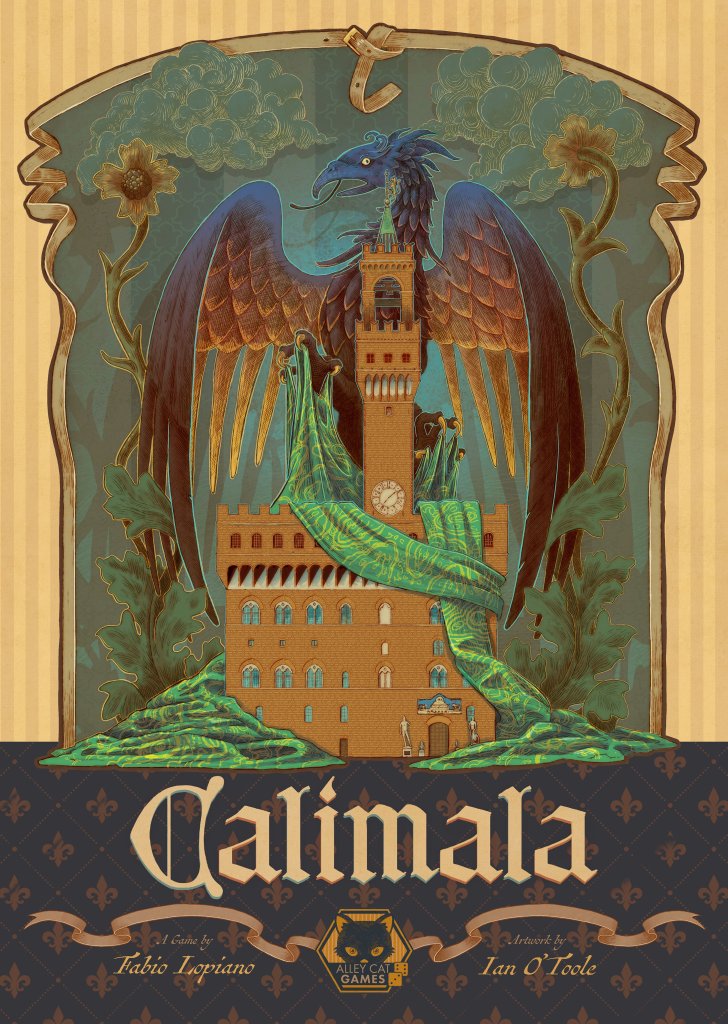
About this board game
Calimala is a board game for 2–5 players, with games lasting about 75 minutes. Set in medieval Florence, it places players in the role of cloth merchants competing through trade, civic projects, and carefully timed influence.
Players assign trusted employees to streets across the city. Each street links two locations where different actions can be taken, and placing an action disc between those actions allows a player to perform both while activating every other disc on that space.
Employees remain in position for a time, carrying out their actions whenever their street is activated. When a fourth disc reaches an action space, the lowest disc is promoted to the city council, triggering a scoring phase that can reshape the course of the game.
- Produce and deliver cloth in Florence.
- Contribute to the construction and decoration of important buildings.
- Use action discs to perform paired actions and activate other employees.
- Time promotions into the city council to make the most of scoring phases.
The arrangement of action spaces and the sequence of scoring phases vary from game to game, giving each session a different rhythm. Secret scoring objectives and action cards add uncertainty, encouraging players to adapt their plans as opportunities change.
Calimala draws on the historical influence of the Arte di Calimala, Florence’s guild of cloth finishers and merchants in foreign cloth. The guild helped supervise major artistic and architectural works, and that connection is reflected in a game where commercial success and contributions to the city develop together.
/pic7182955.jpg)
Board Game Rules for
Calimala
The ‘Arte di Calimala’, the guild of cloth finishers and merchants in foreign cloth, was one of the greater guilds of Florence, who arrogated to themselves the civic power of the Republic of Florence during the Late Middle Ages.
The woolen cloth trade was the engine that drove the city’s economy and the members of the Calimala were the elite of Florence.
Throughout its long history, the Arte di Calimala supervised the execution of artistic and architectural works. Most Florentine guilds performed such activities, but the Calimala distinguished itself from other guilds through the number and prestige of the projects and the sites administered, including the construction and decoration of some of the major churches of the city.
In this game the players act as members of the guild, produce and trade cloth and gain prestige by delivering their goods to foreign markets, contributing to the construction of buildings and sponsoring art works around the city.
The players assign their trusted employees to various streets within the city to carry out actions. Employees stay on their assigned places for a while, carrying out their actions whenever the street is activated again by other employees, and eventually are promoted into the city council, triggering a scoring phase.
Calimala won the distinguished “Hippodice” game authors’ competition in 2016.
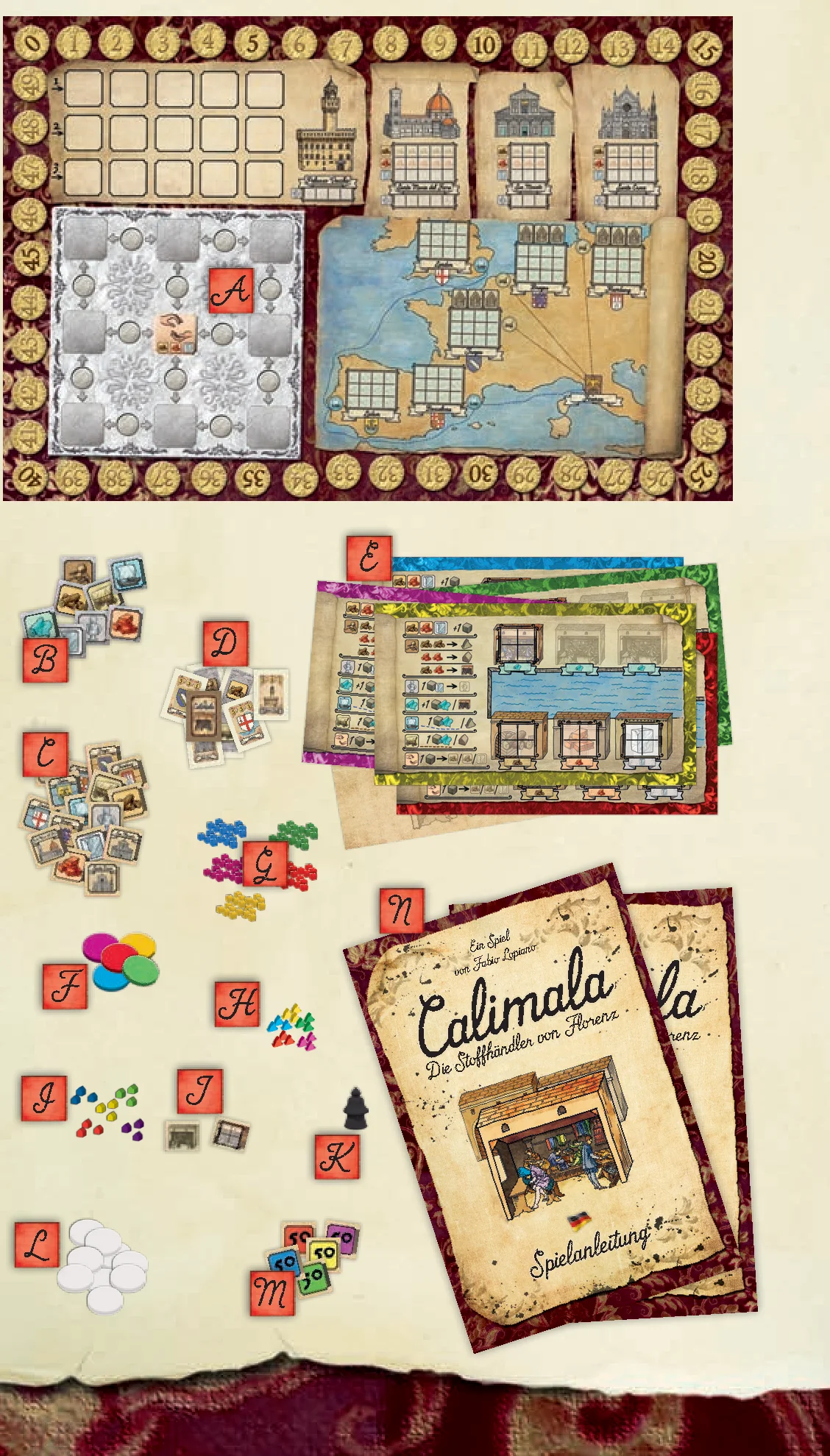
Each copy of Calimala contains the following components:
- A 1 game board
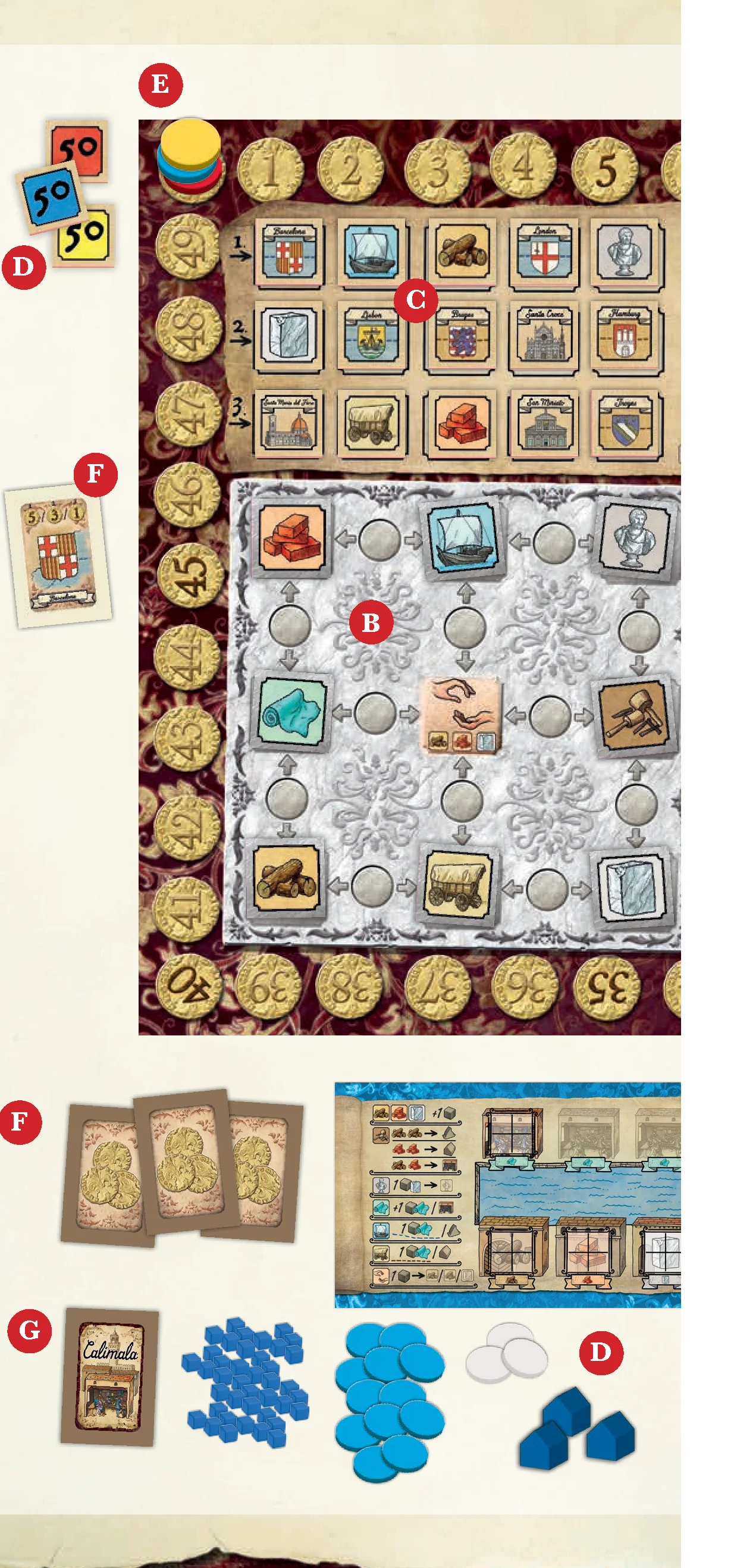
- B 8 action tiles
- C 15 scoring tiles
- D 55 cards (45 action cards, 10 final scoring cards)
- E 5 player mats
- F 65 wooden discs (13 each in five player colors)
- G 200 wooden cubes (40 each in five player colors)
- H 15 wooden ships (3 each in five player colors)
- I 15 wooden trade houses (3 each in five player colors)
- J 10 workshop tiles
- K 1 active player token
- L 10 white wooden discs
- M 5 “50” victory points tiles
- N 2 rulebooks (English & German)
The Game Board, Action Tiles and Scoring Tiles plus Trade Houses
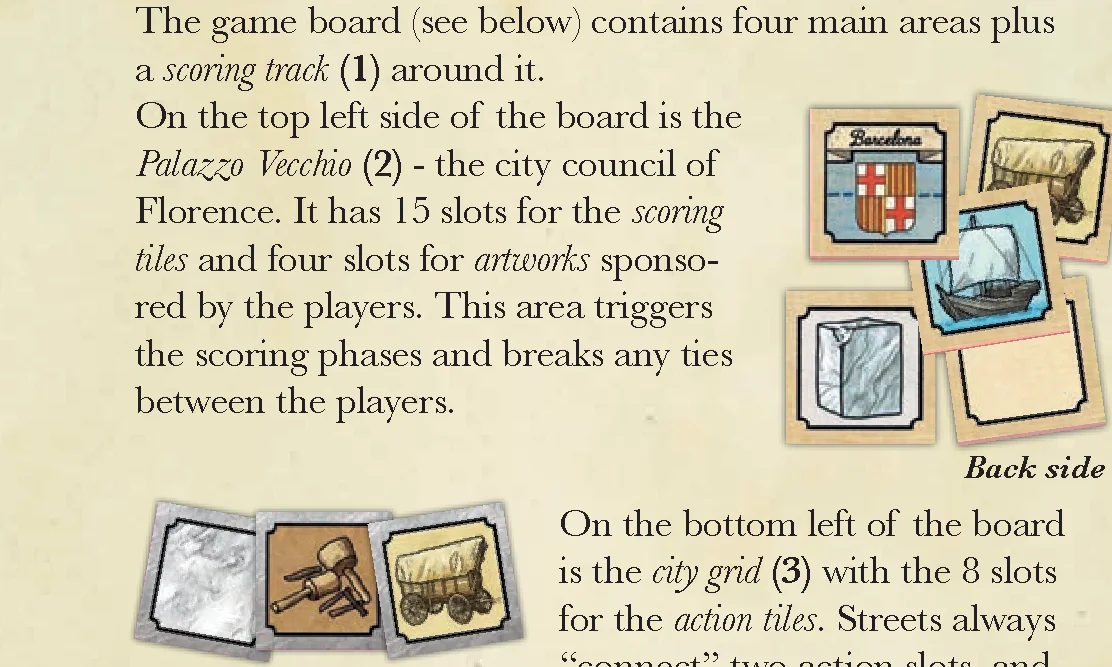
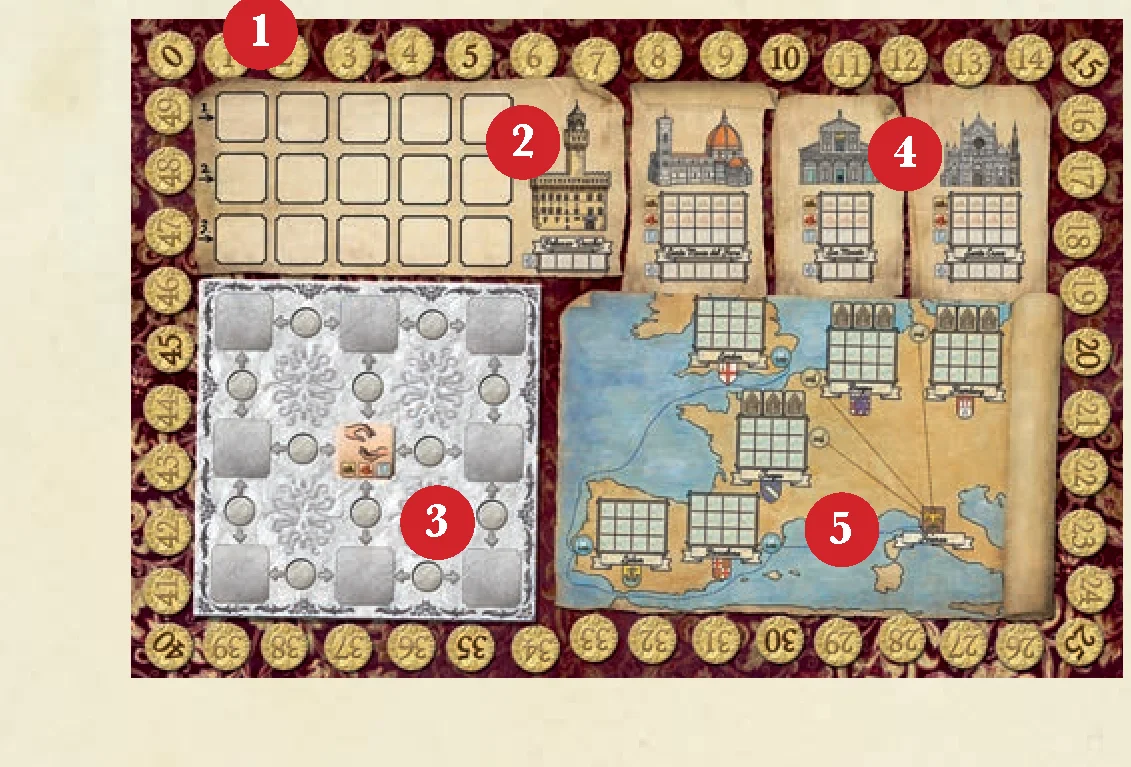
The game board contains four main areas plus a scoring track (1) around it.
- On the top left side of the board is the Palazzo Vecchio (2) – the city council of Florence. It has 15 slots for the scoring tiles and four slots for artworks sponsored by the players. This area triggers the scoring phases and breaks any ties between the players.
- On the bottom left of the board is the city grid (3) with the 8 slots for the action tiles. Streets always “connect” two action slots, and each street contains a round action space where the players will place their wooden discs when taking actions.
- On the top right side of the board are three buildings under construction (4) showing slots for contributions: the cathedral of Santa Maria del Fiore with 15 slots, the church of San Miniato with 9 slots and the church of Santa Croce with 12 slots. Each building also has several slots for artwork (respectively five, three and four slots).
- On the bottom right side of the board is a map with parts of Europe showing six cities (5): three trade cities with slots for trade houses (Troyes, Bruges and Hamburg) and three port cities (Barcelona, Lisbon and London). Each city has 12 slots for the delivery of cloth (cubes). The cities show simplified “city coat of arms”. We slightly adjusted the historical color schemes for a better visualization during play.
The Player Mats, Ships and Workshop Tiles
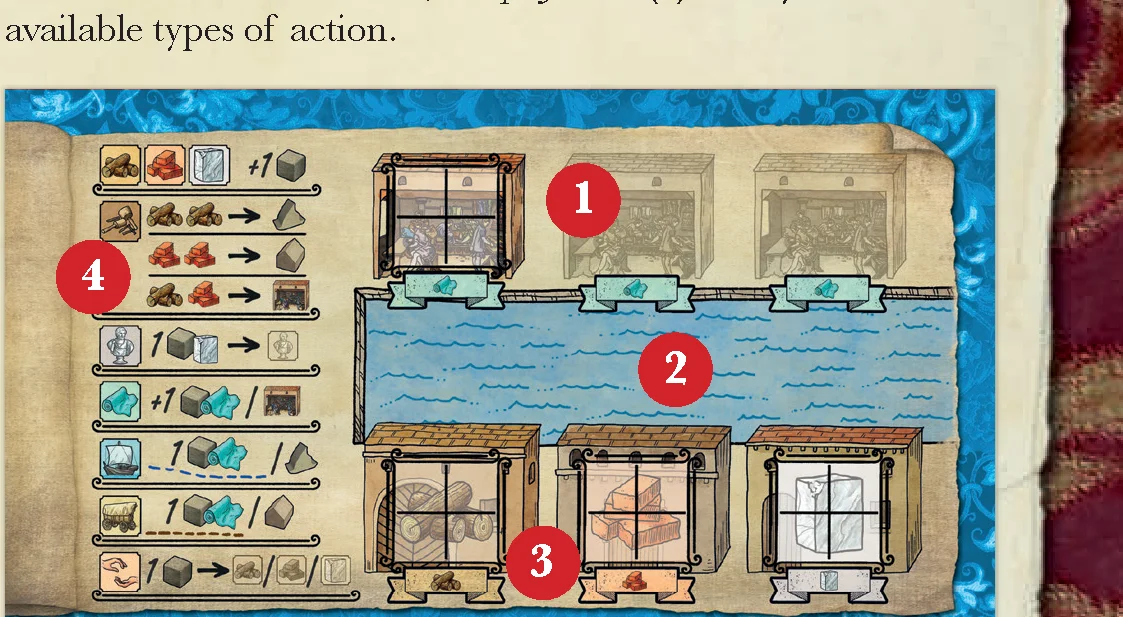
The player mats consist of four main areas:
- Workshops (1) are in the top right. Each player starts with one workshop and can build up to two additional ones by placing the workshop tiles on the empty slots. Workshops produce cloth cubes and each one stores up to four cloth cubes.
- The port (2) is in the center of the mat. Here the players may build ships.
- Three warehouses (3) are at the bottom right, each can store one resource type (wood, bricks and marble). When acquiring these resources, cubes in the player’s color are placed in an available slot of the corresponding warehouse. Each warehouse may hold a maximum of four cubes.
- On the left side of the mat, the player aid (4) briefly lists the available types of action.
The Action Cards and Scoring Cards
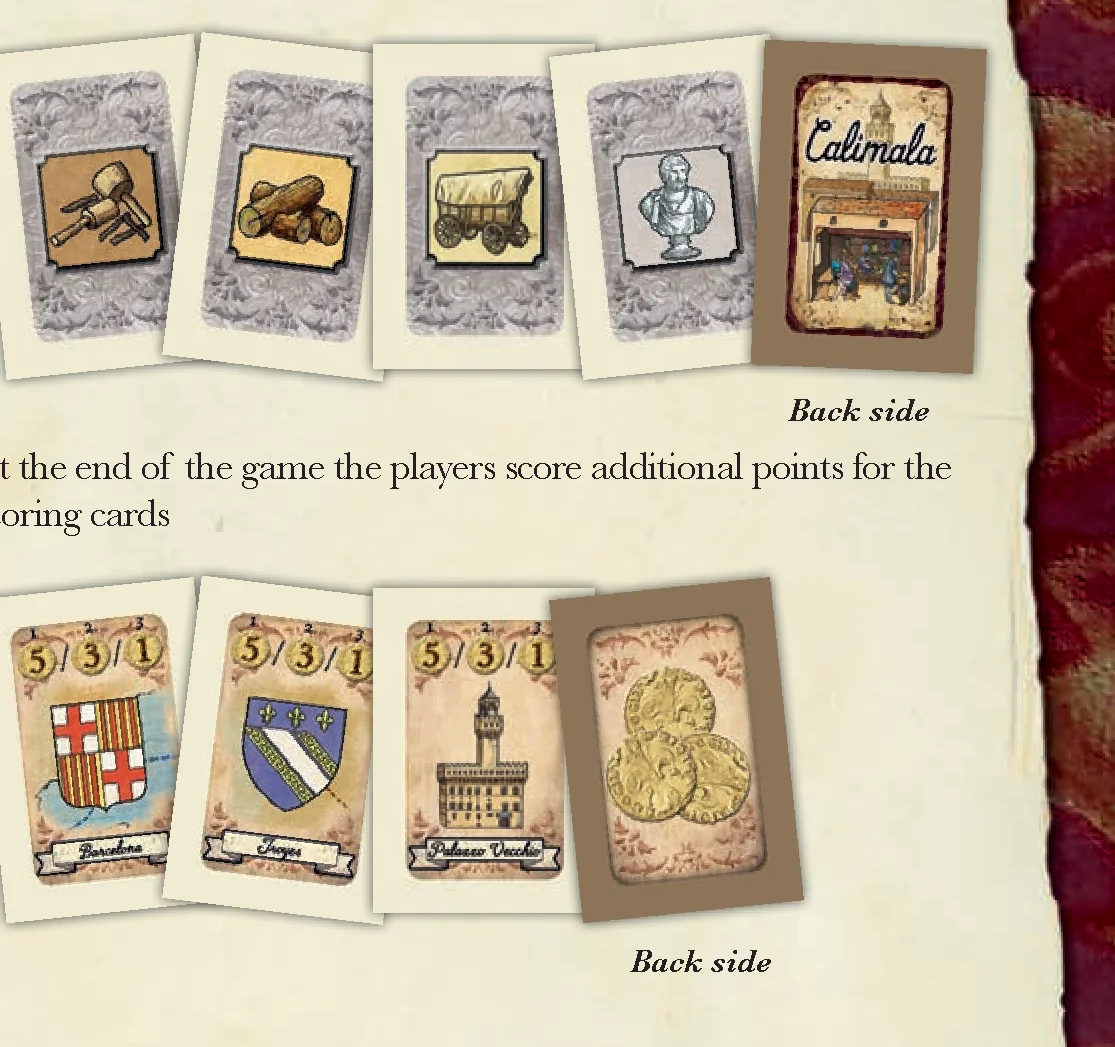
The players will use action cards during the game in addition to the actions triggered on the city grid.
At the end of the game the players score additional points for the scoring cards.
The Wooden Cubes and Active Player Token
Besides ships and trade houses the players also have wooden cubes in their player colors. They use them to mark different resources and clothes of the warehouses and workshops on their player mats and the slots of the buildings and cities on the game board.
During the game, the player taking his turn always has the active player token, so players do not lose track of the player order when they carry out the scoring phases.
- A: The youngest player will be starting player. He takes the active player token and places it in front of himself.
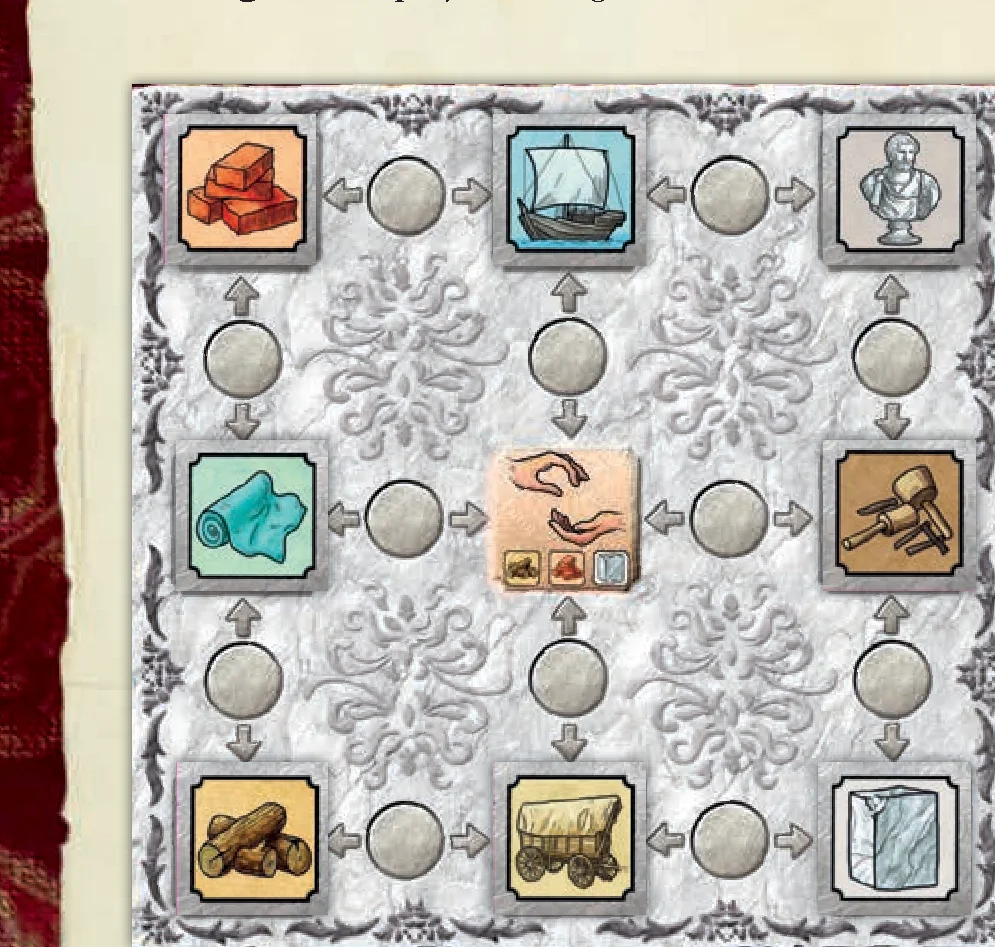
- B: One player shuffles the 8 action tiles and places them randomly, face up, on the corresponding slots of the city grid.
First game: A player arranges the action tiles in the recommended layout.
- C: One player shuffles the 15 scoring tiles and places them randomly, face up, on the corresponding slots of the city council (Palazzo Vecchio). He starts to place them in the top row and in each row from left to right.
- D: Each player takes a player mat and the following components in the player color of his choice:
- 40 cubes
- 3 ships
- 3 trade houses
- 2 neutral workshop tiles
- The “50” victory points tile next to the scoring track
Depending on the number of players, each player also takes:
- 3 players: 12 discs in the player color of his choice and 3 white discs
- 4 players: 10 discs in the player color of his choice and 2 white discs
- 5 players: 8 discs in the player color of his choice and 2 white discs
- E: Each player places an additional of his colored discs on space “0” of the scoring track. The players put surplus discs back into the game box.
- F: A player shuffles the scoring cards and deals them as follows:
- 3 players: Each player receives 3 cards, the remaining card is placed face up next to the board.
- 4 players: Each player receives 2 cards, one of the remaining cards is placed face up next to the board, the other is placed face down back into the game box.
- 5 players: Each player receives 2 cards. No card is placed face up next to the board.
Each player secretly picks (and keeps) one scoring card. Only these cards (and, with 3 or 4 players, the face up scoring card next to the board) will be scored at the end of the game for all players. The cards that have not been picked are placed back face down in the box, without being revealed. (For details on the scoring cards please check page 11.)
- G: The players place one copy each of the following 5 action cards face up on the table: Wood, Brick, Marble, Weave and Build. Each player, starting with the player sitting to the right of the starting player and continuing in counterclockwise order, takes one of these cards in his hand. Each player begins with one action card. The players shuffle the deck of remaining action cards (in games with less than 5 players including the not chosen action cards) and place it face down next to the game board.
Calimala is played in player turns in clockwise order.
The players take turns by choosing and activating different action spaces. Depending on the choice of the active player, the other players may activate the same actions, too.
During the game player turns are interrupted by scoring phases. At that time the players receive victory points. The game ends with a final scoring after all players took the same number of turns.
Choosing an Action Space
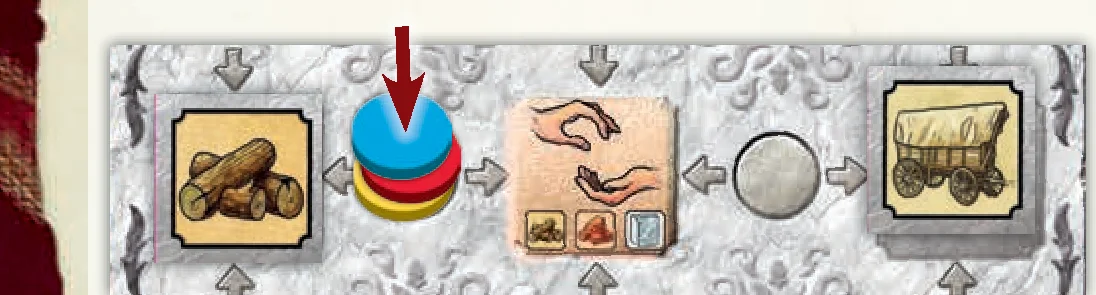
In each player turn, the active player places one of his discs on an action space of the city grid, so that he is able to conduct the two “connected” adjacent actions. He may choose to place a colored disc or one of his white discs. If there are already one or more discs on the chosen action space, the active player places the new disc on top, forming a stack. A stack of discs may consist of a maximum of four discs; see Activating an action space on page 8.
Example: Marion places one of her blue discs on the action space on top of Angelika’s red and Tanja’s yellow disc, so she can conduct the two actions connected to this action space.
Activating an Action Space
After placing the disc on the action space, the active player activates that space and the connected two actions. He has to conduct at least one of the two connected actions, if necessary by playing one or more additional action cards. (Therefore a player is not permitted to place a disc to draw two action cards; see the compensation rules below.)
If he placed his disc on top of one or more discs a total of up to three discs of the stack are activated, from top to bottom:
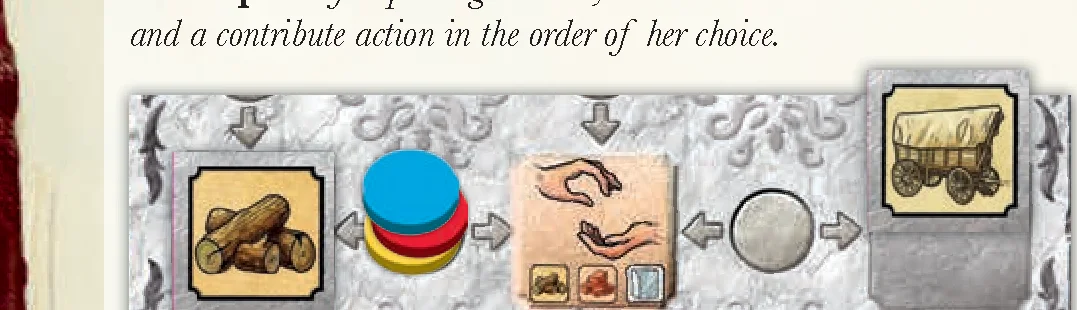
- The active player carries out both actions. He may do this in the order of his choice.
Example: After placing her disc, Marion conducts a wood action and a contribute action in the order of her choice.
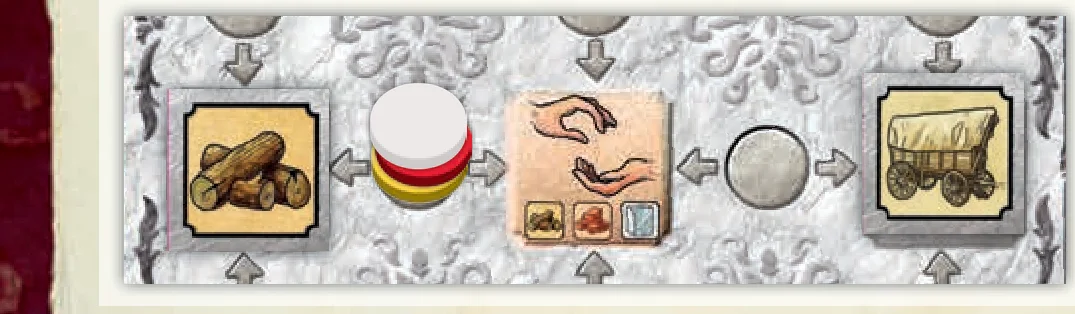
- If the active player placed a white disc: he may carry out each of the two actions connected to that action space twice. The player may conduct these actions in any order of his choice: Either A, A, B, B, or A, B, A, B, or A, B, B, A etc.
Example: Marion places one of her white discs on the action space and conducts these actions twice. First, she decides to take wood twice in a row before she conducts the contribute action twice, and giving the wood to San Miniato.
- Afterwards, the player(s) owning the second and third activated colored disc from top to bottom may perform the two actions linked to the action space, too. Again, each player can choose the order of these two actions, when activating his disc. Other white discs in the stack are not activated.
Note: Colored discs, if played early in the game, will be activated up to three times and will generate up to six actions, either by using the action tiles, or by drawing action cards, see below. White discs generate four actions right away, but are not reactivated later.
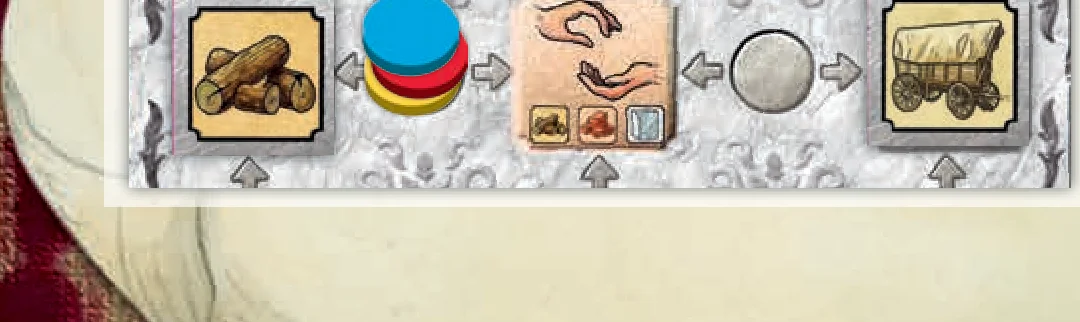
Example: After Marion conducted the two actions, first Angelika and then Tanja have a chance to perform the wood action and contribute action in the order of their choice, too.
Compensation and Action Cards
- Only if a player cannot carry out an action at all, he draws an action card as compensation and takes it into his hand. If the players owning the second or third activated disc cannot perform both actions, they may draw 2 action cards.
- If a player voluntarily decides to skip an activated action, or carries out an action partially, he does not draw an action card.
- The players keep action cards hidden from the other players, only the number of action cards in their hands is public information.
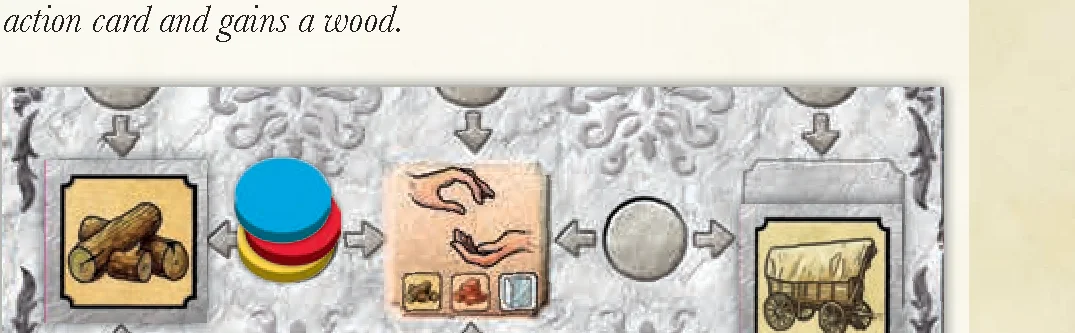
Example: Now, Angelika activates her red disc. As she does not have any resources in her warehouses, she chooses to conduct the contribute action first and the wood action second. Thus, she draws an action card and gains a wood.
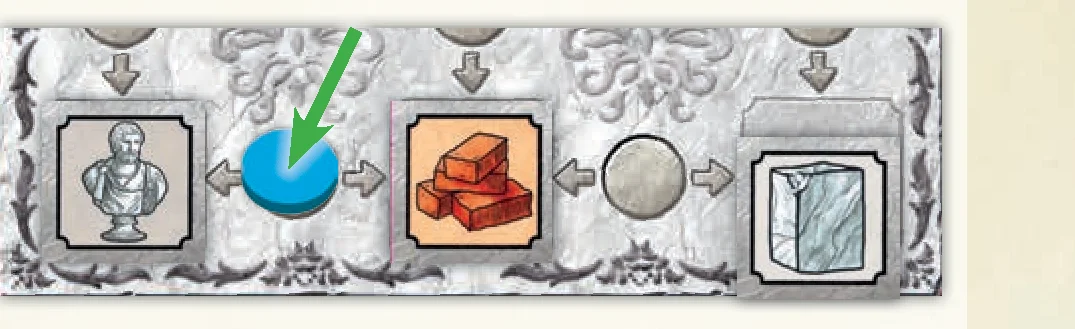
Example: Marion places one of her discs on the action space. She has no marble in her warehouse and cannot conduct the artwork action. Instead, she draws an action card as compensation. Then she conducts the brick action and takes one brick in her warehouse.
Playing Action Cards
- While carrying out the activated actions, a player may also play any number of action cards from his hand, either before or after each of the two actions.
- The player must be able to conduct this action at least partially. If he cannot conduct the action, he cannot play the card. The player cannot discard and replace an action card which he cannot use.
- Afterwards, he discards the played action cards onto a face up discard pile. If the players draw the last action card from the deck, they immediately reshuffle the discard pile and place it face down as the new action deck.
Example: Marion places one of her discs on the action space. As she now has two discs in that stack, she will activate both her discs in this turn, while Angelika activates her disc in between. While activating her topmost disc, Marion is missing a wood to build a ship. Thus, she plays a wood action card from her hand and places one of her blue cubes on the wood warehouse. Then, she conducts the build action. She places the two wood cubes back into her reserve and places a second ship in her port. Now she conducts the ship action and thanks to her two boats delivers two cloth cubes from her workshops to Lisbon.
Next, Angelika takes her turn. She builds a second workshop, removes one cube each from the wood and bricks warehouses and places a workshop tile on her player mat. As she does not have any ships in her port, instead of conducting the ship action she draws an action card.
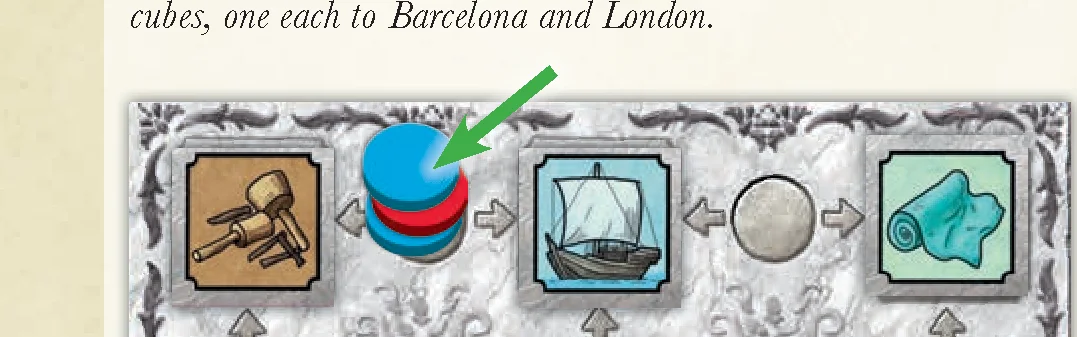
Now, Marion activates her second blue disc at the bottom of the stack. She does not have enough material to build, and instead draws an action card. She is lucky and gets a weave action card, which she immediately plays to place one cloth cube each in her two workshops. She conducts the ship action and delivers two cloth cubes, one each to Barcelona and London.
- After activating up to three discs on the chosen action space the active player passes the active player token to the next player in clockwise order.
- Exception: Player turns may be interrupted by a scoring phase, if temporarily there is a fourth disc at the bottom of the stack. Please check the next section.
Both the actions on the city grid and the action cards offer the following nine actions:
 Wood, Brick, Marble
The player receives one wood, one brick or one marble.
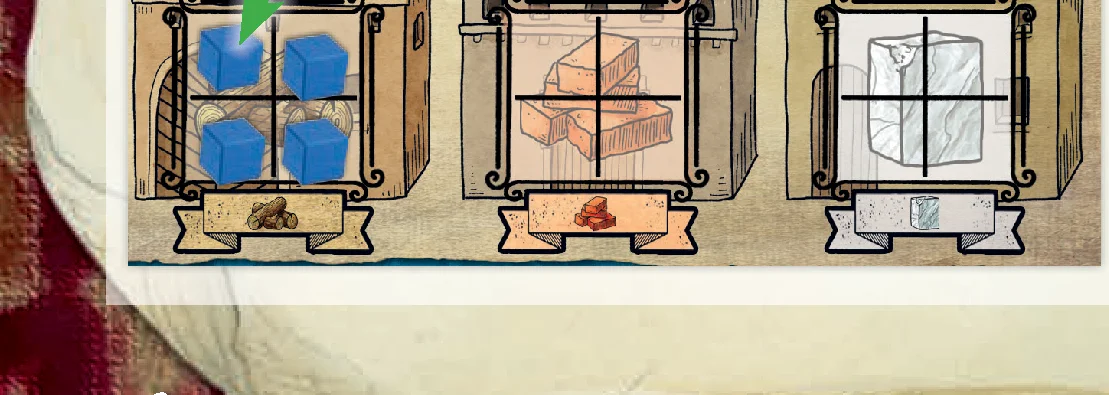
The player places one cube in his color from his reserve on an empty slot of the corresponding warehouse on his player mat. Each cube in a warehouse is considered to be that matching resource.
Only if all four slots of the matching warehouse are filled, a player instead draws an action card.
Example: Marion activates the wood action space and places one of her cubes in the wood warehouse. Now all four slots are filled; next time she is supposed to receive wood, Marion would draw an action card.
 Build
Build
The player either builds one ship, one trade house, or one workshop.
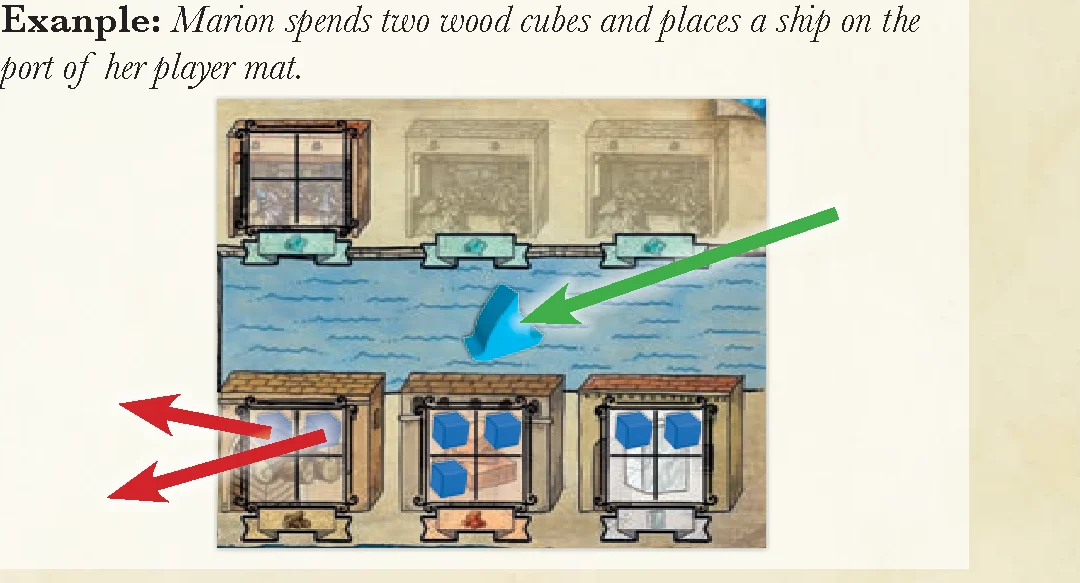
- To build a ship: he places two cubes from his wood warehouse back into his reserve. Then he places one of his ships on the port on his player mat.
Example: Marion spends two wood cubes and places a ship on the port of her player mat.
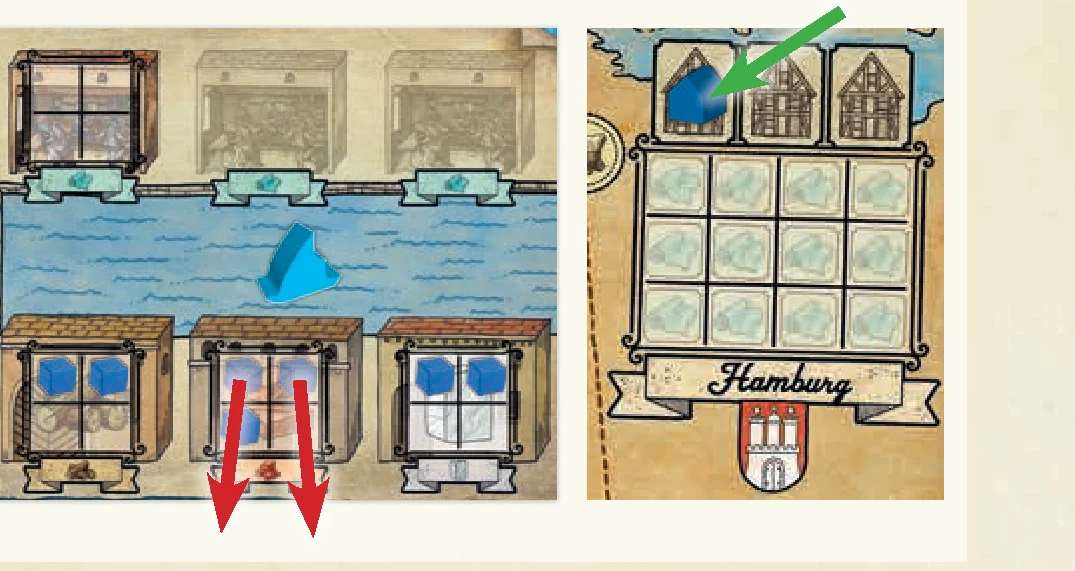
- To build a trade house: the player places two cubes from his bricks warehouse back into his reserve. Then he places one of his wooden trade houses on an empty slot in one of the three trade cities. Each player may not have more than one trade house in a single trade city.
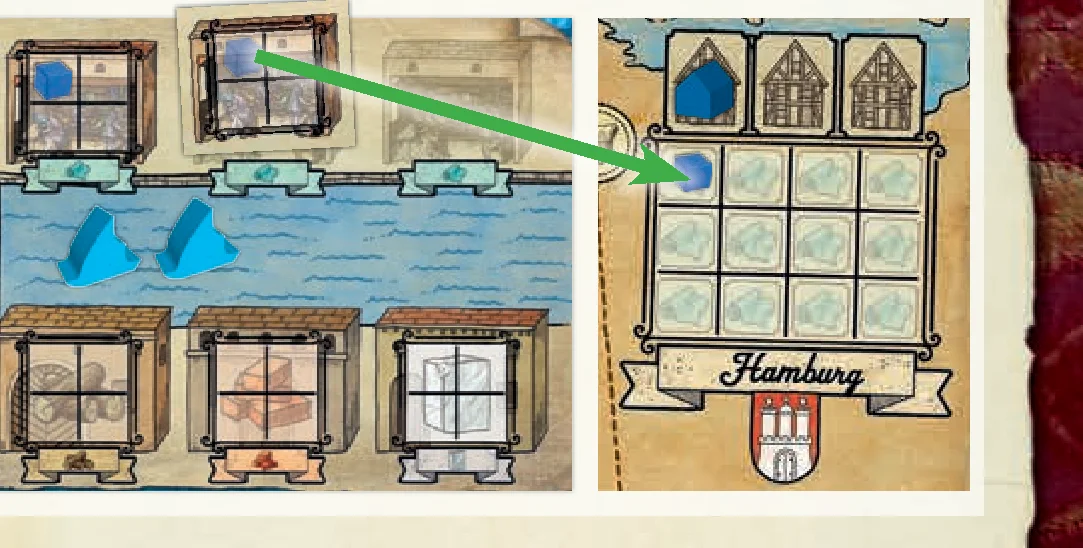
Example: Marion spends two brick cubes and places a trade house on one of the slots in Hamburg.
- To build a workshop: the player places one cube each from his wood and bricks warehouses back into his reserve. He takes one of his workshop tiles and places it on the leftmost empty slot of his player mat.
Example: Marion spends a wood cube and a brick cube and places a workshop on her player mat.
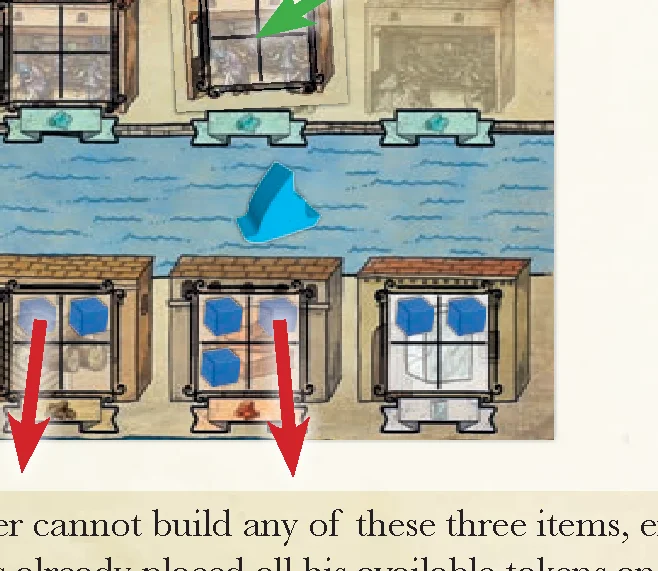
Only if a player cannot build any of these three items, either because he has already placed all his available tokens and tiles, or does not have the matching resources, he instead draws an action card.
 Artwork
The player creates artwork for one of the four buildings.
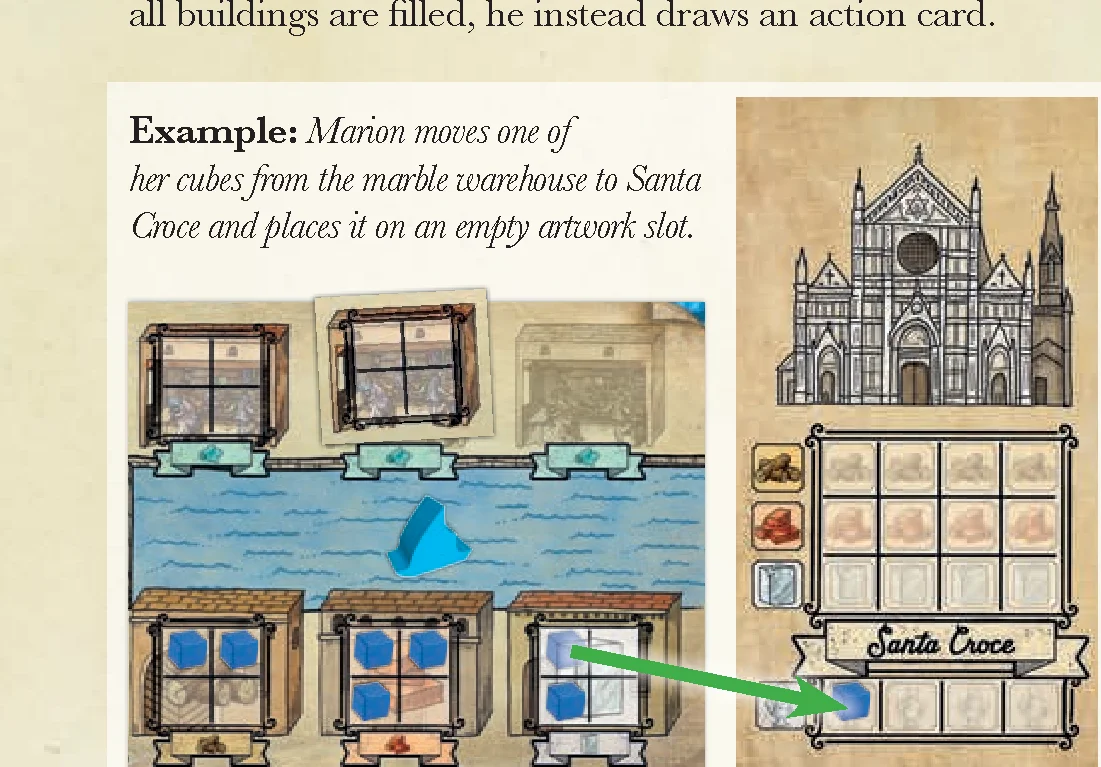
He moves one cube from his marble warehouse to an empty artwork slot next to one of the three buildings under construction or to the city council.
Only if a player does not have any marble, or when all slots of all buildings are filled, he instead draws an action card.
Example: Marion moves one of her cubes from the marble warehouse to Santa Croce and places it on an empty artwork slot.
 Weave
Weave
The player produces cloth in his workshops.
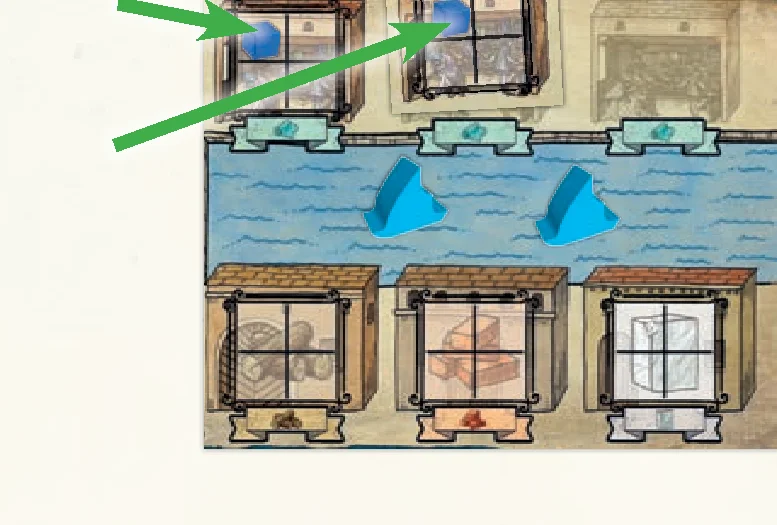
The player places one of his cubes from his reserve on an empty slot of each of his workshops. The cubes are considered to be cloth. This means, if the player activates this action once and already built the second or third workshop, he receives two or even three cubes at the same time.
Only if all slots in all warehouses are filled, the player instead draws an action card.
Example: Marion already has two workshops, therefore she places two of her cubes on empty slots of her workshops, one per workshop.
 Ship
Ship
The player ships cloth to the port cities.
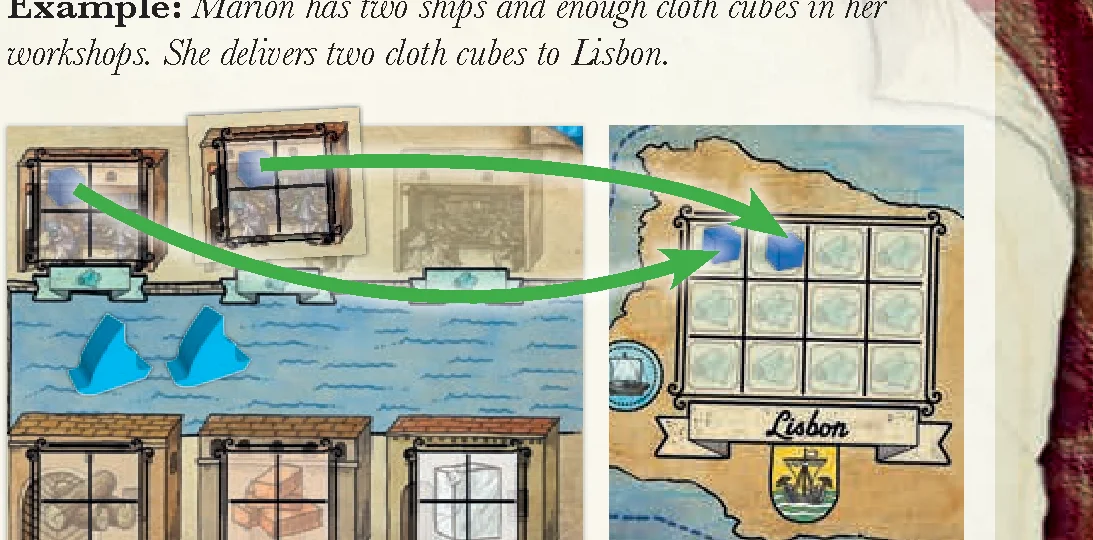
The player transports one cloth cube with each of his ships from his workshops to a port city – if that city has an empty slot. Thus, if the player activates this action once and already has two or three ships and enough cloth cubes in his workshops, he may decide to deliver cloth cubes with one, two or all three ships. For each ship, he may choose the same or a different city as destination.
A player may decide to ship less cloth cubes than the possible maximum. Only if all slots in all three port cities are filled, or if the player does not have any cloth cubes and/or no ships, he instead draws an action card.
Example: Marion has two ships and enough cloth cubes in her workshops. She delivers two cloth cubes to Lisbon.
 Transport
The player transports cloth to the trade cities.
The player transports one cloth cube from his workshops to each of his trade houses in the three trade cities, but at most one cube per trade house. Thus, if the player activates this action once and already has two or three trade houses and enough cloth cubes in his workshops, he may decide to deliver cloth cubes to one, two or all three trade cities.
Only if all slots in all trade cities are filled, or if the player does not have cloth cubes and/or no trade houses, he instead draws an action card.
Example: Marion has a trade house in Hamburg and several cloth cubes in her workshops. She delivers one cloth cube to Hamburg.
Contribute
The player contributes resources to the three buildings under construction: the cathedral of Santa Maria del Fiore, the church of San Miniato, and the church of Santa Croce.
The player moves a cube of his choice from one of his warehouses to a matching empty slot at a resource row at one of the three buildings. Each building has slots for wood, bricks and marble.
Only if all slots at all buildings are filled, or if the player has no matching resource cubes in his warehouses, he instead draws an action card.
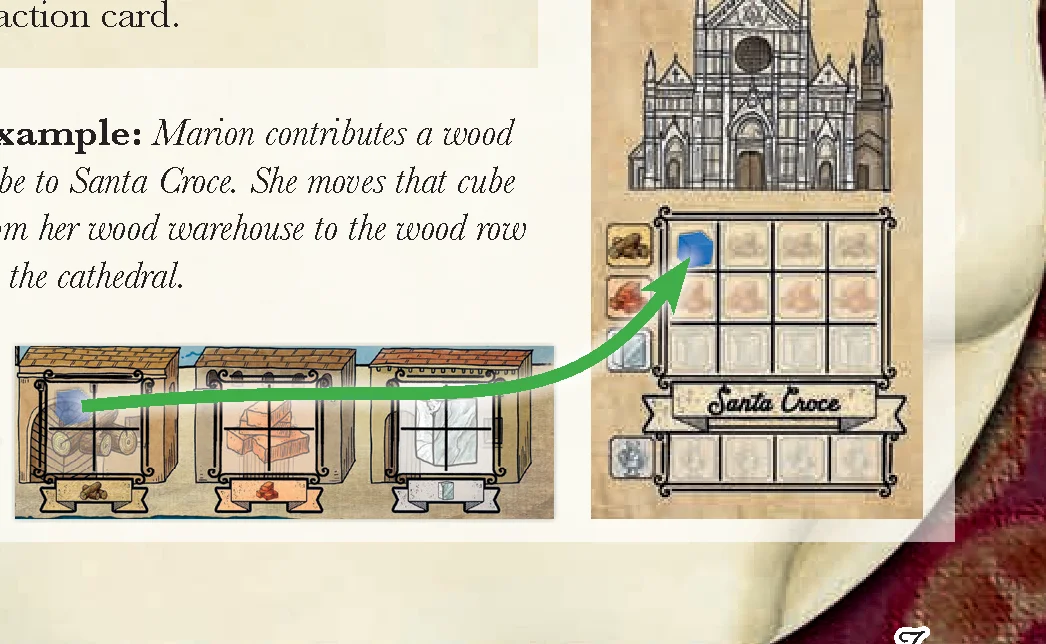
Example: Marion contributes a wood cube to Santa Croce. She moves that cube from her wood warehouse to the wood row of the cathedral.
There are 15 scoring phases in Calimala plus a final scoring round at the end of the game.
When there is a fourth disc at the bottom of the action stack, the player turn is interrupted by a scoring phase after activation of the three topmost discs.
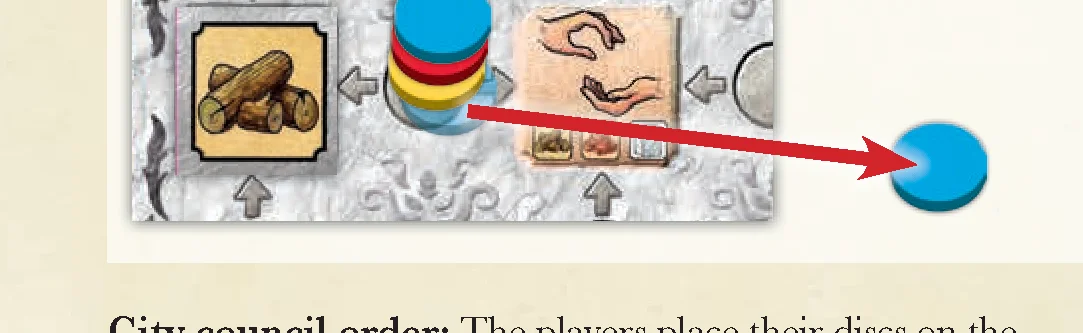
That fourth disc is not activated! Instead the owner of that disc moves it on one of the scoring tiles of the city council and triggers a scoring. The player’s disc in the city council is considered to be a seat.
Example: After the topmost three discs were activated, Marion moves her bottommost fourth disc to the city council.
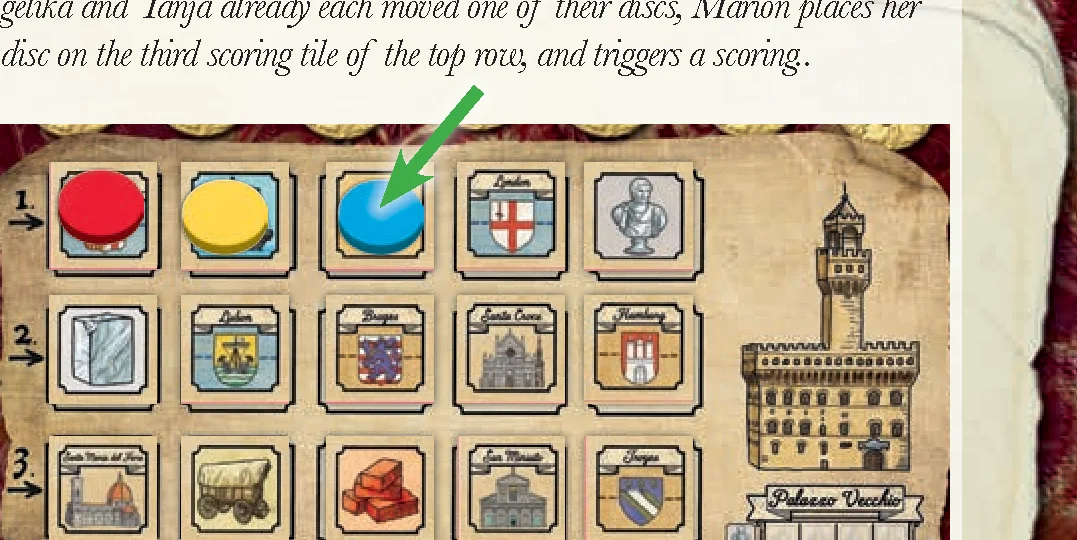
City council order: The players place their discs on the scoring tiles starting in the top row and in each row from left to right. The top-left tile is the first to be scored, the bottom-right one the last.
Example: Marion moves her first disc to the city council. As both Angelika and Tanja already each moved one of their discs, Marion places her disc on the third scoring tile of the top row, and triggers a scoring.
Fourth Disc Resolution Rules
- If the fourth disc of the stack is white: the active player exchanges it with one of his discs from his reserve. He places his colored disc on the scoring tile and the white disc into his reserve.
- If he has already placed all his colored discs on action spaces: he instead takes one of his colored discs from any other action space and places it on the scoring tile. In that case, he places the white disc on top of that stack, so that the number of discs in that stack does not change.
Note: The order in which the scorings are triggered is very important. Players should keep an eye on the upcoming three or four scorings.
After finishing the scoring, the active player passes the active player token to the next player in clockwise order.
The Scoring Categories in Detail
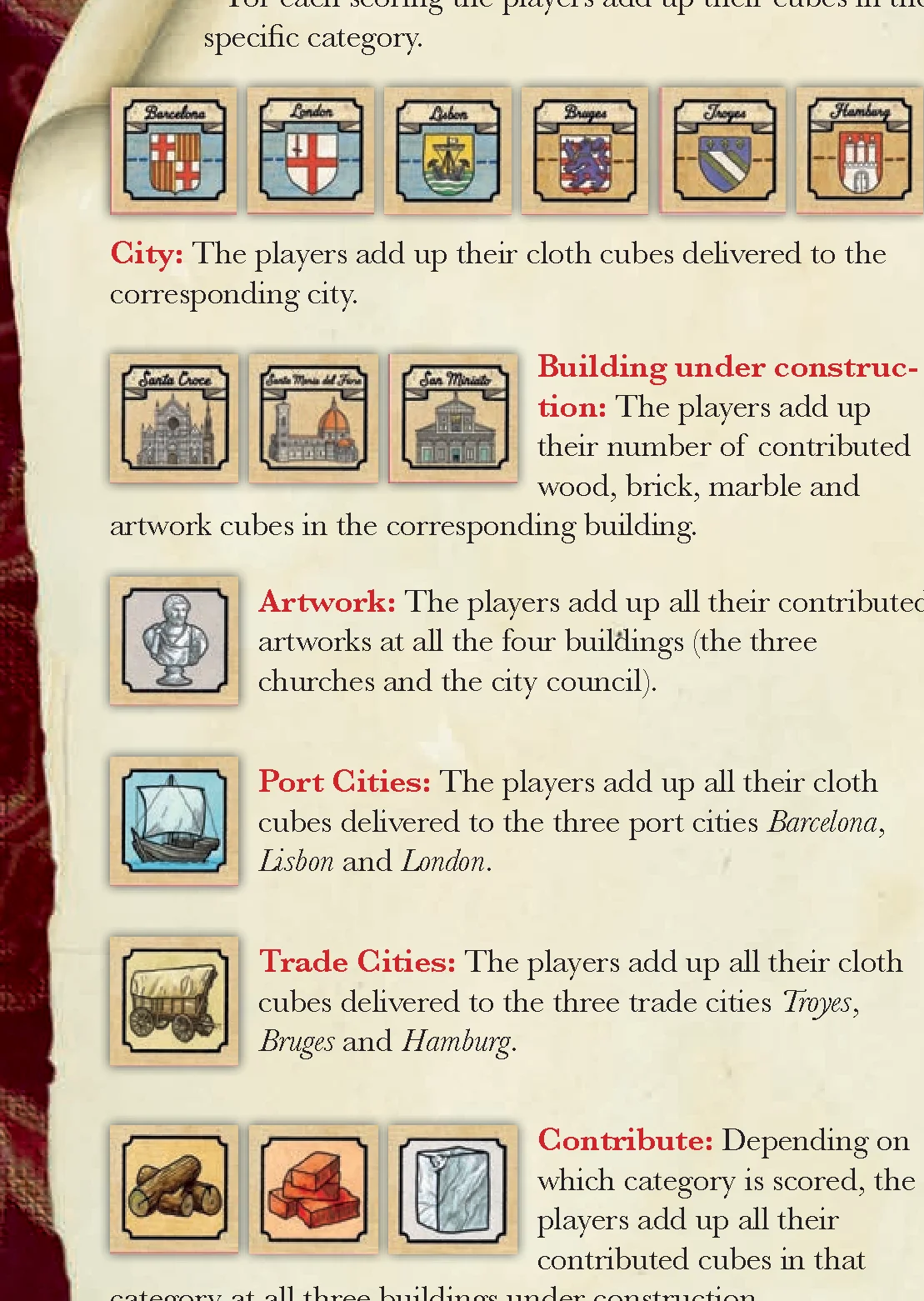
For each scoring the players add up their cubes in the specific category:
- City: The players add up their cloth cubes delivered to the corresponding city.
- Building under construction: The players add up their number of contributed wood, brick, marble and artwork cubes in the corresponding building.
- Artwork: The players add up all their contributed artworks at all the four buildings (the three churches and the city council).
- Port Cities: The players add up all their cloth cubes delivered to the three port cities Barcelona, Lisbon and London.
- Trade Cities: The players add up all their cloth cubes delivered to the three trade cities Troyes, Bruges and Hamburg.
- Contribute: Depending on which category is scored, the players add up all their contributed cubes in that category at all three buildings under construction.
Points and Tie-Breaking
The first three players score the following victory points in a specific category:
- The player with the most cubes will gain 3 victory points.
- The player with the second most cubes will gain 2 victory points.
- The player in third place will gain 1 victory point.
- No points are scored for players that do not have any cubes in the scoring category.
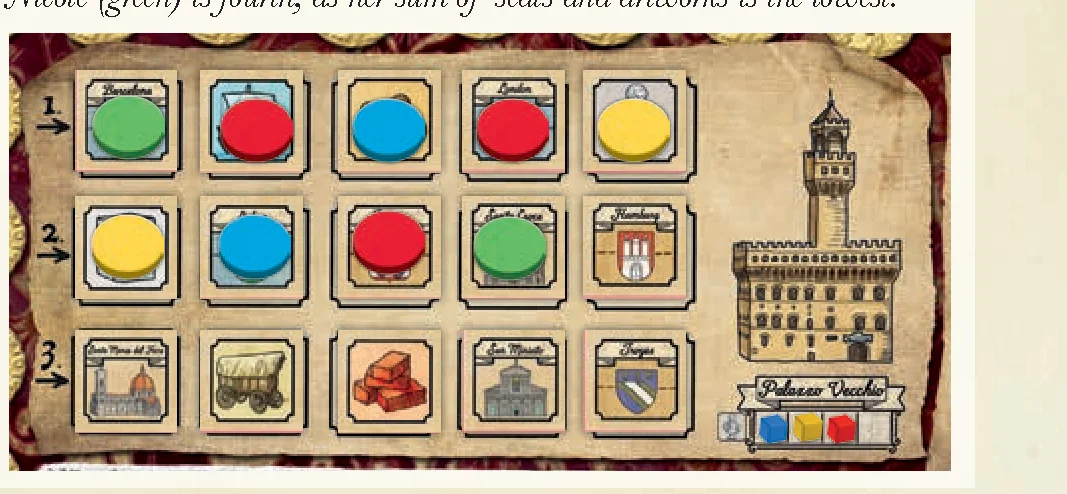
In case of a tie, the tied players add up their seats and their contributed artworks in the city council:
- The tied player with the highest sum wins the tie.
- If two or more players have the same sum, the tied player with more seats wins the tie.
- If the number of seats is the same, the tied player who first gained that number of seats wins the tie.
- If the tied players do not have any seats, the tied player who contributed the first artwork wins the tie.
- If the tied players did not contribute any artwork, they evenly split the victory points (rounded down).
Example: Angelika (red) has three seats and contributed one artwork, so she wins all ties. Tanja (yellow) wins ties against Marion (blue), because she gained her second seat before Marion. Nicole (green) is fourth, as her sum of seats and artworks is the lowest.
The players track their victory points by moving their discs on the scoring track around the game board. If a player has 50 or more victory points, he takes his “50” victory points tile and places it next to his player mat.
The game ends when one of the following conditions occurs:
- The players have placed all action discs on the city grid, both their own colored discs and their white discs. In this case, the players score any remaining scoring tiles in the city council without getting additional seats.
- The players have triggered all 15 scoring tiles. In this case, they finish the current “player round” until each player has placed the same total number of discs. The players do not get additional seats in the city council. Therefore they remove the fourth discs in stacks of any activated action spaces from the game.
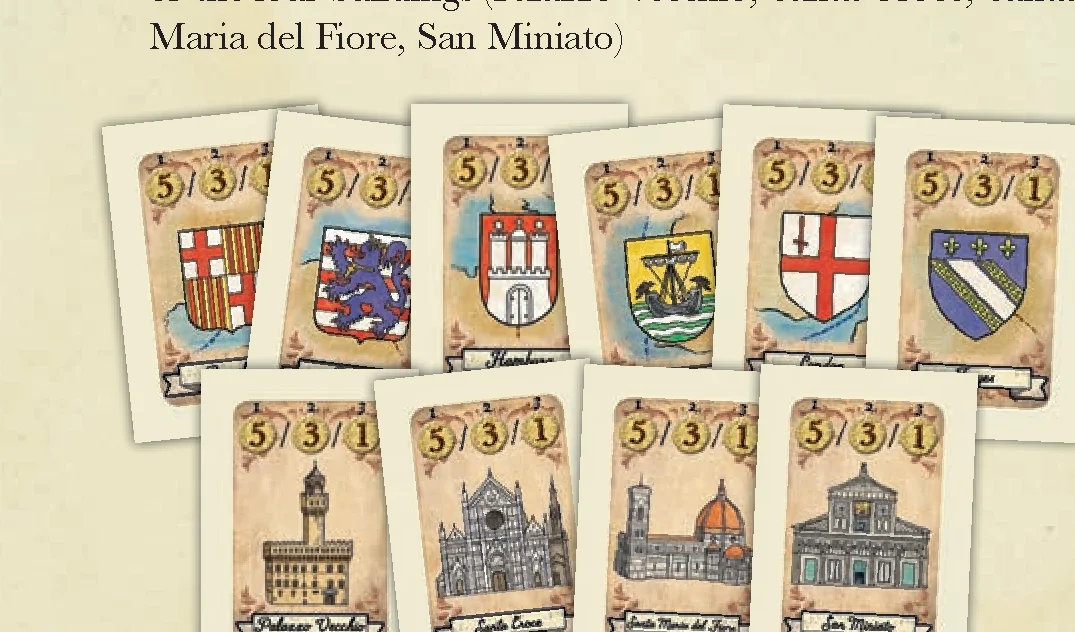
Afterwards, all players reveal their scoring cards and proceed with the corresponding scoring (with 3 or 4 players including the face up scoring card next to the board):
- Each scoring card either shows one of the six cities (Barcelona, Bruges, Hamburg, Lisbon, London, Troyes) or one of the four buildings (Palazzo Vecchio, Santa Croce, Santa Maria del Fiore, San Miniato).
- The players add up all their cubes in the corresponding area. For the Palazzo Vecchio scoring, each player adds their seats and the contributed artwork cubes.
- The player with the most cubes gains 5 victory points.
- The player with the second most cubes gains 3 victory points.
- The player with the third most cubes gains 1 victory point.
- All ties are resolved as described in the Scoring Phases chapter on page 10.
After all scoring cards are resolved, the player with the most points wins the game! In case of a tie, the player with more seats and contributed artworks in the city council is the winner.
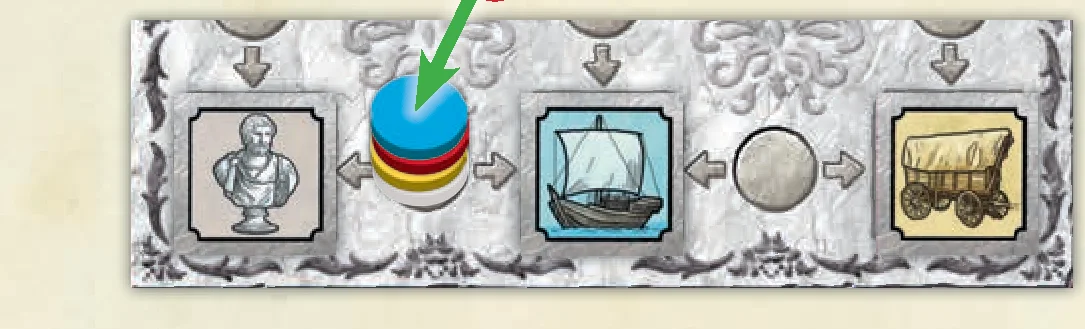
Choosing and Activating an Action Space
Marion begins her turn by placing one of her blue discs on top of the stack on the action space connected to the Artwork and Ship action (a).
Marion has one cloth cube in each of her two workshops, two marble cubes in the warehouse and two ships in her port. She has an artwork action card and a wood action card in her hand.
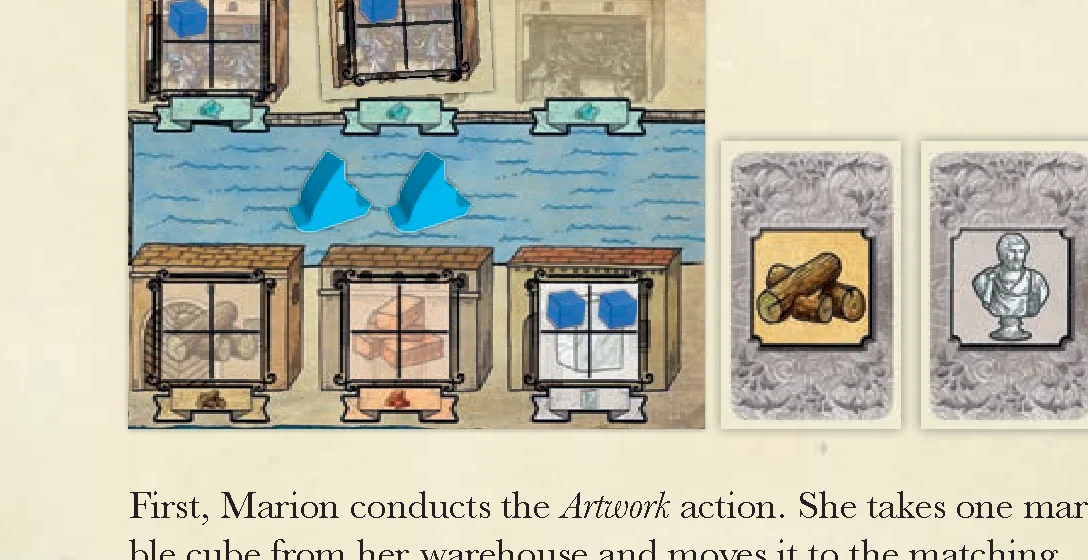
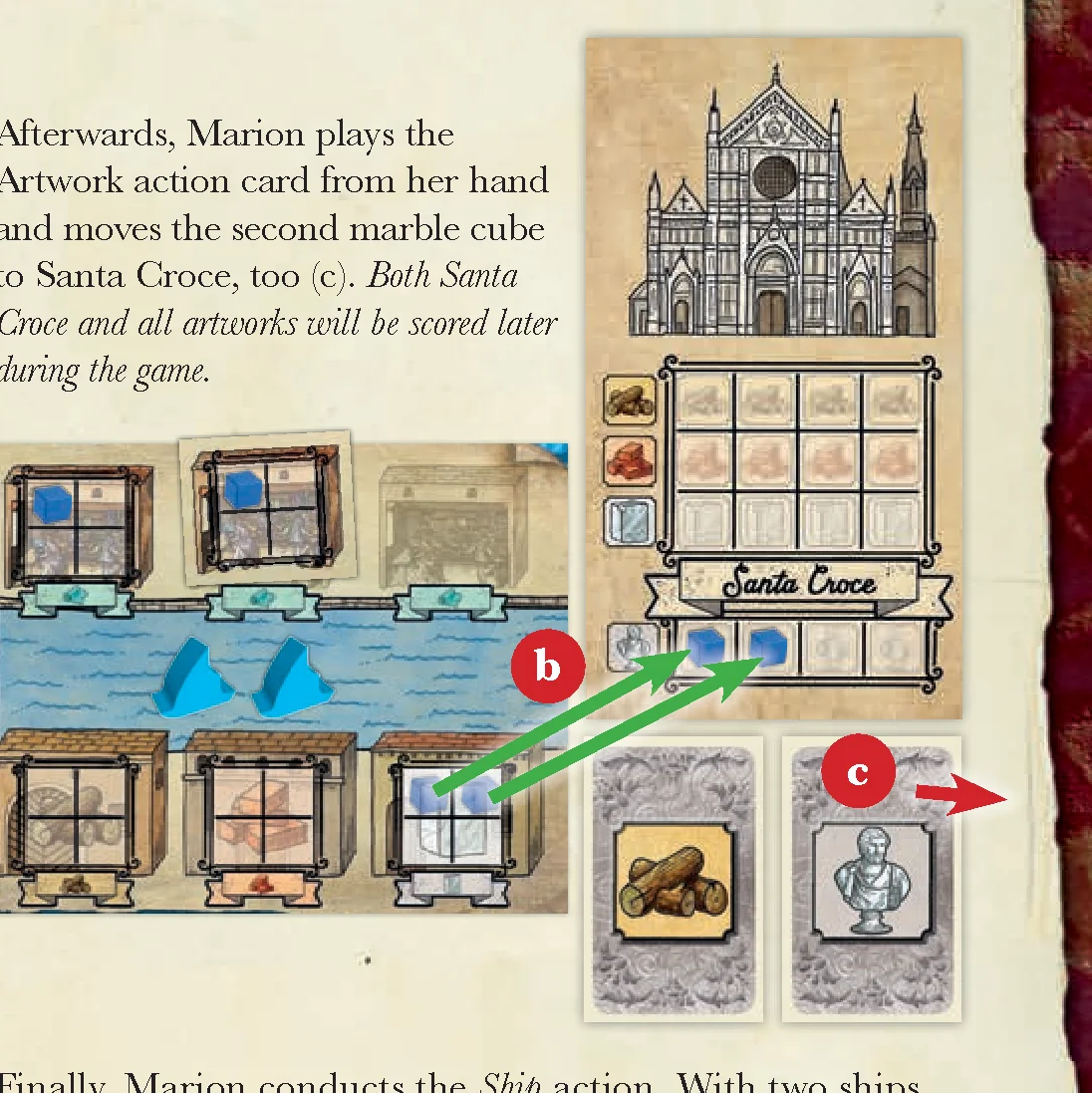
First, Marion conducts the Artwork action. She takes one marble cube from her warehouse and moves it to the matching row at Santa Croce (b).
Afterwards, Marion plays the Artwork action card from her hand and moves the second marble cube to Santa Croce, too (c). Both Santa Croce and all artworks will be scored later during the game.
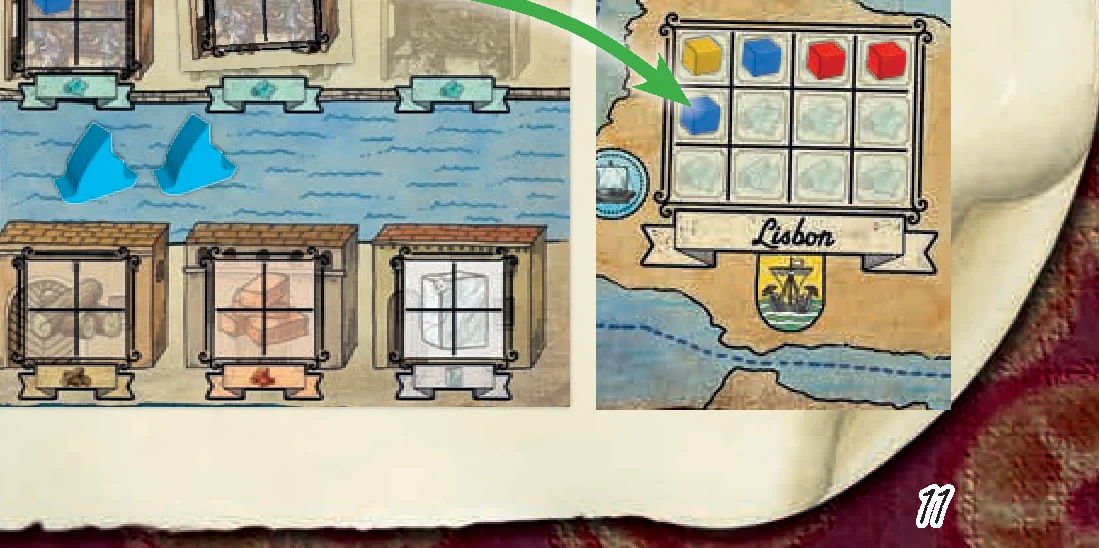
Finally, Marion conducts the Ship action. With two ships and two cloth cubes she may do up to two deliveries to any port cities. She decides to only deliver one cloth cube to Lisbon (d), so that there are now one yellow, two blue and two red cloth cubes.
Now, Angelika activates her red disc in the stack. She has a workshop, two ships in the port, one marble and one stone cube in her warehouses, a Build action card and a trade house in Troyes.
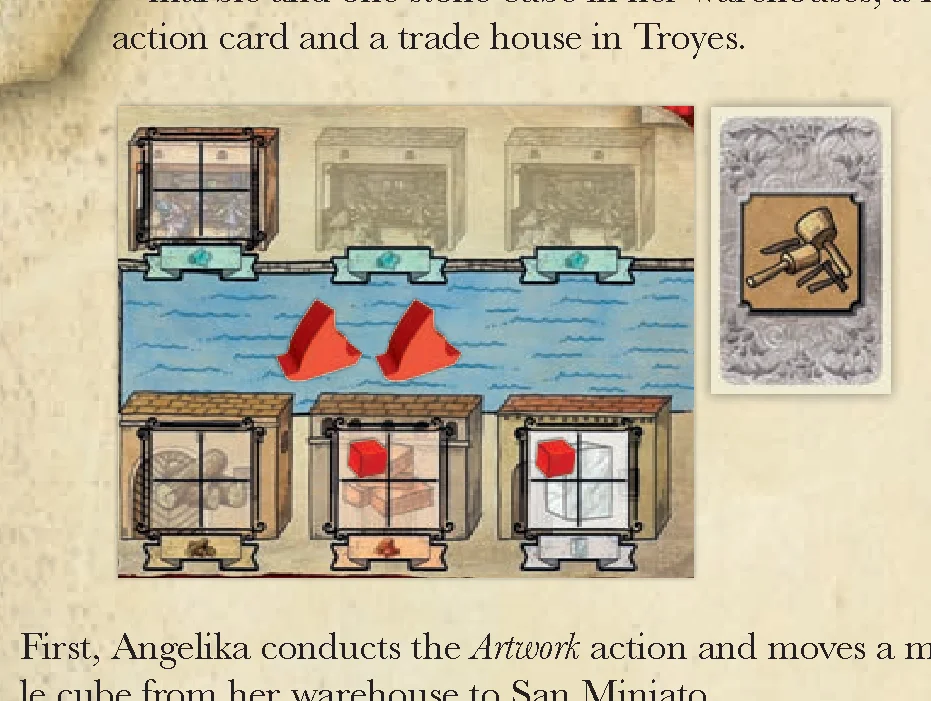
First, Angelika conducts the Artwork action and moves a marble cube from her warehouse to San Miniato.
Angelika does not have any cloth cubes in her workshop, so she cannot conduct the Ship action. Instead she draws an action card and gets a Wood action.
Angelika immediately plays this Wood action card (e) and now has a wood and stone cube in her warehouses. She plays her Build action card and places both cubes back into her reserve to build a workshop (f).
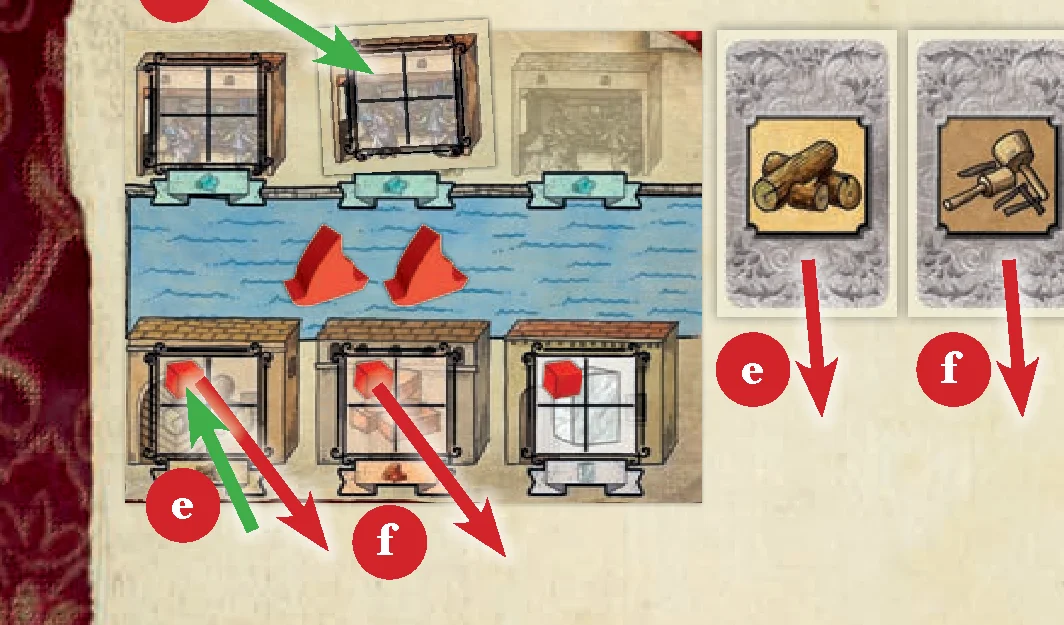
Finally, Tanja activates her disc in the stack. She has no marble or cloth cubes and cannot conduct both actions. Instead, she draws two action cards, which she saves for a later turn.
Scoring Phase
There are four discs in the stack on the action space. Thus, the players interrupt the player turn for a scoring phase, after activating the top three discs of the stack.
There is a white disc at the bottom of the stack. White discs may never be transferred to the city council. Therefore Marion exchanges that disc for one of the blue discs from her reserve (g) and places it on the scoring tile for Lisbon (h).
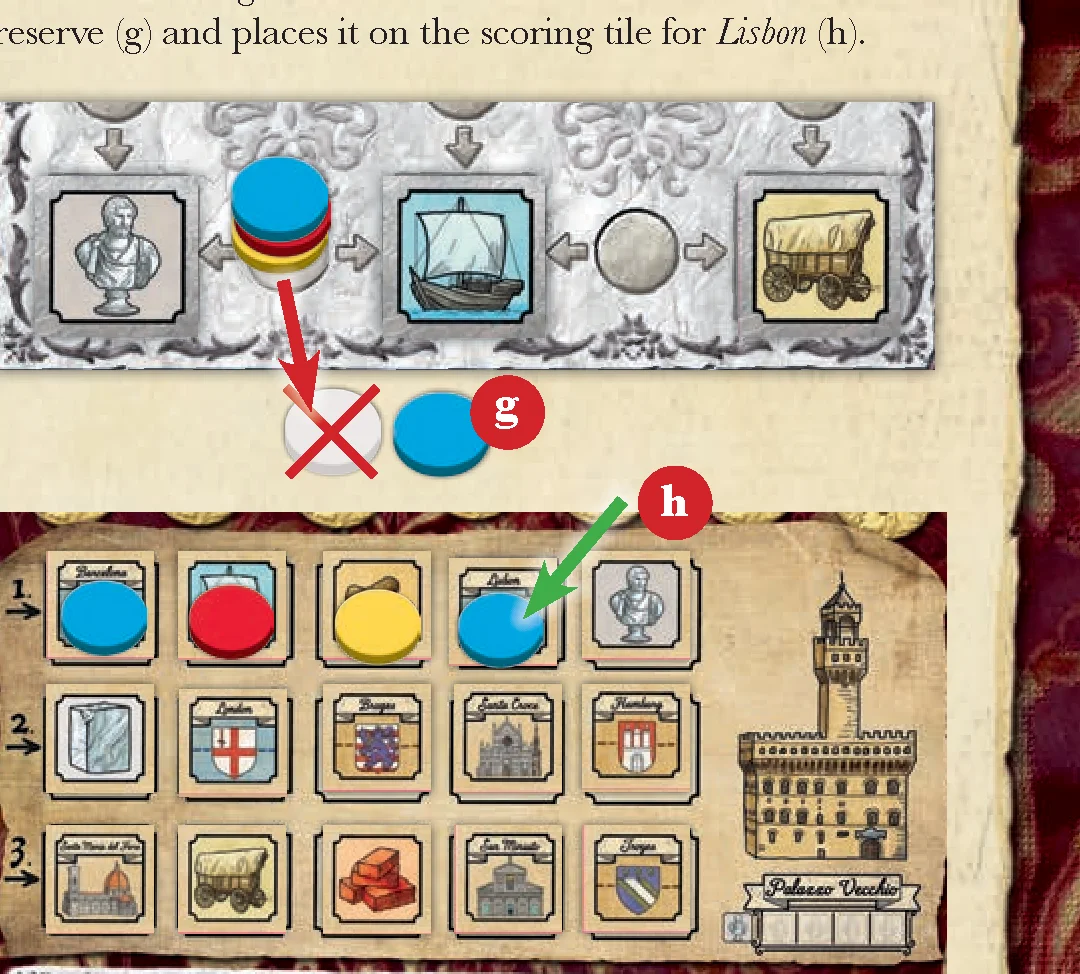
Now, the players score Lisbon!
Angelika and Marion both delivered two cloth cubes to Lisbon, Tanja delivered one cloth cube. Marion has more seats in the city council, so she wins the scoring and receives 3 victory points, while Angelika receives 2 and Tanja 1 victory point. All players adjust their points with their discs on the scoring track.
- AUTHOR: Fabio Lopiano
- DEVELOPMENT: Henning Kröpke, Uli Blennemann
- GRAPHICS: Harald Lieske
- LAYOUT: Filip Stránský
- PUBLISHER: ADC Blackfire Entertainment GmbH, Weidenweg 69, D-47059 Duisburg
Introduction
The ‘Arte di Calimala’, the guild of cloth finishers and merchants in foreign cloth, was one of the greater guilds of Florence, who arrogated to themselves the civic power of the Republic of Florence during the Late Middle Ages.
The woolen cloth trade was the engine that drove the city’s economy and the members of the Calimala were the elite of Florence.
Throughout its long history, the Arte di Calimala supervised the execution of artistic and architectural works. Most Florentine guilds performed such activities, but the Calimala distinguished itself from other guilds through the number and prestige of the projects and the sites administered, including the construction and decoration of some of the major churches of the city.
In this game the players act as members of the guild, produce and trade cloth and gain prestige by delivering their goods to foreign markets, contributing to the construction of buildings and sponsoring art works around the city.
The players assign their trusted employees to various streets within the city to carry out actions. Employees stay on their assigned places for a while, carrying out their actions whenever the street is activated again by other employees, and eventually are promoted into the city council, triggering a scoring phase.
Calimala won the distinguished “Hippodice” game authors’ competition in 2016.
Components
Each copy of Calimala contains the following components:
- A 1 game board
- B 8 action tiles
- C 15 scoring tiles
- D 55 cards (45 action cards, 10 final scoring cards)
- E 5 player mats
- F 65 wooden discs (13 each in five player colors)
- G 200 wooden cubes (40 each in five player colors)
- H 15 wooden ships (3 each in five player colors)
- I 15 wooden trade houses (3 each in five player colors)
- J 10 workshop tiles
- K 1 active player token
- L 10 white wooden discs
- M 5 “50” victory points tiles
- N 2 rulebooks (English & German)
The Game Board, Action Tiles and Scoring Tiles plus Trade Houses
The game board contains four main areas plus a scoring track (1) around it.
- On the top left side of the board is the Palazzo Vecchio (2) – the city council of Florence. It has 15 slots for the scoring tiles and four slots for artworks sponsored by the players. This area triggers the scoring phases and breaks any ties between the players.
- On the bottom left of the board is the city grid (3) with the 8 slots for the action tiles. Streets always “connect” two action slots, and each street contains a round action space where the players will place their wooden discs when taking actions.
- On the top right side of the board are three buildings under construction (4) showing slots for contributions: the cathedral of Santa Maria del Fiore with 15 slots, the church of San Miniato with 9 slots and the church of Santa Croce with 12 slots. Each building also has several slots for artwork (respectively five, three and four slots).
- On the bottom right side of the board is a map with parts of Europe showing six cities (5): three trade cities with slots for trade houses (Troyes, Bruges and Hamburg) and three port cities (Barcelona, Lisbon and London). Each city has 12 slots for the delivery of cloth (cubes). The cities show simplified “city coat of arms”. We slightly adjusted the historical color schemes for a better visualization during play.
The Player Mats, Ships and Workshop Tiles
The player mats consist of four main areas:
- Workshops (1) are in the top right. Each player starts with one workshop and can build up to two additional ones by placing the workshop tiles on the empty slots. Workshops produce cloth cubes and each one stores up to four cloth cubes.
- The port (2) is in the center of the mat. Here the players may build ships.
- Three warehouses (3) are at the bottom right, each can store one resource type (wood, bricks and marble). When acquiring these resources, cubes in the player’s color are placed in an available slot of the corresponding warehouse. Each warehouse may hold a maximum of four cubes.
- On the left side of the mat, the player aid (4) briefly lists the available types of action.
The Action Cards and Scoring Cards
The players will use action cards during the game in addition to the actions triggered on the city grid.
At the end of the game the players score additional points for the scoring cards.
The Wooden Cubes and Active Player Token
Besides ships and trade houses the players also have wooden cubes in their player colors. They use them to mark different resources and clothes of the warehouses and workshops on their player mats and the slots of the buildings and cities on the game board.
During the game, the player taking his turn always has the active player token, so players do not lose track of the player order when they carry out the scoring phases.
Setup
- A: The youngest player will be starting player. He takes the active player token and places it in front of himself.
- B: One player shuffles the 8 action tiles and places them randomly, face up, on the corresponding slots of the city grid.
First game: A player arranges the action tiles in the recommended layout.
- C: One player shuffles the 15 scoring tiles and places them randomly, face up, on the corresponding slots of the city council (Palazzo Vecchio). He starts to place them in the top row and in each row from left to right.
- D: Each player takes a player mat and the following components in the player color of his choice:
- 40 cubes
- 3 ships
- 3 trade houses
- 2 neutral workshop tiles
- The “50” victory points tile next to the scoring track
Depending on the number of players, each player also takes:
- 3 players: 12 discs in the player color of his choice and 3 white discs
- 4 players: 10 discs in the player color of his choice and 2 white discs
- 5 players: 8 discs in the player color of his choice and 2 white discs
- E: Each player places an additional of his colored discs on space “0” of the scoring track. The players put surplus discs back into the game box.
- F: A player shuffles the scoring cards and deals them as follows:
- 3 players: Each player receives 3 cards, the remaining card is placed face up next to the board.
- 4 players: Each player receives 2 cards, one of the remaining cards is placed face up next to the board, the other is placed face down back into the game box.
- 5 players: Each player receives 2 cards. No card is placed face up next to the board.
Each player secretly picks (and keeps) one scoring card. Only these cards (and, with 3 or 4 players, the face up scoring card next to the board) will be scored at the end of the game for all players. The cards that have not been picked are placed back face down in the box, without being revealed. (For details on the scoring cards please check page 11.)
- G: The players place one copy each of the following 5 action cards face up on the table: Wood, Brick, Marble, Weave and Build. Each player, starting with the player sitting to the right of the starting player and continuing in counterclockwise order, takes one of these cards in his hand. Each player begins with one action card. The players shuffle the deck of remaining action cards (in games with less than 5 players including the not chosen action cards) and place it face down next to the game board.
Sequence of Play
Calimala is played in player turns in clockwise order.
The players take turns by choosing and activating different action spaces. Depending on the choice of the active player, the other players may activate the same actions, too.
During the game player turns are interrupted by scoring phases. At that time the players receive victory points. The game ends with a final scoring after all players took the same number of turns.
Choosing an Action Space
In each player turn, the active player places one of his discs on an action space of the city grid, so that he is able to conduct the two “connected” adjacent actions. He may choose to place a colored disc or one of his white discs. If there are already one or more discs on the chosen action space, the active player places the new disc on top, forming a stack. A stack of discs may consist of a maximum of four discs; see Activating an action space on page 8.
Example: Marion places one of her blue discs on the action space on top of Angelika’s red and Tanja’s yellow disc, so she can conduct the two actions connected to this action space.
Activating an Action Space
After placing the disc on the action space, the active player activates that space and the connected two actions. He has to conduct at least one of the two connected actions, if necessary by playing one or more additional action cards. (Therefore a player is not permitted to place a disc to draw two action cards; see the compensation rules below.)
If he placed his disc on top of one or more discs a total of up to three discs of the stack are activated, from top to bottom:
- The active player carries out both actions. He may do this in the order of his choice.
Example: After placing her disc, Marion conducts a wood action and a contribute action in the order of her choice.
- If the active player placed a white disc: he may carry out each of the two actions connected to that action space twice. The player may conduct these actions in any order of his choice: Either A, A, B, B, or A, B, A, B, or A, B, B, A etc.
Example: Marion places one of her white discs on the action space and conducts these actions twice. First, she decides to take wood twice in a row before she conducts the contribute action twice, and giving the wood to San Miniato.
- Afterwards, the player(s) owning the second and third activated colored disc from top to bottom may perform the two actions linked to the action space, too. Again, each player can choose the order of these two actions, when activating his disc. Other white discs in the stack are not activated.
Note: Colored discs, if played early in the game, will be activated up to three times and will generate up to six actions, either by using the action tiles, or by drawing action cards, see below. White discs generate four actions right away, but are not reactivated later.
Example: After Marion conducted the two actions, first Angelika and then Tanja have a chance to perform the wood action and contribute action in the order of their choice, too.
Compensation and Action Cards
- Only if a player cannot carry out an action at all, he draws an action card as compensation and takes it into his hand. If the players owning the second or third activated disc cannot perform both actions, they may draw 2 action cards.
- If a player voluntarily decides to skip an activated action, or carries out an action partially, he does not draw an action card.
- The players keep action cards hidden from the other players, only the number of action cards in their hands is public information.
Example: Now, Angelika activates her red disc. As she does not have any resources in her warehouses, she chooses to conduct the contribute action first and the wood action second. Thus, she draws an action card and gains a wood.
Example: Marion places one of her discs on the action space. She has no marble in her warehouse and cannot conduct the artwork action. Instead, she draws an action card as compensation. Then she conducts the brick action and takes one brick in her warehouse.
Playing Action Cards
- While carrying out the activated actions, a player may also play any number of action cards from his hand, either before or after each of the two actions.
- The player must be able to conduct this action at least partially. If he cannot conduct the action, he cannot play the card. The player cannot discard and replace an action card which he cannot use.
- Afterwards, he discards the played action cards onto a face up discard pile. If the players draw the last action card from the deck, they immediately reshuffle the discard pile and place it face down as the new action deck.
Example: Marion places one of her discs on the action space. As she now has two discs in that stack, she will activate both her discs in this turn, while Angelika activates her disc in between. While activating her topmost disc, Marion is missing a wood to build a ship. Thus, she plays a wood action card from her hand and places one of her blue cubes on the wood warehouse. Then, she conducts the build action. She places the two wood cubes back into her reserve and places a second ship in her port. Now she conducts the ship action and thanks to her two boats delivers two cloth cubes from her workshops to Lisbon.
Next, Angelika takes her turn. She builds a second workshop, removes one cube each from the wood and bricks warehouses and places a workshop tile on her player mat. As she does not have any ships in her port, instead of conducting the ship action she draws an action card.
Now, Marion activates her second blue disc at the bottom of the stack. She does not have enough material to build, and instead draws an action card. She is lucky and gets a weave action card, which she immediately plays to place one cloth cube each in her two workshops. She conducts the ship action and delivers two cloth cubes, one each to Barcelona and London.
- After activating up to three discs on the chosen action space the active player passes the active player token to the next player in clockwise order.
- Exception: Player turns may be interrupted by a scoring phase, if temporarily there is a fourth disc at the bottom of the stack. Please check the next section.
Actions in Detail
Both the actions on the city grid and the action cards offer the following nine actions:
Wood, Brick, Marble
The player receives one wood, one brick or one marble.
The player places one cube in his color from his reserve on an empty slot of the corresponding warehouse on his player mat. Each cube in a warehouse is considered to be that matching resource.
Only if all four slots of the matching warehouse are filled, a player instead draws an action card.
Example: Marion activates the wood action space and places one of her cubes in the wood warehouse. Now all four slots are filled; next time she is supposed to receive wood, Marion would draw an action card.
Build
The player either builds one ship, one trade house, or one workshop.
- To build a ship: he places two cubes from his wood warehouse back into his reserve. Then he places one of his ships on the port on his player mat.
Example: Marion spends two wood cubes and places a ship on the port of her player mat.
- To build a trade house: the player places two cubes from his bricks warehouse back into his reserve. Then he places one of his wooden trade houses on an empty slot in one of the three trade cities. Each player may not have more than one trade house in a single trade city.
Example: Marion spends two brick cubes and places a trade house on one of the slots in Hamburg.
- To build a workshop: the player places one cube each from his wood and bricks warehouses back into his reserve. He takes one of his workshop tiles and places it on the leftmost empty slot of his player mat.
Example: Marion spends a wood cube and a brick cube and places a workshop on her player mat.
Only if a player cannot build any of these three items, either because he has already placed all his available tokens and tiles, or does not have the matching resources, he instead draws an action card.
Artwork
The player creates artwork for one of the four buildings.
He moves one cube from his marble warehouse to an empty artwork slot next to one of the three buildings under construction or to the city council.
Only if a player does not have any marble, or when all slots of all buildings are filled, he instead draws an action card.
Example: Marion moves one of her cubes from the marble warehouse to Santa Croce and places it on an empty artwork slot.
Weave
The player produces cloth in his workshops.
The player places one of his cubes from his reserve on an empty slot of each of his workshops. The cubes are considered to be cloth. This means, if the player activates this action once and already built the second or third workshop, he receives two or even three cubes at the same time.
Only if all slots in all warehouses are filled, the player instead draws an action card.
Example: Marion already has two workshops, therefore she places two of her cubes on empty slots of her workshops, one per workshop.
Ship
The player ships cloth to the port cities.
The player transports one cloth cube with each of his ships from his workshops to a port city – if that city has an empty slot. Thus, if the player activates this action once and already has two or three ships and enough cloth cubes in his workshops, he may decide to deliver cloth cubes with one, two or all three ships. For each ship, he may choose the same or a different city as destination.
A player may decide to ship less cloth cubes than the possible maximum. Only if all slots in all three port cities are filled, or if the player does not have any cloth cubes and/or no ships, he instead draws an action card.
Example: Marion has two ships and enough cloth cubes in her workshops. She delivers two cloth cubes to Lisbon.
Transport
The player transports cloth to the trade cities.
The player transports one cloth cube from his workshops to each of his trade houses in the three trade cities, but at most one cube per trade house. Thus, if the player activates this action once and already has two or three trade houses and enough cloth cubes in his workshops, he may decide to deliver cloth cubes to one, two or all three trade cities.
Only if all slots in all trade cities are filled, or if the player does not have cloth cubes and/or no trade houses, he instead draws an action card.
Example: Marion has a trade house in Hamburg and several cloth cubes in her workshops. She delivers one cloth cube to Hamburg.
Contribute
The player contributes resources to the three buildings under construction: the cathedral of Santa Maria del Fiore, the church of San Miniato, and the church of Santa Croce.
The player moves a cube of his choice from one of his warehouses to a matching empty slot at a resource row at one of the three buildings. Each building has slots for wood, bricks and marble.
Only if all slots at all buildings are filled, or if the player has no matching resource cubes in his warehouses, he instead draws an action card.
Example: Marion contributes a wood cube to Santa Croce. She moves that cube from her wood warehouse to the wood row of the cathedral.
Scoring Phases
There are 15 scoring phases in Calimala plus a final scoring round at the end of the game.
When there is a fourth disc at the bottom of the action stack, the player turn is interrupted by a scoring phase after activation of the three topmost discs.
That fourth disc is not activated! Instead the owner of that disc moves it on one of the scoring tiles of the city council and triggers a scoring. The player’s disc in the city council is considered to be a seat.
Example: After the topmost three discs were activated, Marion moves her bottommost fourth disc to the city council.
City council order: The players place their discs on the scoring tiles starting in the top row and in each row from left to right. The top-left tile is the first to be scored, the bottom-right one the last.
Example: Marion moves her first disc to the city council. As both Angelika and Tanja already each moved one of their discs, Marion places her disc on the third scoring tile of the top row, and triggers a scoring.
Fourth Disc Resolution Rules
- If the fourth disc of the stack is white: the active player exchanges it with one of his discs from his reserve. He places his colored disc on the scoring tile and the white disc into his reserve.
- If he has already placed all his colored discs on action spaces: he instead takes one of his colored discs from any other action space and places it on the scoring tile. In that case, he places the white disc on top of that stack, so that the number of discs in that stack does not change.
Note: The order in which the scorings are triggered is very important. Players should keep an eye on the upcoming three or four scorings.
After finishing the scoring, the active player passes the active player token to the next player in clockwise order.
The Scoring Categories in Detail
For each scoring the players add up their cubes in the specific category:
- City: The players add up their cloth cubes delivered to the corresponding city.
- Building under construction: The players add up their number of contributed wood, brick, marble and artwork cubes in the corresponding building.
- Artwork: The players add up all their contributed artworks at all the four buildings (the three churches and the city council).
- Port Cities: The players add up all their cloth cubes delivered to the three port cities Barcelona, Lisbon and London.
- Trade Cities: The players add up all their cloth cubes delivered to the three trade cities Troyes, Bruges and Hamburg.
- Contribute: Depending on which category is scored, the players add up all their contributed cubes in that category at all three buildings under construction.
Points and Tie-Breaking
The first three players score the following victory points in a specific category:
- The player with the most cubes will gain 3 victory points.
- The player with the second most cubes will gain 2 victory points.
- The player in third place will gain 1 victory point.
- No points are scored for players that do not have any cubes in the scoring category.
In case of a tie, the tied players add up their seats and their contributed artworks in the city council:
- The tied player with the highest sum wins the tie.
- If two or more players have the same sum, the tied player with more seats wins the tie.
- If the number of seats is the same, the tied player who first gained that number of seats wins the tie.
- If the tied players do not have any seats, the tied player who contributed the first artwork wins the tie.
- If the tied players did not contribute any artwork, they evenly split the victory points (rounded down).
Example: Angelika (red) has three seats and contributed one artwork, so she wins all ties. Tanja (yellow) wins ties against Marion (blue), because she gained her second seat before Marion. Nicole (green) is fourth, as her sum of seats and artworks is the lowest.
The players track their victory points by moving their discs on the scoring track around the game board. If a player has 50 or more victory points, he takes his “50” victory points tile and places it next to his player mat.
End of Game & Final Scoring
The game ends when one of the following conditions occurs:
- The players have placed all action discs on the city grid, both their own colored discs and their white discs. In this case, the players score any remaining scoring tiles in the city council without getting additional seats.
- The players have triggered all 15 scoring tiles. In this case, they finish the current “player round” until each player has placed the same total number of discs. The players do not get additional seats in the city council. Therefore they remove the fourth discs in stacks of any activated action spaces from the game.
Afterwards, all players reveal their scoring cards and proceed with the corresponding scoring (with 3 or 4 players including the face up scoring card next to the board):
- Each scoring card either shows one of the six cities (Barcelona, Bruges, Hamburg, Lisbon, London, Troyes) or one of the four buildings (Palazzo Vecchio, Santa Croce, Santa Maria del Fiore, San Miniato).
- The players add up all their cubes in the corresponding area. For the Palazzo Vecchio scoring, each player adds their seats and the contributed artwork cubes.
- The player with the most cubes gains 5 victory points.
- The player with the second most cubes gains 3 victory points.
- The player with the third most cubes gains 1 victory point.
- All ties are resolved as described in the Scoring Phases chapter on page 10.
After all scoring cards are resolved, the player with the most points wins the game! In case of a tie, the player with more seats and contributed artworks in the city council is the winner.
Extended Example of a Player Turn
Choosing and Activating an Action Space
Marion begins her turn by placing one of her blue discs on top of the stack on the action space connected to the Artwork and Ship action (a).
Marion has one cloth cube in each of her two workshops, two marble cubes in the warehouse and two ships in her port. She has an artwork action card and a wood action card in her hand.
First, Marion conducts the Artwork action. She takes one marble cube from her warehouse and moves it to the matching row at Santa Croce (b).
Afterwards, Marion plays the Artwork action card from her hand and moves the second marble cube to Santa Croce, too (c). Both Santa Croce and all artworks will be scored later during the game.
Finally, Marion conducts the Ship action. With two ships and two cloth cubes she may do up to two deliveries to any port cities. She decides to only deliver one cloth cube to Lisbon (d), so that there are now one yellow, two blue and two red cloth cubes.
Now, Angelika activates her red disc in the stack. She has a workshop, two ships in the port, one marble and one stone cube in her warehouses, a Build action card and a trade house in Troyes.
First, Angelika conducts the Artwork action and moves a marble cube from her warehouse to San Miniato.
Angelika does not have any cloth cubes in her workshop, so she cannot conduct the Ship action. Instead she draws an action card and gets a Wood action.
Angelika immediately plays this Wood action card (e) and now has a wood and stone cube in her warehouses. She plays her Build action card and places both cubes back into her reserve to build a workshop (f).
Finally, Tanja activates her disc in the stack. She has no marble or cloth cubes and cannot conduct both actions. Instead, she draws two action cards, which she saves for a later turn.
Scoring Phase
There are four discs in the stack on the action space. Thus, the players interrupt the player turn for a scoring phase, after activating the top three discs of the stack.
There is a white disc at the bottom of the stack. White discs may never be transferred to the city council. Therefore Marion exchanges that disc for one of the blue discs from her reserve (g) and places it on the scoring tile for Lisbon (h).
Now, the players score Lisbon!
Angelika and Marion both delivered two cloth cubes to Lisbon, Tanja delivered one cloth cube. Marion has more seats in the city council, so she wins the scoring and receives 3 victory points, while Angelika receives 2 and Tanja 1 victory point. All players adjust their points with their discs on the scoring track.
Credits
- AUTHOR: Fabio Lopiano
- DEVELOPMENT: Henning Kröpke, Uli Blennemann
- GRAPHICS: Harald Lieske
- LAYOUT: Filip Stránský
- PUBLISHER: ADC Blackfire Entertainment GmbH, Weidenweg 69, D-47059 Duisburg
