Camel Up (Second Edition)
2018
Place your bets, watch camels stack and move, and predict who will finish first and second.
45
minutes
3 - 8
player(s)
8+
Medium Light

About this board game
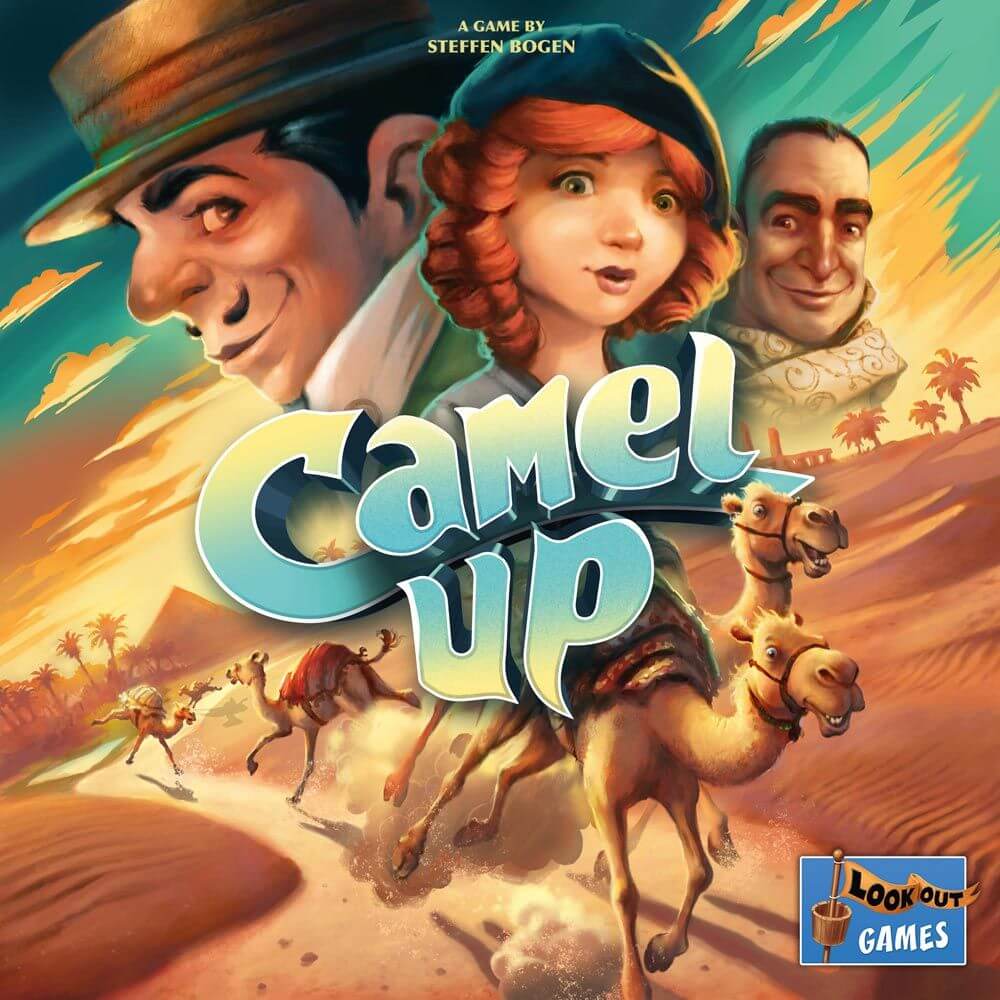
Camel Up (Second Edition) is a betting game for 3–8 players, with races taking about 45 minutes. Players wager on five racing camels as they circle a track around a pyramid, trying to predict which camels will finish first and second.
The earlier you place a bet, the more you can win if your prediction is correct. But the camels do not run in a neat, orderly fashion. A camel can land on top of another camel and be carried along as the camel underneath moves, creating sudden changes in the race.
Movement is determined by the dice released from the pyramid dice shaker. Players pause from placing bets to release one die at a time and discover which camel is moving. This keeps every leg of the race uncertain, as each roll can change the positions and the likely outcome.
- Bet on which camels will finish first and second.
- Watch camels stack together and carry one another around the track.
- Use the pyramid dice shaker to reveal movement one die at a time.
- Explore new game modes, including crazy rogue camels that run in the opposite direction.
This 2018 edition gives Camel Up a complete visual refresh, including new artwork, a new game board design, a new pyramid design, and engraved dice. With unpredictable movement and multiple ways for the race to change, you never know how the finish will unfold.
/pic7182955.jpg)
Board Game Rules for
Camel Up (Second Edition)
Welcome to the craziest camel race you’ll ever see, where you can bet on the most auspicious camels and strike it rich. But the camels tend to carry each other along, so beating the odds is not as easy as you might think. A good sense of timing is just as important as reading the dynamics of the race. However, to make it even harder, two new contestants have joined the race. Unfortunately, these camels are so crazy that they head off in the wrong direction. And even though they are immediately disqualified, they just keep on going… So let the fun begin!
COMPONENTS
- 1 GAME BOARD WITH A GIANT 3D PALM TREE
- 20 BETTING TICKETS (4 of each color)
- 5 PYRAMID TICKETS
- 80 EGYPTIAN POUND COINS (50 × value 1, 30 × value 5)
- 40 FINISH CARDS (5 of each character)
- 8 SPECTATOR TILES (1 of each character)
- 8 PARTNERSHIP CARDS (1 of each character)
- 5 RACING CAMELS
- 5 RACING DICE (Each die matches the color of one of the racing camels and has the numbers 1, 2 and 3 on it twice)
- 2 CRAZY CAMELS
- 1 GREY DIE (The grey die shows the numbers 1, 2 and 3 in white and 1, 2 and 3 in black)
- 1 STARTING PLAYER MARKER
- 1 DICE PYRAMID

- Place the game board in the middle of the table.
- Sort the betting tickets by color (5 colors in total).
Then stack the 4 tickets of each color in the following manner:- Place both
 -Pound tickets on the bottom.
 - Place the
 -Pound ticket on top of them.
 - Place the
 -Pound ticket on the very top.
Then place each stack onto its matching ticket tent on the game board.
- Place both
- Place the 5 pyramid tickets as a stack onto their space on the game board.
- Sort the Egyptian Pound coins by value and place them as a supply next to the game board. This supply is called the “bank”.
- Give each player 3 Egyptian Pounds, which he places in front of him.
- Give each player the 5 finish cards of one character as well as the spectator tile of that character.
- Return any spare finish cards and spectator tiles to the box.
- Each player keeps his hand of five cards hidden from the other players and places his spectator tile in front of him.
- In games with fewer than 6 players, leave the partnership cards in the box – they are not used.
- In games with 6 or more players, give each player his character’s partnership card, which he places in front of him with its “available” side face up. Return any spare partnership cards to the box.
How the partnership cards are used is covered at the end of the rules in the section “Additional rules in games with 6 or more players”.

- To determine the starting positions of the 5 racing camels, take the 5 racing dice and roll them together once. Then place each racing camel onto the race track as indicated by the dice:
- Each racing camel whose matching die rolled a 1 is placed onto space 1 of the track.
- Each camel whose matching die rolled a 2 is placed onto space 2.
- Each camel whose matching die rolled a 3 is placed onto space 3.
Finally, stack all camels standing on the same space (in any order) and make sure they all face clockwise (as this is the direction the race is run).
Example: The dice are rolled with this result:


 . Therefore, you stack the green, yellow, and red camels in any order on space 1. Then you stack the blue and purple camels in any order on space 3.
Afterwards, put the 5 racing dice into the pyramid by removing the cap and dropping the dice through the hole.


- Now determine the starting positions of the 2 crazy camels (black and white) that head in the opposite direction (counterclockwise). To do this, roll the grey die. Then take either of the two crazy camels and place it onto the track as indicated by the number rolled:
- 1 = space 16
- 2 = space 15
- 3 = space 14
Roll the grey die again and place the second crazy camel in the same way. If it is the same space as the first crazy camel, put the second camel on top of the first.
Make sure that the crazy camels face counterclockwise.Example: You roll a
 . Thus you take one of the crazy camels and place it onto space 15. Then you roll a
  and thus place the other crazy camel onto space 16.
Afterwards, drop the grey die into the pyramid, put the cap back on and place the pyramid onto its space on the game board.
- Give the starting player marker to the youngest player and let the race begin!

This overview describes important basics of the game. Detailed rules will follow in the section “Playing the game”.
THE RACING CAMELS
The 5 racing camels do not belong to any player. Instead each player can bet on any of them throughout the race by acquiring betting tickets and placing finish cards.
The racing camels move clockwise around the race track. They do so when a player, as his action, reveals a random die from the pyramid: Then the camel of the revealed color moves as many spaces forward as the die shows.

Camel Stack & Camel Unit
Camel stack: Camels on the same space always form a stack. If a camel that is part of a stack moves, it carries along all camels that sit on top of it. Any camels beneath it are left where they are.

Camel unit: Since sometimes single camels and sometimes camel stacks are moved, we use the term camel unit. A camel unit consists of either a single camel or a stack of camels. If a camel unit ends its movement on a space where there is another camel unit, it jumps on top of that other unit.

THE CRAZY CAMELS
The two crazy camels (black and white) move counterclockwise around the race track. Players cannot bet on them. The crazy camels, however, complicate betting because racing camels landing on their backs might be carried backward again.
A crazy camel moves when the grey die is revealed from the pyramid.

THE LEGS & RANKING
The race comprises several legs. A leg ends when 5 of the 6 dice have been revealed from the pyramid (so one die remains in the pyramid).
At the end of each leg, a leg scoring round occurs, in which players receive or lose money according to the tickets they have acquired during the leg. Afterwards, a new leg starts by returning the acquired tickets to the game board and the 5 revealed dice to the pyramid.
IMPORTANT:
For all purposes of ranking, a racing camel that is farther up a camel stack is always considered ahead of the ones below it.
Crazy camels, however, are ignored for all purposes of ranking, as they have been disqualified by the race organization.

MONEY
- The currency in this game is Egyptian Pounds (also referred to as EP).
- You must store your money publicly in front of you. However, you may stack it up in any way you want.
- For the duration of the race, no player is obliged to disclose exactly how much money he has.
- At any time during the game, you may exchange money one-to-one with money from the bank (for example, exchanging five 1 Pound coins for one 5 Pound coin and so on).
- No player can drop below 0 EP. This means that when you do not have the money to pay a lost bet, you are spared from doing so.
OBJECTIVE & END OF THE GAME OVERVIEW
The game ends as soon as any camel crosses the finish line. Then another leg scoring round occurs, as well as an end of game scoring round for the overall winning camel and the overall losing camel. The player with the most money wins the game.

The player with the starting player marker begins the first leg by performing 1 action.
Then the player to his left performs 1 action, then the next player and so on. Therefore, play proceeds continuously in a clockwise direction.
There are 4 possible actions. When it is your turn, you must choose and perform 1 of them:
- Take the top betting ticket of any stack (and thus back the camel of that color to win the current leg). OR
- Place your spectator tile onto the race track. OR
- Take 1 pyramid ticket and use the pyramid to move a camel. OR
- Bet on the overall winner OR the overall loser by placing 1 of your finish cards face down onto the appropriate betting space.
ACTION 1: TAKE 1 BETTING TICKET
Take the top betting ticket from any stack on the game board and place it in front of you. By doing this, you back the camel of that color (which means that you hope it will be in the lead at the end of the leg).
There is no limit to the number of betting tickets you may collect throughout the leg. You may even have several of the same color.

ACTION 2: PLACE YOUR SPECTATOR TILE
Place your spectator tile onto an empty space of the race track (that has no camels or spectator tile on it). However, you are not allowed to place it onto a space that is adjacent to a space containing a spectator tile. Also, you may never place it onto space 1 of the race track.
- If your spectator tile is already on the game board, you may use this action to move it to a different space (following the same rules).
When you place (or move) your spectator tile, you can either place it with its cheering side up or with its booing side up. Depending on the side, the spectator tile will have a different effect on the movement of camels that stop on it (see below for details).


ACTION 3: TAKE 1 PYRAMID TICKET
Take the top pyramid ticket from the stack on the game board and place it in front of you. Then immediately take the pyramid, shake it, and reveal one die from it.
HOW TO USE THE PYRAMID
- Pick the pyramid up, turn it on its head and shake it thoroughly.
- Turn the pyramid upwards again and hold it with one hand a few inches above the table in front of you.
With the other hand, press the entrance button on the side, thereby revealing one die that falls onto the table. Afterwards, place the pyramid back onto its space on the game board.

Moving Racing Camels
If you reveal a racing die, move the camel of its color as many spaces forward (clockwise) as shown on the die: 1, 2 or 3 spaces.
REMEMBER: If you move a camel that is part of a stack, it carries along all camels that sit on top of it.
Example: The red die is revealed and shows a 3. The red camel moves 3 spaces forward, carrying the yellow camel along with it.

Moving Crazy Camels
If you reveal the grey die, check which crazy camel you must move now:
- If the die shows a white number, you must move the white camel.
- If the die shows a black number, you must move the black camel.
THERE ARE 2 IMPORTANT EXCEPTIONS TO THIS RULE:
- If only one crazy camel is carrying any racing camels on its back, you must move that one, no matter what color the number on the grey die is.
- If one crazy camel is sitting directly on top of the other one (with no racing camels between them), you must move the one on top.
Once you have determined which crazy camel to move, move it as many spaces forward (counterclockwise) as shown on the grey die. (Again, if any camels are sitting on top of it, it carries them along.)
Should a camel unit end its movement on a space with another camel unit, it jumps on top of that other unit.
Example: The purple die is revealed and shows a 2. The purple camel moves 2 spaces forward, carrying along the green camel. Since the yellow camel is already on the space on which they end their movement, purple and green jump on top of it as a unit.

Encountering Spectator Tiles
If a camel unit ends its movement on a space with a spectator tile, the owner of that tile immediately receives 1 Egyptian Pound from the bank. Also (depending on which side of the tile is facing up) the camel unit must immediately move 1 additional space forward or 1 space backward:
- If the tile has its cheering side facing up, the camel unit moves 1 space forward. If it thereby lands on a space with another camel unit, it jumps on top of that unit as usual.

- If the tile has its booing side facing up, the camel unit moves 1 space backward. If it thereby lands on a space with another camel unit, however, it is placed underneath that unit.

If a crazy camel lands on a spectator tile, its movement is influenced in the same way, just in the opposite direction to the racing camels.

NOTE: The camels always keep their orientation: So racing camels keep facing clockwise, crazy camels counterclockwise – even if they go backward.
After a camel unit lands on the spectator tile, the tile still remains on its space (at least until the end of the leg or until its owner moves it as an action).
Completing the Pyramid Action
After you move the appropriate camel, place the revealed die onto a free dice tent in the center of the race track. This way, everybody can keep track of which dice are already out of the pyramid.
Keep the acquired pyramid ticket in front of you.
In the next leg scoring round, you will receive 1 Egyptian Pound for each pyramid ticket you have acquired during the leg.
ACTION 4: BET ON THE OVERALL WINNER OR THE OVERALL LOSER
As your action, you can bet on the overall winner. This means you secretly back the racing camel that you believe will be in the lead at the end of the game. To do this, secretly choose 1 of your finish cards (in the color of the camel you think will win) and put it face down onto the betting space for the overall winner.
You may instead bet on the overall loser (backing the racing camel that you believe will be last on the race track at the end of the game) by secretly choosing 1 of your finish cards and putting it face down onto the betting space for the overall loser.
- If there are already any cards on your chosen betting space, put yours on top of them.
- Once placed, a card must stay where it is, even if you later realize you backed the wrong camel. However, as long as you have finish cards in hand, you may always choose as your action to place 1 of them onto either betting space.

When a player takes the last pyramid ticket from the game board, he first reveals a die from the pyramid and moves the corresponding camel as usual. Then, before the next player takes his turn, a leg scoring round occurs for all players:
- Start by giving the starting player marker to the player to the left of the player who just took the last pyramid ticket (so you will remember who will start the next leg).
- Then check which racing camel is in the lead (on the space farthest along the race track, in a clockwise direction). If there is a stack of camels in the lead, the leading camel is the one on top of the stack.
REMEMBER: The crazy camels are entirely ignored for the ranking. - Now, each player gains or loses Egyptian Pounds according to the tickets in front of him, by adding up his total and then taking it from (or paying it to) the bank accordingly:
- For each betting ticket of the leading racing camel, the player gains the number of Egyptian Pounds printed in large on the ticket:
 ,
,  , or
, or  .
. - For each betting ticket of the racing camel in second place, the player gains 1 EP.
- For each betting ticket of any other racing camel, the player loses 1 EP.
- For each pyramid ticket, the player gains 1 EP.
- For each betting ticket of the leading racing camel, the player gains the number of Egyptian Pounds printed in large on the ticket:

Example: In the leg scoring round, the green camel is in the lead. The yellow camel is in second place. Martina has the following tickets in front of her, which give her 9 Egyptian Pounds in total:

CLEAN UP
After all players have collected (or paid) their money, clean up by:
- returning all betting tickets to their corresponding stacks on the game board in the usual order (from bottom to top: 2>2>3>5),
- returning all pyramid tickets as a stack to their space on the game board,
- returning any spectator tiles from the race track to their owners,
- returning the 5 revealed dice from the dice tents to the pyramid.
Then the player with the starting player marker starts the new leg.
As soon as any camel unit crosses the finish line, the race ends immediately (even if a crazy camel crosses the finish line in a counterclockwise direction).
- Now, carry out one more leg scoring round (as described on the left).
- Next, the end of game scoring round for the overall winner and overall loser occurs. For this, first attend to the face-down card deck on the betting space for the overall winner. Remember that in this deck, the card on the bottom was the first card placed, the card on top the last. Turn the entire deck face up, so that now the card placed first is face up on top, while the card placed last is on the bottom.
Now, players gain or lose money according to the cards they have placed in that deck. Start at the top and go through the face-up deck card by card, awarding money to the owner of each card that shows the actual winning camel:
- The player (if any) that placed the first card showing the actual winner of the race receives 8 Egyptian Pounds from the bank.
- The player (if any) who placed the second card showing the winner receives 5 EP, the third player 3 EP, the fourth player 2 EP, all others 1 EP.
- Note that this only applies to cards showing the actual winner. For each card in the deck that shows any camel other than the winner, the owner of that card must pay 1 EP to the bank.
After going through the deck for the overall winner, go through the deck of cards for the overall loser in the same way. The overall loser, of course, is the least advanced racing camel (in the case of a stack, it is the camel on the bottom of the stack).
Example: The green camel is the winner of the race, the purple camel is the loser. The decks on the betting spaces give the owner of each card EP as follows:

WINNER OF THE GAME
After the end of game scoring round, all players count their money. The player who collected the most Egyptian Pounds wins the game. In the case of a tie, the victory is shared.
NOTE: In the rare case that a crazy camel carries any racing camels across the finish line in a counterclockwise direction, those camels count as the least advanced camels.
In games with 6 or more players, each player also has a partnership card in front of him. On his turn, a player can now choose to perform a 5th possible action called “Enter into a betting partnership”.
5 ENTER INTO A BETTING PARTNERSHIP
You can only perform this action if you have your partnership card with the “available” side face up in front of you.
Choose another player who also has his partnership card with the “available” side face up in front of him. Take his partnership card and place it with its “partnership” side face up in front of you. Then give this player your own partnership card, which he places with its “partnership” side face up in front of him. He may not refuse to exchange his card with you. Now, for the remainder of this leg, you and this player are betting partners.

Leg Scoring with a Partner
At the end of each leg, in the leg scoring round, every player who has a betting partner may choose one ticket belonging to his partner (betting ticket or pyramid ticket) and add its reward to the rewards of his own tickets (i.e. both partners get the rewards of all of their own tickets plus 1 reward that they copy from their partner). However, a player is not obliged to add the reward of one of his partner’s tickets to his own (for example, if his partner only had negative tickets). After the leg scoring round has been completed, return all partnership cards to their owners with the “available” side face up.


Steffen Bogen would like to thank all the testers who led the camels to their oases. Special thanks go to those testers whose names are engraved on the buildings on the game board.
Also we would like to thank Dennis Lohausen for being a huge source of inspiration.
- Game Design: Steffen Bogen
- Producer: Sophie Gravel
- Development: Viktor Kobilke, Martin Bouchard, Peter Eggert, Philippe Schmit & Sophie Gravel
- Art Direction: Philippe Guérin
- Illustrations: Chris Quilliams
- Graphic Design: Philippe Guérin, Karla Ron & Marie-Eve Joly
- Editing: Viktor Kobilke
- Revision: Neil Crowley & Anh Tú Tran
- Foreign Affairs: Andrea Ahlers, Katja Wienicke & Philipp El Alaoui
- Communications: Mike Young
- Marketing: Martin Bouchard
Development by: EGGERTSPIELE
www.eggertspiele.com
[email protected]
© 2018 Plan B Games Europe GmbH
Sinstorfer Weg 70, 21077 Hamburg, Germany
Eggertspiele is a brand of Plan B Games Europe GmbH.
No part of this product may be reproduced without specific permission.
Retain this information for your records.
Made in China.
Components & Introduction
Welcome to the craziest camel race you’ll ever see, where you can bet on the most auspicious camels and strike it rich. But the camels tend to carry each other along, so beating the odds is not as easy as you might think. A good sense of timing is just as important as reading the dynamics of the race. However, to make it even harder, two new contestants have joined the race. Unfortunately, these camels are so crazy that they head off in the wrong direction. And even though they are immediately disqualified, they just keep on going… So let the fun begin!
COMPONENTS
- 1 GAME BOARD WITH A GIANT 3D PALM TREE
- 20 BETTING TICKETS (4 of each color)
- 5 PYRAMID TICKETS
- 80 EGYPTIAN POUND COINS (50 × value 1, 30 × value 5)
- 40 FINISH CARDS (5 of each character)
- 8 SPECTATOR TILES (1 of each character)
- 8 PARTNERSHIP CARDS (1 of each character)
- 5 RACING CAMELS
- 5 RACING DICE (Each die matches the color of one of the racing camels and has the numbers 1, 2 and 3 on it twice)
- 2 CRAZY CAMELS
- 1 GREY DIE (The grey die shows the numbers 1, 2 and 3 in white and 1, 2 and 3 in black)
- 1 STARTING PLAYER MARKER
- 1 DICE PYRAMID
Setup
- Place the game board in the middle of the table.
- Sort the betting tickets by color (5 colors in total).
Then stack the 4 tickets of each color in the following manner:- Place both -Pound tickets on the bottom.
- Place the -Pound ticket on top of them.
- Place the -Pound ticket on the very top.
Then place each stack onto its matching ticket tent on the game board.
- Place both
- Place the 5 pyramid tickets as a stack onto their space on the game board.
- Sort the Egyptian Pound coins by value and place them as a supply next to the game board. This supply is called the “bank”.
- Give each player 3 Egyptian Pounds, which he places in front of him.
- Give each player the 5 finish cards of one character as well as the spectator tile of that character.
- Return any spare finish cards and spectator tiles to the box.
- Each player keeps his hand of five cards hidden from the other players and places his spectator tile in front of him.
- In games with fewer than 6 players, leave the partnership cards in the box – they are not used.
- In games with 6 or more players, give each player his character’s partnership card, which he places in front of him with its “available” side face up. Return any spare partnership cards to the box.
How the partnership cards are used is covered at the end of the rules in the section “Additional rules in games with 6 or more players”.
- To determine the starting positions of the 5 racing camels, take the 5 racing dice and roll them together once. Then place each racing camel onto the race track as indicated by the dice:
- Each racing camel whose matching die rolled a 1 is placed onto space 1 of the track.
- Each camel whose matching die rolled a 2 is placed onto space 2.
- Each camel whose matching die rolled a 3 is placed onto space 3.
Finally, stack all camels standing on the same space (in any order) and make sure they all face clockwise (as this is the direction the race is run).
Example: The dice are rolled with this result:
. Therefore, you stack the green, yellow, and red camels in any order on space 1. Then you stack the blue and purple camels in any order on space 3.Afterwards, put the 5 racing dice into the pyramid by removing the cap and dropping the dice through the hole.
- Now determine the starting positions of the 2 crazy camels (black and white) that head in the opposite direction (counterclockwise). To do this, roll the grey die. Then take either of the two crazy camels and place it onto the track as indicated by the number rolled:
- 1 = space 16
- 2 = space 15
- 3 = space 14
Roll the grey die again and place the second crazy camel in the same way. If it is the same space as the first crazy camel, put the second camel on top of the first.
Make sure that the crazy camels face counterclockwise.Example: You roll a
. Thus you take one of the crazy camels and place it onto space 15. Then you roll a and thus place the other crazy camel onto space 16.Afterwards, drop the grey die into the pyramid, put the cap back on and place the pyramid onto its space on the game board.
- Give the starting player marker to the youngest player and let the race begin!
Core Concepts
This overview describes important basics of the game. Detailed rules will follow in the section “Playing the game”.
THE RACING CAMELS
The 5 racing camels do not belong to any player. Instead each player can bet on any of them throughout the race by acquiring betting tickets and placing finish cards.
The racing camels move clockwise around the race track. They do so when a player, as his action, reveals a random die from the pyramid: Then the camel of the revealed color moves as many spaces forward as the die shows.
Camel Stack & Camel Unit
Camel stack: Camels on the same space always form a stack. If a camel that is part of a stack moves, it carries along all camels that sit on top of it. Any camels beneath it are left where they are.
Camel unit: Since sometimes single camels and sometimes camel stacks are moved, we use the term camel unit. A camel unit consists of either a single camel or a stack of camels. If a camel unit ends its movement on a space where there is another camel unit, it jumps on top of that other unit.
THE CRAZY CAMELS
The two crazy camels (black and white) move counterclockwise around the race track. Players cannot bet on them. The crazy camels, however, complicate betting because racing camels landing on their backs might be carried backward again.
A crazy camel moves when the grey die is revealed from the pyramid.
THE LEGS & RANKING
The race comprises several legs. A leg ends when 5 of the 6 dice have been revealed from the pyramid (so one die remains in the pyramid).
At the end of each leg, a leg scoring round occurs, in which players receive or lose money according to the tickets they have acquired during the leg. Afterwards, a new leg starts by returning the acquired tickets to the game board and the 5 revealed dice to the pyramid.
IMPORTANT:
For all purposes of ranking, a racing camel that is farther up a camel stack is always considered ahead of the ones below it.
Crazy camels, however, are ignored for all purposes of ranking, as they have been disqualified by the race organization.
MONEY
- The currency in this game is Egyptian Pounds (also referred to as EP).
- You must store your money publicly in front of you. However, you may stack it up in any way you want.
- For the duration of the race, no player is obliged to disclose exactly how much money he has.
- At any time during the game, you may exchange money one-to-one with money from the bank (for example, exchanging five 1 Pound coins for one 5 Pound coin and so on).
- No player can drop below 0 EP. This means that when you do not have the money to pay a lost bet, you are spared from doing so.
OBJECTIVE & END OF THE GAME OVERVIEW
The game ends as soon as any camel crosses the finish line. Then another leg scoring round occurs, as well as an end of game scoring round for the overall winning camel and the overall losing camel. The player with the most money wins the game.
How to Play
The player with the starting player marker begins the first leg by performing 1 action.
Then the player to his left performs 1 action, then the next player and so on. Therefore, play proceeds continuously in a clockwise direction.
There are 4 possible actions. When it is your turn, you must choose and perform 1 of them:
- Take the top betting ticket of any stack (and thus back the camel of that color to win the current leg). OR
- Place your spectator tile onto the race track. OR
- Take 1 pyramid ticket and use the pyramid to move a camel. OR
- Bet on the overall winner OR the overall loser by placing 1 of your finish cards face down onto the appropriate betting space.
ACTION 1: TAKE 1 BETTING TICKET
Take the top betting ticket from any stack on the game board and place it in front of you. By doing this, you back the camel of that color (which means that you hope it will be in the lead at the end of the leg).
There is no limit to the number of betting tickets you may collect throughout the leg. You may even have several of the same color.
ACTION 2: PLACE YOUR SPECTATOR TILE
Place your spectator tile onto an empty space of the race track (that has no camels or spectator tile on it). However, you are not allowed to place it onto a space that is adjacent to a space containing a spectator tile. Also, you may never place it onto space 1 of the race track.
- If your spectator tile is already on the game board, you may use this action to move it to a different space (following the same rules).
When you place (or move) your spectator tile, you can either place it with its cheering side up or with its booing side up. Depending on the side, the spectator tile will have a different effect on the movement of camels that stop on it (see below for details).
ACTION 3: TAKE 1 PYRAMID TICKET
Take the top pyramid ticket from the stack on the game board and place it in front of you. Then immediately take the pyramid, shake it, and reveal one die from it.
HOW TO USE THE PYRAMID
- Pick the pyramid up, turn it on its head and shake it thoroughly.
- Turn the pyramid upwards again and hold it with one hand a few inches above the table in front of you.
With the other hand, press the entrance button on the side, thereby revealing one die that falls onto the table. Afterwards, place the pyramid back onto its space on the game board.
Moving Racing Camels
If you reveal a racing die, move the camel of its color as many spaces forward (clockwise) as shown on the die: 1, 2 or 3 spaces.
REMEMBER: If you move a camel that is part of a stack, it carries along all camels that sit on top of it.
Example: The red die is revealed and shows a 3. The red camel moves 3 spaces forward, carrying the yellow camel along with it.
Moving Crazy Camels
If you reveal the grey die, check which crazy camel you must move now:
- If the die shows a white number, you must move the white camel.
- If the die shows a black number, you must move the black camel.
THERE ARE 2 IMPORTANT EXCEPTIONS TO THIS RULE:
- If only one crazy camel is carrying any racing camels on its back, you must move that one, no matter what color the number on the grey die is.
- If one crazy camel is sitting directly on top of the other one (with no racing camels between them), you must move the one on top.
Once you have determined which crazy camel to move, move it as many spaces forward (counterclockwise) as shown on the grey die. (Again, if any camels are sitting on top of it, it carries them along.)
Should a camel unit end its movement on a space with another camel unit, it jumps on top of that other unit.
Example: The purple die is revealed and shows a 2. The purple camel moves 2 spaces forward, carrying along the green camel. Since the yellow camel is already on the space on which they end their movement, purple and green jump on top of it as a unit.
Encountering Spectator Tiles
If a camel unit ends its movement on a space with a spectator tile, the owner of that tile immediately receives 1 Egyptian Pound from the bank. Also (depending on which side of the tile is facing up) the camel unit must immediately move 1 additional space forward or 1 space backward:
- If the tile has its cheering side facing up, the camel unit moves 1 space forward. If it thereby lands on a space with another camel unit, it jumps on top of that unit as usual.
- If the tile has its booing side facing up, the camel unit moves 1 space backward. If it thereby lands on a space with another camel unit, however, it is placed underneath that unit.
If a crazy camel lands on a spectator tile, its movement is influenced in the same way, just in the opposite direction to the racing camels.
NOTE: The camels always keep their orientation: So racing camels keep facing clockwise, crazy camels counterclockwise – even if they go backward.
After a camel unit lands on the spectator tile, the tile still remains on its space (at least until the end of the leg or until its owner moves it as an action).
Completing the Pyramid Action
After you move the appropriate camel, place the revealed die onto a free dice tent in the center of the race track. This way, everybody can keep track of which dice are already out of the pyramid.
Keep the acquired pyramid ticket in front of you.
In the next leg scoring round, you will receive 1 Egyptian Pound for each pyramid ticket you have acquired during the leg.
ACTION 4: BET ON THE OVERALL WINNER OR THE OVERALL LOSER
As your action, you can bet on the overall winner. This means you secretly back the racing camel that you believe will be in the lead at the end of the game. To do this, secretly choose 1 of your finish cards (in the color of the camel you think will win) and put it face down onto the betting space for the overall winner.
You may instead bet on the overall loser (backing the racing camel that you believe will be last on the race track at the end of the game) by secretly choosing 1 of your finish cards and putting it face down onto the betting space for the overall loser.
- If there are already any cards on your chosen betting space, put yours on top of them.
- Once placed, a card must stay where it is, even if you later realize you backed the wrong camel. However, as long as you have finish cards in hand, you may always choose as your action to place 1 of them onto either betting space.
End of a Leg
When a player takes the last pyramid ticket from the game board, he first reveals a die from the pyramid and moves the corresponding camel as usual. Then, before the next player takes his turn, a leg scoring round occurs for all players:
- Start by giving the starting player marker to the player to the left of the player who just took the last pyramid ticket (so you will remember who will start the next leg).
- Then check which racing camel is in the lead (on the space farthest along the race track, in a clockwise direction). If there is a stack of camels in the lead, the leading camel is the one on top of the stack.
REMEMBER: The crazy camels are entirely ignored for the ranking. - Now, each player gains or loses Egyptian Pounds according to the tickets in front of him, by adding up his total and then taking it from (or paying it to) the bank accordingly:
- For each betting ticket of the leading racing camel, the player gains the number of Egyptian Pounds printed in large on the ticket: , , or .
- For each betting ticket of the racing camel in second place, the player gains 1 EP.
- For each betting ticket of any other racing camel, the player loses 1 EP.
- For each pyramid ticket, the player gains 1 EP.
- For each betting ticket of the leading racing camel, the player gains the number of Egyptian Pounds printed in large on the ticket:
Example: In the leg scoring round, the green camel is in the lead. The yellow camel is in second place. Martina has the following tickets in front of her, which give her 9 Egyptian Pounds in total:
CLEAN UP
After all players have collected (or paid) their money, clean up by:
- returning all betting tickets to their corresponding stacks on the game board in the usual order (from bottom to top: 2>2>3>5),
- returning all pyramid tickets as a stack to their space on the game board,
- returning any spectator tiles from the race track to their owners,
- returning the 5 revealed dice from the dice tents to the pyramid.
Then the player with the starting player marker starts the new leg.
End of the Game & Final Scoring
As soon as any camel unit crosses the finish line, the race ends immediately (even if a crazy camel crosses the finish line in a counterclockwise direction).
- Now, carry out one more leg scoring round (as described on the left).
- Next, the end of game scoring round for the overall winner and overall loser occurs. For this, first attend to the face-down card deck on the betting space for the overall winner. Remember that in this deck, the card on the bottom was the first card placed, the card on top the last. Turn the entire deck face up, so that now the card placed first is face up on top, while the card placed last is on the bottom.
Now, players gain or lose money according to the cards they have placed in that deck. Start at the top and go through the face-up deck card by card, awarding money to the owner of each card that shows the actual winning camel:
- The player (if any) that placed the first card showing the actual winner of the race receives 8 Egyptian Pounds from the bank.
- The player (if any) who placed the second card showing the winner receives 5 EP, the third player 3 EP, the fourth player 2 EP, all others 1 EP.
- Note that this only applies to cards showing the actual winner. For each card in the deck that shows any camel other than the winner, the owner of that card must pay 1 EP to the bank.
After going through the deck for the overall winner, go through the deck of cards for the overall loser in the same way. The overall loser, of course, is the least advanced racing camel (in the case of a stack, it is the camel on the bottom of the stack).
Example: The green camel is the winner of the race, the purple camel is the loser. The decks on the betting spaces give the owner of each card EP as follows:
WINNER OF THE GAME
After the end of game scoring round, all players count their money. The player who collected the most Egyptian Pounds wins the game. In the case of a tie, the victory is shared.
NOTE: In the rare case that a crazy camel carries any racing camels across the finish line in a counterclockwise direction, those camels count as the least advanced camels.
Additional Rules for 6 or More Players
In games with 6 or more players, each player also has a partnership card in front of him. On his turn, a player can now choose to perform a 5th possible action called “Enter into a betting partnership”.
5 ENTER INTO A BETTING PARTNERSHIP
You can only perform this action if you have your partnership card with the “available” side face up in front of you.
Choose another player who also has his partnership card with the “available” side face up in front of him. Take his partnership card and place it with its “partnership” side face up in front of you. Then give this player your own partnership card, which he places with its “partnership” side face up in front of him. He may not refuse to exchange his card with you. Now, for the remainder of this leg, you and this player are betting partners.
Leg Scoring with a Partner
At the end of each leg, in the leg scoring round, every player who has a betting partner may choose one ticket belonging to his partner (betting ticket or pyramid ticket) and add its reward to the rewards of his own tickets (i.e. both partners get the rewards of all of their own tickets plus 1 reward that they copy from their partner). However, a player is not obliged to add the reward of one of his partner’s tickets to his own (for example, if his partner only had negative tickets). After the leg scoring round has been completed, return all partnership cards to their owners with the “available” side face up.
Credits
Steffen Bogen would like to thank all the testers who led the camels to their oases. Special thanks go to those testers whose names are engraved on the buildings on the game board.
Also we would like to thank Dennis Lohausen for being a huge source of inspiration.
- Game Design: Steffen Bogen
- Producer: Sophie Gravel
- Development: Viktor Kobilke, Martin Bouchard, Peter Eggert, Philippe Schmit & Sophie Gravel
- Art Direction: Philippe Guérin
- Illustrations: Chris Quilliams
- Graphic Design: Philippe Guérin, Karla Ron & Marie-Eve Joly
- Editing: Viktor Kobilke
- Revision: Neil Crowley & Anh Tú Tran
- Foreign Affairs: Andrea Ahlers, Katja Wienicke & Philipp El Alaoui
- Communications: Mike Young
- Marketing: Martin Bouchard
Development by: EGGERTSPIELE
www.eggertspiele.com
[email protected]
© 2018 Plan B Games Europe GmbH
Sinstorfer Weg 70, 21077 Hamburg, Germany
Eggertspiele is a brand of Plan B Games Europe GmbH.
No part of this product may be reproduced without specific permission.
Retain this information for your records.
Made in China.