
Earth
2023
Create a self-sustaining tableau of flora, fauna, resources, and natural synergies in a richly strategic game for 1–5 players.
90
minutes
1 - 5
player(s)
13+
Medium


About this board game
Earth is a tableau-building strategy game for 1–5 players, with games lasting about 90 minutes. Inspired by the planet’s rich environments, it invites players to create thriving ecosystems from interconnected cards.
Build a self-supporting engine of growth, expansion, and supply as your tableau develops. Every game offers countless strategic possibilities, with near-infinite combinations allowing you to discover fresh synergies and connections between the elements of your growing environment.
Players use their cards to choose actions, and those actions affect everyone at the table. As you gain resources and expand your tableau, each decision can contribute to a larger network of natural relationships and productive effects.
- Create a tableau inspired by Earth’s flora, fauna, habitats, and ecosystems.
- Develop natural synergies and connections between your cards.
- Turn unused plants into compost for future growth.
- Compete to complete your tableau and earn the most points.
Earth’s encyclopedic nature gives every session a sense of discovery. Over thousands of years of evolution and adaptation, life forms have developed remarkable ways to coexist, and your tableau reflects that versatility through combinations that can unfold differently from game to game.
The first player to complete their tableau triggers the end of the game. After scoring, the player with the most points wins, rewarding thoughtful development and the ability to make the most of your available resources.
With simple rules and abundant strategic depth, Earth offers an engaging challenge for players who enjoy building interconnected systems and exploring new possibilities in every game.
Mechanics
Designer
Illustrators
/pic7182955.jpg)

Board Game Rules for
Earth
Earth, the soil that supports and sustains our beautiful planet, Earth. Over millions of years of evolution and adaptation, the Flora and Fauna of this unique planet have grown and developed into amazing life-forms, creating symbiotic ecosystems and habitats. It’s time to jump into these rich environments and create some amazing natural synergies that replicate and extrapolate on Earth’s amazing versatility and plethora of natural resources.
Create a self-supporting engine of growth, expansion and supply where even your unused Flora become compost for future growth. Earth is an open-world engine builder for 1 to 5 players with simple rules but many strategic possibilities.
With the enormous number of unique cards and combinations, every game will allow you to discover new synergies and connections, just as our vast and fascinating world allows us to do!
Game Objective
The objective in Earth is to score as many Victory Points  (VP) as possible. To do so, you will “plant” cards to create your own island—a 16-card tableau arranged as a grid 4 cards wide by 4 cards tall.
The game ends at the end of a round after a player plants their 16th card, which completes their island.
Players will score points for:
- The value of Flora and Event cards
- Growth and Sprouts placed on their Flora
- Cards in their Compost
- Ecosystem, Fauna, and Terrain bonus points.
Balancing these elements and creating an effective engine is key to maximizing your Victory Points!
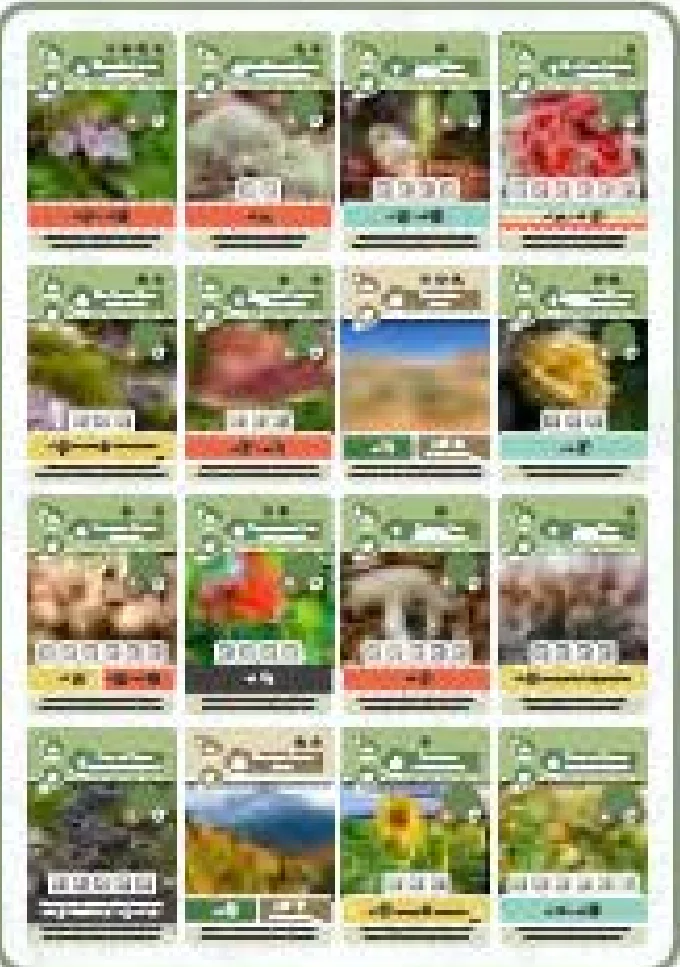
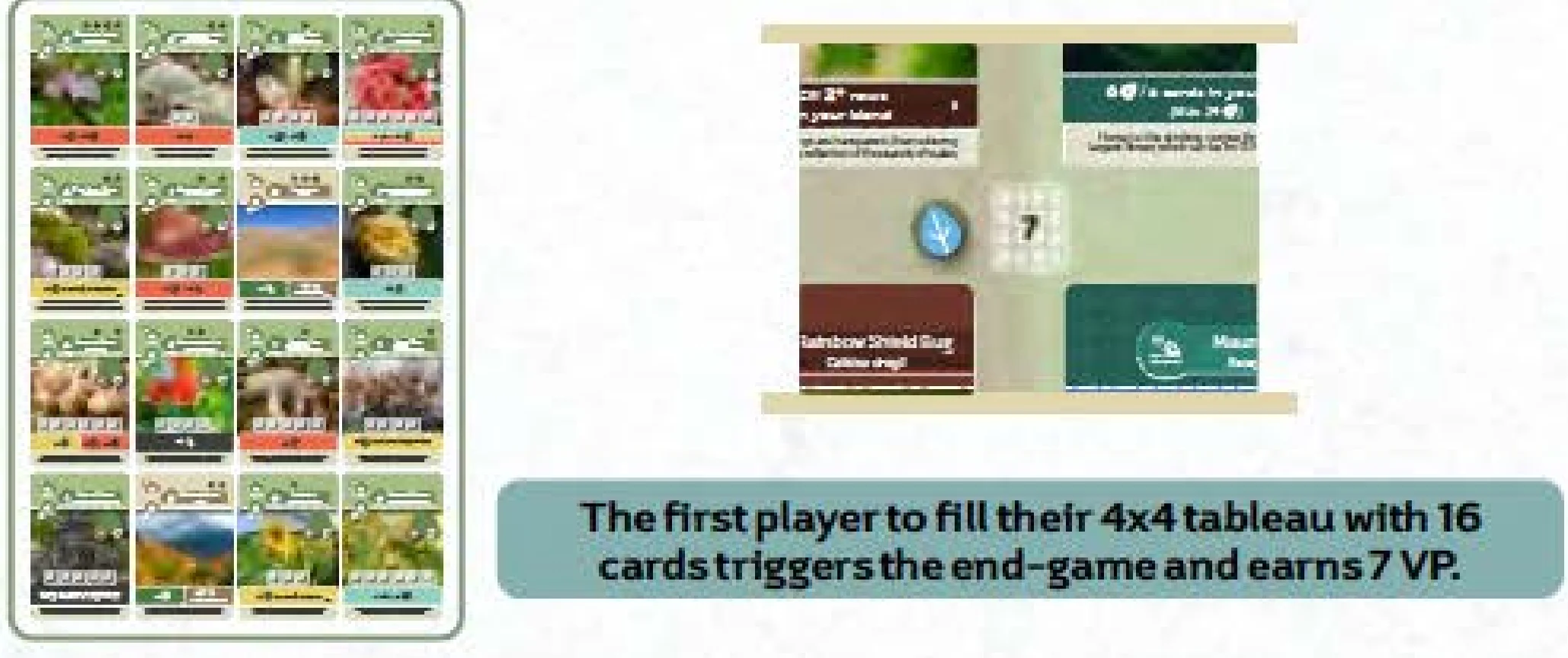
The first player to fill their 4×4 tableau with 16 cards triggers the game end and earns a bonus of 7 VP.
Throughout the rules gray boxes like these will indicate important details which should not be overlooked!
Beige boxes like these will indicate tips and options to make the game easier for new players. Like this one!
Components
- Fauna board
- Player board
- Sprouts
- Soil tokens
- Trunks (Growth)
- Canopies (Growth)
- Earth cards (Flora, Terrain & Event)
- Fauna cards
- Ecosystem cards
- Island cards
- Climate cards
- First player token
- Active player token
- Leaf tokens (in 5 player colours)
- Score pad
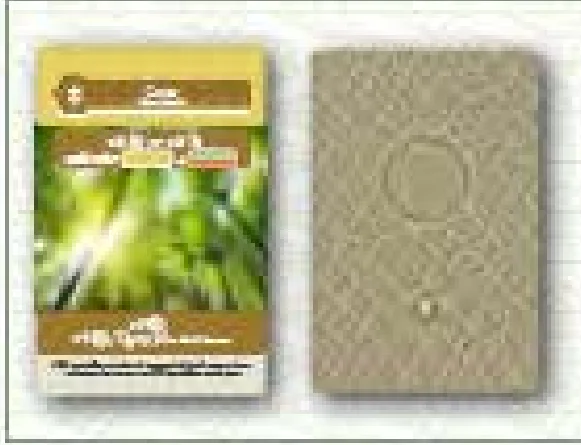
6 cards with a darker back and a
icon are used only in the solo game.
Game Mode Comparison
| Game Mode | Island cards dealt to each player | Climate cards dealt to each player | Ecosystem cards dealt to each player | Fauna board |
|---|---|---|---|---|
| Beginner | 1 | 1 | Not used |  No Ecosystem Cards No Ecosystem Cards |
| Standard | 1 | 1 | 1 | 2 Ecosystem Cards |
| Advanced | 2 | 2 | 2 | 2 Ecosystem Cards |
Shared Setup
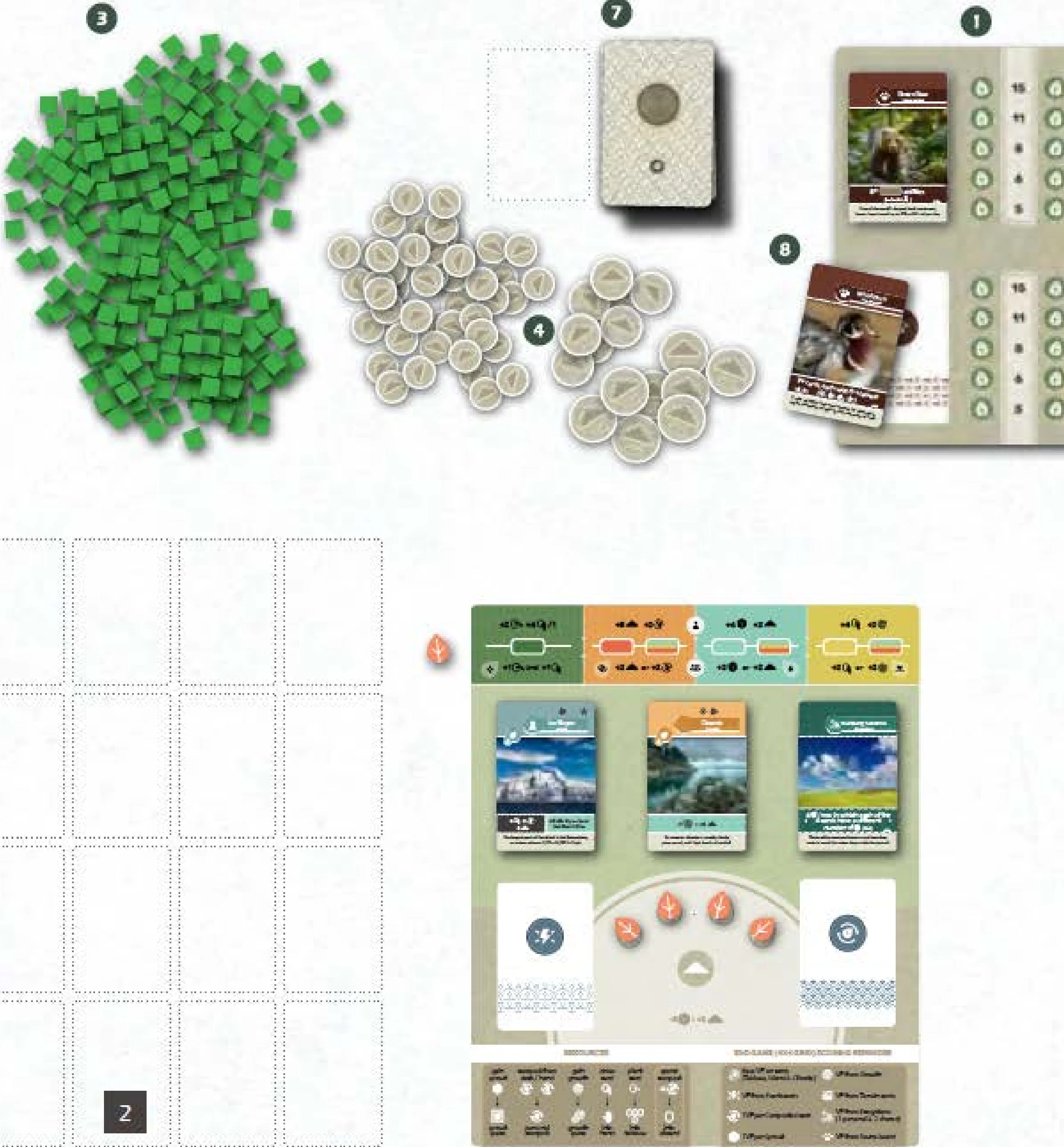
- Place the Fauna board (1) in the center of the table within view of all players. For a simpler game, use the beginner side of the board, marked with a icon in the center.
- Hand out a player board (2) to each player. Make sure all players are using the same side (front) of their player board. The back of some boards are used for other game variations, including solo and teams. Leave space next to each player board where a 4×4 tableau of cards can be created during game play. A tableau and player board create the player’s area.
- Create the central supply by placing all Sprouts (3), Soil tokens (4), and Growth (Trunk (5), Canopy (6)) next to the Fauna board.
- Shuffle all Earth cards (7) and place them in a facedown draw pile (7) within reach of all players. Leave space for a discard pile next to the draw pile(s).
- Shuffle the Fauna cards (8) and then place one on each of the 4
 spaces on the Fauna board, with either side faceup. The remaining Fauna cards will not be used for this game and should be returned to the box.
 - Shuffle the Ecosystem cards (9) and then place one on each of the 2
 spaces on the Fauna board, with either side faceup. Then deal 1 Ecosystem card to each player and continue to the INDIVIDUAL SETUP. The remaining Ecosystem cards will not be used for this game and should be returned to the box.
In a beginner game
Individual Setup
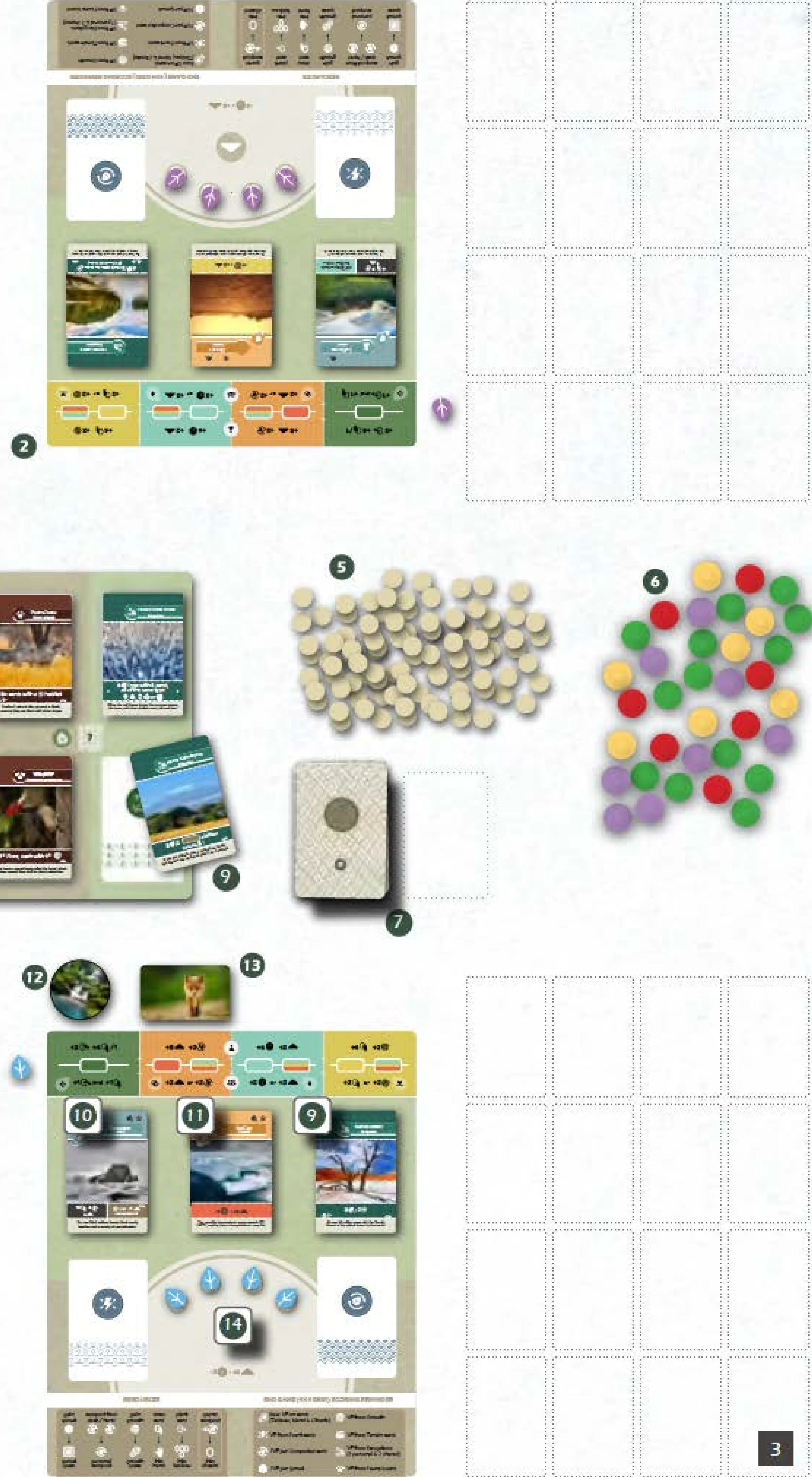
- Shuffle the Island cards (10), and then deal one to each player. The remainder will not be used for this game and should be returned to the box.
- Repeat with the Climate cards (11).
For advanced players, deal out 2 Island, 2 Climate, and 2 Ecosystem cards for them to choose from.
- Once all players are ready, randomly choose a starting player, and give them the First player token (12) and the Active player token (13).
- Each player must now select one side of their Island, Climate, and Ecosystem cards to use by placing it faceup on its corresponding space on their player board.
Island, Climate, and Ecosystem cards grant different starting resources, abilities, and Victory Points—it is recommended to check the Fauna board and choose cards that will help you achieve these objectives.
- Each player takes 5 Leaf tokens of one colour (14), placing 4 of them on the central leaf spaces on their player board and keeping the 5th to the side—it can be used to track their action selection each turn.
Getting Started
- Each player draws
 a number of Earth cards as indicated on their ISLAND card.
 - After reviewing these cards, players simultaneously choose which ones they want to keep in their hand, and which they will Compost. They must Compost from their hand
 the number of cards as indicated on their ISLAND card. To Compost a card, the player simply removes it from their hand and places it facedown on the Compost icon
  on their player board—this creates their personal Compost.
 - Each player takes the number of Soil
 indicated on their ISLAND card and places them on the central area of their player board—this creates their personal reserve.
There are 20 Islands, 20 Climates, and 64 Ecosystems, which means that there are 25,600 possible starting setups—welcome to nature’s diversity!
Card Anatomy
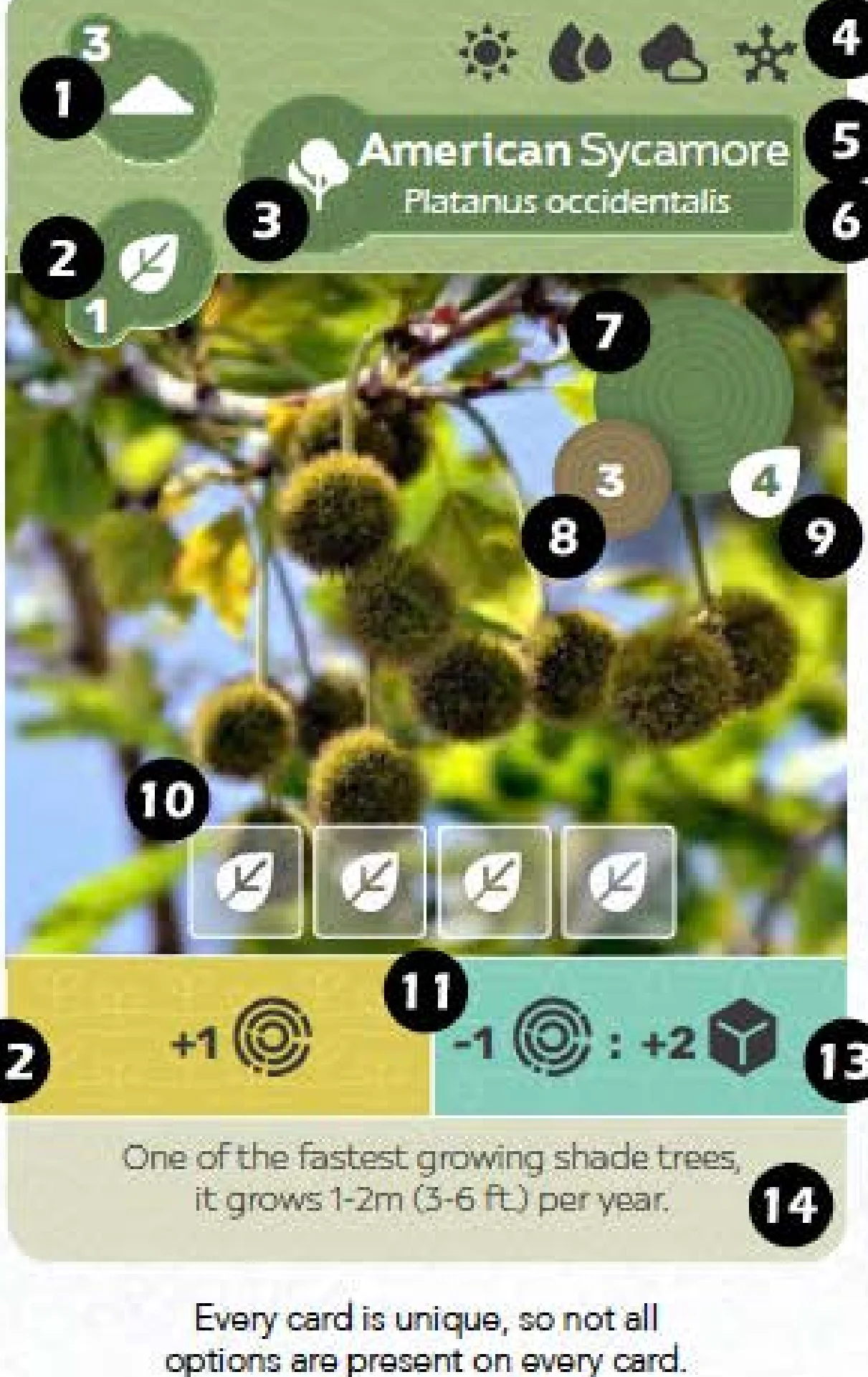
Every card is unique, so not all options are present on every card.
- Soil cost to Plant card (p. 6)
- Base victory point value
- Card type (pp. 8-11)
- Habitat elements (p. 11)
- Card name
- Scientific name
- Growth space (p. 8)
- Maximum Growth number (p. 8)
- Canopy completion VP (p. 8)
- Sprout spaces (p. 7)
- Ability colour(s) (p. 5)
- First ability effect (pp. 5-6)
- Second ability effect
- Flavour text
- Objective direction visual aid (p. 9) (row, column, orthogonal, diagonal)
- Percentage of cards (p. 9)
Types of Cards Overview
There are seven different types of cards in the game:
- FLORA, TERRAIN, and EVENT cards are found in the Earth deck.
- ISLAND and CLIMATE cards are on player boards.
- ECOSYSTEM cards are on both the Fauna board and player boards.
- FAUNA cards are on the Fauna board.
Collectively, all cards in the game are referred to as cards, whereas only the Flora cards are referred to as Flora—this is especially important for Fauna and Ecosystem objectives. Objectives that require “Flora” do not involve Terrain, Event, Island, or Climate cards. Whereas objectives that require “cards” include all cards in a player’s tableau as well as their Island and Climate cards.
Although cards contain a lot of information, players won’t need to keep track of it all. Instead, players should check Ecosystem and Fauna objectives, as well as individual Terrains, to focus on the details that are important to them.
Earth Cards (Deck)
The majority of the cards in the game are Earth cards (283/364)—of which 179 are FLORA, 66 are TERRAINS, and 38 are EVENTS.
Flora Cards
Flora is further classified by type (1), of which there are an equal amount of each:
- Tree
- Herb
- Mushroom
- Bush
Mushrooms are not technically flora but are classified here for gameplay and balance. Since lichens are plural organisms that include algae, mushrooms, and cianobacterias, we’ve added them to Herbs. For this, we apologize to our botanist players.
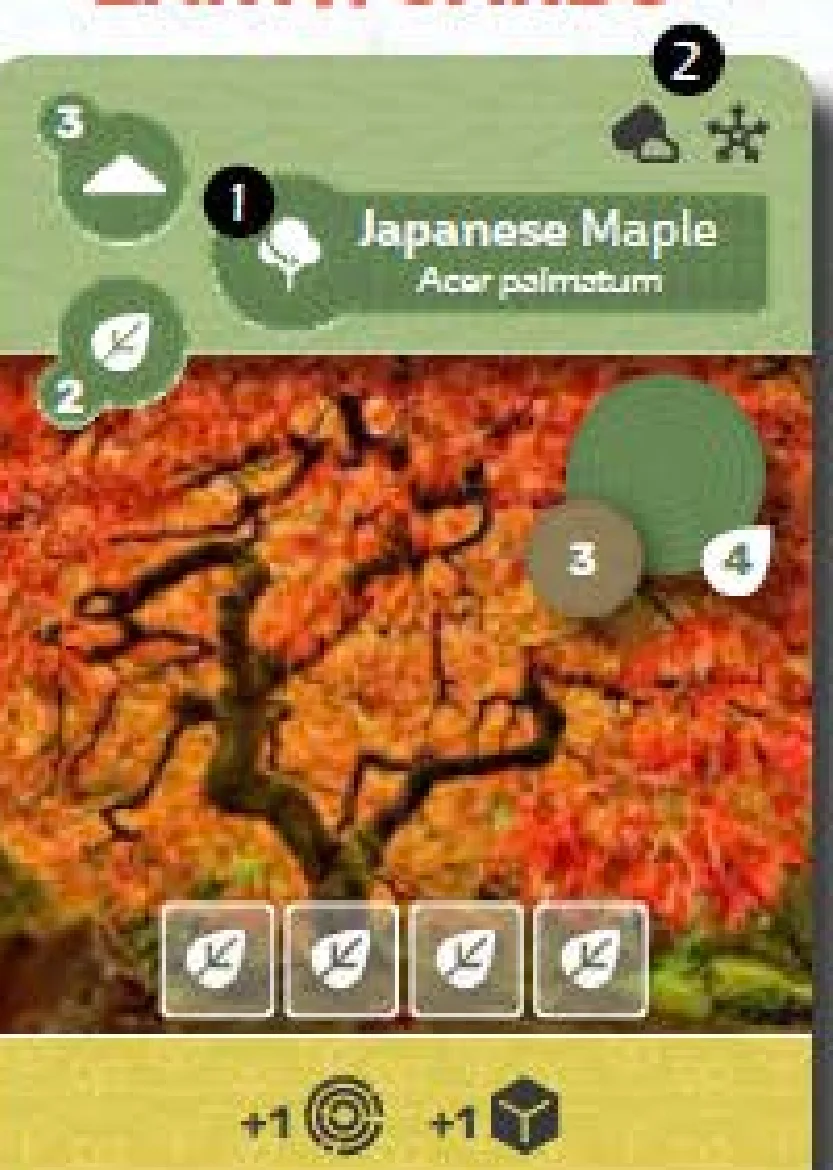
Habitats (2) are used for scoring objectives. Flora, Terrain, Island, and Climate cards have their Habitats listed on the top right of the card: Sunny, Wet, Rocky, Cold.
Terrain Cards
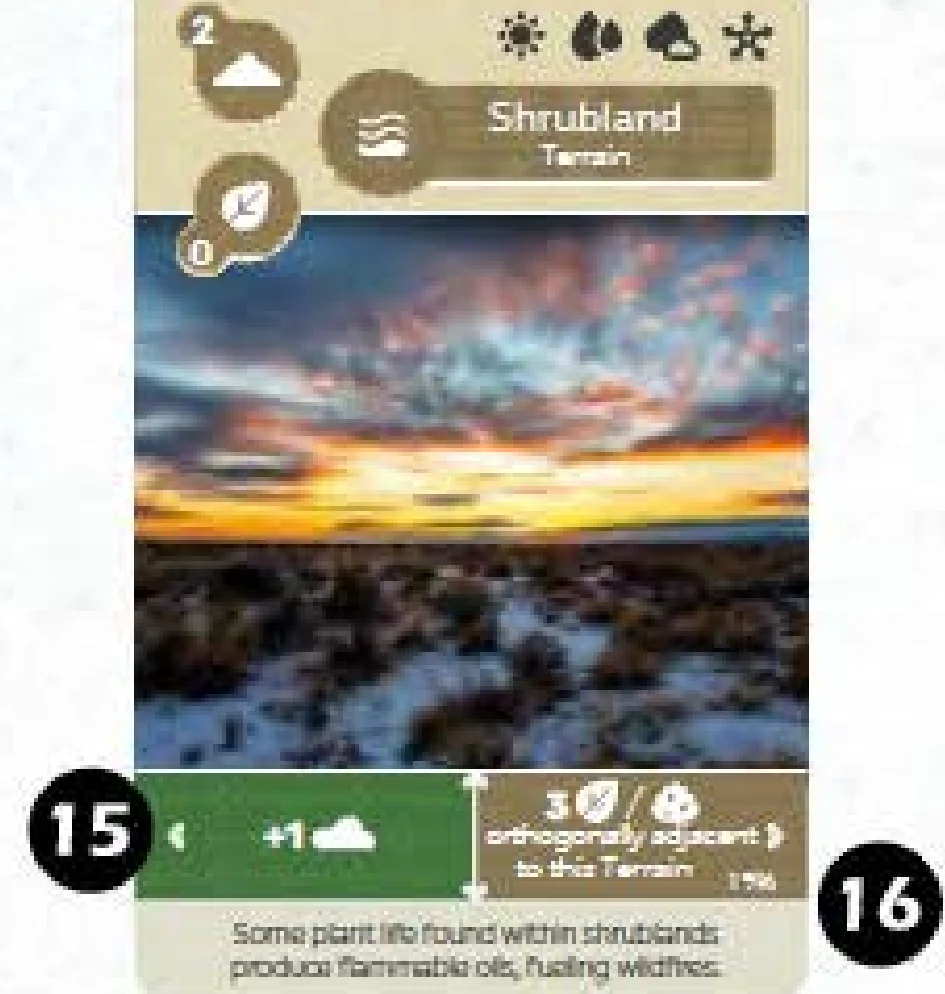
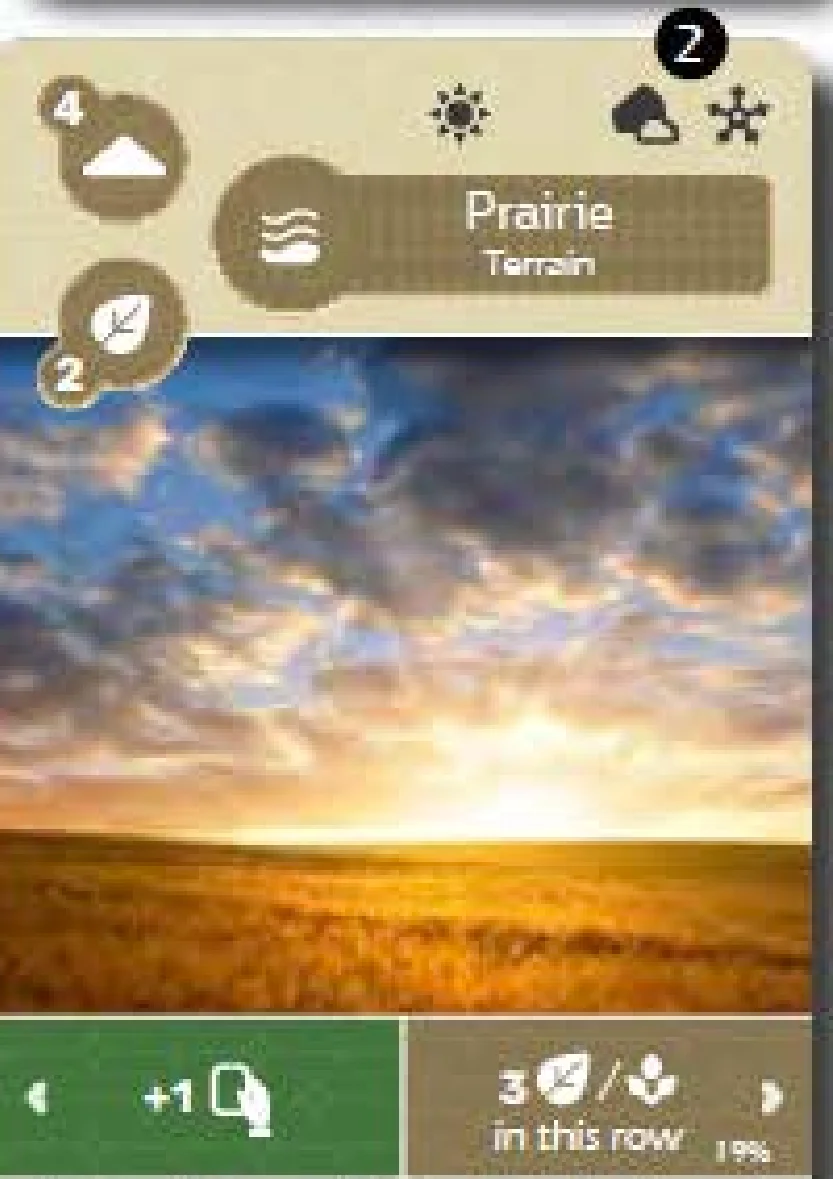
TERRAIN: They offer in-game bonuses or end-game scoring opportunities (page 11).
Terrain cards, like Flora, are planted into your tableau during the Plant action. They often do not gain resources, but instead they offer in-game passive effects or end-game scoring bonuses.
Some Terrain (and Ecosystem) cards have visual aids (small white lines) around their ability colours to help players quickly remember important placement directions for scoring. For example, the “Prairie” Terrain will score a player 3VP per Herb it shares a row with.
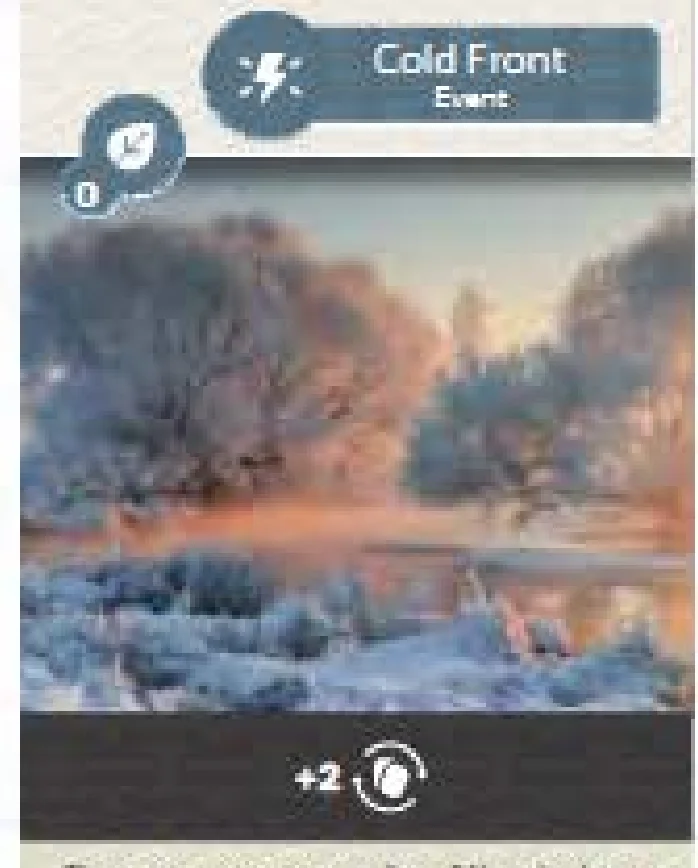
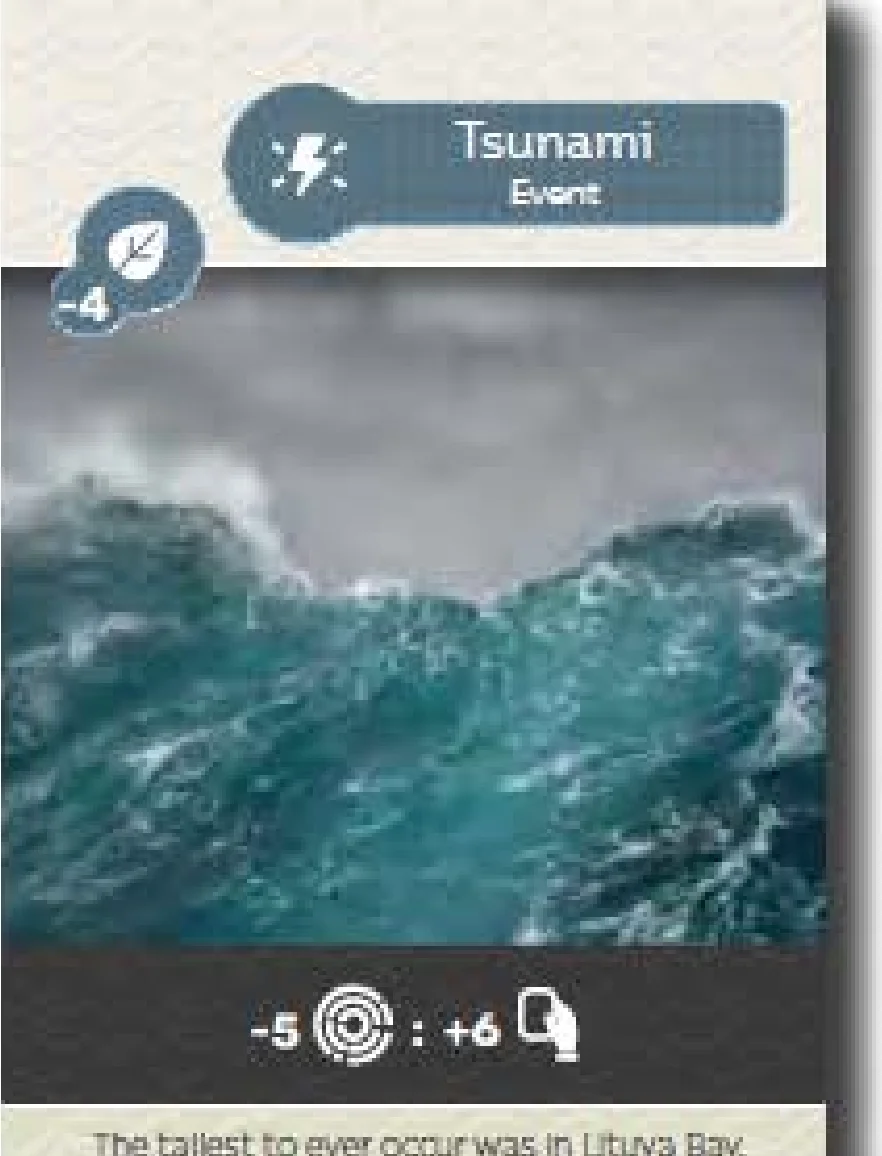
Event Cards
EVENT: Event cards can be played at any time, even on another player’s turn (page 11).
Event cards are unlike other Earth cards in that they can be played at any time, even on another player’s turn, or between the activation of two abilities. They give the player an instant benefit and they don’t directly affect other players. Event cards are the only cards that can be played without the Plant action.
Events are not part of your tableau and therefore do not count towards its 16-card limit.
When you play an Event card, place it faceup in the Event space ( ) on your player board.
At the end of the game, Event cards may earn (or lose) you VP depending on their base VP. Events, once played, cannot be taken, exchanged, activated or composted.
Event cards never count for Terrain, Ecosystem or Fauna objectives unless specifically stated on a card.
Player Board Cards
Island Cards
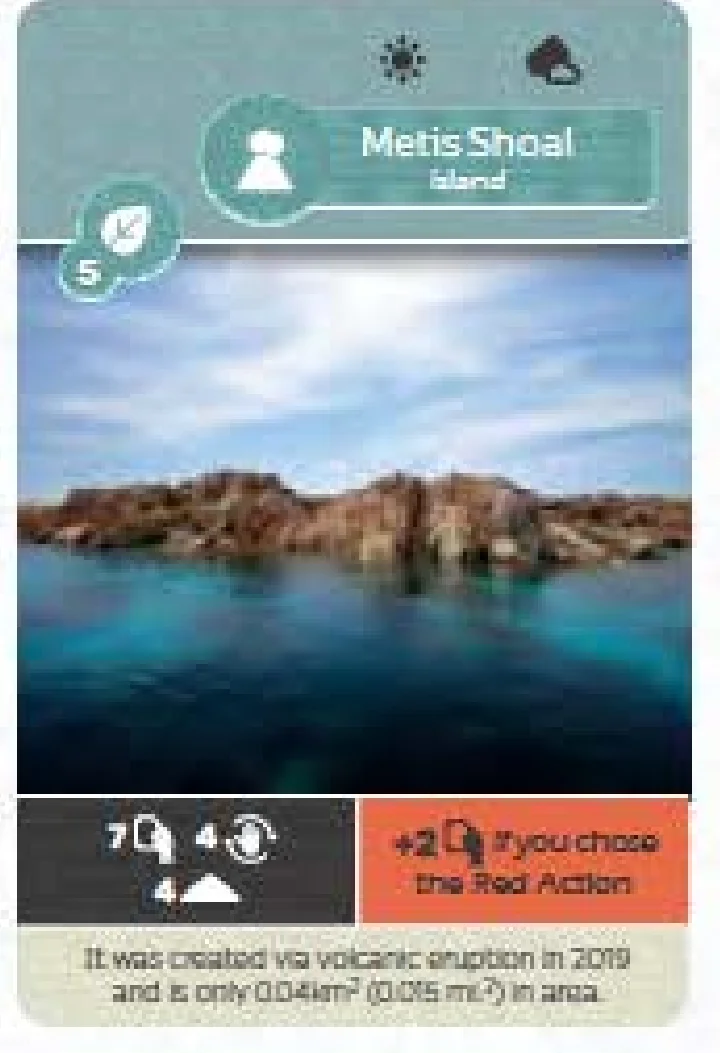
ISLAND: Islands give players their initial resources and a starting ability (page 10).
These two-sided cards give players their starting resources (cards, Compost, and Soil) as well as an ability to help with their strategy—described by the text on each card, with each side being different.
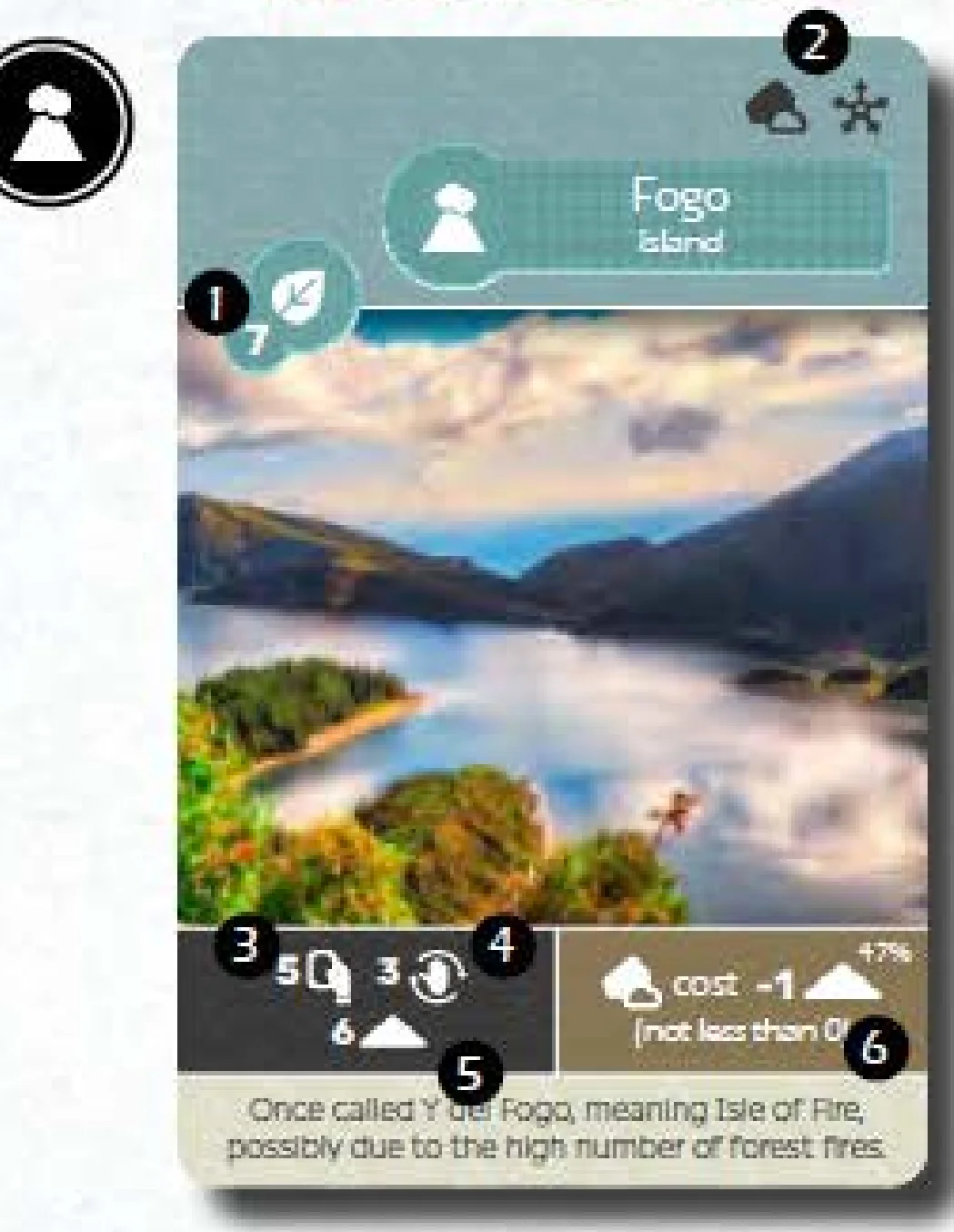
Each Island is unique, with different combinations of:
- Base VP (1)
- Habitats (2)
- Number of cards you draw at the beginning (3)
- Number of cards to Compost from your hand (4)
- Soil (5)
- Ability (6)
At the beginning of the game, choose which side of the card you would like to use. Once chosen, this side will be placed faceup on your player board—it will remain for the entire game and cannot ever be switched.
Players will then draw a number of cards as indicated next to the icon. From these cards, they will need to Compost a number of cards, as indicated next to the icon. Compost is an important in-game resource as well as end-game VP.
Lastly, players collect a number of Soil as indicated next to the icon. Soil is the currency for the game and is needed to plant Flora and Terrain into your tableau (see p.6).
You can activate your Island and then your Climate either before or after you’ve activated your tableau—and you can switch each time depending on what is best for your current turn. However, you cannot activate one card before your tableau and the other after.
You are never forced to activate your Island/Climate’s ability—you may use it or skip it any time it is able to activate.
Climate Cards
CLIMATE: Climates give players another starting ability (page 10).
These two-sided cards give players another ability, which they can use to focus or to diversify their abilities—described by the text on each card, with each side being different.
Each Climate is unique, with different combinations of base VP (1), Habitats (2), and an ability (3).
At the beginning of the game, choose which side of the card you would like to use. Once chosen, this side will be placed faceup on your player board—it will remain for the entire game and cannot ever be switched.
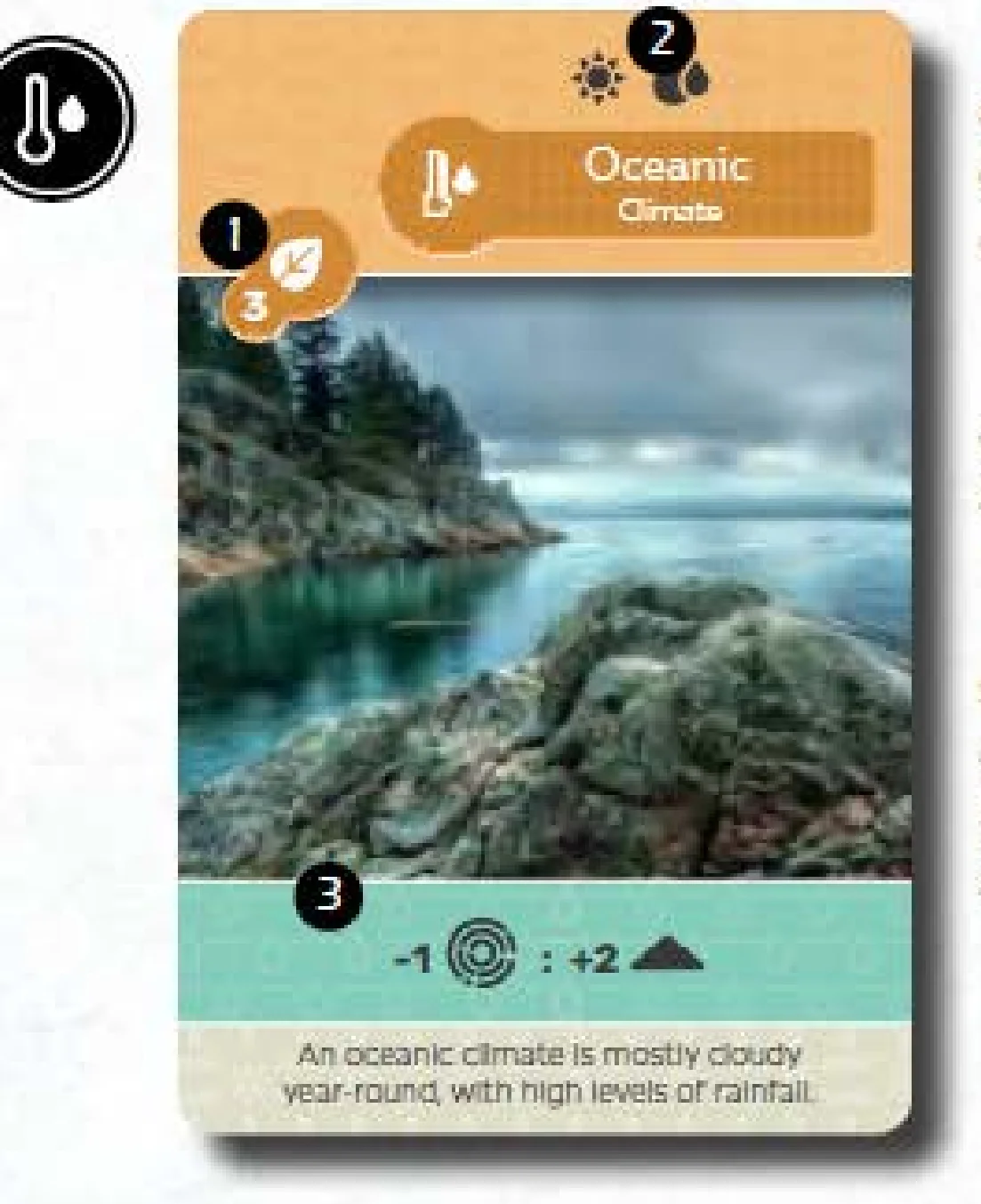
Island and Climate cards can count for Ecosystem and Fauna objectives—depending on what those objectives are. This can be overlooked by new players, so please be kind and remind them throughout the game.
Climate cards give players another ability that can contribute to their strategy, so try to choose one that complements your Island and helps towards Fauna and Ecosystem objectives.
Remember, all costs must be paid in full, however benefits may be collected as desired (partially or in full).
Objective Cards (Summary)
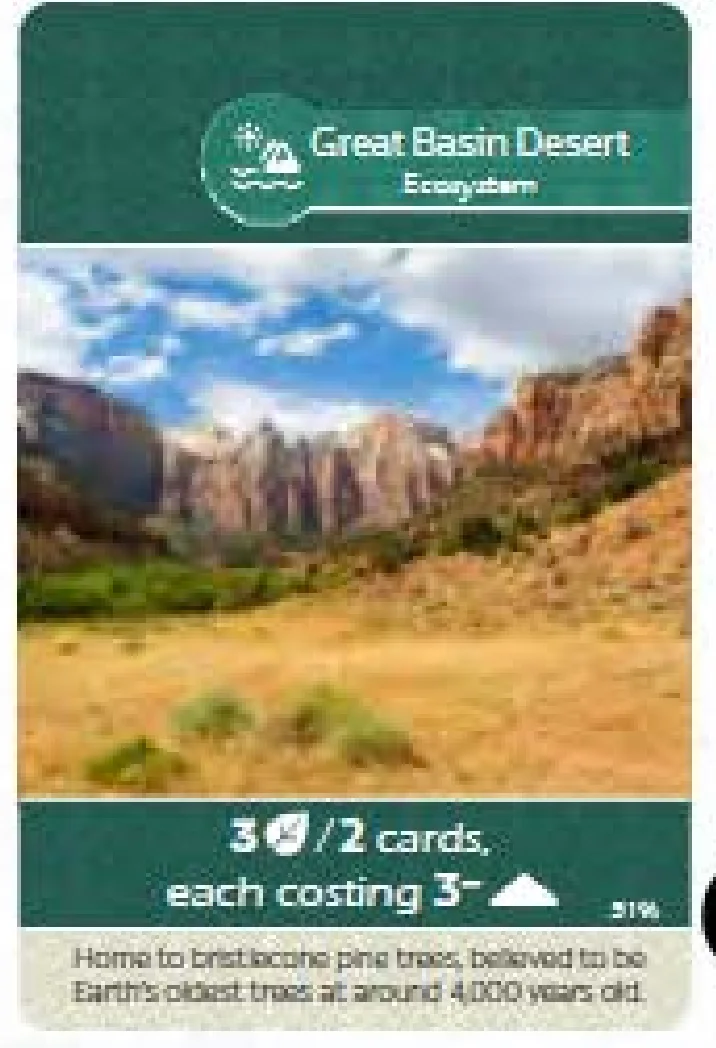
ECOSYSTEM: Score VP at the end of the game for each time you complete its objective (page 8).
FAUNA: Earn VP at the end of the game for completing its objective during the game (page 9).

Turn Overview
On your turn, choose any 1 of the 4 action spaces shown at the top of your player board. To mark your choice, place the active player token above the corresponding action. Other players may choose to place their 5th Leaf token on their matching action space as a way to remember their action options. Players may choose the same action as a previous player, or repeat the same action from their last turn.
Play continues with the Active player token moving clockwise until one player has completed their 4×4 tableau (see End Game, p. 14).

Planting: Place, Draw, and Draft Cards
- Active Player: You may plant up to 2 cards, one at a time, into your tableau by paying their Soil costs with Soil from your reserve. (Only Flora and Terrain cards may be planted into a tableau.) The required amount of Soil is returned from their reserve to the central supply. When planting your first card, you may place it anywhere within your tableau. Each subsequent card must be placed in one of the 8 spaces adjacent to an existing card. Players are not limited in which direction they may expand their tableau, but they are limited to a 4×4 tableau (16 cards). Then draw 4 cards, choosing 1 to keep, and discarding the rest facedown into the discard pile. Do not place these 3 cards in your Compost.
- Other Players: All other players may plant 1 card in their tableau by paying its Soil cost from their reserve. They may also draw 1 card. Players do not need to have planted a card to be able to draw a card, and they cannot draw before planting.
- Ability Activation: Lastly, all players activate the green abilities on their player board and in their tableau (see “Activating Abilities” p.5). Cards on a player board may be activated before or after the tableau, but the tableau must be activated in order—from left column to right, then top row to bottom.
- Scoring: You will score the base VP value of each planted card at the end of the game.
Placement Rules
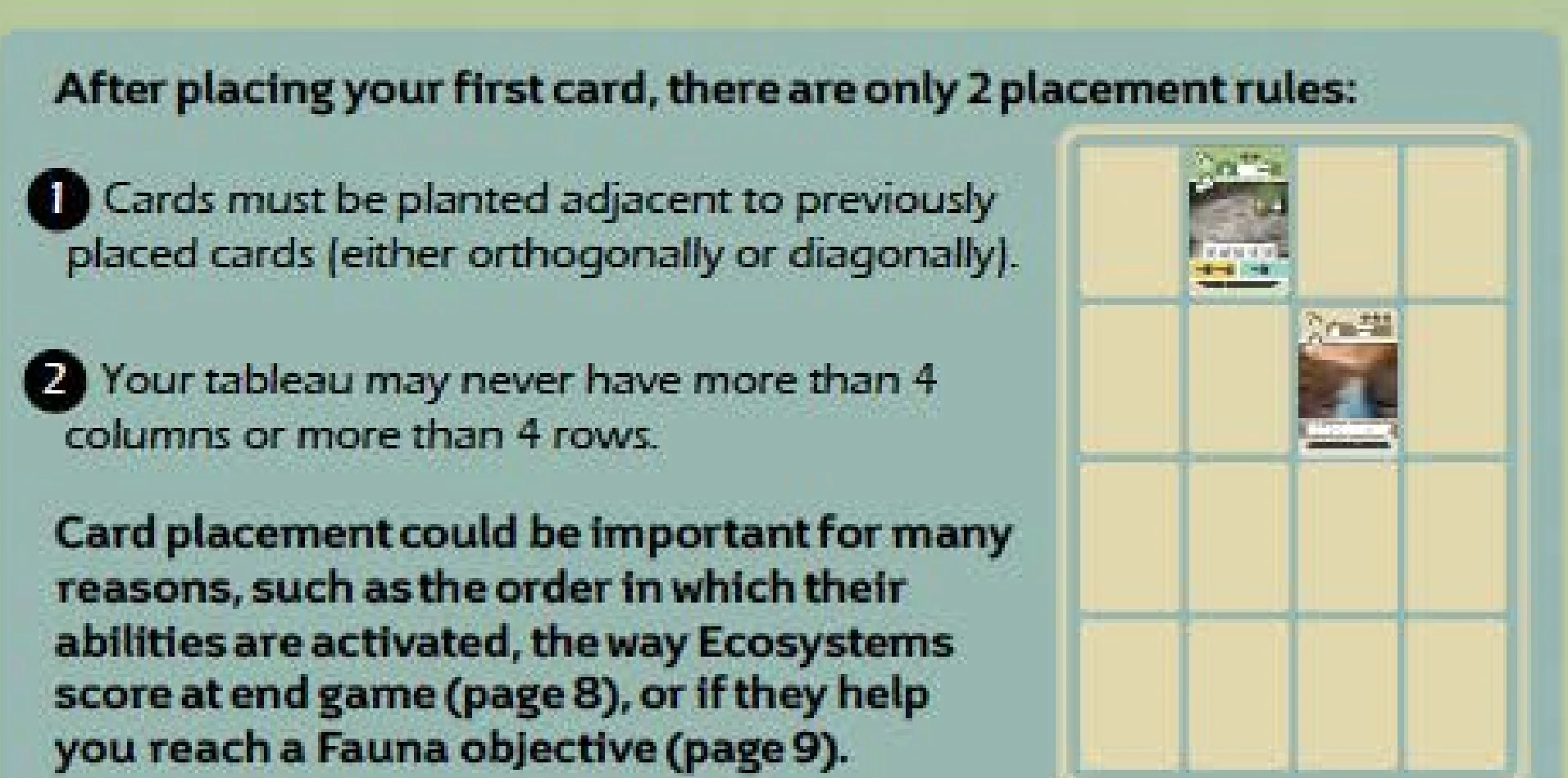
After placing your first card, there are only 2 placement rules:
- Cards must be planted adjacent to previously placed cards (either orthogonally or diagonally).
- Your tableau may never have more than 4 columns or more than 4 rows.
At the end of the game, you will score the base VP value of each card you have planted.
Card placement could be important for many reasons, such as the order in which their abilities are activated, the way Ecosystems score at end game (page 8), or if they help you reach a Fauna objective (page 9).
If the Earth deck runs out, shuffle the discard pile to create a new draw pile. Do not shuffle in any players’ Compost—those are worth VP at the end of the game!
Planting is the most important action in the game—it will score you VP and allow you to activate more abilities.
For a more strategic game, players may plant cards in their tableau facedown until all players have chosen their card(s)—at which point all cards are turned faceup.
In the unlikely event that no cards remain in the draw or discard piles, players may no draw or compost cards from the deck.
Composting: Gain Soil and Compost from the Draw Pile
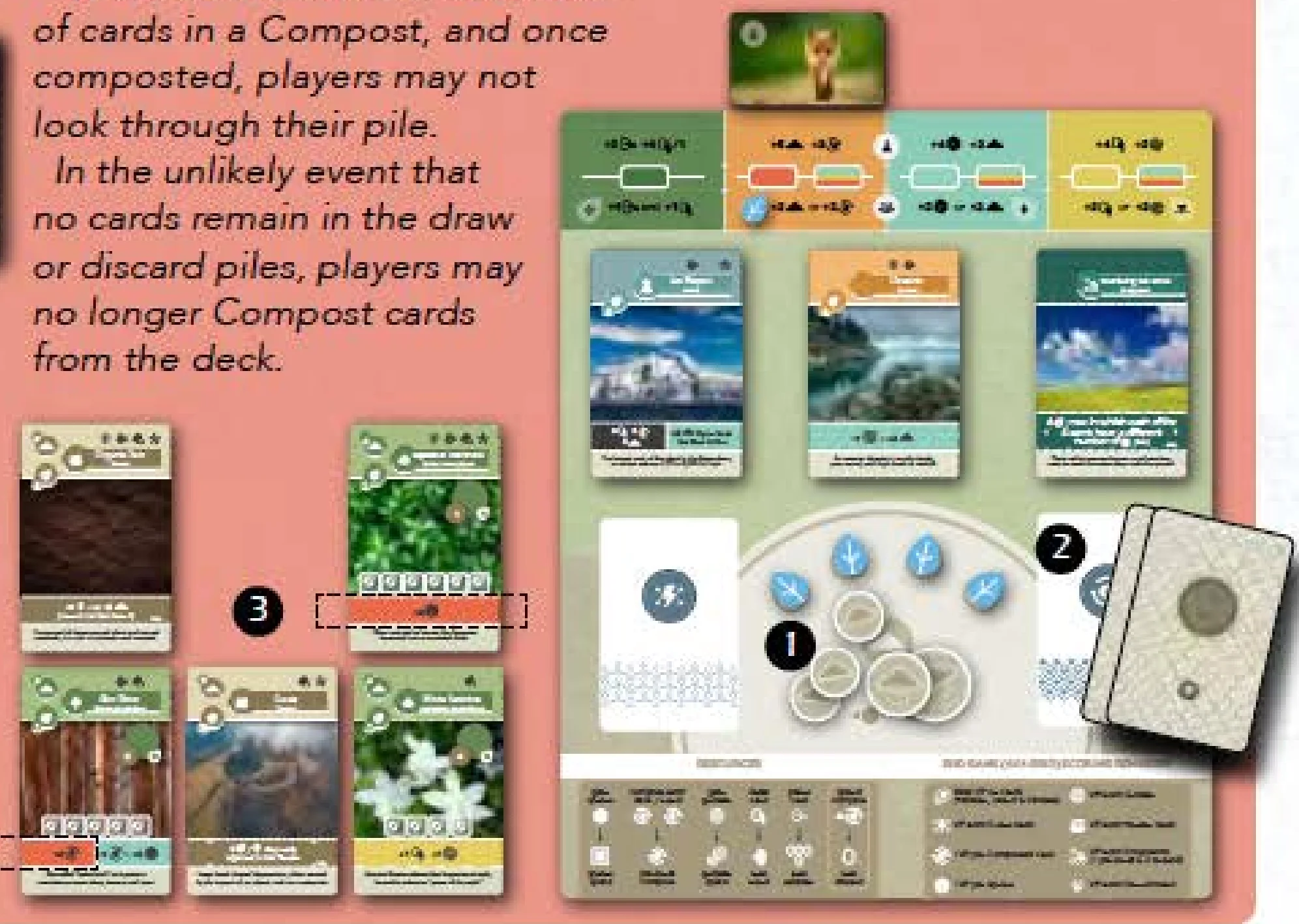
- Active Player: You may gain 5 Soil from the supply, placing them on your player board (your personal reserve) (1). There is no limit to the number of Soil allowed in a reserve. In the very unlikely event that no Soil tokens remain in the supply, use a substitute. Then take 2 cards from the draw pile and place them onto your Compost space on your player board (2) facedown without looking at them.
- Other Players: All other players may either gain 2 Soil from the supply or they may Compost 2 cards from the draw pile. Players may agree to Compost from the discard pile instead of the draw pile to avoid depleting it.
- Ability Activation: Lastly, all players activate the red and multicoloured abilities on their player board and in their tableau (3) (see “Activating Abilities” p.5).
- Scoring: You will score 1VP per card in your Compost at the end of the game—regardless of its type or VP value.
The majority of Compost actions require players to Compost cards from their hand
There is no limit to the number of cards in a Compost, and once composted, players may not look through their pile. In the unlikely event that no cards remain in the draw or discard piles, players may no longer Compost cards from the deck.
Watering: Place Sprouts and Gain Soil
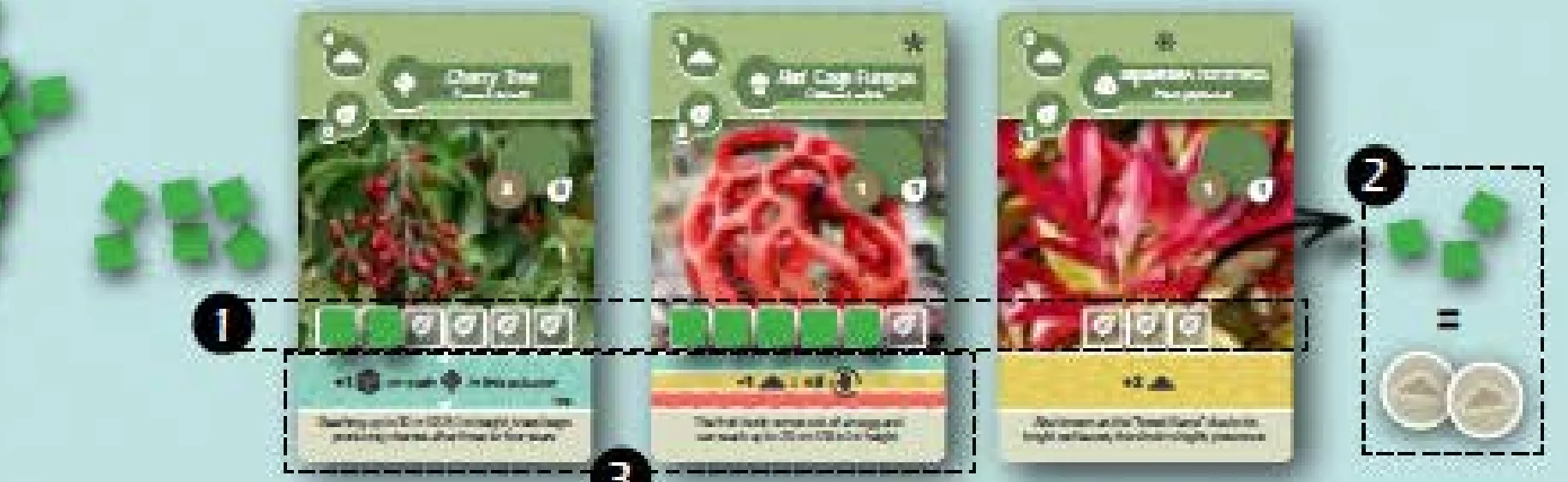
- Active Player: You may gain and place up to a total of 6 Sprouts from the supply immediately on any number of Flora cards in your tableau as long as they have empty Sprout spaces (1). Sprouts can only be placed on Sprout spaces, they cannot be saved in your personal reserve. There is no limit to the number of Sprouts in the supply; in the unlikely event that no Sprouts remain, use a substitute, such as the supplementary Sprouts from the punch board. If a player does not have room for some Sprouts when they are gained during the Watering action, those extra Sprouts are immediately lost—you cannot convert Sprouts that are not already on your tableau. Then the active player may gain 2 Soil from the supply, placing them on their player board.
- Other Players: All other players may either place up to 2 Sprouts on their available Sprout spaces or they may gain 2 Soil.
- Ability Activation: Lastly, all players activate the blue and multicoloured abilities on their player board and in their tableau (3) (see “Activating Abilities” p.5).
- Scoring: You will score 1VP per Sprout on your tableau at the end of the game. Sprouts can also be converted to Soil anytime during the game.
Converting Sprouts to Soil
If a player is ever in need of more Soil, they can convert Sprouts from their tableau into Soil (2). Simply remove 3 Sprouts from any number of your Flora cards and return them to the supply, then take 2 Soil from the supply and place them in your reserve.
Sprouts can be converted to Soil anytime during the game, except while gaining them during the Watering action, or in the middle of a card’s ability being resolved.
You may repeat this conversion as many times as you’d like. Soil, however, cannot be converted to Sprouts.
Early in the game it can be helpful to convert your Sprouts into Soil for the Planting action. However, late in the game it may be unwise to convert too much, since each Sprout is worth 1 VP!
Growing: Draw Cards and Place Growth
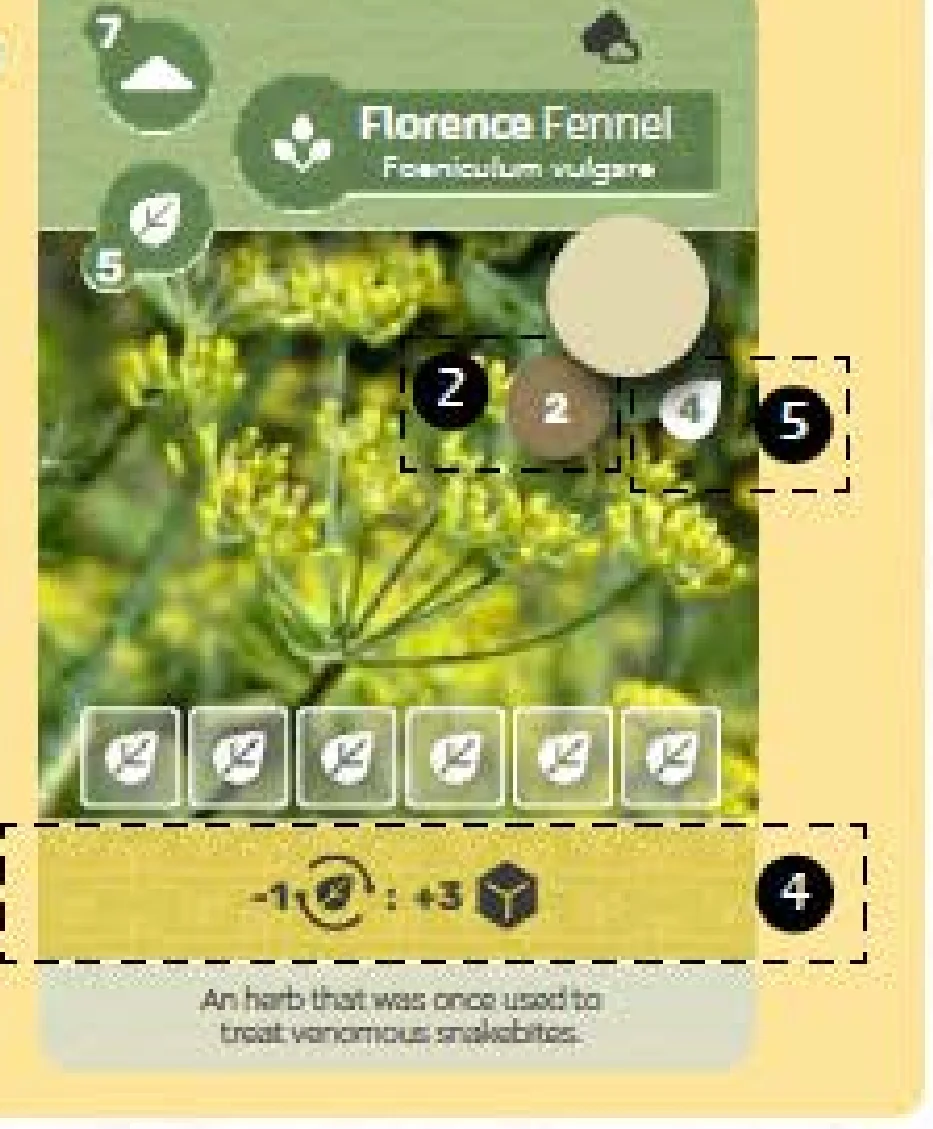
- Active Player: You may draw 4 cards from the Earth stack, placing them in your hand. There is no limit to the number of cards a player may have in their hand. Then you may place up to 2 Growth total on any of your Flora with room on their Growth space. Take Trunks (1) from the supply and place them onto any Flora in your tableau. A Growth space can have as many Growth as shown by their maximum growth number (2).
- The last Growth piece on each space is a Canopy, not a Trunk. To complete Flora, place a Canopy (3) on top of any/all Trunks. Although the Canopies are different colours, they are all treated the same for gameplay and end game scoring. Flora with a maximum Growth space of 1 will only have a Canopy, no Trunk pieces.
- Growth can only be stored on Growth spaces, up to their maximum growth number. If a player gains more pieces than they can immediately place, extras are returned to the supply. The order in which you gain or spend Growth can be very important, so be sure to watch for these abilities as you plant your cards.
- Other Players: All other players may either draw 2 cards or they may place up to 2 Growth on their Flora with available space.
- Ability Activation: Lastly, all players activate the yellow and multicoloured abilities (4) on their player board and in their tableau (see “Activating Abilities” p.5).
- Scoring: You will score 1VP per Growth (Trunk) on your tableau at the end of the game. Any Flora that have reached their maximum growth number (with a Canopy) will instead earn their listed Canopy completion VP (5).
There is no limit to the number of Growth in the supply; in the unlikely event that no Growth remain, use a substitute.
You will score 1VP per Trunk in your tableau at the end of the game. However, any Flora with a Canopy will instead earn their listed Canopy completion VP (5).
If the draw pile is ever depleted, simply shuffle the discard pile to create a new draw pile. Do not shuffle in any Compost from player boards; these are VP at the end of the game! In the unlikely event that no cards remain in the draw or discard piles, players may no longer draw cards or Compost cards from the deck.
It can be helpful to place cards you do not want upside down at the back of your hand. This makes it easier to see which cards you might want to Compost in the future.
Activation Rules and Order
At the end of each action all players may activate any abilities in their tableau and on their player board that match the colour of the currently selected action (GREEN, RED, BLUE, or YELLOW). For multicoloured abilities, see page 6.
Each card’s ability can only be activated one time per turn, and each tableau must be activated in order from the left column to the right and from the top row to the bottom. For an example of a turn, including the activation of abilities, see page 12. You can activate your ISLAND and then your CLIMATE either before or after your tableau’s activation, but not during.
To keep the game moving and to keep players engaged, all players may activate their abilities at the same time.
THE GOLDEN RULE: If a card ability does something that goes against the rules, the card has priority and its abilities can be applied (if desired).
Ability Costs and Benefits
- Some abilities require an extra step prior to receiving the benefit. To activate abilities with a negative number (-X), it is mandatory to pay the cost in full to get its benefit (Ex. 1: Discard 1 card from your Compost, then gain 3 Soil).
- For any abilities that have a numbered resource before a colon (:), it is mandatory to pay the resource requirement on the left of the colon to gain the benefit on the right (Ex. 2: Compost 1 card from your hand, then draw 1 card).
You are never forced to activate a card—you may skip the activations of as many cards as desired.* Only your Island, Climate, and cards planted in your tableau can activate their abilities—cards in your hand cannot.
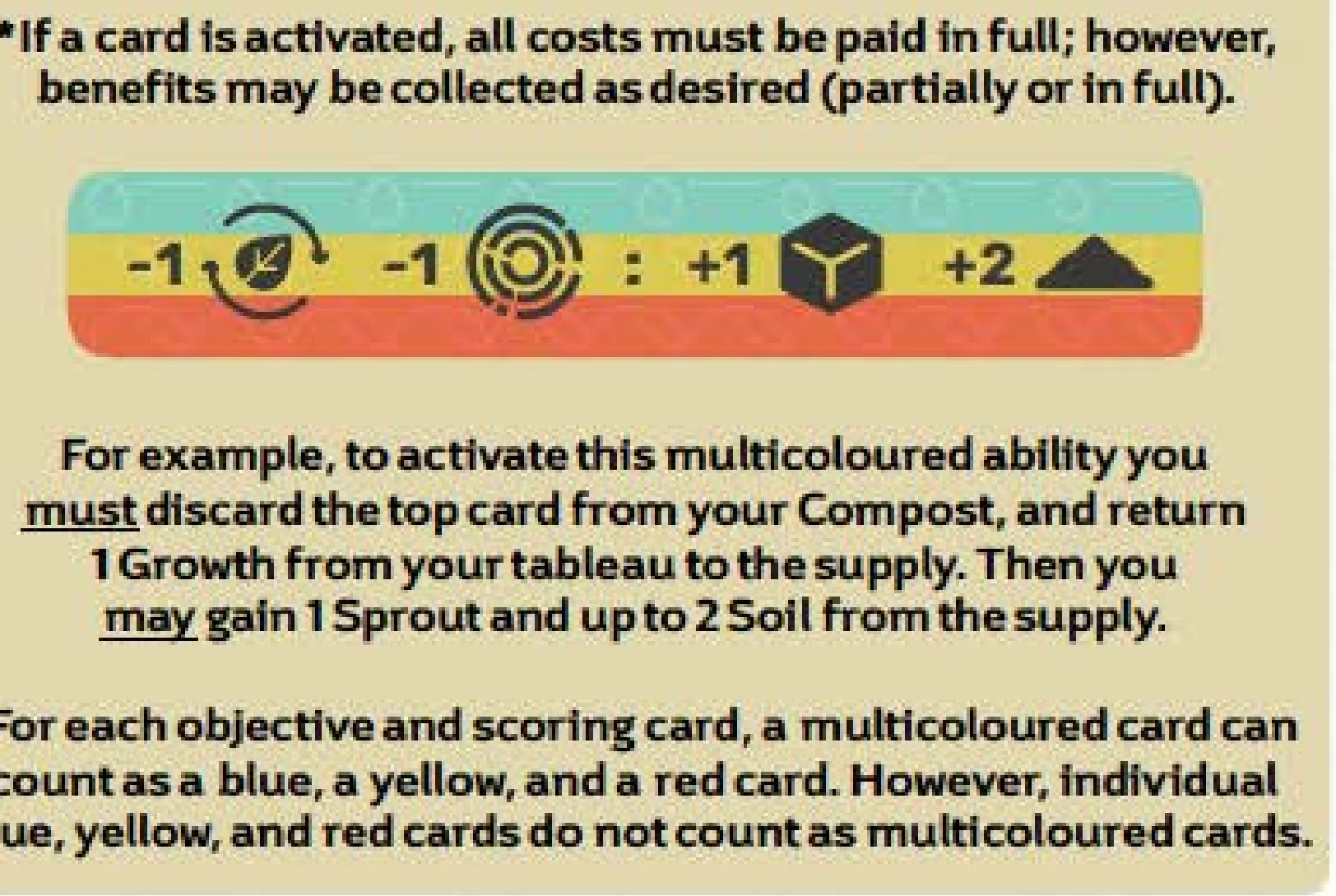
*If a card is activated, all costs must be paid in full; however, benefits may be collected as desired (partially or in full).
Ability Colours
Abilities are activated after taking their matching action (GREEN activates GREEN, RED activates RED… etc.). In addition, multicoloured abilities (which are made up of BLUE, YELLOW, and RED) are also triggered after the BLUE, YELLOW, and RED actions.
Cards with 2 ability colours, or with multicoloured abilities, count as each of those colours when scoring, so if a player had a card with a RED and a YELLOW ability, they could choose to count it as RED for one objective and YELLOW for another.
BLACK abilities are triggered automatically as soon as they are played. BROWN abilities give the opportunity for extra end game scoring options or ongoing advantages. Neither BLACK nor BROWN abilities will trigger during the game due to action selection or engine abilities, but they do count as ability colours.
Cards with green abilities may activate their green ability the same turn they are planted!
Ecosystem Cards – Ecosystem Objectives
These two-sided cards give end-game scoring bonuses—described by the text on each card, with each side being different.
In a standard game, there will be 3 Ecosystem cards in play:
- 2 on the Fauna board—available for any and all players to score
- 1 on each player board—available only for that player to score
At the beginning of the game, when given your ISLAND, CLIMATE, and ECOSYSTEM cards, you will choose which side of each card you want to use. Once selected, you will keep those sides for the rest of the game.
Players may score Ecosystem cards multiple times if they meet the requirements multiple times with different cards/components. Once a card or component has been used to score for an Ecosystem objective, it cannot be used again to score for the same Ecosystem objective.
Try to optimize the Flora, Terrain, and Event cards you choose in an effort to reach various Ecosystem and Fauna objectives.
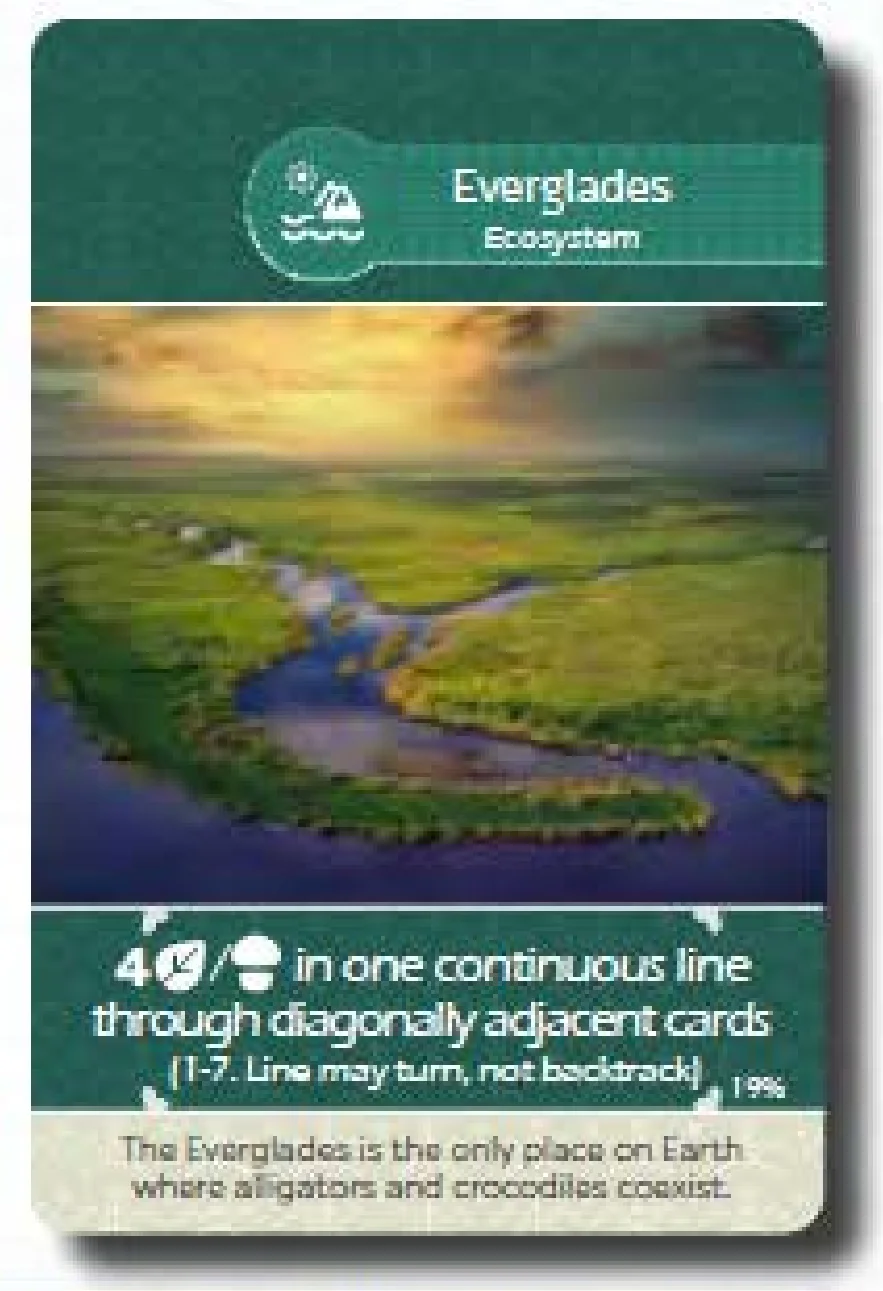
Some cards like “Everglades” have white lines around the edges of the objective; these visual aids are reminders for objectives with directional/placement scoring.
First-time players can use the beginner side of the Fauna board, which does not have Ecosystem cards. This allows players to focus on learning how to play without the extra end-game scoring options.
Ecosystem cards do not have “abilities” and therefore are never activated by any player.
Fauna Cards – Fauna Objectives
These two-sided cards give in-game scoring objectives—described by the text on each card, with each side being different.
In every game there will be 4 random Fauna cards placed on the Fauna board. At the end of a turn in which a player fulfills the listed objective on one (or more) Fauna cards, they may claim the highest available VP tier next to that card. They simply remove one of the Leaf tokens from their player board and place it next to the VP value of that tier.
If two or more players fulfill an objective on the same turn, Leaf tokens are placed in a clockwise turn order, starting with the active player—only players that fulfilled the objective may place their Leaf token.
The first player to fulfill each Fauna card’s objective will score the most points, with each subsequent tier dropping in value. For this reason it is important to factor in the needs of Fauna cards when building your tableau.
Once you claim a Fauna card objective, it cannot be lost, even if you no longer meet the requirements on a future turn. (For example, if you needed 20+ Soil in your reserve, and after claiming that objective you spent Soil and dropped below 20, you would not lose the VP.)
When calculating points at the end of the game, you will add the points earned by each Leaf token you’ve placed on the Fauna board. Remember to include the 7 VP bonus for the player who completed their tableau first! (See End Game p. 14.)
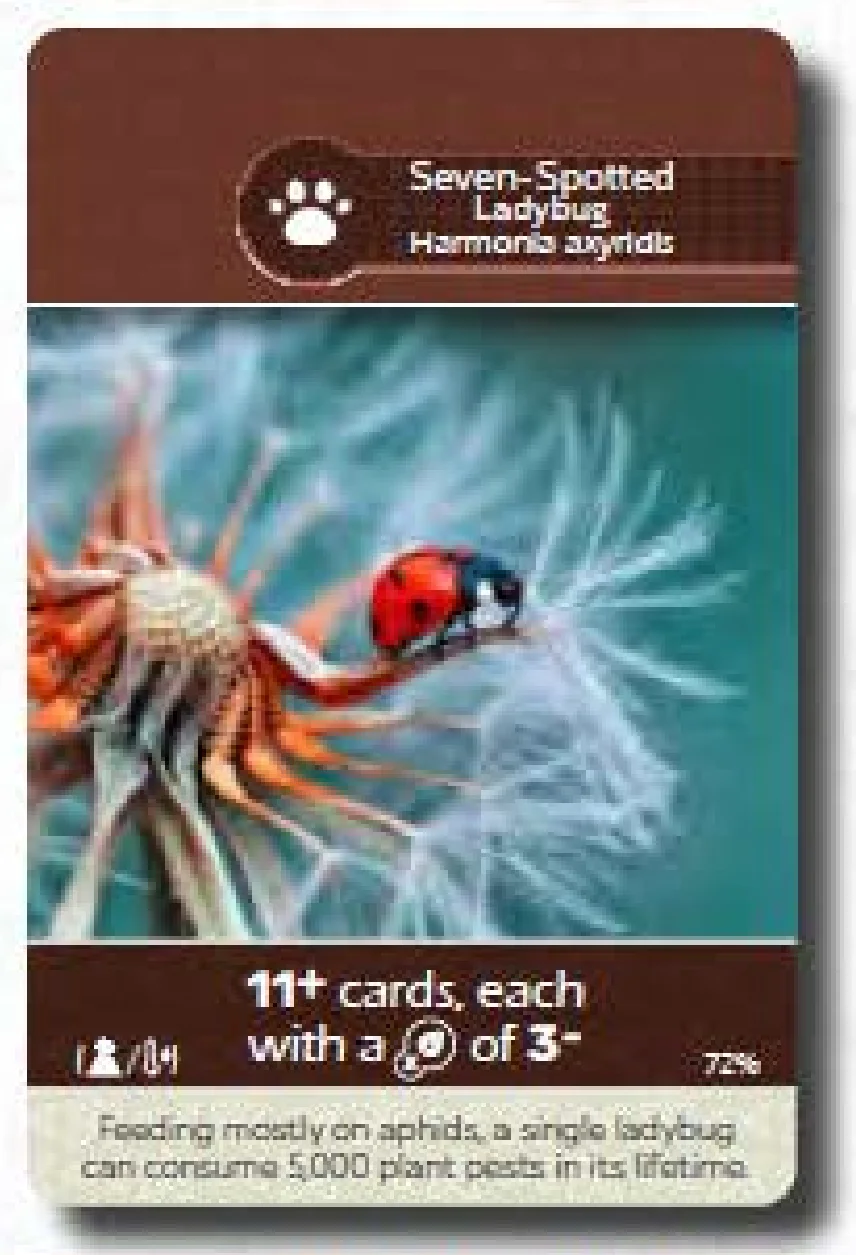
If you look at the “Ladybugs” card, you will notice the + and – symbols after each number; a player would score the Ladybugs objective when they had “11 OR MORE cards, each with a base VP value of 3 OR LESS.”
The percentage (xx%) on some cards informs players what percentage of cards in the game can meet that card’s listed requirements.
This icon
has been added to some Fauna and Ecosystem cards as a reminder to check your Island and Climate cards for that goal!
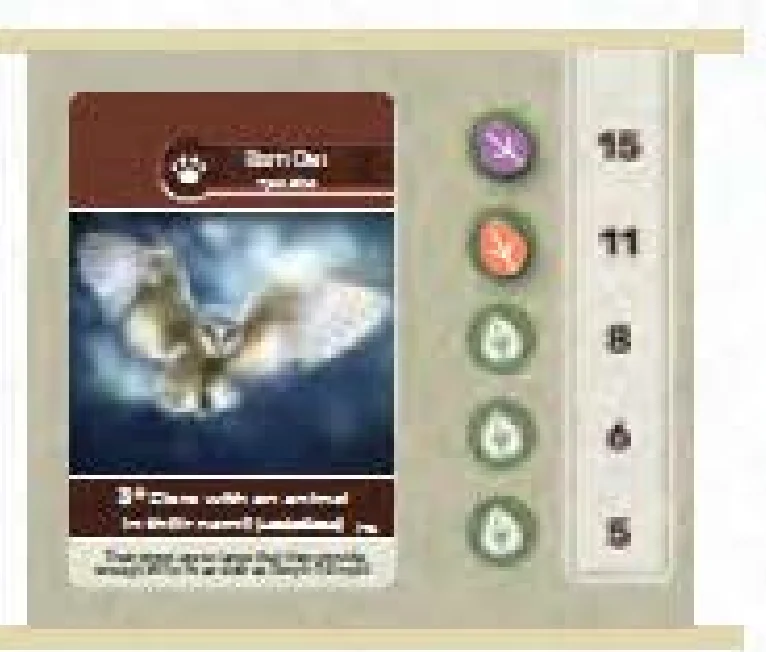
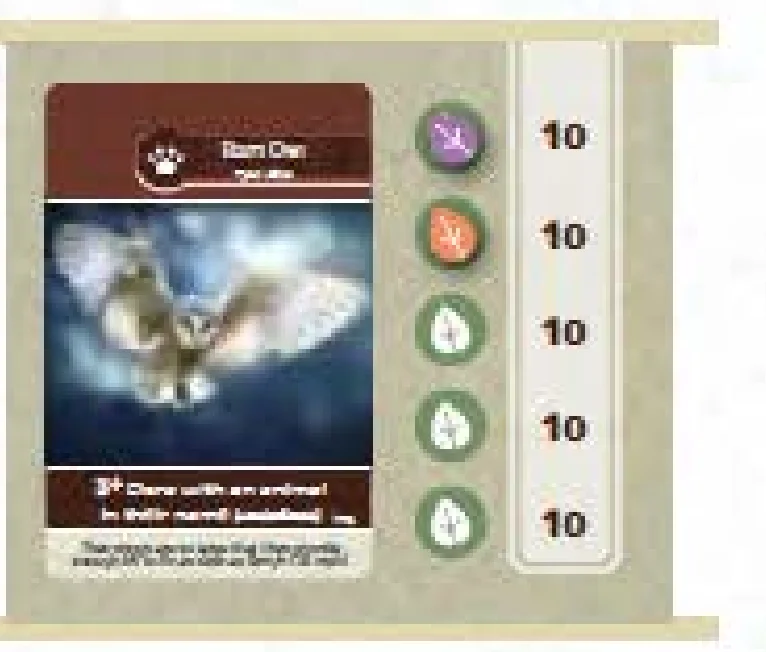
First-time players can use the beginner side of the Fauna board, where all tiers score 10 VP regardless of when a Leaf token is added. This allows players to focus on learning the basics of the game without trying to race for these points.
Fauna cards do not have “abilities” and therefore are never activated by any player.
FROM THIS POINT, YOU ARE 90% READY TO PLAY. Take a look at the scoring reminder and the iconography index on the bottom of your player board and you’ll be 95% ready to play. The rest of the rules represent the other 5%; they include clarifications, examples and a Solo mode, and cover exceptions and specific details.
Example of a Turn
For this example, let’s say that this is the player board and tableau of the active player. They are running low on cards in their hand, so they announce that they will be taking the Grow action (yellow).
- As the active player, they will gain the major benefit at the top of the chosen action (1). Note these icons are in line with the “active player” icon
 .
. - For the Grow action, the player receives 4 cards from the draw pile (2) and 2 Growth from the supply (3). The player may choose any combination of Trunk and/or Canopy pieces, depending on which Flora they place them on.
- Meanwhile, all the other players will gain the minor benefit shown at the bottom of the chosen action (4)—in line with the “other players” icon
 . In this case, that means each other player may gain either 2 cards from the draw pile, or 2 Growth of their choice.
 - Then all players will simultaneously activate their yellow and multicoloured abilities on their player board and in their tableau (5). Each player may choose which area to activate first, their player board or their tableau. In this example, the player does not have any yellow or multicoloured abilities on their player board, so they will only activate cards in their tableau.
Remember that tableaus are always activated from top left to bottom right.
- Stiptic Fungus (6) will activate first, allowing the player to place the top card from their Compost into the discard pile, and then gain 3 Soil from the supply.
- Hairawn muhly (7) activates second, which is good, as the player had no Soil remaining in their reserve. Fortunately, they just gained 3 Soil, so they can return one of those to the supply and gain 2 Sprouts.
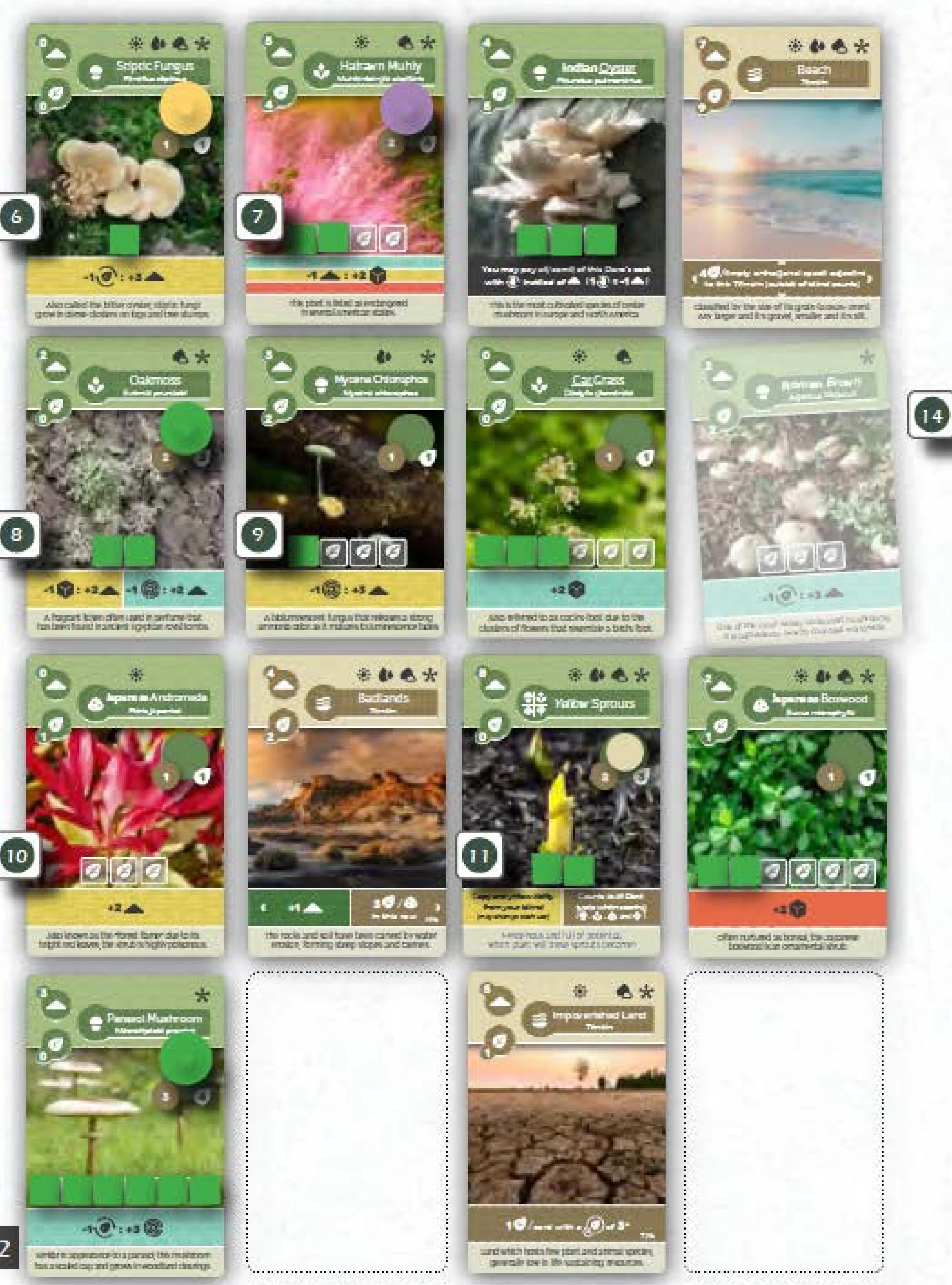
- Oakmoss (8) is up next and allows the player to return one Sprout to the supply to gain 2 Soil.
- Mycena Chlorophos (9) can then activate—one Growth piece is returned in exchange for 3 more Soil.
- Japanese andromeda (10) activates next and gives the player 2 more Soil, at no cost!
- And finally, Yellow sprouts (11) activates, allowing the player to copy any other yellow ability in their tableau. The player decides to copy Japanese andromeda (10) to gain 2 more Soil, again at no cost!
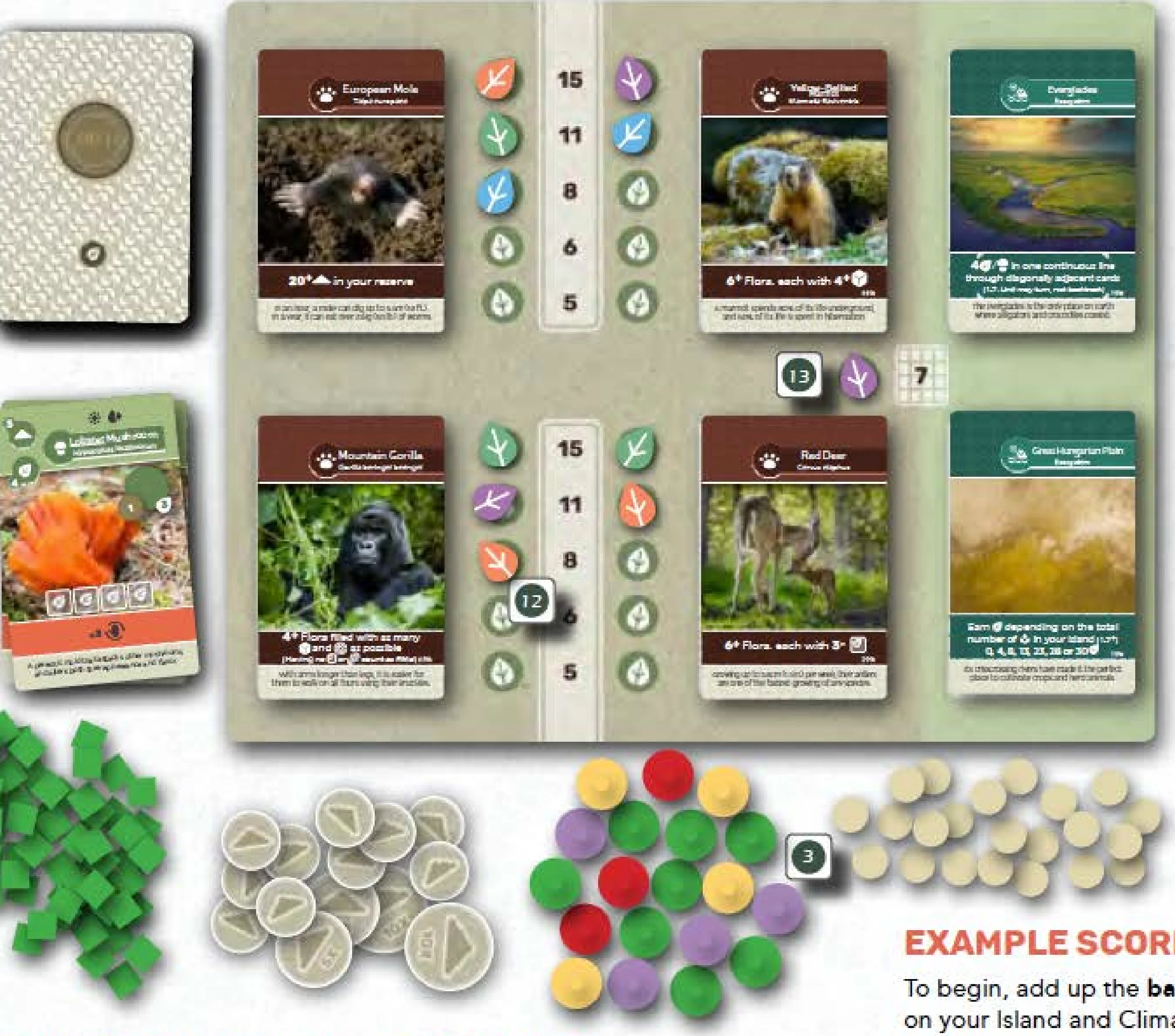
On this turn, when the active player placed both of their Growth on Oakmoss, they fulfilled the requirement for the Fauna card “Mountain Gorilla” which means they can immediately place one of their Leaf tokens on the highest open VP tier—in this case 8 (12).
With all of their yellow abilities activated, their turn is now over, and play progresses in a clockwise manner.
End Game Example
Let’s pretend for a moment, that the next player, who happens to be the last player in the round, chooses the Plant action (green) and by planting 2 cards they fill their tableau (with 16 cards) and end the game. They would immediately place their final Leaf token on the 7 VP bonus on the Fauna board (13).
The orange player decides to plant Roman brown mushrooms into their tableau (14) to help them satisfy a number of Ecosystem and Fauna objectives. They will also draw 1 card (from the “other players” green action), and then gain 1 Soil when their Terrain Badlands activates.
After all players have finished activating their green abilities, the game is over; since the last player in the round ended the game, all players have had an equal number of turns.
We do not recommend players put away components as they are adding up their score—in the rare case of a tie, you will need to check them as tie-breakers.
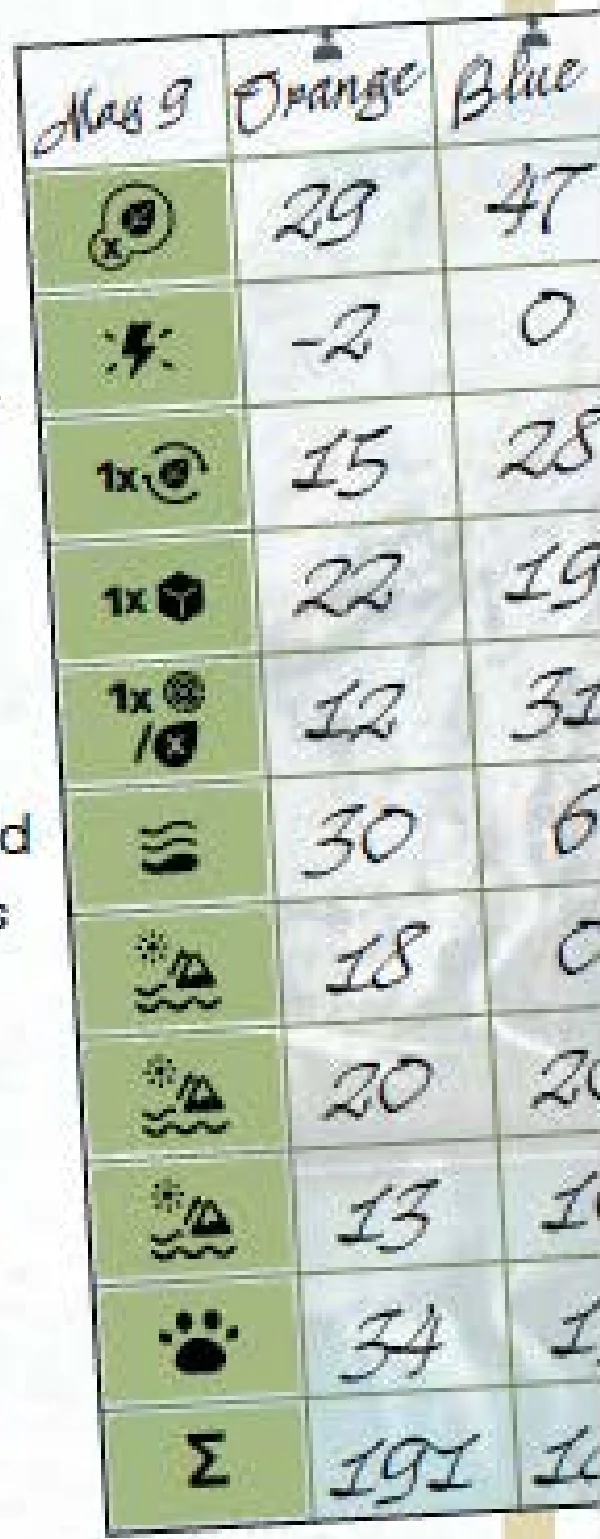
Example Scoring – Orange Player
To begin, add up the base VP value of all cards in your tableau, and on your Island and Climate cards (see image on page 12):
- Next add up the base VP value of any Event cards in your Event stack. This could be a negative number.
- Earn 1VP for each card in your Compost.
- Earn 1VP for each Sprout in your tableau.
- Earn VP for each Trunk in your tableau, or the Canopy completion VP for any Flora with a Canopy.
- Earn VP for each Terrain in your tableau if it gives end-game scoring. Beach scores the player 8VP (4 for each empty orthogonal space), Badlands scores 9VP (Yellow Sprouts can score as any flora type), and Impoverished Land scores 13VP (it scores for itself, for the Island and the Climate cards, but not for any Event cards).
- Earn VP for each Ecosystem card if you meet or exceed their requirements. Their personal Ecosystem card scores them 18VP as they have 4 cards with geographic terms. Everglades scores 20VP as Yellow Sprouts can score as any flora type. Parasol Mushroom does not count as it is not connected in a diagonal line. Great Hungarian Plain scores 13VP as there are 4 Herbs in your tableau.
- Earn VP for your Leaf tokens on the Fauna board—including the tableau completion bonus if you earned it.
End Game Trigger
Earth is played over a series of rounds, and a round involves each player being the active player once.
The game will end at the end of a round during which a player completes their 4×4 tableau (16 cards). That player places one of their Leaf tokens on the 7 VP bonus space on the Fauna board, and then any remaining turns are taken to end the round—so that all players have an equal number of turns.
- If the active player and another player complete their tableaus on the same turn, the active player claims the bonus.
- If multiple players, not including the active player, complete their tableau on the same turn, then the player sitting closest to the active player’s left (going clockwise around the table) claims the bonus.
All players should have an equal number of turns!
For example, if the first player of the round is the first player to complete their tableau, then all other players will have one final turn as the active player.
If the last player in a round is the first one to complete their tableau, then the game will end after their turn is complete.
Scoring Victory Points
After the final round is over, players add up their victory points (VP) and the player with the most VP is the winner.
Players can simultaneously calculate each row on the score pad, but we recommend you record them one row at a time to avoid confusion. While counting the various components below, be sure not to mix up any piles or to “clean up” any play areas—in the case of a tie, these components are needed.
- Add the base VP from your Island and Climate cards with those from all cards in your tableau. Do not include your Event cards, cards in your hand or in your Compost.
- Add the base VP from cards in your Event space—this could be a negative value.
- Add 1 VP per card in your Compost.
- Add 1 VP per Sprout in your tableau.
- Add 1 VP per Trunk in your tableau, unless the Canopy has been placed, in which case score the Canopy completion VP instead of 1VP/Trunk.
- Add VP from any Terrain in your tableau with an end-game scoring bonus. (Terrains with in-game effects do not score bonus points.)
- Add VP from any fulfilled Ecosystem objectives, including your personal Ecosystem and the two shared Ecosystems.
- Add VP from Leaf tokens placed on the Fauna board. Don’t forget to include the 7VP bonus for the first player to complete their tableau.
In the beginner mode, there are no shared Ecosystem cards and Fauna objectives are worth 10 VP, regardless of the order in which they were claimed.
Tie-Breaker Rules
In case of a tie, the victory goes to the tied player who has the most Soil remaining in their reserve.
If the game is still tied, the victory goes to the tied player with the most cards in their hand, then the most Growth on their tableau, then the most Sprouts and finally the most Composted cards.
Solo Mode
The solo mode follows most of the same rules as the standard game, with the most obvious exception being that you are competing against an Artificial Intelligence (AI) named Gaia.
Solo Setup
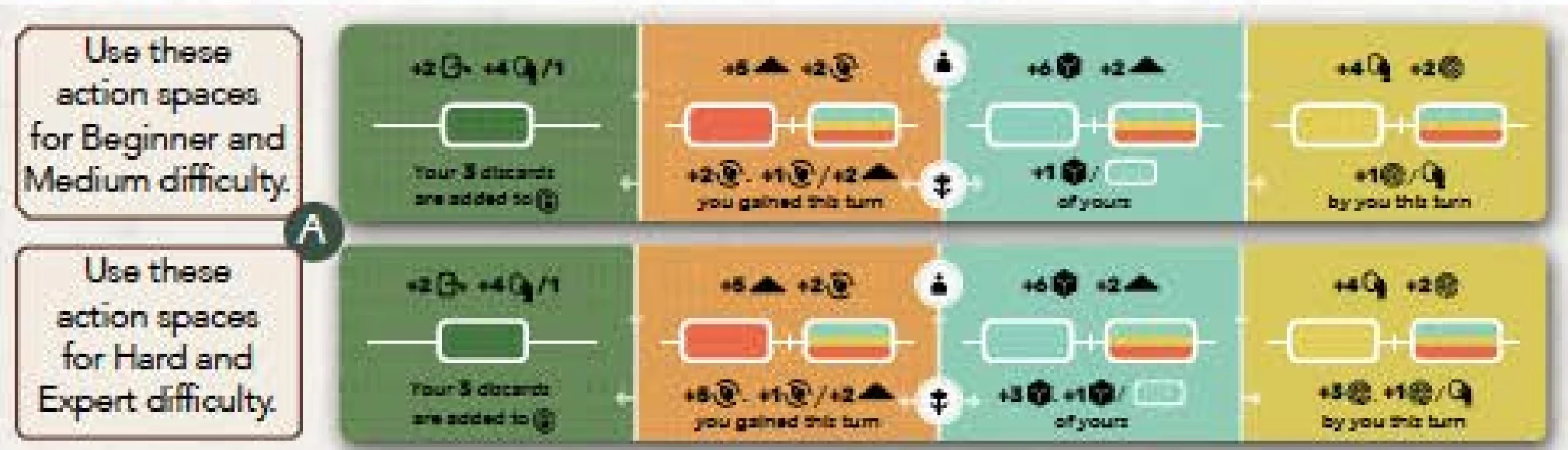
- Begin by setting up the game as you would for a regular (or advanced) game, but set your player board on its solo side and decide on a difficulty level (A). Beginner and Medium use the upper action spaces whereas Hard and Expert use the lower actions. Beginner and Expert are only affected further by the effects listed at the bottom of Gaia’s Fauna objective cards.
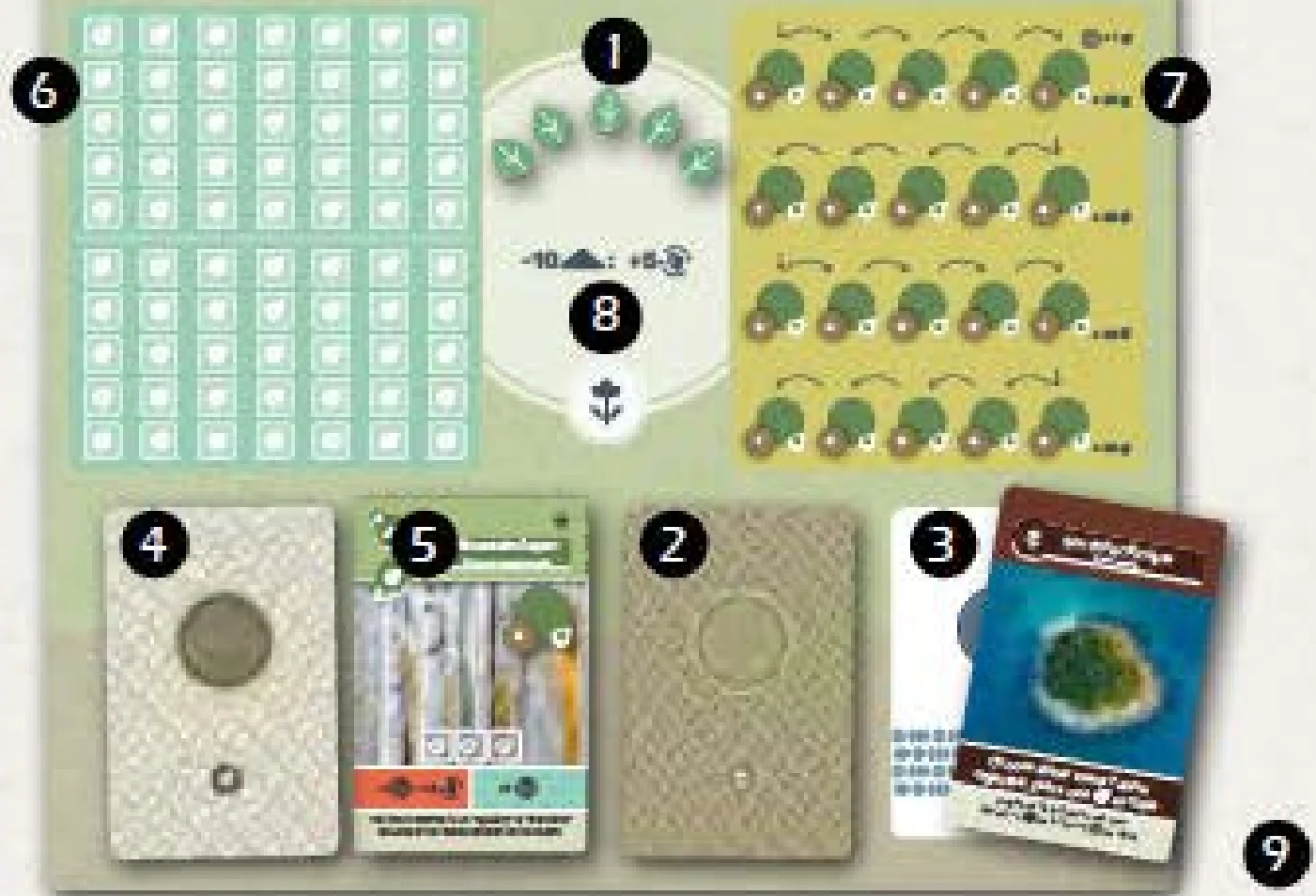
- Place Gaia’s board next to your player board—on the opposite side of where you will build your tableau.
- Select a colour of Leaf tokens and place them on Gaia’s board (1).
- Shuffle her deck of 6 cards () and place it facedown in this space (2). You will go through this deck twice before ending the game.
- Space (3) is where her active card will go.
- Space (4) is where her facedown Compost is placed.
- Space (5) is where her faceup scoring cards are placed.
Once you are set up, you begin as the active player.
As Gaia can “react” when you gain Soil and cards, it can be helpful to place incoming resources next to your player board so she can count them before they are added to your hand/supply.
Solo Mode – Your Turn
Your turns work the same as in the normal game—action selection, resource gain, ability activation. For each action, you will gain the regular benefits; however, Gaia will gain the benefits as indicated by the difficulty level you have chosen.
Always finish your action and card abilities first, then resolve Gaia’s action as the “other player,” taking the variable benefits:
- For the BLUE action: gather her Sprouts here (6)—she scores 1 VP per Sprout at the end of the game.
- For the YELLOW action: stack the Growth here (7), following the arrows when a Canopy is placed. As normal, the last growth piece on every column will be a Canopy. She will score 1 VP per Trunk or the Canopy completion VP.
- For the RED action: gather Soil here (8) until she reaches 10 of them, after which they are returned to the supply and she will Compost 5 cards from the draw pile. She will score 1 VP per composted card (4) at the end of the game. If the total number of Soil gained exceeds 10, leave any excess in her reserve—only converting Soil to Compost in a ratio of 10 Soil to 5 Compost.
- For the GREEN action: place Gaia’s cards faceup in her scoring pile (5). She will score each card’s base VP at the end of the game.
Solo Mode – Gaia’s Turn
On Gaia’s turn, draw the top card from her facedown stack (2) and place it faceup (3). You take the upper ability (if any) and then she takes the lower ability.
It is important that you take the upper ability first because her income can sometimes be tied directly to the choices you made:
- YELLOW ACTION: Gaia counts the total number of cards you gained from the upper ability and your yellow abilities, and gains that number of Growth. She does not count cards earned with Event cards.
- RED ACTION: Gaia counts the total Soil you gained from the upper ability and your red abilities, and gains that number of Soil. She does not count Soil earned with Event cards.
If you reveal one of Gaia’s brown Fauna objective cards (9), follow the directions on the card and place one of Gaia’s Leaf tokens on the highest available VP tier next to either Fauna card—if both are available, you may choose the placement.
If playing on Beginner or Expert mode, also apply the effects as indicated in the “flavour text” area of the card.
Play continues with alternating turns until Gaia activates her last card, at which point her deck is shuffled and reset for a second, and final, use.
The game will end when Gaia’s deck is exhausted for the second time, or when you complete your 4×4 tableau. The player who ends the game claims the 7 VP bonus on the Fauna board, then scores are tallied.
Solo Mode – Scoring
Once the game has ended, you will score VP the same way as in the standard game. Gaia, however, will score points as follows:
- Add the base VP from all cards in her faceup scoring pile (5), including Event cards—negative values are converted to positive values for Gaia!
- Add 1 VP per Sprout (6)
- Add 1 VP per Trunk or the Canopy completion VP (7)
- Add 1 VP per card in her Compost (4)
- Add VP from Leaf tokens placed on the Fauna board.
Gaia does not score points for: TERRAIN cards or ECOSYSTEM cards.
Team Mode (2 vs 2)
The team mode follows the same rules as the regular game, but it allows players to work together against another team.
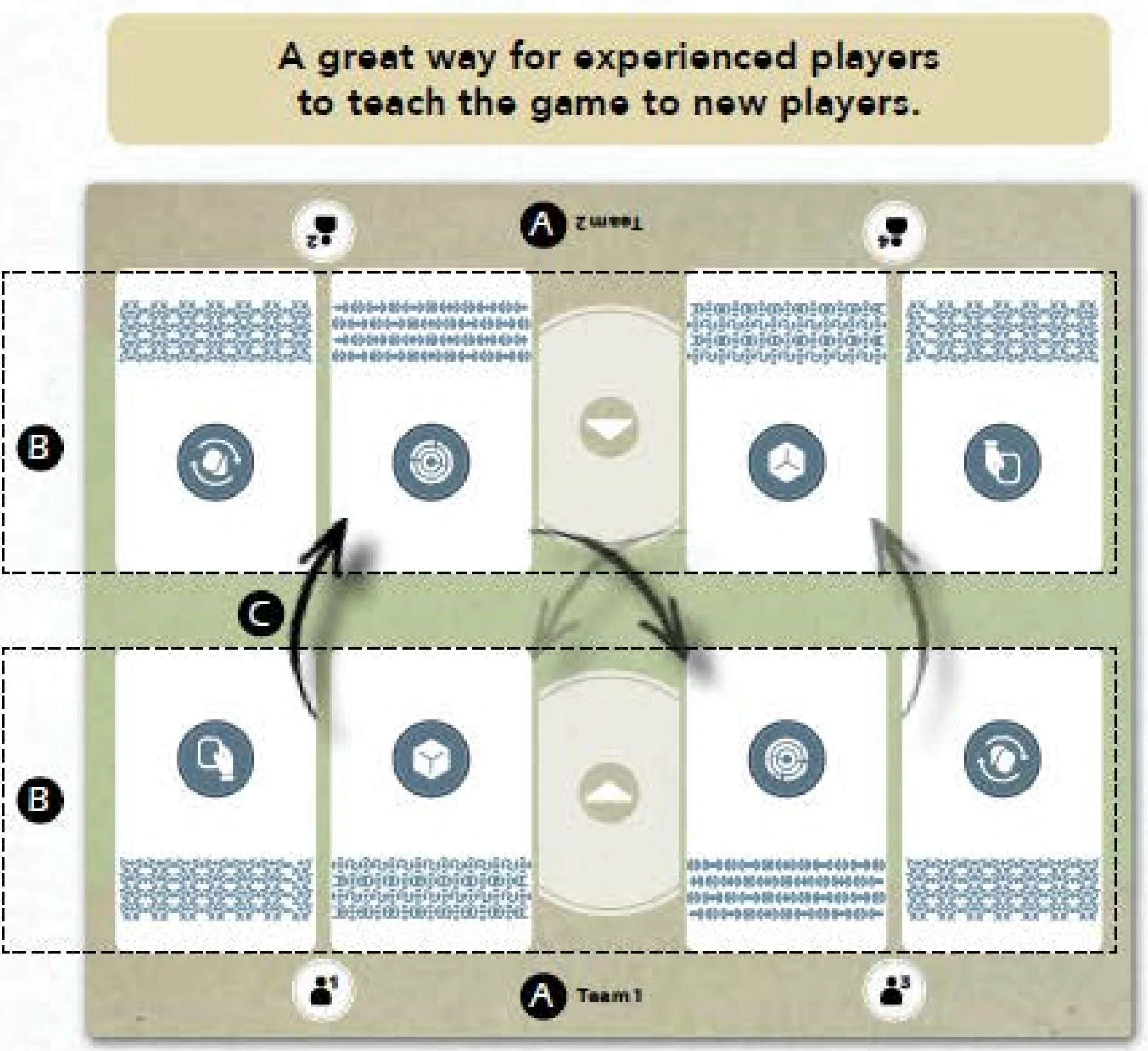
Set up the game as you would for a regular game, with teammates sitting beside each other (A).
Any time a player earns resources (cards, Compost, Soil, Sprouts, or Growth), instead of placing them directly into their tableau, reserve, or hand, they may place them onto their side of the shared Team board (B). These resources must be taken by either teammate before the end of the current turn or they are discarded.
Teammates may discuss strategies and resource needs openly. They may decide together what action each will take, which resource or card to take, and so on.
Play the rest of the game like you would in the standard way—except that turn order follows the player number (1, 2, 3, 4, 1, 2…etc.) (C).
At the end of the game, teammates will simply combine their scores, and the team with the most VP wins!
Credits
- Inside Up Games 2023
- Game Design: Maxime Tardif
- Development & Art Direction: Conor McGoey
- Graphic Design: M81 Studio & Yulia Sozonik
- Editing: Daniel Mansfield
- Box Design and Logo: Kenneth Spond
- Flavour Text: Jenna Muir & Katelyn Summers
- Lead Play-testers: Isabelle Touchette, Renaud Guerin, Simon Bélanger, Philippe Groulx, François-Vincent Talbot, Carter Morash, Hudson Morash, Scotland Morrison, Trevor Waytowich, Dominique, Kilianne, Caleb and Dahlia McGoey
Prefer to watch a video instead of reading the rules? Scan this QR code with your phone! insideupgames.com/earth-how-to-play-video/
Safety Note
Please note that although we did our best to keep all the information and photographs as accurate as possible, we are not botanists, and the game should not represent any sort of field manual or identification aid. Please check with local and national authorities before interacting with any natural environments or species. Thank you!
Designer’s Note
Earth tries to grasp a small glimpse of the immensity of Nature’s diversity. The best players will be the ones that adapt quickly, just like plants and animals need to do to thrive.
This game exists thanks to Isabelle Touchette, my love, who kindly asked me if I could create a game about plants. —Maxime Tardif
This QR code will bring you to the BoardGameGeek website where you can learn more about the design and balance of Earth by reading Maxime’s “Designer Diary.”
And if you ever run out of scoring sheets, you are welcome to download more for free using this QR code.
Overview & Objective
Earth, the soil that supports and sustains our beautiful planet, Earth. Over millions of years of evolution and adaptation, the Flora and Fauna of this unique planet have grown and developed into amazing life-forms, creating symbiotic ecosystems and habitats. It’s time to jump into these rich environments and create some amazing natural synergies that replicate and extrapolate on Earth’s amazing versatility and plethora of natural resources.
Create a self-supporting engine of growth, expansion and supply where even your unused Flora become compost for future growth. Earth is an open-world engine builder for 1 to 5 players with simple rules but many strategic possibilities.
With the enormous number of unique cards and combinations, every game will allow you to discover new synergies and connections, just as our vast and fascinating world allows us to do!
Game Objective
The objective in Earth is to score as many Victory Points (VP) as possible. To do so, you will “plant” cards to create your own island—a 16-card tableau arranged as a grid 4 cards wide by 4 cards tall.
The game ends at the end of a round after a player plants their 16th card, which completes their island.
Players will score points for:
- The value of Flora and Event cards
- Growth and Sprouts placed on their Flora
- Cards in their Compost
- Ecosystem, Fauna, and Terrain bonus points.
Balancing these elements and creating an effective engine is key to maximizing your Victory Points!
The first player to fill their 4×4 tableau with 16 cards triggers the game end and earns a bonus of 7 VP.
Throughout the rules gray boxes like these will indicate important details which should not be overlooked!
Beige boxes like these will indicate tips and options to make the game easier for new players. Like this one!
Components & Game Modes Overview
Components
- Fauna board
- Player board
- Sprouts
- Soil tokens
- Trunks (Growth)
- Canopies (Growth)
- Earth cards (Flora, Terrain & Event)
- Fauna cards
- Ecosystem cards
- Island cards
- Climate cards
- First player token
- Active player token
- Leaf tokens (in 5 player colours)
- Score pad
6 cards with a darker back and a
Game Mode Comparison
| Game Mode | Island cards dealt to each player | Climate cards dealt to each player | Ecosystem cards dealt to each player | Fauna board |
|---|---|---|---|---|
| Beginner | 1 | 1 | Not used | No Ecosystem Cards |
| Standard | 1 | 1 | 1 | 2 Ecosystem Cards |
| Advanced | 2 | 2 | 2 | 2 Ecosystem Cards |
Setup
Shared Setup
- Place the Fauna board (1) in the center of the table within view of all players. For a simpler game, use the beginner side of the board, marked with a icon in the center.
- Hand out a player board (2) to each player. Make sure all players are using the same side (front) of their player board. The back of some boards are used for other game variations, including solo and teams. Leave space next to each player board where a 4×4 tableau of cards can be created during game play. A tableau and player board create the player’s area.
- Create the central supply by placing all Sprouts (3), Soil tokens (4), and Growth (Trunk (5), Canopy (6)) next to the Fauna board.
- Shuffle all Earth cards (7) and place them in a facedown draw pile (7) within reach of all players. Leave space for a discard pile next to the draw pile(s).
- Shuffle the Fauna cards (8) and then place one on each of the 4 spaces on the Fauna board, with either side faceup. The remaining Fauna cards will not be used for this game and should be returned to the box.
- Shuffle the Ecosystem cards (9) and then place one on each of the 2 spaces on the Fauna board, with either side faceup. Then deal 1 Ecosystem card to each player and continue to the INDIVIDUAL SETUP. The remaining Ecosystem cards will not be used for this game and should be returned to the box.
In a beginner game
Individual Setup
- Shuffle the Island cards (10), and then deal one to each player. The remainder will not be used for this game and should be returned to the box.
- Repeat with the Climate cards (11).
For advanced players, deal out 2 Island, 2 Climate, and 2 Ecosystem cards for them to choose from.
- Once all players are ready, randomly choose a starting player, and give them the First player token (12) and the Active player token (13).
- Each player must now select one side of their Island, Climate, and Ecosystem cards to use by placing it faceup on its corresponding space on their player board.
Island, Climate, and Ecosystem cards grant different starting resources, abilities, and Victory Points—it is recommended to check the Fauna board and choose cards that will help you achieve these objectives.
- Each player takes 5 Leaf tokens of one colour (14), placing 4 of them on the central leaf spaces on their player board and keeping the 5th to the side—it can be used to track their action selection each turn.
Getting Started
- Each player draws a number of Earth cards as indicated on their ISLAND card.
- After reviewing these cards, players simultaneously choose which ones they want to keep in their hand, and which they will Compost. They must Compost from their hand the number of cards as indicated on their ISLAND card. To Compost a card, the player simply removes it from their hand and places it facedown on the Compost icon on their player board—this creates their personal Compost.
- Each player takes the number of Soil indicated on their ISLAND card and places them on the central area of their player board—this creates their personal reserve.
There are 20 Islands, 20 Climates, and 64 Ecosystems, which means that there are 25,600 possible starting setups—welcome to nature’s diversity!
Card Anatomy & Card Types
Card Anatomy
Every card is unique, so not all options are present on every card.
- Soil cost to Plant card (p. 6)
- Base victory point value
- Card type (pp. 8-11)
- Habitat elements (p. 11)
- Card name
- Scientific name
- Growth space (p. 8)
- Maximum Growth number (p. 8)
- Canopy completion VP (p. 8)
- Sprout spaces (p. 7)
- Ability colour(s) (p. 5)
- First ability effect (pp. 5-6)
- Second ability effect
- Flavour text
- Objective direction visual aid (p. 9) (row, column, orthogonal, diagonal)
- Percentage of cards (p. 9)
Types of Cards Overview
There are seven different types of cards in the game:
- FLORA, TERRAIN, and EVENT cards are found in the Earth deck.
- ISLAND and CLIMATE cards are on player boards.
- ECOSYSTEM cards are on both the Fauna board and player boards.
- FAUNA cards are on the Fauna board.
Collectively, all cards in the game are referred to as cards, whereas only the Flora cards are referred to as Flora—this is especially important for Fauna and Ecosystem objectives. Objectives that require “Flora” do not involve Terrain, Event, Island, or Climate cards. Whereas objectives that require “cards” include all cards in a player’s tableau as well as their Island and Climate cards.
Although cards contain a lot of information, players won’t need to keep track of it all. Instead, players should check Ecosystem and Fauna objectives, as well as individual Terrains, to focus on the details that are important to them.
Earth Cards (Deck)
The majority of the cards in the game are Earth cards (283/364)—of which 179 are FLORA, 66 are TERRAINS, and 38 are EVENTS.
Flora Cards
Flora is further classified by type (1), of which there are an equal amount of each:
- Tree
- Herb
- Mushroom
- Bush
Mushrooms are not technically flora but are classified here for gameplay and balance. Since lichens are plural organisms that include algae, mushrooms, and cianobacterias, we’ve added them to Herbs. For this, we apologize to our botanist players.
Habitats (2) are used for scoring objectives. Flora, Terrain, Island, and Climate cards have their Habitats listed on the top right of the card: Sunny, Wet, Rocky, Cold.
Terrain Cards
TERRAIN: They offer in-game bonuses or end-game scoring opportunities (page 11).
Terrain cards, like Flora, are planted into your tableau during the Plant action. They often do not gain resources, but instead they offer in-game passive effects or end-game scoring bonuses.
Some Terrain (and Ecosystem) cards have visual aids (small white lines) around their ability colours to help players quickly remember important placement directions for scoring. For example, the “Prairie” Terrain will score a player 3VP per Herb it shares a row with.
Event Cards
EVENT: Event cards can be played at any time, even on another player’s turn (page 11).
Event cards are unlike other Earth cards in that they can be played at any time, even on another player’s turn, or between the activation of two abilities. They give the player an instant benefit and they don’t directly affect other players. Event cards are the only cards that can be played without the Plant action.
Events are not part of your tableau and therefore do not count towards its 16-card limit.
When you play an Event card, place it faceup in the Event space () on your player board.
At the end of the game, Event cards may earn (or lose) you VP depending on their base VP. Events, once played, cannot be taken, exchanged, activated or composted.
Event cards never count for Terrain, Ecosystem or Fauna objectives unless specifically stated on a card.
Player Board Cards
Island Cards
ISLAND: Islands give players their initial resources and a starting ability (page 10).
These two-sided cards give players their starting resources (cards, Compost, and Soil) as well as an ability to help with their strategy—described by the text on each card, with each side being different.
Each Island is unique, with different combinations of:
- Base VP (1)
- Habitats (2)
- Number of cards you draw at the beginning (3)
- Number of cards to Compost from your hand (4)
- Soil (5)
- Ability (6)
At the beginning of the game, choose which side of the card you would like to use. Once chosen, this side will be placed faceup on your player board—it will remain for the entire game and cannot ever be switched.
Players will then draw a number of cards as indicated next to the icon. From these cards, they will need to Compost a number of cards, as indicated next to the icon. Compost is an important in-game resource as well as end-game VP.
Lastly, players collect a number of Soil as indicated next to the icon. Soil is the currency for the game and is needed to plant Flora and Terrain into your tableau (see p.6).
You can activate your Island and then your Climate either before or after you’ve activated your tableau—and you can switch each time depending on what is best for your current turn. However, you cannot activate one card before your tableau and the other after.
You are never forced to activate your Island/Climate’s ability—you may use it or skip it any time it is able to activate.
Climate Cards
CLIMATE: Climates give players another starting ability (page 10).
These two-sided cards give players another ability, which they can use to focus or to diversify their abilities—described by the text on each card, with each side being different.
Each Climate is unique, with different combinations of base VP (1), Habitats (2), and an ability (3).
At the beginning of the game, choose which side of the card you would like to use. Once chosen, this side will be placed faceup on your player board—it will remain for the entire game and cannot ever be switched.
Island and Climate cards can count for Ecosystem and Fauna objectives—depending on what those objectives are. This can be overlooked by new players, so please be kind and remind them throughout the game.
Climate cards give players another ability that can contribute to their strategy, so try to choose one that complements your Island and helps towards Fauna and Ecosystem objectives.
Remember, all costs must be paid in full, however benefits may be collected as desired (partially or in full).
Objective Cards (Summary)
ECOSYSTEM: Score VP at the end of the game for each time you complete its objective (page 8).
FAUNA: Earn VP at the end of the game for completing its objective during the game (page 9).
How to Play & Actions
Turn Overview
On your turn, choose any 1 of the 4 action spaces shown at the top of your player board. To mark your choice, place the active player token above the corresponding action. Other players may choose to place their 5th Leaf token on their matching action space as a way to remember their action options. Players may choose the same action as a previous player, or repeat the same action from their last turn.
Play continues with the Active player token moving clockwise until one player has completed their 4×4 tableau (see End Game, p. 14).
Planting: Place, Draw, and Draft Cards
- Active Player: You may plant up to 2 cards, one at a time, into your tableau by paying their Soil costs with Soil from your reserve. (Only Flora and Terrain cards may be planted into a tableau.) The required amount of Soil is returned from their reserve to the central supply. When planting your first card, you may place it anywhere within your tableau. Each subsequent card must be placed in one of the 8 spaces adjacent to an existing card. Players are not limited in which direction they may expand their tableau, but they are limited to a 4×4 tableau (16 cards). Then draw 4 cards, choosing 1 to keep, and discarding the rest facedown into the discard pile. Do not place these 3 cards in your Compost.
- Other Players: All other players may plant 1 card in their tableau by paying its Soil cost from their reserve. They may also draw 1 card. Players do not need to have planted a card to be able to draw a card, and they cannot draw before planting.
- Ability Activation: Lastly, all players activate the green abilities on their player board and in their tableau (see “Activating Abilities” p.5). Cards on a player board may be activated before or after the tableau, but the tableau must be activated in order—from left column to right, then top row to bottom.
- Scoring: You will score the base VP value of each planted card at the end of the game.
Placement Rules
After placing your first card, there are only 2 placement rules:
- Cards must be planted adjacent to previously placed cards (either orthogonally or diagonally).
- Your tableau may never have more than 4 columns or more than 4 rows.
At the end of the game, you will score the base VP value of each card you have planted.
Card placement could be important for many reasons, such as the order in which their abilities are activated, the way Ecosystems score at end game (page 8), or if they help you reach a Fauna objective (page 9).
If the Earth deck runs out, shuffle the discard pile to create a new draw pile. Do not shuffle in any players’ Compost—those are worth VP at the end of the game!
Planting is the most important action in the game—it will score you VP and allow you to activate more abilities.
For a more strategic game, players may plant cards in their tableau facedown until all players have chosen their card(s)—at which point all cards are turned faceup.
In the unlikely event that no cards remain in the draw or discard piles, players may no draw or compost cards from the deck.
Composting: Gain Soil and Compost from the Draw Pile
- Active Player: You may gain 5 Soil from the supply, placing them on your player board (your personal reserve) (1). There is no limit to the number of Soil allowed in a reserve. In the very unlikely event that no Soil tokens remain in the supply, use a substitute. Then take 2 cards from the draw pile and place them onto your Compost space on your player board (2) facedown without looking at them.
- Other Players: All other players may either gain 2 Soil from the supply or they may Compost 2 cards from the draw pile. Players may agree to Compost from the discard pile instead of the draw pile to avoid depleting it.
- Ability Activation: Lastly, all players activate the red and multicoloured abilities on their player board and in their tableau (3) (see “Activating Abilities” p.5).
- Scoring: You will score 1VP per card in your Compost at the end of the game—regardless of its type or VP value.
The majority of Compost actions require players to Compost cards from their hand
There is no limit to the number of cards in a Compost, and once composted, players may not look through their pile. In the unlikely event that no cards remain in the draw or discard piles, players may no longer Compost cards from the deck.
Watering: Place Sprouts and Gain Soil
- Active Player: You may gain and place up to a total of 6 Sprouts from the supply immediately on any number of Flora cards in your tableau as long as they have empty Sprout spaces (1). Sprouts can only be placed on Sprout spaces, they cannot be saved in your personal reserve. There is no limit to the number of Sprouts in the supply; in the unlikely event that no Sprouts remain, use a substitute, such as the supplementary Sprouts from the punch board. If a player does not have room for some Sprouts when they are gained during the Watering action, those extra Sprouts are immediately lost—you cannot convert Sprouts that are not already on your tableau. Then the active player may gain 2 Soil from the supply, placing them on their player board.
- Other Players: All other players may either place up to 2 Sprouts on their available Sprout spaces or they may gain 2 Soil.
- Ability Activation: Lastly, all players activate the blue and multicoloured abilities on their player board and in their tableau (3) (see “Activating Abilities” p.5).
- Scoring: You will score 1VP per Sprout on your tableau at the end of the game. Sprouts can also be converted to Soil anytime during the game.
Converting Sprouts to Soil
If a player is ever in need of more Soil, they can convert Sprouts from their tableau into Soil (2). Simply remove 3 Sprouts from any number of your Flora cards and return them to the supply, then take 2 Soil from the supply and place them in your reserve.
Sprouts can be converted to Soil anytime during the game, except while gaining them during the Watering action, or in the middle of a card’s ability being resolved.
You may repeat this conversion as many times as you’d like. Soil, however, cannot be converted to Sprouts.
Early in the game it can be helpful to convert your Sprouts into Soil for the Planting action. However, late in the game it may be unwise to convert too much, since each Sprout is worth 1 VP!
Growing: Draw Cards and Place Growth
- Active Player: You may draw 4 cards from the Earth stack, placing them in your hand. There is no limit to the number of cards a player may have in their hand. Then you may place up to 2 Growth total on any of your Flora with room on their Growth space. Take Trunks (1) from the supply and place them onto any Flora in your tableau. A Growth space can have as many Growth as shown by their maximum growth number (2).
- The last Growth piece on each space is a Canopy, not a Trunk. To complete Flora, place a Canopy (3) on top of any/all Trunks. Although the Canopies are different colours, they are all treated the same for gameplay and end game scoring. Flora with a maximum Growth space of 1 will only have a Canopy, no Trunk pieces.
- Growth can only be stored on Growth spaces, up to their maximum growth number. If a player gains more pieces than they can immediately place, extras are returned to the supply. The order in which you gain or spend Growth can be very important, so be sure to watch for these abilities as you plant your cards.
- Other Players: All other players may either draw 2 cards or they may place up to 2 Growth on their Flora with available space.
- Ability Activation: Lastly, all players activate the yellow and multicoloured abilities (4) on their player board and in their tableau (see “Activating Abilities” p.5).
- Scoring: You will score 1VP per Growth (Trunk) on your tableau at the end of the game. Any Flora that have reached their maximum growth number (with a Canopy) will instead earn their listed Canopy completion VP (5).
There is no limit to the number of Growth in the supply; in the unlikely event that no Growth remain, use a substitute.
You will score 1VP per Trunk in your tableau at the end of the game. However, any Flora with a Canopy will instead earn their listed Canopy completion VP (5).
If the draw pile is ever depleted, simply shuffle the discard pile to create a new draw pile. Do not shuffle in any Compost from player boards; these are VP at the end of the game! In the unlikely event that no cards remain in the draw or discard piles, players may no longer draw cards or Compost cards from the deck.
It can be helpful to place cards you do not want upside down at the back of your hand. This makes it easier to see which cards you might want to Compost in the future.
Activating Abilities
Activation Rules and Order
At the end of each action all players may activate any abilities in their tableau and on their player board that match the colour of the currently selected action (GREEN, RED, BLUE, or YELLOW). For multicoloured abilities, see page 6.
Each card’s ability can only be activated one time per turn, and each tableau must be activated in order from the left column to the right and from the top row to the bottom. For an example of a turn, including the activation of abilities, see page 12. You can activate your ISLAND and then your CLIMATE either before or after your tableau’s activation, but not during.
To keep the game moving and to keep players engaged, all players may activate their abilities at the same time.
THE GOLDEN RULE: If a card ability does something that goes against the rules, the card has priority and its abilities can be applied (if desired).
Ability Costs and Benefits
- Some abilities require an extra step prior to receiving the benefit. To activate abilities with a negative number (-X), it is mandatory to pay the cost in full to get its benefit (Ex. 1: Discard 1 card from your Compost, then gain 3 Soil).
- For any abilities that have a numbered resource before a colon (:), it is mandatory to pay the resource requirement on the left of the colon to gain the benefit on the right (Ex. 2: Compost 1 card from your hand, then draw 1 card).
You are never forced to activate a card—you may skip the activations of as many cards as desired.* Only your Island, Climate, and cards planted in your tableau can activate their abilities—cards in your hand cannot.
*If a card is activated, all costs must be paid in full; however, benefits may be collected as desired (partially or in full).
Ability Colours
Abilities are activated after taking their matching action (GREEN activates GREEN, RED activates RED… etc.). In addition, multicoloured abilities (which are made up of BLUE, YELLOW, and RED) are also triggered after the BLUE, YELLOW, and RED actions.
Cards with 2 ability colours, or with multicoloured abilities, count as each of those colours when scoring, so if a player had a card with a RED and a YELLOW ability, they could choose to count it as RED for one objective and YELLOW for another.
BLACK abilities are triggered automatically as soon as they are played. BROWN abilities give the opportunity for extra end game scoring options or ongoing advantages. Neither BLACK nor BROWN abilities will trigger during the game due to action selection or engine abilities, but they do count as ability colours.
Cards with green abilities may activate their green ability the same turn they are planted!
Fauna & Ecosystem Objectives
Ecosystem Cards – Ecosystem Objectives
These two-sided cards give end-game scoring bonuses—described by the text on each card, with each side being different.
In a standard game, there will be 3 Ecosystem cards in play:
- 2 on the Fauna board—available for any and all players to score
- 1 on each player board—available only for that player to score
At the beginning of the game, when given your ISLAND, CLIMATE, and ECOSYSTEM cards, you will choose which side of each card you want to use. Once selected, you will keep those sides for the rest of the game.
Players may score Ecosystem cards multiple times if they meet the requirements multiple times with different cards/components. Once a card or component has been used to score for an Ecosystem objective, it cannot be used again to score for the same Ecosystem objective.
Try to optimize the Flora, Terrain, and Event cards you choose in an effort to reach various Ecosystem and Fauna objectives.
Some cards like “Everglades” have white lines around the edges of the objective; these visual aids are reminders for objectives with directional/placement scoring.
First-time players can use the beginner side of the Fauna board, which does not have Ecosystem cards. This allows players to focus on learning how to play without the extra end-game scoring options.
Ecosystem cards do not have “abilities” and therefore are never activated by any player.
Fauna Cards – Fauna Objectives
These two-sided cards give in-game scoring objectives—described by the text on each card, with each side being different.
In every game there will be 4 random Fauna cards placed on the Fauna board. At the end of a turn in which a player fulfills the listed objective on one (or more) Fauna cards, they may claim the highest available VP tier next to that card. They simply remove one of the Leaf tokens from their player board and place it next to the VP value of that tier.
If two or more players fulfill an objective on the same turn, Leaf tokens are placed in a clockwise turn order, starting with the active player—only players that fulfilled the objective may place their Leaf token.
The first player to fulfill each Fauna card’s objective will score the most points, with each subsequent tier dropping in value. For this reason it is important to factor in the needs of Fauna cards when building your tableau.
Once you claim a Fauna card objective, it cannot be lost, even if you no longer meet the requirements on a future turn. (For example, if you needed 20+ Soil in your reserve, and after claiming that objective you spent Soil and dropped below 20, you would not lose the VP.)
When calculating points at the end of the game, you will add the points earned by each Leaf token you’ve placed on the Fauna board. Remember to include the 7 VP bonus for the player who completed their tableau first! (See End Game p. 14.)
If you look at the “Ladybugs” card, you will notice the + and – symbols after each number; a player would score the Ladybugs objective when they had “11 OR MORE cards, each with a base VP value of 3 OR LESS.”
The percentage (xx%) on some cards informs players what percentage of cards in the game can meet that card’s listed requirements.
This icon
First-time players can use the beginner side of the Fauna board, where all tiers score 10 VP regardless of when a Leaf token is added. This allows players to focus on learning the basics of the game without trying to race for these points.
Fauna cards do not have “abilities” and therefore are never activated by any player.
FROM THIS POINT, YOU ARE 90% READY TO PLAY. Take a look at the scoring reminder and the iconography index on the bottom of your player board and you’ll be 95% ready to play. The rest of the rules represent the other 5%; they include clarifications, examples and a Solo mode, and cover exceptions and specific details.
Turn & Scoring Examples
Example of a Turn
For this example, let’s say that this is the player board and tableau of the active player. They are running low on cards in their hand, so they announce that they will be taking the Grow action (yellow).
- As the active player, they will gain the major benefit at the top of the chosen action (1). Note these icons are in line with the “active player” icon .
- For the Grow action, the player receives 4 cards from the draw pile (2) and 2 Growth from the supply (3). The player may choose any combination of Trunk and/or Canopy pieces, depending on which Flora they place them on.
- Meanwhile, all the other players will gain the minor benefit shown at the bottom of the chosen action (4)—in line with the “other players” icon . In this case, that means each other player may gain either 2 cards from the draw pile, or 2 Growth of their choice.
- Then all players will simultaneously activate their yellow and multicoloured abilities on their player board and in their tableau (5). Each player may choose which area to activate first, their player board or their tableau. In this example, the player does not have any yellow or multicoloured abilities on their player board, so they will only activate cards in their tableau.
Remember that tableaus are always activated from top left to bottom right.
- Stiptic Fungus (6) will activate first, allowing the player to place the top card from their Compost into the discard pile, and then gain 3 Soil from the supply.
- Hairawn muhly (7) activates second, which is good, as the player had no Soil remaining in their reserve. Fortunately, they just gained 3 Soil, so they can return one of those to the supply and gain 2 Sprouts.
- Oakmoss (8) is up next and allows the player to return one Sprout to the supply to gain 2 Soil.
- Mycena Chlorophos (9) can then activate—one Growth piece is returned in exchange for 3 more Soil.
- Japanese andromeda (10) activates next and gives the player 2 more Soil, at no cost!
- And finally, Yellow sprouts (11) activates, allowing the player to copy any other yellow ability in their tableau. The player decides to copy Japanese andromeda (10) to gain 2 more Soil, again at no cost!
On this turn, when the active player placed both of their Growth on Oakmoss, they fulfilled the requirement for the Fauna card “Mountain Gorilla” which means they can immediately place one of their Leaf tokens on the highest open VP tier—in this case 8 (12).
With all of their yellow abilities activated, their turn is now over, and play progresses in a clockwise manner.
End Game Example
Let’s pretend for a moment, that the next player, who happens to be the last player in the round, chooses the Plant action (green) and by planting 2 cards they fill their tableau (with 16 cards) and end the game. They would immediately place their final Leaf token on the 7 VP bonus on the Fauna board (13).
The orange player decides to plant Roman brown mushrooms into their tableau (14) to help them satisfy a number of Ecosystem and Fauna objectives. They will also draw 1 card (from the “other players” green action), and then gain 1 Soil when their Terrain Badlands activates.
After all players have finished activating their green abilities, the game is over; since the last player in the round ended the game, all players have had an equal number of turns.
We do not recommend players put away components as they are adding up their score—in the rare case of a tie, you will need to check them as tie-breakers.
Example Scoring – Orange Player
To begin, add up the base VP value of all cards in your tableau, and on your Island and Climate cards (see image on page 12):
- Next add up the base VP value of any Event cards in your Event stack. This could be a negative number.
- Earn 1VP for each card in your Compost.
- Earn 1VP for each Sprout in your tableau.
- Earn VP for each Trunk in your tableau, or the Canopy completion VP for any Flora with a Canopy.
- Earn VP for each Terrain in your tableau if it gives end-game scoring. Beach scores the player 8VP (4 for each empty orthogonal space), Badlands scores 9VP (Yellow Sprouts can score as any flora type), and Impoverished Land scores 13VP (it scores for itself, for the Island and the Climate cards, but not for any Event cards).
- Earn VP for each Ecosystem card if you meet or exceed their requirements. Their personal Ecosystem card scores them 18VP as they have 4 cards with geographic terms. Everglades scores 20VP as Yellow Sprouts can score as any flora type. Parasol Mushroom does not count as it is not connected in a diagonal line. Great Hungarian Plain scores 13VP as there are 4 Herbs in your tableau.
- Earn VP for your Leaf tokens on the Fauna board—including the tableau completion bonus if you earned it.
End of Game & Final Scoring
End Game Trigger
Earth is played over a series of rounds, and a round involves each player being the active player once.
The game will end at the end of a round during which a player completes their 4×4 tableau (16 cards). That player places one of their Leaf tokens on the 7 VP bonus space on the Fauna board, and then any remaining turns are taken to end the round—so that all players have an equal number of turns.
- If the active player and another player complete their tableaus on the same turn, the active player claims the bonus.
- If multiple players, not including the active player, complete their tableau on the same turn, then the player sitting closest to the active player’s left (going clockwise around the table) claims the bonus.
All players should have an equal number of turns!
For example, if the first player of the round is the first player to complete their tableau, then all other players will have one final turn as the active player.
If the last player in a round is the first one to complete their tableau, then the game will end after their turn is complete.
Scoring Victory Points
After the final round is over, players add up their victory points (VP) and the player with the most VP is the winner.
Players can simultaneously calculate each row on the score pad, but we recommend you record them one row at a time to avoid confusion. While counting the various components below, be sure not to mix up any piles or to “clean up” any play areas—in the case of a tie, these components are needed.
- Add the base VP from your Island and Climate cards with those from all cards in your tableau. Do not include your Event cards, cards in your hand or in your Compost.
- Add the base VP from cards in your Event space—this could be a negative value.
- Add 1 VP per card in your Compost.
- Add 1 VP per Sprout in your tableau.
- Add 1 VP per Trunk in your tableau, unless the Canopy has been placed, in which case score the Canopy completion VP instead of 1VP/Trunk.
- Add VP from any Terrain in your tableau with an end-game scoring bonus. (Terrains with in-game effects do not score bonus points.)
- Add VP from any fulfilled Ecosystem objectives, including your personal Ecosystem and the two shared Ecosystems.
- Add VP from Leaf tokens placed on the Fauna board. Don’t forget to include the 7VP bonus for the first player to complete their tableau.
In the beginner mode, there are no shared Ecosystem cards and Fauna objectives are worth 10 VP, regardless of the order in which they were claimed.
Tie-Breaker Rules
In case of a tie, the victory goes to the tied player who has the most Soil remaining in their reserve.
If the game is still tied, the victory goes to the tied player with the most cards in their hand, then the most Growth on their tableau, then the most Sprouts and finally the most Composted cards.
Game Variants: Solo & Team Modes
Solo Mode
The solo mode follows most of the same rules as the standard game, with the most obvious exception being that you are competing against an Artificial Intelligence (AI) named Gaia.
Solo Setup
- Begin by setting up the game as you would for a regular (or advanced) game, but set your player board on its solo side and decide on a difficulty level (A). Beginner and Medium use the upper action spaces whereas Hard and Expert use the lower actions. Beginner and Expert are only affected further by the effects listed at the bottom of Gaia’s Fauna objective cards.
- Place Gaia’s board next to your player board—on the opposite side of where you will build your tableau.
- Select a colour of Leaf tokens and place them on Gaia’s board (1).
- Shuffle her deck of 6 cards () and place it facedown in this space (2). You will go through this deck twice before ending the game.
- Space (3) is where her active card will go.
- Space (4) is where her facedown Compost is placed.
- Space (5) is where her faceup scoring cards are placed.
Once you are set up, you begin as the active player.
As Gaia can “react” when you gain Soil and cards, it can be helpful to place incoming resources next to your player board so she can count them before they are added to your hand/supply.
Solo Mode – Your Turn
Your turns work the same as in the normal game—action selection, resource gain, ability activation. For each action, you will gain the regular benefits; however, Gaia will gain the benefits as indicated by the difficulty level you have chosen.
Always finish your action and card abilities first, then resolve Gaia’s action as the “other player,” taking the variable benefits:
- For the BLUE action: gather her Sprouts here (6)—she scores 1 VP per Sprout at the end of the game.
- For the YELLOW action: stack the Growth here (7), following the arrows when a Canopy is placed. As normal, the last growth piece on every column will be a Canopy. She will score 1 VP per Trunk or the Canopy completion VP.
- For the RED action: gather Soil here (8) until she reaches 10 of them, after which they are returned to the supply and she will Compost 5 cards from the draw pile. She will score 1 VP per composted card (4) at the end of the game. If the total number of Soil gained exceeds 10, leave any excess in her reserve—only converting Soil to Compost in a ratio of 10 Soil to 5 Compost.
- For the GREEN action: place Gaia’s cards faceup in her scoring pile (5). She will score each card’s base VP at the end of the game.
Solo Mode – Gaia’s Turn
On Gaia’s turn, draw the top card from her facedown stack (2) and place it faceup (3). You take the upper ability (if any) and then she takes the lower ability.
It is important that you take the upper ability first because her income can sometimes be tied directly to the choices you made:
- YELLOW ACTION: Gaia counts the total number of cards you gained from the upper ability and your yellow abilities, and gains that number of Growth. She does not count cards earned with Event cards.
- RED ACTION: Gaia counts the total Soil you gained from the upper ability and your red abilities, and gains that number of Soil. She does not count Soil earned with Event cards.
If you reveal one of Gaia’s brown Fauna objective cards (9), follow the directions on the card and place one of Gaia’s Leaf tokens on the highest available VP tier next to either Fauna card—if both are available, you may choose the placement.
If playing on Beginner or Expert mode, also apply the effects as indicated in the “flavour text” area of the card.
Play continues with alternating turns until Gaia activates her last card, at which point her deck is shuffled and reset for a second, and final, use.
The game will end when Gaia’s deck is exhausted for the second time, or when you complete your 4×4 tableau. The player who ends the game claims the 7 VP bonus on the Fauna board, then scores are tallied.
Solo Mode – Scoring
Once the game has ended, you will score VP the same way as in the standard game. Gaia, however, will score points as follows:
- Add the base VP from all cards in her faceup scoring pile (5), including Event cards—negative values are converted to positive values for Gaia!
- Add 1 VP per Sprout (6)
- Add 1 VP per Trunk or the Canopy completion VP (7)
- Add 1 VP per card in her Compost (4)
- Add VP from Leaf tokens placed on the Fauna board.
Gaia does not score points for: TERRAIN cards or ECOSYSTEM cards.
Team Mode (2 vs 2)
The team mode follows the same rules as the regular game, but it allows players to work together against another team.
Set up the game as you would for a regular game, with teammates sitting beside each other (A).
Any time a player earns resources (cards, Compost, Soil, Sprouts, or Growth), instead of placing them directly into their tableau, reserve, or hand, they may place them onto their side of the shared Team board (B). These resources must be taken by either teammate before the end of the current turn or they are discarded.
Teammates may discuss strategies and resource needs openly. They may decide together what action each will take, which resource or card to take, and so on.
Play the rest of the game like you would in the standard way—except that turn order follows the player number (1, 2, 3, 4, 1, 2…etc.) (C).
At the end of the game, teammates will simply combine their scores, and the team with the most VP wins!
Credits & Notes
Credits
- Inside Up Games 2023
- Game Design: Maxime Tardif
- Development & Art Direction: Conor McGoey
- Graphic Design: M81 Studio & Yulia Sozonik
- Editing: Daniel Mansfield
- Box Design and Logo: Kenneth Spond
- Flavour Text: Jenna Muir & Katelyn Summers
- Lead Play-testers: Isabelle Touchette, Renaud Guerin, Simon Bélanger, Philippe Groulx, François-Vincent Talbot, Carter Morash, Hudson Morash, Scotland Morrison, Trevor Waytowich, Dominique, Kilianne, Caleb and Dahlia McGoey
Prefer to watch a video instead of reading the rules? Scan this QR code with your phone! insideupgames.com/earth-how-to-play-video/
Safety Note
Please note that although we did our best to keep all the information and photographs as accurate as possible, we are not botanists, and the game should not represent any sort of field manual or identification aid. Please check with local and national authorities before interacting with any natural environments or species. Thank you!
Designer’s Note
Earth tries to grasp a small glimpse of the immensity of Nature’s diversity. The best players will be the ones that adapt quickly, just like plants and animals need to do to thrive.
This game exists thanks to Isabelle Touchette, my love, who kindly asked me if I could create a game about plants. —Maxime Tardif
This QR code will bring you to the BoardGameGeek website where you can learn more about the design and balance of Earth by reading Maxime’s “Designer Diary.”
And if you ever run out of scoring sheets, you are welcome to download more for free using this QR code.
Expansions for
Earth
Earth: BoardGameGeek Promo Pack
2023
Three themed promo cards with six distinctive sides to discover.
90
minutes
Medium Heavy

View expansion

Earth: Animal Kingdom
2026
Bring your tableau to life with 36 animals and powerful asymmetrical abilities.
90
minutes
Medium Heavy
View expansion

Earth: Abundance
2025
Expand Earth with richer interaction and more ways to curate your hand.
90
minutes
Medium Heavy
View expansion
