
Flamme Rouge
2016
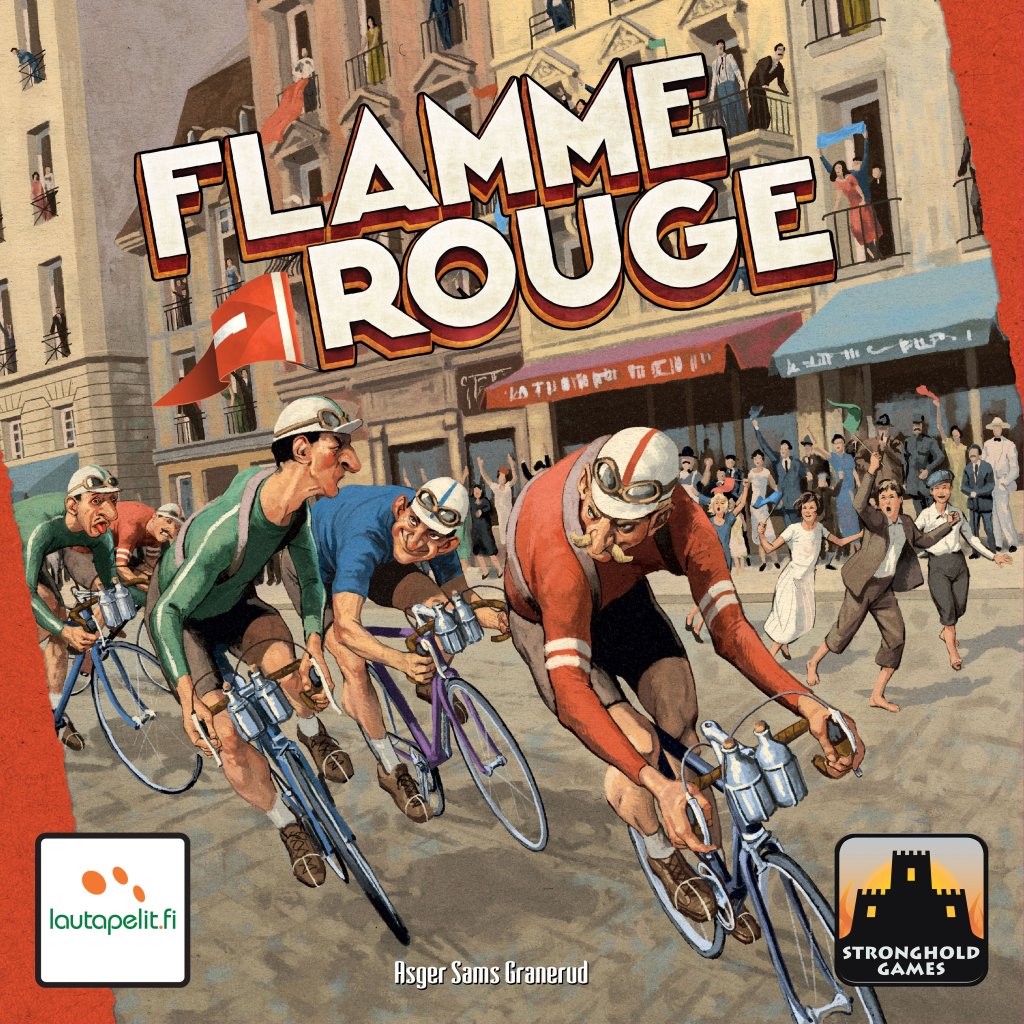
Lead from the front, conserve your riders, and use slipstreams to make the perfect move in a fast-paced tactical bicycle race.
45
minutes
2 - 4
player(s)
8+
Medium Light

About this board game
Flamme Rouge is a fast-paced, tactical bicycle racing game for 2–4 players, with races lasting about 45 minutes. Each player controls a team of two riders and aims to be the first to cross the finish line with one of them.
Every team includes a Rouleur and a Sprinteur, giving players two riders to manage as the race unfolds. Movement is driven by drawing and playing cards from each rider’s specific deck, steadily depleting that deck as the riders push forward.
The race is a contest of timing, positioning, and risk. You might lead from the front and risk exhaustion, stay safely in the middle of the pack, or strike from behind when your opponents least expect it. The key is deciding when to preserve your strength and when to make a decisive move.
- Control a team of two riders: a Rouleur and a Sprinteur.
- Draw and play cards from each rider’s specific deck to move forward.
- Use slipstreams to avoid exhaustion and improve your positioning.
- Time a well-planned sprint for the finish.
Slipstreams offer an important way to avoid exhaustion while keeping your team positioned for the decisive stages of the race. Careful play can help set up one rider for a powerful final push, but every move contributes to the changing battle around the finish line.
In Flamme Rouge, anyone can race, but few become champions. Read the pack, manage both riders, and look for the moment when your team can turn clever positioning into victory.
/pic7182955.jpg)
Board Game Rules for
Flamme Rouge
An illustrated rulebook
2–4 players | 30–45 min | age 8+
Rédacteur en chef: Asger Sams Granerud — PARIS, MERCREDI, 6 JUILLET 1932 — Prix: 5 centimes
The Great Race
In the cycling world, a red flag—Flamme Rouge—signals the last kilometer in a race. It is a sign of the last stretch, and the competing cyclists know to give their all! Gathered on the outskirts of Paris, cyclists from all around the world have arrived to participate in a great race. Everyone wants to ride underneath that red flag towards fame and glory! Spectators are bound to witness a true bout of stamina and strategy. May the best team win!
Goal of the Game
Flamme Rouge is a fast-paced, tactical bicycle racing game where each player controls a team of two riders: a Rouleur and a Sprinteur. The players’ goal is to be the first to cross the finish line with one of their riders. If more than one rider crosses the line in the same round, the one who gets furthest across wins. Players move their riders forward by drawing and playing numbered cards, which show how far each rider moves.

Game Components
- 4 Player Boards (1 per player colour)
- 8 Cyclist Models (2 per player colour):
- 4 Rouleurs
- 4 Sprinteurs
- 21 Track Tiles (double sided):
- 1 Start
- 1 Finish
- 7 Straight
- 6 Soft turns
- 6 Sharp turns
- 190 Cards:
- 120 Energy cards (4 Sprinter decks, 4 Rouleur decks)
- 60 Exhaustion cards (1 Sprinter deck, 1 Rouleur deck)
- 6 Stage cards
- 4 Reference cards


Setting Up
- Build the Track: Pick a stage card, and lay out the track tiles as depicted on it.
For your first game: Use the Avenue Corso Paseo stage card . For all the tiles, use the sides marked with lower case letters (abc…) as shown on the card and in the picture below.
 - Pick a Colour: Take a sprinteur
 and a rouleur
  model, their matching energy cards, and a player board
  of your colour.
 - Form Rider Decks: Shuffle your sprinteur’s energy cards to form a deck
 , and place it on your player board face down on its indicated space. Then, do the same for your rouleur’s energy cards
  .
. - Form Exhaustion Decks: Place all sprinteur exhaustion cards
 face up within easy reach of all players. Then, do the same for rouleur exhaustion cards
  .
.
Building the Track
The track tiles are identified with lower case and capital letters in the lower left corner, e.g. a on one side and A on the other. The start and finish tiles are highlighted with yellow. The start tile is also marked with  . At the bottom of the stage card, there is a string of letters that shows you the correct order of the tiles.
Square vs. Lane
Squares are divided from each other with thick white lines. Each square has two lanes: left & right. One rider occupies one lane. If a square is empty, riders are always placed in the right lane (which is marked with a double line).

Starting Positions
The player who most recently rode a bike (youngest if tied) freely places their two riders one at a time in any square with a free lane, behind the Start line. Continue clockwise around the table until all riders have been placed.

Red player places their riders first. Black player goes second. Blue player then joins black in the 3rd square and takes the top position, which had been left free.

Round Structure: The 3 Phases
The race is played over several rounds. Each round has three phases:
- In the Energy Phase players (simultaneously) draw 4 and play 1 card face down for one of their riders first, then the other.
- In the Movement Phase all played cards are revealed and riders move according to their card.
- In the End Phase the played cards are removed, then slipstreaming and exhaustion is applied.
1. Energy Phase
(all players simultaneously)
- Choose rider, Draw cards: Choose one of your riders (sprinteur or rouleur) and draw four cards from his energy deck
 .
. - Play and Recycle: Select one of the cards and play it face down
 next to the matching rider’s energy deck. This card indicates the rider’s movement value for this round. Recycle the unplayed cards
  .
. - Repeat: After this, repeat steps 1 and 2 for your other rider. When all players have played a card for both their riders, proceed to the Movement Phase.
Recycle: place the card(s) face up at the bottom of the matching rider’s energy deck. You may look at the recycled cards at the bottom of your decks at any time, but not the face down cards.
When drawing cards:
- You cannot draw cards for your second rider before playing the card for your first one. You can look at your played card(s) whenever you like.
- If your energy deck runs out of face down cards, shuffle the recycled cards and place them back on your player board face down. Keep drawing until you have four cards in hand.
- If there are fewer than four cards total in your energy deck (recycled & face down), simply draw all cards.

2. Movement Phase
Turn all played cards face up. Starting with the frontmost rider, move each rider forward the exact number of squares on his matching card.
- You can change lanes at no additional costs.
- A rider landing in an empty square must always be placed in the right-hand lane.
- The frontmost rider is the rider closest to the Finish line in the right-hand lane.
- A rider can move through other riders, but cannot end their movement on them. If a rider would end his movement on a fully occupied square, he must stop behind it, in the first square with a free lane.

Blue sprinteur moves first (energy value 5). Red rouleur moves next (energy value 5). He would end up in a fully occupied square. He has to end his movement on the first square with a free lane.
3. End Phase
1. Remove played cards
Remove all played cards from the game. Cards can be used only once per game.
2. Apply slipstreaming
Starting with the backmost pack of riders, move every pack that gains slipstreaming one square forward.
Pack: consists of one or more riders that have no empty squares between them.
Slipstreaming Rules:
- Check if there is exactly one empty square between two packs. The rear pack is moved forward one square so that the two packs merge. Then, check if slipstreaming applies to this new pack. Keep going through the rest of the packs.
- Riders may gain slipstreaming several times in one round.

Starting with the backmost pack  move all applicable packs in order. Pack 1 does not move, because it is more than one square away from Pack 2. Pack 2 moves because it is one empty square from Pack 3. The Merged Pack A moves because it is one empty square from Pack 4. Thus, the riders in Pack 2 got to move two squares, and Pack 3 got to move one square.
3. Assign exhaustion cards
If your rider is exhausted, take an exhaustion card matching your rider (sprinteur or rouleur) and recycle it.
- Exhaustion: A rider is exhausted if he has an empty square in front of him.
- Exhaustion cards: Are used exactly like any other energy cards with a value of 2.

Give a matching exhaustion card to every rider that has an empty square in front of him  . An empty lane in front of a rider
  does not cause exhaustion—in a real life race the pack is driving in the middle of the road, not in lanes.
Mountains
Mountains can help or hinder you, depending on how you handle them. There are two new road types that portray mountains: Ascents (all squares with  road edges) and Descents (all squares with road edges).
The Ascents add two new rules:
 Movement Phase: A rider starting on, moving onto or going across any red Ascent square can never move more than 5 squares. A higher value card can be played, but its value is capped at 5 and excess moves are wasted.
If the 6th or above move would allow the rider to enter the first square of an Ascent, simply stop him on the last free lane before the Ascent starts. End Phase: A rider on an Ascent can never give nor receive slipstreaming to or from other riders.
The Descents add only one rule:
 If a rider starts a turn on a blue Descent square, his card always counts as a minimum of 5. A lower value card can be played, but its value is always minimum 5. Slipstreaming is awarded as normal.
The road signs on the track tiles are a reminder of these rules.

Slipstreaming: Red Sprinter does not move, because Blue Rouleur is on Ascent. Blue rouleur does not move, because he’s on Ascent and cannot gain slipstreaming. Black Sprinter moves, because he is on Descent and slipstreaming applies normally.
Exhaustion cards are given as per normal rules.
Alternative Stages
The track tiles are double-sided, which allow for very varied setups. There are 6 suggested stages you can try, each with their own Stage card. Feel free to also create your own tracks!

Handicap
If you are introducing this game to new players, consider adding a handicap:
- All players that have already played the game can add 1 exhaustion card to both of their energy decks during setup.
- Really experienced players can add an additional exhaustion card to both of their energy decks.

Reporters of Flamme Rouge
- Designer: Asger Sams Granerud
- Art Director: Jere Kasanen
- Illustrator: Ossi Hiekkala
- Special thanks to: Michael Andresen, Anders Frost Bertelsen, Claus Eggert, Mads Fløe, Hans Peter Hartsteen, Malu Harding Jensen, Hans Lerche, Max Møller, Jakob Lind Olsen, Mikkel Olsen, Daniel Skjold Pedersen, Claus Raasted, Esa Ryömä, Dennis Friis Skram, Troels Vastrup, Nikolaj Wendt
© 2016 Lautapelit.fi
Urho Kekkosen katu 1
00100 Helsinki, Finland
[email protected] — www.lautapelit.fi
Overview & Goal of the Game
An illustrated rulebook
2–4 players | 30–45 min | age 8+
Rédacteur en chef: Asger Sams Granerud — PARIS, MERCREDI, 6 JUILLET 1932 — Prix: 5 centimes
The Great Race
In the cycling world, a red flag—Flamme Rouge—signals the last kilometer in a race. It is a sign of the last stretch, and the competing cyclists know to give their all! Gathered on the outskirts of Paris, cyclists from all around the world have arrived to participate in a great race. Everyone wants to ride underneath that red flag towards fame and glory! Spectators are bound to witness a true bout of stamina and strategy. May the best team win!
Goal of the Game
Flamme Rouge is a fast-paced, tactical bicycle racing game where each player controls a team of two riders: a Rouleur and a Sprinteur. The players’ goal is to be the first to cross the finish line with one of their riders. If more than one rider crosses the line in the same round, the one who gets furthest across wins. Players move their riders forward by drawing and playing numbered cards, which show how far each rider moves.
Components
Game Components
- 4 Player Boards (1 per player colour)
- 8 Cyclist Models (2 per player colour):
- 4 Rouleurs
- 4 Sprinteurs
- 21 Track Tiles (double sided):
- 1 Start
- 1 Finish
- 7 Straight
- 6 Soft turns
- 6 Sharp turns
- 190 Cards:
- 120 Energy cards (4 Sprinter decks, 4 Rouleur decks)
- 60 Exhaustion cards (1 Sprinter deck, 1 Rouleur deck)
- 6 Stage cards
- 4 Reference cards
Setup
Setting Up
- Build the Track: Pick a stage card, and lay out the track tiles as depicted on it.
For your first game: Use the Avenue Corso Paseo stage card. For all the tiles, use the sides marked with lower case letters (abc…) as shown on the card and in the picture below. - Pick a Colour: Take a sprinteur and a rouleur model, their matching energy cards, and a player board of your colour.
- Form Rider Decks: Shuffle your sprinteur’s energy cards to form a deck , and place it on your player board face down on its indicated space. Then, do the same for your rouleur’s energy cards .
- Form Exhaustion Decks: Place all sprinteur exhaustion cards face up within easy reach of all players. Then, do the same for rouleur exhaustion cards .
Building the Track
The track tiles are identified with lower case and capital letters in the lower left corner, e.g. a on one side and A on the other. The start and finish tiles are highlighted with yellow. The start tile is also marked with . At the bottom of the stage card, there is a string of letters that shows you the correct order of the tiles.
Square vs. Lane
Squares are divided from each other with thick white lines. Each square has two lanes: left & right. One rider occupies one lane. If a square is empty, riders are always placed in the right lane (which is marked with a double line).
Starting Positions
The player who most recently rode a bike (youngest if tied) freely places their two riders one at a time in any square with a free lane, behind the Start line. Continue clockwise around the table until all riders have been placed.
Red player places their riders first. Black player goes second. Blue player then joins black in the 3rd square and takes the top position, which had been left free.
How to Play
Round Structure: The 3 Phases
The race is played over several rounds. Each round has three phases:
- In the Energy Phase players (simultaneously) draw 4 and play 1 card face down for one of their riders first, then the other.
- In the Movement Phase all played cards are revealed and riders move according to their card.
- In the End Phase the played cards are removed, then slipstreaming and exhaustion is applied.
1. Energy Phase
(all players simultaneously)
- Choose rider, Draw cards: Choose one of your riders (sprinteur or rouleur) and draw four cards from his energy deck .
- Play and Recycle: Select one of the cards and play it face down next to the matching rider’s energy deck. This card indicates the rider’s movement value for this round. Recycle the unplayed cards .
- Repeat: After this, repeat steps 1 and 2 for your other rider. When all players have played a card for both their riders, proceed to the Movement Phase.
Recycle: place the card(s) face up at the bottom of the matching rider’s energy deck. You may look at the recycled cards at the bottom of your decks at any time, but not the face down cards.
When drawing cards:
- You cannot draw cards for your second rider before playing the card for your first one. You can look at your played card(s) whenever you like.
- If your energy deck runs out of face down cards, shuffle the recycled cards and place them back on your player board face down. Keep drawing until you have four cards in hand.
- If there are fewer than four cards total in your energy deck (recycled & face down), simply draw all cards.
2. Movement Phase
Turn all played cards face up. Starting with the frontmost rider, move each rider forward the exact number of squares on his matching card.
- You can change lanes at no additional costs.
- A rider landing in an empty square must always be placed in the right-hand lane.
- The frontmost rider is the rider closest to the Finish line in the right-hand lane.
- A rider can move through other riders, but cannot end their movement on them. If a rider would end his movement on a fully occupied square, he must stop behind it, in the first square with a free lane.
Blue sprinteur moves first (energy value 5). Red rouleur moves next (energy value 5). He would end up in a fully occupied square. He has to end his movement on the first square with a free lane.
3. End Phase
1. Remove played cards
Remove all played cards from the game. Cards can be used only once per game.
2. Apply slipstreaming
Starting with the backmost pack of riders, move every pack that gains slipstreaming one square forward.
Pack: consists of one or more riders that have no empty squares between them.
Slipstreaming Rules:
- Check if there is exactly one empty square between two packs. The rear pack is moved forward one square so that the two packs merge. Then, check if slipstreaming applies to this new pack. Keep going through the rest of the packs.
- Riders may gain slipstreaming several times in one round.
Starting with the backmost pack move all applicable packs in order. Pack 1 does not move, because it is more than one square away from Pack 2. Pack 2 moves because it is one empty square from Pack 3. The Merged Pack A moves because it is one empty square from Pack 4. Thus, the riders in Pack 2 got to move two squares, and Pack 3 got to move one square.
3. Assign exhaustion cards
If your rider is exhausted, take an exhaustion card matching your rider (sprinteur or rouleur) and recycle it.
- Exhaustion: A rider is exhausted if he has an empty square in front of him.
- Exhaustion cards: Are used exactly like any other energy cards with a value of 2.
Give a matching exhaustion card to every rider that has an empty square in front of him . An empty lane in front of a rider does not cause exhaustion—in a real life race the pack is driving in the middle of the road, not in lanes.
Additional Rules & Variants
Mountains
Mountains can help or hinder you, depending on how you handle them. There are two new road types that portray mountains: Ascents (all squares with road edges) and Descents (all squares with road edges).
The Ascents add two new rules:
- Movement Phase: A rider starting on, moving onto or going across any red Ascent square can never move more than 5 squares. A higher value card can be played, but its value is capped at 5 and excess moves are wasted.
If the 6th or above move would allow the rider to enter the first square of an Ascent, simply stop him on the last free lane before the Ascent starts. - End Phase: A rider on an Ascent can never give nor receive slipstreaming to or from other riders.
The Descents add only one rule:
If a rider starts a turn on a blue Descent square, his card always counts as a minimum of 5. A lower value card can be played, but its value is always minimum 5. Slipstreaming is awarded as normal.
The road signs on the track tiles are a reminder of these rules.
Slipstreaming: Red Sprinter does not move, because Blue Rouleur is on Ascent. Blue rouleur does not move, because he’s on Ascent and cannot gain slipstreaming. Black Sprinter moves, because he is on Descent and slipstreaming applies normally.
Exhaustion cards are given as per normal rules.
Alternative Stages
The track tiles are double-sided, which allow for very varied setups. There are 6 suggested stages you can try, each with their own Stage card. Feel free to also create your own tracks!
Handicap
If you are introducing this game to new players, consider adding a handicap:
- All players that have already played the game can add 1 exhaustion card to both of their energy decks during setup.
- Really experienced players can add an additional exhaustion card to both of their energy decks.
Credits
Reporters of Flamme Rouge
- Designer: Asger Sams Granerud
- Art Director: Jere Kasanen
- Illustrator: Ossi Hiekkala
- Special thanks to: Michael Andresen, Anders Frost Bertelsen, Claus Eggert, Mads Fløe, Hans Peter Hartsteen, Malu Harding Jensen, Hans Lerche, Max Møller, Jakob Lind Olsen, Mikkel Olsen, Daniel Skjold Pedersen, Claus Raasted, Esa Ryömä, Dennis Friis Skram, Troels Vastrup, Nikolaj Wendt
© 2016 Lautapelit.fi
Urho Kekkosen katu 1
00100 Helsinki, Finland
[email protected] — www.lautapelit.fi
Expansions for
Flamme Rouge
Flamme Rouge: Le Grand Tour 2018
2018
Race the final 70 km of the 2018 Tour with 21 authentic track designs.
45
minutes
Light

View expansion
Flamme Rouge: Brettspiel Adventskalender 2017 Promo
2017
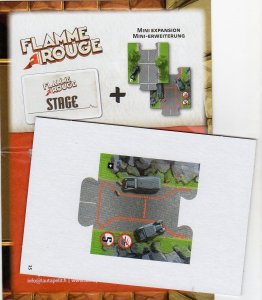
A 2017 promo expansion from Brettspiel Adventskalender 2017
45
minutes
Light
View expansion

Flamme Rouge: Grand Tour
2024
Race through customizable Tours from three stages to a full 21-stage Grand Tour.
60
minutes
Medium

View expansion

Flamme Rouge: Meteo
2018
Bring storms, side winds, and head winds to the Flamme Rouge experience.
45
minutes
Light
View expansion

Flamme Rouge: Peloton
2017
Expand the peloton, add cobblestones, and race with up to twelve players.
45
minutes
Medium Light
View expansion
