
Food Chain Magnate
2015
Run a fast-food chain, recruit key staff, shape demand, and outmaneuver rivals across a variable city map.
240
minutes
2 - 5
player(s)
14+
Heavy


About this board game
Food Chain Magnate is a heavy strategy game for 2–5 players about building a fast-food chain, with play lasting about 240 minutes.
Take control of a growing restaurant company and compete to establish the most effective business. Your progress depends on a card-driven human resource management system, where the people you recruit help shape what your company can accomplish.
Competition unfolds across a variable city map. Players develop their chains through a combination of business decisions, while also competing for important staff members in a shared job market.
- Build and manage a fast-food chain
- Use a card-driven personnel management system
- Compete through purchasing, marketing, and sales
- Recruit key staff members from the job market
- Play on a variable city map
Marketing is central to the struggle for customers. Promote products such as burgers, beer, lemonade, and gourmet burgers, then work to turn that demand into sales. The game’s sharp corporate theme embraces ambitious advertising, aggressive expansion, and management decisions focused on growing the business.
Staffing choices are equally important. Hire and train employees, organize your company around its available personnel, and compete with other players for the specialists who can strengthen your operation. At the same time, careful management of costs remains part of the challenge.
With its combination of purchasing, marketing, sales, personnel management, and a changing city layout, Food Chain Magnate offers a demanding contest for serious gamers. The result is a long-form business strategy experience for groups of two to five players.
/pic7182955.jpg)
Board Game Rules for
Food Chain Magnate
“Lemonade? They want lemonade? What is the world coming to? I want commercials for burgers on all channels, every 15 minutes. We are the Home of the Original Burger, not a hippie health haven. And place a billboard next to that new house on the corner. I want them craving beer every second they sit in their posh new garden.” The new management trainee trembles in front of the CEO and tries to politely point out that… “How do you mean, we don’t have enough staff? The HR director reports to you. Hire more people! Train them! But whatever you do, don’t pay them any real wages. I did not go into business to become poor. And fire that discount manager, she is only costing me money. From now on, we’ll sell gourmet burgers. Same crap, double the price. Get my marketing director in here!”
Food Chain Magnate is a heavy strategy game about building a fast food chain. The focus is on building your company using a card-driven (human) resource management system. Players compete on a variable city map through purchasing, marketing and sales, and on a job market for key staff members. The game can be played by 2-5 serious gamers in 2-4 hours.
Overview
Each player starts as a single entrepreneur and builds up a fast food chain. They do this by hiring and training staff, represented by cards; and by running the operations of their company, which is done on a variable board. The game continues until the bank runs out of money (twice). The richest player then wins.
The game is played in phases. Some phases are played simultaneously; others use a turn order.
Core Concepts
- Employee cards: these cards depict a person. The text under the picture describes what that person can do in the company.
- Cards with a
 in the top left can be hired by recruiters.
 - Cards that show a
 require a salary.
 - Cards that can be trained show future career options in the bottom left.
- Some cards instead show a
 in the bottom left. These are top positions. Each player may only own one of that particular card.
 - On the top right, some cards show “range”, counted by road or zeppelin.
Employee cards can be managers, marketeers, kitchen staff, and many other things.
- Cards with a
- Open slot: a position in the company structure where an employee card could have been played.
- Range: the number of times you cross onto a different tile. Range is normally tracked following a road, unless the card has a zeppelin symbol
 .
. - Restaurant: Each player has three restaurants available. Each restaurant is 2×2 squares big. One of these squares is marked as its entrance by the doors in the corner. If you need to count range from a restaurant, always start counting from its entrance.
- Map tile: a map element that can be picked up. It consists of 5×5 squares. Initially, a square can contain a road, drinks, part of a house, or empty space.
- Food and drinks: The wooden pieces symbolize food (burgers and pizzas) and drinks (soft drinks, lemonade, and beer). Placed on a house, they show demand. Placed on a marketing campaign, they show what is being advertised and for how long. In the hands of a player, they represent their stock. Drinks are also printed on the map. These indicate locations where buyers can get these type of drinks.
Colofon
- Game design: Jeroen Doumen, Joris Wiersinga
- Graphic design: Ynze Moedt, Iris de Haan
- Rule translations: Birgit Hugk, Torsten Hintz
- Published by: Splotter Spellen, The Netherlands, [email protected], http://www.splotter.nl
- Playtesting: Dan Blum, Eric Brosius, Ed Bryan, Nora Ghaoui, James Hayward, Gil Hova, Trisha Huang, Wei-Hwa Huang, Joe Huber, Larry Levy, Ian Mackey, Roel van Meerendonk, Mirjam Molenkamp, Douwe Mulder, Gerard Mulder, Kent Neumann, Steffan O’Sullivan, Joe Rushanan, Alan Stern, Tucker Taylor, Bartel van der Veek, Henriette Verburg, Roel Vinkenvleugel, Stefan Wegner, Arthur Zonnenberg.
- Special thanks to Ragnar Krempel and Bianca van Duijl who playtested the game multiple times a day on many, many Sundays for almost three years. Without them, this game would not exist.
- © Splotter Spellen BV, Woerden, 2015. 3rd printing with some modifications.
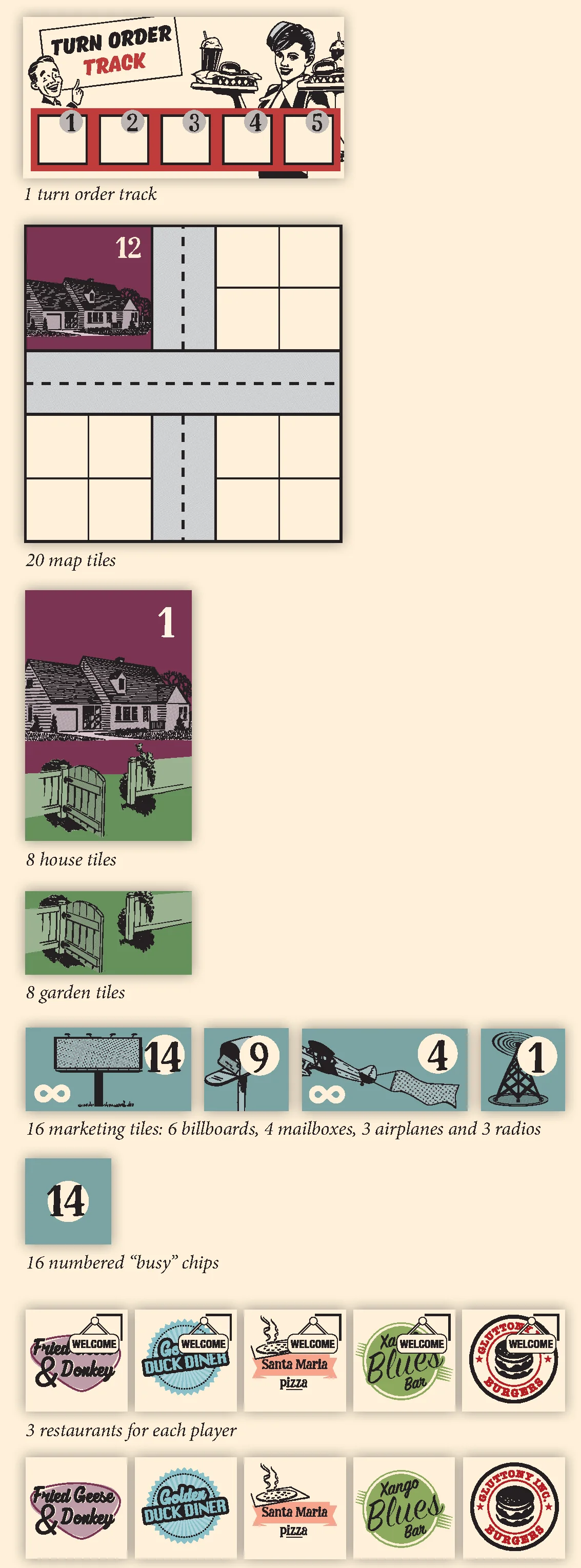
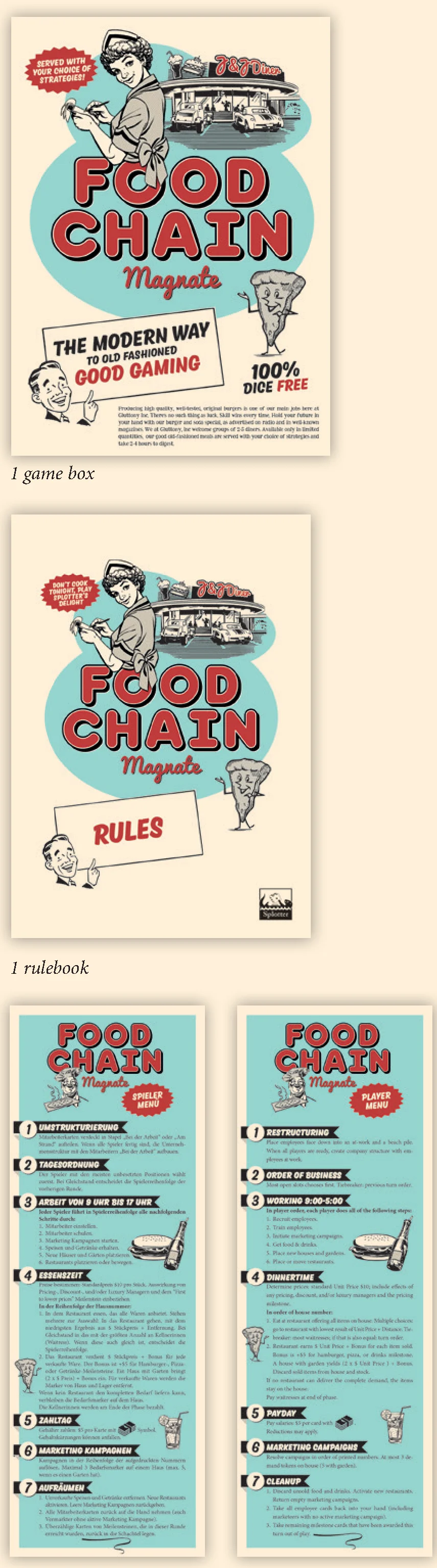
- 1 game box
- 1 rulebook
- 5 German player menus
- 5 English player menus
- 1 turn order track
- 20 map tiles
- 8 house tiles
- 8 garden tiles
- 16 marketing tiles (6 billboards, 4 mailboxes, 3 airplanes and 3 radios)
- 16 numbered “busy” chips
- 3 restaurants for each player
- 1 turn order marker for each player
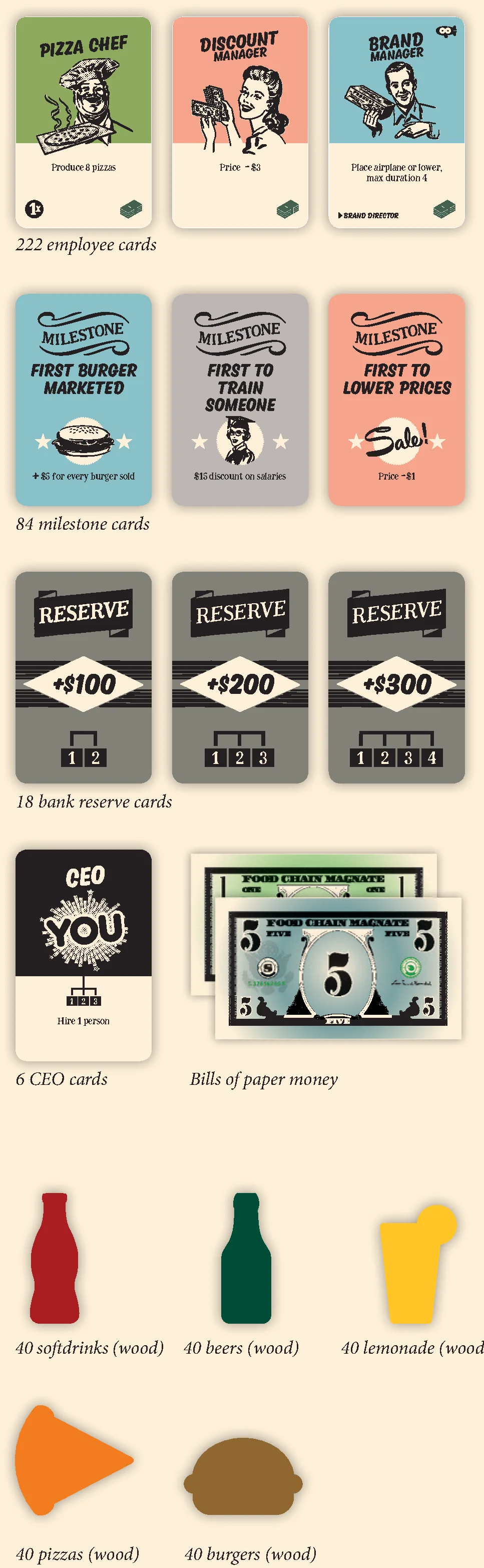
- 222 employee cards
- 84 milestone cards
- 18 bank reserve cards
- 6 CEO cards
- Bills of paper money
- 40 pizzas (wood)
- 40 burgers (wood)
- 40 softdrinks (wood)
- 40 beers (wood)
- 40 lemonade (wood)
Cards Setup
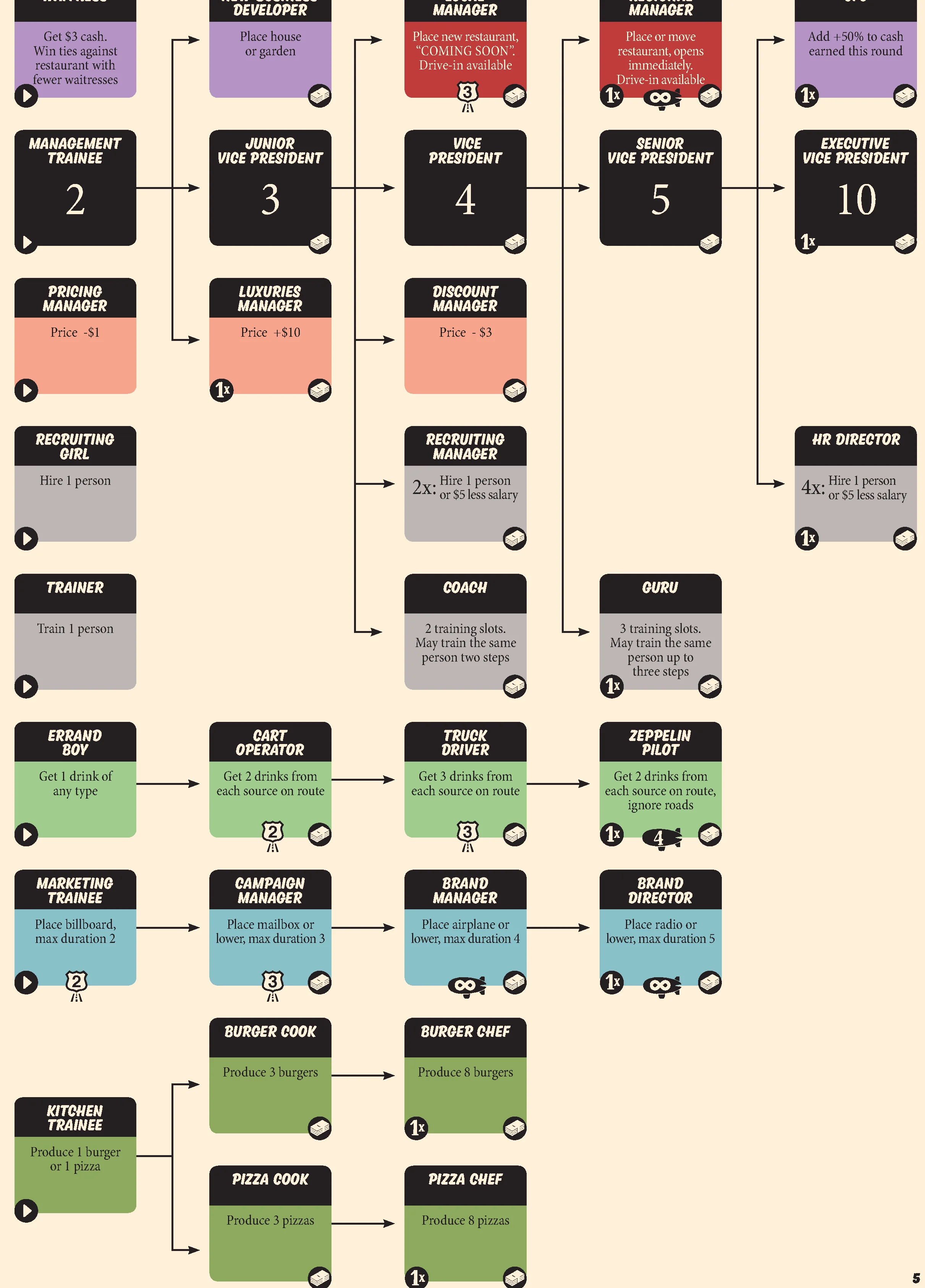
Lay out the employee and milestone cards according to the organizational overview and milestone matrix. If you lay out the cards as pictured, you will have an overview of upgrade paths and you can easily see which cards are in danger of running out.
For each employee card marked with , remove a number of cards so that you end up with the number indicated in the table below.
| Players | employee cards used |
Billboards removed | Map size |
|---|---|---|---|
| 2 | 1 | #12, #15, #16 | 3×3 |
| 3 | 1 | #15, #16 | 3×4 |
| 4 | 2 | #16 | 4×4 |
| 5 | 3 | None | 5×4 |
Put the billboards listed in the above table back in the box.
Map Setup
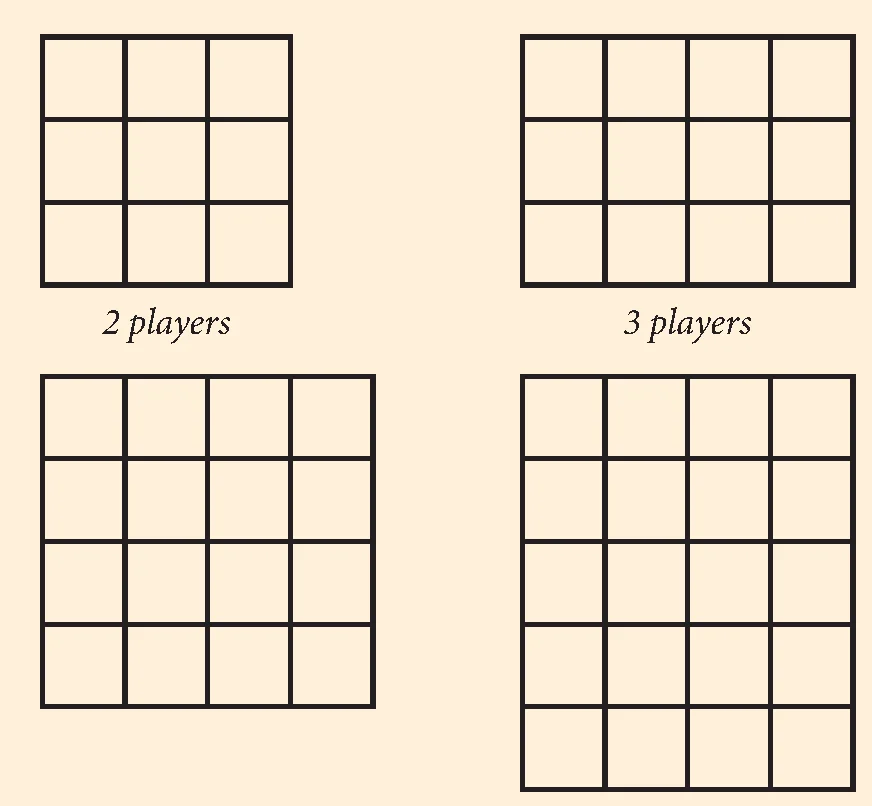
Create a map by randomly selecting map tiles. Rotate each tile randomly before placing it in a grid. The number of map tiles used depends on the number of players, as shown in the table above and the image below.
Filling the Bank
Place $50 × the number of players into the bank pool. Use a practical set of (small) bills. Put the rest of the money back into the box for now. Players do not get any money at the start of the game.
Player Markers
Each player chooses one of the restaurant chains available and receives a CEO card, 3 restaurants and a set of 3 bank reserve cards.
Initial Order of Play
Collect the turn order markers of the chosen restaurant chains and shuffle them. Randomly take out the turn order markers and place them on the turn order track in the order in which they were drawn.
Placing the First Restaurants
Each player has to place one starting restaurant.
Start with the player who is last on the turn order, and end with the player who is first. Each player may either place a restaurant, or pass. If anyone passed, a second round is executed in turn order. Each player who has not yet placed a restaurant must now place it. Players who have already placed a restaurant do not participate in the second round.
There are a few limitations on the initial placement of restaurants:
- Restaurants must be placed fully on empty squares that do not contain any other restaurants, roads, drinks, or houses.
- Restaurants must be placed so that their entrance borders on a square with a road.
- Restaurants may not be placed in such a way that their entrance is on the same tile as the entrance of an existing restaurant.
Setting Goals (Bank Reserve Cards)
Each player now chooses one of their bank reserve cards. The chosen reserve cards are placed face down next to the bank. The other reserve cards are discarded unseen. They will not be used for now.
The chosen bank reserve cards collectively indicate how much money will be added to the bank once it runs out of money. The higher the value of the cards, the longer the game will last. At the start of the game, players will not know exactly how long the game will take, which makes balancing short and long term strategies more challenging.
Phase 1: Restructuring
Each player simultaneously chooses which of their employees to use this turn. These cards are placed face down on the table. All other cards are placed face down in a separate pile. After all players have chosen their cards, they simultaneously open the pile of cards to be used this turn. These employees are said to be “at work”. The rest of the cards cannot be used this turn, although they can be trained, and you will need to pay their salary if they are not fired. These cards are said to be “on the beach”.
During all phases except this one, every player can at any time request to see the cards of another player. This includes both the cards at work and those cards ‘on the beach’.
In the first turn, the CEO will be the only card played. The CEO is always at work.
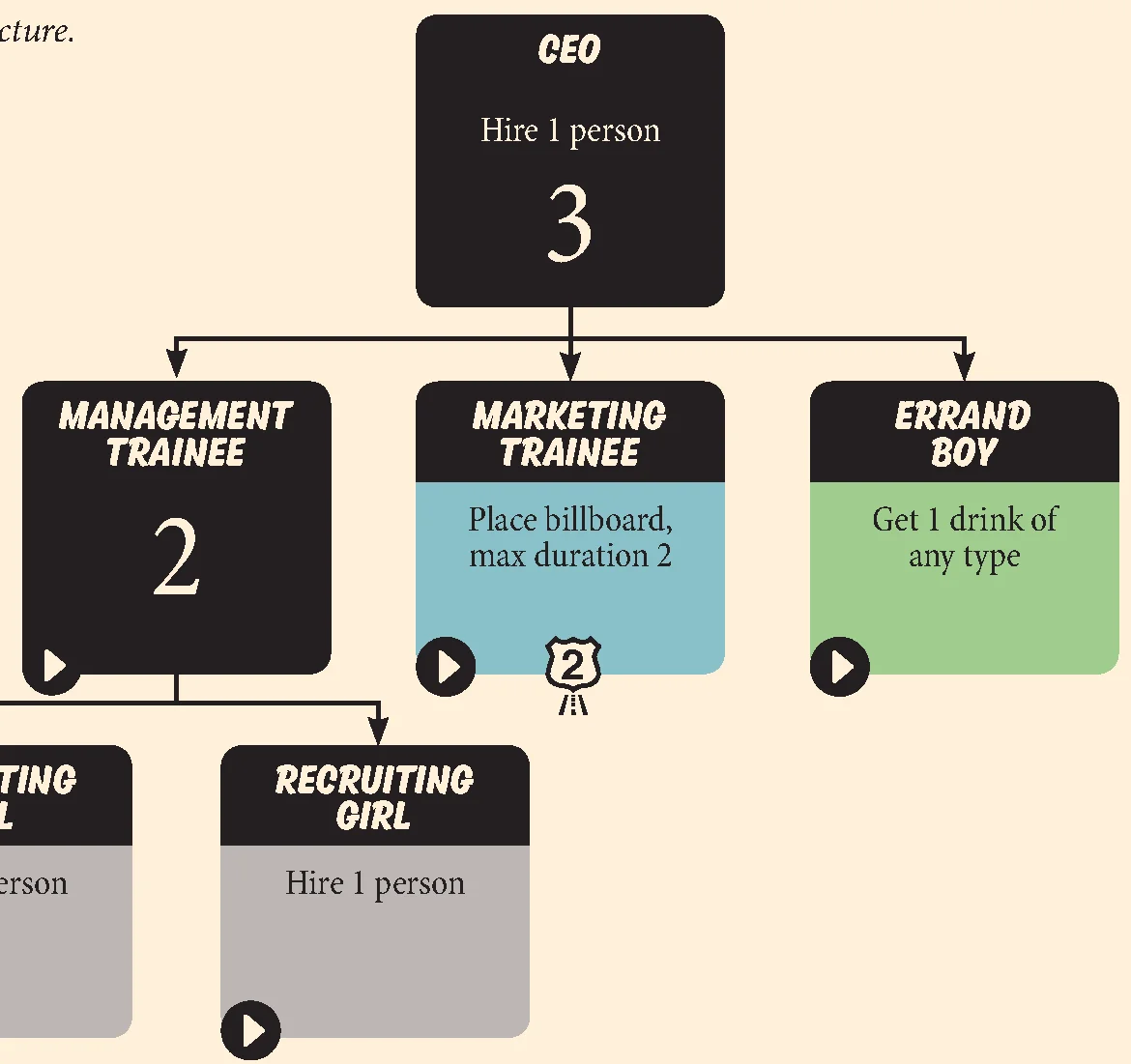
In all subsequent turns, after opening the pile, the cards at work must be placed into a company structure:
- The cards are placed in a pyramid. Each card is placed under the person he/she is reporting to.
- The top of the pyramid is the CEO, who obviously reports to nobody.
- The company structure always contains the CEO. The CEO can have up to three cards reporting to him. This is indicated by the 3 slots (rectangles) on the CEO card.
- The cards reporting to the CEO can be either normal staff or managers (black cards only).
- Each manager can have between 2–10 people reporting to him, as indicated by the number of slots on the card.
- Cards reporting to a manager can only be normal employees, not other managers.
If a player has inadvertently placed more cards than can fit into the company structure, all cards except the CEO are placed on the beach and the player has to play his turn with only the CEO.
After the bank reserve cards have been opened, CEOs may gain or lose a slot. The extra slot can be used for normal staff or managers. You can use a reserve card to indicate the new number of CEO slots.
Phase 2: Order of Business
In this phase, players choose their position on the turn order track.
- The player with the most open slots in his company structure may choose first, followed by the player with the second largest number of open slots, etc. Open slots are slots on a CEO or manager that have not been used for an employee card. (If a player has the “First airplane campaign” milestone, he counts two extra open slots.)
- If two or more players have the same number of open slots, the one who was ahead in turn order in the previous turn chooses first.
- Players choose their position in the turn order by placing the turn order marker on an available spot on the turn order track. Note that there are only as many spots on the chart as there are players participating. For example, with 3 players, you cannot choose the 4th position.
Working 9:00–5:00 Overview
In this phase, all players take turns in turn order. Each player may perform one action for each card he has at work. A player completes all of his actions before the next player gets his turn.
- Mandatory actions: pricing manager, discount manager, luxury manager, CFO, recruiting manager, HR director and waitress.
- Optional actions: all other employees.
Actions must be performed in the order listed below; the position of a card in the organizational chart has no influence.
1. Recruit
Each company always gets one free recruitment action performed by the CEO. You can hire additional employees by having recruitment cards in your company structure. For each recruitment action available, you may hire one additional employee.
- You may only hire people at entry positions (indicated by in the top left corner of the card). Take the card(s) you want and add them to your pile of cards that are on the beach.
- If a certain deck runs out of cards, you may no longer hire that type of employee until cards become available again. However, you may hire such a card if you immediately train it to a higher level in the training sub-phase of this turn (so you don’t actually have to take the card).
- Recruitment actions are available on:
- Recruiting girl (1×)
- Recruiting manager (2×)
- HR director (4×)
- Note: Unused recruitment actions on the recruiting manager and HR director will give a salary discount in phase 5.
2. Train
For each training action in your company structure you may train one person one step. You may only train employee cards that are on the beach, including employees you just hired. Employees that are currently at work in your company structure and busy marketeers cannot be trained.
- Marketeers, kitchen staff and buyers each have their own upgrade track. All other (non-entry) employees are trained directly from managers (black cards).
- Most cards list a number of training options on the bottom of the card. Cards that have no training options listed cannot be trained.
- Return the card you want to train to the main stock of cards and replace it with the card you want to train it to.
- In general, you may not train an employee you have just trained any further in the same turn. Exceptions are:
- A coach may train the same card two steps;
- A guru may train the same card up to three steps;
- If you have the “First to pay $20 in salaries” milestone, you may use multiple trainers, coaches and gurus to train the same card.
- A coach (or guru) may alternatively divide their attention over multiple employees, for example training each one step.
- You cannot train to a position if the final card is not available in the stock. However, if you train multiple steps or hire and immediately train a person, the intermediate cards do not have to be available.
- You may only have one copy of each card marked with .
3. Initiate Marketing Campaigns
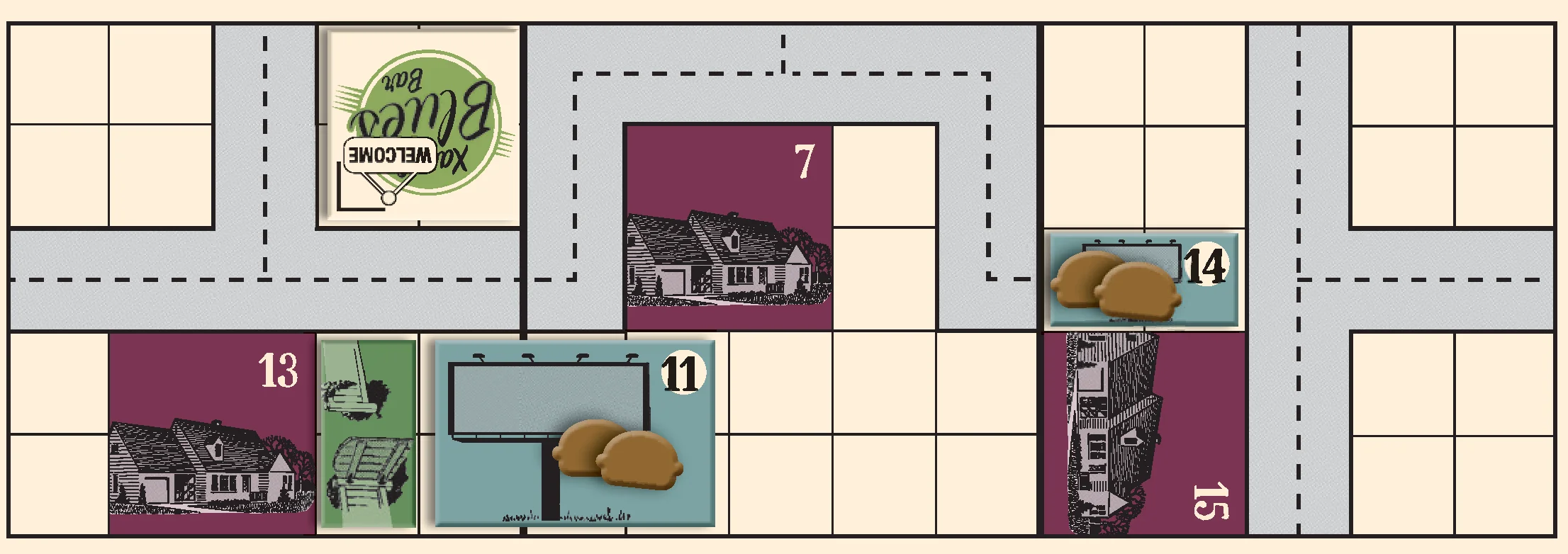
For each marketeer in your company structure, you may place a marketing campaign on the board. Depending on the type of marketeer, you may place either a billboard, a mailbox, an airplane or a radio campaign. The marketeer also indicates a certain specific range and maximum duration. After you place the campaign, you have to choose what you want to advertise.
- Type of campaign:
- Marketing trainees: may place only a billboard.
- Campaign managers: may place a mailbox or billboard.
- Brand managers: may place an airplane, mailbox or billboard.
- Brand directors: may place any type of campaign.
- Range: Each marketeer has a certain range (e.g., marketing trainee has range 2, reaching own tile [0], adjacent [1], or 2 steps away). All connections must be by road and start at a restaurant entrance of your choice. Brand managers and directors are not limited by range and can place campaigns on areas not reachable by road, but billboards, mailboxes, or radios must still be placed adjacent to a road.
- Duration: The marketeer card states the maximum duration of a campaign. Minimum duration is 1 turn. Marketing campaigns can never be ended prematurely.
- Placing the campaign:
- Billboards, mailboxes, and radios: must be placed on empty squares on the board adjacent to the road used to reach the tile. The marketing tile itself must be in range.
- Airplanes: placed on the side of the board (sizes 1, 3, or 5 squares) flying over corresponding rows/columns entirely on the board. They do not connect to roads and ignore range.
- It is allowed to place a campaign where it will not reach any houses.
- Determine what to advertise: A campaign advertises pizza, burgers, or one type of drink. Place wooden pieces of that type on the campaign as advertising markers equal to the duration.
- Marketeer will be busy: Put the marketeer card aside with a matching “busy” chip. The card is unavailable until the campaign ends and takes up no slot in your structure.
- Milestone effect: If a player has the “First billboard placed” milestone, their campaigns are permanent: place on the eternal side with 1 wooden piece. The marketeer card remains unavailable for the rest of the game.
4. Get Food & Drinks
Kitchen staff and buyers take food and drinks from stock. Earned items are kept in front of the player and are available to all restaurants in their chain.
- Kitchen trainee: Take 1 burger or pizza.
- Errand boy: Take 1 drink (soft drink, beer, or lemonade) of your choice.
- Burger cook / chef: Take 3 / 8 burgers as written on the card.
- Pizza cook / chef: Take 3 / 8 pizzas as written on the card.
- Cart operator: Starting from one restaurant entrance, trace a route of range 2 over roads (covering up to 3 tiles). Take 2 drinks from stock for each drink symbol passed orthogonally adjacent to the road. No U-turns allowed. Does not need to return to restaurant.
- Truck driver: Same as cart operator, but range 3, and takes 3 drinks per symbol passed.
- Zeppelin pilot: Starting from a restaurant entrance, trace a route of range 4 ignoring roads (covering up to 5 tiles, no tile visited twice). Collect 2 drinks for each drink symbol on flown-over tiles.
- Milestones:
- “First Errand Boy Played”: Each source provides +1 extra drink (errand boys bring 2 of the same drink; cart operators/zeppelins bring 3; trucks bring 4).
- “First Cart Operator Played”: Cart operators, truck drivers, and zeppelin pilots have +1 range.
5. Place New Houses and Gardens
If your structure contains a new business developer, you may place a new house on the map, or add a garden to an existing house.
- Placing a new house: Placed in any empty area connected to at least one road, without range limitations. Houses placed by a new business developer automatically come with a garden and cannot receive another.
- Placing a new garden: Placed on empty squares connecting over 2 squares to a house printed on a map tile, forming a 2×3 rectangle. Each house may only get one garden.
6. Place or Move Restaurants
If you have a local manager or a regional manager in your structure, you may place a new restaurant or move an existing one on empty squares bordering a road (unlike initial placement, entrances may share a tile with another restaurant).
- Local manager: Place a new restaurant within a range of 3 tiles by road from an existing restaurant. Placed with “COMING SOON” side up (opens at end of turn). All restaurants of that chain have drive-in access (entrances in each corner) while active.
- Regional manager: Place a new restaurant anywhere bordering a road, or pick up and move/rotate an existing one. Active immediately (no “COMING SOON”). All restaurants have drive-in access while active.
Phase 4: Dinnertime
Inhabitants go out to eat in numerical order of the houses, starting with the lowest printed number. Players make no decisions; inhabitants choose where to eat based on rules:
- No demand: If no demand counters are on the house, inhabitants do not go out.
- Road connection & full menu: Inhabitants will only eat at a chain that is connected by road to the house/garden and can completely fulfill their entire demand (all requested food and drinks). If no connected chain can provide the full order, inhabitants stay home.
- Competition (Price + Distance): If multiple chains can fulfill the order, inhabitants calculate:$$text{Total Cost} = text{Unit Price} + text{Distance}$$
- Standard unit price: $10. Modified by Price Managers (-$1), Discount Managers (-$3), Luxury Managers (+$10), and the permanent “First to lower prices” milestone (-$1).
- Distance: Range from house/garden to the nearest restaurant entrance of that chain along roads (crossing a tile border = 1 step; same tile = distance 0).
- Inhabitants choose the chain with the lowest (Unit Price + Distance).
- Tie-breakers:
- Chain with the most waitresses in its structure.
- If still tied, chain earlier in turn order.
- Fulfilling demand & earning cash: The chosen chain serves all items, discards the demand counters and matching stock tokens, and collects money per item:$$text{Income per item} = text{Unit Price} + text{Milestone bonuses}$$
- If the house has a garden, unit price is doubled: $(2 times text{Unit Price}) + text{Bonuses}$.
- Waitresses payout: After all houses are resolved, earn $3 per waitress ($5 with “First waitress played” milestone).
- CFO bonus: Chains with a CFO (or “First to have $100” milestone) add +50% to all cash earned this round (including waitress tips), rounded up.
Breaking the Bank & Game End
- First time: Open the bank reserve cards chosen at game setup. Add the total cash indicated to the bank. The most frequent CEO slot number shown on reserve cards (2, 3, or 4 slots; highest in case of a tie) permanently sets the CEO slots for all players starting next turn.
- Second time: The game ends immediately at the end of Phase 4! Finish paying all earnings. Salaries will not be paid this turn. The player with the most cash wins (ties broken by turn order).
Phase 5: Payday
- Fire employees: Chains may fire any number of employees from their structure or beach (return to stock). Busy marketeers cannot normally be fired.
- Pay wages: Pay $5 to the bank for each employee in your structure or on the beach with a symbol.
- Busy marketeers: Must be paid unless the player has zero cash after firing all other salaried staff; in that emergency, the busy marketeer is fired while the campaign remains.
- Salary discounts:
- Each unused hiring action on a Recruiting Manager or HR Director gives a $5 salary discount.
- Milestones (such as “First to train someone”) provide additional salary discounts.
- All available discounts must be used. Minimum salary paid is $0.
Phase 6: Marketing Campaigns
All campaigns operate in ascending order of their printed numbers. Each house can hold at most 3 demand tokens (5 if it has a garden):
- Billboard: Places 1 demand token on each orthogonally adjacent house/garden.
- Mailbox: Places 1 demand token on every house in the block (area bounded by roads/board edges).
- Airplane: Places 1 demand token on every house in its 1, 3, or 5-line fly-over corridor.
- Radio: Places 1 demand token on every house on its tile and all 8 adjacent tiles (2 demand tokens if started with “First radio campaign”).
After running, remove 1 wooden token from the campaign (unless eternal). When empty, return the marker to stock and retrieve the marketeer to your hand. Otherwise, the campaign stays and the marketeer remains busy.
Phase 7: Clean Up
- Discard all unsold food and drinks (unless you possess the “First to throw away drink/food” milestone freezer).
- Take all cards from your company structure and beach back into your hand.
- Flip “COMING SOON” restaurants to “WELCOME”.
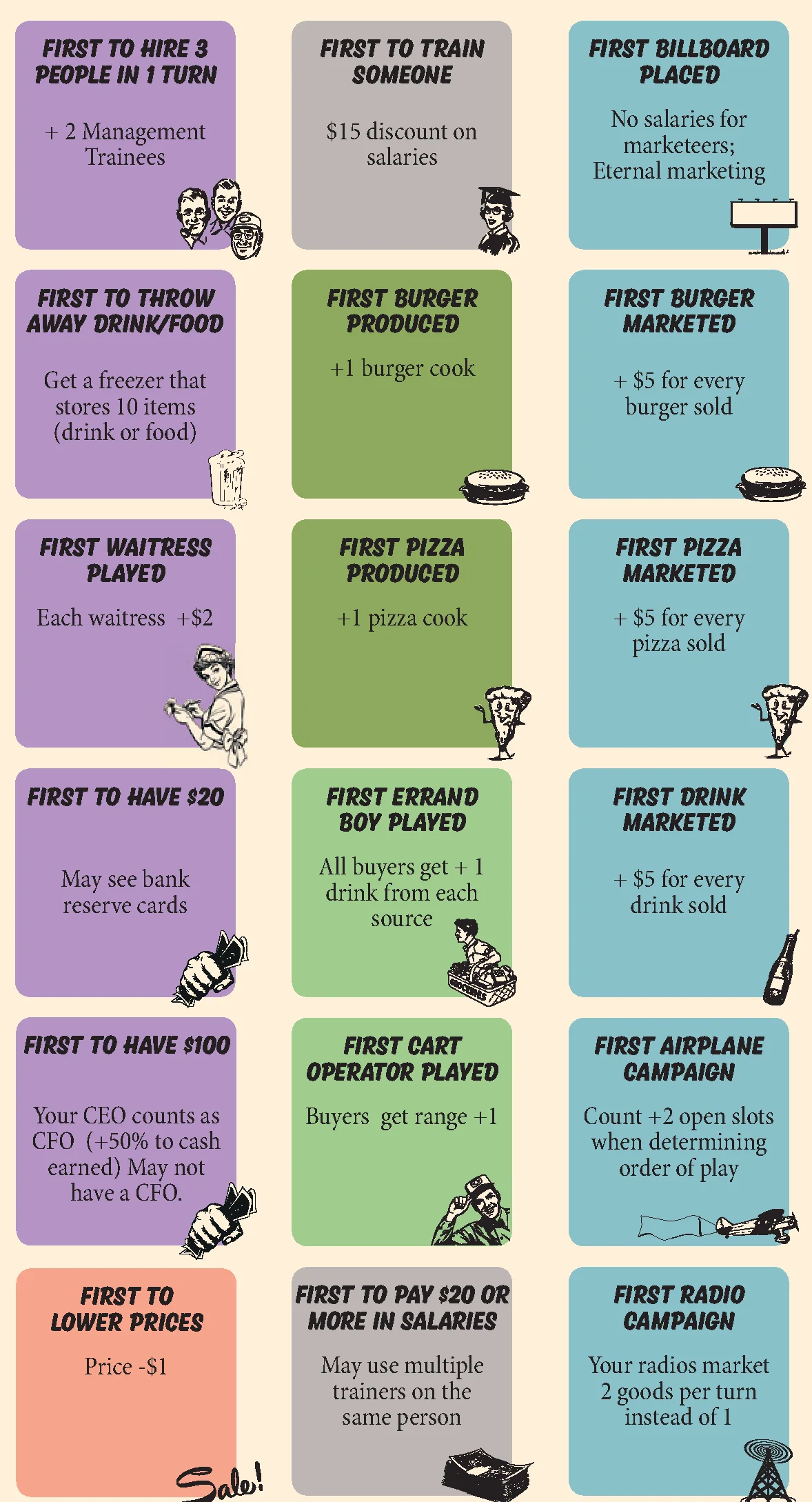
- If any milestones were awarded this round, flip all remaining cards of those types face down (they can no longer be claimed).
- Advertising tokens and house demand tokens remain on the board. Begin next turn at Phase 1.
Claiming Milestones
Milestones are awarded immediately when conditions are met. If multiple players qualify during the same turn, all of them receive the milestone. At the end of the round (Phase 7), any milestone claimed by at least one player becomes closed for the rest of the game.
Milestone Effects
- First Billboard Placed: Marketeers require no salaries. All marketing campaigns you place become eternal and stay on the board for the rest of the game.
- First to Train Someone: Receive a permanent $15 discount on total salaries each turn.
- First to Hire Three People in One Turn: Immediately take 2 Management Trainees onto your beach (may be trained immediately if capacity allows).
- First Burger / Pizza / Drink Marketed: You are the “Home of the Original” product. Receive an extra +$5 bonus whenever you sell that item (for drinks, applies to all drink types).
- First Errand Boy Played: All your buyers collect +1 drink from each source (Errand boy gets 2; Cart operator and Zeppelin get 3; Truck gets 4).
- First to Have $20: You may secretly look at the face-down bank reserve cards at any time.
- First Burger / Pizza Produced: Immediately receive a free Burger Cook or Pizza Cook onto your beach.
- First Waitress Played: Each waitress in your structure yields $5 instead of $3.
- First to Throw Away Drink/Food: Gain a freezer capable of storing up to 10 leftover food and/or drink tokens between turns.
- First to Lower Prices: Permanently reduce your unit price by -$1 for the rest of the game.
- First Cart Operator Played: All your buyers (cart, truck, zeppelin) gain +1 range.
- First Airplane Campaign: Add +2 open slots when determining player order in Phase 2.
- First Radio Campaign: Your radios place 2 goods per house instead of 1.
- First to Have $100: Your CEO permanently acts as a CFO (+50% cash bonus on sales and tips). You cannot hire or keep a CFO card.
- First to Pay $20 or More in Salaries: You may combine multiple trainers, coaches, and gurus onto the same employee in a single turn.
Introductory Game
For your first game, use these simplified rules:
- Do not use reserve cards.
- Put $75 per player into the bank pool instead of $50.
- Remove all milestone cards.
- Skip Phase 5: do not pay any salaries.
- The game ends when the bank breaks once.
Strategy Guide Pointers
- Strategy is highly dependent on map layout, your starting position, and opponent tactics.
- Milestones dictate tempo—securing key milestones early often defines the trajectory of the game.
- Balance internal recruitment and training infrastructure against market demand generation and product delivery.
- The economy accelerates drastically toward the end; plan for sudden bank breaks.
- Advertising items opponents cannot supply can corner sales, but beware enabling future competition.
- Price wars can decisively steal market demand, but consider profitability.
- Houses with gardens double base item price and offer massive windfalls, attracting fierce competition.
Introduction & Core Concepts
“Lemonade? They want lemonade? What is the world coming to? I want commercials for burgers on all channels, every 15 minutes. We are the Home of the Original Burger, not a hippie health haven. And place a billboard next to that new house on the corner. I want them craving beer every second they sit in their posh new garden.” The new management trainee trembles in front of the CEO and tries to politely point out that… “How do you mean, we don’t have enough staff? The HR director reports to you. Hire more people! Train them! But whatever you do, don’t pay them any real wages. I did not go into business to become poor. And fire that discount manager, she is only costing me money. From now on, we’ll sell gourmet burgers. Same crap, double the price. Get my marketing director in here!”
Food Chain Magnate is a heavy strategy game about building a fast food chain. The focus is on building your company using a card-driven (human) resource management system. Players compete on a variable city map through purchasing, marketing and sales, and on a job market for key staff members. The game can be played by 2-5 serious gamers in 2-4 hours.
Overview
Each player starts as a single entrepreneur and builds up a fast food chain. They do this by hiring and training staff, represented by cards; and by running the operations of their company, which is done on a variable board. The game continues until the bank runs out of money (twice). The richest player then wins.
The game is played in phases. Some phases are played simultaneously; others use a turn order.
Core Concepts
- Employee cards: these cards depict a person. The text under the picture describes what that person can do in the company.
- Cards with a in the top left can be hired by recruiters.
- Cards that show a require a salary.
- Cards that can be trained show future career options in the bottom left.
- Some cards instead show a in the bottom left. These are top positions. Each player may only own one of that particular card.
- On the top right, some cards show “range”, counted by road or zeppelin.
Employee cards can be managers, marketeers, kitchen staff, and many other things.
- Cards with a
- Open slot: a position in the company structure where an employee card could have been played.
- Range: the number of times you cross onto a different tile. Range is normally tracked following a road, unless the card has a zeppelin symbol .
- Restaurant: Each player has three restaurants available. Each restaurant is 2×2 squares big. One of these squares is marked as its entrance by the doors in the corner. If you need to count range from a restaurant, always start counting from its entrance.
- Map tile: a map element that can be picked up. It consists of 5×5 squares. Initially, a square can contain a road, drinks, part of a house, or empty space.
- Food and drinks: The wooden pieces symbolize food (burgers and pizzas) and drinks (soft drinks, lemonade, and beer). Placed on a house, they show demand. Placed on a marketing campaign, they show what is being advertised and for how long. In the hands of a player, they represent their stock. Drinks are also printed on the map. These indicate locations where buyers can get these type of drinks.
Colofon
- Game design: Jeroen Doumen, Joris Wiersinga
- Graphic design: Ynze Moedt, Iris de Haan
- Rule translations: Birgit Hugk, Torsten Hintz
- Published by: Splotter Spellen, The Netherlands, [email protected], http://www.splotter.nl
- Playtesting: Dan Blum, Eric Brosius, Ed Bryan, Nora Ghaoui, James Hayward, Gil Hova, Trisha Huang, Wei-Hwa Huang, Joe Huber, Larry Levy, Ian Mackey, Roel van Meerendonk, Mirjam Molenkamp, Douwe Mulder, Gerard Mulder, Kent Neumann, Steffan O’Sullivan, Joe Rushanan, Alan Stern, Tucker Taylor, Bartel van der Veek, Henriette Verburg, Roel Vinkenvleugel, Stefan Wegner, Arthur Zonnenberg.
- Special thanks to Ragnar Krempel and Bianca van Duijl who playtested the game multiple times a day on many, many Sundays for almost three years. Without them, this game would not exist.
- © Splotter Spellen BV, Woerden, 2015. 3rd printing with some modifications.
Components
- 1 game box
- 1 rulebook
- 5 German player menus
- 5 English player menus
- 1 turn order track
- 20 map tiles
- 8 house tiles
- 8 garden tiles
- 16 marketing tiles (6 billboards, 4 mailboxes, 3 airplanes and 3 radios)
- 16 numbered “busy” chips
- 3 restaurants for each player
- 1 turn order marker for each player
- 222 employee cards
- 84 milestone cards
- 18 bank reserve cards
- 6 CEO cards
- Bills of paper money
- 40 pizzas (wood)
- 40 burgers (wood)
- 40 softdrinks (wood)
- 40 beers (wood)
- 40 lemonade (wood)
Setup
Cards Setup
Lay out the employee and milestone cards according to the organizational overview and milestone matrix. If you lay out the cards as pictured, you will have an overview of upgrade paths and you can easily see which cards are in danger of running out.
For each employee card marked with , remove a number of cards so that you end up with the number indicated in the table below.
| Players | employee cards used |
Billboards removed | Map size |
|---|---|---|---|
| 2 | 1 | #12, #15, #16 | 3×3 |
| 3 | 1 | #15, #16 | 3×4 |
| 4 | 2 | #16 | 4×4 |
| 5 | 3 | None | 5×4 |
Put the billboards listed in the above table back in the box.
Map Setup
Create a map by randomly selecting map tiles. Rotate each tile randomly before placing it in a grid. The number of map tiles used depends on the number of players, as shown in the table above and the image below.
Filling the Bank
Place $50 × the number of players into the bank pool. Use a practical set of (small) bills. Put the rest of the money back into the box for now. Players do not get any money at the start of the game.
Player Markers
Each player chooses one of the restaurant chains available and receives a CEO card, 3 restaurants and a set of 3 bank reserve cards.
Initial Order of Play
Collect the turn order markers of the chosen restaurant chains and shuffle them. Randomly take out the turn order markers and place them on the turn order track in the order in which they were drawn.
Placing the First Restaurants
Each player has to place one starting restaurant.
Start with the player who is last on the turn order, and end with the player who is first. Each player may either place a restaurant, or pass. If anyone passed, a second round is executed in turn order. Each player who has not yet placed a restaurant must now place it. Players who have already placed a restaurant do not participate in the second round.
There are a few limitations on the initial placement of restaurants:
- Restaurants must be placed fully on empty squares that do not contain any other restaurants, roads, drinks, or houses.
- Restaurants must be placed so that their entrance borders on a square with a road.
- Restaurants may not be placed in such a way that their entrance is on the same tile as the entrance of an existing restaurant.
Setting Goals (Bank Reserve Cards)
Each player now chooses one of their bank reserve cards. The chosen reserve cards are placed face down next to the bank. The other reserve cards are discarded unseen. They will not be used for now.
The chosen bank reserve cards collectively indicate how much money will be added to the bank once it runs out of money. The higher the value of the cards, the longer the game will last. At the start of the game, players will not know exactly how long the game will take, which makes balancing short and long term strategies more challenging.
Phase 1: Restructuring & Phase 2: Order of Business
Phase 1: Restructuring
Each player simultaneously chooses which of their employees to use this turn. These cards are placed face down on the table. All other cards are placed face down in a separate pile. After all players have chosen their cards, they simultaneously open the pile of cards to be used this turn. These employees are said to be “at work”. The rest of the cards cannot be used this turn, although they can be trained, and you will need to pay their salary if they are not fired. These cards are said to be “on the beach”.
During all phases except this one, every player can at any time request to see the cards of another player. This includes both the cards at work and those cards ‘on the beach’.
In the first turn, the CEO will be the only card played. The CEO is always at work.
In all subsequent turns, after opening the pile, the cards at work must be placed into a company structure:
- The cards are placed in a pyramid. Each card is placed under the person he/she is reporting to.
- The top of the pyramid is the CEO, who obviously reports to nobody.
- The company structure always contains the CEO. The CEO can have up to three cards reporting to him. This is indicated by the 3 slots (rectangles) on the CEO card.
- The cards reporting to the CEO can be either normal staff or managers (black cards only).
- Each manager can have between 2–10 people reporting to him, as indicated by the number of slots on the card.
- Cards reporting to a manager can only be normal employees, not other managers.
If a player has inadvertently placed more cards than can fit into the company structure, all cards except the CEO are placed on the beach and the player has to play his turn with only the CEO.
After the bank reserve cards have been opened, CEOs may gain or lose a slot. The extra slot can be used for normal staff or managers. You can use a reserve card to indicate the new number of CEO slots.
Phase 2: Order of Business
In this phase, players choose their position on the turn order track.
- The player with the most open slots in his company structure may choose first, followed by the player with the second largest number of open slots, etc. Open slots are slots on a CEO or manager that have not been used for an employee card. (If a player has the “First airplane campaign” milestone, he counts two extra open slots.)
- If two or more players have the same number of open slots, the one who was ahead in turn order in the previous turn chooses first.
- Players choose their position in the turn order by placing the turn order marker on an available spot on the turn order track. Note that there are only as many spots on the chart as there are players participating. For example, with 3 players, you cannot choose the 4th position.
Phase 3: Working 9:00–5:00
Working 9:00–5:00 Overview
In this phase, all players take turns in turn order. Each player may perform one action for each card he has at work. A player completes all of his actions before the next player gets his turn.
- Mandatory actions: pricing manager, discount manager, luxury manager, CFO, recruiting manager, HR director and waitress.
- Optional actions: all other employees.
Actions must be performed in the order listed below; the position of a card in the organizational chart has no influence.
1. Recruit
Each company always gets one free recruitment action performed by the CEO. You can hire additional employees by having recruitment cards in your company structure. For each recruitment action available, you may hire one additional employee.
- You may only hire people at entry positions (indicated by in the top left corner of the card). Take the card(s) you want and add them to your pile of cards that are on the beach.
- If a certain deck runs out of cards, you may no longer hire that type of employee until cards become available again. However, you may hire such a card if you immediately train it to a higher level in the training sub-phase of this turn (so you don’t actually have to take the card).
- Recruitment actions are available on:
- Recruiting girl (1×)
- Recruiting manager (2×)
- HR director (4×)
- Note: Unused recruitment actions on the recruiting manager and HR director will give a salary discount in phase 5.
2. Train
For each training action in your company structure you may train one person one step. You may only train employee cards that are on the beach, including employees you just hired. Employees that are currently at work in your company structure and busy marketeers cannot be trained.
- Marketeers, kitchen staff and buyers each have their own upgrade track. All other (non-entry) employees are trained directly from managers (black cards).
- Most cards list a number of training options on the bottom of the card. Cards that have no training options listed cannot be trained.
- Return the card you want to train to the main stock of cards and replace it with the card you want to train it to.
- In general, you may not train an employee you have just trained any further in the same turn. Exceptions are:
- A coach may train the same card two steps;
- A guru may train the same card up to three steps;
- If you have the “First to pay $20 in salaries” milestone, you may use multiple trainers, coaches and gurus to train the same card.
- A coach (or guru) may alternatively divide their attention over multiple employees, for example training each one step.
- You cannot train to a position if the final card is not available in the stock. However, if you train multiple steps or hire and immediately train a person, the intermediate cards do not have to be available.
- You may only have one copy of each card marked with .
3. Initiate Marketing Campaigns
For each marketeer in your company structure, you may place a marketing campaign on the board. Depending on the type of marketeer, you may place either a billboard, a mailbox, an airplane or a radio campaign. The marketeer also indicates a certain specific range and maximum duration. After you place the campaign, you have to choose what you want to advertise.
- Type of campaign:
- Marketing trainees: may place only a billboard.
- Campaign managers: may place a mailbox or billboard.
- Brand managers: may place an airplane, mailbox or billboard.
- Brand directors: may place any type of campaign.
- Range: Each marketeer has a certain range (e.g., marketing trainee has range 2, reaching own tile [0], adjacent [1], or 2 steps away). All connections must be by road and start at a restaurant entrance of your choice. Brand managers and directors are not limited by range and can place campaigns on areas not reachable by road, but billboards, mailboxes, or radios must still be placed adjacent to a road.
- Duration: The marketeer card states the maximum duration of a campaign. Minimum duration is 1 turn. Marketing campaigns can never be ended prematurely.
- Placing the campaign:
- Billboards, mailboxes, and radios: must be placed on empty squares on the board adjacent to the road used to reach the tile. The marketing tile itself must be in range.
- Airplanes: placed on the side of the board (sizes 1, 3, or 5 squares) flying over corresponding rows/columns entirely on the board. They do not connect to roads and ignore range.
- It is allowed to place a campaign where it will not reach any houses.
- Determine what to advertise: A campaign advertises pizza, burgers, or one type of drink. Place wooden pieces of that type on the campaign as advertising markers equal to the duration.
- Marketeer will be busy: Put the marketeer card aside with a matching “busy” chip. The card is unavailable until the campaign ends and takes up no slot in your structure.
- Milestone effect: If a player has the “First billboard placed” milestone, their campaigns are permanent: place on the eternal side with 1 wooden piece. The marketeer card remains unavailable for the rest of the game.
4. Get Food & Drinks
Kitchen staff and buyers take food and drinks from stock. Earned items are kept in front of the player and are available to all restaurants in their chain.
- Kitchen trainee: Take 1 burger or pizza.
- Errand boy: Take 1 drink (soft drink, beer, or lemonade) of your choice.
- Burger cook / chef: Take 3 / 8 burgers as written on the card.
- Pizza cook / chef: Take 3 / 8 pizzas as written on the card.
- Cart operator: Starting from one restaurant entrance, trace a route of range 2 over roads (covering up to 3 tiles). Take 2 drinks from stock for each drink symbol passed orthogonally adjacent to the road. No U-turns allowed. Does not need to return to restaurant.
- Truck driver: Same as cart operator, but range 3, and takes 3 drinks per symbol passed.
- Zeppelin pilot: Starting from a restaurant entrance, trace a route of range 4 ignoring roads (covering up to 5 tiles, no tile visited twice). Collect 2 drinks for each drink symbol on flown-over tiles.
- Milestones:
- “First Errand Boy Played”: Each source provides +1 extra drink (errand boys bring 2 of the same drink; cart operators/zeppelins bring 3; trucks bring 4).
- “First Cart Operator Played”: Cart operators, truck drivers, and zeppelin pilots have +1 range.
5. Place New Houses and Gardens
If your structure contains a new business developer, you may place a new house on the map, or add a garden to an existing house.
- Placing a new house: Placed in any empty area connected to at least one road, without range limitations. Houses placed by a new business developer automatically come with a garden and cannot receive another.
- Placing a new garden: Placed on empty squares connecting over 2 squares to a house printed on a map tile, forming a 2×3 rectangle. Each house may only get one garden.
6. Place or Move Restaurants
If you have a local manager or a regional manager in your structure, you may place a new restaurant or move an existing one on empty squares bordering a road (unlike initial placement, entrances may share a tile with another restaurant).
- Local manager: Place a new restaurant within a range of 3 tiles by road from an existing restaurant. Placed with “COMING SOON” side up (opens at end of turn). All restaurants of that chain have drive-in access (entrances in each corner) while active.
- Regional manager: Place a new restaurant anywhere bordering a road, or pick up and move/rotate an existing one. Active immediately (no “COMING SOON”). All restaurants have drive-in access while active.
Phase 4: Dinnertime & Game End
Phase 4: Dinnertime
Inhabitants go out to eat in numerical order of the houses, starting with the lowest printed number. Players make no decisions; inhabitants choose where to eat based on rules:
- No demand: If no demand counters are on the house, inhabitants do not go out.
- Road connection & full menu: Inhabitants will only eat at a chain that is connected by road to the house/garden and can completely fulfill their entire demand (all requested food and drinks). If no connected chain can provide the full order, inhabitants stay home.
- Competition (Price + Distance): If multiple chains can fulfill the order, inhabitants calculate:$$text{Total Cost} = text{Unit Price} + text{Distance}$$
- Standard unit price: $10. Modified by Price Managers (-$1), Discount Managers (-$3), Luxury Managers (+$10), and the permanent “First to lower prices” milestone (-$1).
- Distance: Range from house/garden to the nearest restaurant entrance of that chain along roads (crossing a tile border = 1 step; same tile = distance 0).
- Inhabitants choose the chain with the lowest (Unit Price + Distance).
- Tie-breakers:
- Chain with the most waitresses in its structure.
- If still tied, chain earlier in turn order.
- Fulfilling demand & earning cash: The chosen chain serves all items, discards the demand counters and matching stock tokens, and collects money per item:$$text{Income per item} = text{Unit Price} + text{Milestone bonuses}$$
- If the house has a garden, unit price is doubled: $(2 times text{Unit Price}) + text{Bonuses}$.
- Waitresses payout: After all houses are resolved, earn $3 per waitress ($5 with “First waitress played” milestone).
- CFO bonus: Chains with a CFO (or “First to have $100” milestone) add +50% to all cash earned this round (including waitress tips), rounded up.
Breaking the Bank & Game End
- First time: Open the bank reserve cards chosen at game setup. Add the total cash indicated to the bank. The most frequent CEO slot number shown on reserve cards (2, 3, or 4 slots; highest in case of a tie) permanently sets the CEO slots for all players starting next turn.
- Second time: The game ends immediately at the end of Phase 4! Finish paying all earnings. Salaries will not be paid this turn. The player with the most cash wins (ties broken by turn order).
Phases 5–7: Payday, Marketing, & Clean Up
Phase 5: Payday
- Fire employees: Chains may fire any number of employees from their structure or beach (return to stock). Busy marketeers cannot normally be fired.
- Pay wages: Pay $5 to the bank for each employee in your structure or on the beach with a symbol.
- Busy marketeers: Must be paid unless the player has zero cash after firing all other salaried staff; in that emergency, the busy marketeer is fired while the campaign remains.
- Salary discounts:
- Each unused hiring action on a Recruiting Manager or HR Director gives a $5 salary discount.
- Milestones (such as “First to train someone”) provide additional salary discounts.
- All available discounts must be used. Minimum salary paid is $0.
Phase 6: Marketing Campaigns
All campaigns operate in ascending order of their printed numbers. Each house can hold at most 3 demand tokens (5 if it has a garden):
- Billboard: Places 1 demand token on each orthogonally adjacent house/garden.
- Mailbox: Places 1 demand token on every house in the block (area bounded by roads/board edges).
- Airplane: Places 1 demand token on every house in its 1, 3, or 5-line fly-over corridor.
- Radio: Places 1 demand token on every house on its tile and all 8 adjacent tiles (2 demand tokens if started with “First radio campaign”).
After running, remove 1 wooden token from the campaign (unless eternal). When empty, return the marker to stock and retrieve the marketeer to your hand. Otherwise, the campaign stays and the marketeer remains busy.
Phase 7: Clean Up
- Discard all unsold food and drinks (unless you possess the “First to throw away drink/food” milestone freezer).
- Take all cards from your company structure and beach back into your hand.
- Flip “COMING SOON” restaurants to “WELCOME”.
- If any milestones were awarded this round, flip all remaining cards of those types face down (they can no longer be claimed).
- Advertising tokens and house demand tokens remain on the board. Begin next turn at Phase 1.
Milestones Reference
Claiming Milestones
Milestones are awarded immediately when conditions are met. If multiple players qualify during the same turn, all of them receive the milestone. At the end of the round (Phase 7), any milestone claimed by at least one player becomes closed for the rest of the game.
Milestone Effects
- First Billboard Placed: Marketeers require no salaries. All marketing campaigns you place become eternal and stay on the board for the rest of the game.
- First to Train Someone: Receive a permanent $15 discount on total salaries each turn.
- First to Hire Three People in One Turn: Immediately take 2 Management Trainees onto your beach (may be trained immediately if capacity allows).
- First Burger / Pizza / Drink Marketed: You are the “Home of the Original” product. Receive an extra +$5 bonus whenever you sell that item (for drinks, applies to all drink types).
- First Errand Boy Played: All your buyers collect +1 drink from each source (Errand boy gets 2; Cart operator and Zeppelin get 3; Truck gets 4).
- First to Have $20: You may secretly look at the face-down bank reserve cards at any time.
- First Burger / Pizza Produced: Immediately receive a free Burger Cook or Pizza Cook onto your beach.
- First Waitress Played: Each waitress in your structure yields $5 instead of $3.
- First to Throw Away Drink/Food: Gain a freezer capable of storing up to 10 leftover food and/or drink tokens between turns.
- First to Lower Prices: Permanently reduce your unit price by -$1 for the rest of the game.
- First Cart Operator Played: All your buyers (cart, truck, zeppelin) gain +1 range.
- First Airplane Campaign: Add +2 open slots when determining player order in Phase 2.
- First Radio Campaign: Your radios place 2 goods per house instead of 1.
- First to Have $100: Your CEO permanently acts as a CFO (+50% cash bonus on sales and tips). You cannot hire or keep a CFO card.
- First to Pay $20 or More in Salaries: You may combine multiple trainers, coaches, and gurus onto the same employee in a single turn.
Variants & Strategy Guide
Introductory Game
For your first game, use these simplified rules:
- Do not use reserve cards.
- Put $75 per player into the bank pool instead of $50.
- Remove all milestone cards.
- Skip Phase 5: do not pay any salaries.
- The game ends when the bank breaks once.
Strategy Guide Pointers
- Strategy is highly dependent on map layout, your starting position, and opponent tactics.
- Milestones dictate tempo—securing key milestones early often defines the trajectory of the game.
- Balance internal recruitment and training infrastructure against market demand generation and product delivery.
- The economy accelerates drastically toward the end; plan for sudden bank breaks.
- Advertising items opponents cannot supply can corner sales, but beware enabling future competition.
- Price wars can decisively steal market demand, but consider profitability.
- Houses with gardens double base item price and offer massive windfalls, attracting fierce competition.

