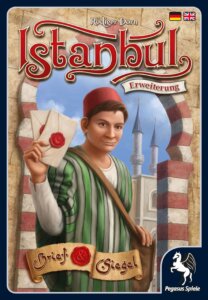
Istanbul
2014
Guide a merchant through Istanbul’s grand bazaar, balancing goods, money, and assistants in a race to collect five rubies.
60
minutes
2 - 5
player(s)
10+
Medium


About this board game
Istanbul is a board game for 2–5 players that takes about 60 minutes, placing merchants in the bustling alleys of Istanbul’s grand bazaar. Each player leads one merchant and four assistants through 16 locations while racing to be the first to collect five rubies.
Every turn presents a movement and planning challenge. Move your merchant and retinue one or two steps, then either leave an assistant at the location or collect one left there earlier before carrying out the site’s action. Since assistants handle the details, you must plan carefully: being left without assistants can leave your merchant unable to take further actions.
The bazaar’s locations offer several ways to develop your position and gather rubies. Your wheelbarrow begins with a capacity of only two for each good, so increasing its capacity can help you transport more goods. You can also fill it with specified goods, sell combinations of goods for money, and use that money to pursue other opportunities.
- Pay to increase your wheelbarrow capacity.
- Fill the wheelbarrow with goods up to its limit.
- Acquire special abilities, with earlier arrivals finding them easier to collect.
- Buy rubies or trade goods for rubies.
- Meet other merchants or certain individuals for possible extra actions.
When a merchant has collected five rubies in the wheelbarrow, the current round is completed. If that player is the only one to reach the goal, they win immediately; if others have also done so, the winner is determined by the money in hand.
With its narrow routes, assistant management, goods, and changing opportunities, Istanbul centers on making each movement count while keeping your merchant’s operation organized.
/pic7182955.jpg)
Istanbul
Board Game Rules
Introduction
Hustle and bustle in the bazaar district of Istanbul: merchants and their assistants are hurrying through the narrow alleys attempting to be more successful than their competitors. Good organization is key: wheelbarrows have to be filled with goods at the warehouses and then swiftly transported by the assistants to the various destinations. The goal of the merchants is to be the first to collect a certain amount of rubies.
Game Idea
You are leading a merchant and four assistants through the 16 Places of the bazaar. At each Place, you can carry out a specific action.
The challenge is that, to carry out an action at any of those Places, your merchant needs the help of an assistant and has to leave him behind. To use that assistant again later, your merchant has to come back to that Place and pick him up. So plan ahead carefully to avoid being left with no assistants and thus unable to do anything …
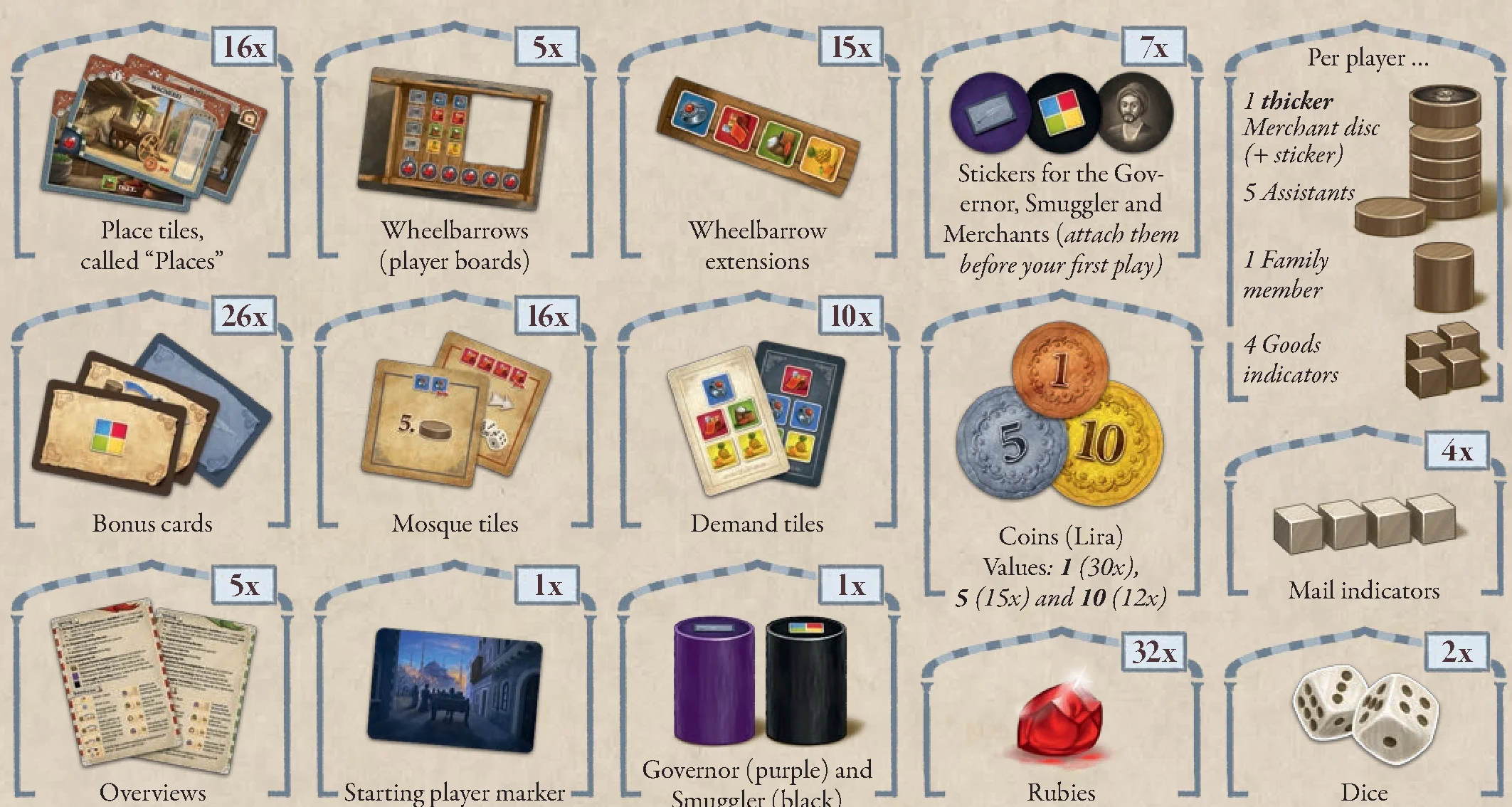
Components
- 16 Place tiles, called “Places”
- 5 Wheelbarrows (player boards)
- 15 Wheelbarrow extensions
- 7 Stickers for the Governor, Smuggler and Merchants (attach them before your first play)
- 26 Bonus cards
- 16 Mosque tiles
- 10 Demand tiles
- Coins (Lira) – Values: 1 (30x), 5 (15x) and 10 (12x)
- 4 Mail indicators
- 5 Overviews
- 1 Starting player marker
- Governor (purple) and Smuggler (black)
- 32 Rubies
- 2 Dice
- Per player:
- 1 thicker Merchant disc (+ sticker)
- 5 Assistants
- 1 Family member
- 4 Goods indicators
Board & Component Anatomy
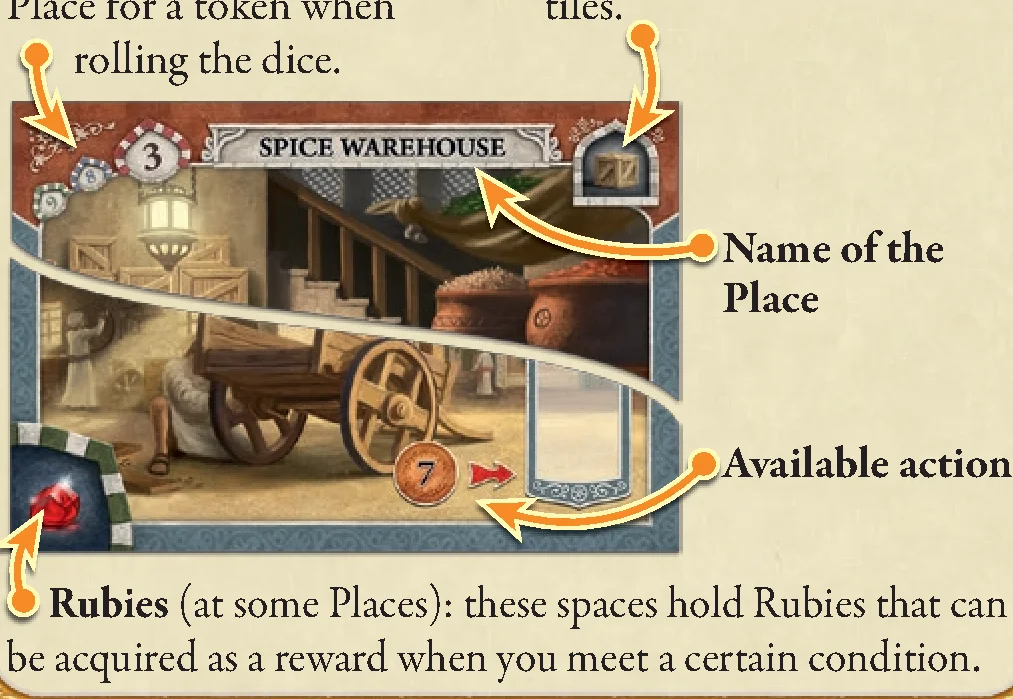
Places
Numbers: used in the various Place tile layouts. The big brown number is also used to denote the new Place for a token when rolling the dice.
Place symbol (at some places): These symbols are referred to on a number of Bonus cards and Mosque tiles.
Rubies (at some Places): these spaces hold Rubies that can be acquired as a reward when you meet a certain condition.
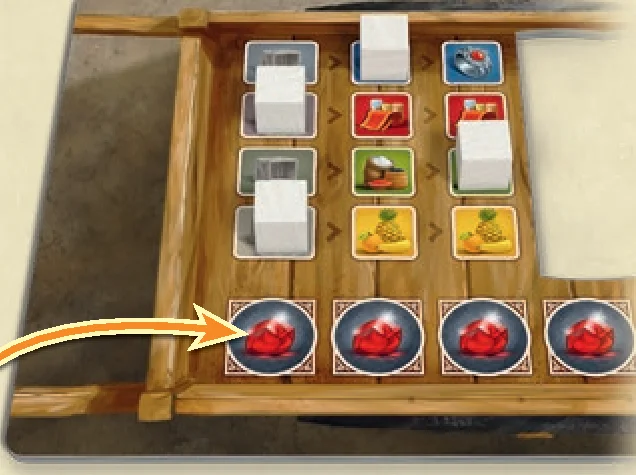
Wheelbarrows
The Goods indicators on your Wheelbarrows indicate how many goods you have. A Goods indicator on the leftmost space indicates that you don’t have any of these goods. If you receive goods, move the Goods indicator to the right. If you pay goods, move it to the left.
E.g. in the example, you have 1 blue and 2 green goods. The Rubies you collect are kept on these spaces.
Symbols
We use the following symbols on the Place tiles, Mosque tiles and Bonus cards:
 Move a token or resource (Merchant, Assistant, …)
 Pay what is shown on the left side and take what is shown on the right side
 As a consequence …
 “and”
“and” “or”
“or” Displays a connection between a Place and Bonus cards or Mosque tiles
 1 good of your choice
 Roll both dice
Game Setup
Green text: special rules for different numbers of players
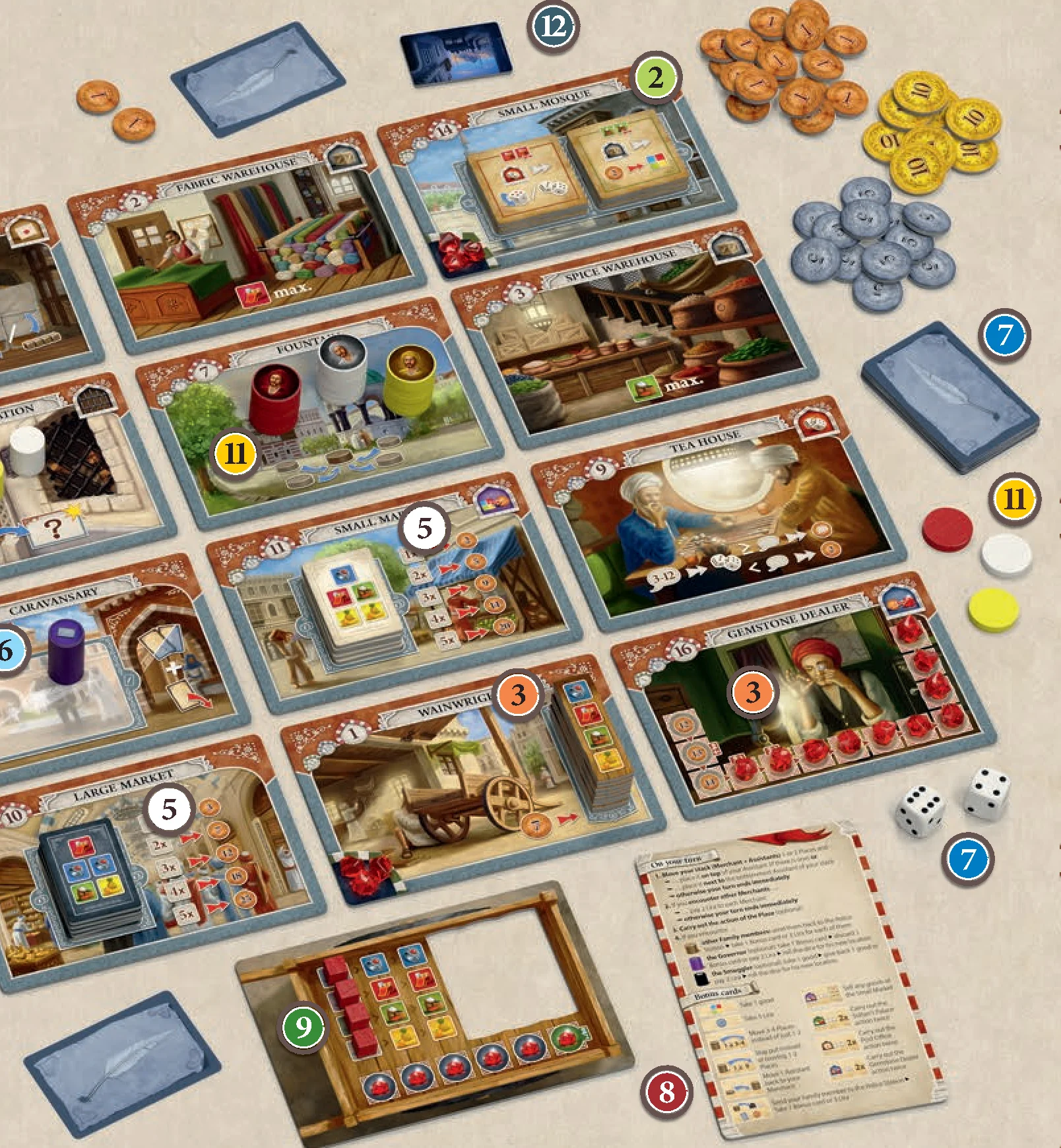
- Game Board: Lay out the 16 Place tiles in a 4×4 grid. This is considered the game board. When playing for the first time, we recommend you use the “Short paths” layout, in which the Place tiles are laid out according to their blue numbers. You can find other available layouts on the last page of this rule book.
- Mosques: Sort the Mosque tiles by color and then by their number of goods symbols in 4 stacks (so that the tile on top of each stack shows 2 symbols) and place them on the two Mosques

 . Place 1 Ruby per player on each of the Mosques.
- 5 players: Only place 4 Rubies on each of the Mosques.
- 3 players: Remove the tiles with 5 symbols from the game.
- 2 players: Remove the tiles with 3 and 5 symbols from the game.
- Wainwright, Gemstone Dealer, & Sultan’s Palace: Per player, place 1 Ruby and 3 Wheelbarrow extensions on the Wainwright
 . Place Rubies on the Gemstone Dealer
  and the Sultan’s Palace
  beginning with the top space on the right. Continue to the space for the appropriate number of players. Place 1 Ruby on each space and leave the remaining spaces empty.
 - Post Office: Place the Mail indicators in the top row of the Post Office
 .
. - Markets: Shuffle the 5 dark Demand tiles and place them face-up in a stack on the Large Market
 . Repeat this procedure for the Small Market
  using the light Demand tiles.
 - Governor and Smuggler: Determine the starting Places of the Governor and the Smuggler. For each of them, roll both dice and place the token on the Place tile with the appropriate number.
- Cards, Coins, Dice: Shuffle the Bonus cards and place them face-down in a stack as well as the coins and dice next to the game board.
- Player Setup: Each player chooses a color and takes the wooden components in that color. Also, take a Wheelbarrow and an Overview and place them in front of you.
- Goods Indicators: Place the 4 Goods indicators on the grey spaces of your Wheelbarrow.
- Family Members: Place your Family members on the Police Station
 .
. - Assistants: Stack your 4 Assistant discs and place your Merchant disc on top of this stack. Then place these stacks on the Fountain
 . Place the 5th Assistant of each player easily accessible next to the game board.
 - Start Player & Starting Resources: Randomly determine a Start player. He gets 2 Lira and the Starting player marker. In clockwise order, each other player gets 1 more Lira than the player to his right. Then each player draws a Bonus card from the top of the stack.
- 2-Player Game Rules: In a 2-player game: place the Merchant discs of the unused colors on the Mosques and the Gemstone Dealer .
Flow of Play
Beginning with the Start player you take turns in clockwise order.
When the first player has collected 5 Rubies (in a 2-player game: 6 Rubies) on the appropriate spaces of his Wheelbarrow, you complete the current round. After this round the game ends.
Your Turn
A turn consists of 4 phases but, most of the time, only the 2 phases “Movement” and “Action” are actually played. The other phases, the so-called “Encounters” (blue background below), will only take place when your Merchant encounters other tokens.
On your turn, you may use any number of Bonus cards and the special abilities of your Mosque tiles.
You must always go through the following phases in the given order regardless of whether you go through all of them or not!
1. Movement
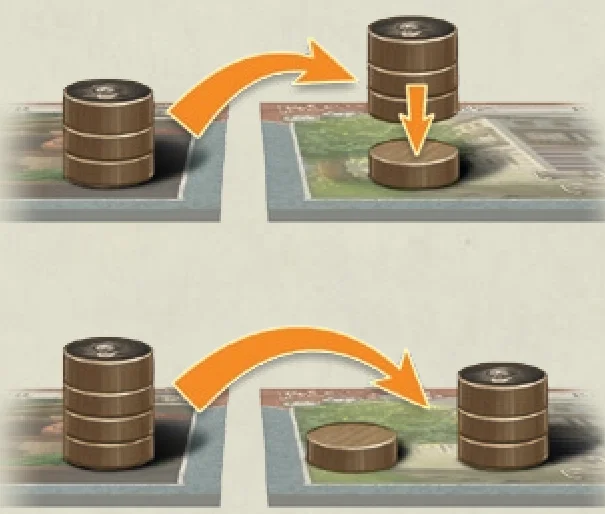
Move your Merchant and the stack of Assistants under him (if any) by 1 or 2 Places. You may not move diagonally and you must end up on a different Place than you started at.
You then have the following three options at the Merchant’s Target Place:
- a) Pick up an Assistant: If one of your Assistants was present at the target place already, put your stack on top of that Assistant. He will leave that place as part of the stack during the next Movement phase.
- b) Leave an Assistant behind: If none of your Assistants was present at the target place, remove the bottommost Assistant from your stack and place him next to it. He will be left behind at that place during the next Movement phase.
- c) If you cannot or do not want to pick up an Assistant or leave one behind, your turn ends immediately (exception: Fountain ).
Note: If you have the yellow Mosque tile, you may pay 2 Lira to take an Assistant back from another Place and add him to your Merchant stack.
2. Encounters with Other Merchants (if any)
If there are any other Merchants at the Target Place, you have to pay each of them 2 Lira. Your turn ends immediately if you cannot or do not want to pay.
Exception: You don’t have to pay other Merchants at the Fountain .
Special case in a 2-player game: If you encounter a neutral Merchant (ie of an unused color), pay the 2 Lira into the general supply. Then roll both dice to determine a new position for this neutral Merchant and place him there.
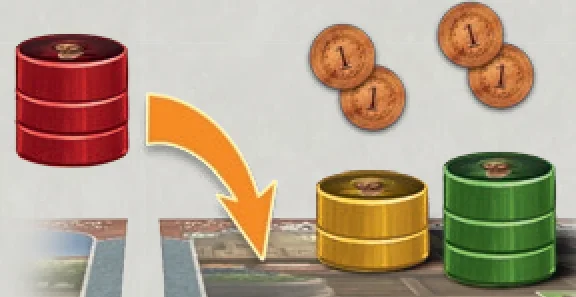
Example: The red player has to pay 2 Lira to the yellow and the green player, otherwise his turn ends immediately.
3. Action
You may carry out the action that the target place provides. If you cannot or do not want to carry it out, you may proceed with phase 4 (Encounters).
4. Encounters (if any) in Any Order with …
- … other Family members: If there are other players’ Family members at the Target Place, you must catch them and send them all to the Police Station (unless they are there already). As a reward for catching them, you may take 1 Bonus card or 3 Lira from the general supply for each such Family member. If you catch more than 1 Family member, you may take a different or the same reward for each of them (you do not get any reward in the Police Station).
- … the Governor: You may draw 1 Bonus card from the face-down stack and put it into your hand. If you do, either pay 2 Lira or discard 1 Bonus card from your hand.
- … the Smuggler: You may gain 1 good of your choice. If you do, either pay 2 Lira or 1 good.
If you used the ability of the Governor or Smuggler, roll both dice and place the appropriate token on the Place indicated by the result of the dice roll (according to the large brown number). Roll separately if you used them both.
Note: You may discard the Bonus card or pay the good you received from the Governor or Smuggler in order to move them.
Places and Their Actions
1 Wainwright
Pay 7 Lira into the general supply to take a Wheelbarrow extension from the Wainwright and place it in your Wheelbarrow.
As soon as you complete your Wheelbarrow, i.e. once you have extended it for the 3rd time, immediately and only once take 1 Ruby off the Wainwright and place it on your Wheelbarrow.
2-4 Fabric/Spice/Fruit Warehouse
Move the Goods indicator of the respective good as far to the right as possible.
If you have the green Mosque tile, you may pay 2 Lira to gain 1 additional good of any type.
5 Post Office
You receive the resources that are depicted on the 4 uncovered spaces. Then move the leftmost Mail indicator of the top row down to the bottom row. If all Mail indicators are already in the bottom row, move them all back to the top row.
Example: You receive 3 Lira, 1 yellow and 1 red good. Then you move the Mail indicator off the blue good onto the yellow one.
6 Caravansary
Take 2 Bonus cards into your hand and discard 1 Bonus card from your hand.
Note: When taking Bonus cards with this action (and only with this one), you may also take them from the top of the face-up discard pile!
7 Fountain
Return any number of your Assistants to your Merchant stack.
The Fountain is the only Place where you do not need to have an Assistant there to carry out the action and you do not have to pay other Merchants if they are present.
If you send your Family Member to the Fountain, your Assistants are still returned to your Merchant stack.
8 Black Market
Gain 1 red or 1 yellow or 1 green good.
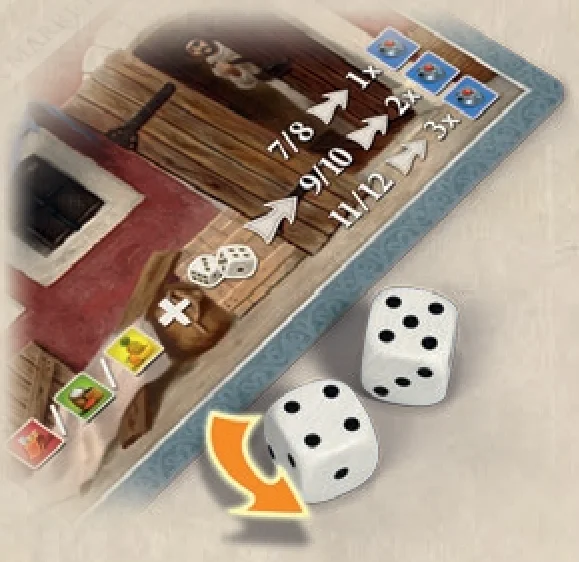
Roll both dice:
- If you rolled 7 or 8: Gain 1 blue good.
- If you rolled 9 or 10: Gain 2 blue goods.
- If you rolled 11 or 12: Gain 3 blue goods.
You may also roll the dice first and gain the one additional good afterwards.
If you have the red Mosque tile, you may turn one die to “4” after the roll or re-roll both dice.
9 Tea House
Announce a number between 3 and 12. Then roll both dice.
If you roll equal to or greater than the announced number, take the announced number of Lira from the general supply. Otherwise, only take 2 Lira.
If you have the red Mosque tile, you may turn one die to “4” after the roll or re-roll both dice.
10/11 Small/Large Market
Sell 1-5 of the goods that are depicted on the Demand tile. Move the Goods indicators on your Wheelbarrow accordingly. Then take the revenue from the general supply according to the table.
Finally, move the current Demand tile to the bottom of the stack.
Example: You sell 1 red, 1 green and 2 yellow goods and in exchange receive 14 Lira.
12 Police Station
If your Family member is in the Police Station, “free” it and send it to another Place. Then carry out the action of that Place. Your Family member does not have any encounters!
While at other Places, your Family member may be caught by other Merchants and sent back to the Police Station. As a reward, the catching player will get 1 Bonus card or 3 Lira.
Example: You send your Family member from the Police Station to the Spice Warehouse. You fill your Wheelbarrow with the green goods. You do not have to pay 2 Lira to your opponent and you may not use the Governor.
13 Sultan’s Palace
Deliver all the goods that are not covered by a Ruby to the Sultan.
As a reward, take the next available Ruby from the track and place it on your Wheelbarrow. Consequently, the next Ruby will be more expensive.
Example: You have to pay 2 blue, 2 red, 1 yellow, 1 green and 1 good of any type to get the next Ruby from the track.
14/15 Small/Great Mosque
Take 1 Mosque tile. To do so, your Wheelbarrow must carry the goods that are depicted on the Mosque tile in the required quantities. Then pay 1 of the depicted goods. Each Mosque tile provides a special ability. You may only have one copy of each tile.
As soon as you acquire both tiles of one Mosque, immediately and only once take 1 Ruby from that Mosque and place it on your Wheelbarrow.
Example: In order to get this Mosque tile, your Wheelbarrow needs to carry at least 3 blue goods and you have to pay 1 of them. After you paid the good, you receive the tile and then add the 5th Assistant of your color to the bottom of your Merchant stack.
16 Gemstone Dealer
Pay a number of Lira into the general supply equal to the biggest number that is not covered by a Ruby.
Then take the next available Ruby from the track and place it on your Wheelbarrow. Consequently, the next Ruby will be more expensive.
Example: The biggest number that is not covered by a Ruby is 15. So you have to pay 15 Lira to get the next Ruby from the track.
Mosque Tiles
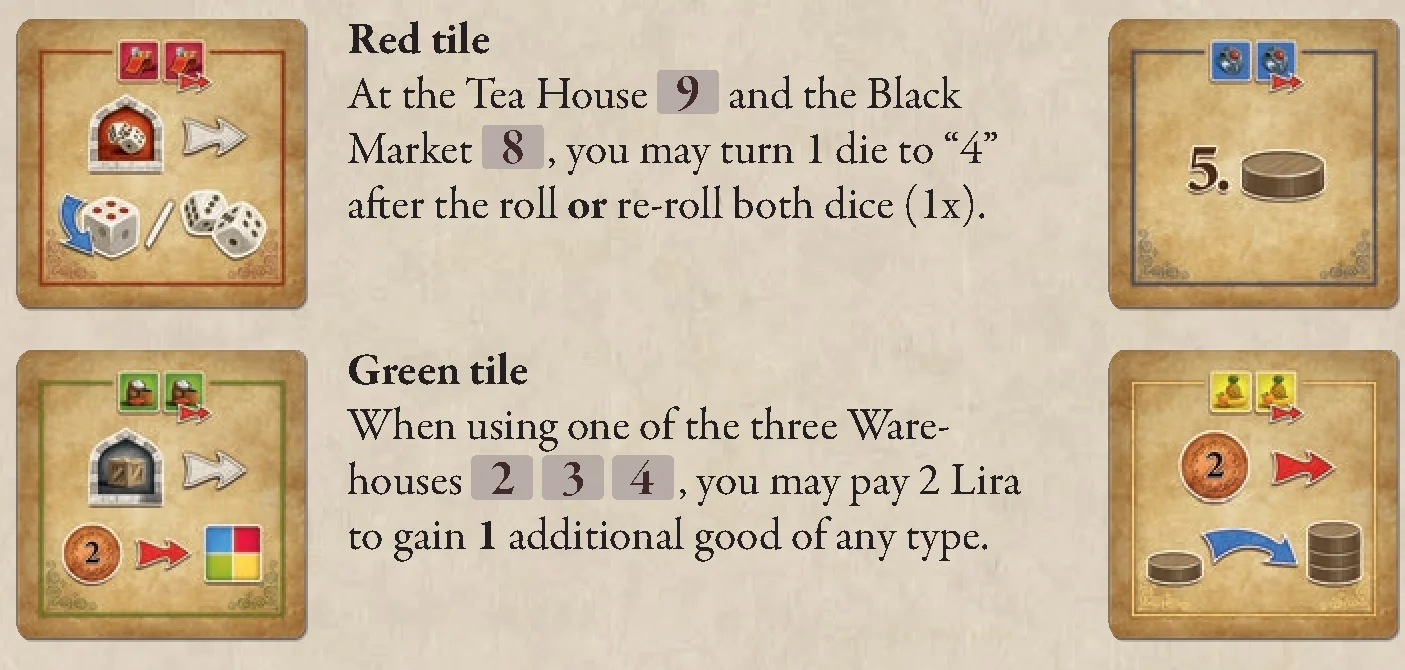
- Red tile: At the Tea House
 and the Black Market
  , you may turn 1 die to “4” after the roll or re-roll both dice (1x).
 - Blue tile: Immediately take the 5th Assistant of your color from the general supply and place him under your Merchant.
- Green tile: When using one of the three Warehouses


 , you may pay 2 Lira to gain 1 additional good of any type.
 - Yellow tile: Once on your turn, you may pay 2 Lira to return an Assistant to your Merchant stack.
Bonus Cards
- On your turn, you may play any number of Bonus cards.
- Place every used or discarded Bonus card on the face-up discard pile on the Caravansary
 .
. - When taking a Bonus card, draw it from the face-down draw pile (exception: Caravansary ).
- Shuffle the discard pile to form a new face-down draw pile as soon as the draw pile runs out.
- You may keep any number of Bonus cards in your hand.
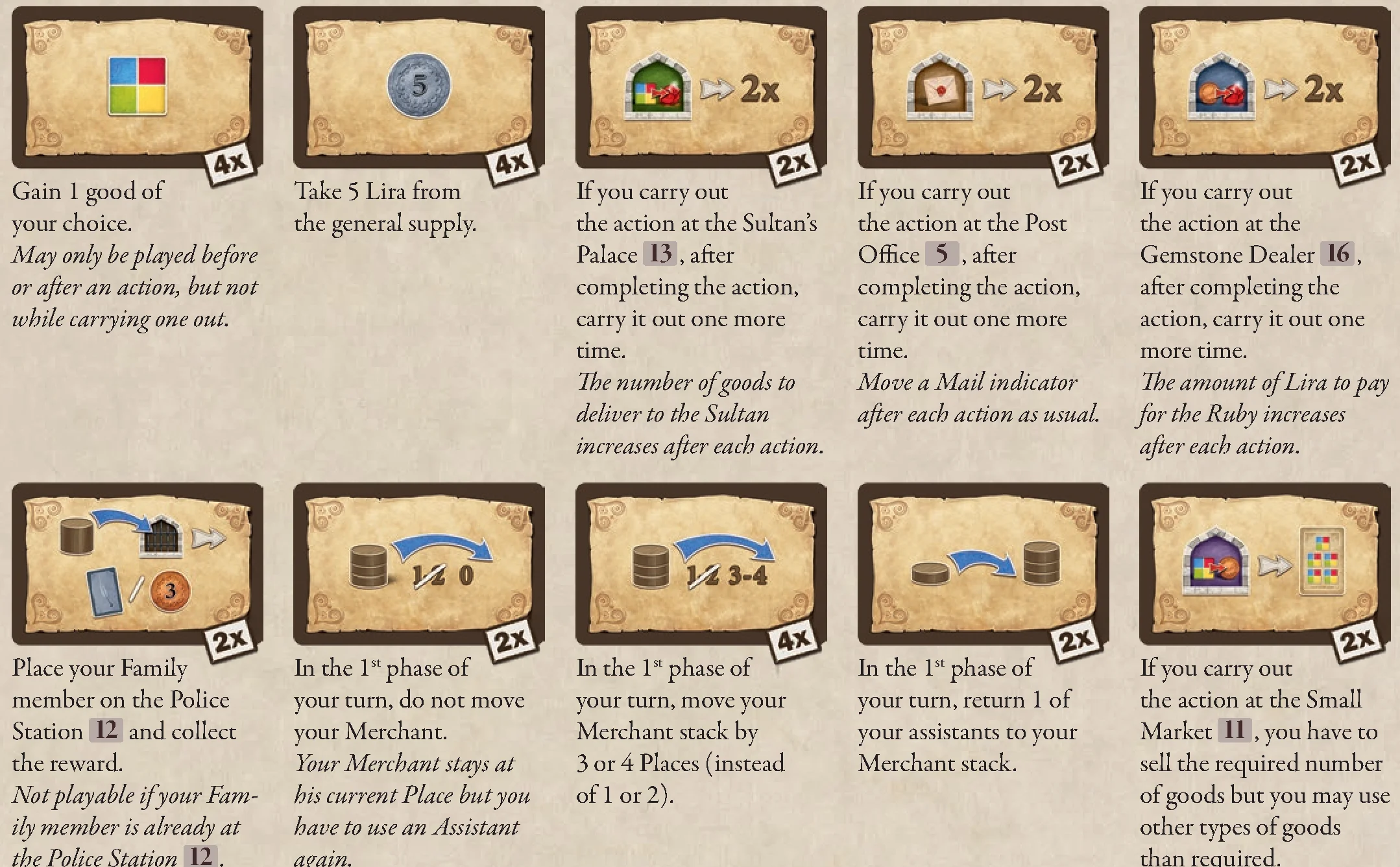
Bonus Card Details
- Gain 1 good of your choice (4x): May only be played before or after an action, but not while carrying one out.
- Take 5 Lira from the general supply (4x).
- Extra Sultan’s Palace action (2x): If you carry out the action at the Sultan’s Palace , after completing the action, carry it out one more time. The number of goods to deliver to the Sultan increases after each action.
- Extra Post Office action (2x): If you carry out the action at the Post Office , after completing the action, carry it out one more time. Move a Mail indicator after each action as usual.
- Extra Gemstone Dealer action (2x): If you carry out the action at the Gemstone Dealer , after completing the action, carry it out one more time. The amount of Lira to pay for the Ruby increases after each action.
- Free your Family member (2x): Place your Family member on the Police Station and collect the reward. Not playable if your Family member is already at the Police Station .
- Stay in Place (2x): In the 1st phase of your turn, do not move your Merchant. Your Merchant stays at his current Place but you have to use an Assistant again.
- Move 3 or 4 Places (4x): In the 1st phase of your turn, move your Merchant stack by 3 or 4 Places (instead of 1 or 2).
- Return an Assistant (2x): In the 1st phase of your turn, return 1 of your assistants to your Merchant stack.
- Wild goods at Small Market (2x): If you carry out the action at the Small Market , you have to sell the required number of goods but you may use other types of goods than required.
End of the Game
The first player to collect 5 Rubies (in a 2-player game: 6 Rubies) triggers the end of the game. When this happens, complete the current round. Then each player may use his leftover Bonus cards that provide goods or money. This may matter for the tie-breaker.
The player with the most Rubies wins.
Tie-Breaker
Ties are broken in the following order:
- Most leftover Lira
- Most leftover goods on the Wheelbarrow
- Most leftover Bonus cards
If these have not resolved the tie, there are multiple winners.
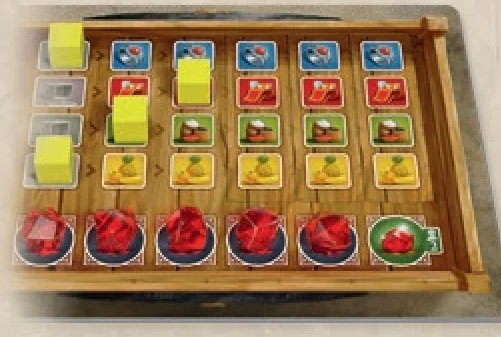
Variations for Place Tile Layouts
- Short paths (sorted by the blue numbers): Use this layout when learning the game or when you wish to play a shorter game. The distances between Places that work well together are small, which makes the game easier to play.
- Long paths (sorted by the green numbers): This layout is designed for experienced players: Places that work well together are far apart from each other, which forces you to plan ahead more carefully when placing your Assistants.
- In order (sorted by the big numbers): This layout is also more challenging: similar Places are grouped together.
- Random layout: This layout offers a lot of variety: shuffle the Place tiles and lay them out in a 4×4 grid. The challenge is to find out which paths are the most efficient in the given layout, which is different from play to play. Please note: even with a random layout, it is recommended that you use the following restrictions:
- The Fountain has to be on one of the 4 Places in the middle of the grid.
- The Black Market and the Tea House should have a distance from each other of at least 3 Places.
- The Fountain
Variant (for 2-4 Players)
If you have already played Istanbul a few times, we recommend you try out this more tactical variant:
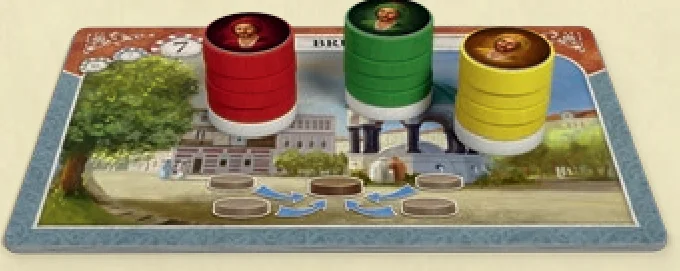
- During setup, replace the bottommost Assistant of your stack with an Assistant of a neutral color (we recommend you use white as the neutral color, see fig. below).
- If your Merchant ends his movement at a Place with a neutral Assistant, he may pick him up as if this were one of your Assistants.
- If there are both a neutral and one of your Assistants at the Target Place, you may decide which Assistant to pick up in order to carry out the action.
- You are allowed to have more than one neutral Assistant under your Merchant.
- At the Fountain , you can only get your own Assistants back.
Credits
The publisher and the designer would like to thank all play-testers and proof-readers for their valuable feedback.
- Designer: Rüdiger Dorn
- Illustrations: Andreas Resch
- Graphic Design: Andreas Resch, Hans-Georg Schneider
- Realization: Ralph Bruhn
- English Translation: Grzegorz Kobiela
Copyright © 2014 Pegasus Spiele GmbH, Straßheimer Str. 2, 61169 Friedberg, www.pegasus.de. All rights reserved. Reprinting or publishing of the rule book, game components or illustrations is prohibited without prior permission.
Overview & Components
Introduction
Hustle and bustle in the bazaar district of Istanbul: merchants and their assistants are hurrying through the narrow alleys attempting to be more successful than their competitors. Good organization is key: wheelbarrows have to be filled with goods at the warehouses and then swiftly transported by the assistants to the various destinations. The goal of the merchants is to be the first to collect a certain amount of rubies.
Game Idea
You are leading a merchant and four assistants through the 16 Places of the bazaar. At each Place, you can carry out a specific action.
The challenge is that, to carry out an action at any of those Places, your merchant needs the help of an assistant and has to leave him behind. To use that assistant again later, your merchant has to come back to that Place and pick him up. So plan ahead carefully to avoid being left with no assistants and thus unable to do anything …
Components
- 16 Place tiles, called “Places”
- 5 Wheelbarrows (player boards)
- 15 Wheelbarrow extensions
- 7 Stickers for the Governor, Smuggler and Merchants (attach them before your first play)
- 26 Bonus cards
- 16 Mosque tiles
- 10 Demand tiles
- Coins (Lira) – Values: 1 (30x), 5 (15x) and 10 (12x)
- 4 Mail indicators
- 5 Overviews
- 1 Starting player marker
- Governor (purple) and Smuggler (black)
- 32 Rubies
- 2 Dice
- Per player:
- 1 thicker Merchant disc (+ sticker)
- 5 Assistants
- 1 Family member
- 4 Goods indicators
Board & Component Anatomy
Places
Numbers: used in the various Place tile layouts. The big brown number is also used to denote the new Place for a token when rolling the dice.
Place symbol (at some places): These symbols are referred to on a number of Bonus cards and Mosque tiles.
Rubies (at some Places): these spaces hold Rubies that can be acquired as a reward when you meet a certain condition.
Wheelbarrows
The Goods indicators on your Wheelbarrows indicate how many goods you have. A Goods indicator on the leftmost space indicates that you don’t have any of these goods. If you receive goods, move the Goods indicator to the right. If you pay goods, move it to the left.
E.g. in the example, you have 1 blue and 2 green goods. The Rubies you collect are kept on these spaces.
Symbols
We use the following symbols on the Place tiles, Mosque tiles and Bonus cards:
- Move a token or resource (Merchant, Assistant, …)
- Pay what is shown on the left side and take what is shown on the right side
- As a consequence …
- “and”
- “or”
- Displays a connection between a Place and Bonus cards or Mosque tiles
- 1 good of your choice
- Roll both dice
Setup
Game Setup
Green text: special rules for different numbers of players
- Game Board: Lay out the 16 Place tiles in a 4×4 grid. This is considered the game board. When playing for the first time, we recommend you use the “Short paths” layout, in which the Place tiles are laid out according to their blue numbers. You can find other available layouts on the last page of this rule book.
- Mosques: Sort the Mosque tiles by color and then by their number of goods symbols in 4 stacks (so that the tile on top of each stack shows 2 symbols) and place them on the two Mosques . Place 1 Ruby per player on each of the Mosques.
- 5 players: Only place 4 Rubies on each of the Mosques.
- 3 players: Remove the tiles with 5 symbols from the game.
- 2 players: Remove the tiles with 3 and 5 symbols from the game.
- Wainwright, Gemstone Dealer, & Sultan’s Palace: Per player, place 1 Ruby and 3 Wheelbarrow extensions on the Wainwright . Place Rubies on the Gemstone Dealer and the Sultan’s Palace beginning with the top space on the right. Continue to the space for the appropriate number of players. Place 1 Ruby on each space and leave the remaining spaces empty.
- Post Office: Place the Mail indicators in the top row of the Post Office .
- Markets: Shuffle the 5 dark Demand tiles and place them face-up in a stack on the Large Market . Repeat this procedure for the Small Market using the light Demand tiles.
- Governor and Smuggler: Determine the starting Places of the Governor and the Smuggler. For each of them, roll both dice and place the token on the Place tile with the appropriate number.
- Cards, Coins, Dice: Shuffle the Bonus cards and place them face-down in a stack as well as the coins and dice next to the game board.
- Player Setup: Each player chooses a color and takes the wooden components in that color. Also, take a Wheelbarrow and an Overview and place them in front of you.
- Goods Indicators: Place the 4 Goods indicators on the grey spaces of your Wheelbarrow.
- Family Members: Place your Family members on the Police Station .
- Assistants: Stack your 4 Assistant discs and place your Merchant disc on top of this stack. Then place these stacks on the Fountain . Place the 5th Assistant of each player easily accessible next to the game board.
- Start Player & Starting Resources: Randomly determine a Start player. He gets 2 Lira and the Starting player marker. In clockwise order, each other player gets 1 more Lira than the player to his right. Then each player draws a Bonus card from the top of the stack.
- 2-Player Game Rules: In a 2-player game: place the Merchant discs of the unused colors on the Mosques and the Gemstone Dealer .
How to Play
Flow of Play
Beginning with the Start player you take turns in clockwise order.
When the first player has collected 5 Rubies (in a 2-player game: 6 Rubies) on the appropriate spaces of his Wheelbarrow, you complete the current round. After this round the game ends.
Your Turn
A turn consists of 4 phases but, most of the time, only the 2 phases “Movement” and “Action” are actually played. The other phases, the so-called “Encounters” (blue background below), will only take place when your Merchant encounters other tokens.
On your turn, you may use any number of Bonus cards and the special abilities of your Mosque tiles.
You must always go through the following phases in the given order regardless of whether you go through all of them or not!
1. Movement
Move your Merchant and the stack of Assistants under him (if any) by 1 or 2 Places. You may not move diagonally and you must end up on a different Place than you started at.
You then have the following three options at the Merchant’s Target Place:
- a) Pick up an Assistant: If one of your Assistants was present at the target place already, put your stack on top of that Assistant. He will leave that place as part of the stack during the next Movement phase.
- b) Leave an Assistant behind: If none of your Assistants was present at the target place, remove the bottommost Assistant from your stack and place him next to it. He will be left behind at that place during the next Movement phase.
- c) If you cannot or do not want to pick up an Assistant or leave one behind, your turn ends immediately (exception: Fountain ).
Note: If you have the yellow Mosque tile, you may pay 2 Lira to take an Assistant back from another Place and add him to your Merchant stack.
2. Encounters with Other Merchants (if any)
If there are any other Merchants at the Target Place, you have to pay each of them 2 Lira. Your turn ends immediately if you cannot or do not want to pay.
Exception: You don’t have to pay other Merchants at the Fountain .
Special case in a 2-player game: If you encounter a neutral Merchant (ie of an unused color), pay the 2 Lira into the general supply. Then roll both dice to determine a new position for this neutral Merchant and place him there.
Example: The red player has to pay 2 Lira to the yellow and the green player, otherwise his turn ends immediately.
3. Action
You may carry out the action that the target place provides. If you cannot or do not want to carry it out, you may proceed with phase 4 (Encounters).
4. Encounters (if any) in Any Order with …
- … other Family members: If there are other players’ Family members at the Target Place, you must catch them and send them all to the Police Station (unless they are there already). As a reward for catching them, you may take 1 Bonus card or 3 Lira from the general supply for each such Family member. If you catch more than 1 Family member, you may take a different or the same reward for each of them (you do not get any reward in the Police Station).
- … the Governor: You may draw 1 Bonus card from the face-down stack and put it into your hand. If you do, either pay 2 Lira or discard 1 Bonus card from your hand.
- … the Smuggler: You may gain 1 good of your choice. If you do, either pay 2 Lira or 1 good.
If you used the ability of the Governor or Smuggler, roll both dice and place the appropriate token on the Place indicated by the result of the dice roll (according to the large brown number). Roll separately if you used them both.
Note: You may discard the Bonus card or pay the good you received from the Governor or Smuggler in order to move them.
Places & Actions Reference
Places and Their Actions
1 Wainwright
Pay 7 Lira into the general supply to take a Wheelbarrow extension from the Wainwright and place it in your Wheelbarrow.
As soon as you complete your Wheelbarrow, i.e. once you have extended it for the 3rd time, immediately and only once take 1 Ruby off the Wainwright and place it on your Wheelbarrow.
2-4 Fabric/Spice/Fruit Warehouse
Move the Goods indicator of the respective good as far to the right as possible.
If you have the green Mosque tile, you may pay 2 Lira to gain 1 additional good of any type.
5 Post Office
You receive the resources that are depicted on the 4 uncovered spaces. Then move the leftmost Mail indicator of the top row down to the bottom row. If all Mail indicators are already in the bottom row, move them all back to the top row.
Example: You receive 3 Lira, 1 yellow and 1 red good. Then you move the Mail indicator off the blue good onto the yellow one.
6 Caravansary
Take 2 Bonus cards into your hand and discard 1 Bonus card from your hand.
Note: When taking Bonus cards with this action (and only with this one), you may also take them from the top of the face-up discard pile!
7 Fountain
Return any number of your Assistants to your Merchant stack.
The Fountain is the only Place where you do not need to have an Assistant there to carry out the action and you do not have to pay other Merchants if they are present.
If you send your Family Member to the Fountain, your Assistants are still returned to your Merchant stack.
8 Black Market
Gain 1 red or 1 yellow or 1 green good.
Roll both dice:
- If you rolled 7 or 8: Gain 1 blue good.
- If you rolled 9 or 10: Gain 2 blue goods.
- If you rolled 11 or 12: Gain 3 blue goods.
You may also roll the dice first and gain the one additional good afterwards.
If you have the red Mosque tile, you may turn one die to “4” after the roll or re-roll both dice.
9 Tea House
Announce a number between 3 and 12. Then roll both dice.
If you roll equal to or greater than the announced number, take the announced number of Lira from the general supply. Otherwise, only take 2 Lira.
If you have the red Mosque tile, you may turn one die to “4” after the roll or re-roll both dice.
10/11 Small/Large Market
Sell 1-5 of the goods that are depicted on the Demand tile. Move the Goods indicators on your Wheelbarrow accordingly. Then take the revenue from the general supply according to the table.
Finally, move the current Demand tile to the bottom of the stack.
Example: You sell 1 red, 1 green and 2 yellow goods and in exchange receive 14 Lira.
12 Police Station
If your Family member is in the Police Station, “free” it and send it to another Place. Then carry out the action of that Place. Your Family member does not have any encounters!
While at other Places, your Family member may be caught by other Merchants and sent back to the Police Station. As a reward, the catching player will get 1 Bonus card or 3 Lira.
Example: You send your Family member from the Police Station to the Spice Warehouse. You fill your Wheelbarrow with the green goods. You do not have to pay 2 Lira to your opponent and you may not use the Governor.
13 Sultan’s Palace
Deliver all the goods that are not covered by a Ruby to the Sultan.
As a reward, take the next available Ruby from the track and place it on your Wheelbarrow. Consequently, the next Ruby will be more expensive.
Example: You have to pay 2 blue, 2 red, 1 yellow, 1 green and 1 good of any type to get the next Ruby from the track.
14/15 Small/Great Mosque
Take 1 Mosque tile. To do so, your Wheelbarrow must carry the goods that are depicted on the Mosque tile in the required quantities. Then pay 1 of the depicted goods. Each Mosque tile provides a special ability. You may only have one copy of each tile.
As soon as you acquire both tiles of one Mosque, immediately and only once take 1 Ruby from that Mosque and place it on your Wheelbarrow.
Example: In order to get this Mosque tile, your Wheelbarrow needs to carry at least 3 blue goods and you have to pay 1 of them. After you paid the good, you receive the tile and then add the 5th Assistant of your color to the bottom of your Merchant stack.
16 Gemstone Dealer
Pay a number of Lira into the general supply equal to the biggest number that is not covered by a Ruby.
Then take the next available Ruby from the track and place it on your Wheelbarrow. Consequently, the next Ruby will be more expensive.
Example: The biggest number that is not covered by a Ruby is 15. So you have to pay 15 Lira to get the next Ruby from the track.
Mosque Tiles & Bonus Cards
Mosque Tiles
- Red tile: At the Tea House and the Black Market , you may turn 1 die to “4” after the roll or re-roll both dice (1x).
- Blue tile: Immediately take the 5th Assistant of your color from the general supply and place him under your Merchant.
- Green tile: When using one of the three Warehouses , you may pay 2 Lira to gain 1 additional good of any type.
- Yellow tile: Once on your turn, you may pay 2 Lira to return an Assistant to your Merchant stack.
Bonus Cards
- On your turn, you may play any number of Bonus cards.
- Place every used or discarded Bonus card on the face-up discard pile on the Caravansary .
- When taking a Bonus card, draw it from the face-down draw pile (exception: Caravansary ).
- Shuffle the discard pile to form a new face-down draw pile as soon as the draw pile runs out.
- You may keep any number of Bonus cards in your hand.
Bonus Card Details
- Gain 1 good of your choice (4x): May only be played before or after an action, but not while carrying one out.
- Take 5 Lira from the general supply (4x).
- Extra Sultan’s Palace action (2x): If you carry out the action at the Sultan’s Palace , after completing the action, carry it out one more time. The number of goods to deliver to the Sultan increases after each action.
- Extra Post Office action (2x): If you carry out the action at the Post Office , after completing the action, carry it out one more time. Move a Mail indicator after each action as usual.
- Extra Gemstone Dealer action (2x): If you carry out the action at the Gemstone Dealer , after completing the action, carry it out one more time. The amount of Lira to pay for the Ruby increases after each action.
- Free your Family member (2x): Place your Family member on the Police Station and collect the reward. Not playable if your Family member is already at the Police Station .
- Stay in Place (2x): In the 1st phase of your turn, do not move your Merchant. Your Merchant stays at his current Place but you have to use an Assistant again.
- Move 3 or 4 Places (4x): In the 1st phase of your turn, move your Merchant stack by 3 or 4 Places (instead of 1 or 2).
- Return an Assistant (2x): In the 1st phase of your turn, return 1 of your assistants to your Merchant stack.
- Wild goods at Small Market (2x): If you carry out the action at the Small Market , you have to sell the required number of goods but you may use other types of goods than required.
End of Game & Scoring
End of the Game
The first player to collect 5 Rubies (in a 2-player game: 6 Rubies) triggers the end of the game. When this happens, complete the current round. Then each player may use his leftover Bonus cards that provide goods or money. This may matter for the tie-breaker.
The player with the most Rubies wins.
Tie-Breaker
Ties are broken in the following order:
- Most leftover Lira
- Most leftover goods on the Wheelbarrow
- Most leftover Bonus cards
If these have not resolved the tie, there are multiple winners.
Variants & Board Layouts
Variations for Place Tile Layouts
- Short paths (sorted by the blue numbers): Use this layout when learning the game or when you wish to play a shorter game. The distances between Places that work well together are small, which makes the game easier to play.
- Long paths (sorted by the green numbers): This layout is designed for experienced players: Places that work well together are far apart from each other, which forces you to plan ahead more carefully when placing your Assistants.
- In order (sorted by the big numbers): This layout is also more challenging: similar Places are grouped together.
- Random layout: This layout offers a lot of variety: shuffle the Place tiles and lay them out in a 4×4 grid. The challenge is to find out which paths are the most efficient in the given layout, which is different from play to play. Please note: even with a random layout, it is recommended that you use the following restrictions:
- The Fountain has to be on one of the 4 Places in the middle of the grid.
- The Black Market and the Tea House should have a distance from each other of at least 3 Places.
- The Fountain
Variant (for 2-4 Players)
If you have already played Istanbul a few times, we recommend you try out this more tactical variant:
- During setup, replace the bottommost Assistant of your stack with an Assistant of a neutral color (we recommend you use white as the neutral color, see fig. below).
- If your Merchant ends his movement at a Place with a neutral Assistant, he may pick him up as if this were one of your Assistants.
- If there are both a neutral and one of your Assistants at the Target Place, you may decide which Assistant to pick up in order to carry out the action.
- You are allowed to have more than one neutral Assistant under your Merchant.
- At the Fountain , you can only get your own Assistants back.
Credits
Credits
The publisher and the designer would like to thank all play-testers and proof-readers for their valuable feedback.
- Designer: Rüdiger Dorn
- Illustrations: Andreas Resch
- Graphic Design: Andreas Resch, Hans-Georg Schneider
- Realization: Ralph Bruhn
- English Translation: Grzegorz Kobiela
Copyright © 2014 Pegasus Spiele GmbH, Straßheimer Str. 2, 61169 Friedberg, www.pegasus.de. All rights reserved. Reprinting or publishing of the rule book, game components or illustrations is prohibited without prior permission.