
Lewis & Clark: The Expedition
2013
Lead an expedition to the Pacific, balancing resources, dual-use cards, and a crew of explorers, Native Americans, and trappers.
120
minutes
1 - 5
player(s)
14+
Medium Heavy


About this board game
Lewis & Clark: The Expedition is a 1–5 player board game with an approximately 120-minute play time, in which each player manages an expedition crossing North America. The goal is to be the first to reach the Pacific coast.
Set after the United States purchased Louisiana from Napoleon in 1803, the game follows the historic ambition of discovering the continent’s vast terra incognita. Each player develops a personal Corps of Discovery by meeting Native Americans and trappers during the journey, while carefully managing the resources found along the way.
At the heart of Lewis & Clark is its dual-use card system. To activate one card, you must combine it with another card, making that second card unavailable for a time. Every decision creates a dilemma: use a card for its effect, or sacrifice it to support another action.
- Handbuilding: Acquire character cards to expand your hand and gain more options.
- Resource management: Decide how to handle the resources gathered during the expedition.
- Timing and positioning: Use your opportunities carefully and take the other players’ positions into account.
A larger crew can offer greater flexibility, but it also makes your cards recycle more slowly, so your hand must be optimized. Sometimes, restraint is more valuable than abundance as you plan each stage of the journey.
With its historical handbuilding mechanism and constant choices between card use and sacrifice, the game rewards careful planning and opportunistic play. Manage your crew, resources, and timing wisely to lead your expedition to the Pacific before your rivals.
Mechanics
Designer
Illustrator
/pic7182955.jpg)


Board Game Rules for
Lewis & Clark: The Expedition
On April 30, 1803, the United States of America purchased the Louisiana Territory from Napoleon for $15 million. Thomas Jefferson decided to send two adventurers – Meriwether Lewis and William Clark – to explore this huge terra incognita. The Lewis & Clark Expedition (lasting from 1804 to 1806) was the first American expedition to cross what is now the western portion of the United States.
Game Overview
Let’s go back to 1803 and imagine that President Jefferson did not send one but many expeditions to explore the Wild West. You and the other players will each lead one of these parties. Your aim will be to cross the North American continent and, of course, to reach the Pacific as soon as possible. History will only remember the first to arrive.
Lewis & Clark is a race game driven by resource and hand management. What needs to be managed are your resources, your Corps of Discovery, and especially the trappers and Native Americans met during the journey. Good management will result in good progress across the West!
Win the race to the West and make history!
- Each turn, choose which side of your cards will be played.
- Each step of your journey, manage your Expedition’s resources sparingly.
- Each game, create a new party of Characters.

Your First Few Games
When you’re first learning the game, we strongly advise you to play it with only 2 to 4 players, since the 5-player game is more suited for experienced players. We do not recommend playing the 5-player game with players who have never played Lewis & Clark before.
- 1 Game board
- 5 Expedition boards
- 12 double-sided Boat tiles
- 84 Character cards (30 Starting Characters with the player’s coloured symbol at the bottom right + 54 numbered Encountered Characters)
- 5 Scout figures of different colours
- 5 Camp tokens of different colours
- 100 Resource hexagons
- 8 Resource Multiplication markers
- 18 Indian figures
- 10 Route Change tokens
- 8 Resource Badge tokens (for solo play)

- Game Board: Unfold the game board and place it in the centre of the table. It represents the territory that you will have to cross, and also an Indian Village where you will be able to get help for your journey.
- Resource Stocks: Place the resource hexagons on the appropriate Stocks of the game board:
- Primary Resources:
- 20 Wood
- 20 Fur
- 15 Food
- 15 Equipment
During your journey, you will need different kinds of resources. Some of them can be obtained directly by using an action (this costs nothing); these are the Primary Resources.
- Transformed Resources:
- 15 Dugout Canoes
- 15 Horses
Other resources need a «transformation»; you will have to give some resources or Indians to get them.
Each group of resources is a Stock.
8 Resource Multiplication Markers: Place them next to the game board. If a Stock is depleted, a player may take a marker, and put an appropriate hexagon on it, making it worth three of that resource. Resources will not run out during the game. Multiplication Markers allow you to compensate for a potential shortage of resource hexagons.
- Primary Resources:
- Indian Stock: Based on the number of players, take the appropriate number of Indian figures and place them next to the game board to form the Stock. Remaining Indians are put back into the box.
Number of Players Number of Indians used 1 6 2 9 3 12 4 15 5 18 The Indians will allow you to perform actions in the Village or with your Characters. They can also increase the power of your actions. More Indians are available when you use the “Interpreter” Starting Character. Use good management as they could slow you down.
- Newcomer Indian: Place 1 Indian figure from the stock on the Newcomer area
 of the game board.
 - Boat Tiles: Place the 12 Boat tiles on the game board (on the Gulf of Mexico) in two stacks of 6 tiles. By adding these Boats to your Expedition, you will increase your storage or passenger capacity.
- Starting Cards: Each player chooses a colour and takes the 6 Starting Character cards of this colour in his hand. These 6 cards represent historical members of the Expedition. They form your starting hand. At the beginning of the game, all the players have identical hands, apart from the names of their explorers. If there are fewer than 5 players, the unused Starting Character cards are placed back in the box.


- Journal of Encounters: Shuffle the 54 Encountered Character cards to form the draw deck, and place it face down on the game board, on top of the Journal of Encounters. Draw 5 cards from this deck and arrange them on the Journal of Encounters by their Strength (number at the card’s top left-hand corner). The lowest Strength card is placed at the bottom of the Journal, close to the Gulf of Mexico, and the highest Strength at the top. If two cards have the same Strength, place them in the order drawn.

The Character Cards
The Characters may either: perform actions; acquire or transform resources; or move your expedition forward on the route. A large number of strategies are possible in Lewis & Clark, thanks to the card combinations that can be made from your hand.
84 Character cards composed of:
- 30 Starting Character cards (5 crews of 6 Characters), with the players’ colours on the back.
- 54 Encountered Character cards, numbered from 1 to 54, whom the players will be able to recruit.
- Expedition Mini-Board: Each player takes an Expedition mini-board of the colour she chose and places it in front of her. She takes an Indian figure from the stock and places it on the fourth Boat of her Expedition.
- Starting Resources: Each player takes 1 Fur, 1 Food, and 1 Equipment from the Stocks and places them on the first boat of his Expedition.
The Expedition Mini-Boards
Your Expedition is represented by your individual board. It is composed of Boats on which:
- you will store the resources you get (hexagonal spots); or
- you will place the Indians who join you (circular spots).
Some of these Boats are «easy to handle»: they will not slow you down during your Encampment phase. Others (with a Time symbol above them  ) will slow your Encampment if their spaces are occupied during this phase.
At any time during your Expedition, you may reorganize your resources and Indians in any way you like, enabling more of them to be on Boats that cost less Time.
- Scouts and Camp Tokens: Each player places the Scout figure of her colour on the Route starting space (St Louis). She places the Camp token of her colour next to the river, pointing at the starting space (St Louis). The Scouts and Camps of the unused colours are placed back in the box.
- Starting Player: The starting player is chosen randomly. The game starts with this player’s turn.


Object
During the game, you will mainly perform actions by using Character cards from your hand, but also by sending Indians of your Expedition to the Village. These actions will allow your Scout to move forward on the route. Character cards can either perform actions (for which they’ll need to be given Strength), or provide Strength to another Character card.
Frequently, you will have to stop and Camp in order to retrieve the Character cards that you have previously played. During this phase, your Scout will have to move back on the route if your Boats are heavily loaded with resources or if you transport a lot of Indians. How long it takes for your Expedition to set up Camp will be crucial. Afterwards, your Camp token will join your Scout.
When a player brings his Camp on or beyond the Fort Clatsop space, the game immediately ends. This player wins the game, because he is the first one to reach the Pacific.
Game End
When a player brings his Camp token on or beyond the Fort Clatsop space, the game ends immediately. This player wins the game.
During your first games, you might think that the start player is at a small disadvantage at the beginning of the game. However, the “sudden death” ending at Fort Clatsop balances things out.

On your turn, you must perform an Action.
In addition to this compulsory Action, you can set up Camp.
You can also Recruit a new Character.
Those two phases are optional: each of them can be done any time during the player’s turn, before or after the compulsory Action, but never simultaneously.
On your turn, you must perform an Action. There are two types of Action: the Character cards’ Actions and the Indian Village Actions on the game board.
To perform an Action, Strength, represented by this symbol  , must be given to the Action by Indian figures, or from another card, or both! Character cards have a Strength from 1 to 3 and the Indian figures have a Strength of 1 each. The Action may be performed this turn as many times as the number of Strength points given to it.
Character Cards Actions
In order to activate the Action of a Character card from your hand, you must play it in front of you. It must be given Strength (its own card Strength is NOT used!) from either:
- (A) another Character card from your hand: choose a card and place it face-down underneath the card to activate it; or
- (B) Indian figures taken from your Expedition: take 1, 2 or 3 Indian figures from your Expedition mini-board and place them on the card to activate; or
- (C) a combination of a Character card from your hand and 1 or 2 Indian figures: choose a card and place it face-down underneath the card and place 1 or 2 Indian figures on it to activate, with a maximum total Strength of 3.
In all three cases, the Action is performed as many times as the Strength that activates it.
The Character cards played remain in front of you and constitute your Playing Area.
- Be careful! In cases A and C, the Action of the face-down card is temporarily unavailable (until the next Encampment).
- In cases B and C, the Indians played still belong to your Expedition.
- It is often useful to perform an Action more than once. Having Character cards with a Strength of 2 or 3 in hand is a big advantage, since Actions can now be done without Indians.

Indian Village Actions
The Village Actions (shown by icons in bubbles) can only be activated by Indians placed on the Action area:
- On an empty circle, place just one Indian figure taken from your Expedition.
- On a semicircle, place simultaneously 1, 2 or 3 Indian figures taken from your Expedition, regardless of whether or not the area is already occupied.
In both cases, perform the Action as many times as the number of Indians you have placed. These Indian figures do not belong to you anymore.
Unlike the Character card Actions, these Actions are available for all the players.
The Village Actions can be hotly contested! Anticipating when the other players will try to grab them is a key part of your strategy.

Examples:
- Karine places 2 Indians and performs the «Canoe manufacturing» Action twice, even if 3 Indians are already present (semicircle).
- Philippe places an Indian and performs the «Hunting» Action once (empty circle).
Important Note About the Actions (Characters and Village)
- It is always permissible to use only a part of the Strength (or none of the Strength) that has been given to an Action. For example: an Action that has been given a Strength of 3 could be performed twice, or once, or not at all, rather than three times.
- It is also permissible to take only some (or none) of the benefits gained from an Action, rather than all of them.
During the adventure, you will meet Characters who will be able to join your Corps of Discovery. They are present on the Journal of Encounters. You can only recruit one Character each round, either before or after your compulsory Action.
Pay the cost in Equipment and Fur corresponding to the Character you want to recruit:
- as many Fur as indicated by his position on the Journal of Encounters
- and as many Equipment as the Strength of the Character.
You can partially or completely pay the required Equipment by discarding one (and only one) card from your hand. Then you save as many Equipment as indicated by the Recruitment Discount on the back of the discarded card. The discarded card is placed face-up into a discard deck beside the game board. Immediately add the recruited Character to your hand.
Then add a new Character card to the Journal of Encounters.
Example: At the beginning of his turn, Cédrick wants to recruit Black Cat. His cost is 4 Fur and 3 Equipment. Cédrick gives 4 Fur, and then puts 2 Equipment into the Stock and discards Hugh McNeal, who has a Strength of 1 (which counts as 1 Equipment). He adds Black Cat to his hand.
Advice to beginners: During your first games, we advise you not to discard your Interpreter and Commander (see Starting Character Actions description). Without these two cards, and without having recruited the necessary Characters, you would not be able to win the game!
Add a new card to the Journal of Encounters
As soon as a spot becomes empty on the Journal of Encounters, move all the Encountered Character cards downwards. Draw a new Character card and place it on the first spot, close to the draw deck. Do not re-arrange the cards by Strength!

You can set up Camp any time during your round, before or after your compulsory Action. Your Camp and your Scout might end up at the same spot during this time.
IF YOU CANNOT PERFORM ANY ACTION (CHARACTER OR VILLAGE) AT THE START OF YOUR TURN, THEN YOU MUST FIRST SET UP CAMP BEFORE TAKING YOUR COMPULSORY ACTION FOR THAT TURN.
This phase allows you to take back into your hand the cards you have played into your Playing Area. Nevertheless, it can take time and delay your progress. This time is symbolized by the «Time» icon present on the cards and on the Boats.
- Your Characters that haven’t been used since the last Encampment slow you down: they want to talk with you about their terms of employment.
- Unloading Boats, only to later re-embark, takes valuable time away from your journey. Therefore, you must carefully manage your resources in order not to fall back.
At any time during your Expedition, you may reorganize your resources and Indians in any way you like, enabling more of them to be on Boats that cost less Time.
Time Costs of the Expedition Boats
- This Boat can contain up to three resources, and costs no Time.
- This Boat can contain up to five resources. It costs one Time per resource.
- This Boat can hold only one Indian, and costs no Time.
- This Boat can contain up to three resources. It costs one Time if it contains at least one resource.
- This Boat can hold an unlimited number of Indians, but it costs one Time per Indian present.
When you set up Camp:
- Place all the Indians played on your Character cards back on the Boats of your Expedition.
- Calculate how much Time you spend in Camp. It is equal to the sum of:
- the Character cards still in your hand at this moment, and
- the possible Time costs of the Boats of your Expedition (based on transported resources and Indians).
- Move your Scout backwards by the same number of spaces as the Time your Expedition spends in Camp, observing the Scouts’ movement rules. IF YOUR SCOUT HAS TO MOVE BACKWARDS MORE THAN 5 SPACES DOWNRIVER FROM SAINT LOUIS, ITS MOVEMENT STOPS ON THE FIRST RIVER SPACE, EVEN IF OTHER SCOUTS ARE ALREADY THERE.
- Bring your Camp up to your Scout if the Scout is further ahead and point your Camp token at the space where the Scout is. Do not move your Camp if your Scout is situated further behind than your Camp.
- Take all the cards from your Playing Area back into your hand.
The Camp
A Camp never moves backwards on the Route. At the end of your Encampment phase, several Camps can be pointing at the same space. A Scout can be on a space pointed at by one or more Camps.

Example of Encampment:
Karine (Blue) must Camp. She takes her two Indian figures (present on her cards in her Playing Area) and puts them on her Boats. She then calculates her Time spent in Camp.
In the situation shown above, Karine’s Time spent in Camp equals 5:
- 1 for the Character card left in her hand (A)
- +1 for the 3 resources present on her Boat (B)
- +2 for the 2 resources present on her Boat (C)
- +1 for the Indian present on her Boat (D). Which makes a total of 5 Time points.
Karine therefore must move her Scout 5 spaces backwards on the River. Then she moves her Camp token next to her Scout and takes back her cards into her hand.
The Route
The Route is composed of several parts:
- three River parts (in blue),
- two Mountain parts (in grey),
- two «Mountain-River» spaces, both of which are River and Mountain at the same time.
Scouts’ Movement
A Scout movement can never end on the same space as an opponent’s Scout because on the Route, only one Scout is permitted per space (except in Saint Louis, which is the starting space, and the first space of river). If this happens, the Scout moves forward to the next available space (possibly moving backward during the Encampment phase). Players may pass through an occupied space, however.
Remember: when your Scout moves forward several times during the same Action (thanks to a card activated 2 or 3 times), do not take the positions of opposing Scouts into account while you’re moving, but only the position of a Scout on the final space of your movement.
As two Scouts cannot stay on the same space, it is possible to end movement on a Mountain space after playing a card that allows you to move only on the River (and the other way around)!

Primary Resources Collection
The Lumberjack, the Hunter, the Blacksmith and the Fur Trader allow you to collect resources. When you play one of these Characters, add up the number of relevant resource badges visible in the top corner of each card in your Playing Area (including the cards used to perform the Action) and also those in your left-hand and right-hand neighbours’ Playing Areas (or your only neighbour if playing a 2-player game).
- Lumberjack: Collect Wood
- Hunter: Collect Food
- Blacksmith: Collect Equipment
- Fur trader: Collect Fur

Multiply the number of badges you’ve just counted by the value of the Strength given to your Action. Take as many resources as you want from the corresponding Stock, up to the total number of badges you’ve worked out. Place them on your Boats’ free spaces.
During a collection, previously held resources cannot be discarded from your Boats unless your Boats are already full. In this case, you can return to the Stocks the excess resources of your choice.
The resources can be reorganized as often as you want, but you can never have more resources than you can store (even temporarily).
Example: Karine (Blue) plays her Lumberjack, and gives him a total Strength of 2 from a Character card placed underneath. There are now 5 visible Wood badges in her own and her two neighbours’ Playing Areas, Julien’s (Orange) and Cédrick’s (Green). Karine can therefore take 2×5 = 10 Wood from the Stock. She decides to keep only 7 which she places on her Boats. The remaining resources go back to the Stock.

Take Indians on board: The Interpreter
The Interpreter allows you to welcome new Indians into your Expedition:
- Gather Indians: Gather on the Powwow area (in the centre of the Village) all the Indians in the Village (including the Indian present on the Newcomer area).
- Board Indians: Then take as many Indians as you want from the Powwow area. Place the Indian(s) you have taken in the Boats of your Expedition.
- Discard and Refill Journal: Discard the Character card situated on the last page (at the bottom) of the Journal of Encounters, and put it face-up in the discard deck. Now add the top card from the draw deck to the Journal.
- Newcomer Indian: Finally, place an Indian figure, taken from the Stock, on the Newcomer area. Ignore this step if the Indian stock is empty.
If you activate the Interpreter action with a Strength of 2 or 3, repeat the process respectively 2 or 3 times, refilling the Journal and the Newcomer area each time. This will allow you to obtain 1 or 2 additional Indians.
The Interpreter Action is a key Action in this game. This is the only way to add Indians to your Expedition. It also:
- makes available all the Village Actions once again,
- reveals new cards in the Journal, which gives more options for recruiting.

Move Forward on the Route: The Commander
The Commander allows you to move your Scout forward on the Route. For each Strength that activates this card, choose one of the following options:
- Pay one Food from your Boats and move your Scout forward 2 River spaces.
- OR pay one Canoe from your Boats and move your Scout forward 4 River spaces.
- OR pay one Horse from your Boats and move your Scout forward 2 Mountain spaces.
There are 2 «Mountain-River» spaces, before and after the first Mountain area. In these spaces, you can move your Scout forward with any of the three resources. A part of the move may be lost, however, if the land type changes to something that the resource normally can’t handle (e.g., after moving through a Mountain-River with a Horse, movement would stop if a River space came next).
Starting Characters Roster
All the cards show historical characters who played a part in the success of the Lewis & Clark Expedition. Each card’s effect is related to the historical role of its character.
The Commanders
Move your Scout forward by paying Food, Canoe or Horse (see page 8).
- Meriwether Lewis (Blue): Captain of the U.S. Army and personal secretary to the President, he is chosen by President Jefferson to command the Expedition.
- William Clark (Orange): Lieutenant during the Northwest Indian War, he is recruited by his friend Lewis when he is 33 to share command of the newly formed Corps of Discovery.
- John Ordway (Yellow): Sergeant of the U.S. Army, he is the right-hand man of the captains. In charge of guard duties and issuing provisions, he keeps the most detailed journal of the Expedition.
- Nathaniel Pryor (Green): Described by the captains as «a man of character and ability», he is one of the «Nine Young Men from Kentucky». He supervises the carpentry at Camp Dubois.
- Charles Floyd (Purple): Quartermaster, he dies in August 1804 because of a fatal appendicitis. He is buried on a bluff overlooking the Missouri River in Iowa. He is the only person to die on the expedition.
The Interpreters
Take Indians from the Village and add them to your Expedition (see page 7).
- Pierre Cruzatte (Blue): Thanks to his French father and his Omaha mother he speaks 3 languages and is skilled in sign language. He is an expert riverman. He entertains the explorers with his fiddle-playing.
- François Labiche (Orange): Recruited as an enlisted member of the Corps, he is an experienced boatman and Indian trader. He speaks English, French and several Indian languages.
- Robert Frazer (Yellow): He joins the Corps of Discovery belatedly, after Moses Reed’s desertion. He keeps a diary and a valuable map.
- George Gibson (Green): He enlists as one of the “Nine Young Men from Kentucky” in 1803 and is a fine hunter and horseman and also plays the fiddle. He has some skills in sign language.
- J. Baptiste Lepage (Purple): He is a French-Canadian fur trader who is living among Minitari and Mandan Indians when the expedition arrives here in 1804. He replaces discharged Private John Newman.
The Lumberjacks
Collect Wood (see page 7).
- Hugh McNeal (Blue): Almost killed by a Tillamook Indian during a romantic assignation. On the return trip, he surprises a grizzly and has to scurry up a willow tree and wait for the bear to leave.
- John B. Thompson (Orange): He serves as a cook and creates maps. He goes out with several elk-hunting parties to “cure” meat in the field–a nearly essential skill in a damp climate.
- Thomas P. Howard (Yellow): He is a steady member of the expedition, despite having been court-martialed for scaling the Fort Mandan stockade wall when returning from a visit to the Mandan Indian village.
- Patrick Gass (Green): He is elected Sergeant after Floyd’s death. As a carpenter, he heads the construction of the Corps’ winter quarters, hews dugout canoes, and builds wagons to portage the canoes.
- Hugh Hall (Purple): He has a penchant for whiskey, which together with other army infractions result in court martial penalties that are not of sufficient severity to dismiss him from the party.
The Hunters
Collect Food (see page 7).
- Seaman (Blue): Lewis’ black Newfoundland dog, he is the only animal to complete the entire trip. He hunts for food and provides warnings.
- York (Orange): Clark’s manservant, he plays a key role in diplomatic relations. Because of his appearance, the Indians suspect he has magical powers. He saves Lewis from a grizzly bear.
- Silas Goodrich (Yellow): He is transferred from his army unit to Lewis and Clark’s command in 1804. He is the principal fisherman for the corps, and provides other food when necessary.
- John Colter (Green): He is one of the best hunters in the group, and is routinely sent out alone to scout the surrounding countryside for game. He is considered to be one of the first mountain men.
- William Werner (Purple): He serves as a cook and was probably born in Kentucky. Before the expedition, he was disciplined for fighting with John Potts and is court-martialed in 1804 for mutiny.
The Blacksmiths
Collect Equipment (see page 7).
- Alexander H. Willard (Blue): He has a powerful physique and serves the expedition as blacksmith and gunsmith. He is able to repair equipment and make tools for trading with the Indians.
- Joseph Whitehouse (Orange): He serves as a tailor and keeps a journal. He is almost killed on the Jefferson River.
- John Shields (Yellow): He is from Virginia and the oldest man of the party, enlisting in 1803 at the age of 34. A talented man, he is head blacksmith, gunsmith, boat builder and general repairman.
- William Bratton (Green): Skilled blacksmith from Kentucky, he is over six feet tall and square-built. He has been suffering an extreme pain in his lower back for months and is cured in an Indian sweat lodge.
- John Potts (Purple): German immigrant and miller by trade, he is a trusted member of the party. He nearly drowns, almost bleeds to death when he cuts his leg, and is attacked by a grizzly bear.
The Fur Traders
Collect Fur (see page 7).
- Richard Windsor (Blue): He is a great hunter and woodsman. Crossing a bluff, he slips and starts to fall down its edge. Lewis runs and tells him to dig his knife in and climb up. He does so, and escapes death.
- Joseph & Ruben Field (Orange): They are brothers, two of the «Nine Young Men from Kentucky». Healthy and lucky, they are two of the top hunters of the expedition.
- George Shannon (Yellow): 18 years old, one of the “Nine Young Men from Kentucky”. He is a good singer, hunter and horseman. He gets lost occasionally, but always manages to find his way back.
- Peter Weiser (Green): He serves as quartermaster, cook, and hunter. He is one of the Corps’ best shots. While the expedition is at Fort Clatsop, he is part of the salt-making detail on the Oregon coast.
- John Collins (Purple): Appointed cook for Sgt. Pryor’s mess, his main contribution is as one of the expedition’s best hunters. He captures specimens to scientifically document the Western wildlife.
In the Village, there are eight different areas, corresponding to eight Actions which can be performed by all the players:
- five areas with only one spot (one circle) for the Hunting, Craftsmanship, Gift, Farewell and Shamanism Actions
- one area with two spots (two circles) for the Expedition Upgrade Action
- and two unlimited areas for the Canoe Manufacturing and Horse Trade Actions.
Village Actions are, overall, less valuable than those of the Encountered Characters; but they save you from having to commit a Character from your hand, and give you the opportunity to get resources that you might not obtain otherwise. They also allow you to reduce the number of Indians in your Expedition.
- Hunting: Take 1 Food AND 1 Fur from the Stock and place them on your Boats.
- Craftsmanship: Take 1 Equipment AND 1 Wood from the Stock and place them on your Boats.
- Gift: Take 2 Fur OR 2 Wood from the Stock and place them on your Boats.
- Farewell: Discard 0 to 3 Character cards from your hand (place them face-up in the discard deck). Then discard all the Character cards from the Journal of Encounters. The discarded cards are placed face up in the discard deck beyond the game board. Refill the Journal by drawing 5 new cards and placing them in the order drawn.
This action can be useful in order to:- lighten your hand and get rid of cards which have become useless
- reveal new Character cards on the Journal, and then recruit one.
- Horse Trade: Pay 3 different resources to take a Horse from the Stock. Each of the three resources must be different from the other two!
- Canoe Manufacturing: Pay 2 Wood to take a Canoe from the Stock.
- Shamanism: Pay one Food to activate a face-up Character Action that is already on the table (one in your Playing Area or one in any other player’s Area). You may do this Action only once, regardless of what Strength had been used to originally activate it. If you copy an Action of one of your opponents, treat that card as if it were in your Playing Area, NOT that of your opponent, when calculating the rewards resulting from that Action. The Character cards with a permanent effect, indicated by this symbol
 , cannot be copied.
 - Expedition Upgrade: Pay 3 Wood and you have the choice to take:
- either one Boat tile (which can carry resources) and 2 primary resources of your choice from the Stocks,
- or one Boat tile (which can carry Indians) and 1 Indian from the Stock. If there is no Indian left in the Stock, take the tile alone.
Add this Boat to your Expedition, along with the Indian or the resources, by placing the tile next to your Expedition. Choose carefully which side of the Boat tile will be facing up! Once those tiles are placed next to your Expedition, they cannot be turned over again.

Remember: A Character’s Action can be activated (simultaneously) as many times as the Strength that has been given to it.
- 1 – Hay: Arikara chief, independent, friendly, he refuses to stop trading with the Teton Sioux.
Action: Take as many different primary resources as there are face-up Characters in your Playing Area (including Hay), so up to 4 resources (each one different from the others). The effect of this action can only apply once. Activating this card with a Strength greater than 1 is useless (but not forbidden!). - 2 – Little Raven: Mandan second chief of Matootonha village, met during the stay at Fort Mandan.
Action: Choose one of the four primary resources. Take as many resources of this type as there are face-up Characters in your Playing Area (Little Raven included). The effect of this action can only apply once. Activating this card with a Strength greater than 1 is useless (but not forbidden!). - 3 – Buffalo Medicine: Teton Sioux third chief, involved in a power struggle. He meets the Expedition on the Bad River in September, 1804.
Action: Pay 1 Food and take 1 Canoe. - 4 – Ebenezer Tuttle: Private, recruited for the first part of the expedition up to Fort Mandan. He is sent back to Saint Louis with Pierre Chouteau’s party of fur traders.
Action: Pay 1 Wood and take 1 Canoe. - 5 – René Jessaume: He lived with his Indian wife and children in the Mandan chief’s village. He helps the captains by providing them with information about the various chiefs and tribal politics.
Action: Pay 3 Furs and take 1 Horse. - 6 – Big Horse: Missouri chief interested in trade, especially for whiskey. Lewis and Clark meet him on the way back from buffalo hunts in August, 1804.
Action: Put 2 Indians from your Boats to the Powwow area and take 1 Horse. - 7 – Moses B. Reed: Private, discharged from the Corps for having deserted and stolen weapons.
Action: Pay 2 Wood and move your Scout 2 spaces forward on the River. - 8 – John Robertson: Initially a corporal, Clark demotes him for having «no authority» over his men and failing to stop a fight at Camp Dubois. He’s probably the first man to leave the expedition.
Action: Pay 2 Equipment and move your Scout 3 spaces forward on the River. - 9 – Joseph Barter: Also known as La Liberté, a private in the U.S. Army before being assigned duties as a boatman. However, he deserts soon afterwards.
Action: Pay 1 Canoe and move your Scout 5 spaces forward on the River. - 10 – J. Baptiste Deschamps: As a French boatman, he is appointed foreman of the French boatmen in the red pirogue. He is among the men who, in April, 1805, navigate the keelboat downriver to St. Louis.
Action: Pay 1 Food and 1 Canoe and move your Scout 6 spaces forward on the River. - 11 – John Newman: Recruited at Fort Massac, he is expelled from the expedition following his court-martial for «having uttered repeated expressions of a highly criminal and mutinous nature.»
Action: Pay 1 Food and move your Scout 1 space forward on the River or in the Mountains. - 12 – Charles Mackenzie: Fur trader, he works for the North West Company. Along with Larocque, he is a frequent visitor to Fort Mandan during the winter of 1804-1805.
Action: Pay 1 Fur and 1 Horse and move your Scout 3 spaces forward in the Mountains. - 13 – John Dame: Aged 19, fair-haired and blue-eyed, he joins the Corps for the 1st part of the journey and comes back to Saint Louis in the spring of 1805. He has shot a white pelican.
Action: Pay 2 Wood and move your Scout 1 space forward in the Mountains. - 14 – Cuscalar: A Clatsop chief, he expects to trade goods with the expedition during the winter at Fort Clatsop. He gives presents and offers women to Lewis and Clark.
Action: For each Strength that activates this card, pay 1 Horse and take into your hand a Character card you choose from the Journal of Encounters. Then refill the Journal in the order drawn. - 15 – Toussaint Charbonneau: French-Canadian fur trader, violent and cowardly, he is known as the husband of Sacagawea. He serves as an interpreter. Lewis calls him «a man of no peculiar merit».
Action: Pay 1 resource of your choice and perform the Action at the Village place of your choice, provided that there is at least one Indian in the chosen place. If you activate this Character several times, you can perform the Actions of various places or the Action of a place several times. However, you are not allowed to use or to take into account the resources and Indians you get as a result of the first (or second) activation for the next activation. - 16 – F. Antoine Larocque: French-Canadian fur trader and explorer, he is employed by the North West Company. He wants to join the expedition but Lewis refuses because of his relations with Britain.
Action: This Character has no effect when you activate him. But, if F. Antoine Larocque is face-up in your Playing Area when your Scout moves (due to another Character), you “jump” the spaces where other Scouts are. Eg.: if there are 2 opposing Scouts in your way when you are moving 4 spaces, you actually end up moving six spaces, since you don’t count the spaces they’re on! The effect of this action can only apply once. - 17 – Joseph Gravelines: He is a French-Canadian who has been living with the Arikara for 13 years. He is hired to conduct the keelboat as its pilot. Later he will conduct some of the Arikara chiefs to Washington.
Action: This Character has no effect when you activate him. But, if Joseph Gravelines is face-up in your Playing Area when you recruit a new Character, you are given a 2 Furs discount on his price. - 18 – John Boley: He is one of the expedition’s reliable journeymen. He is recruited for the first part of the expedition to Fort Mandan, and is assigned to the return party.
Action: This Character has no effect when you activate him. If John Boley is face-up in your Playing Area when you set up Camp, decrease your Camp Time by 1. This card has no effect if your Camp Time is zero. A Camp Time can never be negative! - 19 – John Hay: As a merchant, fur trader, and Cahokia’s postmaster, he provides information. Since he speaks French and English, he helps as an interpreter.
Action: For each Strength that activates this card, choose one of the two resources: Fur or Wood, and collect it. (By activating this card three times, you can, for instance, collect Fur twice and Wood once.) - 20 – Big White: He is the principal chief of the lower Mandan village, nicknamed this way because of his size and complexion. He meets President Jefferson in Washington after the expedition.
Action: For each Strength that activates this card, choose one of the two resources: Equipment or Wood. Then collect it. (By activating this card three times, you can, for instance, collect Equipment twice and Wood once.) - 21 – Dickson & Hancock: Fur trappers, they meet the expedition in September, 1806, during its return to Washington. They invite John Colter to join them as a trapper.
Action: For each Strength that activates this card, choose one of the two resources: Food or Fur. Then collect it. (By activating this card three times, you can, for instance, collect Food twice and Fur once.) - 22 – Black Moccasin: Minitari chief, he captured Sacagawea from the Shoshone a few years earlier.
Action: For each Strength that activates this card, choose one of the two resources: Equipment or Food. Then collect it. (By activating this card three times, you can, for instance, collect Equipment twice and Food once.) - 23 – Yellept: Walla Walla chief, he warmly welcomes the Corps of Discovery, and trades goods. Yellept gives Clark an elegant white horse. In return, Clark gives Yellept his sword.
Action: Pay 1 resource of any kind and take 2 primary resources of your choice. If you activate this Character several times, you are not allowed to use the resources you get as a result of the first (or second) activation to trigger the next Action. You must use resources that had been previously held. - 24 – P. Antoine Tabeau: French-Canadian fur-trader and explorer; provides useful information about Arikara Indian tribes.
Action: Pay 1 Wood and 1 Food and take 2 Canoes. - 25 – Three Eagles: Flathead chief, he meets the party in September, 1805, and welcomes, feeds, and swaps horses with the Corps of Discovery.
Action: Pay 2 Equipment and take 1 Horse. - 26 – Hawk’s Feather: Arikara chief, agrees to attempt peace with the Mandan.
Action: Pay 1 Food and move your Scout 3 spaces forward on the River. - 27 – Man Crow: Arikara chief, challenger to Crow at Rest’s civil authority.
Action: Pay 3 Wood and move your Scout 4 spaces forward on the River. - 28 – Cutssahnem: Wanapam chief, he gives Lewis a map «of the rivers and Tribes above on the great river and its waters on which he puts great numbers of villages of his nation and friends.»
Action: Pay 3 resources of any kind and move your Scout 5 spaces forward on the River. All the resources must be different from each other. - 29 – Black Buffalo: Teton Sioux chief, he has good character, although angry and fierce. He asks Lewis and Clark for goods and tobacco.
Action: Pay 1 Food and move your Scout as many spaces forward on the River as there are visible Food badges on the cards of your Playing Area and your 2 neighbors’ Playing Areas (or your only neighbor in a 2-player game). In a solo game, take into account the Food badges of your Playing Area and those of the occupied Village places. - 30 – Half Man: Yankton Sioux chief, he warns the Expedition about powerful and hostile tribes.
Action: Pay 1 resource of any kind and move your Scout as many spaces forward on the River as there are Scouts located on or farther ahead of your Camp (your own Scout included). In a solo game, Alexander Mackenzie is considered as a Scout. - 31 – Richard Warfington: As an efficient corporal, he leads the crew manning the white pirogue as it ascends the Missouri River and leads the return trip from Mandan villages.
Action: Pay 2 resources of any kind and move your Scout as many spaces forward on the River as there are Indians in your Boats. Do not take into account the Indians placed on the cards of your Playing Area. - 32 – James Mackay: Fur trader, explorer, Scotsman, «perhaps the most widely travelled of the many traders met», he is the creator of the most complete Missouri River map used by Lewis & Clark.
Action: Pay 1 Horse and move your Scout forward 3 spaces, either on the River or in the Mountains; not both! If activated more than once, each multiple of 3 can be either River or Mountains. - 33 – Weuche: Yankton Nakota first chief, he speaks of his people’s need for trading partners they could depend on, and of his people’s poverty. He wants guns and ammunition to fully cooperate.
Action: Pay 2 Equipment and move your Scout as many spaces forward in the Mountains as there are visible Equipment badges on the cards of your Playing Area and your 2 neighbors’ Playing Areas (or your neighbor in a 2-player game). In a solo game, count the Equipment badges in your Playing Area and those in the occupied Village places. - 34 – Pierre Dorion: Married to a Yankton woman, he joins the expedition as an interpreter. In April 1805, he is sent back to St. Louis with chiefs of the Yankton, Omaha, Oto & Missouri tribes.
Action: Pay 3 Furs and move your Scout forward 2 spaces in the Mountains. - 35 – The Partisan: Teton Sioux chief, he is mercurial, and struggles for power with Black Buffalo. He meets Lewis and Clark in a tense situation on the Missouri in September 1804.
Action: Pay 1 Food and activate one face-up Character, of your Playing Area or any players’ Playing Area, once, regardless of the Strength originally used to activate that Character (same Action as Shamanism). Eg: If you give the Partisan 2 Strength, you can copy two face-up Characters’ Actions, or copy the Action of one face-up Character twice. You are not allowed to use or to take into account the resources and Indians you get as a result of the first (or second) activation for the next activation. - 36 – Nicholas Jarrot: French citizen, he serves as an interpreter for Lewis when he meets the Spanish Governor. He offers his land to build Camp Dubois and sells gear and supplies for the journey.
Action: This Character has no effect when you activate him. But if Nicholas Jarrot is face-up in your Playing Area when you move your Scout forward on the River (thanks to another Character), add 2 spaces to one movement on the River (the Strength given to the other Character doesn’t matter). - 37 – Régis Loisel: French-Canadian fur trader and explorer at La Charette, on the Missouri River.
Action: For each Strength that activates this card, choose one of the three resources: Equipment, Food or Wood. Then collect it. (By activating this card three times, you can, for instance, collect Equipment once, Food once and Wood once.) - 38 – Hugh Heney: Canadian fur trader, a «very sensible, intelligent man», he knows the Teton Sioux like no other white man. Heney sends some snakebite medicine to Lewis & Clark.
Action: For each Strength that activates this card, choose one of the three resources: Fur, Food or Wood. Then collect it. (By activating this card three times, you can, for instance, collect Fur once, Food once and Wood once.) - 39 – Black Cat: Grand Chief of the Mandan villages, he possesses «integrity, firmness and intelligence». He supplies the Americans with food during the winter at Fort Mandan.
Action: Take 2 primary resources of your choice. They can be different or identical. - 40 – Twisted Hair: Nez Perce chief, a «cheerful man with apparent sincerity», helps build dugout canoes.
Action: Pay 1 Canoe and take 2 Canoes. If you activate this Character several times, you are not allowed to use the resources you get as a result of the first (or second) activation to trigger the next Action. You must use Canoes that had been previously held. - 41 – Cameahwait: Shoshone chief, he is Sacagawea’s brother. He provides Lewis and Clark hospitality and horses to repay them for reuniting him with his long-lost sister.
Action: Pay 1 Canoe and take 1 Horse or pay 1 Horse and take 1 Canoe. - 42 – Broken Arm: Nez Perce chief. Honest and generous, he gives the Corps horses and desires to make peace with the Shoshone.
Action: Pay 1 Equipment and take 1 Horse. - 43 – Comcomly: Chinook chief, most powerful leader at the mouth of the Columbia, he is described as «a shrewd old savage with but one eye». He is friendly to the white explorers.
Action: Pay 1 Equipment, 1 Food, 1 Fur and 1 Wood and move your Scout 7 spaces forward on the River. - 44 – Little Thief: As the Otoe’s leading chief, he is a shrewd trader and a clever diplomat. In March 1805, he meets with President Jefferson, who promises trade goods and tells him he hopes for peace.
Action: Put 1 Indian from your Boats to the Powwow area and move your Scout 1 space forward on the River per pair of resources of any kind you have on your Boats. The resources do not have to be identical. Do not pay your resources. - 45 – Watkuweis: She is a Nez Perce woman who lived a long time with white traders, who treated her well. Seeing her tribe plotting to kill the Corps, she asks them to do «no hurt» to the explorers.
Action: Pay 1 resource of your choice and move your Scout as many spaces forward on the River as there are face-up Characters in your Playing Area (Watkuweis included). - 46 – Daniel Boone: Legendary pioneer, he is the first White colonist of Kentucky. He has blazed his Wilderness Road through the Appalachian Mountains. He might have met the Expedition.
Action: Pay 2 resources of any kind and move your Scout as many spaces forward on the River as there are Indians in the Village (on the game board). - 47 – Old Toby: Shoshone guide, he is sent by Cameahwait to lead the Expedition across the Rockies. He guides Clark’s exploration of the Salmon River.
Action: Pay 1 Canoe and 1 Horse and move your Scout 6 spaces forward, either on the River or in the Mountains; not both! If activated more than once, each multiple of 6 can be either River or Mountains. - 48 – Coboway: He is the only Clatsop leader to make recorded contact with the Expedition. He exchanges some goods, including a sea otter pelt, for fish hooks and a small bag of Shoshone tobacco.
Action: Pay 1 Equipment, 1 Food, 1 Fur and 1 Wood and move your Scout 4 spaces forward in the Mountains. - 49 – Crow at Rest: Grand Arikara chief, he is interested in trading buffalo skin. He assures the Corps that the Arikara would let them travel on in safety and that peace with the Mandan is desirable.
Action: Pay 2 Furs and 2 Equipment and move your Scout 3 spaces forward in the Mountains. - 50 – George Drouillard: The son of a French-Canadian and a Shawnee mother, he is known as a skillful scout, woodsman, and interpreter. He often conducts special missions for Lewis and Clark.
Action: Put 1 Indian from your Boats to the Powwow area and pay 1 resource of any kind. Then move your Scout 2 spaces forward in the Mountains. - 51 – Tetoharsky: Nez Perce Chief, he helps the Corps cross the Snake River. He acts as an advance man and translator and helps secure friendly relations with the Indians of the upper Columbia.
Action: Put 1 Indian from your Boats to the Powwow area. Then move your Scout 1 space forward in the Mountains per group of 3 resources of any kind you have on your Boats. The resources do not have to be identical. Do not pay your resources. - 52 – One Eye: One Eye, a.k.a. Le Borgne, was the most notorious chief on the upper Missouri. Having an infamous reputation, he is described as cruel, lecherous, and ill-tempered.
Action: Pay 2 resources of any kind and move your Scout as many spaces forward in the Mountains as there are of Scouts located on or farther ahead of your Camp (your own Scout included). In a solo game, Alexander Mackenzie is considered as a Scout. - 53 – Sacagawea: Shoshone Indian, she joins the expedition with her husband Toussaint Charbonneau and gives birth during the journey. She is the guide and the interpreter of the party.
Action: Perform one of the Village Actions, whether the Action location is occupied by Indians or not. You are not allowed to use or to take into account the resources and Indians you get as a result of the first (or second) activation for the next activation (For instance, by activating it twice, you cannot collect 2 Wood using the Crafts and then make a Canoe with these 2 Wood). - 54 – Cut Nose: Nez Perce chief, he provides three guides to the expedition to cross the mountains.
Action: This Character has no effect when you activate him. But if Cut Nose is an Active Character of your Playing Area when you move your Scout forward in the Mountains (thanks to another Character), add 1 space to one movement in the Mountains (the Strength given to the other Character doesn’t matter).
Route Change Variant
After playing Lewis and Clark a few times, you might want to make things a little different with the Route Change tokens.
We suggest designing your own Route! You can add some Route Change tokens to some of the Route spaces on the board. This way, a different distribution of River and Mountain spaces will allow you to try some new strategies.
Starting Resources Variant
Take 4 primary resources of each kind from the Stocks. Randomly, give 3 of them to each player who immediately places them on the first Boat of his Expedition. Place the remaining resources back into the Stocks. This way, the players start with different resources each game.
Solo Variant
Set Up
- Set-up proceeds in the usual way.
- Then place one of the remaining Scouts – who will be called Alexander Mackenzie – on a route space between 0 (easy level) and 7 (expert level) spaces upriver from Saint Louis.
- Place the 8 resource badge tokens on the Village locations according to their backs (matching the illustrations on the board).

In the Solo game, you apply the same rules as for the multi-player game except for the two following differences:
1- Primary Resources Collection
In this variant, each place where an Indian is present in the Indian Village provides the resource corresponding to its resource badge.
During a collection, add up the number of badges of the resource being collected that are visible in your Playing Area and on the occupied places of the Village.
Example: Cédrick plays the Hunter with a Character card having a Strength of 3. The Hunting and Shamanism places are occupied; they provide one Food each that is added to the Food provided by the Food badge in the Playing Area. Cédrick can therefore take 3×3 = 9 Food thanks to this Action.
2- Your Opponent: Alexander Mackenzie
After you have finished your turn, move the Alexander Mackenzie figure one space forward on the route. This figure is treated as a Scout.
You win the game if you manage to settle your Camp in Fort Clatsop (or beyond) before the arrival of Alexander Mackenzie at Fort Clatsop.
Alexander Mackenzie was a Scottish explorer. In 1789, he set out by canoe on the river known as the Dehcho (later renamed the Mackenzie River in his honor) following it to its mouth in the hope of finding the Northwest Passage to the Pacific Ocean. He ended up reaching the Arctic Ocean. He set out again in 1792 and crossed over the Coast Mountains. Descending the Bella Coola river, he reached the Pacific coast on 22 July 1793. Thus he completed the first recorded east to west transcontinental crossing of North America north of Mexico.
Glossary
- TO PAY A RESOURCE: take a resource from your Boats and put it in the Stock.
- TO TAKE A RESOURCE: take a resource from the Stock and put it on your Boats.
- TO COLLECT: count the number of visible badges of this resource on the top corners of the cards in your Playing Area and in your 2 neighbours’ Playing Areas (or 1 neighbour in a 2-player game). Take as many resources from the Stock as the result and then put the collected resources on your Boats.
- A PLAYING AREA: all the cards a player has played and placed in front of her, face up and face down.
- ACTIVE CHARACTER: Character card that is in your Playing Area, face up, whose Action is being or has been activated.
Rules Summary
Game Turn
PERFORM 1 COMPULSORY ACTION:
- Either a card from your hand, activated with Strength from another Character-card played face down and/or Indians.
- Or an Indian Village Action. Place:
- 1 Indian on an empty circle
- or from 1 to 3 Indians on a semicircle, already occupied or empty
Two phases are optional. Each of them can be done once per turn, before or after the compulsory Action:
- Recruit a new Character
- Set up Camp
Recruit a New Character
Add a Character from the Journal to your hand by paying the cost in Fur and Equipment (part of the Equipment cost can be saved by discarding one card from your hand).
Set Up Camp
- Place all your Indians back on your Boats.
- Calculate your Time spent in Camp (equal to the sum of Time icons on the cards still in your hand and on your loaded Boats).
- Move your Scout backwards by the same number of spaces as your Time spent in Camp.
- Bring your Camp up to your Scout.
- Take all the cards back into your hand.
A Scout movement can never end on the same space as an opponent’s Scout.
Starting Characters
- Lumberjack / Hunter / Blacksmith / Fur Trader: Take resources from the Stock, up to the total number of visible badges of this resource in your and your two neighbours’ Playing Areas.
- Interpreter: Take the Indians on the game board and add them to your Expedition. Discard the last card in the journal.
- Commander: Move your Scout forward on the River or in the Mountains and pay resources.
Village Actions
- Take directly 1 food and 1 fur.
- Take directly 1 equipment and 1 wood.
- Take directly 2 furs or 2 woods.
- Pay 3 wood and add one Boat to your Expedition.
- Discard cards from your hand and renew the Journal of Encounters’ cards.
- Pay 1 Food and, once only, copy the Action of a Character card already played.
- Pay 2 Wood and take 1 Canoe.
- Pay 3 different resources and take 1 Horse.
The History Behind the Game
When Thomas Jefferson became the third president of the United States in 1800, the nation occupied a roughly square-shaped area that stretched about 1000 miles (1600 km), from the Atlantic Ocean in the east to the Mississippi River in the west, and from the Great Lakes in the north to the Gulf of Mexico in the south. Roads and paths across the country were poor. Rivers, therefore, were the preferred trade routes.
In 1803, with the stroke of a pen, Jefferson doubled the size of the United States by purchasing the Louisiana Territory from France, at a price of $15 million. France had bought the territory from Spain only three years earlier. The United States now had access to the strategic port of New Orleans, and to the Wild West, beyond the Mississippi. Hitherto, this immense country had been known only to its Native inhabitants, and to fur traders. These rough and burly fellows, working for the North West Company or its rival, the Hudson’s Bay Company, traded in beaver pelts and many of the fur traders married Indian women.
Jefferson assigned the exploration of this Terra Incognita to Meriwether Lewis, aged 29, his personal secretary since 1801. His goal was to find a waterway connecting the east and west of the territory. Lewis showed his genius in choosing as a companion for this fantastic adventure his friend William Clark, a man four years his senior, who would share responsibilities. While Lewis was a slightly-built intellectual and an introverted dreamer, Clark counterbalanced him by being very much the opposite: a very strong man, tutored at home, pragmatic, warmhearted, of very sound judgment, and having the common touch.
In December 1803, Lewis and Clark joined a small contingent at Camp Dubois near St. Louis, arriving in a keelboat specially built for the expedition. The two captains camped during the winter at the mouth of the Wood River and recruited young volunteers, including soldiers from American forts. In the spring, the expedition had 33 men: the Corps of Discovery was born.
On May 14, 1804, the small exploration fleet, consisting of the keelboat and two canoes, began the long climb up the Missouri. The expedition carried a large quantity of cheap trinkets to be given as presents to the Indians: 2800 hooks, about 150 small mirrors, 22 rolls of canvas, 130 rolls of tobacco, hundreds of strings of beads, brass buttons, knives, hatchets, scissors, 400 pins and bracelets, 4600 needles, medals bearing the likeness of Jefferson, gunpowder and weapons.
During the long, hot summer of 1804, the expedition continued upriver, facing hordes of mosquitoes, treacherous currents, and dangerous logs floating in their path. Occasionally, the explorers had to walk on the shoreline, pulling the boats upriver by means of ropes. Some of the crew were sent out to hunt for food. On a good day, the expedition might advance 15 miles (20 km). The group encountered many Indian nations, such as the Missouri, the Sioux, the Omaha and the Lakota. Captains Lewis and Clark offered their gifts, met their leaders, and encouraged peace between them and their new «Father», President Jefferson.
On August 20, Sergeant Charles Floyd died, probably of appendicitis. A river was named in his honour. Amazingly, this was the only death in the Corps of Discovery during the two and a half year expedition.
In October, they reached the villages of the Mandan and Hidatsa in North Dakota. They had traveled 1600 miles (2,500 km) in 164 days. In four weeks, they had built Fort Mandan, and lived there five months that winter, hunting and learning about their future route from Indian and Canadian trappers living nearby.
They also hired Toussaint Charbonneau and his pregnant Shoshone wife, Sacagawea, or «The Bird Woman». This teenager had been kidnapped at age 12 by the Minitari, and Charbonneau won her in a dice-game! She was the only woman in the expedition. In spite of her pregnancy, Clark had the wisdom to see that Sacagawea would help the expedition cross the Rockies by being able to secure horses from the Shoshone.
On April 7, 1805, a small group of men returned to St. Louis on the keelboat, bearing a report for Jefferson. The rest of the expedition (32 people) continued up the Missouri.
The Great Falls Portage, lasting from June 13 to July 25, was an epic American journey, bypassing the Great Falls of the Missouri in present day Montana. Through mountains, for a distance of 18 miles (25 km), all equipment and boats had to be carried by hand, or in makeshift wagons, while avoiding grizzlies, rattlesnakes, and prickly pears.
In July, they reached the territory of the Shoshone. On August 17, Sacagawea, who had been recognizing landmarks from her childhood, found her tribe. Miraculously, its current leader was her own brother. They readily provided the Corps with horses and a mule, without which the expedition couldn’t continue. A Shoshone, Old Toby, agreed to be their guide through the Rockies.
In September, on the crest of the Bitterroot Range in Idaho, the Lolo Trail proved to be a hell of snow and mud lasting 11 days, with nothing to eat and where haggard horses stumbled and rolled into ravines. Descending the western slopes of the mountains, they reached a village of the Nez Perce. The Indians offered them salmon and roots, but the unusual diet made them sick.
Arriving at the Clearwater River, they gave the Nez Perce their horses and built canoes with which they followed the rapid course of the Snake River, and then the Columbia. Not far downriver, the Corps was forced again to portage to avoid rapids. Soon they realized they were in an estuary. In mid-November, 1805, they reached the Pacific. The Corps had traveled for 554 days and 4,132 miles (6,700 km).
Acknowledgements
Visit our web site www.ludonaute.fr and find videos, F.A.Q. …
I would like to thank my wife Karine for her support during this adventure of a first published game such as Lewis & Clark.
Huge thanks to Cédric and Anne-Cécile Lefebvre for their trust and kindness. The development of the « Village 1900 » was above all a team work and I couldn’t dream of better teammates.
Hats off to Vincent Dutrait, whose passion for this expedition carried us away.
Thanks also to all the persons who tested this game and took part in his evolution: Ludonaute’s team (Philippe, Julien, Sébastien, Guillaume, Pierre…), Niort gaming club members (Patrick, François, Sébastien A., Sébastien F., Olivier, Éric…), and all the gamers met on conventions.
And at last, I thank Uwe Rosenberg for having created Le Havre, and Benoît Christen for asking me to play the postman in Toulouse.
Introduction & Overview
On April 30, 1803, the United States of America purchased the Louisiana Territory from Napoleon for $15 million. Thomas Jefferson decided to send two adventurers – Meriwether Lewis and William Clark – to explore this huge terra incognita. The Lewis & Clark Expedition (lasting from 1804 to 1806) was the first American expedition to cross what is now the western portion of the United States.
Game Overview
Let’s go back to 1803 and imagine that President Jefferson did not send one but many expeditions to explore the Wild West. You and the other players will each lead one of these parties. Your aim will be to cross the North American continent and, of course, to reach the Pacific as soon as possible. History will only remember the first to arrive.
Lewis & Clark is a race game driven by resource and hand management. What needs to be managed are your resources, your Corps of Discovery, and especially the trappers and Native Americans met during the journey. Good management will result in good progress across the West!
Win the race to the West and make history!
- Each turn, choose which side of your cards will be played.
- Each step of your journey, manage your Expedition’s resources sparingly.
- Each game, create a new party of Characters.
Your First Few Games
When you’re first learning the game, we strongly advise you to play it with only 2 to 4 players, since the 5-player game is more suited for experienced players. We do not recommend playing the 5-player game with players who have never played Lewis & Clark before.
Components
- 1 Game board
- 5 Expedition boards
- 12 double-sided Boat tiles
- 84 Character cards (30 Starting Characters with the player’s coloured symbol at the bottom right + 54 numbered Encountered Characters)
- 5 Scout figures of different colours
- 5 Camp tokens of different colours
- 100 Resource hexagons
- 8 Resource Multiplication markers
- 18 Indian figures
- 10 Route Change tokens
- 8 Resource Badge tokens (for solo play)
Setup
- Game Board: Unfold the game board and place it in the centre of the table. It represents the territory that you will have to cross, and also an Indian Village where you will be able to get help for your journey.
- Resource Stocks: Place the resource hexagons on the appropriate Stocks of the game board:
- Primary Resources:
- 20 Wood
- 20 Fur
- 15 Food
- 15 Equipment
During your journey, you will need different kinds of resources. Some of them can be obtained directly by using an action (this costs nothing); these are the Primary Resources.
- Transformed Resources:
- 15 Dugout Canoes
- 15 Horses
Other resources need a «transformation»; you will have to give some resources or Indians to get them.
Each group of resources is a Stock.
8 Resource Multiplication Markers: Place them next to the game board. If a Stock is depleted, a player may take a marker, and put an appropriate hexagon on it, making it worth three of that resource. Resources will not run out during the game. Multiplication Markers allow you to compensate for a potential shortage of resource hexagons.
- Primary Resources:
- Indian Stock: Based on the number of players, take the appropriate number of Indian figures and place them next to the game board to form the Stock. Remaining Indians are put back into the box.
Number of Players Number of Indians used 1 6 2 9 3 12 4 15 5 18 The Indians will allow you to perform actions in the Village or with your Characters. They can also increase the power of your actions. More Indians are available when you use the “Interpreter” Starting Character. Use good management as they could slow you down.
- Newcomer Indian: Place 1 Indian figure from the stock on the Newcomer area of the game board.
- Boat Tiles: Place the 12 Boat tiles on the game board (on the Gulf of Mexico) in two stacks of 6 tiles. By adding these Boats to your Expedition, you will increase your storage or passenger capacity.
- Starting Cards: Each player chooses a colour and takes the 6 Starting Character cards of this colour in his hand. These 6 cards represent historical members of the Expedition. They form your starting hand. At the beginning of the game, all the players have identical hands, apart from the names of their explorers. If there are fewer than 5 players, the unused Starting Character cards are placed back in the box.
- Journal of Encounters: Shuffle the 54 Encountered Character cards to form the draw deck, and place it face down on the game board, on top of the Journal of Encounters. Draw 5 cards from this deck and arrange them on the Journal of Encounters by their Strength (number at the card’s top left-hand corner). The lowest Strength card is placed at the bottom of the Journal, close to the Gulf of Mexico, and the highest Strength at the top. If two cards have the same Strength, place them in the order drawn.
The Character Cards
The Characters may either: perform actions; acquire or transform resources; or move your expedition forward on the route. A large number of strategies are possible in Lewis & Clark, thanks to the card combinations that can be made from your hand.
84 Character cards composed of:
- 30 Starting Character cards (5 crews of 6 Characters), with the players’ colours on the back.
- 54 Encountered Character cards, numbered from 1 to 54, whom the players will be able to recruit.
- Expedition Mini-Board: Each player takes an Expedition mini-board of the colour she chose and places it in front of her. She takes an Indian figure from the stock and places it on the fourth Boat of her Expedition.
- Starting Resources: Each player takes 1 Fur, 1 Food, and 1 Equipment from the Stocks and places them on the first boat of his Expedition.
The Expedition Mini-Boards
Your Expedition is represented by your individual board. It is composed of Boats on which:
- you will store the resources you get (hexagonal spots); or
- you will place the Indians who join you (circular spots).
Some of these Boats are «easy to handle»: they will not slow you down during your Encampment phase. Others (with a Time symbol above them ) will slow your Encampment if their spaces are occupied during this phase.
At any time during your Expedition, you may reorganize your resources and Indians in any way you like, enabling more of them to be on Boats that cost less Time.
- Scouts and Camp Tokens: Each player places the Scout figure of her colour on the Route starting space (St Louis). She places the Camp token of her colour next to the river, pointing at the starting space (St Louis). The Scouts and Camps of the unused colours are placed back in the box.
- Starting Player: The starting player is chosen randomly. The game starts with this player’s turn.
Object of the Game & Game End
Object
During the game, you will mainly perform actions by using Character cards from your hand, but also by sending Indians of your Expedition to the Village. These actions will allow your Scout to move forward on the route. Character cards can either perform actions (for which they’ll need to be given Strength), or provide Strength to another Character card.
Frequently, you will have to stop and Camp in order to retrieve the Character cards that you have previously played. During this phase, your Scout will have to move back on the route if your Boats are heavily loaded with resources or if you transport a lot of Indians. How long it takes for your Expedition to set up Camp will be crucial. Afterwards, your Camp token will join your Scout.
When a player brings his Camp on or beyond the Fort Clatsop space, the game immediately ends. This player wins the game, because he is the first one to reach the Pacific.
Game End
When a player brings his Camp token on or beyond the Fort Clatsop space, the game ends immediately. This player wins the game.
During your first games, you might think that the start player is at a small disadvantage at the beginning of the game. However, the “sudden death” ending at Fort Clatsop balances things out.
Game Turn Overview
On your turn, you must perform an Action.
In addition to this compulsory Action, you can set up Camp.
You can also Recruit a new Character.
Those two phases are optional: each of them can be done any time during the player’s turn, before or after the compulsory Action, but never simultaneously.
Actions (Compulsory Phase)
On your turn, you must perform an Action. There are two types of Action: the Character cards’ Actions and the Indian Village Actions on the game board.
To perform an Action, Strength, represented by this symbol , must be given to the Action by Indian figures, or from another card, or both! Character cards have a Strength from 1 to 3 and the Indian figures have a Strength of 1 each. The Action may be performed this turn as many times as the number of Strength points given to it.
Character Cards Actions
In order to activate the Action of a Character card from your hand, you must play it in front of you. It must be given Strength (its own card Strength is NOT used!) from either:
- (A) another Character card from your hand: choose a card and place it face-down underneath the card to activate it; or
- (B) Indian figures taken from your Expedition: take 1, 2 or 3 Indian figures from your Expedition mini-board and place them on the card to activate; or
- (C) a combination of a Character card from your hand and 1 or 2 Indian figures: choose a card and place it face-down underneath the card and place 1 or 2 Indian figures on it to activate, with a maximum total Strength of 3.
In all three cases, the Action is performed as many times as the Strength that activates it.
The Character cards played remain in front of you and constitute your Playing Area.
- Be careful! In cases A and C, the Action of the face-down card is temporarily unavailable (until the next Encampment).
- In cases B and C, the Indians played still belong to your Expedition.
- It is often useful to perform an Action more than once. Having Character cards with a Strength of 2 or 3 in hand is a big advantage, since Actions can now be done without Indians.
Indian Village Actions
The Village Actions (shown by icons in bubbles) can only be activated by Indians placed on the Action area:
- On an empty circle, place just one Indian figure taken from your Expedition.
- On a semicircle, place simultaneously 1, 2 or 3 Indian figures taken from your Expedition, regardless of whether or not the area is already occupied.
In both cases, perform the Action as many times as the number of Indians you have placed. These Indian figures do not belong to you anymore.
Unlike the Character card Actions, these Actions are available for all the players.
The Village Actions can be hotly contested! Anticipating when the other players will try to grab them is a key part of your strategy.
Examples:
- Karine places 2 Indians and performs the «Canoe manufacturing» Action twice, even if 3 Indians are already present (semicircle).
- Philippe places an Indian and performs the «Hunting» Action once (empty circle).
Important Note About the Actions (Characters and Village)
- It is always permissible to use only a part of the Strength (or none of the Strength) that has been given to an Action. For example: an Action that has been given a Strength of 3 could be performed twice, or once, or not at all, rather than three times.
- It is also permissible to take only some (or none) of the benefits gained from an Action, rather than all of them.
Recruitment (Optional Phase)
During the adventure, you will meet Characters who will be able to join your Corps of Discovery. They are present on the Journal of Encounters. You can only recruit one Character each round, either before or after your compulsory Action.
Pay the cost in Equipment and Fur corresponding to the Character you want to recruit:
- as many Fur as indicated by his position on the Journal of Encounters
- and as many Equipment as the Strength of the Character.
You can partially or completely pay the required Equipment by discarding one (and only one) card from your hand. Then you save as many Equipment as indicated by the Recruitment Discount on the back of the discarded card. The discarded card is placed face-up into a discard deck beside the game board. Immediately add the recruited Character to your hand.
Then add a new Character card to the Journal of Encounters.
Example: At the beginning of his turn, Cédrick wants to recruit Black Cat. His cost is 4 Fur and 3 Equipment. Cédrick gives 4 Fur, and then puts 2 Equipment into the Stock and discards Hugh McNeal, who has a Strength of 1 (which counts as 1 Equipment). He adds Black Cat to his hand.
Advice to beginners: During your first games, we advise you not to discard your Interpreter and Commander (see Starting Character Actions description). Without these two cards, and without having recruited the necessary Characters, you would not be able to win the game!
Add a new card to the Journal of Encounters
As soon as a spot becomes empty on the Journal of Encounters, move all the Encountered Character cards downwards. Draw a new Character card and place it on the first spot, close to the draw deck. Do not re-arrange the cards by Strength!
Encampment (Optional Phase)
You can set up Camp any time during your round, before or after your compulsory Action. Your Camp and your Scout might end up at the same spot during this time.
IF YOU CANNOT PERFORM ANY ACTION (CHARACTER OR VILLAGE) AT THE START OF YOUR TURN, THEN YOU MUST FIRST SET UP CAMP BEFORE TAKING YOUR COMPULSORY ACTION FOR THAT TURN.
This phase allows you to take back into your hand the cards you have played into your Playing Area. Nevertheless, it can take time and delay your progress. This time is symbolized by the «Time» icon present on the cards and on the Boats.
- Your Characters that haven’t been used since the last Encampment slow you down: they want to talk with you about their terms of employment.
- Unloading Boats, only to later re-embark, takes valuable time away from your journey. Therefore, you must carefully manage your resources in order not to fall back.
At any time during your Expedition, you may reorganize your resources and Indians in any way you like, enabling more of them to be on Boats that cost less Time.
Time Costs of the Expedition Boats
- This Boat can contain up to three resources, and costs no Time.
- This Boat can contain up to five resources. It costs one Time per resource.
- This Boat can hold only one Indian, and costs no Time.
- This Boat can contain up to three resources. It costs one Time if it contains at least one resource.
- This Boat can hold an unlimited number of Indians, but it costs one Time per Indian present.
When you set up Camp:
- Place all the Indians played on your Character cards back on the Boats of your Expedition.
- Calculate how much Time you spend in Camp. It is equal to the sum of:
- the Character cards still in your hand at this moment, and
- the possible Time costs of the Boats of your Expedition (based on transported resources and Indians).
- Move your Scout backwards by the same number of spaces as the Time your Expedition spends in Camp, observing the Scouts’ movement rules. IF YOUR SCOUT HAS TO MOVE BACKWARDS MORE THAN 5 SPACES DOWNRIVER FROM SAINT LOUIS, ITS MOVEMENT STOPS ON THE FIRST RIVER SPACE, EVEN IF OTHER SCOUTS ARE ALREADY THERE.
- Bring your Camp up to your Scout if the Scout is further ahead and point your Camp token at the space where the Scout is. Do not move your Camp if your Scout is situated further behind than your Camp.
- Take all the cards from your Playing Area back into your hand.
The Camp
A Camp never moves backwards on the Route. At the end of your Encampment phase, several Camps can be pointing at the same space. A Scout can be on a space pointed at by one or more Camps.
Example of Encampment:
Karine (Blue) must Camp. She takes her two Indian figures (present on her cards in her Playing Area) and puts them on her Boats. She then calculates her Time spent in Camp.
In the situation shown above, Karine’s Time spent in Camp equals 5:
- 1 for the Character card left in her hand (A)
- +1 for the 3 resources present on her Boat (B)
- +2 for the 2 resources present on her Boat (C)
- +1 for the Indian present on her Boat (D). Which makes a total of 5 Time points.
Karine therefore must move her Scout 5 spaces backwards on the River. Then she moves her Camp token next to her Scout and takes back her cards into her hand.
Movement on the Route
The Route
The Route is composed of several parts:
- three River parts (in blue),
- two Mountain parts (in grey),
- two «Mountain-River» spaces, both of which are River and Mountain at the same time.
Scouts’ Movement
A Scout movement can never end on the same space as an opponent’s Scout because on the Route, only one Scout is permitted per space (except in Saint Louis, which is the starting space, and the first space of river). If this happens, the Scout moves forward to the next available space (possibly moving backward during the Encampment phase). Players may pass through an occupied space, however.
Remember: when your Scout moves forward several times during the same Action (thanks to a card activated 2 or 3 times), do not take the positions of opposing Scouts into account while you’re moving, but only the position of a Scout on the final space of your movement.
As two Scouts cannot stay on the same space, it is possible to end movement on a Mountain space after playing a card that allows you to move only on the River (and the other way around)!
Starting Characters
Primary Resources Collection
The Lumberjack, the Hunter, the Blacksmith and the Fur Trader allow you to collect resources. When you play one of these Characters, add up the number of relevant resource badges visible in the top corner of each card in your Playing Area (including the cards used to perform the Action) and also those in your left-hand and right-hand neighbours’ Playing Areas (or your only neighbour if playing a 2-player game).
- Lumberjack: Collect Wood
- Hunter: Collect Food
- Blacksmith: Collect Equipment
- Fur trader: Collect Fur
Multiply the number of badges you’ve just counted by the value of the Strength given to your Action. Take as many resources as you want from the corresponding Stock, up to the total number of badges you’ve worked out. Place them on your Boats’ free spaces.
During a collection, previously held resources cannot be discarded from your Boats unless your Boats are already full. In this case, you can return to the Stocks the excess resources of your choice.
The resources can be reorganized as often as you want, but you can never have more resources than you can store (even temporarily).
Example: Karine (Blue) plays her Lumberjack, and gives him a total Strength of 2 from a Character card placed underneath. There are now 5 visible Wood badges in her own and her two neighbours’ Playing Areas, Julien’s (Orange) and Cédrick’s (Green). Karine can therefore take 2×5 = 10 Wood from the Stock. She decides to keep only 7 which she places on her Boats. The remaining resources go back to the Stock.
Take Indians on board: The Interpreter
The Interpreter allows you to welcome new Indians into your Expedition:
- Gather Indians: Gather on the Powwow area (in the centre of the Village) all the Indians in the Village (including the Indian present on the Newcomer area).
- Board Indians: Then take as many Indians as you want from the Powwow area. Place the Indian(s) you have taken in the Boats of your Expedition.
- Discard and Refill Journal: Discard the Character card situated on the last page (at the bottom) of the Journal of Encounters, and put it face-up in the discard deck. Now add the top card from the draw deck to the Journal.
- Newcomer Indian: Finally, place an Indian figure, taken from the Stock, on the Newcomer area. Ignore this step if the Indian stock is empty.
If you activate the Interpreter action with a Strength of 2 or 3, repeat the process respectively 2 or 3 times, refilling the Journal and the Newcomer area each time. This will allow you to obtain 1 or 2 additional Indians.
The Interpreter Action is a key Action in this game. This is the only way to add Indians to your Expedition. It also:
- makes available all the Village Actions once again,
- reveals new cards in the Journal, which gives more options for recruiting.
Move Forward on the Route: The Commander
The Commander allows you to move your Scout forward on the Route. For each Strength that activates this card, choose one of the following options:
- Pay one Food from your Boats and move your Scout forward 2 River spaces.
- OR pay one Canoe from your Boats and move your Scout forward 4 River spaces.
- OR pay one Horse from your Boats and move your Scout forward 2 Mountain spaces.
There are 2 «Mountain-River» spaces, before and after the first Mountain area. In these spaces, you can move your Scout forward with any of the three resources. A part of the move may be lost, however, if the land type changes to something that the resource normally can’t handle (e.g., after moving through a Mountain-River with a Horse, movement would stop if a River space came next).
Starting Characters Roster
All the cards show historical characters who played a part in the success of the Lewis & Clark Expedition. Each card’s effect is related to the historical role of its character.
The Commanders
Move your Scout forward by paying Food, Canoe or Horse (see page 8).
- Meriwether Lewis (Blue): Captain of the U.S. Army and personal secretary to the President, he is chosen by President Jefferson to command the Expedition.
- William Clark (Orange): Lieutenant during the Northwest Indian War, he is recruited by his friend Lewis when he is 33 to share command of the newly formed Corps of Discovery.
- John Ordway (Yellow): Sergeant of the U.S. Army, he is the right-hand man of the captains. In charge of guard duties and issuing provisions, he keeps the most detailed journal of the Expedition.
- Nathaniel Pryor (Green): Described by the captains as «a man of character and ability», he is one of the «Nine Young Men from Kentucky». He supervises the carpentry at Camp Dubois.
- Charles Floyd (Purple): Quartermaster, he dies in August 1804 because of a fatal appendicitis. He is buried on a bluff overlooking the Missouri River in Iowa. He is the only person to die on the expedition.
The Interpreters
Take Indians from the Village and add them to your Expedition (see page 7).
- Pierre Cruzatte (Blue): Thanks to his French father and his Omaha mother he speaks 3 languages and is skilled in sign language. He is an expert riverman. He entertains the explorers with his fiddle-playing.
- François Labiche (Orange): Recruited as an enlisted member of the Corps, he is an experienced boatman and Indian trader. He speaks English, French and several Indian languages.
- Robert Frazer (Yellow): He joins the Corps of Discovery belatedly, after Moses Reed’s desertion. He keeps a diary and a valuable map.
- George Gibson (Green): He enlists as one of the “Nine Young Men from Kentucky” in 1803 and is a fine hunter and horseman and also plays the fiddle. He has some skills in sign language.
- J. Baptiste Lepage (Purple): He is a French-Canadian fur trader who is living among Minitari and Mandan Indians when the expedition arrives here in 1804. He replaces discharged Private John Newman.
The Lumberjacks
Collect Wood (see page 7).
- Hugh McNeal (Blue): Almost killed by a Tillamook Indian during a romantic assignation. On the return trip, he surprises a grizzly and has to scurry up a willow tree and wait for the bear to leave.
- John B. Thompson (Orange): He serves as a cook and creates maps. He goes out with several elk-hunting parties to “cure” meat in the field–a nearly essential skill in a damp climate.
- Thomas P. Howard (Yellow): He is a steady member of the expedition, despite having been court-martialed for scaling the Fort Mandan stockade wall when returning from a visit to the Mandan Indian village.
- Patrick Gass (Green): He is elected Sergeant after Floyd’s death. As a carpenter, he heads the construction of the Corps’ winter quarters, hews dugout canoes, and builds wagons to portage the canoes.
- Hugh Hall (Purple): He has a penchant for whiskey, which together with other army infractions result in court martial penalties that are not of sufficient severity to dismiss him from the party.
The Hunters
Collect Food (see page 7).
- Seaman (Blue): Lewis’ black Newfoundland dog, he is the only animal to complete the entire trip. He hunts for food and provides warnings.
- York (Orange): Clark’s manservant, he plays a key role in diplomatic relations. Because of his appearance, the Indians suspect he has magical powers. He saves Lewis from a grizzly bear.
- Silas Goodrich (Yellow): He is transferred from his army unit to Lewis and Clark’s command in 1804. He is the principal fisherman for the corps, and provides other food when necessary.
- John Colter (Green): He is one of the best hunters in the group, and is routinely sent out alone to scout the surrounding countryside for game. He is considered to be one of the first mountain men.
- William Werner (Purple): He serves as a cook and was probably born in Kentucky. Before the expedition, he was disciplined for fighting with John Potts and is court-martialed in 1804 for mutiny.
The Blacksmiths
Collect Equipment (see page 7).
- Alexander H. Willard (Blue): He has a powerful physique and serves the expedition as blacksmith and gunsmith. He is able to repair equipment and make tools for trading with the Indians.
- Joseph Whitehouse (Orange): He serves as a tailor and keeps a journal. He is almost killed on the Jefferson River.
- John Shields (Yellow): He is from Virginia and the oldest man of the party, enlisting in 1803 at the age of 34. A talented man, he is head blacksmith, gunsmith, boat builder and general repairman.
- William Bratton (Green): Skilled blacksmith from Kentucky, he is over six feet tall and square-built. He has been suffering an extreme pain in his lower back for months and is cured in an Indian sweat lodge.
- John Potts (Purple): German immigrant and miller by trade, he is a trusted member of the party. He nearly drowns, almost bleeds to death when he cuts his leg, and is attacked by a grizzly bear.
The Fur Traders
Collect Fur (see page 7).
- Richard Windsor (Blue): He is a great hunter and woodsman. Crossing a bluff, he slips and starts to fall down its edge. Lewis runs and tells him to dig his knife in and climb up. He does so, and escapes death.
- Joseph & Ruben Field (Orange): They are brothers, two of the «Nine Young Men from Kentucky». Healthy and lucky, they are two of the top hunters of the expedition.
- George Shannon (Yellow): 18 years old, one of the “Nine Young Men from Kentucky”. He is a good singer, hunter and horseman. He gets lost occasionally, but always manages to find his way back.
- Peter Weiser (Green): He serves as quartermaster, cook, and hunter. He is one of the Corps’ best shots. While the expedition is at Fort Clatsop, he is part of the salt-making detail on the Oregon coast.
- John Collins (Purple): Appointed cook for Sgt. Pryor’s mess, his main contribution is as one of the expedition’s best hunters. He captures specimens to scientifically document the Western wildlife.
Description of the Village Actions
In the Village, there are eight different areas, corresponding to eight Actions which can be performed by all the players:
- five areas with only one spot (one circle) for the Hunting, Craftsmanship, Gift, Farewell and Shamanism Actions
- one area with two spots (two circles) for the Expedition Upgrade Action
- and two unlimited areas for the Canoe Manufacturing and Horse Trade Actions.
Village Actions are, overall, less valuable than those of the Encountered Characters; but they save you from having to commit a Character from your hand, and give you the opportunity to get resources that you might not obtain otherwise. They also allow you to reduce the number of Indians in your Expedition.
- Hunting: Take 1 Food AND 1 Fur from the Stock and place them on your Boats.
- Craftsmanship: Take 1 Equipment AND 1 Wood from the Stock and place them on your Boats.
- Gift: Take 2 Fur OR 2 Wood from the Stock and place them on your Boats.
- Farewell: Discard 0 to 3 Character cards from your hand (place them face-up in the discard deck). Then discard all the Character cards from the Journal of Encounters. The discarded cards are placed face up in the discard deck beyond the game board. Refill the Journal by drawing 5 new cards and placing them in the order drawn.
This action can be useful in order to:- lighten your hand and get rid of cards which have become useless
- reveal new Character cards on the Journal, and then recruit one.
- Horse Trade: Pay 3 different resources to take a Horse from the Stock. Each of the three resources must be different from the other two!
- Canoe Manufacturing: Pay 2 Wood to take a Canoe from the Stock.
- Shamanism: Pay one Food to activate a face-up Character Action that is already on the table (one in your Playing Area or one in any other player’s Area). You may do this Action only once, regardless of what Strength had been used to originally activate it. If you copy an Action of one of your opponents, treat that card as if it were in your Playing Area, NOT that of your opponent, when calculating the rewards resulting from that Action. The Character cards with a permanent effect, indicated by this symbol , cannot be copied.
- Expedition Upgrade: Pay 3 Wood and you have the choice to take:
- either one Boat tile (which can carry resources) and 2 primary resources of your choice from the Stocks,
- or one Boat tile (which can carry Indians) and 1 Indian from the Stock. If there is no Indian left in the Stock, take the tile alone.
Add this Boat to your Expedition, along with the Indian or the resources, by placing the tile next to your Expedition. Choose carefully which side of the Boat tile will be facing up! Once those tiles are placed next to your Expedition, they cannot be turned over again.
The Encountered Characters
Remember: A Character’s Action can be activated (simultaneously) as many times as the Strength that has been given to it.
- 1 – Hay: Arikara chief, independent, friendly, he refuses to stop trading with the Teton Sioux.
Action: Take as many different primary resources as there are face-up Characters in your Playing Area (including Hay), so up to 4 resources (each one different from the others). The effect of this action can only apply once. Activating this card with a Strength greater than 1 is useless (but not forbidden!). - 2 – Little Raven: Mandan second chief of Matootonha village, met during the stay at Fort Mandan.
Action: Choose one of the four primary resources. Take as many resources of this type as there are face-up Characters in your Playing Area (Little Raven included). The effect of this action can only apply once. Activating this card with a Strength greater than 1 is useless (but not forbidden!). - 3 – Buffalo Medicine: Teton Sioux third chief, involved in a power struggle. He meets the Expedition on the Bad River in September, 1804.
Action: Pay 1 Food and take 1 Canoe. - 4 – Ebenezer Tuttle: Private, recruited for the first part of the expedition up to Fort Mandan. He is sent back to Saint Louis with Pierre Chouteau’s party of fur traders.
Action: Pay 1 Wood and take 1 Canoe. - 5 – René Jessaume: He lived with his Indian wife and children in the Mandan chief’s village. He helps the captains by providing them with information about the various chiefs and tribal politics.
Action: Pay 3 Furs and take 1 Horse. - 6 – Big Horse: Missouri chief interested in trade, especially for whiskey. Lewis and Clark meet him on the way back from buffalo hunts in August, 1804.
Action: Put 2 Indians from your Boats to the Powwow area and take 1 Horse. - 7 – Moses B. Reed: Private, discharged from the Corps for having deserted and stolen weapons.
Action: Pay 2 Wood and move your Scout 2 spaces forward on the River. - 8 – John Robertson: Initially a corporal, Clark demotes him for having «no authority» over his men and failing to stop a fight at Camp Dubois. He’s probably the first man to leave the expedition.
Action: Pay 2 Equipment and move your Scout 3 spaces forward on the River. - 9 – Joseph Barter: Also known as La Liberté, a private in the U.S. Army before being assigned duties as a boatman. However, he deserts soon afterwards.
Action: Pay 1 Canoe and move your Scout 5 spaces forward on the River. - 10 – J. Baptiste Deschamps: As a French boatman, he is appointed foreman of the French boatmen in the red pirogue. He is among the men who, in April, 1805, navigate the keelboat downriver to St. Louis.
Action: Pay 1 Food and 1 Canoe and move your Scout 6 spaces forward on the River. - 11 – John Newman: Recruited at Fort Massac, he is expelled from the expedition following his court-martial for «having uttered repeated expressions of a highly criminal and mutinous nature.»
Action: Pay 1 Food and move your Scout 1 space forward on the River or in the Mountains. - 12 – Charles Mackenzie: Fur trader, he works for the North West Company. Along with Larocque, he is a frequent visitor to Fort Mandan during the winter of 1804-1805.
Action: Pay 1 Fur and 1 Horse and move your Scout 3 spaces forward in the Mountains. - 13 – John Dame: Aged 19, fair-haired and blue-eyed, he joins the Corps for the 1st part of the journey and comes back to Saint Louis in the spring of 1805. He has shot a white pelican.
Action: Pay 2 Wood and move your Scout 1 space forward in the Mountains. - 14 – Cuscalar: A Clatsop chief, he expects to trade goods with the expedition during the winter at Fort Clatsop. He gives presents and offers women to Lewis and Clark.
Action: For each Strength that activates this card, pay 1 Horse and take into your hand a Character card you choose from the Journal of Encounters. Then refill the Journal in the order drawn. - 15 – Toussaint Charbonneau: French-Canadian fur trader, violent and cowardly, he is known as the husband of Sacagawea. He serves as an interpreter. Lewis calls him «a man of no peculiar merit».
Action: Pay 1 resource of your choice and perform the Action at the Village place of your choice, provided that there is at least one Indian in the chosen place. If you activate this Character several times, you can perform the Actions of various places or the Action of a place several times. However, you are not allowed to use or to take into account the resources and Indians you get as a result of the first (or second) activation for the next activation. - 16 – F. Antoine Larocque: French-Canadian fur trader and explorer, he is employed by the North West Company. He wants to join the expedition but Lewis refuses because of his relations with Britain.
Action: This Character has no effect when you activate him. But, if F. Antoine Larocque is face-up in your Playing Area when your Scout moves (due to another Character), you “jump” the spaces where other Scouts are. Eg.: if there are 2 opposing Scouts in your way when you are moving 4 spaces, you actually end up moving six spaces, since you don’t count the spaces they’re on! The effect of this action can only apply once. - 17 – Joseph Gravelines: He is a French-Canadian who has been living with the Arikara for 13 years. He is hired to conduct the keelboat as its pilot. Later he will conduct some of the Arikara chiefs to Washington.
Action: This Character has no effect when you activate him. But, if Joseph Gravelines is face-up in your Playing Area when you recruit a new Character, you are given a 2 Furs discount on his price. - 18 – John Boley: He is one of the expedition’s reliable journeymen. He is recruited for the first part of the expedition to Fort Mandan, and is assigned to the return party.
Action: This Character has no effect when you activate him. If John Boley is face-up in your Playing Area when you set up Camp, decrease your Camp Time by 1. This card has no effect if your Camp Time is zero. A Camp Time can never be negative! - 19 – John Hay: As a merchant, fur trader, and Cahokia’s postmaster, he provides information. Since he speaks French and English, he helps as an interpreter.
Action: For each Strength that activates this card, choose one of the two resources: Fur or Wood, and collect it. (By activating this card three times, you can, for instance, collect Fur twice and Wood once.) - 20 – Big White: He is the principal chief of the lower Mandan village, nicknamed this way because of his size and complexion. He meets President Jefferson in Washington after the expedition.
Action: For each Strength that activates this card, choose one of the two resources: Equipment or Wood. Then collect it. (By activating this card three times, you can, for instance, collect Equipment twice and Wood once.) - 21 – Dickson & Hancock: Fur trappers, they meet the expedition in September, 1806, during its return to Washington. They invite John Colter to join them as a trapper.
Action: For each Strength that activates this card, choose one of the two resources: Food or Fur. Then collect it. (By activating this card three times, you can, for instance, collect Food twice and Fur once.) - 22 – Black Moccasin: Minitari chief, he captured Sacagawea from the Shoshone a few years earlier.
Action: For each Strength that activates this card, choose one of the two resources: Equipment or Food. Then collect it. (By activating this card three times, you can, for instance, collect Equipment twice and Food once.) - 23 – Yellept: Walla Walla chief, he warmly welcomes the Corps of Discovery, and trades goods. Yellept gives Clark an elegant white horse. In return, Clark gives Yellept his sword.
Action: Pay 1 resource of any kind and take 2 primary resources of your choice. If you activate this Character several times, you are not allowed to use the resources you get as a result of the first (or second) activation to trigger the next Action. You must use resources that had been previously held. - 24 – P. Antoine Tabeau: French-Canadian fur-trader and explorer; provides useful information about Arikara Indian tribes.
Action: Pay 1 Wood and 1 Food and take 2 Canoes. - 25 – Three Eagles: Flathead chief, he meets the party in September, 1805, and welcomes, feeds, and swaps horses with the Corps of Discovery.
Action: Pay 2 Equipment and take 1 Horse. - 26 – Hawk’s Feather: Arikara chief, agrees to attempt peace with the Mandan.
Action: Pay 1 Food and move your Scout 3 spaces forward on the River. - 27 – Man Crow: Arikara chief, challenger to Crow at Rest’s civil authority.
Action: Pay 3 Wood and move your Scout 4 spaces forward on the River. - 28 – Cutssahnem: Wanapam chief, he gives Lewis a map «of the rivers and Tribes above on the great river and its waters on which he puts great numbers of villages of his nation and friends.»
Action: Pay 3 resources of any kind and move your Scout 5 spaces forward on the River. All the resources must be different from each other. - 29 – Black Buffalo: Teton Sioux chief, he has good character, although angry and fierce. He asks Lewis and Clark for goods and tobacco.
Action: Pay 1 Food and move your Scout as many spaces forward on the River as there are visible Food badges on the cards of your Playing Area and your 2 neighbors’ Playing Areas (or your only neighbor in a 2-player game). In a solo game, take into account the Food badges of your Playing Area and those of the occupied Village places. - 30 – Half Man: Yankton Sioux chief, he warns the Expedition about powerful and hostile tribes.
Action: Pay 1 resource of any kind and move your Scout as many spaces forward on the River as there are Scouts located on or farther ahead of your Camp (your own Scout included). In a solo game, Alexander Mackenzie is considered as a Scout. - 31 – Richard Warfington: As an efficient corporal, he leads the crew manning the white pirogue as it ascends the Missouri River and leads the return trip from Mandan villages.
Action: Pay 2 resources of any kind and move your Scout as many spaces forward on the River as there are Indians in your Boats. Do not take into account the Indians placed on the cards of your Playing Area. - 32 – James Mackay: Fur trader, explorer, Scotsman, «perhaps the most widely travelled of the many traders met», he is the creator of the most complete Missouri River map used by Lewis & Clark.
Action: Pay 1 Horse and move your Scout forward 3 spaces, either on the River or in the Mountains; not both! If activated more than once, each multiple of 3 can be either River or Mountains. - 33 – Weuche: Yankton Nakota first chief, he speaks of his people’s need for trading partners they could depend on, and of his people’s poverty. He wants guns and ammunition to fully cooperate.
Action: Pay 2 Equipment and move your Scout as many spaces forward in the Mountains as there are visible Equipment badges on the cards of your Playing Area and your 2 neighbors’ Playing Areas (or your neighbor in a 2-player game). In a solo game, count the Equipment badges in your Playing Area and those in the occupied Village places. - 34 – Pierre Dorion: Married to a Yankton woman, he joins the expedition as an interpreter. In April 1805, he is sent back to St. Louis with chiefs of the Yankton, Omaha, Oto & Missouri tribes.
Action: Pay 3 Furs and move your Scout forward 2 spaces in the Mountains. - 35 – The Partisan: Teton Sioux chief, he is mercurial, and struggles for power with Black Buffalo. He meets Lewis and Clark in a tense situation on the Missouri in September 1804.
Action: Pay 1 Food and activate one face-up Character, of your Playing Area or any players’ Playing Area, once, regardless of the Strength originally used to activate that Character (same Action as Shamanism). Eg: If you give the Partisan 2 Strength, you can copy two face-up Characters’ Actions, or copy the Action of one face-up Character twice. You are not allowed to use or to take into account the resources and Indians you get as a result of the first (or second) activation for the next activation. - 36 – Nicholas Jarrot: French citizen, he serves as an interpreter for Lewis when he meets the Spanish Governor. He offers his land to build Camp Dubois and sells gear and supplies for the journey.
Action: This Character has no effect when you activate him. But if Nicholas Jarrot is face-up in your Playing Area when you move your Scout forward on the River (thanks to another Character), add 2 spaces to one movement on the River (the Strength given to the other Character doesn’t matter). - 37 – Régis Loisel: French-Canadian fur trader and explorer at La Charette, on the Missouri River.
Action: For each Strength that activates this card, choose one of the three resources: Equipment, Food or Wood. Then collect it. (By activating this card three times, you can, for instance, collect Equipment once, Food once and Wood once.) - 38 – Hugh Heney: Canadian fur trader, a «very sensible, intelligent man», he knows the Teton Sioux like no other white man. Heney sends some snakebite medicine to Lewis & Clark.
Action: For each Strength that activates this card, choose one of the three resources: Fur, Food or Wood. Then collect it. (By activating this card three times, you can, for instance, collect Fur once, Food once and Wood once.) - 39 – Black Cat: Grand Chief of the Mandan villages, he possesses «integrity, firmness and intelligence». He supplies the Americans with food during the winter at Fort Mandan.
Action: Take 2 primary resources of your choice. They can be different or identical. - 40 – Twisted Hair: Nez Perce chief, a «cheerful man with apparent sincerity», helps build dugout canoes.
Action: Pay 1 Canoe and take 2 Canoes. If you activate this Character several times, you are not allowed to use the resources you get as a result of the first (or second) activation to trigger the next Action. You must use Canoes that had been previously held. - 41 – Cameahwait: Shoshone chief, he is Sacagawea’s brother. He provides Lewis and Clark hospitality and horses to repay them for reuniting him with his long-lost sister.
Action: Pay 1 Canoe and take 1 Horse or pay 1 Horse and take 1 Canoe. - 42 – Broken Arm: Nez Perce chief. Honest and generous, he gives the Corps horses and desires to make peace with the Shoshone.
Action: Pay 1 Equipment and take 1 Horse. - 43 – Comcomly: Chinook chief, most powerful leader at the mouth of the Columbia, he is described as «a shrewd old savage with but one eye». He is friendly to the white explorers.
Action: Pay 1 Equipment, 1 Food, 1 Fur and 1 Wood and move your Scout 7 spaces forward on the River. - 44 – Little Thief: As the Otoe’s leading chief, he is a shrewd trader and a clever diplomat. In March 1805, he meets with President Jefferson, who promises trade goods and tells him he hopes for peace.
Action: Put 1 Indian from your Boats to the Powwow area and move your Scout 1 space forward on the River per pair of resources of any kind you have on your Boats. The resources do not have to be identical. Do not pay your resources. - 45 – Watkuweis: She is a Nez Perce woman who lived a long time with white traders, who treated her well. Seeing her tribe plotting to kill the Corps, she asks them to do «no hurt» to the explorers.
Action: Pay 1 resource of your choice and move your Scout as many spaces forward on the River as there are face-up Characters in your Playing Area (Watkuweis included). - 46 – Daniel Boone: Legendary pioneer, he is the first White colonist of Kentucky. He has blazed his Wilderness Road through the Appalachian Mountains. He might have met the Expedition.
Action: Pay 2 resources of any kind and move your Scout as many spaces forward on the River as there are Indians in the Village (on the game board). - 47 – Old Toby: Shoshone guide, he is sent by Cameahwait to lead the Expedition across the Rockies. He guides Clark’s exploration of the Salmon River.
Action: Pay 1 Canoe and 1 Horse and move your Scout 6 spaces forward, either on the River or in the Mountains; not both! If activated more than once, each multiple of 6 can be either River or Mountains. - 48 – Coboway: He is the only Clatsop leader to make recorded contact with the Expedition. He exchanges some goods, including a sea otter pelt, for fish hooks and a small bag of Shoshone tobacco.
Action: Pay 1 Equipment, 1 Food, 1 Fur and 1 Wood and move your Scout 4 spaces forward in the Mountains. - 49 – Crow at Rest: Grand Arikara chief, he is interested in trading buffalo skin. He assures the Corps that the Arikara would let them travel on in safety and that peace with the Mandan is desirable.
Action: Pay 2 Furs and 2 Equipment and move your Scout 3 spaces forward in the Mountains. - 50 – George Drouillard: The son of a French-Canadian and a Shawnee mother, he is known as a skillful scout, woodsman, and interpreter. He often conducts special missions for Lewis and Clark.
Action: Put 1 Indian from your Boats to the Powwow area and pay 1 resource of any kind. Then move your Scout 2 spaces forward in the Mountains. - 51 – Tetoharsky: Nez Perce Chief, he helps the Corps cross the Snake River. He acts as an advance man and translator and helps secure friendly relations with the Indians of the upper Columbia.
Action: Put 1 Indian from your Boats to the Powwow area. Then move your Scout 1 space forward in the Mountains per group of 3 resources of any kind you have on your Boats. The resources do not have to be identical. Do not pay your resources. - 52 – One Eye: One Eye, a.k.a. Le Borgne, was the most notorious chief on the upper Missouri. Having an infamous reputation, he is described as cruel, lecherous, and ill-tempered.
Action: Pay 2 resources of any kind and move your Scout as many spaces forward in the Mountains as there are of Scouts located on or farther ahead of your Camp (your own Scout included). In a solo game, Alexander Mackenzie is considered as a Scout. - 53 – Sacagawea: Shoshone Indian, she joins the expedition with her husband Toussaint Charbonneau and gives birth during the journey. She is the guide and the interpreter of the party.
Action: Perform one of the Village Actions, whether the Action location is occupied by Indians or not. You are not allowed to use or to take into account the resources and Indians you get as a result of the first (or second) activation for the next activation (For instance, by activating it twice, you cannot collect 2 Wood using the Crafts and then make a Canoe with these 2 Wood). - 54 – Cut Nose: Nez Perce chief, he provides three guides to the expedition to cross the mountains.
Action: This Character has no effect when you activate him. But if Cut Nose is an Active Character of your Playing Area when you move your Scout forward in the Mountains (thanks to another Character), add 1 space to one movement in the Mountains (the Strength given to the other Character doesn’t matter).
Variants & Solo Play
Route Change Variant
After playing Lewis and Clark a few times, you might want to make things a little different with the Route Change tokens.
We suggest designing your own Route! You can add some Route Change tokens to some of the Route spaces on the board. This way, a different distribution of River and Mountain spaces will allow you to try some new strategies.
Starting Resources Variant
Take 4 primary resources of each kind from the Stocks. Randomly, give 3 of them to each player who immediately places them on the first Boat of his Expedition. Place the remaining resources back into the Stocks. This way, the players start with different resources each game.
Solo Variant
Set Up
- Set-up proceeds in the usual way.
- Then place one of the remaining Scouts – who will be called Alexander Mackenzie – on a route space between 0 (easy level) and 7 (expert level) spaces upriver from Saint Louis.
- Place the 8 resource badge tokens on the Village locations according to their backs (matching the illustrations on the board).
In the Solo game, you apply the same rules as for the multi-player game except for the two following differences:
1- Primary Resources Collection
In this variant, each place where an Indian is present in the Indian Village provides the resource corresponding to its resource badge.
During a collection, add up the number of badges of the resource being collected that are visible in your Playing Area and on the occupied places of the Village.
Example: Cédrick plays the Hunter with a Character card having a Strength of 3. The Hunting and Shamanism places are occupied; they provide one Food each that is added to the Food provided by the Food badge in the Playing Area. Cédrick can therefore take 3×3 = 9 Food thanks to this Action.
2- Your Opponent: Alexander Mackenzie
After you have finished your turn, move the Alexander Mackenzie figure one space forward on the route. This figure is treated as a Scout.
You win the game if you manage to settle your Camp in Fort Clatsop (or beyond) before the arrival of Alexander Mackenzie at Fort Clatsop.
Alexander Mackenzie was a Scottish explorer. In 1789, he set out by canoe on the river known as the Dehcho (later renamed the Mackenzie River in his honor) following it to its mouth in the hope of finding the Northwest Passage to the Pacific Ocean. He ended up reaching the Arctic Ocean. He set out again in 1792 and crossed over the Coast Mountains. Descending the Bella Coola river, he reached the Pacific coast on 22 July 1793. Thus he completed the first recorded east to west transcontinental crossing of North America north of Mexico.
Glossary & Rules Summary
Glossary
- TO PAY A RESOURCE: take a resource from your Boats and put it in the Stock.
- TO TAKE A RESOURCE: take a resource from the Stock and put it on your Boats.
- TO COLLECT: count the number of visible badges of this resource on the top corners of the cards in your Playing Area and in your 2 neighbours’ Playing Areas (or 1 neighbour in a 2-player game). Take as many resources from the Stock as the result and then put the collected resources on your Boats.
- A PLAYING AREA: all the cards a player has played and placed in front of her, face up and face down.
- ACTIVE CHARACTER: Character card that is in your Playing Area, face up, whose Action is being or has been activated.
Rules Summary
Game Turn
PERFORM 1 COMPULSORY ACTION:
- Either a card from your hand, activated with Strength from another Character-card played face down and/or Indians.
- Or an Indian Village Action. Place:
- 1 Indian on an empty circle
- or from 1 to 3 Indians on a semicircle, already occupied or empty
Two phases are optional. Each of them can be done once per turn, before or after the compulsory Action:
- Recruit a new Character
- Set up Camp
Recruit a New Character
Add a Character from the Journal to your hand by paying the cost in Fur and Equipment (part of the Equipment cost can be saved by discarding one card from your hand).
Set Up Camp
- Place all your Indians back on your Boats.
- Calculate your Time spent in Camp (equal to the sum of Time icons on the cards still in your hand and on your loaded Boats).
- Move your Scout backwards by the same number of spaces as your Time spent in Camp.
- Bring your Camp up to your Scout.
- Take all the cards back into your hand.
A Scout movement can never end on the same space as an opponent’s Scout.
Starting Characters
- Lumberjack / Hunter / Blacksmith / Fur Trader: Take resources from the Stock, up to the total number of visible badges of this resource in your and your two neighbours’ Playing Areas.
- Interpreter: Take the Indians on the game board and add them to your Expedition. Discard the last card in the journal.
- Commander: Move your Scout forward on the River or in the Mountains and pay resources.
Village Actions
- Take directly 1 food and 1 fur.
- Take directly 1 equipment and 1 wood.
- Take directly 2 furs or 2 woods.
- Pay 3 wood and add one Boat to your Expedition.
- Discard cards from your hand and renew the Journal of Encounters’ cards.
- Pay 1 Food and, once only, copy the Action of a Character card already played.
- Pay 2 Wood and take 1 Canoe.
- Pay 3 different resources and take 1 Horse.
Historical Background & Acknowledgements
The History Behind the Game
When Thomas Jefferson became the third president of the United States in 1800, the nation occupied a roughly square-shaped area that stretched about 1000 miles (1600 km), from the Atlantic Ocean in the east to the Mississippi River in the west, and from the Great Lakes in the north to the Gulf of Mexico in the south. Roads and paths across the country were poor. Rivers, therefore, were the preferred trade routes.
In 1803, with the stroke of a pen, Jefferson doubled the size of the United States by purchasing the Louisiana Territory from France, at a price of $15 million. France had bought the territory from Spain only three years earlier. The United States now had access to the strategic port of New Orleans, and to the Wild West, beyond the Mississippi. Hitherto, this immense country had been known only to its Native inhabitants, and to fur traders. These rough and burly fellows, working for the North West Company or its rival, the Hudson’s Bay Company, traded in beaver pelts and many of the fur traders married Indian women.
Jefferson assigned the exploration of this Terra Incognita to Meriwether Lewis, aged 29, his personal secretary since 1801. His goal was to find a waterway connecting the east and west of the territory. Lewis showed his genius in choosing as a companion for this fantastic adventure his friend William Clark, a man four years his senior, who would share responsibilities. While Lewis was a slightly-built intellectual and an introverted dreamer, Clark counterbalanced him by being very much the opposite: a very strong man, tutored at home, pragmatic, warmhearted, of very sound judgment, and having the common touch.
In December 1803, Lewis and Clark joined a small contingent at Camp Dubois near St. Louis, arriving in a keelboat specially built for the expedition. The two captains camped during the winter at the mouth of the Wood River and recruited young volunteers, including soldiers from American forts. In the spring, the expedition had 33 men: the Corps of Discovery was born.
On May 14, 1804, the small exploration fleet, consisting of the keelboat and two canoes, began the long climb up the Missouri. The expedition carried a large quantity of cheap trinkets to be given as presents to the Indians: 2800 hooks, about 150 small mirrors, 22 rolls of canvas, 130 rolls of tobacco, hundreds of strings of beads, brass buttons, knives, hatchets, scissors, 400 pins and bracelets, 4600 needles, medals bearing the likeness of Jefferson, gunpowder and weapons.
During the long, hot summer of 1804, the expedition continued upriver, facing hordes of mosquitoes, treacherous currents, and dangerous logs floating in their path. Occasionally, the explorers had to walk on the shoreline, pulling the boats upriver by means of ropes. Some of the crew were sent out to hunt for food. On a good day, the expedition might advance 15 miles (20 km). The group encountered many Indian nations, such as the Missouri, the Sioux, the Omaha and the Lakota. Captains Lewis and Clark offered their gifts, met their leaders, and encouraged peace between them and their new «Father», President Jefferson.
On August 20, Sergeant Charles Floyd died, probably of appendicitis. A river was named in his honour. Amazingly, this was the only death in the Corps of Discovery during the two and a half year expedition.
In October, they reached the villages of the Mandan and Hidatsa in North Dakota. They had traveled 1600 miles (2,500 km) in 164 days. In four weeks, they had built Fort Mandan, and lived there five months that winter, hunting and learning about their future route from Indian and Canadian trappers living nearby.
They also hired Toussaint Charbonneau and his pregnant Shoshone wife, Sacagawea, or «The Bird Woman». This teenager had been kidnapped at age 12 by the Minitari, and Charbonneau won her in a dice-game! She was the only woman in the expedition. In spite of her pregnancy, Clark had the wisdom to see that Sacagawea would help the expedition cross the Rockies by being able to secure horses from the Shoshone.
On April 7, 1805, a small group of men returned to St. Louis on the keelboat, bearing a report for Jefferson. The rest of the expedition (32 people) continued up the Missouri.
The Great Falls Portage, lasting from June 13 to July 25, was an epic American journey, bypassing the Great Falls of the Missouri in present day Montana. Through mountains, for a distance of 18 miles (25 km), all equipment and boats had to be carried by hand, or in makeshift wagons, while avoiding grizzlies, rattlesnakes, and prickly pears.
In July, they reached the territory of the Shoshone. On August 17, Sacagawea, who had been recognizing landmarks from her childhood, found her tribe. Miraculously, its current leader was her own brother. They readily provided the Corps with horses and a mule, without which the expedition couldn’t continue. A Shoshone, Old Toby, agreed to be their guide through the Rockies.
In September, on the crest of the Bitterroot Range in Idaho, the Lolo Trail proved to be a hell of snow and mud lasting 11 days, with nothing to eat and where haggard horses stumbled and rolled into ravines. Descending the western slopes of the mountains, they reached a village of the Nez Perce. The Indians offered them salmon and roots, but the unusual diet made them sick.
Arriving at the Clearwater River, they gave the Nez Perce their horses and built canoes with which they followed the rapid course of the Snake River, and then the Columbia. Not far downriver, the Corps was forced again to portage to avoid rapids. Soon they realized they were in an estuary. In mid-November, 1805, they reached the Pacific. The Corps had traveled for 554 days and 4,132 miles (6,700 km).
Acknowledgements
Visit our web site www.ludonaute.fr and find videos, F.A.Q. …
I would like to thank my wife Karine for her support during this adventure of a first published game such as Lewis & Clark.
Huge thanks to Cédric and Anne-Cécile Lefebvre for their trust and kindness. The development of the « Village 1900 » was above all a team work and I couldn’t dream of better teammates.
Hats off to Vincent Dutrait, whose passion for this expedition carried us away.
Thanks also to all the persons who tested this game and took part in his evolution: Ludonaute’s team (Philippe, Julien, Sébastien, Guillaume, Pierre…), Niort gaming club members (Patrick, François, Sébastien A., Sébastien F., Olivier, Éric…), and all the gamers met on conventions.
And at last, I thank Uwe Rosenberg for having created Le Havre, and Benoît Christen for asking me to play the postman in Toulouse.
Expansions for
Lewis & Clark: The Expedition
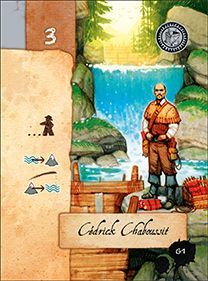
Lewis & Clark: Cédrick Chaboussit
2014
A promotional card that transforms River and Mountain spaces
120
minutes
Medium Heavy
View expansion
Lewis & Clark: Promo Cards
2020
Six new reactive cards plus all five original promo cards
120
minutes
Medium Heavy
View expansion
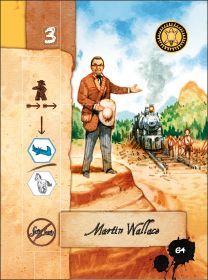
Lewis & Clark: Martin Wallace
2014
Move your Scout back two spaces, then take a Canoe or Horse.
120
minutes
Medium Heavy
View expansion
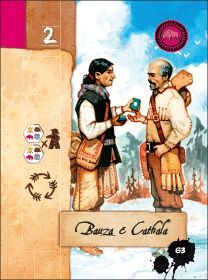
Lewis & Clark: Bauza & Cathala
2014
Pass resources around the table in a chain of choices
120
minutes
Medium Heavy
View expansion
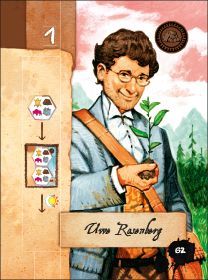
Lewis & Clark: Uwe Rosenberg
2014
Store resources now to collect matching extras after your next Camp phase.
120
minutes
Medium Heavy
View expansion
