
Raptor
2015
A tense two-player card-driven hunt where scientists face a cunning mother raptor, her babies, and tactical double guessing.
30
minutes
2 - 2
player(s)
9+
Medium


About this board game
Raptor is a two-player, 30-minute card-driven board game from 2015, pitting a team of scientists against a mother raptor and her babies.
Mamma Raptor has escaped from her run and laid her eggs in the park. The scientists must neutralize her and capture the baby raptors before they run wild into the forest, while the raptor player works to protect her young and outmaneuver the opposing team.
Each round, both players choose and play a card. The player who played the lowest-ranked card uses its corresponding action, while the opponent receives movement or attack points equal to the difference between the two card values. This creates a constant contest of timing, positioning, and double guessing.
- Scientists: Move pawns, use fire, travel by jeep along the tracks, and call for reinforcements.
- Mother Raptor: Hide in the bushes, yell to frighten scientists, and call for her babies.
- Baby Raptors: Become the focus of the scientists’ capture effort as they threaten to escape into the forest.
The board brings both sides into a compact tactical struggle. Every card choice affects not only the action available to its player, but also the movement or attack potential handed to the opponent, making each round a calculated risk.
With distinct abilities on each side and a simple card comparison driving the action, Raptor offers a focused contest for two players. Scientists must coordinate their pursuit, while Mamma Raptor uses the park and her special abilities to keep her babies safe.
/pic7182955.jpg)
Board Game Rules for
Raptor
A game by Bruno Cathala and Bruno Faidutti
Illustrations by Vincent Dutrait
Present day, on an isolated island in the Pacific Ocean:
“Our advance scouts came back wounded, but they confirmed the rumors: dinosaurs still exist! A female velociraptor lives on this island with her children. We’ve seen five so far, but there might be more. Our mission: Capture at least three live baby raptors. This won’t be easy — the mother is fast, powerful, and protective of her offspring. It will be an epic challenge, but any scientist would love to be in my position. The expedition is about to land. Let the hunt begin!”
— Professor Lindenbrock, paleontologist
Game Overview
A female velociraptor and her five babies are hunted by a team of scientists.
The player who controls the raptor family can win by killing the scientists, or by allowing three of the babies to take shelter deep into the jungle where nobody will ever find them.
The player who controls the scientists must neutralize the mother or capture three of her babies.
Components
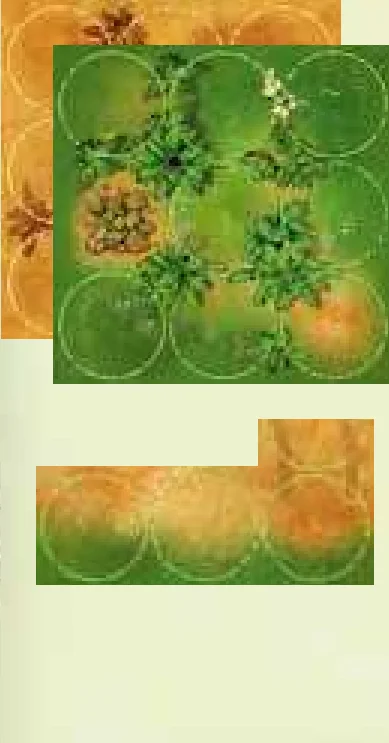
- A game board made of:
- 6 large tiles with 9 spaces
- and 4 L-shaped tiles with 3 spaces and one exit (half-space).
The board is double-sided so that each side provides a different environment.
- 9 Action cards for the Raptor player
- 9 Action cards for the Scientist player
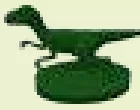
- 1 Mother Raptor Figurine
- 5 Baby Raptor Figurines
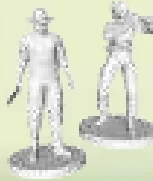
- 10 Scientist Figurines
- 10 Fire Tokens
- 5 Sleep Tokens
- 9 Rocks (made of 2 parts)
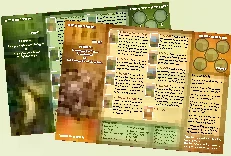
- 2 Player Aids
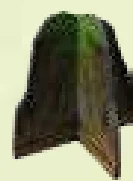
Note: Throughout this document male pronouns are used for the sake of simplicity and readability. It should be clearly understood that in each instance, we mean to include female players as well.
Setting up the board
- Choose one of the two environments for the game (jungle or savannah). Flip all ten tiles to that side.
- Place the 6 square tiles randomly to create a 2-by-3 rectangle.
- Place the 4 L-shaped tiles randomly along the shortest sides of the rectangle you created in step 2.
- Place the 3D rocks on each space that does not show a circle or half-circle.
- The Raptor player places the raptor figurines on the board, then the Scientist player places his figurines.
The Raptor player takes:
- The Raptor player aid (1)
- The 9 Raptor Action cards
- The mother figurine
- The 5 baby raptor figurines
The Raptor player places the mother and the babies on the board:
- The mother raptor is placed on one of the two central tiles. (2)
- The 5 baby raptors are distributed on the board, one on each of the remaining tiles. (3)
The Scientist player takes:
- The Scientist Player Aid (4)
- The 9 Scientist Action cards
- The 10 Scientist Figurines
- The 10 Fire Tokens (5)
- The 5 Sleep Tokens (and places them on the top-right corner of his player aid with the ammunition side up) (6)
The Scientist player places one scientist on a space of his choice on each of the 4 L-shaped tiles. (7)
The remaining 6 scientists are placed next to the player aid to create the reserve. (8)
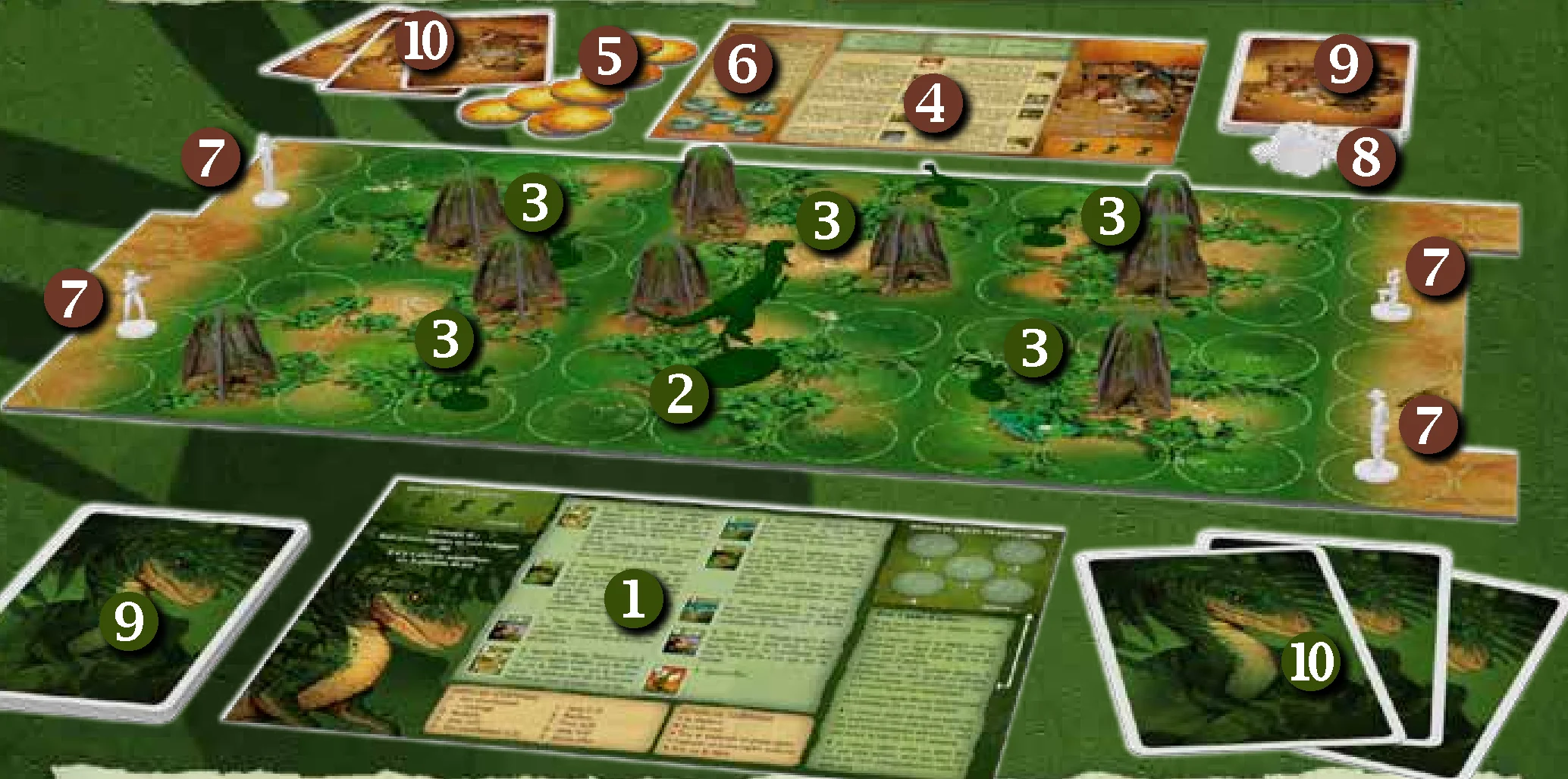
Starting the Game
Each player shuffles his deck of Action cards and places it in front of him. (9)
Then, each player draws the first three cards of his deck. (10)
The first round can now start.
General Board Rules
- There can never be two figurines or tokens on the same space.
- Two spaces are considered to be adjacent if they are orthogonally next to each other. Diagonal adjacency is never taken into account, neither for moving, nor for shooting.
- The half-spaces represent the exits through which the baby raptors must escape. No other figurine or token (the mother, a scientist or a fire token) can be placed there. The ONLY way a baby raptor can move on such a space is by using the “Move a baby raptor” action.
Playing a Round
Each player chooses one of his three cards and places it face-down on the table. Then, both cards are revealed simultaneously.
If both cards have the same value, they have no effect. The round ends immediately.
In most cases however, both cards have a different value. In that case, the player who played the card with the lowest value goes first and applies the effects of his card (effects must be applied, if possible). Then, his opponent receives a number of action points equal to the difference between the values of the two cards.
Important! The player who receives action points does not apply the effects of the card he played.
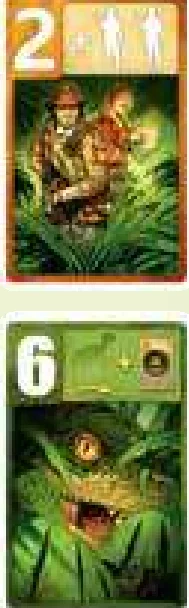
Example:
- The Scientist player played card 2: “Reinforcements”
- The Raptor player played card 6: “Disappearance and Observation”.
The Scientist player played the lowest value. He applies the effect of his card and adds two scientists on the board.
The Raptor player can now spend 4 action points (6 – 2) to perform actions using the mother and/or any active baby raptors.
End of the Round
Each player draws a card to have three cards in hand, and the game continues with a new round. Round after round, the played action cards are placed visibly in front of each player, so that their values can be seen by the opponent.
If a player’s deck is empty, he keeps the cards he has in hand, shuffles all his played cards to create a new deck, and then draws a card to have three cards in hand.
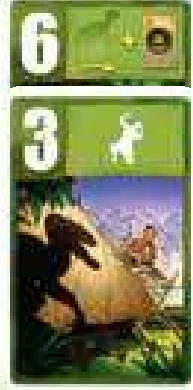
Raptor Player Actions
As the Raptor player, you can spend action points as you like to perform actions using the mother raptor and any active baby raptors.
A baby raptor is active if its figurine is standing up. A raptor can never move to or move through a space occupied by a fire token.
You do not have to use all of your available actions points. In fact, you can choose not to use any action points at all.
You can spend action points in 5 different ways:
1. Move a baby raptor
For one action point, move a baby raptor to a free adjacent space. If by doing so the baby is placed on one of the half-spaces of an L-shaped tile, it escapes; remove the figurine from the board.
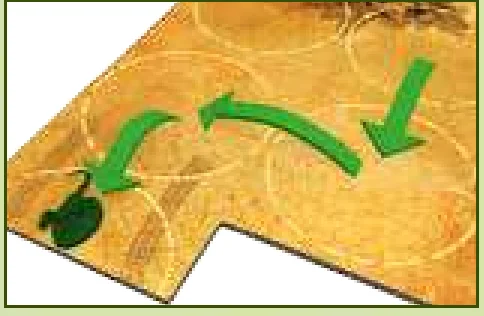
Example: The player spends 3 action points to move a baby raptor 3 spaces and allow it to escape.
2. Move the mother raptor
For one action point, move the mother raptor in a straight line as many spaces as you like, or until she runs into an obstacle (i.e. a rock, a fire token, or another figurine).
If the mother is wounded: Before moving the mother raptor, lose as many action points as the number of sleep tokens on your player aid. If you do not have enough action points left after that, the mother raptor cannot move.
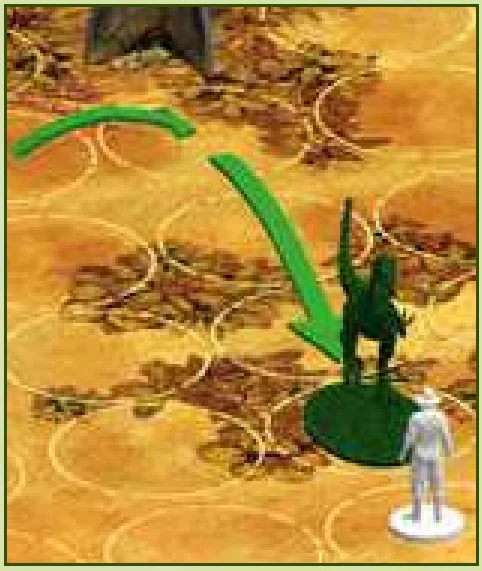
Example: The Raptor player wants to move the mother. Since she has 2 sleep tokens, he must first lose 2 action points before the first move. The player then spends 2 more action points to move her twice in a straight line.
3. Kill a scientist
For one action point, kill a scientist located on a space adjacent to the mother raptor; remove the scientist figurine from the board and return it to the box. Only the mother can kill scientists. You may perform this action multiple times on the same turn.
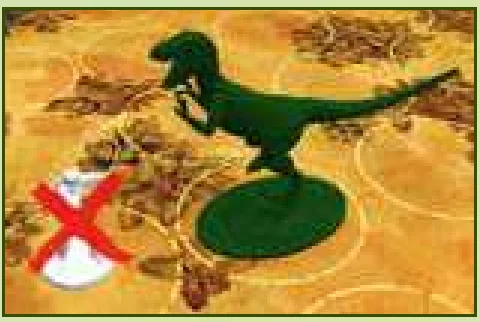
Example: The Raptor player spends 1 action point and kills a scientist adjacent to the mother. That scientist is removed from the game.
4. Wake up a baby raptor
For one action point, wake up a sleeping baby raptor located on a space adjacent to the mother raptor; stand the baby’s figurine back up. The baby raptor is now active; it can immediately be moved by spending action points. You cannot wake up a baby raptor the same round it was put to sleep by a scientist.
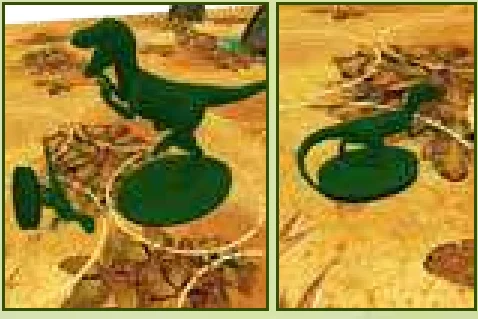
Example: A sleeping baby raptor is adjacent to the mother. For 1 action point, it wakes up and becomes active.
5. Put out a fire
For one action point, put out a fire located on a space adjacent to the mother raptor; remove the fire token and all fire tokens connected to it orthogonally.
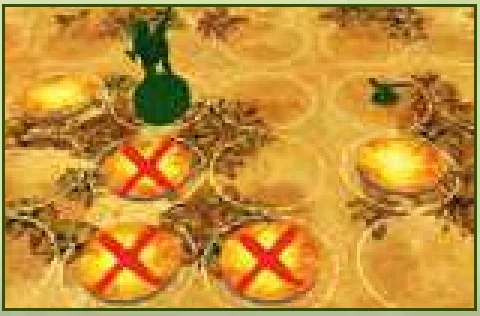
Example: For 1 action point, the player can remove an adjacent fire token, as well as the 2 tokens that are orthogonally connected to it.
Raptor Card Effects
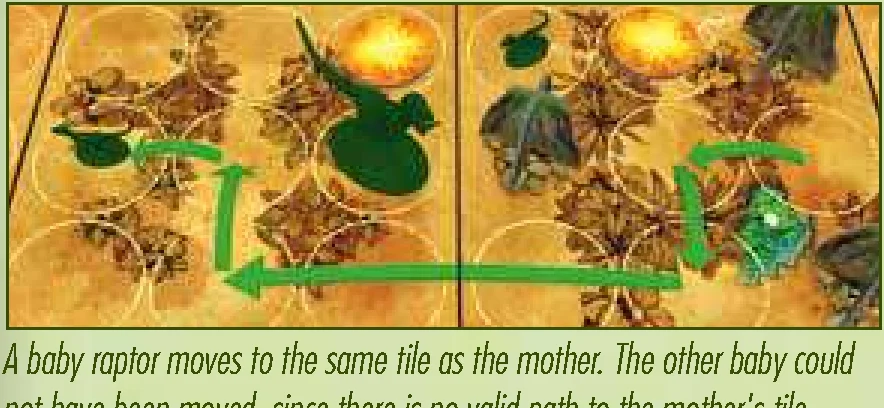
A baby raptor moves to the same tile as the mother. The other baby could not have been moved, since there is no valid path to the mother’s tile.
-
1 – Mother’s Call and Shuffle
Move an active baby raptor to a free space of your choice on the tile where the mother raptor is located (a baby that is already on the same tile as the mother can move to another space). The baby raptor cannot move through spaces that are occupied by a figurine or a fire token. Then, shuffle your deck and your played cards (including this card) to create a new deck. -
2 – Disappearance and Observation
Remove the mother raptor from the board. Then, after the Scientist player has spent all of his action points, place her back on a free space of your choice.
The mother, hidden by the forest, observes the scientists; next round, the Scientist player shows you which card he has chosen before you choose yours. -
3 – Fear
Frighten one scientist of your choice; place its figurine on its side. This scientist becomes inactive (it cannot shoot, move, start a fire, or use sleeping gas) until it stands back up. The Scientist player must spend one action point to stand the figurine back up, but cannot do it this round. -
4 – Mother’s Call (x2)
Move one or two active baby raptors to a free space of your choice on the tile where the mother raptor is located (a baby that is already on the same tile as the mother can move to another space). These baby raptors cannot move through spaces that are occupied by a figurine or a fire token. -
5 – Recovery (x2)
Remove two sleep tokens from your player aid (give them back to the Scientist player who places them on the top-right corner of his player aid with the ammunition side up), or wake up two baby raptors (or remove one sleep token and wake up one baby). -
6 – Disappearance and Observation
Remove the mother raptor from the board. Then, after the Scientist player has spent all of his action points, place her back on a free space of your choice.
The mother, hidden by the forest, observes the scientists; next round, the Scientist player shows you which card he has chosen before you choose yours. -
7 – Recovery (x3)
Remove three sleep tokens from your player aid (give them back to the Scientist player places them on the top-right corner of his player aid with the ammunition side up), or wake up three baby raptors (or do a combination of both). -
8 – Fear (x2)
Frighten one or two scientists of your choice; place each figurine on its side. These scientists become inactive (they cannot shoot, move, start a fire, or use sleeping gas) until they stand back up. The Scientist player must spend one action point to stand each figurine back up, but cannot do it this round. -
9 – No effect
Scientist Player Actions
As the Scientist player, you can spend action points as you like to perform actions using any active scientist.
A scientist is active if its figurine is standing up. Scientists can move through and shoot through a space occupied by a fire token, but they cannot end their movement on a space occupied by a fire token.
IMPORTANT: Each scientist can perform ONLY ONE aggressive action (shoot or capture) per round.
You do not have to use all of your available actions points. In fact, you can choose not to use any action points at all.
You can spend action points in 5 different ways:
1. Move a scientist
For one action point, move a scientist to an adjacent space that is not occupied by a raptor or another scientist. If that space is occupied by a fire token, you cannot end your movement in that space.
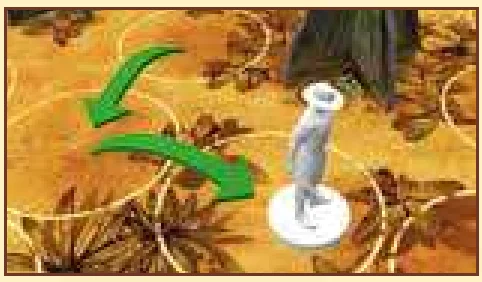
Example: The player spends 2 action points to move a scientist 2 spaces.
2. Stand a scientist back up
For one action point, stand a frightened scientist’s figurine back up. That scientist is now active; it can immediately be used to perform actions. You cannot stand a scientist back up the same round it was frightened.
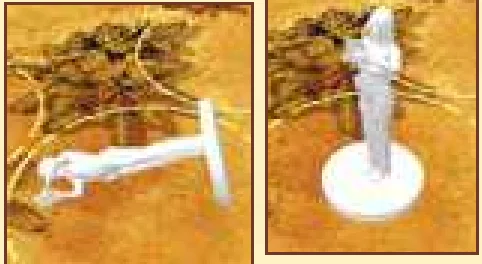
Example: For 1 action point, the frightened scientist stands back up and can be used to perform actions.
3. Put a baby raptor to sleep
For one action point, shoot a baby raptor located on a space adjacent to a scientist to put it to sleep; place its figurine on its side to show that the raptor is inactive and can be captured.
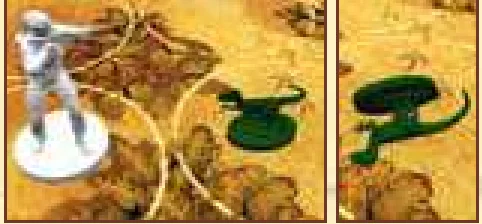
Example: For 1 action point, the scientist puts an adjacent baby raptor to sleep.
4. Capture a sleeping baby raptor
For one action point, capture a sleeping baby raptor located on a space adjacent to a scientist; remove its figurine from the board and place it on the top-left corner of your player aid.
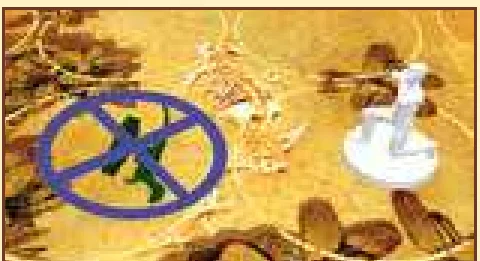
Example: For 1 action point, the scientist captures a sleeping baby raptor located on an adjacent space. The baby is removed from the board.
5. Shoot the mother raptor
For one action point, use an active scientist to shoot the mother raptor. Scientists can shoot orthogonally in a straight line as far as desired, as long as there are no obstacles between the scientist and the mother raptor. Obstacles that block shooting are rocks and active scientists. Therefore, a scientist can shoot through spaces occupied by frightened scientists, fire tokens, or baby raptors. If you shoot the mother raptor, she is wounded; give one sleep token to the Raptor player who places it on the top-right corner of his player aid with the “Zzz” side up.
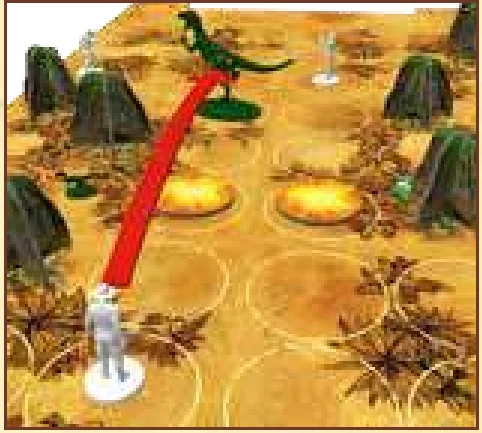
Example: For 1 action point, the scientist shoots the mother raptor who is in the line of sight. The Raptor player receives 1 sleep token.
Scientist Card Effects
-
1 – Sleeping Gas and Shuffle
Put a baby raptor to sleep. The baby raptor must be located on the same tile as a scientist or on an orthogonally adjacent tile; place the baby raptor figurine on its side. The Raptor player must spend one action point to stand the figurine back up, but cannot do it this round. Then, shuffle your deck and your played cards (including this card) to create a new deck.
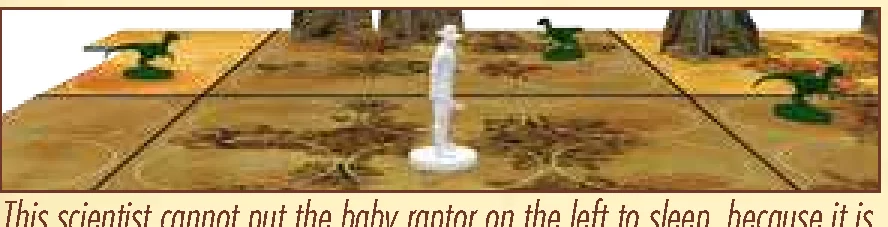
This scientist cannot put the baby raptor on the left to sleep, because it is not on the same tile or on an adjacent tile.
-
2 – Reinforcements
Place one or two scientists from your reserve on empty spaces located along the long edges the board. You can place these scientists only on the square tiles (not on the L-shaped tiles). If you do not have any scientists in your reserve, you do nothing this round. -
3 – Jeep (x2)
Move one or two scientists with a Jeep. When moving with a Jeep, a scientist can move in a straight line as many spaces as you like, as long as it does not run into an obstacle (i.e. a rock or another figurine). If the scientist moves through a space occupied by a fire token, the fire is put out; remove the fire token from the board. You may move the same scientist twice this round. -
4 – Sleeping Gas (x2)
Put one or two baby raptors to sleep. Each baby raptor must be located on the same tile as a scientist or on an orthogonally adjacent tile; place each baby raptor figurine on its side. The Raptor player must spend one action point to stand each figurine back up, but cannot do it this round. -
5 – Fire (x2)
Place two fire tokens on free spaces of the board. A fire token can be placed only on a space adjacent to a scientist or another fire token (including one that was placed this round). -
6 – Reinforcements
Place one or two scientists from your reserve on empty spaces located along the long edges the board. You can place these scientists only on the square tiles (not on the L-shaped tiles). If you do not have any scientists in your reserve, you do nothing this round.
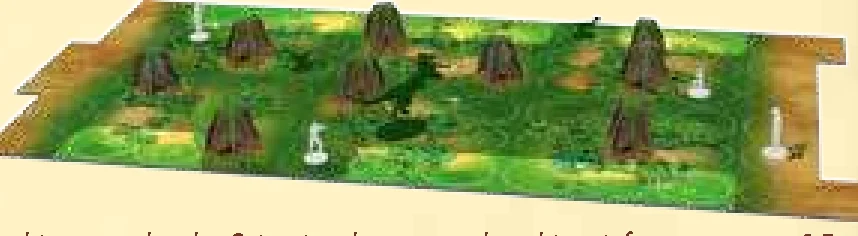
In this example, the Scientist player can place his reinforcements on 15 different spaces (the empty spaces on the edges of the square tiles).
-
7 – Fire (x3)
Place three fire tokens on free spaces of the board. A fire token can be placed only on a space adjacent to a scientist or another fire token (including one that was placed this round). -
8 – Jeep (x4)
Move up to four scientists with a Jeep. When moving with a Jeep, a scientist can move in a straight line as many spaces as you like, as long as it does not run into an obstacle (i.e. a rock or another figurine). If the scientist moves through a space occupied by a fire token, the fire is put out; remove the fire token from the board. You may move the same scientists multiple times. -
9 – No effect
Victory Conditions
The Raptor player wins immediately if:
- Three baby raptors have escaped (removed from the board via the exit half-spaces)
OR - There are no more scientists on the board
The Scientist player wins immediately if:
- The mother has 5 sleep tokens, which neutralizes her
OR - Three baby raptors have been captured
A Few Reminders
- You can never move a figurine or shoot diagonally.
- A single space can never be occupied by two figurines, and a figurine can never move through a space occupied by another figurine, even if they are on the same side.
- Only the player who played the card with the lowest value applies the effect of his card. Only the player who played the card with the highest value receives and spends action points.
- If the mother raptor is wounded, the Raptor player can move her only after losing as many action points as there are sleep tokens on his player aid.
- Each scientist on the board can perform only one aggressive action per turn (put a baby raptor to sleep, capture a sleeping baby raptor, or shoot the mother raptor).
- When you put out a fire with the mother raptor, remove the fire token and all adjacent fire tokens connected to it.
- Sleeping baby raptors and frightened scientists cannot stand back up the same round they were put to sleep or frightened.
- When a scientist drives a Jeep (cards 3 and 8), remove all fire tokens located on spaces it moves through.
- The scientist reinforcements (cards 2 and 6) cannot be placed on the L-shaped tiles.
- The effect of a Recovery card (cards 5 and 7) can be split between the mother and one or more baby raptors.
- When a scientist is killed, it is removed from the game; return it to the box, not to the reserve.
Advice to a Scientist Who Just Graduated
Your brilliant studies might have taught you how to solve any triple integral you might run into, but you are not really (not at all, actually) prepared to face the scary Raptors that inhabit this forsaken island.
As a first step, your goal is… to survive!
Here are a few elementary tips that might be helpful to you:
The law of large numbers
Bringing in reinforcements is vital, otherwise you might be eradicated from the board and defeated.
Unity is strength
Each scientist can perform only one aggressive action per turn. If you move your scientists in teams of two, it is possible to capture a baby in a single turn. The first scientist can put it to sleep and the second scientist can then capture it.
Nice and slow
Your biggest enemy is the mother raptor. She is fast, ruthless, stealthy, and won’t stop devouring you. Slowing her down is therefore very important. Do not hesitate to target her as quickly as possible with one or two shots. It will calm her down…
Dead end
Make a smart use of fire to block the escape routes. Only the mother can put down the fire. The longer the game lasts, the better the chances are for the scientists to win… So slow down the enemy as much as possible!
Advice to an Angry Raptor
There you were, living a peaceful life, and suddenly, Crash! A horde of unknown bipeds with engines invade your territory… And on top of that, they are after your babies… Fools! They might not have realized they were edible!
Out to lunch
To put some pressure on the invaders, one working trick is to chew on some of them as early as possible. If possible, on the same side of the board, in order to make room for your babies.
Make yourself forgotten
Make clever use of your two Disappearance cards to reappear on the other side of the board and peek at your opponent’s next move before choosing your action.
Gather round!
Then, use your mother’s call to bring your babies under your protection, if possible, close to an exit free of scientists.
Whether You Are Raptor or Scientist…
Playing your cards of value 1 and 2 at the right time (when your opponent plays a card of value 3 to 5) can give you an advantage… It allows you to play your “weak” cards without giving many action points to your opponent.
Introduction & Components
A game by Bruno Cathala and Bruno Faidutti
Illustrations by Vincent Dutrait
Present day, on an isolated island in the Pacific Ocean:
“Our advance scouts came back wounded, but they confirmed the rumors: dinosaurs still exist! A female velociraptor lives on this island with her children. We’ve seen five so far, but there might be more. Our mission: Capture at least three live baby raptors. This won’t be easy — the mother is fast, powerful, and protective of her offspring. It will be an epic challenge, but any scientist would love to be in my position. The expedition is about to land. Let the hunt begin!”
— Professor Lindenbrock, paleontologist
Game Overview
A female velociraptor and her five babies are hunted by a team of scientists.
The player who controls the raptor family can win by killing the scientists, or by allowing three of the babies to take shelter deep into the jungle where nobody will ever find them.
The player who controls the scientists must neutralize the mother or capture three of her babies.
Components
- A game board made of:
- 6 large tiles with 9 spaces
- and 4 L-shaped tiles with 3 spaces and one exit (half-space).
The board is double-sided so that each side provides a different environment.
- 9 Action cards for the Raptor player
- 9 Action cards for the Scientist player
- 1 Mother Raptor Figurine
- 5 Baby Raptor Figurines
- 10 Scientist Figurines
- 10 Fire Tokens
- 5 Sleep Tokens
- 9 Rocks (made of 2 parts)
- 2 Player Aids
Note: Throughout this document male pronouns are used for the sake of simplicity and readability. It should be clearly understood that in each instance, we mean to include female players as well.
Setup
Setting up the board
- Choose one of the two environments for the game (jungle or savannah). Flip all ten tiles to that side.
- Place the 6 square tiles randomly to create a 2-by-3 rectangle.
- Place the 4 L-shaped tiles randomly along the shortest sides of the rectangle you created in step 2.
- Place the 3D rocks on each space that does not show a circle or half-circle.
- The Raptor player places the raptor figurines on the board, then the Scientist player places his figurines.
The Raptor player takes:
- The Raptor player aid (1)
- The 9 Raptor Action cards
- The mother figurine
- The 5 baby raptor figurines
The Raptor player places the mother and the babies on the board:
- The mother raptor is placed on one of the two central tiles. (2)
- The 5 baby raptors are distributed on the board, one on each of the remaining tiles. (3)
The Scientist player takes:
- The Scientist Player Aid (4)
- The 9 Scientist Action cards
- The 10 Scientist Figurines
- The 10 Fire Tokens (5)
- The 5 Sleep Tokens (and places them on the top-right corner of his player aid with the ammunition side up) (6)
The Scientist player places one scientist on a space of his choice on each of the 4 L-shaped tiles. (7)
The remaining 6 scientists are placed next to the player aid to create the reserve. (8)
Starting the Game
Each player shuffles his deck of Action cards and places it in front of him. (9)
Then, each player draws the first three cards of his deck. (10)
The first round can now start.
General Rules & Round Structure
General Board Rules
- There can never be two figurines or tokens on the same space.
- Two spaces are considered to be adjacent if they are orthogonally next to each other. Diagonal adjacency is never taken into account, neither for moving, nor for shooting.
- The half-spaces represent the exits through which the baby raptors must escape. No other figurine or token (the mother, a scientist or a fire token) can be placed there. The ONLY way a baby raptor can move on such a space is by using the “Move a baby raptor” action.
Playing a Round
Each player chooses one of his three cards and places it face-down on the table. Then, both cards are revealed simultaneously.
If both cards have the same value, they have no effect. The round ends immediately.
In most cases however, both cards have a different value. In that case, the player who played the card with the lowest value goes first and applies the effects of his card (effects must be applied, if possible). Then, his opponent receives a number of action points equal to the difference between the values of the two cards.
Important! The player who receives action points does not apply the effects of the card he played.
Example:
- The Scientist player played card 2: “Reinforcements”
- The Raptor player played card 6: “Disappearance and Observation”.
The Scientist player played the lowest value. He applies the effect of his card and adds two scientists on the board.
The Raptor player can now spend 4 action points (6 – 2) to perform actions using the mother and/or any active baby raptors.
End of the Round
Each player draws a card to have three cards in hand, and the game continues with a new round. Round after round, the played action cards are placed visibly in front of each player, so that their values can be seen by the opponent.
If a player’s deck is empty, he keeps the cards he has in hand, shuffles all his played cards to create a new deck, and then draws a card to have three cards in hand.
Raptor Player Rules
Raptor Player Actions
As the Raptor player, you can spend action points as you like to perform actions using the mother raptor and any active baby raptors.
A baby raptor is active if its figurine is standing up. A raptor can never move to or move through a space occupied by a fire token.
You do not have to use all of your available actions points. In fact, you can choose not to use any action points at all.
You can spend action points in 5 different ways:
1. Move a baby raptor
For one action point, move a baby raptor to a free adjacent space. If by doing so the baby is placed on one of the half-spaces of an L-shaped tile, it escapes; remove the figurine from the board.
Example: The player spends 3 action points to move a baby raptor 3 spaces and allow it to escape.
2. Move the mother raptor
For one action point, move the mother raptor in a straight line as many spaces as you like, or until she runs into an obstacle (i.e. a rock, a fire token, or another figurine).
If the mother is wounded: Before moving the mother raptor, lose as many action points as the number of sleep tokens on your player aid. If you do not have enough action points left after that, the mother raptor cannot move.
Example: The Raptor player wants to move the mother. Since she has 2 sleep tokens, he must first lose 2 action points before the first move. The player then spends 2 more action points to move her twice in a straight line.
3. Kill a scientist
For one action point, kill a scientist located on a space adjacent to the mother raptor; remove the scientist figurine from the board and return it to the box. Only the mother can kill scientists. You may perform this action multiple times on the same turn.
Example: The Raptor player spends 1 action point and kills a scientist adjacent to the mother. That scientist is removed from the game.
4. Wake up a baby raptor
For one action point, wake up a sleeping baby raptor located on a space adjacent to the mother raptor; stand the baby’s figurine back up. The baby raptor is now active; it can immediately be moved by spending action points. You cannot wake up a baby raptor the same round it was put to sleep by a scientist.
Example: A sleeping baby raptor is adjacent to the mother. For 1 action point, it wakes up and becomes active.
5. Put out a fire
For one action point, put out a fire located on a space adjacent to the mother raptor; remove the fire token and all fire tokens connected to it orthogonally.
Example: For 1 action point, the player can remove an adjacent fire token, as well as the 2 tokens that are orthogonally connected to it.
Raptor Card Effects
A baby raptor moves to the same tile as the mother. The other baby could not have been moved, since there is no valid path to the mother’s tile.
-
1 – Mother’s Call and Shuffle
Move an active baby raptor to a free space of your choice on the tile where the mother raptor is located (a baby that is already on the same tile as the mother can move to another space). The baby raptor cannot move through spaces that are occupied by a figurine or a fire token. Then, shuffle your deck and your played cards (including this card) to create a new deck. -
2 – Disappearance and Observation
Remove the mother raptor from the board. Then, after the Scientist player has spent all of his action points, place her back on a free space of your choice.
The mother, hidden by the forest, observes the scientists; next round, the Scientist player shows you which card he has chosen before you choose yours. -
3 – Fear
Frighten one scientist of your choice; place its figurine on its side. This scientist becomes inactive (it cannot shoot, move, start a fire, or use sleeping gas) until it stands back up. The Scientist player must spend one action point to stand the figurine back up, but cannot do it this round. -
4 – Mother’s Call (x2)
Move one or two active baby raptors to a free space of your choice on the tile where the mother raptor is located (a baby that is already on the same tile as the mother can move to another space). These baby raptors cannot move through spaces that are occupied by a figurine or a fire token. -
5 – Recovery (x2)
Remove two sleep tokens from your player aid (give them back to the Scientist player who places them on the top-right corner of his player aid with the ammunition side up), or wake up two baby raptors (or remove one sleep token and wake up one baby). -
6 – Disappearance and Observation
Remove the mother raptor from the board. Then, after the Scientist player has spent all of his action points, place her back on a free space of your choice.
The mother, hidden by the forest, observes the scientists; next round, the Scientist player shows you which card he has chosen before you choose yours. -
7 – Recovery (x3)
Remove three sleep tokens from your player aid (give them back to the Scientist player places them on the top-right corner of his player aid with the ammunition side up), or wake up three baby raptors (or do a combination of both). -
8 – Fear (x2)
Frighten one or two scientists of your choice; place each figurine on its side. These scientists become inactive (they cannot shoot, move, start a fire, or use sleeping gas) until they stand back up. The Scientist player must spend one action point to stand each figurine back up, but cannot do it this round. -
9 – No effect
Scientist Player Rules
Scientist Player Actions
As the Scientist player, you can spend action points as you like to perform actions using any active scientist.
A scientist is active if its figurine is standing up. Scientists can move through and shoot through a space occupied by a fire token, but they cannot end their movement on a space occupied by a fire token.
IMPORTANT: Each scientist can perform ONLY ONE aggressive action (shoot or capture) per round.
You do not have to use all of your available actions points. In fact, you can choose not to use any action points at all.
You can spend action points in 5 different ways:
1. Move a scientist
For one action point, move a scientist to an adjacent space that is not occupied by a raptor or another scientist. If that space is occupied by a fire token, you cannot end your movement in that space.
Example: The player spends 2 action points to move a scientist 2 spaces.
2. Stand a scientist back up
For one action point, stand a frightened scientist’s figurine back up. That scientist is now active; it can immediately be used to perform actions. You cannot stand a scientist back up the same round it was frightened.
Example: For 1 action point, the frightened scientist stands back up and can be used to perform actions.
3. Put a baby raptor to sleep
For one action point, shoot a baby raptor located on a space adjacent to a scientist to put it to sleep; place its figurine on its side to show that the raptor is inactive and can be captured.
Example: For 1 action point, the scientist puts an adjacent baby raptor to sleep.
4. Capture a sleeping baby raptor
For one action point, capture a sleeping baby raptor located on a space adjacent to a scientist; remove its figurine from the board and place it on the top-left corner of your player aid.
Example: For 1 action point, the scientist captures a sleeping baby raptor located on an adjacent space. The baby is removed from the board.
5. Shoot the mother raptor
For one action point, use an active scientist to shoot the mother raptor. Scientists can shoot orthogonally in a straight line as far as desired, as long as there are no obstacles between the scientist and the mother raptor. Obstacles that block shooting are rocks and active scientists. Therefore, a scientist can shoot through spaces occupied by frightened scientists, fire tokens, or baby raptors. If you shoot the mother raptor, she is wounded; give one sleep token to the Raptor player who places it on the top-right corner of his player aid with the “Zzz” side up.
Example: For 1 action point, the scientist shoots the mother raptor who is in the line of sight. The Raptor player receives 1 sleep token.
Scientist Card Effects
-
1 – Sleeping Gas and Shuffle
Put a baby raptor to sleep. The baby raptor must be located on the same tile as a scientist or on an orthogonally adjacent tile; place the baby raptor figurine on its side. The Raptor player must spend one action point to stand the figurine back up, but cannot do it this round. Then, shuffle your deck and your played cards (including this card) to create a new deck.
This scientist cannot put the baby raptor on the left to sleep, because it is not on the same tile or on an adjacent tile.
-
2 – Reinforcements
Place one or two scientists from your reserve on empty spaces located along the long edges the board. You can place these scientists only on the square tiles (not on the L-shaped tiles). If you do not have any scientists in your reserve, you do nothing this round. -
3 – Jeep (x2)
Move one or two scientists with a Jeep. When moving with a Jeep, a scientist can move in a straight line as many spaces as you like, as long as it does not run into an obstacle (i.e. a rock or another figurine). If the scientist moves through a space occupied by a fire token, the fire is put out; remove the fire token from the board. You may move the same scientist twice this round. -
4 – Sleeping Gas (x2)
Put one or two baby raptors to sleep. Each baby raptor must be located on the same tile as a scientist or on an orthogonally adjacent tile; place each baby raptor figurine on its side. The Raptor player must spend one action point to stand each figurine back up, but cannot do it this round. -
5 – Fire (x2)
Place two fire tokens on free spaces of the board. A fire token can be placed only on a space adjacent to a scientist or another fire token (including one that was placed this round). -
6 – Reinforcements
Place one or two scientists from your reserve on empty spaces located along the long edges the board. You can place these scientists only on the square tiles (not on the L-shaped tiles). If you do not have any scientists in your reserve, you do nothing this round.
In this example, the Scientist player can place his reinforcements on 15 different spaces (the empty spaces on the edges of the square tiles).
-
7 – Fire (x3)
Place three fire tokens on free spaces of the board. A fire token can be placed only on a space adjacent to a scientist or another fire token (including one that was placed this round). -
8 – Jeep (x4)
Move up to four scientists with a Jeep. When moving with a Jeep, a scientist can move in a straight line as many spaces as you like, as long as it does not run into an obstacle (i.e. a rock or another figurine). If the scientist moves through a space occupied by a fire token, the fire is put out; remove the fire token from the board. You may move the same scientists multiple times. -
9 – No effect
End of the Game & Victory Conditions
Victory Conditions
The Raptor player wins immediately if:
- Three baby raptors have escaped (removed from the board via the exit half-spaces)
OR - There are no more scientists on the board
The Scientist player wins immediately if:
- The mother has 5 sleep tokens, which neutralizes her
OR - Three baby raptors have been captured
Rules Reminders & Strategy Advice
A Few Reminders
- You can never move a figurine or shoot diagonally.
- A single space can never be occupied by two figurines, and a figurine can never move through a space occupied by another figurine, even if they are on the same side.
- Only the player who played the card with the lowest value applies the effect of his card. Only the player who played the card with the highest value receives and spends action points.
- If the mother raptor is wounded, the Raptor player can move her only after losing as many action points as there are sleep tokens on his player aid.
- Each scientist on the board can perform only one aggressive action per turn (put a baby raptor to sleep, capture a sleeping baby raptor, or shoot the mother raptor).
- When you put out a fire with the mother raptor, remove the fire token and all adjacent fire tokens connected to it.
- Sleeping baby raptors and frightened scientists cannot stand back up the same round they were put to sleep or frightened.
- When a scientist drives a Jeep (cards 3 and 8), remove all fire tokens located on spaces it moves through.
- The scientist reinforcements (cards 2 and 6) cannot be placed on the L-shaped tiles.
- The effect of a Recovery card (cards 5 and 7) can be split between the mother and one or more baby raptors.
- When a scientist is killed, it is removed from the game; return it to the box, not to the reserve.
Advice to a Scientist Who Just Graduated
Your brilliant studies might have taught you how to solve any triple integral you might run into, but you are not really (not at all, actually) prepared to face the scary Raptors that inhabit this forsaken island.
As a first step, your goal is… to survive!
Here are a few elementary tips that might be helpful to you:
The law of large numbers
Bringing in reinforcements is vital, otherwise you might be eradicated from the board and defeated.
Unity is strength
Each scientist can perform only one aggressive action per turn. If you move your scientists in teams of two, it is possible to capture a baby in a single turn. The first scientist can put it to sleep and the second scientist can then capture it.
Nice and slow
Your biggest enemy is the mother raptor. She is fast, ruthless, stealthy, and won’t stop devouring you. Slowing her down is therefore very important. Do not hesitate to target her as quickly as possible with one or two shots. It will calm her down…
Dead end
Make a smart use of fire to block the escape routes. Only the mother can put down the fire. The longer the game lasts, the better the chances are for the scientists to win… So slow down the enemy as much as possible!
Advice to an Angry Raptor
There you were, living a peaceful life, and suddenly, Crash! A horde of unknown bipeds with engines invade your territory… And on top of that, they are after your babies… Fools! They might not have realized they were edible!
Out to lunch
To put some pressure on the invaders, one working trick is to chew on some of them as early as possible. If possible, on the same side of the board, in order to make room for your babies.
Make yourself forgotten
Make clever use of your two Disappearance cards to reappear on the other side of the board and peek at your opponent’s next move before choosing your action.
Gather round!
Then, use your mother’s call to bring your babies under your protection, if possible, close to an exit free of scientists.
Whether You Are Raptor or Scientist…
Playing your cards of value 1 and 2 at the right time (when your opponent plays a card of value 3 to 5) can give you an advantage… It allows you to play your “weak” cards without giving many action points to your opponent.
