Snow Tails
2008
Build a changing Arctic course, manage your dogs and brake, and push your sled through dangerous turns before damage ends your race.
60
minutes
2 - 5
player(s)
10+
Medium

About this board game
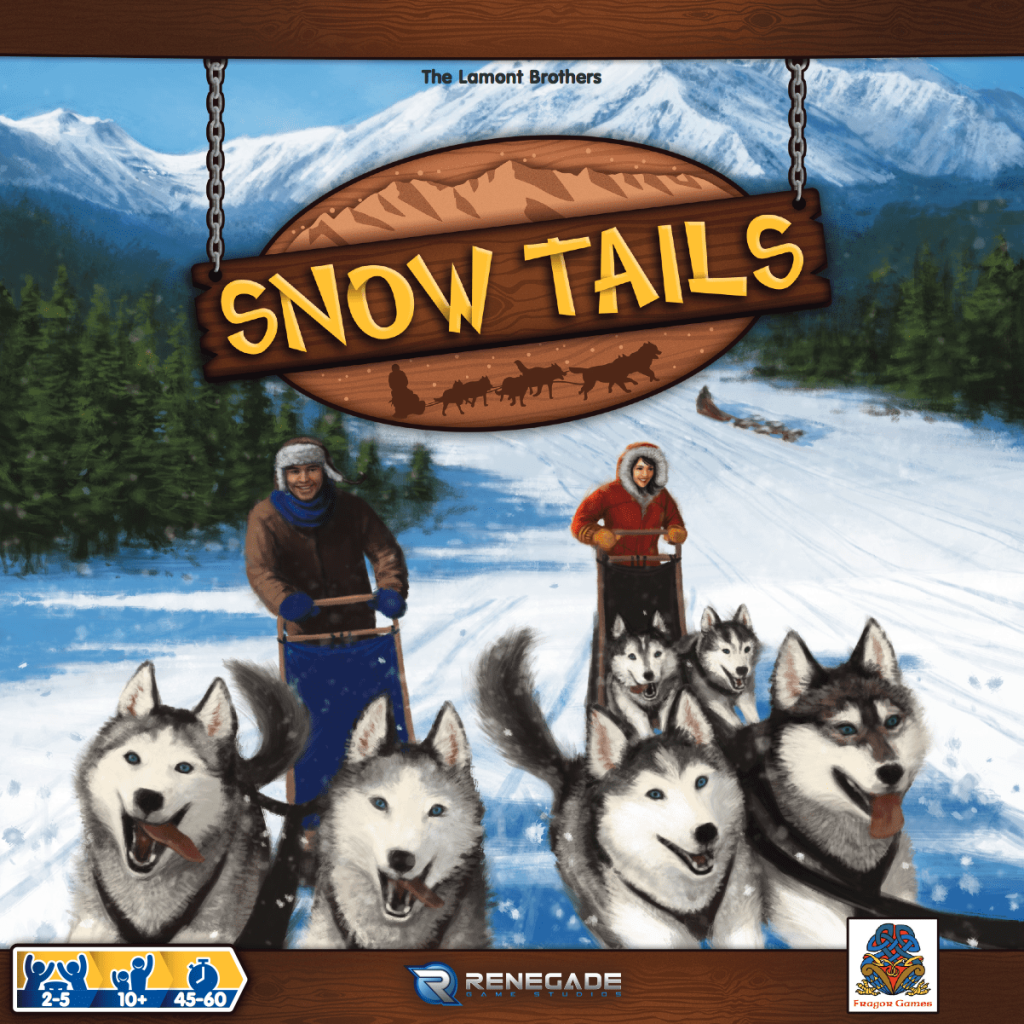
Snow Tails is a fast-paced sled race for 2–5 players, with games lasting about 60 minutes. Set in the snowy Arctic Circle, it challenges players to guide a dog sled through a randomly assembled course while balancing speed, drifting, and control.
Each player has two huskies and a brake, initially valued at 3 each, plus a matching Dog Deck containing five sets of cards numbered 1–5. Draw a hand of five cards, then play one to three cards of the same value onto the sled mat’s three positions: dog 1, dog 2, and brakes.
- Forward speed: dog 1 plus dog 2, minus the brake, with a bonus based on race position when both dogs match.
- Lateral movement: dog 1 minus dog 2, sending the sled toward the side of the stronger dog.
- Modular courses: combine track pieces to create different race layouts.
- Damage: speeding through restricted areas or hitting obstacles adds Dent cards that reduce hand size.
Movement is rarely a straight line. Ice patches, the sides of the track, speed limits, and other hazards make every turn a test of card management and judgment. Push too hard and your sled may acquire Dents; the fifth damage card eliminates you from the race.
Huskies only have one setting: full speed. Choose how to divide your cards between the dogs and brake, manage your changing hand, and aim for the finish before your rivals. In Snow Tails, the first player to cross the finish line wins—but not every sled is guaranteed to make it there.
/pic7182955.jpg)
Board Game Rules for
Snow Tails
The game of Husky Sled Racing
Welcome to the snowy world of the Arctic Circle, where brave sledders race in a test of skill and endurance. Action is fast and furious and not all sleds may make it to the finish. Huskies only have one setting and that is full speed! Hang on to your furs, the reins, your sled and anything else you can get hold of.
Remember, you do not have to be Inuit to win it!
Components

- Track:
- 8 x Straights (Double sided with some special tracks on the reverse)
- 4 x Corners (Double sided)
- 2 x U-turns (Double sided)
- 1 x Start (Double sided)
- 1 x Finish (Double sided)

- 5 x wooden sleds
- 5 x centre swivels
- 5 x brake markers
- 5 x sled mats
- 20 x wooden saplings
- 1 x ‘Big Paws’ token
- Cards:
- 5 Dog decks (20 Canine Cards made up of 4 x 1, 2, 3, 4, and 5.)
- 20 Dent cards
- Rules (located at the end of your fingers)
Sled Mat Assembly


Assemble the 5 sled mats. Connect the centre swivel through their centres.
Once the sled mat is assembled, it can be rotated to match the player’s sled orientation on the track. This makes it easier for the player to determine left and right. To swivel the sled mat, place one finger on top of the centre swivel and use your other hand to rotate the mat.
Be careful not to disturb the cards and brake when turning your mat.
Race Setup
- Set up a course by joining sections of track together (for your first race use the starter track ‘The Nutcracker’ on page 18). The tracks are always set up with the yellow flags on the left and the red flags on the right. A course can get pretty big so get a big table! Alternatively, you can add and remove track as necessary during a race.
- Add the start and finish sections to the track. The start section is placed so 1st position lines up with the inside of the first corner (it is double-sided).
- Each player chooses a colour and takes the appropriate sled token, sled mat, brake marker and Dog Decks in their colour.
- Each player places their sled mat in front of them. The brake marker is set at the number “3” (the dogs also start at 3, but this is pre-printed on the sled mat).
- The dent cards are placed in a pile to the side.
- Each player shuffles their Dog Deck and places it face down beside their sled as a draw pile.
- The player with the huskiest voice is the starting player. The player with the next huskiest voice is second, and so on. Wizened old gamers may decide order randomly.
- The starting player chooses any free starting position for their sled on the start section and places their sled. In order, the others players do the same. Each starting space can only take one sled.
- Each player then draws a starting hand of 5 cards. A player starting in the 4th place takes 1 extra card. A player starting in the 5th place takes two extra cards. (Note – the bonus depends on the starting space of the sled and is not dependent on the number of players.)
The game is now ready to start.

(There is an example of a round of play on page 8)
Every round:
- Players take their turn in race position order (1st, 2nd, 3rd and so on) until everyone has moved.
- If sleds are side by side then the sled (a) on the inside of a corner section of track or (b) the inside of a straight as it approaches a corner is deemed to be in ahead.
- On the final straight(s), the inside is taken to be on the same side as the chequered flag on the finish line.
“Who’s on First”


Straight alignment: Yellow is alone out in front and is first. Red and blue are level, but blue is on the same side as the inside for the next corner. This means blue is second and red is third.
Corner alignment: On corners, there are guides to help show lines that are the same distance along the track but not next to one another. The colour bud at the end of one line corresponds with the colour bud of another line at the same level. Here yellow and blue are level, but yellow is ahead as he is on the inside. Red is furthest back.
On their turn, each player does the following:
- Play 1-3 Canine Cards of the same value
- Move their sled
- Return their hand size to 5 cards (through drawing or discarding)
1. Play 1-3 Canine Cards of the Same Value (“Mush ! Mush !”)
- A player must play at least one Canine Card on their turn.
- A player can play 1, 2 or 3 Canine Cards.
- Each card played must be of the same value (e.g. 5, 3-3, 4-4-4, etc).
- The cards are played face up onto the left dog and/or right dog (on top of any previously played cards) and/or onto the discard pile to move the brake. Each position can only have one card played on it per turn.
- A card can be played on top of another card of the same value (although the existing card would have to have been played on a previous turn).
- If a card is played onto the discard pile then the brake marker on the sled mat is moved to the same number (e.g. playing a 2 causes the brake marker to be moved to 2).

Special rule – if a player has no Canine Cards (this occurs very rarely after crashing into another player’s sled) then they take the following steps:
- Take a dent card
- Draw Canine Cards up to a hand size of 5 (including dent cards)
- Continue their turn as normal (that is, step 1: play 1-3 cards, etc)
2. Move the Sled
- The sled’s Speed is the value of the 2 Canine Cards added together minus the current brake value. The sled is initially set up at speed 3 (3+3 – brake(3) = 3).
- Drift movement (or just “drifting”) of the sled is the difference between the pulling power of the 2 dogs. Drifting is a diagonal forward movement. The sled drifts towards the dog pulling hardest. (e.g. a sled with Canine Cards of 3-5 would cause a drift 2 to the right). The brake value has no effect on drift.
- Drifting always causes a player’s sled to cross a black track line.
- The player moves their sled forward the number of squares equal to their speed (all movement must be used unless a collision occurs). While moving, they must also drift to the side of the strongest dog (highest value). They must drift a number of times equal to the drift number.
- If the drift is higher than the speed, then the excess drift is ignored.
- A sled with speed 0 or less does not move.

Here, red has a speed of 3 (left dog + right dog – brake: 3+5-5=3), and a drift of 2 to the right (the right dog is pulling two stronger than the left dog). Red moves forward three spaces and must drift twice to the right.
- The flags on the sled mat are simply there to help players orientate their left and right during play. The sled mat can also be rotated to help.
- A player is completely free to choose when drifting occurs to their sled. For instance, with a speed of 5 and a drift of 2 to the left they could choose to drift move once, move forward once, drift move again and then move forward twice. However, they must attempt to use all of the drift on their turn (if a player needs to drift twice in their turn then the latest they could start to drift is when taking their second last movement).
- If the two dogs have the same number on them, then no drift occurs. The sled is considered balanced. Balanced sleds have the option of bonus movement (see Balanced Sleds).
- The sled may take damage as a result of its movement. See the hazard section for details.

Note: Movement is unaffected by other sleds and/or scenery being on the spaces with the yellow circles (spaces touching diagonally or spaces overlap).
3. Return Hand Size to Five Cards
- The player now returns their hand size to 5 cards.
- If the player has less than 5 cards (including dent cards) they draw cards from their Dog Deck until they have a hand size of five.
- In some cases, a player may have more than 5 cards (e.g. the first turn for a player starting in 5th position, or as a result of picking up a large number of dent cards). In this case a player must discard Canine Cards down to a hand size of 5. These are discarded (not played). They have no effect on the brake marker on the sled mat.
- Dent cards count towards hand size (as the sled gets beaten up it becomes more difficult to control).
- Dent cards can never be discarded (see Dents and Hazards).
- If a player’s Dog Deck runs out, shuffle the discard pile together with all of the player’s used Canine Cards (the top two cards on the sled mat are still active and remain on the mat) to make up a new Dog Deck. This is placed face down beside the sled mat. The player then draws as normal.
A balanced sled is a happy sled. Imagine the dogs are in complete harmony. Your sled is being pulled directly forward for a change. You are in complete control….this allows you the time to aim for the best routes in the snow or to travel in the tracks left by previous sleds. You get the option of a bonus!

- Your sled is balanced when each dog has the same value of Canine Card (e.g. 3-3). This means they are pulling at the same speed !
- A balanced sled qualifies for an optional bonus movement.
- A balanced sled receives a bonus to its speed equal to the sleds position in the race (e.g. a sled in 3rd position would receive a bonus of +3).
- Bonus movement is taken at the end of a sled’s normal movement. It is always taken as forward movement in a straight line. Drifting is not allowed when taking bonus movement.
- A player must decide whether to take all or none of the bonus – it cannot be partially taken.
- The bonus is added to the sled’s speed. Entering a corner may prove hazardous !
- The sled must have a speed of one or more to receive the bonus.
- This bonus is not used in the first turn of a race (when leaving the start line) as the sleds are just getting up to racing speed. READ THIS AGAIN – YOU WILL FORGET!
Sled racing is a dangerous sport. Despite extensive training and safety precautions accidents still occur. Since the local hospital wing only has 1 copy of monopoly for patients to play, we presume you do not want to spend too much time there. As the race progresses, a player’s sled may take bangs and scrapes. This makes it harder to control in the future. Players may have to draw dent cards. These will limit the number of Canine Cards they have available to play in the future.

Dent cards:
- Count towards hand size
- Can never be played or discarded
- Are double sided so as to be open to other players
1. Entering a Corner Over the Safety Speed (WOOAAAHH!)
There are old sled racers and bold sled racers but no old, bold sled racers. Over 217 playtesters were severely injured in establishing the safe speed limits for corners. Some did not make it past the first corner. Ignore the speed limits at your peril. Ah, forget it…..sometimes you just have to go for it!
- The player completes the rest of their movement.
- They then draw 1 dent card for each point of speed they were over the safety speed (e.g. travelling at speed 5 over a speed limit of 3 means you draw 2 dent cards).
- Remember, bonus movement for balanced sleds counts towards the sled’s speed.
- The safety speed only applies as a sled crosses the line. The corner has no further speed restrictions. Slow in – fast out!
- If the sled has also had a collision later in the turn then this is now resolved. If not, the player moves to step 3 of their turn (return hand size to 5 cards).

2. Colliding with Another Sled (“Oops! Sorry. Accidents will happen.”)
The dogs run into the back of another sled (either by drift movement or directly from behind). It was not the player’s fault….. (obviously !). Thankfully the damage is slight. The dogs are momentarily confused. The following happens :
- The player’s turn ends immediately.
- The sled remains on the space it reached immediately before the collision occurred.
- The player does not refill his hand but does discard down to 5 cards if required (this may occur where a player has just taken a lot of dent cards on the same turn by going too fast through a corner). Remember, dent cards cannot be discarded.
- Play continues with the next player.
- The player who crashed will probably start their next turn with a reduced hand size. However, at the end of that turn, they still draw up to a hand size of 5 once they reach stage 3 (return hand size to 5 cards).
- A player is not obliged to avoid a crash and may do so for tactical reasons.

3. Colliding with the Side of the Track (“Watch out for the tre…….!)
Sleds are precision instruments. Throwing them into the side of the track severely disturbs their ability to move in the snow. May we also remind you that your insurance does not cover sled damage due to driver error. In the unlikely event you do crash with the side of the track then the following steps apply :
- The sled’s movement ends immediately.
- The sled remains on the space it reached immediately before the collision occurred.
- The player draws a dent card and then moves to step 3 of their turn (return hand size to 5 cards).
- A player is not obliged to avoid a crash and may do so for tactical reasons (for example, to avoid speeding through a corner).

Sled Destruction (Elimination)
**YOU ONLY HAVE 4 DENT CARDS PER PLAYER FOR A REASON !**
If a player is ever required to draw a 5th dent card then their sled is reduced to a pile of matchwood. They can travel no further on this sled. It is removed from the race. If, however, the sled has already crossed the finish line then the sled is left in the space it reached before it required to take the dent card. It can still win the race, although the driver might require some bandages.
The special tracks are the snowdrift, chasm and saplings. It is recommended you play the game at least once before using any of them. Once you become a master dog sledder, you might want to include some (or all) of the following track pieces, for a more testing track!
Track Joins
It is always considered that there is a blue line between all track joins. Due to imperfections in the cutting process, this line might sometimes be missing.

Saplings
Some saplings have grown up through the track causing a problem for the unwary sled! During set up, place a wooden sapling onto each marked space on the track (In future, you can experiment with your own sapling formations).
During play, if a player hits a sapling they:
- remove the sapling piece from the board
- take a dent card into their hand
- then continue with their turn (remaining movement, hand refill, etc).
Once the sapling piece has been removed, the space can be used by other players without penalty.

The Chasm
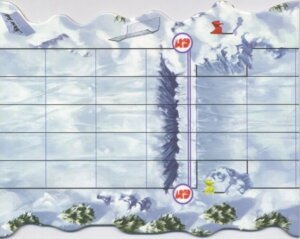
The track sweeps down into the chasm, barely wide enough for one sled to squeeze through safely! Free squares are shown here by the green ticks. The scenery does not block diagonals when moving between free spaces.
Hitting either of the centre columns (marked above with a red X) is considered the same as colliding with the side of the track.

Snow Drift
A snow drift has made part of the track impassable. Free squares are shown here by the green ticks. The scenery does not block diagonals when moving between free spaces.

Race End & Winning
- At the end of a round, all players who have crossed the finish line have finished the race.
- The player furthest passed the finish line wins the race and is considered first. This may differ from the player who crossed the finish line first.
- If the sleds are tied, then the sled to the side of the track nearest the chequered flag wins. Play then continues onto the next round, and so on, until all players have finished the race.

A Racing Season
Instead of a single race, you can play numerous routes over the course of a season. Each player takes it in turn to make up their own course. Points are awarded as follows :
- 1st: 5 points
- 2nd: 3 points
- 3rd: 2 points
- 4th: 1 point
“Big Paws” Token
You have read all this way wondering “what is the effect of the Big Paws Token” ? It is your reward for buying our game and teaching the game to others. Simply give it to the player who takes too long to think about their turn. They can only give it away if someone else takes longer to play on a subsequent turn. It has no effect. Read the title of the token again. Laugh. This token is universal and is compatible with all games……….

Example of a Round of Play


Yellow is ahead and is therefore first to play. She plays a 2 onto her left dog. This gives her a speed of 3 (2+4-3), and a drift of two to the right (the right dog is pulling two stronger than the left dog). The sled travels three spaces forward and drifts twice to the right.
Yellow’s sled is not travelling in excess of the safety limit for the corner, so she does not pick up any dent cards.

Although blue and red are level, blue is on the inside for the next corner and therefore is in second. Blue plays a 2 onto each of his dogs and onto his brake (you are allowed to play more than one of the same value of card). This gives him a provisional speed of 2 (2+2-2), but he also has the option of a bonus for having a balanced sled (both dogs are the same value). The bonus is equal to his position (2nd = 2). He decides to take the bonus giving him a total speed of 4 with no drift.

Red is last to go in the round. He places a 4 onto his left dog and uses another 4 for his brake. He is now travelling at speed 5 (4+5-4) with a drift of one to the right (the right dog is pulling one stronger than the left dog).
Red exceeds the corner safety speed by 1 and takes one dent card.
Example of Drifting on a Corner
Here, red has a speed of 6 (3+5-2) and a drift of 2 to the right (the right dog is 2 stronger than the left).
The player drifts twice by crossing the black lines twice. To execute drift, the player must cross a black line on the track.


Courses / Rennstrecken


Credits
Don’t forget to check out the special tracks and examples in the following couple of pages, and the courses on pages 18 and 19. Have fun and good luck.
Fraser and Gordon (the Lamont Brothers)
Special thanks to:
Team Fragor: Judi, Tabby, Sheena, Iona, and Glenn.
Joy, Sandy, Eilidh and Katie.
Ellis Simpson, Marcus Tiefenbraun, Ian Bothwick, Peter Rose, Steven ‘with a v’ Gladstone and Mark Higgins.
Brian Robson, Gery McGlauchlin, Grant Whitton and Gareth Lodge.
Jon Sykes and everyone involved with E-motion Lab.
Ralph Anderson, Mark Delano and Thomas Scull.
Henning Kröpke, Martin Wehnert, Christian Frank and Bruce Allen.
Artwork: Judi Lamont
Deutsche Übersetzung: Henning Kröpke
Mit Unterstützung von: Andreas Wickner
Game Summary Spielübersicht
EACH ROUND:
The players take their turn in race order.
Each turn a player does the following:
1) Plays cards
- 1 or more cards of the same value onto the left dog, right dog and/or brake
- A maximum of one card for each position (so a maximum of 3 cards in total)
2) Moves the sled
- The speed is the dogs’ value added together minus the brake value
- The drift is the difference between the two dogs (towards the stronger dog)
- If the sled is balanced (both dogs have the same value) the player may take bonus movement
Bonus Movement:
- Equal to the players position in the race
- Player must take all or none of the bonus
- Bonus is added to the sled’s speed, and counts towards corner safety limits
3) Returns hand size to 5
- Draw from Dog Deck if less than 5 cards, discard if more than 5
- Dent cards count towards hand size and cannot be discarded
HAZARDS
Exceeding the safety limit on a corner:
- Take a dent card for each point of speed over the safety limit
- Continue with sled’s movement and rest of turn
Crashing into another sled:
- Sled’s movement and player’s turn ends immediately
- Player does not refill hand (but must still discard if above 5)
Crashing into the side of the track:
- Sled’s movement ends immediately
- Player takes a dent card
- Player moves onto step 3 (Return hand size to 5)
Jede Runde:
Die Spieler führen ihren Zug in Rennreihenfolge aus.
In jedem Zug führt der Spieler die folgenden Schritte durch:
1) Karten ausspielen
- 1-3 Karten mit dem gleichen Wert auf den linken Hund, rechten Hund und/oder die Bremse legen.
- Maximal 1 Karte für jede Position.
2) Schlitten bewegen
- Die Geschwindigkeit entspricht der Summe beider Hunde minus des Wertes der Bremse.
- Der Drift ist die Differenz der Werte der beiden Hunde (in Richtung des stäkeren Hundes).
- Wenn der Schlitten ausgeglichen ist (beide Hunde haben den gleichen Wert), erhält der Spieler eine Bonus-Bewegung.
Bonus-Bewegung:
- Entspricht der Position des Spielers im Rennen
- Man muss entweder gesamte oder keine Bonus-Bewegung nutzen.
- Bonus wird zur Geschwindigkeit hinzugezählt und muss bei Geschwindigkeitsbeschränkung in Kurven berücksichtigt werden.
3) Die Handkarten auf 5 bringen
- Karten vom eigenen Hundestapel ziehen, wenn man weniger als 5 Karten auf der Hand hält, Karten abwerfen, wenn man mehr als 5 hat.
- Dellenkarten zählen zu der Kartenhand und können nicht abgeworfen werden.
GEFAHREN
Die Geschwindigkeitsbeschränkung in Kurven überschreiten:
- Man nimmt eine Dellenkarte pro Geschwindigkeitspunkt über der Geschwindigkeitsbeschränkung.
- Man setzt die Bewegung des Schlittens fort und beendet den Zug normal.
Mit einem anderen Schlitten zusammenstoßen:
- Die Bewegung des Schlittens und der Zug des Spielers sind sofort vorbei.
- Man zieht keine Karten nach (muss aber eventuell auf 5 Karten abwerfen).
Mit dem Streckenrand zusammenstoßen:
- Die Bewegung des Schlittens endet sofort.
- Man nimmt eine Dellenkarte.
- Man setzt den Zug mit Schritt 3 fort (Die Handkartenzahl auf 5 Karten bringen).
Introduction & Components
The game of Husky Sled Racing
Welcome to the snowy world of the Arctic Circle, where brave sledders race in a test of skill and endurance. Action is fast and furious and not all sleds may make it to the finish. Huskies only have one setting and that is full speed! Hang on to your furs, the reins, your sled and anything else you can get hold of.
Remember, you do not have to be Inuit to win it!
Components
- Track:
- 8 x Straights (Double sided with some special tracks on the reverse)
- 4 x Corners (Double sided)
- 2 x U-turns (Double sided)
- 1 x Start (Double sided)
- 1 x Finish (Double sided)
- 5 x wooden sleds
- 5 x centre swivels
- 5 x brake markers
- 5 x sled mats
- 20 x wooden saplings
- 1 x ‘Big Paws’ token
- Cards:
- 5 Dog decks (20 Canine Cards made up of 4 x 1, 2, 3, 4, and 5.)
- 20 Dent cards
- Rules (located at the end of your fingers)
Sled Mat Assembly
Assemble the 5 sled mats. Connect the centre swivel through their centres.
Once the sled mat is assembled, it can be rotated to match the player’s sled orientation on the track. This makes it easier for the player to determine left and right. To swivel the sled mat, place one finger on top of the centre swivel and use your other hand to rotate the mat.
Be careful not to disturb the cards and brake when turning your mat.
Setup
Race Setup
- Set up a course by joining sections of track together (for your first race use the starter track ‘The Nutcracker’ on page 18). The tracks are always set up with the yellow flags on the left and the red flags on the right. A course can get pretty big so get a big table! Alternatively, you can add and remove track as necessary during a race.
- Add the start and finish sections to the track. The start section is placed so 1st position lines up with the inside of the first corner (it is double-sided).
- Each player chooses a colour and takes the appropriate sled token, sled mat, brake marker and Dog Decks in their colour.
- Each player places their sled mat in front of them. The brake marker is set at the number “3” (the dogs also start at 3, but this is pre-printed on the sled mat).
- The dent cards are placed in a pile to the side.
- Each player shuffles their Dog Deck and places it face down beside their sled as a draw pile.
- The player with the huskiest voice is the starting player. The player with the next huskiest voice is second, and so on. Wizened old gamers may decide order randomly.
- The starting player chooses any free starting position for their sled on the start section and places their sled. In order, the others players do the same. Each starting space can only take one sled.
- Each player then draws a starting hand of 5 cards. A player starting in the 4th place takes 1 extra card. A player starting in the 5th place takes two extra cards. (Note – the bonus depends on the starting space of the sled and is not dependent on the number of players.)
The game is now ready to start.
Turn Order & Race Position
(There is an example of a round of play on page 8)
Every round:
- Players take their turn in race position order (1st, 2nd, 3rd and so on) until everyone has moved.
- If sleds are side by side then the sled (a) on the inside of a corner section of track or (b) the inside of a straight as it approaches a corner is deemed to be in ahead.
- On the final straight(s), the inside is taken to be on the same side as the chequered flag on the finish line.
“Who’s on First”
Straight alignment: Yellow is alone out in front and is first. Red and blue are level, but blue is on the same side as the inside for the next corner. This means blue is second and red is third.
Corner alignment: On corners, there are guides to help show lines that are the same distance along the track but not next to one another. The colour bud at the end of one line corresponds with the colour bud of another line at the same level. Here yellow and blue are level, but yellow is ahead as he is on the inside. Red is furthest back.
How to Play (Player Turn)
On their turn, each player does the following:
- Play 1-3 Canine Cards of the same value
- Move their sled
- Return their hand size to 5 cards (through drawing or discarding)
1. Play 1-3 Canine Cards of the Same Value (“Mush ! Mush !”)
- A player must play at least one Canine Card on their turn.
- A player can play 1, 2 or 3 Canine Cards.
- Each card played must be of the same value (e.g. 5, 3-3, 4-4-4, etc).
- The cards are played face up onto the left dog and/or right dog (on top of any previously played cards) and/or onto the discard pile to move the brake. Each position can only have one card played on it per turn.
- A card can be played on top of another card of the same value (although the existing card would have to have been played on a previous turn).
- If a card is played onto the discard pile then the brake marker on the sled mat is moved to the same number (e.g. playing a 2 causes the brake marker to be moved to 2).
Special rule – if a player has no Canine Cards (this occurs very rarely after crashing into another player’s sled) then they take the following steps:
- Take a dent card
- Draw Canine Cards up to a hand size of 5 (including dent cards)
- Continue their turn as normal (that is, step 1: play 1-3 cards, etc)
2. Move the Sled
- The sled’s Speed is the value of the 2 Canine Cards added together minus the current brake value. The sled is initially set up at speed 3 (3+3 – brake(3) = 3).
- Drift movement (or just “drifting”) of the sled is the difference between the pulling power of the 2 dogs. Drifting is a diagonal forward movement. The sled drifts towards the dog pulling hardest. (e.g. a sled with Canine Cards of 3-5 would cause a drift 2 to the right). The brake value has no effect on drift.
- Drifting always causes a player’s sled to cross a black track line.
- The player moves their sled forward the number of squares equal to their speed (all movement must be used unless a collision occurs). While moving, they must also drift to the side of the strongest dog (highest value). They must drift a number of times equal to the drift number.
- If the drift is higher than the speed, then the excess drift is ignored.
- A sled with speed 0 or less does not move.
Here, red has a speed of 3 (left dog + right dog – brake: 3+5-5=3), and a drift of 2 to the right (the right dog is pulling two stronger than the left dog). Red moves forward three spaces and must drift twice to the right.
- The flags on the sled mat are simply there to help players orientate their left and right during play. The sled mat can also be rotated to help.
- A player is completely free to choose when drifting occurs to their sled. For instance, with a speed of 5 and a drift of 2 to the left they could choose to drift move once, move forward once, drift move again and then move forward twice. However, they must attempt to use all of the drift on their turn (if a player needs to drift twice in their turn then the latest they could start to drift is when taking their second last movement).
- If the two dogs have the same number on them, then no drift occurs. The sled is considered balanced. Balanced sleds have the option of bonus movement (see Balanced Sleds).
- The sled may take damage as a result of its movement. See the hazard section for details.
Note: Movement is unaffected by other sleds and/or scenery being on the spaces with the yellow circles (spaces touching diagonally or spaces overlap).
3. Return Hand Size to Five Cards
- The player now returns their hand size to 5 cards.
- If the player has less than 5 cards (including dent cards) they draw cards from their Dog Deck until they have a hand size of five.
- In some cases, a player may have more than 5 cards (e.g. the first turn for a player starting in 5th position, or as a result of picking up a large number of dent cards). In this case a player must discard Canine Cards down to a hand size of 5. These are discarded (not played). They have no effect on the brake marker on the sled mat.
- Dent cards count towards hand size (as the sled gets beaten up it becomes more difficult to control).
- Dent cards can never be discarded (see Dents and Hazards).
- If a player’s Dog Deck runs out, shuffle the discard pile together with all of the player’s used Canine Cards (the top two cards on the sled mat are still active and remain on the mat) to make up a new Dog Deck. This is placed face down beside the sled mat. The player then draws as normal.
Balanced Sleds & Bonus Movement
A balanced sled is a happy sled. Imagine the dogs are in complete harmony. Your sled is being pulled directly forward for a change. You are in complete control….this allows you the time to aim for the best routes in the snow or to travel in the tracks left by previous sleds. You get the option of a bonus!
- Your sled is balanced when each dog has the same value of Canine Card (e.g. 3-3). This means they are pulling at the same speed !
- A balanced sled qualifies for an optional bonus movement.
- A balanced sled receives a bonus to its speed equal to the sleds position in the race (e.g. a sled in 3rd position would receive a bonus of +3).
- Bonus movement is taken at the end of a sled’s normal movement. It is always taken as forward movement in a straight line. Drifting is not allowed when taking bonus movement.
- A player must decide whether to take all or none of the bonus – it cannot be partially taken.
- The bonus is added to the sled’s speed. Entering a corner may prove hazardous !
- The sled must have a speed of one or more to receive the bonus.
- This bonus is not used in the first turn of a race (when leaving the start line) as the sleds are just getting up to racing speed. READ THIS AGAIN – YOU WILL FORGET!
Dents & Hazards
Sled racing is a dangerous sport. Despite extensive training and safety precautions accidents still occur. Since the local hospital wing only has 1 copy of monopoly for patients to play, we presume you do not want to spend too much time there. As the race progresses, a player’s sled may take bangs and scrapes. This makes it harder to control in the future. Players may have to draw dent cards. These will limit the number of Canine Cards they have available to play in the future.
Dent cards:
- Count towards hand size
- Can never be played or discarded
- Are double sided so as to be open to other players
1. Entering a Corner Over the Safety Speed (WOOAAAHH!)
There are old sled racers and bold sled racers but no old, bold sled racers. Over 217 playtesters were severely injured in establishing the safe speed limits for corners. Some did not make it past the first corner. Ignore the speed limits at your peril. Ah, forget it…..sometimes you just have to go for it!
- The player completes the rest of their movement.
- They then draw 1 dent card for each point of speed they were over the safety speed (e.g. travelling at speed 5 over a speed limit of 3 means you draw 2 dent cards).
- Remember, bonus movement for balanced sleds counts towards the sled’s speed.
- The safety speed only applies as a sled crosses the line. The corner has no further speed restrictions. Slow in – fast out!
- If the sled has also had a collision later in the turn then this is now resolved. If not, the player moves to step 3 of their turn (return hand size to 5 cards).
2. Colliding with Another Sled (“Oops! Sorry. Accidents will happen.”)
The dogs run into the back of another sled (either by drift movement or directly from behind). It was not the player’s fault….. (obviously !). Thankfully the damage is slight. The dogs are momentarily confused. The following happens :
- The player’s turn ends immediately.
- The sled remains on the space it reached immediately before the collision occurred.
- The player does not refill his hand but does discard down to 5 cards if required (this may occur where a player has just taken a lot of dent cards on the same turn by going too fast through a corner). Remember, dent cards cannot be discarded.
- Play continues with the next player.
- The player who crashed will probably start their next turn with a reduced hand size. However, at the end of that turn, they still draw up to a hand size of 5 once they reach stage 3 (return hand size to 5 cards).
- A player is not obliged to avoid a crash and may do so for tactical reasons.
3. Colliding with the Side of the Track (“Watch out for the tre…….!)
Sleds are precision instruments. Throwing them into the side of the track severely disturbs their ability to move in the snow. May we also remind you that your insurance does not cover sled damage due to driver error. In the unlikely event you do crash with the side of the track then the following steps apply :
- The sled’s movement ends immediately.
- The sled remains on the space it reached immediately before the collision occurred.
- The player draws a dent card and then moves to step 3 of their turn (return hand size to 5 cards).
- A player is not obliged to avoid a crash and may do so for tactical reasons (for example, to avoid speeding through a corner).
Sled Destruction (Elimination)
**YOU ONLY HAVE 4 DENT CARDS PER PLAYER FOR A REASON !**
If a player is ever required to draw a 5th dent card then their sled is reduced to a pile of matchwood. They can travel no further on this sled. It is removed from the race. If, however, the sled has already crossed the finish line then the sled is left in the space it reached before it required to take the dent card. It can still win the race, although the driver might require some bandages.
Special Tracks & Joins
The special tracks are the snowdrift, chasm and saplings. It is recommended you play the game at least once before using any of them. Once you become a master dog sledder, you might want to include some (or all) of the following track pieces, for a more testing track!
Track Joins
It is always considered that there is a blue line between all track joins. Due to imperfections in the cutting process, this line might sometimes be missing.
Saplings
Some saplings have grown up through the track causing a problem for the unwary sled! During set up, place a wooden sapling onto each marked space on the track (In future, you can experiment with your own sapling formations).
During play, if a player hits a sapling they:
- remove the sapling piece from the board
- take a dent card into their hand
- then continue with their turn (remaining movement, hand refill, etc).
Once the sapling piece has been removed, the space can be used by other players without penalty.
The Chasm
The track sweeps down into the chasm, barely wide enough for one sled to squeeze through safely! Free squares are shown here by the green ticks. The scenery does not block diagonals when moving between free spaces.
Hitting either of the centre columns (marked above with a red X) is considered the same as colliding with the side of the track.
Snow Drift
A snow drift has made part of the track impassable. Free squares are shown here by the green ticks. The scenery does not block diagonals when moving between free spaces.
End of Game & Variants
Race End & Winning
- At the end of a round, all players who have crossed the finish line have finished the race.
- The player furthest passed the finish line wins the race and is considered first. This may differ from the player who crossed the finish line first.
- If the sleds are tied, then the sled to the side of the track nearest the chequered flag wins. Play then continues onto the next round, and so on, until all players have finished the race.
A Racing Season
Instead of a single race, you can play numerous routes over the course of a season. Each player takes it in turn to make up their own course. Points are awarded as follows :
- 1st: 5 points
- 2nd: 3 points
- 3rd: 2 points
- 4th: 1 point
“Big Paws” Token
You have read all this way wondering “what is the effect of the Big Paws Token” ? It is your reward for buying our game and teaching the game to others. Simply give it to the player who takes too long to think about their turn. They can only give it away if someone else takes longer to play on a subsequent turn. It has no effect. Read the title of the token again. Laugh. This token is universal and is compatible with all games……….
Detailed Examples of Play
Example of a Round of Play
Yellow is ahead and is therefore first to play. She plays a 2 onto her left dog. This gives her a speed of 3 (2+4-3), and a drift of two to the right (the right dog is pulling two stronger than the left dog). The sled travels three spaces forward and drifts twice to the right.
Yellow’s sled is not travelling in excess of the safety limit for the corner, so she does not pick up any dent cards.
Although blue and red are level, blue is on the inside for the next corner and therefore is in second. Blue plays a 2 onto each of his dogs and onto his brake (you are allowed to play more than one of the same value of card). This gives him a provisional speed of 2 (2+2-2), but he also has the option of a bonus for having a balanced sled (both dogs are the same value). The bonus is equal to his position (2nd = 2). He decides to take the bonus giving him a total speed of 4 with no drift.
Red is last to go in the round. He places a 4 onto his left dog and uses another 4 for his brake. He is now travelling at speed 5 (4+5-4) with a drift of one to the right (the right dog is pulling one stronger than the left dog).
Red exceeds the corner safety speed by 1 and takes one dent card.
Example of Drifting on a Corner
Here, red has a speed of 6 (3+5-2) and a drift of 2 to the right (the right dog is 2 stronger than the left).
The player drifts twice by crossing the black lines twice. To execute drift, the player must cross a black line on the track.
Courses & Credits
Courses / Rennstrecken
Credits
Don’t forget to check out the special tracks and examples in the following couple of pages, and the courses on pages 18 and 19. Have fun and good luck.
Fraser and Gordon (the Lamont Brothers)
Special thanks to:
Team Fragor: Judi, Tabby, Sheena, Iona, and Glenn.
Joy, Sandy, Eilidh and Katie.
Ellis Simpson, Marcus Tiefenbraun, Ian Bothwick, Peter Rose, Steven ‘with a v’ Gladstone and Mark Higgins.
Brian Robson, Gery McGlauchlin, Grant Whitton and Gareth Lodge.
Jon Sykes and everyone involved with E-motion Lab.
Ralph Anderson, Mark Delano and Thomas Scull.
Henning Kröpke, Martin Wehnert, Christian Frank and Bruce Allen.
Artwork: Judi Lamont
Deutsche Übersetzung: Henning Kröpke
Mit Unterstützung von: Andreas Wickner
Game Summary / Quick Reference
Game Summary Spielübersicht
EACH ROUND:
The players take their turn in race order.
Each turn a player does the following:
1) Plays cards
- 1 or more cards of the same value onto the left dog, right dog and/or brake
- A maximum of one card for each position (so a maximum of 3 cards in total)
2) Moves the sled
- The speed is the dogs’ value added together minus the brake value
- The drift is the difference between the two dogs (towards the stronger dog)
- If the sled is balanced (both dogs have the same value) the player may take bonus movement
Bonus Movement:
- Equal to the players position in the race
- Player must take all or none of the bonus
- Bonus is added to the sled’s speed, and counts towards corner safety limits
3) Returns hand size to 5
- Draw from Dog Deck if less than 5 cards, discard if more than 5
- Dent cards count towards hand size and cannot be discarded
HAZARDS
Exceeding the safety limit on a corner:
- Take a dent card for each point of speed over the safety limit
- Continue with sled’s movement and rest of turn
Crashing into another sled:
- Sled’s movement and player’s turn ends immediately
- Player does not refill hand (but must still discard if above 5)
Crashing into the side of the track:
- Sled’s movement ends immediately
- Player takes a dent card
- Player moves onto step 3 (Return hand size to 5)
Jede Runde:
Die Spieler führen ihren Zug in Rennreihenfolge aus.
In jedem Zug führt der Spieler die folgenden Schritte durch:
1) Karten ausspielen
- 1-3 Karten mit dem gleichen Wert auf den linken Hund, rechten Hund und/oder die Bremse legen.
- Maximal 1 Karte für jede Position.
2) Schlitten bewegen
- Die Geschwindigkeit entspricht der Summe beider Hunde minus des Wertes der Bremse.
- Der Drift ist die Differenz der Werte der beiden Hunde (in Richtung des stäkeren Hundes).
- Wenn der Schlitten ausgeglichen ist (beide Hunde haben den gleichen Wert), erhält der Spieler eine Bonus-Bewegung.
Bonus-Bewegung:
- Entspricht der Position des Spielers im Rennen
- Man muss entweder gesamte oder keine Bonus-Bewegung nutzen.
- Bonus wird zur Geschwindigkeit hinzugezählt und muss bei Geschwindigkeitsbeschränkung in Kurven berücksichtigt werden.
3) Die Handkarten auf 5 bringen
- Karten vom eigenen Hundestapel ziehen, wenn man weniger als 5 Karten auf der Hand hält, Karten abwerfen, wenn man mehr als 5 hat.
- Dellenkarten zählen zu der Kartenhand und können nicht abgeworfen werden.
GEFAHREN
Die Geschwindigkeitsbeschränkung in Kurven überschreiten:
- Man nimmt eine Dellenkarte pro Geschwindigkeitspunkt über der Geschwindigkeitsbeschränkung.
- Man setzt die Bewegung des Schlittens fort und beendet den Zug normal.
Mit einem anderen Schlitten zusammenstoßen:
- Die Bewegung des Schlittens und der Zug des Spielers sind sofort vorbei.
- Man zieht keine Karten nach (muss aber eventuell auf 5 Karten abwerfen).
Mit dem Streckenrand zusammenstoßen:
- Die Bewegung des Schlittens endet sofort.
- Man nimmt eine Dellenkarte.
- Man setzt den Zug mit Schritt 3 fort (Die Handkartenzahl auf 5 Karten bringen).