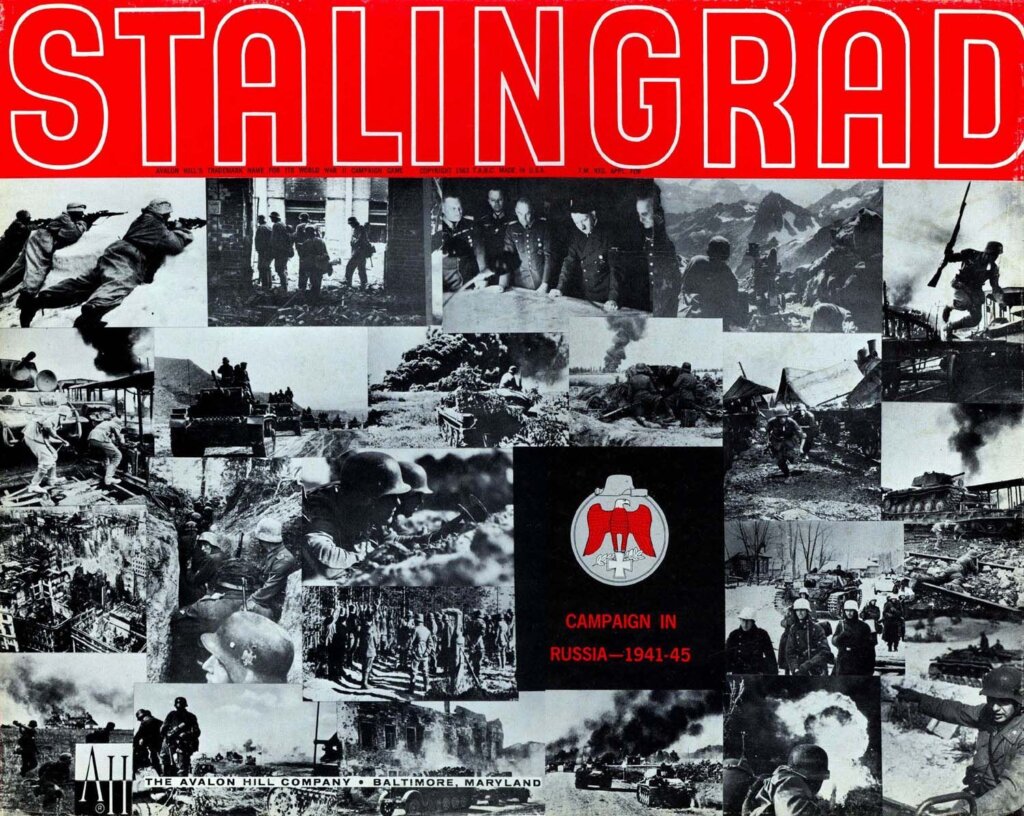
Stalingrad
1963
Command German or Russian forces through shifting weather, tactical combat, and a demanding campaign for key cities.
120
minutes
2 - 2
player(s)
12+
Medium

About this board game
Stalingrad is a two-player hex-based war game released in 1963, with an average play time of about 120 minutes. Players command German and Russian forces in a campaign where careful movement, combat choices, weather, and city control determine the outcome.
The rules are fairly straightforward, making this a useful introduction to hex-based war games, while the strategic possibilities are exceptionally deep. Players alternate movement and combat, with combat mandatory between opposing units that are adjacent at the end of each turn. The attacker decides which units fight, provided every adjacent unit is included in a battle.
Units exert one-hex zones of control, limiting movement through adjoining controlled hexes. Combat uses the classic Avalon Hill six-sided-die table, with results including D Elim and A Elim. Battles may also produce a limited advance of one hex or a retreat of two hexes.
- Terrain: Swamps and mountains restrict movement, while mountains and major cities double defender strength. Rivers can double defenders when attacked only across the river.
- Transportation: Railroads provide a ten-hex movement bonus, taken all at once, while lakes are impassable.
- Weather: Summer is good, winter brings snow, and spring and fall use a weather table. Mud halves ground movement, while snow halves ground and rail movement and freezes some water terrain.
- Replacements: German replacements are limited, while Russian replacement rates increase as the game progresses.
Victory comes from capturing the opposing side’s key cities or destroying its army. The Russians can also win by taking Helsinki, Warsaw, and Bucharest and holding them for two complete turns. With enduring interest for players at different skill levels, Stalingrad offers a classic balance of accessible rules and demanding strategy.
/pic7182955.jpg)
