Stuffed Fables
2018
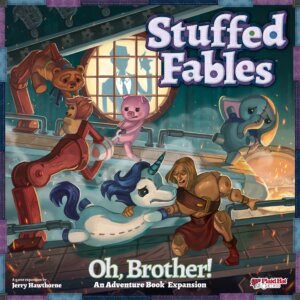
Lead brave stuffies through a branching story, using colorful dice to fight minions, explore strange places, and save the child they love.
90
minutes
2 - 4
player(s)
7+
Medium


About this board game
Stuffed Fables is a narrative adventure game for 2–4 players, with each game taking about 90 minutes. Players become brave stuffies seeking to save the child they love from a scheming, evil mastermind.
Every adventure unfolds inside the unique AdventureBook, which combines the rules reference, story guide, and game board in one immersive storybook. Each chapter opens onto colorful maps and illustrations, with story choices and special rules on the opposite page.
On a turn, a player draws five dice from a bag. Their colors determine the actions and options available, while most dice can also help with movement, items, or group tasks.
- White dice can re-stuff stuffies injured in battle.
- Red and green dice perform melee and ranged attacks.
- Yellow dice search, while blue dice provide special actions.
- Purple dice can be used as any color, and dice may be stored, combined, or spent one at a time.
As turns pass, black dice enter the draw. Once enough appear, minions emerge or attack, and the dice bag is reset. Players can support one another by sharing dice or precious stuffing while facing enemies and unusual challenges.
Beyond combat, every page offers points of interest, charming characters to interact or trade with, and choices that shape a branching overarching story. Chapters explore milestones in a child’s life, while items and a special discovery deck add surprises. With its storybook presentation and sense of wonder, Stuffed Fables is designed for families and adults who still enjoy imaginative adventures.

Board Game Rules for
Stuffed Fables
Object of the Game
Stuffed Fables is a cooperative adventure game for 2-4 players. Players take on the roles of a young girl’s stuffed animals, who are tasked with protecting the child from the minions that lurk under her bed. Using teamwork, courage, compassion, and a little luck, the stuffies will explore their way through a series of interactive stories.

Components
- 1 Rulebook
- 1 Storybook
- 40 Card Discovery Deck
- 1 Sideboard
- 6 Stuffy Figures
- 17 Minion Figures
- 35 Dice
- 1 Dice Bag
- 15 Buttons
- 6 Character Cards
- 29 Lost Cards
- 10 Sleep Cards
- 46 Item Cards
- 12 Minion Cards
- 8 Environment Cards
- 34 Status Cards
- 4 Reference Cards
- 30 Stuffing Tokens
- 15 Heart Tokens
- 4 Objective Tokens
- 4 Lost Tokens
- 1 Bookmark Token
- 1 Red Wagon Token
- 1 Train Token
- 1 Door Token

Storybook

Sideboard
- Group Task Track
- Threat Track

Character Card
- Name
- Active Ability
- Earned Abilities
- Die Storage Slot
- Stuffing Storage Slot
- Heart Storage Slot

Minion Card
- Name
- Type
- Actions
- Defense
- Miniature Base Shape
Discovery Deck
This is the discovery deck. Do NOT rearrange or look through these cards. These cards are arranged and divided (by divider cards) into stories. Each story in the Storybook will instruct players to collect the discovery cards that belong to that story and to set them aside. As the story plays out, players will be instructed to retrieve specific cards from these set aside cards. After each story, any discovered cards are added to their respective decks unless instructed otherwise. At the end of a story, any cards that were not discovered are then added to their respective decks so that they’re available for future stories.

Dice

Item Card
- Name
- Type
- Range Value
- Equipment Slot
- Keywords
- Effect

Lost Card
- Name
- Story
- Effect

Environment Cards
- Name
- Effect

Status Cards
- Name
- Effect

Sleep Cards

Other Components
- Buttons
- Stuffing Tokens
- Heart Tokens
- Bookmark Token
- Objective Tokens
- Lost Tokens
- Story Specific Tokens
Game Setup
To set up a game of Stuffed Fables, follow these steps:
- Each player chooses a stuffy character card and its matching figure and places 5 stuffing tokens on that character card (light side up).
Note: If playing the 2 player game, players may choose to control 2 stuffies each. For the purpose of interpreting rules, a player with two stuffies is treated as 2 players with 2 separate turns. - Put all of the attribute (purple, blue, green, red and yellow) dice into the dice bag. Then add a number of stuffing (white) dice equal to the number of stuffies in play plus 1 and add the same number of threat (black) dice.
- Shuffle the item cards and form an item deck.
- Shuffle the Lost cards and form a Lost deck.
- Create a face-up pile of boss minion cards, then shuffle the remaining minion cards and form a minion deck. When you set up for your first game, you will not have any boss minion cards.
- Form the sleep deck by doing the following:
- Shuffle the Waking sleep card with 2 random sleep cards and set them face-down next to the play area.
- Shuffle the rest of the sleep cards and place them face-down on top of this deck.
- Place status cards, buttons, stuffing tokens, heart tokens, etc. in an easy to reach place.
- Place the Storybook in the center of the play area, and put the sideboard to the right side of it.
- Choose a player to be the first bookkeeper. Give that player the bookmark token. She will take the first turn and play will proceed to the left.
- Choose a story from the Storybook, open it to that story’s start page and read the first section. (If this is your first time playing, start with the first story: The Big Girl Bed.)

Page Setup
Each page of the book will give players some instructions on how to set it up. Below are some general instructions on how to read a game map and how to generate an encounter.
Reading a Map

- Search Difficulty: This is the target number to successfully search the map.
- Colored Lines: To move across a solid colored line, a player must use a die of a color matching the line color to move her stuffy.
- The Lost: See the Lost section below for details.
- Points of Interest: See the points of interest section below for details.
- Stuffy Start Space: Stuffy figures come into play on or adjacent (orthogonally or diagonally) to this space.
- Minion Start Space: When encountering minions, their figures come into play on or adjacent to this space.
- Vendors: See the vendors section below for details.
- Bracketed Space: These spaces are used for counting range. A figure cannot move onto one of these spaces unless directed by the Storybook.
Leaving a Page
When leaving a page, remove any remaining minions and tokens on that page from play and move all stuffy figures to their cards. If the Storybook directs you to leave a page, unless stated otherwise, finish the current player’s turn before leaving.
Turn Overview
On a player’s turn, she does the following steps in order:
- Draw Dice
- Find Stuffing
- Place Threat
- Perform Actions
- Move
- Reserve
- Encourage
- Skill Test
- Group Task
- Attack
- Search
- Discard Dice
- Check Threat
1. Draw Dice
Draw 5 dice out of the dice bag and place them in front of you. If there are fewer than 5 dice in the bag, draw the remaining dice from the bag, then move all of the dice in the discard pool back to the bag, then complete your draw.
2. Find Stuffing
Roll your white dice to find stuffing. Each die may be rolled separately, or multiple may be rolled together as 1 roll (to achieve a higher roll result). After each roll, if the roll result was equal to or higher than your stuffy’s remaining number of stuffing, gain 1 stuffing and then discard that die (or dice), by moving it to the discard pool. There is no limit to the number of stuffing a stuffy can have.
3. Place Threat
Place all of your black dice on the threat track, starting at the top.
4. Perform Actions
All of the remaining colored dice in front of you may be utilized to perform actions. To perform an action, you must spend a die of the appropriate color. To spend a die: Roll that die, resolve its effect, then discard it. Just as with white stuffing dice, each die may be rolled separately, or multiple of the same color (or purple) may be rolled together as 1 roll. On your turn, you may perform as many actions as you like, as many times as you like, so long as you still have the appropriate dice available to spend. The actions that can be performed with each die type are as follows:
Any Color Attribute Dice
- Move across dotted lines or move across solid lines matching the color of die being rolled.
- Reserve (a die)
- Encourage (a stuffy)
- Perform a skill test of the matching color
- Contribute to the group task of the matching color
Red Attribute Dice
Melee Attack
Green Attribute Dice
Ranged Attack
Yellow Attribute Dice
Search
Blue Attribute Dice
No Unique Action
Purple Attribute Dice
Substitute in for any color of attribute die.
5. Discard Dice
Discard all of your remaining dice.
6. Check Threat
If there are minions in play… and the number of dice on the threat track equals or exceeds the number of minions in play, the minions take a turn (see pg. 12).
If there are no minions in play… and the number of dice on the threat track equals or exceeds the number of stuffies in play, resolve the list below in order:
- Resolve the
 effect on the current page of the Storybook.
- If the surge resulted in minions coming into play, the minions will immediately take a minion turn (see pg. 12).
- Discard all of the dice from the threat track.
- Refresh the dice bag. (Return all of the dice in the discard pool to the dice bag.)
After the Check Threat step and a possible minion turn, continue with the next player’s turn (the player to the left of the current player).

Move
- Spend any color dice to move your stuffy up to a number of spaces equal to the roll result.
- Stuffies may be moved diagonally and/or orthogonally.
- A stuffy can only move on the grid. A stuffy cannot move onto bracketed spaces.
- A stuffy may be moved through a space containing another stuffy, but cannot end its movement on that space.
- A stuffy cannot be moved through a space containing a minion.
- A stuffy can only be moved across a solid colored line if you used that color of die and/or purple dice to move.
Note: Solid white lines cannot be crossed.
Reserve
Instead of spending a die, you may reserve it. A reserved die is stored on your stuffy’s card. There is no need to roll a die you are reserving. A reserved die can be spent to defend against damage or can be spent on one of your future turns. You cannot reserve a die if there is already one on your stuffy’s card.
Encourage
To encourage a stuffy, choose another player’s stuffy and do 1 of the following:
- Store 1 of your dice on that stuffy’s card, just as you would with your own stuffy when reserving a die. If that stuffy already has a die stored on its card, discard the previously stored die.
- Discard any color die and give that stuffy 1 of your stuffing.

Skill Test
Sometimes there is a skill test available to perform. Skill tests have a color and a target difficulty number and are represented like so:
To perform a skill test you must spend any number of the appropriate color of dice (or purple). If your roll result meets or exceeds that target number, resolve the pass effect of that skill test. Otherwise resolve the fail effect. You automatically fail a skill test if you are required to make one but do not have the appropriate dice.
There are 4 places that players can look to see if there are skill tests available:
- Storybook Special Rules: Sometimes the Storybook will instruct players to make a skill test.
- Status Cards: Many status cards have a skill test that must be passed to remove them.
- Environment Cards: Some environment cards require players to make a skill test to interact with the environment.
- Lost Cards: Some Lost cards require players to make a skill test.
Group Task
Sometimes there is a group task available to perform. Group tasks are similar to skill tests, except multiple players can contribute on their turns by rolling the appropriate colored dice and placing them on the group task track. When the total of dice on the group task track equals or exceeds the task’s target difficulty number, resolve the task’s pass effect. Unlike skill tests, group tasks cannot fail. Stuffies can contribute to group tasks from anywhere on the map, unless directed otherwise by the Storybook.

Lumpy wants to help the party bust open the door to the hut. He rolls a 5 on one of his red dice and adds it to the group task track. Unfortunately, his roll wasn’t enough to succeed at the task. If he has another red die, or a purple die, he could continue to add to the task.
Combat
Melee Attack
In order to perform a melee attack, a stuffy must be equipped with a melee weapon. To perform a melee attack, choose a target minion. The target must be in a space adjacent to the attacking stuffy without any colored lines in between them (see diagram). Roll any number of red dice. If the roll result meets or exceeds the target minion’s defense value, that minion is defeated. When a minion is defeated, remove it from play by removing its figure from the map and discarding its card. The stuffy that defeated it receives 1 button. If the target minion was a leader or boss, the stuffy also receives a courageous status card.

Lumpy cannot attack crawly A with his Meat Mallet because a stuffy cannot perform a melee attack across a colored line. Thea can attack crawly B with her Letter Opener. The colored lines do not fully block her attack.
Note: When a minion is defeated, leave the black threat dice on the threat track.
Ranged Attack
A ranged attack works just like a melee attack except a stuffy must be equipped with a ranged weapon, a ranged attack uses green dice, and the attack may cross solid colored lines (except solid white lines) to target a minion that is a number of spaces away from the attacking stuffy up to the weapon’s range.

Flops can attack crawly A on the bed with her Archery Set because it is a ranged weapon with a range of 6.
Attacking a Boss
When a boss would be defeated by an attack, instead remove 1 dark stuffing from its card. When it has no dark stuffing on its card, it is then defeated and removed from play.
Search & Equipment
Search
Most maps have a search icon in the upper right corner of the map along with a target number. To search, spend any number of yellow dice. If your roll result meets or exceeds the target search number, draw an item card. When drawing an item card (excepting party items) you may either equip the card to your stuffy or trade it to another player (who must then immediately equip it to her stuffy). When drawing a party item card put it in reach of all players. All players can freely use party items and there is no limit to the number you can have in play.
Equipment Slots
Each stuffy has 4 equipment slots: Head, Body, Paws and Accessory. A stuffy cannot have 2 items equipped that both have the same equipment slot icon.

Example: Theadora is equipped with the Letter Opener. Theadora finds the Scissors item card. Since both cards have the paws icon, Theadora cannot equip both of these items. If Theadora would like to equip the Scissors she must discard the Letter Opener.
Party Items
Party items are not equipped to a stuffy, but are put into play within reach of all players. Party items are treated as if they are equipped to all of the stuffies simultaneously. There is no limit to the number of party items that can be in play.

Bonuses and Using Purple Dice
Various cards and effects can give bonuses to your die rolls. In most cases, these bonuses apply only to dice of a certain color. In all cases, bonuses are applied after effects that change a die result.
Purple dice may be used in place of any other attribute die. However, purple dice do not benefit from any bonuses except for those granted specifically to purple dice.

Sarah is making a melee attack with her stuffy. She rolls 2 red dice and 1 purple die. Her Meat Mallet card gives her red dice a bonus of +1. Sarah rolls a red 3, red 1, and purple 4. Her total is: 3 + 1 + 1 + 1 + 4 = 10
Note: A purple die is used ‘in place’ of another colored die. The purple die does not ‘become’ the other color.
Examples:
You may use a purple die in place of:
- a red die when making a melee attack
- a green die to move across a green line
- a yellow die to search
- a blue die when making a blue skill test
You may NOT:
- use Lumpy’s ability to re-roll purple dice (as it can only re-roll blue dice).
- add +1 to purple dice when using them to attack with the Rubber Bands item (as it adds +1 only to green dice)
Generating an Encounter
Minions (the game’s enemies) will enter play when the Storybook instructs players to generate an encounter. There are 2 types of encounters that the Storybook will instruct players to generate:
- Random Encounter
- Named Encounter
Random Encounter
To generate a random encounter, shuffle the minion deck. Deal a number of cards equal to the number of stuffies in play face-up in a column near the sideboard. Place each of the figures for those minions on or adjacent to any space(s) marked with  . The bookkeeper chooses which of these spaces to place each figure on.
Named Encounter
A named encounter is an encounter that tells players exactly which and how many of each minion will be put into play. When generating a named encounter, search through the minion deck and face-up boss minion cards and collect the minions to be put into play.
Note: If a leader minion could be chosen for the encounter, it must be chosen. Shuffle those minion cards and deal them face-up in a column near the sideboard. Then place the figures for those minions on or adjacent to any space(s) marked with . The bookkeeper chooses which of these spaces to place each figure on.
Encountering a Boss
When adding a boss type minion to play, place a number of stuffing tokens (dark side up) on that boss’s card equal to the number of stuffies in play. When a boss would be defeated, instead remove 1 dark stuffing from its card. When it has no dark stuffing on its card, it is then defeated and removed from play.

Minion Turn
To resolve a minion turn do the following steps in order:
- Minion Activation
- Roll
- Move
- Target
- Attack
- Discard Threat and Refresh Dice
1. Minion Activation
Starting with the minion at the top of the minion column, minions are activated 1 at a time until each minion in play has been activated once. To activate a minion do the following in order:
Roll
Take a die off the threat track and roll it. Match the number result to an action on the minion’s card. That action will determine the minion’s speed, range and strength for the activation as well as any special rules that apply during the action.
Move 
Move the minion by following these steps:
- If the minion is adjacent to a stuffy, do not move it.
- Otherwise, move the minion toward the nearest stuffy (the stuffy that would require the least amount of movement to become adjacent to) until it becomes adjacent to that stuffy or until it has moved a number of spaces equal to its speed, whichever comes first. (If multiple stuffies are equally close, the current bookkeeper decides which of those stuffies the minion will move toward.) Minions can move across solid colored lines (except solid white lines) without penalty.
Target 
Determine which stuffy the minion will target for an attack by following these steps:
- If there are no stuffies within the minion’s range, it will not attack.
- If there is only 1 stuffy within the minion’s range, it will target that stuffy.
- If there are multiple stuffies within the minion’s range, it will target the closest stuffy. (If multiple stuffies are equally close, the current bookkeeper decides which of those stuffies the minion will target.)
Note: Minions can target across solid colored lines (except solid white lines).

Attack 
The minion now attacks its target. To resolve that attack, follow these steps:
- The attacking minion deals damage equal to the minion’s strength.
- If the target stuffy has a die stored on its card, the stuffy may choose to defend against the attack by rolling the stored die and blocking damage up to the roll result.
- Remove a number of stuffing from the target stuffy equal to the unblocked damage. If a stuffy loses all of its stuffing it becomes collapsed. See the Collapsed section below.
- If the target stuffy defended with a die and blocked ALL of the damage (lost no stuffing) then that die is returned to the stuffy’s card. Otherwise, the die is discarded.
After activating a minion, discard the black threat die used to determine its action and activate the next minion in the minion column.
2. Discard Threat and Refresh Dice
Once all minions have been activated once, discard any black threat dice remaining on the threat track, return all dice in the discard pool to the dice bag and continue to the next player’s turn.

Defending
Sometimes the Storybook or a card instructs that a stuffy receives a number of damage. Stuffies can defend against this damage in the same way as defending against a minion attack.
Collapsed
When a stuffy loses all of its stuffing, it becomes collapsed. When a stuffy collapses, tip its figure over on its side and discard all of its status cards, buttons and hearts. Reveal a sleep card. A collapsed stuffy cannot take any actions, have a die stored on it or use item cards. A collapsed stuffy still takes its turn, it just cannot take any actions on that turn if it is still collapsed after the Find Stuffing step of its turn.
A stuffy will return from being collapsed if it gains 1 or more stuffing. A collapsed stuffy can gain stuffing when another stuffy takes an encourage action to give it a stuffing or by finding stuffing on its turn using a white stuffing die.
Points of Interest 
The spaces containing a symbol are points of interest that can be explored. If a stuffy starts, ends, or moves over an explorable on its turn, end that stuffy’s movement, pause that stuffy’s turn, and read the matching entry in the Storybook. Then, unless directed otherwise, resume play. Most symbols can only be explored once. symbols that include a  can be explored multiple times.
The Lost 
The spaces containing a icon will have a token placed in them at some point during the page. Spaces with tokens offer opportunities to interact with some of the Lost (lost toys that are citizens of the Fall). If a stuffy starts, ends or moves over a space with a token, end that stuffy’s movement, pause that stuffy’s turn, and discard the token. The player on the left of the active player draws a Lost card and reads it aloud. The card will usually offer choices that give the stuffies a chance to help needy denizens. This often rewards the stuffies, but sometimes a simple thanks is all they get. Such is the nature of giving. Stuffies can always choose to walk away with no effect unless the card specifies one. DO NOT READ THE RESULT UNTIL THE CHOICE HAS BEEN MADE. After the card resolves, unless directed otherwise, resume play.
Vendors 
symbols represent an opportunity to trade with a local collector. The first time a stuffy enters each space with a symbol, end that stuffy’s movement, pause that stuffy’s turn, and reveal 4 cards from the item deck. Players on or adjacent to this space can trade for one or more of the 4 cards by spending one button or discarding one item card for each card they want to receive. Leave the remaining cards near the map for further trading until play moves to a new page of the Storybook, then shuffle them back into the item deck.
Hearts and Buttons
Buttons
When a stuffy defeats a minion, that stuffy will gain a button. The game will direct players on when buttons can be spent. When a button is spent it is returned to the supply.
Hearts
At times the game will direct players to gain a heart. A heart can be spent to perform an earned ability on your stuffy’s card. A stuffy’s active ability can be performed without having to spend a heart. Both earned abilities and active abilities can be performed at any time, unless otherwise specified on your stuffy’s card. When a heart is spent it is returned to the supply.
Status Cards
Stuffies can be affected by a variety of conditions such as scared, angry or torn. When a stuffy “becomes” something it means to place the corresponding status card on that stuffy, e.g. when a stuffy becomes worried, place a worried status card on it. A stuffy cannot have two status cards of the same type placed on it.
Sleep Cards
Each time a stuffy collapses or the Storybook directs you to, you must reveal a card from the sleep deck. Asleep cards have no effect. Restless cards may have an effect if one is described in the sidebar of the current Storybook page. If the Waking card is revealed, players no longer reveal sleep cards when directed to. The Waking ending will trigger (instead of the Asleep ending) if the stuffies win.
End of Game
If all stuffies are collapsed at the same time the players lose. Players win if the stuffies are successful in their quest as directed by the Storybook.

Glossary

- Adjacent: The 8 spaces that are pointed to in the example are adjacent to the space with the figure on it.
- Attribute Dice: Dice that allow you to perform actions on your turn. They are red, green, yellow, blue and purple.
- Button: A form of in-game currency that a player gets each time her stuffy defeats a minion. The game will inform players on when they can spend buttons.
- Collapsed: A stuffy that has lost all of its stuffing has collapsed.
- Minion: The game’s enemies, consisting of a minion figure and a minion card. There are 3 types of minions: Normal, Leader and Boss.
- Minion Column: A column of minion cards that is created when generating an encounter. The column determines the order in which minions will activate, starting with the minion at the top of the column and moving down the column in order.
- Minion Turn: A turn that consists of each minion being activated once.
- Defend: Roll a die stored on a character card to block 1 or more damage.
- Discard: Discarding a die means moving it to the discarded die pool. Discarding a card means moving it to the discard pile of the deck it came from.
- Encounter: An encounter is when minions are brought into play.
- Encourage: An action that can be taken by a player to give 1 of her stuffy’s stuffing to another stuffy or to store 1 of her dice on another player’s stuffy card.
- Equipment Slot: Each stuffy has 4 equipment slots: Head, Body, Paws, and Accessory. Each slot can have only 1 card equipped to it.
- Figure: The miniatures representing the players’ stuffies and the minions in play.
- Group Task: A task that multiple stuffies can contribute attribute dice to on each of their turns.
- Heart: The game will grant players hearts for accomplishing different story related tasks. Players can spend hearts to use 1 of their stuffy’s earned abilities.
- Item: A type of card that players can get by searching.
- Map: A page of the Storybook that figures are placed on and moved around.
- Party Item: An item that, once found, is put in reach of all players and is available to all players to use.
- Range: The number of spaces away an attack can reach.
- Skill Test: A test with a target number. Players will roll a specific color of dice to take a skill test. The roll result must meet or exceed the test’s target number to pass that test.
- Sleep Deck: A deck of cards that a card is revealed from each time a stuffy collapses and each time the Storybook directs players to reveal a sleep card. If the Waking card is revealed, players no longer reveal sleep cards when directed to. The Waking ending will trigger (instead of the Asleep ending) if the stuffies win.
- Space: A single square of the grid laid over a map.
- Status Card: Effects that are attached to stuffies when the game directs.
- Stuffing Dice: These white dice allow a stuffy to regain stuffing during the Find Stuffing step. Stuffing dice are sometimes referred to as white dice.
- Stuffy: The stuffed animal characters the players play as.
- Surge: When there are no minions in play and the number of dice on the threat track is equal to or higher than the number of stuffies in play, a surge () happens. Each page has its own surge effect(s).
- Threat Dice: These black dice represent the growing danger facing the stuffies. When minions take their turn, these are used to determine minion actions. Threat dice are sometimes referred to as black dice.
- Threat Track: The track on the sideboard where black threat dice are placed when drawn.
Credits
Game Designer and Writer: Jerry Hawthorne
Writer and Editor: Mr Bistro
Producer: Colby Dauch
Content Developer: Keith Miller
Art Directors: Isaac Vega, Sam Vega
Illustrators: Kristen Pauline, Regis Demy
Graphic Designers: Dave Richards, Kendall Wilkerson
Sculptor: Edgar Ramos
Editor: Jonathan Liu
Lead Playtester: Keith Miller
Playtesters: Mark Pruett, Jeffrey Berman, Cameron Crawford, Cabe Dobosh, Douglas Dobosh, Ruah Dobosh, Gordon Helle, Hannah Helle, William Hutton, Jeffrey Joyce, Jenny Joyce, Benji Klas, Jean Kohlhepp, Madison Kohlhepp, Michael Kohlhepp, Michael Konas, Claire McCulloch, Avery McCulloch-Hutton, Ewan McCulloch-Hutton, Brinn Miller, Keith Miller, Tammie Miller, Lindsey Rode, Kaitlyn Sevits, Ray Sevits, Philip Siemens, Ricki Siemens, Richard Spangle, Nathan Stephens, Simon Stephens, Ron Wood
Overview & Components
Object of the Game
Stuffed Fables is a cooperative adventure game for 2-4 players. Players take on the roles of a young girl’s stuffed animals, who are tasked with protecting the child from the minions that lurk under her bed. Using teamwork, courage, compassion, and a little luck, the stuffies will explore their way through a series of interactive stories.
Components
- 1 Rulebook
- 1 Storybook
- 40 Card Discovery Deck
- 1 Sideboard
- 6 Stuffy Figures
- 17 Minion Figures
- 35 Dice
- 1 Dice Bag
- 15 Buttons
- 6 Character Cards
- 29 Lost Cards
- 10 Sleep Cards
- 46 Item Cards
- 12 Minion Cards
- 8 Environment Cards
- 34 Status Cards
- 4 Reference Cards
- 30 Stuffing Tokens
- 15 Heart Tokens
- 4 Objective Tokens
- 4 Lost Tokens
- 1 Bookmark Token
- 1 Red Wagon Token
- 1 Train Token
- 1 Door Token
Storybook
Sideboard
- Group Task Track
- Threat Track
Character Card
- Name
- Active Ability
- Earned Abilities
- Die Storage Slot
- Stuffing Storage Slot
- Heart Storage Slot
Minion Card
- Name
- Type
- Actions
- Defense
- Miniature Base Shape
Discovery Deck
This is the discovery deck. Do NOT rearrange or look through these cards. These cards are arranged and divided (by divider cards) into stories. Each story in the Storybook will instruct players to collect the discovery cards that belong to that story and to set them aside. As the story plays out, players will be instructed to retrieve specific cards from these set aside cards. After each story, any discovered cards are added to their respective decks unless instructed otherwise. At the end of a story, any cards that were not discovered are then added to their respective decks so that they’re available for future stories.
Dice
Item Card
- Name
- Type
- Range Value
- Equipment Slot
- Keywords
- Effect
Lost Card
- Name
- Story
- Effect
Environment Cards
- Name
- Effect
Status Cards
- Name
- Effect
Sleep Cards
Other Components
- Buttons
- Stuffing Tokens
- Heart Tokens
- Bookmark Token
- Objective Tokens
- Lost Tokens
- Story Specific Tokens
Setup
Game Setup
To set up a game of Stuffed Fables, follow these steps:
- Each player chooses a stuffy character card and its matching figure and places 5 stuffing tokens on that character card (light side up).
Note: If playing the 2 player game, players may choose to control 2 stuffies each. For the purpose of interpreting rules, a player with two stuffies is treated as 2 players with 2 separate turns. - Put all of the attribute (purple, blue, green, red and yellow) dice into the dice bag. Then add a number of stuffing (white) dice equal to the number of stuffies in play plus 1 and add the same number of threat (black) dice.
- Shuffle the item cards and form an item deck.
- Shuffle the Lost cards and form a Lost deck.
- Create a face-up pile of boss minion cards, then shuffle the remaining minion cards and form a minion deck. When you set up for your first game, you will not have any boss minion cards.
- Form the sleep deck by doing the following:
- Shuffle the Waking sleep card with 2 random sleep cards and set them face-down next to the play area.
- Shuffle the rest of the sleep cards and place them face-down on top of this deck.
- Place status cards, buttons, stuffing tokens, heart tokens, etc. in an easy to reach place.
- Place the Storybook in the center of the play area, and put the sideboard to the right side of it.
- Choose a player to be the first bookkeeper. Give that player the bookmark token. She will take the first turn and play will proceed to the left.
- Choose a story from the Storybook, open it to that story’s start page and read the first section. (If this is your first time playing, start with the first story: The Big Girl Bed.)
Page Setup
Each page of the book will give players some instructions on how to set it up. Below are some general instructions on how to read a game map and how to generate an encounter.
Reading a Map
- Search Difficulty: This is the target number to successfully search the map.
- Colored Lines: To move across a solid colored line, a player must use a die of a color matching the line color to move her stuffy.
- The Lost: See the Lost section below for details.
- Points of Interest: See the points of interest section below for details.
- Stuffy Start Space: Stuffy figures come into play on or adjacent (orthogonally or diagonally) to this space.
- Minion Start Space: When encountering minions, their figures come into play on or adjacent to this space.
- Vendors: See the vendors section below for details.
- Bracketed Space: These spaces are used for counting range. A figure cannot move onto one of these spaces unless directed by the Storybook.
Leaving a Page
When leaving a page, remove any remaining minions and tokens on that page from play and move all stuffy figures to their cards. If the Storybook directs you to leave a page, unless stated otherwise, finish the current player’s turn before leaving.
Player Turn Structure
Turn Overview
On a player’s turn, she does the following steps in order:
- Draw Dice
- Find Stuffing
- Place Threat
- Perform Actions
- Move
- Reserve
- Encourage
- Skill Test
- Group Task
- Attack
- Search
- Discard Dice
- Check Threat
1. Draw Dice
Draw 5 dice out of the dice bag and place them in front of you. If there are fewer than 5 dice in the bag, draw the remaining dice from the bag, then move all of the dice in the discard pool back to the bag, then complete your draw.
2. Find Stuffing
Roll your white dice to find stuffing. Each die may be rolled separately, or multiple may be rolled together as 1 roll (to achieve a higher roll result). After each roll, if the roll result was equal to or higher than your stuffy’s remaining number of stuffing, gain 1 stuffing and then discard that die (or dice), by moving it to the discard pool. There is no limit to the number of stuffing a stuffy can have.
3. Place Threat
Place all of your black dice on the threat track, starting at the top.
4. Perform Actions
All of the remaining colored dice in front of you may be utilized to perform actions. To perform an action, you must spend a die of the appropriate color. To spend a die: Roll that die, resolve its effect, then discard it. Just as with white stuffing dice, each die may be rolled separately, or multiple of the same color (or purple) may be rolled together as 1 roll. On your turn, you may perform as many actions as you like, as many times as you like, so long as you still have the appropriate dice available to spend. The actions that can be performed with each die type are as follows:
Any Color Attribute Dice
- Move across dotted lines or move across solid lines matching the color of die being rolled.
- Reserve (a die)
- Encourage (a stuffy)
- Perform a skill test of the matching color
- Contribute to the group task of the matching color
Red Attribute Dice
Melee Attack
Green Attribute Dice
Ranged Attack
Yellow Attribute Dice
Search
Blue Attribute Dice
No Unique Action
Purple Attribute Dice
Substitute in for any color of attribute die.
5. Discard Dice
Discard all of your remaining dice.
6. Check Threat
If there are minions in play… and the number of dice on the threat track equals or exceeds the number of minions in play, the minions take a turn (see pg. 12).
If there are no minions in play… and the number of dice on the threat track equals or exceeds the number of stuffies in play, resolve the list below in order:
- Resolve the effect on the current page of the Storybook.
- If the surge resulted in minions coming into play, the minions will immediately take a minion turn (see pg. 12).
- Discard all of the dice from the threat track.
- Refresh the dice bag. (Return all of the dice in the discard pool to the dice bag.)
After the Check Threat step and a possible minion turn, continue with the next player’s turn (the player to the left of the current player).
Player Actions & Movement
Move
- Spend any color dice to move your stuffy up to a number of spaces equal to the roll result.
- Stuffies may be moved diagonally and/or orthogonally.
- A stuffy can only move on the grid. A stuffy cannot move onto bracketed spaces.
- A stuffy may be moved through a space containing another stuffy, but cannot end its movement on that space.
- A stuffy cannot be moved through a space containing a minion.
- A stuffy can only be moved across a solid colored line if you used that color of die and/or purple dice to move.
Note: Solid white lines cannot be crossed.
Reserve
Instead of spending a die, you may reserve it. A reserved die is stored on your stuffy’s card. There is no need to roll a die you are reserving. A reserved die can be spent to defend against damage or can be spent on one of your future turns. You cannot reserve a die if there is already one on your stuffy’s card.
Encourage
To encourage a stuffy, choose another player’s stuffy and do 1 of the following:
- Store 1 of your dice on that stuffy’s card, just as you would with your own stuffy when reserving a die. If that stuffy already has a die stored on its card, discard the previously stored die.
- Discard any color die and give that stuffy 1 of your stuffing.
Skill Test
Sometimes there is a skill test available to perform. Skill tests have a color and a target difficulty number and are represented like so:
To perform a skill test you must spend any number of the appropriate color of dice (or purple). If your roll result meets or exceeds that target number, resolve the pass effect of that skill test. Otherwise resolve the fail effect. You automatically fail a skill test if you are required to make one but do not have the appropriate dice.
There are 4 places that players can look to see if there are skill tests available:
- Storybook Special Rules: Sometimes the Storybook will instruct players to make a skill test.
- Status Cards: Many status cards have a skill test that must be passed to remove them.
- Environment Cards: Some environment cards require players to make a skill test to interact with the environment.
- Lost Cards: Some Lost cards require players to make a skill test.
Group Task
Sometimes there is a group task available to perform. Group tasks are similar to skill tests, except multiple players can contribute on their turns by rolling the appropriate colored dice and placing them on the group task track. When the total of dice on the group task track equals or exceeds the task’s target difficulty number, resolve the task’s pass effect. Unlike skill tests, group tasks cannot fail. Stuffies can contribute to group tasks from anywhere on the map, unless directed otherwise by the Storybook.
Lumpy wants to help the party bust open the door to the hut. He rolls a 5 on one of his red dice and adds it to the group task track. Unfortunately, his roll wasn’t enough to succeed at the task. If he has another red die, or a purple die, he could continue to add to the task.
Combat
Melee Attack
In order to perform a melee attack, a stuffy must be equipped with a melee weapon. To perform a melee attack, choose a target minion. The target must be in a space adjacent to the attacking stuffy without any colored lines in between them (see diagram). Roll any number of red dice. If the roll result meets or exceeds the target minion’s defense value, that minion is defeated. When a minion is defeated, remove it from play by removing its figure from the map and discarding its card. The stuffy that defeated it receives 1 button. If the target minion was a leader or boss, the stuffy also receives a courageous status card.
Lumpy cannot attack crawly A with his Meat Mallet because a stuffy cannot perform a melee attack across a colored line. Thea can attack crawly B with her Letter Opener. The colored lines do not fully block her attack.
Note: When a minion is defeated, leave the black threat dice on the threat track.
Ranged Attack
A ranged attack works just like a melee attack except a stuffy must be equipped with a ranged weapon, a ranged attack uses green dice, and the attack may cross solid colored lines (except solid white lines) to target a minion that is a number of spaces away from the attacking stuffy up to the weapon’s range.
Flops can attack crawly A on the bed with her Archery Set because it is a ranged weapon with a range of 6.
Attacking a Boss
When a boss would be defeated by an attack, instead remove 1 dark stuffing from its card. When it has no dark stuffing on its card, it is then defeated and removed from play.
Search & Equipment
Search
Most maps have a search icon in the upper right corner of the map along with a target number. To search, spend any number of yellow dice. If your roll result meets or exceeds the target search number, draw an item card. When drawing an item card (excepting party items) you may either equip the card to your stuffy or trade it to another player (who must then immediately equip it to her stuffy). When drawing a party item card put it in reach of all players. All players can freely use party items and there is no limit to the number you can have in play.
Equipment Slots
Each stuffy has 4 equipment slots: Head, Body, Paws and Accessory. A stuffy cannot have 2 items equipped that both have the same equipment slot icon.
Example: Theadora is equipped with the Letter Opener. Theadora finds the Scissors item card. Since both cards have the paws icon, Theadora cannot equip both of these items. If Theadora would like to equip the Scissors she must discard the Letter Opener.
Party Items
Party items are not equipped to a stuffy, but are put into play within reach of all players. Party items are treated as if they are equipped to all of the stuffies simultaneously. There is no limit to the number of party items that can be in play.
Bonuses and Using Purple Dice
Various cards and effects can give bonuses to your die rolls. In most cases, these bonuses apply only to dice of a certain color. In all cases, bonuses are applied after effects that change a die result.
Purple dice may be used in place of any other attribute die. However, purple dice do not benefit from any bonuses except for those granted specifically to purple dice.
Sarah is making a melee attack with her stuffy. She rolls 2 red dice and 1 purple die. Her Meat Mallet card gives her red dice a bonus of +1. Sarah rolls a red 3, red 1, and purple 4. Her total is: 3 + 1 + 1 + 1 + 4 = 10
Note: A purple die is used ‘in place’ of another colored die. The purple die does not ‘become’ the other color.
Examples:
You may use a purple die in place of:
- a red die when making a melee attack
- a green die to move across a green line
- a yellow die to search
- a blue die when making a blue skill test
You may NOT:
- use Lumpy’s ability to re-roll purple dice (as it can only re-roll blue dice).
- add +1 to purple dice when using them to attack with the Rubber Bands item (as it adds +1 only to green dice)
Minions, Damage & Health
Generating an Encounter
Minions (the game’s enemies) will enter play when the Storybook instructs players to generate an encounter. There are 2 types of encounters that the Storybook will instruct players to generate:
- Random Encounter
- Named Encounter
Random Encounter
To generate a random encounter, shuffle the minion deck. Deal a number of cards equal to the number of stuffies in play face-up in a column near the sideboard. Place each of the figures for those minions on or adjacent to any space(s) marked with . The bookkeeper chooses which of these spaces to place each figure on.
Named Encounter
A named encounter is an encounter that tells players exactly which and how many of each minion will be put into play. When generating a named encounter, search through the minion deck and face-up boss minion cards and collect the minions to be put into play.
Note: If a leader minion could be chosen for the encounter, it must be chosen. Shuffle those minion cards and deal them face-up in a column near the sideboard. Then place the figures for those minions on or adjacent to any space(s) marked with . The bookkeeper chooses which of these spaces to place each figure on.
Encountering a Boss
When adding a boss type minion to play, place a number of stuffing tokens (dark side up) on that boss’s card equal to the number of stuffies in play. When a boss would be defeated, instead remove 1 dark stuffing from its card. When it has no dark stuffing on its card, it is then defeated and removed from play.
Minion Turn
To resolve a minion turn do the following steps in order:
- Minion Activation
- Roll
- Move
- Target
- Attack
- Discard Threat and Refresh Dice
1. Minion Activation
Starting with the minion at the top of the minion column, minions are activated 1 at a time until each minion in play has been activated once. To activate a minion do the following in order:
Roll
Take a die off the threat track and roll it. Match the number result to an action on the minion’s card. That action will determine the minion’s speed, range and strength for the activation as well as any special rules that apply during the action.
Move
Move the minion by following these steps:
- If the minion is adjacent to a stuffy, do not move it.
- Otherwise, move the minion toward the nearest stuffy (the stuffy that would require the least amount of movement to become adjacent to) until it becomes adjacent to that stuffy or until it has moved a number of spaces equal to its speed, whichever comes first. (If multiple stuffies are equally close, the current bookkeeper decides which of those stuffies the minion will move toward.) Minions can move across solid colored lines (except solid white lines) without penalty.
Target
Determine which stuffy the minion will target for an attack by following these steps:
- If there are no stuffies within the minion’s range, it will not attack.
- If there is only 1 stuffy within the minion’s range, it will target that stuffy.
- If there are multiple stuffies within the minion’s range, it will target the closest stuffy. (If multiple stuffies are equally close, the current bookkeeper decides which of those stuffies the minion will target.)
Note: Minions can target across solid colored lines (except solid white lines).
Attack
The minion now attacks its target. To resolve that attack, follow these steps:
- The attacking minion deals damage equal to the minion’s strength.
- If the target stuffy has a die stored on its card, the stuffy may choose to defend against the attack by rolling the stored die and blocking damage up to the roll result.
- Remove a number of stuffing from the target stuffy equal to the unblocked damage. If a stuffy loses all of its stuffing it becomes collapsed. See the Collapsed section below.
- If the target stuffy defended with a die and blocked ALL of the damage (lost no stuffing) then that die is returned to the stuffy’s card. Otherwise, the die is discarded.
After activating a minion, discard the black threat die used to determine its action and activate the next minion in the minion column.
2. Discard Threat and Refresh Dice
Once all minions have been activated once, discard any black threat dice remaining on the threat track, return all dice in the discard pool to the dice bag and continue to the next player’s turn.
Defending
Sometimes the Storybook or a card instructs that a stuffy receives a number of damage. Stuffies can defend against this damage in the same way as defending against a minion attack.
Collapsed
When a stuffy loses all of its stuffing, it becomes collapsed. When a stuffy collapses, tip its figure over on its side and discard all of its status cards, buttons and hearts. Reveal a sleep card. A collapsed stuffy cannot take any actions, have a die stored on it or use item cards. A collapsed stuffy still takes its turn, it just cannot take any actions on that turn if it is still collapsed after the Find Stuffing step of its turn.
A stuffy will return from being collapsed if it gains 1 or more stuffing. A collapsed stuffy can gain stuffing when another stuffy takes an encourage action to give it a stuffing or by finding stuffing on its turn using a white stuffing die.
World & Special Rules
Points of Interest
The spaces containing a symbol are points of interest that can be explored. If a stuffy starts, ends, or moves over an explorable on its turn, end that stuffy’s movement, pause that stuffy’s turn, and read the matching entry in the Storybook. Then, unless directed otherwise, resume play. Most symbols can only be explored once. symbols that include a can be explored multiple times.
The Lost
The spaces containing a icon will have a token placed in them at some point during the page. Spaces with tokens offer opportunities to interact with some of the Lost (lost toys that are citizens of the Fall). If a stuffy starts, ends or moves over a space with a token, end that stuffy’s movement, pause that stuffy’s turn, and discard the token. The player on the left of the active player draws a Lost card and reads it aloud. The card will usually offer choices that give the stuffies a chance to help needy denizens. This often rewards the stuffies, but sometimes a simple thanks is all they get. Such is the nature of giving. Stuffies can always choose to walk away with no effect unless the card specifies one. DO NOT READ THE RESULT UNTIL THE CHOICE HAS BEEN MADE. After the card resolves, unless directed otherwise, resume play.
Vendors
symbols represent an opportunity to trade with a local collector. The first time a stuffy enters each space with a symbol, end that stuffy’s movement, pause that stuffy’s turn, and reveal 4 cards from the item deck. Players on or adjacent to this space can trade for one or more of the 4 cards by spending one button or discarding one item card for each card they want to receive. Leave the remaining cards near the map for further trading until play moves to a new page of the Storybook, then shuffle them back into the item deck.
Hearts and Buttons
Buttons
When a stuffy defeats a minion, that stuffy will gain a button. The game will direct players on when buttons can be spent. When a button is spent it is returned to the supply.
Hearts
At times the game will direct players to gain a heart. A heart can be spent to perform an earned ability on your stuffy’s card. A stuffy’s active ability can be performed without having to spend a heart. Both earned abilities and active abilities can be performed at any time, unless otherwise specified on your stuffy’s card. When a heart is spent it is returned to the supply.
Status Cards
Stuffies can be affected by a variety of conditions such as scared, angry or torn. When a stuffy “becomes” something it means to place the corresponding status card on that stuffy, e.g. when a stuffy becomes worried, place a worried status card on it. A stuffy cannot have two status cards of the same type placed on it.
Sleep Cards
Each time a stuffy collapses or the Storybook directs you to, you must reveal a card from the sleep deck. Asleep cards have no effect. Restless cards may have an effect if one is described in the sidebar of the current Storybook page. If the Waking card is revealed, players no longer reveal sleep cards when directed to. The Waking ending will trigger (instead of the Asleep ending) if the stuffies win.
End of Game
If all stuffies are collapsed at the same time the players lose. Players win if the stuffies are successful in their quest as directed by the Storybook.
Glossary & Credits
Glossary
- Adjacent: The 8 spaces that are pointed to in the example are adjacent to the space with the figure on it.
- Attribute Dice: Dice that allow you to perform actions on your turn. They are red, green, yellow, blue and purple.
- Button: A form of in-game currency that a player gets each time her stuffy defeats a minion. The game will inform players on when they can spend buttons.
- Collapsed: A stuffy that has lost all of its stuffing has collapsed.
- Minion: The game’s enemies, consisting of a minion figure and a minion card. There are 3 types of minions: Normal, Leader and Boss.
- Minion Column: A column of minion cards that is created when generating an encounter. The column determines the order in which minions will activate, starting with the minion at the top of the column and moving down the column in order.
- Minion Turn: A turn that consists of each minion being activated once.
- Defend: Roll a die stored on a character card to block 1 or more damage.
- Discard: Discarding a die means moving it to the discarded die pool. Discarding a card means moving it to the discard pile of the deck it came from.
- Encounter: An encounter is when minions are brought into play.
- Encourage: An action that can be taken by a player to give 1 of her stuffy’s stuffing to another stuffy or to store 1 of her dice on another player’s stuffy card.
- Equipment Slot: Each stuffy has 4 equipment slots: Head, Body, Paws, and Accessory. Each slot can have only 1 card equipped to it.
- Figure: The miniatures representing the players’ stuffies and the minions in play.
- Group Task: A task that multiple stuffies can contribute attribute dice to on each of their turns.
- Heart: The game will grant players hearts for accomplishing different story related tasks. Players can spend hearts to use 1 of their stuffy’s earned abilities.
- Item: A type of card that players can get by searching.
- Map: A page of the Storybook that figures are placed on and moved around.
- Party Item: An item that, once found, is put in reach of all players and is available to all players to use.
- Range: The number of spaces away an attack can reach.
- Skill Test: A test with a target number. Players will roll a specific color of dice to take a skill test. The roll result must meet or exceed the test’s target number to pass that test.
- Sleep Deck: A deck of cards that a card is revealed from each time a stuffy collapses and each time the Storybook directs players to reveal a sleep card. If the Waking card is revealed, players no longer reveal sleep cards when directed to. The Waking ending will trigger (instead of the Asleep ending) if the stuffies win.
- Space: A single square of the grid laid over a map.
- Status Card: Effects that are attached to stuffies when the game directs.
- Stuffing Dice: These white dice allow a stuffy to regain stuffing during the Find Stuffing step. Stuffing dice are sometimes referred to as white dice.
- Stuffy: The stuffed animal characters the players play as.
- Surge: When there are no minions in play and the number of dice on the threat track is equal to or higher than the number of stuffies in play, a surge () happens. Each page has its own surge effect(s).
- Threat Dice: These black dice represent the growing danger facing the stuffies. When minions take their turn, these are used to determine minion actions. Threat dice are sometimes referred to as black dice.
- Threat Track: The track on the sideboard where black threat dice are placed when drawn.
Credits
Game Designer and Writer: Jerry Hawthorne
Writer and Editor: Mr Bistro
Producer: Colby Dauch
Content Developer: Keith Miller
Art Directors: Isaac Vega, Sam Vega
Illustrators: Kristen Pauline, Regis Demy
Graphic Designers: Dave Richards, Kendall Wilkerson
Sculptor: Edgar Ramos
Editor: Jonathan Liu
Lead Playtester: Keith Miller
Playtesters: Mark Pruett, Jeffrey Berman, Cameron Crawford, Cabe Dobosh, Douglas Dobosh, Ruah Dobosh, Gordon Helle, Hannah Helle, William Hutton, Jeffrey Joyce, Jenny Joyce, Benji Klas, Jean Kohlhepp, Madison Kohlhepp, Michael Kohlhepp, Michael Konas, Claire McCulloch, Avery McCulloch-Hutton, Ewan McCulloch-Hutton, Brinn Miller, Keith Miller, Tammie Miller, Lindsey Rode, Kaitlyn Sevits, Ray Sevits, Philip Siemens, Ricki Siemens, Richard Spangle, Nathan Stephens, Simon Stephens, Ron Wood