The Lord of the Rings: Duel for Middle-earth
2024
Lead the Fellowship to Mount Doom or command Sauron’s forces in a fast, tactical struggle for Middle-earth.
30
minutes
2 - 2
player(s)
10+
Medium

About this board game
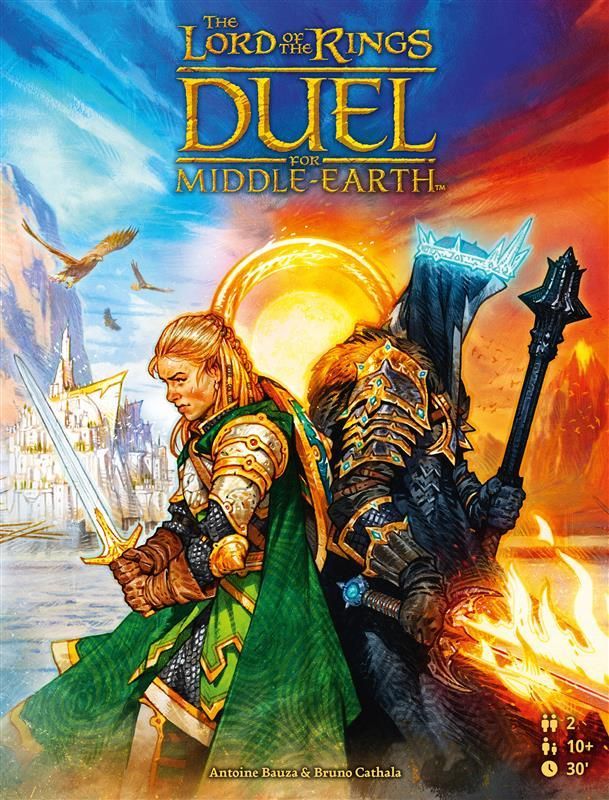
The Lord of the Rings: Duel for Middle-earth is a two-player strategy game played in about 30 minutes, casting one player as the Fellowship and the other as Sauron.
Across three successive chapters, the players compete to shape the fate of Middle-earth. The Fellowship defends the free races and guides Frodo and Sam toward Mount Doom, while Sauron pursues them with the Nazgûl and deploys hordes toward the enemy cities.
On each turn, choose an available card from a display of face-down and face-up cards. Play it by paying its cost to gain its benefit, or discard it to take coins from the reserve based on the current chapter.
- Strengthen Skills and gather treasure.
- Expand your presence across Middle-earth.
- Rally Races to your cause through Green cards.
- Advance the Quest of the Ring.
- Claim Landmark tiles to place Fortress pawns and gain their effects.
Landmark tiles offer another way to develop your position. After paying a tile’s cost, place it in your play area, immediately add a Fortress pawn to its corresponding region on the central board, and benefit from its other effects.
Victory can arrive suddenly through one of three conditions: completing the Quest of the Ring, gathering six different Race symbols on Green cards, or being present in all seven regions with a Fortress and/or at least one Unit. If the third chapter ends without an immediate victory, the player present in the most regions wins; a tie is shared.
With its focused two-player format, branching objectives, and struggle between pursuit, alliances, and territorial control, The Lord of the Rings: Duel for Middle-earth places the destiny of the realm in your hands.
Mechanics
Designer
Illustrator
Usefull links
/pic7182955.jpg) View board game on
View board game onBoard Game Geek
The Lord of the Rings: Duel for Middle-earth
Board Game Rules
Will you play as the Fellowship of the Ring to defend the free races and destroy the One Ring?
Or will you play as Sauron and pursue Frodo and Sam while deploying your hordes to the gates of the enemy cities? The destiny of Middle-earth is in your hands!
Goal of the Game
A game plays over 3 successive chapters that unfold similarly.
On your turn, strengthen your Skills, hoard your treasure, stretch your presence across Middle-earth, rally Races to your cause, or advance the Quest of the Ring.
Immediately win the game by fulfilling one of the 3 victory conditions:
- complete the Quest of the Ring,
- rally the support of 6 different Races,
- conquer Middle-earth.
Components
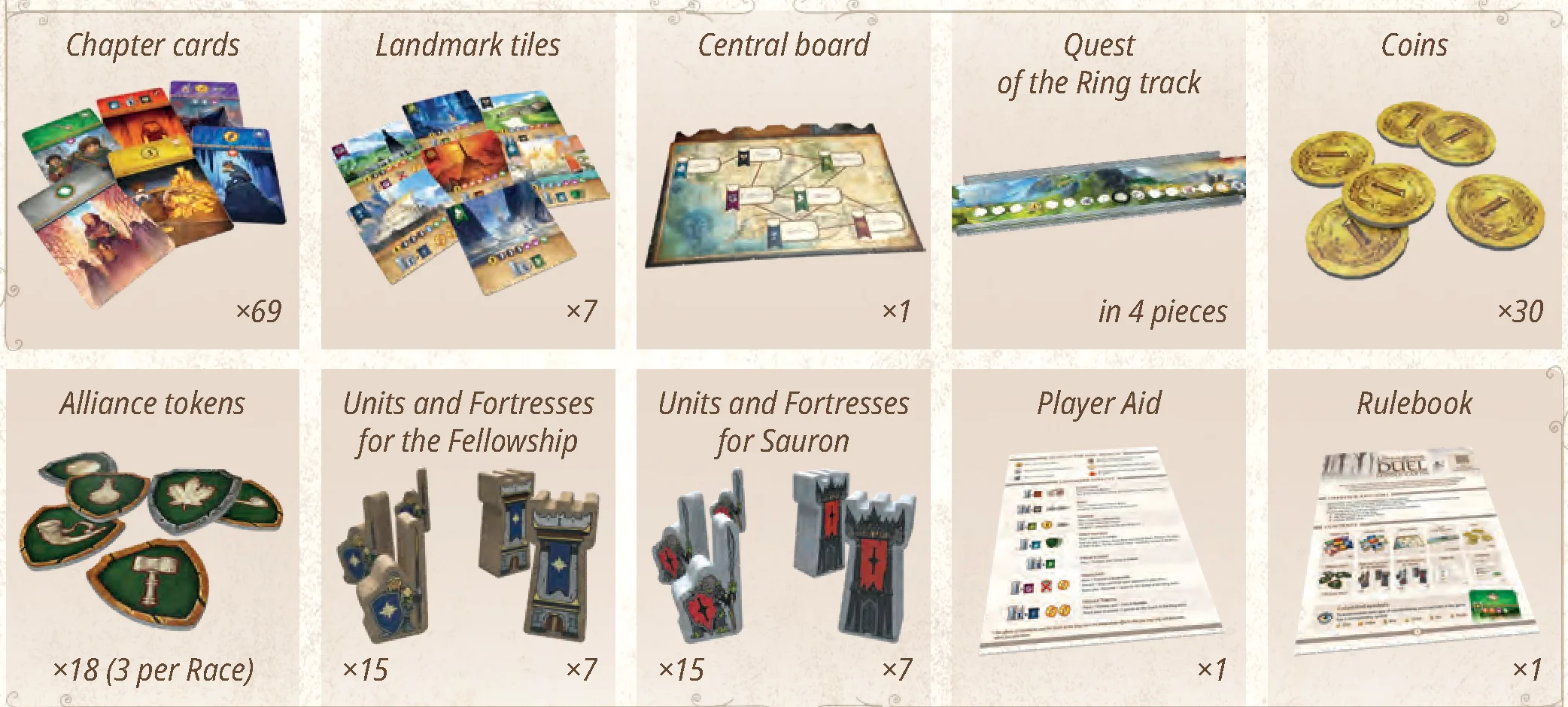
- 69 Chapter cards
- 7 Landmark tiles
- 1 Central board
- Quest of the Ring track (in 4 pieces)
- 30 Coins
- 18 Alliance tokens (3 per Race)
- 15 Units and 7 Fortresses for the Fellowship
- 15 Units and 7 Fortresses for Sauron
- 1 Player Aid
- 1 Rulebook
Colorblind Symbols
To accommodate every type of colorblindness, each card color in the game has a corresponding symbol:
- Grey
- Yellow
- Blue
- Green
- Red
- Purple
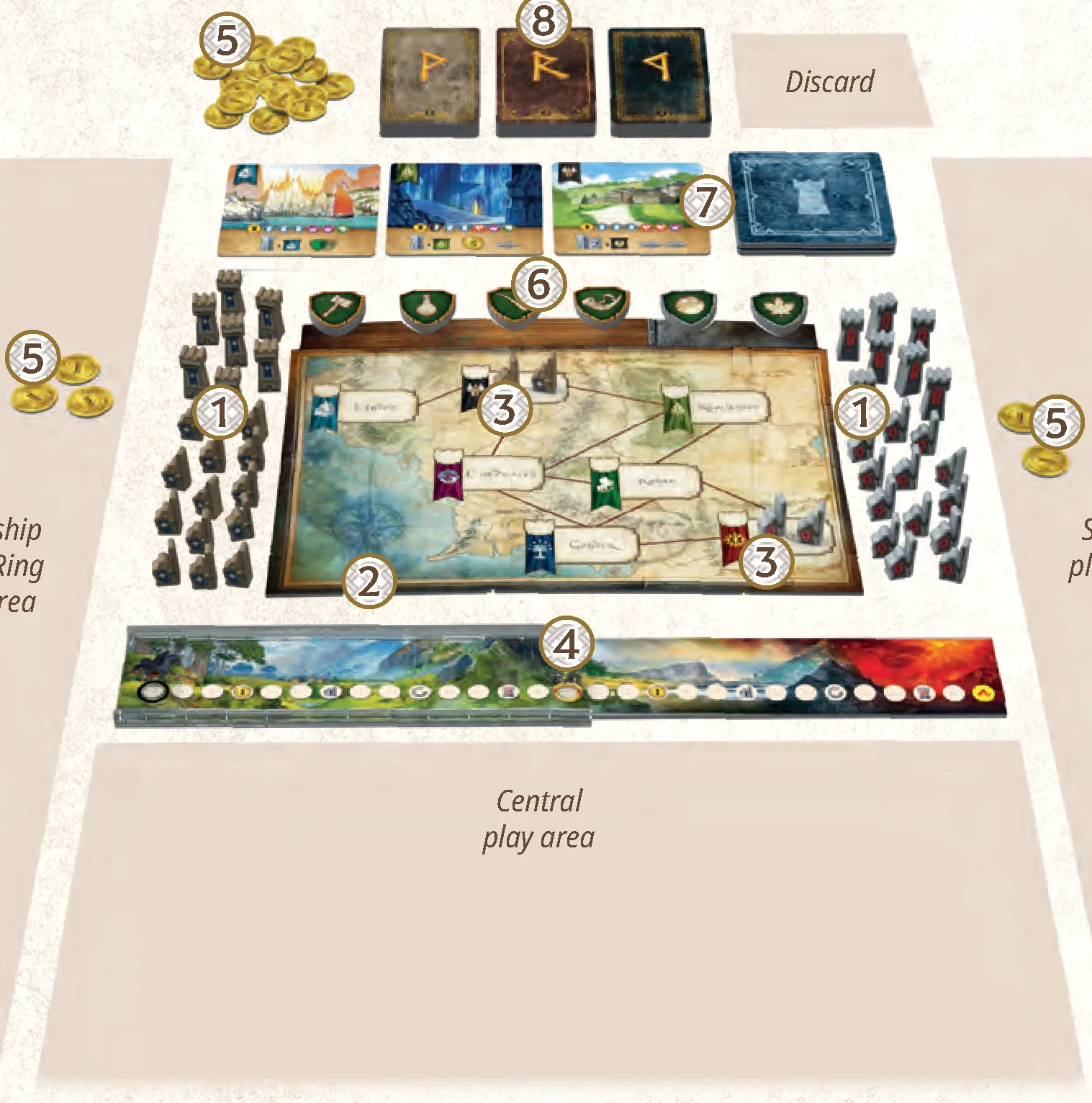
- Choose, or randomly determine, who will play as the Fellowship and who will play as Sauron. Place your respective Unit and Fortress pawns in front of you.
- Place the central board between you and your opponent, next to the central play area.
- On the central board, place 2 Fellowship Units on Arnor and 2 Sauron Units on Mordor.
- Assemble the Quest of the Ring track as shown in the diagram, and place it below the central board.
- The Fellowship player takes 3 Coins while the Sauron player takes 2 Coins. Then make a reserve with the remaining Coins.
- Sort the Alliance tokens according to their backs, to make one stack per Race. Shuffle each stack separately and place them, facedown, above the central board, in the dedicated notches.
- Shuffle the Landmark tiles and place 3, faceup, on the table. Make a stack, facedown, with the remaining tiles.
- Sort the Chapter cards into 3 decks according to the runes on their backs (1), (2) and (3), then shuffle each deck separately.
Preparing a Chapter
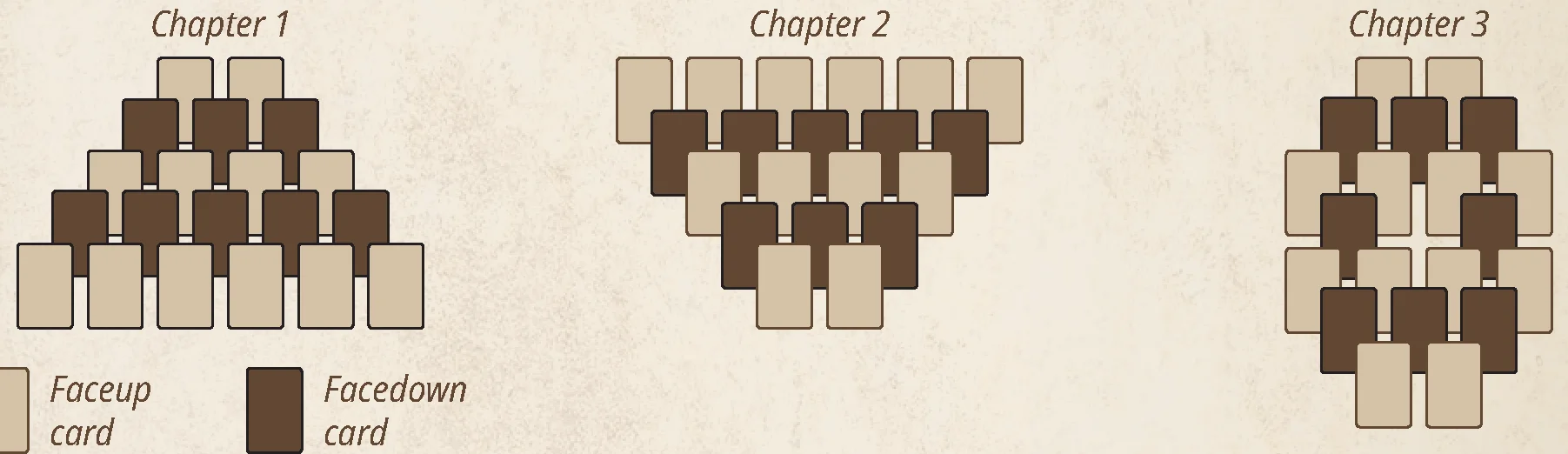
At the start of each chapter (1, 2, then 3), place cards from the corresponding chapter in the central play area, following the diagram below (reminder on the sides of the box). Be careful, since certain cards are placed faceup and others facedown. Place the 3 remaining cards, facedown, in the discard.
Turn Overview
The Sauron player begins the game, then both players take turns, until the end of the game.
On your turn, you may either take a Chapter card or take a Landmark tile.
Option A: Take a Chapter Card
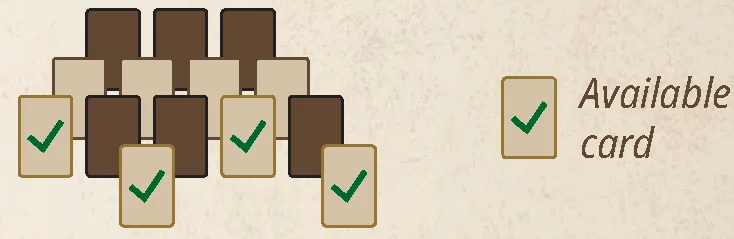
From the central play area, choose an available card, meaning one that is not partially covered by any other cards. Then, play it in front of you or discard it.
- PLAY THE CARD IN FRONT OF YOU: Pay the card cost, if any, and place it in your play area. You may immediately benefit from its effect. Note: Stack cards in front of you by color, making sure you can still see their effects.
- DISCARD THE CARD: Place the card, facedown, in the discard and take as many Coins from the reserve as the current chapter:
- Chapter 1: 1 Coin
- Chapter 2: 2 Coins
- Chapter 3: 3 Coins
Finally, end your turn by revealing any cards that are now available.
Option B: Take a Landmark Tile
Choose one of the faceup tiles. Pay its cost and place it in your play area.
Immediately place a Fortress pawn on the corresponding region of the central board and benefit from its other effects (see the Player Aid).
Finally, end your turn without revealing a new tile.
End of a Chapter
A chapter ends once the final card of this chapter has been taken.
Set up the cards for the next chapter according to the corresponding diagram and reveal new Landmark tiles until there are, if possible, 3 faceup.
Then continue the game as normal.
Note: Since you alternate taking turns, the player who ends a chapter does not begin the next one, unless they are using a “Take another turn” effect (see the Player Aid).
Coins
In order to play them, certain cards have a Coin cost that you must pay to the reserve.
Skills
In order to play them, tiles and the majority of cards require you to have one or more Skills in your play area.
If you do not have the required Skills, you may pay 1 Coin to the reserve per missing Skill symbol.
Notes:
- There is no limit to the number of Skills you may pay for, to the reserve, on your turn.
- If a card does not require a Skill or a Coin, it has no cost, so you may play it for free.
Landmark tiles have an additional Coin cost equal to the number of your Fortress pawns already on the central board. Therefore, the additional cost of your first tile is 0 Coins.
Chaining
Starting in chapter 2, certain cards may be played for free through their chaining symbol.
If you have, in your play area, a card with a matching symbol in its top-right corner, you may play the card for free, without having the required Skills.
Note: If you do not have the matching chaining symbol for a card, you may still play it normally by paying its Skill and/or Coin cost.
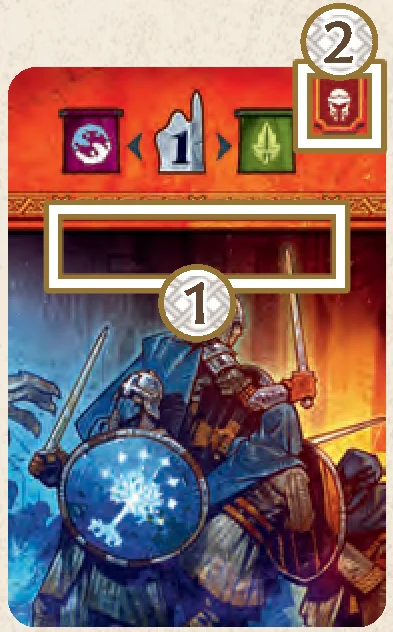
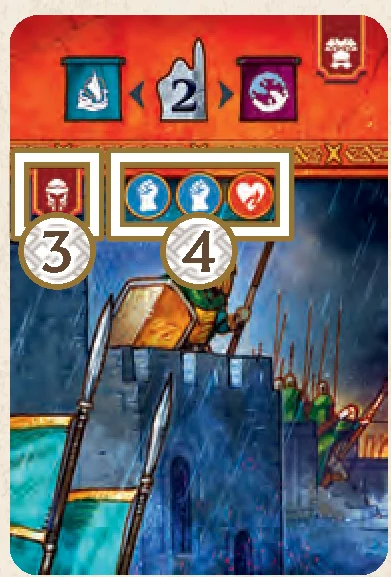
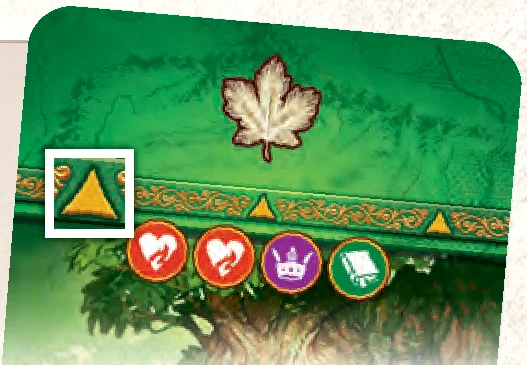
Example: In chapter 1, you play this card for free (1). In addition to its effect, it has a chaining symbol (2). In chapter 2, you may play this card for free since you have the matching chaining symbol (3) on one of your played cards. Otherwise, you would need to have the required Skills (or pay 1 Coin per missing Skill symbol) (4).
Grey Cards
Grey cards provide Skills that let you play other cards and tiles in your play area. You gain 1 Skill per symbol shown. Each symbol may only be used once per turn, on each of your turns:
- Ruse
- Strength
- Courage
- Knowledge
- Leadership
When multiple Skills are separated by a slash (/), you may only use one of them per turn (you choose).
Yellow Cards
Yellow cards immediately provide Coins that you will be able to spend to play other cards and tiles in your play area. Take, from the reserve, the number of Coins shown in the symbol.
Blue Cards
Blue cards immediately let you advance on the Quest of the Ring track. Move your character along the Quest of the Ring track, one space per Ring symbol.
Green Cards
Green cards represent the Races of Middle-earth with whom you may ally:
- Elves
- Ents
- Hobbits
- Humans
- Dwarves
- Wizards
Red Cards
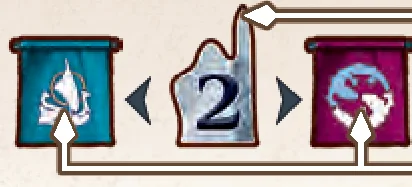
Red cards immediately let you place Units in the regions of Middle-earth. Choose one of the two regions shown by the banners and place all Units in the chosen region.
Purple Cards
(Only available in chapter 3) immediately let you complete various maneuvers:
- Move 1 of your Units to an adjacent region.
- Your opponent loses 1 Coin.
- Remove 1 enemy Unit from any region.
Landmark Tiles
Landmark tiles immediately let you place Fortresses in regions of Middle-earth and benefit from unique effects (see the Player Aid).
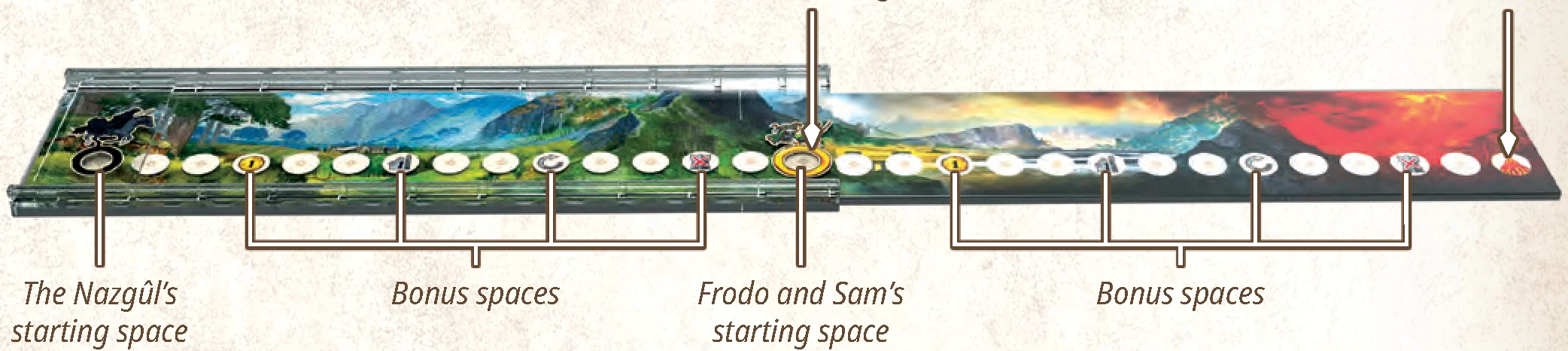
When you advance on the Quest of the Ring track, slide your character (Frodo and Sam for the Fellowship or the Nazgûl for Sauron) from space to space.
When you reach or pass a Bonus space, you may immediately benefit from its effect (see the Player Aid).
Note: The piece that represents the Nazgûl is placed on top of the piece that represents Frodo and Sam. Therefore, when Frodo and Sam move, the Nazgûl automatically moves as well. In other words, the distance between the characters will only decrease, never increase.
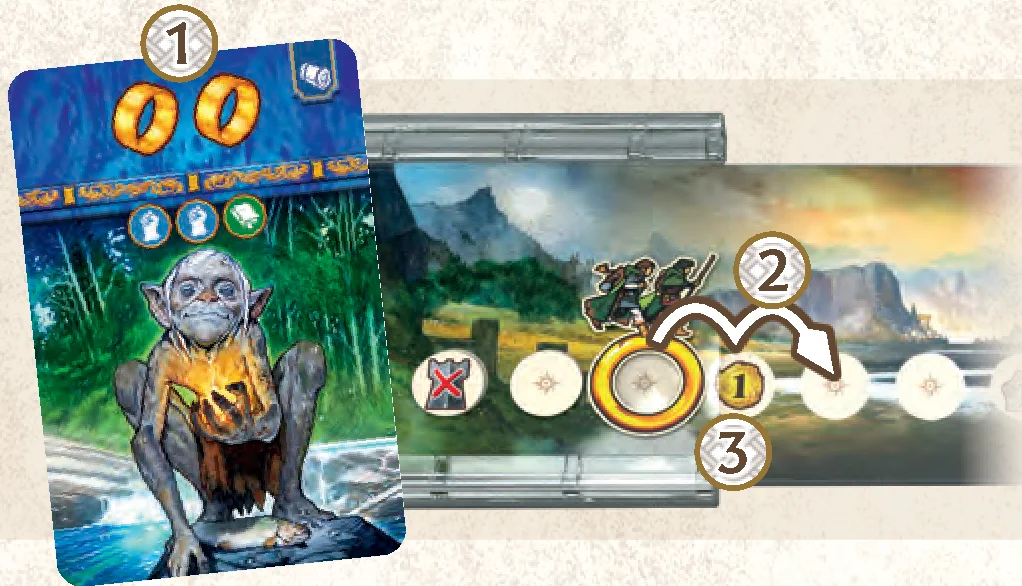
Example: As the Fellowship player, you play a Blue card with 2 Rings (1) that lets you move Frodo and Sam 2 spaces (2). They pass a Bonus space (3), which lets you benefit from its effect (in this case, take 1 Coin from the reserve).
During the game, you may form alliances with the Races of Middle-earth. To do this, in your play area, play Green cards with matching or different Race symbols, according to the following conditions:
- 2 MATCHING RACE SYMBOLS: As soon as you have 2 matching Race symbols, take the top 2 Alliance tokens of this Race and reveal them. Choose 1 to place in front of you; you may now benefit from its effect (see the Player Aid). Put the other token, facedown, on top of its stack.
- 3 DIFFERENT RACE SYMBOLS: Once per game, when you have 3 different Race symbols, take the top Alliance token of each of these 3 Races and reveal them. Choose 1 to place in front of you; you may now benefit from its effect (see the Player Aid). Put the other 2 tokens, facedown, on top of their respective stacks.
Notes:
- A single Race symbol may be used for both conditions (2 matching symbols and 3 different symbols).
- Reveal tokens to both players. There is no hidden information.
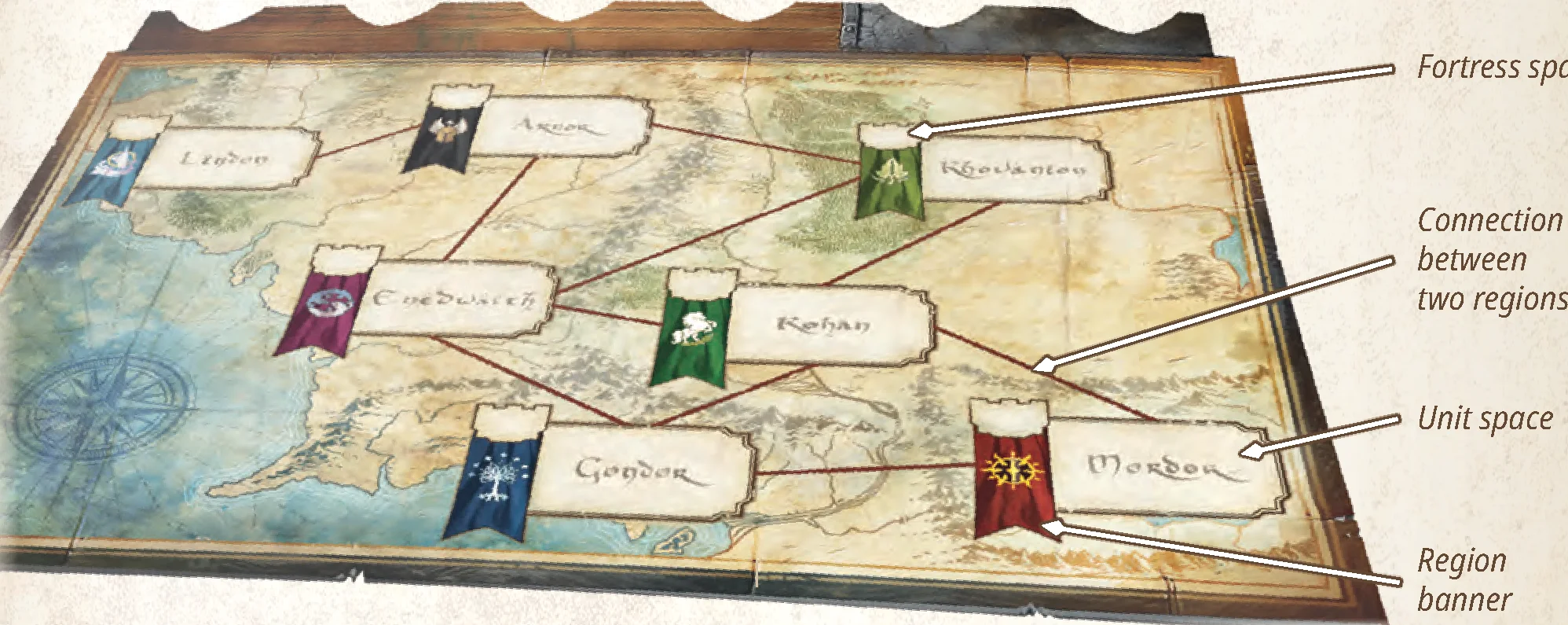
When you place or move one or more Units, two situations are possible:
- If no enemy Unit is present: nothing happens.
- If one or more enemy Units are present: trigger a conflict. Each player removes one of their Units and places it back in front of them. Repeat this until at least one player has no more Units in the region.
Note: An enemy Fortress does not trigger conflicts and does not prevent you from placing your Units in its region. Therefore, it is possible for both players to be present in the same region.
Unit Movement
When you complete multiple movements, you may move the same Unit multiple times, or split your movement between multiple Units. For each movement, move a Unit to an adjacent region (one with a connection). You must complete each movement independently, resolving any conflict triggered, one at a time.
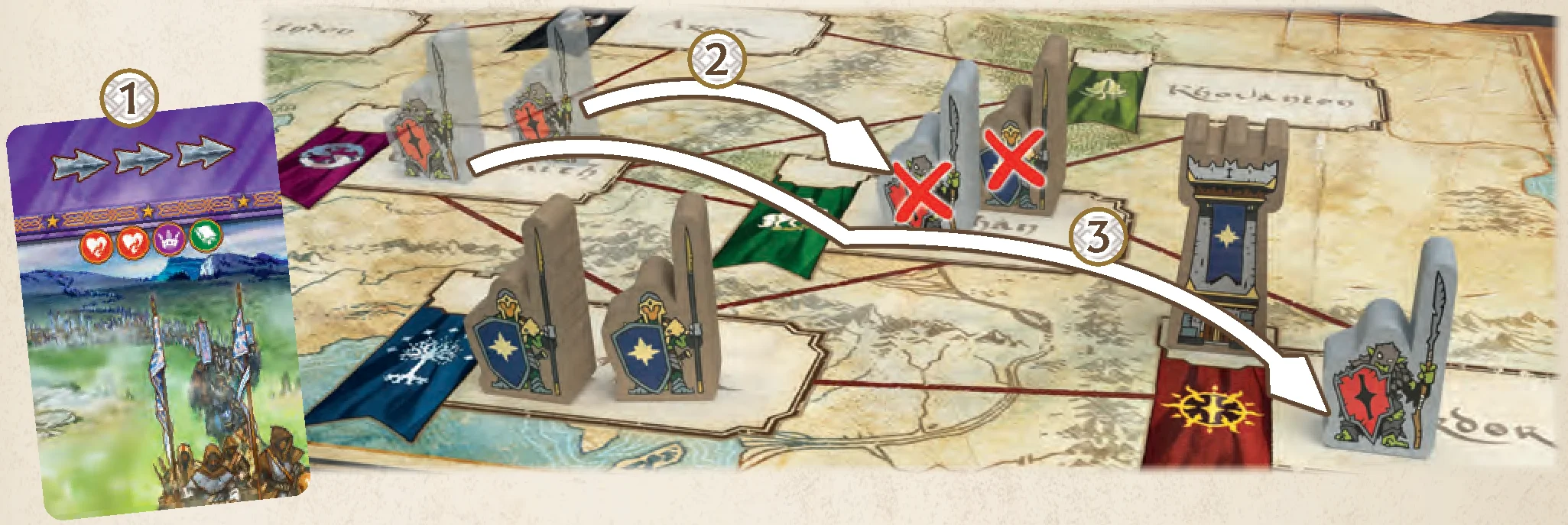
Example: You play a Purple card that provides 3 movements (1). The first lets you move a Unit from Enedwaith to Rohan (2). Since there is an enemy Unit present, you trigger a conflict and each player removes their Unit. You then use your second and third movements to send another Unit from Enedwaith to Mordor, passing through Rohan (3).
Immediate Victory Conditions
There are three immediate victory conditions:
- Quest of the Ring:
- For the Fellowship: If Frodo and Sam reach Mount Doom, they destroy the One Ring and you immediately win the game.
- For Sauron: If the Nazgûl catch Frodo and Sam, they seize the One Ring and you immediately win the game.
- Support of the Races: If you gather 6 different Race symbols on your Green cards, you rally the support of the Races of Middle-earth and immediately win the game. Note: The Eagle symbol, present on one Alliance token, is an additional Race symbol that counts as 1 of the 6 required symbols for the Support of the Races victory.
- Conquering Middle-earth: If you are present in all 7 regions (with a Fortress and/or at least 1 Unit), you dominate Middle-earth and immediately win the game.
End of Chapter 3
If none of these three victory conditions are achieved by the end of chapter 3, the player who is present in the most regions of Middle-earth (with a Fortress and/or at least 1 Unit) wins the game. In case of tie, share the victory.
Designers: Antoine Bauza & Bruno Cathala • Illustrator: Vincent Dutrait
Credits and special thanks: www.rprod.com/en/duel-for-middle-earth/credits
©MIDDLE-EARTH ENTERPRISES, LLC. ALL RIGHTS RESERVED.
©REPOS PRODUCTION 2024. ALL RIGHTS RESERVED.
Repos Production SA • Rue des Comédiens, 22 • 1000 Brussels – Belgium • www.rprod.com
Middle-earth, The Lord of the Rings, and the characters, events, items and places therein, are TM of Middle-earth Enterprises, LLC and used under license by Asmodee North America, Inc. and Repos Production.
Gamegenic and the Gamegenic logo are ® and © Gamegenic GmbH, Germany.
This material may only be used for private entertainment.
Follow us: @ReposProductionUS | @ReposProduction
Overview & Components
Will you play as the Fellowship of the Ring to defend the free races and destroy the One Ring?
Or will you play as Sauron and pursue Frodo and Sam while deploying your hordes to the gates of the enemy cities? The destiny of Middle-earth is in your hands!
Goal of the Game
A game plays over 3 successive chapters that unfold similarly.
On your turn, strengthen your Skills, hoard your treasure, stretch your presence across Middle-earth, rally Races to your cause, or advance the Quest of the Ring.
Immediately win the game by fulfilling one of the 3 victory conditions:
- complete the Quest of the Ring,
- rally the support of 6 different Races,
- conquer Middle-earth.
Components
- 69 Chapter cards
- 7 Landmark tiles
- 1 Central board
- Quest of the Ring track (in 4 pieces)
- 30 Coins
- 18 Alliance tokens (3 per Race)
- 15 Units and 7 Fortresses for the Fellowship
- 15 Units and 7 Fortresses for Sauron
- 1 Player Aid
- 1 Rulebook
Colorblind Symbols
To accommodate every type of colorblindness, each card color in the game has a corresponding symbol:
- Grey
- Yellow
- Blue
- Green
- Red
- Purple
Setup
- Choose, or randomly determine, who will play as the Fellowship and who will play as Sauron. Place your respective Unit and Fortress pawns in front of you.
- Place the central board between you and your opponent, next to the central play area.
- On the central board, place 2 Fellowship Units on Arnor and 2 Sauron Units on Mordor.
- Assemble the Quest of the Ring track as shown in the diagram, and place it below the central board.
- The Fellowship player takes 3 Coins while the Sauron player takes 2 Coins. Then make a reserve with the remaining Coins.
- Sort the Alliance tokens according to their backs, to make one stack per Race. Shuffle each stack separately and place them, facedown, above the central board, in the dedicated notches.
- Shuffle the Landmark tiles and place 3, faceup, on the table. Make a stack, facedown, with the remaining tiles.
- Sort the Chapter cards into 3 decks according to the runes on their backs (1), (2) and (3), then shuffle each deck separately.
Structure of a Chapter & Turns
Preparing a Chapter
At the start of each chapter (1, 2, then 3), place cards from the corresponding chapter in the central play area, following the diagram below (reminder on the sides of the box). Be careful, since certain cards are placed faceup and others facedown. Place the 3 remaining cards, facedown, in the discard.
Turn Overview
The Sauron player begins the game, then both players take turns, until the end of the game.
On your turn, you may either take a Chapter card or take a Landmark tile.
Option A: Take a Chapter Card
From the central play area, choose an available card, meaning one that is not partially covered by any other cards. Then, play it in front of you or discard it.
- PLAY THE CARD IN FRONT OF YOU: Pay the card cost, if any, and place it in your play area. You may immediately benefit from its effect. Note: Stack cards in front of you by color, making sure you can still see their effects.
- DISCARD THE CARD: Place the card, facedown, in the discard and take as many Coins from the reserve as the current chapter:
- Chapter 1: 1 Coin
- Chapter 2: 2 Coins
- Chapter 3: 3 Coins
Finally, end your turn by revealing any cards that are now available.
Option B: Take a Landmark Tile
Choose one of the faceup tiles. Pay its cost and place it in your play area.
Immediately place a Fortress pawn on the corresponding region of the central board and benefit from its other effects (see the Player Aid).
Finally, end your turn without revealing a new tile.
End of a Chapter
A chapter ends once the final card of this chapter has been taken.
Set up the cards for the next chapter according to the corresponding diagram and reveal new Landmark tiles until there are, if possible, 3 faceup.
Then continue the game as normal.
Note: Since you alternate taking turns, the player who ends a chapter does not begin the next one, unless they are using a “Take another turn” effect (see the Player Aid).
Card and Tile Costs
Coins
In order to play them, certain cards have a Coin cost that you must pay to the reserve.
Skills
In order to play them, tiles and the majority of cards require you to have one or more Skills in your play area.
If you do not have the required Skills, you may pay 1 Coin to the reserve per missing Skill symbol.
Notes:
- There is no limit to the number of Skills you may pay for, to the reserve, on your turn.
- If a card does not require a Skill or a Coin, it has no cost, so you may play it for free.
Landmark tiles have an additional Coin cost equal to the number of your Fortress pawns already on the central board. Therefore, the additional cost of your first tile is 0 Coins.
Chaining
Starting in chapter 2, certain cards may be played for free through their chaining symbol.
If you have, in your play area, a card with a matching symbol in its top-right corner, you may play the card for free, without having the required Skills.
Note: If you do not have the matching chaining symbol for a card, you may still play it normally by paying its Skill and/or Coin cost.
Example: In chapter 1, you play this card for free (1). In addition to its effect, it has a chaining symbol (2). In chapter 2, you may play this card for free since you have the matching chaining symbol (3) on one of your played cards. Otherwise, you would need to have the required Skills (or pay 1 Coin per missing Skill symbol) (4).
Card and Tile Effects
Grey Cards
Grey cards provide Skills that let you play other cards and tiles in your play area. You gain 1 Skill per symbol shown. Each symbol may only be used once per turn, on each of your turns:
- Ruse
- Strength
- Courage
- Knowledge
- Leadership
When multiple Skills are separated by a slash (/), you may only use one of them per turn (you choose).
Yellow Cards
Yellow cards immediately provide Coins that you will be able to spend to play other cards and tiles in your play area. Take, from the reserve, the number of Coins shown in the symbol.
Blue Cards
Blue cards immediately let you advance on the Quest of the Ring track. Move your character along the Quest of the Ring track, one space per Ring symbol.
Green Cards
Green cards represent the Races of Middle-earth with whom you may ally:
- Elves
- Ents
- Hobbits
- Humans
- Dwarves
- Wizards
Red Cards
Red cards immediately let you place Units in the regions of Middle-earth. Choose one of the two regions shown by the banners and place all Units in the chosen region.
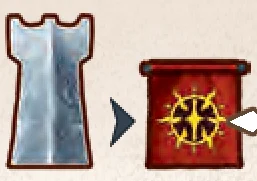
Purple Cards
(Only available in chapter 3) immediately let you complete various maneuvers:
- Move 1 of your Units to an adjacent region.
- Your opponent loses 1 Coin.
- Remove 1 enemy Unit from any region.
Landmark Tiles
Landmark tiles immediately let you place Fortresses in regions of Middle-earth and benefit from unique effects (see the Player Aid).
Quest of the Ring
When you advance on the Quest of the Ring track, slide your character (Frodo and Sam for the Fellowship or the Nazgûl for Sauron) from space to space.
When you reach or pass a Bonus space, you may immediately benefit from its effect (see the Player Aid).
Note: The piece that represents the Nazgûl is placed on top of the piece that represents Frodo and Sam. Therefore, when Frodo and Sam move, the Nazgûl automatically moves as well. In other words, the distance between the characters will only decrease, never increase.
Example: As the Fellowship player, you play a Blue card with 2 Rings (1) that lets you move Frodo and Sam 2 spaces (2). They pass a Bonus space (3), which lets you benefit from its effect (in this case, take 1 Coin from the reserve).
Race Alliances
During the game, you may form alliances with the Races of Middle-earth. To do this, in your play area, play Green cards with matching or different Race symbols, according to the following conditions:
- 2 MATCHING RACE SYMBOLS: As soon as you have 2 matching Race symbols, take the top 2 Alliance tokens of this Race and reveal them. Choose 1 to place in front of you; you may now benefit from its effect (see the Player Aid). Put the other token, facedown, on top of its stack.
- 3 DIFFERENT RACE SYMBOLS: Once per game, when you have 3 different Race symbols, take the top Alliance token of each of these 3 Races and reveal them. Choose 1 to place in front of you; you may now benefit from its effect (see the Player Aid). Put the other 2 tokens, facedown, on top of their respective stacks.
Notes:
- A single Race symbol may be used for both conditions (2 matching symbols and 3 different symbols).
- Reveal tokens to both players. There is no hidden information.
Conquering Middle-earth
When you place or move one or more Units, two situations are possible:
- If no enemy Unit is present: nothing happens.
- If one or more enemy Units are present: trigger a conflict. Each player removes one of their Units and places it back in front of them. Repeat this until at least one player has no more Units in the region.
Note: An enemy Fortress does not trigger conflicts and does not prevent you from placing your Units in its region. Therefore, it is possible for both players to be present in the same region.
Unit Movement
When you complete multiple movements, you may move the same Unit multiple times, or split your movement between multiple Units. For each movement, move a Unit to an adjacent region (one with a connection). You must complete each movement independently, resolving any conflict triggered, one at a time.
Example: You play a Purple card that provides 3 movements (1). The first lets you move a Unit from Enedwaith to Rohan (2). Since there is an enemy Unit present, you trigger a conflict and each player removes their Unit. You then use your second and third movements to send another Unit from Enedwaith to Mordor, passing through Rohan (3).
End of the Game
Immediate Victory Conditions
There are three immediate victory conditions:
- Quest of the Ring:
- For the Fellowship: If Frodo and Sam reach Mount Doom, they destroy the One Ring and you immediately win the game.
- For Sauron: If the Nazgûl catch Frodo and Sam, they seize the One Ring and you immediately win the game.
- Support of the Races: If you gather 6 different Race symbols on your Green cards, you rally the support of the Races of Middle-earth and immediately win the game. Note: The Eagle symbol, present on one Alliance token, is an additional Race symbol that counts as 1 of the 6 required symbols for the Support of the Races victory.
- Conquering Middle-earth: If you are present in all 7 regions (with a Fortress and/or at least 1 Unit), you dominate Middle-earth and immediately win the game.
End of Chapter 3
If none of these three victory conditions are achieved by the end of chapter 3, the player who is present in the most regions of Middle-earth (with a Fortress and/or at least 1 Unit) wins the game. In case of tie, share the victory.
Credits
Designers: Antoine Bauza & Bruno Cathala • Illustrator: Vincent Dutrait
Credits and special thanks: www.rprod.com/en/duel-for-middle-earth/credits
©MIDDLE-EARTH ENTERPRISES, LLC. ALL RIGHTS RESERVED.
©REPOS PRODUCTION 2024. ALL RIGHTS RESERVED.
Repos Production SA • Rue des Comédiens, 22 • 1000 Brussels – Belgium • www.rprod.com
Middle-earth, The Lord of the Rings, and the characters, events, items and places therein, are TM of Middle-earth Enterprises, LLC and used under license by Asmodee North America, Inc. and Repos Production.
Gamegenic and the Gamegenic logo are ® and © Gamegenic GmbH, Germany.
This material may only be used for private entertainment.
Follow us: @ReposProductionUS | @ReposProduction
Board game expansions
The Lord of the Rings: Duel for Middle-earth – Grond Promo Tile
2024
A powerful Landmark tile that reshapes a region and forces an enemy retreat.
45
minutes
Medium
View game
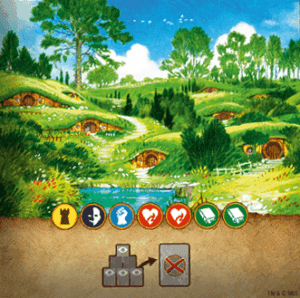
The Lord of the Rings: Duel for Middle-earth – The Shire Promo Tile
2024
Play a current-chapter card directly in your area—even when unavailable.
45
minutes
Medium Light

View game
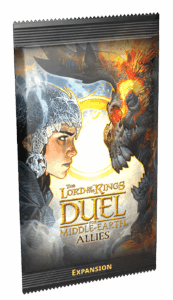
The Lord of the Rings: Duel for Middle-Earth – Allies
2025
Call upon Tolkien’s characters and gather power for your side.
30
minutes
Medium Light
View game
