Ubongo
2003
Solve spatial puzzles against the timer, move for better gem choices, and finish with the strongest collection after nine rounds.
25
minutes
1 - 4
player(s)
8+
Light

About this board game
Ubongo is a competitive puzzle game for 1–4 players that plays in about 25 minutes. Players race to recreate shapes with polyomino pieces, then use their finishing positions to collect gems.
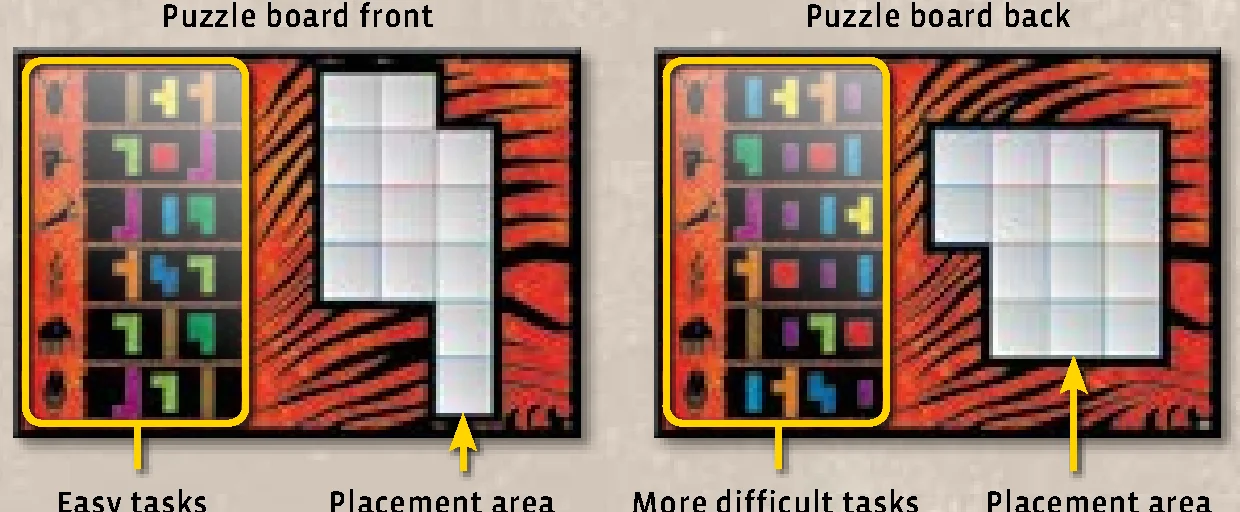
Each player has twelve polyominoes, with pieces made from 2–5 squares in different configurations. Every round, players receive a puzzle card showing a target shape. The card offers six rows of puzzles, with one side using three pieces and the other using four for a more difficult challenge.
A die determines which row of pieces each player must use. With the sand timer running, everyone works simultaneously to complete their individual puzzle. Finishing quickly matters because the puzzle race determines how players can collect gems from the main board.
- The first player to finish in time can move up to three rows left or right.
- The second player can move two rows, while the third can move one.
- Players collect two gems from the row where their pawn ends.
After nine rounds in the original edition, the winner is the player with the most gems in a single color. Ties are resolved by comparing the players’ totals in a second color, continuing as needed.
In the 2015 edition, the puzzle race remains the same, but the scoring system changes. Pawns are removed: the winner takes a 3-point gem and a random gem, the second-place player takes a 1-point gem and a random gem, and every other player who finishes before time takes a random gem. The player with the most gem-points after nine rounds wins.
With simultaneous puzzle solving, a shared timer, and changing gem priorities, Ubongo combines individual spatial challenges with a race for the best rewards.
Designer
/pic7182955.jpg)

Board Game Rules for
Ubongo
Sprint to Solve the Puzzle
For 1–4 Players, Ages 8 Years and Up
Game Overview
Each player receives one set of 12 tiles. At the beginning of each round, each player also receives a new puzzle board. The task to be completed on each puzzle board is determined by rolling the die; immediately afterward, the hourglass is turned over. All players simultaneously try to place a predetermined set of tiles on the light-colored placement area of their puzzle boards in such a way that the area is completely covered. Each player who can complete his or her task before the hourglass runs out shouts “Ubongo!” and takes a gem from the bag — the two fastest players also receive a bonus gem from the game round track.
You win if, after 9 rounds, you have the most valuable gem collection.
Components
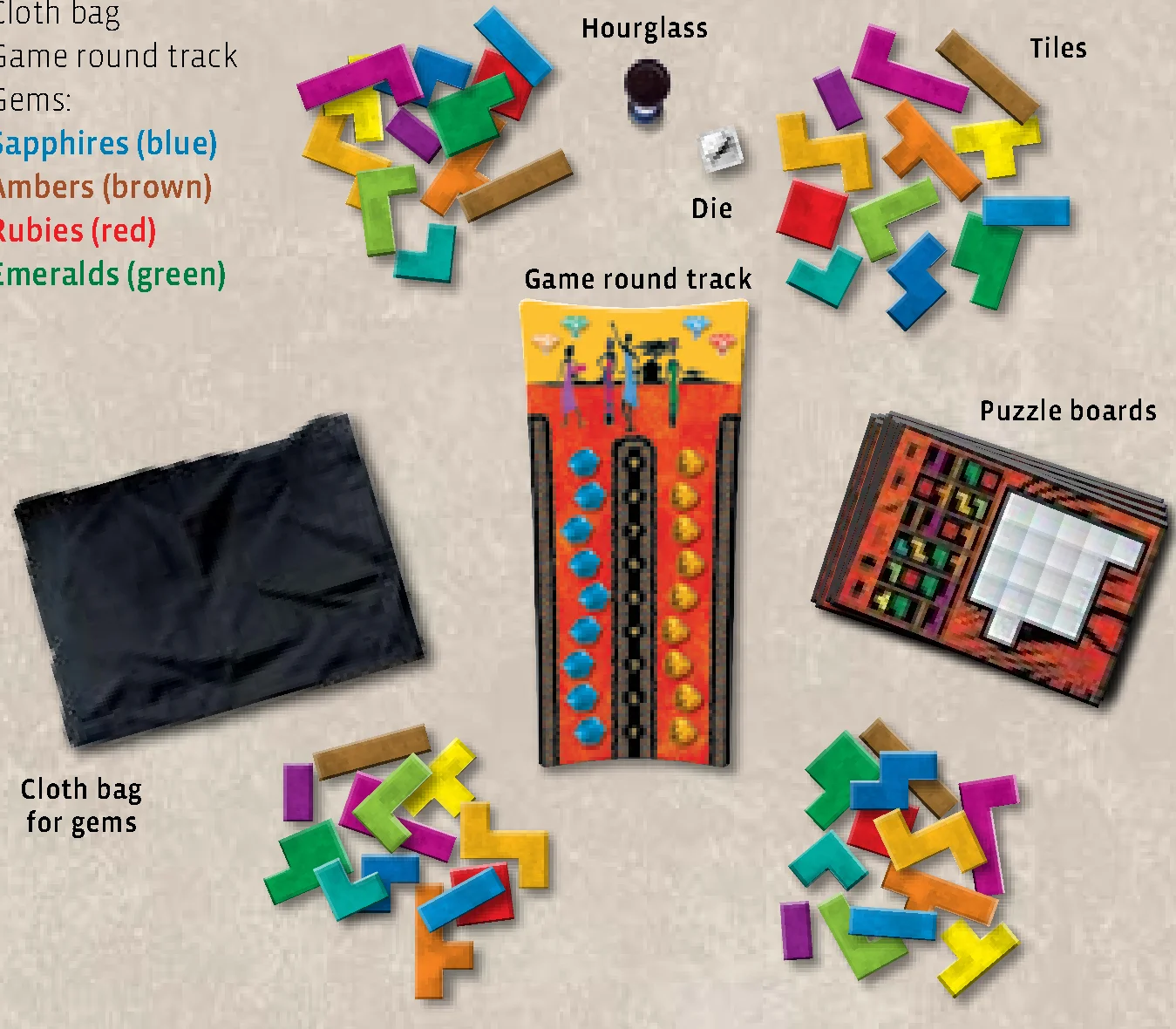
- 4×12 Tiles
- 36 Puzzle boards (with 432 different puzzles)
- 1 Die
- 1 Hourglass
- 1 Cloth bag
- 1 Game round track
- 58 Gems:
- 19 Sapphires (blue)
- 19 Ambers (brown)
- 10 Rubies (red)
- 10 Emeralds (green)
Before your first game, put all of the gems into the cloth bag.
Play it smart
Learn how to play the game!
Would you like to watch a tutorial to learn how to play this game instead of reading the rules? If so, you can learn to play the game by downloading the free Play It Smart App. Look for the Play It Smart Leaflet included with this game. In the leaflet you will find out which devices support the app and how to download it and get started. The app also offers a variable timer, a solution aid, and a solo game timer.
Preparation
- Take the 36 puzzle boards from the box. There are two levels of difficulty: one side of the puzzle boards shows the easy tasks, which only require three tiles each. The other side shows the more difficult tasks, which require four tiles each. For your first game, we recommend that you use the easy tasks with only three tiles. Turn all puzzle boards so that the tasks with three tiles are face down and place them as a stack in the center of the table, because the tasks you will complete must initially be concealed.
- Each player receives a set of 12 different tiles, one of each color. In a game of fewer than four players, put the tiles that are not needed back into the box.
- Place the game round track in the center of the table.
- Take nine sapphires (blue) and nine ambers (brown) from the bag containing the gems. Put these gems into the corresponding holes of the game round track. These 18 gems are the rewards and, at the same time, the round counter.
The gems have different values:
- Red = 4 Points
- Blue = 3 Points
- Green = 2 Points
- Brown = 1 Points
You win if, at the end of the game, you have collected the most valuable gems.
- Place the hourglass and the die on the table.
The game lasts nine rounds.
Round Sequence
- Each player takes a puzzle board from the stack and places it in front of himself or herself. Turn your puzzle board over, so that you can see the tasks requiring three tiles.
- Now the youngest player rolls the die and flips the hourglass. The symbol rolled indicates which task the players must complete as fast as possible.
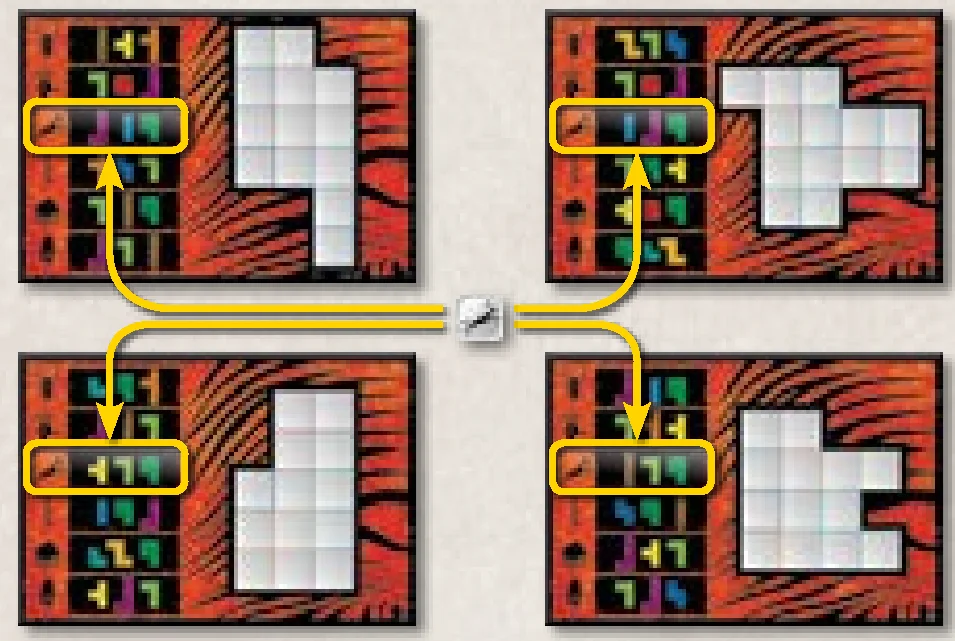
Example:
- Each player takes a look at his or her own puzzle board and, from his or her supply of 12 tiles, selects the tiles shown next to the symbol rolled, as fast as he or she can.
- As soon as you have found the required tiles, you try to fit the tiles exactly into the light-colored placement area of your puzzle board. This means that the area must be covered completely — the tiles may not protrude laterally. To this end, you may rotate and flip the tiles over.
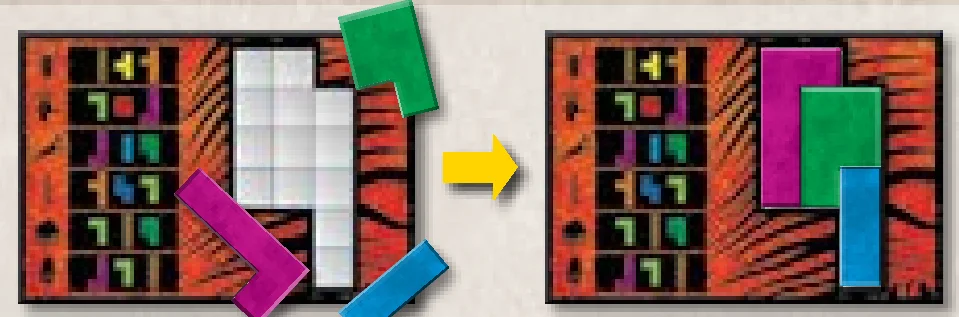
Example:
- As soon as one of the players has completed his or her task, he or she shouts “Ubongo!”
- The other players continue trying to complete their tasks before the hourglass runs out.
- As soon as one of the players notices that the hourglass has run out, he or she shouts “Stop,” and all players must immediately stop.
Second-Chance Round
The hourglass has run out and nobody was able to complete his or her task? In this case, a second-chance round takes place. Flip the hourglass again and continue trying to cover your placement area.
If the previous situation repeats — i.e., nobody can cover his or her placement area before the hourglass runs out again — the round comes to an end.
Rewards
Each player who completed his or her task receives a reward:
- The fastest player to fit the tiles exactly into his or her placement area and shout “Ubongo!” takes one blue sapphire from the game round track. In addition, he or she randomly takes one gem from the bag.
- The second fastest player receives one brown amber from the game round track. In addition, he or she randomly takes one gem from the bag.
- The third fastest player randomly takes one gem from the bag.
- The fourth fastest player randomly takes one gem from the bag.
Regrettably, all players who couldn’t completely cover their placement areas before the hourglass ran out get nothing in this round.
End of the Round
The rows of nine sapphires and nine ambers also serve as a round counter. At the end of each round, the rows must contain exactly one blue sapphire and one brown amber fewer than when the round started.
However, it may happen that only one or none of the players completes his or her task before the hourglass runs out, in which case the number of gems on the track must be reduced accordingly at the end of the round:
- If only one player was able to fit the tiles exactly into his or her placement area, the brown amber representing this round must be removed and tossed into the bag.
- If none of the players were able to complete the task, both the blue sapphire and the brown amber representing this round are removed and tossed into the bag.
At the end of the round, put all of the puzzle boards used in the round on the top of a shared discard pile.
New Round
Each player takes a new puzzle board from the unused stack.
The players take turns rolling the die and flipping the hourglass at the start of each round. The die is rolled and the hourglass is flipped by the player to the left of the player who rolled the die in the previous round.
The game ends after nine rounds — that is, when no more gems are left on the game round track.
Each player adds up the values of the gems he or she has collected. You win the game if you have the most points.
If various players tie for the highest score, a “playoff” takes place. Each tying player takes a puzzle board. One of the players rolls the die. The hourglass is not used. The first player to complete the task wins the whole game!
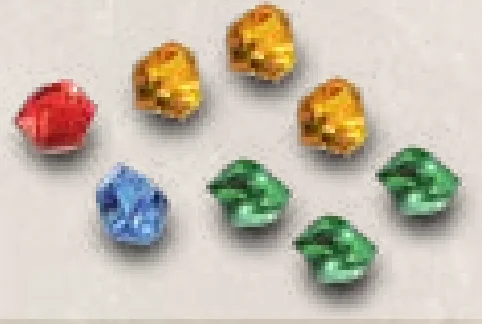
Example:
At the end of the game, one of the players has one red ruby, one blue sapphire, three green emeralds, and three brown ambers. Therefore, he has earned:
1 x 4 + 1 x 3 + 3 x 2 + 3 x 1 = 16 points
If you want to play Ubongo by yourself, you need a clock or stopwatch.
Note: The Play Smarter app also includes a solo game timer!
- Try to complete as many tasks as possible within five (or 10, or 20) minutes.
- Another solo variant consists in measuring the time you need to complete five (or 10, or 20) tasks.
- If you get stuck in your task, you can put it aside and draw a new puzzle board.
- Write your results down and try to establish a new record each time you play.
Game Designer: Grzegorz Rejchtman, born in 1970 in Poland, lives in Monaco. A computer science and economics graduate, he prefers games that are fast to learn, communicative, and fun. He has published many games in Scandinavia and worldwide.
Grzegorz Rejchtman and KOSMOS thank all of the play-testers and all the people who reviewed the game rules.
Art: Bernd Wagenfeld, Karl Homes, Nicolas Neubauer
Graphic Design: SENSiT Communication, München
Editorial Team: Bärbel Schmidts, Markus Reichert, Ralph Querfurth
English Translation: Gavin Allister
English Text Editing: Ted McGuire
Additional Design: Dan Freitas
© 2015 Franckh-Kosmos Verlags-GmbH & Co. KG
Pfizerstr. 5-7, D-70184 Stuttgart, Germany.
© 2015 Thames & Kosmos, LLC, Providence, RI, USA
Thames & Kosmos® is a registered trademark of Thames & Kosmos, LLC.
Distributed in North America by Thames & Kosmos, LLC. Providence, RI 02903
Phone: 800-587-2872; Web: www.thamesandkosmos.com
Distributed in United Kingdom by Thames & Kosmos UK, LP. Goudhurst, Kent TN17 2QZ
Phone: 01580 212000; Web: www.thamesandkosmos.co.uk
Printed in Germany / Imprimé en Allemagne
Overview & Components
Sprint to Solve the Puzzle
For 1–4 Players, Ages 8 Years and Up
Game Overview
Each player receives one set of 12 tiles. At the beginning of each round, each player also receives a new puzzle board. The task to be completed on each puzzle board is determined by rolling the die; immediately afterward, the hourglass is turned over. All players simultaneously try to place a predetermined set of tiles on the light-colored placement area of their puzzle boards in such a way that the area is completely covered. Each player who can complete his or her task before the hourglass runs out shouts “Ubongo!” and takes a gem from the bag — the two fastest players also receive a bonus gem from the game round track.
You win if, after 9 rounds, you have the most valuable gem collection.
Components
- 4×12 Tiles
- 36 Puzzle boards (with 432 different puzzles)
- 1 Die
- 1 Hourglass
- 1 Cloth bag
- 1 Game round track
- 58 Gems:
- 19 Sapphires (blue)
- 19 Ambers (brown)
- 10 Rubies (red)
- 10 Emeralds (green)
Before your first game, put all of the gems into the cloth bag.
Play it smart
Learn how to play the game!
Would you like to watch a tutorial to learn how to play this game instead of reading the rules? If so, you can learn to play the game by downloading the free Play It Smart App. Look for the Play It Smart Leaflet included with this game. In the leaflet you will find out which devices support the app and how to download it and get started. The app also offers a variable timer, a solution aid, and a solo game timer.
Setup
Preparation
- Take the 36 puzzle boards from the box. There are two levels of difficulty: one side of the puzzle boards shows the easy tasks, which only require three tiles each. The other side shows the more difficult tasks, which require four tiles each. For your first game, we recommend that you use the easy tasks with only three tiles. Turn all puzzle boards so that the tasks with three tiles are face down and place them as a stack in the center of the table, because the tasks you will complete must initially be concealed.
- Each player receives a set of 12 different tiles, one of each color. In a game of fewer than four players, put the tiles that are not needed back into the box.
- Place the game round track in the center of the table.
- Take nine sapphires (blue) and nine ambers (brown) from the bag containing the gems. Put these gems into the corresponding holes of the game round track. These 18 gems are the rewards and, at the same time, the round counter.
The gems have different values:
- Red = 4 Points
- Blue = 3 Points
- Green = 2 Points
- Brown = 1 Points
You win if, at the end of the game, you have collected the most valuable gems.
- Place the hourglass and the die on the table.
Gameplay
The game lasts nine rounds.
Round Sequence
- Each player takes a puzzle board from the stack and places it in front of himself or herself. Turn your puzzle board over, so that you can see the tasks requiring three tiles.
- Now the youngest player rolls the die and flips the hourglass. The symbol rolled indicates which task the players must complete as fast as possible.
Example:
- Each player takes a look at his or her own puzzle board and, from his or her supply of 12 tiles, selects the tiles shown next to the symbol rolled, as fast as he or she can.
- As soon as you have found the required tiles, you try to fit the tiles exactly into the light-colored placement area of your puzzle board. This means that the area must be covered completely — the tiles may not protrude laterally. To this end, you may rotate and flip the tiles over.
Example:
- As soon as one of the players has completed his or her task, he or she shouts “Ubongo!”
- The other players continue trying to complete their tasks before the hourglass runs out.
- As soon as one of the players notices that the hourglass has run out, he or she shouts “Stop,” and all players must immediately stop.
Second-Chance Round
The hourglass has run out and nobody was able to complete his or her task? In this case, a second-chance round takes place. Flip the hourglass again and continue trying to cover your placement area.
If the previous situation repeats — i.e., nobody can cover his or her placement area before the hourglass runs out again — the round comes to an end.
Rewards
Each player who completed his or her task receives a reward:
- The fastest player to fit the tiles exactly into his or her placement area and shout “Ubongo!” takes one blue sapphire from the game round track. In addition, he or she randomly takes one gem from the bag.
- The second fastest player receives one brown amber from the game round track. In addition, he or she randomly takes one gem from the bag.
- The third fastest player randomly takes one gem from the bag.
- The fourth fastest player randomly takes one gem from the bag.
Regrettably, all players who couldn’t completely cover their placement areas before the hourglass ran out get nothing in this round.
End of the Round
The rows of nine sapphires and nine ambers also serve as a round counter. At the end of each round, the rows must contain exactly one blue sapphire and one brown amber fewer than when the round started.
However, it may happen that only one or none of the players completes his or her task before the hourglass runs out, in which case the number of gems on the track must be reduced accordingly at the end of the round:
- If only one player was able to fit the tiles exactly into his or her placement area, the brown amber representing this round must be removed and tossed into the bag.
- If none of the players were able to complete the task, both the blue sapphire and the brown amber representing this round are removed and tossed into the bag.
At the end of the round, put all of the puzzle boards used in the round on the top of a shared discard pile.
New Round
Each player takes a new puzzle board from the unused stack.
The players take turns rolling the die and flipping the hourglass at the start of each round. The die is rolled and the hourglass is flipped by the player to the left of the player who rolled the die in the previous round.
End of the Game & Scoring
The game ends after nine rounds — that is, when no more gems are left on the game round track.
Each player adds up the values of the gems he or she has collected. You win the game if you have the most points.
If various players tie for the highest score, a “playoff” takes place. Each tying player takes a puzzle board. One of the players rolls the die. The hourglass is not used. The first player to complete the task wins the whole game!
Example:
At the end of the game, one of the players has one red ruby, one blue sapphire, three green emeralds, and three brown ambers. Therefore, he has earned:
1 x 4 + 1 x 3 + 3 x 2 + 3 x 1 = 16 points
Solo Variant
If you want to play Ubongo by yourself, you need a clock or stopwatch.
Note: The Play Smarter app also includes a solo game timer!
- Try to complete as many tasks as possible within five (or 10, or 20) minutes.
- Another solo variant consists in measuring the time you need to complete five (or 10, or 20) tasks.
- If you get stuck in your task, you can put it aside and draw a new puzzle board.
- Write your results down and try to establish a new record each time you play.
Credits
Game Designer: Grzegorz Rejchtman, born in 1970 in Poland, lives in Monaco. A computer science and economics graduate, he prefers games that are fast to learn, communicative, and fun. He has published many games in Scandinavia and worldwide.
Grzegorz Rejchtman and KOSMOS thank all of the play-testers and all the people who reviewed the game rules.
Art: Bernd Wagenfeld, Karl Homes, Nicolas Neubauer
Graphic Design: SENSiT Communication, München
Editorial Team: Bärbel Schmidts, Markus Reichert, Ralph Querfurth
English Translation: Gavin Allister
English Text Editing: Ted McGuire
Additional Design: Dan Freitas
© 2015 Franckh-Kosmos Verlags-GmbH & Co. KG
Pfizerstr. 5-7, D-70184 Stuttgart, Germany.
© 2015 Thames & Kosmos, LLC, Providence, RI, USA
Thames & Kosmos® is a registered trademark of Thames & Kosmos, LLC.
Distributed in North America by Thames & Kosmos, LLC. Providence, RI 02903
Phone: 800-587-2872; Web: www.thamesandkosmos.com
Distributed in United Kingdom by Thames & Kosmos UK, LP. Goudhurst, Kent TN17 2QZ
Phone: 01580 212000; Web: www.thamesandkosmos.co.uk
Printed in Germany / Imprimé en Allemagne