
Via Nebula
2016
Open paths, move shared resources, and complete contracts as you help rebuild the mist-covered valley.
60
minutes
2 - 4
player(s)
12+
Medium


About this board game
Via Nebula is a board game for 2–4 players, played in about 60 minutes. Players work to dispel the mists covering a valley, open routes and production sites, transport resources, and help settlers construct new buildings.
Each game begins with a hexagonal-grid board showing available resources such as wood, stone, wheat, and pigs, along with building sites scattered through the mist. On each turn, players have two actions to spend on developing the valley.
- Clear a mist-covered hex to create a new transportation path.
- Open a production site or a building site in a city.
- Carry resources from production sites to your own building sites.
- Complete a construction by fulfilling one of your contracts.
Paths and resources created during play can be used by everyone. This encourages temporary cooperation as players open routes and share goods, but every improvement may also help an opponent. The balance between helping the valley and advancing your own plans is central to the experience.
Players begin with two contracts, while four additional contracts remain visible and available on a first-come, first-served basis. Most contracts also provide a special power when completed, giving each construction an added effect.
The game ends when one player completes a fifth building. The other players then take two final actions before scoring begins. Points come from cleared hexes, opened production sites, and completed contracts, with an additional bonus for the player who ended the game. In Via Nebula, every shared path can support your opponents as well as your own growing network.
/pic7182955.jpg)
Board Game Rules for
Via Nebula
The Nebula Valley has just emerged from a dark era, when for centuries, monstrous creatures inhabited the mists. It is now time for guilds of brave explorers to travel through the foggy pathways, exploit the resources and build new buildings and towns on the ruins of the devastated cities. Nebula will retrieve its peace and prosperity, and you are to become the heroes of the valley!
Aim of the Game
To collect points (representing glory, prestige, and riches), you will mainly fulfill contracts and open exploitations. The player with the most points at the end of the game is declared the winner and hero of Nebula!
Components
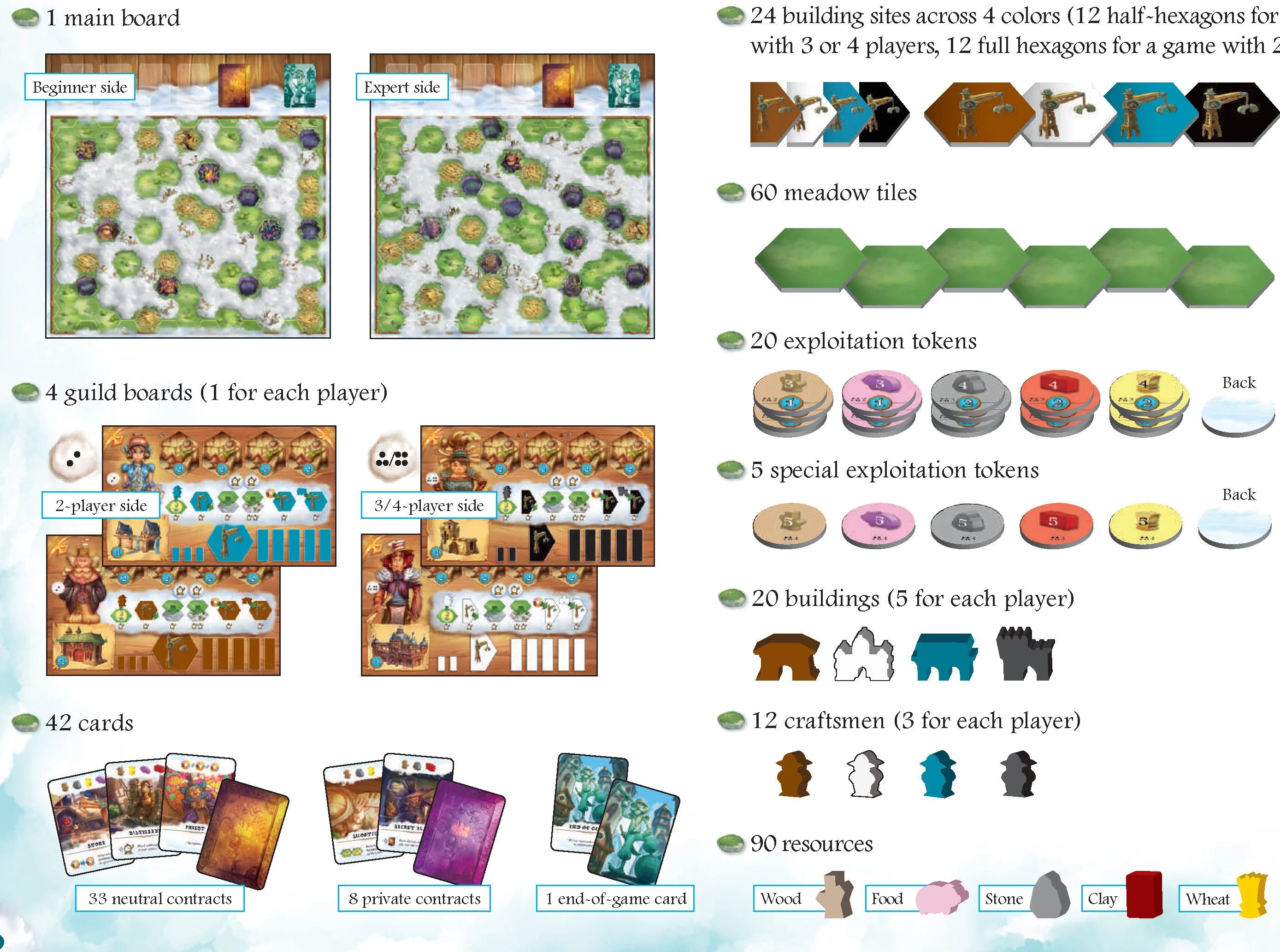
- 1 main board (Beginner side / Expert side)
- 4 guild boards (1 for each player, 2-player side / 3/4-player side)
- 24 building sites across 4 colors (12 half-hexagons for a game with 3 or 4 players, 12 full hexagons for a game with 2 players)
- 60 meadow tiles
- 20 exploitation tokens
- 5 special exploitation tokens
- 20 buildings (5 for each player)
- 12 craftsmen (3 for each player)
- 90 resources: Wood, Food, Stone, Clay, Wheat
- 42 cards:
- 33 neutral contracts
- 8 private contracts
- 1 end-of-game card
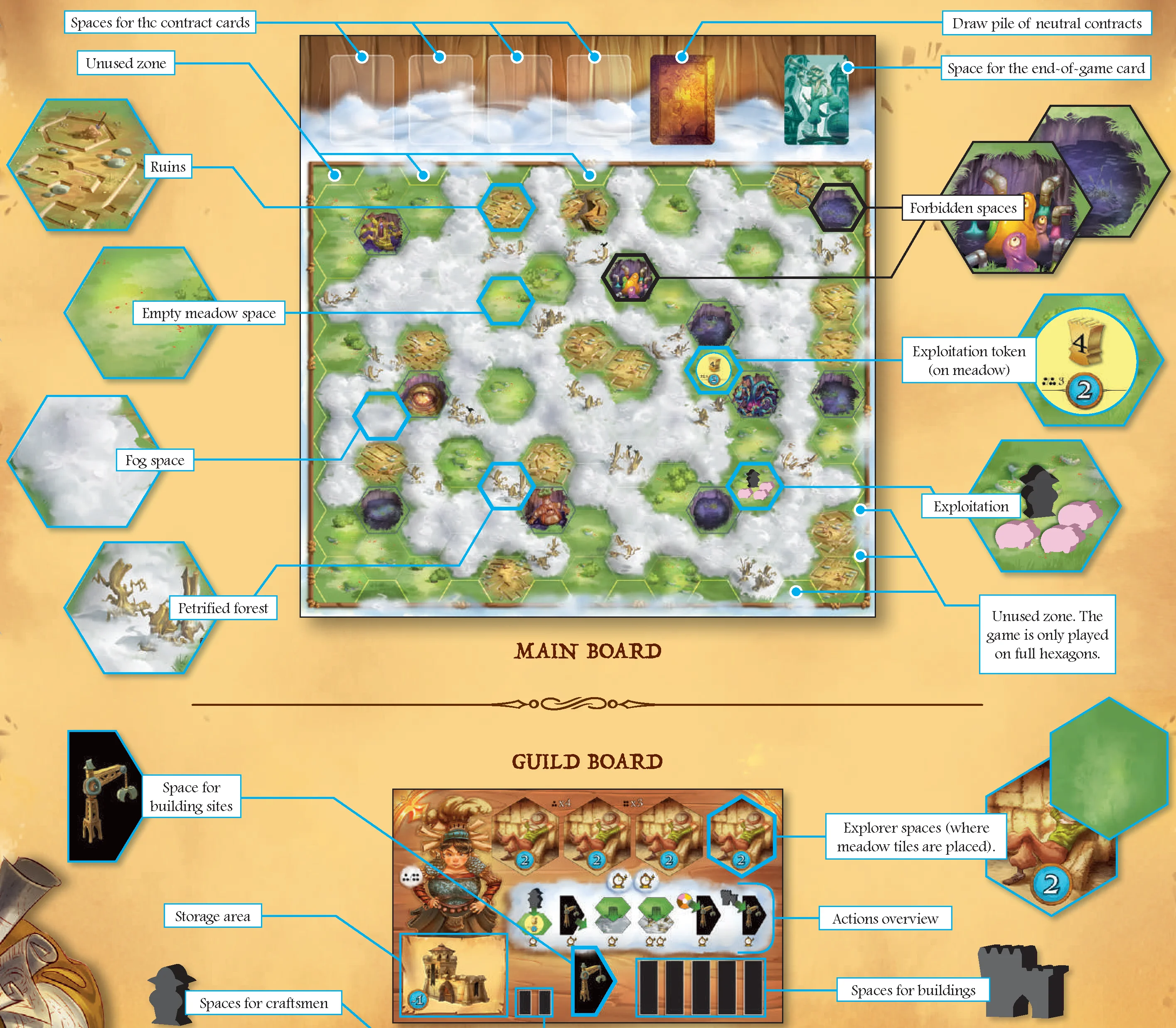
The Boards in Detail
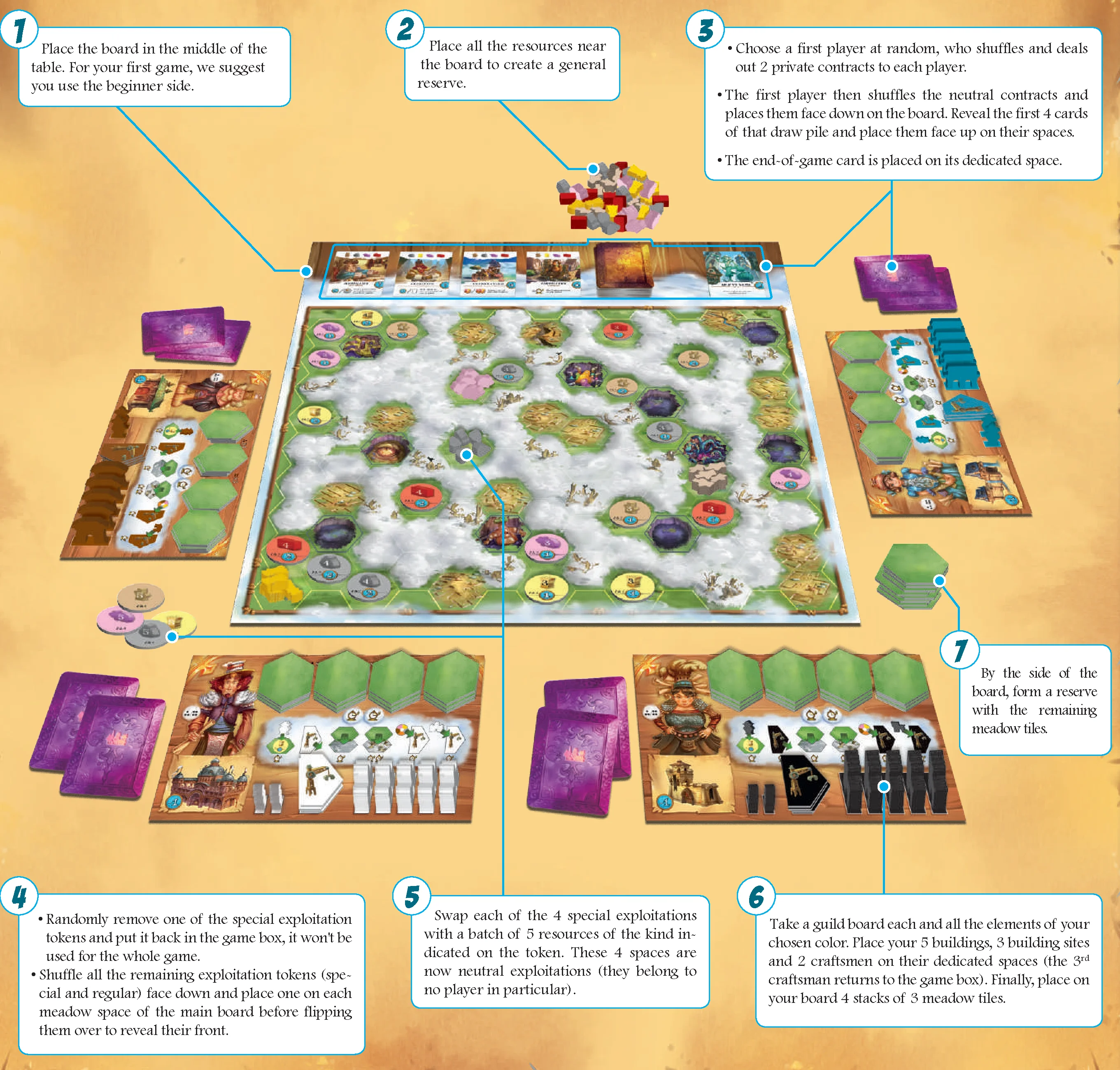
Game Setup (4 Players)
Note: adjustments for a game with 2 or 3 players are to be found at the end of the booklet.
- Place the board in the middle of the table. For your first game, we suggest you use the beginner side.
- Place all the resources near the board to create a general reserve.
- Setup cards:
- Choose a first player at random, who shuffles and deals out 2 private contracts to each player.
- The first player then shuffles the neutral contracts and places them face down on the board. Reveal the first 4 cards of that draw pile and place them face up on their spaces.
- The end-of-game card is placed on its dedicated space.
- Exploitation tokens:
- Randomly remove one of the special exploitation tokens and put it back in the game box, it won’t be used for the whole game.
- Shuffle all the remaining exploitation tokens (special and regular) face down and place one on each meadow space of the main board before flipping them over to reveal their front.
- Swap each of the 4 special exploitations with a batch of 5 resources of the kind indicated on the token. These 4 spaces are now neutral exploitations (they belong to no player in particular).
- Take a guild board each and all the elements of your chosen color. Place your 5 buildings, 3 building sites and 2 craftsmen on their dedicated spaces (the 3rd craftsman returns to the game box). Finally, place on your board 4 stacks of 3 meadow tiles.
- By the side of the board, form a reserve with the remaining meadow tiles.
Turn Structure
The first player starts, then the game proceeds clockwise.
On your turn, you must carry out 2 actions from the 6 at your disposal:
- A – Place a craftsman;
- B – Place a building site;
- C – Explore a fog space;
- D – Explore a petrified forest (this action costs two actions);
- E – Transport a resource to one of your building sites;
- F – Erect a building.
Note: You may carry out the same action more than once during your turn, but remember action D costs TWO of your actions.
Action A: Place a Craftsman
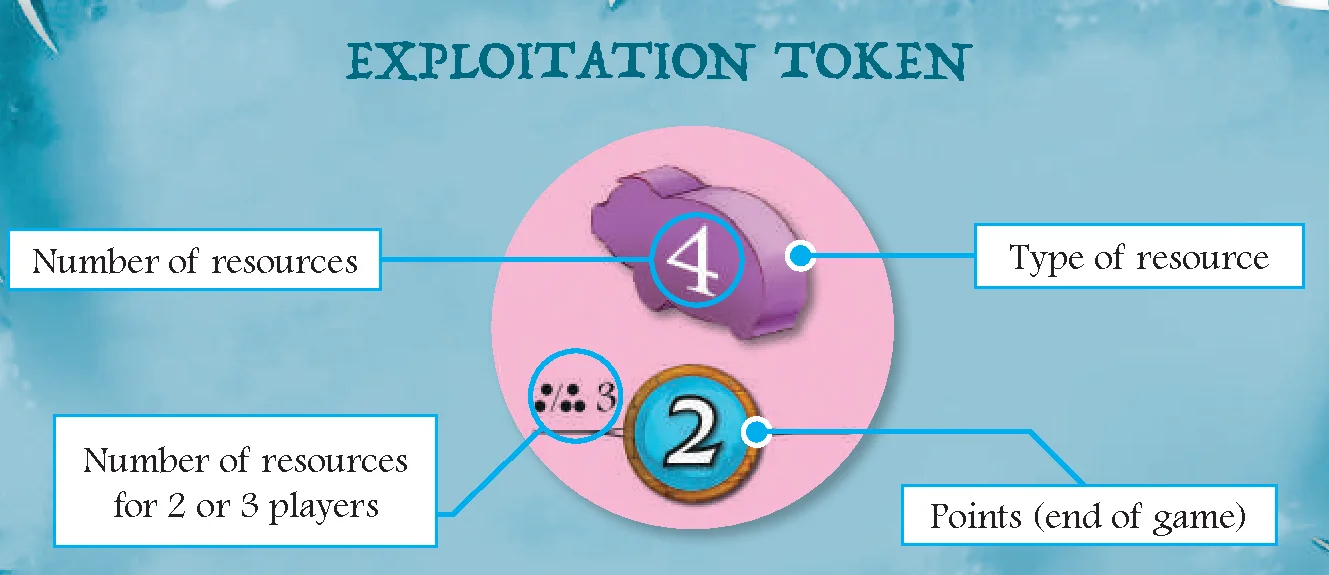
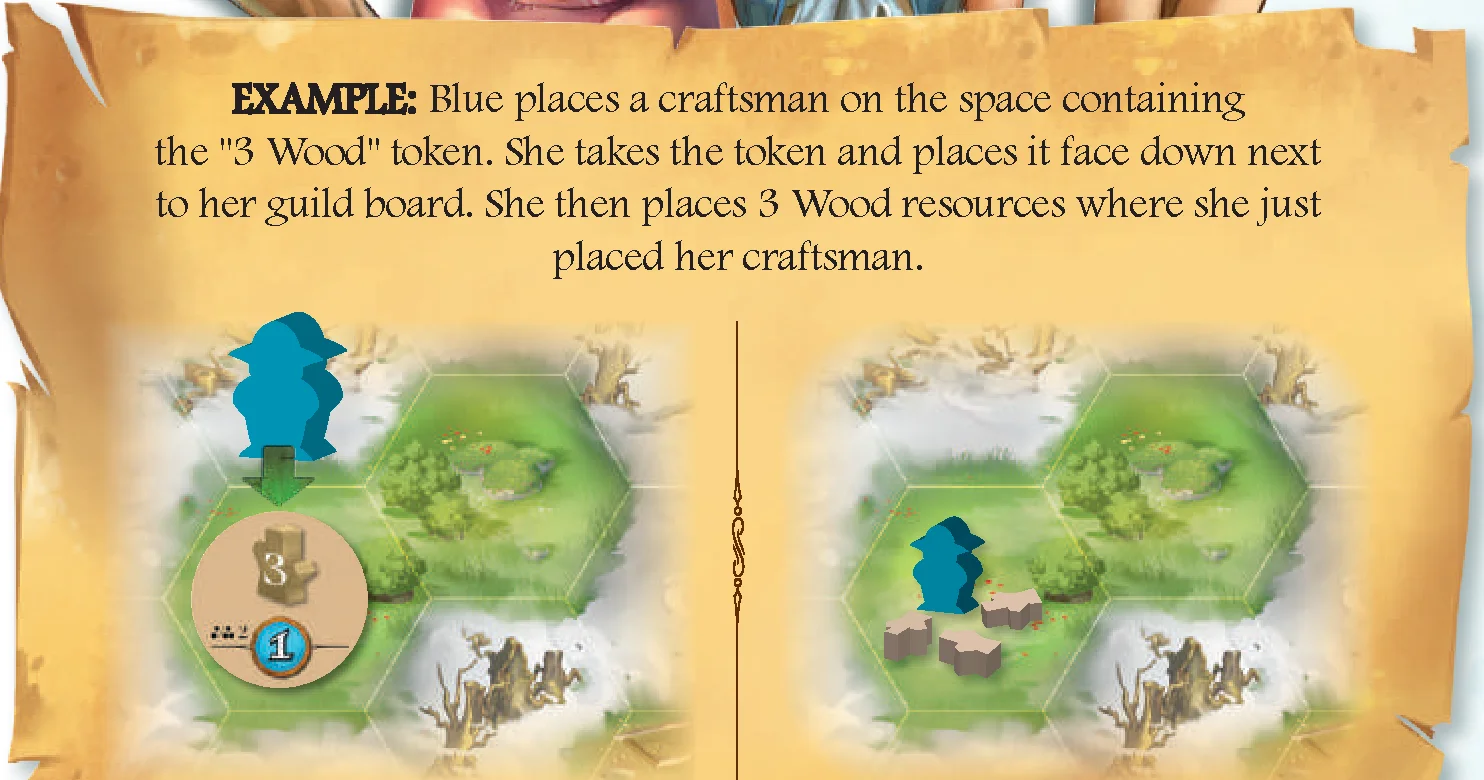
Place one of your available craftsmen onto any space containing an exploitation token. Take that token and put it face down next to your guild board, and then place on the space as many resources of the type indicated by the token. You just opened a new exploitation.
Note: an available craftsman is one on your guild board. You can not choose this action if you do not have an available craftsman.
Action B: Place a Building Site
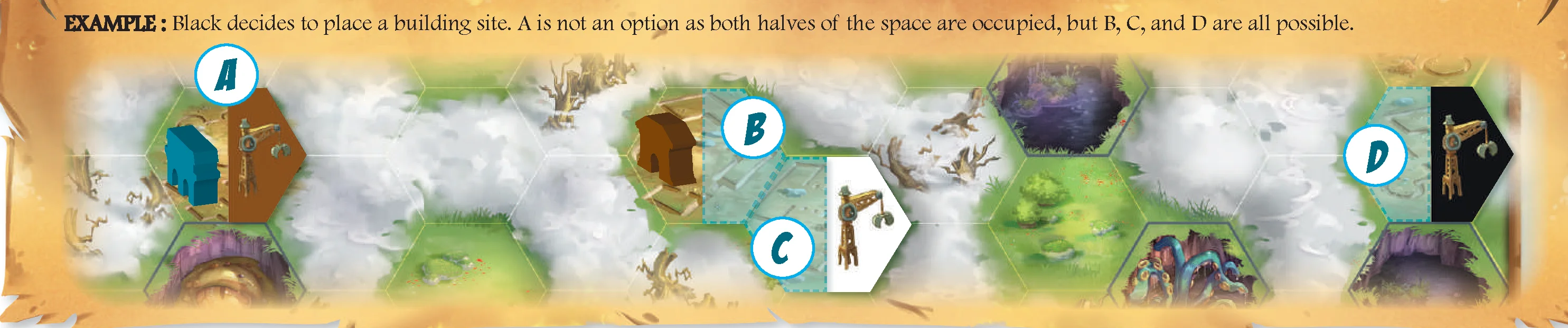
Take one of your own building sites, and cover a free half of a ruins space not already covered by another building site or building.
All ruins spaces have room for two building sites. They may simultaneously contain two sites belonging to the same player or two different players.
Notes:
- You can not choose this action if you don’t have an available building site.
- You can never have more building sites present on the main board than you have buildings left on your guild board.
Action C: Explore a Fog Space
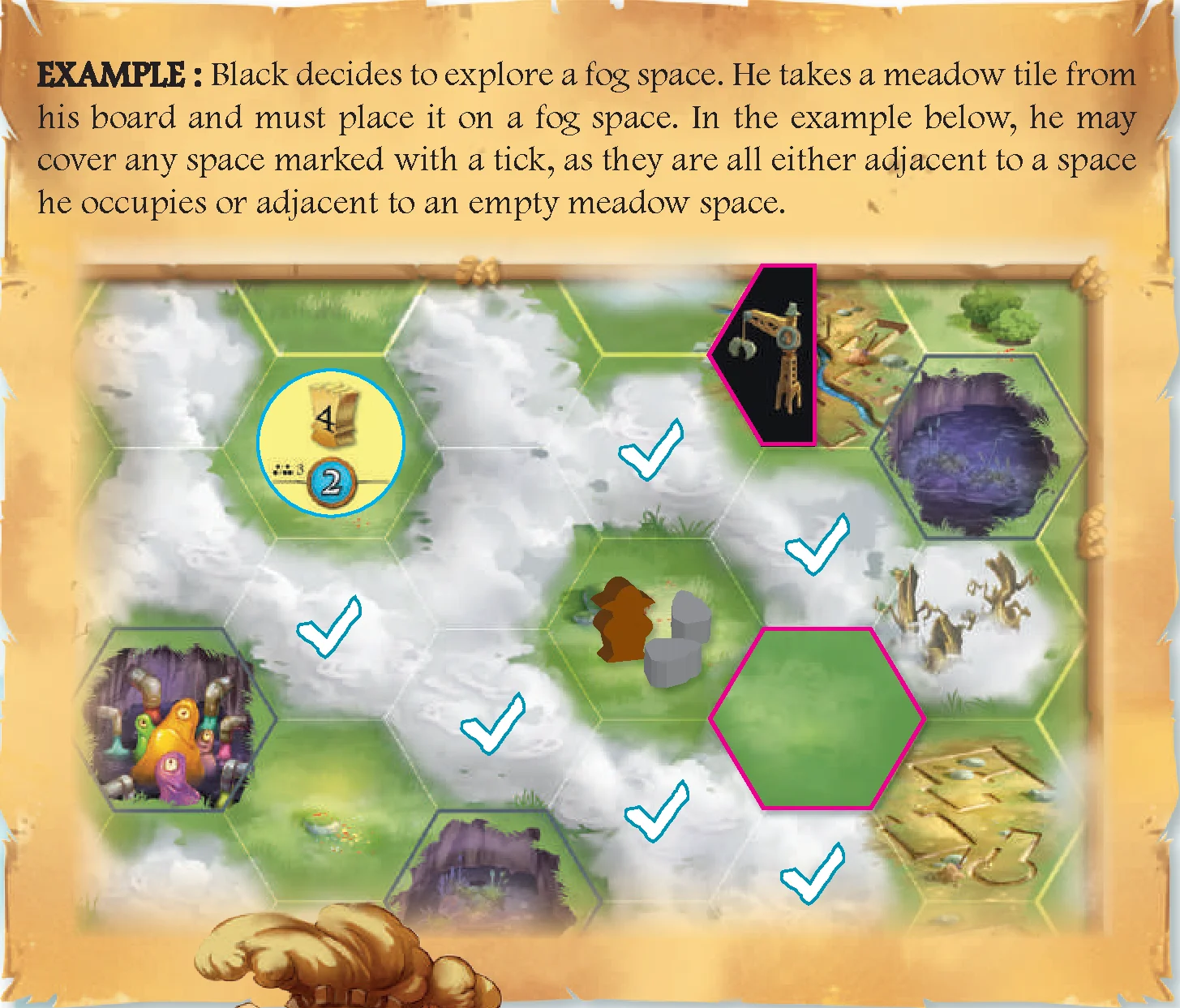
Take a meadow tile from the leftmost pile on your guild board and place it on a fog space. That space must be either:
- adjacent to a space occupied by an element of your color (craftsman, building site or building), or
- adjacent to an empty meadow space or tile (that is, without any resources or exploitation token on it).
Action D: Explore a Petrified Forest
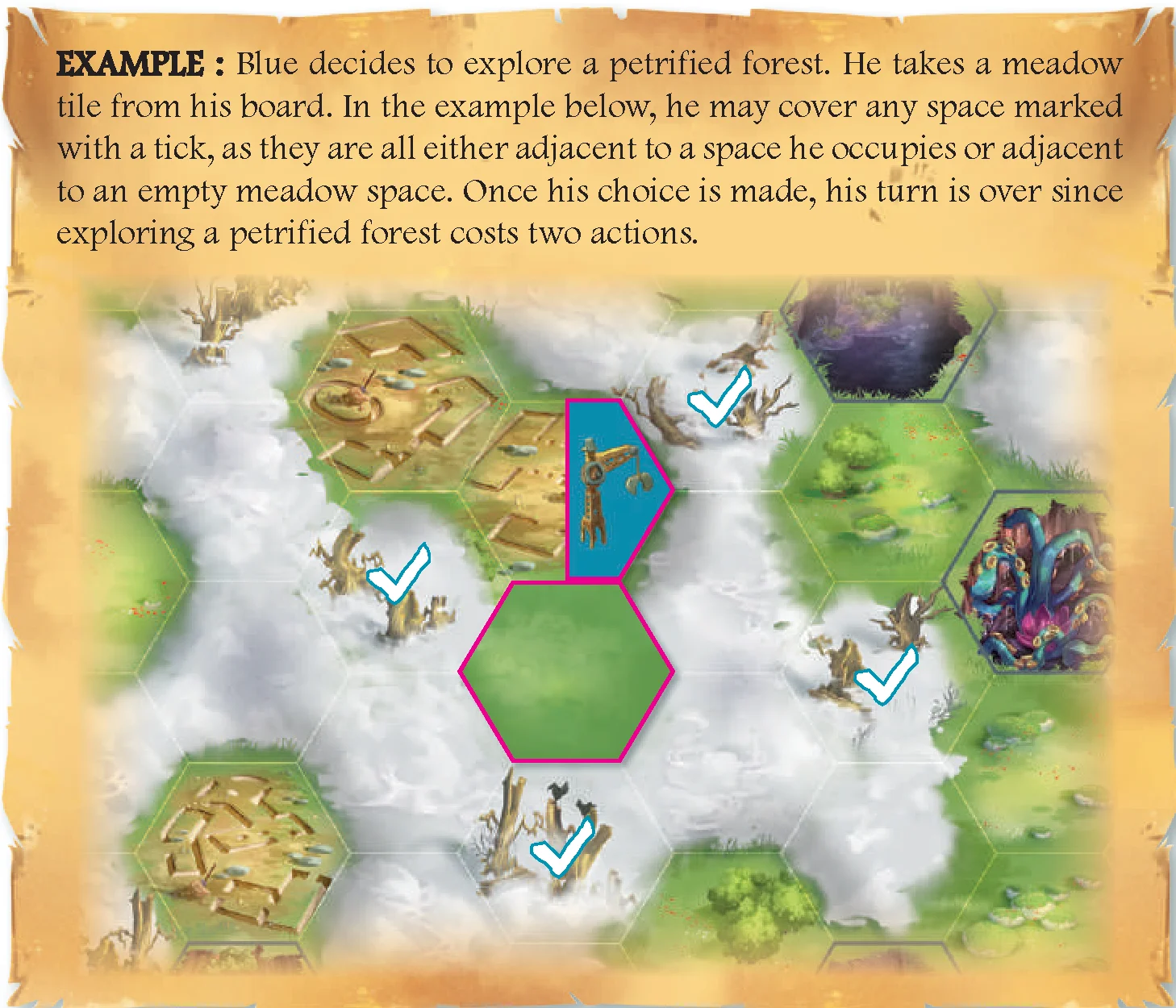
Take a meadow tile from the leftmost pile on your guild board and place it on a petrified forest. That forest must be either:
- adjacent to a space occupied by an element of your color (craftsman, building site or building), or
- adjacent to an empty meadow space or tile (that is, without any resources or exploitation token on it).
IMPORTANT: This action uses two of your actions. Therefore, after you explore a petrified forest, your turn is immediately over.
Explorers
When you explore, you use the meadow tiles placed on your guild board. When depleted, each pile reveals an explorer. At the end of the game each explorer rewards you with 2 points.
Note: if you want to explore but happen to have run out of tiles, you may use the tiles from the reserve, as long as there are some left.
Action E: Transport a Resource to a Building Site
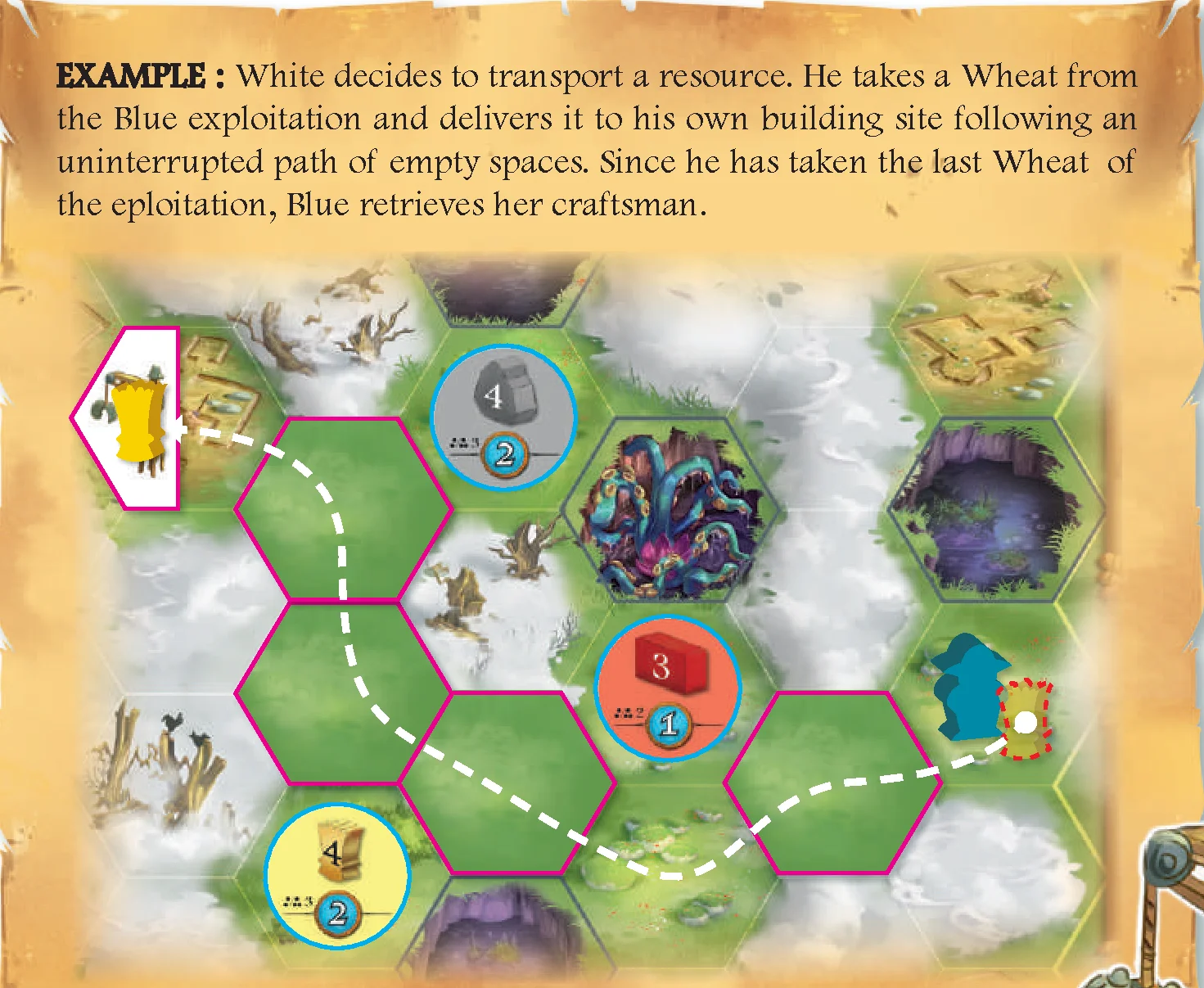
Choose and take a resource from any exploitation that is occupied by one of your craftsmen, by the craftsman of an opponent, or by no one i.e. a neutral exploitation. Transport the chosen resource to one of your own building sites following an uninterrupted path of empty meadow spaces. These spaces may be tiles placed by the players during the game or depleted exploitations.
If the resource you picked was the last of the exploitation, the owner of the craftsman retrieves it and puts it back on his guild board. That way, the exploitation is fully depleted and the space now counts as an empty meadow space. It is henceforth possible to move normally through this space.
Notes:
- You may never transport a resource over a space that is not empty.
- You may never deliver a resource to the building site of an opponent.
- A building site tile doesn’t have a specific orientation within a space. It is therefore possible to deliver a resource to a building site from any side of the space it is lying on.
- A resource lying on a building site may never be transported again.
Action F: Erect a Building
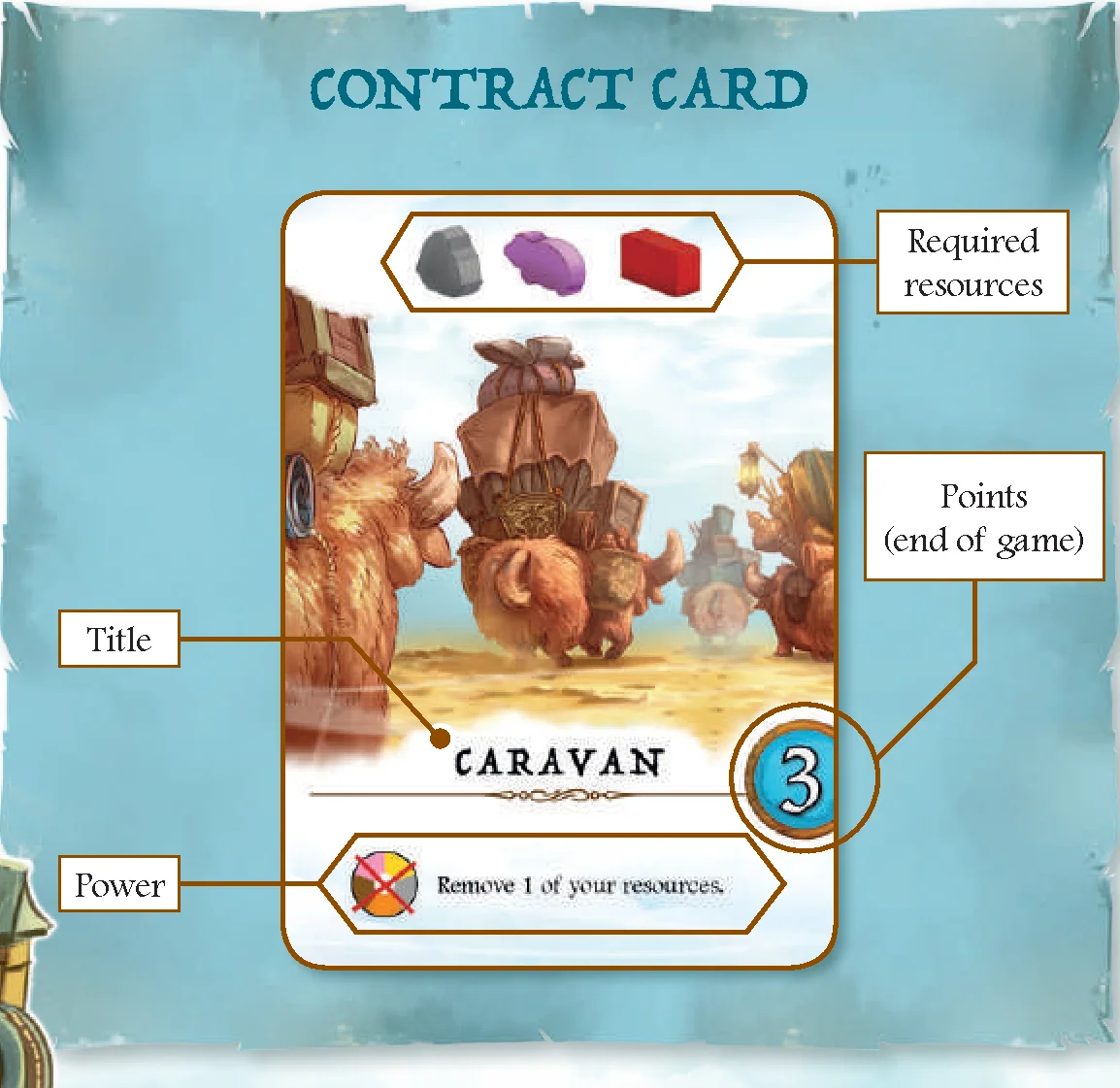
You may erect a building on one of your building sites containing all the resources required by a contract. That contract may be either:
- one of the contracts in your hand;
- one of the four contracts displayed face up on the main board.
YOU MUST THEN:
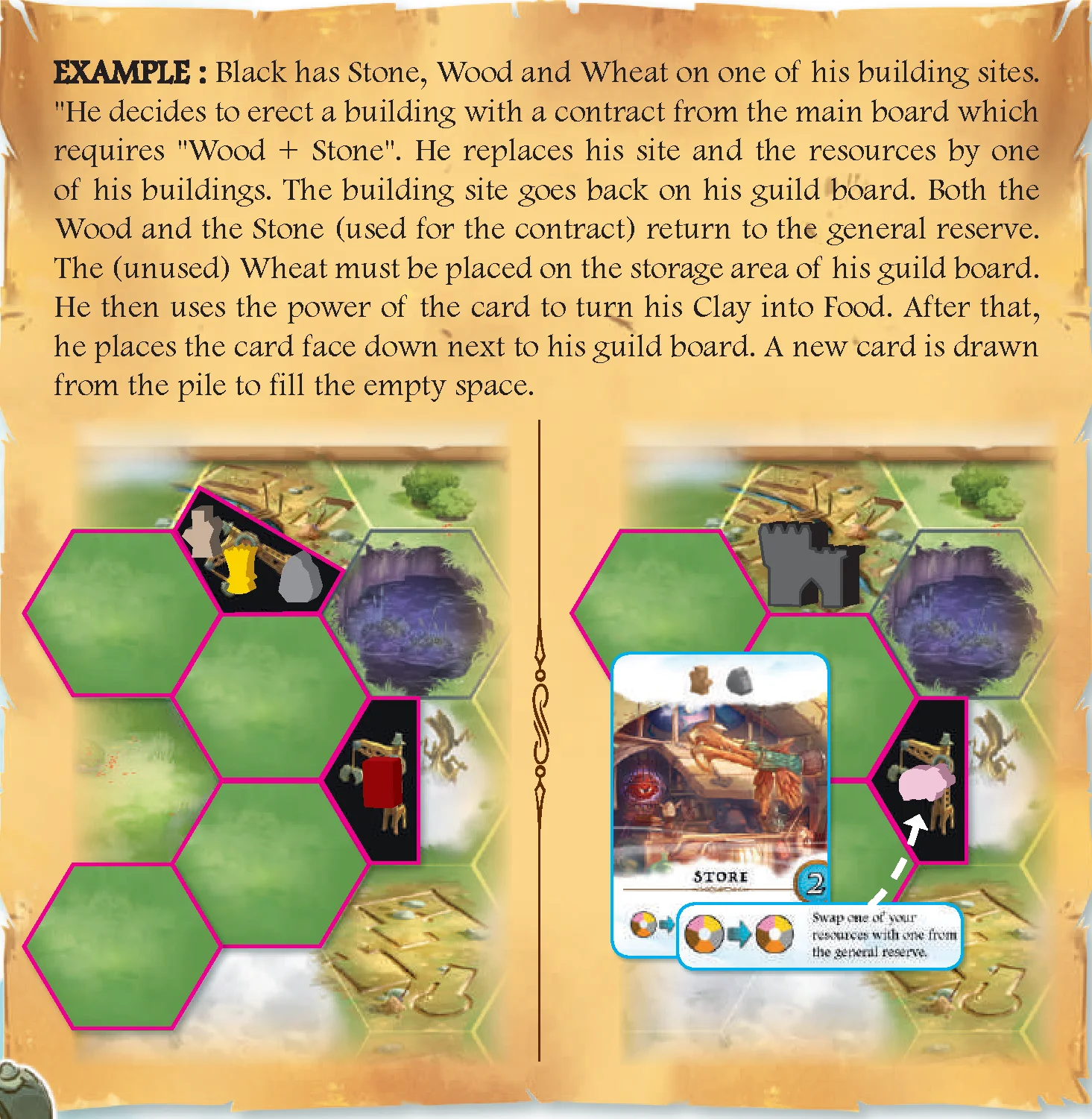
- Replace your building site and the resources on it with one of your buildings. The resources go back to the general reserve and the building site returns to your guild board;
- Immediately use the power of the card if you wish to do so;
- Place the fulfilled contract card face down next to your board. If it was a contract from the main board, immediately replace it with a card from the draw pile.
IMPORTANT: you are allowed to erect a building even if there are more resources on your building site than what is required by the contract you’re fulfilling. However, any additional resources are placed on your storage area and each one will cost you 1 point during the final scoring.
End of Game
The game ends after a player has erected his fifth and last building. That player is given the end-of-game card and his turn is immediately over.
As stated on the end of game card, all other players then get one final turn, after which all the players must collect any resources left on their building sites or exploitations and place them on the storage area of their guild board.
The final scoring round then takes place.
Final Scoring
Now Add Up:
- The points on your exploitation tokens;
- The points on your fulfilled contracts. Note: Any cards you still have in hand are ignored;
- The reward for your explorers (2, 4, 6 or 8) depending on how many you were able to reveal;
- The 2 points from the end-of-game card (for the player who triggers the end of the game);
- You must now deduct 1 point for each resource present on your storage area.
The player with the highest score wins. In case of a tie, the player amongst the tied ones who has the least resources in storage wins. If there is still a tie, the tied players share the win and shake hands.
Via Nebula for 3 Players
The game remains the same with some minor adjustments:
- During the setup, place piles of 4 meadow tiles (instead of 3) on your guild board;
- Exploitation tokens produce one resource fewer (4 instead of 5, 3 instead of 4 and 2 instead of 3);
- Each player gets 2 private contract cards. The remaining 2 cards are put back into the game box.
Via Nebula for 2 Players
The game remains the same with some minor adjustments:
- Use the back of the guild boards (marked “2 players”).
- During the setup, place piles of 5 meadow tiles (instead of 3) on your guild board;
- You get 3 craftsmen instead of 2;
- The ruins on the main board may only be occupied by a single building site (or building). Players therefore must use the hexagonal building site tiles instead of the half-hexagons used in the game with 3 or 4 players. As soon as you have covered ruins with one of your building sites, your opponent is barred from that space;
- Exploitation tokens produce one resource fewer (4 instead of 5, 3 instead of 4 and 2 instead of 3);
- Each player gets 2 private contract cards. The remaining 4 cards are put back into the game box.
Card Rules
The cards usually offer a power. The power of a card may only be used immediately upon fulfilling that contract (erecting that building). If it is not used at that time, the power is lost and may not be used at a later time in the game.
Some powers appearing on the cards may conflict with the general rules of the game. In such cases, the power on a card always takes precedence over the regular rules.
Private Contracts (8)
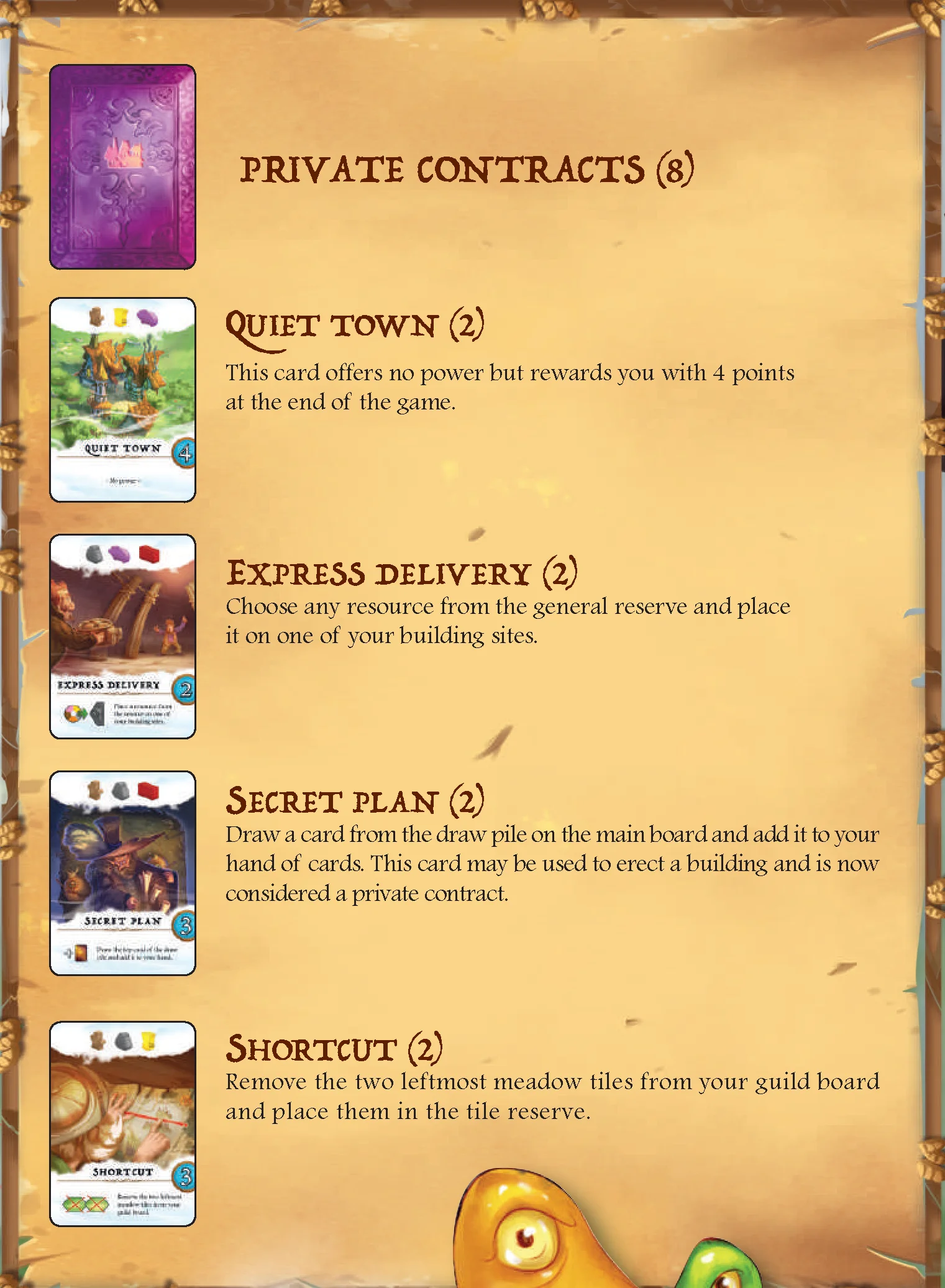
- Quiet Town (2): This card offers no power but rewards you with 4 points at the end of the game.
- Express Delivery (2): Choose any resource from the general reserve and place it on one of your building sites.
- Secret Plan (2): Draw a card from the draw pile on the main board and add it to your hand of cards. This card may be used to erect a building and is now considered a private contract.
- Shortcut (2): Remove the two leftmost meadow tiles from your guild board and place them in the tile reserve.
Neutral Contracts (33)
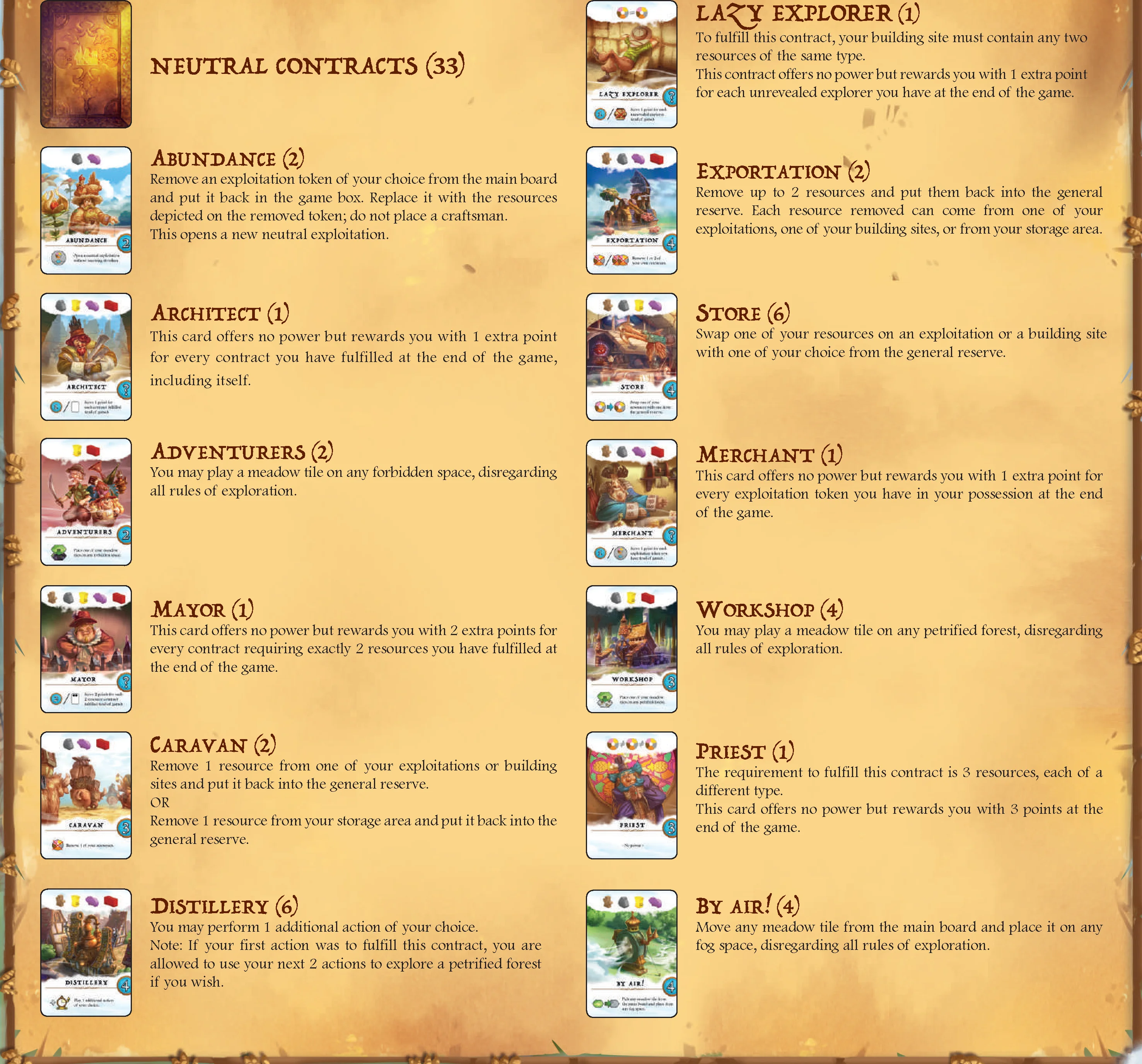
- Lazy Explorer (1): To fulfill this contract, your building site must contain any two resources of the same type. This contract offers no power but rewards you with 1 extra point for each unrevealed explorer you have at the end of the game.
- Abundance (2): Remove an exploitation token of your choice from the main board and put it back in the game box. Replace it with the resources depicted on the removed token; do not place a craftsman. This opens a new neutral exploitation.
- Exportation (2): Remove up to 2 resources and put them back into the general reserve. Each resource removed can come from one of your exploitations, one of your building sites, or from your storage area.
- Architect (1): This card offers no power but rewards you with 1 extra point for every contract you have fulfilled at the end of the game, including itself.
- Store (6): Swap one of your resources on an exploitation or a building site with one of your choice from the general reserve.
- Adventurers (2): You may play a meadow tile on any forbidden space, disregarding all rules of exploration.
- Merchant (1): This card offers no power but rewards you with 1 extra point for every exploitation token you have in your possession at the end of the game.
- Mayor (1): This card offers no power but rewards you with 2 extra points for every contract requiring exactly 2 resources you have fulfilled at the end of the game.
- Workshop (4): You may play a meadow tile on any petrified forest, disregarding all rules of exploration.
- Caravan (2): Remove 1 resource from one of your exploitations or building sites and put it back into the general reserve. OR Remove 1 resource from your storage area and put it back into the general reserve.
- Priest (1): The requirement to fulfill this contract is 3 resources, each of a different type. This card offers no power but rewards you with 3 points at the end of the game.
- Distillery (6): You may perform 1 additional action of your choice. Note: If your first action was to fulfill this contract, you are allowed to use your next 2 actions to explore a petrified forest if you wish.
- By Air! (4): Move any meadow tile from the main board and place it on any fog space, disregarding all rules of exploration.
Martin Wallace
Nebula is a good example of how something can come from nothing. The inspiration for the game came from Nikolaj Wendt, one of my regular playtesters. He had an idea for a game where your actions also benefit other players. Most of the design work occurred while walking into town one day; it’s a long but scenic walk.
I only showed the game to Space Cowboys because they did not like the other game I had taken along to a meeting with them. Bizarrely enough they said they really liked it, and the rest, as they say, is history. I have to shout out a big thanks for Philippe, CROC, and Marc, not only for publishing this design, but for being incredibly supportive over the years.
Vincent Joubert
Vincent works in his five-floor datcha in the Lyons area, in the midst of hens and poppy fields. After a brief visit to the fourth-and-a-half dimension, he has been head of the 3D decor department on video games like V-Rally, Kya or the last Alone in the Dark.
After several years spent as a layout designer and illustrator for Ankama, he now mainly works as a concept artist for animated movies.
When the weather allows it, he also goes back and forth between illustrations for books, video games and board games.
Overview & Components
The Nebula Valley has just emerged from a dark era, when for centuries, monstrous creatures inhabited the mists. It is now time for guilds of brave explorers to travel through the foggy pathways, exploit the resources and build new buildings and towns on the ruins of the devastated cities. Nebula will retrieve its peace and prosperity, and you are to become the heroes of the valley!
Aim of the Game
To collect points (representing glory, prestige, and riches), you will mainly fulfill contracts and open exploitations. The player with the most points at the end of the game is declared the winner and hero of Nebula!
Components
- 1 main board (Beginner side / Expert side)
- 4 guild boards (1 for each player, 2-player side / 3/4-player side)
- 24 building sites across 4 colors (12 half-hexagons for a game with 3 or 4 players, 12 full hexagons for a game with 2 players)
- 60 meadow tiles
- 20 exploitation tokens
- 5 special exploitation tokens
- 20 buildings (5 for each player)
- 12 craftsmen (3 for each player)
- 90 resources: Wood, Food, Stone, Clay, Wheat
- 42 cards:
- 33 neutral contracts
- 8 private contracts
- 1 end-of-game card
The Boards in Detail
Game Setup
Game Setup (4 Players)
Note: adjustments for a game with 2 or 3 players are to be found at the end of the booklet.
- Place the board in the middle of the table. For your first game, we suggest you use the beginner side.
- Place all the resources near the board to create a general reserve.
- Setup cards:
- Choose a first player at random, who shuffles and deals out 2 private contracts to each player.
- The first player then shuffles the neutral contracts and places them face down on the board. Reveal the first 4 cards of that draw pile and place them face up on their spaces.
- The end-of-game card is placed on its dedicated space.
- Exploitation tokens:
- Randomly remove one of the special exploitation tokens and put it back in the game box, it won’t be used for the whole game.
- Shuffle all the remaining exploitation tokens (special and regular) face down and place one on each meadow space of the main board before flipping them over to reveal their front.
- Swap each of the 4 special exploitations with a batch of 5 resources of the kind indicated on the token. These 4 spaces are now neutral exploitations (they belong to no player in particular).
- Take a guild board each and all the elements of your chosen color. Place your 5 buildings, 3 building sites and 2 craftsmen on their dedicated spaces (the 3rd craftsman returns to the game box). Finally, place on your board 4 stacks of 3 meadow tiles.
- By the side of the board, form a reserve with the remaining meadow tiles.
How to Play
Turn Structure
The first player starts, then the game proceeds clockwise.
On your turn, you must carry out 2 actions from the 6 at your disposal:
- A – Place a craftsman;
- B – Place a building site;
- C – Explore a fog space;
- D – Explore a petrified forest (this action costs two actions);
- E – Transport a resource to one of your building sites;
- F – Erect a building.
Note: You may carry out the same action more than once during your turn, but remember action D costs TWO of your actions.
Action A: Place a Craftsman
Place one of your available craftsmen onto any space containing an exploitation token. Take that token and put it face down next to your guild board, and then place on the space as many resources of the type indicated by the token. You just opened a new exploitation.
Note: an available craftsman is one on your guild board. You can not choose this action if you do not have an available craftsman.
Action B: Place a Building Site
Take one of your own building sites, and cover a free half of a ruins space not already covered by another building site or building.
All ruins spaces have room for two building sites. They may simultaneously contain two sites belonging to the same player or two different players.
Notes:
- You can not choose this action if you don’t have an available building site.
- You can never have more building sites present on the main board than you have buildings left on your guild board.
Action C: Explore a Fog Space
Take a meadow tile from the leftmost pile on your guild board and place it on a fog space. That space must be either:
- adjacent to a space occupied by an element of your color (craftsman, building site or building), or
- adjacent to an empty meadow space or tile (that is, without any resources or exploitation token on it).
Action D: Explore a Petrified Forest
Take a meadow tile from the leftmost pile on your guild board and place it on a petrified forest. That forest must be either:
- adjacent to a space occupied by an element of your color (craftsman, building site or building), or
- adjacent to an empty meadow space or tile (that is, without any resources or exploitation token on it).
IMPORTANT: This action uses two of your actions. Therefore, after you explore a petrified forest, your turn is immediately over.
Explorers
When you explore, you use the meadow tiles placed on your guild board. When depleted, each pile reveals an explorer. At the end of the game each explorer rewards you with 2 points.
Note: if you want to explore but happen to have run out of tiles, you may use the tiles from the reserve, as long as there are some left.
Action E: Transport a Resource to a Building Site
Choose and take a resource from any exploitation that is occupied by one of your craftsmen, by the craftsman of an opponent, or by no one i.e. a neutral exploitation. Transport the chosen resource to one of your own building sites following an uninterrupted path of empty meadow spaces. These spaces may be tiles placed by the players during the game or depleted exploitations.
If the resource you picked was the last of the exploitation, the owner of the craftsman retrieves it and puts it back on his guild board. That way, the exploitation is fully depleted and the space now counts as an empty meadow space. It is henceforth possible to move normally through this space.
Notes:
- You may never transport a resource over a space that is not empty.
- You may never deliver a resource to the building site of an opponent.
- A building site tile doesn’t have a specific orientation within a space. It is therefore possible to deliver a resource to a building site from any side of the space it is lying on.
- A resource lying on a building site may never be transported again.
Action F: Erect a Building
You may erect a building on one of your building sites containing all the resources required by a contract. That contract may be either:
- one of the contracts in your hand;
- one of the four contracts displayed face up on the main board.
YOU MUST THEN:
- Replace your building site and the resources on it with one of your buildings. The resources go back to the general reserve and the building site returns to your guild board;
- Immediately use the power of the card if you wish to do so;
- Place the fulfilled contract card face down next to your board. If it was a contract from the main board, immediately replace it with a card from the draw pile.
IMPORTANT: you are allowed to erect a building even if there are more resources on your building site than what is required by the contract you’re fulfilling. However, any additional resources are placed on your storage area and each one will cost you 1 point during the final scoring.
End of Game & Scoring
End of Game
The game ends after a player has erected his fifth and last building. That player is given the end-of-game card and his turn is immediately over.
As stated on the end of game card, all other players then get one final turn, after which all the players must collect any resources left on their building sites or exploitations and place them on the storage area of their guild board.
The final scoring round then takes place.
Final Scoring
Now Add Up:
- The points on your exploitation tokens;
- The points on your fulfilled contracts. Note: Any cards you still have in hand are ignored;
- The reward for your explorers (2, 4, 6 or 8) depending on how many you were able to reveal;
- The 2 points from the end-of-game card (for the player who triggers the end of the game);
- You must now deduct 1 point for each resource present on your storage area.
The player with the highest score wins. In case of a tie, the player amongst the tied ones who has the least resources in storage wins. If there is still a tie, the tied players share the win and shake hands.
Variants for 2 & 3 Players
Via Nebula for 3 Players
The game remains the same with some minor adjustments:
- During the setup, place piles of 4 meadow tiles (instead of 3) on your guild board;
- Exploitation tokens produce one resource fewer (4 instead of 5, 3 instead of 4 and 2 instead of 3);
- Each player gets 2 private contract cards. The remaining 2 cards are put back into the game box.
Via Nebula for 2 Players
The game remains the same with some minor adjustments:
- Use the back of the guild boards (marked “2 players”).
- During the setup, place piles of 5 meadow tiles (instead of 3) on your guild board;
- You get 3 craftsmen instead of 2;
- The ruins on the main board may only be occupied by a single building site (or building). Players therefore must use the hexagonal building site tiles instead of the half-hexagons used in the game with 3 or 4 players. As soon as you have covered ruins with one of your building sites, your opponent is barred from that space;
- Exploitation tokens produce one resource fewer (4 instead of 5, 3 instead of 4 and 2 instead of 3);
- Each player gets 2 private contract cards. The remaining 4 cards are put back into the game box.
Powers of the Cards Reference
Card Rules
The cards usually offer a power. The power of a card may only be used immediately upon fulfilling that contract (erecting that building). If it is not used at that time, the power is lost and may not be used at a later time in the game.
Some powers appearing on the cards may conflict with the general rules of the game. In such cases, the power on a card always takes precedence over the regular rules.
Private Contracts (8)
- Quiet Town (2): This card offers no power but rewards you with 4 points at the end of the game.
- Express Delivery (2): Choose any resource from the general reserve and place it on one of your building sites.
- Secret Plan (2): Draw a card from the draw pile on the main board and add it to your hand of cards. This card may be used to erect a building and is now considered a private contract.
- Shortcut (2): Remove the two leftmost meadow tiles from your guild board and place them in the tile reserve.
Neutral Contracts (33)
- Lazy Explorer (1): To fulfill this contract, your building site must contain any two resources of the same type. This contract offers no power but rewards you with 1 extra point for each unrevealed explorer you have at the end of the game.
- Abundance (2): Remove an exploitation token of your choice from the main board and put it back in the game box. Replace it with the resources depicted on the removed token; do not place a craftsman. This opens a new neutral exploitation.
- Exportation (2): Remove up to 2 resources and put them back into the general reserve. Each resource removed can come from one of your exploitations, one of your building sites, or from your storage area.
- Architect (1): This card offers no power but rewards you with 1 extra point for every contract you have fulfilled at the end of the game, including itself.
- Store (6): Swap one of your resources on an exploitation or a building site with one of your choice from the general reserve.
- Adventurers (2): You may play a meadow tile on any forbidden space, disregarding all rules of exploration.
- Merchant (1): This card offers no power but rewards you with 1 extra point for every exploitation token you have in your possession at the end of the game.
- Mayor (1): This card offers no power but rewards you with 2 extra points for every contract requiring exactly 2 resources you have fulfilled at the end of the game.
- Workshop (4): You may play a meadow tile on any petrified forest, disregarding all rules of exploration.
- Caravan (2): Remove 1 resource from one of your exploitations or building sites and put it back into the general reserve. OR Remove 1 resource from your storage area and put it back into the general reserve.
- Priest (1): The requirement to fulfill this contract is 3 resources, each of a different type. This card offers no power but rewards you with 3 points at the end of the game.
- Distillery (6): You may perform 1 additional action of your choice. Note: If your first action was to fulfill this contract, you are allowed to use your next 2 actions to explore a petrified forest if you wish.
- By Air! (4): Move any meadow tile from the main board and place it on any fog space, disregarding all rules of exploration.
Biographies & Credits
Martin Wallace
Nebula is a good example of how something can come from nothing. The inspiration for the game came from Nikolaj Wendt, one of my regular playtesters. He had an idea for a game where your actions also benefit other players. Most of the design work occurred while walking into town one day; it’s a long but scenic walk.
I only showed the game to Space Cowboys because they did not like the other game I had taken along to a meeting with them. Bizarrely enough they said they really liked it, and the rest, as they say, is history. I have to shout out a big thanks for Philippe, CROC, and Marc, not only for publishing this design, but for being incredibly supportive over the years.
Vincent Joubert
Vincent works in his five-floor datcha in the Lyons area, in the midst of hens and poppy fields. After a brief visit to the fourth-and-a-half dimension, he has been head of the 3D decor department on video games like V-Rally, Kya or the last Alone in the Dark.
After several years spent as a layout designer and illustrator for Ankama, he now mainly works as a concept artist for animated movies.
When the weather allows it, he also goes back and forth between illustrations for books, video games and board games.
