Tigris & Euphrates
1997
Develop ancient civilizations through tile placement, manage four leaders, and make sure your weakest category never falls behind.
120
minutes
2 - 4
player(s)
14+
Medium Heavy

About this board game
Tigris & Euphrates is a tile-laying civilization game for 2–4 players, with an estimated play time of 120 minutes. Set in the ancient Fertile Crescent, it challenges players to build and develop civilizations while competing across four distinct categories.
Each player has four leaders: farming, trading, religion, and government. These leaders collect victory points in their corresponding categories, but final scoring rewards balance rather than specialization: your result is determined by the number of points in your weakest category.
As civilizations expand across the board, they can connect with one another and trigger external conflicts. When this happens, only one leader of each type survives. Leaders can also be replaced through internal conflicts within a civilization, making the development of each kingdom an ongoing struggle for control.
- Build civilizations through tile placement.
- Use four leader types to collect category-specific victory points.
- Balance farming, trading, religion, and government to protect your final score.
- Resolve external and internal conflicts as kingdoms develop.
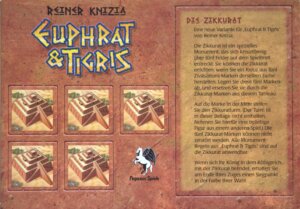
Some editions released from 2008 onward include a double-sided board and components for an advanced version featuring the ziggurat expansion. This special monument is built by replacing a cross of five same-colored civilization tokens with ziggurat markers and a tower. The markers cannot be destroyed, and a king within the ziggurat’s kingdom can earn one victory point in a color of choice at the end of a turn.
Regarded by many as Reiner Knizia’s masterpiece, Tigris & Euphrates is also associated with Knizia’s tile-laying trilogy. First released in 1997, it offers a focused contest of expansion, leadership, conflict, and carefully balanced scoring.
Mechanics
Designer
Illustrators
/pic7182955.jpg)

Board Game Rules for
Tigris & Euphrates
Introduction
Ur, Nineveh, Babylon—the ancient texts describe these cities as the origin of mankind. In fertile Mesopotamia, between the Tigris and Euphrates rivers, lies the cradle of civilization.
Around 3,000 B.C.E., the first large settlements of civilization developed along the embankments of these two great rivers. Farmers began to irrigate large parts of the surrounding lands, reaching out into the arid plains. Their triumph in turn bore consequences. Transport problems arose. In response, the clever artisans turned potters’ wheels on their sides and mounted them onto crude carts. Food could then be carried along the dry trails to market. Surpluses could be moved where needed.
Trade flourished, and markets dotted the countryside. In order to record the burgeoning number of transactions, merchants sought new tools of inscription. They began scratching marks into their urns, thereby inventing writing—even before the Egyptians. As the land began supporting denser populations and great concentrations of wealth and resources, society began to organize around a system of classes. A multitude of priests and royal administrators helped govern everyday life. They served many jealous gods and, of course, a succession of kings. Over the centuries, one dynasty succeeded another.
The game of Tigris & Euphrates allows you to take part in this fascinating saga. Step back to the dawn of urban civilization. Mesopotamia, the land of the two rivers, stretches before you. Now you and your people can try to forge the mightiest and most balanced culture. Now you can dominate the rich valleys of the Tigris and Euphrates.
Game Components
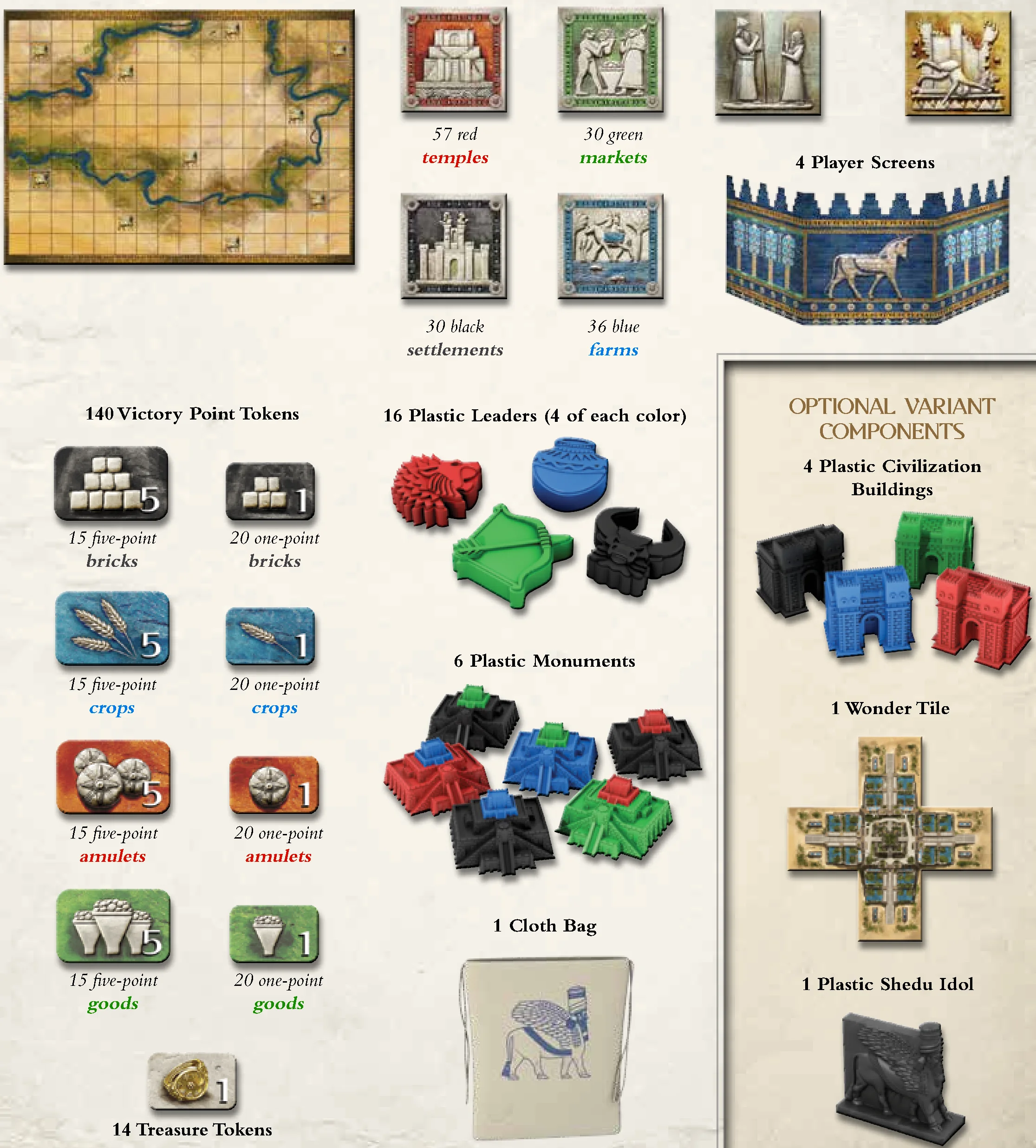
- 1 Double-Sided Game Board
- 153 Civilization Tiles:
- 57 red temples
- 30 black settlements
- 36 blue farms
- 30 green markets
- 4 Unification Tiles
- 8 Catastrophe Tiles
- 16 Plastic Leaders (4 of each color)
- 6 Plastic Monuments
- 140 Victory Point Tokens:
- 15 five-point bricks, 20 one-point bricks
- 15 five-point crops, 20 one-point crops
- 15 five-point amulets, 20 one-point amulets
- 15 five-point goods, 20 one-point goods
- 14 Treasure Tokens
- 4 Player Screens
- 1 Cloth Bag
Optional Variant Components
- 4 Plastic Civilization Buildings
- 1 Wonder Tile
- 1 Plastic Shedu Idol
Tiles and Colors
Tigris & Euphrates’ civilization tiles, buildings, leaders, and victory points exist in one of four colors: black, red, blue, or green. Each component and color combination has a unique thematic name. For example, blue civilization tiles are “farms.” This rulebook references components by their name; however, when a component is tied to a specific color, the name is printed using that color to help players learn both the name and color of each component. Furthermore, when this rulebook references “tiles,” it is referring to civilization tiles; all other tile types will be mentioned specifically.
Assembling the Monuments
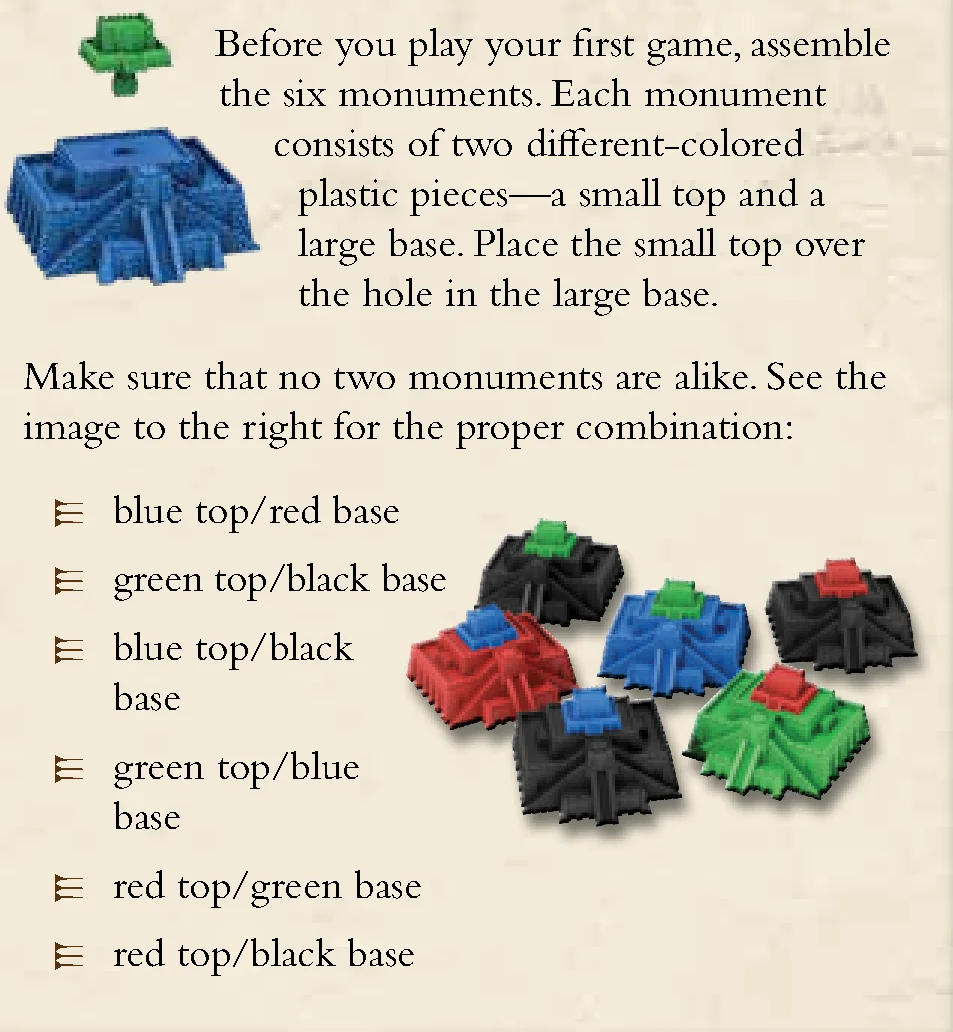
Before you play your first game, assemble the six monuments. Each monument consists of two different-colored plastic pieces—a small top and a large base. Place the small top over the hole in the large base.
Make sure that no two monuments are alike. The proper combinations are:
- blue top / red base
- green top / black base
- blue top / black base
- green top / blue base
- red top / green base
- red top / black base
Setup Steps
To set up a game of Tigris & Euphrates, follow these steps:
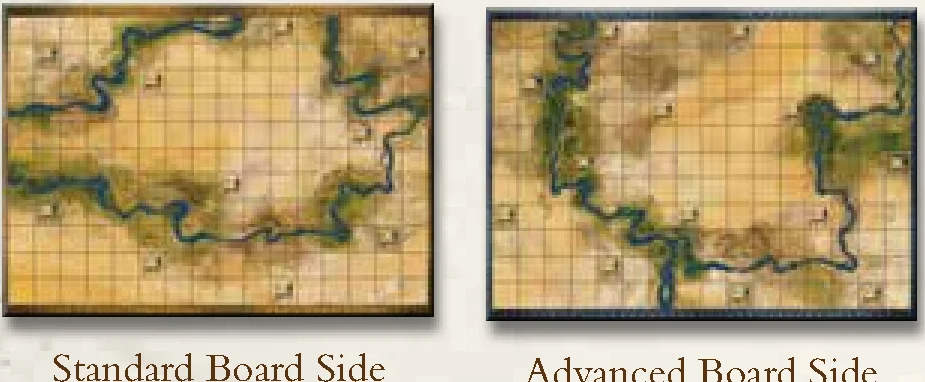
- Set the Game Board: Place the game board in the play area. Use the standard game board, which has a gold—rather than blue—border. The other side of the board (which has a blue border) is used for the advanced game.
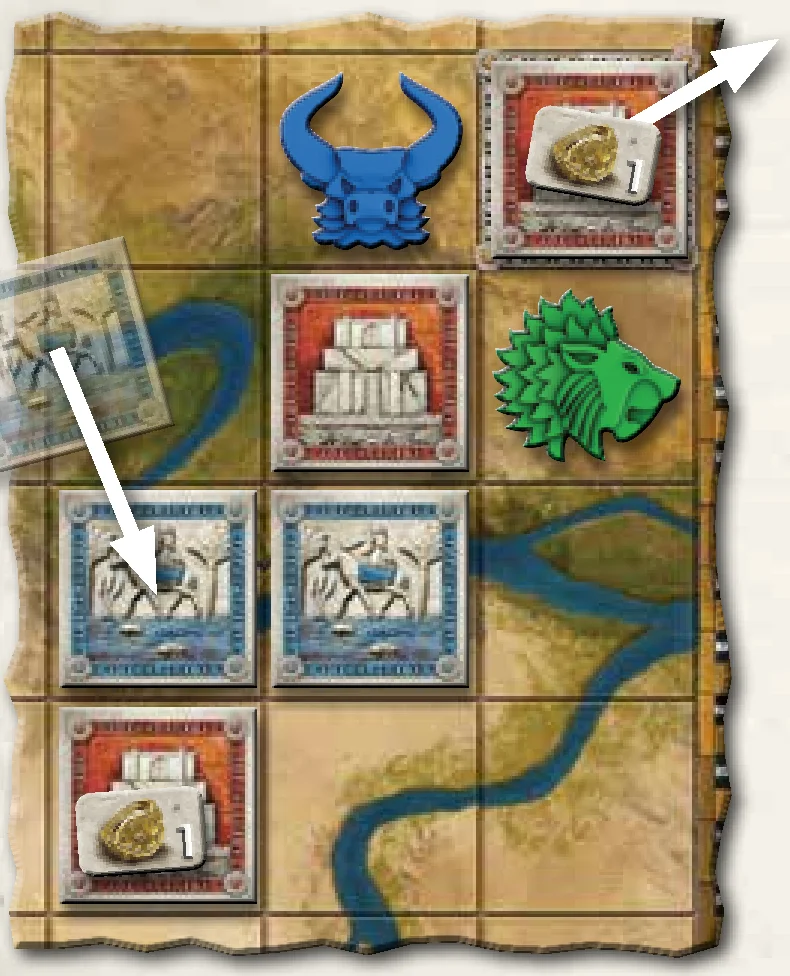
Place a temple tile on each of the ten board spaces marked by a winged beast (called a “Shedu”). Then, place a treasure token on top of each temple. - Prepare the Reserves: Put all of the remaining civilization tiles into the bag and shuffle them together. Then, place the four unused treasure tokens back into the box and all monuments near the side of the board. Finally, divide all of the victory point tokens by color and place them by the board.
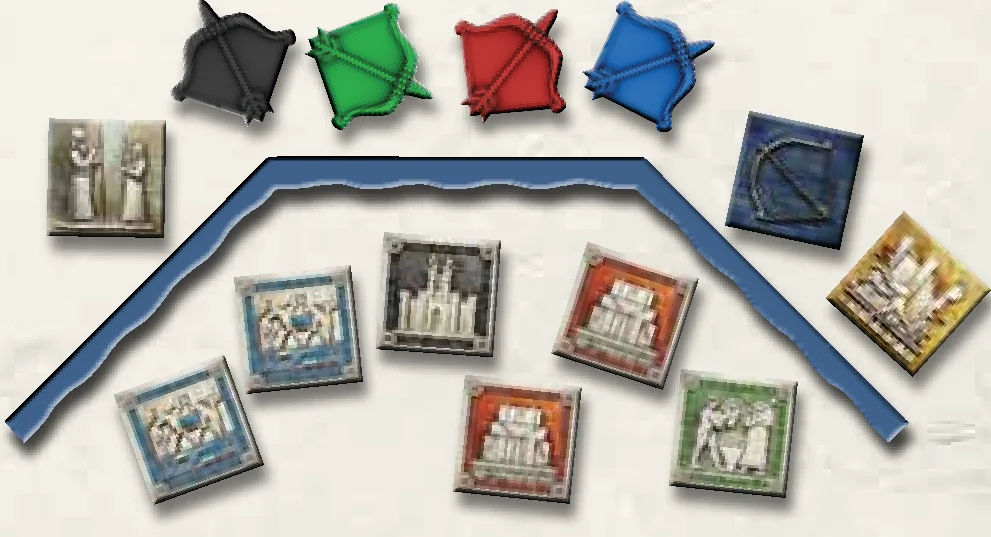
- Choose Dynasties: Each player chooses a dynasty consisting of four leaders. The four leaders should bear the same dynastic symbol (i.e., the archer, the bull, the pot, or the lion) in a different color. Each player then takes the unification tile and two catastrophe tiles that contain his dynastic symbol, along with the screen bearing his dynastic symbol.
Note: Players are identified by their symbols, not by colors. Everyone uses all four colors.
Then, each player draws six tiles from the bag. He places the tiles behind his screen so that only he can see them. He leaves his leaders, his catastrophe tiles, and his unification tile in front of him and in full view of the other players. Put the spare leaders, screens, unification tiles, and catastrophe tiles back into the game box.
Choose a starting player at random by placing all of the players’ unification tiles with the dynastic symbols facedown on the table, mixing them, and then picking one. Play will proceed in a clockwise order.
The Tigris and Euphrates Rivers
Both of these great rivers originate in the mountains of what is now eastern Turkey. They make their way southeast first weaving through semi-arid hills and then winding across the parched plain of Mesopotamia, until they reach the Persian Gulf. Together, they brought life to the great cities in the heartland of the Fertile Crescent.
The first true civilization, Sumer, grew up above the confluence of the Tigris and Euphrates.
Object of the Game
The goal of each player is to develop all four of the key spheres of civilization: settlements, temples, farms, and markets. To do this, players will position their leaders, create and extend kingdoms, build monuments, and resolve conflicts. They will thus gain victory points in each of the four spheres. At the end of the game, players compare their lowest spheres; the winner is the player with most victory points in their lowest sphere.
Kingdoms
Players will build, unite, and destroy kingdoms during the course of the game. They are fundamental tools in the development of everyone’s civilizations.
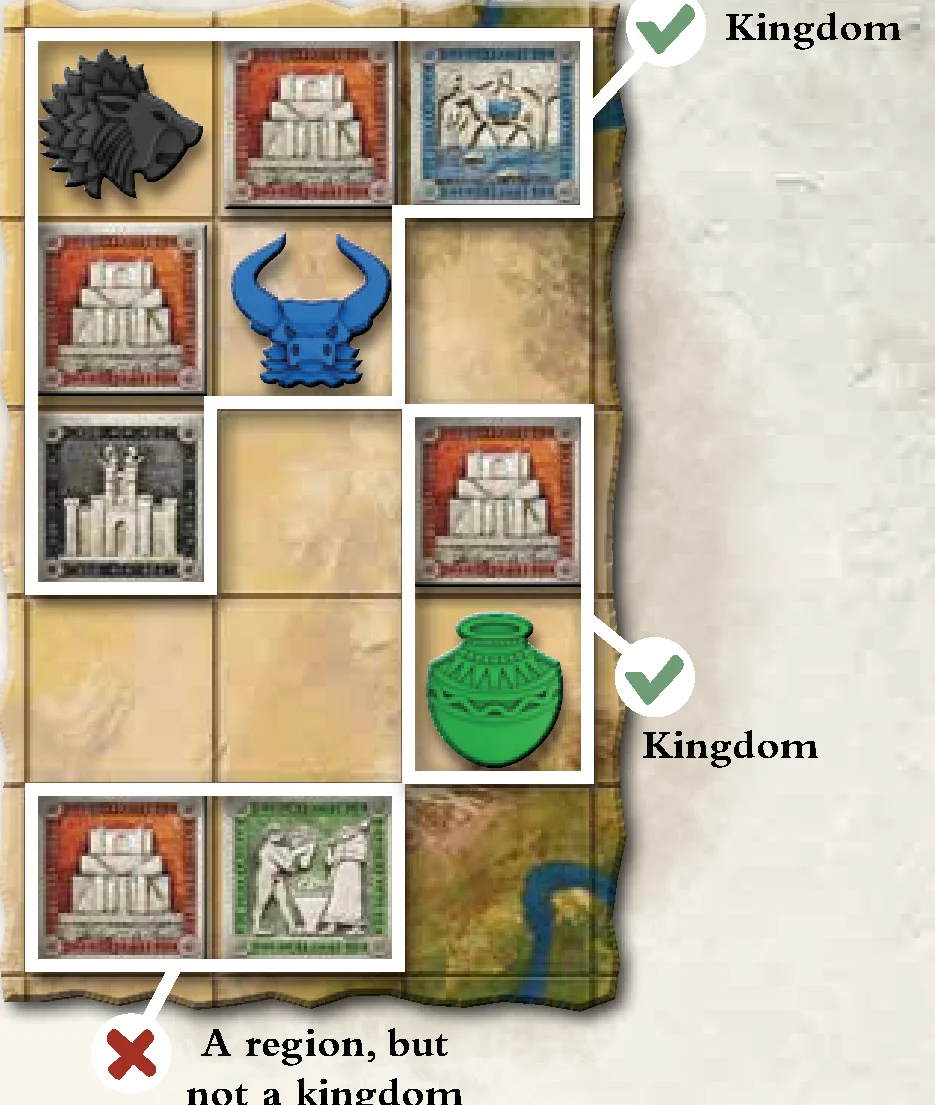
- A region is any area on the game board covered by a lone tile (e.g., a temple) or two or more linked tiles. Regions do not contain leaders. At the start of the game there are ten distinct, one-tile regions.
- Tiles and leaders with a common edge are adjacent. Tiles or leaders are linked if they are adjacent or if they are connected through a chain of adjacent tiles and leaders.
- A group of one or more linked tiles and at least one leader together is called a kingdom. A kingdom can contain several leaders. It does not matter whether they belong to the same player or different players.
Kingdoms grow when leaders and tiles are added to the board. Kingdoms can be united and separated. As long as a kingdom contains only leaders of different colors, everything is peaceful. Conflicts arise when there are two like-colored leaders within one kingdom.
Hidden Information
- All victory point and treasure tokens gained and tiles behind a player’s screen are hidden information; they are kept secret from other players until scoring.
- The number of tiles in the bag is hidden information; players cannot deliberately count the tiles in the bag.
- Tiles that are removed from the game are hidden information; they are kept facedown in the box and cannot be viewed by any player.
Turn Overview
The player taking his turn is called the active player. During his turn, the active player may resolve up to two actions in any order. After his turn is complete, the player sitting to his left becomes the active player.
There are four different actions an active player can resolve. The active player may choose two different actions or the same action twice:
- Position (place, move, or withdraw) a leader.
- Place a tile.
- Play a catastrophe tile.
- Replace up to six tiles from his hand.
After a tile is placed, a few other events may occur: conflicts, monument building, or treasure distribution. These events are not finished until fully resolved.
Action: Positioning a Leader
Each player possesses a dynasty of four leaders: a king, a priest, a farmer, and a trader. A player may only position his own leaders.
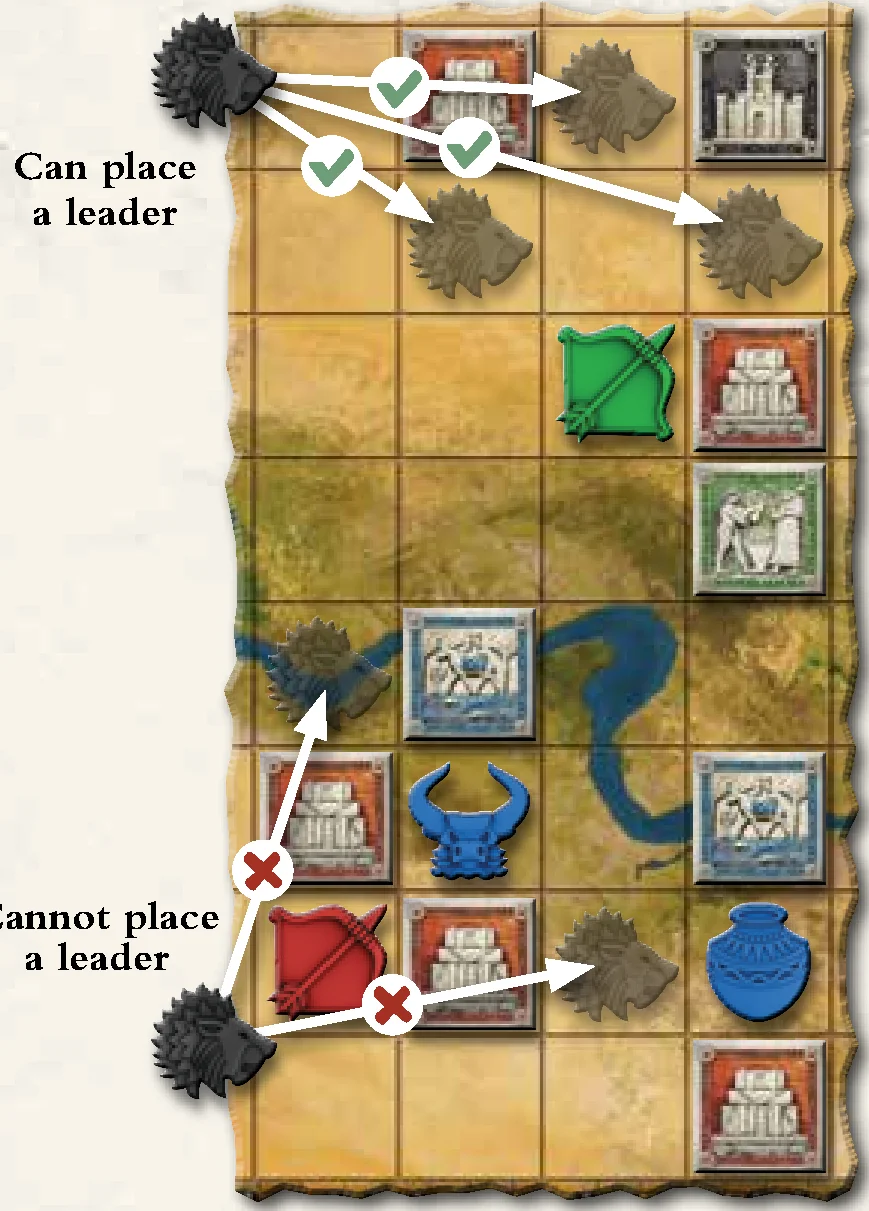
A leader can either come from outside the board or be repositioned from another space on the board. Furthermore, a leader can be withdrawn from the board. Leader placement must obey the following restrictions:
- A leader must be placed on an empty space.
- A leader can only be placed adjacent to a temple (i.e., the leader and temple must have a common edge).
- A leader cannot be placed in such a way as to unite kingdoms.
- A leader cannot be placed on a river space.
In certain situations, tiles can be removed from the board or turned facedown. When the last temple adjacent to a given leader is removed or turned facedown, the leader is returned to the player of that dynasty.
No victory points are gained for the positioning of leaders. A player cannot gain victory points without first having at least one leader on the board.
Action: Placing a Civilization Tile
A player will have six tiles behind his screen at the beginning of his turn. Players use these tiles to extend regions and kingdoms, strengthen leaders, and gain victory points. To place a tile, a player takes a tile from behind his screen and places it on the board according to the following restrictions:
- A tile must be placed faceup on an empty space.
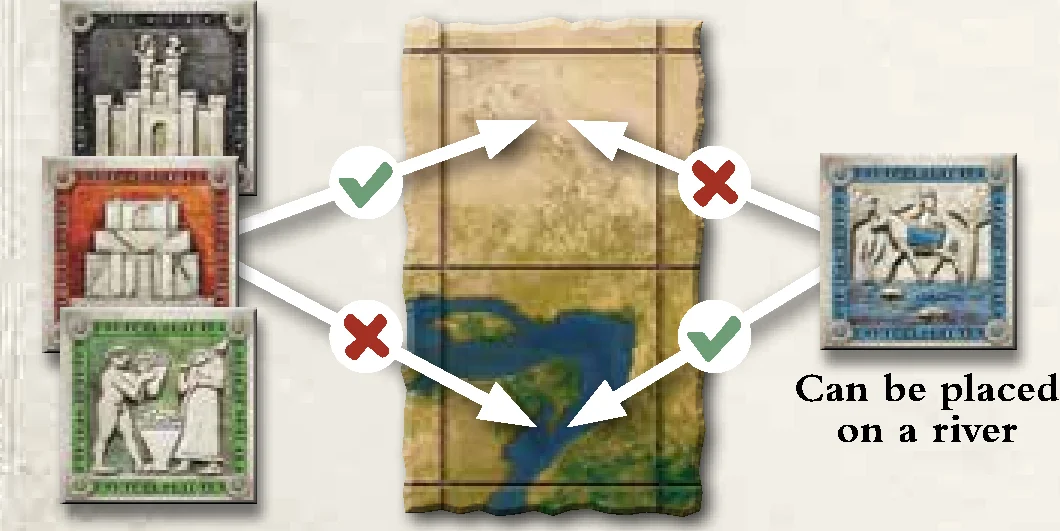
- Farms can only be placed on river spaces.
- Settlements, temples, and markets cannot be placed on river spaces.
- A tile cannot be placed where it would unite more than two kingdoms.
When placing a tile, it can be placed adjacent to another tile, leader, or in isolation (i.e., adjacent to nothing). After a tile is placed, it cannot be relocated.
Most of the time, a player will gain a victory point when a tile is placed. The victory point is always the same color as the placed tile.
Gaining Victory Points
There are four types of victory points; each one is colored to correspond to a specific tile as follows:
- Bricks (Black VP) – Settlements
- Amulets (Red VP) – Temples
- Crops (Blue VP) – Farms
- Goods (Green VP) – Markets
A victory point is gained for placing a tile under the following circumstances:
- If the tile is placed in a kingdom, and this kingdom contains a leader of the same color, then the victory point is gained by the player controlling that leader.
- If there is no leader of the respective color, but there is a king within the kingdom, then the victory point is gained by the player controlling the king.
No victory point is gained if:
- the tile is not placed in a kingdom;
- there is no leader of the respective color or king to gain the victory point; or
- the tile is placed so that it unites two kingdoms, even if there are no conflicts.
Victory points are gained immediately when a tile is placed. They are kept hidden behind the players’ screens. When a player gains a victory point, he always takes a token valued at “1.” At any point during his turn, a player may exchange five tokens valued at “1” for one token valued at “5.”
Action: Playing a Catastrophe Tile
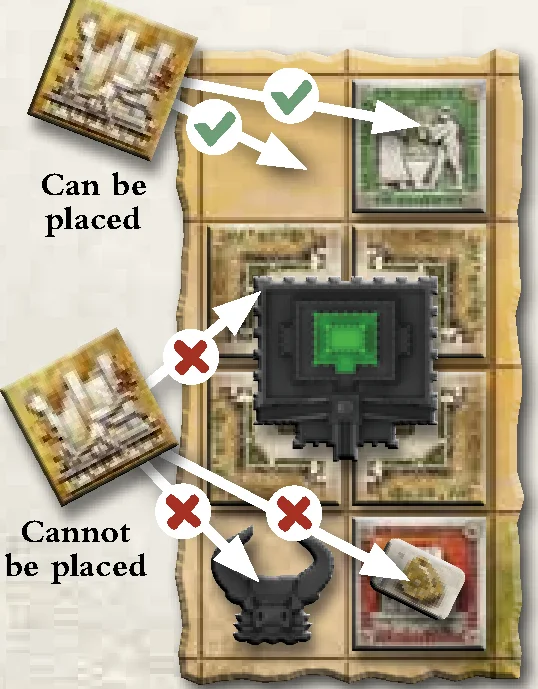
At the beginning of the game, each player receives two catastrophe tiles. A player can use them to permanently occupy and negate spaces on the board. When played, the catastrophe tile remains on the board for the rest of the game. It creates a blocked space that cannot be used again.
A player can place catastrophe tiles on an empty space or on top of an existing tile (which is then removed from the game). The only restrictions are as follows:
- A catastrophe tile cannot be played on a tile bearing a treasure or a monument.
- A catastrophe tile cannot be played on a leader.
A catastrophe tile disrupts the connection between leaders or tiles. In this way, a catastrophe tile may divide a kingdom into two or more parts. If a catastrophe tile destroys the last temple adjacent to a leader, that leader is immediately withdrawn from the board and returned to the player.
Action: Replacing Tiles
A player may take up to six tiles from his hand and return them to the box facedown. Then, he refreshes by drawing the same number of tiles from the bag and adding them to his hand. Discarded tiles are permanently removed from the game.
If a player replaces tiles as his first action, he can use the new tiles to carry out his second action.
End of a Turn
A player’s turn ends after he carries out his two actions (or if he chooses to end his turn before taking both available actions). If one or more of his leaders are linked with monuments, he may gain additional victory points. Finally, he refreshes his hand of tiles by drawing from the bag so that he ends his turn with six tiles in his hand.
If other players have fewer than six tiles at this point, then they also refresh their hand of tiles. Then, it is the next player’s turn.
Conflicts Overview
Conflicts can arise when someone positions a leader or places a tile. A conflict occurs whenever there are two like-colored leaders (e.g., two farmers or two kings) in a given kingdom. This can happen in two ways, so there are two different types of conflicts:
- Revolt: A revolt occurs when a leader is positioned in a kingdom that already contains a leader of the same color.
- War: Wars occur when two kingdoms are united through a new tile, and the new, larger kingdom contains leaders of the same color.
Keep the following in mind:
- Leader placement can only cause revolts, not wars.
- Tile placement can only cause wars, not revolts.
The conflict is resolved using tiles on the board and additional tiles played from behind the screens. An action does not end before the conflict is resolved. After all conflicts have been resolved, a kingdom will only contain leaders of different colors.
Conflict Summary
If a leader is positioned in a kingdom which already contains a leader of the same color, a revolt occurs, and the temples adjacent to the leaders (plus any additional tiles committed from hand) decide the outcome of the revolt. If two kingdoms are united such that the new, larger kingdom contains leaders of the same color, a war ensues, and the strength of the original supporters of the involved leaders (plus any additional tiles committed from hand) determine victory of the war.
Revolts
A revolt occurs when a leader is positioned in a kingdom that already contains a leader of the same color.
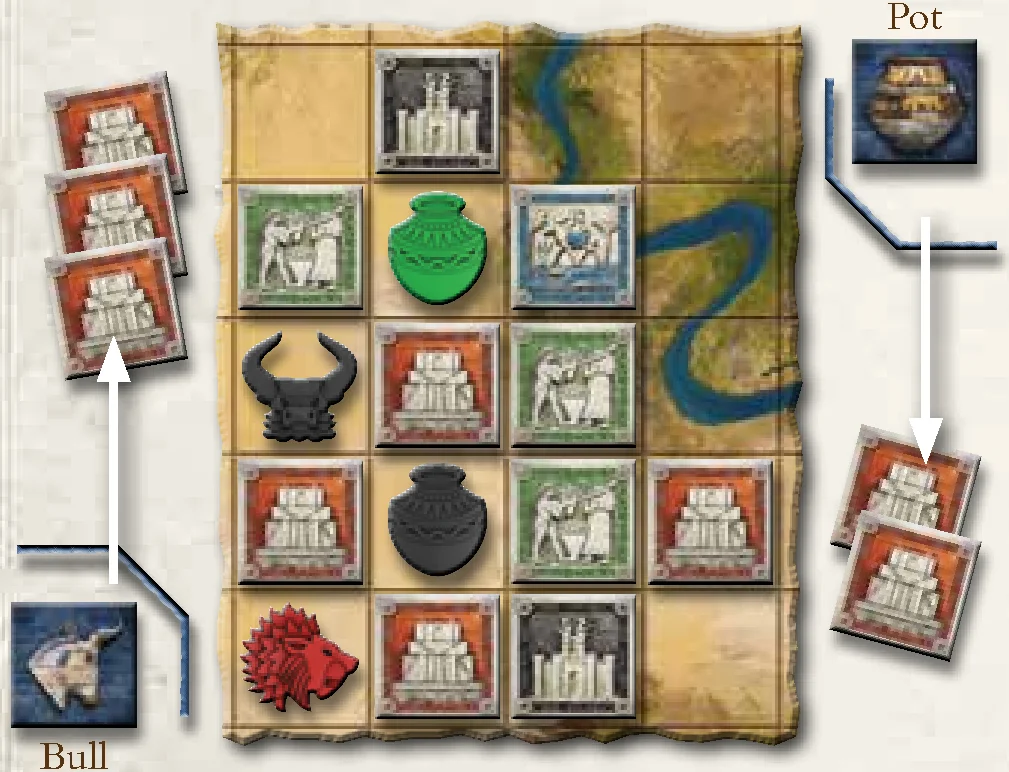
During a revolt, the player positioning the new leader is the attacker. The controller of the existing leader of the same color in that kingdom is the defender. Both the attacker and the defender draw their strength from temples.
Resolve revolts as follows:
- Count temples adjacent to leaders: Both the attacker and the defender draw strength by counting the number of temples adjacent to their conflicting leaders. A temple can count for both leaders.
- Players commit temples from their hands: First the attacker, and then the defender, may increase their strength by committing to the conflict any number of extra temples from their hands, placing them faceup in front of their screens. Each player can commit extra temples only once.
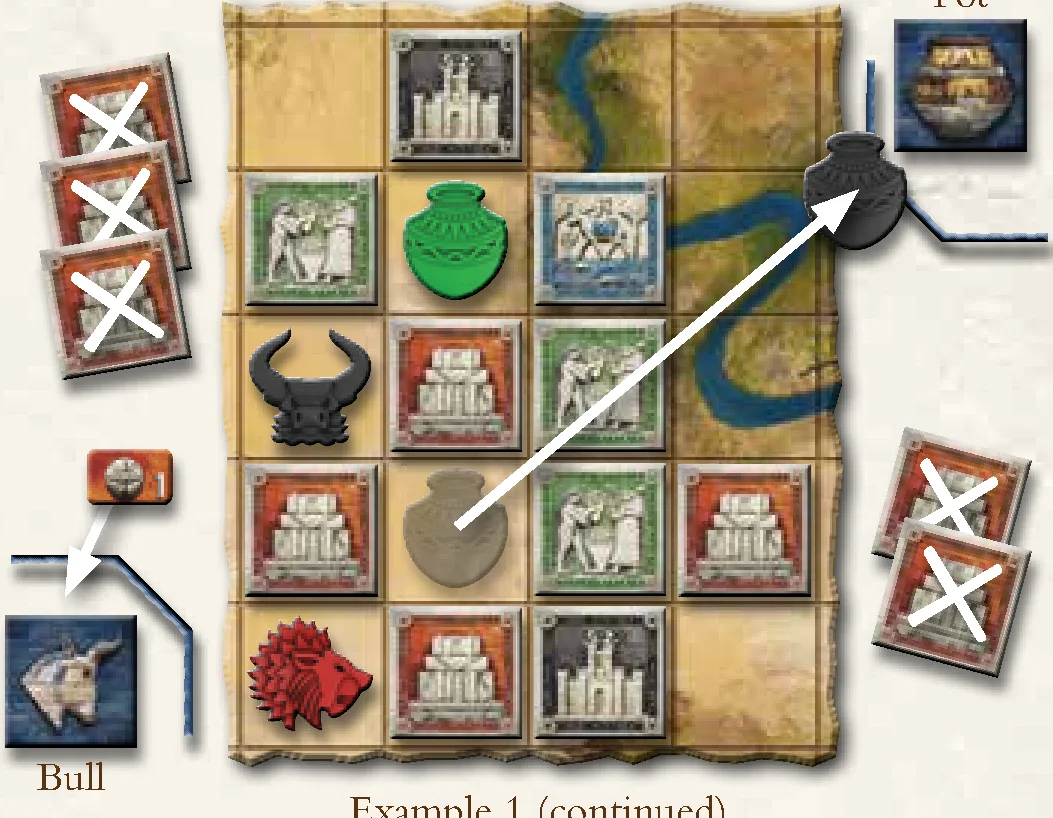
Whoever has the higher total strength (total number of temples) wins the conflict. The defender wins ties.
The consequences of a revolt are as follows:
- The loser must withdraw his leader from the board.
- The victor gains one amulet (because the conflict was fought with temples).
- Both players remove all committed temples from the game, placing them facedown in the box.
Wars
Wars occur when two kingdoms are united, and the new, larger kingdom contains leaders of the same color.
Remember that two kingdoms can be united through tile placement but not through leader positioning. Three or more kingdoms cannot be united by one tile. No victory point is gained when a tile is placed that unites two kingdoms. Instead, that tile is covered by the unification tile. A new, larger kingdom is created.
If the new united kingdom contains no two leaders of a like color, remove the unification tile and conclude the action without resolving any conflict. However, if the united kingdom contains leaders of the same color, war erupts.
All conflicts between two like-colored leaders are resolved individually. Each time there are wars between leaders in more than one color, the active player decides which war to resolve first. For each war after the first, players resolve the war using the kingdom’s current configuration, as recent wars might have disrupted the connection between leaders and tiles.
War Resolution
Resolve wars as follows:
- Determine who is the attacker: If the active player chooses to resolve a conflict that involves one of his leaders, he becomes the attacker. Otherwise, the next player (in clockwise order) with a leader involved becomes the attacker. The other player involved in the conflict is the defender.
- Count the supporters: Both the attacker and the defender draw strength by counting their leader’s supporters, which are tiles of like color on the board that are still connected to the leader. These tiles need not be adjacent to the respective leader. They only have to be in that part of the kingdom on his segment of the unification tile.
- Players commit tiles from their hands: First the attacker, and then the defender, may increase the strength of their supporters. They do this by committing to the conflict any number of extra tiles of the matching color from their hands, placing them faceup in front of their screens. Each player can commit tiles only once.
Whoever has the higher total strength (supporters on the board plus tiles committed from hand) wins the conflict. The defender wins ties.
Consequences of a War
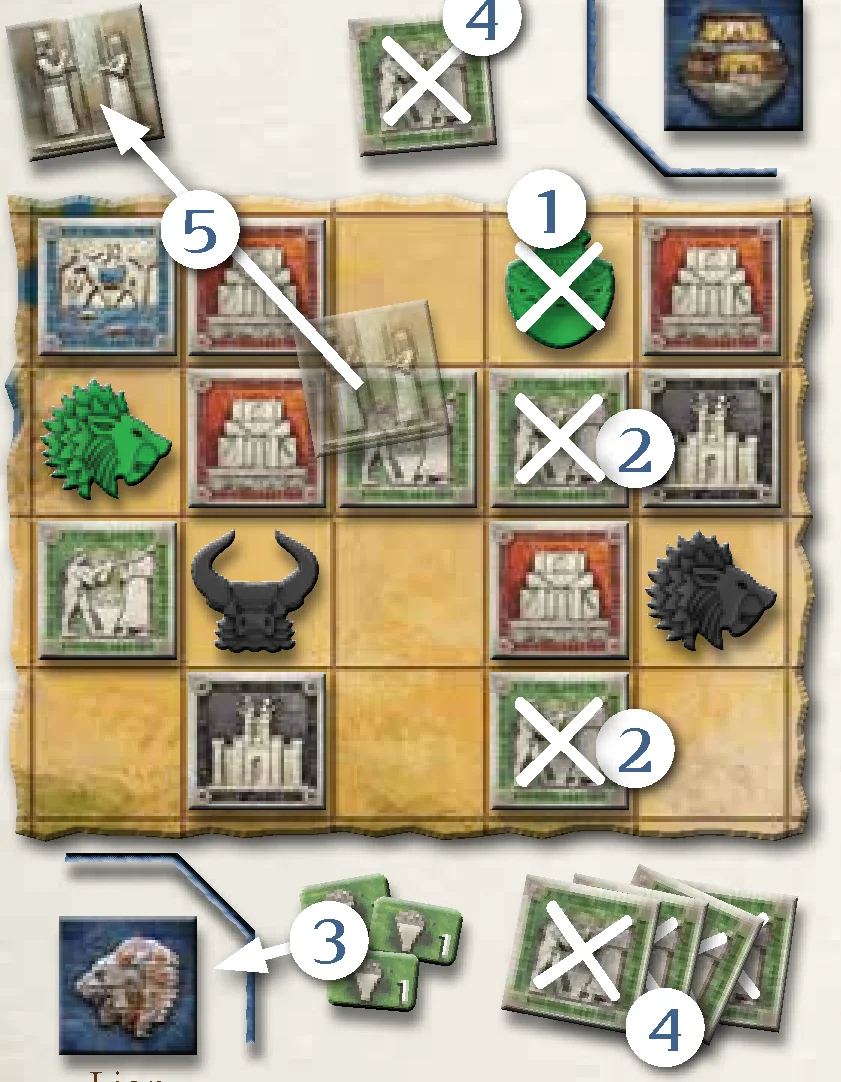
- The loser must withdraw his leader and remove all supporters from the kingdom.
- The victor receives one victory point that matches the color of the withdrawn leader and one (also of matching color) for each of the supporters that are removed from the board. The tiles committed from any player’s hand do not count toward victory points.
- The defeated leader is returned to the losing player.
- Supporters of the defeated leader, and any committed tiles added by both players, are removed from the game and placed back in the box.
- Priest Conflict Exception: If two priests cause a conflict, temples (i.e., supporters) which bear a treasure, or have another leader adjacent to them, are not removed. Amulets are only gained for the defeated priest and the temples actually removed from the board.
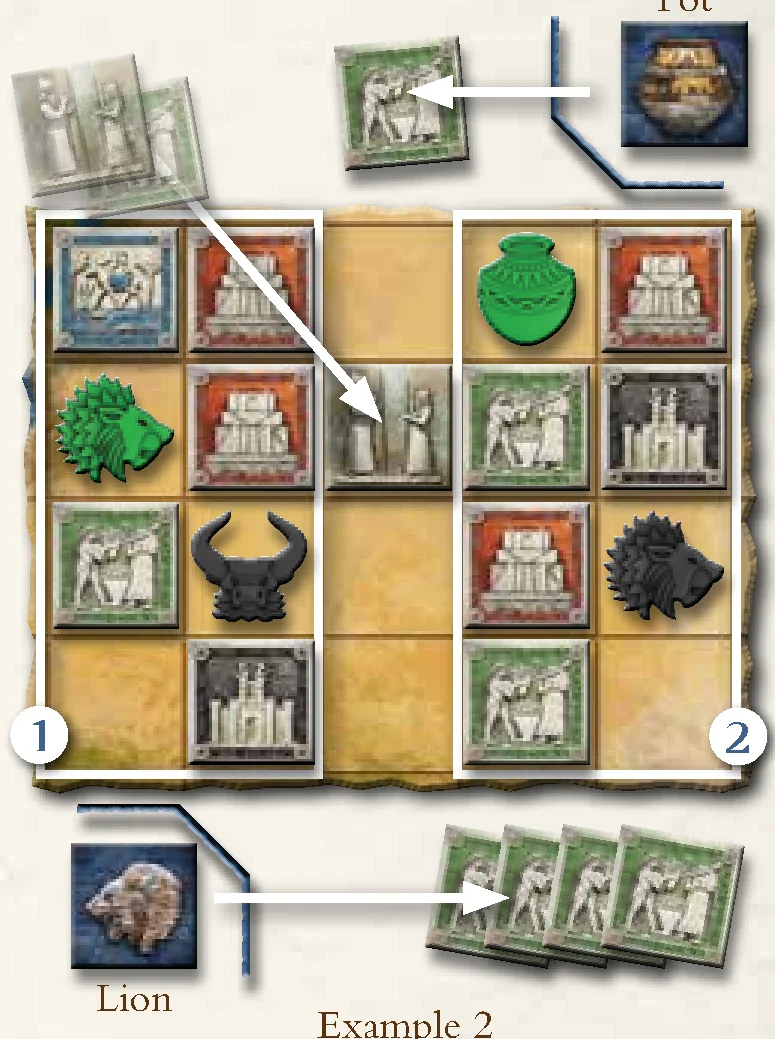
When a tile is removed from the board, it might cause the kingdom to be divided into two or more parts. As a consequence, leaders originally exposed to war can end up in different kingdoms. If this occurs, then those leaders are no longer in conflict. However, if there are still leaders of like colors in the kingdom, a new war commences with the active player determining which conflict is resolved next. (The active player can influence events by choosing the order of conflict resolution.)
After all wars are resolved, the active player’s unification tile is removed and placed back outside his screen.
At the end of the active player’s turn, all other players who have committed tiles from their hands also refresh their hands back up to six.
Playing a Unification Tile
When a player unites kingdoms, he places his unification tile on top of the linking tile, as a reminder that a war might be about to take place between the newly united kingdoms. Whether or not a war ensues, no players gain victory points from the linking tile.
Only one unification tile can be in play at a given time. It remains on the board only while the players resolve any conflicts that might arise from the act of unification and is removed after all wars (if any) are resolved.
A player does not place a unification tile when he links regions or when he links a kingdom and a region.
Conflict Rewards Summary
- Winning a revolt: After a revolt, the winner gains one (and only one) amulet.
- Winning a war: After a war, the winner gains one victory point token of the matching color for each tile (plus the leader) that the loser removes from the board.
Temple Clarifications
Temples are important for many reasons. Leaders must be adjacent to temples at all times, and all treasures begin the game on temples. As such, some interesting situations involving temples may arise:
- During a revolt, a single temple can be used by multiple leaders.
- If a player uses a catastrophe tile to block a space containing a temple that is adjacent to a leader and that leader is no longer adjacent to a temple, that leader is removed from the game board.
- If a temple is flipped facedown or replaced with the wonder tile, any leaders adjacent to that temple that are no longer adjacent to any other temples are removed from the game board.
- When a player loses a war with a priest, he cannot remove temples from the game board if those temples either contain a treasure or are adjacent to leaders of any other color (king, trader, or farmer). The victor does not gain victory points for tiles that remain on the game board due to these exceptions.
- If a temple contains a treasure token and the active player wishes to use that tile to build a monument or wonder, he temporarily removes the treasure token and either places it back on the tile after the tile is flipped facedown (monument) or places it on the cross-shaped wonder tile (wonder). This treasure token is still in play and players can collect it following the normal rules.
Monument Building
Monument building can occur when someone places a tile.
There are six monuments in the game. Each monument consists of two different-colored parts; be sure to assemble these in the correct configuration.
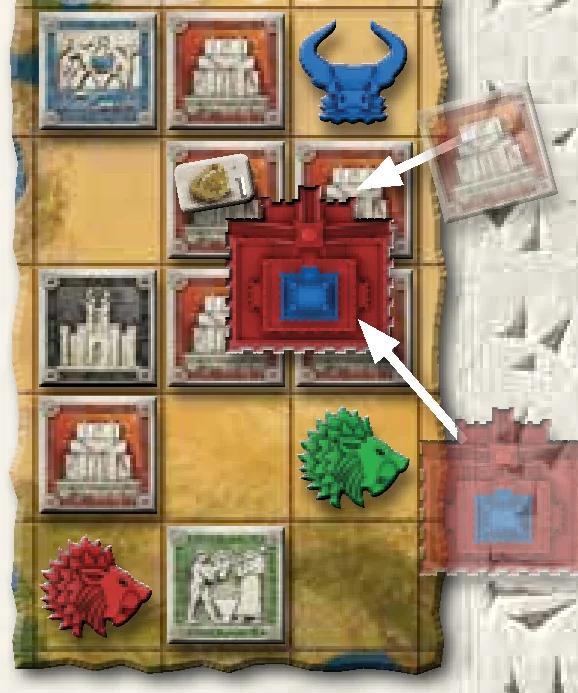
If the active player places a tile in such a way that he creates a 2×2 square of four like-colored tiles, he may flip those four tiles facedown and place a monument on top of them. One color of the monument must match the facedown tiles. If that color is no longer available, the monument cannot be built, and therefore the tiles cannot be flipped facedown.
If tile placement initiates a war, the players must resolve the conflict before flipping tiles facedown. If the square still exists after resolving the conflict, the active player may build a monument.
If the player completing the square does not build a monument as part of his current action, the tiles remain faceup. A monument can be built only at the end of the action in which the active player completed a 2×2 square.
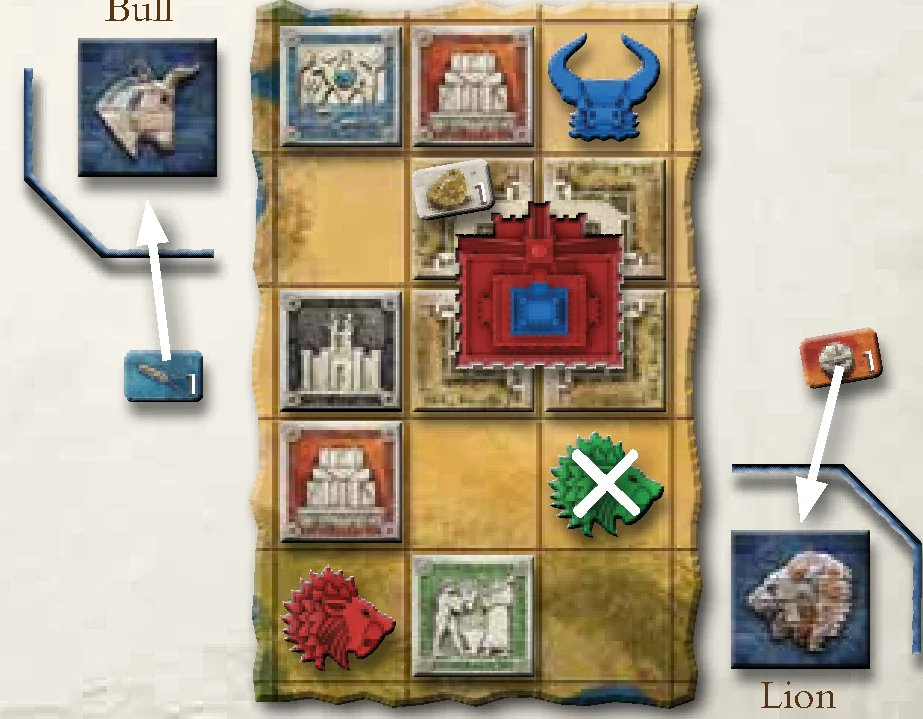
The four facedown tiles still count as part of regions and kingdoms, linking leaders and tiles. However, they no longer count for any other functions (e.g., as supporters in conflicts). A monument cannot be destroyed.
When four temples are flipped facedown and a monument is built, the following applies:
- If a treasure lies on a temple, it remains on that facedown tile.
- If a leader is no longer adjacent to a temple, withdraw that leader and return it to the player.
A monument regularly provides victory points. At the end of the active player’s turn, he determines if one or more of his leaders are in the same kingdom as a like-colored monument. For each such leader, he gains one victory point of the leader’s color for each like-colored monument in the same kingdom. For example, if he has a blue leader (farmer) in a kingdom with a blue monument, he gains a blue victory point (crop). Since a monument has two colors, it can provide victory points for up to two leaders each turn.
A king gains a victory point only when linked to a black monument. While the placement of a tile can allow a king to gain victory points in other colors (in the absence of the respective leaders), this does not apply for monuments.
Treasure Distribution
Treasure distribution can be initiated when a player positions a leader or places a tile.
At the beginning of the game, ten treasure tokens are placed on the first ten temples on the board.
Treasures are gained in the following way:
If a kingdom contains more than one treasure at the end of a player’s action, the trader in that kingdom must gain all but one of these treasures. If there are treasures on a special border space, the player must take treasures from those spaces first; after that, he may choose from which space to take his remaining treasures.
If there is no trader in the kingdom, the treasures remain there until the kingdom has a trader.
Each treasure counts as one wild victory point. At the end of the game, you may allocate each treasure individually to any victory point type of your choice.
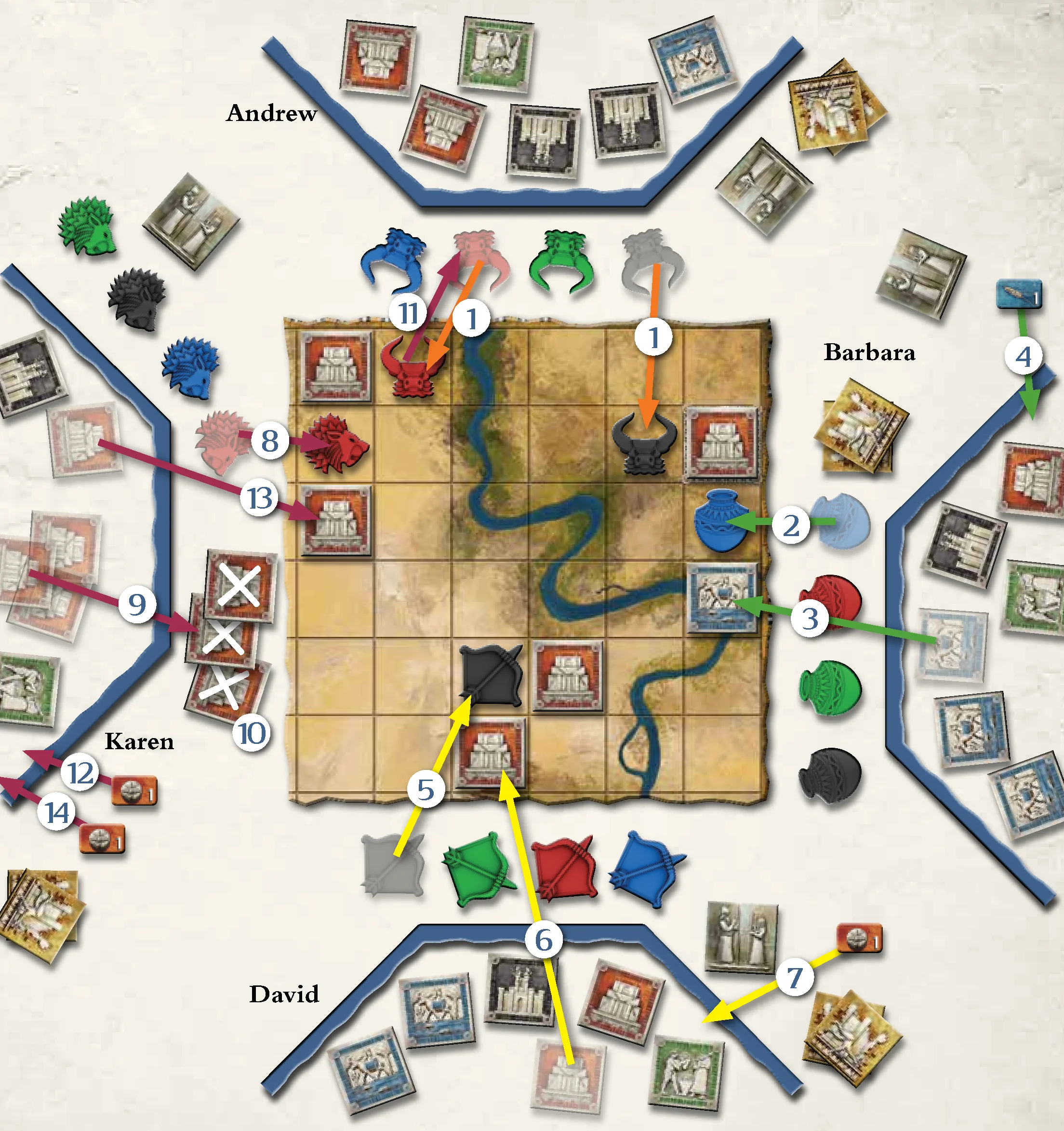
Round Walkthrough
Andrew’s Turn
Andrew begins the game. He positions two of his leaders on the board: a king and a priest (1). In this way he creates two kingdoms.
Barbara’s Turn
First, Barbara positions her farmer (2), extending one of the kingdoms created by Andrew. Then, she places a farm on the adjacent river space (3). For this she receives one crop (4). (The farmer and the farm are of like colors, and she controls the farmer.) She draws one tile from the bag to refresh her hand.
David’s Turn
David positions his king (5) and creates a new kingdom. Then, he places a temple (6). He gains one amulet (7) because there is no priest in the kingdom (matching the color of the temple). Hence, the controller of the king gains the amulet. Note that David has placed his temple in such a way that his king is now adjacent to two temples. David refreshes his hand by drawing one tile.
Karen’s Turn
Karen drew four temples at the beginning and feels aggressive. As her first action, she positions her priest (8) in the same kingdom as Andrew’s priest. A revolt arises. On the board, both players have one temple in support of their leaders. Karen commits three extra temples from behind her screen (9).
At most, Andrew could commit two extra temples, but that would not be enough to tie with Karen, so he refrains from committing any extra temples. Karen wins (four to one). Her committed temples are removed from the game (10). Andrew must withdraw his priest (11). Karen gains one amulet (12) for winning the revolt. As her second action, Karen places her fourth temple on the board (13) and receives another amulet (14). Then, she refreshes her hand by drawing four tiles.
Now it is Andrew’s turn again.
End of the Game
The game ends when either of the following conditions are met:
- Only one or two treasures remain on the board at the end of a player’s turn, or
- A player who is attempting to draw a tile is unable to because the bag is empty.
Determining the Winner
At this point all players lower their screens. Each player determines in which sphere they possess the fewest number of victory points, with each player freely allocating his treasures to any sphere(s). The player whose lowest sphere has the highest number of victory points is the winner. In the case of a tie, the tied players compare their second lowest spheres, and so on. If multiple tied players are evenly matched in all four spheres, those players share the victory.
Advanced Game Rules: Civilization Buildings
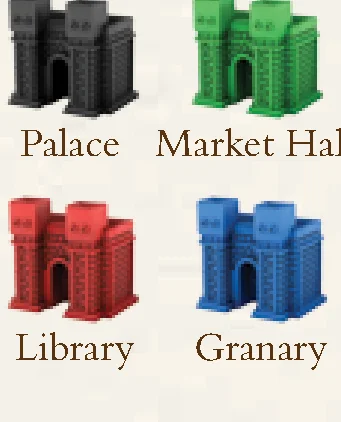
The advanced game uses four civilization buildings. They include a palace, a library, a market hall, and a granary. During setup, place these buildings next to the board near the monuments.
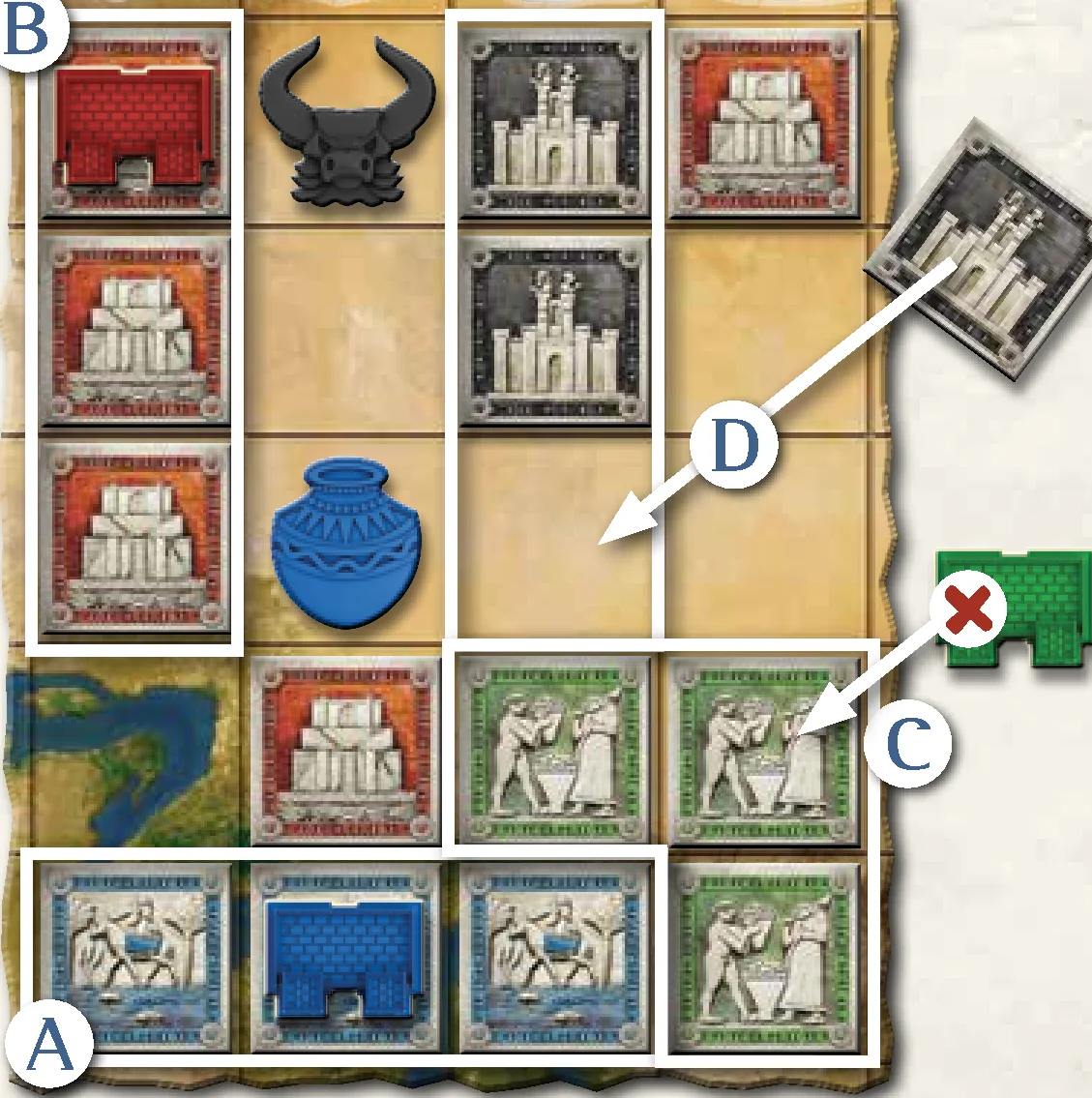
When a player places one of his tiles on the board so that it becomes part of an uninterrupted vertical or horizontal line of three or more tiles of the same color, that player may take the corresponding color building from beside the board and place it on any one of the color tiles in the line.
If the corresponding building is already on the board, the player may remove the building from its current location and place it on any one of the color tiles in the new line, provided the new line is longer than the line where the building is currently located.
If a building is on a tile that is part of both a horizontal line and a vertical line, the new line must be longer than each of the building’s current lines.
Civilization buildings must be placed before building a monument or erecting a wonder (if able).
When a player places a tile in a kingdom containing a building of the corresponding color, the reward for the respective leader (or the king if the leader is absent) increases from one to two victory points. (Rewards for conflicts or monuments remain unaffected.)
Players must resolve conflicts before building placement. A tile directly under a building counts in conflicts and cannot be removed. Catastrophe tiles cannot be played on a tile that is under a building. If you flip over a tile that is under a building in order to build a monument or wonder, remove the building and place it next to the board for future use.
The Rise of Civilization
Sumer’s kings and city states emerged before 3000 BCE. They brought writing and commerce to the Fertile Crescent. In time (circa 2371 B.C.E.), the Akkadians supplanted the Sumerians and created a more centralized state. Their Kings, notably Sargon and his grandson Naram-Sin, forged an empire stretching far to the north and west. Many peoples and dynasties would follow, all seeking to rule these rich lands.
Advanced Game Board
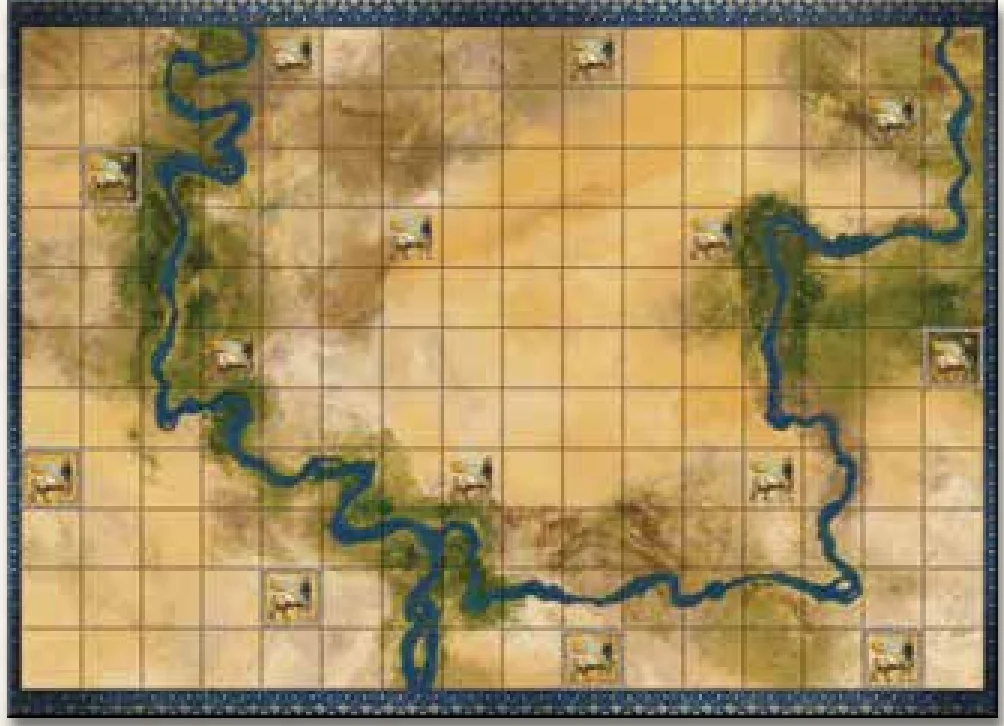
The advanced game board is an alternate board printed on the back of the original board. It is differentiated by a blue border (rather than gold). It uses a different map and contains four extra treasures. When you play with the alternate board, place one temple with a treasure on each of the fourteen Shedu spaces. Then, play by the original rules.
When a player collects a treasure from a kingdom containing more than one treasure, he must first collect those treasures from spaces outlined with the special border.
English Variant
In order to restrict the opportunity to discard extra tiles during a conflict that do not influence its resolution, the following variant may be adopted: the attacker may commit extra tiles if thereafter his total exceeds the current strength of the defender. If he has no chance of winning the conflict, he cannot commit any extra tiles. The defender can commit extra tiles only in order to win the conflict by establishing a tie. No more, no less!
Wonder Variant
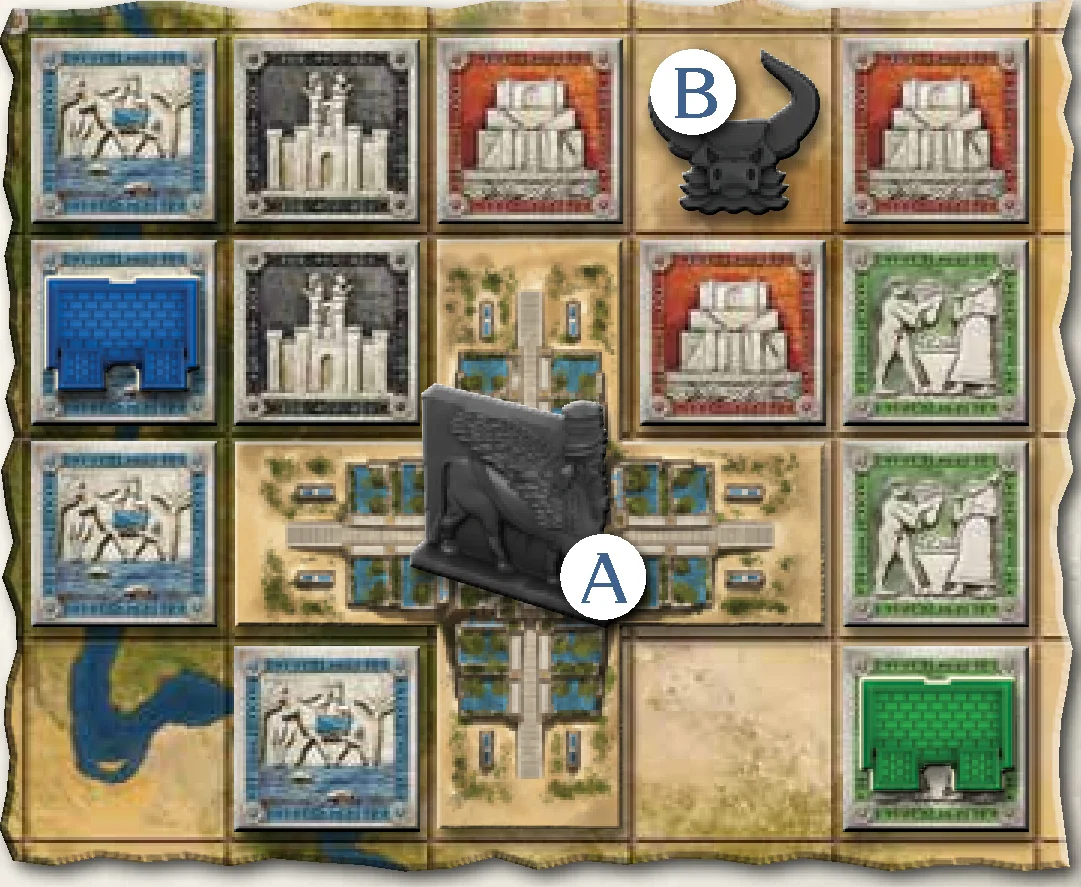
The wonder is a special five-tile monument with a cross-like shape. A player may erect the wonder when he creates a cross configuration of five tiles of a single color. If a player chooses to erect a wonder, he discards the five tiles that formed the cross configuration and replaces them with the wonder tile, which cannot be destroyed. Place the Shedu idol on top of the wonder tile. The wonder tile still counts as part of regions and kingdoms, and it can link leaders and tiles. However, it no longer counts for any other functions (e.g., as supporters in conflicts). All other monument rules apply to the wonder. At the end of the active player’s turn, if he has a king in a kingdom with the wonder, he gains 1 victory point token in the color of his choice.
Credits
Game Design: Reiner Knizia
Advanced Game Rules: Reiner Knizia, with Sebastian Bleasdale and Kevin Jacklin
Producer: Jason Walden
Editing: Adam Baker
Graphic Design: David Ardila and Edge Studios, with Christopher Hosch
Cover Art: Dleoblack and Zach Graves
Board and Interior Art: David Ardila and David Griffith
Managing Art Director: Andy Christensen
Proofreading: Christopher Meyer and Heather Silsbee
Quality Assurance Coordinator: Zach Tewalthomas
Plastics Management: Jason Beaudoin
Plastic Sculpting: Bexley Andrajack
Managing Graphic Designer: Brian Schomburg
FFG Licensing Coordinator: Amanda Greenhart
Production Manager: Eric Knight
Lead Game Producer: Steven Kimball
Executive Producer: Michael Hurley
Executive Game Designer: Corey Konieczka
Publisher: Christian T. Petersen
Playtesters: Iain Adams, Chris Bowyer, Gunthart von Chiari, John Christian, Andrew Daglish, Chris Dawe, Paul Evans, David Farquhar, Martin Higham, Ross Inglis, Kevin Jacklin, Tina Köther, Chris Lawson, Alex Martell, Werner Müller, Andreas and Karen Seyfarth, Daniel Steel, Andreas Trieb, Jo Weigand, Clemens Wildemann, Hannes Wildner, and Tony Wright
Introduction & Components
Introduction
Ur, Nineveh, Babylon—the ancient texts describe these cities as the origin of mankind. In fertile Mesopotamia, between the Tigris and Euphrates rivers, lies the cradle of civilization.
Around 3,000 B.C.E., the first large settlements of civilization developed along the embankments of these two great rivers. Farmers began to irrigate large parts of the surrounding lands, reaching out into the arid plains. Their triumph in turn bore consequences. Transport problems arose. In response, the clever artisans turned potters’ wheels on their sides and mounted them onto crude carts. Food could then be carried along the dry trails to market. Surpluses could be moved where needed.
Trade flourished, and markets dotted the countryside. In order to record the burgeoning number of transactions, merchants sought new tools of inscription. They began scratching marks into their urns, thereby inventing writing—even before the Egyptians. As the land began supporting denser populations and great concentrations of wealth and resources, society began to organize around a system of classes. A multitude of priests and royal administrators helped govern everyday life. They served many jealous gods and, of course, a succession of kings. Over the centuries, one dynasty succeeded another.
The game of Tigris & Euphrates allows you to take part in this fascinating saga. Step back to the dawn of urban civilization. Mesopotamia, the land of the two rivers, stretches before you. Now you and your people can try to forge the mightiest and most balanced culture. Now you can dominate the rich valleys of the Tigris and Euphrates.
Game Components
- 1 Double-Sided Game Board
- 153 Civilization Tiles:
- 57 red temples
- 30 black settlements
- 36 blue farms
- 30 green markets
- 4 Unification Tiles
- 8 Catastrophe Tiles
- 16 Plastic Leaders (4 of each color)
- 6 Plastic Monuments
- 140 Victory Point Tokens:
- 15 five-point bricks, 20 one-point bricks
- 15 five-point crops, 20 one-point crops
- 15 five-point amulets, 20 one-point amulets
- 15 five-point goods, 20 one-point goods
- 14 Treasure Tokens
- 4 Player Screens
- 1 Cloth Bag
Optional Variant Components
- 4 Plastic Civilization Buildings
- 1 Wonder Tile
- 1 Plastic Shedu Idol
Tiles and Colors
Tigris & Euphrates’ civilization tiles, buildings, leaders, and victory points exist in one of four colors: black, red, blue, or green. Each component and color combination has a unique thematic name. For example, blue civilization tiles are “farms.” This rulebook references components by their name; however, when a component is tied to a specific color, the name is printed using that color to help players learn both the name and color of each component. Furthermore, when this rulebook references “tiles,” it is referring to civilization tiles; all other tile types will be mentioned specifically.
Assembling the Monuments
Before you play your first game, assemble the six monuments. Each monument consists of two different-colored plastic pieces—a small top and a large base. Place the small top over the hole in the large base.
Make sure that no two monuments are alike. The proper combinations are:
- blue top / red base
- green top / black base
- blue top / black base
- green top / blue base
- red top / green base
- red top / black base
Setup
Setup Steps
To set up a game of Tigris & Euphrates, follow these steps:
- Set the Game Board: Place the game board in the play area. Use the standard game board, which has a gold—rather than blue—border. The other side of the board (which has a blue border) is used for the advanced game.
Place a temple tile on each of the ten board spaces marked by a winged beast (called a “Shedu”). Then, place a treasure token on top of each temple. - Prepare the Reserves: Put all of the remaining civilization tiles into the bag and shuffle them together. Then, place the four unused treasure tokens back into the box and all monuments near the side of the board. Finally, divide all of the victory point tokens by color and place them by the board.
- Choose Dynasties: Each player chooses a dynasty consisting of four leaders. The four leaders should bear the same dynastic symbol (i.e., the archer, the bull, the pot, or the lion) in a different color. Each player then takes the unification tile and two catastrophe tiles that contain his dynastic symbol, along with the screen bearing his dynastic symbol.
Note: Players are identified by their symbols, not by colors. Everyone uses all four colors.
Then, each player draws six tiles from the bag. He places the tiles behind his screen so that only he can see them. He leaves his leaders, his catastrophe tiles, and his unification tile in front of him and in full view of the other players. Put the spare leaders, screens, unification tiles, and catastrophe tiles back into the game box.
Choose a starting player at random by placing all of the players’ unification tiles with the dynastic symbols facedown on the table, mixing them, and then picking one. Play will proceed in a clockwise order.
The Tigris and Euphrates Rivers
Both of these great rivers originate in the mountains of what is now eastern Turkey. They make their way southeast first weaving through semi-arid hills and then winding across the parched plain of Mesopotamia, until they reach the Persian Gulf. Together, they brought life to the great cities in the heartland of the Fertile Crescent.
The first true civilization, Sumer, grew up above the confluence of the Tigris and Euphrates.
Core Concepts & Object of the Game
Object of the Game
The goal of each player is to develop all four of the key spheres of civilization: settlements, temples, farms, and markets. To do this, players will position their leaders, create and extend kingdoms, build monuments, and resolve conflicts. They will thus gain victory points in each of the four spheres. At the end of the game, players compare their lowest spheres; the winner is the player with most victory points in their lowest sphere.
Kingdoms
Players will build, unite, and destroy kingdoms during the course of the game. They are fundamental tools in the development of everyone’s civilizations.
- A region is any area on the game board covered by a lone tile (e.g., a temple) or two or more linked tiles. Regions do not contain leaders. At the start of the game there are ten distinct, one-tile regions.
- Tiles and leaders with a common edge are adjacent. Tiles or leaders are linked if they are adjacent or if they are connected through a chain of adjacent tiles and leaders.
- A group of one or more linked tiles and at least one leader together is called a kingdom. A kingdom can contain several leaders. It does not matter whether they belong to the same player or different players.
Kingdoms grow when leaders and tiles are added to the board. Kingdoms can be united and separated. As long as a kingdom contains only leaders of different colors, everything is peaceful. Conflicts arise when there are two like-colored leaders within one kingdom.
Hidden Information
- All victory point and treasure tokens gained and tiles behind a player’s screen are hidden information; they are kept secret from other players until scoring.
- The number of tiles in the bag is hidden information; players cannot deliberately count the tiles in the bag.
- Tiles that are removed from the game are hidden information; they are kept facedown in the box and cannot be viewed by any player.
Turn Structure & Actions
Turn Overview
The player taking his turn is called the active player. During his turn, the active player may resolve up to two actions in any order. After his turn is complete, the player sitting to his left becomes the active player.
There are four different actions an active player can resolve. The active player may choose two different actions or the same action twice:
- Position (place, move, or withdraw) a leader.
- Place a tile.
- Play a catastrophe tile.
- Replace up to six tiles from his hand.
After a tile is placed, a few other events may occur: conflicts, monument building, or treasure distribution. These events are not finished until fully resolved.
Action: Positioning a Leader
Each player possesses a dynasty of four leaders: a king, a priest, a farmer, and a trader. A player may only position his own leaders.
A leader can either come from outside the board or be repositioned from another space on the board. Furthermore, a leader can be withdrawn from the board. Leader placement must obey the following restrictions:
- A leader must be placed on an empty space.
- A leader can only be placed adjacent to a temple (i.e., the leader and temple must have a common edge).
- A leader cannot be placed in such a way as to unite kingdoms.
- A leader cannot be placed on a river space.
In certain situations, tiles can be removed from the board or turned facedown. When the last temple adjacent to a given leader is removed or turned facedown, the leader is returned to the player of that dynasty.
No victory points are gained for the positioning of leaders. A player cannot gain victory points without first having at least one leader on the board.
Action: Placing a Civilization Tile
A player will have six tiles behind his screen at the beginning of his turn. Players use these tiles to extend regions and kingdoms, strengthen leaders, and gain victory points. To place a tile, a player takes a tile from behind his screen and places it on the board according to the following restrictions:
- A tile must be placed faceup on an empty space.
- Farms can only be placed on river spaces.
- Settlements, temples, and markets cannot be placed on river spaces.
- A tile cannot be placed where it would unite more than two kingdoms.
When placing a tile, it can be placed adjacent to another tile, leader, or in isolation (i.e., adjacent to nothing). After a tile is placed, it cannot be relocated.
Most of the time, a player will gain a victory point when a tile is placed. The victory point is always the same color as the placed tile.
Gaining Victory Points
There are four types of victory points; each one is colored to correspond to a specific tile as follows:
- Bricks (Black VP) – Settlements
- Amulets (Red VP) – Temples
- Crops (Blue VP) – Farms
- Goods (Green VP) – Markets
A victory point is gained for placing a tile under the following circumstances:
- If the tile is placed in a kingdom, and this kingdom contains a leader of the same color, then the victory point is gained by the player controlling that leader.
- If there is no leader of the respective color, but there is a king within the kingdom, then the victory point is gained by the player controlling the king.
No victory point is gained if:
- the tile is not placed in a kingdom;
- there is no leader of the respective color or king to gain the victory point; or
- the tile is placed so that it unites two kingdoms, even if there are no conflicts.
Victory points are gained immediately when a tile is placed. They are kept hidden behind the players’ screens. When a player gains a victory point, he always takes a token valued at “1.” At any point during his turn, a player may exchange five tokens valued at “1” for one token valued at “5.”
Action: Playing a Catastrophe Tile
At the beginning of the game, each player receives two catastrophe tiles. A player can use them to permanently occupy and negate spaces on the board. When played, the catastrophe tile remains on the board for the rest of the game. It creates a blocked space that cannot be used again.
A player can place catastrophe tiles on an empty space or on top of an existing tile (which is then removed from the game). The only restrictions are as follows:
- A catastrophe tile cannot be played on a tile bearing a treasure or a monument.
- A catastrophe tile cannot be played on a leader.
A catastrophe tile disrupts the connection between leaders or tiles. In this way, a catastrophe tile may divide a kingdom into two or more parts. If a catastrophe tile destroys the last temple adjacent to a leader, that leader is immediately withdrawn from the board and returned to the player.
Action: Replacing Tiles
A player may take up to six tiles from his hand and return them to the box facedown. Then, he refreshes by drawing the same number of tiles from the bag and adding them to his hand. Discarded tiles are permanently removed from the game.
If a player replaces tiles as his first action, he can use the new tiles to carry out his second action.
End of a Turn
A player’s turn ends after he carries out his two actions (or if he chooses to end his turn before taking both available actions). If one or more of his leaders are linked with monuments, he may gain additional victory points. Finally, he refreshes his hand of tiles by drawing from the bag so that he ends his turn with six tiles in his hand.
If other players have fewer than six tiles at this point, then they also refresh their hand of tiles. Then, it is the next player’s turn.
Conflicts
Conflicts Overview
Conflicts can arise when someone positions a leader or places a tile. A conflict occurs whenever there are two like-colored leaders (e.g., two farmers or two kings) in a given kingdom. This can happen in two ways, so there are two different types of conflicts:
- Revolt: A revolt occurs when a leader is positioned in a kingdom that already contains a leader of the same color.
- War: Wars occur when two kingdoms are united through a new tile, and the new, larger kingdom contains leaders of the same color.
Keep the following in mind:
- Leader placement can only cause revolts, not wars.
- Tile placement can only cause wars, not revolts.
The conflict is resolved using tiles on the board and additional tiles played from behind the screens. An action does not end before the conflict is resolved. After all conflicts have been resolved, a kingdom will only contain leaders of different colors.
Conflict Summary
If a leader is positioned in a kingdom which already contains a leader of the same color, a revolt occurs, and the temples adjacent to the leaders (plus any additional tiles committed from hand) decide the outcome of the revolt. If two kingdoms are united such that the new, larger kingdom contains leaders of the same color, a war ensues, and the strength of the original supporters of the involved leaders (plus any additional tiles committed from hand) determine victory of the war.
Revolts
A revolt occurs when a leader is positioned in a kingdom that already contains a leader of the same color.
During a revolt, the player positioning the new leader is the attacker. The controller of the existing leader of the same color in that kingdom is the defender. Both the attacker and the defender draw their strength from temples.
Resolve revolts as follows:
- Count temples adjacent to leaders: Both the attacker and the defender draw strength by counting the number of temples adjacent to their conflicting leaders. A temple can count for both leaders.
- Players commit temples from their hands: First the attacker, and then the defender, may increase their strength by committing to the conflict any number of extra temples from their hands, placing them faceup in front of their screens. Each player can commit extra temples only once.
Whoever has the higher total strength (total number of temples) wins the conflict. The defender wins ties.
The consequences of a revolt are as follows:
- The loser must withdraw his leader from the board.
- The victor gains one amulet (because the conflict was fought with temples).
- Both players remove all committed temples from the game, placing them facedown in the box.
Wars
Wars occur when two kingdoms are united, and the new, larger kingdom contains leaders of the same color.
Remember that two kingdoms can be united through tile placement but not through leader positioning. Three or more kingdoms cannot be united by one tile. No victory point is gained when a tile is placed that unites two kingdoms. Instead, that tile is covered by the unification tile. A new, larger kingdom is created.
If the new united kingdom contains no two leaders of a like color, remove the unification tile and conclude the action without resolving any conflict. However, if the united kingdom contains leaders of the same color, war erupts.
All conflicts between two like-colored leaders are resolved individually. Each time there are wars between leaders in more than one color, the active player decides which war to resolve first. For each war after the first, players resolve the war using the kingdom’s current configuration, as recent wars might have disrupted the connection between leaders and tiles.
War Resolution
Resolve wars as follows:
- Determine who is the attacker: If the active player chooses to resolve a conflict that involves one of his leaders, he becomes the attacker. Otherwise, the next player (in clockwise order) with a leader involved becomes the attacker. The other player involved in the conflict is the defender.
- Count the supporters: Both the attacker and the defender draw strength by counting their leader’s supporters, which are tiles of like color on the board that are still connected to the leader. These tiles need not be adjacent to the respective leader. They only have to be in that part of the kingdom on his segment of the unification tile.
- Players commit tiles from their hands: First the attacker, and then the defender, may increase the strength of their supporters. They do this by committing to the conflict any number of extra tiles of the matching color from their hands, placing them faceup in front of their screens. Each player can commit tiles only once.
Whoever has the higher total strength (supporters on the board plus tiles committed from hand) wins the conflict. The defender wins ties.
Consequences of a War
- The loser must withdraw his leader and remove all supporters from the kingdom.
- The victor receives one victory point that matches the color of the withdrawn leader and one (also of matching color) for each of the supporters that are removed from the board. The tiles committed from any player’s hand do not count toward victory points.
- The defeated leader is returned to the losing player.
- Supporters of the defeated leader, and any committed tiles added by both players, are removed from the game and placed back in the box.
- Priest Conflict Exception: If two priests cause a conflict, temples (i.e., supporters) which bear a treasure, or have another leader adjacent to them, are not removed. Amulets are only gained for the defeated priest and the temples actually removed from the board.
When a tile is removed from the board, it might cause the kingdom to be divided into two or more parts. As a consequence, leaders originally exposed to war can end up in different kingdoms. If this occurs, then those leaders are no longer in conflict. However, if there are still leaders of like colors in the kingdom, a new war commences with the active player determining which conflict is resolved next. (The active player can influence events by choosing the order of conflict resolution.)
After all wars are resolved, the active player’s unification tile is removed and placed back outside his screen.
At the end of the active player’s turn, all other players who have committed tiles from their hands also refresh their hands back up to six.
Playing a Unification Tile
When a player unites kingdoms, he places his unification tile on top of the linking tile, as a reminder that a war might be about to take place between the newly united kingdoms. Whether or not a war ensues, no players gain victory points from the linking tile.
Only one unification tile can be in play at a given time. It remains on the board only while the players resolve any conflicts that might arise from the act of unification and is removed after all wars (if any) are resolved.
A player does not place a unification tile when he links regions or when he links a kingdom and a region.
Conflict Rewards Summary
- Winning a revolt: After a revolt, the winner gains one (and only one) amulet.
- Winning a war: After a war, the winner gains one victory point token of the matching color for each tile (plus the leader) that the loser removes from the board.
Temple Clarifications
Temples are important for many reasons. Leaders must be adjacent to temples at all times, and all treasures begin the game on temples. As such, some interesting situations involving temples may arise:
- During a revolt, a single temple can be used by multiple leaders.
- If a player uses a catastrophe tile to block a space containing a temple that is adjacent to a leader and that leader is no longer adjacent to a temple, that leader is removed from the game board.
- If a temple is flipped facedown or replaced with the wonder tile, any leaders adjacent to that temple that are no longer adjacent to any other temples are removed from the game board.
- When a player loses a war with a priest, he cannot remove temples from the game board if those temples either contain a treasure or are adjacent to leaders of any other color (king, trader, or farmer). The victor does not gain victory points for tiles that remain on the game board due to these exceptions.
- If a temple contains a treasure token and the active player wishes to use that tile to build a monument or wonder, he temporarily removes the treasure token and either places it back on the tile after the tile is flipped facedown (monument) or places it on the cross-shaped wonder tile (wonder). This treasure token is still in play and players can collect it following the normal rules.
Monuments & Treasures
Monument Building
Monument building can occur when someone places a tile.
There are six monuments in the game. Each monument consists of two different-colored parts; be sure to assemble these in the correct configuration.
If the active player places a tile in such a way that he creates a 2×2 square of four like-colored tiles, he may flip those four tiles facedown and place a monument on top of them. One color of the monument must match the facedown tiles. If that color is no longer available, the monument cannot be built, and therefore the tiles cannot be flipped facedown.
If tile placement initiates a war, the players must resolve the conflict before flipping tiles facedown. If the square still exists after resolving the conflict, the active player may build a monument.
If the player completing the square does not build a monument as part of his current action, the tiles remain faceup. A monument can be built only at the end of the action in which the active player completed a 2×2 square.
The four facedown tiles still count as part of regions and kingdoms, linking leaders and tiles. However, they no longer count for any other functions (e.g., as supporters in conflicts). A monument cannot be destroyed.
When four temples are flipped facedown and a monument is built, the following applies:
- If a treasure lies on a temple, it remains on that facedown tile.
- If a leader is no longer adjacent to a temple, withdraw that leader and return it to the player.
A monument regularly provides victory points. At the end of the active player’s turn, he determines if one or more of his leaders are in the same kingdom as a like-colored monument. For each such leader, he gains one victory point of the leader’s color for each like-colored monument in the same kingdom. For example, if he has a blue leader (farmer) in a kingdom with a blue monument, he gains a blue victory point (crop). Since a monument has two colors, it can provide victory points for up to two leaders each turn.
A king gains a victory point only when linked to a black monument. While the placement of a tile can allow a king to gain victory points in other colors (in the absence of the respective leaders), this does not apply for monuments.
Treasure Distribution
Treasure distribution can be initiated when a player positions a leader or places a tile.
At the beginning of the game, ten treasure tokens are placed on the first ten temples on the board.
Treasures are gained in the following way:
If a kingdom contains more than one treasure at the end of a player’s action, the trader in that kingdom must gain all but one of these treasures. If there are treasures on a special border space, the player must take treasures from those spaces first; after that, he may choose from which space to take his remaining treasures.
If there is no trader in the kingdom, the treasures remain there until the kingdom has a trader.
Each treasure counts as one wild victory point. At the end of the game, you may allocate each treasure individually to any victory point type of your choice.
First Round Example
Round Walkthrough
Andrew’s Turn
Andrew begins the game. He positions two of his leaders on the board: a king and a priest (1). In this way he creates two kingdoms.
Barbara’s Turn
First, Barbara positions her farmer (2), extending one of the kingdoms created by Andrew. Then, she places a farm on the adjacent river space (3). For this she receives one crop (4). (The farmer and the farm are of like colors, and she controls the farmer.) She draws one tile from the bag to refresh her hand.
David’s Turn
David positions his king (5) and creates a new kingdom. Then, he places a temple (6). He gains one amulet (7) because there is no priest in the kingdom (matching the color of the temple). Hence, the controller of the king gains the amulet. Note that David has placed his temple in such a way that his king is now adjacent to two temples. David refreshes his hand by drawing one tile.
Karen’s Turn
Karen drew four temples at the beginning and feels aggressive. As her first action, she positions her priest (8) in the same kingdom as Andrew’s priest. A revolt arises. On the board, both players have one temple in support of their leaders. Karen commits three extra temples from behind her screen (9).
At most, Andrew could commit two extra temples, but that would not be enough to tie with Karen, so he refrains from committing any extra temples. Karen wins (four to one). Her committed temples are removed from the game (10). Andrew must withdraw his priest (11). Karen gains one amulet (12) for winning the revolt. As her second action, Karen places her fourth temple on the board (13) and receives another amulet (14). Then, she refreshes her hand by drawing four tiles.
Now it is Andrew’s turn again.
Game End and Winner
End of the Game
The game ends when either of the following conditions are met:
- Only one or two treasures remain on the board at the end of a player’s turn, or
- A player who is attempting to draw a tile is unable to because the bag is empty.
Determining the Winner
At this point all players lower their screens. Each player determines in which sphere they possess the fewest number of victory points, with each player freely allocating his treasures to any sphere(s). The player whose lowest sphere has the highest number of victory points is the winner. In the case of a tie, the tied players compare their second lowest spheres, and so on. If multiple tied players are evenly matched in all four spheres, those players share the victory.
Advanced Rules & Variants
Advanced Game Rules: Civilization Buildings
The advanced game uses four civilization buildings. They include a palace, a library, a market hall, and a granary. During setup, place these buildings next to the board near the monuments.
When a player places one of his tiles on the board so that it becomes part of an uninterrupted vertical or horizontal line of three or more tiles of the same color, that player may take the corresponding color building from beside the board and place it on any one of the color tiles in the line.
If the corresponding building is already on the board, the player may remove the building from its current location and place it on any one of the color tiles in the new line, provided the new line is longer than the line where the building is currently located.
If a building is on a tile that is part of both a horizontal line and a vertical line, the new line must be longer than each of the building’s current lines.
Civilization buildings must be placed before building a monument or erecting a wonder (if able).
When a player places a tile in a kingdom containing a building of the corresponding color, the reward for the respective leader (or the king if the leader is absent) increases from one to two victory points. (Rewards for conflicts or monuments remain unaffected.)
Players must resolve conflicts before building placement. A tile directly under a building counts in conflicts and cannot be removed. Catastrophe tiles cannot be played on a tile that is under a building. If you flip over a tile that is under a building in order to build a monument or wonder, remove the building and place it next to the board for future use.
The Rise of Civilization
Sumer’s kings and city states emerged before 3000 BCE. They brought writing and commerce to the Fertile Crescent. In time (circa 2371 B.C.E.), the Akkadians supplanted the Sumerians and created a more centralized state. Their Kings, notably Sargon and his grandson Naram-Sin, forged an empire stretching far to the north and west. Many peoples and dynasties would follow, all seeking to rule these rich lands.
Advanced Game Board
The advanced game board is an alternate board printed on the back of the original board. It is differentiated by a blue border (rather than gold). It uses a different map and contains four extra treasures. When you play with the alternate board, place one temple with a treasure on each of the fourteen Shedu spaces. Then, play by the original rules.
When a player collects a treasure from a kingdom containing more than one treasure, he must first collect those treasures from spaces outlined with the special border.
English Variant
In order to restrict the opportunity to discard extra tiles during a conflict that do not influence its resolution, the following variant may be adopted: the attacker may commit extra tiles if thereafter his total exceeds the current strength of the defender. If he has no chance of winning the conflict, he cannot commit any extra tiles. The defender can commit extra tiles only in order to win the conflict by establishing a tie. No more, no less!
Wonder Variant
The wonder is a special five-tile monument with a cross-like shape. A player may erect the wonder when he creates a cross configuration of five tiles of a single color. If a player chooses to erect a wonder, he discards the five tiles that formed the cross configuration and replaces them with the wonder tile, which cannot be destroyed. Place the Shedu idol on top of the wonder tile. The wonder tile still counts as part of regions and kingdoms, and it can link leaders and tiles. However, it no longer counts for any other functions (e.g., as supporters in conflicts). All other monument rules apply to the wonder. At the end of the active player’s turn, if he has a king in a kingdom with the wonder, he gains 1 victory point token in the color of his choice.
Credits
Credits
Game Design: Reiner Knizia
Advanced Game Rules: Reiner Knizia, with Sebastian Bleasdale and Kevin Jacklin
Producer: Jason Walden
Editing: Adam Baker
Graphic Design: David Ardila and Edge Studios, with Christopher Hosch
Cover Art: Dleoblack and Zach Graves
Board and Interior Art: David Ardila and David Griffith
Managing Art Director: Andy Christensen
Proofreading: Christopher Meyer and Heather Silsbee
Quality Assurance Coordinator: Zach Tewalthomas
Plastics Management: Jason Beaudoin
Plastic Sculpting: Bexley Andrajack
Managing Graphic Designer: Brian Schomburg
FFG Licensing Coordinator: Amanda Greenhart
Production Manager: Eric Knight
Lead Game Producer: Steven Kimball
Executive Producer: Michael Hurley
Executive Game Designer: Corey Konieczka
Publisher: Christian T. Petersen
Playtesters: Iain Adams, Chris Bowyer, Gunthart von Chiari, John Christian, Andrew Daglish, Chris Dawe, Paul Evans, David Farquhar, Martin Higham, Ross Inglis, Kevin Jacklin, Tina Köther, Chris Lawson, Alex Martell, Werner Müller, Andreas and Karen Seyfarth, Daniel Steel, Andreas Trieb, Jo Weigand, Clemens Wildemann, Hannes Wildner, and Tony Wright