
Bohnanza
1997
Trade cleverly, manage an unchangeable hand, and harvest beans for coins before the deck runs out.
45
minutes
3 - 7
player(s)
12+
Medium Light

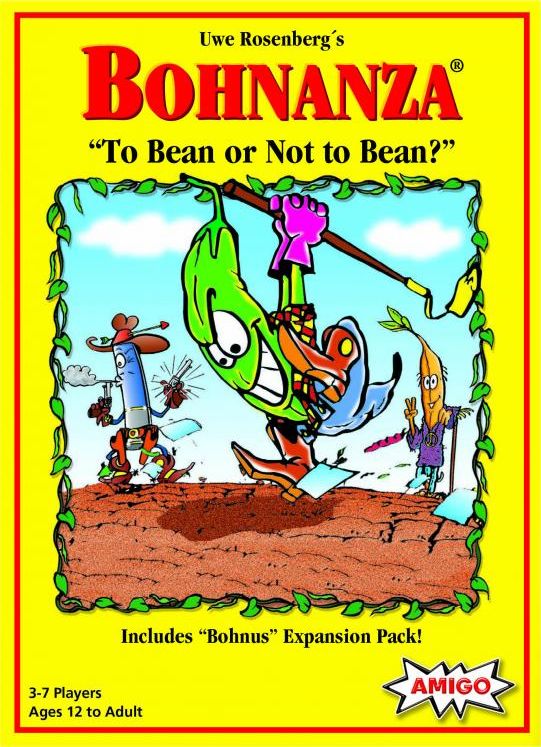
About this board game
Bohnanza is a bean-trading card game for 3–7 players that plays in about 45 minutes and was first released in 1997. Plant beans, negotiate trades, and harvest your fields to earn the most coins.
Each player begins with a random hand of bean cards, but the cards must stay in the order they were received. You cannot rearrange them, so every new card affects your plans. Trading is the heart of the game, letting you exchange unwanted cards with other players and avoid costly harvests.
On your turn, plant the first one or two cards in your hand. Each field can contain only one bean type, so planting a new type may force you to harvest a field to make room. Next, reveal two cards from the deck and trade them, along with cards from your hand, with other players. Every trade during the turn must involve the active player, though future promises can be made for cards received immediately.
- Plant: Add the first one or two cards from your hand to your fields.
- Trade: Exchange cards with other players, including the two newly revealed cards.
- Harvest: Convert bean cards into coins according to the beanometer for that type.
- Draw: Place new cards at the back of your hand.
When harvesting, flip over between one and four cards from a field to turn them into coins; any remaining cards go to the discard pile. Once the deck is exhausted, shuffle the discards and play through the deck two more times. After the final harvest, the player with the most coins wins.
Several major card sets are represented in the Bohnanza family, including the base game, an expanded version for up to seven players, and Bohnanza Pocket.
/pic7182955.jpg)
Board Game Rules for
Bohnanza
“To Bean or not to bean!”
by Uwe Rosenberg, with illustrations by Björn Pertoft
Players: 2–7 • Ages: 10 and up • Duration: approx. 45 minutes
The Idea of the Game
Bohnanza is all about planting, trading, and harvesting beans. Trade beans with the other players and plant them in your fields. That is great fun! And the more beans you have in your field, the more gold coins you get when you harvest them. If you have the most gold coins at the end of the game, you win!
The following rules describe the original Base-Game for 3-5 players, with the original bean kinds.
The three additional bean kinds – Cocoa Bean, Wax Bean and Coffee Bean – are only used in the variant for up to 7 players. (See page 7)
Bean Field Mats
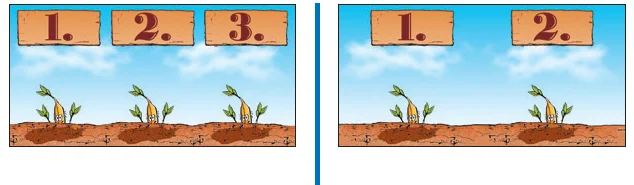
Give one of the bean field mats to each player. These mats have one side showing three bean fields and one side showing two fields:
- If there are three players, use the mats with the three bean fields side up.
- If there are four or five players, start with two bean fields each.
Starting Player
Pick a starting player and give them the starting player card. (The second starting player card is a replacement card if you need it—you can keep it in the box.)
Bean Cards & Hand Order Rule
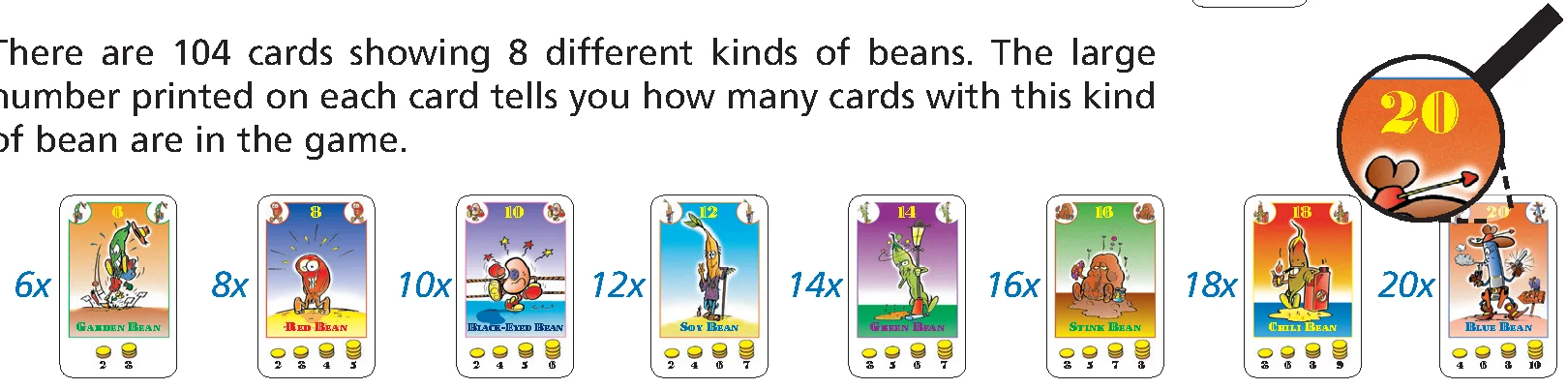
There are 104 cards showing 8 different kinds of beans. The large number printed on each card tells you how many cards with this kind of bean are in the game.
Shuffle all the cards and deal five cards to each player.
Attention! This is the most important rule of the whole game!
You cannot change the order of the cards in your hand at any point during the game! The first card you are dealt is the first card in your hand. It is completely visible to you. Put all other cards you receive behind it, in the order drawn. You may never sort your cards for any reason.
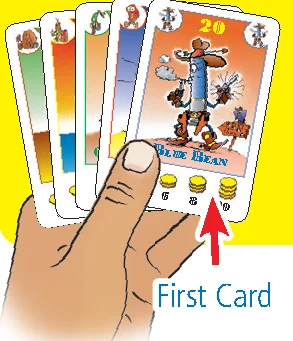
Table Layout
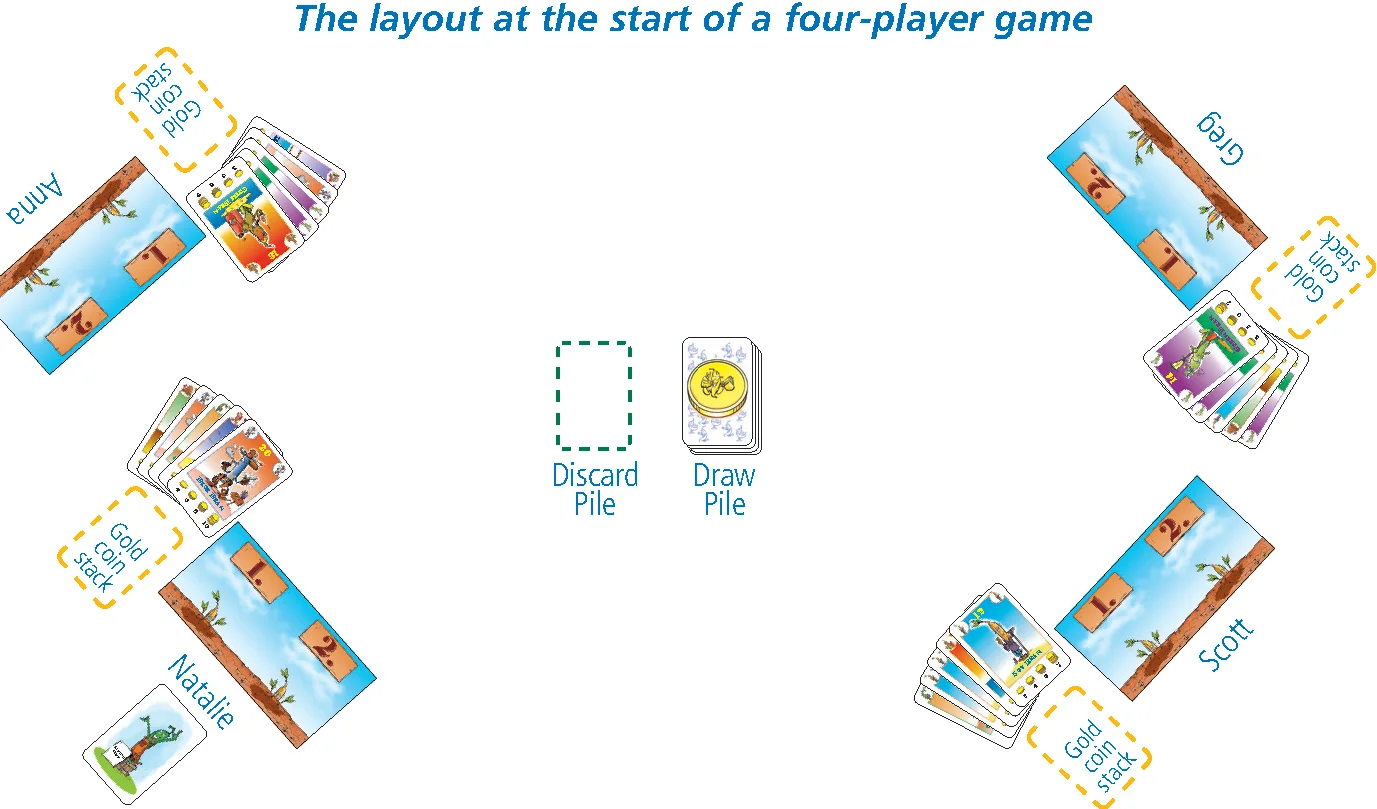
Put the remaining cards in the center of the table as a draw pile, gold coin side up. During the game, you will create a discard pile next to it and a gold coin stack in front of each player (see illustration to the right).
The starting player is the first active player. After that, players take turns going to the in clockwise order. The starting player keeps the starting player card for the whole game (see “The End of the Game”).
When it is your turn, you play through these four phases in order:
- Plant Bean Cards from Your Hand
- Turn Over and Trade Bean Cards
- Plant Turned-over and Traded Bean Cards
- Draw Bean Cards
Important Rules for Planting Beans
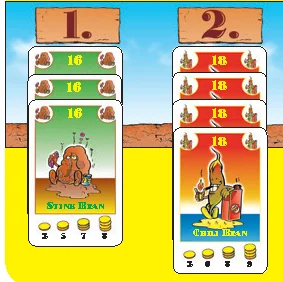
You can only plant one kind of bean in each field at a time. You are allowed to plant the same kind of bean in two different fields at the same time, but not two kinds of bean in the same field. Put the bean cards in your field on top of each other, as shown to the left.
Phase 1: Plant Bean Cards from Your Hand
- You must plant the first card in your hand (i.e. the one that is completely visible) in one of your fields (see both illustrations to the right).
- After that, you may choose to plant one more card – the one that is now completely visible – in one of your fields (see both illustrations to the right). You cannot plant a third bean at this time.
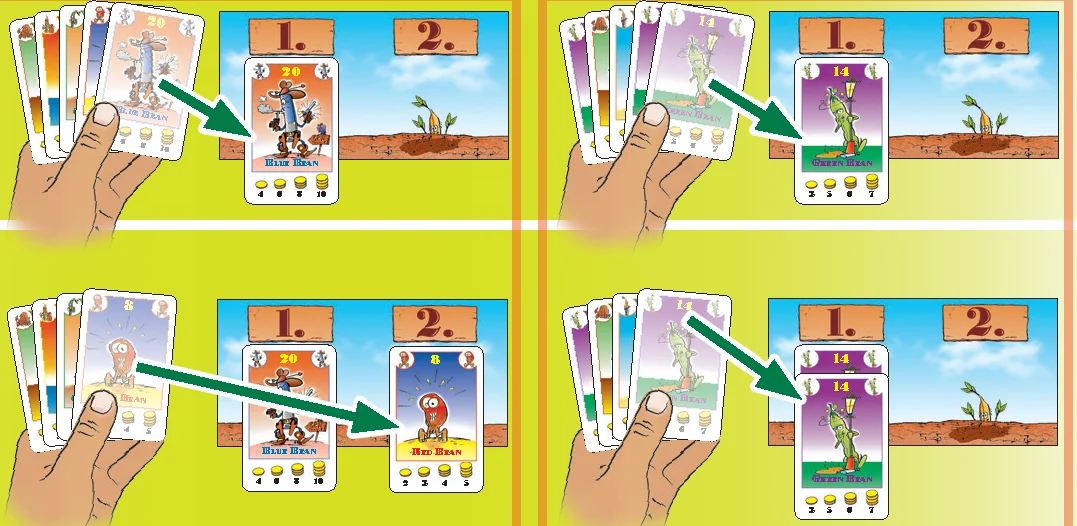
When planting, you start or extend the column of cards in the field.
- If you have to plant a kind of bean you do not have space for, you must harvest a field first (see “Harvesting Beans”).
- If you do not have any cards in your hand at the start of phase 1, skip it and go straight to phase 2.
Phase 2: Turn Over and Trade Bean Cards
Turn over the top two cards from the draw pile and put them next to it face-up for all players to see.
The turned-over cards belong to you: You can plant them in your fields or use them to trade with the other players.
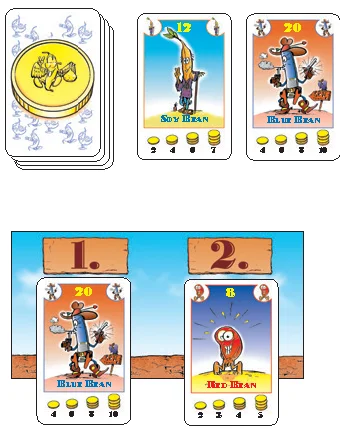
Example #1: Natalie has turned over a Soy Bean and a Blue Bean. She keeps the Blue Bean, but there is no space for the Soy Bean in her bean fields, so she offers it up for trade to the other players. She asks: “Would anyone like this Soy Bean? I’d like to trade it for a Red Bean.”
Rules for Trading Beans:
- Only the active player is allowed to trade with the other players. The other players cannot trade with each other.
- You may all trade using your hand cards, no matter where they are in your hands.
- The active player can use the two turned-over cards for trading in addition to their hand cards.
- You cannot trade cards you have received in a trade.
- You cannot trade the cards in your fields, either.
- You are allowed to trade any number of beans for any number of other beans (e.g., two Blue Beans for one Green Bean).
Example #2: No-one wants to trade with Natalie, so she ups her offer: “I’ll give you the turned-over Soy Bean and a Chili Bean from my hand for a Red Bean.”
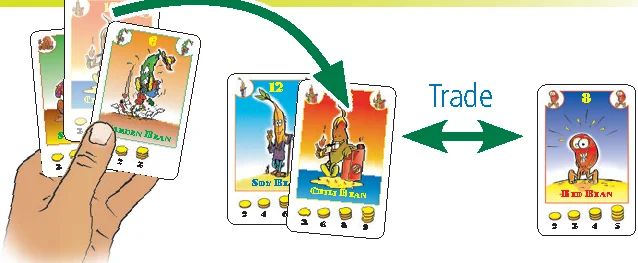
Note: Only remove beans from your hand once the trade has been agreed on. Both players have to agree to the trade. This way, you can avoid discussions about where the card was in your hand after having taken it out of order too soon.
Put any bean cards you receive in trade next to your bean fields horizontally for now. Do not add them to your hand!
Example #3: Anna accepts Natalie’s offer of the Soy Bean and the Chili Bean. Natalie puts it next to her bean fields horizontally. Anna does the same with the Soy Bean and the Chili Bean.
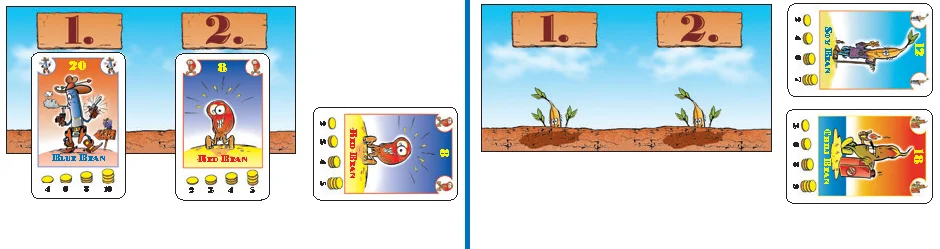
Note: As a special form of trade, you can also give another player bean cards. Players receiving gifts have to agree to take them, though. If they refuse, you cannot give them the cards.
You may continue trading for as long as you like, even after the turned-over cards are gone. When you want to stop, tell the other players. This ends phase 2.
Phase 3: Plant Turned-over and Traded Bean Cards
All players who have horizontal cards next to their bean fields now have to plant them. As the active player, you will also have to plant any turned-over cards you have not traded away.
You can plant your new bean cards in any order you choose.
Example #4: Natalie plants the Red Bean she received in trade and the Blue Bean she turned over in her two fields. Anna plants the Soy Bean and the Chili Bean in her two fields.
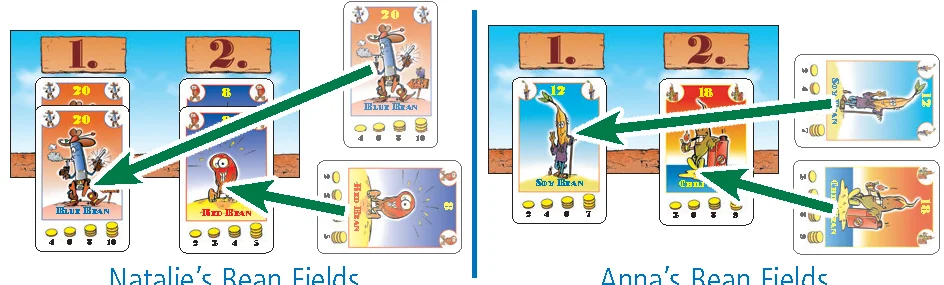
If you have to plant a kind of bean that does not match the beans you already have in your fields, you will have to harvest a field before you can plant your new beans (see “Harvesting Beans”).
Phase 4: Draw Bean Cards
End your turn by drawing three cards, one after the other, from the draw pile. Put them in the back of your hand, behind the last card, in the order you draw them. Then, the player to your left becomes the new active player.
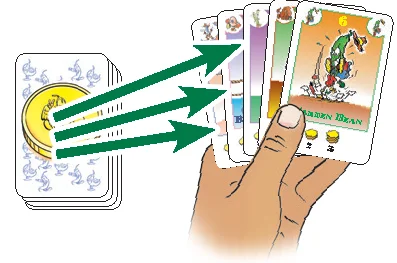
You may harvest beans from your fields at any time during the game, even when you are not the active player.
The Beanometer
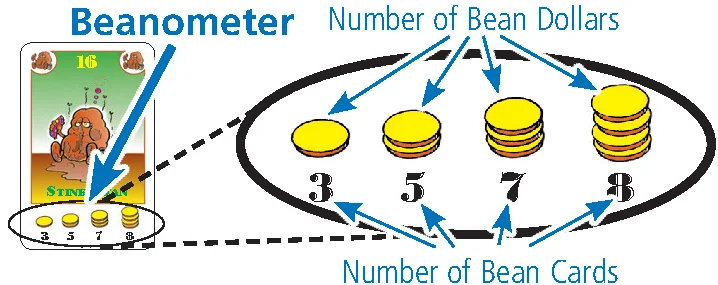
Each kind of bean has its own “beanometer”. This tells you how many Gold coins you get for a given number of beans you harvest.
Note: Some harvests may not earn you any gold coins!
The Stink Bean’s beanometer tells you:
- If you harvest 1 or 2 Stink Beans, you do not get any gold coins.
- For 3 or 4 Stink Beans, you earn one gold coin.
- 5 or 6 Stink Beans earn you two gold coins.
- For 7 Stink Beans you get three gold coins.
- 8 or more Stink Beans pay out four gold coins.
Harvesting Steps
When you harvest beans, follow these steps:
- Count the number of cards in the bean field you want to harvest.
- Check the top card’s beanometer.
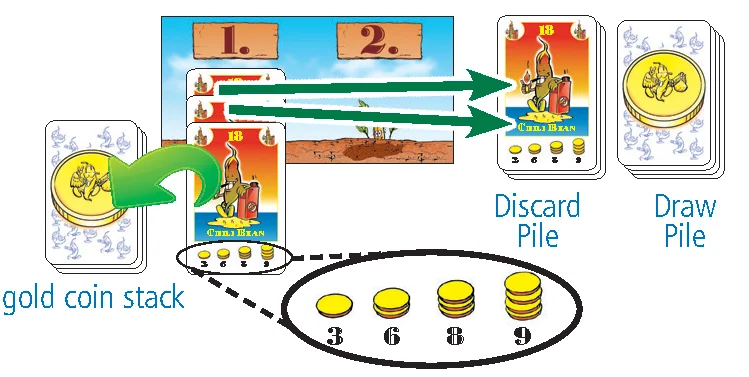
- Turn over as many of those cards as you get gold coins (according to the beanometer) so that their gold coin sides show.
- Put these cards on your gold coin stack.
- Put the remaining cards from your field face-up on the discard pile.
- After you harvest, the field must be empty—you cannot harvest only part of a field.
Example #5: Greg has 3 Chili Beans in one of his fields. The Chili Bean’s beanometer tells him that these three beans are worth 1 gold coin. Greg turns one card over to its dollar side and puts it on his gold coin stack. Then, he puts the remaining two Chili Beans on the discard pile.
The Bean Protection Rule
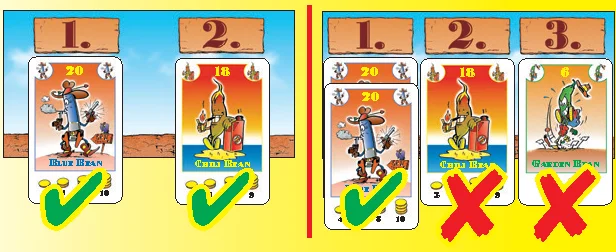
If there is only one bean card in one of your fields, you cannot harvest it as long as you have another field containing more than one bean card.
If The Draw Pile Is Empty
When you draw the last card from the draw pile, re-shuffle the discard pile. Turn it over and put it back in the center of the table as the new draw pile.
The game ends when the draw pile runs out for the third time. If this happens during phase 2, “Trading Bean Cards”, complete phases 2 and 3 of your turn (even if you could only turn over one card instead of two), then the game ends.
At the end of the game, harvest all of your bean fields and give yourself the appropriate number of gold coins. Cards in your hand do not count towards your total.
Count the cards in your gold coin stack. Each card is worth one gold coin. The player with the most gold coins wins the game!
If there is a tie, the tied player who sits the furthest away from the starting player (going around the table clockwise) wins the game.
Components & Setup
Add the Cocoa, Wax, and Coffee Beans to your game.
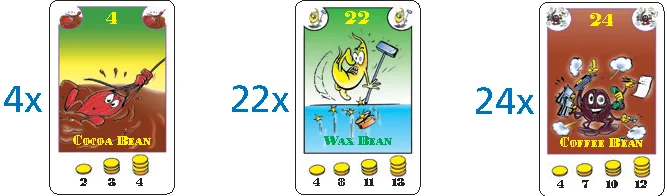
Depending on the number of players, you will need to remove certain types of beans from the game. The number of available bean fields also depends on the number of players.
Beans in Play
Based on the number of players, remove the following types of beans and put the cards back in the box:
- three players: Cocoa Beans
- four/five players: Coffee Beans
- six/seven players: Cocoa and Garden Beans
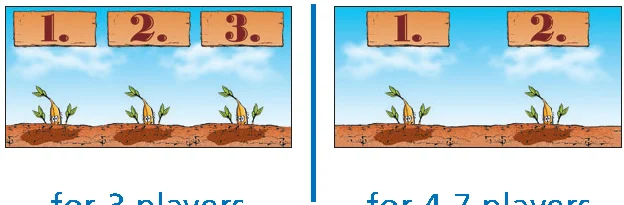
Number of Bean Fields
- If there are three players, turn over your bean field mats so the side with three bean fields shows.
- If there are four to seven players, use the side of the bean field mats showing two bean fields.
Playing the Game
Play the game just like regular Bohnanza: Each player starts with five cards in their hands; On your turn, play through the usual four phases. Only the rules for phase 4, “Drawing bean cards”, and the end of the game change when you play with extra types of beans.
Phase 4: Draw Bean Cards
Unlike in the base game, every player draws one card from the draw pile, adding them to their hands behind the last card. Start with the active player and draw cards in a clockwise direction.
The End of the Game
- If there are three players, the game ends when the draw pile runs out for the second time.
- If there are four or more players, the game ends when the draw pile runs out for the third time, as usual.
The bean duel with two players uses the same rules as the variant for three players with the following changes:
- Remove the Garden Beans and the Cocoa Beans from the game.
- A player may only sell beans from his bean fields on his turn.
- The game ends when the draw deck is exhausted for the first time.
Turn Structure
On a player’s turn, he does the following in the order indicated:
- Plant or discard offered bean cards
The player may plant or discard the bean cards his opponent left as an offer in step 3 of his turn. This is omitted by the starting player on his first turn. - Plant bean cards & discard
After planting one or two cards in his bean fields (as in the normal game), the player may discard one card from anywhere in his hand face up on the discard pile. - Draw, plant, and offer beans
The active player draws the three topmost cards from the draw deck and puts them face up on the table so both players can see them. If the topmost card on the discard pile matches any of the cards just drawn, the player adds it to them. He does the same with the new topmost card from the discard pile until the topmost card on the discard pile does not match any of the drawn cards. Now the player may plant any of these drawn (from the draw deck or discard pile) cards he wants, selling such beans as he can and wants in the process. He leaves any drawn cards he does not want as an offer to his opponent. He need not plant any of the drawn cards. The players can earn more gold coins through this extended draw. - Draw new bean cards
The active player draws two cards from the draw deck. He draws them one at a time, placing each in turn at the back of his hand.
Introduction & Overview
“To Bean or not to bean!”
by Uwe Rosenberg, with illustrations by Björn Pertoft
Players: 2–7 • Ages: 10 and up • Duration: approx. 45 minutes
The Idea of the Game
Bohnanza is all about planting, trading, and harvesting beans. Trade beans with the other players and plant them in your fields. That is great fun! And the more beans you have in your field, the more gold coins you get when you harvest them. If you have the most gold coins at the end of the game, you win!
The following rules describe the original Base-Game for 3-5 players, with the original bean kinds.
The three additional bean kinds – Cocoa Bean, Wax Bean and Coffee Bean – are only used in the variant for up to 7 players. (See page 7)
Setup
Bean Field Mats
Give one of the bean field mats to each player. These mats have one side showing three bean fields and one side showing two fields:
- If there are three players, use the mats with the three bean fields side up.
- If there are four or five players, start with two bean fields each.
Starting Player
Pick a starting player and give them the starting player card. (The second starting player card is a replacement card if you need it—you can keep it in the box.)
Bean Cards & Hand Order Rule
There are 104 cards showing 8 different kinds of beans. The large number printed on each card tells you how many cards with this kind of bean are in the game.
Shuffle all the cards and deal five cards to each player.
Attention! This is the most important rule of the whole game!
You cannot change the order of the cards in your hand at any point during the game! The first card you are dealt is the first card in your hand. It is completely visible to you. Put all other cards you receive behind it, in the order drawn. You may never sort your cards for any reason.
Table Layout
Put the remaining cards in the center of the table as a draw pile, gold coin side up. During the game, you will create a discard pile next to it and a gold coin stack in front of each player (see illustration to the right).
How to Play (Turn Structure)
The starting player is the first active player. After that, players take turns going to the in clockwise order. The starting player keeps the starting player card for the whole game (see “The End of the Game”).
When it is your turn, you play through these four phases in order:
- Plant Bean Cards from Your Hand
- Turn Over and Trade Bean Cards
- Plant Turned-over and Traded Bean Cards
- Draw Bean Cards
Important Rules for Planting Beans
You can only plant one kind of bean in each field at a time. You are allowed to plant the same kind of bean in two different fields at the same time, but not two kinds of bean in the same field. Put the bean cards in your field on top of each other, as shown to the left.
Phase 1: Plant Bean Cards from Your Hand
- You must plant the first card in your hand (i.e. the one that is completely visible) in one of your fields (see both illustrations to the right).
- After that, you may choose to plant one more card – the one that is now completely visible – in one of your fields (see both illustrations to the right). You cannot plant a third bean at this time.
When planting, you start or extend the column of cards in the field.
- If you have to plant a kind of bean you do not have space for, you must harvest a field first (see “Harvesting Beans”).
- If you do not have any cards in your hand at the start of phase 1, skip it and go straight to phase 2.
Phase 2: Turn Over and Trade Bean Cards
Turn over the top two cards from the draw pile and put them next to it face-up for all players to see.
The turned-over cards belong to you: You can plant them in your fields or use them to trade with the other players.
Example #1: Natalie has turned over a Soy Bean and a Blue Bean. She keeps the Blue Bean, but there is no space for the Soy Bean in her bean fields, so she offers it up for trade to the other players. She asks: “Would anyone like this Soy Bean? I’d like to trade it for a Red Bean.”
Rules for Trading Beans:
- Only the active player is allowed to trade with the other players. The other players cannot trade with each other.
- You may all trade using your hand cards, no matter where they are in your hands.
- The active player can use the two turned-over cards for trading in addition to their hand cards.
- You cannot trade cards you have received in a trade.
- You cannot trade the cards in your fields, either.
- You are allowed to trade any number of beans for any number of other beans (e.g., two Blue Beans for one Green Bean).
Example #2: No-one wants to trade with Natalie, so she ups her offer: “I’ll give you the turned-over Soy Bean and a Chili Bean from my hand for a Red Bean.”
Note: Only remove beans from your hand once the trade has been agreed on. Both players have to agree to the trade. This way, you can avoid discussions about where the card was in your hand after having taken it out of order too soon.
Put any bean cards you receive in trade next to your bean fields horizontally for now. Do not add them to your hand!
Example #3: Anna accepts Natalie’s offer of the Soy Bean and the Chili Bean. Natalie puts it next to her bean fields horizontally. Anna does the same with the Soy Bean and the Chili Bean.
Note: As a special form of trade, you can also give another player bean cards. Players receiving gifts have to agree to take them, though. If they refuse, you cannot give them the cards.
You may continue trading for as long as you like, even after the turned-over cards are gone. When you want to stop, tell the other players. This ends phase 2.
Phase 3: Plant Turned-over and Traded Bean Cards
All players who have horizontal cards next to their bean fields now have to plant them. As the active player, you will also have to plant any turned-over cards you have not traded away.
You can plant your new bean cards in any order you choose.
Example #4: Natalie plants the Red Bean she received in trade and the Blue Bean she turned over in her two fields. Anna plants the Soy Bean and the Chili Bean in her two fields.
If you have to plant a kind of bean that does not match the beans you already have in your fields, you will have to harvest a field before you can plant your new beans (see “Harvesting Beans”).
Phase 4: Draw Bean Cards
End your turn by drawing three cards, one after the other, from the draw pile. Put them in the back of your hand, behind the last card, in the order you draw them. Then, the player to your left becomes the new active player.
Harvesting Beans
You may harvest beans from your fields at any time during the game, even when you are not the active player.
The Beanometer
Each kind of bean has its own “beanometer”. This tells you how many Gold coins you get for a given number of beans you harvest.
Note: Some harvests may not earn you any gold coins!
The Stink Bean’s beanometer tells you:
- If you harvest 1 or 2 Stink Beans, you do not get any gold coins.
- For 3 or 4 Stink Beans, you earn one gold coin.
- 5 or 6 Stink Beans earn you two gold coins.
- For 7 Stink Beans you get three gold coins.
- 8 or more Stink Beans pay out four gold coins.
Harvesting Steps
When you harvest beans, follow these steps:
- Count the number of cards in the bean field you want to harvest.
- Check the top card’s beanometer.
- Turn over as many of those cards as you get gold coins (according to the beanometer) so that their gold coin sides show.
- Put these cards on your gold coin stack.
- Put the remaining cards from your field face-up on the discard pile.
- After you harvest, the field must be empty—you cannot harvest only part of a field.
Example #5: Greg has 3 Chili Beans in one of his fields. The Chili Bean’s beanometer tells him that these three beans are worth 1 gold coin. Greg turns one card over to its dollar side and puts it on his gold coin stack. Then, he puts the remaining two Chili Beans on the discard pile.
The Bean Protection Rule
If there is only one bean card in one of your fields, you cannot harvest it as long as you have another field containing more than one bean card.
If The Draw Pile Is Empty
When you draw the last card from the draw pile, re-shuffle the discard pile. Turn it over and put it back in the center of the table as the new draw pile.
End of the Game & Winning
The game ends when the draw pile runs out for the third time. If this happens during phase 2, “Trading Bean Cards”, complete phases 2 and 3 of your turn (even if you could only turn over one card instead of two), then the game ends.
At the end of the game, harvest all of your bean fields and give yourself the appropriate number of gold coins. Cards in your hand do not count towards your total.
Count the cards in your gold coin stack. Each card is worth one gold coin. The player with the most gold coins wins the game!
If there is a tie, the tied player who sits the furthest away from the starting player (going around the table clockwise) wins the game.
Variant: Three New Types of Beans (for 3-7 player games)
Components & Setup
Add the Cocoa, Wax, and Coffee Beans to your game.
Depending on the number of players, you will need to remove certain types of beans from the game. The number of available bean fields also depends on the number of players.
Beans in Play
Based on the number of players, remove the following types of beans and put the cards back in the box:
- three players: Cocoa Beans
- four/five players: Coffee Beans
- six/seven players: Cocoa and Garden Beans
Number of Bean Fields
- If there are three players, turn over your bean field mats so the side with three bean fields shows.
- If there are four to seven players, use the side of the bean field mats showing two bean fields.
Playing the Game
Play the game just like regular Bohnanza: Each player starts with five cards in their hands; On your turn, play through the usual four phases. Only the rules for phase 4, “Drawing bean cards”, and the end of the game change when you play with extra types of beans.
Phase 4: Draw Bean Cards
Unlike in the base game, every player draws one card from the draw pile, adding them to their hands behind the last card. Start with the active player and draw cards in a clockwise direction.
The End of the Game
- If there are three players, the game ends when the draw pile runs out for the second time.
- If there are four or more players, the game ends when the draw pile runs out for the third time, as usual.
Variant: The Bean Duel for 2 Players
The bean duel with two players uses the same rules as the variant for three players with the following changes:
- Remove the Garden Beans and the Cocoa Beans from the game.
- A player may only sell beans from his bean fields on his turn.
- The game ends when the draw deck is exhausted for the first time.
Turn Structure
On a player’s turn, he does the following in the order indicated:
- Plant or discard offered bean cards
The player may plant or discard the bean cards his opponent left as an offer in step 3 of his turn. This is omitted by the starting player on his first turn. - Plant bean cards & discard
After planting one or two cards in his bean fields (as in the normal game), the player may discard one card from anywhere in his hand face up on the discard pile. - Draw, plant, and offer beans
The active player draws the three topmost cards from the draw deck and puts them face up on the table so both players can see them. If the topmost card on the discard pile matches any of the cards just drawn, the player adds it to them. He does the same with the new topmost card from the discard pile until the topmost card on the discard pile does not match any of the drawn cards. Now the player may plant any of these drawn (from the draw deck or discard pile) cards he wants, selling such beans as he can and wants in the process. He leaves any drawn cards he does not want as an offer to his opponent. He need not plant any of the drawn cards. The players can earn more gold coins through this extended draw. - Draw new bean cards
The active player draws two cards from the draw deck. He draws them one at a time, placing each in turn at the back of his hand.
Expansions for
Bohnanza

Bohnanza: Bohnaparte & High Bohn
2015
Conquer the Bohnreich and outwit rivals with powerful new bean strategies.
90
minutes
Medium

View expansion
Ladybohn
2002
Add female beans, stronger payoffs, and fresh rules to Bohnanza.
45
minutes
Medium
View expansion
High Bohn: Bohnenduell um 12 Uhr mittags
2001
Expand your bean empire with rule-bending buildings and new bean varieties.
60
minutes
Medium
View expansion
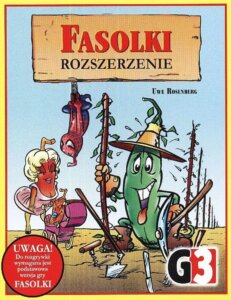
Fasolki: Rozszerzenie
2010
A Polish Bohnanza expansion blending new beans, variants, and two-player rules
60
minutes
Medium Light
View expansion
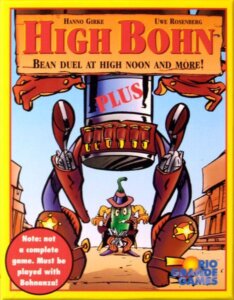
High Bohn Plus
2004
Expand Bohnanza with new beans, buildings, fields, and special orders.
60
minutes
Medium
View expansion
