
Civilization: A New Dawn
2017
Expand across an undiscovered world, gain technologies, build wonders, and race to complete changing victory agendas.
120
minutes
2 - 4
player(s)
14+
Medium Heavy

About this board game
Civilization: A New Dawn is a strategy board game for 2–4 players, with games taking about 120 minutes. Each player rules one of history’s most memorable empires, seeking to become the greatest world power.
Every game begins with an undiscovered country built from beautifully illustrated map tiles. Players construct and populate this evolving world with barbarians, natural resources, and city-states, then develop plans for shaping it according to their vision.
Your civilization can spread across the map, gain new technologies, and build many of humanity’s greatest wonders. Expansion and development are central to the contest, but the path to victory is never exactly the same from one game to the next.
- Explore and populate a world assembled from map tiles.
- Expand your domain while pursuing technological progress.
- Build celebrated wonders of human history.
- Race to complete changing agendas revealed by victory cards.
At setup, three victory cards are drawn, and each card details an agenda that can guide the game’s shifting objectives. Players compete to be the first to accomplish one agenda on each of these cards, turning every match into a race to adapt and achieve.
With its changing goals and contested world, Civilization: A New Dawn invites players to formulate ambitious plans while responding to the development of the map. The winning nation is the one that secures its place as the greatest power and leaves an indelible mark upon history.
/pic7182955.jpg)
Board Game Rules for
Civilization: A New Dawn
Game Overview
“Each of us is carving a stone, erecting a column, or cutting a piece of stained glass in the construction of something much bigger than ourselves.”
—Adrienne Clarkson
Sid Meier’s Civilization: A New Dawn is a strategy board game in which two to four players act as the leaders of history’s most memorable civilizations. Over the course of the game, they will expand their domains, gain new technologies, and build many of humanity’s greatest wonders. In the end, one civilization will rise above all others to leave its indelible mark upon history.
Component List
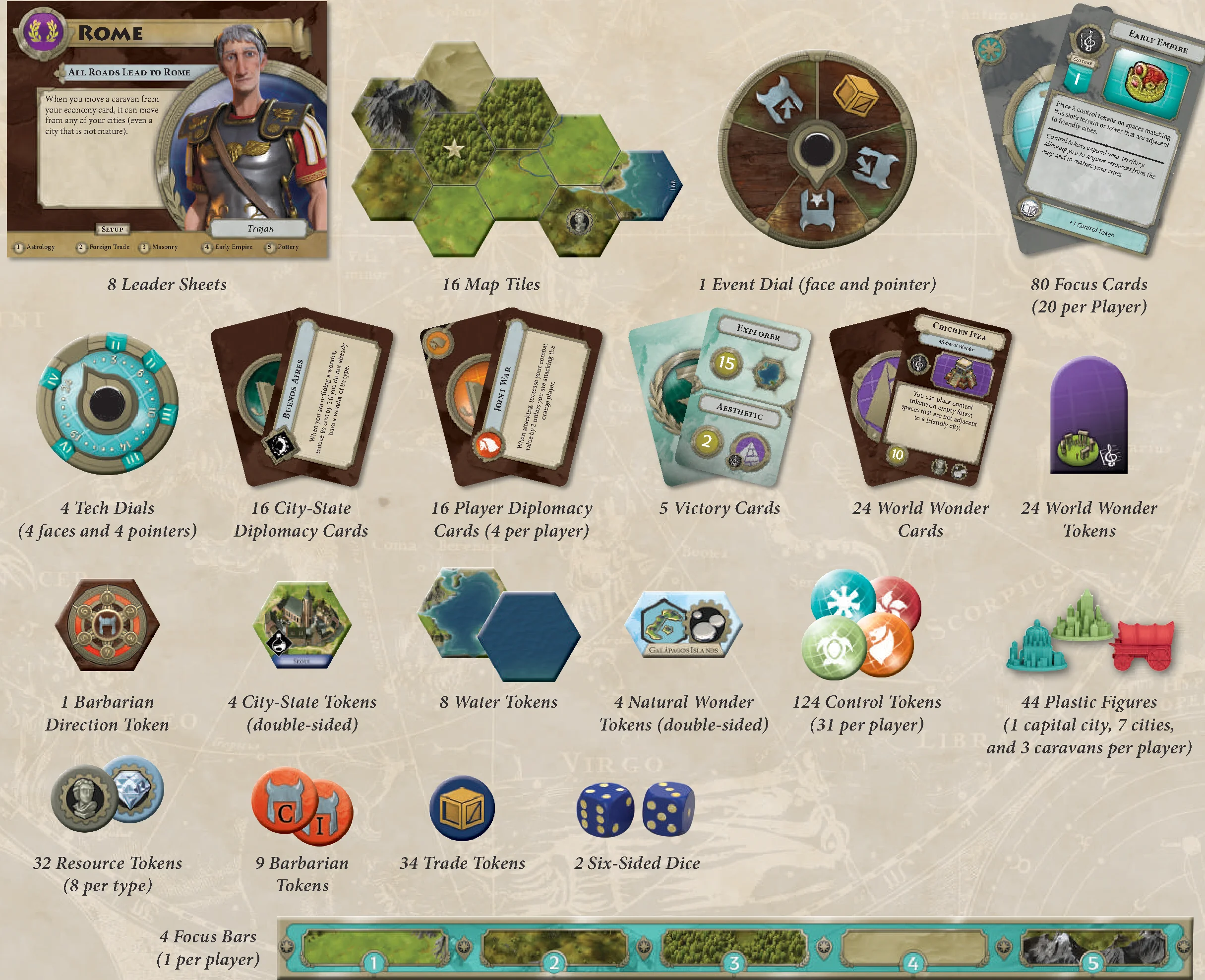
- 16 Map Tiles
- 8 Water Tokens
- 1 Event Dial (face and pointer)
- 124 Control Tokens (31 per player)
- 24 World Wonder Tokens
- 4 Focus Bars (1 per player)
- 8 Leader Sheets
- 9 Barbarian Tokens
- 32 Resource Tokens (8 per type)
- 34 Trade Tokens
- 80 Focus Cards (20 per Player)
- 16 Player Diplomacy Cards (4 per player)
- 5 Victory Cards
- 24 World Wonder Cards
- 16 City-State Diplomacy Cards
- 4 Natural Wonder Tokens (double-sided)
- 1 Barbarian Direction Token
- 4 City-State Tokens (double-sided)
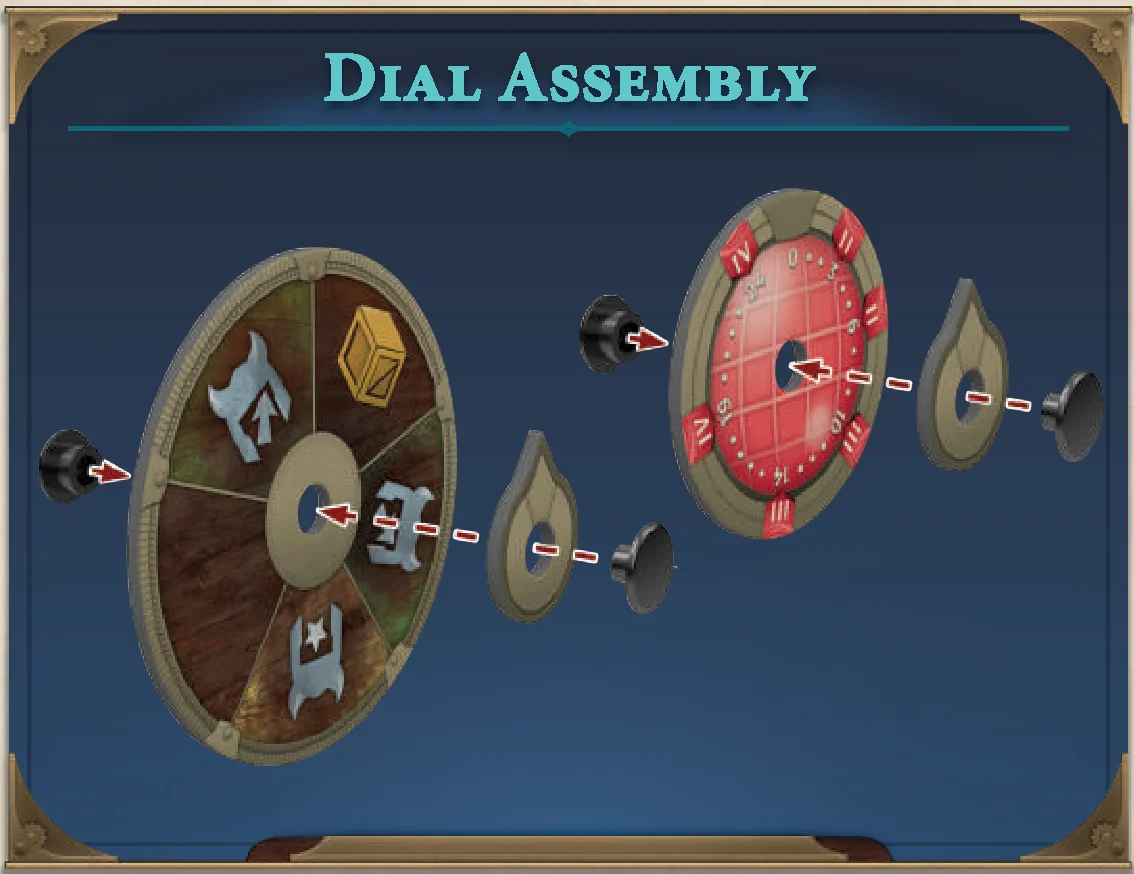
- 4 Tech Dials (4 faces and 4 pointers)
- 2 Six-Sided Dice
- 44 Plastic Figures (1 capital city, 7 cities, and 3 caravans per player)
Setup Steps
To set up a game of Sid Meier’s Civilization: A New Dawn, players perform the following steps:
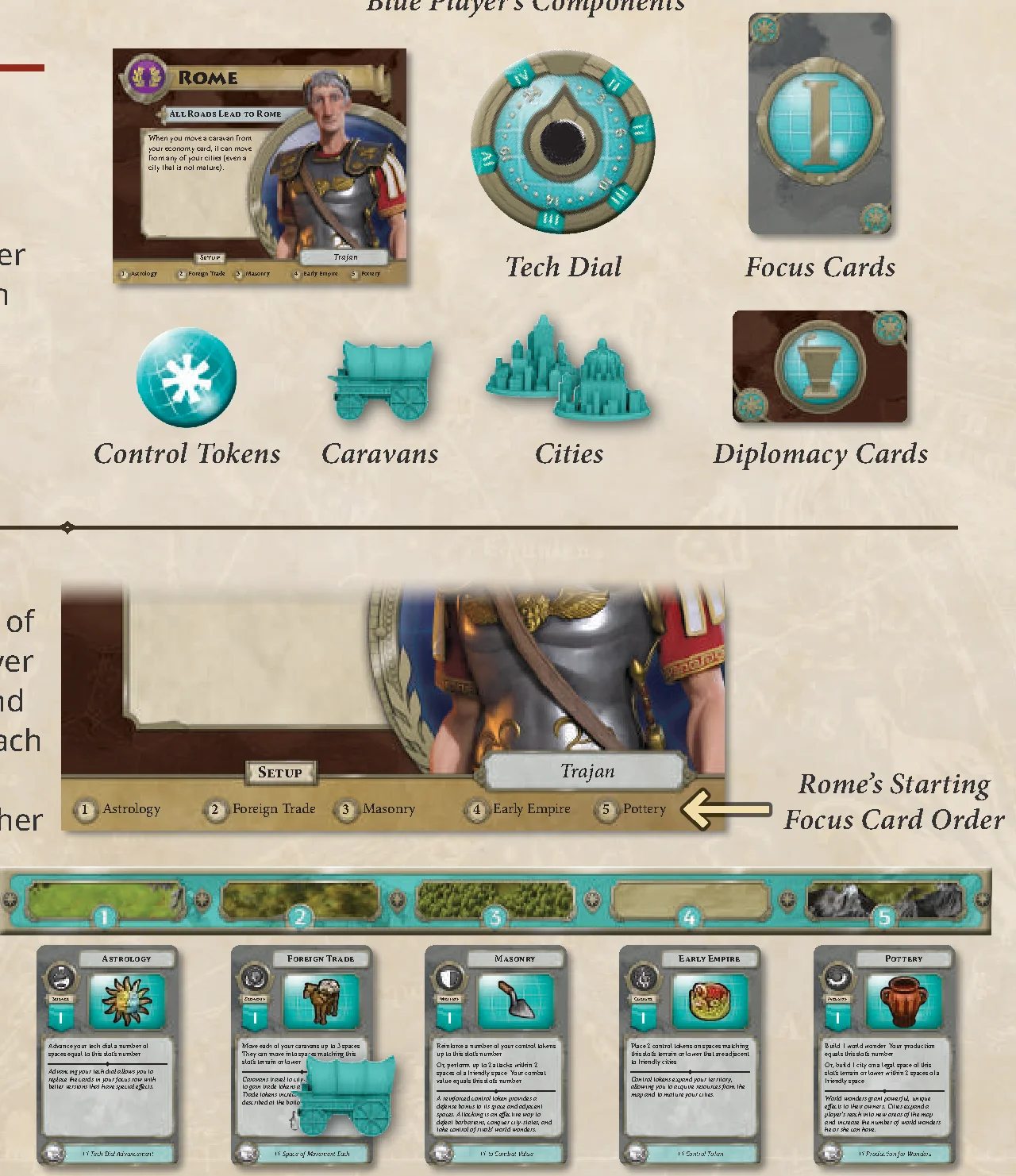
- Select Leader and Player Color: Each player takes one random leader sheet. Then, each player chooses a player color and takes the cities, caravans, control tokens, tech dial, diplomacy cards, and focus cards of that color. Then, each player rotates the pointer on his or her tech dial to “0.”
- Construct Focus Bars: Each player places the focus bar of his or her color below his or her leader sheet. Each player takes the five focus cards that display “I” on the back and places them faceup in the slots below the focus bar—each player’s leader sheet lists the order the cards must be placed in. Then, each player places a caravan on his or her “Foreign Trade” card.
- Construct Map: Players use the map tiles to construct the map. For the first game, they construct the map as described below. For future games, they use the advanced map-building rules.
- Populate Map: For each space on the map that has an icon, the players take one token that matches that icon and place it on that space. For each barbarian icon, the barbarian token placed on it should display the same letter. For each city-state icon, the city-state token placed on it should share the same icon and black frame (diamond or circle) around the icon.
- Place City-State Cards: For each city-state token placed on the map, place both copies of that city-state’s diplomacy card on top of each other and next to the map, in view of all players. Return the unused city-state diplomacy cards to the game box.
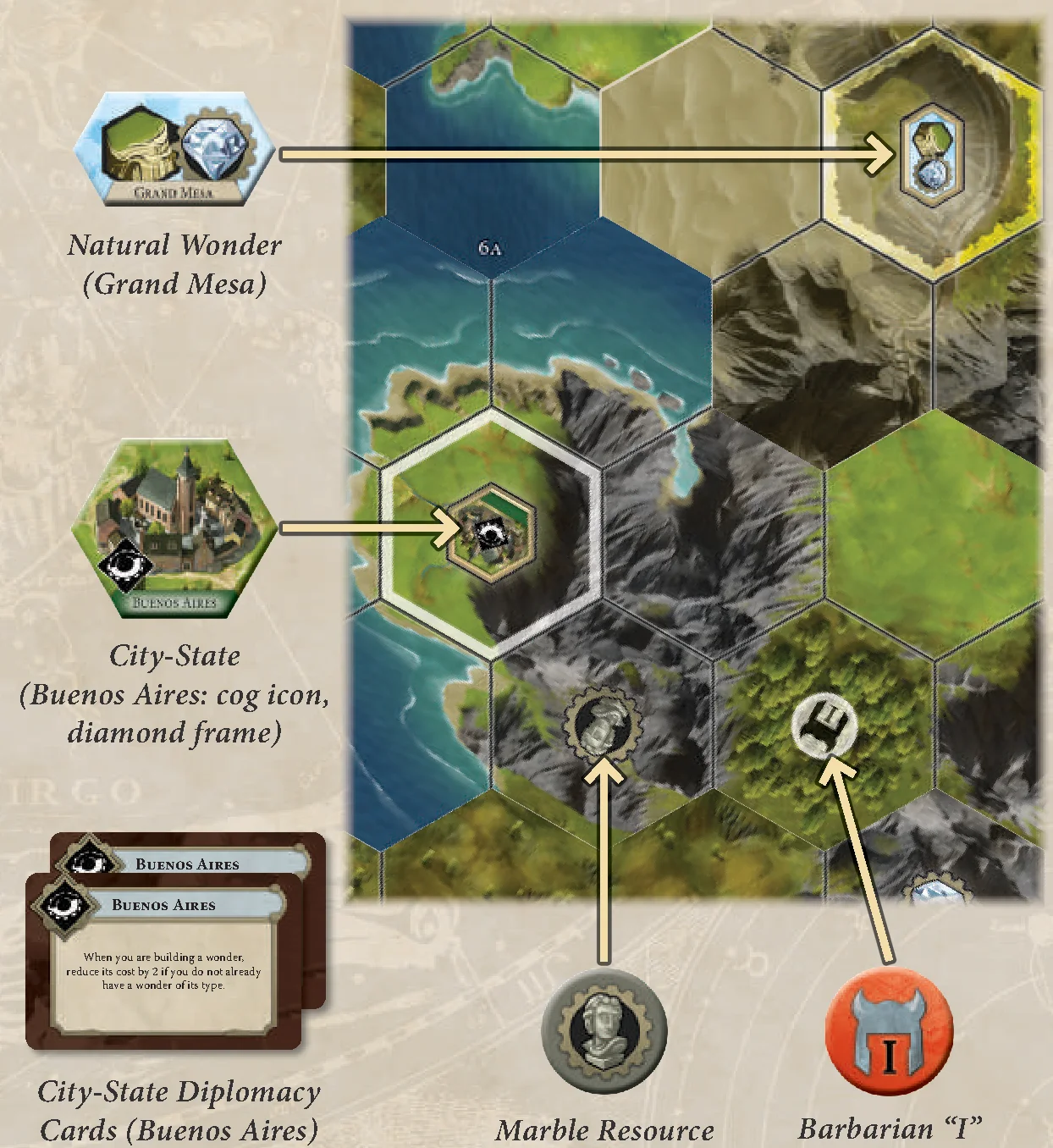
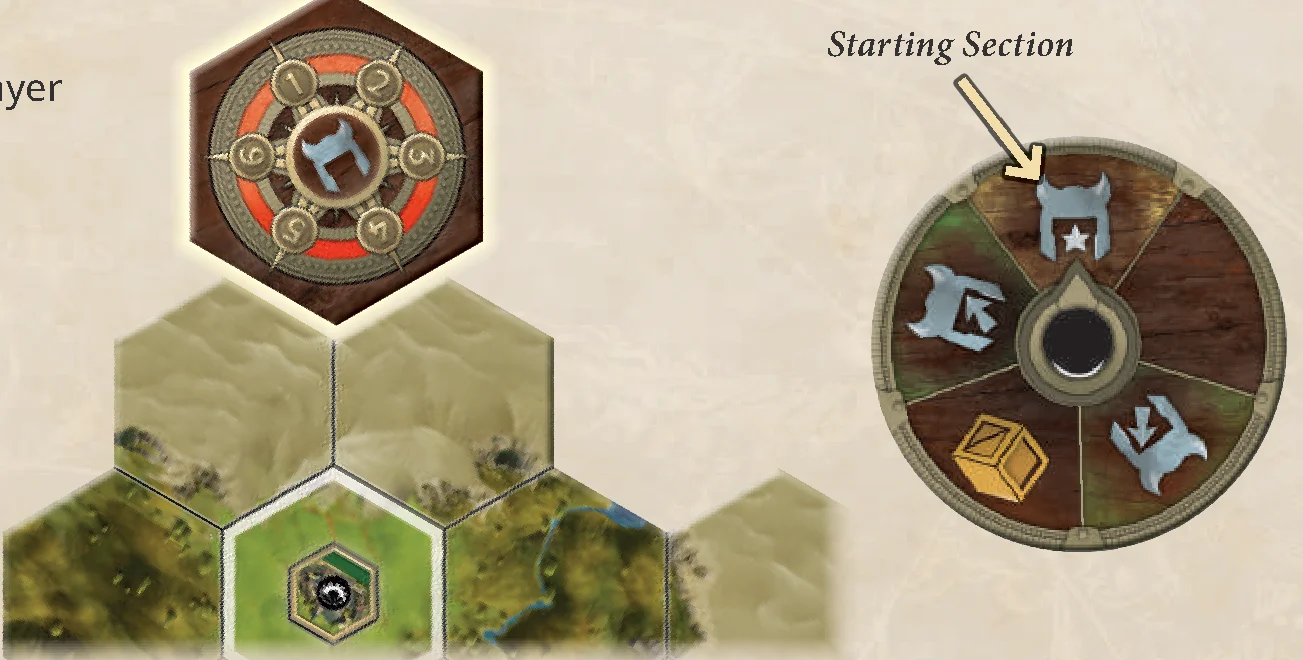
- Set Direction Token and Event Dial: A random player places the barbarian direction token against any edge of the map (it does not matter which direction each number points). Then, that player places the event dial next to his or her leader sheet with the pointer pointing to the helmet with the star. The player who has the event dial is the FIRST PLAYER and will take the first turn of the game.
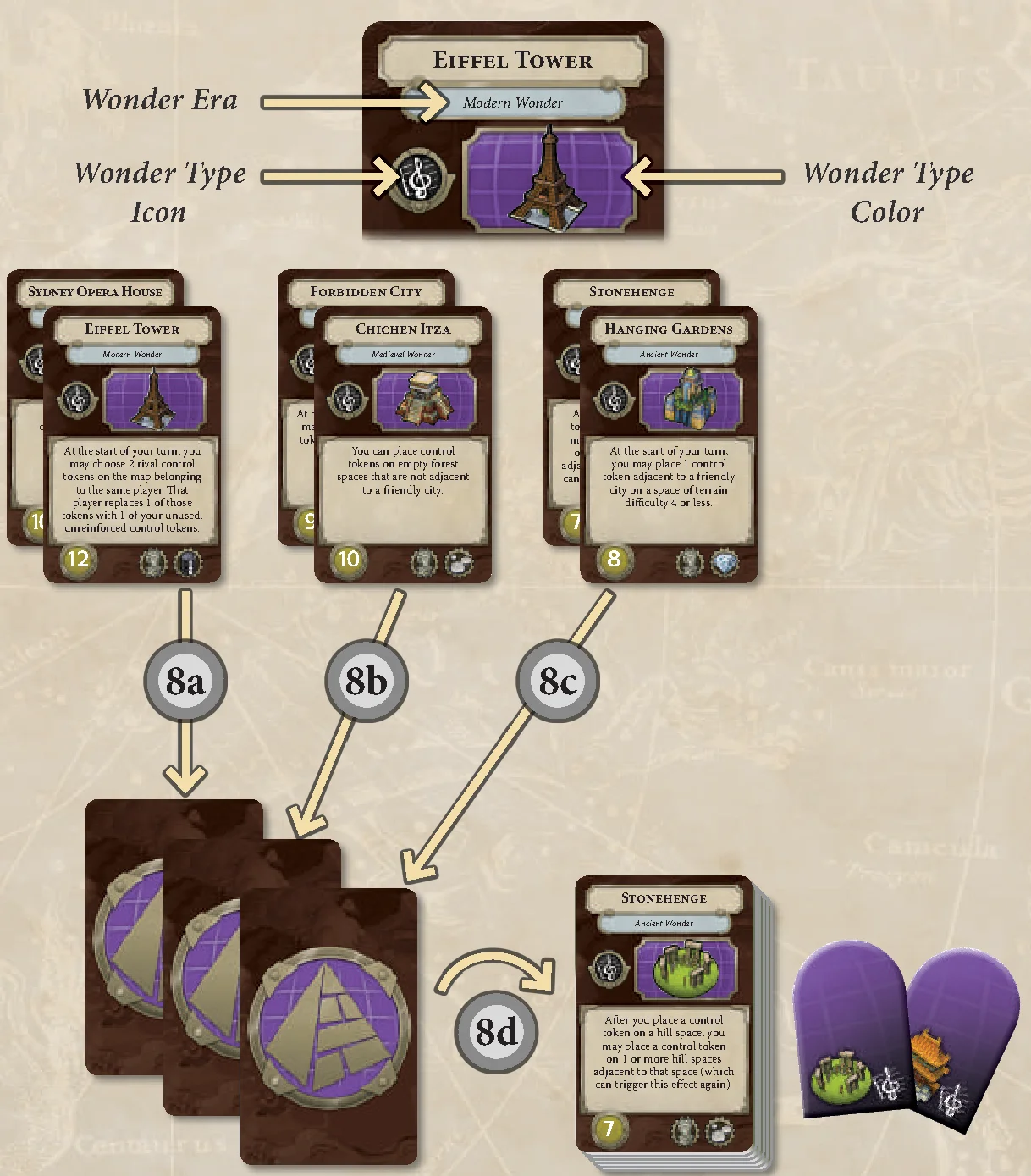
- Separate Wonder Cards: Separate the world wonder cards by type into four piles. The type is indicated by the card’s color and by the icon to the left of the wonder’s image.
- Three-Player Game: If playing with only three players, return one random ancient-era card from each pile to the game box without revealing them.
- Two-Player Game: If playing with only two players, return one random ancient-era card and one random medieval-era card from each pile to the game box without revealing them.
- Create Wonder Decks: For each pile of wonder cards, do the following:
- Randomize the modern-era cards of that type and place them facedown.
- Randomize the medieval-era cards of that type and place them facedown on the modern-era cards.
- Randomize the ancient-era cards of that type and place them facedown on the medieval-era cards.
- Flip the top card of the deck faceup and place the deck in view of all players.
- Organize Wonder Tokens: Next to each wonder deck, place all of the world wonder tokens that display the same type icon and color as the cards in that deck.
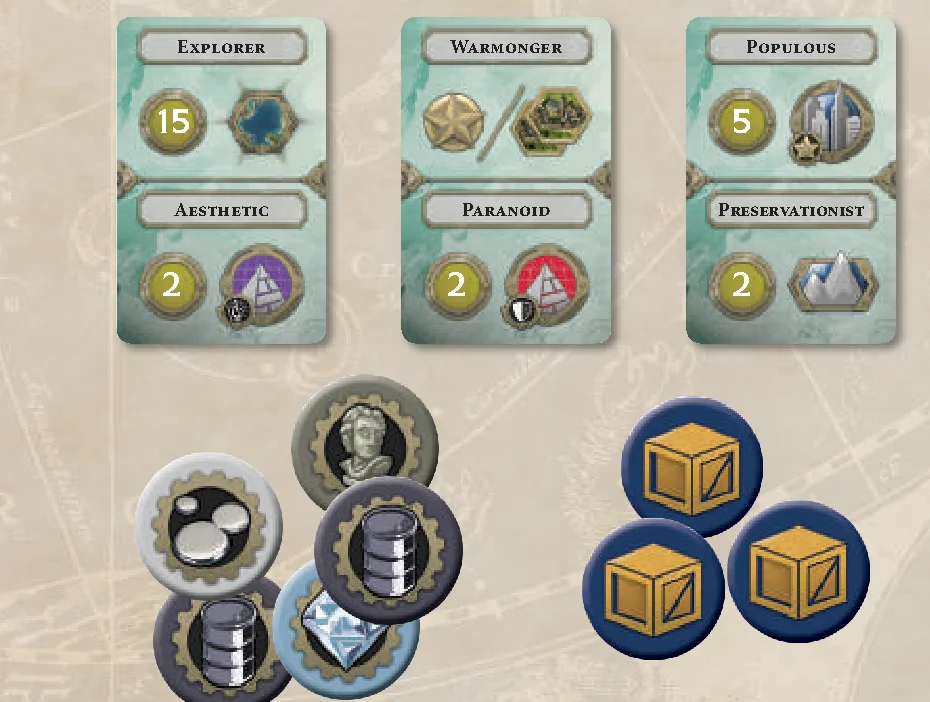
- Deal Victory Cards: Place three random victory cards faceup next to the map. Return the remaining victory cards to the game box.
- Create Supply: Place the trade tokens and the remaining resource tokens in piles near the map to form the SUPPLY.
For the First Game
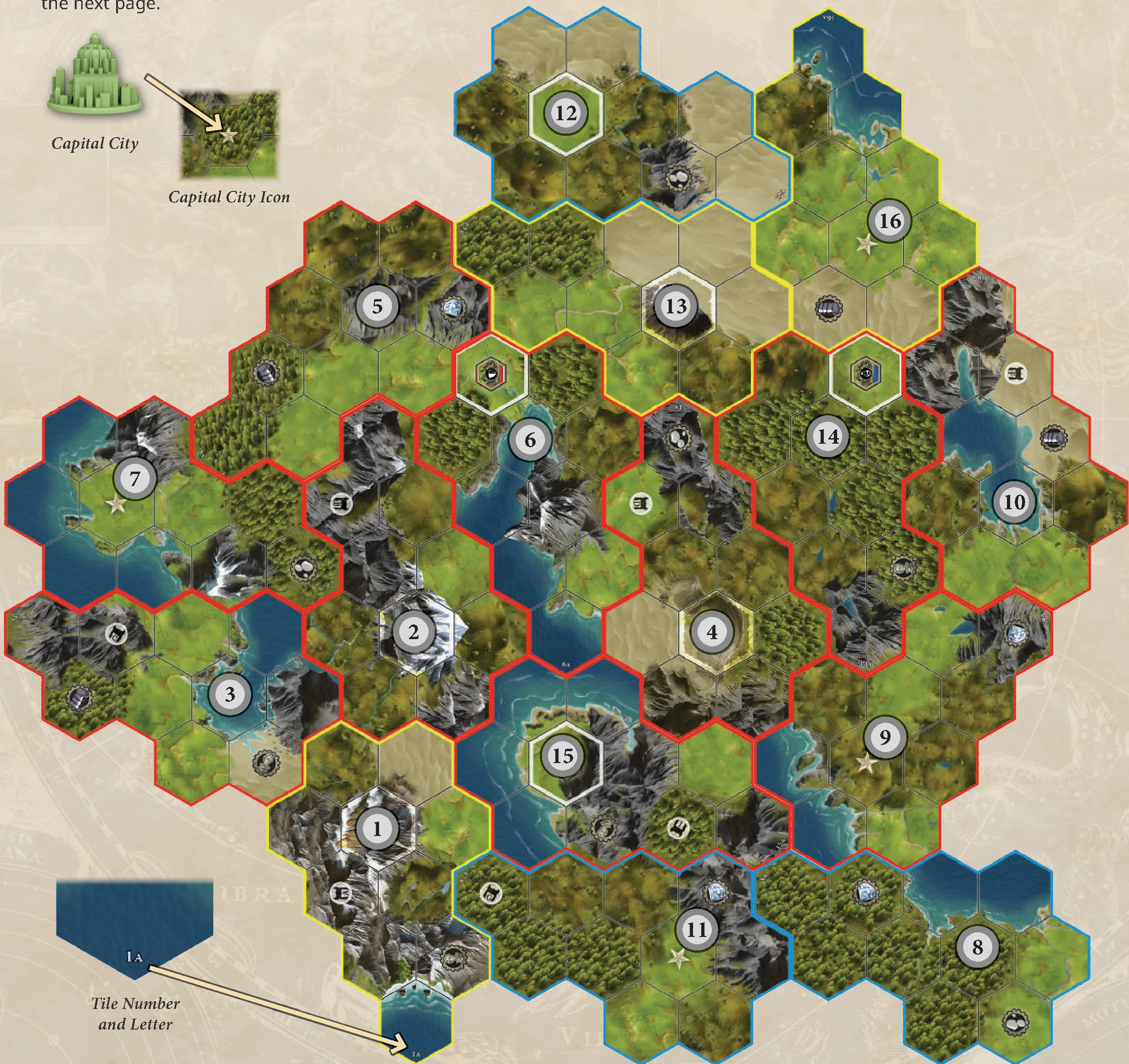
The players use a predetermined map for their first game to make learning easier. Before proceeding to setup on the next page, the players construct the map shown below. Each tile is labeled with a number and letter; the numbers on the map below correspond to the tile numbers. The first-game map uses only the A-side of tiles for ease of construction.
- Players begin by placing the tiles outlined in red.
- If playing with at least three players, they add the tiles outlined in yellow.
- If playing with four players, they also add the tiles outlined in blue.
After the map is constructed, each player chooses a capital city and places it on the capital city icon that is closest to him or her. The color of the capital city is the color that player will use for the first game instead of choosing a color during step 1 on the next page.
Advanced Map Building
For all games after the first game, players use the advanced map-building rules to construct their own maps. These rules add a level of strategy and provide a different map for every game. The players construct an initial landmass, called the CORE, and then they take turns adding tiles to it, placing their tiles strategically to gain the most benefit.
To perform advanced map building, follow these steps:
- Deal one random tile that has a capital-city icon (star) to each player. Return unused capital-city tiles to the box.
- Take two random tiles that have a natural wonder and two random tiles that have a city-state and shuffle all four together. These are the core tiles.
- All core tiles will be placed on the same side. To determine the side, roll a die. On a result of 1–3, use side A for all core tiles; otherwise, use side B.
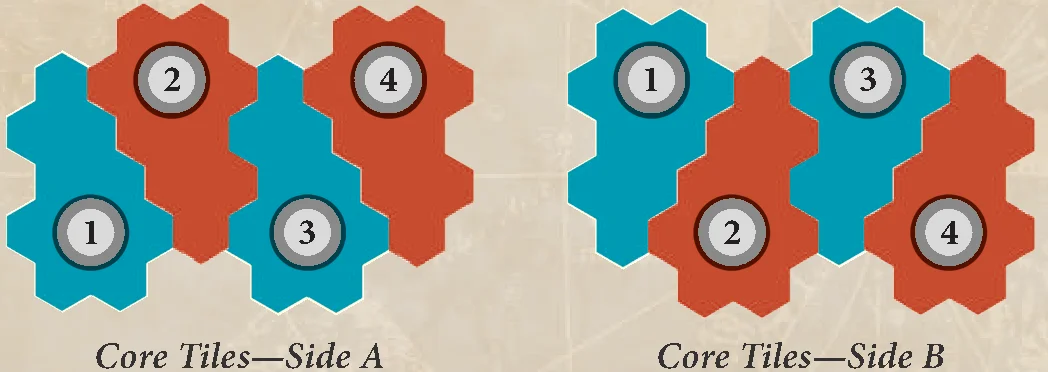
- Form the core by drawing and placing the core tiles, one at a time, into the center of the table. Place the tiles in the order and orientation shown below for the side being used. Then, place a trade token on each of the four tiles to help players remember that these are the core tiles.
- Shuffle the remaining unplaced tiles and deal two to each player. Return the rest to the game box.
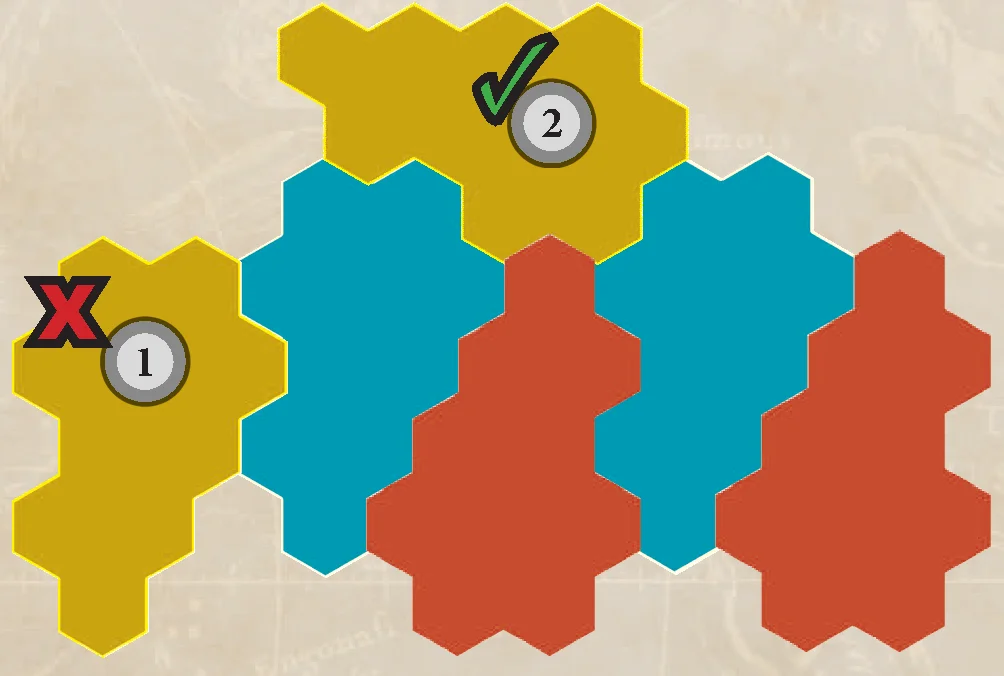
- Starting with a random player and proceeding clockwise, each player chooses and places one of his or her three tiles. Each tile can be placed on either of its sides, but the players must obey these restrictions:
- The tile being placed must touch at least four spaces on tiles that are already on the table.
- The tile must touch the core, even if it must be flipped to a specific side to do so. If it cannot touch the core while satisfying the previous restriction, it must touch a tile that is touching the core.
- If a player places a capital-city tile, he or she must place his or her capital city on that tile’s capital city icon.
- If a completely enclosed hole in the map is formed, the players fill the hole with water tokens.
- The players repeat step 6 until they have placed all of their tiles. Then, they remove the trade tokens from the core tiles and continue with normal setup.
Players must familiarize themselves with these terms to understand how to resolve focus cards.
Spaces and Terrain
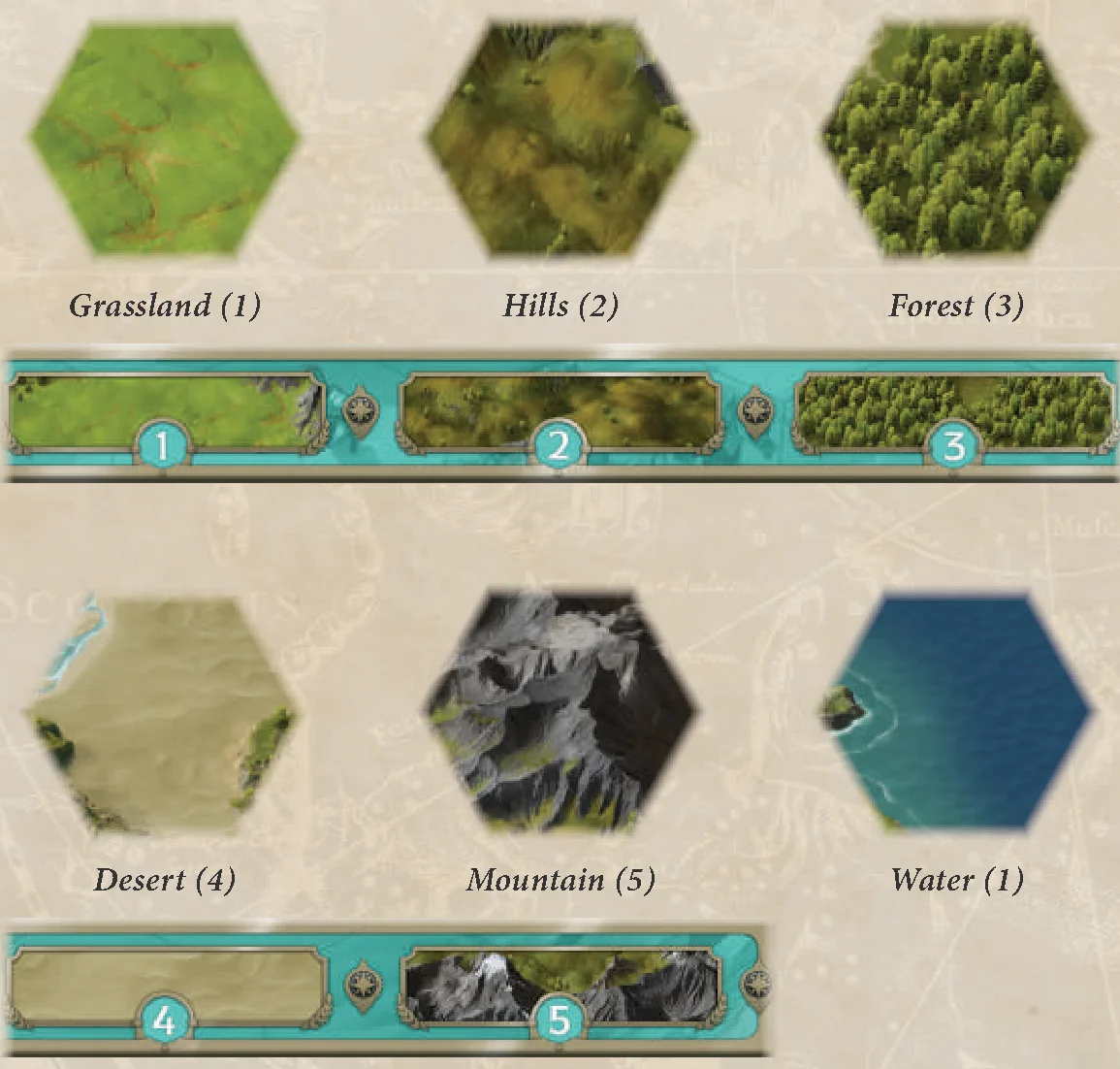
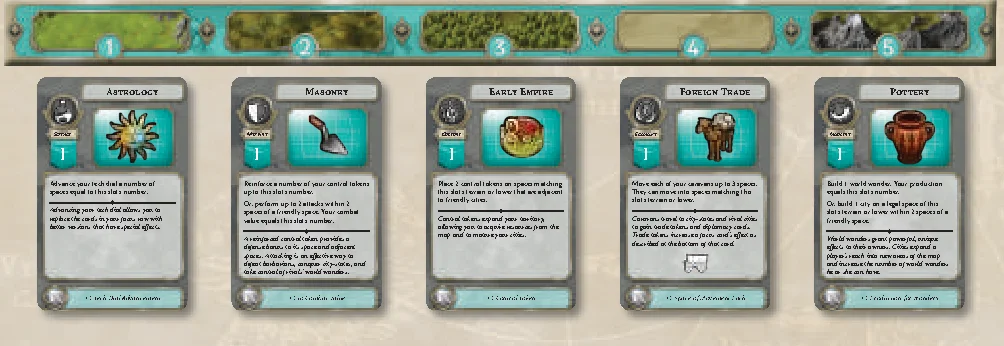
Each hex on a map tile is a SPACE. Spaces on the map have a TERRAIN represented by art. The five basic types of terrain each correspond to a slot on the focus bar: grassland (1), hills (2), forest (3), desert (4), and mountains (5). A terrain’s slot number is its DIFFICULTY.
Terrain affects many aspects of the game. In general, terrain that corresponds to a higher slot is more difficult to expand into and more difficult to conquer.
The sixth terrain type, water, does not appear on the focus bar. Water has a difficulty of one, but players generally cannot interact with water unless a card specifically allows them to do so.
When a space appears to have more than one terrain, its terrain is the type that covers the most area in the space.
Friendly and Rival
Many cards refer to spaces or game pieces as FRIENDLY or RIVAL:
- All of the control tokens and plastic figures of a player’s color are friendly to that player.
- All of the control tokens and plastic figures of other colors are rival to that player.
- Similarly, the spaces that contain a player’s cities or control tokens are friendly to that player, and spaces that contain cities and control tokens of other colors are rival to that player.
- Caravans do not cause a space to be friendly or rival.
Empty Spaces
A space is empty if it does not contain any tokens or plastic figures of any kind.
Resources and Natural Wonders
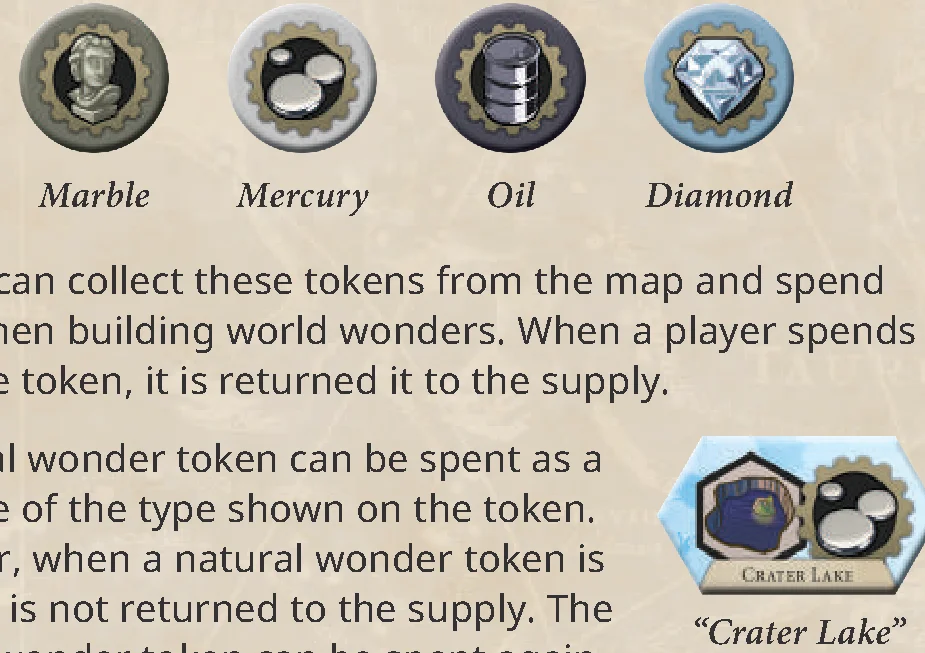
Resources and natural wonders power the creation of amazing world wonders. There are four types of resources: Marble, Mercury, Oil, Diamond.
Players can collect these tokens from the map and spend them when building world wonders. When a player spends a resource token, it is returned it to the supply.
A natural wonder token can be spent as a resource of the type shown on the token. However, when a natural wonder token is spent, it is not returned to the supply. The natural wonder token can be spent again during future turns, but it cannot be spent more than once per turn.
Spaces with natural wonder tokens do not have a terrain type, but the terrain difficulty of all natural wonder spaces is five.
Cities and Mature Cities
Cities are the focal points around which empires are built. They allow players to extend into new areas of the map.
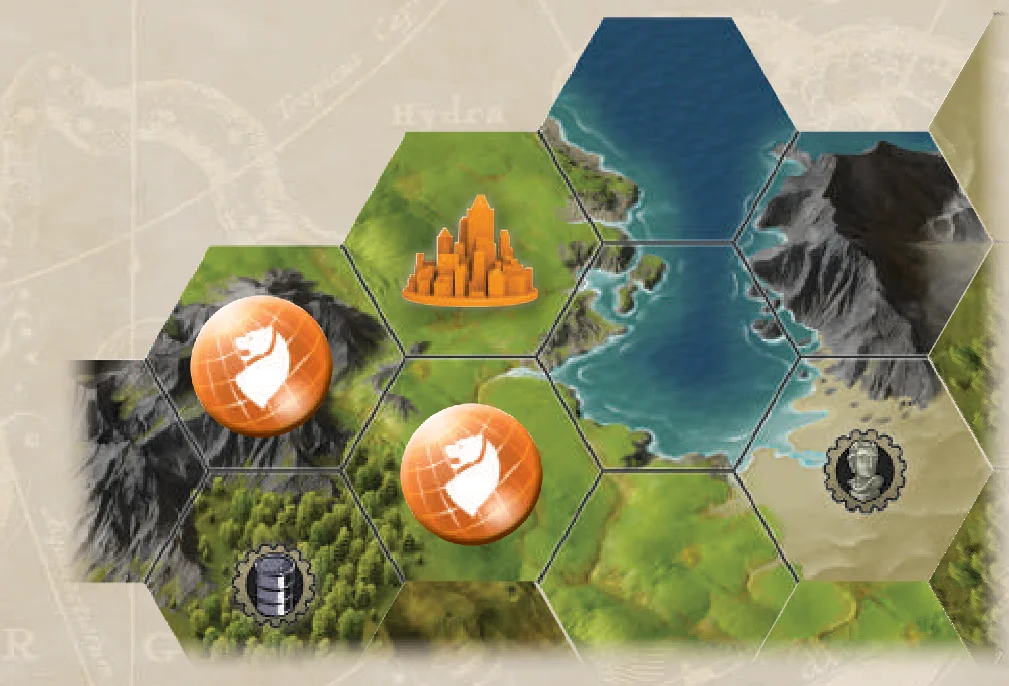
Mature cities are fully developed cities that contribute to the well-being of a player’s civilization. They periodically generate trade tokens (which are described later) and act as new starting points for caravans.
A city is mature when each space adjacent to it either contains a friendly control token or is a water space. Cities on the edge of the map can mature faster because they have fewer adjacent spaces.
Game Flow
Sid Meier’s Civilization: A New Dawn is played over a series of turns. As the players take turns, they use their cards to build their civilizations from single cities to sprawling empires filled with wonders and technology.
The player who has the event dial is the FIRST PLAYER; he or she takes the first turn of the game. Players continue to take turns in clockwise order until the game ends. A player wins the game by completing one agenda on each victory card. The full rules for winning the game are described on page 12.
Additionally, world events occur periodically that affect the map and all of the players, such as barbarian attacks. Before each of the first player’s turns (excluding the first turn), the first player advances the event dial, possibly producing one of these events. The event dial and its effects are described later on page 12.
The Focus Row
A player’s turn revolves around the concept of the FOCUS ROW, which is the row of five cards below his or her focus bar. The focus row represents a nation’s various pursuits, such as scientific advancements, cultural developments, and military production. Each focus row has five SLOTS, one for each card.
The cards in a player’s focus row shift to different slots as the player takes turns. A card generally shifts toward the fifth slot until it is used, which is when it moves back to the first slot. From there, it will slowly shift toward the fifth slot again.
This process represents the investment of time; a card resolved in the fifth slot has a greater impact than a card resolved in the first slot. A key strategy in the game is knowing when to resolve a card in a low slot for its immediate effect and when to wait to resolve a card for its maximum effect.
The Player Turn
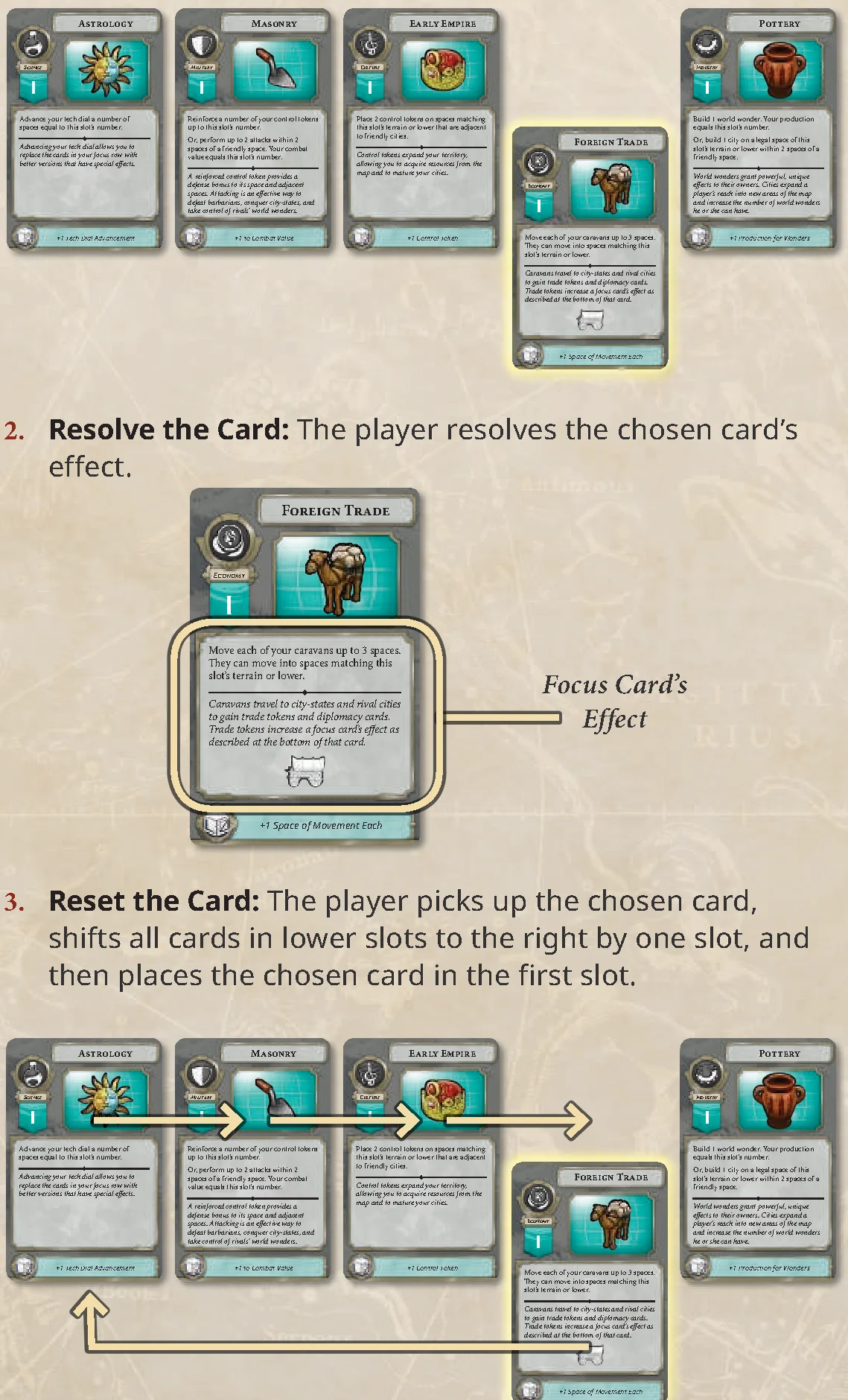
A player’s turn consists of three steps:
- Choose a Card: The player chooses one of the five cards in his or her focus row and offsets it to indicate that it was the chosen card.
- Resolve the Card: The player resolves the chosen card’s effect.
- Reset the Card: The player picks up the chosen card, shifts all cards in lower slots to the right by one slot, and then places the chosen card in the first slot.
After the player resets the chosen card, the turn ends and the next player in clockwise order takes the next turn.
The detailed rules for each type of focus card are described in the “Focus Cards” section starting on page 8, but before reading that section, players should learn the game’s key concepts on the next page.
Focus Cards Overview
There are five TYPES of focus cards. A focus card’s type is indicated by an icon in the upper-left corner. Each player’s focus row contains one card of each type.
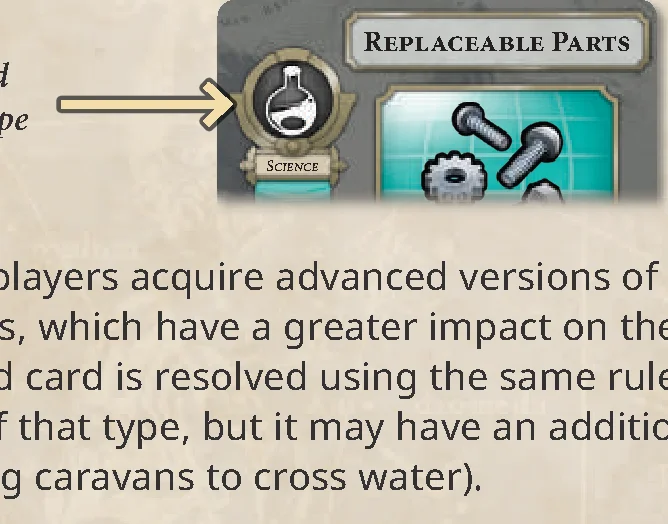
During the game, players acquire advanced versions of their starting focus cards, which have a greater impact on the game. An advanced card is resolved using the same rules as the starting card of that type, but it may have an additional effect (e.g., allowing caravans to cross water).
The following sections describe the rules for each type of focus card.
Culture 
Culture focus cards allow players to place control tokens, which expands territory and claims resources. The card’s focus row slot determines which types of terrain the player can place control tokens on.
To place a control token, the player takes one of his or her unused control tokens and places it on a space adjacent to a friendly city. If that space contains a resource or natural wonder token, he or she places that resource or natural wonder token next to his or her leader sheet.
The player must obey the following rules:
- The player cannot place the token on a water space or on any space whose terrain corresponds to a higher focus row slot than the culture card’s slot. All natural wonders are treated as having a terrain difficulty of five.
- The space cannot contain a barbarian token, city, city-state, or control token.
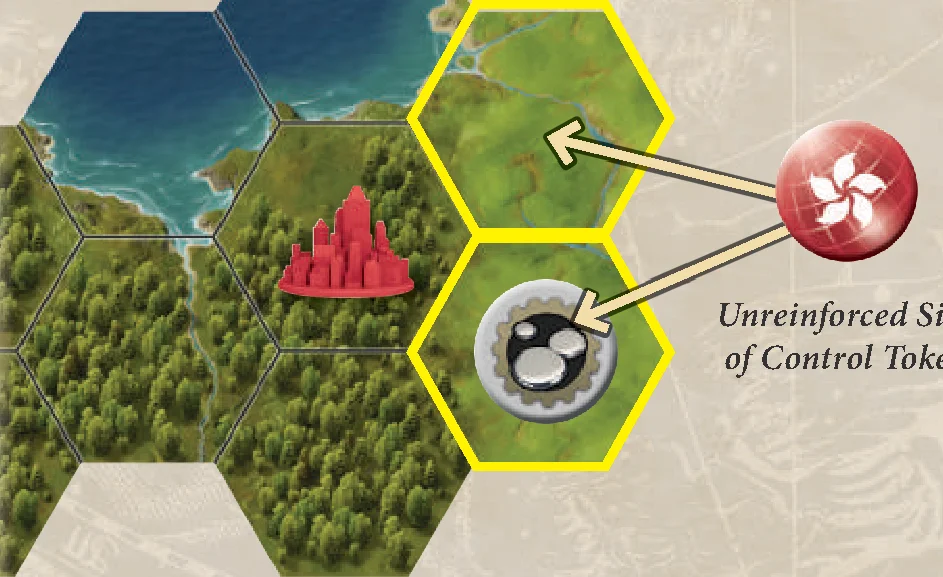
- The token must be placed on its unreinforced side (the side that does not have a white circle around the icon).
Science 
The science focus card advances a player’s tech dial, allowing the player to discover new technologies. The card’s focus row slot determines how much the dial advances.
To advance a tech dial, the player rotates the dial’s pointer clockwise a number of spaces (dots and numbers) equal to the number of the science card’s focus row slot.
Each focus card has a TECH LEVEL, and some spaces on the tech dial are paired with a tech level:
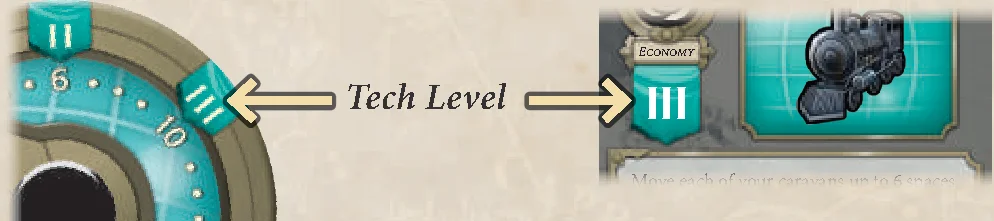
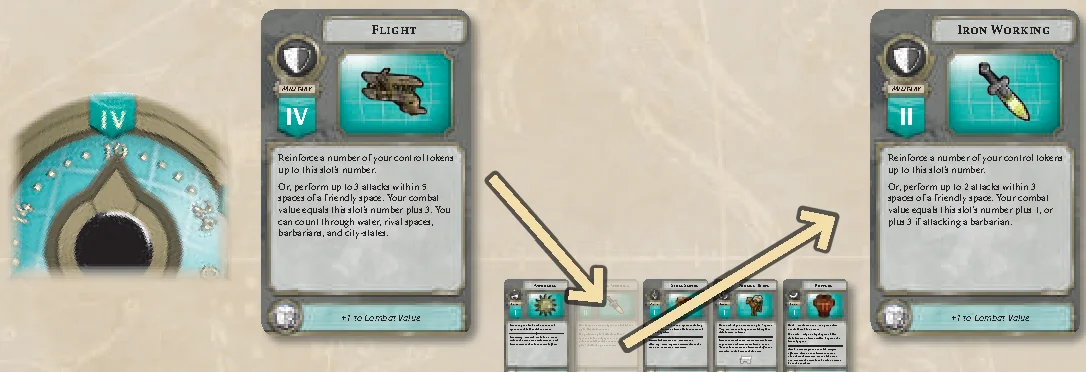
When the dial’s pointer advances to (or passes) a tech level space, the player may gain a new focus card. He or she can choose any card from his or her focus card deck whose tech level exactly matches the tech level reached on the dial. The chosen card replaces the card of the same type in his or her focus row; the replaced card is returned to the deck.
Economy 
Economy focus cards allow a player to interact with city-states and rival cities by moving caravans. The card’s focus row slot determines which terrain types the caravans can move into.
Each player starts the game with one caravan on his or her economy card. During the game, a player may gain better economy cards that increase the number of caravans he or she can use. When this occurs, he or she places the unlocked caravans on his or her economy card.
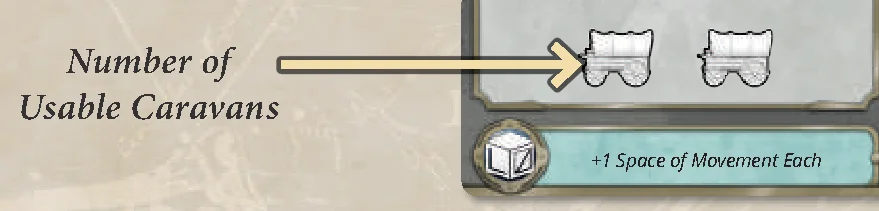
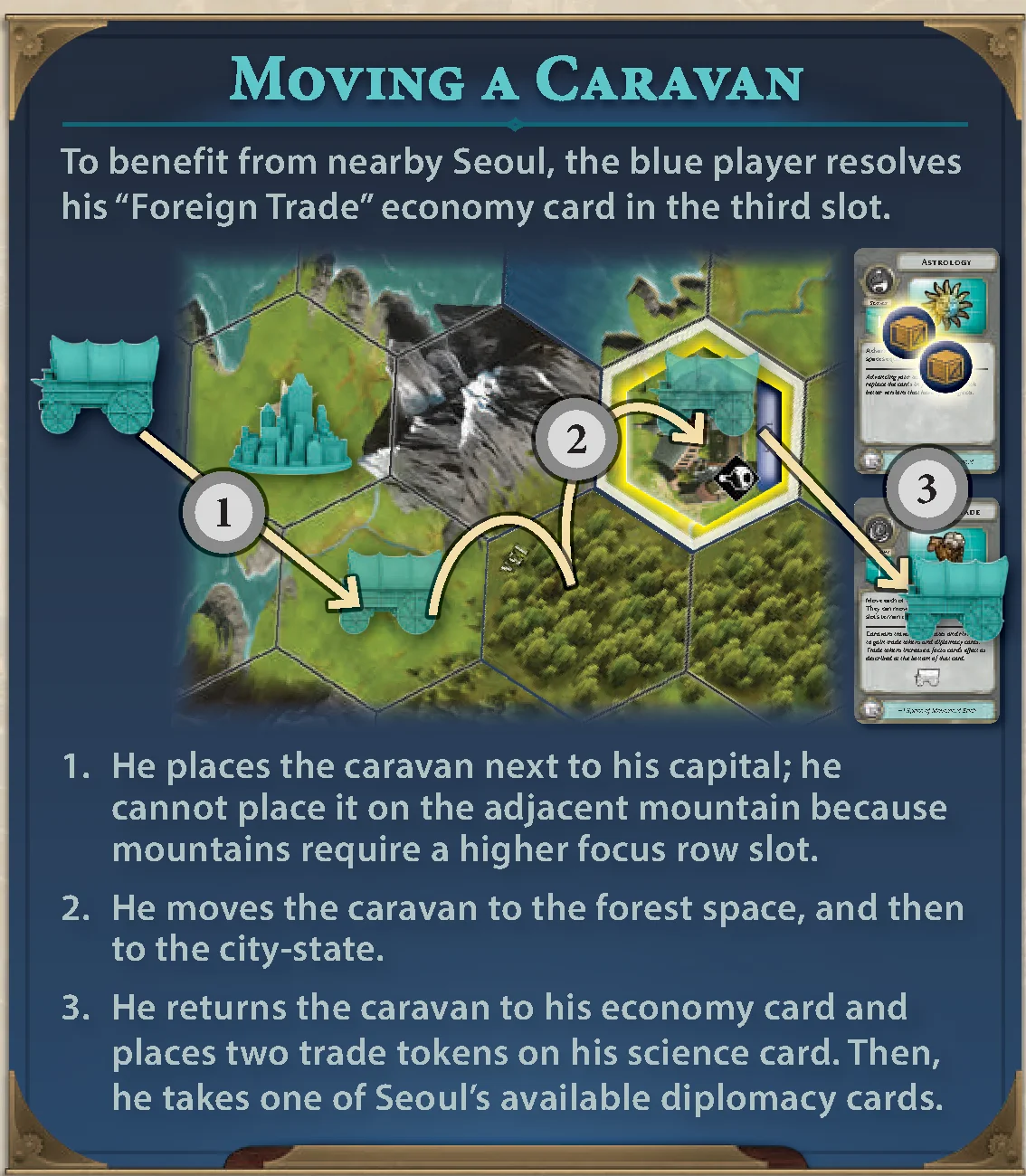
To move a caravan, the player moves the figure one space at a time up to the distance indicated on the card. A caravan on an economy card can move out of its player’s capital city or mature cities as though it was already in that city’s space. If a caravan does not reach a city-state or rival city in a single turn, it remains on the board and can be moved again the next time the player resolves the economy card.
The player must obey the following rules:
- The player cannot place or move a caravan onto a water space or any space whose terrain corresponds to a higher focus row slot than the economy card’s slot.
- The space cannot contain a barbarian token.
- The player cannot move more than one caravan to the same city or city-state during the same turn.
When a player moves a caravan to a city-state or rival city, he or she resolves the following steps according to the destination:
- The player returns the caravan to his or her economy card.
- The player gains two trade tokens from the supply:
- City-State: The trade tokens are placed on the card in his or her focus row that shares that city-state’s type.
- Rival City: The trade tokens are placed on cards in his or her focus row, distributed as desired.
- The player may take one diplomacy card:
- City-State: If a copy of that city-state’s diplomacy card is next to the map, he or she places that card next to his or her leader sheet. The player cannot take that card if he or she already has a copy of it.
- Rival City: The player chooses one of that rival player’s available diplomacy cards and places it next to his or her leader sheet. If the player already has one of the rival player’s diplomacy cards, he or she must return it before taking another card from the rival player.
City-states, trade tokens, and diplomacy cards are described on page 13.
Industry 
The industry focus card allows a player to build either a new city or a world wonder. If building a city, the card’s focus row slot determines which types of terrain the player can consider. If building a world wonder, the focus row slot contributes toward the cost of that wonder.
Building Cities
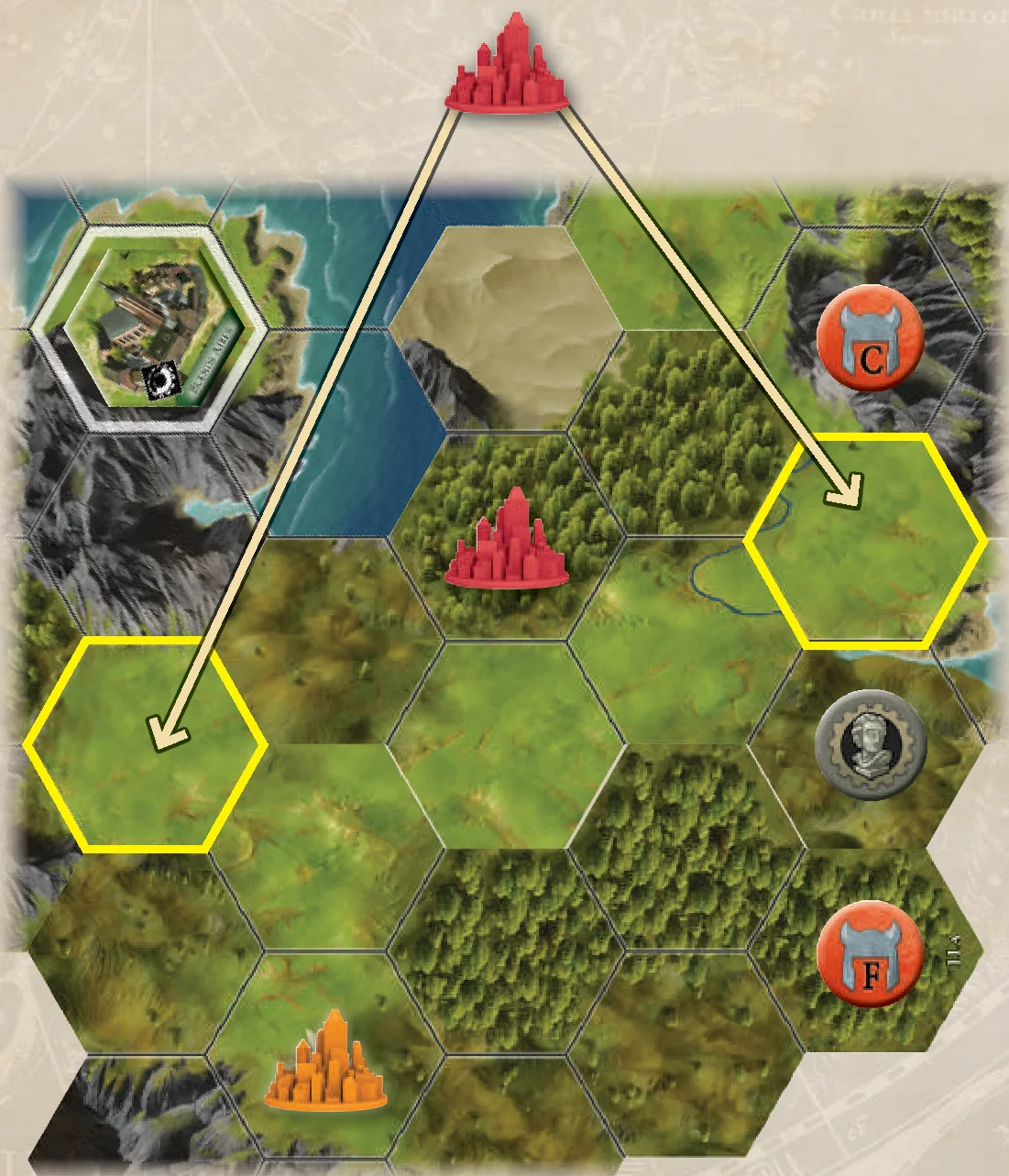
To build a new city, the player takes one of his or her unused cities and places it on an empty space within the number of spaces indicated on the industry focus card, counting from any friendly space.
The player must obey the following rules:
- The player cannot build on a space that contains any component other than a caravan or a friendly control token. If built on a caravan, the components share the space; if built on a friendly control token, the token is removed from the map and returned to its player.
- The player cannot build adjacent to a city-state or city.
- The player cannot build on or count through a water space or any space whose terrain corresponds to a higher focus row slot than the industry card’s slot.
- The player cannot count through a rival space or a barbarian token.
Building World Wonders
World wonders grant powerful abilities to the players who control them.
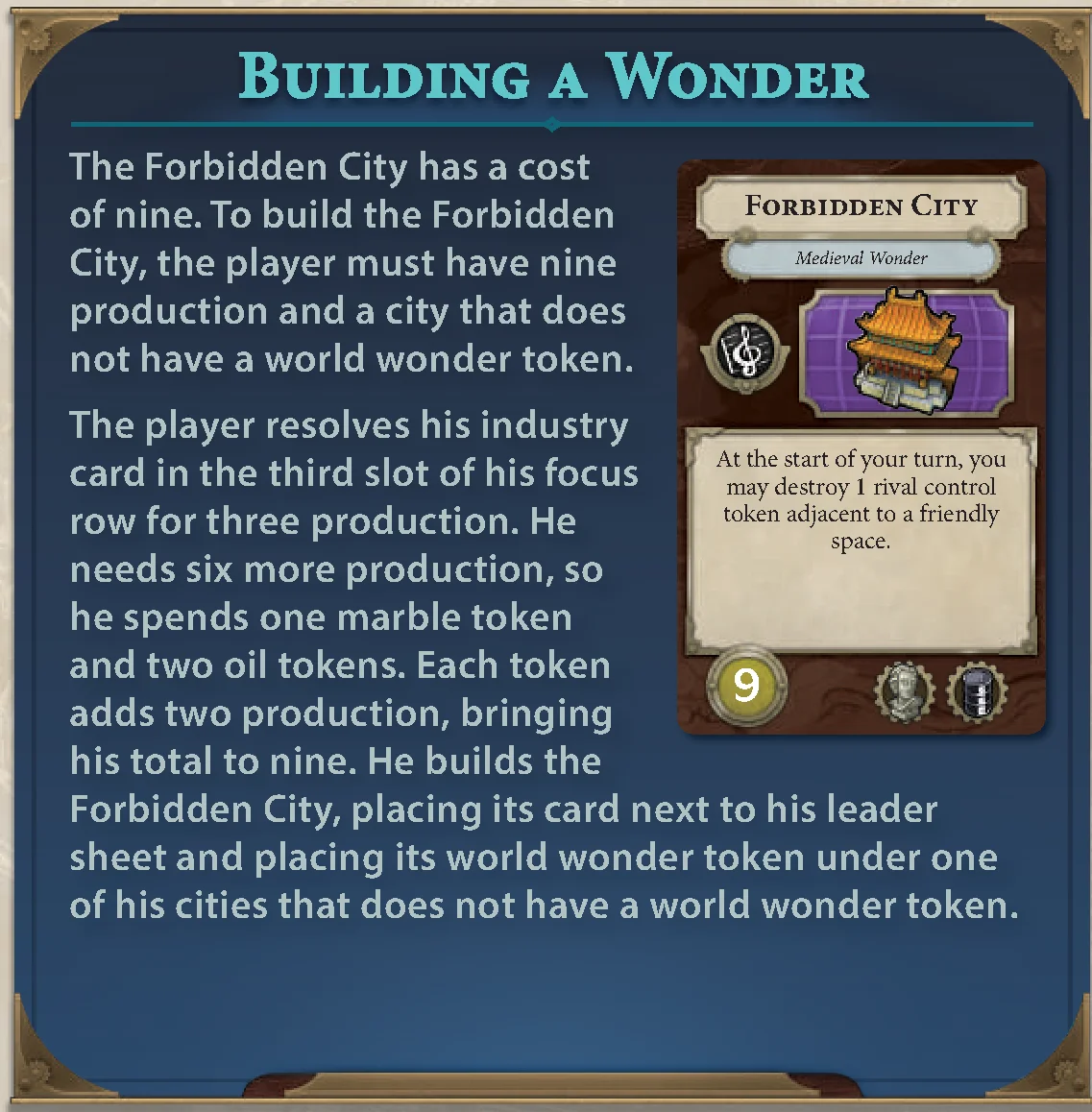
A wonder’s COST is the number printed in the lower-left corner of the wonder card. Resources that a player can spend toward that cost are displayed in the lower-right corner.

To build a wonder, the player chooses one of the faceup wonder cards on top of a wonder deck and pays its cost in PRODUCTION, which is the sum of:
- The number of the industry card’s focus row slot.
- Two production for each eligible resource the player spends.
- One production for each trade token the player spends from the industry card.
If the player’s production equals or exceeds the wonder’s cost, the wonder is built. The player places the wonder card next to his or her leader sheet and places the matching wonder token under a friendly city that does not already have a wonder token. Then, the player reveals the next wonder of that type by flipping the top card of that wonder deck faceup.
A player cannot build a wonder if all of his or her cities already have a wonder token.
World wonders are described in more detail on page 13.
Military 
Military focus cards allow a player to either reinforce defenses or perform attacks. The focus row slot affects how many control tokens can be reinforced, or it affects the strength of each attack.
Reinforcing Control Tokens
Reinforced control tokens are powerful defensive tools that are useful for protecting valuable territory and cities that house world wonders.
To reinforce control tokens, the player chooses a number of his or her control tokens up to the number of the military card’s slot. The player flips each of the chosen tokens to its reinforced side.
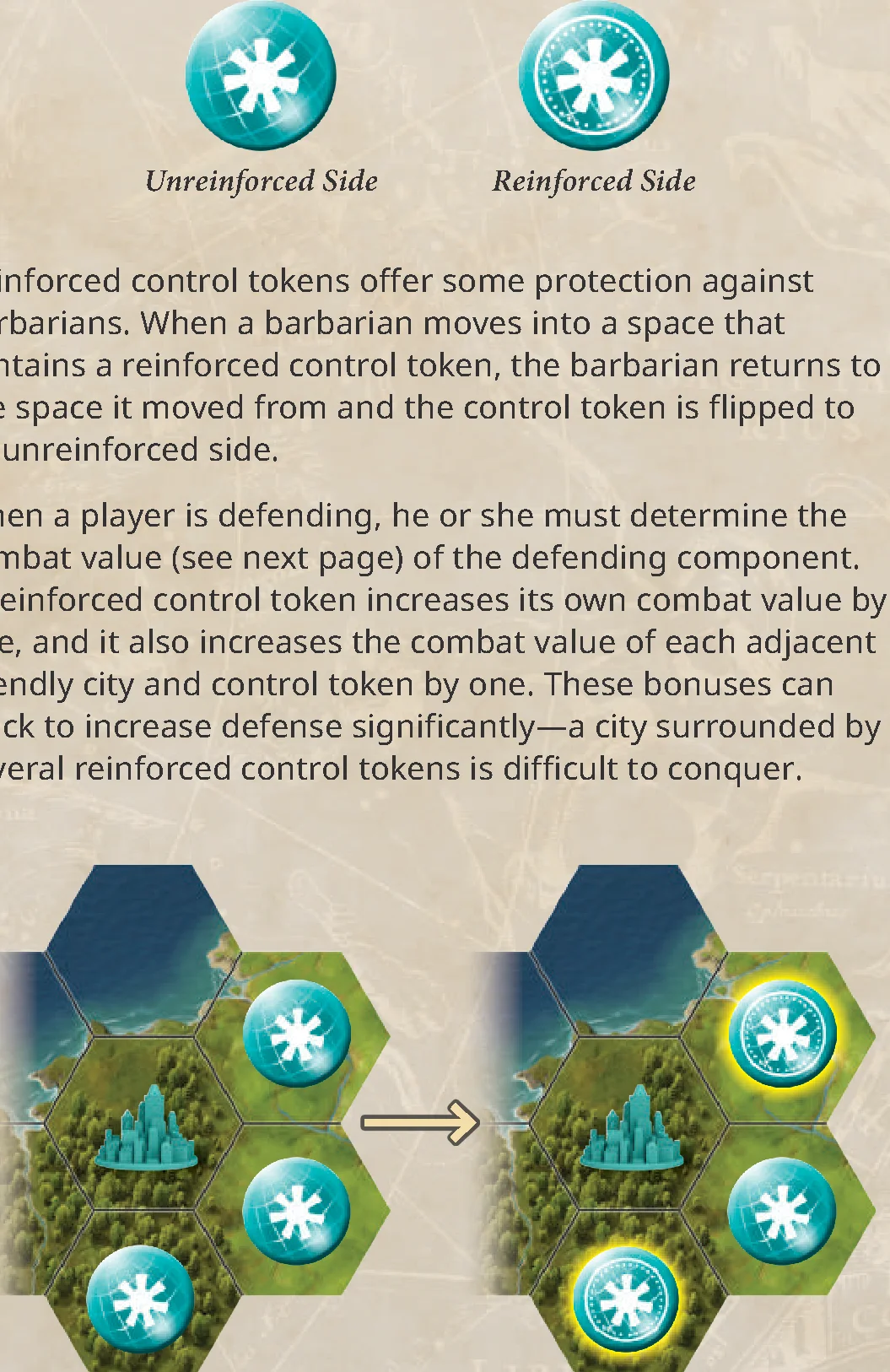
Reinforced control tokens offer some protection against barbarians. When a barbarian moves into a space that contains a reinforced control token, the barbarian returns to the space it moved from and the control token is flipped to its unreinforced side.
When a player is defending, he or she must determine the combat value of the defending component. A reinforced control token increases its own combat value by one, and it also increases the combat value of each adjacent friendly city and control token by one. These bonuses can stack to increase defense significantly—a city surrounded by several reinforced control tokens is difficult to conquer.
Performing Attacks
Players perform attacks to defeat barbarians, conquer city-states, and capture rival territory. To perform an attack, the player chooses a space to attack from and a target that is within the number of spaces indicated on the military card, counting from a friendly space.
The player must obey the following rules:
- The DEFENDER (the target of the attack) must be a barbarian token, city-state, rival city, or rival control token.
- The player cannot count through a water space, a rival space, or a barbarian token. The player can count through all other terrain regardless of the military card’s slot.
- The player cannot attack from a space that he or she attacked and took control of this turn.
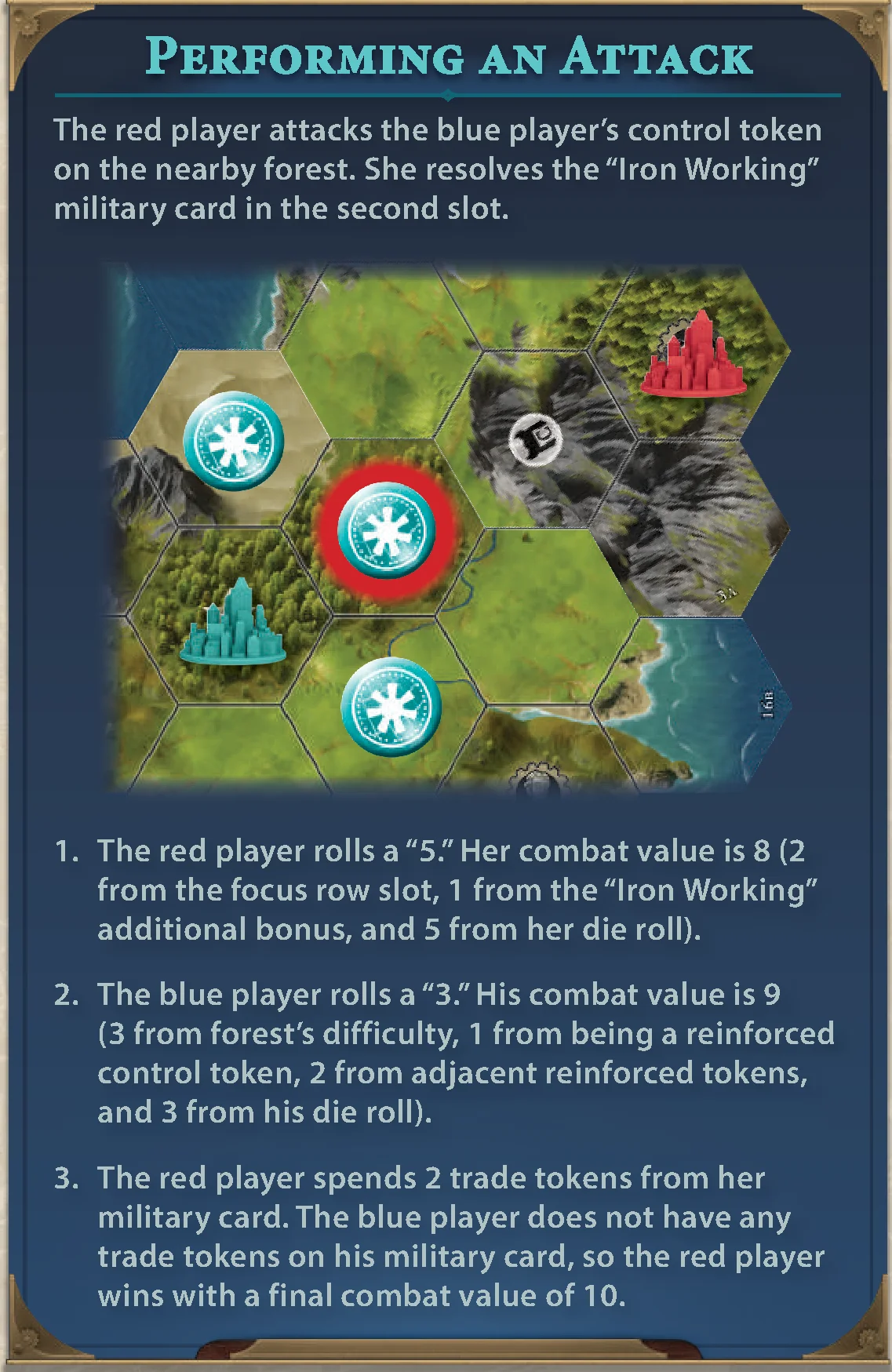
After the defender is determined, the attacker and defender each roll one die to determine their COMBAT VALUES. If the defender is a barbarian or city-state, the player to the right of the attacker rolls for the defender.
The attacker’s combat value equals his or her die result plus the number of the military card’s slot. He or she also adds any other attack bonuses on his or her cards and leader sheet.
The defender’s combat value equals his or her die result plus a bonus depending on what type of component is defending:
- City-State: The bonus equals eight.
- Barbarian: The bonus equals the difficulty of the defending space’s terrain.
- Control Token: The bonus equals the difficulty of the defending space’s terrain, plus any defense bonuses on the defending player’s cards and leader sheet. The bonus also increases by one for each friendly reinforced control token adjacent to the defender (including the defender itself if it is a reinforced control token).
- City: The bonus is the same as for a control token, but the space’s terrain difficulty is doubled (e.g., mountain terrain adds a bonus of 10 instead of 5).
After determining combat values, the attacker can spend trade tokens from his or her military card. Then, the defender can spend trade tokens from his or her own military card. Each token a player spends increases his or her combat value by one.
The player with the higher final combat value wins the attack (the defender wins ties). If the defender wins, nothing happens. If the attacker wins, he or she resolves an effect based on the target of the attack:
- City-State: The attacker conquers the city-state by placing the city-state’s token on the card in his or her focus row that shares the same type (city-state tokens are described later). Then, the attacker places one of his or her cities in the city-state’s space. Both of that city-state’s diplomacy cards are placed facedown to the side of the map.
- Barbarian: The attacker removes the barbarian from the map and places one trade token on any card in his or her focus row.
- Control Token: The attacker replaces the token with one of his or her unused control tokens on its unreinforced side. If the token is on a natural wonder space, the attacker takes that natural wonder’s token from the defending player.
- Non-Capital City: The attacker replaces the city with one of his or her unused cities. If the space was a city-state’s space, the attacker conquers or liberates it (see “City-States” on page 13).
- Capital City: The attacker takes up to two trade tokens from the defending player’s focus cards and places them on his or her own focus cards, distributed as desired.
If the attacker defeats a city that has a world wonder token, the token remains in the space (under the attacker’s new city) and the attacker takes the matching wonder card. If the city was a capital city, the attacker must move the token to one of his or her cities. If the attacker cannot move the token because all of his or her cities already have a world wonder token, the attacker cannot take the wonder’s card or token.
The Event Dial
The event dial governs effects that are not part of any player’s turn, such as barbarian activity. Before the first player starts each of his or her turns (excluding the first turn), he or she must rotate the event dial’s pointer clockwise to the next section. If that section has an icon, the first player resolves the effect of that icon. Then, the first player starts his or her turn. Each icon on the event dial is described below.
Barbarian Movement
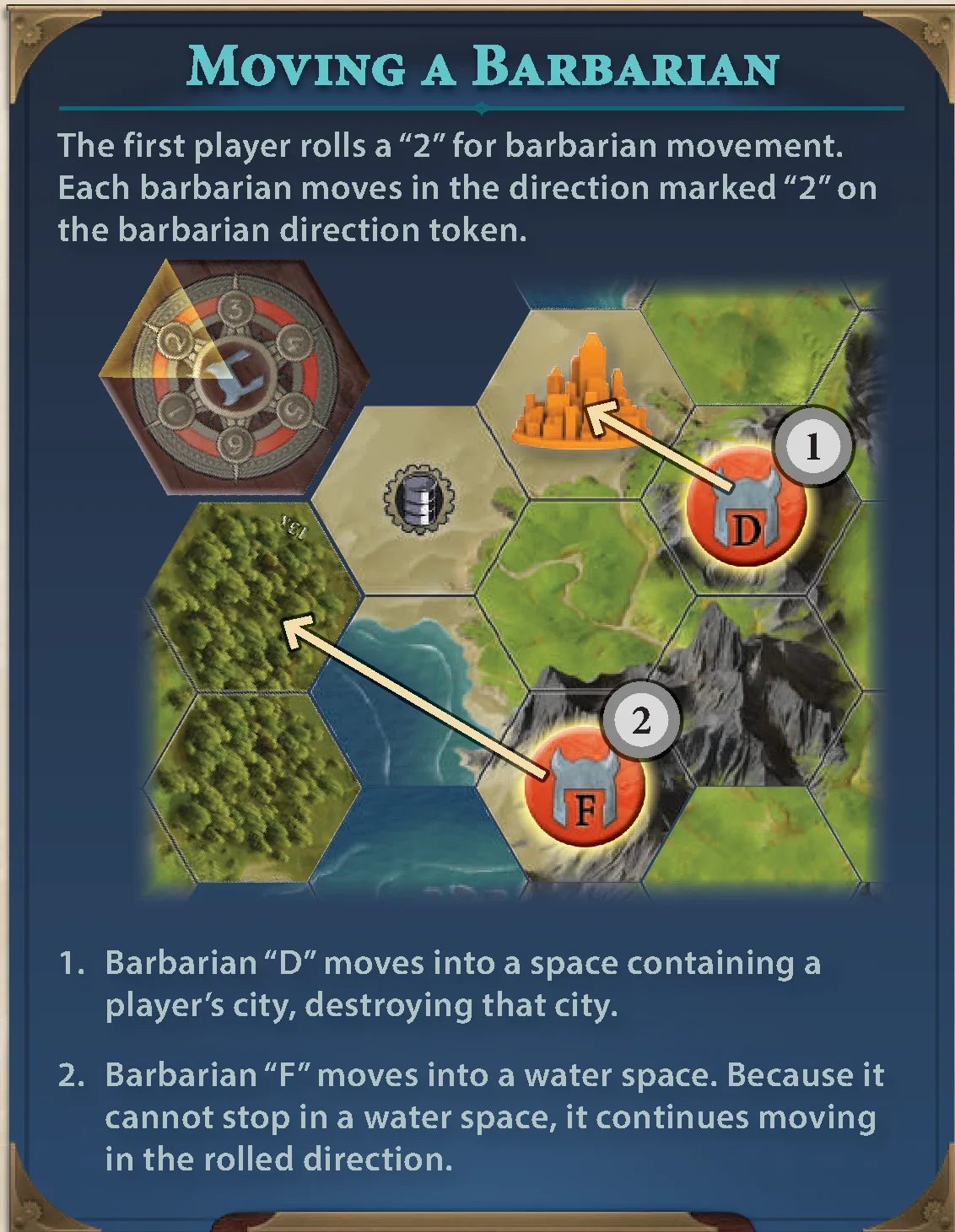
Barbarians rove around the map, seeking caravans to plunder and cities to raze. When the pointer rotates to this icon, each barbarian on the map moves. To determine the direction they all move, the first player rolls a die and matches the result to a direction on the barbarian direction token. Each barbarian token moves one space in the rolled direction.
If a barbarian moves into a space that contains a player’s component, that player resolves the corresponding effect:
- Caravan: The component is destroyed and returned to its player’s economy focus card.
- Unreinforced Control Token or Non-Capital City: The component is destroyed and returned to its player.
- Reinforced Control Token: The token is flipped to its unreinforced side and the barbarian returns to the space it moved from.
- Capital City: The player chooses and discards a total of two trade tokens from the cards in his or her focus row.
If a barbarian moves into a water space, it continues to move in the rolled direction until it reaches a non-water space. If a barbarian would move off the edge of the map, it moves in the opposite direction instead.
Barbarian Spawning
Barbarians regularly respawn throughout the game. When the pointer rotates to this icon, each defeated barbarian token is placed back on the map.
Each barbarian token displays a letter. When a barbarian token respawns, it is placed on the barbarian icon that displays the same letter.
A barbarian respawns only if its matching space is empty or occupied by a caravan (the caravan is destroyed); otherwise, the barbarian remains off the map, awaiting the next opportunity to respawn.
Trade
Mature cities contribute to their civilizations in the form of trade tokens. When the pointer rotates to this icon, each player places trade tokens from the supply on the cards in his or her focus row, distributed as desired. The number of trade tokens that player places is equal to the number of mature cities he or she controls.
City-States
A city-state is a small, sovereign state that is neutral toward all players. City-states are valuable trading partners, rewarding players who send caravans to them. Each city-state has two diplomacy cards that share the city-state’s name.
When a player moves a caravan to a city-state, that player places two trade tokens on the card in his or her focus row that shares the city-state’s type. If the player does not already have that city-state’s card, he or she takes one of its cards from the side of the map and places it next to his or her leader sheet. The player cannot take the city-state’s card from another player.
The terrain of all city-states is grassland, but the defense bonus of all city-states is eight.
A player cannot move more than one caravan into the same city or city-state each turn.
Conquering and Liberating City-States
Players can gain some of a city-state’s benefits by attacking it or by liberating it from another player.
When a player attacks and conquers a city-state, that player places one of his or her unused cities in that space and places the city-state token on the card in his or her focus row that shares the city-state’s type. Then, all of that city-state’s diplomacy cards are placed facedown to the side of the map.
When a player resolves a focus card that has a city-state token on it, he or she can spend the city-state token as a trade token. The token remains on that focus card instead of returning to the supply, but it cannot be spent more than once per turn.
If a player attacks and defeats a rival city on a conquered city-state, he or she may either conquer it (as described on page 11) or liberate it. If the player liberates it, he or she returns the city-state’s token to its space instead of placing a city. Then, the player flips that city-state’s cards faceup and takes one of them.
Diplomacy Cards
Diplomacy cards provide useful bonuses to players who send caravans to city-states and rival cities. Each player has a set of diplomacy cards corresponding to that player’s color, and each city-state has a pair of city-state diplomacy cards.
A player gets no effect from his or her own diplomacy cards, but he or she can use the diplomacy cards he or she takes from city-states and other players. A player cannot have more than one diplomacy card from each city-state and each other player.
If a player attacks a city-state or rival space, he or she must return any diplomacy cards he or she has taken from that city-state or player.
Trade Tokens
Trade tokens enhance the effects of focus cards. Players gain trade tokens by sending caravans to city-states and rival cities and when the event dial’s pointer moves to the trade icon.
When a player resolves a focus card, he or she may spend any number of trade tokens on that card. Each trade token spent produces the effect indicated on the bottom of that focus card:
- Culture: One additional control token may be placed.
- Military: If attacking or defending, the player’s combat value increases by one during that attack.
- Science: The tech dial advances one extra space.
- Industry: If building a wonder, the player’s production increases by one.
- Economy: Each caravan may move one additional space.
When a trade token is spent, it is returned to the supply.
A focus card cannot have more than three trade tokens on it. Trade tokens in excess of three are immediately returned to the supply. City-state tokens do not count against this limit.
World Wonders
World wonders provide powerful, unique effects to the players that control them. There are four types of world wonders: cultural, economic, scientific, and militaristic. A wonder’s type is indicated on its card and token by both an icon and a color. Wonder type determines which deck a wonder belongs to.
Players build world wonders by using an industry focus card. When a player builds a wonder, he or she places the wonder’s card next to his or her leader sheet and places the wonder’s token under a friendly city that does not already have a world wonder. Then, the player reveals the next wonder of that type by flipping the top card of that deck faceup.
A player controls a world wonder while its token is under a friendly city (or in rare cases, under a friendly control token). Another player can attack a rival space that has a world wonder token to take control of the wonder as described on page 11.
If a barbarian destroys a city that has a world wonder, the world wonder token remains in that space and a player can gain control of it by placing a city or control token on it.

Winning the Game
Each victory card is divided into two AGENDAS; the players’ objective is to complete one agenda on each victory card next to the map. The meaning of each agenda’s icon is described on the back page of the rulebook.
When a player completes an agenda, that player places one of his or her control tokens next to that agenda’s victory card. Even if the player ceases to satisfy the agenda later, the token remains and the player does not need to complete an agenda on that card again.
At the start of the first player’s turn, if a player has completed one agenda on each victory card, that player wins. If there is a tie, the tied player with the most world wonders wins. If still tied, the tied player with the most friendly spaces wins.
“Epic Game” Optional Rule
If experienced players want to play a longer game, they can use the “epic game” rule. To do so, they place four victory cards next to the map during setup (instead of three). The rules for winning remain the same—a player must complete one agenda on each victory card next to the map.
This section clarifies situations that may occur during the game.
Attacking
- If a player unsuccessfully attacks a target, he or she can attack it again during the same turn.
- If a player conquers a city or city-state and has no cities remaining to place there, that player places a reinforced control token instead. If that token is on a city-state’s space and an attacker defeats it and conquers the city-state, he or she must replace the token with a city if possible.
- If a player must place a control token (instead of a city) on a city-state or world wonder token, he or she has still conquered that city-state or gained control of that world wonder.
Barbarians
- If a barbarian reverses direction due to the edge of the map or a reinforced control token and it reverses onto a water space, it continues moving in that direction until it reaches a land space.
- While a barbarian is in a city-state’s space, caravans cannot move into that space and the city-state cannot be attacked.
- After barbarians move, if a space contains more than one barbarian, roll a die and move one of those barbarians in the rolled direction. Repeat until no space contains more than one barbarian.
Caravans
- Caravans can move through city-states and rival cities, but they cannot stop and remain in those spaces.
- When a caravan moves to the space of a conquered city-state, it resolves the effect of moving to a rival city.
- After a caravan returns to its economy card, it cannot move again that turn.
Control Tokens
- When placing control tokens, the player can split the tokens he or she places among multiple cities.
- If a player must place a control token but has none remaining, he or she may remove a friendly control token from the map first.
- If a control token is removed from a natural wonder’s space due to a card effect or a barbarian, that natural wonder’s token is returned to that space.
Focus Cards, Focus Row, and Tech Dial
- When a player replaces a card in his or her focus row, all trade tokens on that card are moved to the replacement card.
- If a player reaches more than one tech level space on the tech dial during a single turn, he or she gains both spaces’ effect.
- If a player’s tech dial would rotate past space 24, the next space is space 15. The pointer proceeds toward space 24 again, and more level-IV focus cards can be gained.
- A player can resolve a focus card for no effect.
- If all players agree, the players can continue the game while a player is choosing a focus card from his focus deck.
Other
- All components except trade tokens are limited to the quantities included in the box.
- When a player takes a diplomacy card from another player, its color must match that player’s color and it must currently be in that player’s deck of diplomacy cards.
- When a player’s component is destroyed, it is returned to that player and can be used again.
Players should keep this quick reference at hand for easy reference during gameplay.
Agendas
- Civilized: Have 8 of your cities on the map.
- Money Grubber: Control 2 economic world wonders.
- Warmonger: Defeat 1 rival capital city or control 2 conquered city-states.
- Paranoid: Control 2 military world wonders.
- Explorer: Control 15 spaces adjacent to water or the edge of the map.
- Aesthetic: Control 2 cultural world wonders.
- Technophile: Reach “24” on your tech dial.
- Scholarly: Control 2 scientific world wonders.
- Populous: Control 5 mature cities.
- Preservationist: Control 2 natural wonders.

Event Dial Icons
 Trade: Each player places 1 trade token on a card in his or her focus row for each of his or her mature cities.
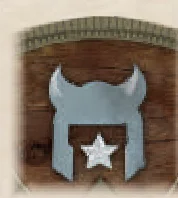 Respawn: Respawn each defeated barbarian on the barbarian icon space that displays the same letter (unless there is a city or token there).
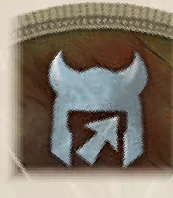 Movement: Roll a die and move each barbarian in the rolled direction.
Building a Wonder
Choose 1 faceup world wonder card on top of a wonder deck; pay its cost with production equal to:
- The number of your industry focus card’s slot.
- +2 for each eligible resource spent.
- +1 for each trade token spent from your industry focus card.
The player must have a city that does not have a world wonder token.
Performing an Attack
- Choose Target: The attacker chooses a space to attack from and a target to attack.
- Attacker Rolls: The attacker rolls a die and adds bonuses from the following sources:
- The number of his or her military focus card’s slot.
- Bonuses on his or her cards and leader sheet.
- Defender Rolls: The defender rolls a die and adds bonuses corresponding to the defender’s type:
- City-State: Bonus = 8.
- Barbarian: Bonus = Defending space’s terrain difficulty.
- Rival Space: Bonus = The sum of the following:
- Defending space’s terrain difficulty (doubled if the defender is a city).
- +1 for each adjacent, friendly, reinforced control token.
- +1 if defender itself is a reinforced control token.
- Card and leader sheet bonuses.
- Spend Trade Tokens: The attacker and then the defender have one chance to spend trade tokens from their military focus cards. +1 to combat value for each trade token spent.
- Compare Combat Values: Player with highest combat value wins (defender wins ties).
Game Credits
Fantasy Flight Games Credits
Game Design and Development: James Kniffen
Producer: Jason Walden
Editing: Adam Baker
Proofreading: Chris Meyer
Graphic Design: WiL Springer with Michael Silsby
Graphic Design Manager: Brian Schomburg
Cover and Map Tile Art: Anders Finér
Art Direction: Andy Christensen
Sculpting: Neil Hagre
Sculpting Coordinator: Niklas Norman
Managing Art Director: Melissa Shetler
Quality Assurance Coordinator: Zach Tewalthomas
Senior Project Manager: John Franz-Wichlacz
Senior Manager of Product Development: Chris Gerber
Executive Game Designer: Corey Konieczka
Creative Director: Andrew Navaro
Asmodee North America Credits
Licensing Coordinator: Sherry Anisi
Licensing Manager: Simone Elliott
Production Management: Jason Beaudoin and Megan Duehn
Publisher: Christian T. Petersen
Firaxis Credits
Studio Art Director: Arne Schmidt
Marketing Director: Lindsay Riehl
Marketing Managers: Peter Murray and Kevin Schultz
2K & Take-Two Interactive Credits
Director, Marketing: Matt Knoles
Product Manager: Jenny Tam
Director of Digital Sales: Max Schenkein
Playtester Credits
Justin Beers, Dane Beltrami, Federico Castelo, Chris J Davis, Pablo Espinosa, Petra Exnarova, Tino Gouvras, Michael Hurley, Nathaniel Kaplan, Nick Kingery, Hunter Lewis, Federico Martinez, Eric Montag, Robert Parkinson, Tom Parry, Matthew Ryan, Dan Smith, AJ Swanson, Paul Winchester, and Luke Wolaszek.
Special thanks to all of our diligent beta testers.
Art was used from the Firaxis archives. Thanks to all of these artists for their contributions.
Overview & Components
Game Overview
“Each of us is carving a stone, erecting a column, or cutting a piece of stained glass in the construction of something much bigger than ourselves.”
—Adrienne Clarkson
Sid Meier’s Civilization: A New Dawn is a strategy board game in which two to four players act as the leaders of history’s most memorable civilizations. Over the course of the game, they will expand their domains, gain new technologies, and build many of humanity’s greatest wonders. In the end, one civilization will rise above all others to leave its indelible mark upon history.
Component List
- 16 Map Tiles
- 8 Water Tokens
- 1 Event Dial (face and pointer)
- 124 Control Tokens (31 per player)
- 24 World Wonder Tokens
- 4 Focus Bars (1 per player)
- 8 Leader Sheets
- 9 Barbarian Tokens
- 32 Resource Tokens (8 per type)
- 34 Trade Tokens
- 80 Focus Cards (20 per Player)
- 16 Player Diplomacy Cards (4 per player)
- 5 Victory Cards
- 24 World Wonder Cards
- 16 City-State Diplomacy Cards
- 4 Natural Wonder Tokens (double-sided)
- 1 Barbarian Direction Token
- 4 City-State Tokens (double-sided)
- 4 Tech Dials (4 faces and 4 pointers)
- 2 Six-Sided Dice
- 44 Plastic Figures (1 capital city, 7 cities, and 3 caravans per player)
Game Setup
Setup Steps
To set up a game of Sid Meier’s Civilization: A New Dawn, players perform the following steps:
- Select Leader and Player Color: Each player takes one random leader sheet. Then, each player chooses a player color and takes the cities, caravans, control tokens, tech dial, diplomacy cards, and focus cards of that color. Then, each player rotates the pointer on his or her tech dial to “0.”
- Construct Focus Bars: Each player places the focus bar of his or her color below his or her leader sheet. Each player takes the five focus cards that display “I” on the back and places them faceup in the slots below the focus bar—each player’s leader sheet lists the order the cards must be placed in. Then, each player places a caravan on his or her “Foreign Trade” card.
- Construct Map: Players use the map tiles to construct the map. For the first game, they construct the map as described below. For future games, they use the advanced map-building rules.
- Populate Map: For each space on the map that has an icon, the players take one token that matches that icon and place it on that space. For each barbarian icon, the barbarian token placed on it should display the same letter. For each city-state icon, the city-state token placed on it should share the same icon and black frame (diamond or circle) around the icon.
- Place City-State Cards: For each city-state token placed on the map, place both copies of that city-state’s diplomacy card on top of each other and next to the map, in view of all players. Return the unused city-state diplomacy cards to the game box.
- Set Direction Token and Event Dial: A random player places the barbarian direction token against any edge of the map (it does not matter which direction each number points). Then, that player places the event dial next to his or her leader sheet with the pointer pointing to the helmet with the star. The player who has the event dial is the FIRST PLAYER and will take the first turn of the game.
- Separate Wonder Cards: Separate the world wonder cards by type into four piles. The type is indicated by the card’s color and by the icon to the left of the wonder’s image.
- Three-Player Game: If playing with only three players, return one random ancient-era card from each pile to the game box without revealing them.
- Two-Player Game: If playing with only two players, return one random ancient-era card and one random medieval-era card from each pile to the game box without revealing them.
- Create Wonder Decks: For each pile of wonder cards, do the following:
- Randomize the modern-era cards of that type and place them facedown.
- Randomize the medieval-era cards of that type and place them facedown on the modern-era cards.
- Randomize the ancient-era cards of that type and place them facedown on the medieval-era cards.
- Flip the top card of the deck faceup and place the deck in view of all players.
- Organize Wonder Tokens: Next to each wonder deck, place all of the world wonder tokens that display the same type icon and color as the cards in that deck.
- Deal Victory Cards: Place three random victory cards faceup next to the map. Return the remaining victory cards to the game box.
- Create Supply: Place the trade tokens and the remaining resource tokens in piles near the map to form the SUPPLY.
For the First Game
The players use a predetermined map for their first game to make learning easier. Before proceeding to setup on the next page, the players construct the map shown below. Each tile is labeled with a number and letter; the numbers on the map below correspond to the tile numbers. The first-game map uses only the A-side of tiles for ease of construction.
- Players begin by placing the tiles outlined in red.
- If playing with at least three players, they add the tiles outlined in yellow.
- If playing with four players, they also add the tiles outlined in blue.
After the map is constructed, each player chooses a capital city and places it on the capital city icon that is closest to him or her. The color of the capital city is the color that player will use for the first game instead of choosing a color during step 1 on the next page.
Advanced Map Building
For all games after the first game, players use the advanced map-building rules to construct their own maps. These rules add a level of strategy and provide a different map for every game. The players construct an initial landmass, called the CORE, and then they take turns adding tiles to it, placing their tiles strategically to gain the most benefit.
To perform advanced map building, follow these steps:
- Deal one random tile that has a capital-city icon (star) to each player. Return unused capital-city tiles to the box.
- Take two random tiles that have a natural wonder and two random tiles that have a city-state and shuffle all four together. These are the core tiles.
- All core tiles will be placed on the same side. To determine the side, roll a die. On a result of 1–3, use side A for all core tiles; otherwise, use side B.
- Form the core by drawing and placing the core tiles, one at a time, into the center of the table. Place the tiles in the order and orientation shown below for the side being used. Then, place a trade token on each of the four tiles to help players remember that these are the core tiles.
- Shuffle the remaining unplaced tiles and deal two to each player. Return the rest to the game box.
- Starting with a random player and proceeding clockwise, each player chooses and places one of his or her three tiles. Each tile can be placed on either of its sides, but the players must obey these restrictions:
- The tile being placed must touch at least four spaces on tiles that are already on the table.
- The tile must touch the core, even if it must be flipped to a specific side to do so. If it cannot touch the core while satisfying the previous restriction, it must touch a tile that is touching the core.
- If a player places a capital-city tile, he or she must place his or her capital city on that tile’s capital city icon.
- If a completely enclosed hole in the map is formed, the players fill the hole with water tokens.
- The players repeat step 6 until they have placed all of their tiles. Then, they remove the trade tokens from the core tiles and continue with normal setup.
Core Concepts
Players must familiarize themselves with these terms to understand how to resolve focus cards.
Spaces and Terrain
Each hex on a map tile is a SPACE. Spaces on the map have a TERRAIN represented by art. The five basic types of terrain each correspond to a slot on the focus bar: grassland (1), hills (2), forest (3), desert (4), and mountains (5). A terrain’s slot number is its DIFFICULTY.
Terrain affects many aspects of the game. In general, terrain that corresponds to a higher slot is more difficult to expand into and more difficult to conquer.
The sixth terrain type, water, does not appear on the focus bar. Water has a difficulty of one, but players generally cannot interact with water unless a card specifically allows them to do so.
When a space appears to have more than one terrain, its terrain is the type that covers the most area in the space.
Friendly and Rival
Many cards refer to spaces or game pieces as FRIENDLY or RIVAL:
- All of the control tokens and plastic figures of a player’s color are friendly to that player.
- All of the control tokens and plastic figures of other colors are rival to that player.
- Similarly, the spaces that contain a player’s cities or control tokens are friendly to that player, and spaces that contain cities and control tokens of other colors are rival to that player.
- Caravans do not cause a space to be friendly or rival.
Empty Spaces
A space is empty if it does not contain any tokens or plastic figures of any kind.
Resources and Natural Wonders
Resources and natural wonders power the creation of amazing world wonders. There are four types of resources: Marble, Mercury, Oil, Diamond.
Players can collect these tokens from the map and spend them when building world wonders. When a player spends a resource token, it is returned it to the supply.
A natural wonder token can be spent as a resource of the type shown on the token. However, when a natural wonder token is spent, it is not returned to the supply. The natural wonder token can be spent again during future turns, but it cannot be spent more than once per turn.
Spaces with natural wonder tokens do not have a terrain type, but the terrain difficulty of all natural wonder spaces is five.
Cities and Mature Cities
Cities are the focal points around which empires are built. They allow players to extend into new areas of the map.
Mature cities are fully developed cities that contribute to the well-being of a player’s civilization. They periodically generate trade tokens (which are described later) and act as new starting points for caravans.
A city is mature when each space adjacent to it either contains a friendly control token or is a water space. Cities on the edge of the map can mature faster because they have fewer adjacent spaces.
Gameplay & The Focus Row
Game Flow
Sid Meier’s Civilization: A New Dawn is played over a series of turns. As the players take turns, they use their cards to build their civilizations from single cities to sprawling empires filled with wonders and technology.
The player who has the event dial is the FIRST PLAYER; he or she takes the first turn of the game. Players continue to take turns in clockwise order until the game ends. A player wins the game by completing one agenda on each victory card. The full rules for winning the game are described on page 12.
Additionally, world events occur periodically that affect the map and all of the players, such as barbarian attacks. Before each of the first player’s turns (excluding the first turn), the first player advances the event dial, possibly producing one of these events. The event dial and its effects are described later on page 12.
The Focus Row
A player’s turn revolves around the concept of the FOCUS ROW, which is the row of five cards below his or her focus bar. The focus row represents a nation’s various pursuits, such as scientific advancements, cultural developments, and military production. Each focus row has five SLOTS, one for each card.
The cards in a player’s focus row shift to different slots as the player takes turns. A card generally shifts toward the fifth slot until it is used, which is when it moves back to the first slot. From there, it will slowly shift toward the fifth slot again.
This process represents the investment of time; a card resolved in the fifth slot has a greater impact than a card resolved in the first slot. A key strategy in the game is knowing when to resolve a card in a low slot for its immediate effect and when to wait to resolve a card for its maximum effect.
The Player Turn
A player’s turn consists of three steps:
- Choose a Card: The player chooses one of the five cards in his or her focus row and offsets it to indicate that it was the chosen card.
- Resolve the Card: The player resolves the chosen card’s effect.
- Reset the Card: The player picks up the chosen card, shifts all cards in lower slots to the right by one slot, and then places the chosen card in the first slot.
After the player resets the chosen card, the turn ends and the next player in clockwise order takes the next turn.
The detailed rules for each type of focus card are described in the “Focus Cards” section starting on page 8, but before reading that section, players should learn the game’s key concepts on the next page.
Focus Cards in Detail
Focus Cards Overview
There are five TYPES of focus cards. A focus card’s type is indicated by an icon in the upper-left corner. Each player’s focus row contains one card of each type.
During the game, players acquire advanced versions of their starting focus cards, which have a greater impact on the game. An advanced card is resolved using the same rules as the starting card of that type, but it may have an additional effect (e.g., allowing caravans to cross water).
The following sections describe the rules for each type of focus card.
Culture
Culture focus cards allow players to place control tokens, which expands territory and claims resources. The card’s focus row slot determines which types of terrain the player can place control tokens on.
To place a control token, the player takes one of his or her unused control tokens and places it on a space adjacent to a friendly city. If that space contains a resource or natural wonder token, he or she places that resource or natural wonder token next to his or her leader sheet.
The player must obey the following rules:
- The player cannot place the token on a water space or on any space whose terrain corresponds to a higher focus row slot than the culture card’s slot. All natural wonders are treated as having a terrain difficulty of five.
- The space cannot contain a barbarian token, city, city-state, or control token.
- The token must be placed on its unreinforced side (the side that does not have a white circle around the icon).
Science
The science focus card advances a player’s tech dial, allowing the player to discover new technologies. The card’s focus row slot determines how much the dial advances.
To advance a tech dial, the player rotates the dial’s pointer clockwise a number of spaces (dots and numbers) equal to the number of the science card’s focus row slot.
Each focus card has a TECH LEVEL, and some spaces on the tech dial are paired with a tech level:
When the dial’s pointer advances to (or passes) a tech level space, the player may gain a new focus card. He or she can choose any card from his or her focus card deck whose tech level exactly matches the tech level reached on the dial. The chosen card replaces the card of the same type in his or her focus row; the replaced card is returned to the deck.
Economy
Economy focus cards allow a player to interact with city-states and rival cities by moving caravans. The card’s focus row slot determines which terrain types the caravans can move into.
Each player starts the game with one caravan on his or her economy card. During the game, a player may gain better economy cards that increase the number of caravans he or she can use. When this occurs, he or she places the unlocked caravans on his or her economy card.
To move a caravan, the player moves the figure one space at a time up to the distance indicated on the card. A caravan on an economy card can move out of its player’s capital city or mature cities as though it was already in that city’s space. If a caravan does not reach a city-state or rival city in a single turn, it remains on the board and can be moved again the next time the player resolves the economy card.
The player must obey the following rules:
- The player cannot place or move a caravan onto a water space or any space whose terrain corresponds to a higher focus row slot than the economy card’s slot.
- The space cannot contain a barbarian token.
- The player cannot move more than one caravan to the same city or city-state during the same turn.
When a player moves a caravan to a city-state or rival city, he or she resolves the following steps according to the destination:
- The player returns the caravan to his or her economy card.
- The player gains two trade tokens from the supply:
- City-State: The trade tokens are placed on the card in his or her focus row that shares that city-state’s type.
- Rival City: The trade tokens are placed on cards in his or her focus row, distributed as desired.
- The player may take one diplomacy card:
- City-State: If a copy of that city-state’s diplomacy card is next to the map, he or she places that card next to his or her leader sheet. The player cannot take that card if he or she already has a copy of it.
- Rival City: The player chooses one of that rival player’s available diplomacy cards and places it next to his or her leader sheet. If the player already has one of the rival player’s diplomacy cards, he or she must return it before taking another card from the rival player.
City-states, trade tokens, and diplomacy cards are described on page 13.
Industry
The industry focus card allows a player to build either a new city or a world wonder. If building a city, the card’s focus row slot determines which types of terrain the player can consider. If building a world wonder, the focus row slot contributes toward the cost of that wonder.
Building Cities
To build a new city, the player takes one of his or her unused cities and places it on an empty space within the number of spaces indicated on the industry focus card, counting from any friendly space.
The player must obey the following rules:
- The player cannot build on a space that contains any component other than a caravan or a friendly control token. If built on a caravan, the components share the space; if built on a friendly control token, the token is removed from the map and returned to its player.
- The player cannot build adjacent to a city-state or city.
- The player cannot build on or count through a water space or any space whose terrain corresponds to a higher focus row slot than the industry card’s slot.
- The player cannot count through a rival space or a barbarian token.
Building World Wonders
World wonders grant powerful abilities to the players who control them.
A wonder’s COST is the number printed in the lower-left corner of the wonder card. Resources that a player can spend toward that cost are displayed in the lower-right corner.
To build a wonder, the player chooses one of the faceup wonder cards on top of a wonder deck and pays its cost in PRODUCTION, which is the sum of:
- The number of the industry card’s focus row slot.
- Two production for each eligible resource the player spends.
- One production for each trade token the player spends from the industry card.
If the player’s production equals or exceeds the wonder’s cost, the wonder is built. The player places the wonder card next to his or her leader sheet and places the matching wonder token under a friendly city that does not already have a wonder token. Then, the player reveals the next wonder of that type by flipping the top card of that wonder deck faceup.
A player cannot build a wonder if all of his or her cities already have a wonder token.
World wonders are described in more detail on page 13.
Military
Military focus cards allow a player to either reinforce defenses or perform attacks. The focus row slot affects how many control tokens can be reinforced, or it affects the strength of each attack.
Reinforcing Control Tokens
Reinforced control tokens are powerful defensive tools that are useful for protecting valuable territory and cities that house world wonders.
To reinforce control tokens, the player chooses a number of his or her control tokens up to the number of the military card’s slot. The player flips each of the chosen tokens to its reinforced side.
Reinforced control tokens offer some protection against barbarians. When a barbarian moves into a space that contains a reinforced control token, the barbarian returns to the space it moved from and the control token is flipped to its unreinforced side.
When a player is defending, he or she must determine the combat value of the defending component. A reinforced control token increases its own combat value by one, and it also increases the combat value of each adjacent friendly city and control token by one. These bonuses can stack to increase defense significantly—a city surrounded by several reinforced control tokens is difficult to conquer.
Performing Attacks
Players perform attacks to defeat barbarians, conquer city-states, and capture rival territory. To perform an attack, the player chooses a space to attack from and a target that is within the number of spaces indicated on the military card, counting from a friendly space.
The player must obey the following rules:
- The DEFENDER (the target of the attack) must be a barbarian token, city-state, rival city, or rival control token.
- The player cannot count through a water space, a rival space, or a barbarian token. The player can count through all other terrain regardless of the military card’s slot.
- The player cannot attack from a space that he or she attacked and took control of this turn.
After the defender is determined, the attacker and defender each roll one die to determine their COMBAT VALUES. If the defender is a barbarian or city-state, the player to the right of the attacker rolls for the defender.
The attacker’s combat value equals his or her die result plus the number of the military card’s slot. He or she also adds any other attack bonuses on his or her cards and leader sheet.
The defender’s combat value equals his or her die result plus a bonus depending on what type of component is defending:
- City-State: The bonus equals eight.
- Barbarian: The bonus equals the difficulty of the defending space’s terrain.
- Control Token: The bonus equals the difficulty of the defending space’s terrain, plus any defense bonuses on the defending player’s cards and leader sheet. The bonus also increases by one for each friendly reinforced control token adjacent to the defender (including the defender itself if it is a reinforced control token).
- City: The bonus is the same as for a control token, but the space’s terrain difficulty is doubled (e.g., mountain terrain adds a bonus of 10 instead of 5).
After determining combat values, the attacker can spend trade tokens from his or her military card. Then, the defender can spend trade tokens from his or her own military card. Each token a player spends increases his or her combat value by one.
The player with the higher final combat value wins the attack (the defender wins ties). If the defender wins, nothing happens. If the attacker wins, he or she resolves an effect based on the target of the attack:
- City-State: The attacker conquers the city-state by placing the city-state’s token on the card in his or her focus row that shares the same type (city-state tokens are described later). Then, the attacker places one of his or her cities in the city-state’s space. Both of that city-state’s diplomacy cards are placed facedown to the side of the map.
- Barbarian: The attacker removes the barbarian from the map and places one trade token on any card in his or her focus row.
- Control Token: The attacker replaces the token with one of his or her unused control tokens on its unreinforced side. If the token is on a natural wonder space, the attacker takes that natural wonder’s token from the defending player.
- Non-Capital City: The attacker replaces the city with one of his or her unused cities. If the space was a city-state’s space, the attacker conquers or liberates it (see “City-States” on page 13).
- Capital City: The attacker takes up to two trade tokens from the defending player’s focus cards and places them on his or her own focus cards, distributed as desired.
If the attacker defeats a city that has a world wonder token, the token remains in the space (under the attacker’s new city) and the attacker takes the matching wonder card. If the city was a capital city, the attacker must move the token to one of his or her cities. If the attacker cannot move the token because all of his or her cities already have a world wonder token, the attacker cannot take the wonder’s card or token.
World Elements & Events
The Event Dial
The event dial governs effects that are not part of any player’s turn, such as barbarian activity. Before the first player starts each of his or her turns (excluding the first turn), he or she must rotate the event dial’s pointer clockwise to the next section. If that section has an icon, the first player resolves the effect of that icon. Then, the first player starts his or her turn. Each icon on the event dial is described below.
Barbarian Movement
Barbarians rove around the map, seeking caravans to plunder and cities to raze. When the pointer rotates to this icon, each barbarian on the map moves. To determine the direction they all move, the first player rolls a die and matches the result to a direction on the barbarian direction token. Each barbarian token moves one space in the rolled direction.
If a barbarian moves into a space that contains a player’s component, that player resolves the corresponding effect:
- Caravan: The component is destroyed and returned to its player’s economy focus card.
- Unreinforced Control Token or Non-Capital City: The component is destroyed and returned to its player.
- Reinforced Control Token: The token is flipped to its unreinforced side and the barbarian returns to the space it moved from.
- Capital City: The player chooses and discards a total of two trade tokens from the cards in his or her focus row.
If a barbarian moves into a water space, it continues to move in the rolled direction until it reaches a non-water space. If a barbarian would move off the edge of the map, it moves in the opposite direction instead.
Barbarian Spawning
Barbarians regularly respawn throughout the game. When the pointer rotates to this icon, each defeated barbarian token is placed back on the map.
Each barbarian token displays a letter. When a barbarian token respawns, it is placed on the barbarian icon that displays the same letter.
A barbarian respawns only if its matching space is empty or occupied by a caravan (the caravan is destroyed); otherwise, the barbarian remains off the map, awaiting the next opportunity to respawn.
Trade
Mature cities contribute to their civilizations in the form of trade tokens. When the pointer rotates to this icon, each player places trade tokens from the supply on the cards in his or her focus row, distributed as desired. The number of trade tokens that player places is equal to the number of mature cities he or she controls.
City-States
A city-state is a small, sovereign state that is neutral toward all players. City-states are valuable trading partners, rewarding players who send caravans to them. Each city-state has two diplomacy cards that share the city-state’s name.
When a player moves a caravan to a city-state, that player places two trade tokens on the card in his or her focus row that shares the city-state’s type. If the player does not already have that city-state’s card, he or she takes one of its cards from the side of the map and places it next to his or her leader sheet. The player cannot take the city-state’s card from another player.
The terrain of all city-states is grassland, but the defense bonus of all city-states is eight.
A player cannot move more than one caravan into the same city or city-state each turn.
Conquering and Liberating City-States
Players can gain some of a city-state’s benefits by attacking it or by liberating it from another player.
When a player attacks and conquers a city-state, that player places one of his or her unused cities in that space and places the city-state token on the card in his or her focus row that shares the city-state’s type. Then, all of that city-state’s diplomacy cards are placed facedown to the side of the map.
When a player resolves a focus card that has a city-state token on it, he or she can spend the city-state token as a trade token. The token remains on that focus card instead of returning to the supply, but it cannot be spent more than once per turn.
If a player attacks and defeats a rival city on a conquered city-state, he or she may either conquer it (as described on page 11) or liberate it. If the player liberates it, he or she returns the city-state’s token to its space instead of placing a city. Then, the player flips that city-state’s cards faceup and takes one of them.
Diplomacy Cards
Diplomacy cards provide useful bonuses to players who send caravans to city-states and rival cities. Each player has a set of diplomacy cards corresponding to that player’s color, and each city-state has a pair of city-state diplomacy cards.
A player gets no effect from his or her own diplomacy cards, but he or she can use the diplomacy cards he or she takes from city-states and other players. A player cannot have more than one diplomacy card from each city-state and each other player.
If a player attacks a city-state or rival space, he or she must return any diplomacy cards he or she has taken from that city-state or player.
Trade Tokens
Trade tokens enhance the effects of focus cards. Players gain trade tokens by sending caravans to city-states and rival cities and when the event dial’s pointer moves to the trade icon.
When a player resolves a focus card, he or she may spend any number of trade tokens on that card. Each trade token spent produces the effect indicated on the bottom of that focus card:
- Culture: One additional control token may be placed.
- Military: If attacking or defending, the player’s combat value increases by one during that attack.
- Science: The tech dial advances one extra space.
- Industry: If building a wonder, the player’s production increases by one.
- Economy: Each caravan may move one additional space.
When a trade token is spent, it is returned to the supply.
A focus card cannot have more than three trade tokens on it. Trade tokens in excess of three are immediately returned to the supply. City-state tokens do not count against this limit.
World Wonders
World wonders provide powerful, unique effects to the players that control them. There are four types of world wonders: cultural, economic, scientific, and militaristic. A wonder’s type is indicated on its card and token by both an icon and a color. Wonder type determines which deck a wonder belongs to.
Players build world wonders by using an industry focus card. When a player builds a wonder, he or she places the wonder’s card next to his or her leader sheet and places the wonder’s token under a friendly city that does not already have a world wonder. Then, the player reveals the next wonder of that type by flipping the top card of that deck faceup.
A player controls a world wonder while its token is under a friendly city (or in rare cases, under a friendly control token). Another player can attack a rival space that has a world wonder token to take control of the wonder as described on page 11.
If a barbarian destroys a city that has a world wonder, the world wonder token remains in that space and a player can gain control of it by placing a city or control token on it.
Winning the Game & Variants
Winning the Game
Each victory card is divided into two AGENDAS; the players’ objective is to complete one agenda on each victory card next to the map. The meaning of each agenda’s icon is described on the back page of the rulebook.
When a player completes an agenda, that player places one of his or her control tokens next to that agenda’s victory card. Even if the player ceases to satisfy the agenda later, the token remains and the player does not need to complete an agenda on that card again.
At the start of the first player’s turn, if a player has completed one agenda on each victory card, that player wins. If there is a tie, the tied player with the most world wonders wins. If still tied, the tied player with the most friendly spaces wins.
“Epic Game” Optional Rule
If experienced players want to play a longer game, they can use the “epic game” rule. To do so, they place four victory cards next to the map during setup (instead of three). The rules for winning remain the same—a player must complete one agenda on each victory card next to the map.
Rules Clarifications
This section clarifies situations that may occur during the game.
Attacking
- If a player unsuccessfully attacks a target, he or she can attack it again during the same turn.
- If a player conquers a city or city-state and has no cities remaining to place there, that player places a reinforced control token instead. If that token is on a city-state’s space and an attacker defeats it and conquers the city-state, he or she must replace the token with a city if possible.
- If a player must place a control token (instead of a city) on a city-state or world wonder token, he or she has still conquered that city-state or gained control of that world wonder.
Barbarians
- If a barbarian reverses direction due to the edge of the map or a reinforced control token and it reverses onto a water space, it continues moving in that direction until it reaches a land space.
- While a barbarian is in a city-state’s space, caravans cannot move into that space and the city-state cannot be attacked.
- After barbarians move, if a space contains more than one barbarian, roll a die and move one of those barbarians in the rolled direction. Repeat until no space contains more than one barbarian.
Caravans
- Caravans can move through city-states and rival cities, but they cannot stop and remain in those spaces.
- When a caravan moves to the space of a conquered city-state, it resolves the effect of moving to a rival city.
- After a caravan returns to its economy card, it cannot move again that turn.
Control Tokens
- When placing control tokens, the player can split the tokens he or she places among multiple cities.
- If a player must place a control token but has none remaining, he or she may remove a friendly control token from the map first.
- If a control token is removed from a natural wonder’s space due to a card effect or a barbarian, that natural wonder’s token is returned to that space.
Focus Cards, Focus Row, and Tech Dial
- When a player replaces a card in his or her focus row, all trade tokens on that card are moved to the replacement card.
- If a player reaches more than one tech level space on the tech dial during a single turn, he or she gains both spaces’ effect.
- If a player’s tech dial would rotate past space 24, the next space is space 15. The pointer proceeds toward space 24 again, and more level-IV focus cards can be gained.
- A player can resolve a focus card for no effect.
- If all players agree, the players can continue the game while a player is choosing a focus card from his focus deck.
Other
- All components except trade tokens are limited to the quantities included in the box.
- When a player takes a diplomacy card from another player, its color must match that player’s color and it must currently be in that player’s deck of diplomacy cards.
- When a player’s component is destroyed, it is returned to that player and can be used again.
Quick Reference
Players should keep this quick reference at hand for easy reference during gameplay.
Agendas
- Civilized: Have 8 of your cities on the map.
- Money Grubber: Control 2 economic world wonders.
- Warmonger: Defeat 1 rival capital city or control 2 conquered city-states.
- Paranoid: Control 2 military world wonders.
- Explorer: Control 15 spaces adjacent to water or the edge of the map.
- Aesthetic: Control 2 cultural world wonders.
- Technophile: Reach “24” on your tech dial.
- Scholarly: Control 2 scientific world wonders.
- Populous: Control 5 mature cities.
- Preservationist: Control 2 natural wonders.
Event Dial Icons
- Trade: Each player places 1 trade token on a card in his or her focus row for each of his or her mature cities.
- Respawn: Respawn each defeated barbarian on the barbarian icon space that displays the same letter (unless there is a city or token there).
- Movement: Roll a die and move each barbarian in the rolled direction.
Building a Wonder
Choose 1 faceup world wonder card on top of a wonder deck; pay its cost with production equal to:
- The number of your industry focus card’s slot.
- +2 for each eligible resource spent.
- +1 for each trade token spent from your industry focus card.
The player must have a city that does not have a world wonder token.
Performing an Attack
- Choose Target: The attacker chooses a space to attack from and a target to attack.
- Attacker Rolls: The attacker rolls a die and adds bonuses from the following sources:
- The number of his or her military focus card’s slot.
- Bonuses on his or her cards and leader sheet.
- Defender Rolls: The defender rolls a die and adds bonuses corresponding to the defender’s type:
- City-State: Bonus = 8.
- Barbarian: Bonus = Defending space’s terrain difficulty.
- Rival Space: Bonus = The sum of the following:
- Defending space’s terrain difficulty (doubled if the defender is a city).
- +1 for each adjacent, friendly, reinforced control token.
- +1 if defender itself is a reinforced control token.
- Card and leader sheet bonuses.
- Spend Trade Tokens: The attacker and then the defender have one chance to spend trade tokens from their military focus cards. +1 to combat value for each trade token spent.
- Compare Combat Values: Player with highest combat value wins (defender wins ties).
Credits
Game Credits
Fantasy Flight Games Credits
Game Design and Development: James Kniffen
Producer: Jason Walden
Editing: Adam Baker
Proofreading: Chris Meyer
Graphic Design: WiL Springer with Michael Silsby
Graphic Design Manager: Brian Schomburg
Cover and Map Tile Art: Anders Finér
Art Direction: Andy Christensen
Sculpting: Neil Hagre
Sculpting Coordinator: Niklas Norman
Managing Art Director: Melissa Shetler
Quality Assurance Coordinator: Zach Tewalthomas
Senior Project Manager: John Franz-Wichlacz
Senior Manager of Product Development: Chris Gerber
Executive Game Designer: Corey Konieczka
Creative Director: Andrew Navaro
Asmodee North America Credits
Licensing Coordinator: Sherry Anisi
Licensing Manager: Simone Elliott
Production Management: Jason Beaudoin and Megan Duehn
Publisher: Christian T. Petersen
Firaxis Credits
Studio Art Director: Arne Schmidt
Marketing Director: Lindsay Riehl
Marketing Managers: Peter Murray and Kevin Schultz
2K & Take-Two Interactive Credits
Director, Marketing: Matt Knoles
Product Manager: Jenny Tam
Director of Digital Sales: Max Schenkein
Playtester Credits
Justin Beers, Dane Beltrami, Federico Castelo, Chris J Davis, Pablo Espinosa, Petra Exnarova, Tino Gouvras, Michael Hurley, Nathaniel Kaplan, Nick Kingery, Hunter Lewis, Federico Martinez, Eric Montag, Robert Parkinson, Tom Parry, Matthew Ryan, Dan Smith, AJ Swanson, Paul Winchester, and Luke Wolaszek.
Special thanks to all of our diligent beta testers.
Art was used from the Firaxis archives. Thanks to all of these artists for their contributions.
Expansions for
Civilization: A New Dawn
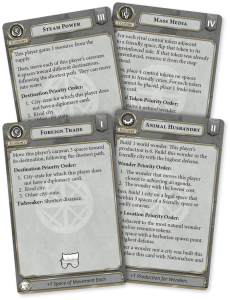
Civilization: A New Dawn – Automatic Civilization
2020
A streamlined automated opponent for solo and competitive Civilization games
120
minutes
Medium Heavy
View expansion
Civilization: A New Dawn – Terra Incognita
2020
Explore unknown lands, develop districts, and shape a growing civilization.
120
minutes
Medium Heavy
View expansion
