
Fresco
2010
Plan your apprentices, mix the right paints, and race to restore a Renaissance fresco while keeping your workforce happy.
60
minutes
2 - 4
player(s)
10+
Medium

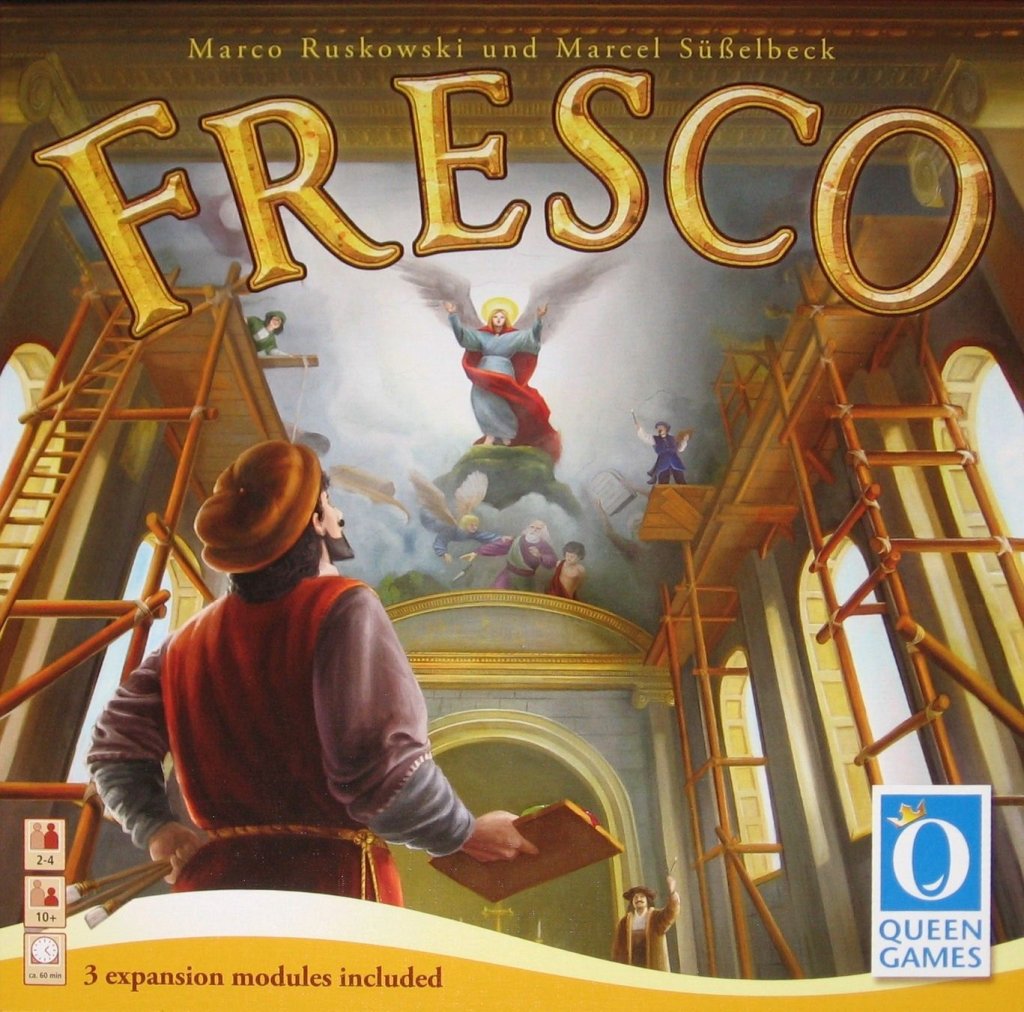
About this board game
Fresco is a strategy board game for 2–4 players, with games lasting about 60 minutes, in which master painters work to restore a Renaissance church fresco.
Each round begins with a crucial choice: decide when your apprentices will wake up. Waking earlier gives you an earlier turn order and better access to the available options, but repeatedly rising early can make your apprentices unhappy and reduce their efficiency. Choosing when to start the day is an important part of planning your actions.
Once the day begins, deploy your apprentices to carry out essential tasks. You may need to:
- Buy paint before other players claim the options you want.
- Mix colors to create the combinations required for the fresco.
- Paint sections of the fresco to earn points.
- Raise money by painting portraits.
- Send apprentices to the opera to improve their happiness.
Painting the fresco is the main source of points, but completing its sections requires specific combinations of paints. You must therefore manage your money, purchase colors wisely, and decide when to mix them, all while competing for the segments and supplies that best fit your plans.
Fresco includes several expansion modules that let you adjust the experience. Play without expansions for a lighter family game, or add modules to increase variety, decision-making, and difficulty.
This flexible design gives Fresco strong replay value, allowing each group to choose how much complexity to include as they plan, paint, and manage the happiness of their Renaissance workshop.
/pic7182955.jpg)
Board Game Rules for
Fresco
A game by Marco Ruskowski and Marcel Süßelbeck for 2-4 players aged 10 years and above
The bishop awaits very high-ranking visitors, but unfortunately the large fresco – the painting at the ceiling of the cathedral – is in urgent need of being restored.
The most renowned fresco painters of the renaissance are hired and now have to prove their skillful mastership. Which painter will succeed in restoring the fresco to its former glory?
Overview
“Fresco” is an exquisite family game for 2-4 players aged 10 years and above. It will whisk you away to the epoch of the renaissance and all its grandeur. Plunge into this cavalier era und experience advanced ways of gaming by using the 3 expansion modules included in this box. You may combine the basic game with these modules in any way you like. The modules will increase the challenge gradually, thus affecting the playing time.
“Fresco” is a game sure to provide entertainment many times over.
- The basic game: Fresco
- The expansion modules, gradually increasing the challenge:
- Module 1: The Portraits
- Module 2: The bishop’s requests
- Module 3: Special blend colors
Object of the game
The players find themselves in the roles of fresco painters and by order of the bishop have to restore the large painting at the cathedral’s ceiling.
The painters need to carefully plan for their workday. More often than not they have to get up very early in the morning, buying and mixing paints for their work in the cathedral in order to restore the fresco to its immaculate condition.
In case their income is not sufficient the players have to meet orders in their own studio. This may lead to a bad mood of their apprentices which can be cured only by attending the evening show at the theater.
Only slick planning will help you to gain the most victory points and to become the most glorious fresco painter.
All components of “Fresco” are listed on the next page. The supplement contains all components and rules of the modules.
The rules for the two player game can also be found in the supplement.
Game components
- 1 double-sided game board
- 14 market tiles
- 25 fresco tiles with values from 3 to 11.
- 60 coins (Thalers) with values of 1 (36x), 5 (16 x), and 10 (8x)
- 78 paint pieces, 17 each of red, yellow, blue; 9 each of green, purple, orange
- 4 natural-colored apprentices
- 20 apprentices, 5 each in 4 colors
- 12 master painters, 3 each in 4 colors
- 1 bishop
- 4 small screens
- 4 large screens
- 4 action sheets
- 4 cards showing tables of blending paints
- 1 linen bag
- 1 rules leaflet
Any surplus components are not used for the basic game.
Gaming material per player
Each player takes in their selected player color:
- 1 small screen and 1 action sheet, which they place behind the screen, side “1” being visible
- 1 large screen, behind which they place 1 yellow, 1 red and 1 blue paint piece and 12 Thalers
- 1 card with table of blending basic paints
- 3 master painters
- 5 apprentices
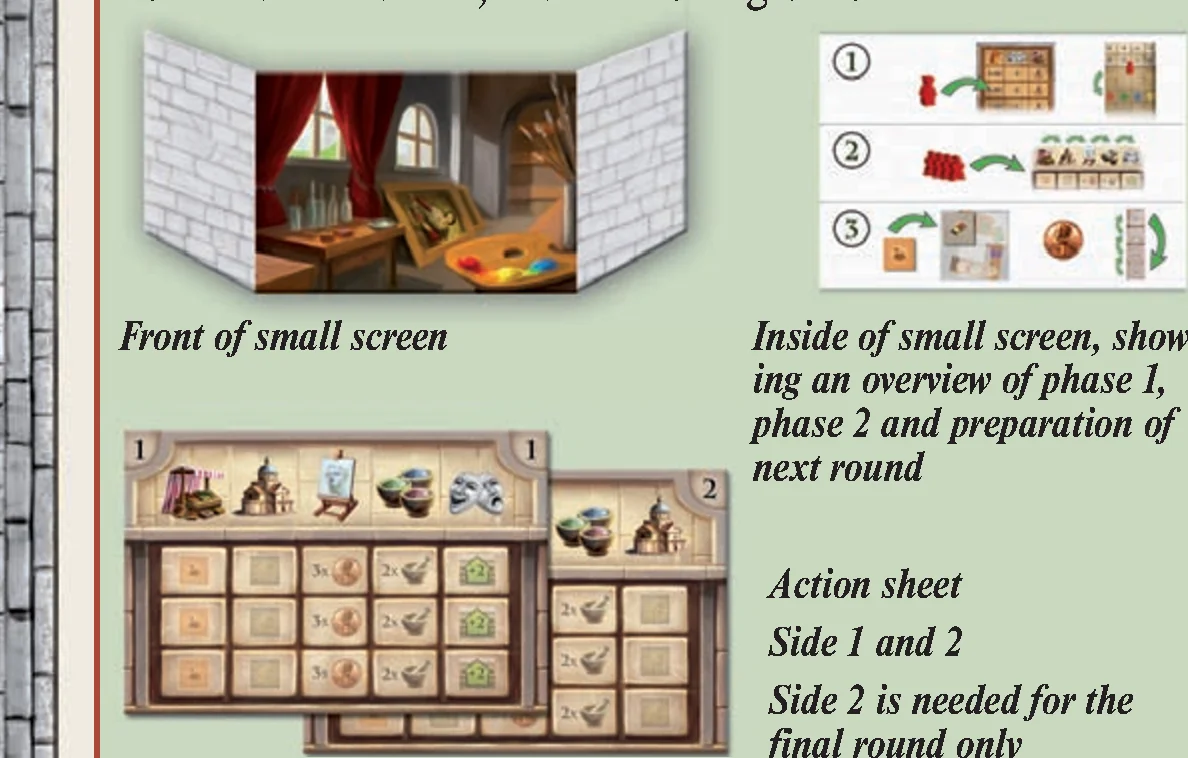
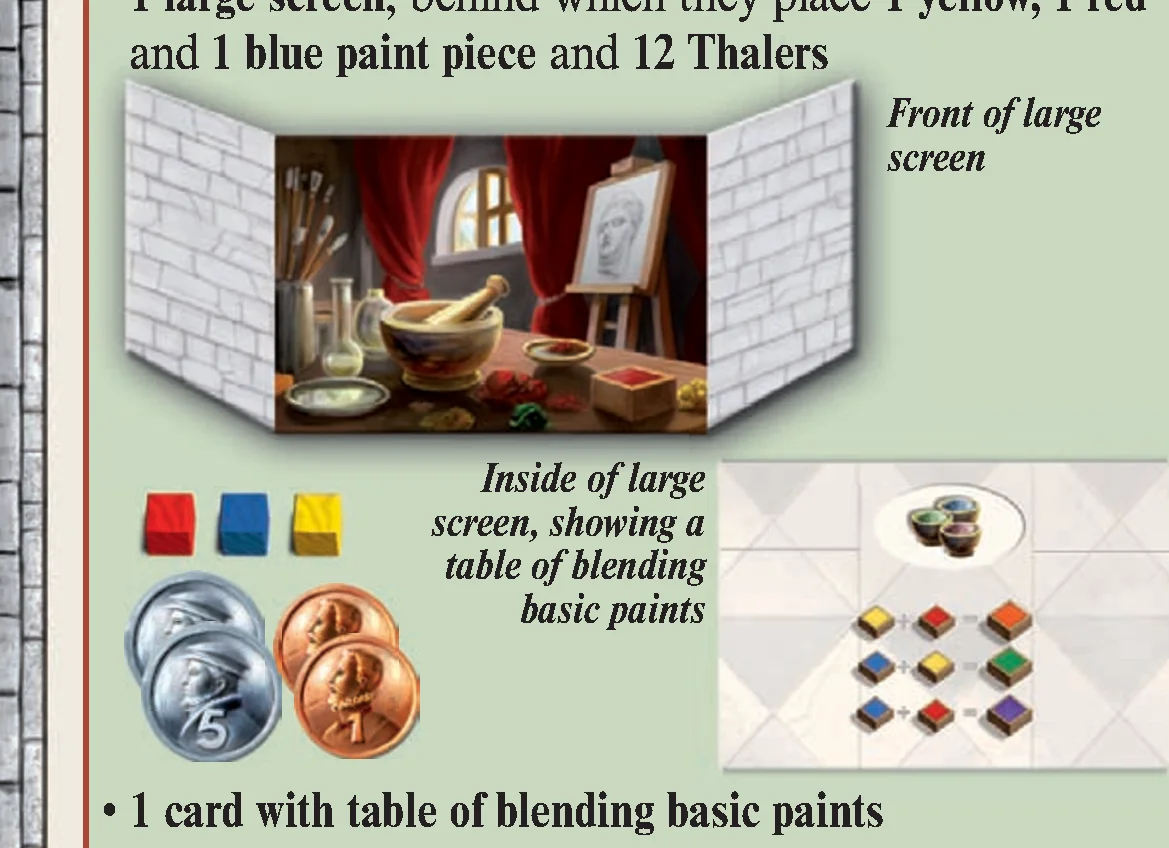
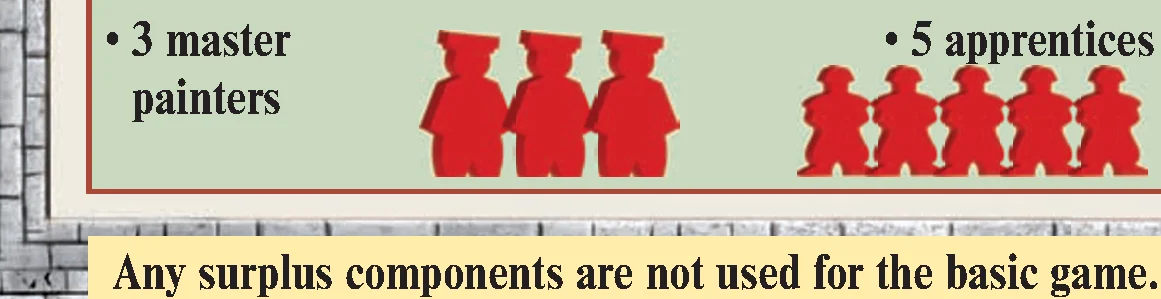
Set up for a 3 or 4 player game
Any distinctive features for a 3 player game are highlighted by a blue background
- The double-sided game board …
… is placed in the middle of the table within easy reach for all players. The side for 4 players is face up (starting spaces S1 – S4).
For 3 players turn the board over and use the side showing starting spaces S1 – S3. - The starting spaces (S1-S4)
Put 1 master painter of each player into the linen bag. Then draw one after the other from the bag and place them on the starting spaces S1 to S4 in the order as they were drawn. - The hostel
Each player places one of their master painters on a space above the hostel.
The hostel displays:- Left column – get up time in the morning
- Middle column – change of mood
- Right column – market prices
- The market with four booths I – IV
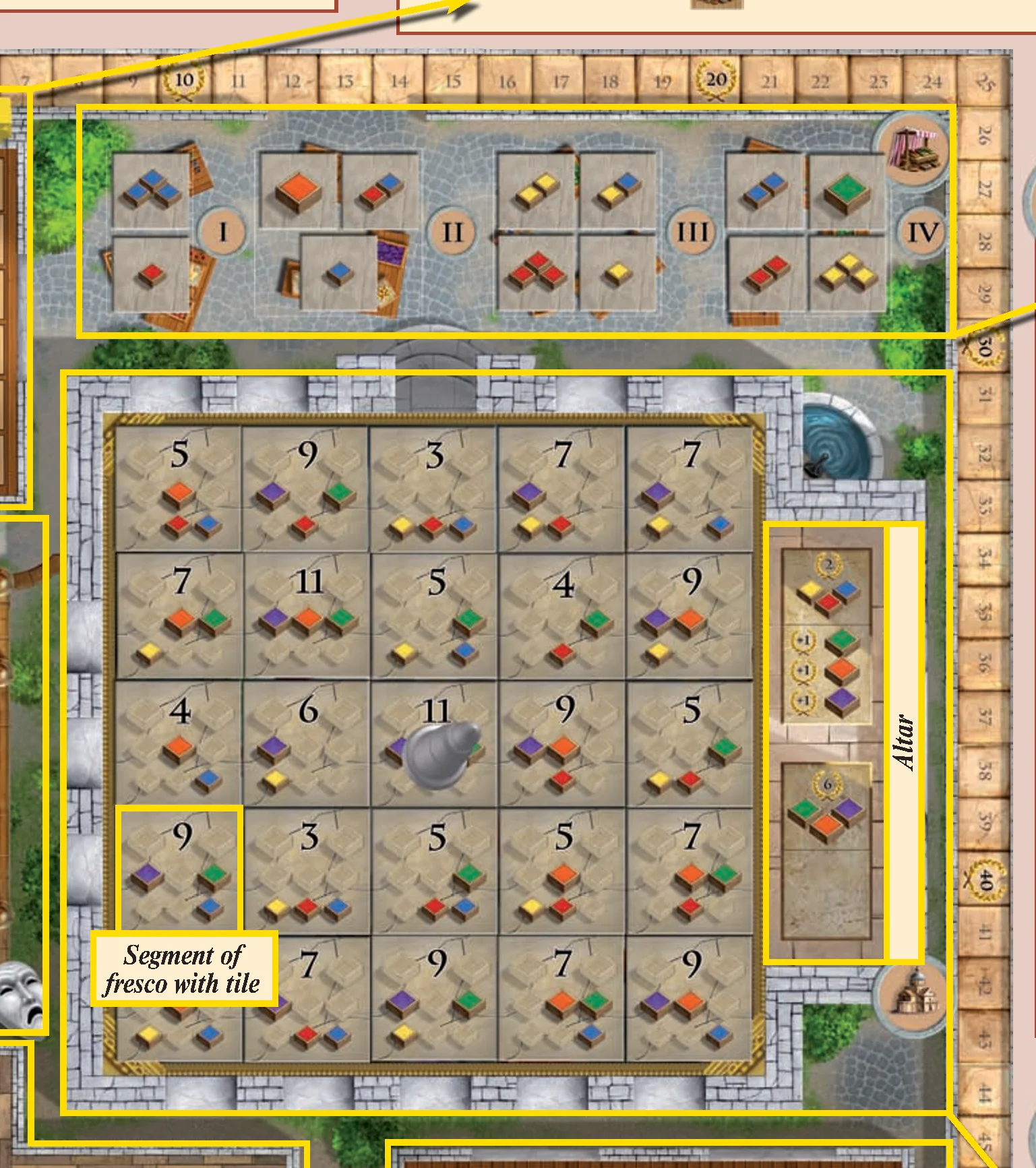
Put all 14 market tiles into the linen bag and shuffle well. The tiles show the paints which can be bought at the market. Draw the appropriate number of tiles for each booth and place them there face up. 1 tile will be left over in the bag.
For three players there are only 3 booths. Please remove the tiles shown below from the game: There is a total of 11 tiles, 2 of which will be left over in the bag. - The cathedral with fresco and altar
Take one of the 25 fresco tiles valued 11 and place it face up in the center space of the fresco.
Shuffle the remaining tiles and randomly deal them out face up onto the segments of the fresco. - The studio
Place all coins on the three free spaces of the studio, sorted by denomination. This is the common supply. - The workshop
All paint pieces are placed on the 6 spaces of the workshop, sorted by color. This is the common supply. - The theater
Each player places one of their master painters on the corresponding space of the mood display.
One natural-colored apprentice is placed on the space above each column. - The bishop
The bishop takes his place in the center of the fresco.
Fresco lasts for several rounds; each round is split into 2 phases:
- Choosing get up time and adjusting mood
- Planning and performing actions
Both phases are now explained in detail:
Phase 1. Choosing get up time and adjusting mood
Please note: At the start of the game the master painters are standing on the starting spaces S1 – S4, S1 qualifying for the last position.
The player holding last position on the victory point track goes first.
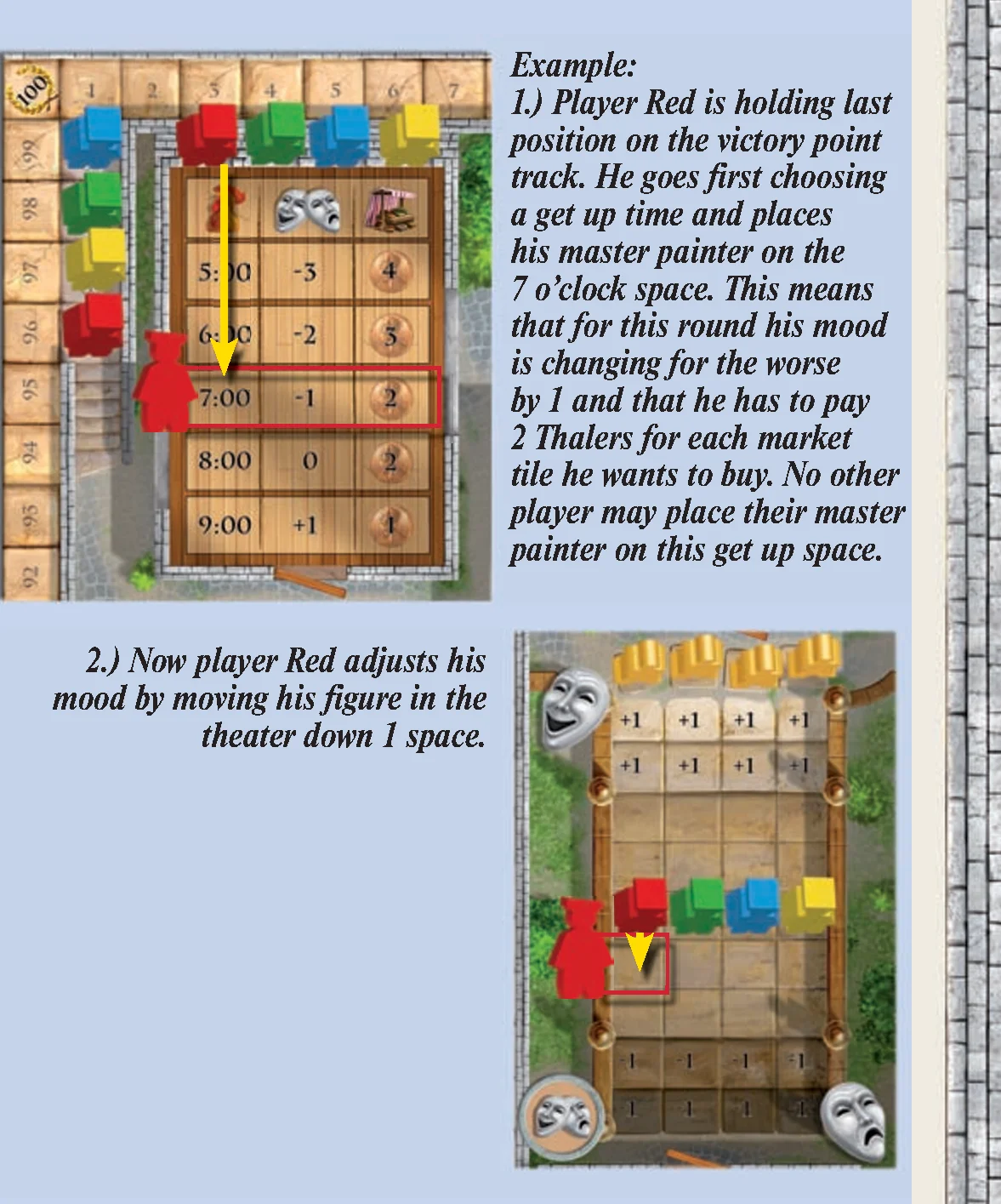
They take their master painter from his space above the hostel and place the figure on a get up space of their choice (left column). The other players do likewise in order from second last position to first position, placing their master painter on any free get up space. Only one painter may occupy any single get up space.
The get up time has the following effects for each player:
- It may change the player’s own mood
- It affects their market price
- It determines the player order for the actions in phase 2.
Change of mood
Any change of mood is displayed in the middle column of the hostel. Immediately after choosing their get up time the player adjusts their mood by moving their painter up or down his column on the mood display. A figure may never be moved beyond the top or bottom space of a column.
The emotional state affects the following:
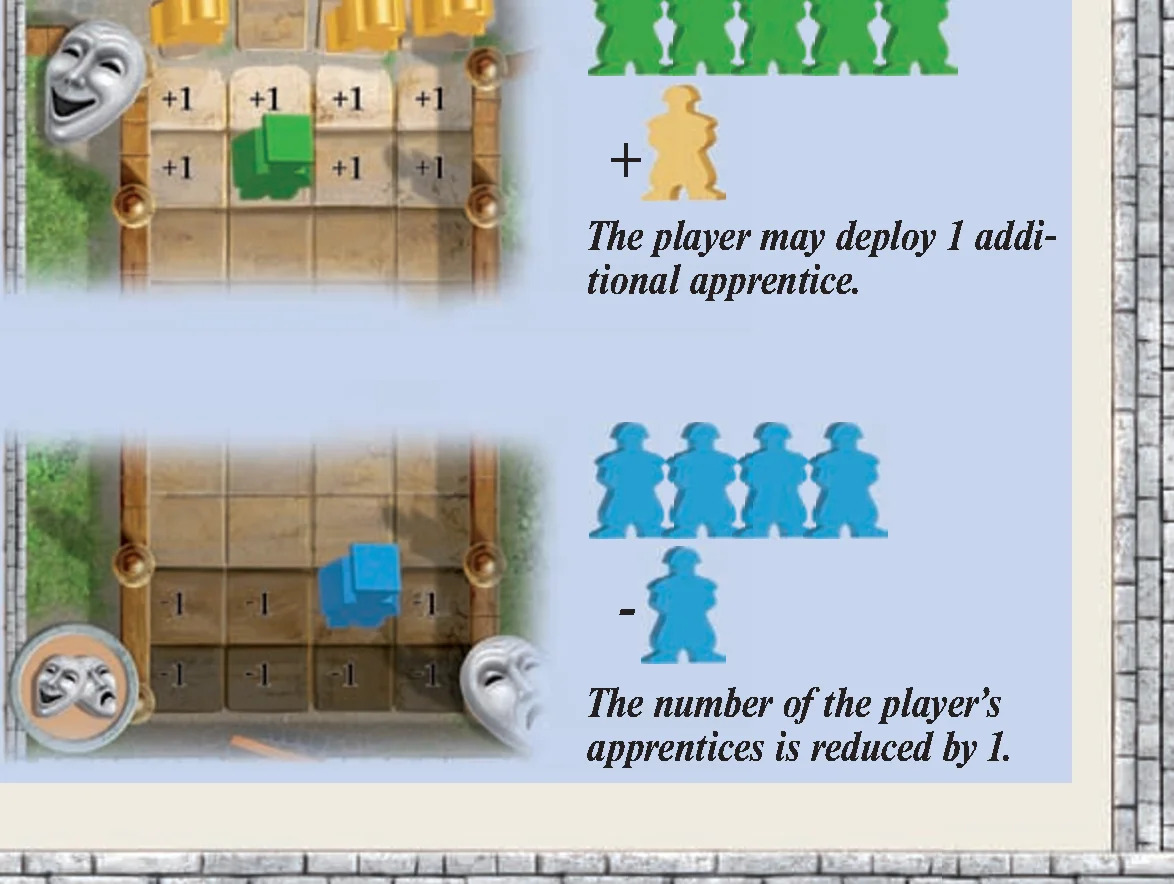
- “+1” Spaces: If a player’s master painter is occupying any of the two “+1” spaces they take the natural-colored apprentice from the space above their column. They may use this apprentice for 1 additional action (thus having a total of 6 actions) on their action sheet. A player keeps their extra apprentice until they are leaving the “+1” spaces. When leaving these spaces they return the apprentice to his space above the column.
- “-1” Spaces: If a player’s master painter is occupying any of the two “-1” spaces they have to dispense 1 of their own apprentices, placing him in front of their screen (thus having a total of only 4 actions during phase 2). When leaving these spaces they take their apprentice back and can use him again.
Market prices
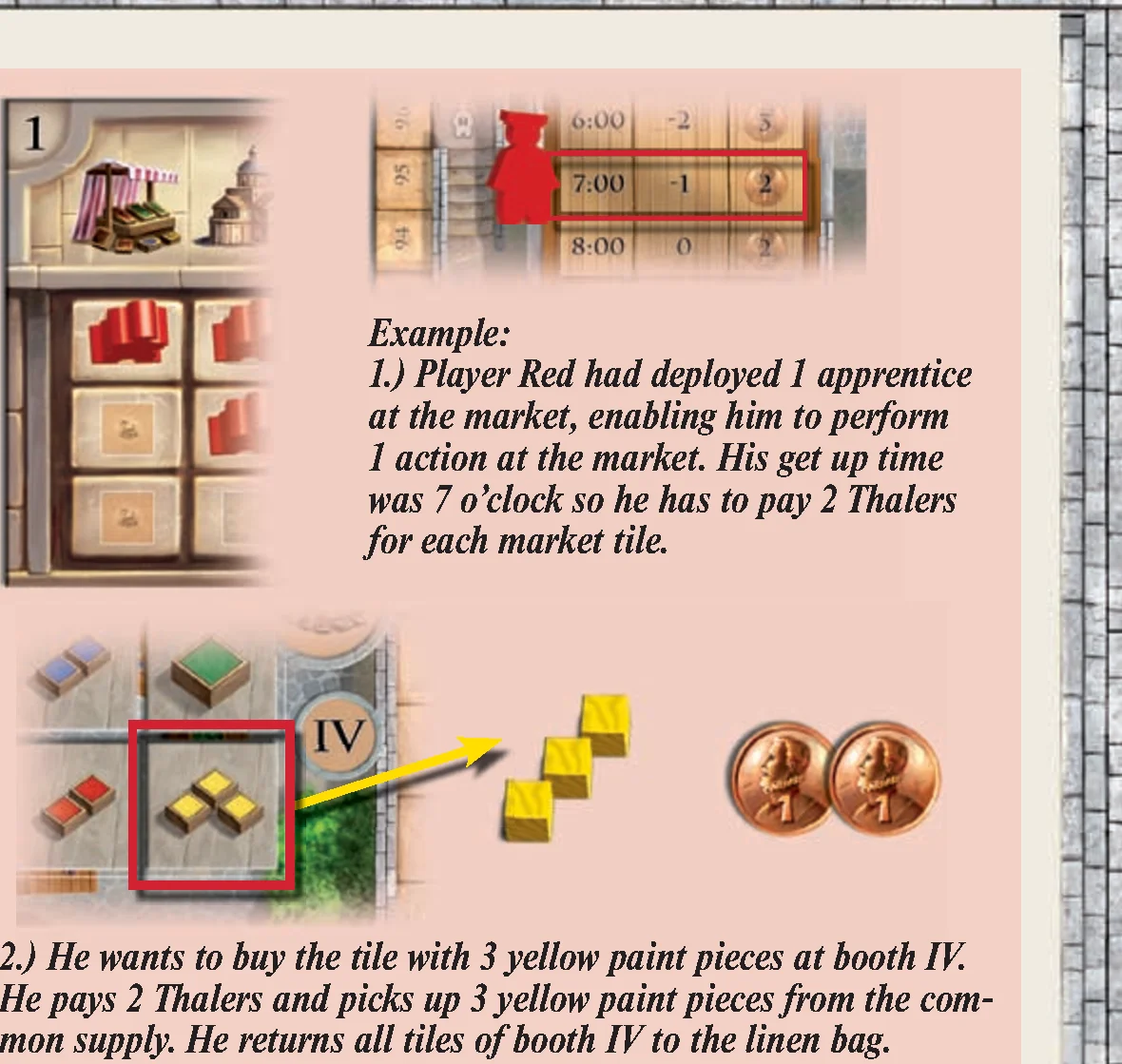
Depending on the get up time they choose, the column to the right shows the price a player has to pay at the market for 1 market tile.
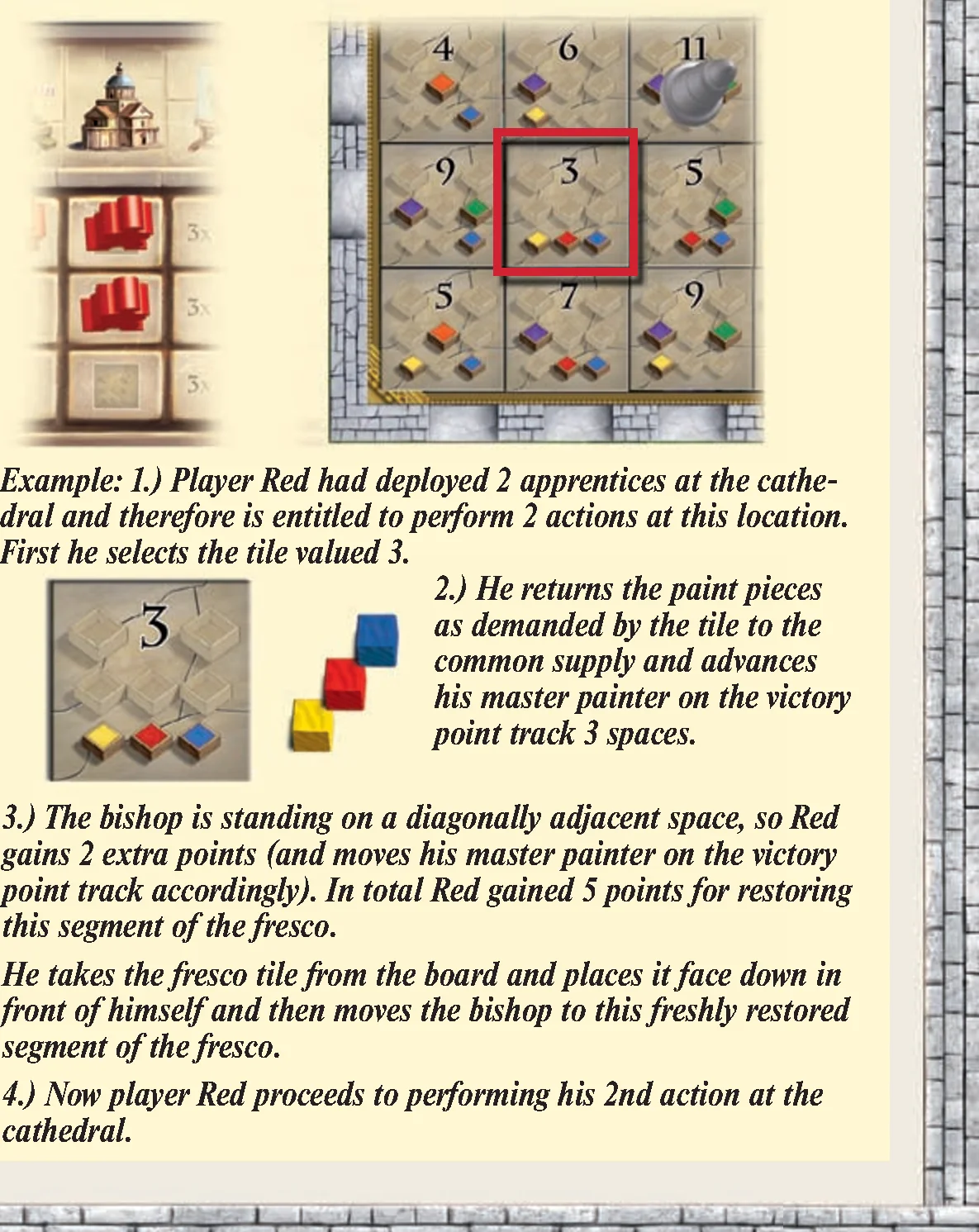
Example: Player Red has to pay 2 Thalers for each market tile he wants to buy.
Player order
After all players choose their get up time the player order for this round is fixed. The player having chosen the earliest get up time will be first player during phase 2, followed by the other players in ascending order of their chosen get up time.
Important: There are 2 different player orders during the game:
- The order of choosing get up time (depending on the players’ positions on the victory point track).
- The order of performing actions (depending on the players’ get up time).
Phase 2. Planning and performing actions
Planning actions
Now all the players begin planning their forthcoming actions simultaneously behind their small screen. They can perform actions at the 5 different locations on the game board. The players deploy their available apprentices to the 15 spaces of their action sheet. Only 1 apprentice may be placed on any single action space, thus activating this action.
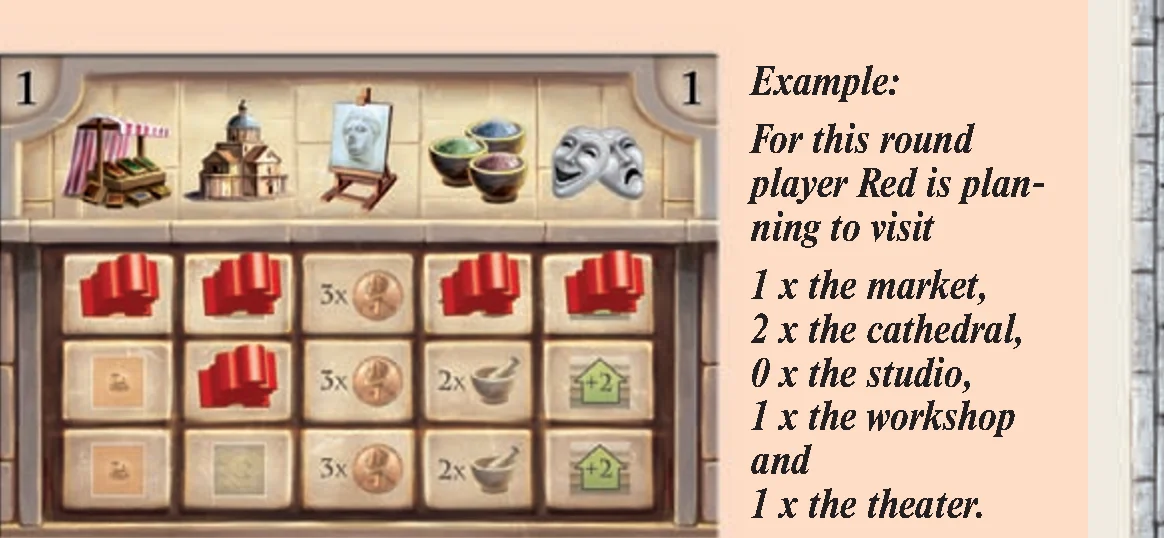
Performing actions
After all players have chosen where to send their apprentices they remove their small screens and go visiting the 5 locations one after the other. At each location the attending players perform their actions in order of their previously chosen get up time. The active player performs all their actions at a certain location before the next player will perform their actions at this location.
If a player did not deploy at least one of their apprentices at a certain location, they do not perform any actions there. They are simply skipped in the player order.
Players are not forced to perform their chosen actions. A player may forfeit performing any of their chosen actions. In case a player does not possess sufficient money or paint pieces needed for a certain action, they must forfeit this action.
The particular locations and associated actions:
- Market: Buy paints or close down market booth
- Cathedral: Restore the fresco or altar
- Studio: Paint portraits
- Workshop: Blend paints
- Theater: Improve one’s mood
Locations and actions in detail
 Market: Buy paints or close down market booth
First the active player selects one of the available market booths and then decides to perform one of the two following actions:
- Buy paints: Each of the player’s apprentices deployed at the “market” column may buy 1 market tile from the selected booth. Each tile can be bought only once. The purchase price depends on the player’s previously chosen get up time. The player takes the paint pieces shown on the tile they just bought from the common supply and hides them behind their large screen. Having finished all their purchases at the selected booth the player returns all tiles of this booth to the linen bag.
- Close down market booth: If the active player deployed at least 1 of their apprentices at the “market” column they may forfeit buying paints and close down the selected booth instead. All tiles of this booth are returned to the linen bag. This counts as a free action.
 Cathedral: Restore the fresco or altar
Each of the player’s apprentices deployed at the “cathedral” column may:
- restore one segment of the fresco or
- restore the altar once
Restore a segment of the fresco
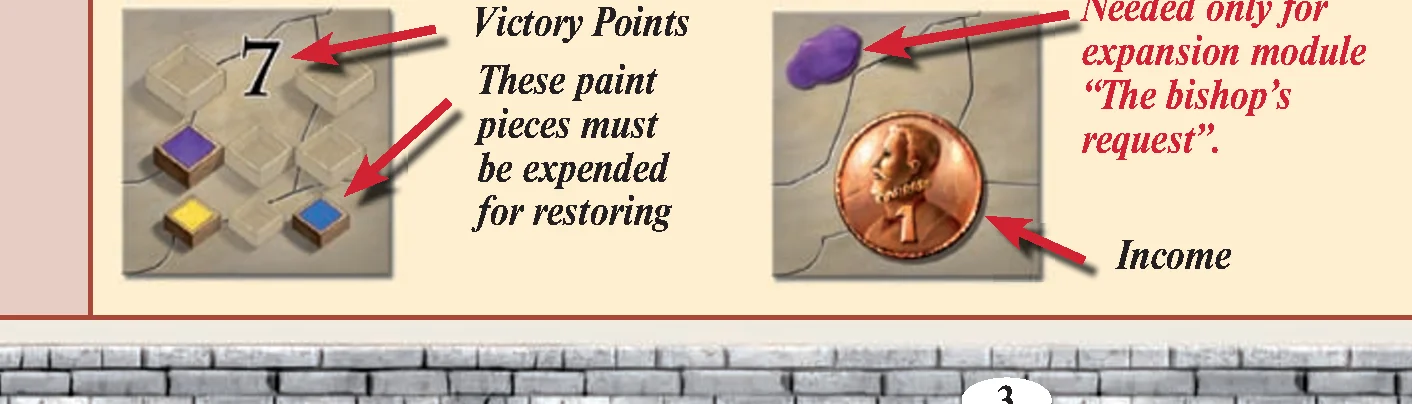
The fresco is divided into 25 segments; each segment is covered by 1 tile. In order to restore a segment the player must own the paint pieces shown on the segment’s tile.
When restoring a segment the player returns the requested paint pieces to the common supply and gains the victory points shown on the tile plus any bonus points gained by the bishop, if applicable (see bishop).
The player advances their master painter on the victory point track as many spaces as the number of victory points they just gained (not counting the starting spaces S1 – S4, the actual victory point track starts with space 1). If their movement ends on a space already occupied by another player’s painter they have to decide whether to stop on the next empty space behind or in front of the occupied space. No space on the victory point track may ever be occupied by more than 1 figure.
After restoring a segment the player removes the fresco tile from the board and places it face down in front of them. Finally they move the bishop to the restored segment.
Moving the bishop
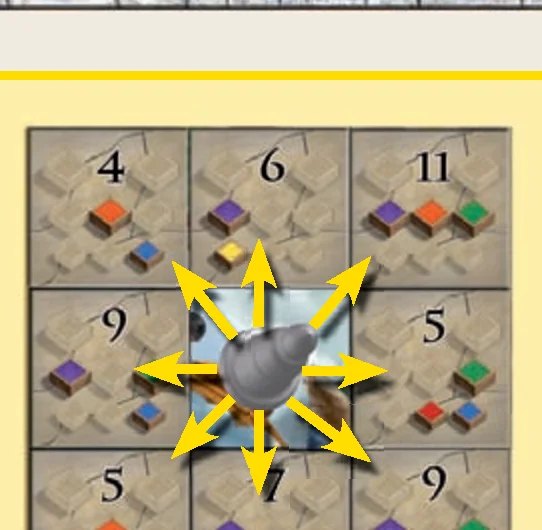
Before restoring any segment of the fresco, the player may move the bishop once only 1 space in any direction (vertically, horizontally or diagonally) by paying 1 Thaler to the community supply. This movement may end on any segment no matter if restored already or still covered by a tile.
The bishop’s bonus points
- If the bishop is standing on the segment to be restored the player gains 3 bonus points.
- If the bishop is standing on a space adjacent (vertically, horizontally or diagonally) to the segment to be restored the player gains 2 bonus points.
Restore the altar
Please note: Usually this action will become more attractive when the game is nearing its end and the number of unrestored fresco segments is dwindling.
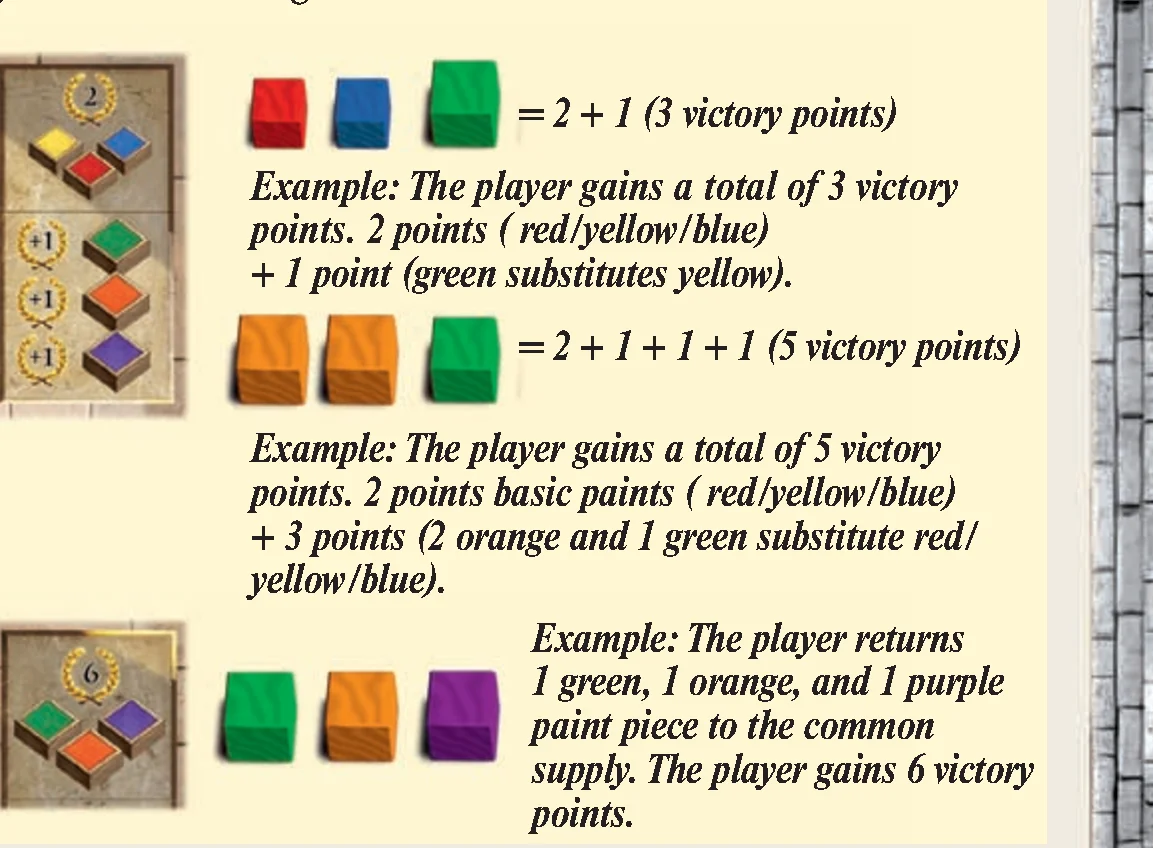
Instead of restoring a segment of the fresco the active player may choose to restore the altar. This can be done in two ways:
- Restore the altar using basic paints: The player returns 1 each of yellow, red, and blue paint pieces from behind their screen to the common supply. They gain 2 victory points for this restoration. The player may substitute any one or even all of these paints by green, orange or purple paint, each of these wildcard paints being worth 1 additional victory point.
- Restore the altar using 3 different blended paints only: The player returns 1 each of orange, green, and purple paint pieces from behind their screen to the common supply. They gain 6 victory points for this restoration.
 Studio: Paint portraits
For each of their apprentices deployed at the “studio” column a player is paid 3 Thalers from the common supply.
Example: Player Red had not deployed any apprentice at the studio and therefore does not collect any Thalers from the common supply. He does not perform any actions at this location and his turn is skipped.
 Workshop: Blend paints
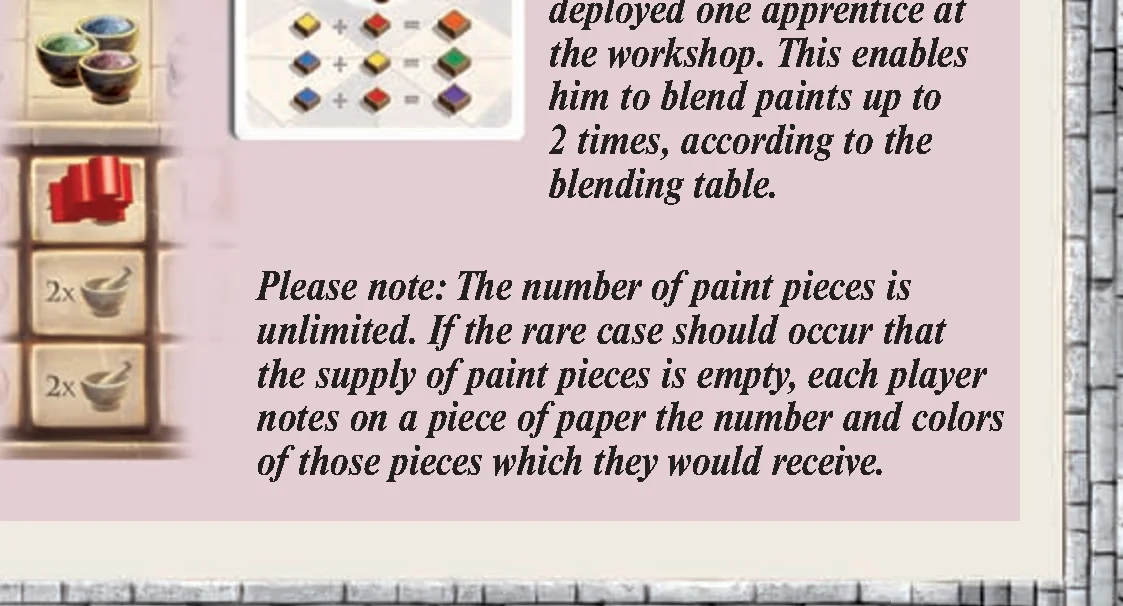
For each of their apprentices deployed at the “workshop” column a player may blend paints up to 2 times.
It’s the active player’s decision which paints they want to blend. They simply return the blended paint pieces to the common supply and take the resulting paint piece instead.
Please note: The number of paint pieces is unlimited. If the rare case should occur that the supply of paint pieces is empty, each player notes on a piece of paper the number and colors of those pieces which they would receive.
 Theater: Improve one’s mood
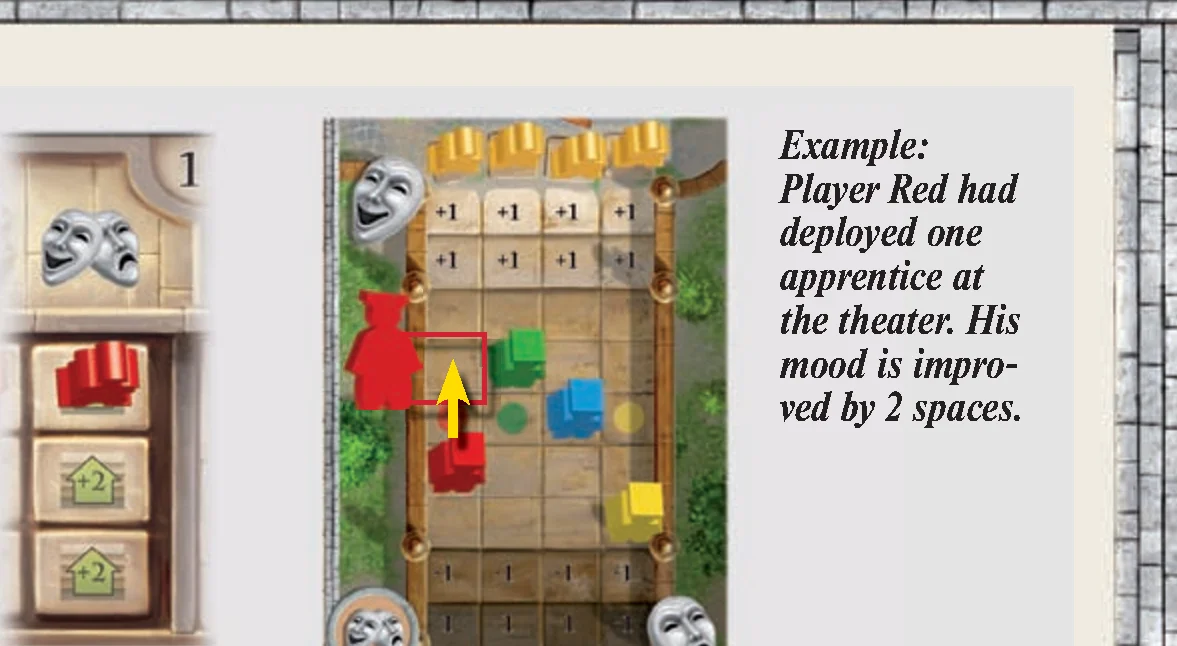
For each of their apprentices deployed at the “theater” column a player may move their master painter 2 spaces upwards on the mood display.
Please note: Any change of mood by visiting the theater will be effective on the next round after selecting the get up time. Only after this any apprentices are returned or retrieved.
Preparing the next round
After all players have finished all their actions the next round has to be prepared:
- Draw the appropriate number of market tiles for each market booth and place them there face up.
- Each player is paid their income which is 1 Thaler for each of their face down fresco tiles in front of themselves (applicable only after having restored at least one segment of the fresco).
- All players move their master painters back to their sleeping places at the top of the hostel.
In case 2 or more master painters are still standing on the starting spaces they will change places. The first one is moved to the end of the line and the others are moved one space forward.
The player holding last position on the victory point track starts the next round by selecting their get up time.
End of the game and final scoring
If there are 6 or less fresco tiles remaining on the board at the beginning of a round this is the final round of the game.
All players flip their action sheet over, now showing side 2.
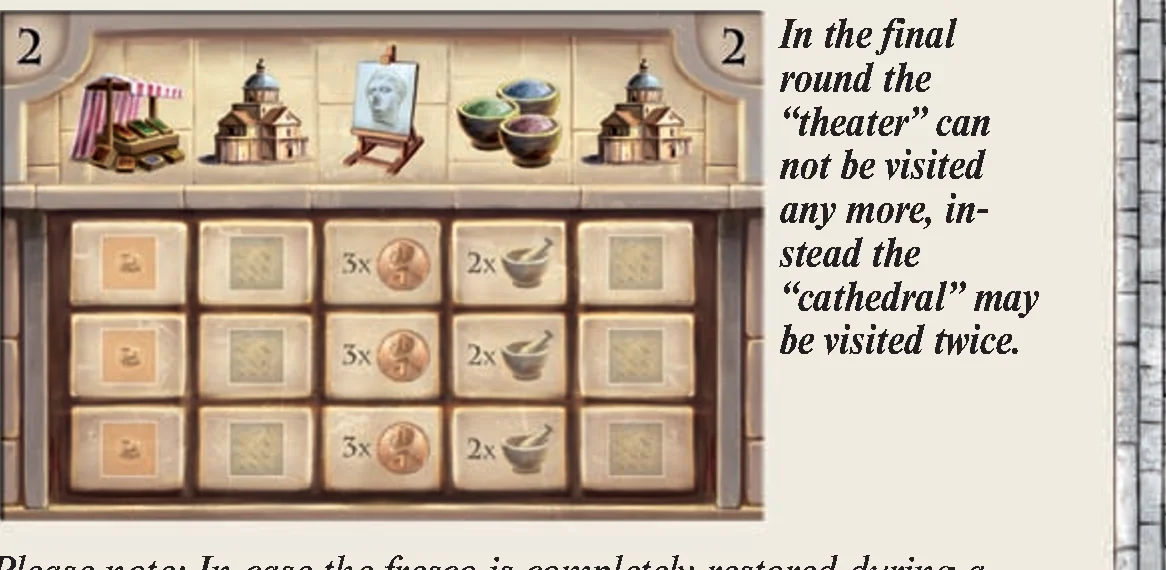
In the final round the “theater” can not be visited any more, instead the “cathedral” may be visited twice.
The game will end after this round, even if the fresco is not restored completely. No income is paid at the end of the final round.
Please note: In case the fresco is completely restored during a round without the final round being triggered, that is the final round and followed immediately by final scoring. As it’s the final round, no income is paid.
Final scoring
Now all players are awarded victory points for their money. Every 2 Thalers are worth 1 victory point. These final victory points are awarded in player order (get up time) of the final round.
Please note: If a master painter is landing on an occupied space of the victory point track during final scoring, the figure is moved forward to the next free space.
The player with the highest victory point total is the master of all fresco painters and winner of the game.
Rules for 2 players (basic game)
Use the same side of the game board as in a 3 player game, using rules (set up) for three players. An imaginary third player is introduced – his name is Leonardo.
Leonardo does not receive any paint pieces and is not paid any income, but is awarded victory points.
During set up Leonardo is given:
- 3 master painters and 2 apprentices of a color not used by the players
- 1 action sheet – he does not need any further material, like screens etc.
Placement of Leonardo’s pieces:
- 1 of Leonardo’s master painters is placed on the starting space S3, 1 master painter on a space above the hostel and 1 master painter on the center of the fresco, along with the bishop.
- His action sheet is placed on the table showing side 1.
- 1 each of his apprentices is placed on the top space of the market and cathedral columns. This array remains unchanged for the rest of the game.
Give the Leonardo tile to the starting player. They will play for and act as Leonardo for this game round. The next round Leonardo is played by the other player, alternating between the two players from round to round.
The usual player order applies to Leonardo as well, but there is a difference to the way Leonardo performs his actions:
1. Choosing get up time
When it’s Leonardo’s turn his current player places his master painter on the desired get up space (Don’t forget: There is no master painter of Leonardo on the mood display!).
2. Performing actions
Market: Close down market booth
Leonardo never buys any paints; instead he closes down any open market booth as chosen by his player.
Cathedral: Restore the fresco
Each round Leonardo restores 1 fresco tile only. His master painter is moved one space up or down or left or right (not diagonally). The master painter must be moved, if this is not possible he jumps to the fresco tile with the lowest value. If there are several tiles with the lowest value it’s up to Leonardo’s player where he jumps.
Leonardo gains victory points as usual including bonus points from the bishop.
Advance his master painter on the victory point track accordingly. Place the restored fresco tile in front of his action sheet, back side up. Both the bishop and Leonardo’s master painter are moved to the freshly restored space of the fresco.
When the players flip their action sheets over Leonardo’s action sheet is not flipped, but his apprentice is removed from the cathedral column, he cannot perform this action anymore now.
Final scoring: please don’t forget that Leonardo occupies one space on the victory point track!
2 players using modules
Module 1: The portraits
- During set up one additional apprentice is placed on the top space of the studio column of Leonardo’s action sheet.
- When it’s Leonardo’s turn in the studio, he must paint a portrait, if possible. Remove the card from the game. Leonardo gains any victory points granted by the card.
Module 2: The bishop’s request
- During set up one additional apprentice is placed on the top space of the workshop column of Leonardo’s action sheet.
- When it’s Leonardo’s turn in the workshop, he may fulfill a request of the bishop, provided he meets the necessary prerequisites. Leonardo gains the victory points as shown, but then the respective fresco tiles and the request tile are removed from the game.
Module 3: Special blend colors
There are no special rules for Leonardo for this module.
In cooperation with Wolfgang Panning
In this supplement you will find the rules for the 3 expansion modules, including descriptions of all their components. Only additions and amendments of the basic rules are mentioned here. Generally, the basic rules remain unchanged.
Module 1: The portraits
Renowned personalities want their portraits painted at the studio of the painters. This will be advantageous during the game!
Who will benefit most from these privileges?
This module will have an impact on Studio: Paint portraits and “End of the Game”.
Additional game components
- 18 portrait cards – during the game the players will gain money, paint pieces, and other benefits with these cards. There are 2 different kinds of portrait cards:
- Cards with
 : A player who obtains such a card places it face open in front of themselves. From now on they will permanently benefit from its advantages.
 - Cards with
 : When a player obtains such a card they are paid the reward immediately. Subsequently the card is removed from the game.
- Cards with
Changes in set up
Place all coins beside the game board.
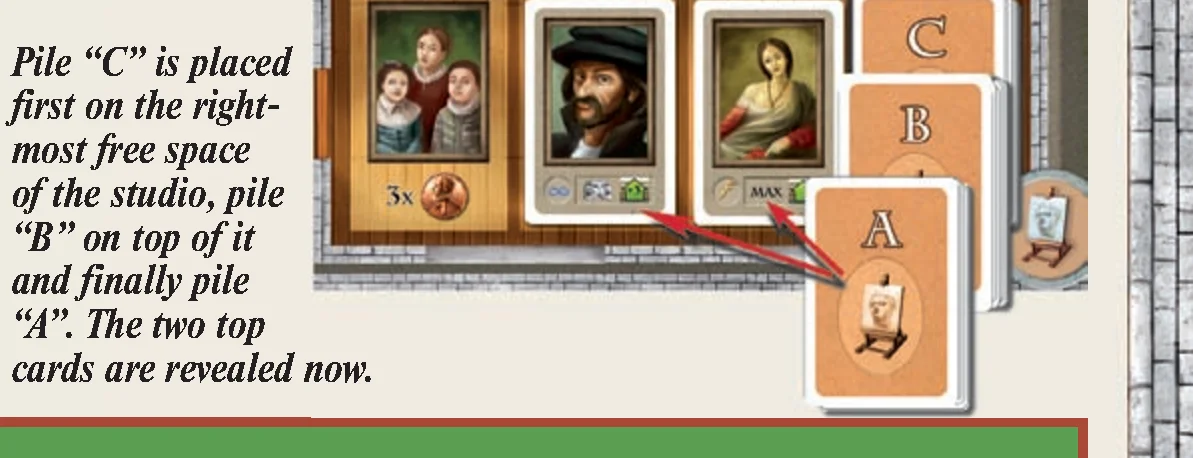
Sort the 18 portrait cards by their back sides “A”, “B”, and “C”. Shuffle each pile separately and place them on top of each on a space of the studio. Pile “C” is placed first on the rightmost free space of the studio, pile “B” on top of it and finally pile “A”. Reveal the top two cards and place them on the two remaining free spaces.
Changes in game play
Studio: Paint portraits
- The active player may take one of the two portrait cards on open display for one of their apprentices at the studio.
- For each of their other apprentices at the studio they are paid 3 Thalers as usual.
- If both portraits have been painted (picked up) already, the players can only be paid 3 Thalers.
Preparing the next round:
Reveal 2 new cards from the top of the deck. Any card(s) left from the previous round are removed from the game.
Changes for “End of the game”
This module introduces an alternative game end condition: If the last 2 portrait cards have been revealed this is the final round (flip your action sheets over!).
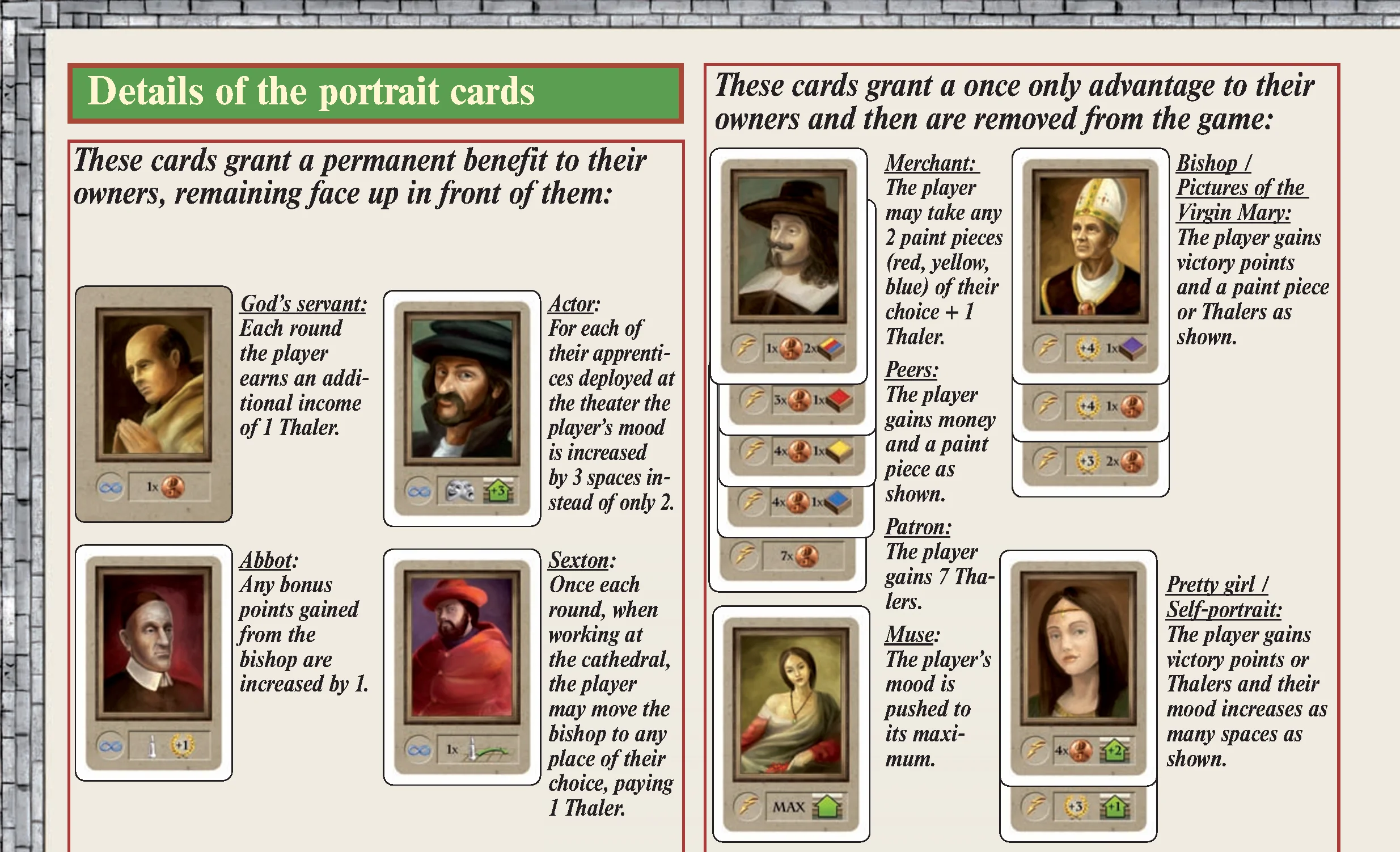
Details of the portrait cards
Permanent benefits (cards remaining face up in front of players):
- God’s servant: Each round the player earns an additional income of 1 Thaler.
- Actor: For each of their apprentices deployed at the theater the player’s mood is increased by 3 spaces instead of only 2.
- Abbot: Any bonus points gained from the bishop are increased by 1.
- Sexton: Once each round, when working at the cathedral, the player may move the bishop to any place of their choice, paying 1 Thaler.
One-time advantages (cards removed from the game after use):
- Merchant: The player may take any 2 paint pieces (red, yellow, blue) of their choice + 1 Thaler.
- Patron: The player gains 7 Thalers.
- Muse: The player’s mood is pushed to its maximum.
- Peers: The player gains money and a paint piece as shown.
- Bishop / Pictures of the Virgin Mary: The player gains victory points and a paint piece or Thalers as shown.
- Pretty girl / Self-portrait: The player gains victory points or Thalers and their mood increases as many spaces as shown.
Module 2: The bishop’s request
If a player is prepared to fulfill special requests by order of the bishop and forfeit part of their income they will gain extra victory points and will regularly be rewarded with valuable paints!
This module will have an impact on Workshop: Blend paints.
Additional game components
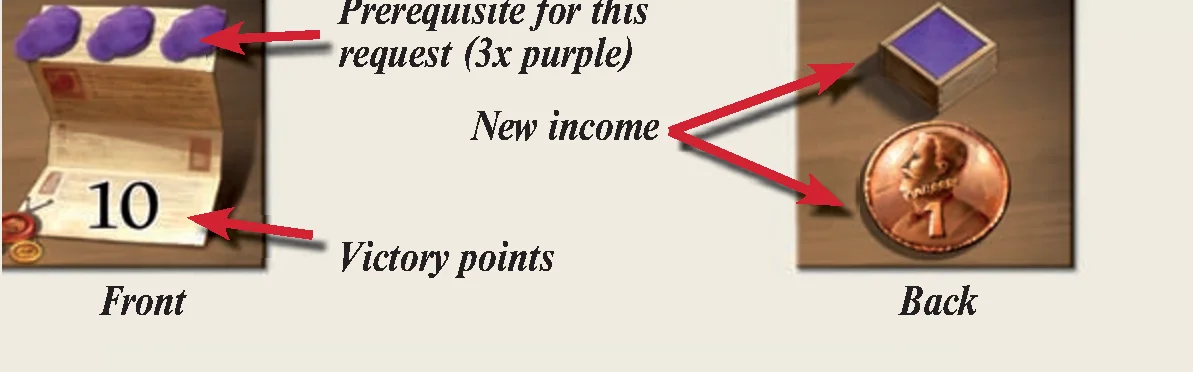
- 12 request tiles – 1 type of general and 3 types of special requests (purple, orange, and green) will generate additional victory points for fresco tiles.
Changes in set up
Place all paint pieces beside the game board.
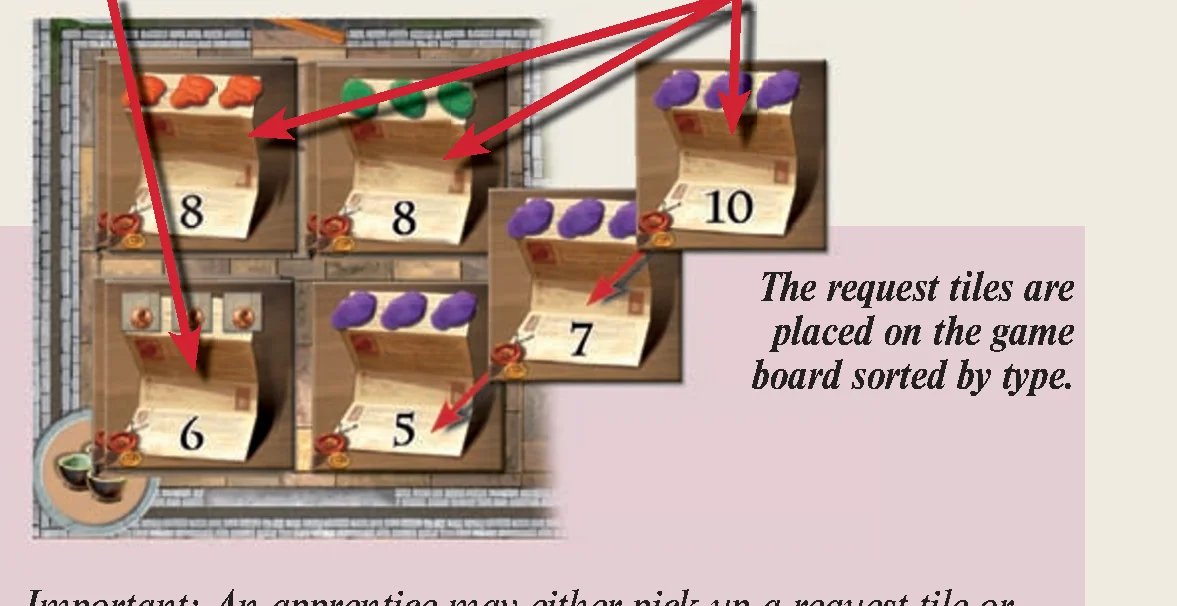
Sort the 12 request tiles by type and place them face up on the spaces of the workshop. Of each type the tile with the lowest number is placed first, the other ones on top of it in ascending order.
Changes in game play
Workshop: Blend paints
Additional action: Fulfill a request
Each round, each player may have 1 apprentice in the workshop fulfill 1 request instead of blending paints. All their other apprentices must be used to blend paints in the workshop as usual.
Important: An apprentice may either pick up a request tile or blend paints – not both at the same time!
Fulfilling a general request
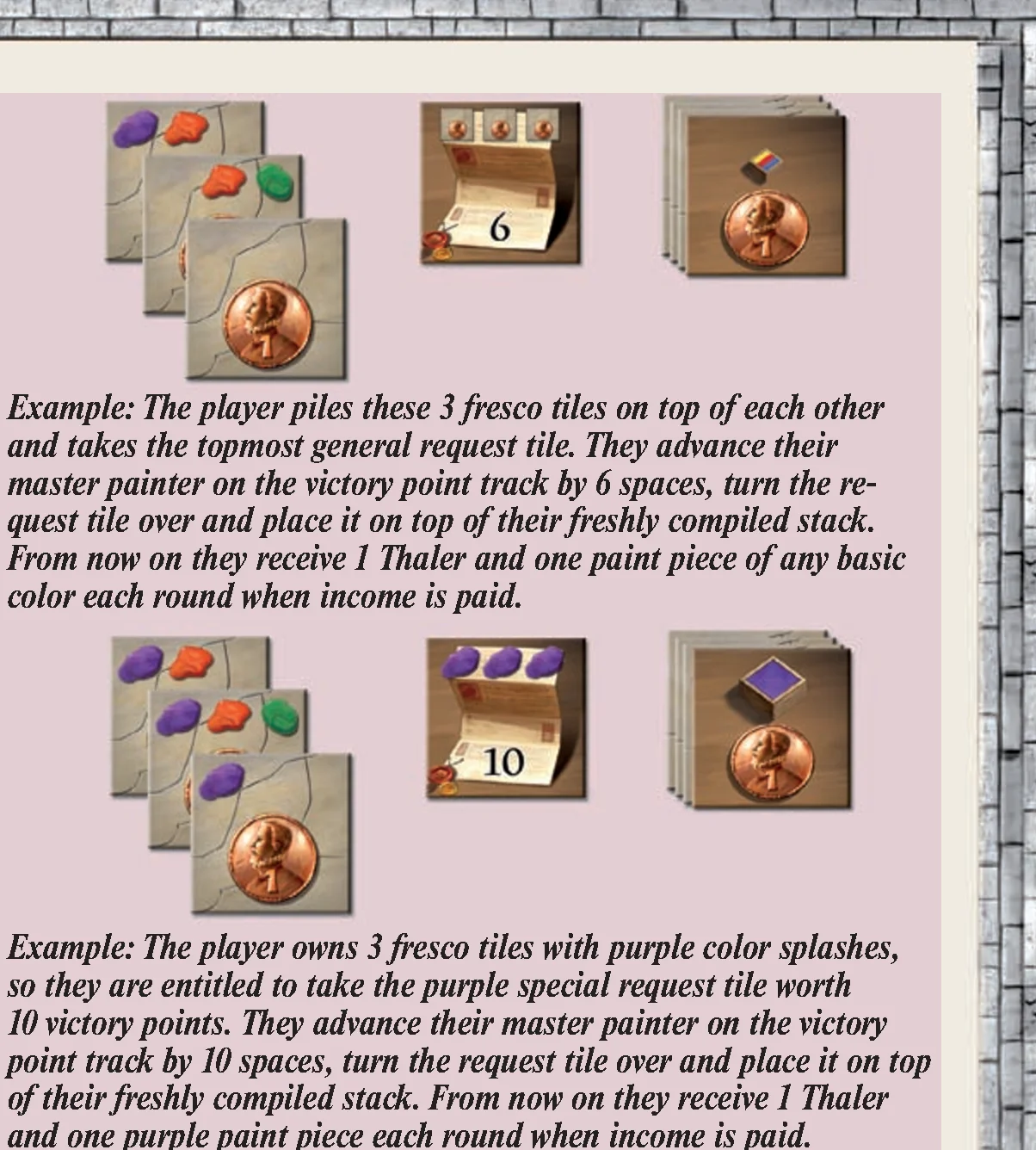
If a player has at least 3 fresco tiles laid out in front of themselves they are entitled to retrieve 1 request tile “general request” and advance their master painter on the victory point track accordingly. Subsequently they pile any 3 of their fresco tiles on top of each other, flip the request tile over so its back is showing and place it on top of this stack.
Each request tile is good for 1 Thaler of income and the paint piece shown. A “general request” allows the player to select one paint piece of any basic color each round.
Fulfilling a special request
On many fresco tiles there are orange, green or purple splashes of color to be seen. A player needs any 3 fresco tiles showing the same splash of color on their back in order to fulfill a “special request” of the same color. Follow the same procedure as described above.
Module 3: Special blend colors
The fresco turns even more colorful. New paint pieces require even more blended colors. Skillful use of these blended colors will earn the players more victory points.
This module will have an impact on Cathedral: Restore the fresco or altar and Workshop: Blend paints.
Additional game components
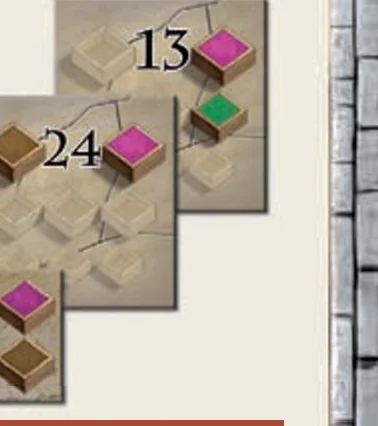
- 7 fresco tiles – with values between 13 and 24
- 12 paint pieces – 6 each of pink and brown
- 4 enhanced tables of blending paints (see back of basic blending tables)
- 1 altar tile
Changes in set up
- The 12 new paint pieces are placed on the game board along with all other paint pieces.
- The altar tile is placed on the free space of the altar.
- Give each player a blending table.
- Pick the tile valued 24 out of the 7 new fresco tiles and place it in the center of the fresco.
- Randomly remove 7 of the basic fresco tiles from the game, mix the remaining tiles with the 6 remaining new fresco tiles and spread them out on the fresco as described in the basic rules.
Changes in game play
Cathedral: Restore the fresco and altar
If a player wants to restore the altar using blended colors they may replace the colors green, orange and purple by pink or brown in any way they want.
- Each pink paint piece is worth an additional 3 victory points.
- Each brown paint piece is worth an additional 5 points!

Workshop: Blend paints
Adding to the blends the players know from the basic game they can now blend:
- purple + red into pink
- orange + green into brown
The same apprentice who just blended a certain paint may reuse this paint immediately for a second blend.
Overview & Components
A game by Marco Ruskowski and Marcel Süßelbeck for 2-4 players aged 10 years and above
The bishop awaits very high-ranking visitors, but unfortunately the large fresco – the painting at the ceiling of the cathedral – is in urgent need of being restored.
The most renowned fresco painters of the renaissance are hired and now have to prove their skillful mastership. Which painter will succeed in restoring the fresco to its former glory?
Overview
“Fresco” is an exquisite family game for 2-4 players aged 10 years and above. It will whisk you away to the epoch of the renaissance and all its grandeur. Plunge into this cavalier era und experience advanced ways of gaming by using the 3 expansion modules included in this box. You may combine the basic game with these modules in any way you like. The modules will increase the challenge gradually, thus affecting the playing time.
“Fresco” is a game sure to provide entertainment many times over.
- The basic game: Fresco
- The expansion modules, gradually increasing the challenge:
- Module 1: The Portraits
- Module 2: The bishop’s requests
- Module 3: Special blend colors
Object of the game
The players find themselves in the roles of fresco painters and by order of the bishop have to restore the large painting at the cathedral’s ceiling.
The painters need to carefully plan for their workday. More often than not they have to get up very early in the morning, buying and mixing paints for their work in the cathedral in order to restore the fresco to its immaculate condition.
In case their income is not sufficient the players have to meet orders in their own studio. This may lead to a bad mood of their apprentices which can be cured only by attending the evening show at the theater.
Only slick planning will help you to gain the most victory points and to become the most glorious fresco painter.
All components of “Fresco” are listed on the next page. The supplement contains all components and rules of the modules.
The rules for the two player game can also be found in the supplement.
Game components
- 1 double-sided game board
- 14 market tiles
- 25 fresco tiles with values from 3 to 11.
- 60 coins (Thalers) with values of 1 (36x), 5 (16 x), and 10 (8x)
- 78 paint pieces, 17 each of red, yellow, blue; 9 each of green, purple, orange
- 4 natural-colored apprentices
- 20 apprentices, 5 each in 4 colors
- 12 master painters, 3 each in 4 colors
- 1 bishop
- 4 small screens
- 4 large screens
- 4 action sheets
- 4 cards showing tables of blending paints
- 1 linen bag
- 1 rules leaflet
Any surplus components are not used for the basic game.
Gaming material per player
Each player takes in their selected player color:
- 1 small screen and 1 action sheet, which they place behind the screen, side “1” being visible
- 1 large screen, behind which they place 1 yellow, 1 red and 1 blue paint piece and 12 Thalers
- 1 card with table of blending basic paints
- 3 master painters
- 5 apprentices
Setup
Set up for a 3 or 4 player game
Any distinctive features for a 3 player game are highlighted by a blue background
- The double-sided game board …
… is placed in the middle of the table within easy reach for all players. The side for 4 players is face up (starting spaces S1 – S4).
For 3 players turn the board over and use the side showing starting spaces S1 – S3. - The starting spaces (S1-S4)
Put 1 master painter of each player into the linen bag. Then draw one after the other from the bag and place them on the starting spaces S1 to S4 in the order as they were drawn. - The hostel
Each player places one of their master painters on a space above the hostel.
The hostel displays:- Left column – get up time in the morning
- Middle column – change of mood
- Right column – market prices
- The market with four booths I – IV
Put all 14 market tiles into the linen bag and shuffle well. The tiles show the paints which can be bought at the market. Draw the appropriate number of tiles for each booth and place them there face up. 1 tile will be left over in the bag.
For three players there are only 3 booths. Please remove the tiles shown below from the game: There is a total of 11 tiles, 2 of which will be left over in the bag. - The cathedral with fresco and altar
Take one of the 25 fresco tiles valued 11 and place it face up in the center space of the fresco.
Shuffle the remaining tiles and randomly deal them out face up onto the segments of the fresco. - The studio
Place all coins on the three free spaces of the studio, sorted by denomination. This is the common supply. - The workshop
All paint pieces are placed on the 6 spaces of the workshop, sorted by color. This is the common supply. - The theater
Each player places one of their master painters on the corresponding space of the mood display.
One natural-colored apprentice is placed on the space above each column. - The bishop
The bishop takes his place in the center of the fresco.
How to Play: Phase 1 (Get Up Time & Mood)
Fresco lasts for several rounds; each round is split into 2 phases:
- Choosing get up time and adjusting mood
- Planning and performing actions
Both phases are now explained in detail:
Phase 1. Choosing get up time and adjusting mood
Please note: At the start of the game the master painters are standing on the starting spaces S1 – S4, S1 qualifying for the last position.
The player holding last position on the victory point track goes first.
They take their master painter from his space above the hostel and place the figure on a get up space of their choice (left column). The other players do likewise in order from second last position to first position, placing their master painter on any free get up space. Only one painter may occupy any single get up space.
The get up time has the following effects for each player:
- It may change the player’s own mood
- It affects their market price
- It determines the player order for the actions in phase 2.
Change of mood
Any change of mood is displayed in the middle column of the hostel. Immediately after choosing their get up time the player adjusts their mood by moving their painter up or down his column on the mood display. A figure may never be moved beyond the top or bottom space of a column.
The emotional state affects the following:
- “+1” Spaces: If a player’s master painter is occupying any of the two “+1” spaces they take the natural-colored apprentice from the space above their column. They may use this apprentice for 1 additional action (thus having a total of 6 actions) on their action sheet. A player keeps their extra apprentice until they are leaving the “+1” spaces. When leaving these spaces they return the apprentice to his space above the column.
- “-1” Spaces: If a player’s master painter is occupying any of the two “-1” spaces they have to dispense 1 of their own apprentices, placing him in front of their screen (thus having a total of only 4 actions during phase 2). When leaving these spaces they take their apprentice back and can use him again.
Market prices
Depending on the get up time they choose, the column to the right shows the price a player has to pay at the market for 1 market tile.
Example: Player Red has to pay 2 Thalers for each market tile he wants to buy.
Player order
After all players choose their get up time the player order for this round is fixed. The player having chosen the earliest get up time will be first player during phase 2, followed by the other players in ascending order of their chosen get up time.
Important: There are 2 different player orders during the game:
- The order of choosing get up time (depending on the players’ positions on the victory point track).
- The order of performing actions (depending on the players’ get up time).
How to Play: Phase 2 (Actions & Locations)
Phase 2. Planning and performing actions
Planning actions
Now all the players begin planning their forthcoming actions simultaneously behind their small screen. They can perform actions at the 5 different locations on the game board. The players deploy their available apprentices to the 15 spaces of their action sheet. Only 1 apprentice may be placed on any single action space, thus activating this action.
Performing actions
After all players have chosen where to send their apprentices they remove their small screens and go visiting the 5 locations one after the other. At each location the attending players perform their actions in order of their previously chosen get up time. The active player performs all their actions at a certain location before the next player will perform their actions at this location.
If a player did not deploy at least one of their apprentices at a certain location, they do not perform any actions there. They are simply skipped in the player order.
Players are not forced to perform their chosen actions. A player may forfeit performing any of their chosen actions. In case a player does not possess sufficient money or paint pieces needed for a certain action, they must forfeit this action.
The particular locations and associated actions:
- Market: Buy paints or close down market booth
- Cathedral: Restore the fresco or altar
- Studio: Paint portraits
- Workshop: Blend paints
- Theater: Improve one’s mood
Locations and actions in detail
Market: Buy paints or close down market booth
First the active player selects one of the available market booths and then decides to perform one of the two following actions:
- Buy paints: Each of the player’s apprentices deployed at the “market” column may buy 1 market tile from the selected booth. Each tile can be bought only once. The purchase price depends on the player’s previously chosen get up time. The player takes the paint pieces shown on the tile they just bought from the common supply and hides them behind their large screen. Having finished all their purchases at the selected booth the player returns all tiles of this booth to the linen bag.
- Close down market booth: If the active player deployed at least 1 of their apprentices at the “market” column they may forfeit buying paints and close down the selected booth instead. All tiles of this booth are returned to the linen bag. This counts as a free action.
Cathedral: Restore the fresco or altar
Each of the player’s apprentices deployed at the “cathedral” column may:
- restore one segment of the fresco or
- restore the altar once
Restore a segment of the fresco
The fresco is divided into 25 segments; each segment is covered by 1 tile. In order to restore a segment the player must own the paint pieces shown on the segment’s tile.
When restoring a segment the player returns the requested paint pieces to the common supply and gains the victory points shown on the tile plus any bonus points gained by the bishop, if applicable (see bishop).
The player advances their master painter on the victory point track as many spaces as the number of victory points they just gained (not counting the starting spaces S1 – S4, the actual victory point track starts with space 1). If their movement ends on a space already occupied by another player’s painter they have to decide whether to stop on the next empty space behind or in front of the occupied space. No space on the victory point track may ever be occupied by more than 1 figure.
After restoring a segment the player removes the fresco tile from the board and places it face down in front of them. Finally they move the bishop to the restored segment.
Moving the bishop
Before restoring any segment of the fresco, the player may move the bishop once only 1 space in any direction (vertically, horizontally or diagonally) by paying 1 Thaler to the community supply. This movement may end on any segment no matter if restored already or still covered by a tile.
The bishop’s bonus points
- If the bishop is standing on the segment to be restored the player gains 3 bonus points.
- If the bishop is standing on a space adjacent (vertically, horizontally or diagonally) to the segment to be restored the player gains 2 bonus points.
Restore the altar
Please note: Usually this action will become more attractive when the game is nearing its end and the number of unrestored fresco segments is dwindling.
Instead of restoring a segment of the fresco the active player may choose to restore the altar. This can be done in two ways:
- Restore the altar using basic paints: The player returns 1 each of yellow, red, and blue paint pieces from behind their screen to the common supply. They gain 2 victory points for this restoration. The player may substitute any one or even all of these paints by green, orange or purple paint, each of these wildcard paints being worth 1 additional victory point.
- Restore the altar using 3 different blended paints only: The player returns 1 each of orange, green, and purple paint pieces from behind their screen to the common supply. They gain 6 victory points for this restoration.
Studio: Paint portraits
For each of their apprentices deployed at the “studio” column a player is paid 3 Thalers from the common supply.
Example: Player Red had not deployed any apprentice at the studio and therefore does not collect any Thalers from the common supply. He does not perform any actions at this location and his turn is skipped.
Workshop: Blend paints
For each of their apprentices deployed at the “workshop” column a player may blend paints up to 2 times.
It’s the active player’s decision which paints they want to blend. They simply return the blended paint pieces to the common supply and take the resulting paint piece instead.
Please note: The number of paint pieces is unlimited. If the rare case should occur that the supply of paint pieces is empty, each player notes on a piece of paper the number and colors of those pieces which they would receive.
Theater: Improve one’s mood
For each of their apprentices deployed at the “theater” column a player may move their master painter 2 spaces upwards on the mood display.
Please note: Any change of mood by visiting the theater will be effective on the next round after selecting the get up time. Only after this any apprentices are returned or retrieved.
Round End & Game End
Preparing the next round
After all players have finished all their actions the next round has to be prepared:
- Draw the appropriate number of market tiles for each market booth and place them there face up.
- Each player is paid their income which is 1 Thaler for each of their face down fresco tiles in front of themselves (applicable only after having restored at least one segment of the fresco).
- All players move their master painters back to their sleeping places at the top of the hostel.
In case 2 or more master painters are still standing on the starting spaces they will change places. The first one is moved to the end of the line and the others are moved one space forward.
The player holding last position on the victory point track starts the next round by selecting their get up time.
End of the game and final scoring
If there are 6 or less fresco tiles remaining on the board at the beginning of a round this is the final round of the game.
All players flip their action sheet over, now showing side 2.
In the final round the “theater” can not be visited any more, instead the “cathedral” may be visited twice.
The game will end after this round, even if the fresco is not restored completely. No income is paid at the end of the final round.
Please note: In case the fresco is completely restored during a round without the final round being triggered, that is the final round and followed immediately by final scoring. As it’s the final round, no income is paid.
Final scoring
Now all players are awarded victory points for their money. Every 2 Thalers are worth 1 victory point. These final victory points are awarded in player order (get up time) of the final round.
Please note: If a master painter is landing on an occupied space of the victory point track during final scoring, the figure is moved forward to the next free space.
The player with the highest victory point total is the master of all fresco painters and winner of the game.
Two-Player Rules
Rules for 2 players (basic game)
Use the same side of the game board as in a 3 player game, using rules (set up) for three players. An imaginary third player is introduced – his name is Leonardo.
Leonardo does not receive any paint pieces and is not paid any income, but is awarded victory points.
During set up Leonardo is given:
- 3 master painters and 2 apprentices of a color not used by the players
- 1 action sheet – he does not need any further material, like screens etc.
Placement of Leonardo’s pieces:
- 1 of Leonardo’s master painters is placed on the starting space S3, 1 master painter on a space above the hostel and 1 master painter on the center of the fresco, along with the bishop.
- His action sheet is placed on the table showing side 1.
- 1 each of his apprentices is placed on the top space of the market and cathedral columns. This array remains unchanged for the rest of the game.
Give the Leonardo tile to the starting player. They will play for and act as Leonardo for this game round. The next round Leonardo is played by the other player, alternating between the two players from round to round.
The usual player order applies to Leonardo as well, but there is a difference to the way Leonardo performs his actions:
1. Choosing get up time
When it’s Leonardo’s turn his current player places his master painter on the desired get up space (Don’t forget: There is no master painter of Leonardo on the mood display!).
2. Performing actions
Market: Close down market booth
Leonardo never buys any paints; instead he closes down any open market booth as chosen by his player.
Cathedral: Restore the fresco
Each round Leonardo restores 1 fresco tile only. His master painter is moved one space up or down or left or right (not diagonally). The master painter must be moved, if this is not possible he jumps to the fresco tile with the lowest value. If there are several tiles with the lowest value it’s up to Leonardo’s player where he jumps.
Leonardo gains victory points as usual including bonus points from the bishop.
Advance his master painter on the victory point track accordingly. Place the restored fresco tile in front of his action sheet, back side up. Both the bishop and Leonardo’s master painter are moved to the freshly restored space of the fresco.
When the players flip their action sheets over Leonardo’s action sheet is not flipped, but his apprentice is removed from the cathedral column, he cannot perform this action anymore now.
Final scoring: please don’t forget that Leonardo occupies one space on the victory point track!
2 players using modules
Module 1: The portraits
- During set up one additional apprentice is placed on the top space of the studio column of Leonardo’s action sheet.
- When it’s Leonardo’s turn in the studio, he must paint a portrait, if possible. Remove the card from the game. Leonardo gains any victory points granted by the card.
Module 2: The bishop’s request
- During set up one additional apprentice is placed on the top space of the workshop column of Leonardo’s action sheet.
- When it’s Leonardo’s turn in the workshop, he may fulfill a request of the bishop, provided he meets the necessary prerequisites. Leonardo gains the victory points as shown, but then the respective fresco tiles and the request tile are removed from the game.
Module 3: Special blend colors
There are no special rules for Leonardo for this module.
Expansion Modules
In cooperation with Wolfgang Panning
In this supplement you will find the rules for the 3 expansion modules, including descriptions of all their components. Only additions and amendments of the basic rules are mentioned here. Generally, the basic rules remain unchanged.
Module 1: The portraits
Renowned personalities want their portraits painted at the studio of the painters. This will be advantageous during the game!
Who will benefit most from these privileges?
This module will have an impact on Studio: Paint portraits and “End of the Game”.
Additional game components
- 18 portrait cards – during the game the players will gain money, paint pieces, and other benefits with these cards. There are 2 different kinds of portrait cards:
- Cards with : A player who obtains such a card places it face open in front of themselves. From now on they will permanently benefit from its advantages.
- Cards with : When a player obtains such a card they are paid the reward immediately. Subsequently the card is removed from the game.
- Cards with
Changes in set up
Place all coins beside the game board.
Sort the 18 portrait cards by their back sides “A”, “B”, and “C”. Shuffle each pile separately and place them on top of each on a space of the studio. Pile “C” is placed first on the rightmost free space of the studio, pile “B” on top of it and finally pile “A”. Reveal the top two cards and place them on the two remaining free spaces.
Changes in game play
Studio: Paint portraits
- The active player may take one of the two portrait cards on open display for one of their apprentices at the studio.
- For each of their other apprentices at the studio they are paid 3 Thalers as usual.
- If both portraits have been painted (picked up) already, the players can only be paid 3 Thalers.
Preparing the next round:
Reveal 2 new cards from the top of the deck. Any card(s) left from the previous round are removed from the game.
Changes for “End of the game”
This module introduces an alternative game end condition: If the last 2 portrait cards have been revealed this is the final round (flip your action sheets over!).
Details of the portrait cards
Permanent benefits (cards remaining face up in front of players):
- God’s servant: Each round the player earns an additional income of 1 Thaler.
- Actor: For each of their apprentices deployed at the theater the player’s mood is increased by 3 spaces instead of only 2.
- Abbot: Any bonus points gained from the bishop are increased by 1.
- Sexton: Once each round, when working at the cathedral, the player may move the bishop to any place of their choice, paying 1 Thaler.
One-time advantages (cards removed from the game after use):
- Merchant: The player may take any 2 paint pieces (red, yellow, blue) of their choice + 1 Thaler.
- Patron: The player gains 7 Thalers.
- Muse: The player’s mood is pushed to its maximum.
- Peers: The player gains money and a paint piece as shown.
- Bishop / Pictures of the Virgin Mary: The player gains victory points and a paint piece or Thalers as shown.
- Pretty girl / Self-portrait: The player gains victory points or Thalers and their mood increases as many spaces as shown.
Module 2: The bishop’s request
If a player is prepared to fulfill special requests by order of the bishop and forfeit part of their income they will gain extra victory points and will regularly be rewarded with valuable paints!
This module will have an impact on Workshop: Blend paints.
Additional game components
- 12 request tiles – 1 type of general and 3 types of special requests (purple, orange, and green) will generate additional victory points for fresco tiles.
Changes in set up
Place all paint pieces beside the game board.
Sort the 12 request tiles by type and place them face up on the spaces of the workshop. Of each type the tile with the lowest number is placed first, the other ones on top of it in ascending order.
Changes in game play
Workshop: Blend paints
Additional action: Fulfill a request
Each round, each player may have 1 apprentice in the workshop fulfill 1 request instead of blending paints. All their other apprentices must be used to blend paints in the workshop as usual.
Important: An apprentice may either pick up a request tile or blend paints – not both at the same time!
Fulfilling a general request
If a player has at least 3 fresco tiles laid out in front of themselves they are entitled to retrieve 1 request tile “general request” and advance their master painter on the victory point track accordingly. Subsequently they pile any 3 of their fresco tiles on top of each other, flip the request tile over so its back is showing and place it on top of this stack.
Each request tile is good for 1 Thaler of income and the paint piece shown. A “general request” allows the player to select one paint piece of any basic color each round.
Fulfilling a special request
On many fresco tiles there are orange, green or purple splashes of color to be seen. A player needs any 3 fresco tiles showing the same splash of color on their back in order to fulfill a “special request” of the same color. Follow the same procedure as described above.
Module 3: Special blend colors
The fresco turns even more colorful. New paint pieces require even more blended colors. Skillful use of these blended colors will earn the players more victory points.
This module will have an impact on Cathedral: Restore the fresco or altar and Workshop: Blend paints.
Additional game components
- 7 fresco tiles – with values between 13 and 24
- 12 paint pieces – 6 each of pink and brown
- 4 enhanced tables of blending paints (see back of basic blending tables)
- 1 altar tile
Changes in set up
- The 12 new paint pieces are placed on the game board along with all other paint pieces.
- The altar tile is placed on the free space of the altar.
- Give each player a blending table.
- Pick the tile valued 24 out of the 7 new fresco tiles and place it in the center of the fresco.
- Randomly remove 7 of the basic fresco tiles from the game, mix the remaining tiles with the 6 remaining new fresco tiles and spread them out on the fresco as described in the basic rules.
Changes in game play
Cathedral: Restore the fresco and altar
If a player wants to restore the altar using blended colors they may replace the colors green, orange and purple by pink or brown in any way they want.
- Each pink paint piece is worth an additional 3 victory points.
- Each brown paint piece is worth an additional 5 points!
Workshop: Blend paints
Adding to the blends the players know from the basic game they can now blend:
- purple + red into pink
- orange + green into brown
The same apprentice who just blended a certain paint may reuse this paint immediately for a second blend.
Expansions for
Fresco
Fresco: Expansion Modules 8, 9 and 10
2013
Three flexible modules add bells, wall restoration, and illness to Fresco.
90
minutes
Medium Heavy

View expansion
Fresco: The Bishop’s Favor
2011
Claim hidden rewards by completing fresco tiles at the bishop’s location.
60
minutes
Medium Light

View expansion
Fresco: Expansion Module 7 – The Scrolls
2010
Restore the fresco with the elder masters’ scrolls
45
minutes
Medium
View expansion
Fresco: Expansion Modules 4, 5 and 6
2010
Three modular additions bring wishes, gold leaf, and colorful glass to Fresco.
60
minutes
Medium
View expansion
