King of Tokyo
2011
Battle rival monsters, gather energy, buy powerful cards, and fight for Tokyo in a dice-rolling clash for 2–6 players.
30
minutes
2 - 6
player(s)
8+
Light


About this board game
King of Tokyo is a dice-rolling battle game for 2–6 players that plays in about 30 minutes. You take the role of a mutant monster, gigantic robot, or strange alien competing to become the one and only King of Tokyo.
Each turn, roll six dice over up to three successive throws. Choose which dice to keep and which to reroll as you pursue Victory Points, Energy, healing, or attacks against your opponents.
- Victory Points: Roll 1, 2, or 3 to build your score.
- Energy: Collect energy to purchase special cards.
- Heal: Restore your monster’s health when the rules allow.
- Attack: Strike rival monsters and make Tokyo your territory.
The monster occupying Tokyo earns extra Victory Points, but cannot heal and must face the other monsters alone. Holding the city is a powerful advantage, yet remaining there also makes you a clear target for every opponent.
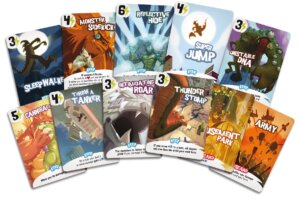
Spend Energy on special cards with permanent or temporary effects. These cards can grant abilities such as growing a second head for an additional die, using body armor, or unleashing a nova death ray, adding surprising possibilities to each battle.
There are two paths to victory in King of Tokyo: accumulate 20 Victory Points and destroy Tokyo, or be the only surviving monster after the fighting ends. Released in 2011, it is the first game in the King of Tokyo series and combines push-your-luck dice decisions, direct attacks, and special powers in an explosive contest for control.
Mechanics
Designer
Illustrators


Board Game Rules for
King of Tokyo
About the Game
A game by Richard Garfield
- 2–6 Players
- Ages 8+
- 30 minutes
King of Tokyo is a game for 2 to 6 players where you play as mutant monsters, rampaging robots, or even abominable aliens battling in a fun, chaotic atmosphere. Roll dice and choose your strategy: Will you attack your enemies? Heal your wounds? Improve your Monster? Stomp your path to victory!
Your Mission
Destroy everything in your path to become the one and only King of Tokyo!
Overview and Goal
You are a gigantic Monster willing to do anything to become King of Tokyo.
Your rampage brings you glory in the form of Victory Points ( ). To win, be the first Monster to gain 20 Victory Points.
Or, get your claws out and eliminate your enemies. The last one standing claims victory!
Components & Game Elements
6 Monster Boards
These boards represent the Monsters that you play as in King of Tokyo. Each has a name, a dial for Victory Points (), and a dial for Life Points ( ).

1 Tokyo Board
The board represents the City of Tokyo divided into two places: Tokyo City (1) and Tokyo Bay (2). When a rule or card refers to “Tokyo”, it means both places.

6 Black Dice
Each die has 6 symbols that represent the actions you can take on your turn:


 : Gain Victory Points ()
 : Gain Energy cube (
 )
 : Smash Monsters to lose Life Points ()
 : Gain Life Points ()
66 Power Cards
Power cards have a name, a cost to pay in Energy cubes (), a type (KEEP / DISCARD) and an effect.
Power cards can be one of two different types:
- KEEP: Keep these cards face-up in front of you until the end of the game (unless something tells you to do otherwise).
- DISCARD: Resolve these cards immediately, then discard them.

6 Cardboard Figures
These figures represent the Monsters you play as. Keep them near you. When you take control of Tokyo, place your Monster on the board, in Tokyo City or Tokyo Bay.

Energy Cubes
Keep energy cubes you’ve gained from die faces. You can spend them to buy cards or to resolve or activate certain card effects.

28 Tokens and 2 Green Dice
The tokens and green dice are used with certain Power cards.
- 3 Smoke tokens
- 1 Mimic token
- 12 Shrink tokens
- 12 Poison tokens

Game Setup
- Each player chooses a Monster and takes his figure and Monster board. Set your Monster’s Life Points () to 10 and Victory Points () to 0.
- Place the Tokyo board at the center of the table, within easy access of every player.
- With 2 to 4 players: use only Tokyo City.
- With 5 to 6 players: use both Tokyo City and Tokyo Bay.
- Shuffle the cards to form a deck.
- Deal the first three cards face-up on the table next to Tokyo board. Place the tokens nearby.
- Put the black dice at the center of the table. Set the green ones aside (some cards allow you to roll the green dice).
- Form a pool with all the Energy cubes ().

Game Flow
The game plays clockwise.
Each player rolls the 6 black dice. Whoever has the most results goes first. In case of tie, players roll dice until one player has the greatest number of .
Turn Overview
- Roll Dice
- Resolve Dice
- Enter Tokyo
- Buy Power cards
- End of turn
1. Roll Dice
On your turn, you can roll the dice up to three times. You can stop rolling any time.
- First Roll: Roll the 6 black dice (and 1 or 2 green dice if you have a Power card that lets you roll them).
- Second Roll: If you like some of your results, you can set them aside and only roll the ones you don’t like again.
- Third Roll: If you change your mind, you can roll any dice you set aside again, along with any you still don’t like.
After you finish your three Rolls (or you decide to stop), continue to the Resolve Dice step.
2. Resolve Dice
You can resolve your dice in any order, but you must resolve all of them.
Symbols rolled at the end of your last die Roll represent the actions of your turn:
Victory Points ( )
If you roll three-of-a-kind of 1, 2, or 3, gain as many Victory Points () as the number.
Each additional die rolled with the same face gains you 1 additional Victory Point ().
Example: Gigazaur rolls 1, 1, 1, 1. 1 + 1 + 1 = 1 , plus the fourth 1 (+1 ) = 2 .
Energy ()
Gain 1 from the pool for each rolled. Place them in your reserve in front of yourself. Keep Energy cubes until you spend them.
Smash ()
Monsters that are not in the same place as you lose 1 for each rolled.
- If you are in Tokyo (Tokyo City or Tokyo Bay) and you roll , all Monsters outside of Tokyo lose .
- If you are outside of Tokyo and you roll , all Monsters who are in Tokyo lose (Tokyo City and Tokyo Bay). These Monsters can then decide to Yield and leave Tokyo or stay. Monsters who Yield Tokyo still lose .
Each results in losing one Life Point . If a Monster loses his last Life Point then the  appears and he is eliminated (his KEEP cards and Energy cubes are discarded).
Since no Monster starts the game in Tokyo, the Monster who plays first does not cause Monsters to lose with .
Note: lost dealt from a Power card effect is different than . A Monster can only Yield Tokyo when losing from .
Heal ()
If you are outside of Tokyo, you can gain 1 for each rolled.
If you are in Tokyo, the you roll do not let you gain (you can only gain with Power cards).
Note: You cannot gain above 10 .
Example of a Die Roll
CyberKitty is in Tokyo City. It’s Gigazaur’s turn.
- Roll Dice:
- Gigazaur takes the black dice and rolls: 1, 2, 3, 3, Heal, Energy.
- He keeps 3, 3 and rolls the four other dice again. He gets: 3, 3, 2, 2, 2, Heal.
- He has one Roll left. This time he keeps 2, 2, 2 and rolls the three other dice again. He gets: 2, 2, 2, 2, Energy, Smash.
- Resolve Dice:
- Because he rolled 2, 2, 2, he gains 2 , plus 1 extra for the fourth 2 face.
- With Energy, he gains 1 .
- With Smash, he makes CyberKitty in Tokyo lose 1 (if Gigazaur was in Tokyo, all Monsters outside of Tokyo would lose 1 ).
- Gigazaur rolled no Heal, so he gains no .
- Gigazaur takes 1 from the pool because of Energy.
- Because he rolled 2, 2, 2, he gains 2
Controlling Tokyo & 3. Enter Tokyo
Effects of Tokyo
Being in Tokyo (Tokyo City or Tokyo Bay) has some advantages and disadvantages:
- Entering Tokyo: You gain 1 when you enter Tokyo.
- Starting turn in Tokyo: You gain 2 if you start your turn in Tokyo.
- No healing from dice: Monsters in Tokyo cannot use (but they can still use Power cards to gain ).
Moreover, targets of your smash depend on where you are:
- The of Monsters in Tokyo cause all Monsters outside of Tokyo to lose .
- The of Monsters outside of Tokyo cause all Monsters in Tokyo to lose .
You can only leave Tokyo after losing from rolled by another Monster.
Entering Tokyo Rules
If no one is in Tokyo, you must enter and place your Monster in Tokyo City.
You can only Yield when you lose from rolled by a Monster.
Note: No Monster starts the game in Tokyo. The first player must enter Tokyo City during this step.
With 5 to 6 players:
- If Tokyo City is occupied, but Tokyo Bay is empty, you must enter Tokyo Bay.
- Monsters in Tokyo City and Tokyo Bay are both considered “in Tokyo”. Tokyo Bay has the same effects as Tokyo City.
- Once the game has 4 or fewer players, you must leave Tokyo Bay immediately (except if Tokyo City is empty, in which case you move there).

4. Buy Power Cards
You now may buy one or more of the three face-up cards. To buy a Power card, spend as many as the cost indicated at the top of the card. Replace bought cards immediately from the top of the deck. New cards are immediately available for purchase.
You can also spend 2 to sweep all three face-up cards to the discard. Then reveal three new Power cards from the deck. They are immediately available for purchase.
As long as you have enough , you can continue to buy or sweep cards.
Example: Space Penguin has 10 and doesn’t like any available cards. He spends 2 to sweep them to the discard and reveals the next three. He still has 8 and sees a card he likes that costs 3 . He buys this card and replaces it with a new card. He still has 5 but he saves them for another turn.
5. End of Turn
Certain Power card effects activate at the end of your turn.
Once you’re done, pass the dice to the player on your left.
Example of a 5-Player Game
Gigazaur is in Tokyo City, and Space Penguin is in Tokyo Bay. The King, CyberKitty, and MekaDragon are the three other Monsters.
- It is MekaDragon’s turn. He rolls 4 . Gigazaur and Space Penguin each lose 4 . They both Yield Tokyo. After resolving his dice, MekaDragon enters Tokyo City and gains 1 . Tokyo Bay is unoccupied.
- It’s now Gigazaur’s turn. He rolls 1 . Only MekaDragon loses 1 since no one is in Tokyo Bay. He decides to stay in Tokyo. Gigazaur must now enter Tokyo Bay since it is unoccupied, and he gains 1 .
- Next, Space Penguin rolls 1 . Gigazaur and MekaDragon each lose 1 . Gigazaur decides to Yield Tokyo Bay, but MekaDragon stays in Tokyo City. After resolving dice, Space Penguin must enter Tokyo Bay and gains 1 .
- The King and CyberKitty roll 0 on their turns, so no one enters or leaves Tokyo.
- MekaDragon begins his turn in Tokyo and gains 2 for that. He rolls 3 and makes all Monsters outside of Tokyo lose 3 : Gigazaur, The King, and CyberKitty. Space Penguin who is in Tokyo loses no – Monsters in Tokyo do not smash each other.
- Gigazaur has 0 , and is eliminated. Now only four Monsters remain in the game. Space Penguin must leave Tokyo Bay immediately, leaving MekaDragon alone in Tokyo.

End of Game
The game ends at the end of a round when a Monster reaches 20 or if only one Monster remains.
The Monster who reaches 20 or is the last survivor is crowned King of Tokyo!
Glossary
- Roll: The act of throwing the dice on the table. Before a Roll, a player can set aside one or more dice of the dice previously rolled. He can also decide to roll one or more of the previously set aside dice again.
- Yield: A Monster may Yield Tokyo only after losing from rolled by another Monster. The smashing Monster must then take his place during the Enter Tokyo step.
- Smash: When you roll to make Monsters lose .
General Clarifications
- If you reach 20 and reach 0 in the same turn because of a Power card, you are eliminated. You must survive your turn to win. If all Monsters are eliminated at the same time… everyone loses!
- Power cards do not let Monsters gain above 10 , unless a KEEP card says otherwise.
Specific Cards
Mimic
Mimic copies the effects of a card as if it had just been played (with tokens, for example). If the copied card is discarded, Mimic no longer has an effect and you take back the associated token. You can place it on another KEEP card at the start of your next turn (before you roll dice) by spending 1 .

Opportunist
If there are two Opportunist in play (because of Mimic), the first Monster clockwise from the Monster whose turn it is gets first opportunity to buy newly revealed cards.

Poison Spit & Shrink Ray
Poison and Shrink tokens stay even if their associated cards are discarded. You cannot remove these tokens while you are in Tokyo: you must be outside of Tokyo to use the to remove tokens.

Fire Breathing
The Monsters of the players seated to your left and right each lose 1 . They lose this even if they are in the same place as you. If there are only 2 players, your opponent only loses 1 .

Metamorph
Discarding your KEEP cards happens in the End of Turn step. You get back the full cost of the card as printed, even if you bought it at a discount.

Credits
- Game Design: Richard Garfield
- Game Development: Richard Garfield & Skaff Elias
- Editing Directors: Cédric Barbé & Patrice Boulet
- Project Manager: Timothée Simonot
- Product Manager US: Jeff Quick
- Translator: Danni Loe-Sterphone
- Packager: Origames
- Coordination: Guillaume Gille-Naves
- Artistic Manager: Igor Polouchine
- Artwork (inspired by Igor Polouchine’s monsters): Régis Torres
- Color: Régis Torres, Anthony Wolf, Djib, Gabriel Bulik, Jonathan Silvestre, Romain Gaschet
- Playtesting US: Mons Johnson, Bill Rose, Andy Buehler, Mike Davis, Jamie Fristrom, Bill Dugan, Henry Stern, Mike Turian, Skaff Elias, Paul Peterson, Chip Brown, Bruce Kaskel, Daniel Allcock, Rob Watkins, Chris Lopez, Robert Gutschera, Marc LeBlanc, Alan Comer, Jim Lin, Greg Canessa, Dave-Bob Lee, Joel Mick, Tom Lehman, Terry Garfield, et le fléau de Tokyo – Schuyler Garfield
- Playtesting France: Cédric, Patrice, Gabriel, Vincent, Rodolphe, Guillaume, Thibault, Igor, Benjamin, Fred, Joahn, Tatiana, Victor, Théodore, Elliot, Isabelle et Fabrice
Overview & Components
About the Game
A game by Richard Garfield
- 2–6 Players
- Ages 8+
- 30 minutes
King of Tokyo is a game for 2 to 6 players where you play as mutant monsters, rampaging robots, or even abominable aliens battling in a fun, chaotic atmosphere. Roll dice and choose your strategy: Will you attack your enemies? Heal your wounds? Improve your Monster? Stomp your path to victory!
Your Mission
Destroy everything in your path to become the one and only King of Tokyo!
Overview and Goal
You are a gigantic Monster willing to do anything to become King of Tokyo.
Your rampage brings you glory in the form of Victory Points (). To win, be the first Monster to gain 20 Victory Points.
Or, get your claws out and eliminate your enemies. The last one standing claims victory!
Components & Game Elements
6 Monster Boards
These boards represent the Monsters that you play as in King of Tokyo. Each has a name, a dial for Victory Points (), and a dial for Life Points ().
1 Tokyo Board
The board represents the City of Tokyo divided into two places: Tokyo City (1) and Tokyo Bay (2). When a rule or card refers to “Tokyo”, it means both places.
6 Black Dice
Each die has 6 symbols that represent the actions you can take on your turn:
- : Gain Victory Points ()
- : Gain Energy cube ()
- : Smash Monsters to lose Life Points ()
- : Gain Life Points ()
66 Power Cards
Power cards have a name, a cost to pay in Energy cubes (), a type (KEEP / DISCARD) and an effect.
Power cards can be one of two different types:
- KEEP: Keep these cards face-up in front of you until the end of the game (unless something tells you to do otherwise).
- DISCARD: Resolve these cards immediately, then discard them.
6 Cardboard Figures
These figures represent the Monsters you play as. Keep them near you. When you take control of Tokyo, place your Monster on the board, in Tokyo City or Tokyo Bay.
Energy Cubes
Keep energy cubes you’ve gained from die faces. You can spend them to buy cards or to resolve or activate certain card effects.
28 Tokens and 2 Green Dice
The tokens and green dice are used with certain Power cards.
- 3 Smoke tokens
- 1 Mimic token
- 12 Shrink tokens
- 12 Poison tokens
Setup
Game Setup
- Each player chooses a Monster and takes his figure and Monster board. Set your Monster’s Life Points () to 10 and Victory Points () to 0.
- Place the Tokyo board at the center of the table, within easy access of every player.
- With 2 to 4 players: use only Tokyo City.
- With 5 to 6 players: use both Tokyo City and Tokyo Bay.
- Shuffle the cards to form a deck.
- Deal the first three cards face-up on the table next to Tokyo board. Place the tokens nearby.
- Put the black dice at the center of the table. Set the green ones aside (some cards allow you to roll the green dice).
- Form a pool with all the Energy cubes ().
How to Play
Game Flow
The game plays clockwise.
Each player rolls the 6 black dice. Whoever has the most results goes first. In case of tie, players roll dice until one player has the greatest number of .
Turn Overview
- Roll Dice
- Resolve Dice
- Enter Tokyo
- Buy Power cards
- End of turn
1. Roll Dice
On your turn, you can roll the dice up to three times. You can stop rolling any time.
- First Roll: Roll the 6 black dice (and 1 or 2 green dice if you have a Power card that lets you roll them).
- Second Roll: If you like some of your results, you can set them aside and only roll the ones you don’t like again.
- Third Roll: If you change your mind, you can roll any dice you set aside again, along with any you still don’t like.
After you finish your three Rolls (or you decide to stop), continue to the Resolve Dice step.
2. Resolve Dice
You can resolve your dice in any order, but you must resolve all of them.
Symbols rolled at the end of your last die Roll represent the actions of your turn:
Victory Points ( )
If you roll three-of-a-kind of 1, 2, or 3, gain as many Victory Points () as the number.
Each additional die rolled with the same face gains you 1 additional Victory Point ().
Example: Gigazaur rolls 1, 1, 1, 1. 1 + 1 + 1 = 1 , plus the fourth 1 (+1 ) = 2 .
Energy ()
Gain 1 from the pool for each rolled. Place them in your reserve in front of yourself. Keep Energy cubes until you spend them.
Smash ()
Monsters that are not in the same place as you lose 1 for each rolled.
- If you are in Tokyo (Tokyo City or Tokyo Bay) and you roll , all Monsters outside of Tokyo lose .
- If you are outside of Tokyo and you roll , all Monsters who are in Tokyo lose (Tokyo City and Tokyo Bay). These Monsters can then decide to Yield and leave Tokyo or stay. Monsters who Yield Tokyo still lose .
Each results in losing one Life Point . If a Monster loses his last Life Point then the appears and he is eliminated (his KEEP cards and Energy cubes are discarded).
Since no Monster starts the game in Tokyo, the Monster who plays first does not cause Monsters to lose with .
Note: lost dealt from a Power card effect is different than . A Monster can only Yield Tokyo when losing from .
Heal ()
If you are outside of Tokyo, you can gain 1 for each rolled.
If you are in Tokyo, the you roll do not let you gain (you can only gain with Power cards).
Note: You cannot gain above 10 .
Example of a Die Roll
CyberKitty is in Tokyo City. It’s Gigazaur’s turn.
- Roll Dice:
- Gigazaur takes the black dice and rolls: 1, 2, 3, 3, Heal, Energy.
- He keeps 3, 3 and rolls the four other dice again. He gets: 3, 3, 2, 2, 2, Heal.
- He has one Roll left. This time he keeps 2, 2, 2 and rolls the three other dice again. He gets: 2, 2, 2, 2, Energy, Smash.
- Resolve Dice:
- Because he rolled 2, 2, 2, he gains 2 , plus 1 extra for the fourth 2 face.
- With Energy, he gains 1 .
- With Smash, he makes CyberKitty in Tokyo lose 1 (if Gigazaur was in Tokyo, all Monsters outside of Tokyo would lose 1 ).
- Gigazaur rolled no Heal, so he gains no .
- Gigazaur takes 1 from the pool because of Energy.
- Because he rolled 2, 2, 2, he gains 2
Controlling Tokyo & 3. Enter Tokyo
Effects of Tokyo
Being in Tokyo (Tokyo City or Tokyo Bay) has some advantages and disadvantages:
- Entering Tokyo: You gain 1 when you enter Tokyo.
- Starting turn in Tokyo: You gain 2 if you start your turn in Tokyo.
- No healing from dice: Monsters in Tokyo cannot use (but they can still use Power cards to gain ).
Moreover, targets of your smash depend on where you are:
- The of Monsters in Tokyo cause all Monsters outside of Tokyo to lose .
- The of Monsters outside of Tokyo cause all Monsters in Tokyo to lose .
You can only leave Tokyo after losing from rolled by another Monster.
Entering Tokyo Rules
If no one is in Tokyo, you must enter and place your Monster in Tokyo City.
You can only Yield when you lose from rolled by a Monster.
Note: No Monster starts the game in Tokyo. The first player must enter Tokyo City during this step.
With 5 to 6 players:
- If Tokyo City is occupied, but Tokyo Bay is empty, you must enter Tokyo Bay.
- Monsters in Tokyo City and Tokyo Bay are both considered “in Tokyo”. Tokyo Bay has the same effects as Tokyo City.
- Once the game has 4 or fewer players, you must leave Tokyo Bay immediately (except if Tokyo City is empty, in which case you move there).
4. Buy Power Cards
You now may buy one or more of the three face-up cards. To buy a Power card, spend as many as the cost indicated at the top of the card. Replace bought cards immediately from the top of the deck. New cards are immediately available for purchase.
You can also spend 2 to sweep all three face-up cards to the discard. Then reveal three new Power cards from the deck. They are immediately available for purchase.
As long as you have enough , you can continue to buy or sweep cards.
Example: Space Penguin has 10 and doesn’t like any available cards. He spends 2 to sweep them to the discard and reveals the next three. He still has 8 and sees a card he likes that costs 3 . He buys this card and replaces it with a new card. He still has 5 but he saves them for another turn.
5. End of Turn
Certain Power card effects activate at the end of your turn.
Once you’re done, pass the dice to the player on your left.
Example of a 5-Player Game
Gigazaur is in Tokyo City, and Space Penguin is in Tokyo Bay. The King, CyberKitty, and MekaDragon are the three other Monsters.
- It is MekaDragon’s turn. He rolls 4 . Gigazaur and Space Penguin each lose 4 . They both Yield Tokyo. After resolving his dice, MekaDragon enters Tokyo City and gains 1 . Tokyo Bay is unoccupied.
- It’s now Gigazaur’s turn. He rolls 1 . Only MekaDragon loses 1 since no one is in Tokyo Bay. He decides to stay in Tokyo. Gigazaur must now enter Tokyo Bay since it is unoccupied, and he gains 1 .
- Next, Space Penguin rolls 1 . Gigazaur and MekaDragon each lose 1 . Gigazaur decides to Yield Tokyo Bay, but MekaDragon stays in Tokyo City. After resolving dice, Space Penguin must enter Tokyo Bay and gains 1 .
- The King and CyberKitty roll 0 on their turns, so no one enters or leaves Tokyo.
- MekaDragon begins his turn in Tokyo and gains 2 for that. He rolls 3 and makes all Monsters outside of Tokyo lose 3 : Gigazaur, The King, and CyberKitty. Space Penguin who is in Tokyo loses no – Monsters in Tokyo do not smash each other.
- Gigazaur has 0 , and is eliminated. Now only four Monsters remain in the game. Space Penguin must leave Tokyo Bay immediately, leaving MekaDragon alone in Tokyo.
End of Game & Glossary
End of Game
The game ends at the end of a round when a Monster reaches 20 or if only one Monster remains.
The Monster who reaches 20 or is the last survivor is crowned King of Tokyo!
Glossary
- Roll: The act of throwing the dice on the table. Before a Roll, a player can set aside one or more dice of the dice previously rolled. He can also decide to roll one or more of the previously set aside dice again.
- Yield: A Monster may Yield Tokyo only after losing from rolled by another Monster. The smashing Monster must then take his place during the Enter Tokyo step.
- Smash: When you roll to make Monsters lose .
Power Card Clarifications
General Clarifications
- If you reach 20 and reach 0 in the same turn because of a Power card, you are eliminated. You must survive your turn to win. If all Monsters are eliminated at the same time… everyone loses!
- Power cards do not let Monsters gain above 10 , unless a KEEP card says otherwise.
Specific Cards
Mimic
Mimic copies the effects of a card as if it had just been played (with tokens, for example). If the copied card is discarded, Mimic no longer has an effect and you take back the associated token. You can place it on another KEEP card at the start of your next turn (before you roll dice) by spending 1 .
Opportunist
If there are two Opportunist in play (because of Mimic), the first Monster clockwise from the Monster whose turn it is gets first opportunity to buy newly revealed cards.
Poison Spit & Shrink Ray
Poison and Shrink tokens stay even if their associated cards are discarded. You cannot remove these tokens while you are in Tokyo: you must be outside of Tokyo to use the to remove tokens.
Fire Breathing
The Monsters of the players seated to your left and right each lose 1 . They lose this even if they are in the same place as you. If there are only 2 players, your opponent only loses 1 .
Metamorph
Discarding your KEEP cards happens in the End of Turn step. You get back the full cost of the card as printed, even if you bought it at a discount.
Credits
Credits
- Game Design: Richard Garfield
- Game Development: Richard Garfield & Skaff Elias
- Editing Directors: Cédric Barbé & Patrice Boulet
- Project Manager: Timothée Simonot
- Product Manager US: Jeff Quick
- Translator: Danni Loe-Sterphone
- Packager: Origames
- Coordination: Guillaume Gille-Naves
- Artistic Manager: Igor Polouchine
- Artwork (inspired by Igor Polouchine’s monsters): Régis Torres
- Color: Régis Torres, Anthony Wolf, Djib, Gabriel Bulik, Jonathan Silvestre, Romain Gaschet
- Playtesting US: Mons Johnson, Bill Rose, Andy Buehler, Mike Davis, Jamie Fristrom, Bill Dugan, Henry Stern, Mike Turian, Skaff Elias, Paul Peterson, Chip Brown, Bruce Kaskel, Daniel Allcock, Rob Watkins, Chris Lopez, Robert Gutschera, Marc LeBlanc, Alan Comer, Jim Lin, Greg Canessa, Dave-Bob Lee, Joel Mick, Tom Lehman, Terry Garfield, et le fléau de Tokyo – Schuyler Garfield
- Playtesting France: Cédric, Patrice, Gabriel, Vincent, Rodolphe, Guillaume, Thibault, Igor, Benjamin, Fred, Joahn, Tatiana, Victor, Théodore, Elliot, Isabelle et Fabrice