
Orléans
2014
Recruit farmers, merchants, knights, monks, and more as you pursue trade, construction, science, and supremacy in medieval France.
90
minutes
2 - 5
player(s)
12+
Medium Heavy


About this board game
Orléans is a strategy board game for 2–5 players, with an approximately 90-minute play time, set amid medieval France. Assemble a following of farmers, merchants, knights, monks, and other followers to pursue supremacy through trade, construction, and science.
In Orléans, you recruit followers and put them to work, using each group’s abilities to develop your position. Farmers and Boatmen provide money and goods, while Knights expand your scope of action and help secure mercantile expeditions.
- Craftsmen build trading stations and tools to facilitate work.
- Scholars advance your progress in science.
- Traders open new locations for your followers to use.
- Monks support your activity in monasteries and make you less likely to fall prey to fate.
Every turn presents more possibilities than you can carry out, creating a constant challenge as you decide which opportunities matter most. You will need to combine your followers and their abilities carefully, balancing immediate gains with the broader direction of your strategy.
With many paths to victory, Orléans rewards thoughtful planning and flexible decision-making. Focus on the approaches that best suit your strategy as you develop your following and make your mark through commerce, building, and scientific progress.
/pic7182955.jpg)


Board Game Rules for
Orléans
Goal of the Game
You are trying to achieve dominance in various areas in medieval France. You will get goods, coins, and victory points via production, trade, development, and by committing to the common good.
Components
- 1 Large Game Board
- 1 Small “Beneficial Deeds” Board
- 4 Player Boards
- 4 Followers Bags
- 4 Merchant Tokens
- 40 Trading Stations
- 28 Wooden Cubes
- 104 Character Tiles
- 90 Goods:
- 24 x Grain
- 21 x Cheese
- 18 x Wine
- 15 x Wool
- 12 x Brocade
- 16 Technology Tiles
- 14 Citizen Tiles
- 47 Coins
- 20 Place Tiles
- 18 Hour Glass Tiles
- 2 Overview Cards
- 1 Start Player Token
- 1 rulebook
Setup
1. Each player takes:
- 1 Followers Bag
- 5 coins
- As well as in one player color:
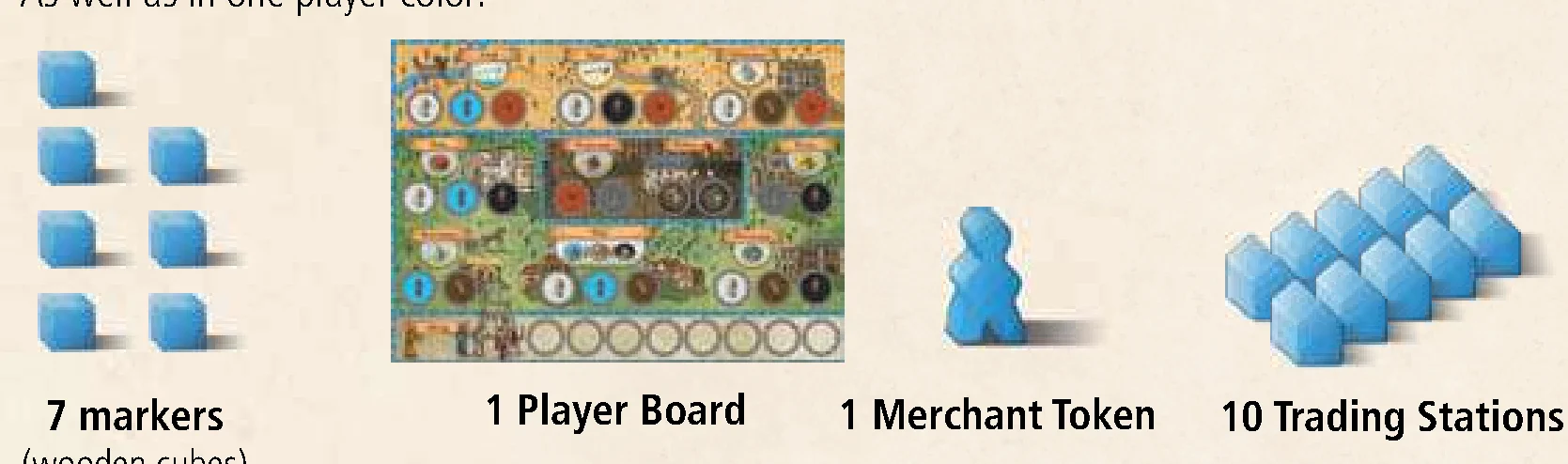
- 7 markers (wooden cubes)
- 1 Player Board
- 1 Merchant Token
- 10 Trading Stations
- 1 set of Followers: a Farmer, a Boatman, a Craftsman, and a Trader
- Place the large game board (places and terrain) and the “Beneficial Deeds” board on the table.
- Place the Technology Tiles in a stack on the appropriate space of the game board.
- Remove the “Pilgrimage” Tile (lighter hue) from the deck of Hour Glass Tiles, then shuffle the remaining tiles. Place the shuffled stack of tiles face down on the appropriate space of the game board and put the “Pilgrimage” Tile on top. The game will always start with the “Pilgrimage” event during the first round.
- Place 1 marker from each player on the first space of each of the Character Tracks as well as the Development Track.
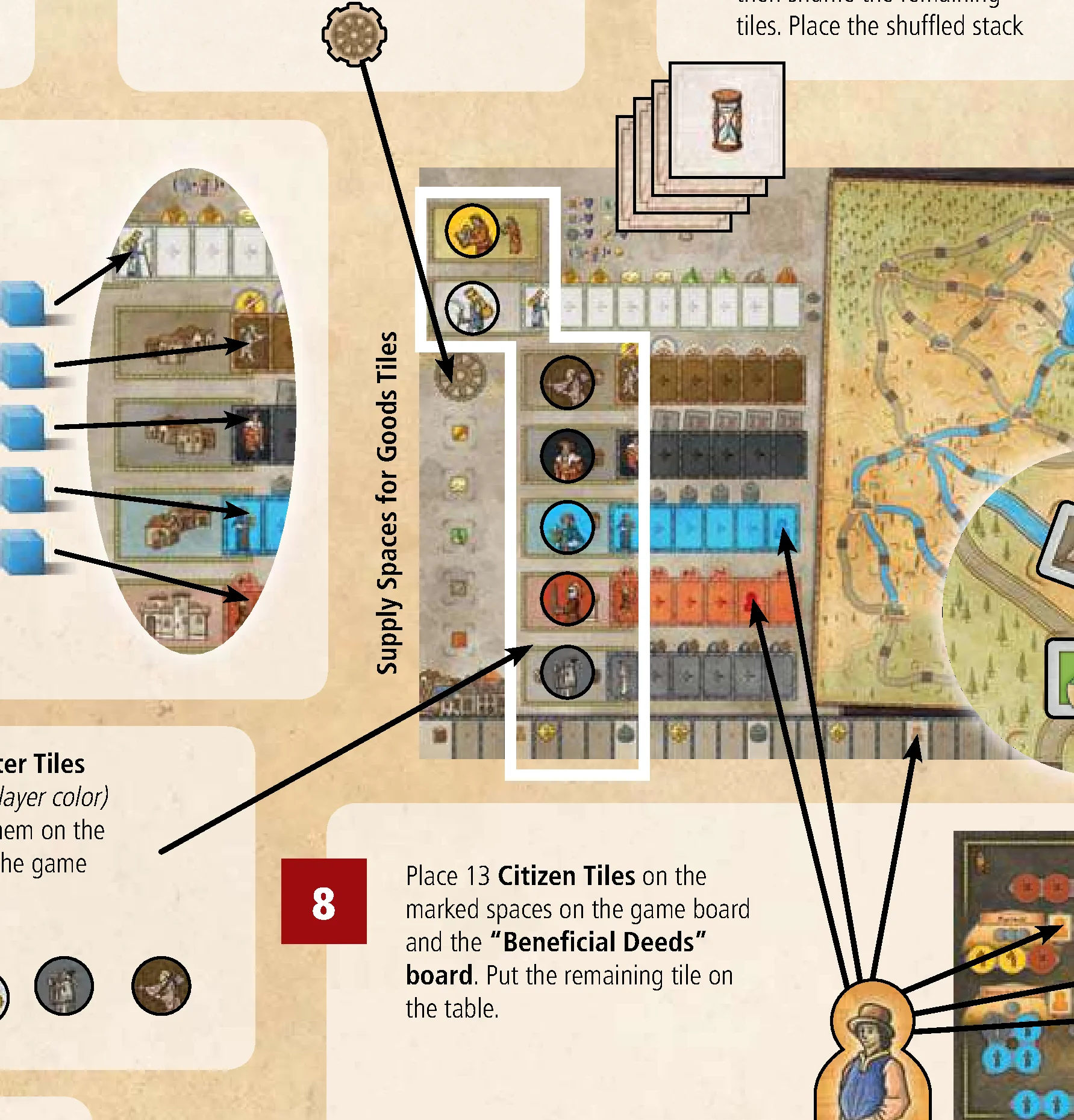
- Sort the neutral Character Tiles (without the marking in player color) by profession and place them on the appropriate buildings on the game board.
- Put the coins on the table close at hand.
- Place 13 Citizen Tiles on the marked spaces on the game board and the “Beneficial Deeds” board. Put the remaining tile on the table.
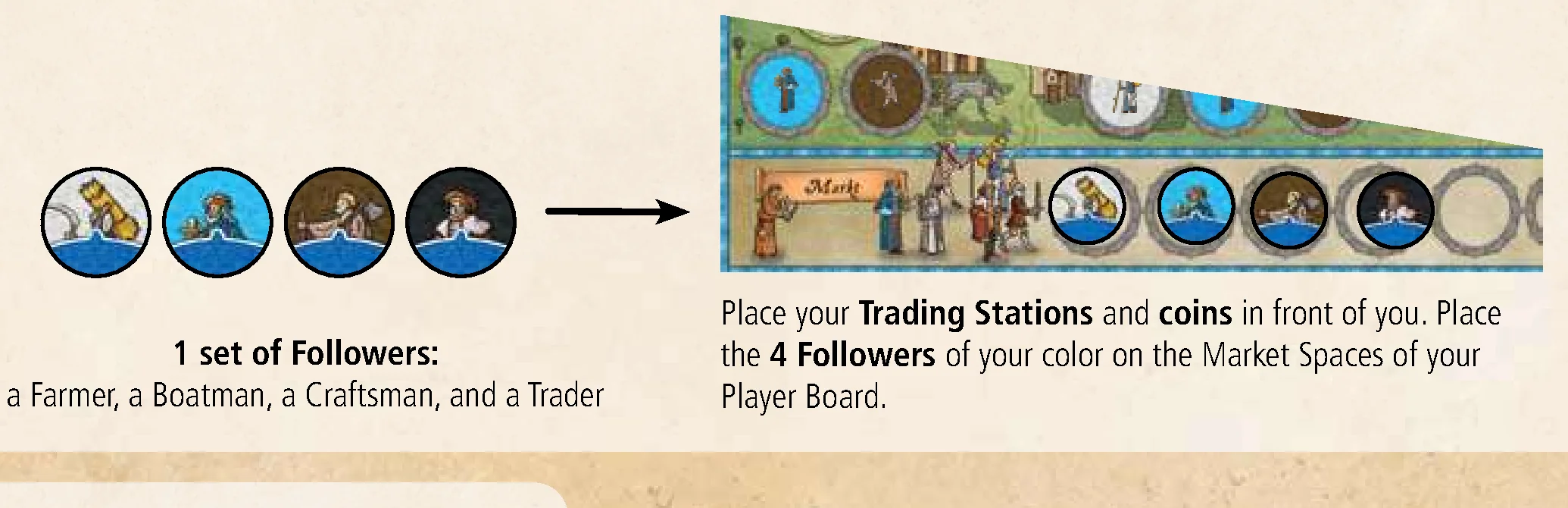
Place your Trading Stations and coins in front of you. Place the 4 Followers of your color on the Market Spaces of your Player Board.
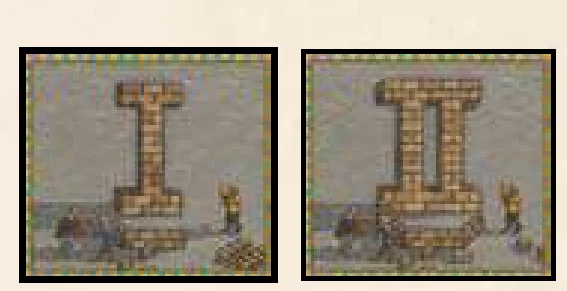
- Sort the Place Tiles by the Roman numerals on the reverse side and place them in separate stacks on the table.
- Shuffle the Goods Tiles face down and place them face up on the Road and Waterway Spaces, one tile per space. In 4-player games, every such space receives a tile (whereas in 2- and 3-player games some spaces remain empty, see right). Sort the remaining Goods Tiles and place them face up on the appropriate spaces of the Goods Market (on the left side of the game board).
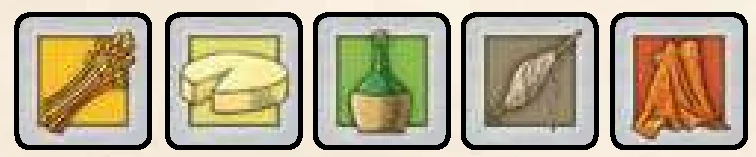
- Place your Merchant Token in Orléans.
Player adjustments
3-player game:
- Remove the Followers of the unused player color from the game.
- Remove 2 each of the neutral “Farmer”, “Boatman”, “Craftsman”, and “Trader” Character Tiles from the game.
- Remove 3 each of the “Knight”, “Scholar”, and “Monk” Character Tiles from the game.
- Remove 6 Goods Tiles from the game at random.
- Do not place any Goods Tiles on spaces marked with “4”. Those spaces remain empty.
2-player game:
- Remove the Followers of the unused player colors from the game.
- Remove 4 each of the neutral “Farmer”, “Boatman”, “Craftsman”, and “Trader” Character Tiles from the game.
- Remove 6 each of the “Knight”, “Scholar”, and “Monk” Character Tiles from the game.
- Remove 12 Goods Tiles from the game at random.
- Do not place any Goods Tiles on spaces marked with “3” or “4”. Those spaces remain empty.
13. You are now ready to play!
Course of Play
The youngest player receives the Start Player Token.
The game is played over 18 rounds, with each round being comprised of 7 phases.
Phase 1: Hour Glass
The Start Player draws the topmost Hour Glass Tile from the stack and turns it face up. The Hour Glass Tiles determine the length of the game. The game ends at the end of the round in which the 18th and last tile is drawn. Each Hour Glass Tile also introduces an event that will affect the current round. There are 6 different types of events (see “The Events in Detail”). Except Pilgrimage, events are resolved in Phase 6: “Event”.
Phase 2: Census
Determine who has the most and who has the least Farmers. The player whose marker is furthest ahead on the Farmers Track receives 1 coin from the supply. If there is a tie, no player receives the coin. The player whose marker is furthest behind on the track must pay 1 coin to the supply. If there is a tie, no player has to pay the coin.
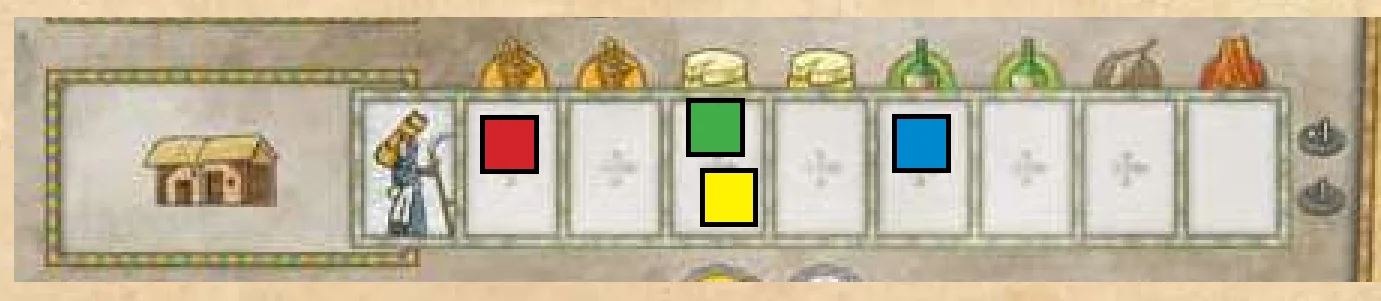
Example: The blue player receives a coin and the red player must pay a coin.
2 Players: In the 2-player game, the player who is behind on the track does not have to pay a coin. The player who is ahead still receives a coin.
Phase 3: Followers
Draw Character Tiles from your Followers Bag and place them on the Market. You may draw a number of Character Tiles from your bag equal to or lower than the number indicated by your marker on the Knights Track. At the beginning of the game, this number is 4. Place the drawn tiles on the Market Spaces of your Player Board. You may not draw more tiles than you can fit in your Market. (Note: Character Tiles that you do not use remain on your Market, thus taking up space that you might need when drawing tiles.)
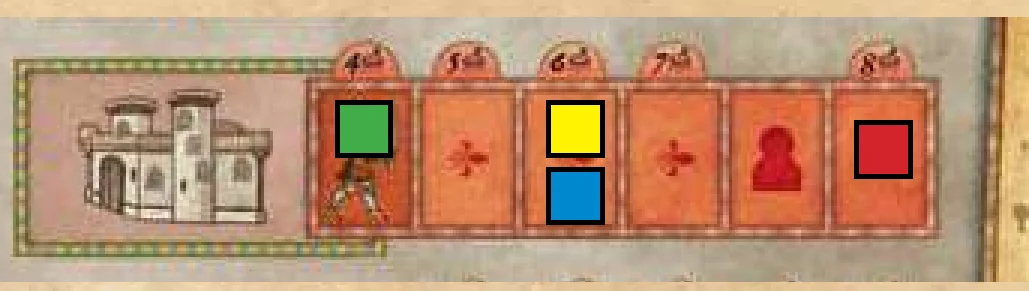
Example: The green player may draw 4 tiles from his bag. The yellow and blue player may each draw 6 tiles, and the red player may even draw 8 tiles from his bag.
Phase 4: Planning
You may use the Character Tiles from your Market to activate actions in Places. You may leave Character Tiles on your Market to use them in subsequent rounds.
Each Place provides a specific action and requires a certain set of Character Tiles to activate. (Some Place Tiles only require a single tile for activation or none at all.)
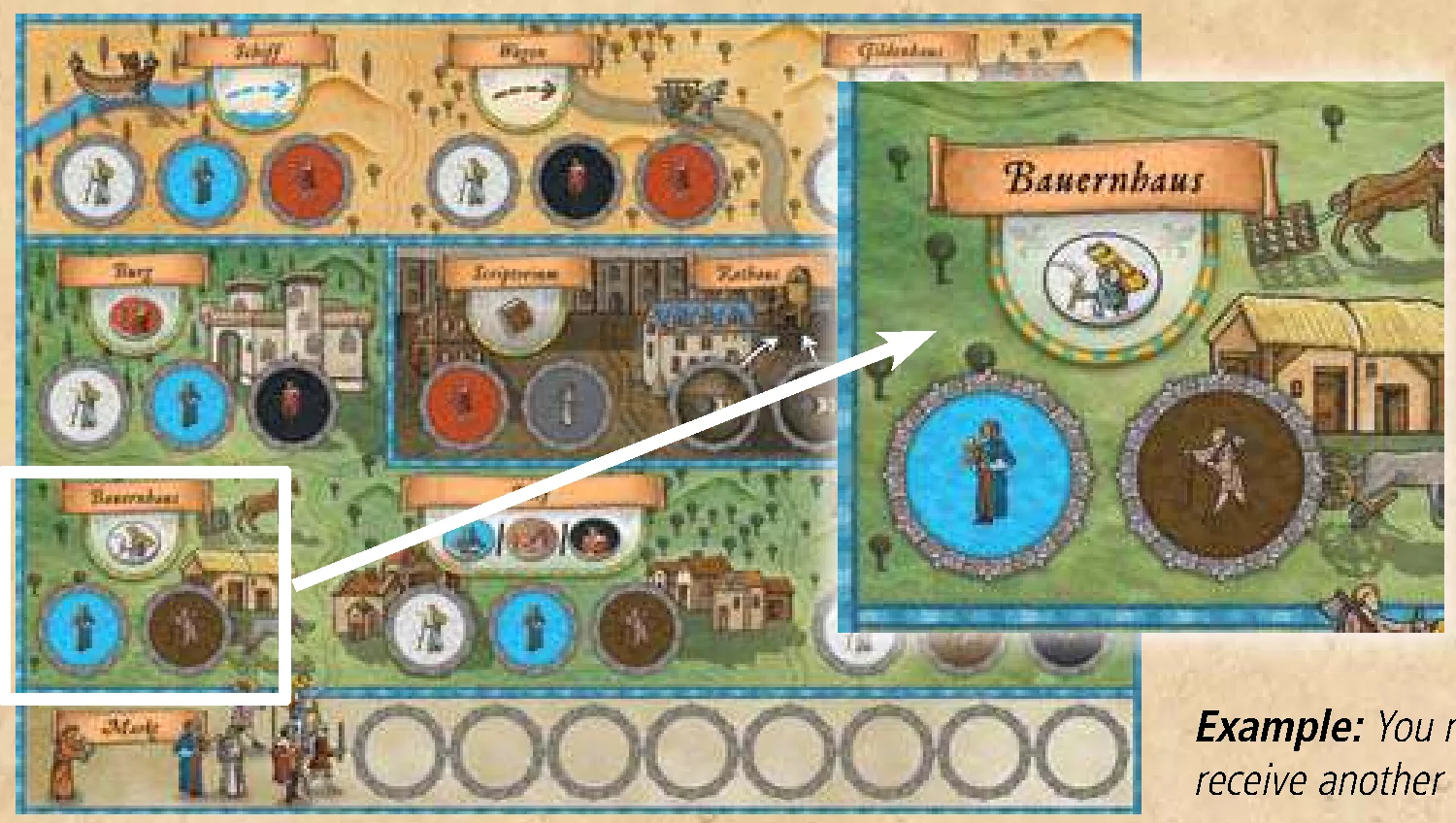
Example: You need a boatman and a craftsman to receive another farmer.
Place the required Character Tiles on the corresponding Action Spaces of the Place you want to activate. A Place is considered activated as soon as all of its Action Spaces have a tile. You can carry out the action during the following or during a future Action Phase.
You are not required to place all required tiles during the same Planning Phase. You may place some now and the rest in subsequent rounds. As long as you have not placed all of the required tiles, you have not activated the action and may not play it.
Phase 5: Actions
You may carry out the actions of the Places you activated, i.e. where you placed a Follower (or Technology Tile) on every required space.
Beginning with the Start Player and in clockwise order, each player may carry out 1 action or pass. If you pass, you cannot carry out any more actions during that round.
After you played an action, remove the Followers from that action (e.g. the Boatman and the Craftsman from the Farm House) and put them back into your bag.
Please note: Technology Tiles remain on the Action Spaces you placed them until the end of the game.
You may carry out your actions in any order. You are not required to carry out an activated action. You may pass even if you could carry out more actions. The Action Phase ends when all players have passed. If you pass, you cannot participate in the current Action Phase anymore. Activated actions that you did not use this round remain activated and can be used in a subsequent round. Do not remove Character Tiles from actions you have not used yet.
Phase 6: Event
Resolve the event shown on the Hour Glass Tile of this round. (The event affects all players. See below for details on the events.)
Phase 7: Start Player
The current Start Player passes the Start Player Token to the player to his left.

General Rules of the Game
Turn Order
Most phases can be played simultaneously. In Phase 4 (Planning), start planning at the same time. Then tell the other players when you are done planning. If need be, do this in turn order, i.e. beginning with the Start Player and in clockwise order. Likewise, resolve payments in that same order.
Payments
Pay coins into the general supply and take coins from there when you receive them.
Running Out of Tiles:
Character, Technology, and Goods Tiles are limited in this game. You cannot gain a tile if it is not available anymore. When you run out of a particular tile, you can no longer play an action that provides that tile. Events may result in certain tiles becoming available again (Harvest, Plague). When this happens, you can play the corresponding actions again. When there are not enough coins in the supply (temporarily), players cannot receive coins (at the moment).
Checking on Your Followers
At any time during the game, you may look into your bag to see how many and which Followers you have in there. (When you finish looking, shuffle the tiles in your bag so that you cannot draw particular tiles on purpose.)
Empty Roads or Waterways
You may use empty Roads and Waterways. You just do not receive a good.
Marked Followers
The marked Followers of your color (which you received during setup) always remain with you (either in your bag or on your board). You cannot use them for Beneficial Deeds nor lose them to the Plague nor pay with them during Torture.
Placed Character Tiles
You cannot move a Character Tile from one Action Space to another. However, when drawing Followers from your bag during Phase 3: “Followers”, for each Follower that you decline to draw, you may move a Character Tile from an Action Space to your Market. (Example: Stefan may draw 6 Followers. He only draws 4 Followers and moves 2 Followers from Action Spaces to his Market.)
The Actions/Places
Every Place represents a specific action. Your Player Board features the most common Places. As the game progresses, you can acquire additional Places (see below, “Expanding the City”).
You can play an action if it is activated (all spaces occupied). After you played an action, you remove the Character Tiles (but not the Technology Tiles) used to activate it and return them to your Followers Bag.
The Places and their actions in detail:
Farm House
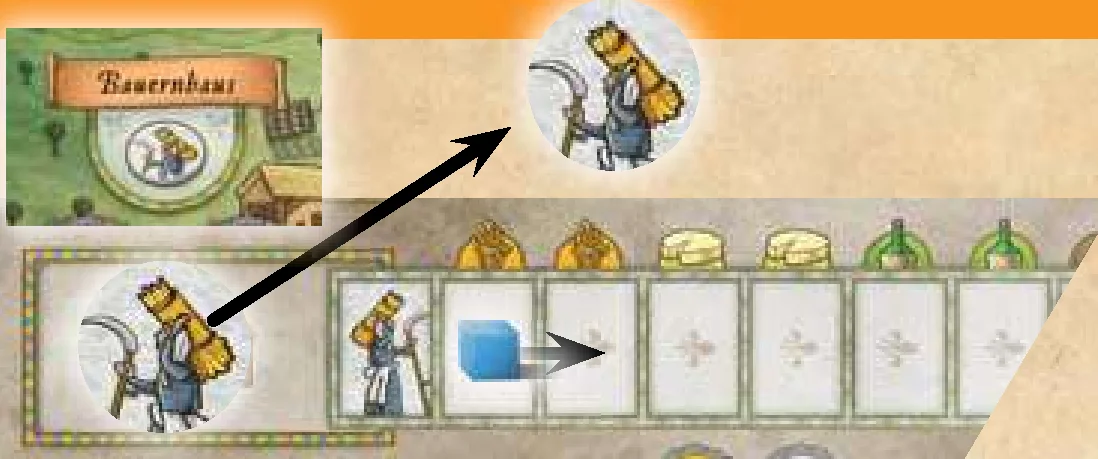
Take a Farmer Tile from the Farm House on the game board and put the Farmer into your bag.
Then advance your marker one space on the Farmers Track and receive the depicted good. The position of your marker on this track also plays a role during Phase 2: “Census”.
Village
In the Village, you can receive another Boatman, Craftsman, or Trader. You can choose one of the following actions (Boatman, Craftsman, Trader):
Boatman
Take a Boatman Tile from the game board and put it into your Followers Bag. Then advance one space on the Boatmen Track and receive the depicted number of coins. On the last space of that track, the first player to get there receives a Citizen Tile instead of coins.
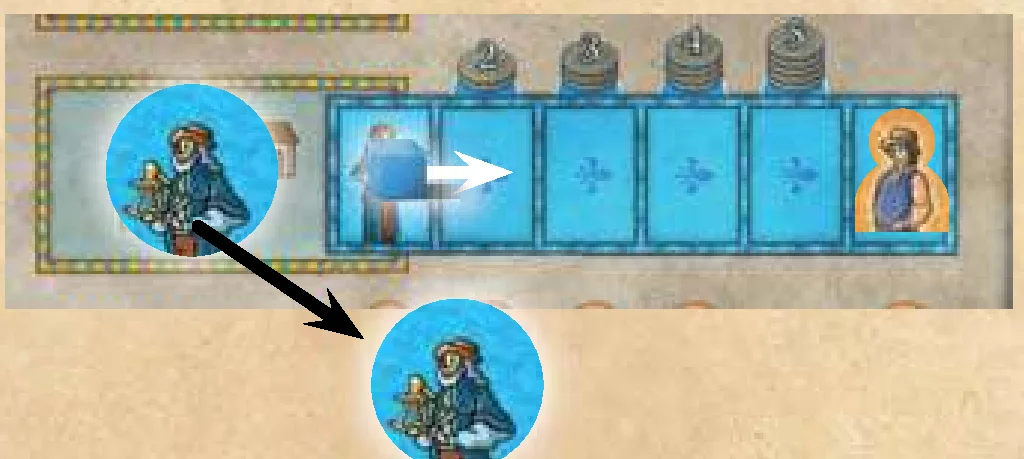
Craftsman
Take a Craftsman Tile from the game board and put it into your Followers Bag. Then advance one space on the Craftsmen Track and receive a Technology Tile. Put the Technology Tile next to your Player Board. You may only use it after you pass.
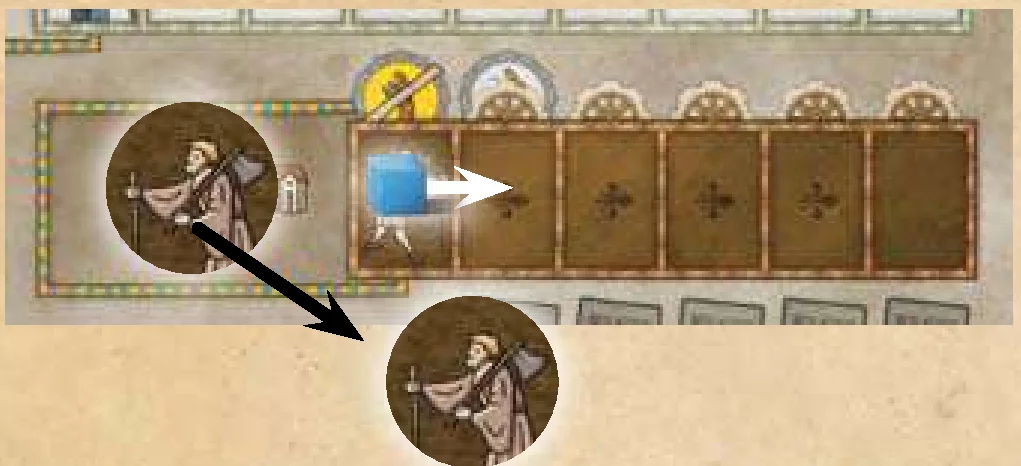
Technology: You can place the Technology Tile on an Action Space of your choice to replace the required Character Tile for the rest of the game. You do not remove the Technology Tile after you played the action. It remains on its space until the end of the game.
Constraints:
- The first Technology Tile you place in a game must replace a Farmer.
- Subsequent Technology Tiles may replace any Character Tile except Monks.
- Monks can never be replaced with Technology Tiles.
- You may not place more than 1 Technology Tile at one Place.
- You may not place a Technology Tile at a Place that only requires a single Character Tile.
- You may not move a Technology Tile after you placed it.
Trader
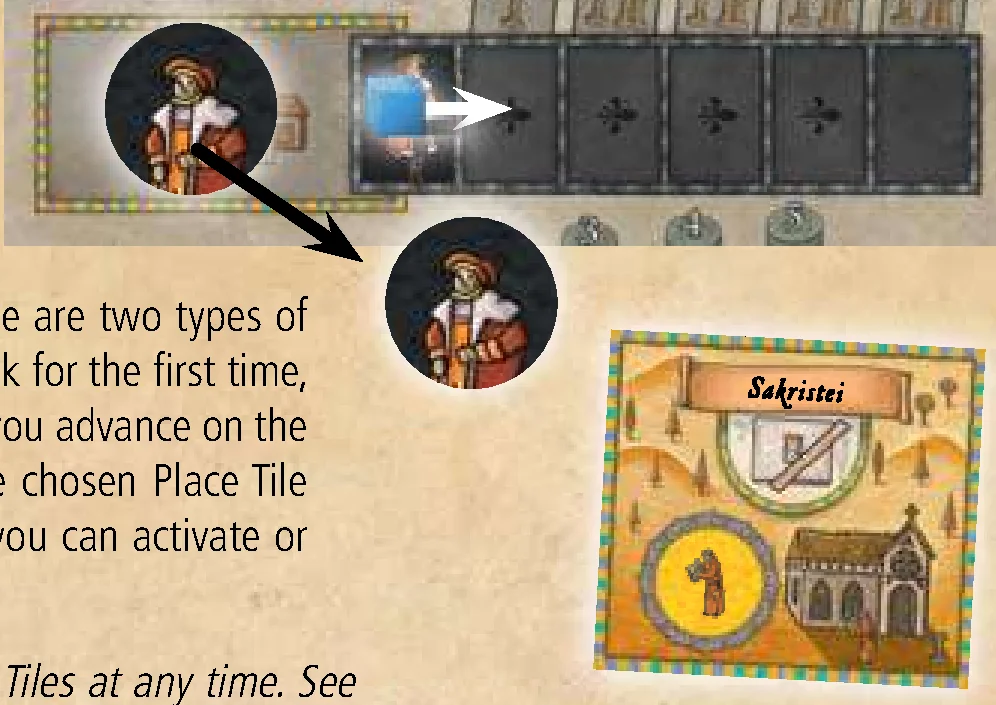
Take a Trader Tile from the game board and put it into your Followers Bag. Then advance one space on the Traders Track and expand your city with a Place Tile.
Expanding the City: You may choose a Place Tile. There are two types of Place Tiles, I and II. When you advance on the Traders Track for the first time, you may only choose a tile from stack I. Every other time you advance on the track, you may choose a tile from stack I or II. Place the chosen Place Tile next to your Player Board. You now have another Place you can activate or use its special ability.
Note: The players may look through the stacks of Place Tiles at any time. See the appendix for details on the different Place Tiles.
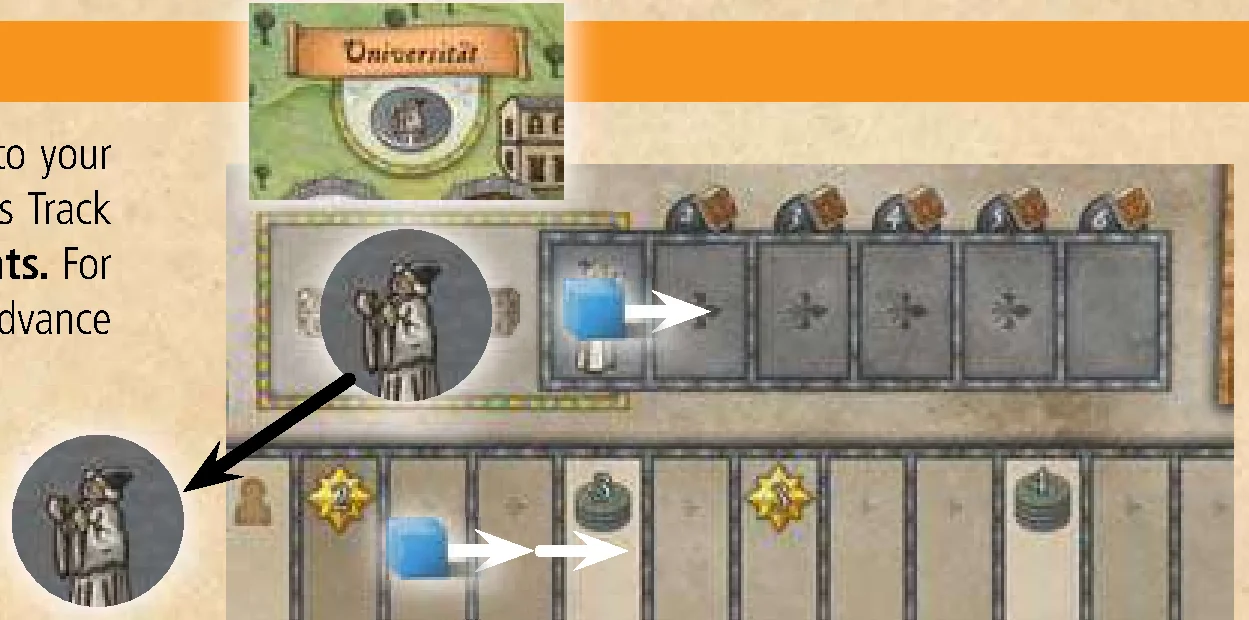
University
Take a Scholar Tile from the game board and put it into your Followers Bag. Then advance one space on the Scholars Track and receive the depicted number of Development Points. For each Development Point you receive during the game, advance your marker one space on the Development Track.
Castle
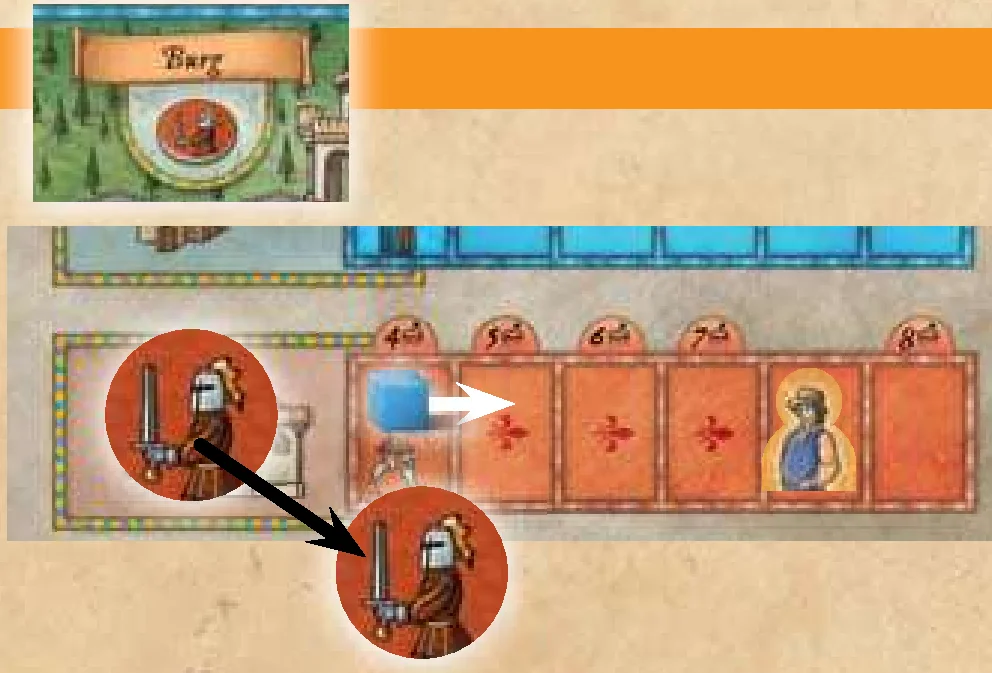
Take a Knight Tile from the game board and put it into your Followers Bag. Then advance one space on the Knights Track. The Knights Track indicates how many Followers you may draw from your bag and place on your Market in Phase 3. At the beginning of the game, you may draw 4 Followers each round. You can increase this number by recruiting Knights.
Note: When you get your fourth Knight, this number (7) does not increase, but you may receive a Citizen Tile if you are the first player to get there.
Monastery
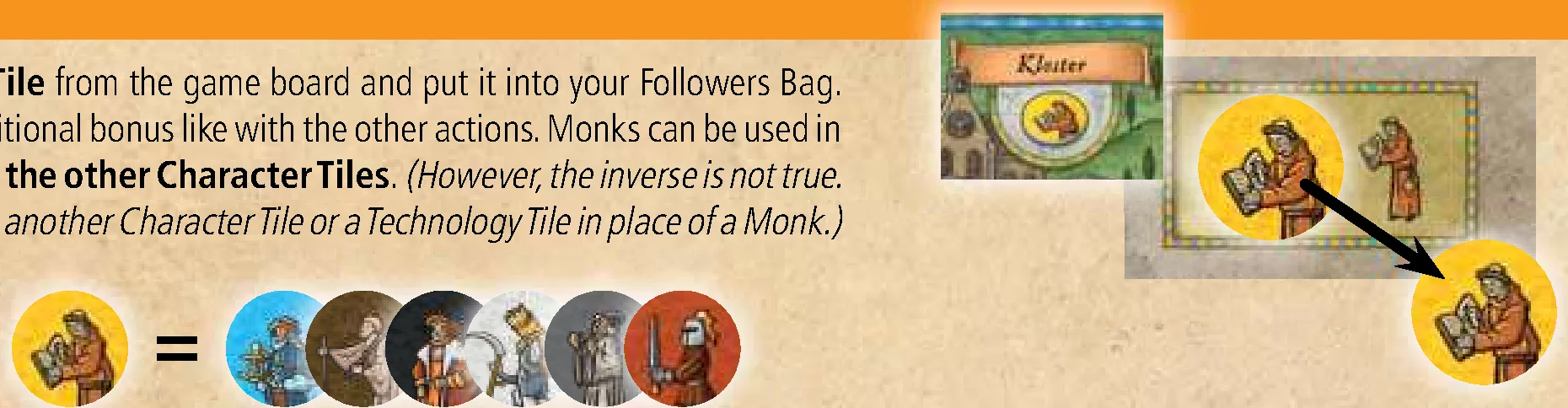
Take a Monk Tile from the game board and put it into your Followers Bag. There is no additional bonus like with the other actions. Monks can be used in place of any of the other Character Tiles. (However, the inverse is not true. You cannot use another Character Tile or a Technology Tile in place of a Monk.)
Note: Once your marker moves onto the last space of a track, you may no longer take the corresponding action.
Ship
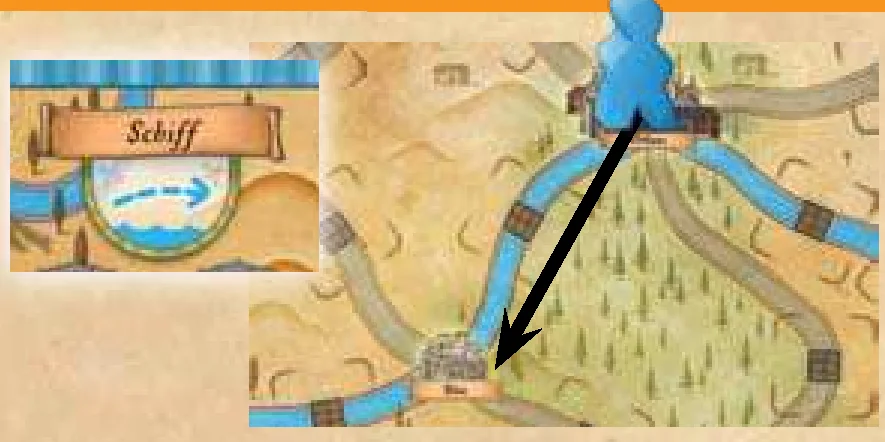
Move your Merchant Token from its current location along a Waterway (blue connection) to an adjacent town. If there is a Goods Tile on the way, you may take it. If there are multiple goods, you may take one of them. Place the Goods Tile next to your Player Board.
Wagon
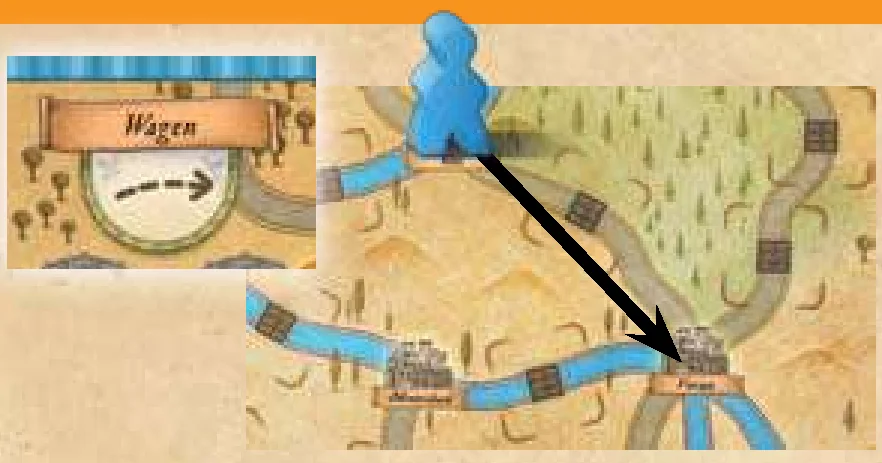
This action is similar to the “Ship” action, but rather than moving along a Waterway, move your Merchant Token along a Road (brown connection).
Guildhall
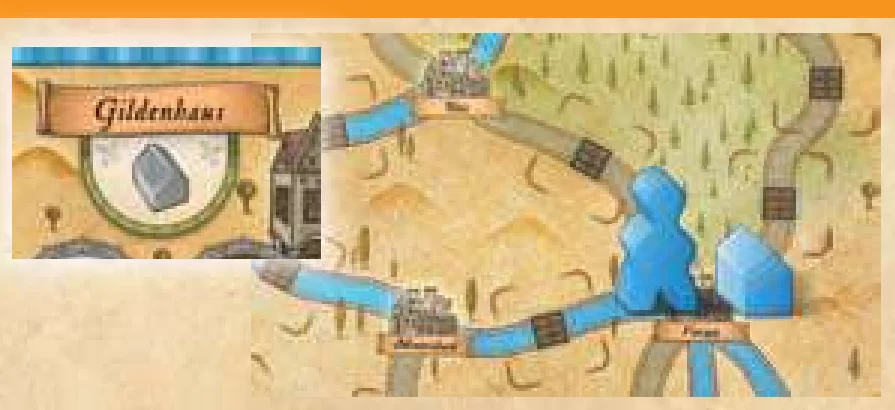
Build a Trading Station in the town in which your Merchant Token is present if there is no Trading Station in that town already (regardless of which player it belongs to). Each town can only have one Trading Station.
Exception: In Orléans, each player may build one Trading Station.
Scriptorium
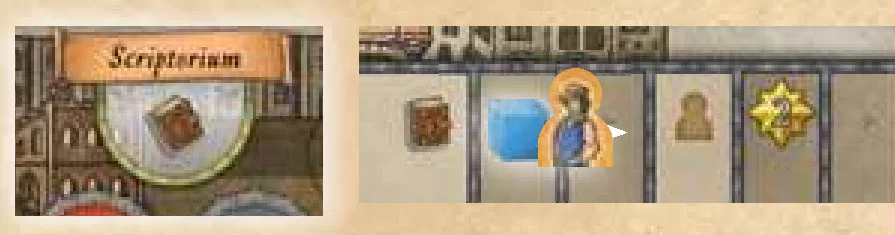
You receive 1 Development Point. Advance your marker one space on the Development Track.
Town Hall
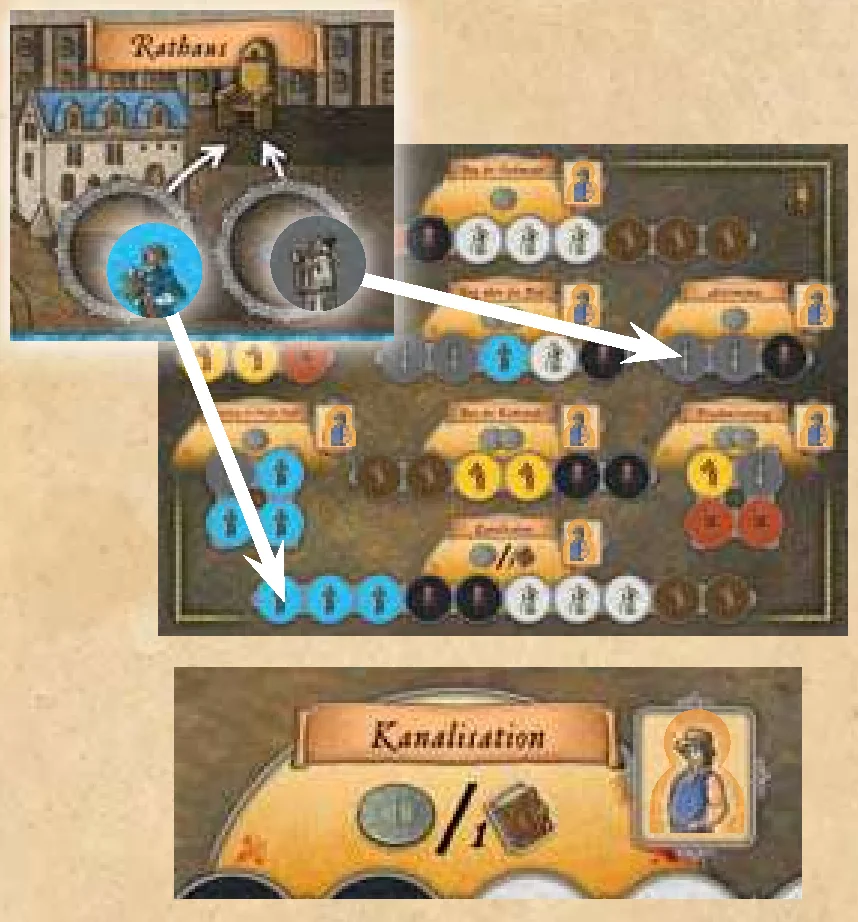
During the Planning Phase, you can place 1 or 2 Character Tiles in the Town Hall. (The Town Hall does not require both spaces be occupied in order to activate.) When using the “Town Hall” action, move one or both Character Tiles from the Town Hall to any free appropriate spaces on the “Beneficial Deeds” board. You receive the depicted reward (1, 2, or 3 coins, and in case of Canalization 1 coin or 1 Development Point) for each character.
When you complete a Beneficial Deed (i.e. you place a tile on the last remaining unoccupied space), you receive the Citizen Tile of that Beneficial Deed.
You cannot replace the Character Tiles required for Beneficial Deeds with other tiles (like Monks). You must always use the exact Character Tiles as shown on the spaces. Character Tiles used for Beneficial Deeds remain there for the rest of the game.
Please note: You may not place the Followers of your color (i.e. your initial Farmer, Boatman, Craftsman, and Trader) in the Town Hall.
The Development Track
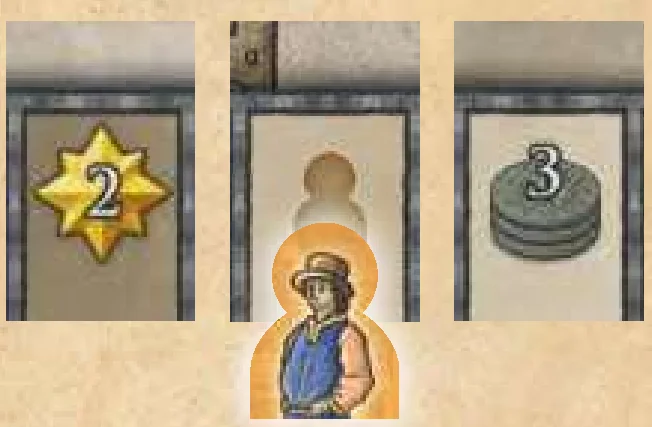
Some spaces of the Development Track show coins or contain a Citizen Tile. If you move your marker onto or past a space with coins, you receive the depicted amount of coins from the supply. If you are the first player to move onto or past a space with a Citizen Tile, you receive that tile.
Development Status Spaces indicate your state of development. If you move onto or past such a space, your Development Status immediately becomes the depicted value. At the beginning of the game, this value is 1.
Note: Your Development Status affects the “Income” event (you receive a number of coins equal to your Development Status), the Hospital, as well as the victory point value of your Citizen Tiles and Trading Stations at the end of the game.
The Events in Detail
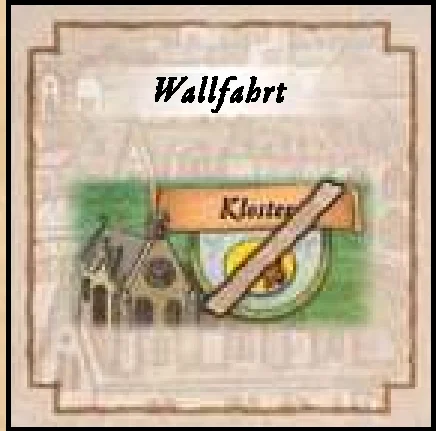
3x Pilgrimage:
When the “Pilgrimage” event is drawn, you may not recruit Monks this round. Pilgrimage is the only event that is not triggered in Phase 6: “Event”, but in Phase 5: “Actions”.
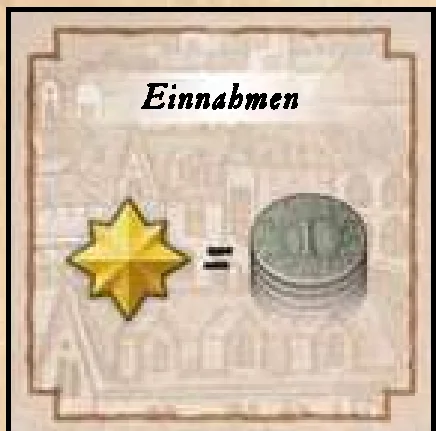
3x Income:
You receive a number of coins equal to your Development Status.
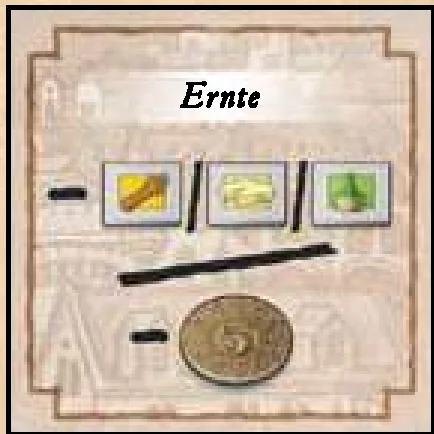
3x Harvest:
You must pay 1 food item (grain, cheese, or wine). Return the paid food item to the Goods Market. If you cannot pay the food, pay 5 coins instead. If you cannot do this either, you must undergo torture (see below).
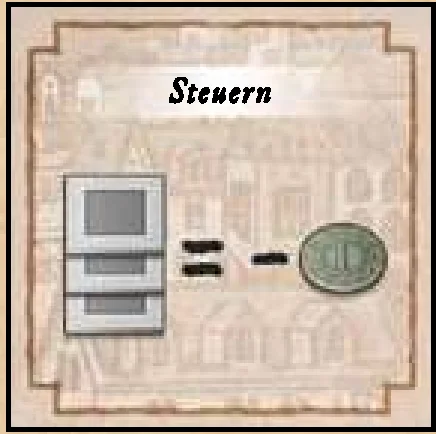
3x Taxes:
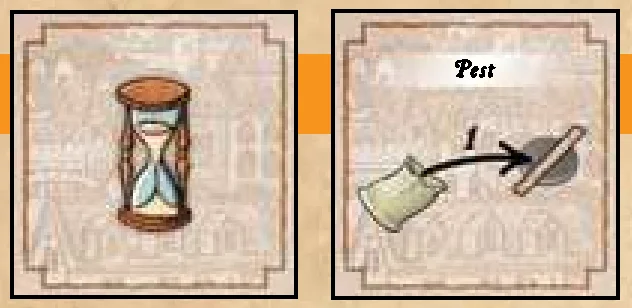
Count the number of goods you have. Pay 1 coin per 3 goods you have. If you cannot pay, you must undergo torture (see below).
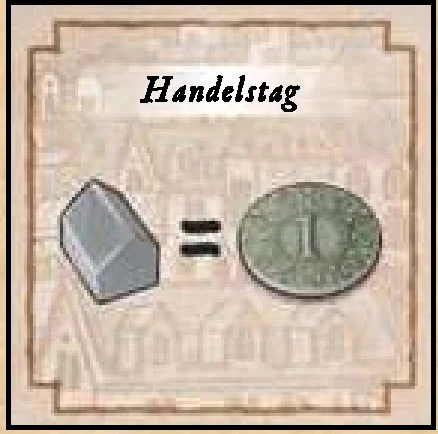
3x Trading Day:
You receive 1 coin per Trading Station you built.
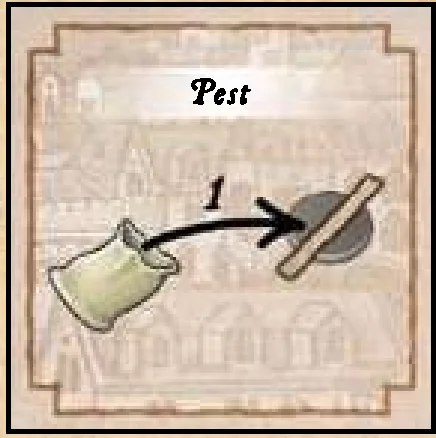
3x Plague:
You lose 1 Character Tile. Draw a Character Tile from your Followers Bag and return it to the game board (it becomes available again). Do not move your marker back on the corresponding track. You cannot lose the Character Tiles of your color (i.e. your initial Farmer, Boatman, Craftsman, or Trader). If you draw one of them, lucky you. In this case, you do not lose a Character Tile this round.
Torture (Bankruptcy)
Every time you must pay something (e.g. during Census or Taxes) and you cannot do so, you must undergo torture. You must replace every missing coin with something else from this list:
- a Trading Station (an already built one or one from your supply)
- a Follower (draw a random one from your bag; as long as you draw a Follower of your color, put the Follower back into the bag and draw again)
- a Development Point (move your marker on the Development Track one space to the left, but not onto or past a space with coins)
- a Goods Tile
- a Place Tile
- a Technology Tile
You may replace missing coins with any mix of items from this list (e.g. if you owe 5 coins, you may replace them with 1 Follower, 2 Trading Stations, and 2 Development Points).
All items lost in this process are removed from the game. Only Development Points can be re-gained.
The Place Tiles in Detail
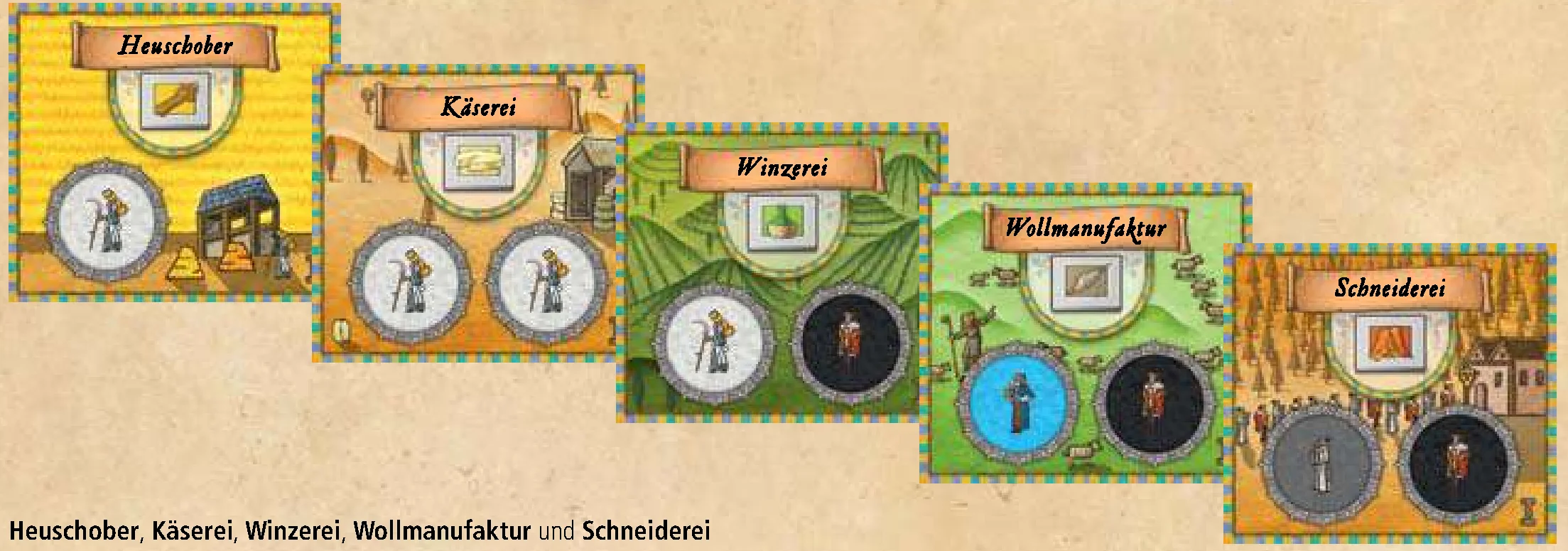
Hayrick, Cheese Factory, Winery, Wool Manufacturer, and Tailor Shop
You receive the depicted good from the Goods Market. You cannot play this action if there is no Goods Tile of the depicted type left in the Goods Market.
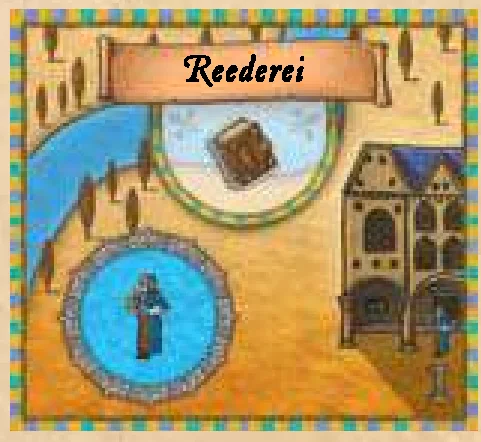
Shipping Line
You receive 1 Development Point.
Brewery
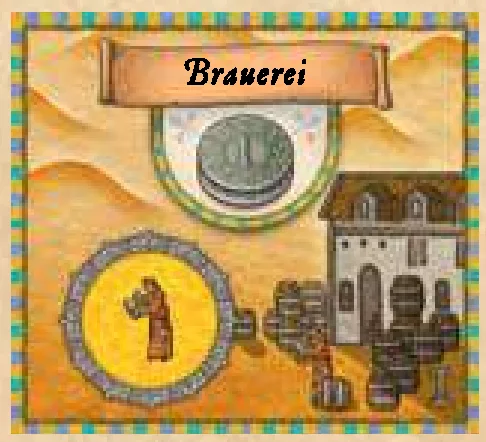
You receive 2 coins from the supply.
Library
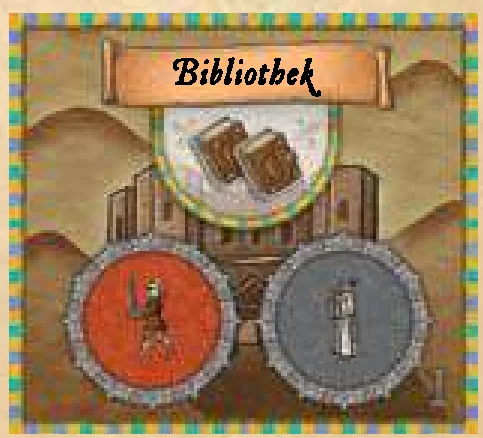
You receive 2 Development Points.
Windmill
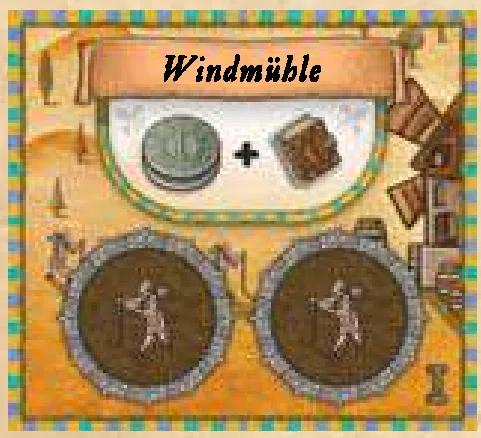
You receive 2 coins from the supply and 1 Development Point.
Cellar
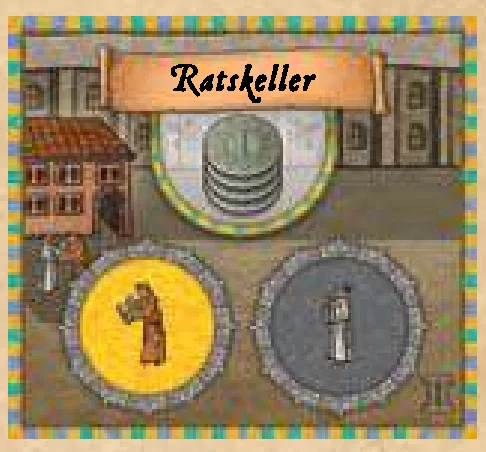
You receive 4 coins from the supply.
Pharmacy
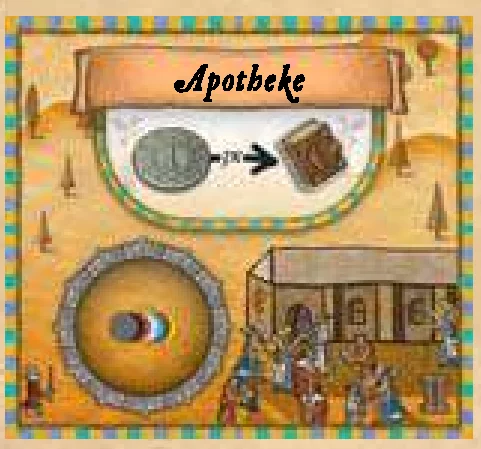
You can activate the Pharmacy with any Character Tile. As the action, you may spend up to 3 coins to advance on the Development Track. For each coin you spend (min. 1), you may move your marker one space to the right.
Office
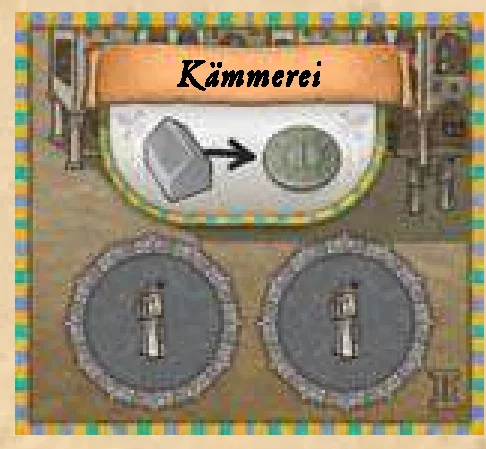
You receive 1 coin for each Trading Station you built.
Bathhouse
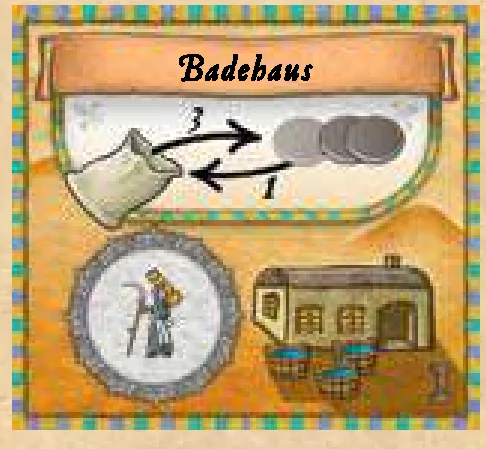
Draw 3 Character Tiles from your bag and choose 2 of them. Immediately place the chosen tiles on appropriate Action Spaces. (You cannot place these tiles on the Bathhouse.) Put the third tile you have drawn as well as the Follower from the Bathhouse back into your bag. If you cannot place 2 of the drawn tiles on Action Spaces, only place one or none and put the rest back into your bag.
Hospital
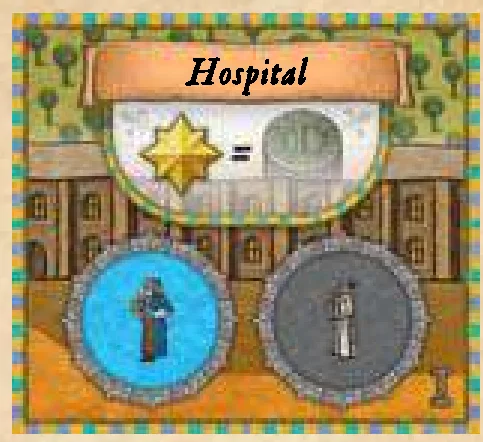
You receive a number of coins from the supply equal to your current Development Status.
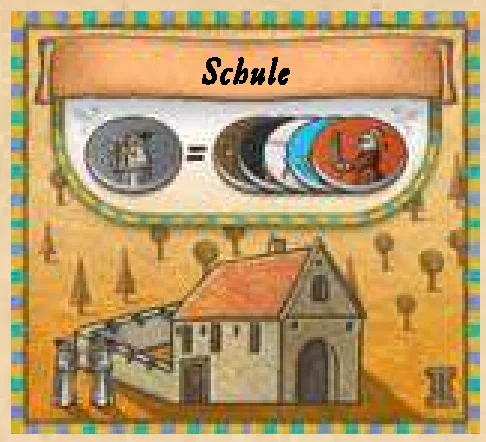
School
As the owner of the School, you can use Scholars in place of other Character Tiles but Monks.
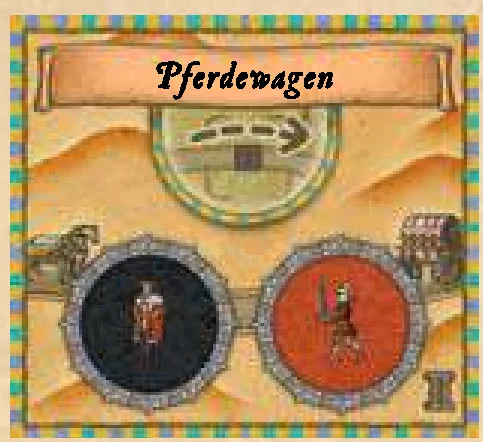
Horse Wagon
Move your Merchant Token along a Road to an adjacent town and collect one good if available.
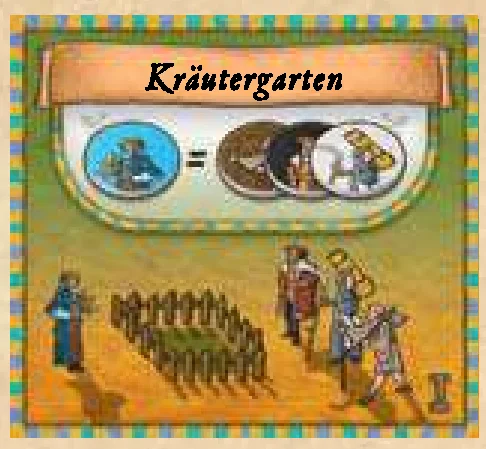
Herb Garden
As the owner of the Herb Garden, you can use Boatmen in place of Craftsmen, Traders, and Farmers.
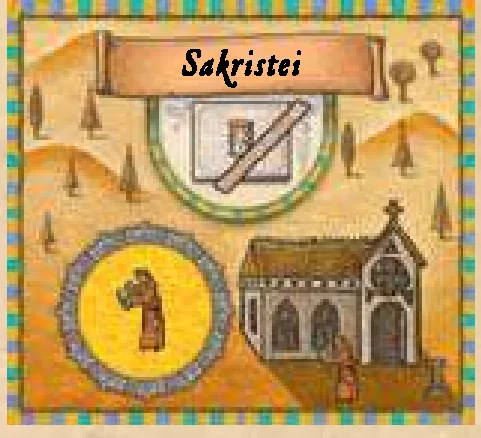
Sacristy
The Sacristy can protect you from negative events (like Harvest, Taxes, or Plague) if it is activated. During the Event Phase, remove the Monk from the Sacristy and put the tile back into your bag instead of suffering the negative effects of the event in play.
Gunpowder Tower
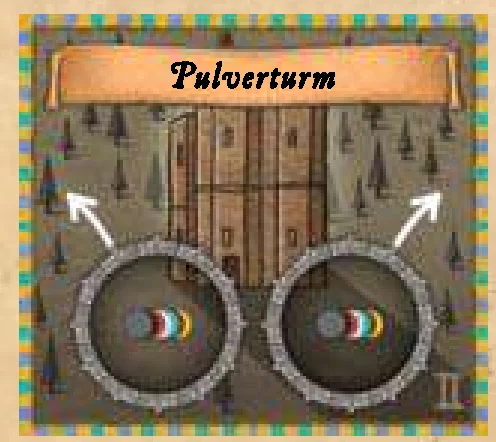
The Gunpowder Tower expands your Market by 2 spaces. During Phase 3: “Followers”, you can place 1 or 2 Character Tiles on the Gunpowder Tower. During the Planning Phase, you can place one or both of these tiles on Action Spaces, or use them for Beneficial Deeds during the Action Phase. (You can use both of these tiles for Beneficial Deeds in one action.) You may not use the Followers of your color for Beneficial Deeds.
Laboratory
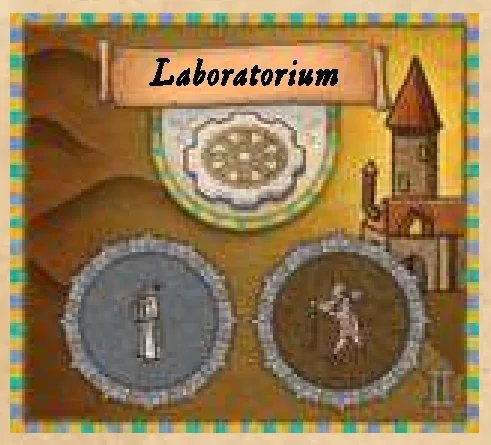
You receive a Technology Tile that you may place on an Action Space of your choice (except for Monk Spaces). The usual rules for Technology Tiles apply. You may place the Technology Tile on the Laboratory if you want.
End of the Game and Scoring
The game ends after 18 rounds. Before you proceed with the scoring, the player who has built the most Trading Stations receives the remaining Citizen Tile. If there is a tie, no player receives the tile. Then determine your final scores. You score victory points (VP) for:
- Coins: 1 VP per coin
- Goods:
- Brocade: 5 VP
- Wool: 4 VP
- Wine: 3 VP
- Cheese: 2 VP
- Grain: 1 VP
- Trading Stations and Citizen Tiles: Each Trading Station you have built and every Citizen Tile you have collected is worth a number of VP equal to your Development Status.
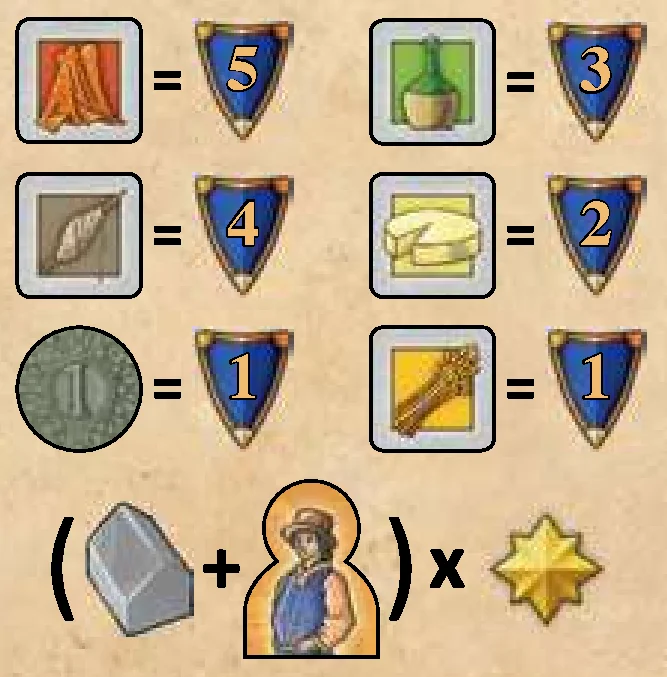
(Example: Klemens has built 5 Trading Stations and collected 2 Citizen Tiles. His current Development Status is 4, as indicated by the Development Track. He receives (5+2) x 4 = 28 VP.)
The player with the most VP wins. In case of a tie, the player further ahead on the Development Track wins. If still tied, there are multiple winners.
Additional Rule: Exclusion of Place Tiles (Recommended for Experienced Players)
At the beginning of the game (before the first round), beginning with the Start Player and in clockwise order, each player may exclude one Place Tile from play (from category I or II). Put the excluded tiles back into the game box. In a 2-player game, each player excludes 2 tiles.
Credits
Author: Reiner Stockhausen
Illustrations: Klemens Franz | atelier198
Translation: Grzegorz Kobiela
Proofreading: Stefan Malz
© dlp games 2014
www.dlp-games.de
E-mail: [email protected]
Setup & Components
Goal of the Game
You are trying to achieve dominance in various areas in medieval France. You will get goods, coins, and victory points via production, trade, development, and by committing to the common good.
Components
- 1 Large Game Board
- 1 Small “Beneficial Deeds” Board
- 4 Player Boards
- 4 Followers Bags
- 4 Merchant Tokens
- 40 Trading Stations
- 28 Wooden Cubes
- 104 Character Tiles
- 90 Goods:
- 24 x Grain
- 21 x Cheese
- 18 x Wine
- 15 x Wool
- 12 x Brocade
- 16 Technology Tiles
- 14 Citizen Tiles
- 47 Coins
- 20 Place Tiles
- 18 Hour Glass Tiles
- 2 Overview Cards
- 1 Start Player Token
- 1 rulebook
Setup
1. Each player takes:
- 1 Followers Bag
- 5 coins
- As well as in one player color:
- 7 markers (wooden cubes)
- 1 Player Board
- 1 Merchant Token
- 10 Trading Stations
- 1 set of Followers: a Farmer, a Boatman, a Craftsman, and a Trader
- Place the large game board (places and terrain) and the “Beneficial Deeds” board on the table.
- Place the Technology Tiles in a stack on the appropriate space of the game board.
- Remove the “Pilgrimage” Tile (lighter hue) from the deck of Hour Glass Tiles, then shuffle the remaining tiles. Place the shuffled stack of tiles face down on the appropriate space of the game board and put the “Pilgrimage” Tile on top. The game will always start with the “Pilgrimage” event during the first round.
- Place 1 marker from each player on the first space of each of the Character Tracks as well as the Development Track.
- Sort the neutral Character Tiles (without the marking in player color) by profession and place them on the appropriate buildings on the game board.
- Put the coins on the table close at hand.
- Place 13 Citizen Tiles on the marked spaces on the game board and the “Beneficial Deeds” board. Put the remaining tile on the table.
Place your Trading Stations and coins in front of you. Place the 4 Followers of your color on the Market Spaces of your Player Board.
- Sort the Place Tiles by the Roman numerals on the reverse side and place them in separate stacks on the table.
- Shuffle the Goods Tiles face down and place them face up on the Road and Waterway Spaces, one tile per space. In 4-player games, every such space receives a tile (whereas in 2- and 3-player games some spaces remain empty, see right). Sort the remaining Goods Tiles and place them face up on the appropriate spaces of the Goods Market (on the left side of the game board).
- Place your Merchant Token in Orléans.
Player adjustments
3-player game:
- Remove the Followers of the unused player color from the game.
- Remove 2 each of the neutral “Farmer”, “Boatman”, “Craftsman”, and “Trader” Character Tiles from the game.
- Remove 3 each of the “Knight”, “Scholar”, and “Monk” Character Tiles from the game.
- Remove 6 Goods Tiles from the game at random.
- Do not place any Goods Tiles on spaces marked with “4”. Those spaces remain empty.
2-player game:
- Remove the Followers of the unused player colors from the game.
- Remove 4 each of the neutral “Farmer”, “Boatman”, “Craftsman”, and “Trader” Character Tiles from the game.
- Remove 6 each of the “Knight”, “Scholar”, and “Monk” Character Tiles from the game.
- Remove 12 Goods Tiles from the game at random.
- Do not place any Goods Tiles on spaces marked with “3” or “4”. Those spaces remain empty.
13. You are now ready to play!
How to Play & Round Structure
Course of Play
The youngest player receives the Start Player Token.
The game is played over 18 rounds, with each round being comprised of 7 phases.
Phase 1: Hour Glass
The Start Player draws the topmost Hour Glass Tile from the stack and turns it face up. The Hour Glass Tiles determine the length of the game. The game ends at the end of the round in which the 18th and last tile is drawn. Each Hour Glass Tile also introduces an event that will affect the current round. There are 6 different types of events (see “The Events in Detail”). Except Pilgrimage, events are resolved in Phase 6: “Event”.
Phase 2: Census
Determine who has the most and who has the least Farmers. The player whose marker is furthest ahead on the Farmers Track receives 1 coin from the supply. If there is a tie, no player receives the coin. The player whose marker is furthest behind on the track must pay 1 coin to the supply. If there is a tie, no player has to pay the coin.
Example: The blue player receives a coin and the red player must pay a coin.
2 Players: In the 2-player game, the player who is behind on the track does not have to pay a coin. The player who is ahead still receives a coin.
Phase 3: Followers
Draw Character Tiles from your Followers Bag and place them on the Market. You may draw a number of Character Tiles from your bag equal to or lower than the number indicated by your marker on the Knights Track. At the beginning of the game, this number is 4. Place the drawn tiles on the Market Spaces of your Player Board. You may not draw more tiles than you can fit in your Market. (Note: Character Tiles that you do not use remain on your Market, thus taking up space that you might need when drawing tiles.)
Example: The green player may draw 4 tiles from his bag. The yellow and blue player may each draw 6 tiles, and the red player may even draw 8 tiles from his bag.
Phase 4: Planning
You may use the Character Tiles from your Market to activate actions in Places. You may leave Character Tiles on your Market to use them in subsequent rounds.
Each Place provides a specific action and requires a certain set of Character Tiles to activate. (Some Place Tiles only require a single tile for activation or none at all.)
Example: You need a boatman and a craftsman to receive another farmer.
Place the required Character Tiles on the corresponding Action Spaces of the Place you want to activate. A Place is considered activated as soon as all of its Action Spaces have a tile. You can carry out the action during the following or during a future Action Phase.
You are not required to place all required tiles during the same Planning Phase. You may place some now and the rest in subsequent rounds. As long as you have not placed all of the required tiles, you have not activated the action and may not play it.
Phase 5: Actions
You may carry out the actions of the Places you activated, i.e. where you placed a Follower (or Technology Tile) on every required space.
Beginning with the Start Player and in clockwise order, each player may carry out 1 action or pass. If you pass, you cannot carry out any more actions during that round.
After you played an action, remove the Followers from that action (e.g. the Boatman and the Craftsman from the Farm House) and put them back into your bag.
Please note: Technology Tiles remain on the Action Spaces you placed them until the end of the game.
You may carry out your actions in any order. You are not required to carry out an activated action. You may pass even if you could carry out more actions. The Action Phase ends when all players have passed. If you pass, you cannot participate in the current Action Phase anymore. Activated actions that you did not use this round remain activated and can be used in a subsequent round. Do not remove Character Tiles from actions you have not used yet.
Phase 6: Event
Resolve the event shown on the Hour Glass Tile of this round. (The event affects all players. See below for details on the events.)
Phase 7: Start Player
The current Start Player passes the Start Player Token to the player to his left.
General Rules of the Game
Turn Order
Most phases can be played simultaneously. In Phase 4 (Planning), start planning at the same time. Then tell the other players when you are done planning. If need be, do this in turn order, i.e. beginning with the Start Player and in clockwise order. Likewise, resolve payments in that same order.
Payments
Pay coins into the general supply and take coins from there when you receive them.
Running Out of Tiles:
Character, Technology, and Goods Tiles are limited in this game. You cannot gain a tile if it is not available anymore. When you run out of a particular tile, you can no longer play an action that provides that tile. Events may result in certain tiles becoming available again (Harvest, Plague). When this happens, you can play the corresponding actions again. When there are not enough coins in the supply (temporarily), players cannot receive coins (at the moment).
Checking on Your Followers
At any time during the game, you may look into your bag to see how many and which Followers you have in there. (When you finish looking, shuffle the tiles in your bag so that you cannot draw particular tiles on purpose.)
Empty Roads or Waterways
You may use empty Roads and Waterways. You just do not receive a good.
Marked Followers
The marked Followers of your color (which you received during setup) always remain with you (either in your bag or on your board). You cannot use them for Beneficial Deeds nor lose them to the Plague nor pay with them during Torture.
Placed Character Tiles
You cannot move a Character Tile from one Action Space to another. However, when drawing Followers from your bag during Phase 3: “Followers”, for each Follower that you decline to draw, you may move a Character Tile from an Action Space to your Market. (Example: Stefan may draw 6 Followers. He only draws 4 Followers and moves 2 Followers from Action Spaces to his Market.)
Places & Board Actions
The Actions/Places
Every Place represents a specific action. Your Player Board features the most common Places. As the game progresses, you can acquire additional Places (see below, “Expanding the City”).
You can play an action if it is activated (all spaces occupied). After you played an action, you remove the Character Tiles (but not the Technology Tiles) used to activate it and return them to your Followers Bag.
The Places and their actions in detail:
Farm House
Take a Farmer Tile from the Farm House on the game board and put the Farmer into your bag.
Then advance your marker one space on the Farmers Track and receive the depicted good. The position of your marker on this track also plays a role during Phase 2: “Census”.
Village
In the Village, you can receive another Boatman, Craftsman, or Trader. You can choose one of the following actions (Boatman, Craftsman, Trader):
Boatman
Take a Boatman Tile from the game board and put it into your Followers Bag. Then advance one space on the Boatmen Track and receive the depicted number of coins. On the last space of that track, the first player to get there receives a Citizen Tile instead of coins.
Craftsman
Take a Craftsman Tile from the game board and put it into your Followers Bag. Then advance one space on the Craftsmen Track and receive a Technology Tile. Put the Technology Tile next to your Player Board. You may only use it after you pass.
Technology: You can place the Technology Tile on an Action Space of your choice to replace the required Character Tile for the rest of the game. You do not remove the Technology Tile after you played the action. It remains on its space until the end of the game.
Constraints:
- The first Technology Tile you place in a game must replace a Farmer.
- Subsequent Technology Tiles may replace any Character Tile except Monks.
- Monks can never be replaced with Technology Tiles.
- You may not place more than 1 Technology Tile at one Place.
- You may not place a Technology Tile at a Place that only requires a single Character Tile.
- You may not move a Technology Tile after you placed it.
Trader
Take a Trader Tile from the game board and put it into your Followers Bag. Then advance one space on the Traders Track and expand your city with a Place Tile.
Expanding the City: You may choose a Place Tile. There are two types of Place Tiles, I and II. When you advance on the Traders Track for the first time, you may only choose a tile from stack I. Every other time you advance on the track, you may choose a tile from stack I or II. Place the chosen Place Tile next to your Player Board. You now have another Place you can activate or use its special ability.
Note: The players may look through the stacks of Place Tiles at any time. See the appendix for details on the different Place Tiles.
University
Take a Scholar Tile from the game board and put it into your Followers Bag. Then advance one space on the Scholars Track and receive the depicted number of Development Points. For each Development Point you receive during the game, advance your marker one space on the Development Track.
Castle
Take a Knight Tile from the game board and put it into your Followers Bag. Then advance one space on the Knights Track. The Knights Track indicates how many Followers you may draw from your bag and place on your Market in Phase 3. At the beginning of the game, you may draw 4 Followers each round. You can increase this number by recruiting Knights.
Note: When you get your fourth Knight, this number (7) does not increase, but you may receive a Citizen Tile if you are the first player to get there.
Monastery
Take a Monk Tile from the game board and put it into your Followers Bag. There is no additional bonus like with the other actions. Monks can be used in place of any of the other Character Tiles. (However, the inverse is not true. You cannot use another Character Tile or a Technology Tile in place of a Monk.)
Note: Once your marker moves onto the last space of a track, you may no longer take the corresponding action.
Ship
Move your Merchant Token from its current location along a Waterway (blue connection) to an adjacent town. If there is a Goods Tile on the way, you may take it. If there are multiple goods, you may take one of them. Place the Goods Tile next to your Player Board.
Wagon
This action is similar to the “Ship” action, but rather than moving along a Waterway, move your Merchant Token along a Road (brown connection).
Guildhall
Build a Trading Station in the town in which your Merchant Token is present if there is no Trading Station in that town already (regardless of which player it belongs to). Each town can only have one Trading Station.
Exception: In Orléans, each player may build one Trading Station.
Scriptorium
You receive 1 Development Point. Advance your marker one space on the Development Track.
Town Hall
During the Planning Phase, you can place 1 or 2 Character Tiles in the Town Hall. (The Town Hall does not require both spaces be occupied in order to activate.) When using the “Town Hall” action, move one or both Character Tiles from the Town Hall to any free appropriate spaces on the “Beneficial Deeds” board. You receive the depicted reward (1, 2, or 3 coins, and in case of Canalization 1 coin or 1 Development Point) for each character.
When you complete a Beneficial Deed (i.e. you place a tile on the last remaining unoccupied space), you receive the Citizen Tile of that Beneficial Deed.
You cannot replace the Character Tiles required for Beneficial Deeds with other tiles (like Monks). You must always use the exact Character Tiles as shown on the spaces. Character Tiles used for Beneficial Deeds remain there for the rest of the game.
Please note: You may not place the Followers of your color (i.e. your initial Farmer, Boatman, Craftsman, and Trader) in the Town Hall.
The Development Track
Some spaces of the Development Track show coins or contain a Citizen Tile. If you move your marker onto or past a space with coins, you receive the depicted amount of coins from the supply. If you are the first player to move onto or past a space with a Citizen Tile, you receive that tile.
Development Status Spaces indicate your state of development. If you move onto or past such a space, your Development Status immediately becomes the depicted value. At the beginning of the game, this value is 1.
Note: Your Development Status affects the “Income” event (you receive a number of coins equal to your Development Status), the Hospital, as well as the victory point value of your Citizen Tiles and Trading Stations at the end of the game.
Events & Torture (Bankruptcy)
The Events in Detail
3x Pilgrimage:
When the “Pilgrimage” event is drawn, you may not recruit Monks this round. Pilgrimage is the only event that is not triggered in Phase 6: “Event”, but in Phase 5: “Actions”.
3x Income:
You receive a number of coins equal to your Development Status.
3x Harvest:
You must pay 1 food item (grain, cheese, or wine). Return the paid food item to the Goods Market. If you cannot pay the food, pay 5 coins instead. If you cannot do this either, you must undergo torture (see below).
3x Taxes:
Count the number of goods you have. Pay 1 coin per 3 goods you have. If you cannot pay, you must undergo torture (see below).
3x Trading Day:
You receive 1 coin per Trading Station you built.
3x Plague:
You lose 1 Character Tile. Draw a Character Tile from your Followers Bag and return it to the game board (it becomes available again). Do not move your marker back on the corresponding track. You cannot lose the Character Tiles of your color (i.e. your initial Farmer, Boatman, Craftsman, or Trader). If you draw one of them, lucky you. In this case, you do not lose a Character Tile this round.
Torture (Bankruptcy)
Every time you must pay something (e.g. during Census or Taxes) and you cannot do so, you must undergo torture. You must replace every missing coin with something else from this list:
- a Trading Station (an already built one or one from your supply)
- a Follower (draw a random one from your bag; as long as you draw a Follower of your color, put the Follower back into the bag and draw again)
- a Development Point (move your marker on the Development Track one space to the left, but not onto or past a space with coins)
- a Goods Tile
- a Place Tile
- a Technology Tile
You may replace missing coins with any mix of items from this list (e.g. if you owe 5 coins, you may replace them with 1 Follower, 2 Trading Stations, and 2 Development Points).
All items lost in this process are removed from the game. Only Development Points can be re-gained.
Place Tiles Reference
The Place Tiles in Detail
Hayrick, Cheese Factory, Winery, Wool Manufacturer, and Tailor Shop
You receive the depicted good from the Goods Market. You cannot play this action if there is no Goods Tile of the depicted type left in the Goods Market.
Shipping Line
You receive 1 Development Point.
Brewery
You receive 2 coins from the supply.
Library
You receive 2 Development Points.
Windmill
You receive 2 coins from the supply and 1 Development Point.
Cellar
You receive 4 coins from the supply.
Pharmacy
You can activate the Pharmacy with any Character Tile. As the action, you may spend up to 3 coins to advance on the Development Track. For each coin you spend (min. 1), you may move your marker one space to the right.
Office
You receive 1 coin for each Trading Station you built.
Bathhouse
Draw 3 Character Tiles from your bag and choose 2 of them. Immediately place the chosen tiles on appropriate Action Spaces. (You cannot place these tiles on the Bathhouse.) Put the third tile you have drawn as well as the Follower from the Bathhouse back into your bag. If you cannot place 2 of the drawn tiles on Action Spaces, only place one or none and put the rest back into your bag.
Hospital
You receive a number of coins from the supply equal to your current Development Status.
School
As the owner of the School, you can use Scholars in place of other Character Tiles but Monks.
Horse Wagon
Move your Merchant Token along a Road to an adjacent town and collect one good if available.
Herb Garden
As the owner of the Herb Garden, you can use Boatmen in place of Craftsmen, Traders, and Farmers.
Sacristy
The Sacristy can protect you from negative events (like Harvest, Taxes, or Plague) if it is activated. During the Event Phase, remove the Monk from the Sacristy and put the tile back into your bag instead of suffering the negative effects of the event in play.
Gunpowder Tower
The Gunpowder Tower expands your Market by 2 spaces. During Phase 3: “Followers”, you can place 1 or 2 Character Tiles on the Gunpowder Tower. During the Planning Phase, you can place one or both of these tiles on Action Spaces, or use them for Beneficial Deeds during the Action Phase. (You can use both of these tiles for Beneficial Deeds in one action.) You may not use the Followers of your color for Beneficial Deeds.
Laboratory
You receive a Technology Tile that you may place on an Action Space of your choice (except for Monk Spaces). The usual rules for Technology Tiles apply. You may place the Technology Tile on the Laboratory if you want.
End of Game, Scoring, Variants & Credits
End of the Game and Scoring
The game ends after 18 rounds. Before you proceed with the scoring, the player who has built the most Trading Stations receives the remaining Citizen Tile. If there is a tie, no player receives the tile. Then determine your final scores. You score victory points (VP) for:
- Coins: 1 VP per coin
- Goods:
- Brocade: 5 VP
- Wool: 4 VP
- Wine: 3 VP
- Cheese: 2 VP
- Grain: 1 VP
- Trading Stations and Citizen Tiles: Each Trading Station you have built and every Citizen Tile you have collected is worth a number of VP equal to your Development Status.
(Example: Klemens has built 5 Trading Stations and collected 2 Citizen Tiles. His current Development Status is 4, as indicated by the Development Track. He receives (5+2) x 4 = 28 VP.)
The player with the most VP wins. In case of a tie, the player further ahead on the Development Track wins. If still tied, there are multiple winners.
Additional Rule: Exclusion of Place Tiles (Recommended for Experienced Players)
At the beginning of the game (before the first round), beginning with the Start Player and in clockwise order, each player may exclude one Place Tile from play (from category I or II). Put the excluded tiles back into the game box. In a 2-player game, each player excludes 2 tiles.
Credits
Author: Reiner Stockhausen
Illustrations: Klemens Franz | atelier198
Translation: Grzegorz Kobiela
Proofreading: Stefan Malz
© dlp games 2014
www.dlp-games.de
E-mail: [email protected]
Expansions for
Orléans
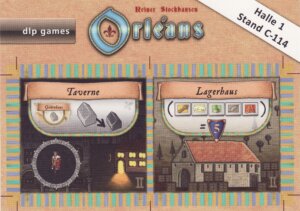
Orléans: Tavern & Depot
2014
Two promotional place tiles for expanding the Orléans base game.
Medium Heavy
View expansion
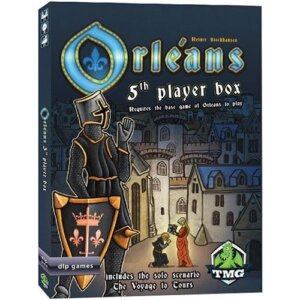
Orléans: 5th Player Box
2017
Expand Orléans to five players with new components and bonus content.
Medium

View expansion
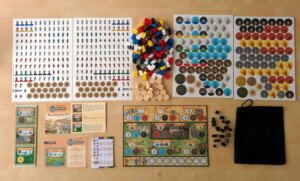
Orléans: Fan-Kit
2014
An all-inclusive upgrade kit with new components and support for a fifth player.
Medium Heavy
View expansion
