
Tiny Towns
2019
Build a prosperous forest town on a 4×4 grid, using scarce resources wisely before wasted spaces cost you victory points.
60
minutes
1 - 6
player(s)
14+
Medium

About this board game
Tiny Towns is a town-building board game for 1–6 players, playable in about 60 minutes. As the mayor of a tiny forest town, you will help build a hidden civilization for the smaller creatures of the woods.
Your town is represented by a 4×4 grid, and space is limited. Resources are scarce, so every material matters as you plan where to place resource cubes and which building layouts to complete.
Construct buildings by arranging resources in their required patterns. Each building scores victory points in its own unique way, making careful planning essential as you develop your small settlement.
- Place resource cubes in specific layouts.
- Construct buildings that score in different ways.
- Manage limited space in your 4×4 town grid.
- Avoid unfinished spaces, which are worth -1 VP each at the end.
In Tiny Towns, you must take the building materials available to you and use them as effectively as possible. A promising plan can quickly become difficult when your grid fills with resources that do not contribute to a useful building.
The game ends when no player can place any more resources or construct any more buildings. After scoring the buildings in each town, empty squares count against their owner, and the player with the most victory points wins.
With its compact grid and distinct building scoring, Tiny Towns challenges you to turn scarce materials into the most prosperous settlement possible.
Mechanics
Designer
Illustrators
/pic7182955.jpg)

Board Game Rules for
Tiny Towns
You are the mayor of a tiny town in the forest, where the smaller creatures of the woods have created a civilization hidden away from predators. This new land is small and the resources are scarce—you take what you can get and never say no to building materials. Cleverly plan and construct a thriving town, and don’t let it fill up with wasted resources!
Whoever builds the most prosperous tiny town wins!
Objective
Your town is represented by a 4×4 grid, on which you will place Resource cubes in specific layouts to construct buildings. Each building scores Victory Points ( ) in a unique way. When no player can place any more resources or construct any buildings, the game ends, and any squares without a building are worth -1 .
The player with the most wins!
Contents
- 1 rulebook
- 6 player boards
- 25 Building cards
- 15 Monument cards
- 15 Resource cards
- 1 scorepad
- 126 wooden buildings
- 1 wooden Master Builder hammer
- 6 wooden monuments
- 90 wooden Resource cubes
A game by Peter McPherson, for 1–6 players, ages 14 and up.
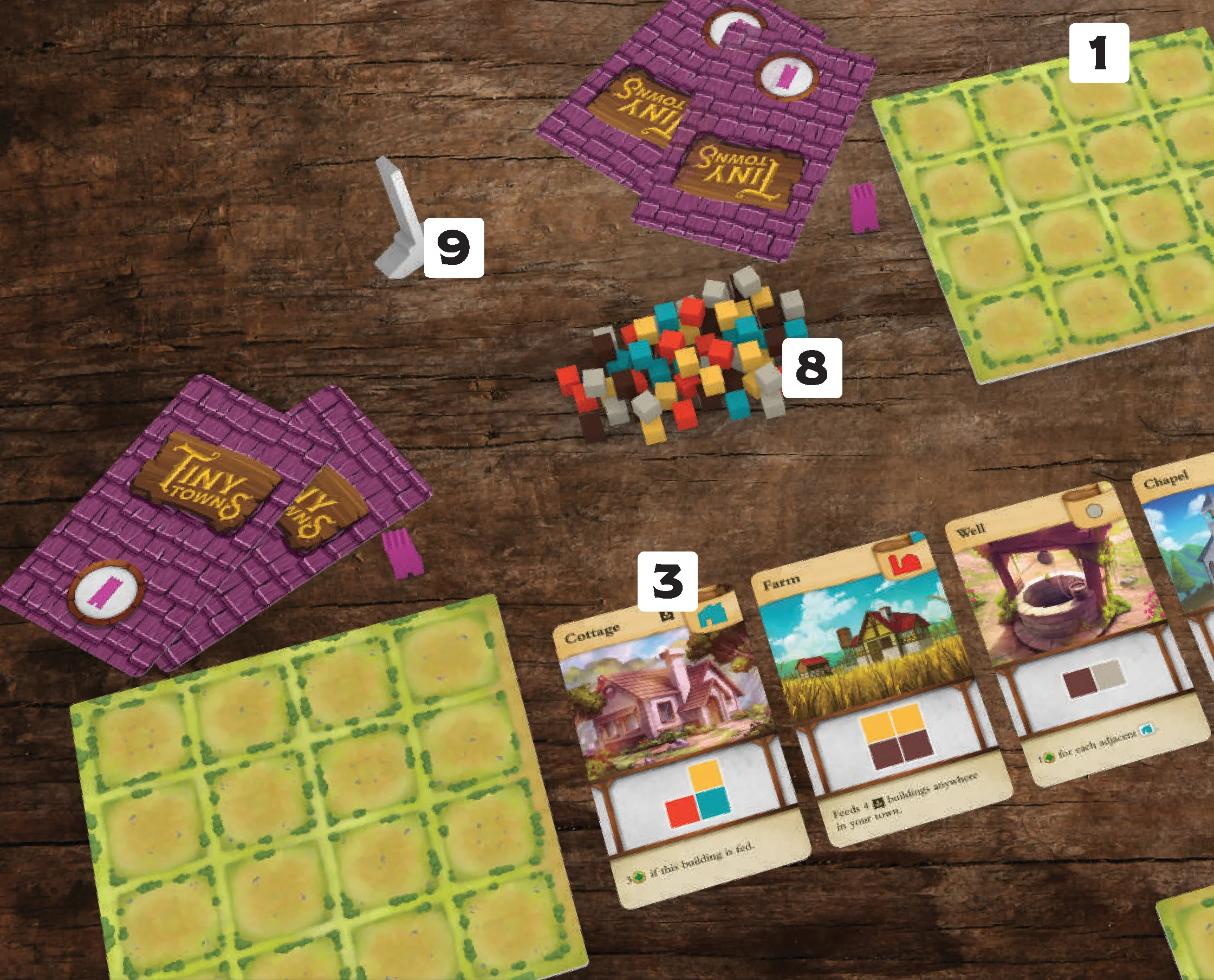
- Give each player a player board.
- Leave the Resource cards in the box (unless you are playing the Town Hall rules or Solo variant).
- Place the Cottage card (with the
 symbol on the back) face-up in the center of the table.
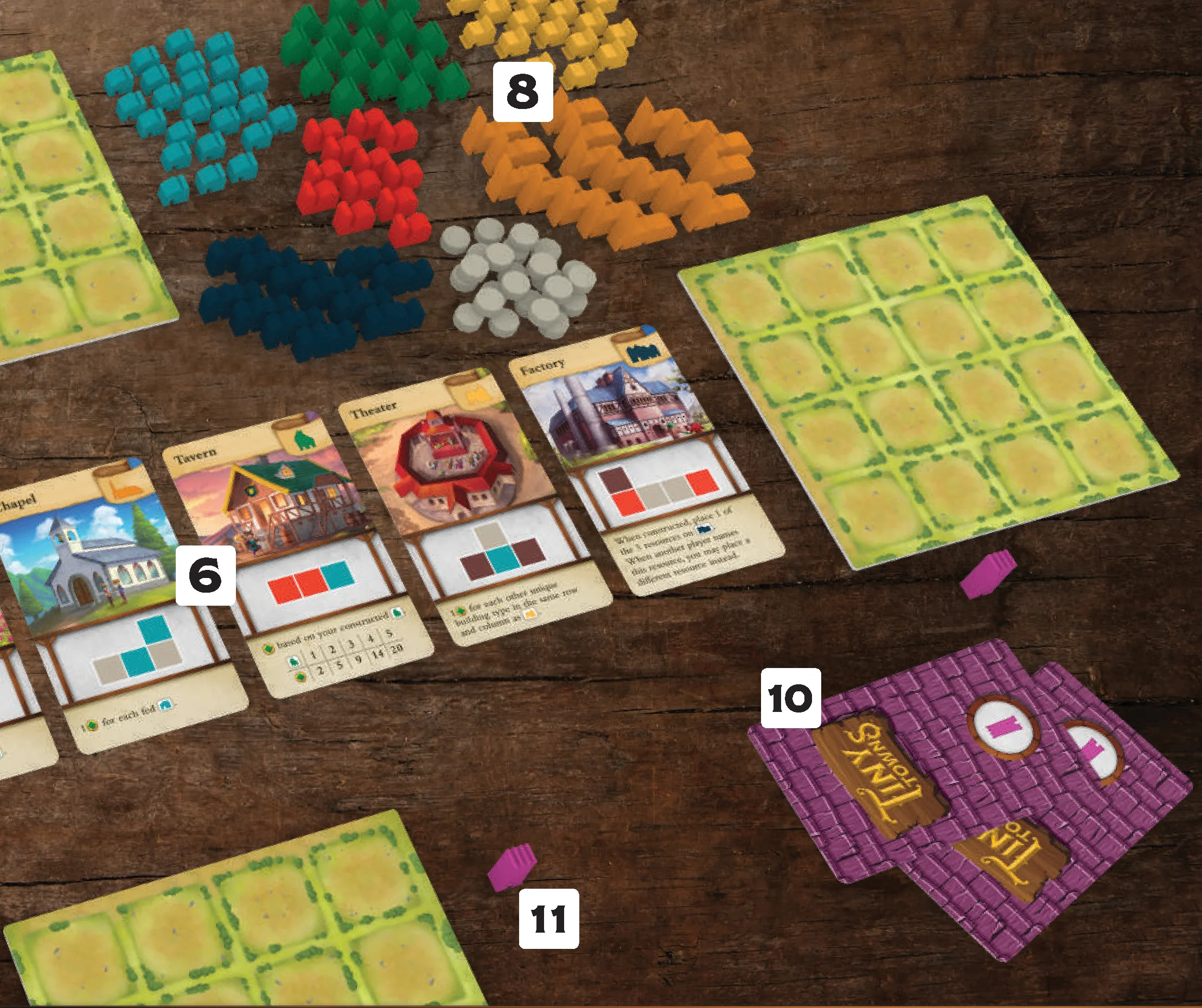
 - Sort the remaining Building cards into separate piles by the symbols on the back.
- Shuffle each pile of 4 cards.
- Draw 1 card from each pile and place them face-up next to the Cottage card, so they are visible to all players.
- Place the remaining Building cards back into the box – they will not be used for this game. For your first game, it is recommended to use the set of Building cards shown on the right.
- Place the wooden Resource cubes and buildings (but NOT monuments) in a general supply where all players can reach them.
There are 5 different resources: WOOD (brown), WHEAT (yellow), BRICK (red), GLASS (teal), and STONE (gray).
- The starting player is the player who most recently constructed something (in real life). Give that player the Master Builder hammer.
- Shuffle the Monument cards and deal each player 2 Monument cards face-down, which they should look at but keep secret. Players should select 1 Monument card to keep and discard the other to the box, face-down.
- Give each player 1 wooden monument (
 ), which they should keep next to their Monument card. Return any remaining monuments to the box—they will not be available to players in this game. For your first game, you may want to play without monuments.
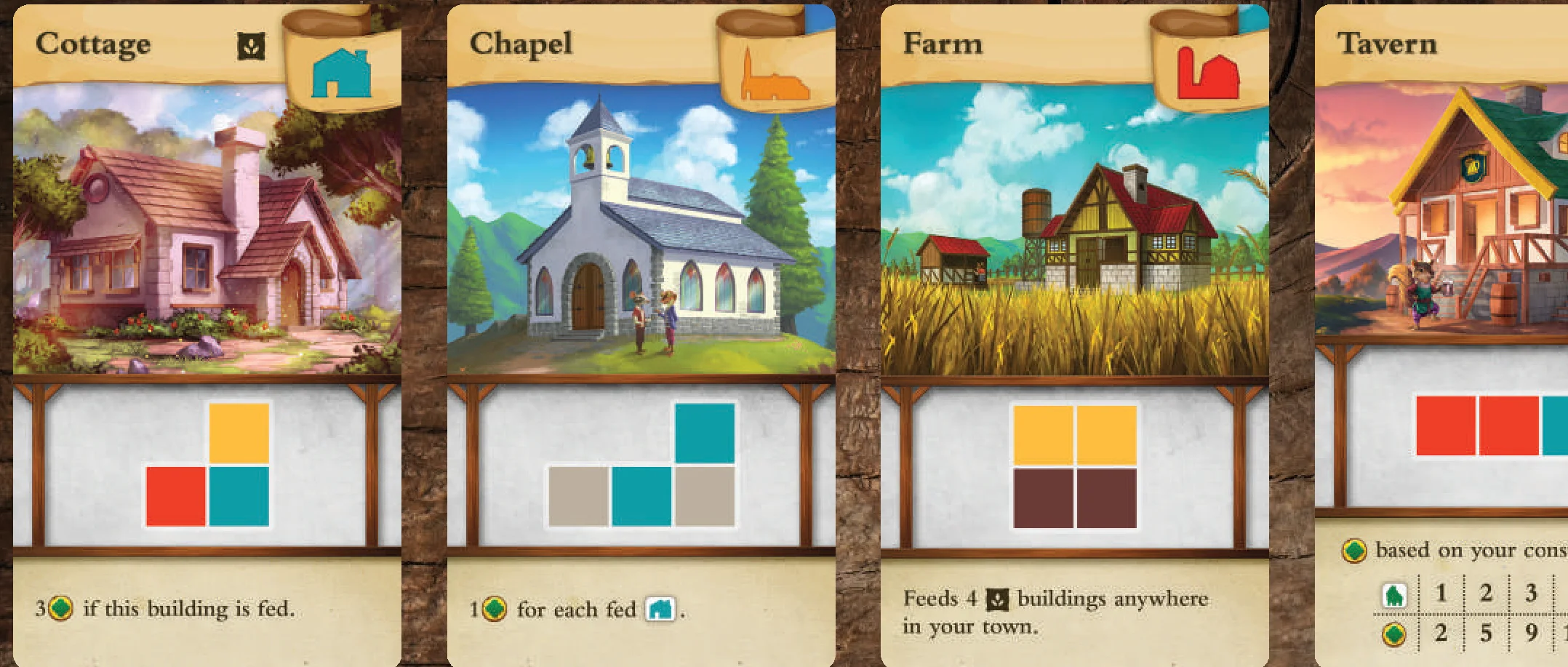
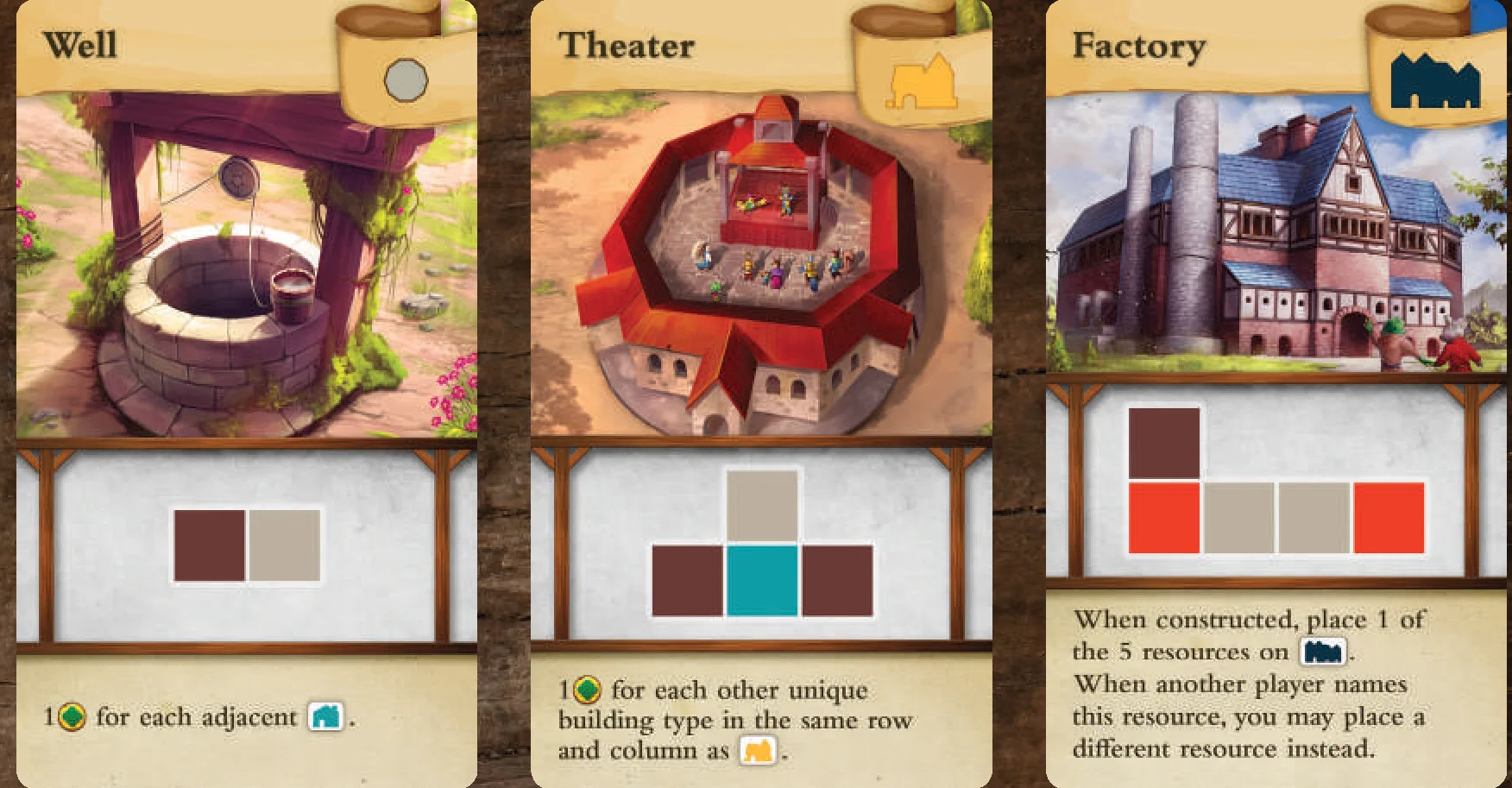
Building Card Anatomy
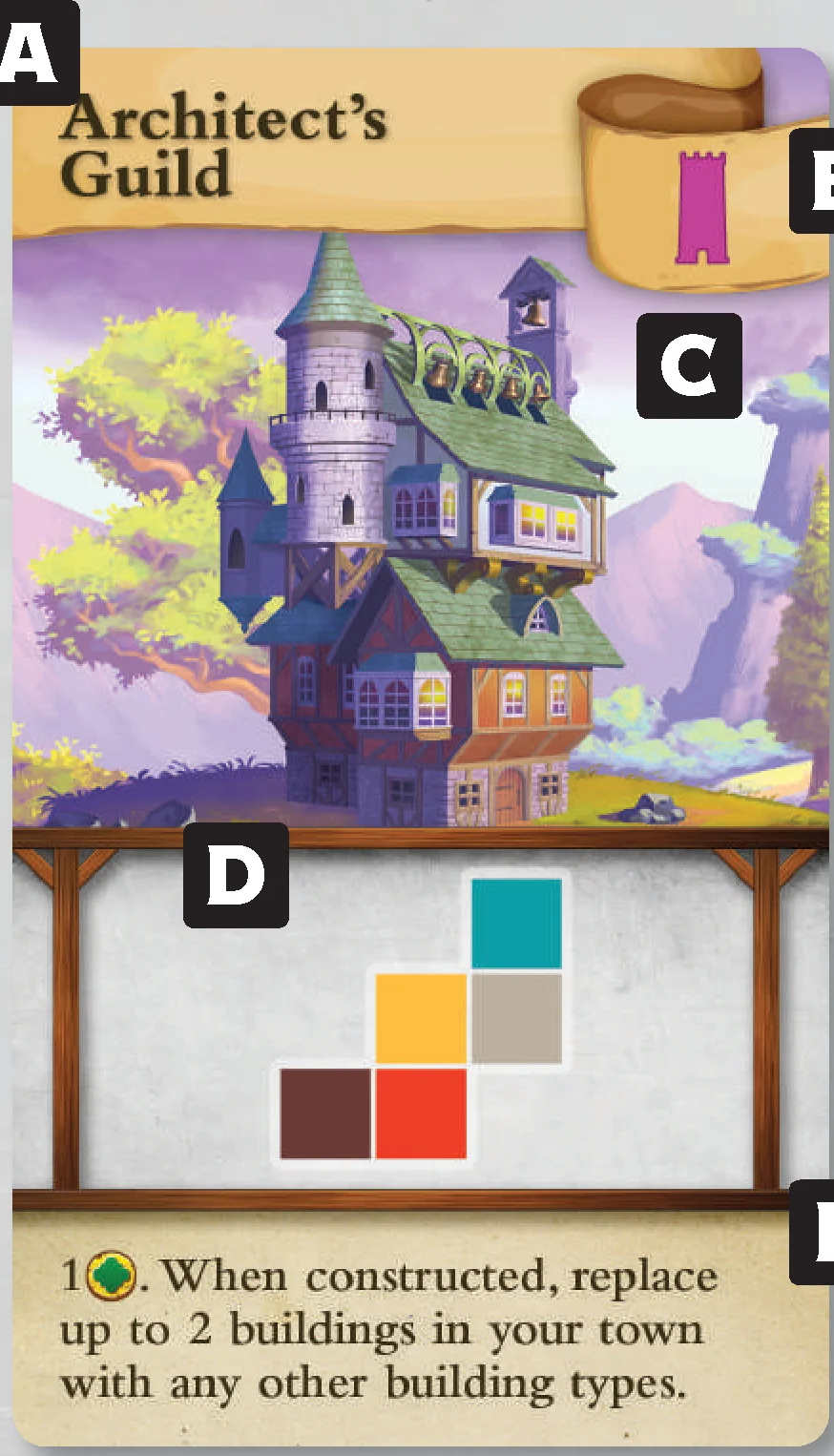
- A. Card Title
- B. Building Type
- C. Art
- D. Resource Build Pattern
- E. Building Ability / Scoring
- The Master Builder names a type of resource: Wood, Wheat, Brick, Glass, or Stone.
- All players MUST take a cube of this resource and place it in an empty square in their town grid. Players do this simultaneously.
Resource Placement
- Resources may never be moved to a different square after being placed.
- Resources can only be removed by constructing a building.
- Only 1 resource or building may occupy a square.
- When resources are removed from a board, they go back to the general supply.
- Players may construct any buildings for which they have the matching resources in the correct shape. Players do this simultaneously and should announce what building they are constructing.
- Once all players have placed their resources and constructed buildings, a new round begins. The Master Builder token passes to the player on the left.
The new Master Builder should always wait until all players are ready before naming the next resource. Players can show that they are still thinking by holding up their resource cube until they place it. After a resource has been placed, players have until the next resource is named to construct any buildings.
The Cavern Rule
Building a Tiny Town is difficult. If this is one of your first games, or if you want a little more flexibility in your town, we recommend that you play with the Cavern rule. Throughout the game, players have the option of placing up to 2 resources named by other players off to the side of their board. These resources score no points or penalties at the end of the game. Players must decide when it is most advantageous to use this special ability!
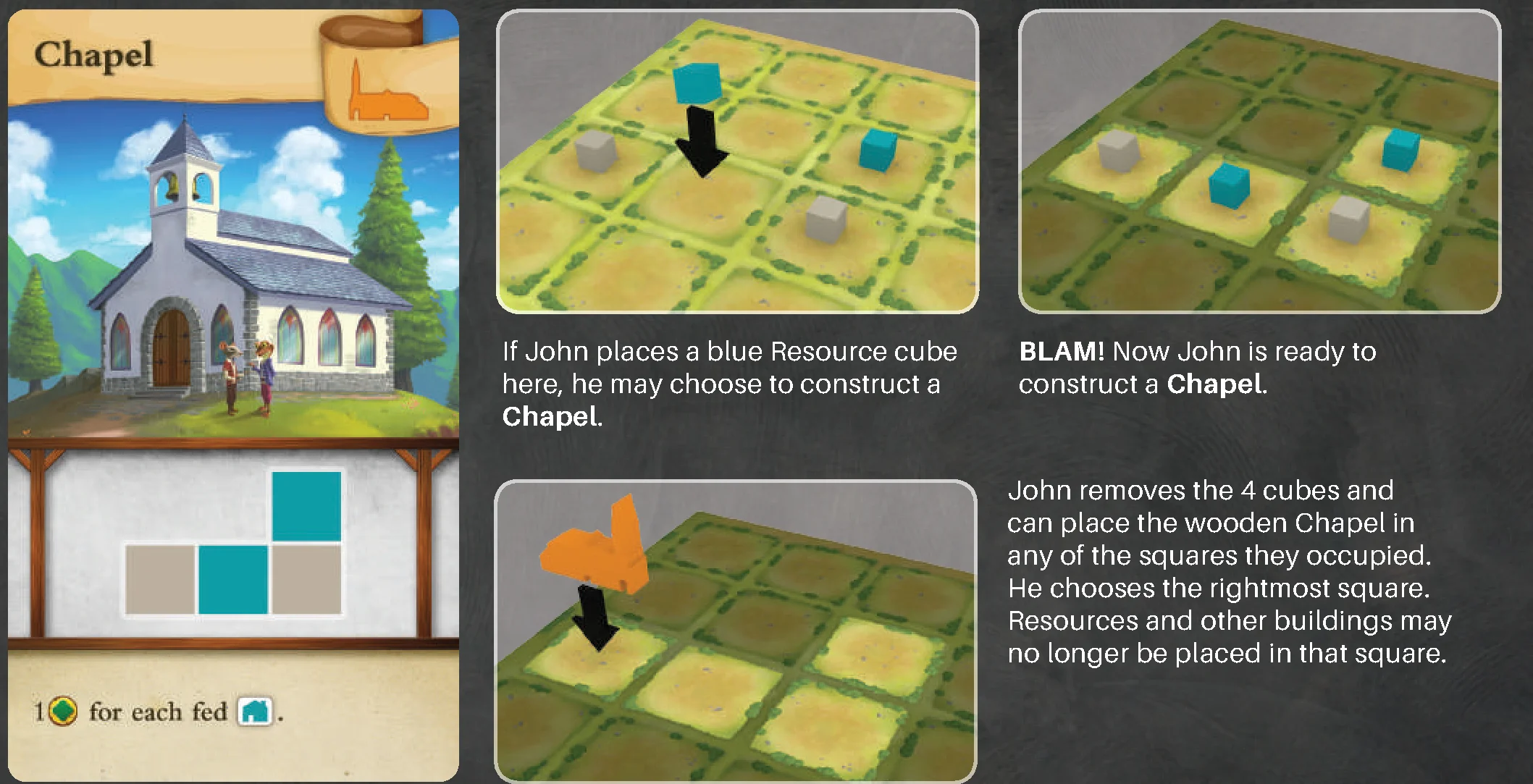
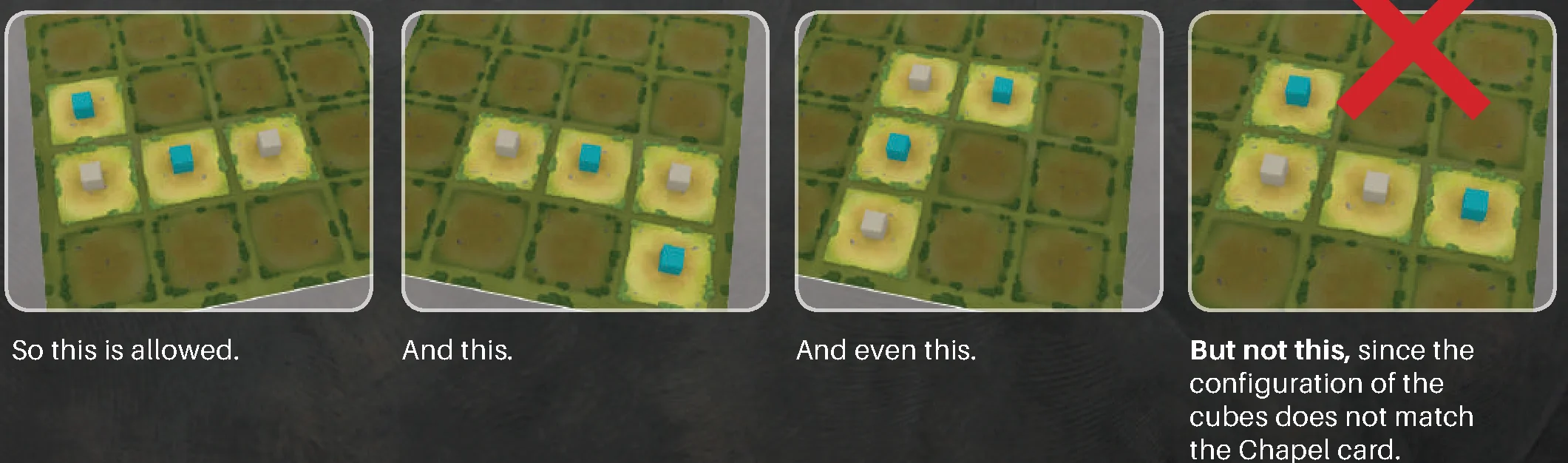
Building layouts may be mirrored/flipped and rotated, as long as the configuration of resources remains the same.
To construct a building:
- Remove the correct resources in the correct shape from your board and place them back in the general supply.
- Take the matching wooden building from the general supply.
- Place it in 1 of the squares that was occupied by the resources removed.
Construction Restrictions
- A resource can only be used to construct 1 building—in other words, every building requires all of its resources.
- Buildings do not have to be constructed as soon as its resources are in place. Players may wait as many rounds as they want to construct a building.
- Players may construct multiple buildings at once.
- Buildings may never be moved to a different square after being placed.
- Any player can construct any of the buildings (except other players’ monuments). Building cards are not replaced when players construct buildings.
- Players cannot construct a building immediately after a resource has been named without physically placing the resource cube in their town first.
Feeding Your Cottages
Remember! Cottages ( ) must be fed by
  buildings to be worth 3 . Players may construct Cottages before or after constructing buildings, but unfed Cottages at game end score 0 .
Monuments
A monument is a special type of building that can only be constructed by the player holding that card. Players may only construct their monuments once. Monuments may be constructed in any round, just like a normal building (see Building Construction Rules).
Upon constructing a monument, the player should read the Monument card aloud, place it face-up in front of them, and resolve any immediate effects. If the card grants an ability, that ability takes effect immediately and only applies to the card’s holder. Scoring for Monument cards is resolved at game end. Monuments are not a part of the general supply.
Completing Your Town
When your town is filled with resources and you cannot (or choose not to) construct any buildings, your town is completed. You are out of the game and can start calculating your score. (You no longer take turns naming resources as the Master Builder.)
Note: A player may continue to place resources and name resources as the Master Builder as long as they have space for the resources in their town, even if it will not be possible for them to construct any buildings.
If only 1 player is left, that player can continue to name resources as the sole Master Builder until their town is completed.
Game End
When all players’ towns are completed, the game ends immediately. Remove all remaining resource cubes (except from Warehouses). Each empty square is worth -1 . Players add their for each building in their town and subtract any penalties to calculate their final score. The player with the most wins!
Tiebreakers
In the case of a tie, resolve in this order:
- The tied player who had the fewest turns as Master Builder wins.
- If there is still a tie, the player with the fewest empty squares wins.
- If there is still a tie, the player with the most Cottages wins.
- If there is still a tie, the tied players share the victory.
Additional Rules
- Resource cubes and buildings are unlimited. If you run out, substitute some other marker.
- Unfed Cottages at game end remain on the board but score no . Some other buildings (such as Wells) still score points from unfed Cottages.
- “Adjacent” means up, down, left, and right.
- It is possible to have a negative score.
- never score on their own.
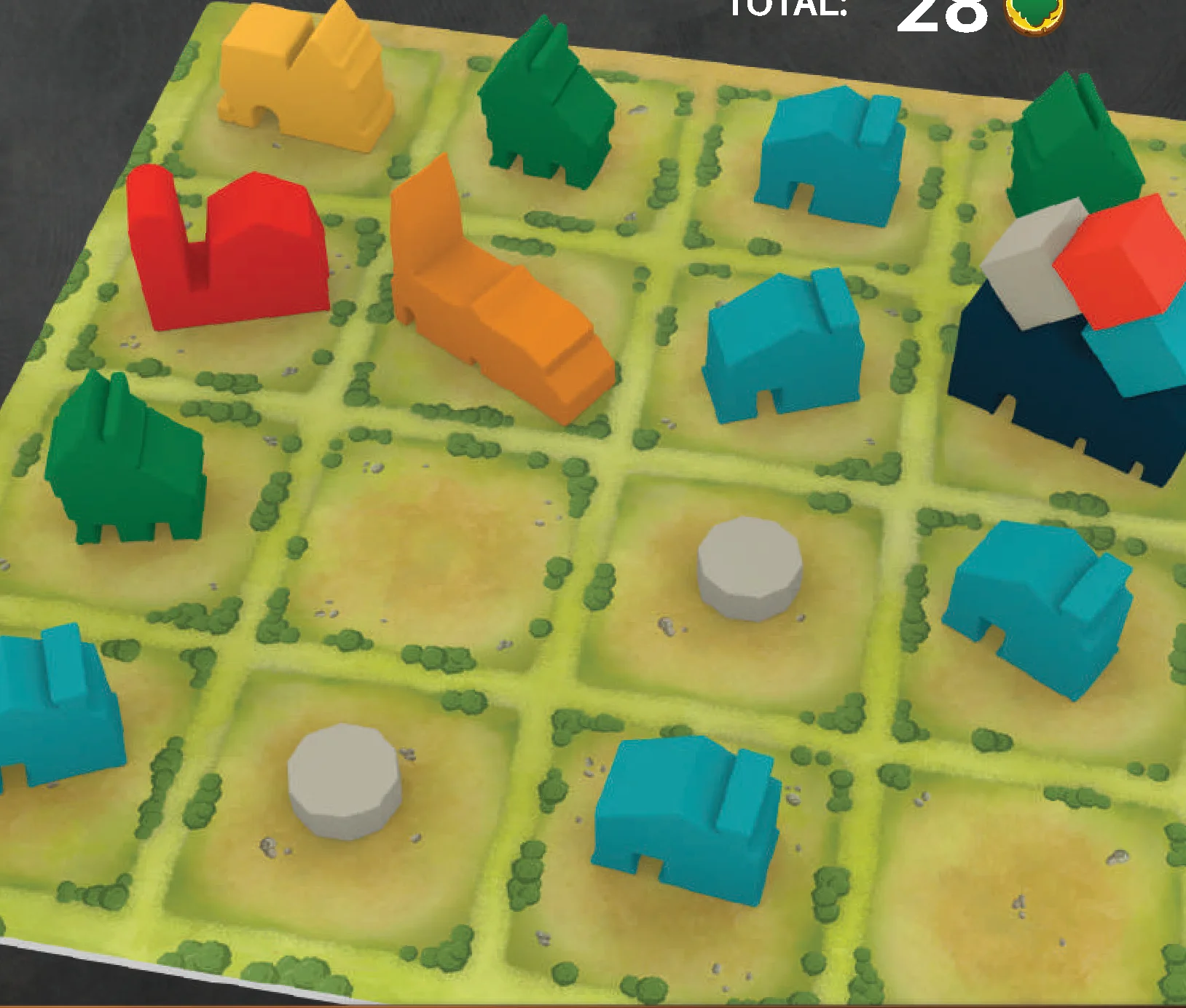
Scoring Example
Playing without monuments, this board would score:
- 2 Wells: 1 for each adjacent cottage (fed and unfed) = 5
- 4 Fed Cottages: 3 for each fed cottage. 1 Farm only feeds 4 Cottages, so only 4 of the 5 constructed Cottages score = 12
- Chapel: 1 for each of the 4 fed Cottages and 0 for the 1 unfed Cottage = 4
- 3 Taverns: 9 for having constructed 3 Taverns = 9
- Bakery: 3 for being adjacent to a Farm = 3
- Warehouse: -1 for each resource it holds = -3
- 2 Empty Squares: -1 each = -2
- TOTAL: 28
Town Hall Rules
Town Hall is a different way to play Tiny Towns that introduces the Resource deck and changes the way resources are selected during the game.
Assign 1 player to be the Mayor, who will draw Resource cards to determine which resource all players will place.
Gameplay
Shuffle the 15 Resource cards to form a draw pile, and discard the top 5 cards face-down to a discard pile.
- The Mayor starts the game by drawing the top Resource card from the draw pile and placing it face-up on the table. Players must place the resource shown on the card in their town.
- After all players have placed their resources, the Mayor places the Resource card on the discard pile and draws a new Resource card for the second round, placing it face-up on the table. All players once again place the indicated resource in their town, and the Mayor places the Resource card on the discard pile.
- In the third round, players individually choose 1 of the 5 resources from the supply to place in their town. (Players do this simultaneously.)
In subsequent rounds repeat this pattern, with the Mayor drawing 1 Resource card each for every first and second round, and players choosing a resource individually for every third round. When a Resource card needs to be drawn and the draw pile is empty, the Mayor shuffles the cards in the discard pile to form a new draw pile and again discards the top 5 cards face-down. Play continues until the end conditions of the standard game are met.
Note: In this mode, Building and Monument cards that refer to other players naming resources (Factory, Warehouse, Statue of the Bondmaker) apply to rounds in which the Mayor draws a Resource card. The ongoing effect of Bank applies to every third round, in which players have their choice of resource (that is, players can no longer choose from the supply in those rounds the resources placed on any of their Banks).
If a player builds the monument Fort Ironweed, that player may no longer take and place resources every third round, in which players have their choice of resource, unless that player is the only player remaining.
Solo Variant
There is no Master Builder in the Solo variant.
Setup
Remove the following cards from the game when playing the solo variant:
- The Inn (
 )
) - The Bank (
 )
) - Fort Ironweed (
 )
) - Opaleye’s Watch (
 )
)
Solo Rules
Shuffle the 15 Resource cards to form a draw pile and reveal the top 3 cards. You choose to place any 1 of the 3 resources shown in your town and construct buildings as normal. Then place the corresponding card face-down on the bottom of the draw pile and draw a new Resource card to replace it.
Note: In this variant, Building and Monument cards that refer to other players naming resources (Factory, Warehouse, Statue of the Bondmaker) apply to choosing resources from the resource deck.
The game ends as normal, when your town is completed (your town is filled with resources and you cannot or choose not to construct any buildings).
Skill Level Achieved
| Victory Points () |
Skill Level Achieved |
|---|---|
| 38 or more | Master Architect |
| 32–37 | Town Planner |
| 25–31 | Engineer |
| 18–24 | Carpenter |
| 10–17 | Builder’s Apprentice |
| 9 or less | Aspiring Architect |
Building Clarifications
- Cottage: Unfed Cottages remain on the board but do not score points on their own. Some other buildings, such as Wells, treat fed and unfed Cottages the same. You may construct Cottages even if you don’t yet have a .
- Farm: Farms feed 4 anywhere on the board.
- Granary: Granaries only feed in the 8 immediate surrounding squares (up, down, left, right, and diagonal), for a maximum of 8 .
- Greenhouse: Greenhouses feed 1 contiguous group of that are adjacent (up, down, left, and right) to each other. This group does not have to be adjacent to a Greenhouse.
- Orchard: Orchards will always feed a maximum of 6 , no matter where they are placed.
- Fountain: Fountains cannot score more than 2 . Adjacent refers to up, down, left, and right, not diagonal.
- Millstone: Millstones cannot score more than 2 , even if they are adjacent to multiple or
 .
. - Shed: Sheds are not restricted to being placed in the 2 squares their resources came from when constructed, but may be placed in any empty square on the board.
- Well: Adjacent refers to up, down, left, and right, not diagonal. Adjacent fed and unfed score 1 .
- Abbey: Abbeys like to be isolated. If an Abbey is adjacent (up, down, left, and right) to any of
 ,
,  ,
,  , it is worth 0 .
 - Chapel: Score Chapels individually. A town with 3 fed and 1 unfed will make each Chapel worth 3 . (Chapels do not earn for unfed .)
- Cloister: Cloisters not placed in a corner will still score 1 for each other Cloister placed in a corner. The maximum a Cloister can score is 4 .
- Temple: Temples are worth 0 if they are not adjacent to at least 2 fed .
- Almshouse: The maximum Almshouse score is 26 . If you construct more than 6 Almshouses, the total Almshouse score is still 26 .
- Feast Hall: If you tie with the player to your right, your Feast Halls are only worth 2 . In a 2-player game, Feast Halls are worth 3 to the player with the most and 2 to the player with the least, or 2 if tied.
- Inn: Inns in the same row or column are worth 0 .
- Tavern: Taverns score points as a group. For example, 4 Taverns are worth 14 total (but can be anywhere on the board). Any Taverns constructed after the 5th Tavern do not increase your Tavern score.
- Bakery: Adjacent refers to up, down, left, and right, not diagonal.
- Market: Markets score for either a row or column, but not both. Markets always score 1 for themselves in addition to any other Markets in the same row or column, for a maximum score of 4 .
- Tailor: Tailors not constructed in the 4 center squares are still worth 1 plus 1 for each other Tailor in the 4 center squares. The maximum a Tailor can score in total is 5 .
- Theater: A Theater’s score is the total number of unique building types besides Theater that share a row or column with that Theater, for a maximum score of 6 . If there are buildings of the same type in both the same row and column as Theater, that building type only counts once toward Theater’s score. Monument counts as a unique building type (unless it is Barrett Castle, which counts as 2 ).
- Bank: You cannot construct more than 5 Banks, since there would be no resource for them to hold.
- Factory: You may choose for multiple Factories to hold the same resource, but it offers you no advantage.
- Trading Post: Trading Posts can be used in the layout of any future buildings. When you construct a building that used a Trading Post as a resource, you do not remove the Trading Post from its square. You can use multiple Trading Posts to construct a single building, but at least 1 non-Trading Post resource must be used.
- Warehouse: You can store up to 3 resources with a Warehouse by physically placing the cubes on the building. When another player names a resource that you do not want, place the resource on your Warehouse. You may remove a resource from your Warehouse and place it in an empty square on your board when you do this. You can never remove a resource without placing a new resource on the Warehouse. As a result, the number of resources on a Warehouse will never decrease.
Monument Clarifications
- Architect’s Guild: You may choose not to use the ability of the Architect’s Guild, but you cannot use it later. The buildings you place may be the same type or 2 different types. You cannot change buildings into monuments, since they are not in the general supply.
- Archive of the Second Age: It does not matter where buildings are located for scoring this monument.
- Barrett Castle: For all building scoring, Barrett Castle counts as 2 and not a monument token ().
- Cathedral of Caterina: This applies only to empty squares on your own board.
- Fort Ironweed: Once this monument is constructed, you may not be Master Builder and must pass the token to the player on your left, unless you are the last player in the game.
- Grove University: You cannot place a monument after constructing Grove University since monuments are not in the general supply.
- Mandras Palace: Adjacent refers to up, down, left, and right, not diagonal.
- Opaleye’s Watch: You may not choose monument as a building type for this card, since it is not in the general supply.
- Shrine of the Elder Tree: If this is the 7th or later building you construct, it still only scores 8 .
- Silva Forum: A contiguous group refers to buildings that are adjacent to one another.
- The Starloom: You score the full points for 1st, 2nd, or 3rd if you complete your town in the same round as (tie with) another player.
- Statue of the Bondmaker: Resources on squares containing cannot be used to construct buildings.
- Design: Peter McPherson
- Development Lead: Josh Wood
- Project Lead: Nicolas Bongiu
- Production: David Lepore
- Art: Gong Studios
- Graphic Design: Matt Paquette
- Writing: Andre Chautard
©2019 Alderac Entertainment Group.
Tiny Towns and all associated marks are ™ and © Alderac Entertainment, Inc.
555 N El Camino Real #A393, San Clemente, CA 92672, USA.
All rights reserved. Printed in China.
Special Thanks
Peter McPherson is a freelance writer and game designer from upstate New York. Tiny Towns is his first game.
Thank you to Indiana Nash for her endless encouragement and for being the first playtester. I would also like to thank my family: Dad, Mom, and Griff.
Thank you to Alan Barrett for his work on the first prototype.
Thank you to John Zinser for believing in this tiny game, and to Josh Wood for all of his input, ideas, and general design wisdom.
Tiny Towns is dedicated to the memory of Bill Dawes.
Playtesters: Courtney Maki, Josh Beauregard, Mark J. Minick, Jenna Townsend, Lucas Roby, Jesse Bisceglia, Adam Schuurmans, Nick Wilsey, Faith Hardin, Nick Painter, Jenny Ritz, Ben Ritz, Andrew Couperus, Danielle Schissler, Josh McCabe, Kevin Root, Jeff Warrender, Kevin Gibson, Quentin Hudspeth, Dean Howard, P.D. Magnus, Brian Neugebauer, Sam LaFleche, Kevin Piala, Jed Moody, Martin Glazer, Emily Garrick, Jon “Ouch!” Luke, and all of the others who played this game.
Introduction & Components
You are the mayor of a tiny town in the forest, where the smaller creatures of the woods have created a civilization hidden away from predators. This new land is small and the resources are scarce—you take what you can get and never say no to building materials. Cleverly plan and construct a thriving town, and don’t let it fill up with wasted resources!
Whoever builds the most prosperous tiny town wins!
Objective
Your town is represented by a 4×4 grid, on which you will place Resource cubes in specific layouts to construct buildings. Each building scores Victory Points () in a unique way. When no player can place any more resources or construct any buildings, the game ends, and any squares without a building are worth -1 .
The player with the most wins!
Contents
- 1 rulebook
- 6 player boards
- 25 Building cards
- 15 Monument cards
- 15 Resource cards
- 1 scorepad
- 126 wooden buildings
- 1 wooden Master Builder hammer
- 6 wooden monuments
- 90 wooden Resource cubes
A game by Peter McPherson, for 1–6 players, ages 14 and up.
Setup
- Give each player a player board.
- Leave the Resource cards in the box (unless you are playing the Town Hall rules or Solo variant).
- Place the Cottage card (with the symbol on the back) face-up in the center of the table.
- Sort the remaining Building cards into separate piles by the symbols on the back.
- Shuffle each pile of 4 cards.
- Draw 1 card from each pile and place them face-up next to the Cottage card, so they are visible to all players.
- Place the remaining Building cards back into the box – they will not be used for this game. For your first game, it is recommended to use the set of Building cards shown on the right.
- Place the wooden Resource cubes and buildings (but NOT monuments) in a general supply where all players can reach them.
There are 5 different resources: WOOD (brown), WHEAT (yellow), BRICK (red), GLASS (teal), and STONE (gray).
- The starting player is the player who most recently constructed something (in real life). Give that player the Master Builder hammer.
- Shuffle the Monument cards and deal each player 2 Monument cards face-down, which they should look at but keep secret. Players should select 1 Monument card to keep and discard the other to the box, face-down.
- Give each player 1 wooden monument (), which they should keep next to their Monument card. Return any remaining monuments to the box—they will not be available to players in this game. For your first game, you may want to play without monuments.
Building Card Anatomy
- A. Card Title
- B. Building Type
- C. Art
- D. Resource Build Pattern
- E. Building Ability / Scoring
How to Play
- The Master Builder names a type of resource: Wood, Wheat, Brick, Glass, or Stone.
- All players MUST take a cube of this resource and place it in an empty square in their town grid. Players do this simultaneously.
Resource Placement
- Resources may never be moved to a different square after being placed.
- Resources can only be removed by constructing a building.
- Only 1 resource or building may occupy a square.
- When resources are removed from a board, they go back to the general supply.
- Players may construct any buildings for which they have the matching resources in the correct shape. Players do this simultaneously and should announce what building they are constructing.
- Once all players have placed their resources and constructed buildings, a new round begins. The Master Builder token passes to the player on the left.
The new Master Builder should always wait until all players are ready before naming the next resource. Players can show that they are still thinking by holding up their resource cube until they place it. After a resource has been placed, players have until the next resource is named to construct any buildings.
The Cavern Rule
Building a Tiny Town is difficult. If this is one of your first games, or if you want a little more flexibility in your town, we recommend that you play with the Cavern rule. Throughout the game, players have the option of placing up to 2 resources named by other players off to the side of their board. These resources score no points or penalties at the end of the game. Players must decide when it is most advantageous to use this special ability!
Building & Monument Construction
Building layouts may be mirrored/flipped and rotated, as long as the configuration of resources remains the same.
To construct a building:
- Remove the correct resources in the correct shape from your board and place them back in the general supply.
- Take the matching wooden building from the general supply.
- Place it in 1 of the squares that was occupied by the resources removed.
Construction Restrictions
- A resource can only be used to construct 1 building—in other words, every building requires all of its resources.
- Buildings do not have to be constructed as soon as its resources are in place. Players may wait as many rounds as they want to construct a building.
- Players may construct multiple buildings at once.
- Buildings may never be moved to a different square after being placed.
- Any player can construct any of the buildings (except other players’ monuments). Building cards are not replaced when players construct buildings.
- Players cannot construct a building immediately after a resource has been named without physically placing the resource cube in their town first.
Feeding Your Cottages
Remember! Cottages () must be fed by buildings to be worth 3 . Players may construct Cottages before or after constructing buildings, but unfed Cottages at game end score 0 .
Monuments
A monument is a special type of building that can only be constructed by the player holding that card. Players may only construct their monuments once. Monuments may be constructed in any round, just like a normal building (see Building Construction Rules).
Upon constructing a monument, the player should read the Monument card aloud, place it face-up in front of them, and resolve any immediate effects. If the card grants an ability, that ability takes effect immediately and only applies to the card’s holder. Scoring for Monument cards is resolved at game end. Monuments are not a part of the general supply.
End of Game & Scoring
Completing Your Town
When your town is filled with resources and you cannot (or choose not to) construct any buildings, your town is completed. You are out of the game and can start calculating your score. (You no longer take turns naming resources as the Master Builder.)
Note: A player may continue to place resources and name resources as the Master Builder as long as they have space for the resources in their town, even if it will not be possible for them to construct any buildings.
If only 1 player is left, that player can continue to name resources as the sole Master Builder until their town is completed.
Game End
When all players’ towns are completed, the game ends immediately. Remove all remaining resource cubes (except from Warehouses). Each empty square is worth -1 . Players add their for each building in their town and subtract any penalties to calculate their final score. The player with the most wins!
Tiebreakers
In the case of a tie, resolve in this order:
- The tied player who had the fewest turns as Master Builder wins.
- If there is still a tie, the player with the fewest empty squares wins.
- If there is still a tie, the player with the most Cottages wins.
- If there is still a tie, the tied players share the victory.
Additional Rules
- Resource cubes and buildings are unlimited. If you run out, substitute some other marker.
- Unfed Cottages at game end remain on the board but score no . Some other buildings (such as Wells) still score points from unfed Cottages.
- “Adjacent” means up, down, left, and right.
- It is possible to have a negative score.
- never score on their own.
Scoring Example
Playing without monuments, this board would score:
- 2 Wells: 1 for each adjacent cottage (fed and unfed) = 5
- 4 Fed Cottages: 3 for each fed cottage. 1 Farm only feeds 4 Cottages, so only 4 of the 5 constructed Cottages score = 12
- Chapel: 1 for each of the 4 fed Cottages and 0 for the 1 unfed Cottage = 4
- 3 Taverns: 9 for having constructed 3 Taverns = 9
- Bakery: 3 for being adjacent to a Farm = 3
- Warehouse: -1 for each resource it holds = -3
- 2 Empty Squares: -1 each = -2
- TOTAL: 28
Variants
Town Hall Rules
Town Hall is a different way to play Tiny Towns that introduces the Resource deck and changes the way resources are selected during the game.
Assign 1 player to be the Mayor, who will draw Resource cards to determine which resource all players will place.
Gameplay
Shuffle the 15 Resource cards to form a draw pile, and discard the top 5 cards face-down to a discard pile.
- The Mayor starts the game by drawing the top Resource card from the draw pile and placing it face-up on the table. Players must place the resource shown on the card in their town.
- After all players have placed their resources, the Mayor places the Resource card on the discard pile and draws a new Resource card for the second round, placing it face-up on the table. All players once again place the indicated resource in their town, and the Mayor places the Resource card on the discard pile.
- In the third round, players individually choose 1 of the 5 resources from the supply to place in their town. (Players do this simultaneously.)
In subsequent rounds repeat this pattern, with the Mayor drawing 1 Resource card each for every first and second round, and players choosing a resource individually for every third round. When a Resource card needs to be drawn and the draw pile is empty, the Mayor shuffles the cards in the discard pile to form a new draw pile and again discards the top 5 cards face-down. Play continues until the end conditions of the standard game are met.
Note: In this mode, Building and Monument cards that refer to other players naming resources (Factory, Warehouse, Statue of the Bondmaker) apply to rounds in which the Mayor draws a Resource card. The ongoing effect of Bank applies to every third round, in which players have their choice of resource (that is, players can no longer choose from the supply in those rounds the resources placed on any of their Banks).
If a player builds the monument Fort Ironweed, that player may no longer take and place resources every third round, in which players have their choice of resource, unless that player is the only player remaining.
Solo Variant
There is no Master Builder in the Solo variant.
Setup
Remove the following cards from the game when playing the solo variant:
- The Inn ()
- The Bank ()
- Fort Ironweed ()
- Opaleye’s Watch ()
Solo Rules
Shuffle the 15 Resource cards to form a draw pile and reveal the top 3 cards. You choose to place any 1 of the 3 resources shown in your town and construct buildings as normal. Then place the corresponding card face-down on the bottom of the draw pile and draw a new Resource card to replace it.
Note: In this variant, Building and Monument cards that refer to other players naming resources (Factory, Warehouse, Statue of the Bondmaker) apply to choosing resources from the resource deck.
The game ends as normal, when your town is completed (your town is filled with resources and you cannot or choose not to construct any buildings).
Skill Level Achieved
| Victory Points () |
Skill Level Achieved |
|---|---|
| 38 or more | Master Architect |
| 32–37 | Town Planner |
| 25–31 | Engineer |
| 18–24 | Carpenter |
| 10–17 | Builder’s Apprentice |
| 9 or less | Aspiring Architect |
Card Clarifications
Building Clarifications
- Cottage: Unfed Cottages remain on the board but do not score points on their own. Some other buildings, such as Wells, treat fed and unfed Cottages the same. You may construct Cottages even if you don’t yet have a .
- Farm: Farms feed 4 anywhere on the board.
- Granary: Granaries only feed in the 8 immediate surrounding squares (up, down, left, right, and diagonal), for a maximum of 8 .
- Greenhouse: Greenhouses feed 1 contiguous group of that are adjacent (up, down, left, and right) to each other. This group does not have to be adjacent to a Greenhouse.
- Orchard: Orchards will always feed a maximum of 6 , no matter where they are placed.
- Fountain: Fountains cannot score more than 2 . Adjacent refers to up, down, left, and right, not diagonal.
- Millstone: Millstones cannot score more than 2 , even if they are adjacent to multiple or .
- Shed: Sheds are not restricted to being placed in the 2 squares their resources came from when constructed, but may be placed in any empty square on the board.
- Well: Adjacent refers to up, down, left, and right, not diagonal. Adjacent fed and unfed score 1 .
- Abbey: Abbeys like to be isolated. If an Abbey is adjacent (up, down, left, and right) to any of , , , it is worth 0 .
- Chapel: Score Chapels individually. A town with 3 fed and 1 unfed will make each Chapel worth 3 . (Chapels do not earn for unfed .)
- Cloister: Cloisters not placed in a corner will still score 1 for each other Cloister placed in a corner. The maximum a Cloister can score is 4 .
- Temple: Temples are worth 0 if they are not adjacent to at least 2 fed .
- Almshouse: The maximum Almshouse score is 26 . If you construct more than 6 Almshouses, the total Almshouse score is still 26 .
- Feast Hall: If you tie with the player to your right, your Feast Halls are only worth 2 . In a 2-player game, Feast Halls are worth 3 to the player with the most and 2 to the player with the least, or 2 if tied.
- Inn: Inns in the same row or column are worth 0 .
- Tavern: Taverns score points as a group. For example, 4 Taverns are worth 14 total (but can be anywhere on the board). Any Taverns constructed after the 5th Tavern do not increase your Tavern score.
- Bakery: Adjacent refers to up, down, left, and right, not diagonal.
- Market: Markets score for either a row or column, but not both. Markets always score 1 for themselves in addition to any other Markets in the same row or column, for a maximum score of 4 .
- Tailor: Tailors not constructed in the 4 center squares are still worth 1 plus 1 for each other Tailor in the 4 center squares. The maximum a Tailor can score in total is 5 .
- Theater: A Theater’s score is the total number of unique building types besides Theater that share a row or column with that Theater, for a maximum score of 6 . If there are buildings of the same type in both the same row and column as Theater, that building type only counts once toward Theater’s score. Monument counts as a unique building type (unless it is Barrett Castle, which counts as 2 ).
- Bank: You cannot construct more than 5 Banks, since there would be no resource for them to hold.
- Factory: You may choose for multiple Factories to hold the same resource, but it offers you no advantage.
- Trading Post: Trading Posts can be used in the layout of any future buildings. When you construct a building that used a Trading Post as a resource, you do not remove the Trading Post from its square. You can use multiple Trading Posts to construct a single building, but at least 1 non-Trading Post resource must be used.
- Warehouse: You can store up to 3 resources with a Warehouse by physically placing the cubes on the building. When another player names a resource that you do not want, place the resource on your Warehouse. You may remove a resource from your Warehouse and place it in an empty square on your board when you do this. You can never remove a resource without placing a new resource on the Warehouse. As a result, the number of resources on a Warehouse will never decrease.
Monument Clarifications
- Architect’s Guild: You may choose not to use the ability of the Architect’s Guild, but you cannot use it later. The buildings you place may be the same type or 2 different types. You cannot change buildings into monuments, since they are not in the general supply.
- Archive of the Second Age: It does not matter where buildings are located for scoring this monument.
- Barrett Castle: For all building scoring, Barrett Castle counts as 2 and not a monument token ().
- Cathedral of Caterina: This applies only to empty squares on your own board.
- Fort Ironweed: Once this monument is constructed, you may not be Master Builder and must pass the token to the player on your left, unless you are the last player in the game.
- Grove University: You cannot place a monument after constructing Grove University since monuments are not in the general supply.
- Mandras Palace: Adjacent refers to up, down, left, and right, not diagonal.
- Opaleye’s Watch: You may not choose monument as a building type for this card, since it is not in the general supply.
- Shrine of the Elder Tree: If this is the 7th or later building you construct, it still only scores 8 .
- Silva Forum: A contiguous group refers to buildings that are adjacent to one another.
- The Starloom: You score the full points for 1st, 2nd, or 3rd if you complete your town in the same round as (tie with) another player.
- Statue of the Bondmaker: Resources on squares containing cannot be used to construct buildings.
Credits
- Design: Peter McPherson
- Development Lead: Josh Wood
- Project Lead: Nicolas Bongiu
- Production: David Lepore
- Art: Gong Studios
- Graphic Design: Matt Paquette
- Writing: Andre Chautard
©2019 Alderac Entertainment Group.
Tiny Towns and all associated marks are ™ and © Alderac Entertainment, Inc.
555 N El Camino Real #A393, San Clemente, CA 92672, USA.
All rights reserved. Printed in China.
Special Thanks
Peter McPherson is a freelance writer and game designer from upstate New York. Tiny Towns is his first game.
Thank you to Indiana Nash for her endless encouragement and for being the first playtester. I would also like to thank my family: Dad, Mom, and Griff.
Thank you to Alan Barrett for his work on the first prototype.
Thank you to John Zinser for believing in this tiny game, and to Josh Wood for all of his input, ideas, and general design wisdom.
Tiny Towns is dedicated to the memory of Bill Dawes.
Playtesters: Courtney Maki, Josh Beauregard, Mark J. Minick, Jenna Townsend, Lucas Roby, Jesse Bisceglia, Adam Schuurmans, Nick Wilsey, Faith Hardin, Nick Painter, Jenny Ritz, Ben Ritz, Andrew Couperus, Danielle Schissler, Josh McCabe, Kevin Root, Jeff Warrender, Kevin Gibson, Quentin Hudspeth, Dean Howard, P.D. Magnus, Brian Neugebauer, Sam LaFleche, Kevin Piala, Jed Moody, Martin Glazer, Emily Garrick, Jon “Ouch!” Luke, and all of the others who played this game.
Expansions for
Tiny Towns
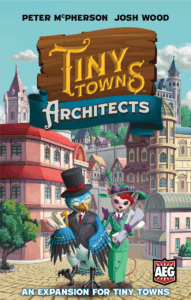
Tiny Towns: Architects
2024
Expand your city plans with wild resources, cozy cabins, and new monuments.
45
minutes
Medium
View expansion
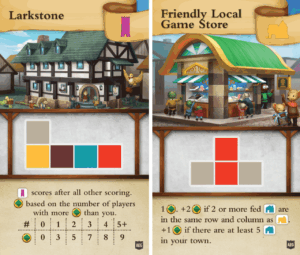
Tiny Towns: FLGS and Larkstone Promo Cards
2020
Two special promo cards adding fresh scoring possibilities to Tiny Towns.
60
minutes
Medium
View expansion
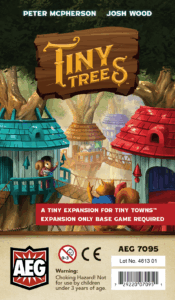
Tiny Towns: Tiny Trees
2020
Grow a tree, gain a resource, and make every empty space count.
45
minutes
Medium
View expansion

Tiny Towns: Villagers
2020
Welcome talented villagers and give your tiny civilization room to grow.
45
minutes
Medium
View expansion
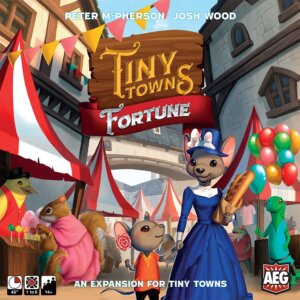
Tiny Towns: Fortune
2020
Build a thriving tiny town and turn scarce resources into valuable fortune.
60
minutes
Medium
View expansion
