
Race for the Galaxy
2007
Secretly choose phases, develop worlds and technologies, produce goods, and pursue victory points in a fast-moving galactic civilization race.
60
minutes
2 - 4
player(s)
12+
Medium

About this board game
Race for the Galaxy is a card game for 2–4 players that plays in about 60 minutes, inviting players to build galactic civilizations through worlds, technologies, and social developments.
Each card represents either a world to settle or a development to implement. Cards in your tableau show your civilization’s achievements, while cards in your hand represent the opportunities available to you. Playing a card requires discarding other cards equal to its cost, turning every decision into a choice about which possibilities to give up.
Play unfolds over a series of rounds. At the start of each round, players secretly and simultaneously select an action card. Only the phases selected that round take place, but every player may participate in each phase that occurs. Players who selected a phase receive a bonus, creating a constant balance between choosing the action you need and anticipating what others may select.
- Settle or develop: Add a world or development to your tableau.
- Produce: Add goods to worlds that produce them.
- Consume: Use goods to gain victory point chips.
- Explore or trade: Add cards to your hand through exploration or by trading a good.
Many worlds provide special powers and can produce goods for further cards or victory points. The game ends when a player builds a civilization of 12 cards or the pool of victory point chips is exhausted. The player with the most points from their tableau and collected chips wins.
Released in 2007, Race for the Galaxy’s 2018 second edition includes color-blindness improvements, five revised cards, and six New Worlds promotional homeworlds.
Thematics
Mechanics
Designer
Illustrators
/pic7182955.jpg)

Board Game Rules for
Race for the Galaxy
TOM LEHMANN
Explore, Settle, Develop, Trade, Consume, or Produce? Which do you need the most? Which of Earth’s former colonies will be most successful at settling the galaxy, now that JumpDrive exists? Who will discover the secrets of the mysteriously vanished Alien Overlords? Your goal: to build the most prosperous and powerful space empire!
Game Overview
In Race for the Galaxy, players build galactic civilizations by game cards that represent worlds or technical and social developments.
Each round consists of one or more of five possible phases. In each round, each player secretly and simultaneously chooses one of seven different action cards and then reveals it. Only the selected phases occur. For these phases, every player performs the phase’s action, while the selecting player(s) also get a bonus for that phase.
For example, if at least one player chooses the Develop action, then the Develop phase will occur; otherwise it is skipped. In it, each player may simultaneously select a development from his hand of cards to build. After revealing the cards, each player adds his development to his tableau of cards on the table and then discards cards from his hand equal to its cost. Each player who chose Develop discards one card fewer as his bonus.
Explore allows a player to draw cards and select which of them to add to his hand. Settle allows a player to place a world in his tableau. Some worlds produce goods, represented by face down cards, when Produce is selected. These goods can be discarded for victory points or sold to add cards to the player’s hand by selecting Consume. With cards, players can settle new worlds and build more developments, gaining both victory points and card powers that provide advantages in certain phases.
The player who best manages his cards, phase and bonus selections, and card powers to build the greatest space empire, wins.
The winner is the player with the most victory points.
- Players simultaneously choose which game phases will occur. Game phases that nobody chooses do not occur. Each player receives a bonus in the phase that they chose.
- Cards are used in three ways: as developments or worlds to be placed; as money; or as goods to be consumed or sold.
- Players explore for useful cards, build developments, settle worlds, and produce goods. Goods can be consumed for victory points or sold for cards.
- The player with the most victory points wins!
Components
Some cards in the three decks have been presorted for your very first game (see Setup). Unpack the card decks carefully.
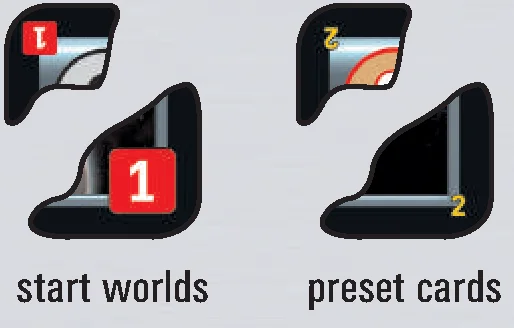
- 5 start world cards (numbered “0” to “4” in red or blue squares in their upper left and lower right corners)
- 109 game cards (like start worlds, these have the title on back):
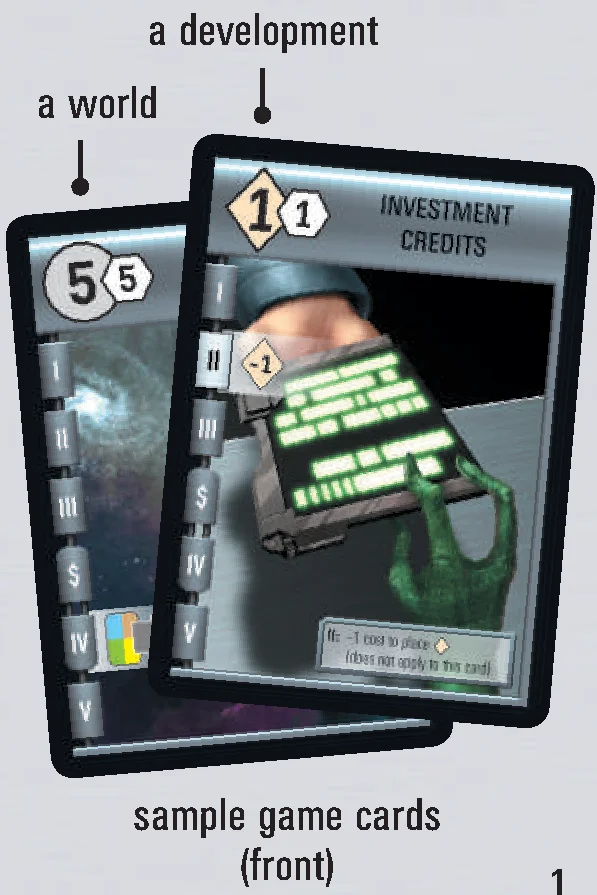
- 59 worlds (with
 symbols)
 - 50 developments (with
 symbols)
- 59 worlds (with
- 4 sets of 7 player action cards (used to select phases and bonuses each round; these have no title on their brightly colored backs)
- 8 duplicate action cards for experienced 2-player games (marked
 )
) - 4 summary sheets
- 28 Victory Point (VP) chips: 18 @ 1, 6 @ 5, and 4 @ 10
Carefully remove the VP chips from their frame before your first game.
Setup Steps
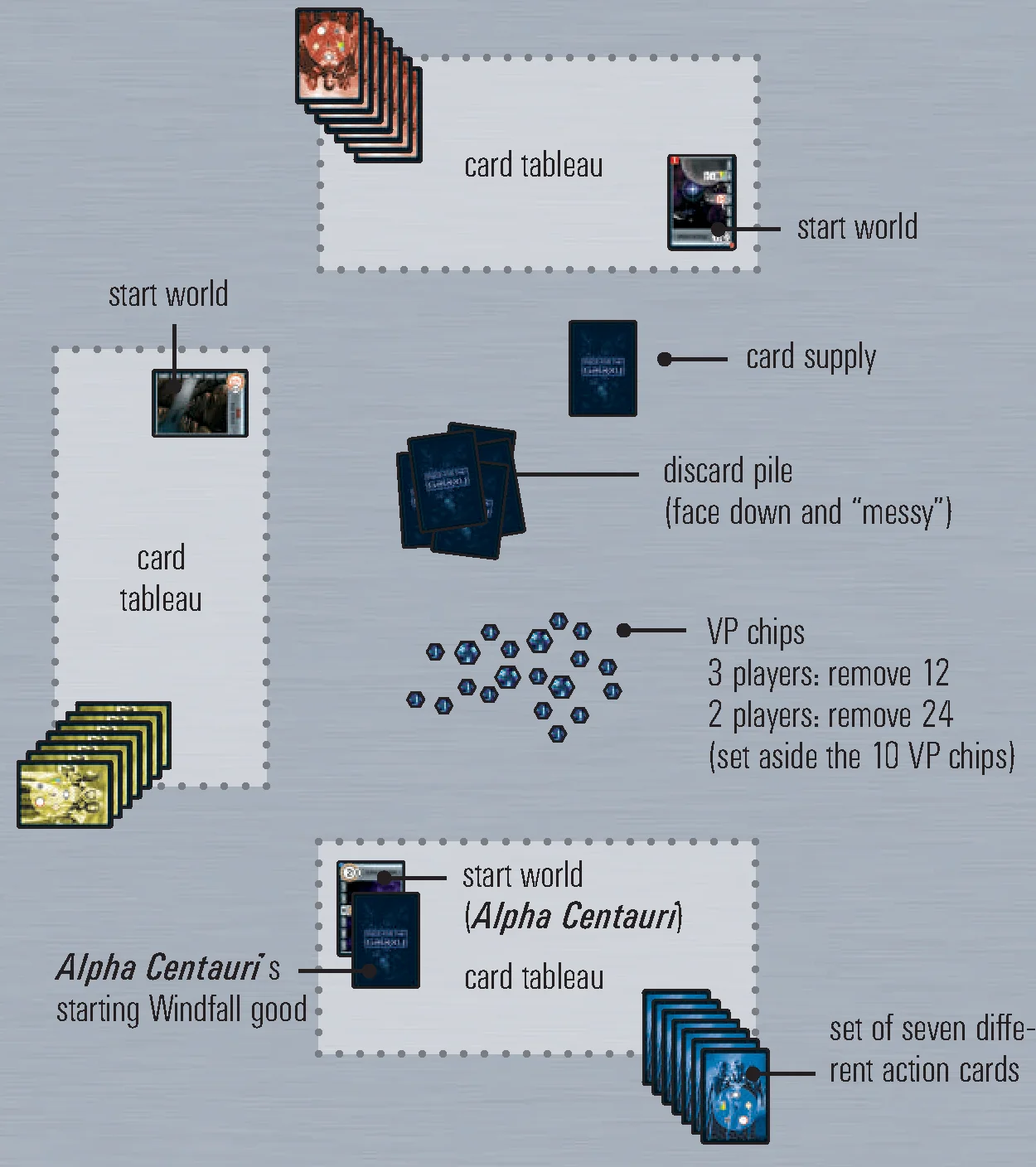
- Place 12 victory point (VP) chips per player in 1 and 5 VP chips nearby. Set aside the 10 VP chips (and any left over chips) for use only during the final round of play.
- 2 players: remove 24 (use 24 VPs)
- 3 players: remove 12 (use 36 VPs)
- 4 players: use 48 VPs
- Each player takes a set of seven different action cards.
- Find and shuffle the five start worlds. Deal one world face up to each player. These form each player’s initial card tableau.
- Your first game: instead, for two players, use start worlds 1 and 2; for three, use start worlds 1–3; and, for four, use start worlds 1–4.
- Shuffle the unused start worlds together with the game cards. Deal six face down cards to each player. Each player then examines these cards and discards two cards face down to the discard pile. The remaining game cards form the initial card supply.
- Your first game: instead, each player uses the four numbered game cards matching his start world’s number as his initial (preset) hand. After finding these preset hand cards, shuffle all the remaining game cards, including any left over start worlds and preset hand cards, together.
- The start worlds, preset hands, and action card sets for your very first game have already been presorted by the printer.
- If Alpha Centauri is in play, place a card from the card supply face down on top of it (as its starting windfall good).
Each player’s card tableau is in front of him. It is one or more rows of face up cards: developments and worlds. Initially, it contains only the player’s start world.
Cards in the card supply and the discard pile are both face down. To tell them apart, keep the card supply neat and the discard pile a bit “messy”.
Card Uses
Game cards have three uses:
- As a development or world to be placed in a player’s tableau;
- As one wealth (money) to discard from one’s hand face down when paying to place a development or world;
- As a good placed face down on a world either upon it being settled or during production.
Card Powers
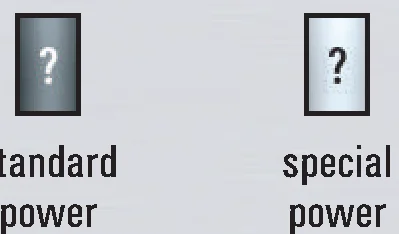
Every development, and most worlds, list one or more powers. Standard powers are depicted by icons with no text description (see the reference sheet). Special powers have icons, highlighted phases, and text descriptions at the bottom of the card which begin with the corresponding phase number.
Power icons appear on the left side of cards, arranged in I to V phase order, allowing players to easily scan their tableaus for them during a phase.
The chromosome icon, UPLIFT, IMPERIUM, and TERRAFORMING are for use in future expansion sets.
Rules for Powers
- All powers modify rules and are cumulative. A power modifies only the rules listed in its description; all other rules still apply.
- “Draw” — in all phases except Explore — means draw a card and add it to your hand. In Explore, it means draw a card and add it to the cards you then select from, as in the Explore rules.
- If, due to powers, a cost is reduced below 0, it becomes 0. A player does not receive cards as a “refund” if this occurs.
- Timing: A power does not take effect in the phase in which its card is placed; it can begin to take effect as soon as the next phase. (Thus, the Public Works power to draw one card after its owner builds a development does not apply to Public Works itself.)
- Unless a power’s description uses the word “may”, a power must be used, if possible, in the phase to which it applies (though a player may freely choose the order in which to invoke powers, as discussed further under Consume).
- An optional power (such as a Colony Ship) must be used if it is needed to place a development or world which a player has selected and then revealed.
- Powers are resolved sequentially (even though their effects can be cumulative). A player cannot “interrupt” one power with another.
Round Structure
A game is played over several rounds (typically 7 to 11). At the start of a round, each player simultaneously and secretly chooses one action card, placing it face down in front of himself. Once all players have done so, they turn these action cards face up. Then, the players perform the selected phases in order:
- I: Explore
- II: Develop
- III: Settle
- IV: Consume
- V: Produce
Omitting every phase not chosen by at least one player.
Each phase has an action, which is performed by all players. In addition, the players who chose that phase get a bonus.
Important: if more than one player chooses the same phase, its action is still only performed once (with all the players who selected that phase receiving a bonus).
The bonus for an action either modifies it (such as reducing its cost or doubling the VPs gained) or is in addition to it (such as a card draw afterwards or the opportunity to sell a good).
Players may find it useful to turn over the action card(s) for each phase as it is completed before performing the next one.
New players may find it useful to place the selected action cards in the center in numerical order. As players become more familiar with the phase order, this won’t be necessary.
After all phases chosen that round have been performed, each player must discard down to ten (game) cards in his hand and then reclaims the action card that he or she played that round.
Successive rounds are performed in the same manner until an end-of-game condition is met (see Game End).
I: EXPLORE
Action: each player draws two cards and then simultaneously selects which one of them to add to his hand, discarding the other card face down in the center discard area.
All cards drawn are dealt out before any cards are discarded.
There are two possible Explore bonuses, depending on which Explore action card was chosen by a player:
- Explore: +5: draws five more cards to select from before making his choice. Such a player explores by drawing 7 cards and choosing 1 of them to add to his hand.
- Explore: +1,+1: draws one more card to select from and keeps another card. Such a player explores by drawing 3 cards and choosing 2 of them to add to his hand.
Thus, depending on the bonus chosen with the Explore action, a player can either have more cards to select from or gain an extra card to keep.
The powers of various cards can alter these rules if a player has them in his tableau, possibly providing extra card draws or allowing a player to keep additional cards.

II: DEVELOP
Action: each player places a development card from his hand face down, or no card if a player doesn’t intend to place a development. Once all players have done so, they simultaneously turn them face up and then pay for them.
If desired, players can put their intended developments (if any) under their action card, revealing them when everyone is ready. To indicate no development, some players “knock” on the table, others put a world instead face down and flip it over, others put a card down but pick it up saying “no” when all are ready. Agree on a convention.
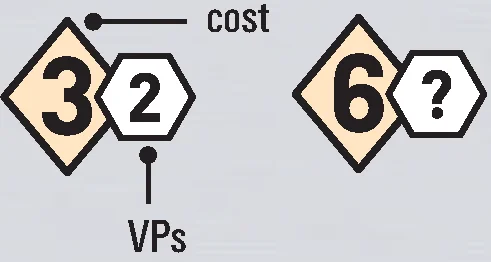
Each development has a symbol containing its cost, ranging from 1–6. To pay for a development, a player discards cards equal to this number face down from his hand.
Bonus: Players who chose Develop discard one card fewer than the development’s cost. If, due to special powers, a player is already discarding no cards, no bonus is received.
Rule: A player may not build a given development if another copy of it is currently in his tableau.
Next to a development’s diamond is its victory point (VP) value. It adds to the player’s final victory point total at the end of the game.
6-cost developments have  listed as their victory point values. These are worth a variable number of victory points at the end of the game, as indicated on these cards.
The powers of various cards can alter these rules if a player has them in his tableau before the development phase begins.
III: SETTLE
Action: each player places a world card from his hand face down, or no card if a player doesn’t intend to place a world. Once all players have done so, they simultaneously turn them face up and then pay for (or conquer) them.
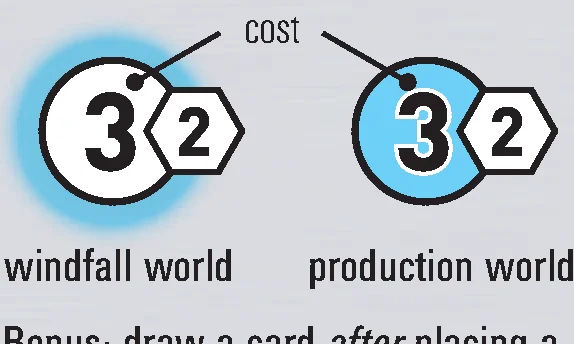
Many worlds contain a black number, ranging from 0–6, in a black circle; this is the world’s cost. To pay for such worlds, the player discards cards face down from his hand equal to this number.
Bonus: Players who chose Settle draw one card after placing and paying for (or conquering) a world.
Beside a world’s circle is its victory point value. This adds to the player’s final victory point total at the end of the game.
The powers of various cards can alter the settle rules if a player has them in his tableau before the settle phase begins.
Windfalls
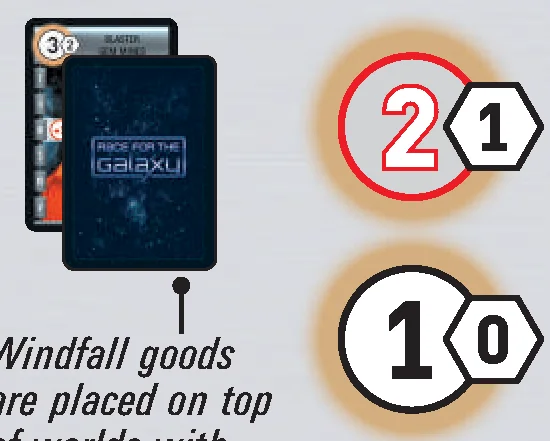
Some worlds have a colored “halo” around their circle, showing that they are windfall worlds and that a good is to be put on them when they are first settled. To do so, as part of placing the world in a player’s tableau, he takes a card face down — without looking at it — from the card supply and puts it on top of the world’s lower right portion (to avoid hiding the world’s VPs and powers). This card represents a good of the kind indicated by the color of the world’s halo.
There are four kinds of goods in the game:
 Alien technology: artifacts left by the vanished Alien Overlords.
 Genes: genetic material used in biological research.
 Rare elements: transuranic elements powering JumpDrive.
 Novelty goods: such as artwork and entertainment.
Military Conquest
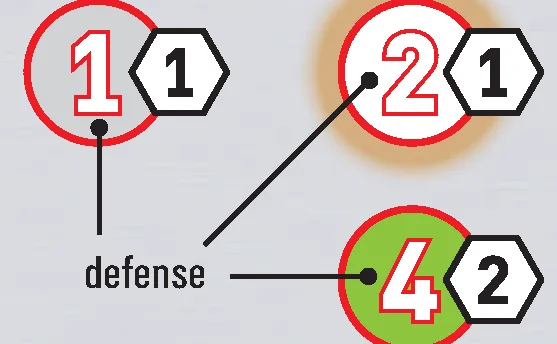
Some worlds have red circles and, within them, a red outlined number, ranging from 1–7; this is the world’s defense. These worlds cannot be placed by payment, but instead must be conquered. To conquer a world, a player’s total Military must equal or exceed the world’s defense. Then, the player simply places it — and its windfall good, if it has a halo — without paying for it (and then draws a bonus card if that player chose Settle).
Military is granted by powers of various start worlds, developments, or worlds, and lasts until the end of the settle phase.
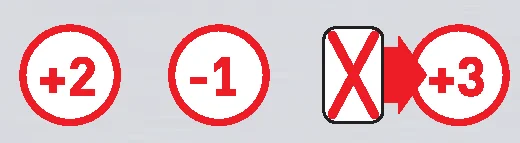
- Some developments and worlds, such as the Empath World, subtract from a player’s total Military.
- New Military Tactics may be discarded from a player’s tableau for +3 Military until the end of that settle phase.
- A Contact Specialist enables a player to place and pay for a military world (except an Alien military world), at a cost equal to one less than the world’s defense. Important: this cost is not reduced by a player’s Military (Military and payments never combine).
- Cost discounts from Replicant Robots, Mining Robots, etc. do combine with a Contact Specialist to reduce the cost of placing a military world. Similarly, a Colony Ship allows a Contact Specialist to place a (non-Alien) military world at no cost.
Thus, there are two completely separate ways to place military worlds.
IV: CONSUME
Action: all players must use their consume powers to discard goods for victory point chips and/or card draws.
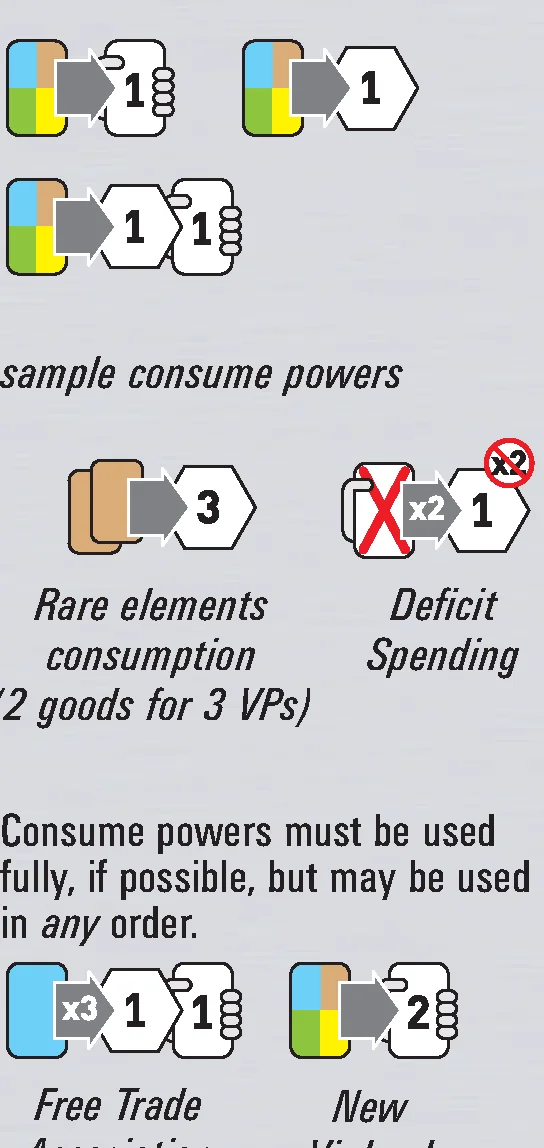
Some powers consume several goods. Others consume goods of a specific kind. Some, such as Deficit Spending, consume cards, not goods, discarded from a player’s hand. A few powers, such as New Economy, don’t involve discarding anything; they simply take effect during a Consume phase.
Goods are discarded face down (without examining them). Each good being discarded applies to only one consume power. A good may or may not be on the world consuming it.
Consumption is mandatory. However, consume powers can be invoked in any desired order, even if this results in some unconsumed goods left over that could have been consumed with a different order (due to their kinds not matching the player’s remaining unused consume powers).
Each consume power can be used only once in a consume phase. Some powers allow multiple goods, “up to” some number, to be discarded, with each good producing an effect. Such powers must be fully used, if possible, when invoked.
Example: a player with a tableau containing three novelty goods, New Vinland, and Free Trade Association, cannot consume two goods using FTA’s power (to consume up to 3 novelty goods for 1 VP and a card apiece) and then, based on the cards received, decide to consume the third novelty good using New Vinland’s power (to consume a good for two cards). The third novelty good must now be consumed by FTA. (These powers could have been invoked in the reverse order, but this choice must be made before invoking FTA’s power — once a power is invoked, its resolution cannot be interrupted by another power.)
Consume Bonuses
There are two possible Consume bonuses, depending on which Consume action card was chosen by a player:
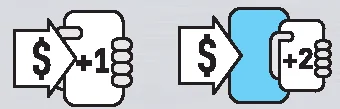
- $: Trade: players who chose Consume: Trade must sell one good (before applying their consume powers), by discarding it and drawing a number of cards that depends on the kind of good sold:
- Alien technology: 5 cards
- Genes: 4 cards
- Rare elements: 3 cards
- Novelty: 2 cards
Only players who chose Consume: Trade can sell a good. Players choosing Consume: Trade also apply all relevant Trade special powers (listed next to $) to this sale (typically, to draw extra cards).
- Consume: 2x VPs: players who chose this double the number of victory point chips — but not any other effects — that their consume powers provide. Exception: VPs for discarding cards from your hand (from powers such as Deficit Spending or Merchant World) are not doubled by this bonus.
Important: Trade is not a separate phase; it occurs before a Consume phase for only those who chose it.
V: PRODUCE
Action: place a good on each production world (worlds with colored, solid circles) without a good, by taking a card face down — without looking at it — from the card supply and putting it on top of the world’s lower right portion (to avoid hiding the world’s VPs and powers). This good is of the kind indicated by the color of the world’s solid circle.
No world can have more than one good. Some worlds, such as Gem World, provide a card draw as part of producing a good. If a good is already present, then no cards are drawn.
Bonus: Players who chose Produce produce a good (if possible) on one of their windfall worlds that does not already have a good.
Some cards, such as Genetics Lab, can also produce goods on windfall worlds (without goods). Others, such as the Pan-Galactic League, provide a card draw for each world of a specific kind in a player’s tableau (such as Genes worlds, with either a green halo or a green solid circle).
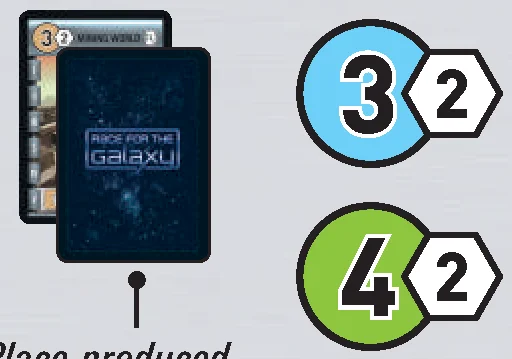
Icons for produce powers that provide cards or windfalls are listed twice, once in the icon bar and once on the top, right corner of each card, as an aid when dealing out production.
Round End, Cards, and Chips
- After all chosen phases are done, players must discard down to 10 (game) cards before starting the next round.
- All discards are face down. Keep the discard pile a bit “messy” so that it is not confused with the card supply.
- When the card supply is exhausted, immediately reshuffle the discards to form a new card supply.
- All players’ VP chips and the number of game cards they have in their hands are open for examination. Make change among VP chips as needed.
Game End
The game ends at the end of the round (including discarding) in which:
- a player has 12 or more cards in his card tableau, or
(A player can end with more than 12 cards in his card tableau by placing both a development and a world in the final round.) - the last victory point chip is given out.
If victory point chips run out, add the 10 VP chips and make change so that all victory points earned in the final consume phase can be taken.
Scoring
Total each player’s:
- tableau card VPs
- VP chips
- any end of game VPs for 6-cost developments.
The player with the highest total is the winner!
Tiebreaker: If two or more players tie, the player among them with the highest total number of cards in hand (after discarding) and goods on worlds wins. If there is still a tie, then all the tied players win.
After a game, separate the start worlds by fanning the deck, looking for boxed numbers in the right-hand corners.

Timing
Mostly, play can and should be performed simultaneously.
However, there are a few cases where player order can matter, such as:
- when there are only a few cards left in the card supply, or
- when the VP chips might run out in a Consume phase, or
- when players are settling near the end of the game.
Near the end of the game, if several players have New Military Tactics or Colony Ships, a player may wish to know whether another player is using (and discarding) one of these cards or placing a twelfth card in his tableau (thus ending the game that round), before deciding whether to use one of these cards himself.
In this and similar cases, resolve any timing issues clockwise, starting with the player who has the lowest numbered (original) start world.
2 Player Game (for experienced players)
Initially, two players should just play the standard rules. Once you’re familiar with the game, play with the following changes:
- Each player uses a full set of nine action cards and chooses two of them at the start of each round.
- A player selecting both Explore bonuses draws eight cards and keeps two of them (plus the effects of any applicable powers).
- If a player chooses either two Develop or two Settle actions, then two complete, sequential phases of that type occur (with this player receiving a bonus in each of them). If his opponent also chose one of these same actions, then his opponent receives a bonus only for the first of these two phases. Powers placed in the first such phase can be used in the second one.
- A player who selects both Consume bonuses must sell one good before consuming other goods for double VPs.
Card Powers (by phase)
I: EXPLORE
 Draw Extra: Draw 1 or 2 more cards to select from. These powers do not alter the number of cards that a player keeps.
 Keep Extra: Keep 1 more card.
 Draw and Keep Extra: Draw 2 more cards to select from; keep 1 more card.
II: DEVELOP
Powers cannot reduce costs below 0 nor take effect during the phase in which they are placed.
 Draw: Draw 1 card at the start of the Develop phase.
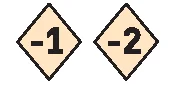 Reduce Cost: Reduce the cost to place a development () by 1 or 2 cards.
 Draw After: Draw 1 card after placing a development ().
III: SETTLE
Powers cannot reduce costs below 0 nor take effect during the phase in which they are placed. Cost reductions can apply when using a “Pay for Military” power to settle a military world ( ).
).
 Reduce Cost: –2 cost to place a non-military world (
 ).
). Specific Reduce Cost: –1 cost to place a non-military Rare elements production or windfall world (
 ).
). Reduce Cost to 0: The player may discard this card from his tableau to reduce the cost of placing a non-military world () to 0. This cannot be used to place an Alien production or windfall world (
 ). It can place the Alien Rosetta Stone World.
- Military: Contributes Military towards conquering a military world (). The –1 is not optional; this power reduces the player’s Military, making worlds harder to conquer.
 Specific Military: +4 Military towards conquering a Rebel military world (
 ).
).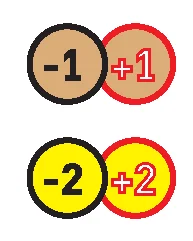 Specific Reduce Cost / Military: Reduce the cost of placing a non-military world of the indicated kind (
 ), or add to the player’s Military when conquering a military world of that kind.
 Temporary Military: The player may discard this card from his tableau to gain +3 Military until the end of this Settle phase.
 Pay for Military: As the action, the player may place a military world () as a non-military world (). The cost is the world’s defense -1, with other applicable discounts. This cannot be used to place an Alien production or windfall world (). The Contact Specialist also has a -1 Military power.
 Draw After: Draw 1 card after placing a world (
 ).
).
$: TRADE
 Any Good: Draw 1 or 2 more cards when selling a good.
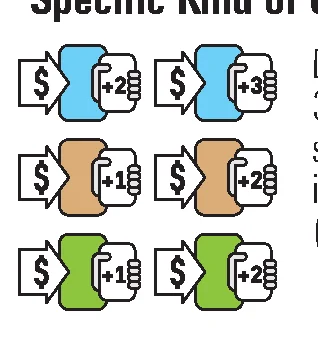 Specific Kind of Good: Draw 1, 2, or 3 more cards when selling a good of the indicated kind ().
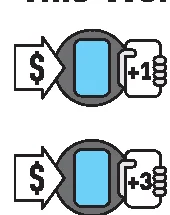 This World’s Good: Draw 1 or 3 more cards when selling a good from the world (
 ) with this power (plus any other applicable Trade powers, possibly due to its kind).
IV: CONSUME
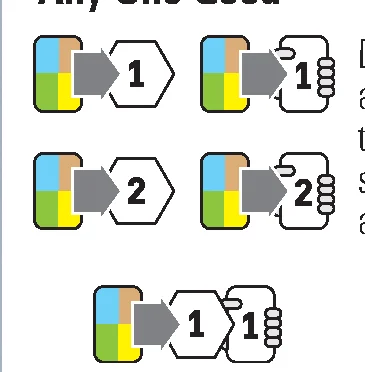 Any One Good: Discard 1 good (of any kind) to gain the specified VP chips and/or cards.
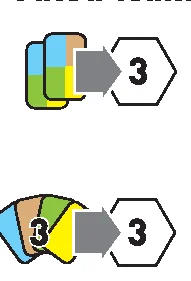 Fixed Number of Goods:
- Discard 2 goods (of any kind, possibly the same) to gain 3 VP chips.
- Discard exactly 3 goods, each of a different kind (), to gain 3 VP chips.
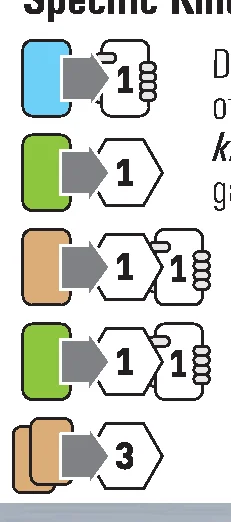 Specific Kind of Good(s): Discard the indicated number of good(s) of the specified kind () to gain VP chips and/or cards.
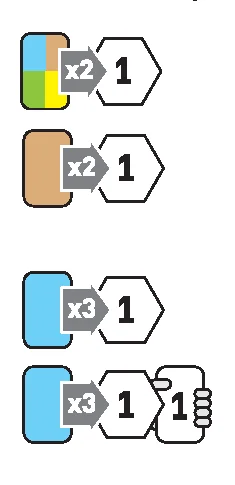 Discarding “up to”: Discard goods up to the indicated number to gain the specified VP chips and/or cards for each good discarded. Once invoked, these powers must be used to the fullest extent possible. (Example: with two remaining goods of the appropriate kind, the player must discard both of them after invoking one of these powers.)
 All Goods: Discard all goods (possibly after using other consume powers) to gain VP chips equal to one less than the number of goods discarded. Example: if the player has 3 goods when this power is invoked, he discards all of them for 2 VPs.
- For Cards at Trade Prices:
- Black Market Trading World:
 Discard 1 good to gain cards equal to its Trade price (Novelty: 2; Rare elements: 3; Genes: 4; Alien: 5). Trade Powers do not affect this power.
 - Trade League:
 Discard 1 good to gain cards equal to its Trade price (Novelty: 2; Rare elements: 3; Genes: 4; Alien: 5), plus all applicable Trade powers (including its own Trade power).
- Black Market Trading World:
 Draw: Draw 1 card.
 Draw if Lucky: Name a number from 1–7. Turn the top card from the card supply face up. If its cost or defense matches the number, keep it. Otherwise, discard it. The Gambling World also has a standard consume power in addition to this one.
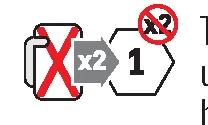 Discard Cards, not Goods: The player may discard up to 2 cards from his hand to gain 1 VP apiece. These VPs are not doubled by the Consume: 2x bonus.
V: PRODUCE
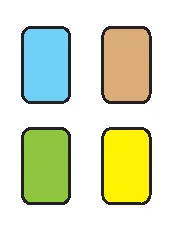 Produce Good: Produce a good on this world (if it does not have a good on it).
 Produce Windfall Good: The player produces a good on one of his windfall worlds (
 ) without a good on it.
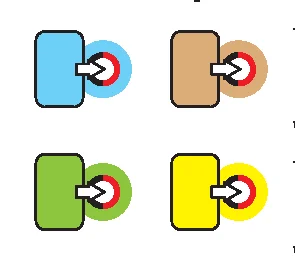 Produce Specific Windfall: The player produces a good on one of his windfall worlds of the specified kind () without a good on it.
 Draw: Draw 1 or 2 cards.
 Produce Good and Draw: Produce a good on this world (if it does not have a good on it) and then draw 1 or 2 cards. Do not draw any cards if no good was produced. The production reminders for these powers show only their draw card icons.
 Draw on Produced Windfall: Draw 1 card after producing a good on this world (). The production reminder for this power shows a draw card on this world icon.
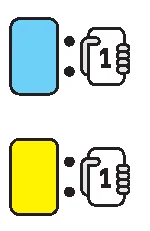 Draw for Kind: Draw 1 card for each good of the specified kind () that the player produced during this Produce phase.
 Draw for Worlds: Draw 1 card for each Genes production or windfall world (
 ) in the player’s tableau.
 Draw for Most of a Kind: At the end of Produce, draw 2 cards if the player produced more Rare elements goods () during this phase than any other player.
 Draw for Different Kinds: Draw 1 card for each different kind of good () that the player produced this Produce phase.
6-COST DEVELOPMENTS POWERS
For these developments, score end of the game VPs for every card in its owner’s tableau that satisfies one of the conditions listed on that development (and for every 3 VPs in chips its owner has in the case of Galactic Renaissance).
- Alien Tech Institute:
- 3 VPs per Alien technology production world
- 2 VPs per Alien technology windfall world
- 2 VPs per other ALIEN card (including this one)
- Free Trade Association:
- 2 VPs per Novelty production world
- 1 VP per Novelty windfall world
- 2 VPs per Consumer Markets, Expanding Colony
- Galactic Federation:
- 2 VPs per 6-cost developments (including this one)
- 1 VP per other developments
- Galactic Imperium:
- 2 VPs per Rebel military world (Rebel military worlds have a red, shaded circle beneath their VPs)
- 1 VP per other military world
- Galactic Renaissance:
- 1 VP per every three VP chips (rounded down)
- 3 VPs per Research Labs, Galactic Trendsetters, Artist Colony
- Galactic Survey/SETI:
- 1 VP per development with an Explore power (including this one)
- 2 VPs per world with an Explore power
- 1 VP per other world
- Merchant Guild:
- 2 VPs per Novelty, Rare elements, Genes, or Alien production world (not windfall)
- Mining League:
- 2 VPs per Rare elements production world
- 1 VP per Rare elements windfall world
- 2 VPs per Mining Robots, Mining Conglomerate
- New Economy:
- 2 VPs per development with a Consume power (including this one)
- 1 VP per world with a Consume power
- Trade powers are not considered Consume powers for these VP conditions
- New Galactic Order:
- +? VPs based on total Military (count negative Military but do not count specialized Military). Specialized Military includes not only bonuses against Rebel and Alien military worlds, etc. but also temporary Military, such as provided by New Military Tactics.
- Pan-Galactic League:
- 2 VPs per Genes world (production or windfall)
- 1 VP per other military world
- 3 VPs per Contact Specialist
- Trade League:
- 2 VPs per development with a Trade power (including this one)
- 1 VP per world with a Trade power
ABOUT THE CARDS
Distribution (114 game cards):
- 5 start worlds: 4 and 1
- 22 other military worlds
- 37 other non-military worlds
- 12 6-cost developments
- 38 other developments: 19×2
23 worlds are military worlds :
- 6 defense 1 (1 Rebel)
- 7 defense 2 (1 Alien, 1 Rebel, 1 start)
- 3 defense 3 (2 Rebel)
- 2 defense 4 (1 Alien)
- 2 defense 5 (1 Alien, 1 Rebel)
- 2 defense 6 (1 Alien, 1 Rebel)
- 1 defense 7 (1 Rebel)
- Contact Specialist not allowed for 4 Alien
19 cards provide Military:
- 7 : 2x +1, 3x +2, 2x +3
- 2 provide +3 upon discard
- 6 : 4x +1, 1x +2, 1x +3
- 2 +1
- 2 start worlds: +1; +2
- Galactic Empire: +4 vs 7 Rebel
- 1 and 1 are +2 vs 4 Alien
- Alpha Centauri: +1 vs. 3 Rare
- 5 cards have –1 Military
91 cards are placed by payment:
- 2 cost 0: 0 and 2
- 18 cost 1: 12 and 6
- 23 cost 2: 12 and 11
- 14 cost 3: 4 and 10
- 13 cost 4: 8 and 5
- 7 cost 5: 2 and 5
- 14 cost 6: 12 and 2
25 worlds are windfall worlds :
- 5 Novelty : 2 and 3
- 7 Rare : 5 (1 start) and 2
- 7 Genes : 2 and 5
- 6 Alien : 3 and 3
21 worlds produce a good:
- 9 Novelty : 8 (1 start) and 1
- 6 Rare : 5 and 1
- 4 Genes : 3 and 1
- 2 Alien : 1 and 1
- 6 and 2 produce a good at a specific kind of windfall world; 1 produces one at any world.
33 cards consume one or more goods:
- 13 (3 start) and 2
- 15
- 2 and 1 consume cards for VPs.
Credits
Design, development, and rules: Tom Lehmann
Story background inspired by: Frederik Pohl and David Brin
Original graphics and development assistance: Wei-Hwa Huang
Graphics: Mirko Suzuki
Illustrations: Martin Hoffmann and Claus Stephan
Playtesting and Advice: Corin Anderson, Brian Bankler, Eric Brosius, Mark Delano, David des Jardins, Chris Esko, Barry Eynon, Jeff Goldsmith, Dave Helmbold, Jay Heyman, Beth Howard, Bryan Howard, Joe Huber, Chris Lopez, Larry Rosenberg, Ron Sapolsky, Steve Thomas, Jay Tummelson, Lou Wainwright, Don Woods, and many, many others. Thank you all!
Special Thanks (way beyond the call of duty): Wei-Hwa Huang
Special thanks are also due to: Rob Watkins, who assisted me in the mid–90s on an unpublished CCG, Duel for the Stars, from which much of this is drawn; Richard Borg, for a key idea; Stefan Brück, who allowed Richard and me to work on a prototype Puerto Rico card game; and Andreas Seyfarth, without whom we wouldn’t have been inspired to do so.
If you have comments, questions, or suggestions, please write to us at:
Rio Grande Games, PO Box 45715, Rio Rancho, NM 87174, USA
E-Mail: [email protected]
© 2004 – 2007 Tom Lehmann
© 2007 Rio Grande Games

Overview & Components
TOM LEHMANN
Explore, Settle, Develop, Trade, Consume, or Produce? Which do you need the most? Which of Earth’s former colonies will be most successful at settling the galaxy, now that JumpDrive exists? Who will discover the secrets of the mysteriously vanished Alien Overlords? Your goal: to build the most prosperous and powerful space empire!
Game Overview
In Race for the Galaxy, players build galactic civilizations by game cards that represent worlds or technical and social developments.
Each round consists of one or more of five possible phases. In each round, each player secretly and simultaneously chooses one of seven different action cards and then reveals it. Only the selected phases occur. For these phases, every player performs the phase’s action, while the selecting player(s) also get a bonus for that phase.
For example, if at least one player chooses the Develop action, then the Develop phase will occur; otherwise it is skipped. In it, each player may simultaneously select a development from his hand of cards to build. After revealing the cards, each player adds his development to his tableau of cards on the table and then discards cards from his hand equal to its cost. Each player who chose Develop discards one card fewer as his bonus.
Explore allows a player to draw cards and select which of them to add to his hand. Settle allows a player to place a world in his tableau. Some worlds produce goods, represented by face down cards, when Produce is selected. These goods can be discarded for victory points or sold to add cards to the player’s hand by selecting Consume. With cards, players can settle new worlds and build more developments, gaining both victory points and card powers that provide advantages in certain phases.
The player who best manages his cards, phase and bonus selections, and card powers to build the greatest space empire, wins.
The winner is the player with the most victory points.
- Players simultaneously choose which game phases will occur. Game phases that nobody chooses do not occur. Each player receives a bonus in the phase that they chose.
- Cards are used in three ways: as developments or worlds to be placed; as money; or as goods to be consumed or sold.
- Players explore for useful cards, build developments, settle worlds, and produce goods. Goods can be consumed for victory points or sold for cards.
- The player with the most victory points wins!
Components
Some cards in the three decks have been presorted for your very first game (see Setup). Unpack the card decks carefully.
- 5 start world cards (numbered “0” to “4” in red or blue squares in their upper left and lower right corners)
- 109 game cards (like start worlds, these have the title on back):
- 59 worlds (with symbols)
- 50 developments (with symbols)
- 59 worlds (with
- 4 sets of 7 player action cards (used to select phases and bonuses each round; these have no title on their brightly colored backs)
- 8 duplicate action cards for experienced 2-player games (marked )
- 4 summary sheets
- 28 Victory Point (VP) chips: 18 @ 1, 6 @ 5, and 4 @ 10
Carefully remove the VP chips from their frame before your first game.
Setup
Setup Steps
- Place 12 victory point (VP) chips per player in 1 and 5 VP chips nearby. Set aside the 10 VP chips (and any left over chips) for use only during the final round of play.
- 2 players: remove 24 (use 24 VPs)
- 3 players: remove 12 (use 36 VPs)
- 4 players: use 48 VPs
- Each player takes a set of seven different action cards.
- Find and shuffle the five start worlds. Deal one world face up to each player. These form each player’s initial card tableau.
- Your first game: instead, for two players, use start worlds 1 and 2; for three, use start worlds 1–3; and, for four, use start worlds 1–4.
- Shuffle the unused start worlds together with the game cards. Deal six face down cards to each player. Each player then examines these cards and discards two cards face down to the discard pile. The remaining game cards form the initial card supply.
- Your first game: instead, each player uses the four numbered game cards matching his start world’s number as his initial (preset) hand. After finding these preset hand cards, shuffle all the remaining game cards, including any left over start worlds and preset hand cards, together.
- The start worlds, preset hands, and action card sets for your very first game have already been presorted by the printer.
- If Alpha Centauri is in play, place a card from the card supply face down on top of it (as its starting windfall good).
Each player’s card tableau is in front of him. It is one or more rows of face up cards: developments and worlds. Initially, it contains only the player’s start world.
Cards in the card supply and the discard pile are both face down. To tell them apart, keep the card supply neat and the discard pile a bit “messy”.
General Concepts & Card Rules
Card Uses
Game cards have three uses:
- As a development or world to be placed in a player’s tableau;
- As one wealth (money) to discard from one’s hand face down when paying to place a development or world;
- As a good placed face down on a world either upon it being settled or during production.
Card Powers
Every development, and most worlds, list one or more powers. Standard powers are depicted by icons with no text description (see the reference sheet). Special powers have icons, highlighted phases, and text descriptions at the bottom of the card which begin with the corresponding phase number.
Power icons appear on the left side of cards, arranged in I to V phase order, allowing players to easily scan their tableaus for them during a phase.
The chromosome icon, UPLIFT, IMPERIUM, and TERRAFORMING are for use in future expansion sets.
Rules for Powers
- All powers modify rules and are cumulative. A power modifies only the rules listed in its description; all other rules still apply.
- “Draw” — in all phases except Explore — means draw a card and add it to your hand. In Explore, it means draw a card and add it to the cards you then select from, as in the Explore rules.
- If, due to powers, a cost is reduced below 0, it becomes 0. A player does not receive cards as a “refund” if this occurs.
- Timing: A power does not take effect in the phase in which its card is placed; it can begin to take effect as soon as the next phase. (Thus, the Public Works power to draw one card after its owner builds a development does not apply to Public Works itself.)
- Unless a power’s description uses the word “may”, a power must be used, if possible, in the phase to which it applies (though a player may freely choose the order in which to invoke powers, as discussed further under Consume).
- An optional power (such as a Colony Ship) must be used if it is needed to place a development or world which a player has selected and then revealed.
- Powers are resolved sequentially (even though their effects can be cumulative). A player cannot “interrupt” one power with another.
How to Play (Phases of a Round)
Round Structure
A game is played over several rounds (typically 7 to 11). At the start of a round, each player simultaneously and secretly chooses one action card, placing it face down in front of himself. Once all players have done so, they turn these action cards face up. Then, the players perform the selected phases in order:
- I: Explore
- II: Develop
- III: Settle
- IV: Consume
- V: Produce
Omitting every phase not chosen by at least one player.
Each phase has an action, which is performed by all players. In addition, the players who chose that phase get a bonus.
Important: if more than one player chooses the same phase, its action is still only performed once (with all the players who selected that phase receiving a bonus).
The bonus for an action either modifies it (such as reducing its cost or doubling the VPs gained) or is in addition to it (such as a card draw afterwards or the opportunity to sell a good).
Players may find it useful to turn over the action card(s) for each phase as it is completed before performing the next one.
New players may find it useful to place the selected action cards in the center in numerical order. As players become more familiar with the phase order, this won’t be necessary.
After all phases chosen that round have been performed, each player must discard down to ten (game) cards in his hand and then reclaims the action card that he or she played that round.
Successive rounds are performed in the same manner until an end-of-game condition is met (see Game End).
I: EXPLORE
Action: each player draws two cards and then simultaneously selects which one of them to add to his hand, discarding the other card face down in the center discard area.
All cards drawn are dealt out before any cards are discarded.
There are two possible Explore bonuses, depending on which Explore action card was chosen by a player:
- Explore: +5: draws five more cards to select from before making his choice. Such a player explores by drawing 7 cards and choosing 1 of them to add to his hand.
- Explore: +1,+1: draws one more card to select from and keeps another card. Such a player explores by drawing 3 cards and choosing 2 of them to add to his hand.
Thus, depending on the bonus chosen with the Explore action, a player can either have more cards to select from or gain an extra card to keep.
The powers of various cards can alter these rules if a player has them in his tableau, possibly providing extra card draws or allowing a player to keep additional cards.
II: DEVELOP
Action: each player places a development card from his hand face down, or no card if a player doesn’t intend to place a development. Once all players have done so, they simultaneously turn them face up and then pay for them.
If desired, players can put their intended developments (if any) under their action card, revealing them when everyone is ready. To indicate no development, some players “knock” on the table, others put a world instead face down and flip it over, others put a card down but pick it up saying “no” when all are ready. Agree on a convention.
Each development has a symbol containing its cost, ranging from 1–6. To pay for a development, a player discards cards equal to this number face down from his hand.
Bonus: Players who chose Develop discard one card fewer than the development’s cost. If, due to special powers, a player is already discarding no cards, no bonus is received.
Rule: A player may not build a given development if another copy of it is currently in his tableau.
Next to a development’s diamond is its victory point (VP) value. It adds to the player’s final victory point total at the end of the game.
6-cost developments have listed as their victory point values. These are worth a variable number of victory points at the end of the game, as indicated on these cards.
The powers of various cards can alter these rules if a player has them in his tableau before the development phase begins.
III: SETTLE
Action: each player places a world card from his hand face down, or no card if a player doesn’t intend to place a world. Once all players have done so, they simultaneously turn them face up and then pay for (or conquer) them.
Many worlds contain a black number, ranging from 0–6, in a black circle; this is the world’s cost. To pay for such worlds, the player discards cards face down from his hand equal to this number.
Bonus: Players who chose Settle draw one card after placing and paying for (or conquering) a world.
Beside a world’s circle is its victory point value. This adds to the player’s final victory point total at the end of the game.
The powers of various cards can alter the settle rules if a player has them in his tableau before the settle phase begins.
Windfalls
Some worlds have a colored “halo” around their circle, showing that they are windfall worlds and that a good is to be put on them when they are first settled. To do so, as part of placing the world in a player’s tableau, he takes a card face down — without looking at it — from the card supply and puts it on top of the world’s lower right portion (to avoid hiding the world’s VPs and powers). This card represents a good of the kind indicated by the color of the world’s halo.
There are four kinds of goods in the game:
- Alien technology: artifacts left by the vanished Alien Overlords.
- Genes: genetic material used in biological research.
- Rare elements: transuranic elements powering JumpDrive.
- Novelty goods: such as artwork and entertainment.
Military Conquest
Some worlds have red circles and, within them, a red outlined number, ranging from 1–7; this is the world’s defense. These worlds cannot be placed by payment, but instead must be conquered. To conquer a world, a player’s total Military must equal or exceed the world’s defense. Then, the player simply places it — and its windfall good, if it has a halo — without paying for it (and then draws a bonus card if that player chose Settle).
Military is granted by powers of various start worlds, developments, or worlds, and lasts until the end of the settle phase.
- Some developments and worlds, such as the Empath World, subtract from a player’s total Military.
- New Military Tactics may be discarded from a player’s tableau for +3 Military until the end of that settle phase.
- A Contact Specialist enables a player to place and pay for a military world (except an Alien military world), at a cost equal to one less than the world’s defense. Important: this cost is not reduced by a player’s Military (Military and payments never combine).
- Cost discounts from Replicant Robots, Mining Robots, etc. do combine with a Contact Specialist to reduce the cost of placing a military world. Similarly, a Colony Ship allows a Contact Specialist to place a (non-Alien) military world at no cost.
Thus, there are two completely separate ways to place military worlds.
IV: CONSUME
Action: all players must use their consume powers to discard goods for victory point chips and/or card draws.
Some powers consume several goods. Others consume goods of a specific kind. Some, such as Deficit Spending, consume cards, not goods, discarded from a player’s hand. A few powers, such as New Economy, don’t involve discarding anything; they simply take effect during a Consume phase.
Goods are discarded face down (without examining them). Each good being discarded applies to only one consume power. A good may or may not be on the world consuming it.
Consumption is mandatory. However, consume powers can be invoked in any desired order, even if this results in some unconsumed goods left over that could have been consumed with a different order (due to their kinds not matching the player’s remaining unused consume powers).
Each consume power can be used only once in a consume phase. Some powers allow multiple goods, “up to” some number, to be discarded, with each good producing an effect. Such powers must be fully used, if possible, when invoked.
Example: a player with a tableau containing three novelty goods, New Vinland, and Free Trade Association, cannot consume two goods using FTA’s power (to consume up to 3 novelty goods for 1 VP and a card apiece) and then, based on the cards received, decide to consume the third novelty good using New Vinland’s power (to consume a good for two cards). The third novelty good must now be consumed by FTA. (These powers could have been invoked in the reverse order, but this choice must be made before invoking FTA’s power — once a power is invoked, its resolution cannot be interrupted by another power.)
Consume Bonuses
There are two possible Consume bonuses, depending on which Consume action card was chosen by a player:
- $: Trade: players who chose Consume: Trade must sell one good (before applying their consume powers), by discarding it and drawing a number of cards that depends on the kind of good sold:
- Alien technology: 5 cards
- Genes: 4 cards
- Rare elements: 3 cards
- Novelty: 2 cards
Only players who chose Consume: Trade can sell a good. Players choosing Consume: Trade also apply all relevant Trade special powers (listed next to $) to this sale (typically, to draw extra cards).
- Consume: 2x VPs: players who chose this double the number of victory point chips — but not any other effects — that their consume powers provide. Exception: VPs for discarding cards from your hand (from powers such as Deficit Spending or Merchant World) are not doubled by this bonus.
Important: Trade is not a separate phase; it occurs before a Consume phase for only those who chose it.
V: PRODUCE
Action: place a good on each production world (worlds with colored, solid circles) without a good, by taking a card face down — without looking at it — from the card supply and putting it on top of the world’s lower right portion (to avoid hiding the world’s VPs and powers). This good is of the kind indicated by the color of the world’s solid circle.
No world can have more than one good. Some worlds, such as Gem World, provide a card draw as part of producing a good. If a good is already present, then no cards are drawn.
Bonus: Players who chose Produce produce a good (if possible) on one of their windfall worlds that does not already have a good.
Some cards, such as Genetics Lab, can also produce goods on windfall worlds (without goods). Others, such as the Pan-Galactic League, provide a card draw for each world of a specific kind in a player’s tableau (such as Genes worlds, with either a green halo or a green solid circle).
Icons for produce powers that provide cards or windfalls are listed twice, once in the icon bar and once on the top, right corner of each card, as an aid when dealing out production.
Round End, Cards, and Chips
- After all chosen phases are done, players must discard down to 10 (game) cards before starting the next round.
- All discards are face down. Keep the discard pile a bit “messy” so that it is not confused with the card supply.
- When the card supply is exhausted, immediately reshuffle the discards to form a new card supply.
- All players’ VP chips and the number of game cards they have in their hands are open for examination. Make change among VP chips as needed.
Game End, Scoring & Timing
Game End
The game ends at the end of the round (including discarding) in which:
- a player has 12 or more cards in his card tableau, or
(A player can end with more than 12 cards in his card tableau by placing both a development and a world in the final round.) - the last victory point chip is given out.
If victory point chips run out, add the 10 VP chips and make change so that all victory points earned in the final consume phase can be taken.
Scoring
Total each player’s:
- tableau card VPs
- VP chips
- any end of game VPs for 6-cost developments.
The player with the highest total is the winner!
Tiebreaker: If two or more players tie, the player among them with the highest total number of cards in hand (after discarding) and goods on worlds wins. If there is still a tie, then all the tied players win.
After a game, separate the start worlds by fanning the deck, looking for boxed numbers in the right-hand corners.
Timing
Mostly, play can and should be performed simultaneously.
However, there are a few cases where player order can matter, such as:
- when there are only a few cards left in the card supply, or
- when the VP chips might run out in a Consume phase, or
- when players are settling near the end of the game.
Near the end of the game, if several players have New Military Tactics or Colony Ships, a player may wish to know whether another player is using (and discarding) one of these cards or placing a twelfth card in his tableau (thus ending the game that round), before deciding whether to use one of these cards himself.
In this and similar cases, resolve any timing issues clockwise, starting with the player who has the lowest numbered (original) start world.
Variants
2 Player Game (for experienced players)
Initially, two players should just play the standard rules. Once you’re familiar with the game, play with the following changes:
- Each player uses a full set of nine action cards and chooses two of them at the start of each round.
- A player selecting both Explore bonuses draws eight cards and keeps two of them (plus the effects of any applicable powers).
- If a player chooses either two Develop or two Settle actions, then two complete, sequential phases of that type occur (with this player receiving a bonus in each of them). If his opponent also chose one of these same actions, then his opponent receives a bonus only for the first of these two phases. Powers placed in the first such phase can be used in the second one.
- A player who selects both Consume bonuses must sell one good before consuming other goods for double VPs.
Reference: Card Powers
Card Powers (by phase)
I: EXPLORE
- Draw Extra: Draw 1 or 2 more cards to select from. These powers do not alter the number of cards that a player keeps.
- Keep Extra: Keep 1 more card.
- Draw and Keep Extra: Draw 2 more cards to select from; keep 1 more card.
II: DEVELOP
Powers cannot reduce costs below 0 nor take effect during the phase in which they are placed.
- Draw: Draw 1 card at the start of the Develop phase.
- Reduce Cost: Reduce the cost to place a development () by 1 or 2 cards.
- Draw After: Draw 1 card after placing a development ().
III: SETTLE
Powers cannot reduce costs below 0 nor take effect during the phase in which they are placed. Cost reductions can apply when using a “Pay for Military” power to settle a military world ().
- Reduce Cost: –2 cost to place a non-military world ().
- Specific Reduce Cost: –1 cost to place a non-military Rare elements production or windfall world ().
- Reduce Cost to 0: The player may discard this card from his tableau to reduce the cost of placing a non-military world () to 0. This cannot be used to place an Alien production or windfall world (). It can place the Alien Rosetta Stone World.
- Military: Contributes Military towards conquering a military world (). The –1 is not optional; this power reduces the player’s Military, making worlds harder to conquer.
- Specific Military: +4 Military towards conquering a Rebel military world ().
- Specific Reduce Cost / Military: Reduce the cost of placing a non-military world of the indicated kind (), or add to the player’s Military when conquering a military world of that kind.
- Temporary Military: The player may discard this card from his tableau to gain +3 Military until the end of this Settle phase.
- Pay for Military: As the action, the player may place a military world () as a non-military world (). The cost is the world’s defense -1, with other applicable discounts. This cannot be used to place an Alien production or windfall world (). The Contact Specialist also has a -1 Military power.
- Draw After: Draw 1 card after placing a world ().
$: TRADE
- Any Good: Draw 1 or 2 more cards when selling a good.
- Specific Kind of Good: Draw 1, 2, or 3 more cards when selling a good of the indicated kind ().
- This World’s Good: Draw 1 or 3 more cards when selling a good from the world () with this power (plus any other applicable Trade powers, possibly due to its kind).
IV: CONSUME
- Any One Good: Discard 1 good (of any kind) to gain the specified VP chips and/or cards.
- Fixed Number of Goods:
- Discard 2 goods (of any kind, possibly the same) to gain 3 VP chips.
- Discard exactly 3 goods, each of a different kind (), to gain 3 VP chips.
- Specific Kind of Good(s): Discard the indicated number of good(s) of the specified kind () to gain VP chips and/or cards.
- Discarding “up to”: Discard goods up to the indicated number to gain the specified VP chips and/or cards for each good discarded. Once invoked, these powers must be used to the fullest extent possible. (Example: with two remaining goods of the appropriate kind, the player must discard both of them after invoking one of these powers.)
- All Goods: Discard all goods (possibly after using other consume powers) to gain VP chips equal to one less than the number of goods discarded. Example: if the player has 3 goods when this power is invoked, he discards all of them for 2 VPs.
- For Cards at Trade Prices:
- Black Market Trading World: Discard 1 good to gain cards equal to its Trade price (Novelty: 2; Rare elements: 3; Genes: 4; Alien: 5). Trade Powers do not affect this power.
- Trade League: Discard 1 good to gain cards equal to its Trade price (Novelty: 2; Rare elements: 3; Genes: 4; Alien: 5), plus all applicable Trade powers (including its own Trade power).
- Black Market Trading World:
- Draw: Draw 1 card.
- Draw if Lucky: Name a number from 1–7. Turn the top card from the card supply face up. If its cost or defense matches the number, keep it. Otherwise, discard it. The Gambling World also has a standard consume power in addition to this one.
- Discard Cards, not Goods: The player may discard up to 2 cards from his hand to gain 1 VP apiece. These VPs are not doubled by the Consume: 2x bonus.
V: PRODUCE
- Produce Good: Produce a good on this world (if it does not have a good on it).
- Produce Windfall Good: The player produces a good on one of his windfall worlds () without a good on it.
- Produce Specific Windfall: The player produces a good on one of his windfall worlds of the specified kind () without a good on it.
- Draw: Draw 1 or 2 cards.
- Produce Good and Draw: Produce a good on this world (if it does not have a good on it) and then draw 1 or 2 cards. Do not draw any cards if no good was produced. The production reminders for these powers show only their draw card icons.
- Draw on Produced Windfall: Draw 1 card after producing a good on this world (). The production reminder for this power shows a draw card on this world icon.
- Draw for Kind: Draw 1 card for each good of the specified kind () that the player produced during this Produce phase.
- Draw for Worlds: Draw 1 card for each Genes production or windfall world () in the player’s tableau.
- Draw for Most of a Kind: At the end of Produce, draw 2 cards if the player produced more Rare elements goods () during this phase than any other player.
- Draw for Different Kinds: Draw 1 card for each different kind of good () that the player produced this Produce phase.
6-COST DEVELOPMENTS POWERS
For these developments, score end of the game VPs for every card in its owner’s tableau that satisfies one of the conditions listed on that development (and for every 3 VPs in chips its owner has in the case of Galactic Renaissance).
- Alien Tech Institute:
- 3 VPs per Alien technology production world
- 2 VPs per Alien technology windfall world
- 2 VPs per other ALIEN card (including this one)
- Free Trade Association:
- 2 VPs per Novelty production world
- 1 VP per Novelty windfall world
- 2 VPs per Consumer Markets, Expanding Colony
- Galactic Federation:
- 2 VPs per 6-cost developments (including this one)
- 1 VP per other developments
- Galactic Imperium:
- 2 VPs per Rebel military world (Rebel military worlds have a red, shaded circle beneath their VPs)
- 1 VP per other military world
- Galactic Renaissance:
- 1 VP per every three VP chips (rounded down)
- 3 VPs per Research Labs, Galactic Trendsetters, Artist Colony
- Galactic Survey/SETI:
- 1 VP per development with an Explore power (including this one)
- 2 VPs per world with an Explore power
- 1 VP per other world
- Merchant Guild:
- 2 VPs per Novelty, Rare elements, Genes, or Alien production world (not windfall)
- Mining League:
- 2 VPs per Rare elements production world
- 1 VP per Rare elements windfall world
- 2 VPs per Mining Robots, Mining Conglomerate
- New Economy:
- 2 VPs per development with a Consume power (including this one)
- 1 VP per world with a Consume power
- Trade powers are not considered Consume powers for these VP conditions
- New Galactic Order:
- +? VPs based on total Military (count negative Military but do not count specialized Military). Specialized Military includes not only bonuses against Rebel and Alien military worlds, etc. but also temporary Military, such as provided by New Military Tactics.
- Pan-Galactic League:
- 2 VPs per Genes world (production or windfall)
- 1 VP per other military world
- 3 VPs per Contact Specialist
- Trade League:
- 2 VPs per development with a Trade power (including this one)
- 1 VP per world with a Trade power
Card Distribution & Credits
ABOUT THE CARDS
Distribution (114 game cards):
- 5 start worlds: 4 and 1
- 22 other military worlds
- 37 other non-military worlds
- 12 6-cost developments
- 38 other developments: 19×2
23 worlds are military worlds :
- 6 defense 1 (1 Rebel)
- 7 defense 2 (1 Alien, 1 Rebel, 1 start)
- 3 defense 3 (2 Rebel)
- 2 defense 4 (1 Alien)
- 2 defense 5 (1 Alien, 1 Rebel)
- 2 defense 6 (1 Alien, 1 Rebel)
- 1 defense 7 (1 Rebel)
- Contact Specialist not allowed for 4 Alien
19 cards provide Military:
- 7 : 2x +1, 3x +2, 2x +3
- 2 provide +3 upon discard
- 6 : 4x +1, 1x +2, 1x +3
- 2 +1
- 2 start worlds: +1; +2
- Galactic Empire: +4 vs 7 Rebel
- 1 and 1 are +2 vs 4 Alien
- Alpha Centauri: +1 vs. 3 Rare
- 5 cards have –1 Military
91 cards are placed by payment:
- 2 cost 0: 0 and 2
- 18 cost 1: 12 and 6
- 23 cost 2: 12 and 11
- 14 cost 3: 4 and 10
- 13 cost 4: 8 and 5
- 7 cost 5: 2 and 5
- 14 cost 6: 12 and 2
25 worlds are windfall worlds :
- 5 Novelty : 2 and 3
- 7 Rare : 5 (1 start) and 2
- 7 Genes : 2 and 5
- 6 Alien : 3 and 3
21 worlds produce a good:
- 9 Novelty : 8 (1 start) and 1
- 6 Rare : 5 and 1
- 4 Genes : 3 and 1
- 2 Alien : 1 and 1
- 6 and 2 produce a good at a specific kind of windfall world; 1 produces one at any world.
33 cards consume one or more goods:
- 13 (3 start) and 2
- 15
- 2 and 1 consume cards for VPs.
Credits
Design, development, and rules: Tom Lehmann
Story background inspired by: Frederik Pohl and David Brin
Original graphics and development assistance: Wei-Hwa Huang
Graphics: Mirko Suzuki
Illustrations: Martin Hoffmann and Claus Stephan
Playtesting and Advice: Corin Anderson, Brian Bankler, Eric Brosius, Mark Delano, David des Jardins, Chris Esko, Barry Eynon, Jeff Goldsmith, Dave Helmbold, Jay Heyman, Beth Howard, Bryan Howard, Joe Huber, Chris Lopez, Larry Rosenberg, Ron Sapolsky, Steve Thomas, Jay Tummelson, Lou Wainwright, Don Woods, and many, many others. Thank you all!
Special Thanks (way beyond the call of duty): Wei-Hwa Huang
Special thanks are also due to: Rob Watkins, who assisted me in the mid–90s on an unpublished CCG, Duel for the Stars, from which much of this is drawn; Richard Borg, for a key idea; Stefan Brück, who allowed Richard and me to work on a prototype Puerto Rico card game; and Andreas Seyfarth, without whom we wouldn’t have been inspired to do so.
If you have comments, questions, or suggestions, please write to us at:
Rio Grande Games, PO Box 45715, Rio Rancho, NM 87174, USA
E-Mail: [email protected]
© 2004 – 2007 Tom Lehmann
© 2007 Rio Grande Games
Expansions for
Race for the Galaxy

Race for the Galaxy: New Worlds Promo Cards
2017
Add six new start worlds and a fresh strategic opening to your galaxy.
60
minutes
Medium Heavy

View expansion

Race for the Galaxy: Expansion and Brinkmanship
2022
Expand your empire as alien mysteries, rebellion, and war reshape the galaxy.
60
minutes
Medium Heavy
View expansion

Race for the Galaxy: Xeno Invasion
2015
Defend the galaxy from relentless Xeno attacks in a tense expansion.
60
minutes
Medium Heavy
View expansion
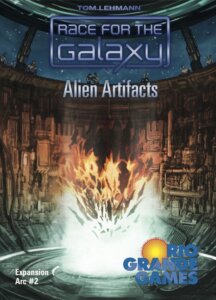
Race for the Galaxy: Alien Artifacts
2013
Balance empire-building with a daring expedition into the Alien Orb.
45
minutes
Medium
View expansion

Race for the Galaxy: The Gathering Storm
2008
Expand your galactic race with new cards, goals, drafting, and solitaire play.
60
minutes
Medium
View expansion
