
Concordia Venus
2018
Develop cities, acquire powerful cards, and outmaneuver rivals across four modular maps in a peaceful Roman strategy game.
120
minutes
2 - 6
player(s)
12+
Medium Heavy

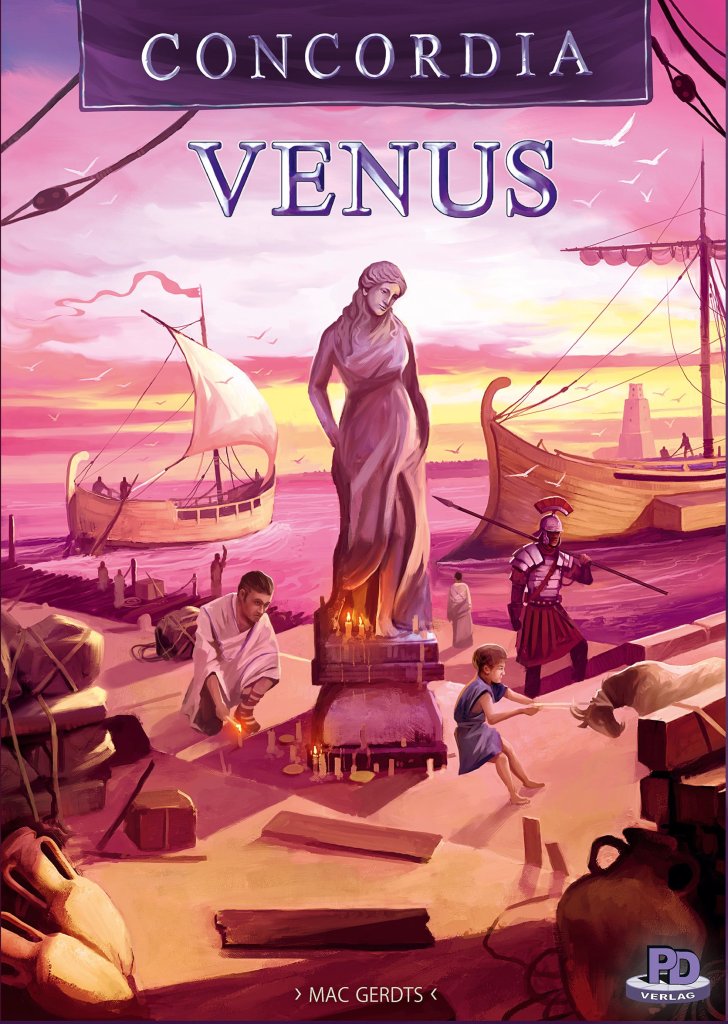
About this board game
Concordia Venus is a peaceful strategy game of economic development in Roman times for 2–6 players, with games lasting about 120 minutes. Players send colonists from Rome to settle cities and build an expanding network of production across four different maps.
Each player begins with an identical set of cards. During the game, new cards can be acquired from the market, giving players more ways to act while also contributing victory points at the end. Because cards serve these two purposes, every purchase can shape both your immediate plans and your final scoring potential.
There are no dice to rely on, so success comes from strategic planning and careful observation. Watch which goals your rivals are pursuing, decide where you can outpace them, and manage the resources produced by cities that make bricks, food, tools, wine, and cloth.
- 2–6 players, with teams of two able to play against each other
- Four maps: the classic Imperium map, plus Cyprus, Hellas, and Ionium
- New personality cards featuring the goddess Venus, offering additional strategies
- A modular city layout and changing market card sequence make each game different
The game ends when all cards have been sold from the market or after the first player builds their 15th house. Players then score victory points from the gods, including Jupiter, Saturnus, Mercurius, Minerva, Vesta, and Venus. The player with the most points wins.
As a standalone reimplementation with added features, Concordia Venus offers the classic economic development experience alongside team play, new maps, and Venus personality cards. It is separate from the Concordia: Venus expansion, which requires Concordia to play.
/pic7182955.jpg)
Board Game Rules for
Concordia Venus
Game Material
Concordia Venus includes:
- 2 game boards with 4 scenarios: Ionium, Hellas, Imperium, Cyprus
- 6 storehouses
- 1 card display (2 puzzle pieces)
- 1 Praefectus Magnus/Pantheon
- 132 wooden pieces in player colors red, green, yellow, blue, black, and white; per player:
- 3 sea colonists
- 3 land colonists
- 1 scoring marker
- 15 houses
- 100 wooden units of goods: brick, food, tool, wine, cloth
- 110 cards:
- 102 personality cards (60 starting cards, 10 per player; 42 cards for sale, decks I – V)
- 1 Concordia Card
- 1 Praefectus Magnus with explanation
- 6 player aids
- 30 city tokens
- 24 bonus markers
- Coins (1, 2, 5, and 10 sestertii)
- 1 game rules
- 1 quick intro
- 1 turn order marker


Individual or Team Play
Concordia Venus offers two different variants: The Individual Play for 2 to 5 players, and the Team Play for 4 or 6 players (in 2 or 3 teams). Most game rules apply to both variants. It is clearly indicated if any rules apply only to the Individual or the Team Play variant.
Individual Play for 2-5 players
This variant, where every player plays individually for themselves, is recommended for your first Concordia game. The first session will probably last longer than announced, especially with 5 new players.
Team Play for 4 or 6 players
This variant establishes 2 or 3 teams of 2 players each. Both partners will win or lose together. It is very important not only to think of yourself, but also for the needs of your partner.
Game Setup
The setup of Concordia Venus is described in detail in the separate quick intro.
Game Flow
- Players execute their turns in clockwise order.
- A player’s hand consists of their unplayed personality cards.
- A player’s turn consists of playing 1 card from their hand and executing the related actions.
- All played cards form a personal discard pile showing only the last card played.
- With the Tribune, a player takes back all cards previously played.
- In the Team Play variant, the actions of a played card are executed not only by its owner, but also by their partner as well.
General Rules
Storehouse
Each player has a storehouse with 12 storage spaces. Each space may house either one colonist or one unit of goods. At the beginning of the game, 4 storage spaces are occupied by colonists and therefore are not available for housing goods. However, if a player places new colonists on the game board, additional storage spaces become available. If all spaces are occupied in one way or another, no more units of goods can be taken in. It is not allowed to discard goods in order to make room for other ones instead. If a player receives plenty of goods without having enough empty storage spaces, it is allowed to choose which specific units of goods they want to take, but not to leave any storage spaces empty.
Trade and Stockpile
Players are not allowed to trade goods with each other. Goods and coins are considered to be unlimited. The number of colonists is restricted to 6 per player.
Præfectus Magnus
- If a player who currently owns the PRÆFECTUS M. plays a Prefect card (or uses one with the Diplomat) in order to let a province produce, they receive a double bonus (2 units instead of 1). Production inside the cities is not affected.
- After their turn they hand the PRÆFECTUS M. to the player sitting to their right.
- A player must use the PRÆFECTUS M. when able and may not choose to forego its benefit to keep it for later.
- But if a player plays a Prefect card in order to receive the cash bonus, the PRÆFECTUS M. is not activated and remains with the player: it is not allowed to double the cash bonus.
- If the Team Play variant is used, the PRÆFECTUS M. works in the usual way, but only for its current owner. The current owner’s partner does not benefit in any way from it.
Tribune
- Recover cards: The player recovers all of their previously played cards back into his hand. If the player takes back more than 3 cards (including the Tribune in the count), they receive 1 sestertius per card past the 3rd from the bank.
- 1 new colonist: In addition the player may optionally purchase 1 new colonist by paying 1 food and 1 tool to the bank and placing either a new land or sea colonist from their storehouse into the capital city.

Architect
- Move colonists: The number of colonists a player has on the board determines the number of possible movement steps that a player can freely allocate to their own colonists.
- Land colonists are moved only along the brown lines and sea colonists only along the blue lines.
- A colonist’s first movement step is out of its starting city onto an adjacent line. Any further steps will move the colonist through a city and onto the next adjacent line to that city.
- At the end of its movement, a colonist cannot be placed on a line that is already occupied by another colonist.
- However, a colonist is allowed to move through occupied lines, adding the occupied sections passed through into its movement count.
- Build houses (after all movements): The player may build houses in cities adjacent to any of their own colonists. Each new house built in a city is paid with goods and coins to the bank:
- Goods: 1 food in a brick city, or 1 brick plus the good of that city type in every other city.
- Coins: 1 sestertius in a brick city, 2 sestertii in a food city, 3 in a tool city, 4 in a wine city, and 5 in a cloth city.
If a new house is built in a city where there are already other houses, the cost in coins is multiplied by the number of houses that will be in the city after this build (i.e., to build the fourth house in a city the cost in coins is multiplied by 4). The cost in goods remains the same.
Players may never have more than 1 of their own houses in a single city and never have a house in the capital city.
Team Play: A colonist that is still inside a city cannot be used to build a house.

Prefect
The player chooses between two alternatives:
- a) Province production: The player chooses a province where the houses produce goods. They can only choose an active province whose bonus marker (province tile) still shows the goods symbol. It is not necessary that the player (or any other player) owns a house in the chosen province. They flip the bonus marker of the province to its coin side and receives 1 unit of the goods type depicted on the bonus marker from the bank. In addition all houses inside the province, regardless of their owner, each produce one unit of the goods produced in that city.
or - b) Cash bonus: Instead of producing the player may choose to collect the cash bonus. For every visible coin on the bonus markers they receive 1 sestertius from the bank. Afterwards all bonus markers are flipped back to the side showing their good’s symbol.

Mercator
This turn is executed in 2 steps:
- The player receives 3 sestertii from the bank (or 5 sestertii with a purchased Mercator).
- They may then trade in two types of goods with the bank. This means they may sell two types, buy two types, or sell one type and buy another. The number of units they may sell and/or buy is only limited by the free space inside their storehouse, where every single unit occupies one storage space. The trade is done at fixed prices, which are shown on the roof of the storehouses.

Diplomat
The player executes an action from a personality card that is on top of an opponent’s discard pile and thus is displayed face up in front of them. The action is executed the same as if the player had played that card himself. Actions of players who recently used a Diplomat card or took back their cards into their hand with their Tribune card cannot be copied.
In the Team Play variant, a personality card cannot be copied by the partner of the same team, because that partner is not considered as an opponent. Furthermore, a single card cannot be copied twice by 2 partners of the same team.

Colonist
The player chooses between two alternatives:
- a) Place new colonists: The player may place new colonists on the game board, each of which cost 1 food and 1 tool. New colonists can be placed inside the capital city or inside any other city where the player owns a house.
or - b) Collect sestertii: The player receives 5 sestertii plus 1 sestertius for each of their own colonists on the game board.

Specialists (Mason, Farmer, Smith, Vintner, Weaver)
All the player’s houses of the related type of goods produce one unit each.
Magister (only individual play)
The player executes the actions from his previously played personality card once again. The only exception is the Senator who cannot be activated by a Magister. The actions of the previous card are executed as if the player had played that card themselves.

Senator (only individual play)
The player may purchase up to two personality cards from the card display and take them into their hand. The price of a card is the sum of:
- The goods depicted inside the red field of the card
- plus the goods depicted beneath the card’s position on the card display, where a question mark stands for a good of the player’s choice.
After the purchase(s), all remaining personality cards inside the display move to the left if their left position is empty, and the display is replenished to the new total of 7 cards (as long as there are cards inside the stack).

Consul (only individual play)
The player may purchase one personality card from the card display and take it into their hand. The price consists only of the goods depicted in the red field of the personality card. Any goods depicted beneath the card’s position on the card display are ignored. As with a Senator, the remaining cards inside the display move to the left if their left position is empty, and the display is replenished from the stack (as long as the stack exists).

Praetor (only team play)
A Praetor works like the Senator, but each partner of the team can purchase no more than 1 personality card from the card display. The display is only replenished after both partners have completed their turn.
Proconsul (only team play)
As with the Consul, the player may purchase one personality card from the display and take it into their hand (The only exception is that another Proconsul cannot be purchased this way.). After that, the partner plays another personality card from their own hand and executes its actions, but only for themselves. The only card the partner could not play would be the Legatus. The card display is only replenished until both partners have completed their turn.
Important: The partner’s play does not change the general turn order; the orange marker stays with the Proconsul until both partners completed their turn.

Legatus (only team play)
The Legatus is a request to one’s partner for playing a certain card from their hand immediately. Before that happens, the player may inspect their partner‘s hand of cards, and silently suggest a certain card by putting it in front when returning the cards. Of course, the partner is always free to follow that suggestion or not. The partner plays a personality card, and that personality card finally played determines the actions for both partners in the usual way. Now the partner who plays the card also starts with executing the related actions.
Note that the general turn order is not affected and the orange marker stays with the Legatus until both partners have completed their turn.

Double Choice Cards
Prefect / Architect – Architect / Mercator – Prefect / Mercator
There is always a choice between these two personality cards. The chosen personality is used exactly the way as described in the respective section of the game rules.
- Individual Play variant: Choose one of either personalities and execute its actions.
- Team Play variant: The player who plays the card chooses one of either personalities. Their partner is then obliged to use the other personality depicted.

Teams
The players establish 2 (or 3) teams of 2 players each and take their seats around the table opposite to each other.
Turns
A player’s turn consists of playing 1 card from their hand, placing it face up on their discard pile, and executing the related actions. Immediately afterwards, their partner executes the related actions of that card as well. The partner themselves does not play a card (exceptions: Legatus and Proconsul).
Turn Order Marker
After a team has finished its turn with both partners, the orange marker moves in clockwise order to the next player, who then plays a personality card for their team etc.

Stockpile and Sestertii
Both team partners administrate their personal stuff strictly separated. It is never allowed to exchange, lend or trade in any way neither stockpile nor personality cards with each other. The sestertii are the only exception from this general rule: If a player needs additional sestertii for their desired actions (for instance with an Architect or Mercator), they may take the needed cash from their partner, who cannot refuse this.
Communication between Partners
Each player decides on their own which card to play and how to use it. These decisions are always to be respected, even if they contradict their partner‘s plans and ideas.
Before starting to play, it is recommended to agree on the ways in which partners are allowed to communicate with each other. Teams that are not as experienced could be allowed to communicate more explicitly than other teams. According to the rules, the Legatus is the only way to look inside the partner’s hand of cards and to propose playing a certain card.
While Concordia promotes common unity, Venus requires a real understanding of your partner.
Game Board IONIUM
IONIUM contains a special connection between BRUNDISIUM and APOLLONIA where land colonists may cross the sea. Using that line, a land colonist needs a movement step in the usual way, but is not allowed to stay on that line after moving.
For a tighter 2 or 3 player game it is recommended to reduce the number of cities to 22 by omitting the cities marked with a “B”. This way, the 3 Italian provinces do not take part. They may be easily covered by the separate card display.
Card Display
The boards of IONIUM and CYPRUS do not contain a card display area. Instead, the separate cardboard display is used and placed next to the game board. On its reverse side there is a variant with different additional costs, which is generally usable with all game boards of CONCORDIA. When applied, the new display covers the printed one on the board.
Pantheon
This summary shows how often these gods appear on the cards that enter the game, depending on the player count.
Intermediate Scoring
Each personality card is related to an ancient god. These gods individually reward certain achievements (for instance number of populated provinces, number of colonists, etc.).
If Concordia (Venus) is played for the first time, it is recommended to use the Individual Play variant and to conduct an intermediate scoring. The final (and intermediate) scorings are described in detail on the last page.
If a player plays their Tribune card for the first time in the game in order to take their cards back into their hand, they immediately perform a personal intermediate scoring. They score all their cards as described below for the final scoring, and tallies their VP on the VP-track.
After all players have played their Tribune card for the first time and have received the intermediate scoring, these scores are compared and player with the highest score receives 2 sestertii. Second place receives 1 sestertius. If players share the same position, they all receive the same amount (all in 1st place receive 2 sestertii and all in 2nd place receive 1 sestertius). After that, all scoring markers move back to the zero position on the VP-track.
We do not recommend performing intermediate scoring if all players know the game well.
Game End
The game ends either after a player purchases the last card from the card display on the board, or after the first player builds their 15th house. In either case, this player is awarded the Concordia Card.
If a player purchases the last personality card and thereby empties the card display, or if they build their 15th house, they receive the Concordia Card, which is worth 7 additional VP.
- Individual Play variant: Every other player now executes his last turn.
- Team Play variant: After the team has completed its turn, all other teams execute one last turn as well.
After the last turn in the game the final scoring is done as described below.
The player or the team with the most VP wins the game. A tie is won by the player or the team owning PRÆFECTUS MAGNUS, or by the tied player who would receive it next in the course of the game.
The VP of a team are calculated as the sum of VP of both partners, after each partner has counted his VP individually.
The Legatus contains 3 ancient gods, and therefore is counted once along with Jupiter, once with Saturnus, and once with Venus.
Final Scoring
Each personality card is related to an ancient god who rewards its owner with victory points. First players gather all their cards, including the ones from their discard pile, and arrange them according to the different ancient gods. The back of the player aid shows a summary of the gods and in which order they are scored. The victory points assigned to each card that is marked with the respective god are described in the following text. All victory points (VP) are tallied with the player’s score marker on the VP-track. It is recommended to first score VESTA for all players, then JUPITER etc.
- VESTA: The value of all goods in the storehouse (usual price as depicted) is added to the player’s money. Then the player receives 1 VP per full 10 sestertii, any fractions are ignored.
- JUPITER: For each house inside a non-brick city the player receives 1 VP. (max. 15 VP per card)
- SATURNUS: For each province with at least one of their houses the player receives 1 VP. (max. VP per card = number of different provinces)
- VENUS:
- Individual Play: For each province with at least two of their houses the player receives 2 VP. (max. 14 VP per card)
- Team Play: For each province, where both partners at least have 1 house each, the player receives 1 VP. (max. VP per card = number of different provinces)
- MERCURIUS: For each type of goods that the player produces with their houses, they receive 2 VP. (max. 10 VP per card)
- MARS: For each of their colonists on the game board the player receives 2 VP. (max. 12 VP per card)
- MINERVA: For each city of the related city type the player receives a certain number of VP as depicted on the specialist’s card.

Components & Game Modes
Game Material
Concordia Venus includes:
- 2 game boards with 4 scenarios: Ionium, Hellas, Imperium, Cyprus
- 6 storehouses
- 1 card display (2 puzzle pieces)
- 1 Praefectus Magnus/Pantheon
- 132 wooden pieces in player colors red, green, yellow, blue, black, and white; per player:
- 3 sea colonists
- 3 land colonists
- 1 scoring marker
- 15 houses
- 100 wooden units of goods: brick, food, tool, wine, cloth
- 110 cards:
- 102 personality cards (60 starting cards, 10 per player; 42 cards for sale, decks I – V)
- 1 Concordia Card
- 1 Praefectus Magnus with explanation
- 6 player aids
- 30 city tokens
- 24 bonus markers
- Coins (1, 2, 5, and 10 sestertii)
- 1 game rules
- 1 quick intro
- 1 turn order marker
Individual or Team Play
Concordia Venus offers two different variants: The Individual Play for 2 to 5 players, and the Team Play for 4 or 6 players (in 2 or 3 teams). Most game rules apply to both variants. It is clearly indicated if any rules apply only to the Individual or the Team Play variant.
Individual Play for 2-5 players
This variant, where every player plays individually for themselves, is recommended for your first Concordia game. The first session will probably last longer than announced, especially with 5 new players.
Team Play for 4 or 6 players
This variant establishes 2 or 3 teams of 2 players each. Both partners will win or lose together. It is very important not only to think of yourself, but also for the needs of your partner.
Game Overview & General Rules
Game Setup
The setup of Concordia Venus is described in detail in the separate quick intro.
Game Flow
- Players execute their turns in clockwise order.
- A player’s hand consists of their unplayed personality cards.
- A player’s turn consists of playing 1 card from their hand and executing the related actions.
- All played cards form a personal discard pile showing only the last card played.
- With the Tribune, a player takes back all cards previously played.
- In the Team Play variant, the actions of a played card are executed not only by its owner, but also by their partner as well.
General Rules
Storehouse
Each player has a storehouse with 12 storage spaces. Each space may house either one colonist or one unit of goods. At the beginning of the game, 4 storage spaces are occupied by colonists and therefore are not available for housing goods. However, if a player places new colonists on the game board, additional storage spaces become available. If all spaces are occupied in one way or another, no more units of goods can be taken in. It is not allowed to discard goods in order to make room for other ones instead. If a player receives plenty of goods without having enough empty storage spaces, it is allowed to choose which specific units of goods they want to take, but not to leave any storage spaces empty.
Trade and Stockpile
Players are not allowed to trade goods with each other. Goods and coins are considered to be unlimited. The number of colonists is restricted to 6 per player.
Præfectus Magnus
- If a player who currently owns the PRÆFECTUS M. plays a Prefect card (or uses one with the Diplomat) in order to let a province produce, they receive a double bonus (2 units instead of 1). Production inside the cities is not affected.
- After their turn they hand the PRÆFECTUS M. to the player sitting to their right.
- A player must use the PRÆFECTUS M. when able and may not choose to forego its benefit to keep it for later.
- But if a player plays a Prefect card in order to receive the cash bonus, the PRÆFECTUS M. is not activated and remains with the player: it is not allowed to double the cash bonus.
- If the Team Play variant is used, the PRÆFECTUS M. works in the usual way, but only for its current owner. The current owner’s partner does not benefit in any way from it.
Personality Cards
Tribune
- Recover cards: The player recovers all of their previously played cards back into his hand. If the player takes back more than 3 cards (including the Tribune in the count), they receive 1 sestertius per card past the 3rd from the bank.
- 1 new colonist: In addition the player may optionally purchase 1 new colonist by paying 1 food and 1 tool to the bank and placing either a new land or sea colonist from their storehouse into the capital city.
Architect
- Move colonists: The number of colonists a player has on the board determines the number of possible movement steps that a player can freely allocate to their own colonists.
- Land colonists are moved only along the brown lines and sea colonists only along the blue lines.
- A colonist’s first movement step is out of its starting city onto an adjacent line. Any further steps will move the colonist through a city and onto the next adjacent line to that city.
- At the end of its movement, a colonist cannot be placed on a line that is already occupied by another colonist.
- However, a colonist is allowed to move through occupied lines, adding the occupied sections passed through into its movement count.
- Build houses (after all movements): The player may build houses in cities adjacent to any of their own colonists. Each new house built in a city is paid with goods and coins to the bank:
- Goods: 1 food in a brick city, or 1 brick plus the good of that city type in every other city.
- Coins: 1 sestertius in a brick city, 2 sestertii in a food city, 3 in a tool city, 4 in a wine city, and 5 in a cloth city.
If a new house is built in a city where there are already other houses, the cost in coins is multiplied by the number of houses that will be in the city after this build (i.e., to build the fourth house in a city the cost in coins is multiplied by 4). The cost in goods remains the same.
Players may never have more than 1 of their own houses in a single city and never have a house in the capital city.
Team Play: A colonist that is still inside a city cannot be used to build a house.
Prefect
The player chooses between two alternatives:
- a) Province production: The player chooses a province where the houses produce goods. They can only choose an active province whose bonus marker (province tile) still shows the goods symbol. It is not necessary that the player (or any other player) owns a house in the chosen province. They flip the bonus marker of the province to its coin side and receives 1 unit of the goods type depicted on the bonus marker from the bank. In addition all houses inside the province, regardless of their owner, each produce one unit of the goods produced in that city.
or - b) Cash bonus: Instead of producing the player may choose to collect the cash bonus. For every visible coin on the bonus markers they receive 1 sestertius from the bank. Afterwards all bonus markers are flipped back to the side showing their good’s symbol.
Mercator
This turn is executed in 2 steps:
- The player receives 3 sestertii from the bank (or 5 sestertii with a purchased Mercator).
- They may then trade in two types of goods with the bank. This means they may sell two types, buy two types, or sell one type and buy another. The number of units they may sell and/or buy is only limited by the free space inside their storehouse, where every single unit occupies one storage space. The trade is done at fixed prices, which are shown on the roof of the storehouses.
Diplomat
The player executes an action from a personality card that is on top of an opponent’s discard pile and thus is displayed face up in front of them. The action is executed the same as if the player had played that card himself. Actions of players who recently used a Diplomat card or took back their cards into their hand with their Tribune card cannot be copied.
In the Team Play variant, a personality card cannot be copied by the partner of the same team, because that partner is not considered as an opponent. Furthermore, a single card cannot be copied twice by 2 partners of the same team.
Colonist
The player chooses between two alternatives:
- a) Place new colonists: The player may place new colonists on the game board, each of which cost 1 food and 1 tool. New colonists can be placed inside the capital city or inside any other city where the player owns a house.
or - b) Collect sestertii: The player receives 5 sestertii plus 1 sestertius for each of their own colonists on the game board.
Specialists (Mason, Farmer, Smith, Vintner, Weaver)
All the player’s houses of the related type of goods produce one unit each.
Magister (only individual play)
The player executes the actions from his previously played personality card once again. The only exception is the Senator who cannot be activated by a Magister. The actions of the previous card are executed as if the player had played that card themselves.
Senator (only individual play)
The player may purchase up to two personality cards from the card display and take them into their hand. The price of a card is the sum of:
- The goods depicted inside the red field of the card
- plus the goods depicted beneath the card’s position on the card display, where a question mark stands for a good of the player’s choice.
After the purchase(s), all remaining personality cards inside the display move to the left if their left position is empty, and the display is replenished to the new total of 7 cards (as long as there are cards inside the stack).
Consul (only individual play)
The player may purchase one personality card from the card display and take it into their hand. The price consists only of the goods depicted in the red field of the personality card. Any goods depicted beneath the card’s position on the card display are ignored. As with a Senator, the remaining cards inside the display move to the left if their left position is empty, and the display is replenished from the stack (as long as the stack exists).
Praetor (only team play)
A Praetor works like the Senator, but each partner of the team can purchase no more than 1 personality card from the card display. The display is only replenished after both partners have completed their turn.
Proconsul (only team play)
As with the Consul, the player may purchase one personality card from the display and take it into their hand (The only exception is that another Proconsul cannot be purchased this way.). After that, the partner plays another personality card from their own hand and executes its actions, but only for themselves. The only card the partner could not play would be the Legatus. The card display is only replenished until both partners have completed their turn.
Important: The partner’s play does not change the general turn order; the orange marker stays with the Proconsul until both partners completed their turn.
Legatus (only team play)
The Legatus is a request to one’s partner for playing a certain card from their hand immediately. Before that happens, the player may inspect their partner‘s hand of cards, and silently suggest a certain card by putting it in front when returning the cards. Of course, the partner is always free to follow that suggestion or not. The partner plays a personality card, and that personality card finally played determines the actions for both partners in the usual way. Now the partner who plays the card also starts with executing the related actions.
Note that the general turn order is not affected and the orange marker stays with the Legatus until both partners have completed their turn.
Double Choice Cards
Prefect / Architect – Architect / Mercator – Prefect / Mercator
There is always a choice between these two personality cards. The chosen personality is used exactly the way as described in the respective section of the game rules.
- Individual Play variant: Choose one of either personalities and execute its actions.
- Team Play variant: The player who plays the card chooses one of either personalities. Their partner is then obliged to use the other personality depicted.
Team Play Variant Rules
Teams
The players establish 2 (or 3) teams of 2 players each and take their seats around the table opposite to each other.
Turns
A player’s turn consists of playing 1 card from their hand, placing it face up on their discard pile, and executing the related actions. Immediately afterwards, their partner executes the related actions of that card as well. The partner themselves does not play a card (exceptions: Legatus and Proconsul).
Turn Order Marker
After a team has finished its turn with both partners, the orange marker moves in clockwise order to the next player, who then plays a personality card for their team etc.
Stockpile and Sestertii
Both team partners administrate their personal stuff strictly separated. It is never allowed to exchange, lend or trade in any way neither stockpile nor personality cards with each other. The sestertii are the only exception from this general rule: If a player needs additional sestertii for their desired actions (for instance with an Architect or Mercator), they may take the needed cash from their partner, who cannot refuse this.
Communication between Partners
Each player decides on their own which card to play and how to use it. These decisions are always to be respected, even if they contradict their partner‘s plans and ideas.
Before starting to play, it is recommended to agree on the ways in which partners are allowed to communicate with each other. Teams that are not as experienced could be allowed to communicate more explicitly than other teams. According to the rules, the Legatus is the only way to look inside the partner’s hand of cards and to propose playing a certain card.
While Concordia promotes common unity, Venus requires a real understanding of your partner.
Boards & Board Variants
Game Board IONIUM
IONIUM contains a special connection between BRUNDISIUM and APOLLONIA where land colonists may cross the sea. Using that line, a land colonist needs a movement step in the usual way, but is not allowed to stay on that line after moving.
For a tighter 2 or 3 player game it is recommended to reduce the number of cities to 22 by omitting the cities marked with a “B”. This way, the 3 Italian provinces do not take part. They may be easily covered by the separate card display.
Card Display
The boards of IONIUM and CYPRUS do not contain a card display area. Instead, the separate cardboard display is used and placed next to the game board. On its reverse side there is a variant with different additional costs, which is generally usable with all game boards of CONCORDIA. When applied, the new display covers the printed one on the board.
Pantheon
This summary shows how often these gods appear on the cards that enter the game, depending on the player count.
Game End & Scoring
Intermediate Scoring
Each personality card is related to an ancient god. These gods individually reward certain achievements (for instance number of populated provinces, number of colonists, etc.).
If Concordia (Venus) is played for the first time, it is recommended to use the Individual Play variant and to conduct an intermediate scoring. The final (and intermediate) scorings are described in detail on the last page.
If a player plays their Tribune card for the first time in the game in order to take their cards back into their hand, they immediately perform a personal intermediate scoring. They score all their cards as described below for the final scoring, and tallies their VP on the VP-track.
After all players have played their Tribune card for the first time and have received the intermediate scoring, these scores are compared and player with the highest score receives 2 sestertii. Second place receives 1 sestertius. If players share the same position, they all receive the same amount (all in 1st place receive 2 sestertii and all in 2nd place receive 1 sestertius). After that, all scoring markers move back to the zero position on the VP-track.
We do not recommend performing intermediate scoring if all players know the game well.
Game End
The game ends either after a player purchases the last card from the card display on the board, or after the first player builds their 15th house. In either case, this player is awarded the Concordia Card.
If a player purchases the last personality card and thereby empties the card display, or if they build their 15th house, they receive the Concordia Card, which is worth 7 additional VP.
- Individual Play variant: Every other player now executes his last turn.
- Team Play variant: After the team has completed its turn, all other teams execute one last turn as well.
After the last turn in the game the final scoring is done as described below.
The player or the team with the most VP wins the game. A tie is won by the player or the team owning PRÆFECTUS MAGNUS, or by the tied player who would receive it next in the course of the game.
The VP of a team are calculated as the sum of VP of both partners, after each partner has counted his VP individually.
The Legatus contains 3 ancient gods, and therefore is counted once along with Jupiter, once with Saturnus, and once with Venus.
Final Scoring
Each personality card is related to an ancient god who rewards its owner with victory points. First players gather all their cards, including the ones from their discard pile, and arrange them according to the different ancient gods. The back of the player aid shows a summary of the gods and in which order they are scored. The victory points assigned to each card that is marked with the respective god are described in the following text. All victory points (VP) are tallied with the player’s score marker on the VP-track. It is recommended to first score VESTA for all players, then JUPITER etc.
- VESTA: The value of all goods in the storehouse (usual price as depicted) is added to the player’s money. Then the player receives 1 VP per full 10 sestertii, any fractions are ignored.
- JUPITER: For each house inside a non-brick city the player receives 1 VP. (max. 15 VP per card)
- SATURNUS: For each province with at least one of their houses the player receives 1 VP. (max. VP per card = number of different provinces)
- VENUS:
- Individual Play: For each province with at least two of their houses the player receives 2 VP. (max. 14 VP per card)
- Team Play: For each province, where both partners at least have 1 house each, the player receives 1 VP. (max. VP per card = number of different provinces)
- MERCURIUS: For each type of goods that the player produces with their houses, they receive 2 VP. (max. 10 VP per card)
- MARS: For each of their colonists on the game board the player receives 2 VP. (max. 12 VP per card)
- MINERVA: For each city of the related city type the player receives a certain number of VP as depicted on the specialist’s card.
Expansions for
Concordia Venus
Concordia: Roma / Sicilia
2023
Explore two distinct settings in this double-sided Concordia expansion.
100
minutes
Medium

View expansion
Concordia Venus: Balearica / Italia
2019
Explore four islands and turn fish into goods, cash, or special actions.
120
minutes
Medium Heavy
View expansion

Concordia: Gallia / Corsica
2016
Two maps, distinct challenges, and tighter choices for Concordia players.
90
minutes
Medium
View expansion
Concordia: Solitaria
2021
Plan every card play to outwit the unpredictable Contrarius.
60
minutes
Medium
View expansion
Concordia: Aegyptus / Creta
2017
Two maps bring new challenges to Concordia, from Nile floods to tight competition.
90
minutes
Medium Heavy
View expansion

Concordia: Britannia / Germania
2014
Explore two distinct maps with tight play, castles, and river routes.
90
minutes
Medium Heavy
View expansion

Concordia: Salsa
2015
Add salt, Forum cards, and two new maps to your Concordia experience.
90
minutes
Medium Heavy
View expansion
