
Twilight Struggle
2005
Use limited resources, play event cards, and compete for influence across a divided world from 1945 to 1989.
180
minutes
2 - 2
player(s)
13+
Medium Heavy


About this board game
Twilight Struggle is a two-player strategy game with an approximately 180-minute play time, simulating the forty-five-year conflict between the Soviet Union and the United States from 1945 to 1989.
In the aftermath of the Second World War, the two new superpowers compete for allies and control across a world map. This struggle is fought less by soldiers and tanks than by spies, politicians, scientists, intellectuals, artists, and traitors, with occasional flares of warfare adding danger to the contest.
Players must decide how to use consistently limited resources, units, and cards to advance their superpower’s position. Event cards add historical detail and flavor, while movement and influence allow each side to shape the political balance in countries around the globe.
- A strategic contest designed for exactly two players
- A world map representing the period’s global struggle
- Influence, control, units, and event cards as central tools
- Multiple paths to automatic victory, with final scoring if neither side prevails
Twilight Struggle inherits its fundamental systems from We the People and Hannibal: Rome vs. Carthage, presenting them in a quick-playing, low-complexity tradition. Every card and decision matters as both players weigh immediate opportunities against the broader balance of power.
The game unfolds over up to ten turns. Several conditions can produce an automatic victory; if neither side achieves victory by the end of the final turn, the points are totaled and the player with the most points wins.
/pic7182955.jpg)
Board Game Rules for
Twilight Struggle
Twilight Struggle: The Cold War, 1945–1989
Deluxe Edition / 2nd Edition
By Jason Matthews & Ananda Gupta
© 2007 GMT Games, LLC
“Now the trumpet summons us again — not as a call to bear arms, though arms we need, not as a call to battle, though embattled we are — but a call to bear the burden of a long twilight struggle…”
— John F. Kennedy, Inaugural Speech, January 1961
In 1945, unlikely allies slew the Nazi beast, while humanity’s most devastating weapons forced the proud Japanese Empire to its knees in a storm of fire. Where once there stood many great powers, now stood only two. The world had scant time to sigh relief before a new conflict threatened. Unlike the titanic conflicts of the preceding decades, this conflict would be waged primarily not by soldiers and tanks, but by spies and politicians, scientists and intellectuals, artists and traitors.
Twilight Struggle is a two-player game simulating the forty-five-year dance of intrigue, prestige, and occasional flares of warfare between the Soviet Union and the United States. The entire world is the stage on which these two titans fight to make the world safe for their own ideologies and ways of life. The game begins amidst the ruins of Europe as the two new ‘superpowers’ struggle over the wreckage of the Second World War, and ends in 1989, when only the United States remained standing.
Twilight Struggle inherits its fundamental systems from the card-driven classics We the People and Hannibal: Rome vs. Carthage. It is a quick-playing, low-complexity game in that tradition. Event cards cover a vast array of historical happenings, from the Arab-Israeli conflicts of 1948 and 1967, to Vietnam and the U.S. peace movement, to the Cuban Missile Crisis and other such incidents that brought the world to the brink of nuclear annihilation. Subsystems capture the prestige-laden Space Race as well as nuclear tensions, with the possibility of nuclear war ending the game.
These rules are organized into numbered sections and subsections. Terms that have specialized meaning, such as ‘Influence’ or ‘Battleground’, are consistently capitalized.
Game Components
A complete game of Twilight Struggle includes:
- One 22” by 34” Map Board
- Two sheets of markers
- One Rules Booklet
- Two Player Aid Cards
- 110 Cards
- Two 6-sided dice
The Game Map
“From Stettin in the Baltic to Trieste in the Adriatic, an iron curtain has descended across the continent.”
— Winston Churchill
Regions and Sub-regions
The map is divided into six Regions: Europe, Asia, Central America, South America, Africa, and the Middle East.
- Europe is divided into Eastern Europe and Western Europe. Historically neutral countries (Austria and Finland) are categorized as being in both Eastern and Western Europe.
- Asia contains the Southeast Asia sub-region.
- Country spaces of a region share a color tint; sub-regions have distinct shades.
- Design Note: The Middle East includes Libya and Egypt; Canada and Turkey are included in Europe.
- Any event, rule, action, or card referring to ‘Europe’ or ‘Asia’ includes their associated sub-regions.
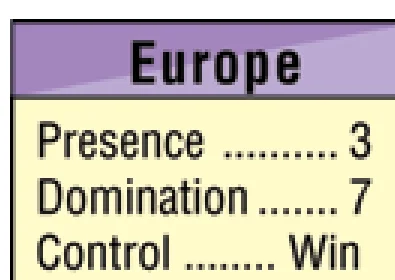
Countries, Stability, and Battlegrounds
Each space represents a country or bloc of countries with a Stability Number denoting its overall stability, independence, and power.
Names highlighted in purple indicate Battleground countries, which possess special significance for regional scoring and Coup attempts. Non-battleground countries have names on white.
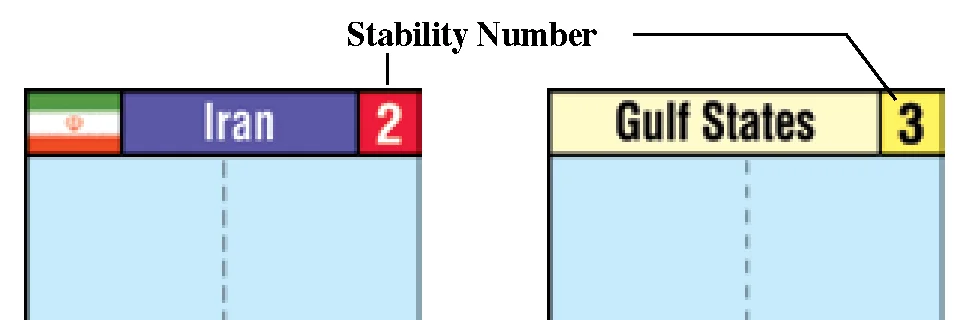
Superpower Spaces and Connections
The United States and Soviet Union map spaces are out of play for Influence Markers, but are considered “adjacent controlled countries” for events and realignments.
Countries are linked by colored lines:
- Brown lines: Connections within a single region.
- Red dashed lines: Connections across different regions.
- Black lines: Direct connections between countries and superpowers.
A country is considered adjacent to all countries to which it connects.
Controlling Countries
A country is Controlled by a player if and only if:
- The player’s Influence points in the country are at least equal to its Stability Number; and
- The player’s Influence exceeds the opponent’s Influence by at least the country’s Stability Number.
Example: Israel has Stability 4. To control it, a player must have at least 4 Influence and lead by 4 or more over the opponent.
Cards
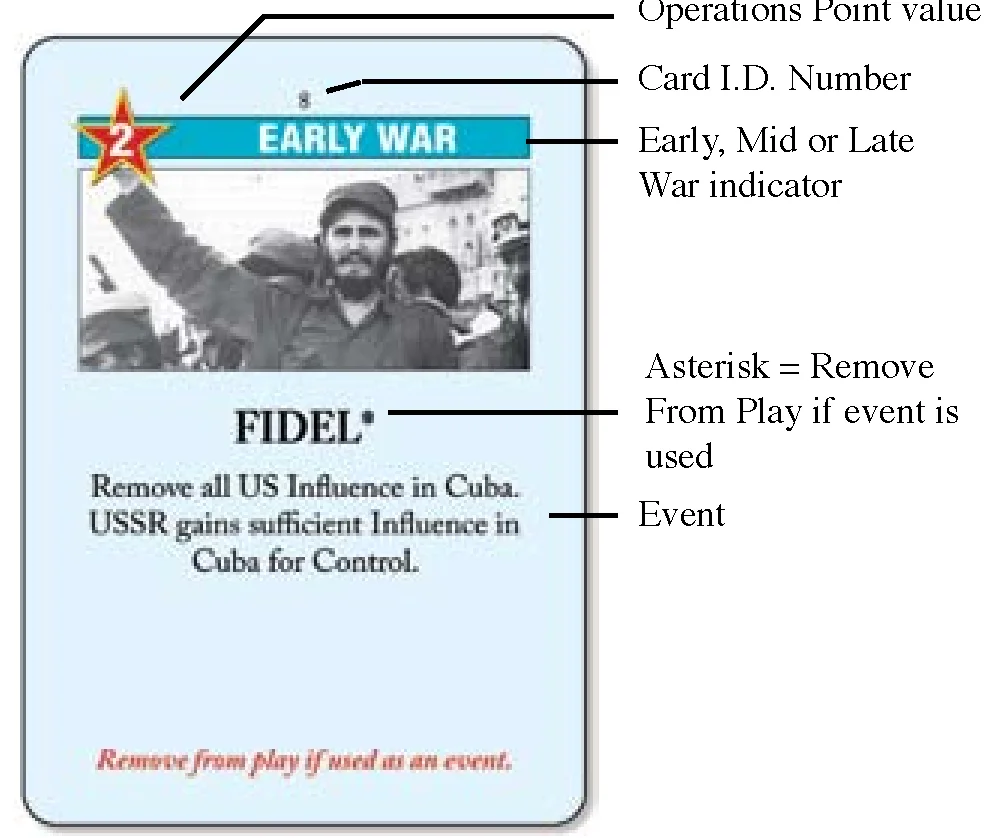
- Composition: 110 cards, each containing Operations Points, an Event Title, and Event Text. Scoring cards must be played during the turn drawn.
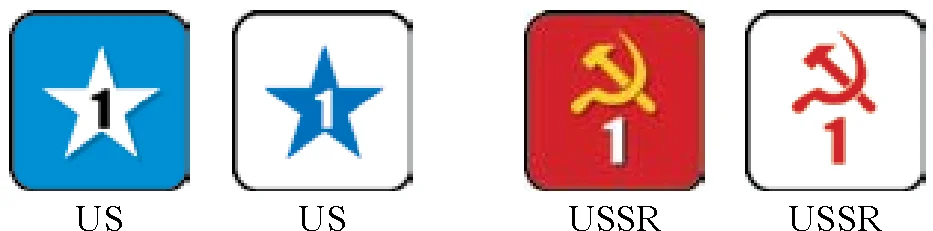
- Superpower Association:
- Red star: USSR Event.
- White star: US Event.
- Split Red/White star: Neutral / Dual Event.
- Play Modes: Cards are played either as Events or for Operations.
- Asterisk (*): Cards with an asterisk after the title are permanently removed from play when triggered as Events.
- Underlined Events: Remain face-up in effect until cancelled or game end.
- Discards: Placed face-up in the discard pile next to the draw deck.
Markers
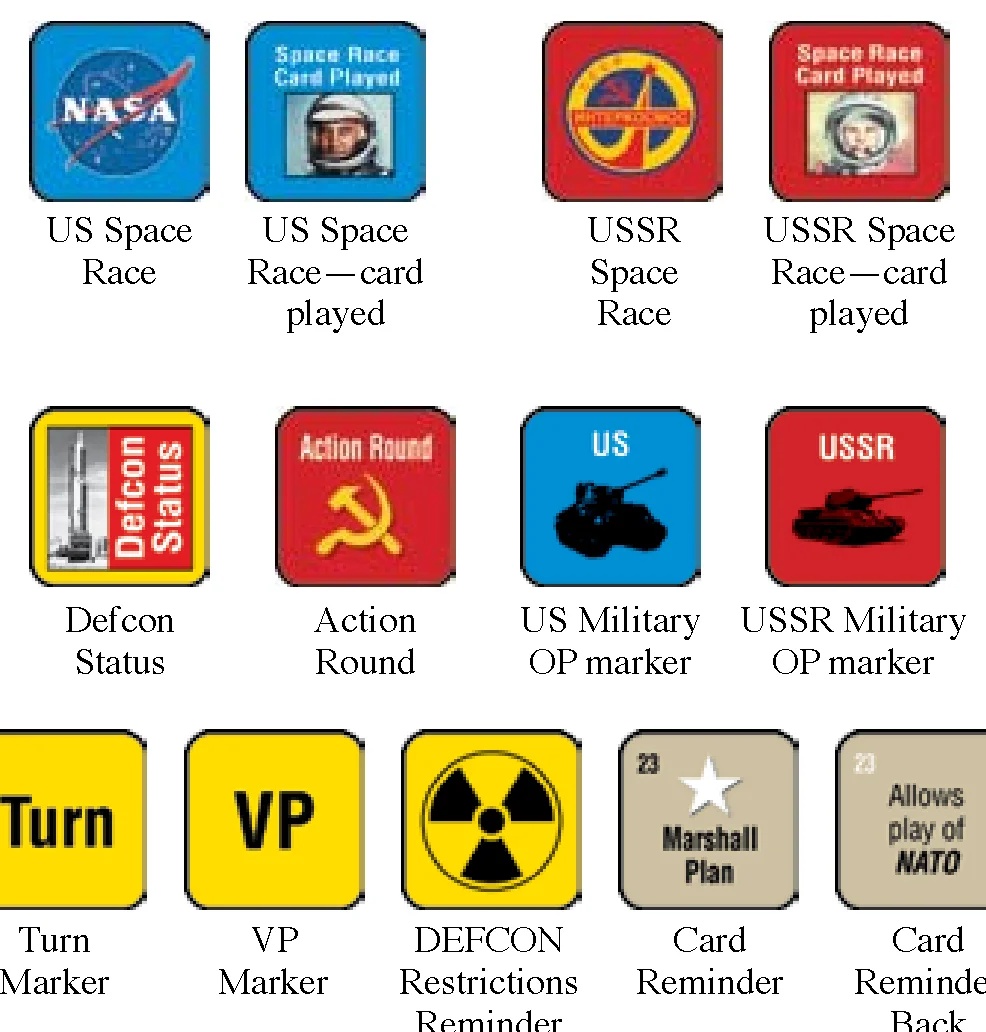
Includes Turn, VP, DEFCON, Space Race, Military Operations, Action Round, and Reminder markers.
Game Setup
- Cards: Shuffle Early War cards and deal 8 to each player. Place The China Card face up with the USSR player. Players examine hands before setup.
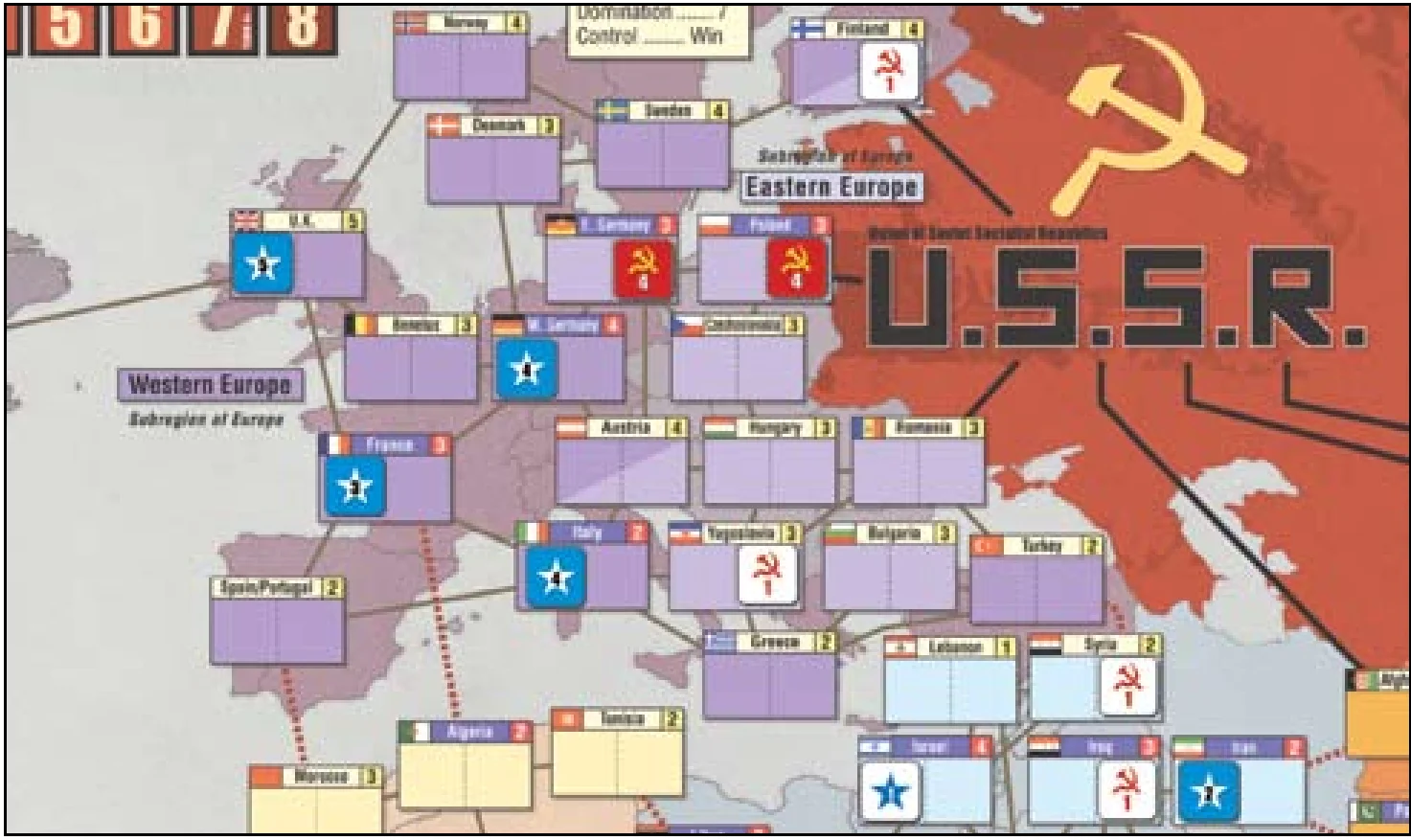
- USSR Setup: Places 15 Influence markers:
- 1 in Syria
- 1 in Iraq
- 3 in North Korea
- 3 in East Germany
- 1 in Finland
- 6 anywhere in Eastern Europe
- US Setup: Places 25 Influence markers:
- 2 in Canada
- 1 in Iran
- 1 in Israel
- 1 in Japan
- 4 in Australia
- 1 in the Philippines
- 1 in South Korea
- 1 in Panama
- 1 in South Africa
- 5 in the United Kingdom
- 7 anywhere in Western Europe
- Tracks:
- Space Race markers start to the left of the track.
- Military OP markers at 0.
- Turn marker on space 1.
- DEFCON marker on space 5.
- VP marker on space 0 (At Start).
Game Sequence
The game lasts 10 turns (Turns 1–3: Early War; Turns 4–7: Mid War; Turns 8–10: Late War). Each turn follows these phases:
- A. Improve DEFCON Status: If below 5, increase DEFCON by 1 toward peace.
- B. Deal Cards: Bring hand size to 8 (Turns 1–3) or 9 (Turns 4–10). (The China Card is separate).
- C. Headline Phase: Both players secretly select a card and reveal simultaneously. The card with higher Operations value takes effect first (ties go to US). Scoring cards have value 0 and take effect second. If playing opponent’s event, opponent executes it, but phasing player is responsible for DEFCON.
- D. Action Rounds: 6 rounds in Turns 1–3; 7 rounds in Turns 4–10. USSR always acts first, then US. Players alternate playing 1 card per round. Unplayed card is held (scoring cards cannot be held).
- E. Check Military Operations Phase: Compare Military Ops against DEFCON requirement. Deficits award VPs directly to the opponent. Reset Mil Ops to 0.
- F. Reveal Held Card: (Tournament play) Confirm no scoring cards are withheld.
- G. Flip ‘The China Card’: If passed face-down this turn, flip face-up.
- H. Advance Turn Marker: Shuffle Mid War deck into draw deck at end of Turn 3; Late War deck at end of Turn 7.
- I. Final Scoring: After Turn 10, all regions are scored.
Card Play Rules
- Play Choice: Played as Operations or Events. Cards cannot simply be passed or discarded without effect.
- Opponent’s Events: Playing a card containing an opponent’s event for Operations still triggers that Event. The phasing player chooses whether the Event occurs before or after conducting the Operations. If conditions/prerequisites are not met, the event does not trigger (asterisked card goes to discard).
- Card Value Requirements: When an event requires discarding a card of specific value, higher-value cards are valid.
- Forced Discards: Event text on discarded cards does not take effect.
- Card Precedence: Card text supersedes written rules.
Operations Actions
Operations points may be spent on exactly one of four actions per card play:
1. Placing Influence Markers
- Placed one at a time with or adjacent to existing friendly influence present at the start of the action round (or connected to home superpower).
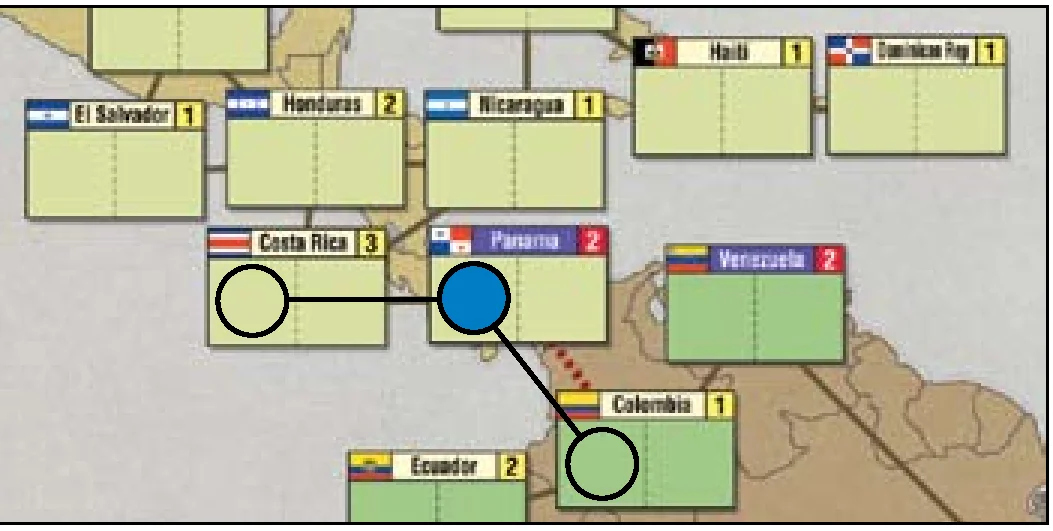
- Cost: 1 OP per marker in friendly or uncontrolled countries; 2 OPs per marker in enemy-controlled countries (drops to 1 once control is broken).
2. Realignment Rolls
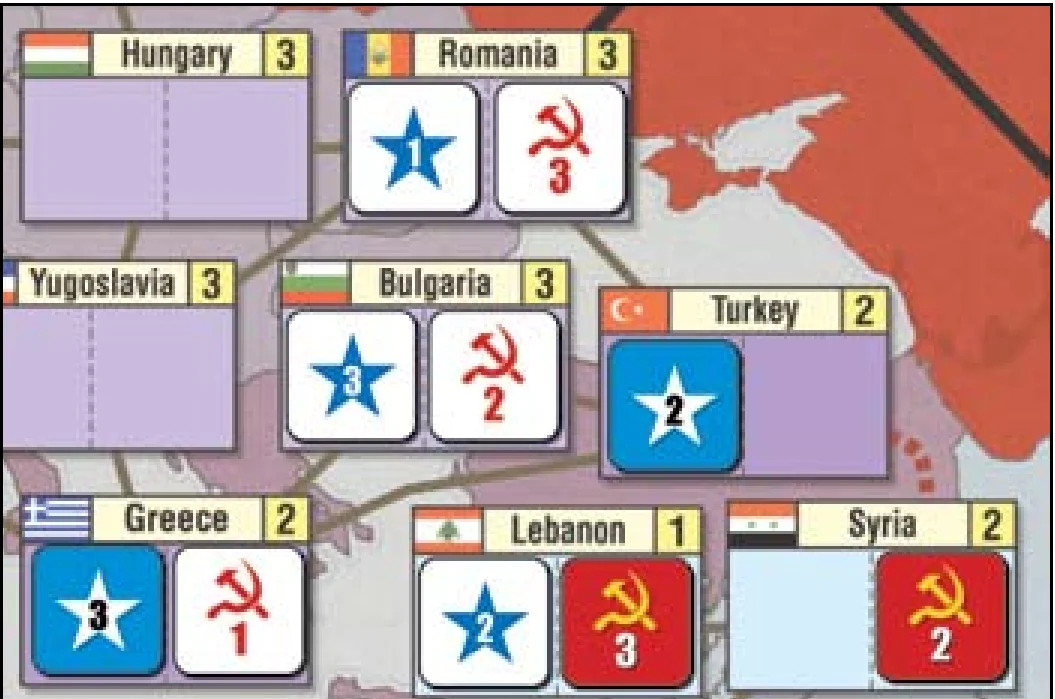
- Used to reduce opponent’s Influence. Costs 1 OP per roll. Target country need not have friendly influence.
- Both players roll 1d6. High roller removes difference in rolls from opponent’s Influence in target.
- Modifiers: +1 per adjacent controlled country; +1 if having more influence in target; +1 if home superpower is adjacent. Ties: no effect.
3. Coup Attempts
- Costs OP value of the card. Target must contain opponent Influence.
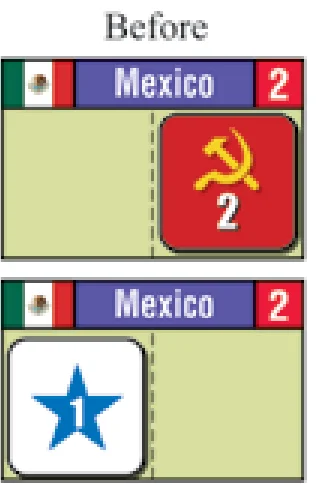
- Resolution: Roll 1d6 + Card OP value. If result exceeds
(Target Stability × 2), remove opponent influence equal to difference. Any excess difference adds friendly influence. - Advance Military Operations marker by card’s OP value.
- DEFCON Impact: Coups in Battleground countries degrade DEFCON by 1.
4. The Space Race
- Spend card with OP value equal to or greater than track box requirement, roll 1d6 in required range to advance.
- Limited to 1 attempt per turn (unless modified by special ability).
- Events on discarded cards are ignored (serves as a safety valve for hostile events).
- Awards VPs (first/second) and persistent special perks (cancelled when second player reaches that space):
- Space 2 (Animal in Space): May attempt Space Race twice per turn.
- Space 4 (Man in Orbit): Opponent must reveal Headline card first.
- Space 6 (Eagle/Bear Landed): May discard held card at end of turn.
- Space 8 (Space Station): May play 8 Action Rounds per turn.
Events
- Friendly and neutral events take effect according to card text.
- Permanent Events: Underlined cards remain active for the game.
- Operations Modifiers: Cumulative effects affecting subsequent card OP values.
- War Events: Korean War, Arab-Israeli War, Indo-Pakistani War, Brush War, Iran-Iraq War provide Mil Ops and possible VPs regardless of influence presence.
DEFCON Track
Ranges from 5 (Peace) to 1 (Nuclear War). Reaching DEFCON 1 ends the game immediately; the phasing player loses.
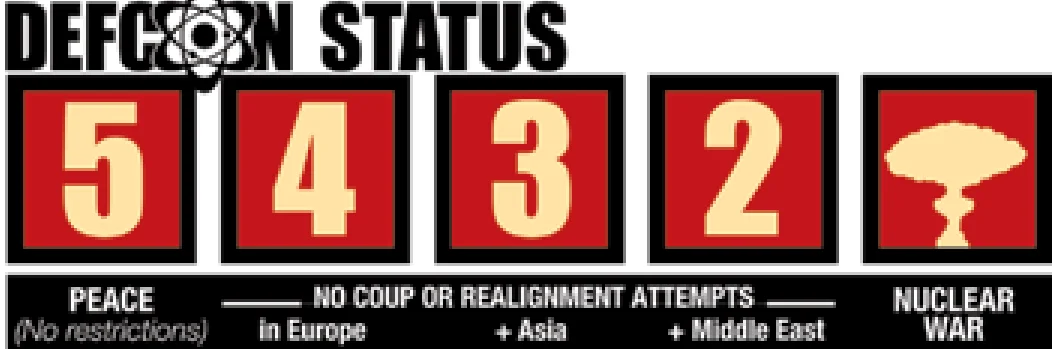
- DEFCON 5: No restrictions.
- DEFCON 4: No Coups or Realignments in Europe.
- DEFCON 3: No Coups or Realignments in Europe or Asia.
- DEFCON 2: No Coups or Realignments in Europe, Asia, or Middle East.
- DEFCON 1: Nuclear war. Phasing player responsible loses immediately.
Required Military Operations
- Each turn, required Mil Ops equal the current DEFCON level.
- Earned by conducting Coups or playing War cards.
- Each point lacking awards 1 VP to opponent at phase E.
The China Card Rules
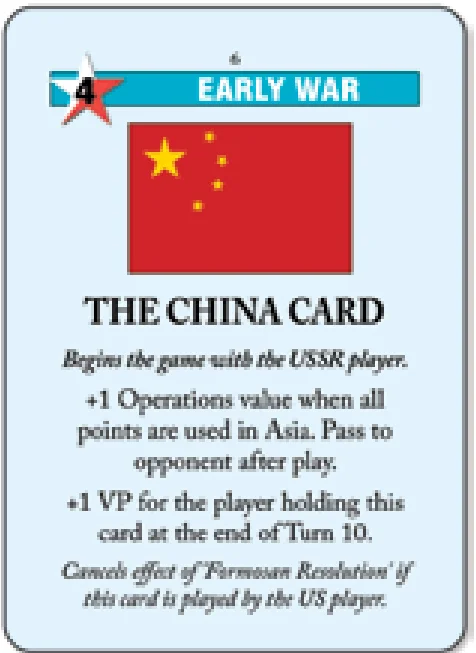
- Starts face-up with USSR. Can be played as an Action Round card; does not count against hand size.
- When played, passes face-down to opponent (cannot be played same turn; flips face-up at turn end).
- Provides +1 OP bonus if all points are spent in Asia/Southeast Asia.
- Cannot be played during Headline phase or discarded to satisfy event conditions.
Regional Scoring Levels
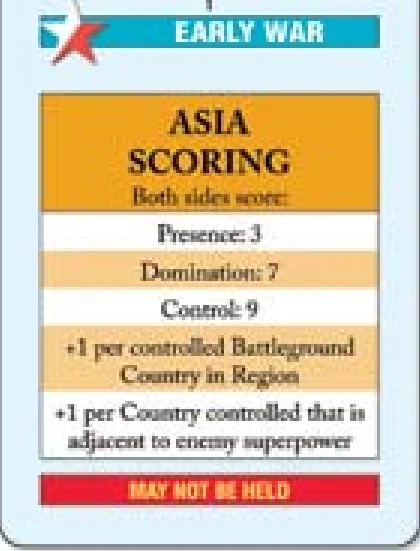
- Presence: Superpower controls at least 1 country in the Region.
- Domination: Controls more total countries AND more Battleground countries than opponent, including at least one Battleground and one non-Battleground.
- Control: Controls more countries than opponent AND controls all Battleground countries in the Region.
- Bonuses: +1 VP per controlled Battleground; +1 VP per controlled country adjacent to enemy superpower.
Victory Point Track
Ranging from -20 (USSR Win) to +20 (US Win), beginning at 0.
Victory Conditions
- Automatic Victory: Reaching +20 VP (US) or -20 VP (USSR); controlling Europe when Europe Scoring is resolved; opponent triggering DEFCON 1.
- End Game Victory: Following Turn 10 final scoring of all regions, highest score wins (positive = US, negative = USSR, 0 = Draw). Europe Control still yields instant win.
Tournament Play
- Held cards revealed at end of turn; holding scoring card causes immediate loss.
- Deal cards alternating starting with USSR.
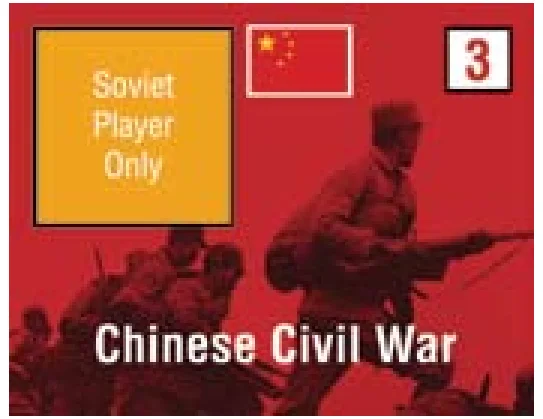
Chinese Civil War Variant
Adds a 3-box space adjacent to USSR only. USSR must invest 3 Influence to claim The China Card; restricts certain China-related events until resolved.
A Late War Scenario (1975–1989)
By Volko Ruhnke (C3i Magazine #19)
- Begins on Turn 8 with DEFCON at 4, VP at -4, USSR holding China Card.
- Specific starting control across regions reflects post-Vietnam balance of power.
- US must reach 20+ VPs by final scoring (or play Wargames) to win; otherwise USSR wins.
Designer Optional Rules
- Realignment Variant: Remove DEFCON geographic restrictions; phasing player cannot lose influence.
- Space Race Variant: Player dumping card may choose not to roll.
Tournament Match Overview
Tournament final match between Chris Withers (USSR) and Stefan Mecay (US).
Turn 1
US headlines Mideast Scoring, USSR headlines Olympic Games. USSR coups Iran to lock down Middle East access. US pushes into Southeast Asia and South America.
Turn 2
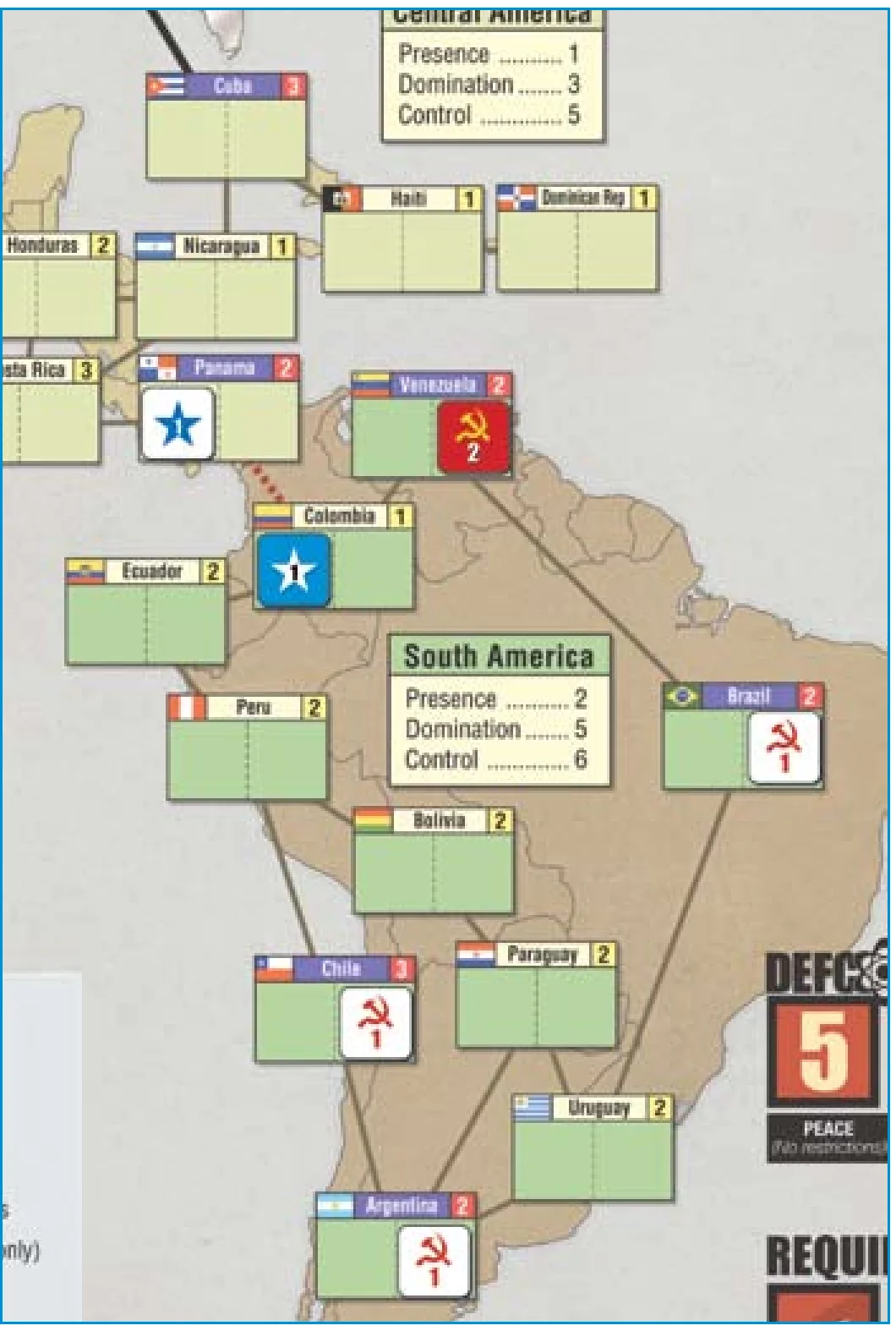
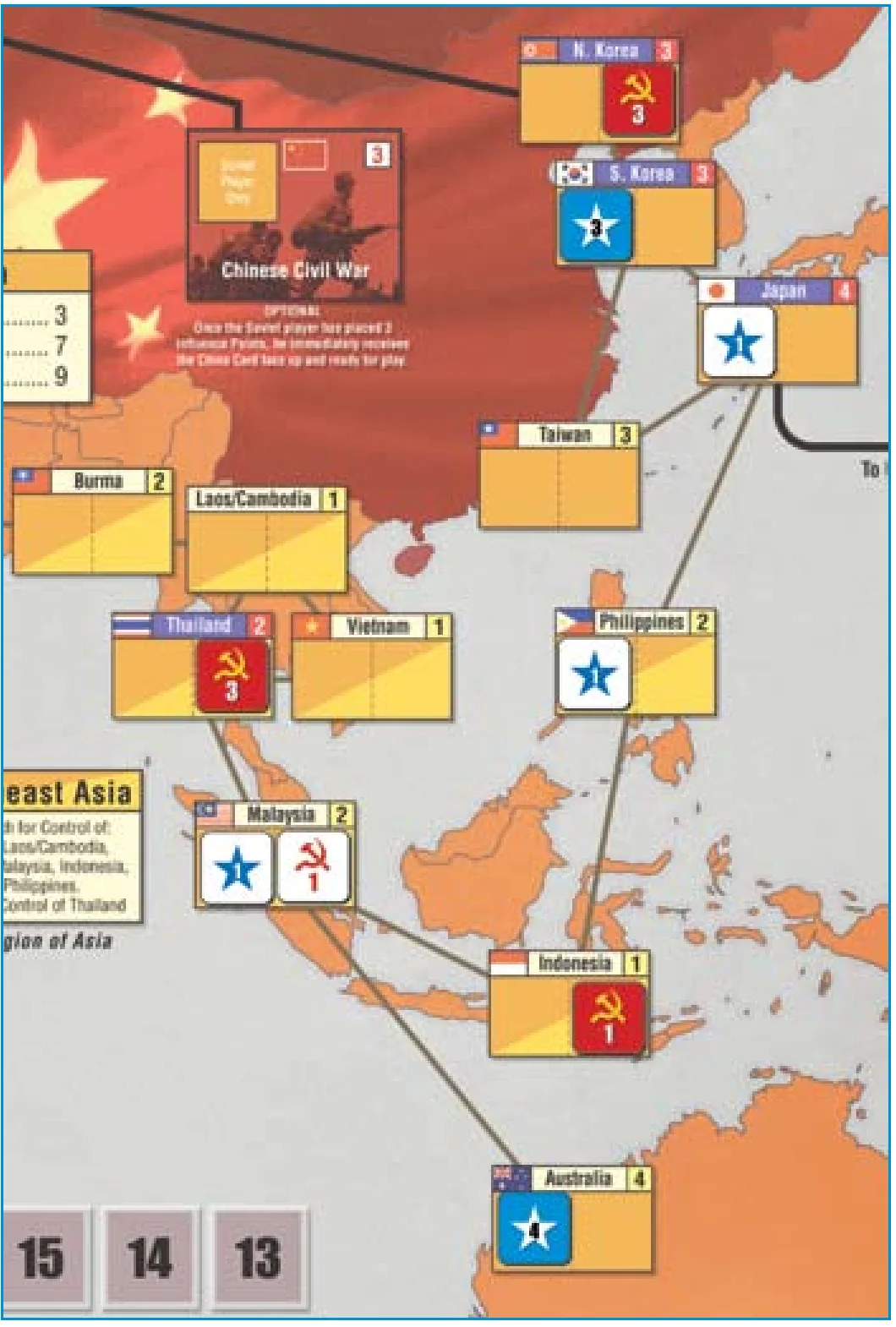
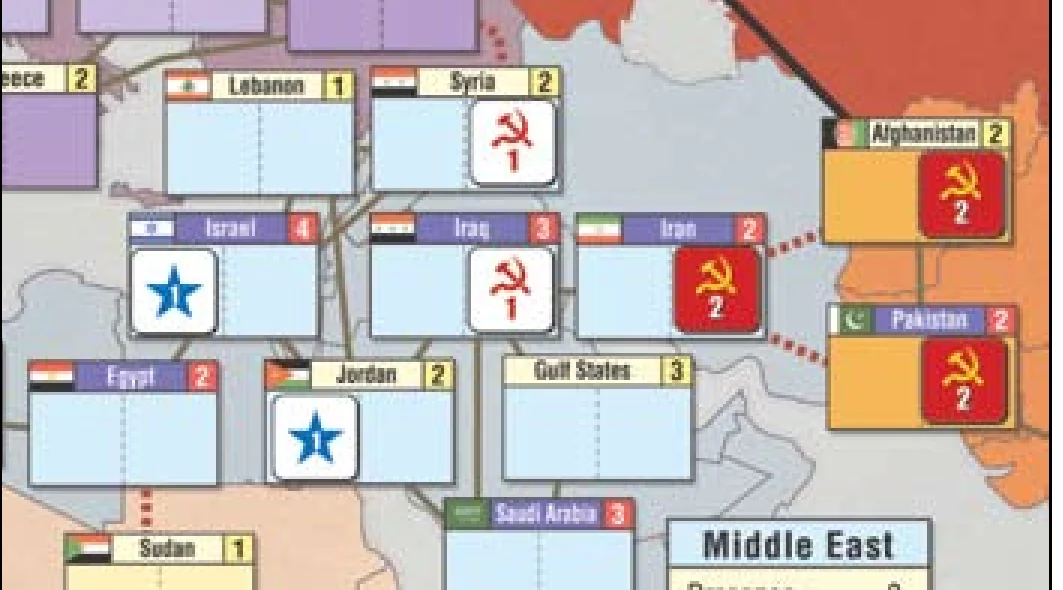
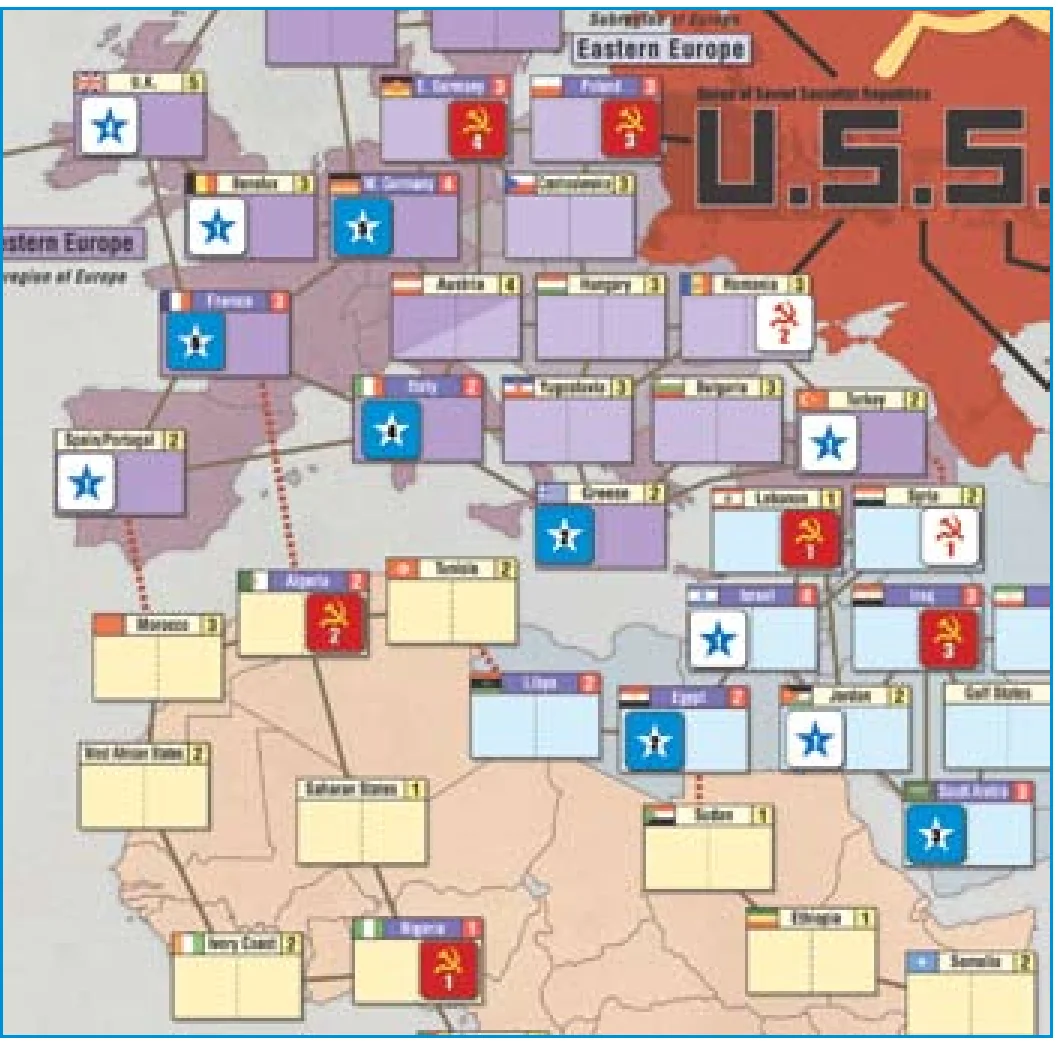
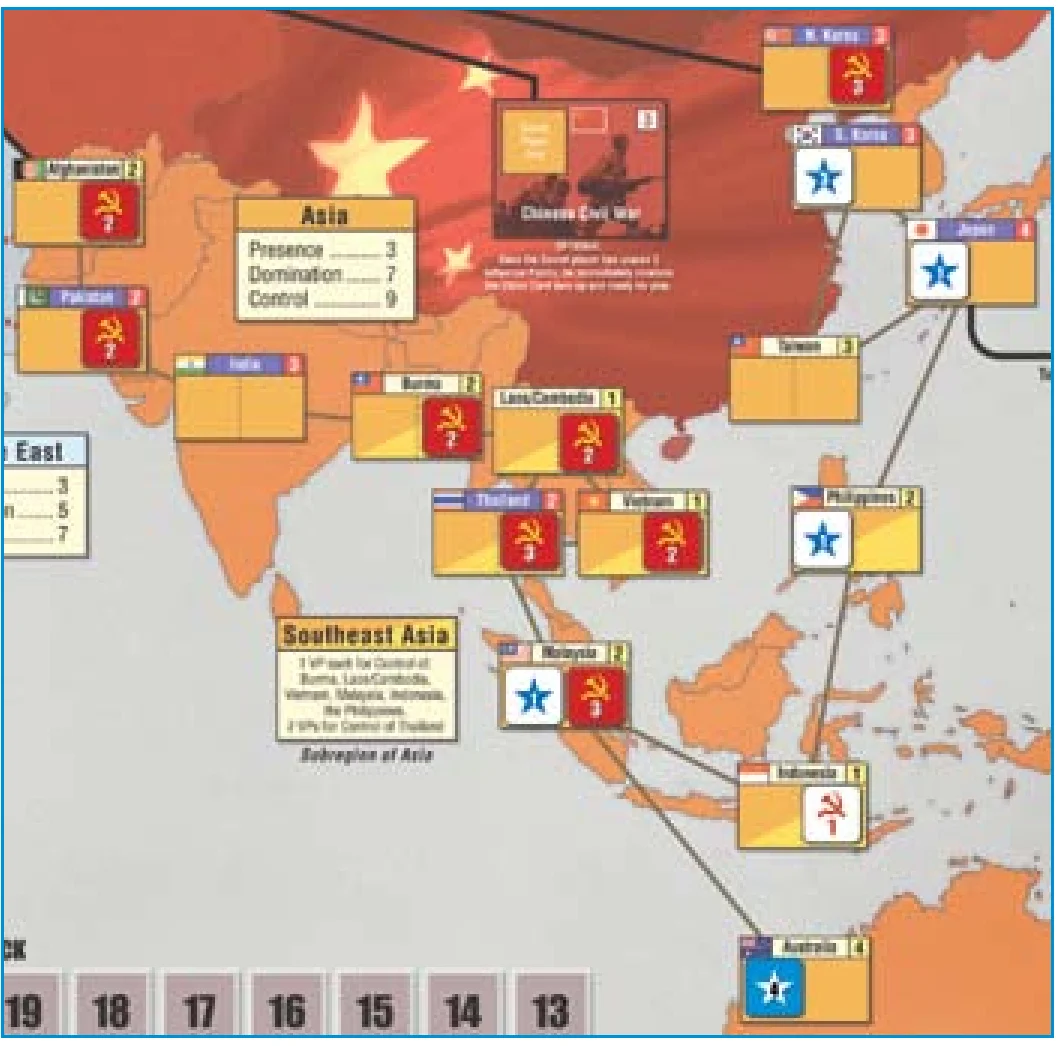
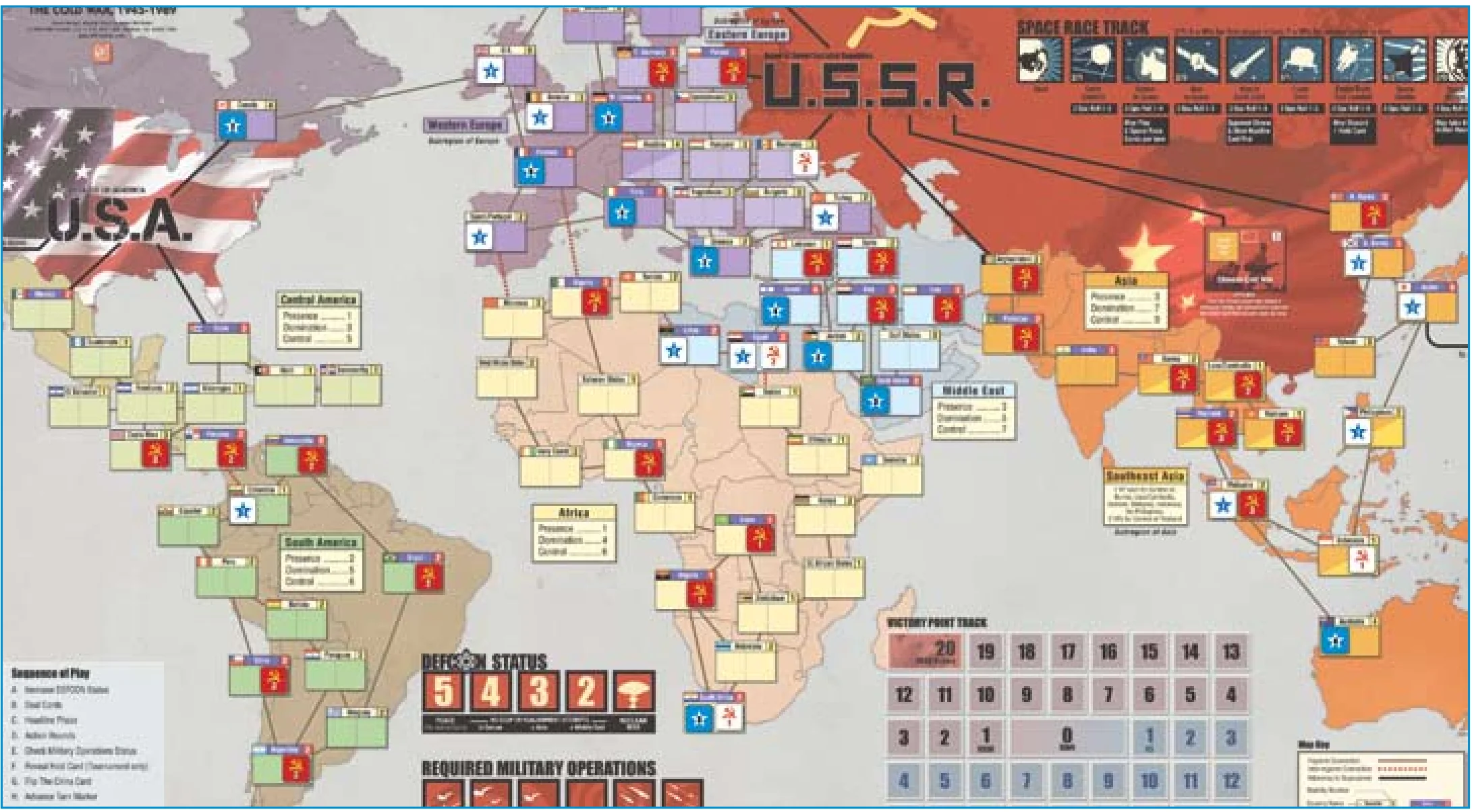
USSR headlines Red Scare; US fails Indo-Pakistani War roll. USSR expands influence in Latin America, Asia, and Africa. US maneuvers in Middle East and Africa.
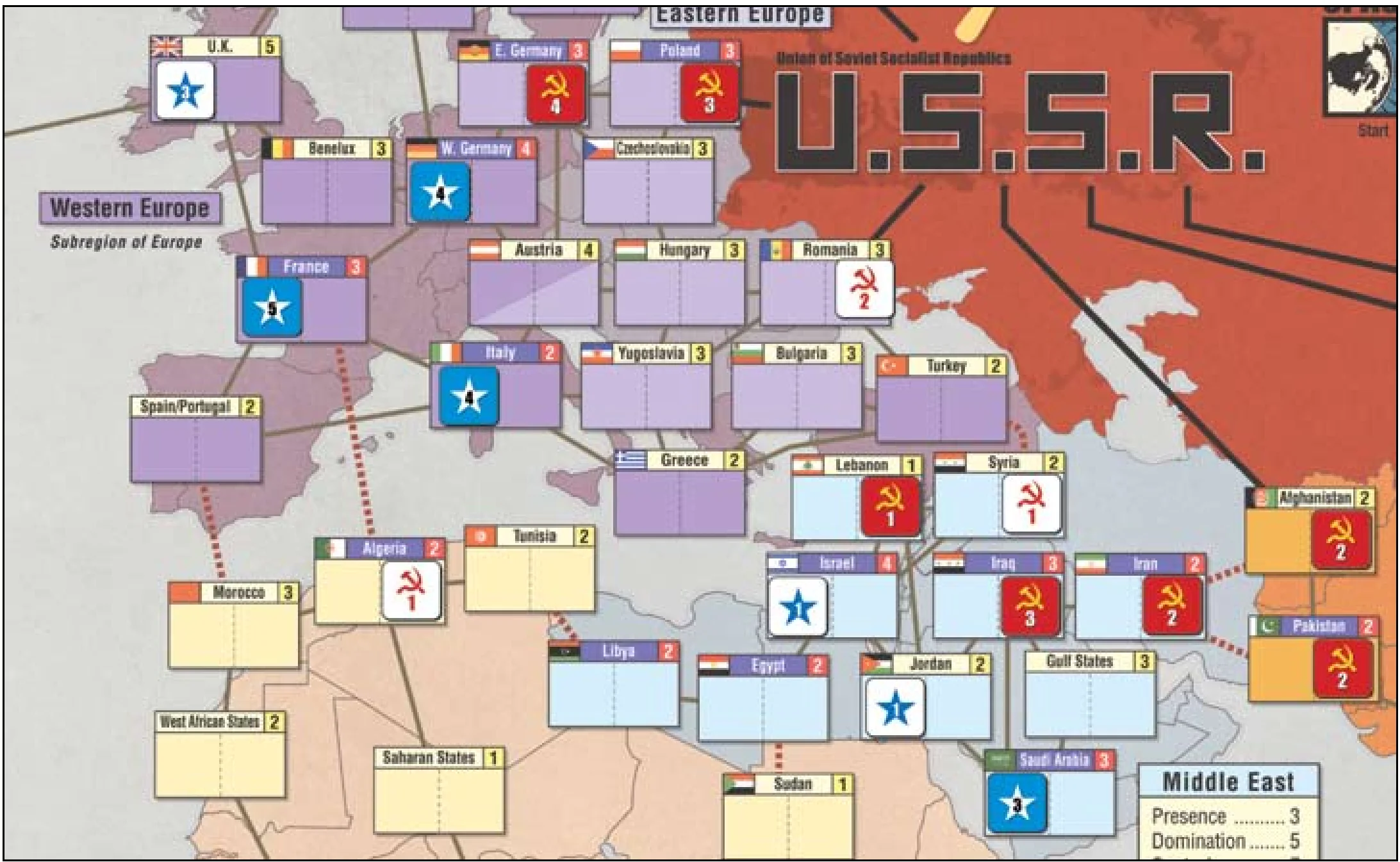
Turn 3
US headlines Marshall Plan to fortify Western Europe; USSR plays Decolonization. Both sides score key regions.
Card Histories
Historical background notes detailing the real-world events behind cards across Early, Mid, and Late War periods:
- Asia / Europe / Mideast Scoring: Key theaters of ideological confrontation and geopolitical conflict.
- Duck and Cover & Five Year Plan: Cold war civil defense programs and Soviet centralized economic planning.
- The China Card & Socialist Governments: Geopolitical balance shifts, Chinese civil war, and post-war leftist politics in Western Europe.
- Fidel, Blockade, Korean War: Cuban revolution, Berlin Airlift crisis of 1948–49, and the first major armed conflict sanctioned by the UN.
- Truman Doctrine, Marshall Plan, NATO, Warsaw Pact: Institutional architecture of containment, reconstruction, and competing military alliances.
- Cuban Missile Crisis, Quagmire, Bear Trap: Nuclear brinkmanship in 1962 and proxy quagmires in Vietnam and Afghanistan.
- SALT, ABM Treaty, Star Wars: Bilateral arms limitation frameworks and the Strategic Defense Initiative.
- Solidarity, Glasnost, “Tear Down This Wall”: The internal unraveling of the Soviet bloc and conclusion of the Cold War.
Designer’s Notes
“Twilight Struggle represents a bit of Cold War nostalgia… fighting for cherished principle against an enemy that we understood.”
The designers recount creating a fast, tense card-driven game balancing historical flavor and competitive playability. Key mechanical choices—including the domino influence mechanics, the DEFCON tension dynamic, and the Space Race safety valve—reflect the underlying psychology and brinkmanship of the era.
Credits
Designers: Jason Matthews & Ananda Gupta. Art: Rodger MacGowan. Map: Mark Simonitch & Guillaume Ries.
Introduction & Overview
Twilight Struggle: The Cold War, 1945–1989
Deluxe Edition / 2nd Edition
By Jason Matthews & Ananda Gupta
© 2007 GMT Games, LLC
“Now the trumpet summons us again — not as a call to bear arms, though arms we need, not as a call to battle, though embattled we are — but a call to bear the burden of a long twilight struggle…”
— John F. Kennedy, Inaugural Speech, January 1961
In 1945, unlikely allies slew the Nazi beast, while humanity’s most devastating weapons forced the proud Japanese Empire to its knees in a storm of fire. Where once there stood many great powers, now stood only two. The world had scant time to sigh relief before a new conflict threatened. Unlike the titanic conflicts of the preceding decades, this conflict would be waged primarily not by soldiers and tanks, but by spies and politicians, scientists and intellectuals, artists and traitors.
Twilight Struggle is a two-player game simulating the forty-five-year dance of intrigue, prestige, and occasional flares of warfare between the Soviet Union and the United States. The entire world is the stage on which these two titans fight to make the world safe for their own ideologies and ways of life. The game begins amidst the ruins of Europe as the two new ‘superpowers’ struggle over the wreckage of the Second World War, and ends in 1989, when only the United States remained standing.
Twilight Struggle inherits its fundamental systems from the card-driven classics We the People and Hannibal: Rome vs. Carthage. It is a quick-playing, low-complexity game in that tradition. Event cards cover a vast array of historical happenings, from the Arab-Israeli conflicts of 1948 and 1967, to Vietnam and the U.S. peace movement, to the Cuban Missile Crisis and other such incidents that brought the world to the brink of nuclear annihilation. Subsystems capture the prestige-laden Space Race as well as nuclear tensions, with the possibility of nuclear war ending the game.
These rules are organized into numbered sections and subsections. Terms that have specialized meaning, such as ‘Influence’ or ‘Battleground’, are consistently capitalized.
Components & Map Board
Game Components
A complete game of Twilight Struggle includes:
- One 22” by 34” Map Board
- Two sheets of markers
- One Rules Booklet
- Two Player Aid Cards
- 110 Cards
- Two 6-sided dice
The Game Map
“From Stettin in the Baltic to Trieste in the Adriatic, an iron curtain has descended across the continent.”
— Winston Churchill
Regions and Sub-regions
The map is divided into six Regions: Europe, Asia, Central America, South America, Africa, and the Middle East.
- Europe is divided into Eastern Europe and Western Europe. Historically neutral countries (Austria and Finland) are categorized as being in both Eastern and Western Europe.
- Asia contains the Southeast Asia sub-region.
- Country spaces of a region share a color tint; sub-regions have distinct shades.
- Design Note: The Middle East includes Libya and Egypt; Canada and Turkey are included in Europe.
- Any event, rule, action, or card referring to ‘Europe’ or ‘Asia’ includes their associated sub-regions.
Countries, Stability, and Battlegrounds
Each space represents a country or bloc of countries with a Stability Number denoting its overall stability, independence, and power.
Names highlighted in purple indicate Battleground countries, which possess special significance for regional scoring and Coup attempts. Non-battleground countries have names on white.
Superpower Spaces and Connections
The United States and Soviet Union map spaces are out of play for Influence Markers, but are considered “adjacent controlled countries” for events and realignments.
Countries are linked by colored lines:
- Brown lines: Connections within a single region.
- Red dashed lines: Connections across different regions.
- Black lines: Direct connections between countries and superpowers.
A country is considered adjacent to all countries to which it connects.
Controlling Countries
A country is Controlled by a player if and only if:
- The player’s Influence points in the country are at least equal to its Stability Number; and
- The player’s Influence exceeds the opponent’s Influence by at least the country’s Stability Number.
Example: Israel has Stability 4. To control it, a player must have at least 4 Influence and lead by 4 or more over the opponent.
Cards
- Composition: 110 cards, each containing Operations Points, an Event Title, and Event Text. Scoring cards must be played during the turn drawn.
- Superpower Association:
- Red star: USSR Event.
- White star: US Event.
- Split Red/White star: Neutral / Dual Event.
- Play Modes: Cards are played either as Events or for Operations.
- Asterisk (*): Cards with an asterisk after the title are permanently removed from play when triggered as Events.
- Underlined Events: Remain face-up in effect until cancelled or game end.
- Discards: Placed face-up in the discard pile next to the draw deck.
Markers
Includes Turn, VP, DEFCON, Space Race, Military Operations, Action Round, and Reminder markers.
Setup
Game Setup
- Cards: Shuffle Early War cards and deal 8 to each player. Place The China Card face up with the USSR player. Players examine hands before setup.
- USSR Setup: Places 15 Influence markers:
- 1 in Syria
- 1 in Iraq
- 3 in North Korea
- 3 in East Germany
- 1 in Finland
- 6 anywhere in Eastern Europe
- US Setup: Places 25 Influence markers:
- 2 in Canada
- 1 in Iran
- 1 in Israel
- 1 in Japan
- 4 in Australia
- 1 in the Philippines
- 1 in South Korea
- 1 in Panama
- 1 in South Africa
- 5 in the United Kingdom
- 7 anywhere in Western Europe
- Tracks:
- Space Race markers start to the left of the track.
- Military OP markers at 0.
- Turn marker on space 1.
- DEFCON marker on space 5.
- VP marker on space 0 (At Start).
Turn Structure
Game Sequence
The game lasts 10 turns (Turns 1–3: Early War; Turns 4–7: Mid War; Turns 8–10: Late War). Each turn follows these phases:
- A. Improve DEFCON Status: If below 5, increase DEFCON by 1 toward peace.
- B. Deal Cards: Bring hand size to 8 (Turns 1–3) or 9 (Turns 4–10). (The China Card is separate).
- C. Headline Phase: Both players secretly select a card and reveal simultaneously. The card with higher Operations value takes effect first (ties go to US). Scoring cards have value 0 and take effect second. If playing opponent’s event, opponent executes it, but phasing player is responsible for DEFCON.
- D. Action Rounds: 6 rounds in Turns 1–3; 7 rounds in Turns 4–10. USSR always acts first, then US. Players alternate playing 1 card per round. Unplayed card is held (scoring cards cannot be held).
- E. Check Military Operations Phase: Compare Military Ops against DEFCON requirement. Deficits award VPs directly to the opponent. Reset Mil Ops to 0.
- F. Reveal Held Card: (Tournament play) Confirm no scoring cards are withheld.
- G. Flip ‘The China Card’: If passed face-down this turn, flip face-up.
- H. Advance Turn Marker: Shuffle Mid War deck into draw deck at end of Turn 3; Late War deck at end of Turn 7.
- I. Final Scoring: After Turn 10, all regions are scored.
Card Play & Operations
Card Play Rules
- Play Choice: Played as Operations or Events. Cards cannot simply be passed or discarded without effect.
- Opponent’s Events: Playing a card containing an opponent’s event for Operations still triggers that Event. The phasing player chooses whether the Event occurs before or after conducting the Operations. If conditions/prerequisites are not met, the event does not trigger (asterisked card goes to discard).
- Card Value Requirements: When an event requires discarding a card of specific value, higher-value cards are valid.
- Forced Discards: Event text on discarded cards does not take effect.
- Card Precedence: Card text supersedes written rules.
Operations Actions
Operations points may be spent on exactly one of four actions per card play:
1. Placing Influence Markers
- Placed one at a time with or adjacent to existing friendly influence present at the start of the action round (or connected to home superpower).
- Cost: 1 OP per marker in friendly or uncontrolled countries; 2 OPs per marker in enemy-controlled countries (drops to 1 once control is broken).
2. Realignment Rolls
- Used to reduce opponent’s Influence. Costs 1 OP per roll. Target country need not have friendly influence.
- Both players roll 1d6. High roller removes difference in rolls from opponent’s Influence in target.
- Modifiers: +1 per adjacent controlled country; +1 if having more influence in target; +1 if home superpower is adjacent. Ties: no effect.
3. Coup Attempts
- Costs OP value of the card. Target must contain opponent Influence.
- Resolution: Roll 1d6 + Card OP value. If result exceeds
(Target Stability × 2), remove opponent influence equal to difference. Any excess difference adds friendly influence. - Advance Military Operations marker by card’s OP value.
- DEFCON Impact: Coups in Battleground countries degrade DEFCON by 1.
4. The Space Race
- Spend card with OP value equal to or greater than track box requirement, roll 1d6 in required range to advance.
- Limited to 1 attempt per turn (unless modified by special ability).
- Events on discarded cards are ignored (serves as a safety valve for hostile events).
- Awards VPs (first/second) and persistent special perks (cancelled when second player reaches that space):
- Space 2 (Animal in Space): May attempt Space Race twice per turn.
- Space 4 (Man in Orbit): Opponent must reveal Headline card first.
- Space 6 (Eagle/Bear Landed): May discard held card at end of turn.
- Space 8 (Space Station): May play 8 Action Rounds per turn.
Events
- Friendly and neutral events take effect according to card text.
- Permanent Events: Underlined cards remain active for the game.
- Operations Modifiers: Cumulative effects affecting subsequent card OP values.
- War Events: Korean War, Arab-Israeli War, Indo-Pakistani War, Brush War, Iran-Iraq War provide Mil Ops and possible VPs regardless of influence presence.
DEFCON & Military Operations
DEFCON Track
Ranges from 5 (Peace) to 1 (Nuclear War). Reaching DEFCON 1 ends the game immediately; the phasing player loses.
- DEFCON 5: No restrictions.
- DEFCON 4: No Coups or Realignments in Europe.
- DEFCON 3: No Coups or Realignments in Europe or Asia.
- DEFCON 2: No Coups or Realignments in Europe, Asia, or Middle East.
- DEFCON 1: Nuclear war. Phasing player responsible loses immediately.
Required Military Operations
- Each turn, required Mil Ops equal the current DEFCON level.
- Earned by conducting Coups or playing War cards.
- Each point lacking awards 1 VP to opponent at phase E.
The China Card
The China Card Rules
- Starts face-up with USSR. Can be played as an Action Round card; does not count against hand size.
- When played, passes face-down to opponent (cannot be played same turn; flips face-up at turn end).
- Provides +1 OP bonus if all points are spent in Asia/Southeast Asia.
- Cannot be played during Headline phase or discarded to satisfy event conditions.
Scoring & Victory
Regional Scoring Levels
- Presence: Superpower controls at least 1 country in the Region.
- Domination: Controls more total countries AND more Battleground countries than opponent, including at least one Battleground and one non-Battleground.
- Control: Controls more countries than opponent AND controls all Battleground countries in the Region.
- Bonuses: +1 VP per controlled Battleground; +1 VP per controlled country adjacent to enemy superpower.
Victory Point Track
Ranging from -20 (USSR Win) to +20 (US Win), beginning at 0.
Victory Conditions
- Automatic Victory: Reaching +20 VP (US) or -20 VP (USSR); controlling Europe when Europe Scoring is resolved; opponent triggering DEFCON 1.
- End Game Victory: Following Turn 10 final scoring of all regions, highest score wins (positive = US, negative = USSR, 0 = Draw). Europe Control still yields instant win.
Variants & Scenarios
Tournament Play
- Held cards revealed at end of turn; holding scoring card causes immediate loss.
- Deal cards alternating starting with USSR.
Chinese Civil War Variant
Adds a 3-box space adjacent to USSR only. USSR must invest 3 Influence to claim The China Card; restricts certain China-related events until resolved.
A Late War Scenario (1975–1989)
By Volko Ruhnke (C3i Magazine #19)
- Begins on Turn 8 with DEFCON at 4, VP at -4, USSR holding China Card.
- Specific starting control across regions reflects post-Vietnam balance of power.
- US must reach 20+ VPs by final scoring (or play Wargames) to win; otherwise USSR wins.
Designer Optional Rules
- Realignment Variant: Remove DEFCON geographic restrictions; phasing player cannot lose influence.
- Space Race Variant: Player dumping card may choose not to roll.
Extended Example of Play
Tournament Match Overview
Tournament final match between Chris Withers (USSR) and Stefan Mecay (US).
Turn 1
US headlines Mideast Scoring, USSR headlines Olympic Games. USSR coups Iran to lock down Middle East access. US pushes into Southeast Asia and South America.
Turn 2
USSR headlines Red Scare; US fails Indo-Pakistani War roll. USSR expands influence in Latin America, Asia, and Africa. US maneuvers in Middle East and Africa.
Turn 3
US headlines Marshall Plan to fortify Western Europe; USSR plays Decolonization. Both sides score key regions.
Historical Background & Designer's Notes
Card Histories
Historical background notes detailing the real-world events behind cards across Early, Mid, and Late War periods:
- Asia / Europe / Mideast Scoring: Key theaters of ideological confrontation and geopolitical conflict.
- Duck and Cover & Five Year Plan: Cold war civil defense programs and Soviet centralized economic planning.
- The China Card & Socialist Governments: Geopolitical balance shifts, Chinese civil war, and post-war leftist politics in Western Europe.
- Fidel, Blockade, Korean War: Cuban revolution, Berlin Airlift crisis of 1948–49, and the first major armed conflict sanctioned by the UN.
- Truman Doctrine, Marshall Plan, NATO, Warsaw Pact: Institutional architecture of containment, reconstruction, and competing military alliances.
- Cuban Missile Crisis, Quagmire, Bear Trap: Nuclear brinkmanship in 1962 and proxy quagmires in Vietnam and Afghanistan.
- SALT, ABM Treaty, Star Wars: Bilateral arms limitation frameworks and the Strategic Defense Initiative.
- Solidarity, Glasnost, “Tear Down This Wall”: The internal unraveling of the Soviet bloc and conclusion of the Cold War.
Designer’s Notes
“Twilight Struggle represents a bit of Cold War nostalgia… fighting for cherished principle against an enemy that we understood.”
The designers recount creating a fast, tense card-driven game balancing historical flavor and competitive playability. Key mechanical choices—including the domino influence mechanics, the DEFCON tension dynamic, and the Space Race safety valve—reflect the underlying psychology and brinkmanship of the era.
Credits
Designers: Jason Matthews & Ananda Gupta. Art: Rodger MacGowan. Map: Mark Simonitch & Guillaume Ries.
Expansions for
Twilight Struggle
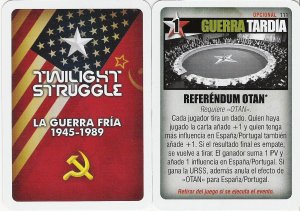
Twilight Struggle: “Referendum NATO” Promo Card
2012
A late-war NATO referendum decided by dice, influence, and a crucial VP.
Medium Heavy
View expansion
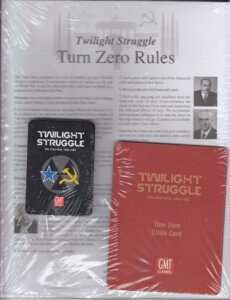
Twilight Struggle: Turn Zero and Promo Packs
2017
Expand the Cold War with new cards, alternate histories, and Turn Zero rules.
360
minutes
Medium Heavy
View expansion
Twilight Struggle: Turn Zero
2015
Rewrite the Cold War’s opening with alternate starting situations.
180
minutes
Medium

View expansion
