
Spirit Island
2017
A complex cooperative strategy game where spirits and islanders resist expanding colonial Invaders through powerful, carefully planned magic.
120
minutes
1 - 4
player(s)
13+
Heavy

About this board game
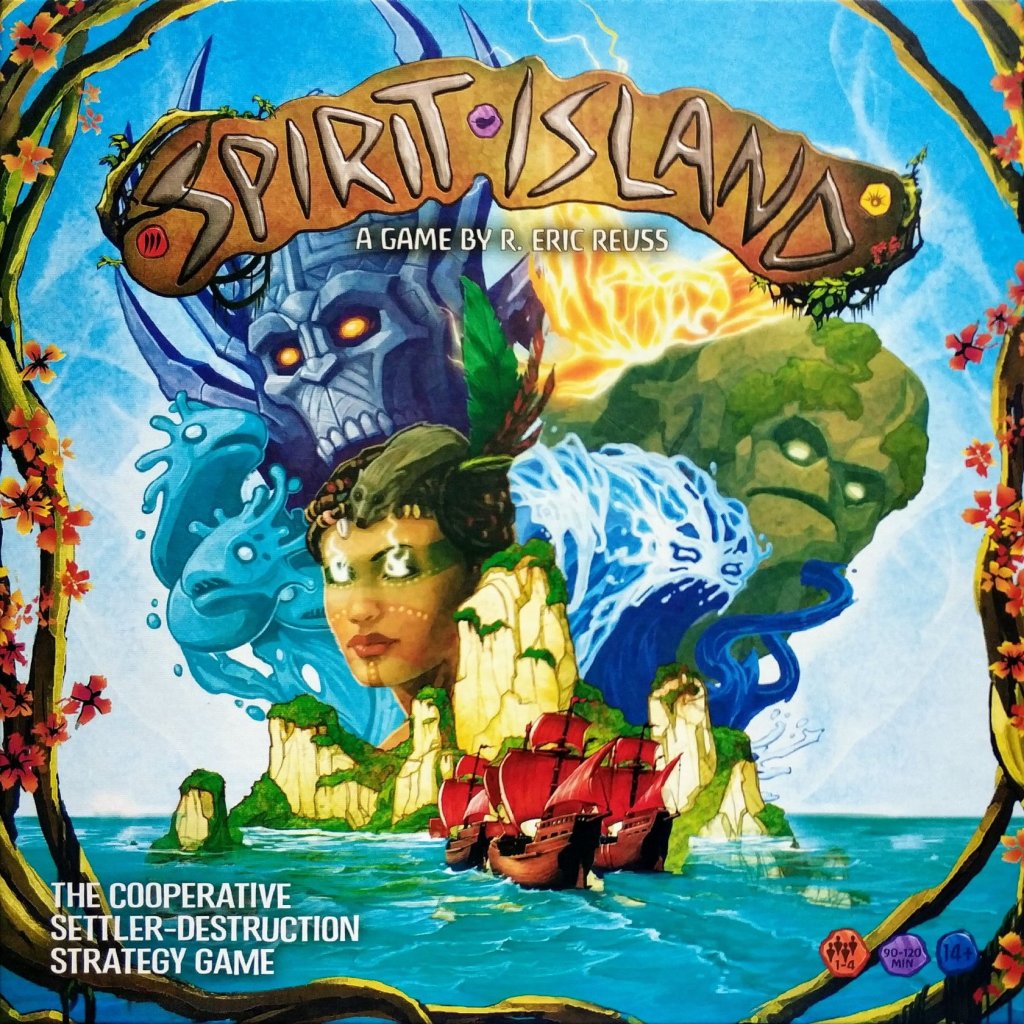
Spirit Island is a complex, thematic cooperative game for 1–4 players, with games lasting about 120 minutes. Players become spirits of the land, sky, and natural world, defending their island home against expanding colonial Invaders.
Each spirit has unique elemental powers and a distinctive way to influence the island. Every turn, players simultaneously choose power cards and spend energy to play them. Matching elemental affinities can unlock free bonus effects, while faster powers act immediately and slower powers demand careful planning.
During the Spirit phase, spirits gain energy and decide how to grow. They may reclaim used power cards, seek new powers, or spread their presence into new parts of the island. Meanwhile, the Invaders follow a semi-predictable pattern: they explore new lands, build towns and cities, then ravage those areas, bringing blight and attacking native islanders.
- Coordinate powers: Combine different spirits’ abilities and elemental affinities to respond to threats.
- Manage escalation: Expand your presence and gain stronger powers as the Invaders increase their efforts.
- Turn fear into victory: At first, every Invader must be destroyed, but growing fear can make them flee even while towns or cities remain.
Islanders fight back when attacked and can provide other forms of aid, although their actions may not always be exactly what you hoped. Some powers work through them, helping drive out Invaders or remove blight from the land.
Victory requires forcing the Invaders from the island, while defeat comes if a spirit is destroyed, blight overwhelms the island, or the Invader deck runs out first. Spirit Island also includes different adversaries, such as a Swedish Mining Colony and a Remote British Colony, each changing play and offering escalating difficulty for experienced players.
Thematics
Mechanics
Designer
Illustrators
Useful links
/pic7182955.jpg) View board game on
View board game onBoard Game Geek
Board Game Rules for
Spirit Island
Introduction
You are powerful Spirits of the natural world, existing on an isolated island. Invaders from beyond the known sea have recently begun their colonization of your island, killing the native islanders – a people called the Dahan – and upsetting the natural balance. The Spirits of the island must grow in power and throw back the Invaders before the island is blighted beyond hope of recovery!
Gameplay Overview
Spirit Island is a cooperative game for 1-4 players where each player is a Spirit of nature, defending their island from invading colonists who have little regard for the well-being of the land or its native inhabitants, the Dahan. Every turn, all Spirits act simultaneously, employing Powers to push the Invaders back, bolster the island, and aid the Dahan. But the Spirits start out small and limited, and will have to learn some new tricks in order to catch up to the rapidly expanding Invaders, whose Actions (automated by the game) drive them to spread across the Island and establish settlements, spreading Blight in their path. To win, the Spirits (with the help of the Dahan) must destroy the Invaders and scare away any survivors. However, the game will end in defeat if the island is overrun by Blight, if any Spirit is destroyed completely, or if you act too slowly and fail to drive the Invaders off before they become entrenched.
Once you know the game, Spirit Island takes about 90-120 minutes to play – slightly shorter for games with 1-2 players, slightly longer for games with 4.
How to Read This Rulebook
The rules are divided into three major sections: Game Setup, Sequence of Play, and Game Concepts. Read Game Setup first. Then read Sequence of Play and Game Concepts in the order that best suits your learning style. Sequence of Play will introduce you to the overall game structure while Game Concepts drills down into individual game mechanics.
First-Time Players
Spirit Island is a complex game with many moving parts. The first time or two you play, you should:
- Choose a low-complexity Spirit: (Lightning’s Swift Strike, Vital Strength of the Earth, River Surges in Sunlight, or Shadows Flicker Like Flame.)
- Take the Power Progression Card for your Spirit. Set aside all the Minor and Major Powers listed on the card. During the game, when you gain a new Power Card, add the next Power Card on the list to your hand instead of using the standard method.
If everyone is playing the game for the first time, also:
- Don’t use a Blight Card. Instead, use the pre-printed Blight space on the board.
- Don’t use an Adversary or Scenario. They increase difficulty and add additional rules.
Whenever your group is ready for a more challenging game, we recommend the Kingdom of Brandenburg-Prussia as a good first Adversary – it mostly modifies setup rather than introducing new rules. The Kingdoms of England and Sweden involve more fundamental changes to how the Invaders work.
Components
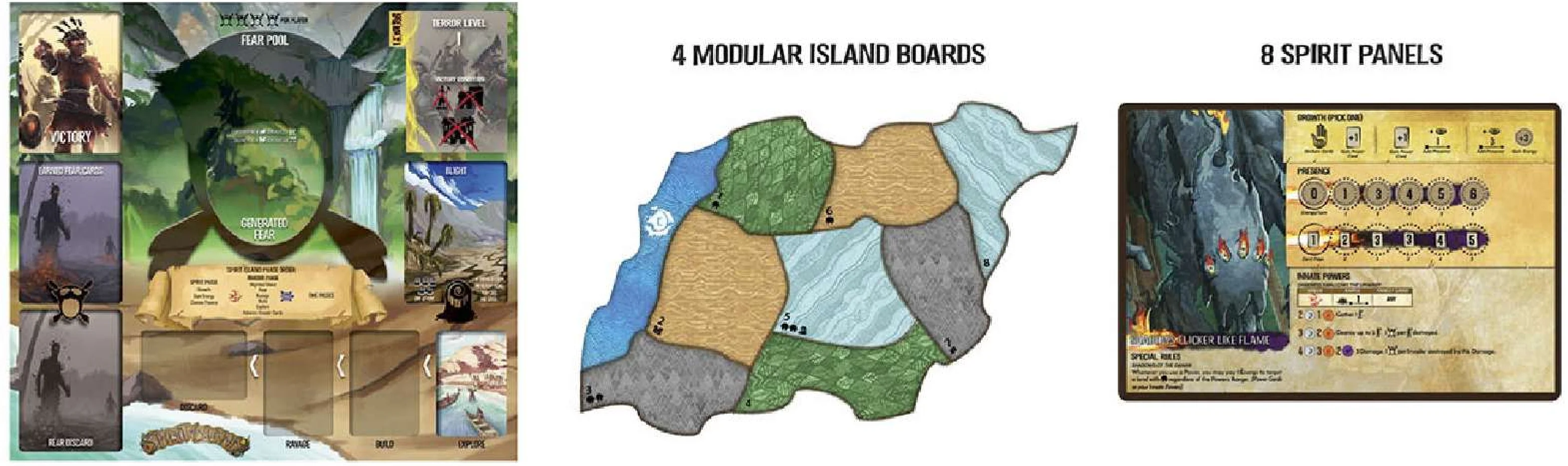
- 1 Invader Board
- 4 Modular Island Boards
- 8 Spirit Panels
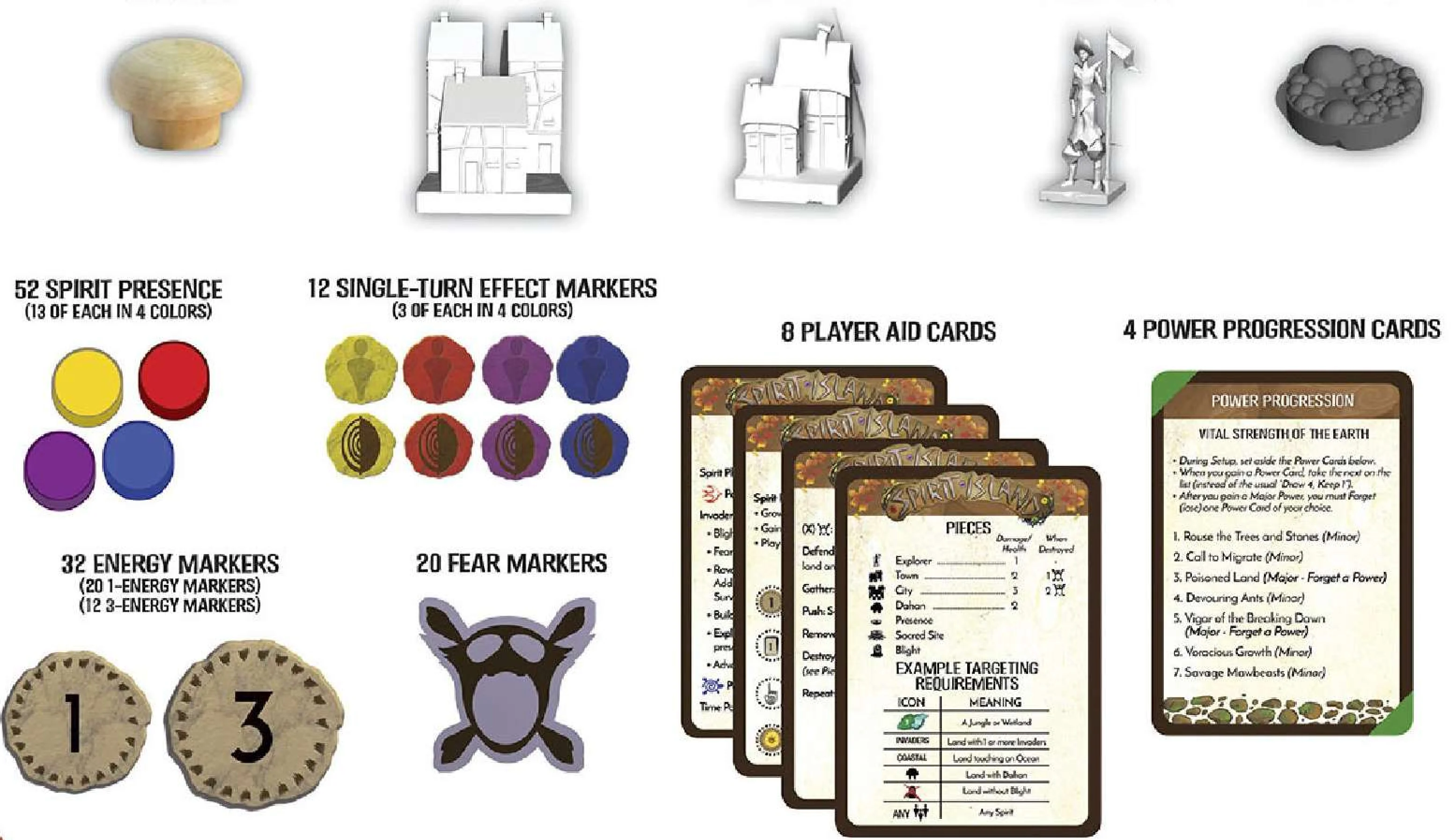
- 36 Dahan
- 20 Cities
- 32 Towns
- 40 Explorers
- 38 Blight
- 52 Spirit Presence (13 of each in 4 colors)
- 12 Single-Turn Effect Markers (3 of each in 4 colors)
- 32 Energy Markers (20 1-Energy markers, 12 3-Energy markers)
- 20 Fear Markers
- 8 Player Aid Cards
- 4 Power Progression Cards
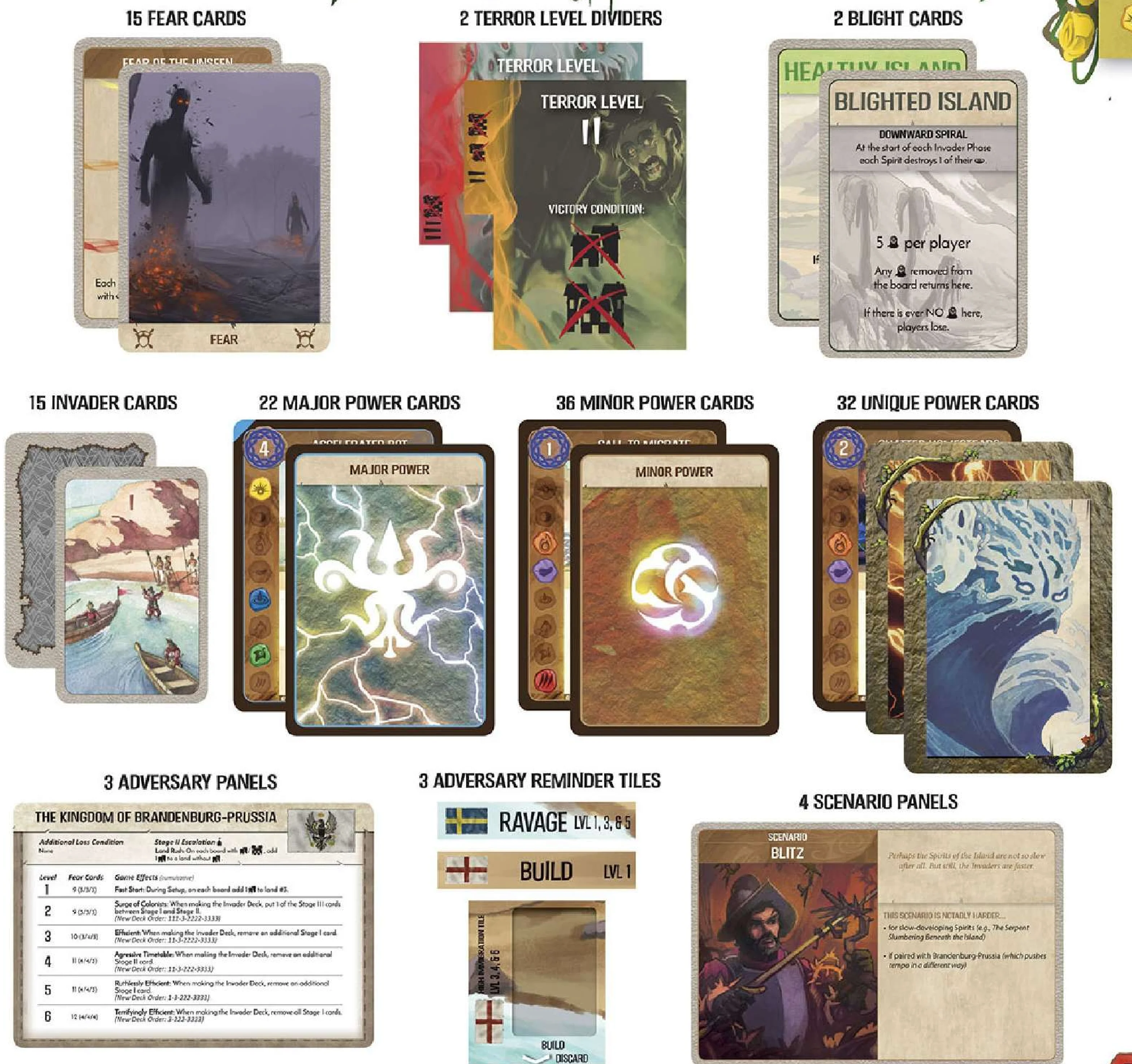
- 15 Fear Cards
- 2 Terror Level Dividers
- 2 Blight Cards
- 15 Invader Cards
- 22 Major Power Cards
- 36 Minor Power Cards
- 32 Unique Power Cards
- 3 Adversary Panels
- 3 Adversary Reminder Tiles
- 4 Scenario Panels
Overview
For most games of Spirit Island, Setup proceeds as below. However, when setting up Spirit Island using an Adversary and/or Scenario, select them first, as they can change how the game is set up.
Invader Board
To set up the Invader Board:
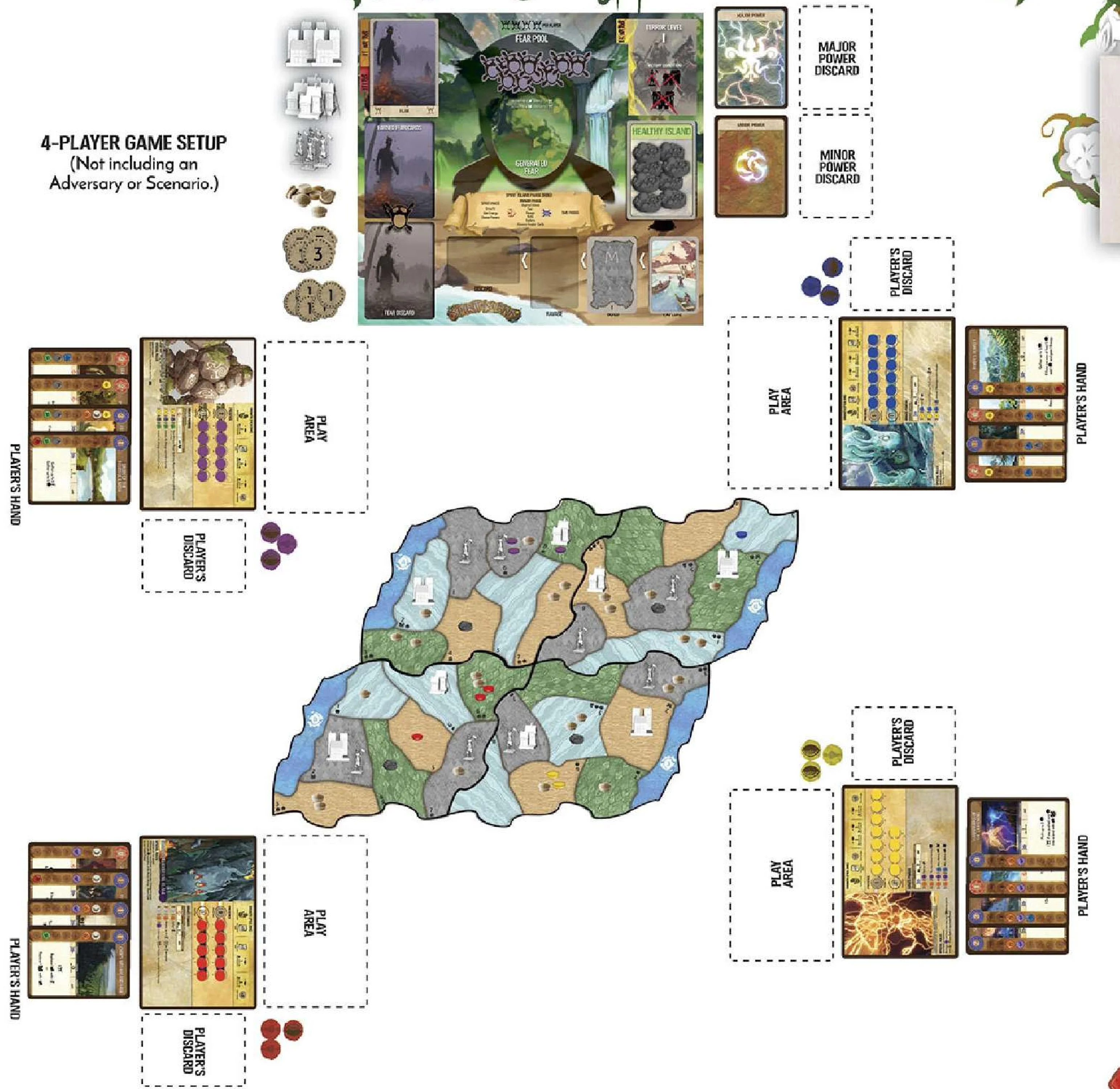
- Place the Invader Board on one side of the play area.
- Put 4 Fear Markers per player into the Fear Pool.
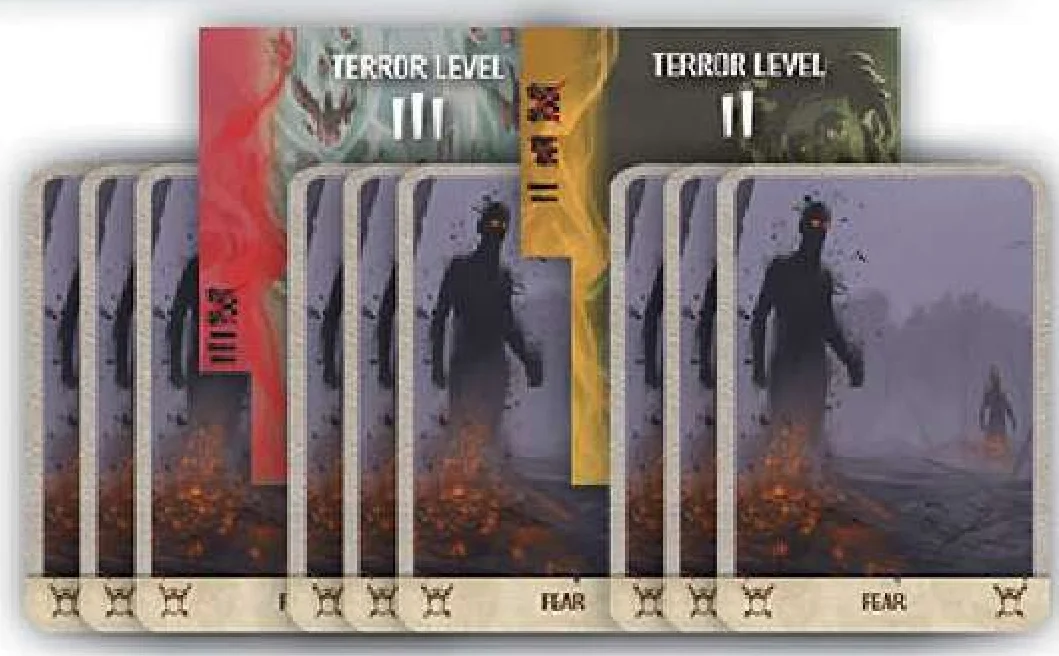
- Shuffle the Fear Cards and put 9 on the Fear Deck Space. Place the “Terror Level 3” divider 3 cards from the bottom and the “Terror Level 2” divider 3 cards above that, so the deck is divided into 3 groups of 3 cards each.
- Make the Invader Deck and put it on the Invader Board on the Explore Action Space (see sidebar).
- Take a random Blight Card and place it on top of the Blight Space on the board, “Healthy Island” side up, without looking at the back. If you are not using a Blight Card, use the Blight instructions printed on the Invader Board instead. Place the shown amount of Blight onto the card.
Making the Invader Deck
The Invader Deck is 12 cards:
- 3 Stage I cards on top, then
- 4 Stage II cards, then
- 5 Stage III cards on the bottom.
Mix up the cards from each Stage and choose without looking at them, putting unused cards back in the box. (The game comes with 4 Stage I cards, 5 Stage II cards, and 6 Stage III cards, so you can just remove one of each.)
The Island and Supply
To set up the island:
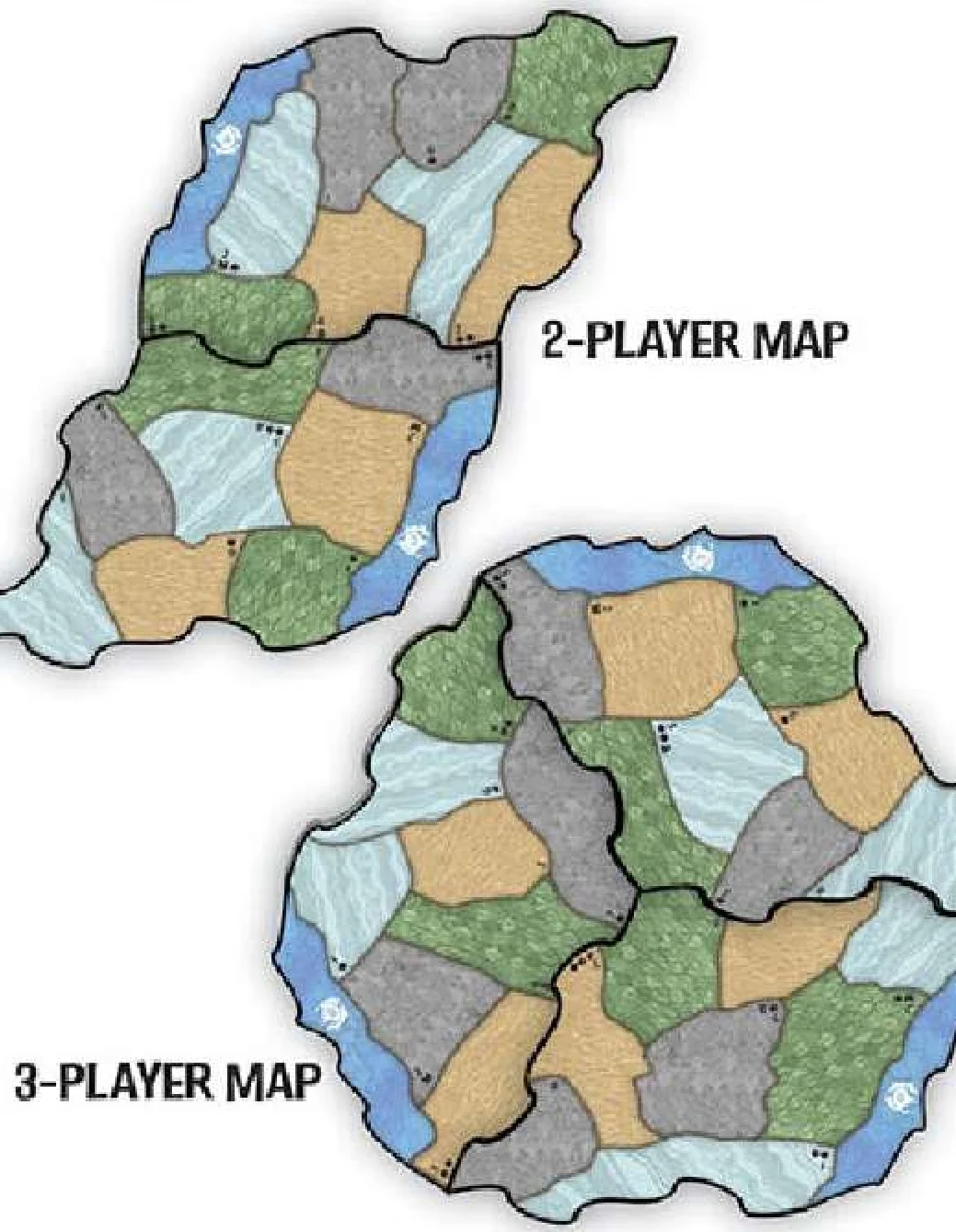
- Randomly pick one Island Board per player and arrange them to form the Island (see sidebar).
- Populate the Island Boards with Invaders, Dahan, and Blight (from the box, not the Blight Card) as indicated by the icons in each land.
To set up the Supply:
- Shuffle the Minor and Major Power Decks. Put them near the board with room for each deck to have a discard pile.
- Put the Energy, Cities, Towns, Explorers, and the Dahan near the board. Make sure all players can reach them; you may need multiple piles.
Player Setup
Each player takes all Spirit Presence and Single-Turn Effect Markers of one color, then chooses a Spirit by taking a Spirit Panel and its four Unique Power Cards, which is their starting hand. New players should choose a low-complexity Spirit and take its Power Progression Card, as described on p. 3.
Each player starts on a different island board and follows Setup instructions on the back of their Spirit Panel. This always includes putting Presence into one or more lands on their starting board; some Spirits have additional instructions. (Once the game begins, Spirits are not restricted to play only on their starting board. Presence and Powers may be placed or used on any board.) Players then flip their Spirit Panels and place all remaining Presence onto the dashed circles on their Presence Tracks. The leftmost numbers with solid circles remain uncovered.
Invaders’ Starting Action
To finalize the Setup, the Invaders take an initial Action. Reveal the top card of the Invader Deck. The Invaders Explore in that land type (see Explore, page 10). Then place that card face-up in the “Build” Action Space.
Round Structure
Each turn has the following phases:
- Spirit Phase
- Fast Power Phase
- Invader Phase
- Slow Power Phase
- Time Passes
Players play simultaneously within each phase, conferring as they wish. Table talk is not just allowed, it’s likely necessary for victory!
General Rules for Simultaneous Play
The Urgency of War
Some Spirits are inclined to take a long time choosing Power Cards: perhaps several centuries in the case of slow-moving earth Spirits. But the threat of the Invaders forbids the luxury of infinite time.
Any player may place a limit on the time available to complete the Spirit Phase. This can be done using a timer, setting a condition (“When I get back, we start”), or any other means desired.
Of course, as this is a cooperative game, it behooves you to not be too draconian.
Who Decides?
When the game calls for a decision (where Blight cascades to, which Invaders to do Damage to, etc) and it’s not specified who makes it, what do you do?
If the decision springs from a Power, the Spirit using the Power makes the decision.
For other situations, players should try to come to a consensus.
But in the rare event that agreement is not possible:
- For decisions about/within a land: Each Spirit makes choices regarding the lands on their starting board.
- For other cases: The game owner/organizer makes the call.
1. Spirit Phase
Each Spirit does three things, in the following order:
- Grow: Choose one option (unless stated otherwise) next to “Growth” at the upper-right of the Spirit Panel. Each section is a single choice. You must do everything shown, but may choose the order. (For more on Growth options, see page 14.)
- Gain Energy: Gain an amount of Energy equal to the highest uncovered number on your Energy Presence Track. Place any gained Energy on or near your Spirit Panel.
- Play and Pay for Power Cards: Select the Power Cards (Fast and Slow) that you will use this turn. The maximum number of Power Cards you can play each turn is the highest uncovered number on the Card Plays Presence Track (even if you have enough Energy to pay for more). You must immediately pay Energy for all Power Cards played, even Slow ones. Likewise, you immediately gain all Elements from played Power Cards, even if the Powers’ effects are Slow. Do not resolve the effects of the Power Cards yet.
2. Fast Power Phase
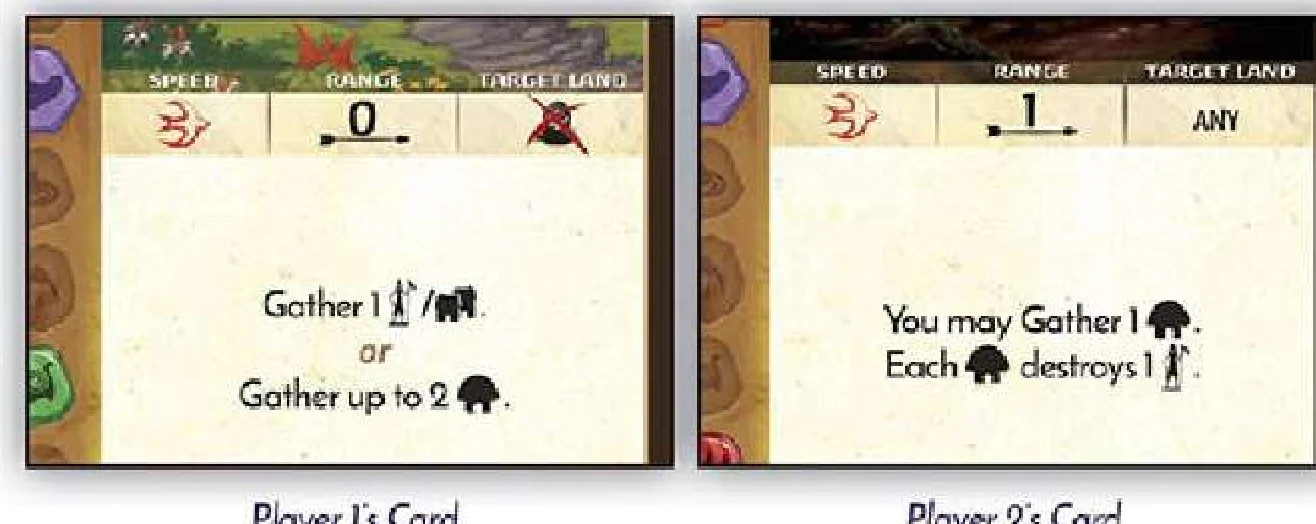
Players resolve Fast Powers – both Innate Powers printed on their Spirit Panel and Power Cards they played. Power resolution can be done mostly simultaneously. When timing becomes important, Powers may be resolved in whatever order the players want, so long as no Power interrupts another partway through.
If a player discovers they do not want to use a Power’s text effect (or cannot use it), they may choose to skip it entirely. Sometimes, a Power Card will be worth playing purely for its Elements (see Elements Gained, p. 16).
You cannot delay using a Fast Power until the Slow Phase, even if you want to. Use it now or forego it.
3. Invader Phase
The Invader phase has the following parts:
- Blighted Island (once appropriate)
- Fear
- Invader Actions:
- 3a. Ravage
- 3b. Build
- 3c. Explore
- Advance Invader Cards
3.1. Blighted Island
If the Blight Card has flipped to “Blighted Island”, follow the instructions there. If you have trouble remembering to do this, put a Blight from the box onto the Fear Space as a reminder.
3.2. Fear
If any Fear Cards have been earned (see Fear and Terror, page 12), pick up the whole face-down stack, flip it over and resolve the cards one at a time in the order they were earned. Then discard them to the Fear Discard Space on the board. Use only the effect listed next to the current Terror Level. This could be higher than when the card was earned. Fear effects last only for the current turn.
Fear Earned Through Fear Effects
Most Fear effects do not cause more Fear. They remove Invaders rather than Damaging or destroying them. However, there are exceptions. If you do earn a new Fear Card this way, put it at the bottom of the stack of cards you’re currently resolving.
3.3. Invader Actions
The Invader Board has three Action Spaces: Ravage, Build, and Explore. The Invader Card in an Action Space determines which lands will be affected by that Action. (If there is no Invader Card in a space, no action is taken.)
3a. Ravage
Look at the Invader Card in the Ravage Action Space on the Invader Board (if any): the Invaders Ravage in each land of the shown type only. First, Invaders deal Damage to the land and Dahan. Then, any surviving Dahan fight back.
Wherever there are Invaders in the shown lands, Invaders deal Damage: 1 per Explorer, 2 per Town, and 3 per City. Damage is done both to the land and Dahan.
- Invaders Damage the Land: If 2 or more Damage is dealt, add a Blight to the land. (See sidebar.) This only happens once, no matter how much Damage is dealt. Partial Damage to the land is ignored.
- Invaders Fight the Dahan: Every 2 points of Damage destroys one Dahan. You must destroy Dahan as efficiently as possible; you cannot disperse Damage among multiple Dahan to avoid killing them. If a Dahan is dealt 1 Damage, turn it over to show that it is Damaged. Any surviving Damaged Dahan will recover at the end of the turn.
After Invader Damage has been fully resolved in a land, any surviving Dahan there fight back. Each Dahan deals 2 Damage to the Invaders. (See page 15 for Invaders’ Health.) The Dahan will fight back even if the Ravaging Invaders deal no Damage (for example, due to Defend Powers), but not if the Ravage Action has been skipped or stopped from happening altogether.
Spirit Presence does not fight back as Invaders do not directly attack the Spirits.
Effects of Blight
Cascading: Whenever you add Blight to a land, if that land already has Blight, you must also add a Blight to one adjacent land. (If that adjacent land also already has Blight, it cascades again from there, and so forth.)
Presence: Adding Blight to a land destroys one Presence from each Spirit in that land. Remember: destroyed Presence is removed from play (set next to the Island), not returned to the Spirit Panels! (For more on Blight, see page 15.)
3b. Build
Look at the Invader Card in the Build Action Space on the Invader Board: the Invaders Build in each land of the shown type only.
Wherever there are Invaders in the specified type of land, they add either one City or one Town:
- If the land has more Towns than Cities, add a City. (You are not upgrading the Towns, you are adding a new City from the supply.)
- In all other cases, add a Town.
Do not Build in lands without Invaders.
3c. Explore
Turn the top card of the Invader Deck face-up. Invaders Explore in accessible lands of the shown type only, venturing forth from Towns and Cities or approaching from the Ocean. If the card has a flag icon and you are playing with an Adversary, first perform the Escalation effect (see sidebar). If there is no card to turn up, time has run out and you lose.
Add an Explorer to every land of the shown type which either:
- Contains a Town or City; or
- Is adjacent to a Town, City, or Ocean.
No matter how many sources are in or adjacent to an Explored land, you only add one Explorer. Explorers are added directly from the supply, not moved around on the board.
Stage II Escalation
Most Stage II cards have a flag icon  . Its effect depends on your Adversary. If you are playing without an Adversary, ignore the flag icons.
Escalation effects happen as soon as the card is revealed, before Explore, unless the Adversary states otherwise. Some may make changes to how the upcoming Explore works.
3.4. Advance Invader Cards
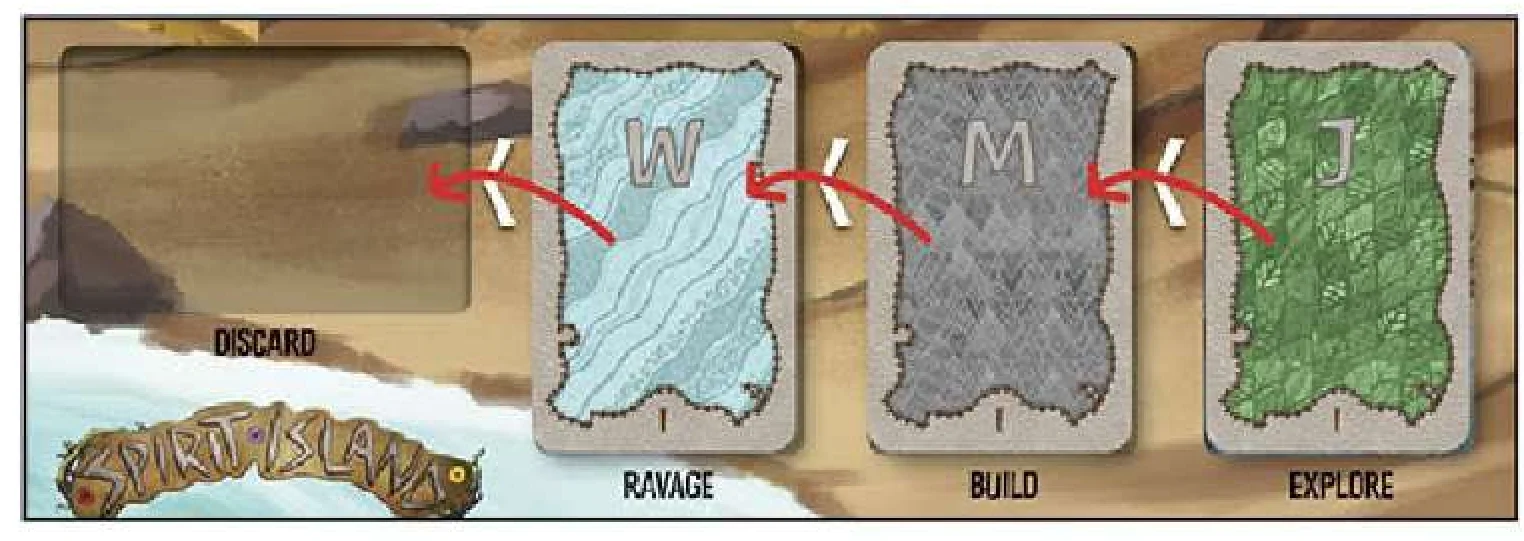
After Explore, slide all of the Invader Cards left: Move the Ravage Card to the discard, the Build Card to the Ravage Space, and the Explore Card to the Build Space, so that next turn they will Ravage where they Built this turn and Build where they Explored this turn.
Remember!
Ravage, Build, and Explore affect only the land type(s) shown on their cards! Ravage and Build Actions only affect lands that have Invaders! Explore only affects lands adjacent to a source of Invaders!
4. Slow Power Phase
Players resolve Slow Powers, which may be either Innate Powers printed on their Spirit Panel or Power Cards they played. This works just like the “Fast Power Phase”, explained on page 8.
5. Time Passes
This is the wrap-up phase at the end of each turn.
- Discard: Players discard all Power Cards played this turn into their personal discard piles.
- Damage and Elements Clear: All Elements go away. All Damage done during the turn goes away; if you turned any pieces on their sides to note partial Damage, turn them back.
If you’re using the reminder tokens for Single-Turn Effects, make sure to remove those at this time.
Ravage Examples
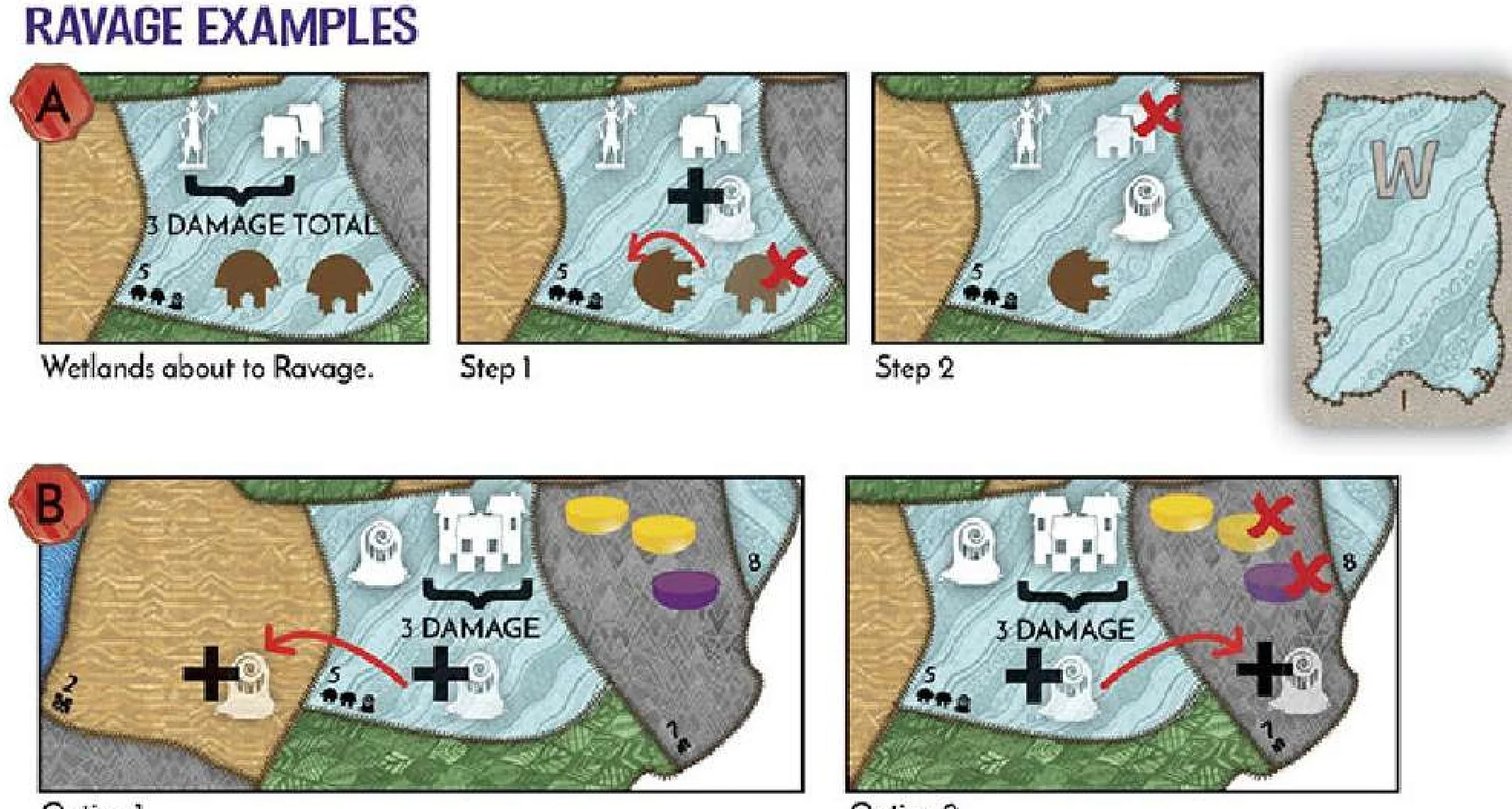
For these examples, the Ravage Action takes place in Wetlands because of the Invader Card shown.
- A) This Wetland has 2 Dahan, 1 Town, and 1 Explorer in it. The Town and Explorer deal a combined Damage total of 3 (2 from the Town and 1 from the Explorer) to the land and to the Dahan.
- (Step 1) 3 Damage to the land adds a Blight. 3 Damage to the Dahan destroys one of the Dahan and deals 1 Damage to the other.
- (Step 2) Now it’s the Dahan’s turn to fight back, dealing 2 Damage. The players choose to direct that 2 Damage at the Town, destroying it. This generates 1 Fear.
- B) The City deals 3 Damage to the land; since at least 2 Damage was dealt to the land, it adds a Blight. Because Blight already exists here, the newly added Blight causes a cascade: another Blight must be added to an adjacent land of the players’ choosing. Two of the available options are:
- Option 1: The Blight cascades to land #2, which was previously empty.
- Option 2: The Blight cascades to land #7, destroying 1 yellow Presence (meaning this land is no longer a Sacred Site for yellow) and 1 purple Presence (removing purple from the land entirely).
Option 1 is likely the better choice because it does not destroy any Presence.
Build Examples
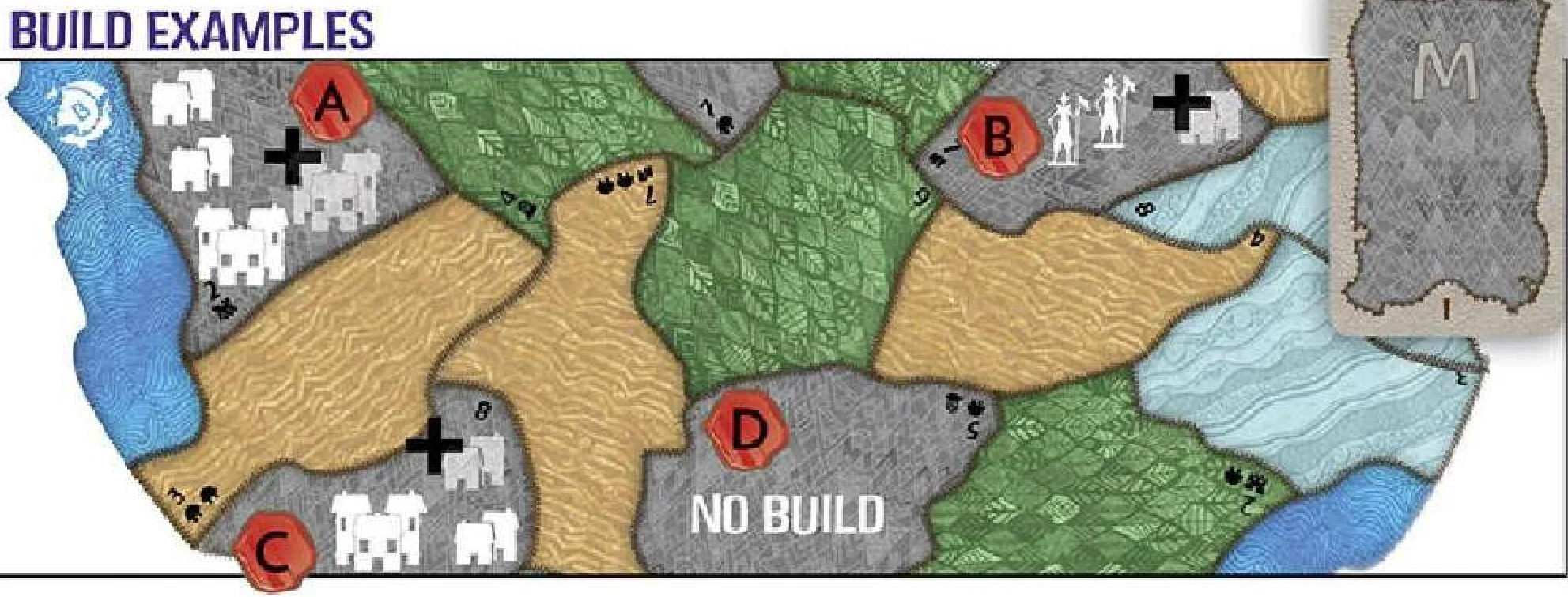
For these examples, the Build Action takes place in Mountains because of the Invader Card shown.
- A) This land has more Towns than Cities, so a City is Built here.
- B) This land has only Explorers, which means it has the same number of Towns and Cities: zero. Therefore, a Town is Built here.
- C) This land has the same amount of Towns and Cities, so a Town is Built here.
- D) This land has no Invaders, so the Invaders do not Build here.
Explore Examples
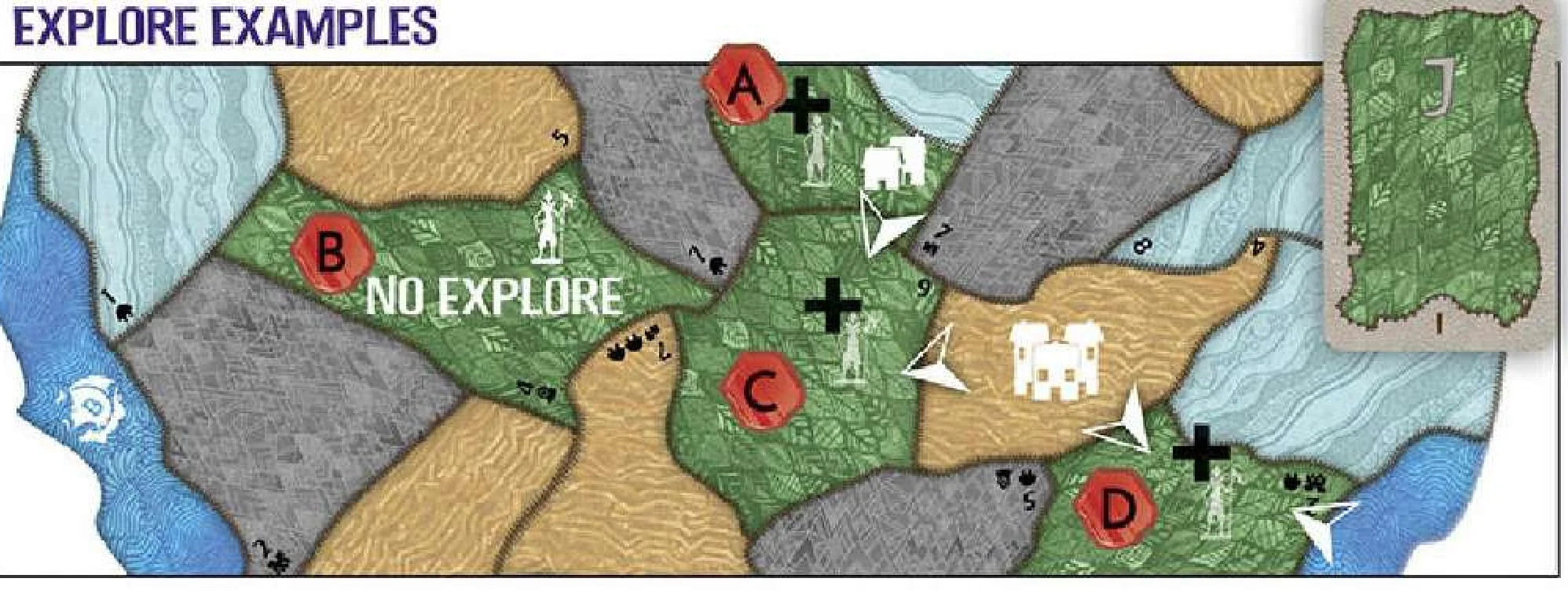
For these examples, the Explore Action takes place in Jungles because of the Invader Card shown.
- A) This land includes a Town or City already, so an Explorer is added here.
- B) This land is not Coastal and is not adjacent to a land with any Towns or Cities. The Invaders do not Explore here.
- C) This land is adjacent to a land with a Town or City, so an Explorer is added here.
- D) This land is Coastal and is adjacent to a land with a Town or City. (Either would be sufficient.) An Explorer is added here.
Victory and Defeat
At the start of the game, the Invaders are at Terror Level 1. They’re not afraid of the island and probably aren’t even aware of the Spirits’ existence. To win, you need to completely clear the island of Invaders. As you earn Fear Cards (see Fear and Terror, below), you will reach new Terror Levels with easier victory conditions. You win immediately anytime you meet the current victory condition.
You can lose three ways:
- Too Much Blight: If the last Blight comes off of the Blight Card, you follow the instructions there, which are often “you lose”.
- A Spirit Is Destroyed: If any Spirit has no Presence left on the island, you lose.
- Time Runs Out: If you need to draw an Invader Card (to Explore), but the Invader Deck is empty, you lose.
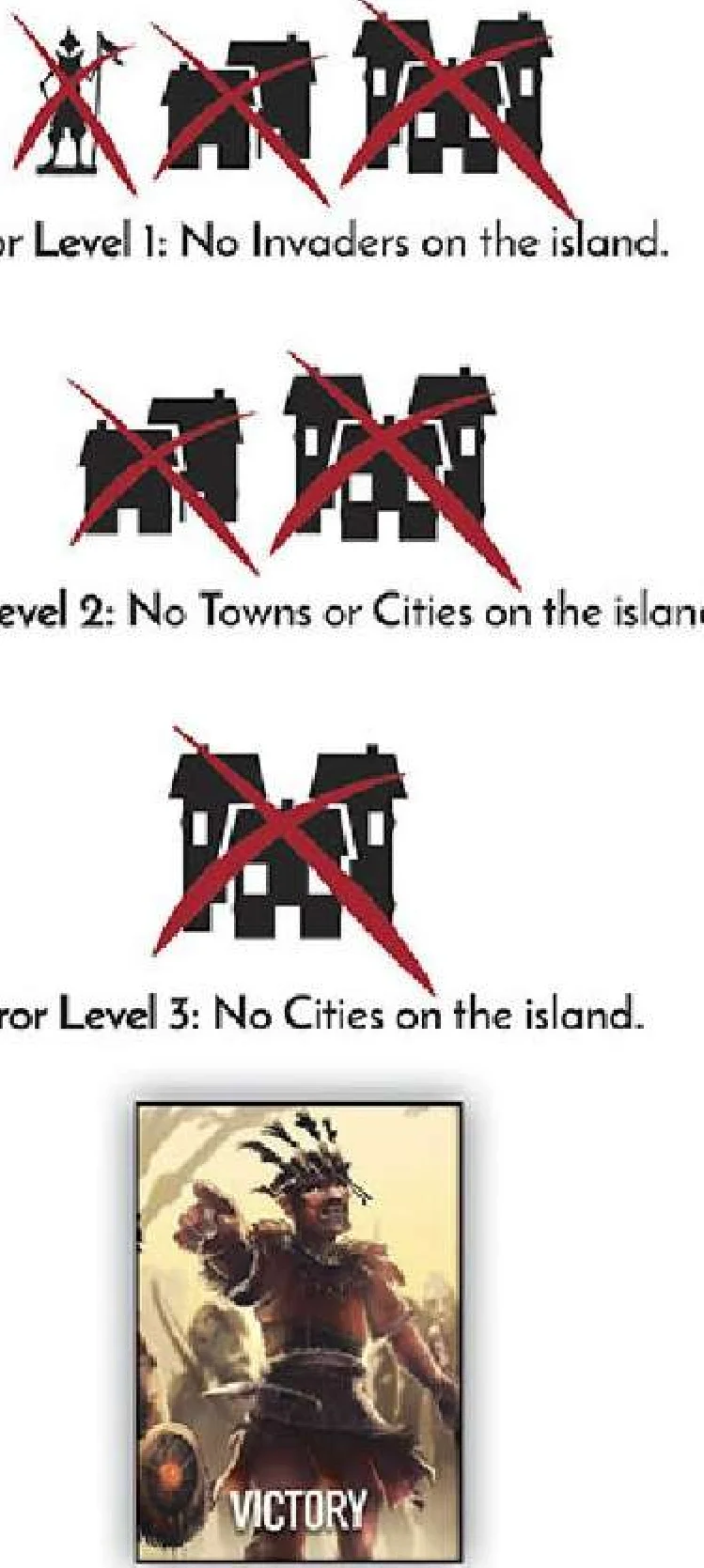
Win Conditions
- Terror Level 1: No Invaders on the island.
- Terror Level 2: No Towns or Cities on the island.
- Terror Level 3: No Cities on the island.
- Terror Level VICTORY: Immediate victory!
In the rare case that a single Power Card or other effect causes you to both win and lose, you win a sacrifice victory: you are destroyed, but the island, the Dahan, and many other Spirits survive.
Fear and Terror
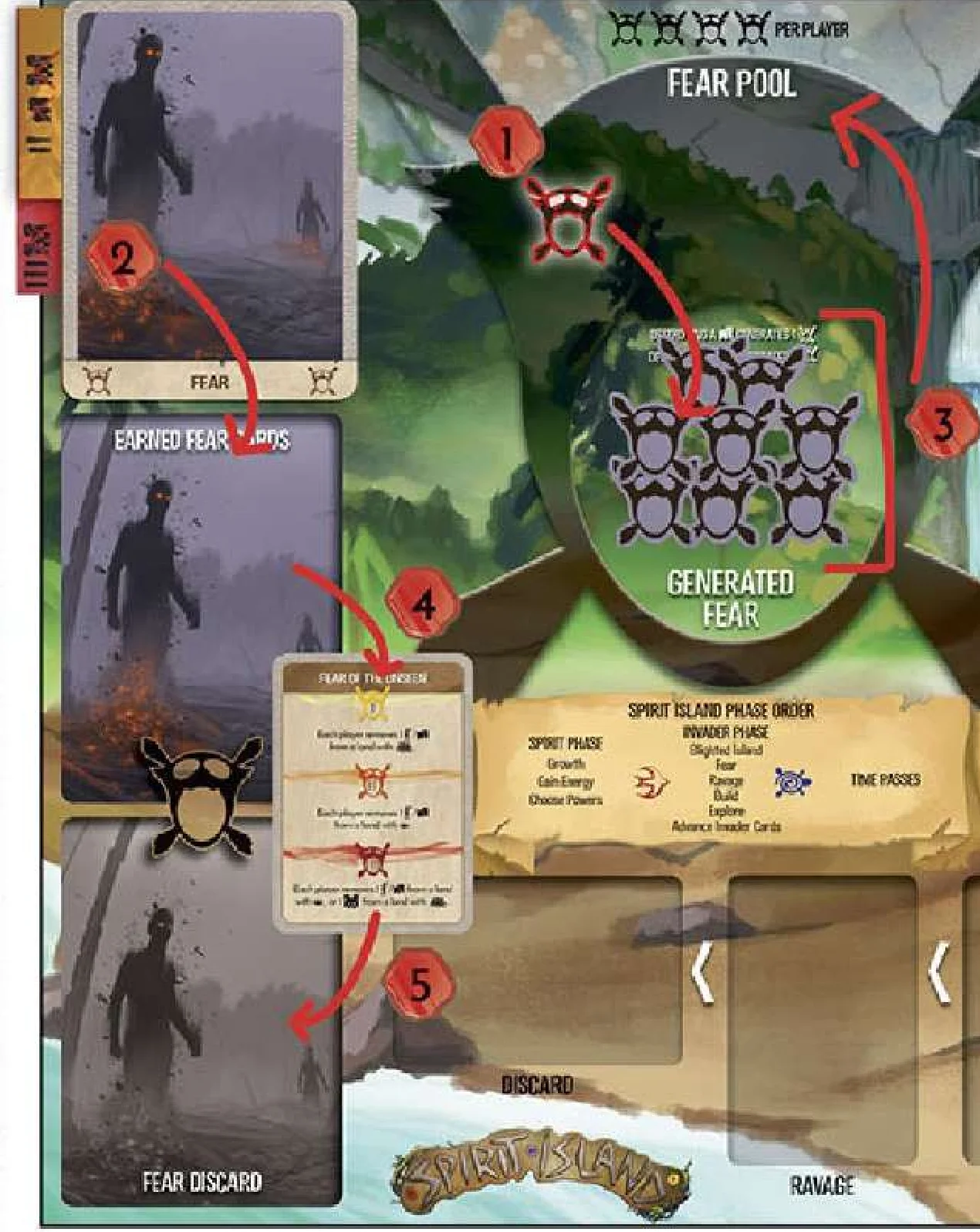
Fear is generated by Spirit Powers with the Fear symbol ( ) and by destruction (either directly by an effect or by Damage): destroying a Town generates 1 Fear and destroying a City generates 2 Fear. Fear terrifies the Invaders as a whole. For each Fear generated, advance one Fear Marker from the Fear Pool on the Invader board to the Generated Fear area.
- When all of the Fear Markers have advanced,
- move the top card of the Fear Deck face-down into the Earned Fear Cards area. If this reveals a Terror Level divider, move it to cover the old Terror Level (which starts at Level 1, preprinted on the board).
- Move the Fear Markers back to the Fear Pool; if you have leftover Fear after earning a card, move that many Fear Markers to the Generated Fear area.
- Cards in the Earned Fear Cards Space are flipped and resolved during the next Invader Phase (see page 9). Like Powers, effects of Fear Cards last for the current turn only, unless they change the board in some way. After each Fear Card is resolved,
- move it to the Fear Discard Space.
When you reveal a new Terror Level divider, the new Terror Level and victory conditions take effect immediately, so you might instantly win!
Boards and Lands
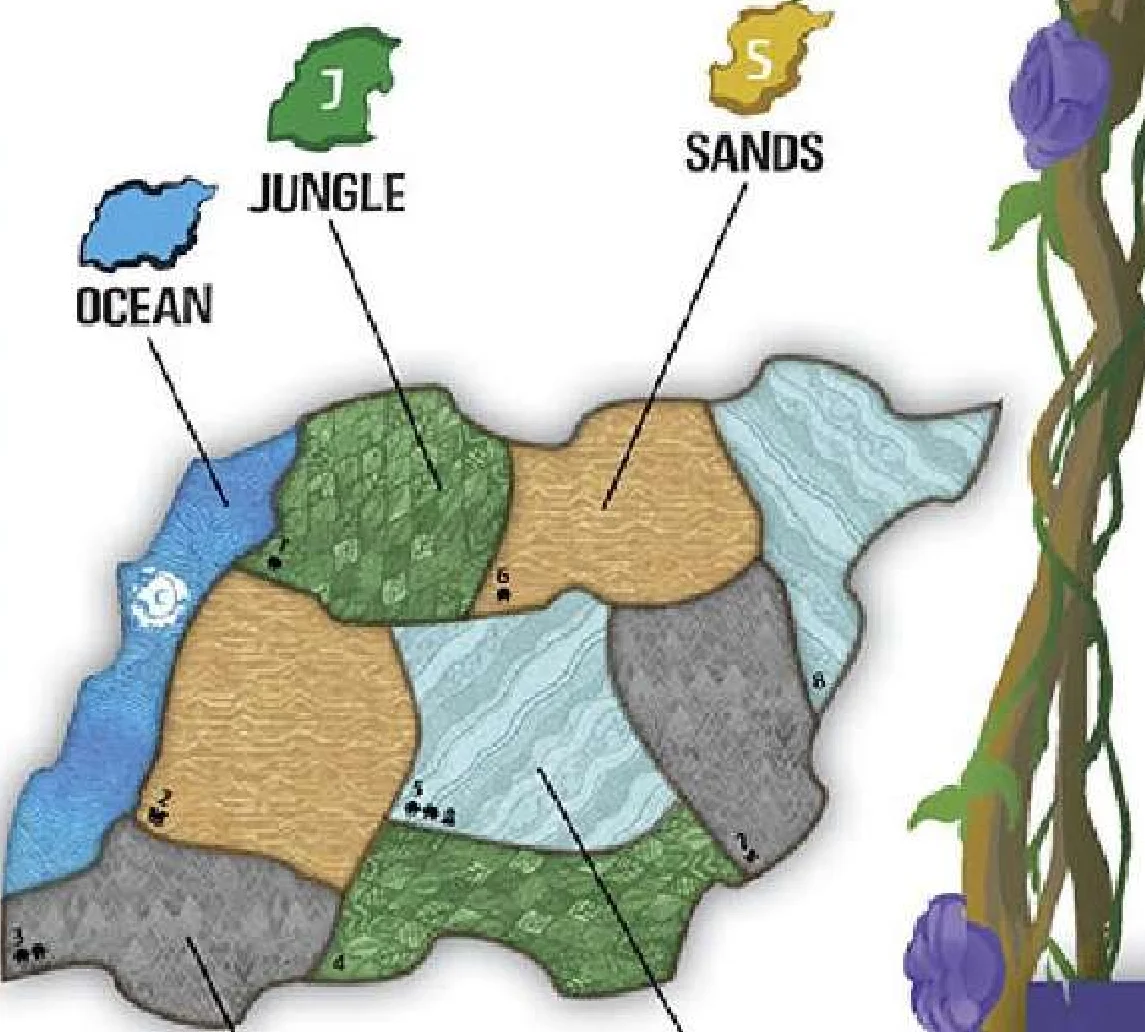
The game is played with one island board per player, laid out to make an island (see Setup, page 6). Each island board is divided into eight numbered lands, with exactly two of each terrain (Jungle, Mountain, Sands, and Wetland). Most pieces only affect other pieces in the same land, unless explicitly specified.
Two lands are “adjacent” when they touch, even if they’re not on the same island board or meet only at a corner.
Each board also shows a swath of Ocean, to indicate which lands are readily accessible by sea. Lands adjacent to the Ocean are Coastal. Lands not adjacent to the Ocean are Inland. (The other island borders are rocky cliffs and do not count as Coastal.) The Ocean itself is not a land, and is not in play.
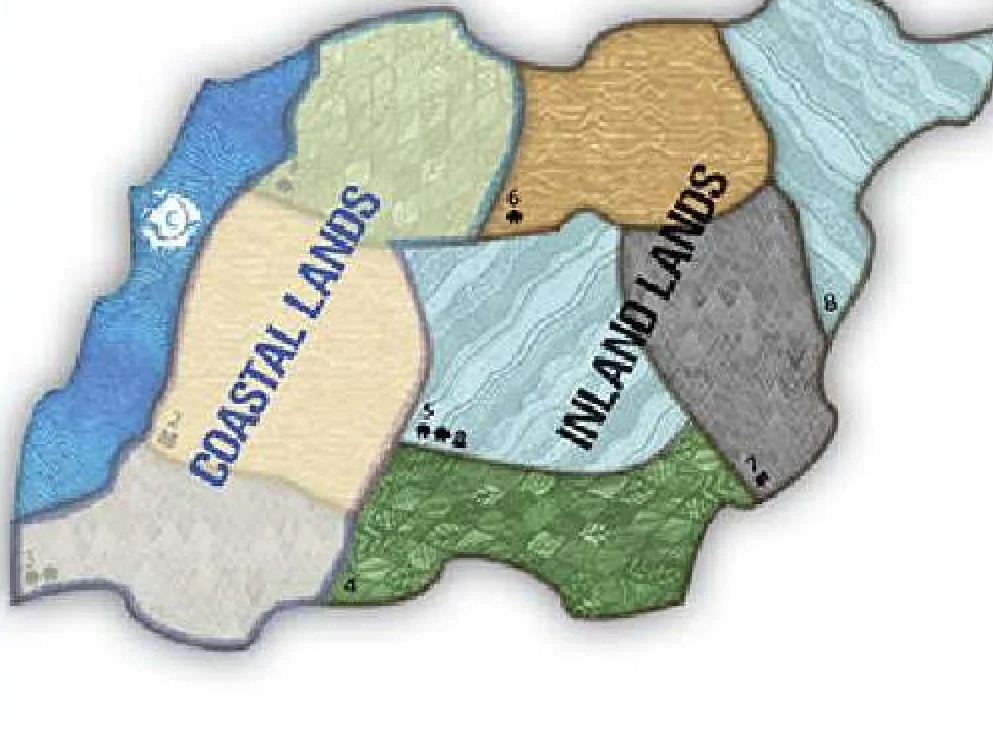
The reverse side of each island board shows a thematic map that can be used to play once you’re more familiar with the game (see Thematic Map, page 23).
Presence and Sacred Sites
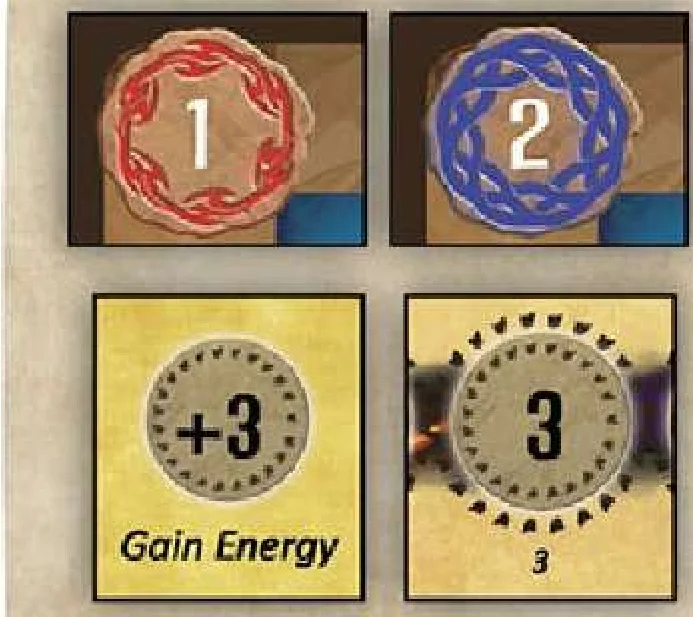
Spirit Presence marks the lands a Spirit occupies. Lands with your Presence are sometimes referred to as “your lands”. If your Presence is ever destroyed (for example, by Invaders Blighting the land), it is removed and put next to the Island. If any Spirit ever has no Presence left on the island, the players immediately lose. A land can hold any number of Presence from any number of Spirits.
Game effects which do things with Presence (such as move it or destroy it) always affect Presence on the Island unless they say otherwise.
A Spirit’s Sacred Sites are any lands where that Spirit has more than one Presence. Some Powers can only be used from these places of focused influence.
 Presence: A land where that Spirit has at least 1 Presence.
 Sacred Site: A land where that Spirit has 2 or more Presence.
Energy and Card Plays
Spirits affect things on the island by playing Power Cards from their hand. A Spirit can play whichever cards they like each turn, limited by two things:
- They can only play as many cards as they have Card Plays available, which is the highest revealed number on the Card Plays Presence Track.
- They must have enough Energy to pay for the cards they play.
Every turn, each Spirit gains Energy equal to the highest revealed amount on their “Energy/Turn” Presence Track. Unspent Energy carries over to the next turn. Energy is individual and cannot be transferred between Spirits. Card Plays are also individual and cannot be shared with other Spirits. Unused Card Plays do not carry over to future turns.
Spirits
Each Spirit has:
- A Spirit Panel with Growth, Presence Tracks, and Innate Powers;
- Four Unique Power Cards (For example Power Cards, see Powers on page 16.)
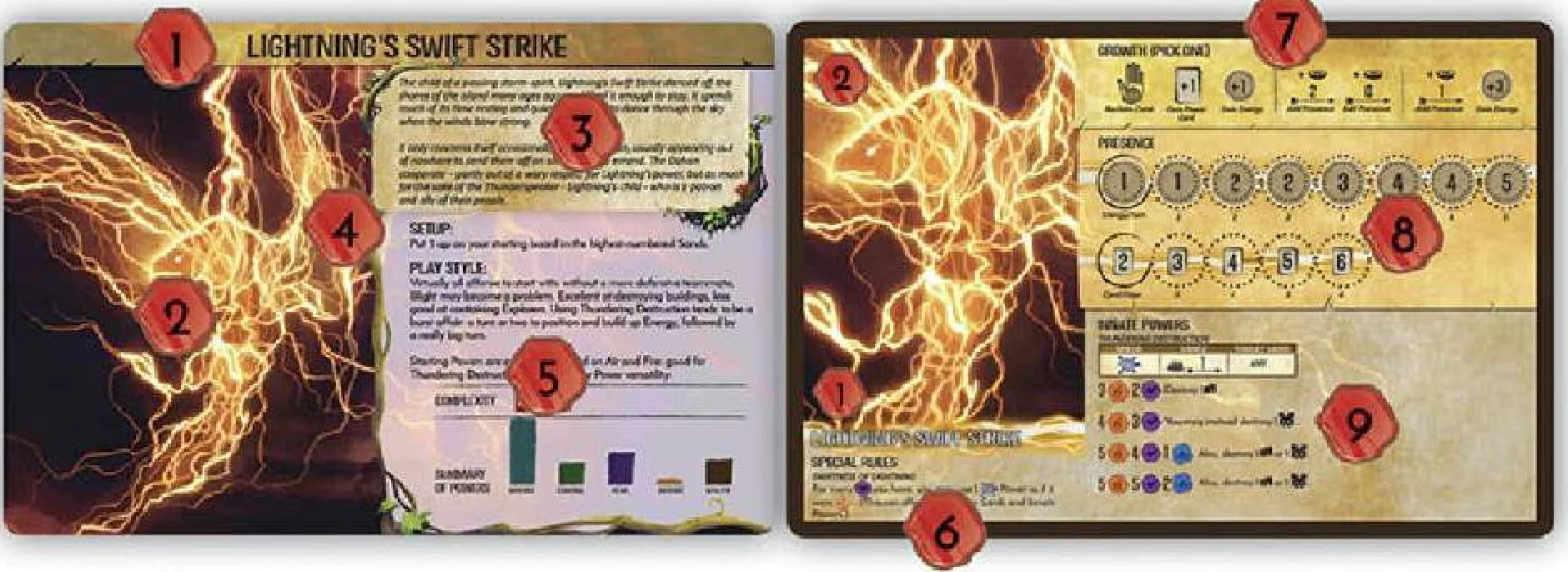
Anatomy of a Spirit Panel
- Spirit Name
- Art: An image of this Spirit.
- Backstory: The story and history of the Spirit.
- Setup: Initial Presence placement, and any special instructions.
- Play Style/Complexity: A brief description of the Spirit’s strategy and comparison of its strengths and weaknesses, as well as a summary of Powers.
- Special Rules: Any rules that work differently for this Spirit.
- Growth Options: The Spirit’s options for regathering of strength, reaching out to new lands, and learning new Powers. When a Spirit chooses a Growth option, they will select one section and take all of the actions indicated in it, unless specified otherwise. (See the sidebar for common Growth options, and page 8 for the Growth step of the Spirit Phase.)
- Presence Tracks: Each Spirit Panel contains two Presence Tracks. The top one is Energy Gained per turn and the bottom one is Card Plays. To start, all but the leftmost space on each track is covered by Presence. When placing Presence on the island, you can choose which track to take it from, but always take it from left to right. As you remove Presence from each track you reveal progressively greater benefits. Removing Presence from the top track grants you more Energy each turn, while removing Presence from the bottom track allows you to play more Power Cards each turn. Spirits use only the highest revealed number on the tracks for their Energy or Card Plays (these benefits are not additive). Note: Destroyed Presence is removed from play, not returned to the Panel!
- Some Spirits have a “Reclaim One” space. While this space is revealed, the Spirit may return one Power Card to their hand any time during the Spirit Phase (so the ability can be used the turn it is revealed), letting them go longer before having to take a “Reclaim All” Growth option.
- Some Spirits have bonus Elements on their Presence Tracks. These constantly provide one of the shown Elements for as long as the space is revealed (see Elements Gained, page 16). A space marked with “+Any” grants one Element each turn: the Spirit may choose which Element they get at any time, but then cannot change it until the next turn.
- Innate Powers: Free Powers that can be triggered using Elements. (For more on Powers, see page 16). Unless explicitly specified, Innate Powers never cost Energy or use Card Plays. Like all Powers, they target a single land or Spirit unless explicitly stated otherwise.
Common Growth Options
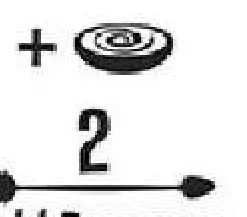 Add Presence: Add one Presence to the board at Range 2 (up to 2 lands away from your existing Presence).
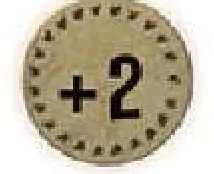 Gain Energy: Gain 2 Energy (in addition to this turn’s normal Energy income).
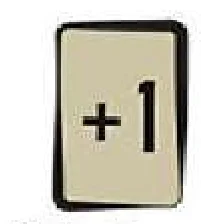 Gain Power Card: Gain a Power Card (see page 18).
 Reclaim Cards: Reclaim all played Power Cards from your personal discard pile, returning them to your hand.
Moving Presence
It is rarely relevant, but whenever you would add Presence, you may choose to instead move one of your Presence already on the board. So, if you manage to get all of your Presence into play, you can still reposition it.
Elemental Thresholds
Innate Powers have Elemental Thresholds, meaning they can only be used on Turns you have all the required Elements. Elements are never spent, only checked.
Elements from Power Cards do not persist from Turn to Turn. You have them only as long as the Power Card is in play. (See Elemental Thresholds, page 17)
Invaders
The Invaders have begun to colonize your island! While not specifically aiming to exterminate you, their colonization and “taming” of the land has upset the natural balance. The goal of the game is to drive off the Invaders by meeting the victory conditions of the current Terror Level. As more Invaders learn to Fear you, the victory conditions will get easier!
Invaders in a land do not automatically harm Spirit Presence or Dahan there. Invaders harm things only when Ravaging (see Ravage, page 9). Each type of Invader has a specified Health. To destroy an Invader, you must deal Damage that meets or exceeds its Health in one turn. Some effects also destroy Invaders regardless of Damage or Health.
There are three types of Invaders: Explorers, Towns, and Cities. A land containing any number of these is “a land with Invaders”. The number of Invaders is not limited by the supply of pieces; in the unlikely case that you run out, use 3-Energy tokens as “3 of this piece” markers.
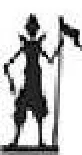 Explorers represent Invaders willing to travel into uncharted wilderness: mapping expeditions, the very boldest homesteaders, etc. They have 1 Health and deal 1 Damage during Ravage.
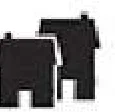 Towns represent homesteads and small frontier settlements. They have 2 Health and deal 2 Damage during Ravage. Towns act as a source of Explorers when Invaders Explore.
 Cities are the largest and most pernicious type of Invader piece. They have 3 Health and deal 3 Damage during Ravage. Cities act as a source of Explorers when Invaders Explore.
Destroying Towns and Cities affects the Invaders’ morale. Whenever a Town is destroyed, it generates 1 Fear. Whenever a City is destroyed, it generates 2 Fear (see Fear and Terror, page 12).
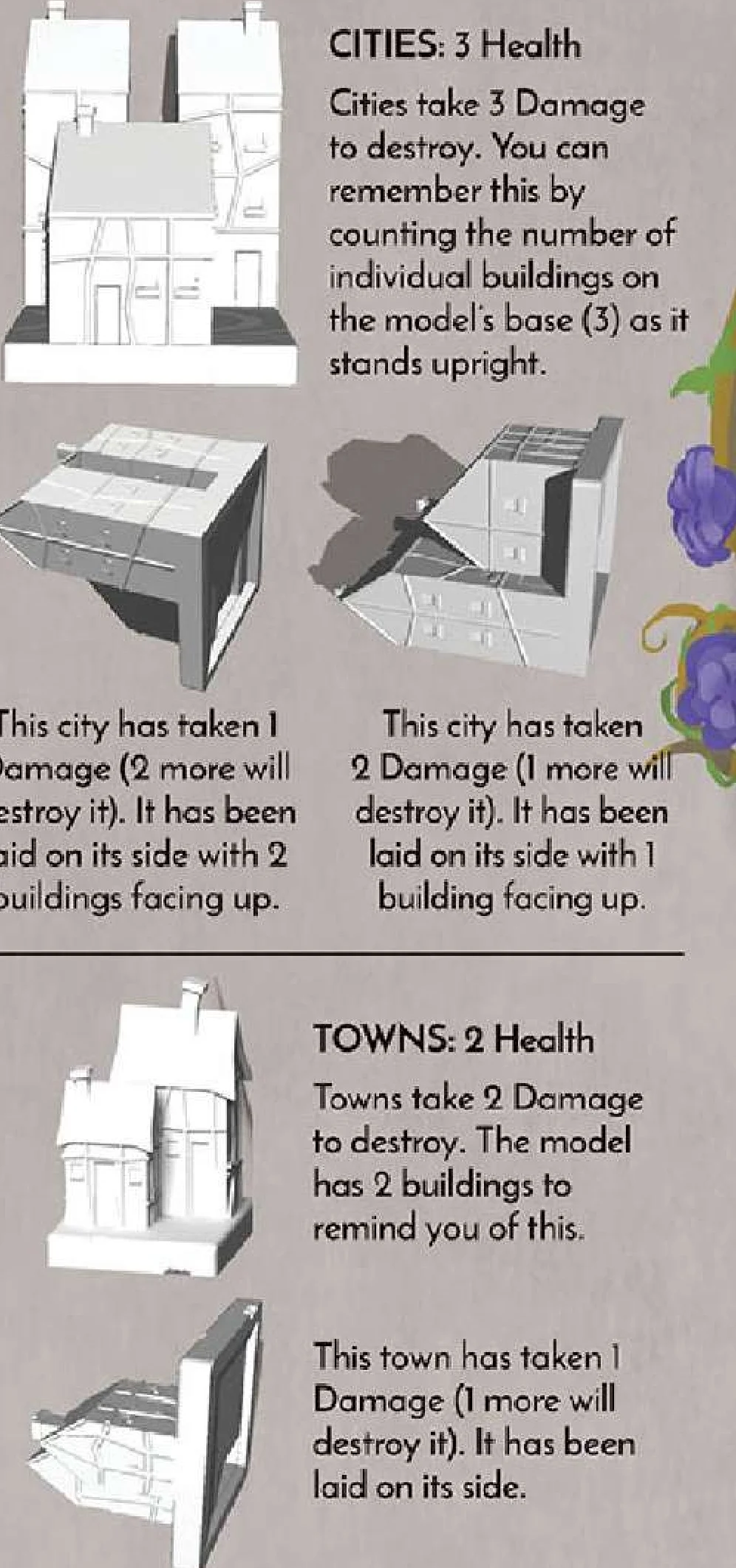
Tracking Damage
Town and City models are designed to help you track how much Damage will destroy them.
- CITIES: 3 Health. Cities take 3 Damage to destroy. You can remember this by counting the number of individual buildings on the model’s base (3) as it stands upright.
- A city standing upright has taken 0 Damage.
- A city laid on its side with 2 buildings facing up has taken 1 Damage (2 more will destroy it).
- A city laid on its side with 1 building facing up has taken 2 Damage (1 more will destroy it).
- TOWNS: 2 Health. Towns take 2 Damage to destroy. The model has 2 buildings to remind you of this.
- A town laid on its side has taken 1 Damage (1 more will destroy it).
When a piece has taken Damage equal to or exceeding its Health, it is destroyed. Return it to the supply, and earn 1 Fear for a Town or 2 Fear for a City. At the end of each Turn, when Time Passes, Damage clears and all models are reset.
Blight
Invaders slowly but inexorably Blight the land. A certain amount of Blight is normal in nature – such as damage from a forest fire – but too much will overwhelm the island. When you add Blight to the island during play, take it from the Blight Card – which starts Healthy side up – or Blight Space on the Invader board. If you remove Blight from the island, return it to the Blight Card. If you run out of Blight on the card, follow its instructions – either “lose” or “flip the card over and do what it says on the reverse”. Flipped Blight Cards do not flip back; the island cannot heal from Blighted to Healthy within the timespan of the game.
After Setup, whenever you add Blight to a land (including when Blight cascades), two bad things happen:
- Destroy Presence: In that land, destroy one Presence from each Spirit with Presence there. Destroyed Presence is placed next to the Island, not returned to the Spirit Panels.
- Cascade: If the land already had any Blight, also add one Blight to any one adjacent land. (If that adjacent land also has Blight, it will then cascade again from there, etc.)
The Dahan
The Dahan are the native human inhabitants of Spirit Island. They coexist well with the land and the Spirits. They also aren’t too thrilled about the Invaders’ colonization, but are wary of initiating violence.
Each island board starts with 6 Dahan pieces. Population growth in the game’s timespan occurs only with a few Powers which grant blessings of health, fertility, and good harvests. The number of Dahan is not limited by the supply of pieces.
Dahan only attack Invaders when a Spirit Power prompts them to do so, or when attacked themselves: after Invaders Ravage a land, any surviving Dahan in that land each deal 2 Damage to the Invaders in that land.
Each Dahan has 2 Health, meaning they are destroyed by 2 Damage from Invaders. Damage from Spirits does not hurt Dahan, although some Spirit Powers cause Dahan casualties as a terrible side-effect.
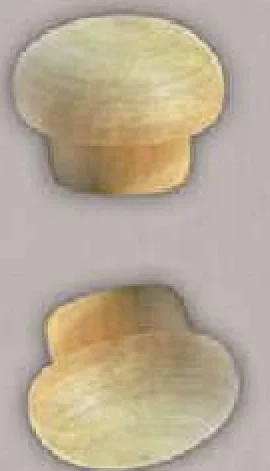
Tracking Damage to Dahan
DAHAN: 2 Health. The Dahan take 2 Damage to destroy. This Dahan has taken 1 Damage (1 more will destroy it). It has been flipped upside-down.
Powers
Spirits affect the game using Powers, which are either Power Cards or Innate Powers printed on a Spirit Panel. Innate Powers function similarly to Power Cards, except they are automatically available every turn (i.e. do not use Card Plays) and require having certain Elements rather than spending Energy.
Anatomy of Powers
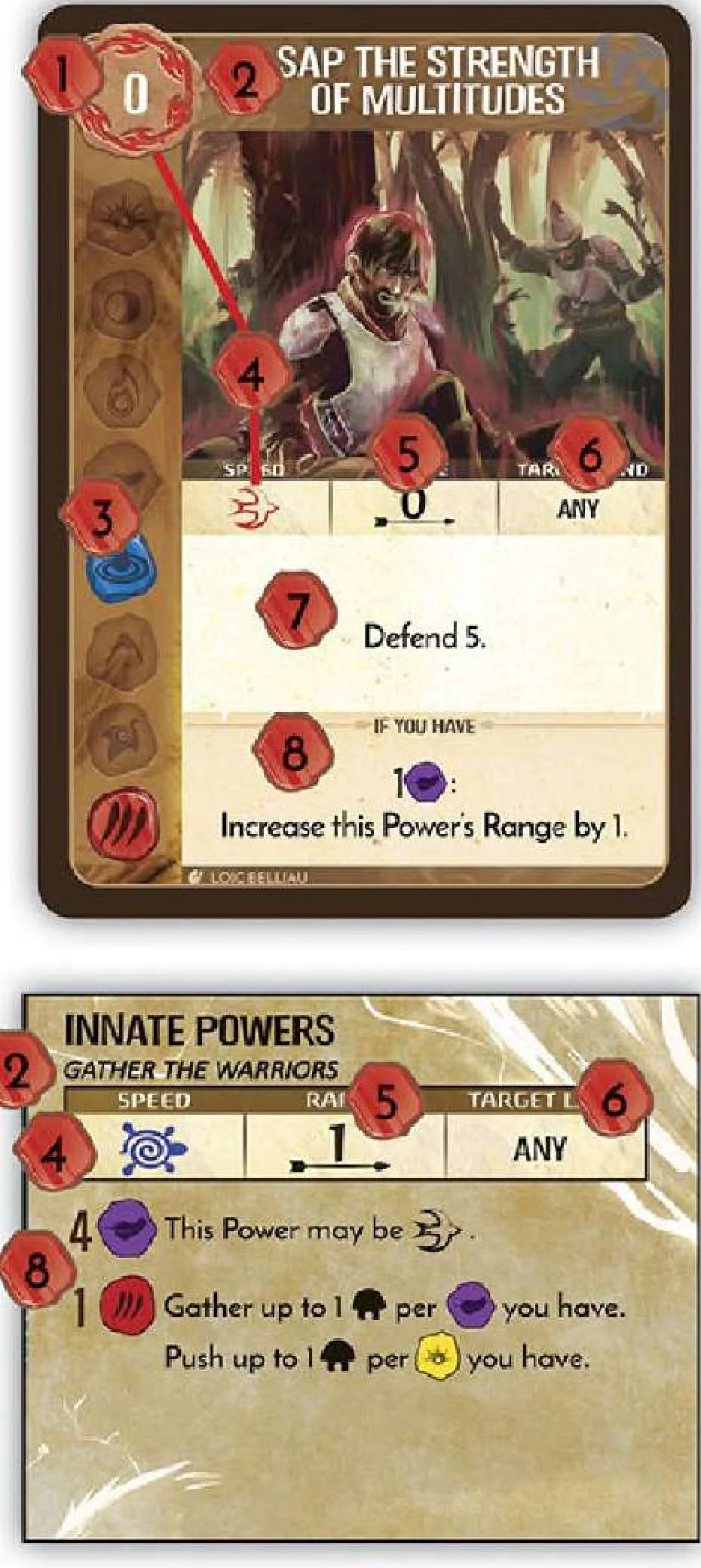
- Energy Cost (Power Cards only): You must pay this much Energy to play the card.
- Name
- Elements Gained (Power Cards only): There are eight Elements: Sun, Moon, Fire, Air, Water, Earth, Plant, and Animal. When you play a Power Card, you gain the Elements shown. Some Powers have extra effects if you have gained specific Elements (see #8 on the next page). Elements do not carry over from turn to turn. You gain Elements the moment you pay for a Power Card, regardless of whether the Power is Fast or Slow, and they go away as soon as it leaves play (usually during Time Passes).
- Speed: Fast Powers (
 ) resolve their effects before the Invader Phase, while Slow Powers (
 ) resolve their effects afterwards. Power Cards also show their speed by a red or blue ring around the Energy cost.
 - Range: How many lands away from your Presence this Power can reach. This is a maximum; you can always use a shorter Range. A Range of 0 means a land where you have Presence. Some Powers have limitations on what sort of land you can use them from (such as only from a Sacred Site, or only from a specific terrain); these are shown left of the range icon.
- Target: What land type this Power can affect. Most Powers can target any type of land, but some are restricted by terrain, what’s in the land, or whether it’s Coastal/Inland. Powers always target one single land unless explicitly stated. Some Powers target a Spirit instead of a land. (See back cover for Targeting reference.)
- Effects (Power Cards only): What the Power does. All effects take place in the single target land unless explicitly stated otherwise. (“Destroy all ” means “Destroy all Towns in target land”, not “Destroy all Towns in the game”!) Perform effects in order, skipping any that cannot be followed. Effects that do not change anything on the board – such as “Invaders do not Build in target land” – last only for the current turn.
- Elemental Thresholds: Optional effects which may only be used if the Spirit has gained certain Elements this turn (see #3 on the previous page). The required Elements are not “used up”; the threshold is simply a check to see if they are in play. For instance, a Spirit with 2 Water in play could meet any number of thresholds requiring 2 Water. You may always resolve a Power as if you had fewer elements than you actually do. If you meet more than one threshold under a Power, do each of them in order, from top to bottom.
- Exception: If a threshold says “Instead”, it replaces the effects of previous levels.
Elements
 Sun: Day, light, heat, dominance, command, constancy
 Moon: Night, cycles, darkness, dreams, transformation
 Fire: Heat, anger, destruction, desire, violent change
 Air: Wind, sky, sound, distance, speed, trickery, thought
 Water: River, fluidity, fertility, empathy, healing, disease
 Earth: The land, strength, constancy, stasis, resilience
 Plant: Verdancy, growth, entwining, regeneration
 Animal: Beasts, humans, blood, the body, life, death
General Principles for Resolving Powers
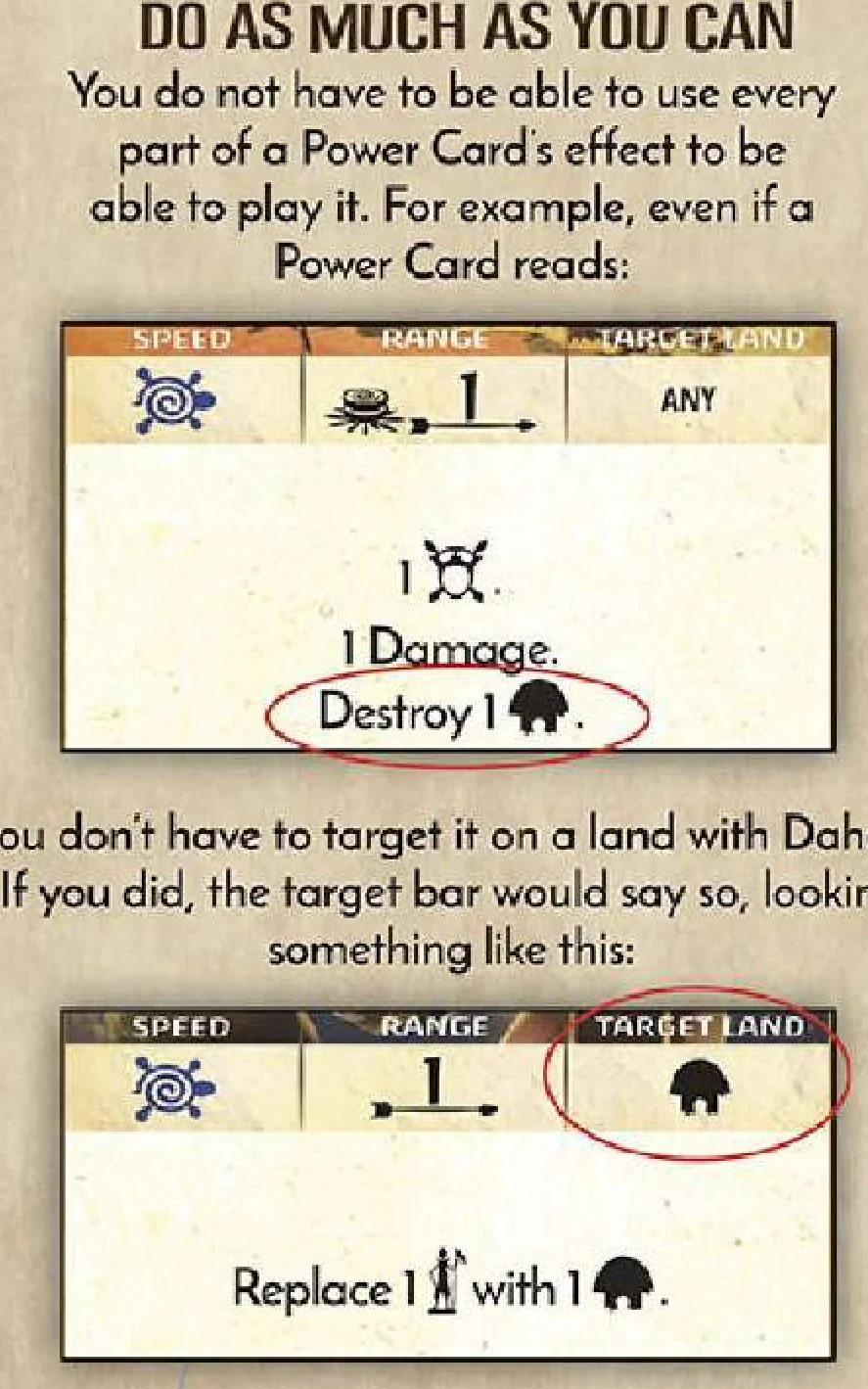
Do as Much as You Can
When resolving a Power’s effects, do as much as you can. If one part does not apply or cannot be done, skip it and do the rest. The only targeting restrictions are those in the target bar.
You Can Skip Using a Power’s Effect
If you cannot or do not want to use a Power you’ve played – perhaps the board situation has changed – you’re allowed to skip its effects entirely, as if it had a blank text-box. If it was a Power Card, you don’t get your Energy back, but you do still get to use the Elements granted by the card.
Similarly, when resolving a Power with thresholds, you may act as if you have fewer Elements than you really do, to avoid hitting thresholds.
One Land! One Turn! One Use!
Unless a Power explicitly says otherwise:
- It only affects one single target land. “Destroy up to 3 Explorers” will let you destroy up to 3 Explorers in the same land – not in multiple different lands. If a Power has multiple effects, they ALL apply to the same land.
- It only affects the current turn. “Dahan have +3 Health” or “Invaders do not Ravage in target land” affect this turn only, not the rest of the game. Any permanent changes to the game will be represented by changes to a board – pieces leaving, Fear Markers moving, etc.
- It can only be used once this turn. You cannot choose to pay for a Power Card twice and use it twice. Innate Powers only trigger once even if you have twice as many Elements as you need. If something makes a Slow Power Fast, you only get to use it during the Fast Phase, not both.
Single-Turn Effects
A few Powers have temporary effects on a land (such as “Invaders skip all Actions”). There are reminder tokens you can use to mark those lands for the turn if you want; just remember to remove them at the end of the turn!

Gaining Power Cards
You will usually gain new Power Cards via Growth, but some Power effects can grant them. New Power Cards always go into your hand.
Whenever you’re told to “Gain a Power Card”:
- Choose whether you’re gaining a Minor or Major Power. Draw 4 cards from that deck. If you need to, reshuffle the deck’s discard pile.
- Keep one drawn Power Card in your hand. Discard the others into the discard pile for that deck.
- After you gain a Major Power, you must Forget – permanently lose – one of your Power Cards. Put the Forgotten Power Card into the discard pile for its deck. Place it under your Spirit Panel if it is one of your Unique Powers.
If you are playing with a Power Progression, instead of drawing 4 and keeping one, simply take the next card in your Progression. (See First-Time Players, page 3)
What Power Cards Can I Forget?
Any of your cards! From your hand, your discard, or (if you somehow gain a Major Power mid-turn) from your cards in play. It can even be the Major Power you just chose. If you Forget a Power Card from play, you immediately lose the Elements it provided, and if you haven’t used it yet, you don’t get to. If you already used it, its effects continue until end of turn as usual.
Power and Fear Effects
Damage, Destruction, and Removal
Some effects remove Invaders, representing them fleeing in terror. Return the specified pieces to the supply. Some replace Invaders: first you remove the Invader, then you put something else in its place. A replaced Invader keeps any Damage it had. More Powers destroy Invaders outright. Return the specified pieces to the supply. Destroying a Town generates 1 Fear and destroying a City generates 2 Fear, but removing or replacing does not.
Whenever a Power or other effect says “Damage”, it always means “Damage to Invaders” unless explicitly specified otherwise. When dealing Damage, it is done to any Invaders in the target land, divided among them however you choose. If an Invader has taken Damage equal to or greater than its Health (see Invaders, page 15), it is destroyed immediately. Damage may be combined from multiple Powers. However, at the end of the turn any remaining Damage on survivors clears.
Damage Hurts Invaders
Invaders are not the only recipients of Damage in Spirit Island: the land and Dahan can take Damage from Invaders Ravaging. But the overwhelming majority of Damage in the game is done to Invaders. Any time a Power, Fear Card, or other game rule does Damage, it always means “Damage to Invaders” unless explicitly specified otherwise. Most Spirit Powers do not harm the land or Dahan.
Damage Tokens?
There are no tokens in Spirit Island for tracking Damage. Instead the models are built to be rotated to help track Damage done to them. (For more details, see sidebars on page 15 and 16.)
Defend
Some Powers let you Defend a target land, which reduces Damage done by Invaders to the land and/or Dahan. “Defend 2” means “Whenever the Invaders deal Damage to target land or Dahan there this turn, reduce the total amount of Damage they do by 2”. If multiple Defend effects are used in one land, they add together. Defend effects last for the entire turn. There are optional tokens you can use to help you remember that a land is Defended this turn.
Fear from Destruction
Whenever you destroy a City or Town (via Damage or otherwise), it frightens the Invaders. You generate 2 Fear for each City destroyed and 1 Fear for each Town destroyed. If you remove or replace a City/Town, it does not generate this automatic Fear.
Removing Blight
When you remove Blight from the island, return it to the Blight Card, on whichever side is currently face-up. The Blight Card will not flip from Blighted back to Healthy during the timespan of the game, no matter how much Blight you remove.
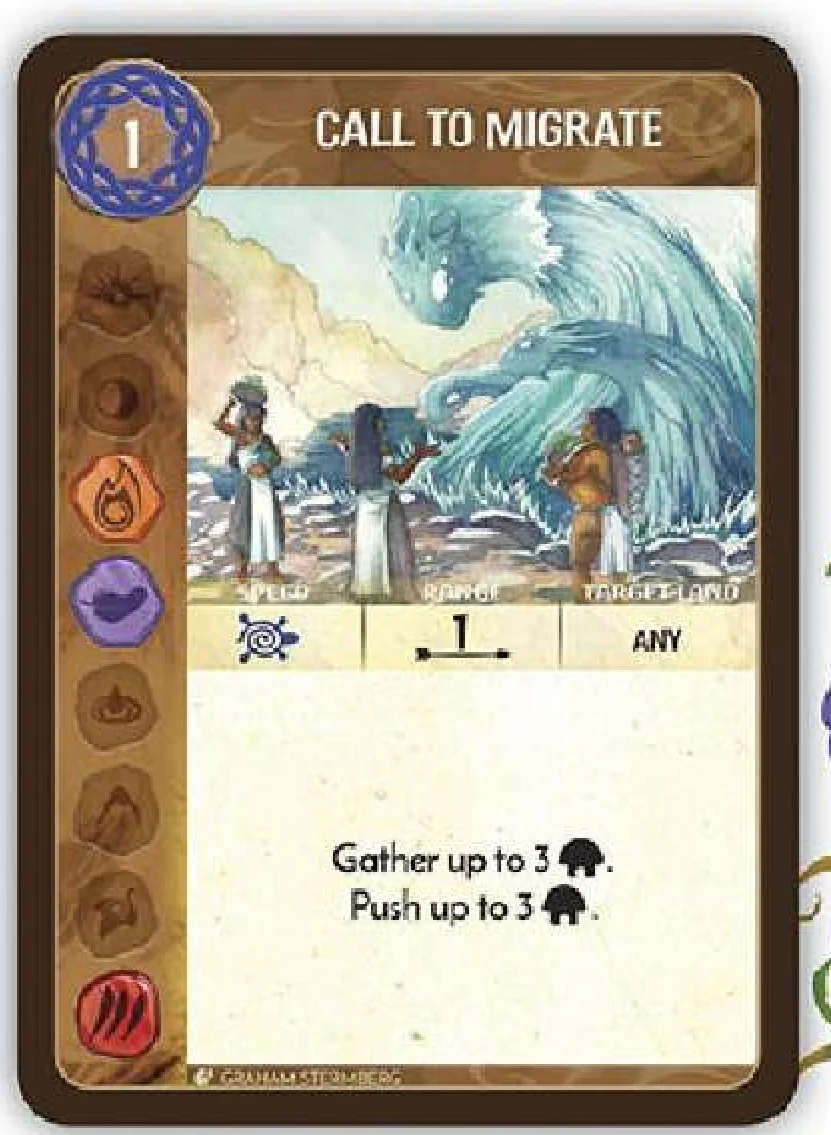
Gather and Push
Some Powers tell you to Gather things into the target land (such as “Gather 1 “, or “Gather up to 3  Description”). This means “Move that many things into the target land from land(s) adjacent to it”. Gather only pulls things in from adjacent lands; boosts to a Power’s Range do not affect Gathering distance.
Other Powers tell you to Push things from the target land (such as “Push 1 “, or “Push up to 3 Description”). This is the exact reverse of Gather. It means “Move that many things out of the target land, to adjacent land(s)”. Push only sends things one land away; boosts to a Power’s Range do not affect Pushing distance. If Pushing multiple things, they may go to different lands or not, as you wish. You can only Push into a valid land, not off the board or into the Ocean.
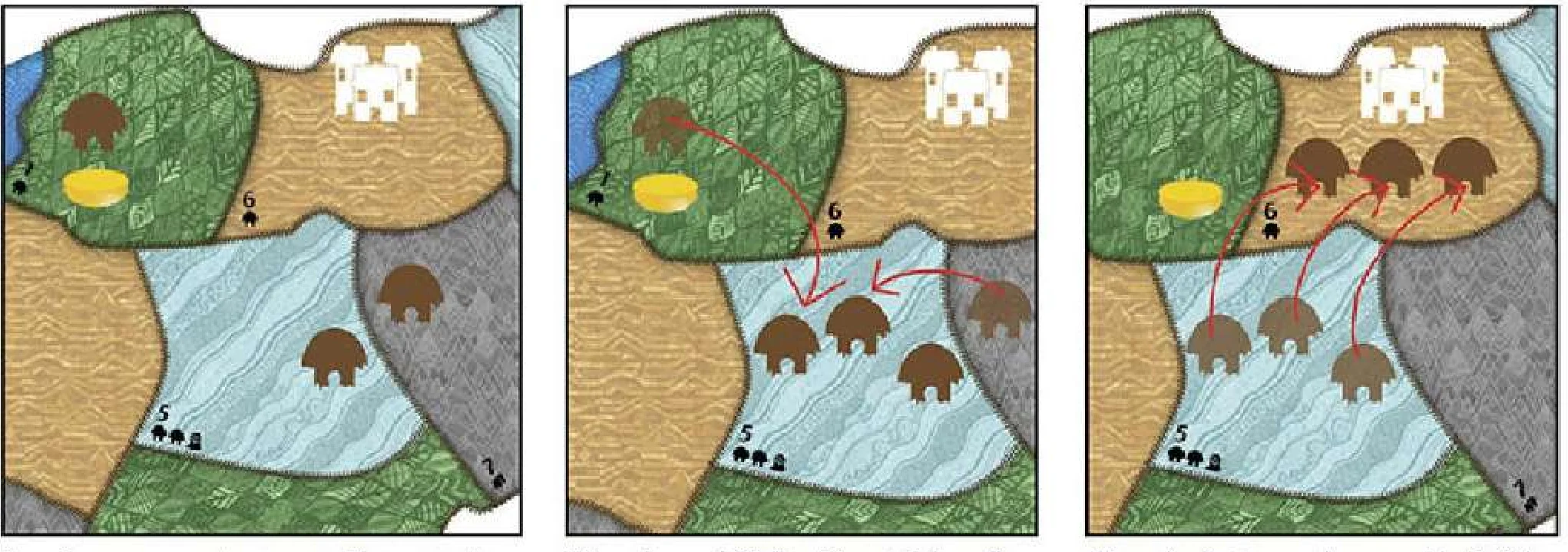
Repeat
Repeating a Power lets you activate its effects again. It does not give you Elements again (you gain Elements for putting a Power Card in play, not for using its effect) and Repeats cannot be chained (ignore any “Repeat” effects on a Repeated Power). The Repeated Power is Slow or Fast, whichever the original Power is. Here are some additional fine points:
- Changes to a Power carry over to the Repeat use. (For instance, if a Power is made Fast or given additional Range, that also applies to the Repeat.)
- You may make different choices when Repeating a Power.
- If a Repeat specifies where to use it, obey those instructions (instead of the usual Range and Target restrictions). Otherwise, you can choose any valid target by the usual rules, including the same target as its first use.
- Repeating a Power Card does not count as playing another Power Card. (For the purposes of, e.g., Boon of Vigor.)
Solo Player Mode
Solo games work much like normal games, but with a single board as the whole island. The only difference is that you can target yourself with Powers that specifically target “Another Spirit”, though you do not gain extra benefits from Powers that are better when used on another Spirit, like Gift of Constancy or Elemental Boon. Also, the luck of the draw is high, and you have no fellow Spirits to compensate for your Spirit’s weaknesses and limitations.
Adversaries
Adversaries are specific colonizing Powers from the world of Spirit Island. Including an Adversary in a game is optional, but doing so adds an additional layer of depth and strategy to the game. Be sure to choose your foe before Setup begins, as some may change the rules of Setup.
The Adversary Panel specifies an Escalation effect, which is performed when the is revealed on Stage II Invader Cards (see page 10). Some Adversaries also include additional loss conditions. These two rules are the ‘base level’ of an Adversary, providing a small difficulty boost. From there, each Adversary offers multiple increased difficulty levels, indicated by the number on the left. All listed game effects are cumulative: if you’re fighting vs. Level 3, you also use the effects from Level 1 and Level 2. Some Adversaries modify the Invader Actions. There are Reminder Tiles to put below the Invader Action spaces on the Invader Board to remind you that the rules for those Actions are modified. For a full list of each Adversary’s difficulty rating, see the chart on page 28.
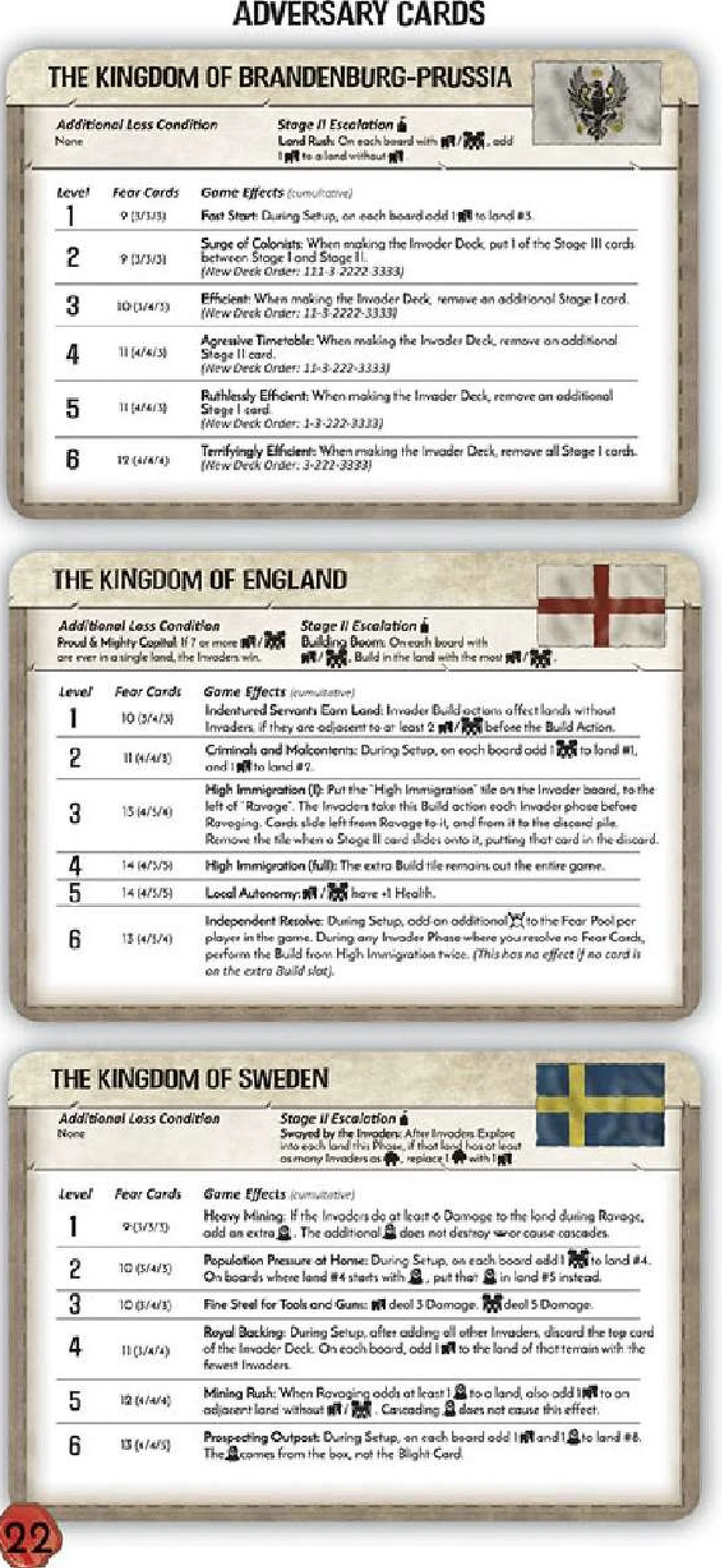
Fear Cards
As the difficulty increases, reaching higher Terror Levels becomes harder. Each Level shows how many Fear Cards to use and how many cards go in the top/middle/bottom of the Fear Deck.
The Kingdom of Brandenburg-Prussia
- Excellent first adversary with few new rules; most of the changes occur during Game Setup.
- Speed is the name of the game: the Invaders do everything at a faster tempo. Cards with 2 land types come up much earlier, often before the Spirits have had time to prepare.
- This Adversary is notably harder for Spirits which need substantial time to develop.
The Kingdom of England
- Buildings, buildings, and more buildings – England sends so many immigrants that the colonies spill over into unexplored lands. It doesn’t start out fast, but constantly pushes its borders forward. They will push hard to found a capital during Stage II.
- England is notably easier for Spirits good at wrecking Towns (e.g. Lightning’s Swift Strike).
- This Adversary is notably harder for Spirits which rely on moving/killing Explorers to prevent Invader Builds (e.g. Shadows Flicker Like Flame).
The Kingdom of Sweden
- Sweden’s Ravages are more dangerous than most, with advanced military tactics and a large population interested in farming and mining. The Crown’s policies favor assimilating the Dahan where possible, though these efforts will only work where Invader population is large.
- This Adversary is notably easier for Spirits which can prevent Ravages (e.g. A Spread of Rampant Green or Vital Strength of the Earth).
- A Note Regarding Setup: The Kingdom of Sweden can add Blight during Setup. Blight added during Setup does not cascade or destroy Spirit Presence.
Scenarios
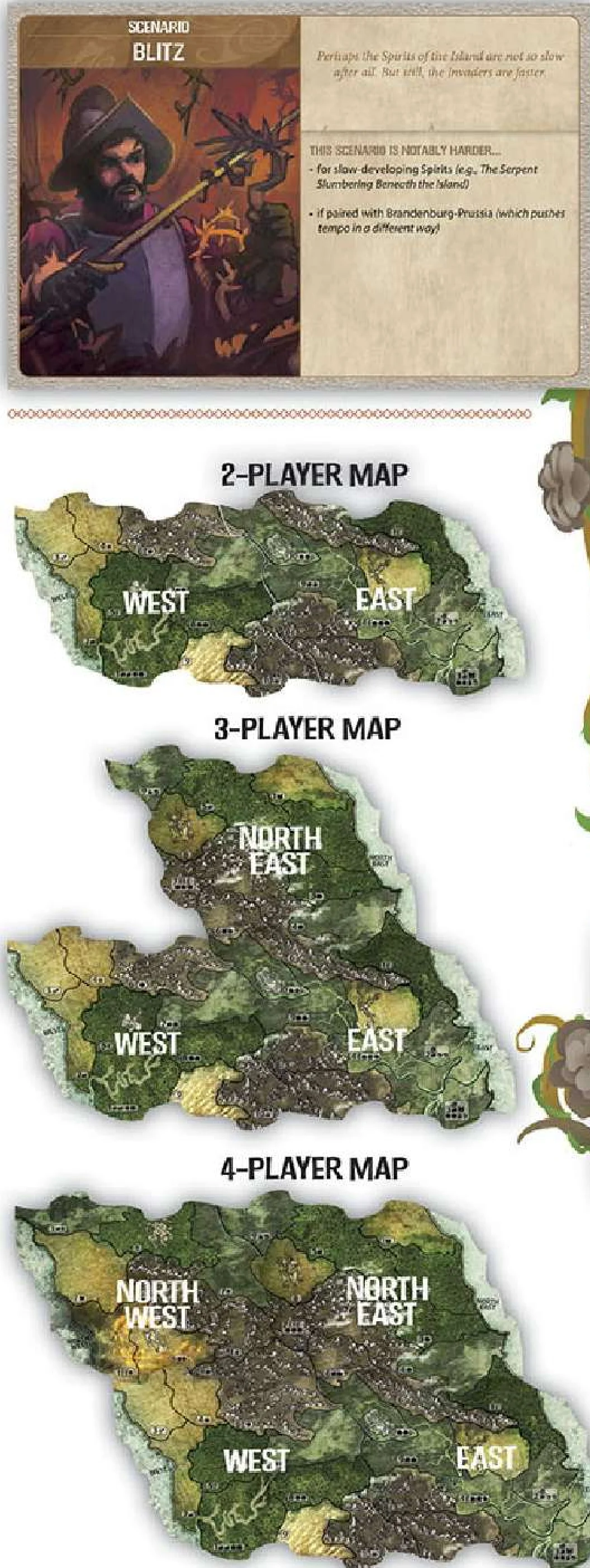
Scenarios change the situation the Spirits find themselves in, or the capabilities of the Spirits. They may involve different victory conditions or additional prerequisites for the standard victory condition, in addition to other rules changes. All Scenarios have a number in the upper-right corner that denotes their difficulty rating on a scale from 0 (no change) – 10 (insanely difficult).
Playing with Scenarios is optional. You may play a game with an Adversary and a Scenario or just using one or the other. If rules changes from a Scenario and an Adversary contradict each other, the Scenario takes precedence.
Thematic Map
The reverse side of each island board shows an alternate map. These maps represent the canonical Spirit Island, and prioritize theme more highly than the front “balanced” sides: land types cluster together, wet terrains tend to be on the windward side of mountains, etc.
The thematic boards are intended for experienced players, both because finding terrains at a glance is harder with the more realistic art style, and because some of the changes make the game more difficult: more lands per board, clustered terrains, more starting Invaders, etc.
Thematic Board Setup
The thematic boards have a fixed layout relative to each other. You can use any of them that you want – but for the definitive geography at each player count:
- 1 player: Use Northeast.
- 2 players: Use West and East, touching on the side opposite the Ocean.
- 3 players: Use West and East as above, plus Northeast above East.
- 4 players: Use West, East, Northwest, and Northeast in the usual four player layout.
Some lands overlap slightly onto other boards. A land is always considered to be on the board where its land number and Setup icons are. Ignore any unattached land fragments; they aren’t in play.
Some lands have Setup icons for tokens from the Branch & Claw expansion; ignore them when playing with just the core game. Illustrations of Spirits, rivers, and wildfires are for flavor and do not alter gameplay.
Scoring
If you would like to score your games (to compare your group’s performance across game plays):
- Victory: Score 5x Difficulty, +10 bonus for winning, +2 per Invader Card remaining in the deck.
- Defeat: Score 2x Difficulty, +1 per Invader Card not in the deck (both in the discard and face-up under Invader Actions).
- Victory or Defeat: +1 per X living Dahan and -1 per X Blight on the island, where X is the number of players in the game.
Tips & Tricks
Whoops!
You suddenly realize that for the past 4 turns you’ve been using a Power Card on lands it can’t actually target. What to do?
The answer is: don’t sweat it.
Especially on your first play or two, you’ll likely make minor mistakes here and there. They’re unlikely to break anything: the game will just be slightly easier/harder.
So long as everyone’s having fun, it’s all good, there’s no need to try and “rewind” and fix things. Just take note of what the correct rule is, and use it going forward!
Streamlining Gameplay
- As you play Power Cards, put the required Energy on top of them. This will help you remember to pay for them.
- When you resolve a Power Card, you can push it forward or turn it sideways to note that it has been used. Don’t discard it until end of turn, because you may be making use of its Elements for Innate Powers!
- When you resolve a Fear effect that affects an Invader Action (such as “Defend 2 in all lands”), place it atop the affected Invader Card so you don’t forget to apply it.
- Every board has exactly two lands of each terrain. Knowing this can make it easier to search out all lands of a particular terrain.
- When resolving Invader Actions, be clear about which player is handling what, so you don’t accidentally double Explore, Build, or Ravage. Some groups have each player manage the Invader Actions on their starting board. This can help new players understand how the Invaders act.
- During Setup, once you’ve put Blight on the Blight Card and the island, return the rest of the Blight to the box. This prevents accidentally taking Blight from/returning Blight to the wrong place! It’s easy to access the box a single time when the island becomes Blighted.
- When coordinating with your fellow Spirits, trying to remember every detail of what every player is doing is a recipe for overload. It can be much more fruitful to focus on objectives, diving into details only when necessary.
- Some players enjoy the game with a very analytical and carefully planned style, while others prefer very fast-and-loose “good enough!” play. The game works either way (or anywhere between) but both extremes at the same table can cause frustration. Try to make sure everyone is on the same page regarding time taken. (See The Urgency of War, page 8).
Basic Strategy
Feel under no obligation to read or use these – refer to them if you’re feeling lost in you first games.
Fighting the Invaders
- Destroy or move Explorers before they Build to keep Invaders from spreading.
- Destroy Invaders before they Ravage to keep them from harming the land and the Dahan.
- Once Invaders Explore into a particular terrain, you know they’ll Build there next turn, and Ravage there the turn after that. That predictability is useful when planning how to use Slow Powers.
Where Should I Put My Presence/Sacred Sites?
- Put your Presence close enough to the Invaders that you can use all your Powers on them.
- Avoid lands where Invaders are about to Ravage and add Blight. It will destroy your Presence.
- Spread your Presence out across the island so you can collaborate with other players. Three “1 Damage” Powers can destroy a City!
- Many Damaging Powers and beneficial Fear effects require Sacred Sites, so put them close to the Invaders.
Where Should I Move the Dahan?
- Into lands with a few Invaders. Many Fear effects will scare off Invaders from lands with Dahan, or inspire the Dahan to take the offensive. If Invaders are about to Ravage there, surviving Dahan will fight back.
- Out of lands with many Invaders. If the Dahan will be wiped out when the Invaders Ravage, save them by getting them out of harm’s way!
Miscellaneous
- Blight spreads quickly once it starts cascading. Try to clean up lands before a second Blight is added.
- If you are having trouble finding good targets for your Powers, that can mean one of two things:
- That you are winning! If you have the Invaders on the ropes, focus on achieving victory!
- That your Presence/Sacred Sites aren’t close to the parts of the board you want to affect. Focus on getting Presence and Sacred Sites in places where your Powers will be able to reach the Invaders.
- If you are feeling constantly low on Energy, try placing more Presence from your Energy Track, not using all of your Power Card plays, choosing less expensive Power Cards, or taking an Energy-granting Growth option for a turn or two.
- Major Powers require a lot of Energy to play, and require Forgetting one of your existing Power Cards when you gain them. You will usually want to take Minor Powers for your first pick or two.
Quick Reference Guide
Iconography
- Explorer: A type of Invader. Does 1 Damage, has 1 Health.
- Town: A type of Invader. Does 2 Damage, has 2 Health. 1 Fear when destroyed.
- City: A type of Invader. Does 3 Damage, has 3 Health. 2 Fear when destroyed.
- Dahan: A clan/village of local islanders. Does 2 Damage, has 2 Health.
 Blight: Environmental/spiritual harm to the Island.
- Fear: Fright done to Invaders. Advances Fear Markers, earning Fear Cards.
 Presence: A Spirit’s Presence disk – where they live in the land.
- Sacred Site: A land where a Spirit has 2 or more Presence.
- Fast Power: Resolve its effects before the Invader Phase.
- Slow Power: Resolve its effects after the Invader Phase.
- / Refers to both Explorers and Towns. “Push 2 / ” can Push 2 , 1 and 1 , or 2 .
- / Refers to both Towns and Cities. “A land with / ” means a land with at least 1 , at least 1 , or both.
Target
- ANY: Target is any one land.
- COASTAL: Target is a land touching an Ocean.
- INLAND: Target is a land not touching an Ocean.
- INVADERS: Target is a land with Invaders.
- NO INVADERS: Target is a land without Invaders.
 Target is a Mountain or Wetland.
- ANY
 : Target is any Spirit.
 - ANOTHER : Target is a Spirit other than yourself (except in solo game).
 Target is a land with Dahan.
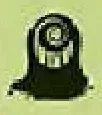 Target is a land with Blight.
 Target is a land without Blight.
Range
- 0: A land with your Presence.
 1: Range 1 from a Mountain with your Presence.
- 2: Range 2 from a land with your Sacred Site.
- +3: Increases Range by 3 lands.
Presence Track
 Energy: Each Spirit Phase, gain Energy equal to the highest uncovered number.
 Card Plays: Each Spirit Phase, play no more than the highest uncovered number.
 Reclaim One: Each Spirit Phase, you may return one Power Card from discard to hand.
 Bonus Element: Gained so long as it is uncovered.
Turn Order (All play is simultaneous.)
- Spirit Phase
- Growth
- Gain Energy
- Play and pay for Power Cards
- Fast Power Phase (Cards and Innate)
- Invader Phase
- Blighted Island Effect
- Fear Effects
- Ravage: Invaders Damage the land and Dahan. Add Blight if the land takes 2 or more Damage. Surviving Dahan fight back.
- Build: If Invaders are present, add a Town or City.
- Explore: If a source of Invaders is adjacent/present, add an Explorer.
- Advance Invader Cards
- Slow Power Phase (Cards and Innate)
- Time Passes
- Played Power Cards go to personal discards.
- Damage and Elements go away.
Glossary / Index
- Action: See Invader Action.
- Add: To put onto the board from the supply.
- Adjacent Land: Sharing a border or corner. [p. 13]
- Adversary: A specific colonizer to fight against. Boosts difficulty and changes how the game plays. [p. 22]
- +Any: Any one element, chosen anew each turn. Once set for a turn, cannot be changed until the next turn. [p. 14]
- Blight (): A piece showing environmental/spiritual harm to the Island. [p. 15]
- Blight Card: A card that holds the Blight pieces that are not on the Island. Starts off on the Healthy side, and may flip to the Blighted side during the course of the game. [p. 15]
- Blighted Island: The Island becomes Blighted when all the Blight on the front of the Blight Card goes onto the board. If all Blight on the Blighted side runs out, the players lose. [p. 15]
- Board: See Island Board or Invader Board.
- Build: An Invader Action. Adds a Town or City. [p. 10]
- Card Plays: The number of Power Cards a Spirit may play each turn, determined by the highest revealed number on a Spirit’s lower Presence Track. [p. 14]
- Cascade: Upon adding Blight to an already-Blighted land, you must also add one Blight to one adjacent land. [p. 15]
- City (): A type of Invader piece. Does 3 Damage, has 3 Health. Destroying a City causes 2 Fear. [p. 15]
- Coastal Land: A land readily accessible to ships, adjacent to the printed Ocean area. [p. 13]
- Dahan (): A piece representing a clan/village of local islanders. Does 2 Damage, has 2 Health. [p. 16]
- Damage: Harm done to Invaders, the land, or Dahan. Whenever a card doesn’t specify, it always means ‘to Invaders’. Damage equal to an Invader or Dahan’s Health destroys it. Dealing 2 or more Damage to a land adds one Blight to the land. [p. 9, 18]
- Destroy: Take off of the board and return to the supply. Destroying a Town causes 1 Fear. Destroying a City causes 2 Fear. [p. 18]
- Defend: Guard a land against the Invaders. Reduces the Damage done by the Invaders to the land/Dahan by the specified amount. [p. 18]
- Effect: The text instructions of a card or other game element.
- Element: Affinity with an aspect of nature, usually granted by a Power Card. Lets you use threshold effects. [p. 16, 32]
- Elemental Thresholds: See Threshold Effects.
- Energy: Pays for Power Cards. Carries over from turn to turn. [p. 13]
- Escalation Effect (): Something an Adversary does each time Exploring reveals an Invader Card with an Adversary icon on it. This icon appears only on Stage II cards. [p. 10, 22]
- Explore: An Invader Action. Adds Explorers to accessible lands. [p. 10]
- Explorer (): A type of Invader piece. Does 1 Damage, has 1 Health. [p. 15]
- Fear: Fright done to Invaders. Advances Fear Markers, earning Fear Cards. [p. 12]
- Fear Card: A card from the Fear Deck, earned by doing Fear to the Invaders. The Terror Level dividers are not Fear Cards. [p. 9, 12]
- Fear Effect: Anything done by an earned Fear Card. [p. 12, 18]
- Forget a Power Card: Permanently lose a Power Card from your hand, discard pile, or in play. Put it in the discard for its deck, or out of the game if it’s Unique to your Spirit. [p. 18]
- Gain a Power Card: In a Teaching Game, take your next Power Card. In a normal game, draw four Minor Powers or four Major Powers and keep one. When you gain a Major Power by any means, you must Forget (lose) a Power Card. [p. 3, 18]
- Gather: Move into a land from adjacent land(s). [p. 19]
- Growth: The first part of the Spirit Phase. Lets you place Presence, gain new Powers, and reclaim played Power Cards. [p. 8, 14]
- Health: How much Damage an Invader or Dahan can take before it is destroyed. [p. 15, 16]
- Healthy Island: The Island starts the game Healthy. It becomes Blighted when the first pool of Blight on the Blight Card is emptied and the card flips to the Blighted side. [p. 15]
- Inland Land: A land not adjacent to the printed Ocean area. [p. 13]
- Innate Power: A Power printed on your Spirit Panel. [p. 14, 16]
- Invader: A City, Town, or Explorer. [p. 15]
- Invader Action: One of three bad things the Invaders do during the Invader Phase – Ravage, Build, or Explore. [p. 9-11]
- Invader Board: The board which governs the Actions of the Invaders, including places for the Invader Deck and each of their three Actions. Additionally, the Invader board features the Fear Pool, the Fear Deck, and the Blight Space where a Blight Card is placed during Setup. [p. 6]
- Invader Card: Cards in the Invader Deck, indicating in which lands the Invaders will act. Divided into Stage I, Stage II, and Stage III. [p. 6]
- Island: The entire playing area of the game comprised of one or more island boards. [p. 6-7, 13]
- Island Board: An individual punchboard piece that comprises the Island. The reverse has a thematic map for more experienced players. [p. 6-7, 13]
- Land: A bordered area on the island map (other than Ocean). Whenever a land takes 2 Damage, you add a Blight to it. [p. 13, 15]
- Land Type: A description of what sort of land to act upon. This may be a terrain, Coastal/Inland, or a requirement for what’s in/not in the land (e.g. ‘A land with Invaders’). [p. 13, 16]
- Land with (Blight, Dahan, Invaders): A land having at least one (Blight, Dahan, Invader).
- Move: To put into a land from somewhere else on the island, via Pushing, Gathering, or other means.
- Ocean: Where the Invaders sail in. The stretch of Ocean on each island board determines which lands are Coastal. Oceans are not lands. [p. 13]
- Outnumber: ‘where A outnumbers B’ can be true in lands where there is no B. (For instance, ‘where Dahan outnumber Cities’ is true in lands with no Cities, so long as there’s 1 or more Dahan).
- Permanent Element: An element shown on a Presence Track. While uncovered, it gives an Element of that type. [p. 14]
- Power: A Power Card or Innate Power. [p. 16]
- Power Card: A Power on a card. May be a Minor Power, a Major Power, or a Unique Power. [p. 16]
- Power Progression: A fixed sequence of Power Cards a Spirit gains instead of the usual “Draw 4, keep 1” from a Power Card Deck. Used in introductory games only. [p. 3, 6]
- Presence: A piece showing where your Spirit lives in the land (). [p. 13]
- Push: Move to adjacent land(s). [p. 19]
- Range: The maximum number of lands away you can use a Power or effect. You may always act closer! Measured from your Presence unless otherwise specified. [p. 16]
- Ravage: An Invader Action. Invaders deal Damage to the land and Dahan; surviving Dahan then fight back. [p. 9]
- Reclaim: Take all played Power Cards from your personal discard pile into your hand of available Power Cards. [p. 14]
- Reclaim One: Take a single Power Card from your personal discard pile into your hand of available Power Cards. When revealed on a Presence Track, may be done once every Spirit Phase, starting immediately. [p. 14]
- Remove: Take off the board and return to the supply. Distinct from Destroy; Removing Invaders does not cause Fear. [p. 18]
- Repeat: Use the text effects of a Power again. Doesn’t grant additional Elements. Repeats never chain. [p. 19]
- Replace: Remove one piece and put another piece in its place. [p. 18]
- Sacred Site (): A land where a Spirit has 2 or more Presence. [p. 13]
- Scenario: A situation providing alternate rules/victory conditions. Boosts difficulty and changes how the game plays. [p. 23]
- Target: The land or Spirit a Power affects. [p. 16]
- Terrain: Jungle, Mountain, Sands, or Wetland. Each land has one terrain. [p. 13]
- Terror Level: A number from 1 – 3, representing how frightened the Invaders are. Sets the current Victory Condition. [p. 12]
- Threshold Effects: Part of a Power’s effects which depend on having certain Elements that turn. [p. 14]
- Town (): A type of Invader piece. Does 2 Damage, has 2 Health. Destroying a Town causes 1 Fear. [p. 15]
- Up To: May be zero. “Up to 3” means “0, 1, 2, or 3”.
- Your Land: A land with your Presence in it. [p. 13]
Lore: The Story Thus Far
The world of Spirit Island is roughly similar to our own world’s past. Details differ, but the overall trends of society and technology across the globe are broadly the same.
Europe is no exception: its politics have taken a different turn, but the customs and attitudes of its people are similar to our own history. There is some belief in the supernatural – religion speaks of good and evil powers, there are folk customs and superstitions – but nowhere in Europe or other large empires of humanity is there a place where the stones will speak to you or trees draw up their roots and rove across the land.
It is no wonder the Invaders fail to understand Spirit Island when they arrive.
The Island
The Island has existed far longer than humans have lived there. But despite the continued existence of first-hand witnesses, assembling a coherent history is virtually impossible. Even among the most trustworthy Spirits, tales of the past are rife with contradictions, all maintained to be true. Did Voice of the Deepest Gorge sacrifice itself, or descend to some greater destiny, or remain unchanged as an oracle of sorts? All three, apparently. Estimations of time and ordering are similarly hazy.
The Spirits
The Spirits of the Island are many and diverse: thronging wisps of breeze, strange half-seen shadows across still water, the sunbeam which forms perfect patterns even through tangled deadwood. Most do not fight the Invaders: the smaller Spirits are too weak; the greatest ones too slow or so strong they’d destroy the Island. Some, like Watcher Acts Not, are restrained by their own nature; and others can’t be bothered. Not every grove or gully has a Spirit – but there are certainly more Spirits than Dahan.
The Dahan
The Dahan were the first humans on Spirit Island. They immigrated centuries ago, in a time when Ocean’s Hungry Grasp prowled nearby waters less frequently. Their lore spoke of Spirits, and they expected their new home would have some, but were greatly surprised by the Spirits’ numbers, vitality, and intensity of manifestation. Some mistook the greater Spirits for gods.
The Dahan’s agriculture and animals brought Blight to the land and conflict with the Spirits, triggering the First Reckoning. The Dahan capitulated quickly, and an accord was reached: the Spirits would transform crops and animals to be more compatible with the ecosystem. The Dahan would change their methods of farming and seek counsel from friendlier Spirits. The two became neighbors, though unequal: the Dahan were reliant on and obligated to the Spirits.
The Second Reckoning
Many generations later came the Second Reckoning, when the Dahan discovered their advisors and protectors had not been entirely candid with them, and the power balance between Dahan and Spirits evened out – but that is another story. Suffice it to say that the Dahan no longer view the Spirits as gods.
The Invaders
The Invaders found Spirit Island a decade ago. Early coastal contact with the Dahan was fairly peaceful. The Dahan saw these new seafarers as analogues of their those-who-travel, and offered them appropriate hospitality. The Invaders saw a fertile, sparsely-populated island, and brought word home of a land ripe for the taking.
The first colony ships arrived five years later, bringing both settlers and an onslaught of foreign diseases which tore through the Dahan. Spirit assistance helped many Dahan survive – but even so, as the game opens, they are just regaining their footing, mourning their dead, and discovering that these scourges were not the act of angry Spirits. They are divided on what to do: some see the Invaders as a menace to drive away, while others still think of them as “our new neighbors”, or are fascinated with their lifestyle, tools, and beliefs.
The larger Spirits of the Island live and act on much longer timescales than humans. The most common reaction to the Invaders’ arrival was “oh, great, more humans – here we go again”, tempered with some optimism that Spirit-speakers of the Dahan could act as intermediaries to avoid another confrontation.
But the Invaders refused to listen, and spread impossibly quickly, with more and more colony ships arriving each year. In the blink of an eye there were nearly as many Invaders as Dahan, methodically reshaping the land, destroying Spirit and Dahan alike in their heedless, swarming expansion…
YOU ARE THE SPIRITS. CAN YOU SAVE YOUR ISLAND?
Lore: The Enemy Advances
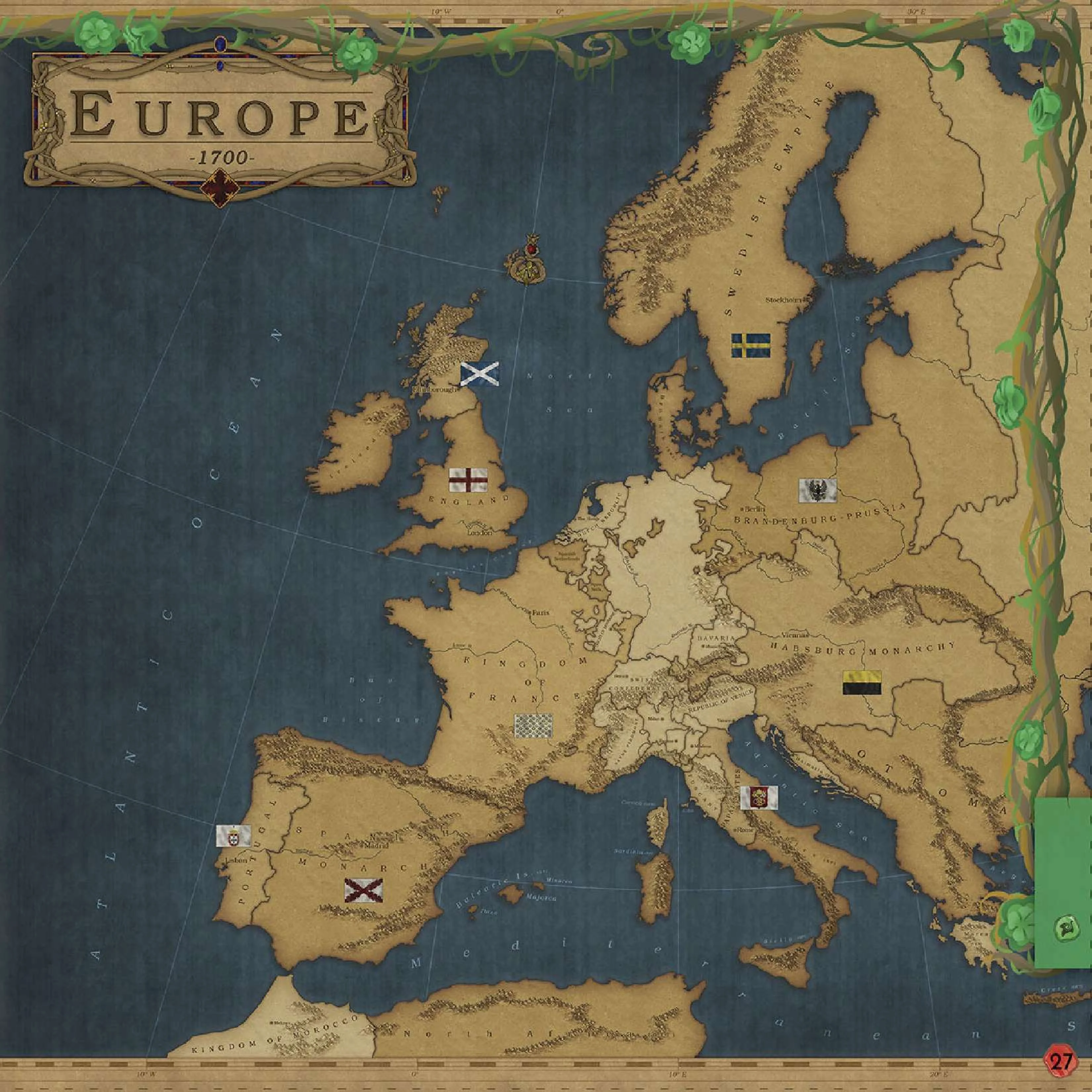
Though the Adversaries may seem familiar, upon closer inspection you will find that the Explorers of Spirit Island have a slightly different story to tell than your history books. The year is A.D. 1700, and the Great Powers of Europe have begun a scramble for colonies throughout the world. In the alternate history setting of Spirit Island, this scramble is even more intense than in our own world, as historical events have transpired to lead to the rise of many major naval powers.
The Kingdom of Brandenburg-Prussia: Frederick II
Frederick William inherited the Duchy of Prussia and Electorate of Brandenburg upon the death of his father George William in December 1640. Eschewing the ineffective and vacillatory foreign policy of his father, Frederick William abandoned the Polish Vasa dynasty and allied with King Gustavus Adolphus of Sweden against Catholic Poland. The triple alliance of Sweden, Russia, and Brandenburg-Prussia resulted in the resounding defeat of the Polish-Lithuanian Commonwealth in 1644, and its subsequent partition more than doubled the size of Prussian lands.
As a result of this victory, Frederick William, the Great Elector of Brandenburg, declared himself Frederick I, King in Prussia, and set about the process of building infrastructure and extending Prussian control throughout his newly acquired territory. Upon his death in 1701, his son Frederick II inherited a thoroughly Prussian kingdom and one of the premier European armies.
Frederick II sought to further expand Prussian territory without upsetting the continental balance of power between Sweden, Russia, France, and the Habsburgs. Building up the Prussian navy, the new king strove to catch up to other European colonial powers and quickly integrate new colonies into the Prussian economy.
The Kingdom of England
Queen Elizabeth I of England married Robert Dudley, son of the Duke of Northumberland, in 1562. The marriage was initially a scandal due to the suspicious circumstances surrounding the death of Dudley’s first wife, and inspired a revolt of several noble houses. However, the co-monarchs Robert I and Elizabeth I grew in popularity after the suppression of the revolt in 1564 and the birth of their son Edward in 1566. With the defeat of an attempted invasion from Spain and Scotland in 1587, the Kingdom of England became one of the premier naval powers in the North Atlantic. After the death of Robert in 1588 and Elizabeth in 1603, their son Edward VII became King of England.
England was only briefly involved in the religious wars on the continent in the 17th century. Following a disastrous invasion attempt in France in 1633 and a clash with Scotland in 1651, the Kingdom of England focused on fortifying the Scottish frontier and building up its naval power.
Unable to project power on the continent and constrained to southern Britain, the Kingdom of England was one of the first to seek colonies in the New World, using its overseas possessions to provide citizens with opportunities that were increasingly hard to come by at home.
Kingdom of Sweden: King Erik XV
Following his triumph at the Battle of Lützen in 1632, King Gustavus Adolphus led the Kingdom of Sweden to further victories over Catholic armies, defeating and partitioning the Polish-Lithuanian Commonwealth with Brandenburg and Russia in 1644. Following his death in 1651, Gustavus Adolphus was succeeded by his son, King Gustav III, who went on to defeat Kingdom of Denmark in a series of campaigns between 1657 and 1668 and secure total Swedish dominion over the Baltic Sea.
Gustav III was succeeded by his son Erik in 1683, who became the eighth Vasa ruler of Sweden. Under his rule, constrained from further growth on the continent by Russia to their East and the Holy Roman Empire and Prussia to their south, Sweden begun leveraging their powerful navy to set up colonies throughout the world.
The absorption of former Polish lands in the eastern Baltic has given Sweden a significant influx of Slavs and other non-Scandinavian people. While a tremendous boon to their economic and military power, this demographic shift has also been a source of internal turmoil as the Kingdom of Sweden attempts the historically difficult task of integrating a multi-ethnic society. Along with a desire for more natural resources, Sweden’s desire for a “safety valve” outlet for discontents and political agitators has driven their desire to establish themselves as a colonial power.
Adversary & Scenario Difficulty Chart
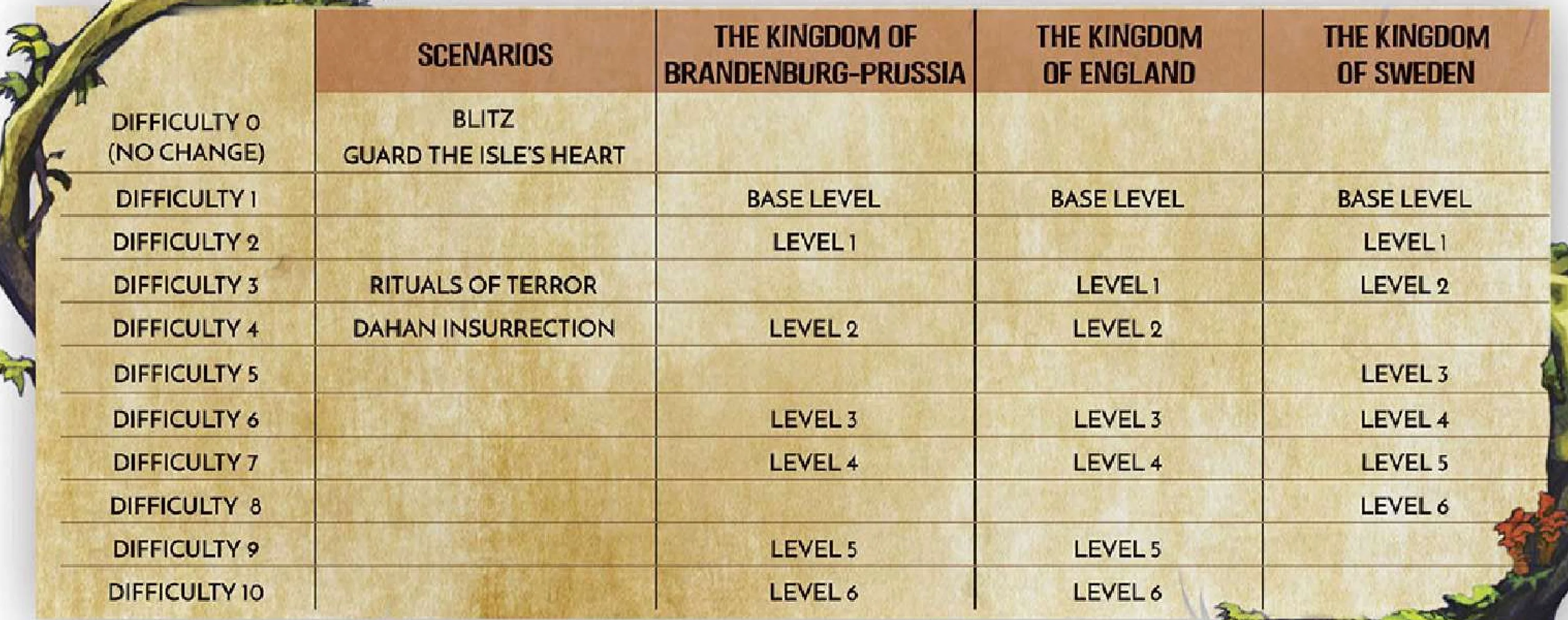
Using Thematic Maps (see page 23) increases the game difficulty by 3.
Please note that Difficulty level is a rough guide: some Spirits are better/worse against certain Adversaries and Scenarios, and Scenario/Adversary combinations will vary in how much they combo with each other.
Design Notes
The seed for Spirit Island was prompted by a colonization action in some other game – Goa? Navegador? Endeavor? – where I thought, “I wonder how angry the locals are about this new colony of foreigners? We’ll never know, because this game has entirely abstracted away the people who already lived there. Well, that’s kind of rude.” I shared the thought, maybe people laughed, then we got back to the game.
The idea stuck with me, though, because so many Euros have themes from that era: some explicitly colonial, others social or mercantile. It seemed like a game portraying the opposite point of view – that of being the subject of colonialism, trying to fight it off – could be interesting, and perhaps highlight the prevalence of eurocentric colonial themes.
In retrospect, I could have gone an entirely different route: find a specific colonial-vs-anticolonial struggle to try and model, going down a path similar to, e.g., King of Siam. Instead, my brain imagined a conflict that never was, but which could serve as a stand-in for struggles against different colonial powers throughout history. Spirit Island poses the question: what if actual (or semi-actual) colonizers from the Age of Discovery tried to colonize a place where they faced opposition of a nature they never expected?
(There is, incidentally, a reason that Spirits exist in abundance on Spirit Island, but are unknown to most empires of humanity. It goes back millennia, and has to do with binding bargains.)
I set as my design goal a cooperative game as thematically evocative as strong ‘experience’ games like Arkham Horror, but with substantially deeper and more strategic gameplay, a playtime of roughly two hours, and no ‘alpha player’/’quarterbacking’ problem that some groups have with co-ops. It’s been a long road, but I’m pleased with how it’s turned out – and I hope you have even more fun playing it than I’ve had creating it.
You can read more design notes on Spirit Island at is.gd/spiritisland_designdiary and posts linked therefrom.
– R. Eric Reuss
Playtesters
Daniel R. Abraham, Vivian Abraham, Joel Aernouts, Andy Arenson, Bernie Bagin, Ben Barden, Rick Baxter, Geoffrey Benedict, Mark Bigney, Brian Blankstein, Mike “Spiff” Booth, Chris Burton, Galen Garrick Brownsmith, Trey Chambers, Danielle Church, Chris Cieslik, Justin du Coeur, Jesse Cox, Christopher Dade, Nathan Dilday, Nathan Engert, Kathryn Goldenock, Jeremy Gottesman, Shoshana Gourdin, Bryan Graham, Luke Hagerling, Betsy Helms, David Helms, Tim Hogue, Donner Holten, Prescott Jenner, Paul Kalmar, Robert Kamphaus II, Dave Kapell, Kathryn Kun, Andy Latto, Charles Leiserson Jr., Brian W. Lenz, Russ Luzetski, Andrew Menard, Hung Nguyen, Leanne Opaskar, Mark Opaskar, Alex Pogue, Danielle Reese, Curtis Reubens, Anna Roberts, Uncle Don Ross, Ariel Segall, Cameron T. Seitzman, Randy Smith, Kevin Spak, Brock Stafford, Rick Stefanich, David A. Stern III, Tyler Stewart, Bill Stull, Dylan Thurston, Jared Tinney, Brent Ur, Carolyn VanEseltine, Rebecca Vessenes, Ted Vessenes, Paul Watson, Katarina Whimsy, Sameer Yalamanchi, and countless people who gave feedback at conventions. Many thanks to all of you!
Artists
Jason Behnke, Loïc Belliau, Kat G Birmelin, Cari Corene, Lucas Durham, Rocky Hammer, Sydni Kruger, Nolan N Nasser, Jorge Ramos, Moro Rogers, Graham Sternberg, Shane Tyree, Joshua Wright
Credits
- Game Designer: R. Eric Reuss
- Developer: Ted Vessenes
- Editor-in-Chief: Christopher Badell
- Creative Director: Adam Rebottaro
- Managing Art Director: Jennifer Closson
- Graphic Design: SaRae Henderson, Darrell Louder
- Cover Art: Joshua Wright
- Cover Vines: Nolan N Nasser
- Figure Design: Jorge Ramos
- Editors: Brian Blankstein, Dylan Thurston, Ted Vessenes
- Alternate Historian: Paul Bender
Thanks beyond all words to my wife Anne Cross for many years of loving support, and to Ted Vessenes for many years of development and suggestions. Spirit Island wouldn’t have happened without either of you. – Eric
Spirit Island and the Fabled Nexus logo are property of Greater Than Games, LLC. © 2016 – 2017
For more information about this and other great games, go to www.GreaterThanGames.com. If you have any questions, or require replacement pieces, please email [email protected].
Introduction & Overview
Introduction
You are powerful Spirits of the natural world, existing on an isolated island. Invaders from beyond the known sea have recently begun their colonization of your island, killing the native islanders – a people called the Dahan – and upsetting the natural balance. The Spirits of the island must grow in power and throw back the Invaders before the island is blighted beyond hope of recovery!
Gameplay Overview
Spirit Island is a cooperative game for 1-4 players where each player is a Spirit of nature, defending their island from invading colonists who have little regard for the well-being of the land or its native inhabitants, the Dahan. Every turn, all Spirits act simultaneously, employing Powers to push the Invaders back, bolster the island, and aid the Dahan. But the Spirits start out small and limited, and will have to learn some new tricks in order to catch up to the rapidly expanding Invaders, whose Actions (automated by the game) drive them to spread across the Island and establish settlements, spreading Blight in their path. To win, the Spirits (with the help of the Dahan) must destroy the Invaders and scare away any survivors. However, the game will end in defeat if the island is overrun by Blight, if any Spirit is destroyed completely, or if you act too slowly and fail to drive the Invaders off before they become entrenched.
Once you know the game, Spirit Island takes about 90-120 minutes to play – slightly shorter for games with 1-2 players, slightly longer for games with 4.
How to Read This Rulebook
The rules are divided into three major sections: Game Setup, Sequence of Play, and Game Concepts. Read Game Setup first. Then read Sequence of Play and Game Concepts in the order that best suits your learning style. Sequence of Play will introduce you to the overall game structure while Game Concepts drills down into individual game mechanics.
First-Time Players
Spirit Island is a complex game with many moving parts. The first time or two you play, you should:
- Choose a low-complexity Spirit: (Lightning’s Swift Strike, Vital Strength of the Earth, River Surges in Sunlight, or Shadows Flicker Like Flame.)
- Take the Power Progression Card for your Spirit. Set aside all the Minor and Major Powers listed on the card. During the game, when you gain a new Power Card, add the next Power Card on the list to your hand instead of using the standard method.
If everyone is playing the game for the first time, also:
- Don’t use a Blight Card. Instead, use the pre-printed Blight space on the board.
- Don’t use an Adversary or Scenario. They increase difficulty and add additional rules.
Whenever your group is ready for a more challenging game, we recommend the Kingdom of Brandenburg-Prussia as a good first Adversary – it mostly modifies setup rather than introducing new rules. The Kingdoms of England and Sweden involve more fundamental changes to how the Invaders work.
Components
Components
- 1 Invader Board
- 4 Modular Island Boards
- 8 Spirit Panels
- 36 Dahan
- 20 Cities
- 32 Towns
- 40 Explorers
- 38 Blight
- 52 Spirit Presence (13 of each in 4 colors)
- 12 Single-Turn Effect Markers (3 of each in 4 colors)
- 32 Energy Markers (20 1-Energy markers, 12 3-Energy markers)
- 20 Fear Markers
- 8 Player Aid Cards
- 4 Power Progression Cards
- 15 Fear Cards
- 2 Terror Level Dividers
- 2 Blight Cards
- 15 Invader Cards
- 22 Major Power Cards
- 36 Minor Power Cards
- 32 Unique Power Cards
- 3 Adversary Panels
- 3 Adversary Reminder Tiles
- 4 Scenario Panels
Game Setup
Overview
For most games of Spirit Island, Setup proceeds as below. However, when setting up Spirit Island using an Adversary and/or Scenario, select them first, as they can change how the game is set up.
Invader Board
To set up the Invader Board:
- Place the Invader Board on one side of the play area.
- Put 4 Fear Markers per player into the Fear Pool.
- Shuffle the Fear Cards and put 9 on the Fear Deck Space. Place the “Terror Level 3” divider 3 cards from the bottom and the “Terror Level 2” divider 3 cards above that, so the deck is divided into 3 groups of 3 cards each.
- Make the Invader Deck and put it on the Invader Board on the Explore Action Space (see sidebar).
- Take a random Blight Card and place it on top of the Blight Space on the board, “Healthy Island” side up, without looking at the back. If you are not using a Blight Card, use the Blight instructions printed on the Invader Board instead. Place the shown amount of Blight onto the card.
Making the Invader Deck
The Invader Deck is 12 cards:
- 3 Stage I cards on top, then
- 4 Stage II cards, then
- 5 Stage III cards on the bottom.
Mix up the cards from each Stage and choose without looking at them, putting unused cards back in the box. (The game comes with 4 Stage I cards, 5 Stage II cards, and 6 Stage III cards, so you can just remove one of each.)
The Island and Supply
To set up the island:
- Randomly pick one Island Board per player and arrange them to form the Island (see sidebar).
- Populate the Island Boards with Invaders, Dahan, and Blight (from the box, not the Blight Card) as indicated by the icons in each land.
To set up the Supply:
- Shuffle the Minor and Major Power Decks. Put them near the board with room for each deck to have a discard pile.
- Put the Energy, Cities, Towns, Explorers, and the Dahan near the board. Make sure all players can reach them; you may need multiple piles.
Player Setup
Each player takes all Spirit Presence and Single-Turn Effect Markers of one color, then chooses a Spirit by taking a Spirit Panel and its four Unique Power Cards, which is their starting hand. New players should choose a low-complexity Spirit and take its Power Progression Card, as described on p. 3.
Each player starts on a different island board and follows Setup instructions on the back of their Spirit Panel. This always includes putting Presence into one or more lands on their starting board; some Spirits have additional instructions. (Once the game begins, Spirits are not restricted to play only on their starting board. Presence and Powers may be placed or used on any board.) Players then flip their Spirit Panels and place all remaining Presence onto the dashed circles on their Presence Tracks. The leftmost numbers with solid circles remain uncovered.
Invaders’ Starting Action
To finalize the Setup, the Invaders take an initial Action. Reveal the top card of the Invader Deck. The Invaders Explore in that land type (see Explore, page 10). Then place that card face-up in the “Build” Action Space.
Sequence of Play
Round Structure
Each turn has the following phases:
- Spirit Phase
- Fast Power Phase
- Invader Phase
- Slow Power Phase
- Time Passes
Players play simultaneously within each phase, conferring as they wish. Table talk is not just allowed, it’s likely necessary for victory!
General Rules for Simultaneous Play
The Urgency of War
Some Spirits are inclined to take a long time choosing Power Cards: perhaps several centuries in the case of slow-moving earth Spirits. But the threat of the Invaders forbids the luxury of infinite time.
Any player may place a limit on the time available to complete the Spirit Phase. This can be done using a timer, setting a condition (“When I get back, we start”), or any other means desired.
Of course, as this is a cooperative game, it behooves you to not be too draconian.
Who Decides?
When the game calls for a decision (where Blight cascades to, which Invaders to do Damage to, etc) and it’s not specified who makes it, what do you do?
If the decision springs from a Power, the Spirit using the Power makes the decision.
For other situations, players should try to come to a consensus.
But in the rare event that agreement is not possible:
- For decisions about/within a land: Each Spirit makes choices regarding the lands on their starting board.
- For other cases: The game owner/organizer makes the call.
1. Spirit Phase
Each Spirit does three things, in the following order:
- Grow: Choose one option (unless stated otherwise) next to “Growth” at the upper-right of the Spirit Panel. Each section is a single choice. You must do everything shown, but may choose the order. (For more on Growth options, see page 14.)
- Gain Energy: Gain an amount of Energy equal to the highest uncovered number on your Energy Presence Track. Place any gained Energy on or near your Spirit Panel.
- Play and Pay for Power Cards: Select the Power Cards (Fast and Slow) that you will use this turn. The maximum number of Power Cards you can play each turn is the highest uncovered number on the Card Plays Presence Track (even if you have enough Energy to pay for more). You must immediately pay Energy for all Power Cards played, even Slow ones. Likewise, you immediately gain all Elements from played Power Cards, even if the Powers’ effects are Slow. Do not resolve the effects of the Power Cards yet.
2. Fast Power Phase
Players resolve Fast Powers – both Innate Powers printed on their Spirit Panel and Power Cards they played. Power resolution can be done mostly simultaneously. When timing becomes important, Powers may be resolved in whatever order the players want, so long as no Power interrupts another partway through.
If a player discovers they do not want to use a Power’s text effect (or cannot use it), they may choose to skip it entirely. Sometimes, a Power Card will be worth playing purely for its Elements (see Elements Gained, p. 16).
You cannot delay using a Fast Power until the Slow Phase, even if you want to. Use it now or forego it.
3. Invader Phase
The Invader phase has the following parts:
- Blighted Island (once appropriate)
- Fear
- Invader Actions:
- 3a. Ravage
- 3b. Build
- 3c. Explore
- Advance Invader Cards
3.1. Blighted Island
If the Blight Card has flipped to “Blighted Island”, follow the instructions there. If you have trouble remembering to do this, put a Blight from the box onto the Fear Space as a reminder.
3.2. Fear
If any Fear Cards have been earned (see Fear and Terror, page 12), pick up the whole face-down stack, flip it over and resolve the cards one at a time in the order they were earned. Then discard them to the Fear Discard Space on the board. Use only the effect listed next to the current Terror Level. This could be higher than when the card was earned. Fear effects last only for the current turn.
Fear Earned Through Fear Effects
Most Fear effects do not cause more Fear. They remove Invaders rather than Damaging or destroying them. However, there are exceptions. If you do earn a new Fear Card this way, put it at the bottom of the stack of cards you’re currently resolving.
3.3. Invader Actions
The Invader Board has three Action Spaces: Ravage, Build, and Explore. The Invader Card in an Action Space determines which lands will be affected by that Action. (If there is no Invader Card in a space, no action is taken.)
3a. Ravage
Look at the Invader Card in the Ravage Action Space on the Invader Board (if any): the Invaders Ravage in each land of the shown type only. First, Invaders deal Damage to the land and Dahan. Then, any surviving Dahan fight back.
Wherever there are Invaders in the shown lands, Invaders deal Damage: 1 per Explorer, 2 per Town, and 3 per City. Damage is done both to the land and Dahan.
- Invaders Damage the Land: If 2 or more Damage is dealt, add a Blight to the land. (See sidebar.) This only happens once, no matter how much Damage is dealt. Partial Damage to the land is ignored.
- Invaders Fight the Dahan: Every 2 points of Damage destroys one Dahan. You must destroy Dahan as efficiently as possible; you cannot disperse Damage among multiple Dahan to avoid killing them. If a Dahan is dealt 1 Damage, turn it over to show that it is Damaged. Any surviving Damaged Dahan will recover at the end of the turn.
After Invader Damage has been fully resolved in a land, any surviving Dahan there fight back. Each Dahan deals 2 Damage to the Invaders. (See page 15 for Invaders’ Health.) The Dahan will fight back even if the Ravaging Invaders deal no Damage (for example, due to Defend Powers), but not if the Ravage Action has been skipped or stopped from happening altogether.
Spirit Presence does not fight back as Invaders do not directly attack the Spirits.
Effects of Blight
Cascading: Whenever you add Blight to a land, if that land already has Blight, you must also add a Blight to one adjacent land. (If that adjacent land also already has Blight, it cascades again from there, and so forth.)
Presence: Adding Blight to a land destroys one Presence from each Spirit in that land. Remember: destroyed Presence is removed from play (set next to the Island), not returned to the Spirit Panels! (For more on Blight, see page 15.)
3b. Build
Look at the Invader Card in the Build Action Space on the Invader Board: the Invaders Build in each land of the shown type only.
Wherever there are Invaders in the specified type of land, they add either one City or one Town:
- If the land has more Towns than Cities, add a City. (You are not upgrading the Towns, you are adding a new City from the supply.)
- In all other cases, add a Town.
Do not Build in lands without Invaders.
3c. Explore
Turn the top card of the Invader Deck face-up. Invaders Explore in accessible lands of the shown type only, venturing forth from Towns and Cities or approaching from the Ocean. If the card has a flag icon and you are playing with an Adversary, first perform the Escalation effect (see sidebar). If there is no card to turn up, time has run out and you lose.
Add an Explorer to every land of the shown type which either:
- Contains a Town or City; or
- Is adjacent to a Town, City, or Ocean.
No matter how many sources are in or adjacent to an Explored land, you only add one Explorer. Explorers are added directly from the supply, not moved around on the board.
Stage II Escalation
Most Stage II cards have a flag icon . Its effect depends on your Adversary. If you are playing without an Adversary, ignore the flag icons.
Escalation effects happen as soon as the card is revealed, before Explore, unless the Adversary states otherwise. Some may make changes to how the upcoming Explore works.
3.4. Advance Invader Cards
After Explore, slide all of the Invader Cards left: Move the Ravage Card to the discard, the Build Card to the Ravage Space, and the Explore Card to the Build Space, so that next turn they will Ravage where they Built this turn and Build where they Explored this turn.
Remember!
Ravage, Build, and Explore affect only the land type(s) shown on their cards! Ravage and Build Actions only affect lands that have Invaders! Explore only affects lands adjacent to a source of Invaders!
4. Slow Power Phase
Players resolve Slow Powers, which may be either Innate Powers printed on their Spirit Panel or Power Cards they played. This works just like the “Fast Power Phase”, explained on page 8.
5. Time Passes
This is the wrap-up phase at the end of each turn.
- Discard: Players discard all Power Cards played this turn into their personal discard piles.
- Damage and Elements Clear: All Elements go away. All Damage done during the turn goes away; if you turned any pieces on their sides to note partial Damage, turn them back.
If you’re using the reminder tokens for Single-Turn Effects, make sure to remove those at this time.
Invader Actions: Examples
Ravage Examples
For these examples, the Ravage Action takes place in Wetlands because of the Invader Card shown.
- A) This Wetland has 2 Dahan, 1 Town, and 1 Explorer in it. The Town and Explorer deal a combined Damage total of 3 (2 from the Town and 1 from the Explorer) to the land and to the Dahan.
- (Step 1) 3 Damage to the land adds a Blight. 3 Damage to the Dahan destroys one of the Dahan and deals 1 Damage to the other.
- (Step 2) Now it’s the Dahan’s turn to fight back, dealing 2 Damage. The players choose to direct that 2 Damage at the Town, destroying it. This generates 1 Fear.
- B) The City deals 3 Damage to the land; since at least 2 Damage was dealt to the land, it adds a Blight. Because Blight already exists here, the newly added Blight causes a cascade: another Blight must be added to an adjacent land of the players’ choosing. Two of the available options are:
- Option 1: The Blight cascades to land #2, which was previously empty.
- Option 2: The Blight cascades to land #7, destroying 1 yellow Presence (meaning this land is no longer a Sacred Site for yellow) and 1 purple Presence (removing purple from the land entirely).
Option 1 is likely the better choice because it does not destroy any Presence.
Build Examples
For these examples, the Build Action takes place in Mountains because of the Invader Card shown.
- A) This land has more Towns than Cities, so a City is Built here.
- B) This land has only Explorers, which means it has the same number of Towns and Cities: zero. Therefore, a Town is Built here.
- C) This land has the same amount of Towns and Cities, so a Town is Built here.
- D) This land has no Invaders, so the Invaders do not Build here.
Explore Examples
For these examples, the Explore Action takes place in Jungles because of the Invader Card shown.
- A) This land includes a Town or City already, so an Explorer is added here.
- B) This land is not Coastal and is not adjacent to a land with any Towns or Cities. The Invaders do not Explore here.
- C) This land is adjacent to a land with a Town or City, so an Explorer is added here.
- D) This land is Coastal and is adjacent to a land with a Town or City. (Either would be sufficient.) An Explorer is added here.
Core Concepts: Spirits, Lands & Invaders
Victory and Defeat
At the start of the game, the Invaders are at Terror Level 1. They’re not afraid of the island and probably aren’t even aware of the Spirits’ existence. To win, you need to completely clear the island of Invaders. As you earn Fear Cards (see Fear and Terror, below), you will reach new Terror Levels with easier victory conditions. You win immediately anytime you meet the current victory condition.
You can lose three ways:
- Too Much Blight: If the last Blight comes off of the Blight Card, you follow the instructions there, which are often “you lose”.
- A Spirit Is Destroyed: If any Spirit has no Presence left on the island, you lose.
- Time Runs Out: If you need to draw an Invader Card (to Explore), but the Invader Deck is empty, you lose.
Win Conditions
- Terror Level 1: No Invaders on the island.
- Terror Level 2: No Towns or Cities on the island.
- Terror Level 3: No Cities on the island.
- Terror Level VICTORY: Immediate victory!
In the rare case that a single Power Card or other effect causes you to both win and lose, you win a sacrifice victory: you are destroyed, but the island, the Dahan, and many other Spirits survive.
Fear and Terror
Fear is generated by Spirit Powers with the Fear symbol () and by destruction (either directly by an effect or by Damage): destroying a Town generates 1 Fear and destroying a City generates 2 Fear. Fear terrifies the Invaders as a whole. For each Fear generated, advance one Fear Marker from the Fear Pool on the Invader board to the Generated Fear area.
- When all of the Fear Markers have advanced,
- move the top card of the Fear Deck face-down into the Earned Fear Cards area. If this reveals a Terror Level divider, move it to cover the old Terror Level (which starts at Level 1, preprinted on the board).
- Move the Fear Markers back to the Fear Pool; if you have leftover Fear after earning a card, move that many Fear Markers to the Generated Fear area.
- Cards in the Earned Fear Cards Space are flipped and resolved during the next Invader Phase (see page 9). Like Powers, effects of Fear Cards last for the current turn only, unless they change the board in some way. After each Fear Card is resolved,
- move it to the Fear Discard Space.
When you reveal a new Terror Level divider, the new Terror Level and victory conditions take effect immediately, so you might instantly win!
Boards and Lands
The game is played with one island board per player, laid out to make an island (see Setup, page 6). Each island board is divided into eight numbered lands, with exactly two of each terrain (Jungle, Mountain, Sands, and Wetland). Most pieces only affect other pieces in the same land, unless explicitly specified.
Two lands are “adjacent” when they touch, even if they’re not on the same island board or meet only at a corner.
Each board also shows a swath of Ocean, to indicate which lands are readily accessible by sea. Lands adjacent to the Ocean are Coastal. Lands not adjacent to the Ocean are Inland. (The other island borders are rocky cliffs and do not count as Coastal.) The Ocean itself is not a land, and is not in play.
The reverse side of each island board shows a thematic map that can be used to play once you’re more familiar with the game (see Thematic Map, page 23).
Presence and Sacred Sites
Spirit Presence marks the lands a Spirit occupies. Lands with your Presence are sometimes referred to as “your lands”. If your Presence is ever destroyed (for example, by Invaders Blighting the land), it is removed and put next to the Island. If any Spirit ever has no Presence left on the island, the players immediately lose. A land can hold any number of Presence from any number of Spirits.
Game effects which do things with Presence (such as move it or destroy it) always affect Presence on the Island unless they say otherwise.
A Spirit’s Sacred Sites are any lands where that Spirit has more than one Presence. Some Powers can only be used from these places of focused influence.
- Presence: A land where that Spirit has at least 1 Presence.
- Sacred Site: A land where that Spirit has 2 or more Presence.
Energy and Card Plays
Spirits affect things on the island by playing Power Cards from their hand. A Spirit can play whichever cards they like each turn, limited by two things:
- They can only play as many cards as they have Card Plays available, which is the highest revealed number on the Card Plays Presence Track.
- They must have enough Energy to pay for the cards they play.
Every turn, each Spirit gains Energy equal to the highest revealed amount on their “Energy/Turn” Presence Track. Unspent Energy carries over to the next turn. Energy is individual and cannot be transferred between Spirits. Card Plays are also individual and cannot be shared with other Spirits. Unused Card Plays do not carry over to future turns.
Spirits
Each Spirit has:
- A Spirit Panel with Growth, Presence Tracks, and Innate Powers;
- Four Unique Power Cards (For example Power Cards, see Powers on page 16.)
Anatomy of a Spirit Panel
- Spirit Name
- Art: An image of this Spirit.
- Backstory: The story and history of the Spirit.
- Setup: Initial Presence placement, and any special instructions.
- Play Style/Complexity: A brief description of the Spirit’s strategy and comparison of its strengths and weaknesses, as well as a summary of Powers.
- Special Rules: Any rules that work differently for this Spirit.
- Growth Options: The Spirit’s options for regathering of strength, reaching out to new lands, and learning new Powers. When a Spirit chooses a Growth option, they will select one section and take all of the actions indicated in it, unless specified otherwise. (See the sidebar for common Growth options, and page 8 for the Growth step of the Spirit Phase.)
- Presence Tracks: Each Spirit Panel contains two Presence Tracks. The top one is Energy Gained per turn and the bottom one is Card Plays. To start, all but the leftmost space on each track is covered by Presence. When placing Presence on the island, you can choose which track to take it from, but always take it from left to right. As you remove Presence from each track you reveal progressively greater benefits. Removing Presence from the top track grants you more Energy each turn, while removing Presence from the bottom track allows you to play more Power Cards each turn. Spirits use only the highest revealed number on the tracks for their Energy or Card Plays (these benefits are not additive). Note: Destroyed Presence is removed from play, not returned to the Panel!
- Some Spirits have a “Reclaim One” space. While this space is revealed, the Spirit may return one Power Card to their hand any time during the Spirit Phase (so the ability can be used the turn it is revealed), letting them go longer before having to take a “Reclaim All” Growth option.
- Some Spirits have bonus Elements on their Presence Tracks. These constantly provide one of the shown Elements for as long as the space is revealed (see Elements Gained, page 16). A space marked with “+Any” grants one Element each turn: the Spirit may choose which Element they get at any time, but then cannot change it until the next turn.
- Innate Powers: Free Powers that can be triggered using Elements. (For more on Powers, see page 16). Unless explicitly specified, Innate Powers never cost Energy or use Card Plays. Like all Powers, they target a single land or Spirit unless explicitly stated otherwise.
Common Growth Options
- Add Presence: Add one Presence to the board at Range 2 (up to 2 lands away from your existing Presence).
- Gain Energy: Gain 2 Energy (in addition to this turn’s normal Energy income).
- Gain Power Card: Gain a Power Card (see page 18).
- Reclaim Cards: Reclaim all played Power Cards from your personal discard pile, returning them to your hand.
Moving Presence
It is rarely relevant, but whenever you would add Presence, you may choose to instead move one of your Presence already on the board. So, if you manage to get all of your Presence into play, you can still reposition it.
Elemental Thresholds
Innate Powers have Elemental Thresholds, meaning they can only be used on Turns you have all the required Elements. Elements are never spent, only checked.
Elements from Power Cards do not persist from Turn to Turn. You have them only as long as the Power Card is in play. (See Elemental Thresholds, page 17)
Invaders
The Invaders have begun to colonize your island! While not specifically aiming to exterminate you, their colonization and “taming” of the land has upset the natural balance. The goal of the game is to drive off the Invaders by meeting the victory conditions of the current Terror Level. As more Invaders learn to Fear you, the victory conditions will get easier!
Invaders in a land do not automatically harm Spirit Presence or Dahan there. Invaders harm things only when Ravaging (see Ravage, page 9). Each type of Invader has a specified Health. To destroy an Invader, you must deal Damage that meets or exceeds its Health in one turn. Some effects also destroy Invaders regardless of Damage or Health.
There are three types of Invaders: Explorers, Towns, and Cities. A land containing any number of these is “a land with Invaders”. The number of Invaders is not limited by the supply of pieces; in the unlikely case that you run out, use 3-Energy tokens as “3 of this piece” markers.
- Explorers represent Invaders willing to travel into uncharted wilderness: mapping expeditions, the very boldest homesteaders, etc. They have 1 Health and deal 1 Damage during Ravage.
- Towns represent homesteads and small frontier settlements. They have 2 Health and deal 2 Damage during Ravage. Towns act as a source of Explorers when Invaders Explore.
- Cities are the largest and most pernicious type of Invader piece. They have 3 Health and deal 3 Damage during Ravage. Cities act as a source of Explorers when Invaders Explore.
Destroying Towns and Cities affects the Invaders’ morale. Whenever a Town is destroyed, it generates 1 Fear. Whenever a City is destroyed, it generates 2 Fear (see Fear and Terror, page 12).
Tracking Damage
Town and City models are designed to help you track how much Damage will destroy them.
- CITIES: 3 Health. Cities take 3 Damage to destroy. You can remember this by counting the number of individual buildings on the model’s base (3) as it stands upright.
- A city standing upright has taken 0 Damage.
- A city laid on its side with 2 buildings facing up has taken 1 Damage (2 more will destroy it).
- A city laid on its side with 1 building facing up has taken 2 Damage (1 more will destroy it).
- TOWNS: 2 Health. Towns take 2 Damage to destroy. The model has 2 buildings to remind you of this.
- A town laid on its side has taken 1 Damage (1 more will destroy it).
When a piece has taken Damage equal to or exceeding its Health, it is destroyed. Return it to the supply, and earn 1 Fear for a Town or 2 Fear for a City. At the end of each Turn, when Time Passes, Damage clears and all models are reset.
Blight
Invaders slowly but inexorably Blight the land. A certain amount of Blight is normal in nature – such as damage from a forest fire – but too much will overwhelm the island. When you add Blight to the island during play, take it from the Blight Card – which starts Healthy side up – or Blight Space on the Invader board. If you remove Blight from the island, return it to the Blight Card. If you run out of Blight on the card, follow its instructions – either “lose” or “flip the card over and do what it says on the reverse”. Flipped Blight Cards do not flip back; the island cannot heal from Blighted to Healthy within the timespan of the game.
After Setup, whenever you add Blight to a land (including when Blight cascades), two bad things happen:
- Destroy Presence: In that land, destroy one Presence from each Spirit with Presence there. Destroyed Presence is placed next to the Island, not returned to the Spirit Panels.
- Cascade: If the land already had any Blight, also add one Blight to any one adjacent land. (If that adjacent land also has Blight, it will then cascade again from there, etc.)
The Dahan
The Dahan are the native human inhabitants of Spirit Island. They coexist well with the land and the Spirits. They also aren’t too thrilled about the Invaders’ colonization, but are wary of initiating violence.
Each island board starts with 6 Dahan pieces. Population growth in the game’s timespan occurs only with a few Powers which grant blessings of health, fertility, and good harvests. The number of Dahan is not limited by the supply of pieces.
Dahan only attack Invaders when a Spirit Power prompts them to do so, or when attacked themselves: after Invaders Ravage a land, any surviving Dahan in that land each deal 2 Damage to the Invaders in that land.
Each Dahan has 2 Health, meaning they are destroyed by 2 Damage from Invaders. Damage from Spirits does not hurt Dahan, although some Spirit Powers cause Dahan casualties as a terrible side-effect.
Tracking Damage to Dahan
DAHAN: 2 Health. The Dahan take 2 Damage to destroy. This Dahan has taken 1 Damage (1 more will destroy it). It has been flipped upside-down.
Core Concepts: Powers & Elements
Powers
Spirits affect the game using Powers, which are either Power Cards or Innate Powers printed on a Spirit Panel. Innate Powers function similarly to Power Cards, except they are automatically available every turn (i.e. do not use Card Plays) and require having certain Elements rather than spending Energy.
Anatomy of Powers
- Energy Cost (Power Cards only): You must pay this much Energy to play the card.
- Name
- Elements Gained (Power Cards only): There are eight Elements: Sun, Moon, Fire, Air, Water, Earth, Plant, and Animal. When you play a Power Card, you gain the Elements shown. Some Powers have extra effects if you have gained specific Elements (see #8 on the next page). Elements do not carry over from turn to turn. You gain Elements the moment you pay for a Power Card, regardless of whether the Power is Fast or Slow, and they go away as soon as it leaves play (usually during Time Passes).
- Speed: Fast Powers () resolve their effects before the Invader Phase, while Slow Powers () resolve their effects afterwards. Power Cards also show their speed by a red or blue ring around the Energy cost.
- Range: How many lands away from your Presence this Power can reach. This is a maximum; you can always use a shorter Range. A Range of 0 means a land where you have Presence. Some Powers have limitations on what sort of land you can use them from (such as only from a Sacred Site, or only from a specific terrain); these are shown left of the range icon.
- Target: What land type this Power can affect. Most Powers can target any type of land, but some are restricted by terrain, what’s in the land, or whether it’s Coastal/Inland. Powers always target one single land unless explicitly stated. Some Powers target a Spirit instead of a land. (See back cover for Targeting reference.)
- Effects (Power Cards only): What the Power does. All effects take place in the single target land unless explicitly stated otherwise. (“Destroy all ” means “Destroy all Towns in target land”, not “Destroy all Towns in the game”!) Perform effects in order, skipping any that cannot be followed. Effects that do not change anything on the board – such as “Invaders do not Build in target land” – last only for the current turn.
- Elemental Thresholds: Optional effects which may only be used if the Spirit has gained certain Elements this turn (see #3 on the previous page). The required Elements are not “used up”; the threshold is simply a check to see if they are in play. For instance, a Spirit with 2 Water in play could meet any number of thresholds requiring 2 Water. You may always resolve a Power as if you had fewer elements than you actually do. If you meet more than one threshold under a Power, do each of them in order, from top to bottom.
- Exception: If a threshold says “Instead”, it replaces the effects of previous levels.
Elements
- Sun: Day, light, heat, dominance, command, constancy
- Moon: Night, cycles, darkness, dreams, transformation
- Fire: Heat, anger, destruction, desire, violent change
- Air: Wind, sky, sound, distance, speed, trickery, thought
- Water: River, fluidity, fertility, empathy, healing, disease
- Earth: The land, strength, constancy, stasis, resilience
- Plant: Verdancy, growth, entwining, regeneration
- Animal: Beasts, humans, blood, the body, life, death
General Principles for Resolving Powers
Do as Much as You Can
When resolving a Power’s effects, do as much as you can. If one part does not apply or cannot be done, skip it and do the rest. The only targeting restrictions are those in the target bar.
You Can Skip Using a Power’s Effect
If you cannot or do not want to use a Power you’ve played – perhaps the board situation has changed – you’re allowed to skip its effects entirely, as if it had a blank text-box. If it was a Power Card, you don’t get your Energy back, but you do still get to use the Elements granted by the card.
Similarly, when resolving a Power with thresholds, you may act as if you have fewer Elements than you really do, to avoid hitting thresholds.
One Land! One Turn! One Use!
Unless a Power explicitly says otherwise:
- It only affects one single target land. “Destroy up to 3 Explorers” will let you destroy up to 3 Explorers in the same land – not in multiple different lands. If a Power has multiple effects, they ALL apply to the same land.
- It only affects the current turn. “Dahan have +3 Health” or “Invaders do not Ravage in target land” affect this turn only, not the rest of the game. Any permanent changes to the game will be represented by changes to a board – pieces leaving, Fear Markers moving, etc.
- It can only be used once this turn. You cannot choose to pay for a Power Card twice and use it twice. Innate Powers only trigger once even if you have twice as many Elements as you need. If something makes a Slow Power Fast, you only get to use it during the Fast Phase, not both.
Single-Turn Effects
A few Powers have temporary effects on a land (such as “Invaders skip all Actions”). There are reminder tokens you can use to mark those lands for the turn if you want; just remember to remove them at the end of the turn!
Gaining Power Cards
You will usually gain new Power Cards via Growth, but some Power effects can grant them. New Power Cards always go into your hand.
Whenever you’re told to “Gain a Power Card”:
- Choose whether you’re gaining a Minor or Major Power. Draw 4 cards from that deck. If you need to, reshuffle the deck’s discard pile.
- Keep one drawn Power Card in your hand. Discard the others into the discard pile for that deck.
- After you gain a Major Power, you must Forget – permanently lose – one of your Power Cards. Put the Forgotten Power Card into the discard pile for its deck. Place it under your Spirit Panel if it is one of your Unique Powers.
If you are playing with a Power Progression, instead of drawing 4 and keeping one, simply take the next card in your Progression. (See First-Time Players, page 3)
What Power Cards Can I Forget?
Any of your cards! From your hand, your discard, or (if you somehow gain a Major Power mid-turn) from your cards in play. It can even be the Major Power you just chose. If you Forget a Power Card from play, you immediately lose the Elements it provided, and if you haven’t used it yet, you don’t get to. If you already used it, its effects continue until end of turn as usual.
Power and Fear Effects
Damage, Destruction, and Removal
Some effects remove Invaders, representing them fleeing in terror. Return the specified pieces to the supply. Some replace Invaders: first you remove the Invader, then you put something else in its place. A replaced Invader keeps any Damage it had. More Powers destroy Invaders outright. Return the specified pieces to the supply. Destroying a Town generates 1 Fear and destroying a City generates 2 Fear, but removing or replacing does not.
Whenever a Power or other effect says “Damage”, it always means “Damage to Invaders” unless explicitly specified otherwise. When dealing Damage, it is done to any Invaders in the target land, divided among them however you choose. If an Invader has taken Damage equal to or greater than its Health (see Invaders, page 15), it is destroyed immediately. Damage may be combined from multiple Powers. However, at the end of the turn any remaining Damage on survivors clears.
Damage Hurts Invaders
Invaders are not the only recipients of Damage in Spirit Island: the land and Dahan can take Damage from Invaders Ravaging. But the overwhelming majority of Damage in the game is done to Invaders. Any time a Power, Fear Card, or other game rule does Damage, it always means “Damage to Invaders” unless explicitly specified otherwise. Most Spirit Powers do not harm the land or Dahan.
Damage Tokens?
There are no tokens in Spirit Island for tracking Damage. Instead the models are built to be rotated to help track Damage done to them. (For more details, see sidebars on page 15 and 16.)
Defend
Some Powers let you Defend a target land, which reduces Damage done by Invaders to the land and/or Dahan. “Defend 2” means “Whenever the Invaders deal Damage to target land or Dahan there this turn, reduce the total amount of Damage they do by 2”. If multiple Defend effects are used in one land, they add together. Defend effects last for the entire turn. There are optional tokens you can use to help you remember that a land is Defended this turn.
Fear from Destruction
Whenever you destroy a City or Town (via Damage or otherwise), it frightens the Invaders. You generate 2 Fear for each City destroyed and 1 Fear for each Town destroyed. If you remove or replace a City/Town, it does not generate this automatic Fear.
Removing Blight
When you remove Blight from the island, return it to the Blight Card, on whichever side is currently face-up. The Blight Card will not flip from Blighted back to Healthy during the timespan of the game, no matter how much Blight you remove.
Gather and Push
Some Powers tell you to Gather things into the target land (such as “Gather 1 “, or “Gather up to 3 Description”). This means “Move that many things into the target land from land(s) adjacent to it”. Gather only pulls things in from adjacent lands; boosts to a Power’s Range do not affect Gathering distance.
Other Powers tell you to Push things from the target land (such as “Push 1 “, or “Push up to 3 Description”). This is the exact reverse of Gather. It means “Move that many things out of the target land, to adjacent land(s)”. Push only sends things one land away; boosts to a Power’s Range do not affect Pushing distance. If Pushing multiple things, they may go to different lands or not, as you wish. You can only Push into a valid land, not off the board or into the Ocean.
Repeat
Repeating a Power lets you activate its effects again. It does not give you Elements again (you gain Elements for putting a Power Card in play, not for using its effect) and Repeats cannot be chained (ignore any “Repeat” effects on a Repeated Power). The Repeated Power is Slow or Fast, whichever the original Power is. Here are some additional fine points:
- Changes to a Power carry over to the Repeat use. (For instance, if a Power is made Fast or given additional Range, that also applies to the Repeat.)
- You may make different choices when Repeating a Power.
- If a Repeat specifies where to use it, obey those instructions (instead of the usual Range and Target restrictions). Otherwise, you can choose any valid target by the usual rules, including the same target as its first use.
- Repeating a Power Card does not count as playing another Power Card. (For the purposes of, e.g., Boon of Vigor.)
Gameplay Options & Variants
Solo Player Mode
Solo games work much like normal games, but with a single board as the whole island. The only difference is that you can target yourself with Powers that specifically target “Another Spirit”, though you do not gain extra benefits from Powers that are better when used on another Spirit, like Gift of Constancy or Elemental Boon. Also, the luck of the draw is high, and you have no fellow Spirits to compensate for your Spirit’s weaknesses and limitations.
Adversaries
Adversaries are specific colonizing Powers from the world of Spirit Island. Including an Adversary in a game is optional, but doing so adds an additional layer of depth and strategy to the game. Be sure to choose your foe before Setup begins, as some may change the rules of Setup.
The Adversary Panel specifies an Escalation effect, which is performed when the is revealed on Stage II Invader Cards (see page 10). Some Adversaries also include additional loss conditions. These two rules are the ‘base level’ of an Adversary, providing a small difficulty boost. From there, each Adversary offers multiple increased difficulty levels, indicated by the number on the left. All listed game effects are cumulative: if you’re fighting vs. Level 3, you also use the effects from Level 1 and Level 2. Some Adversaries modify the Invader Actions. There are Reminder Tiles to put below the Invader Action spaces on the Invader Board to remind you that the rules for those Actions are modified. For a full list of each Adversary’s difficulty rating, see the chart on page 28.
Fear Cards
As the difficulty increases, reaching higher Terror Levels becomes harder. Each Level shows how many Fear Cards to use and how many cards go in the top/middle/bottom of the Fear Deck.
The Kingdom of Brandenburg-Prussia
- Excellent first adversary with few new rules; most of the changes occur during Game Setup.
- Speed is the name of the game: the Invaders do everything at a faster tempo. Cards with 2 land types come up much earlier, often before the Spirits have had time to prepare.
- This Adversary is notably harder for Spirits which need substantial time to develop.
The Kingdom of England
- Buildings, buildings, and more buildings – England sends so many immigrants that the colonies spill over into unexplored lands. It doesn’t start out fast, but constantly pushes its borders forward. They will push hard to found a capital during Stage II.
- England is notably easier for Spirits good at wrecking Towns (e.g. Lightning’s Swift Strike).
- This Adversary is notably harder for Spirits which rely on moving/killing Explorers to prevent Invader Builds (e.g. Shadows Flicker Like Flame).
The Kingdom of Sweden
- Sweden’s Ravages are more dangerous than most, with advanced military tactics and a large population interested in farming and mining. The Crown’s policies favor assimilating the Dahan where possible, though these efforts will only work where Invader population is large.
- This Adversary is notably easier for Spirits which can prevent Ravages (e.g. A Spread of Rampant Green or Vital Strength of the Earth).
- A Note Regarding Setup: The Kingdom of Sweden can add Blight during Setup. Blight added during Setup does not cascade or destroy Spirit Presence.
Scenarios
Scenarios change the situation the Spirits find themselves in, or the capabilities of the Spirits. They may involve different victory conditions or additional prerequisites for the standard victory condition, in addition to other rules changes. All Scenarios have a number in the upper-right corner that denotes their difficulty rating on a scale from 0 (no change) – 10 (insanely difficult).
Playing with Scenarios is optional. You may play a game with an Adversary and a Scenario or just using one or the other. If rules changes from a Scenario and an Adversary contradict each other, the Scenario takes precedence.
Thematic Map
The reverse side of each island board shows an alternate map. These maps represent the canonical Spirit Island, and prioritize theme more highly than the front “balanced” sides: land types cluster together, wet terrains tend to be on the windward side of mountains, etc.
The thematic boards are intended for experienced players, both because finding terrains at a glance is harder with the more realistic art style, and because some of the changes make the game more difficult: more lands per board, clustered terrains, more starting Invaders, etc.
Thematic Board Setup
The thematic boards have a fixed layout relative to each other. You can use any of them that you want – but for the definitive geography at each player count:
- 1 player: Use Northeast.
- 2 players: Use West and East, touching on the side opposite the Ocean.
- 3 players: Use West and East as above, plus Northeast above East.
- 4 players: Use West, East, Northwest, and Northeast in the usual four player layout.
Some lands overlap slightly onto other boards. A land is always considered to be on the board where its land number and Setup icons are. Ignore any unattached land fragments; they aren’t in play.
Some lands have Setup icons for tokens from the Branch & Claw expansion; ignore them when playing with just the core game. Illustrations of Spirits, rivers, and wildfires are for flavor and do not alter gameplay.
Scoring
If you would like to score your games (to compare your group’s performance across game plays):
- Victory: Score 5x Difficulty, +10 bonus for winning, +2 per Invader Card remaining in the deck.
- Defeat: Score 2x Difficulty, +1 per Invader Card not in the deck (both in the discard and face-up under Invader Actions).
- Victory or Defeat: +1 per X living Dahan and -1 per X Blight on the island, where X is the number of players in the game.
Strategy & Gameplay Tips
Tips & Tricks
Whoops!
You suddenly realize that for the past 4 turns you’ve been using a Power Card on lands it can’t actually target. What to do?
The answer is: don’t sweat it.
Especially on your first play or two, you’ll likely make minor mistakes here and there. They’re unlikely to break anything: the game will just be slightly easier/harder.
So long as everyone’s having fun, it’s all good, there’s no need to try and “rewind” and fix things. Just take note of what the correct rule is, and use it going forward!
Streamlining Gameplay
- As you play Power Cards, put the required Energy on top of them. This will help you remember to pay for them.
- When you resolve a Power Card, you can push it forward or turn it sideways to note that it has been used. Don’t discard it until end of turn, because you may be making use of its Elements for Innate Powers!
- When you resolve a Fear effect that affects an Invader Action (such as “Defend 2 in all lands”), place it atop the affected Invader Card so you don’t forget to apply it.
- Every board has exactly two lands of each terrain. Knowing this can make it easier to search out all lands of a particular terrain.
- When resolving Invader Actions, be clear about which player is handling what, so you don’t accidentally double Explore, Build, or Ravage. Some groups have each player manage the Invader Actions on their starting board. This can help new players understand how the Invaders act.
- During Setup, once you’ve put Blight on the Blight Card and the island, return the rest of the Blight to the box. This prevents accidentally taking Blight from/returning Blight to the wrong place! It’s easy to access the box a single time when the island becomes Blighted.
- When coordinating with your fellow Spirits, trying to remember every detail of what every player is doing is a recipe for overload. It can be much more fruitful to focus on objectives, diving into details only when necessary.
- Some players enjoy the game with a very analytical and carefully planned style, while others prefer very fast-and-loose “good enough!” play. The game works either way (or anywhere between) but both extremes at the same table can cause frustration. Try to make sure everyone is on the same page regarding time taken. (See The Urgency of War, page 8).
Basic Strategy
Feel under no obligation to read or use these – refer to them if you’re feeling lost in you first games.
Fighting the Invaders
- Destroy or move Explorers before they Build to keep Invaders from spreading.
- Destroy Invaders before they Ravage to keep them from harming the land and the Dahan.
- Once Invaders Explore into a particular terrain, you know they’ll Build there next turn, and Ravage there the turn after that. That predictability is useful when planning how to use Slow Powers.
Where Should I Put My Presence/Sacred Sites?
- Put your Presence close enough to the Invaders that you can use all your Powers on them.
- Avoid lands where Invaders are about to Ravage and add Blight. It will destroy your Presence.
- Spread your Presence out across the island so you can collaborate with other players. Three “1 Damage” Powers can destroy a City!
- Many Damaging Powers and beneficial Fear effects require Sacred Sites, so put them close to the Invaders.
Where Should I Move the Dahan?
- Into lands with a few Invaders. Many Fear effects will scare off Invaders from lands with Dahan, or inspire the Dahan to take the offensive. If Invaders are about to Ravage there, surviving Dahan will fight back.
- Out of lands with many Invaders. If the Dahan will be wiped out when the Invaders Ravage, save them by getting them out of harm’s way!
Miscellaneous
- Blight spreads quickly once it starts cascading. Try to clean up lands before a second Blight is added.
- If you are having trouble finding good targets for your Powers, that can mean one of two things:
- That you are winning! If you have the Invaders on the ropes, focus on achieving victory!
- That your Presence/Sacred Sites aren’t close to the parts of the board you want to affect. Focus on getting Presence and Sacred Sites in places where your Powers will be able to reach the Invaders.
- If you are feeling constantly low on Energy, try placing more Presence from your Energy Track, not using all of your Power Card plays, choosing less expensive Power Cards, or taking an Energy-granting Growth option for a turn or two.
- Major Powers require a lot of Energy to play, and require Forgetting one of your existing Power Cards when you gain them. You will usually want to take Minor Powers for your first pick or two.
Quick Reference Guide
Quick Reference Guide
Iconography
- Explorer: A type of Invader. Does 1 Damage, has 1 Health.
- Town: A type of Invader. Does 2 Damage, has 2 Health. 1 Fear when destroyed.
- City: A type of Invader. Does 3 Damage, has 3 Health. 2 Fear when destroyed.
- Dahan: A clan/village of local islanders. Does 2 Damage, has 2 Health.
- Blight: Environmental/spiritual harm to the Island.
- Fear: Fright done to Invaders. Advances Fear Markers, earning Fear Cards.
- Presence: A Spirit’s Presence disk – where they live in the land.
- Sacred Site: A land where a Spirit has 2 or more Presence.
- Fast Power: Resolve its effects before the Invader Phase.
- Slow Power: Resolve its effects after the Invader Phase.
- / Refers to both Explorers and Towns. “Push 2 / ” can Push 2 , 1 and 1 , or 2 .
- / Refers to both Towns and Cities. “A land with / ” means a land with at least 1 , at least 1 , or both.
Target
- ANY: Target is any one land.
- COASTAL: Target is a land touching an Ocean.
- INLAND: Target is a land not touching an Ocean.
- INVADERS: Target is a land with Invaders.
- NO INVADERS: Target is a land without Invaders.
- Target is a Mountain or Wetland.
- ANY : Target is any Spirit.
- ANOTHER : Target is a Spirit other than yourself (except in solo game).
- Target is a land with Dahan.
- Target is a land with Blight.
- Target is a land without Blight.
Range
- 0: A land with your Presence.
- 1: Range 1 from a Mountain with your Presence.
- 2: Range 2 from a land with your Sacred Site.
- +3: Increases Range by 3 lands.
Presence Track
- Energy: Each Spirit Phase, gain Energy equal to the highest uncovered number.
- Card Plays: Each Spirit Phase, play no more than the highest uncovered number.
- Reclaim One: Each Spirit Phase, you may return one Power Card from discard to hand.
- Bonus Element: Gained so long as it is uncovered.
Turn Order (All play is simultaneous.)
- Spirit Phase
- Growth
- Gain Energy
- Play and pay for Power Cards
- Fast Power Phase (Cards and Innate)
- Invader Phase
- Blighted Island Effect
- Fear Effects
- Ravage: Invaders Damage the land and Dahan. Add Blight if the land takes 2 or more Damage. Surviving Dahan fight back.
- Build: If Invaders are present, add a Town or City.
- Explore: If a source of Invaders is adjacent/present, add an Explorer.
- Advance Invader Cards
- Slow Power Phase (Cards and Innate)
- Time Passes
- Played Power Cards go to personal discards.
- Damage and Elements go away.
Glossary & Index
Glossary / Index
- Action: See Invader Action.
- Add: To put onto the board from the supply.
- Adjacent Land: Sharing a border or corner. [p. 13]
- Adversary: A specific colonizer to fight against. Boosts difficulty and changes how the game plays. [p. 22]
- +Any: Any one element, chosen anew each turn. Once set for a turn, cannot be changed until the next turn. [p. 14]
- Blight (): A piece showing environmental/spiritual harm to the Island. [p. 15]
- Blight Card: A card that holds the Blight pieces that are not on the Island. Starts off on the Healthy side, and may flip to the Blighted side during the course of the game. [p. 15]
- Blighted Island: The Island becomes Blighted when all the Blight on the front of the Blight Card goes onto the board. If all Blight on the Blighted side runs out, the players lose. [p. 15]
- Board: See Island Board or Invader Board.
- Build: An Invader Action. Adds a Town or City. [p. 10]
- Card Plays: The number of Power Cards a Spirit may play each turn, determined by the highest revealed number on a Spirit’s lower Presence Track. [p. 14]
- Cascade: Upon adding Blight to an already-Blighted land, you must also add one Blight to one adjacent land. [p. 15]
- City (): A type of Invader piece. Does 3 Damage, has 3 Health. Destroying a City causes 2 Fear. [p. 15]
- Coastal Land: A land readily accessible to ships, adjacent to the printed Ocean area. [p. 13]
- Dahan (): A piece representing a clan/village of local islanders. Does 2 Damage, has 2 Health. [p. 16]
- Damage: Harm done to Invaders, the land, or Dahan. Whenever a card doesn’t specify, it always means ‘to Invaders’. Damage equal to an Invader or Dahan’s Health destroys it. Dealing 2 or more Damage to a land adds one Blight to the land. [p. 9, 18]
- Destroy: Take off of the board and return to the supply. Destroying a Town causes 1 Fear. Destroying a City causes 2 Fear. [p. 18]
- Defend: Guard a land against the Invaders. Reduces the Damage done by the Invaders to the land/Dahan by the specified amount. [p. 18]
- Effect: The text instructions of a card or other game element.
- Element: Affinity with an aspect of nature, usually granted by a Power Card. Lets you use threshold effects. [p. 16, 32]
- Elemental Thresholds: See Threshold Effects.
- Energy: Pays for Power Cards. Carries over from turn to turn. [p. 13]
- Escalation Effect (): Something an Adversary does each time Exploring reveals an Invader Card with an Adversary icon on it. This icon appears only on Stage II cards. [p. 10, 22]
- Explore: An Invader Action. Adds Explorers to accessible lands. [p. 10]
- Explorer (): A type of Invader piece. Does 1 Damage, has 1 Health. [p. 15]
- Fear: Fright done to Invaders. Advances Fear Markers, earning Fear Cards. [p. 12]
- Fear Card: A card from the Fear Deck, earned by doing Fear to the Invaders. The Terror Level dividers are not Fear Cards. [p. 9, 12]
- Fear Effect: Anything done by an earned Fear Card. [p. 12, 18]
- Forget a Power Card: Permanently lose a Power Card from your hand, discard pile, or in play. Put it in the discard for its deck, or out of the game if it’s Unique to your Spirit. [p. 18]
- Gain a Power Card: In a Teaching Game, take your next Power Card. In a normal game, draw four Minor Powers or four Major Powers and keep one. When you gain a Major Power by any means, you must Forget (lose) a Power Card. [p. 3, 18]
- Gather: Move into a land from adjacent land(s). [p. 19]
- Growth: The first part of the Spirit Phase. Lets you place Presence, gain new Powers, and reclaim played Power Cards. [p. 8, 14]
- Health: How much Damage an Invader or Dahan can take before it is destroyed. [p. 15, 16]
- Healthy Island: The Island starts the game Healthy. It becomes Blighted when the first pool of Blight on the Blight Card is emptied and the card flips to the Blighted side. [p. 15]
- Inland Land: A land not adjacent to the printed Ocean area. [p. 13]
- Innate Power: A Power printed on your Spirit Panel. [p. 14, 16]
- Invader: A City, Town, or Explorer. [p. 15]
- Invader Action: One of three bad things the Invaders do during the Invader Phase – Ravage, Build, or Explore. [p. 9-11]
- Invader Board: The board which governs the Actions of the Invaders, including places for the Invader Deck and each of their three Actions. Additionally, the Invader board features the Fear Pool, the Fear Deck, and the Blight Space where a Blight Card is placed during Setup. [p. 6]
- Invader Card: Cards in the Invader Deck, indicating in which lands the Invaders will act. Divided into Stage I, Stage II, and Stage III. [p. 6]
- Island: The entire playing area of the game comprised of one or more island boards. [p. 6-7, 13]
- Island Board: An individual punchboard piece that comprises the Island. The reverse has a thematic map for more experienced players. [p. 6-7, 13]
- Land: A bordered area on the island map (other than Ocean). Whenever a land takes 2 Damage, you add a Blight to it. [p. 13, 15]
- Land Type: A description of what sort of land to act upon. This may be a terrain, Coastal/Inland, or a requirement for what’s in/not in the land (e.g. ‘A land with Invaders’). [p. 13, 16]
- Land with (Blight, Dahan, Invaders): A land having at least one (Blight, Dahan, Invader).
- Move: To put into a land from somewhere else on the island, via Pushing, Gathering, or other means.
- Ocean: Where the Invaders sail in. The stretch of Ocean on each island board determines which lands are Coastal. Oceans are not lands. [p. 13]
- Outnumber: ‘where A outnumbers B’ can be true in lands where there is no B. (For instance, ‘where Dahan outnumber Cities’ is true in lands with no Cities, so long as there’s 1 or more Dahan).
- Permanent Element: An element shown on a Presence Track. While uncovered, it gives an Element of that type. [p. 14]
- Power: A Power Card or Innate Power. [p. 16]
- Power Card: A Power on a card. May be a Minor Power, a Major Power, or a Unique Power. [p. 16]
- Power Progression: A fixed sequence of Power Cards a Spirit gains instead of the usual “Draw 4, keep 1” from a Power Card Deck. Used in introductory games only. [p. 3, 6]
- Presence: A piece showing where your Spirit lives in the land (). [p. 13]
- Push: Move to adjacent land(s). [p. 19]
- Range: The maximum number of lands away you can use a Power or effect. You may always act closer! Measured from your Presence unless otherwise specified. [p. 16]
- Ravage: An Invader Action. Invaders deal Damage to the land and Dahan; surviving Dahan then fight back. [p. 9]
- Reclaim: Take all played Power Cards from your personal discard pile into your hand of available Power Cards. [p. 14]
- Reclaim One: Take a single Power Card from your personal discard pile into your hand of available Power Cards. When revealed on a Presence Track, may be done once every Spirit Phase, starting immediately. [p. 14]
- Remove: Take off the board and return to the supply. Distinct from Destroy; Removing Invaders does not cause Fear. [p. 18]
- Repeat: Use the text effects of a Power again. Doesn’t grant additional Elements. Repeats never chain. [p. 19]
- Replace: Remove one piece and put another piece in its place. [p. 18]
- Sacred Site (): A land where a Spirit has 2 or more Presence. [p. 13]
- Scenario: A situation providing alternate rules/victory conditions. Boosts difficulty and changes how the game plays. [p. 23]
- Target: The land or Spirit a Power affects. [p. 16]
- Terrain: Jungle, Mountain, Sands, or Wetland. Each land has one terrain. [p. 13]
- Terror Level: A number from 1 – 3, representing how frightened the Invaders are. Sets the current Victory Condition. [p. 12]
- Threshold Effects: Part of a Power’s effects which depend on having certain Elements that turn. [p. 14]
- Town (): A type of Invader piece. Does 2 Damage, has 2 Health. Destroying a Town causes 1 Fear. [p. 15]
- Up To: May be zero. “Up to 3” means “0, 1, 2, or 3”.
- Your Land: A land with your Presence in it. [p. 13]
Lore & Background
Lore: The Story Thus Far
The world of Spirit Island is roughly similar to our own world’s past. Details differ, but the overall trends of society and technology across the globe are broadly the same.
Europe is no exception: its politics have taken a different turn, but the customs and attitudes of its people are similar to our own history. There is some belief in the supernatural – religion speaks of good and evil powers, there are folk customs and superstitions – but nowhere in Europe or other large empires of humanity is there a place where the stones will speak to you or trees draw up their roots and rove across the land.
It is no wonder the Invaders fail to understand Spirit Island when they arrive.
The Island
The Island has existed far longer than humans have lived there. But despite the continued existence of first-hand witnesses, assembling a coherent history is virtually impossible. Even among the most trustworthy Spirits, tales of the past are rife with contradictions, all maintained to be true. Did Voice of the Deepest Gorge sacrifice itself, or descend to some greater destiny, or remain unchanged as an oracle of sorts? All three, apparently. Estimations of time and ordering are similarly hazy.
The Spirits
The Spirits of the Island are many and diverse: thronging wisps of breeze, strange half-seen shadows across still water, the sunbeam which forms perfect patterns even through tangled deadwood. Most do not fight the Invaders: the smaller Spirits are too weak; the greatest ones too slow or so strong they’d destroy the Island. Some, like Watcher Acts Not, are restrained by their own nature; and others can’t be bothered. Not every grove or gully has a Spirit – but there are certainly more Spirits than Dahan.
The Dahan
The Dahan were the first humans on Spirit Island. They immigrated centuries ago, in a time when Ocean’s Hungry Grasp prowled nearby waters less frequently. Their lore spoke of Spirits, and they expected their new home would have some, but were greatly surprised by the Spirits’ numbers, vitality, and intensity of manifestation. Some mistook the greater Spirits for gods.
The Dahan’s agriculture and animals brought Blight to the land and conflict with the Spirits, triggering the First Reckoning. The Dahan capitulated quickly, and an accord was reached: the Spirits would transform crops and animals to be more compatible with the ecosystem. The Dahan would change their methods of farming and seek counsel from friendlier Spirits. The two became neighbors, though unequal: the Dahan were reliant on and obligated to the Spirits.
The Second Reckoning
Many generations later came the Second Reckoning, when the Dahan discovered their advisors and protectors had not been entirely candid with them, and the power balance between Dahan and Spirits evened out – but that is another story. Suffice it to say that the Dahan no longer view the Spirits as gods.
The Invaders
The Invaders found Spirit Island a decade ago. Early coastal contact with the Dahan was fairly peaceful. The Dahan saw these new seafarers as analogues of their those-who-travel, and offered them appropriate hospitality. The Invaders saw a fertile, sparsely-populated island, and brought word home of a land ripe for the taking.
The first colony ships arrived five years later, bringing both settlers and an onslaught of foreign diseases which tore through the Dahan. Spirit assistance helped many Dahan survive – but even so, as the game opens, they are just regaining their footing, mourning their dead, and discovering that these scourges were not the act of angry Spirits. They are divided on what to do: some see the Invaders as a menace to drive away, while others still think of them as “our new neighbors”, or are fascinated with their lifestyle, tools, and beliefs.
The larger Spirits of the Island live and act on much longer timescales than humans. The most common reaction to the Invaders’ arrival was “oh, great, more humans – here we go again”, tempered with some optimism that Spirit-speakers of the Dahan could act as intermediaries to avoid another confrontation.
But the Invaders refused to listen, and spread impossibly quickly, with more and more colony ships arriving each year. In the blink of an eye there were nearly as many Invaders as Dahan, methodically reshaping the land, destroying Spirit and Dahan alike in their heedless, swarming expansion…
YOU ARE THE SPIRITS. CAN YOU SAVE YOUR ISLAND?
Lore: The Enemy Advances
Though the Adversaries may seem familiar, upon closer inspection you will find that the Explorers of Spirit Island have a slightly different story to tell than your history books. The year is A.D. 1700, and the Great Powers of Europe have begun a scramble for colonies throughout the world. In the alternate history setting of Spirit Island, this scramble is even more intense than in our own world, as historical events have transpired to lead to the rise of many major naval powers.
The Kingdom of Brandenburg-Prussia: Frederick II
Frederick William inherited the Duchy of Prussia and Electorate of Brandenburg upon the death of his father George William in December 1640. Eschewing the ineffective and vacillatory foreign policy of his father, Frederick William abandoned the Polish Vasa dynasty and allied with King Gustavus Adolphus of Sweden against Catholic Poland. The triple alliance of Sweden, Russia, and Brandenburg-Prussia resulted in the resounding defeat of the Polish-Lithuanian Commonwealth in 1644, and its subsequent partition more than doubled the size of Prussian lands.
As a result of this victory, Frederick William, the Great Elector of Brandenburg, declared himself Frederick I, King in Prussia, and set about the process of building infrastructure and extending Prussian control throughout his newly acquired territory. Upon his death in 1701, his son Frederick II inherited a thoroughly Prussian kingdom and one of the premier European armies.
Frederick II sought to further expand Prussian territory without upsetting the continental balance of power between Sweden, Russia, France, and the Habsburgs. Building up the Prussian navy, the new king strove to catch up to other European colonial powers and quickly integrate new colonies into the Prussian economy.
The Kingdom of England
Queen Elizabeth I of England married Robert Dudley, son of the Duke of Northumberland, in 1562. The marriage was initially a scandal due to the suspicious circumstances surrounding the death of Dudley’s first wife, and inspired a revolt of several noble houses. However, the co-monarchs Robert I and Elizabeth I grew in popularity after the suppression of the revolt in 1564 and the birth of their son Edward in 1566. With the defeat of an attempted invasion from Spain and Scotland in 1587, the Kingdom of England became one of the premier naval powers in the North Atlantic. After the death of Robert in 1588 and Elizabeth in 1603, their son Edward VII became King of England.
England was only briefly involved in the religious wars on the continent in the 17th century. Following a disastrous invasion attempt in France in 1633 and a clash with Scotland in 1651, the Kingdom of England focused on fortifying the Scottish frontier and building up its naval power.
Unable to project power on the continent and constrained to southern Britain, the Kingdom of England was one of the first to seek colonies in the New World, using its overseas possessions to provide citizens with opportunities that were increasingly hard to come by at home.
Kingdom of Sweden: King Erik XV
Following his triumph at the Battle of Lützen in 1632, King Gustavus Adolphus led the Kingdom of Sweden to further victories over Catholic armies, defeating and partitioning the Polish-Lithuanian Commonwealth with Brandenburg and Russia in 1644. Following his death in 1651, Gustavus Adolphus was succeeded by his son, King Gustav III, who went on to defeat Kingdom of Denmark in a series of campaigns between 1657 and 1668 and secure total Swedish dominion over the Baltic Sea.
Gustav III was succeeded by his son Erik in 1683, who became the eighth Vasa ruler of Sweden. Under his rule, constrained from further growth on the continent by Russia to their East and the Holy Roman Empire and Prussia to their south, Sweden begun leveraging their powerful navy to set up colonies throughout the world.
The absorption of former Polish lands in the eastern Baltic has given Sweden a significant influx of Slavs and other non-Scandinavian people. While a tremendous boon to their economic and military power, this demographic shift has also been a source of internal turmoil as the Kingdom of Sweden attempts the historically difficult task of integrating a multi-ethnic society. Along with a desire for more natural resources, Sweden’s desire for a “safety valve” outlet for discontents and political agitators has driven their desire to establish themselves as a colonial power.
Reference & Credits
Adversary & Scenario Difficulty Chart
Using Thematic Maps (see page 23) increases the game difficulty by 3.
Please note that Difficulty level is a rough guide: some Spirits are better/worse against certain Adversaries and Scenarios, and Scenario/Adversary combinations will vary in how much they combo with each other.
Design Notes
The seed for Spirit Island was prompted by a colonization action in some other game – Goa? Navegador? Endeavor? – where I thought, “I wonder how angry the locals are about this new colony of foreigners? We’ll never know, because this game has entirely abstracted away the people who already lived there. Well, that’s kind of rude.” I shared the thought, maybe people laughed, then we got back to the game.
The idea stuck with me, though, because so many Euros have themes from that era: some explicitly colonial, others social or mercantile. It seemed like a game portraying the opposite point of view – that of being the subject of colonialism, trying to fight it off – could be interesting, and perhaps highlight the prevalence of eurocentric colonial themes.
In retrospect, I could have gone an entirely different route: find a specific colonial-vs-anticolonial struggle to try and model, going down a path similar to, e.g., King of Siam. Instead, my brain imagined a conflict that never was, but which could serve as a stand-in for struggles against different colonial powers throughout history. Spirit Island poses the question: what if actual (or semi-actual) colonizers from the Age of Discovery tried to colonize a place where they faced opposition of a nature they never expected?
(There is, incidentally, a reason that Spirits exist in abundance on Spirit Island, but are unknown to most empires of humanity. It goes back millennia, and has to do with binding bargains.)
I set as my design goal a cooperative game as thematically evocative as strong ‘experience’ games like Arkham Horror, but with substantially deeper and more strategic gameplay, a playtime of roughly two hours, and no ‘alpha player’/’quarterbacking’ problem that some groups have with co-ops. It’s been a long road, but I’m pleased with how it’s turned out – and I hope you have even more fun playing it than I’ve had creating it.
You can read more design notes on Spirit Island at is.gd/spiritisland_designdiary and posts linked therefrom.
– R. Eric Reuss
Playtesters
Daniel R. Abraham, Vivian Abraham, Joel Aernouts, Andy Arenson, Bernie Bagin, Ben Barden, Rick Baxter, Geoffrey Benedict, Mark Bigney, Brian Blankstein, Mike “Spiff” Booth, Chris Burton, Galen Garrick Brownsmith, Trey Chambers, Danielle Church, Chris Cieslik, Justin du Coeur, Jesse Cox, Christopher Dade, Nathan Dilday, Nathan Engert, Kathryn Goldenock, Jeremy Gottesman, Shoshana Gourdin, Bryan Graham, Luke Hagerling, Betsy Helms, David Helms, Tim Hogue, Donner Holten, Prescott Jenner, Paul Kalmar, Robert Kamphaus II, Dave Kapell, Kathryn Kun, Andy Latto, Charles Leiserson Jr., Brian W. Lenz, Russ Luzetski, Andrew Menard, Hung Nguyen, Leanne Opaskar, Mark Opaskar, Alex Pogue, Danielle Reese, Curtis Reubens, Anna Roberts, Uncle Don Ross, Ariel Segall, Cameron T. Seitzman, Randy Smith, Kevin Spak, Brock Stafford, Rick Stefanich, David A. Stern III, Tyler Stewart, Bill Stull, Dylan Thurston, Jared Tinney, Brent Ur, Carolyn VanEseltine, Rebecca Vessenes, Ted Vessenes, Paul Watson, Katarina Whimsy, Sameer Yalamanchi, and countless people who gave feedback at conventions. Many thanks to all of you!
Artists
Jason Behnke, Loïc Belliau, Kat G Birmelin, Cari Corene, Lucas Durham, Rocky Hammer, Sydni Kruger, Nolan N Nasser, Jorge Ramos, Moro Rogers, Graham Sternberg, Shane Tyree, Joshua Wright
Credits
- Game Designer: R. Eric Reuss
- Developer: Ted Vessenes
- Editor-in-Chief: Christopher Badell
- Creative Director: Adam Rebottaro
- Managing Art Director: Jennifer Closson
- Graphic Design: SaRae Henderson, Darrell Louder
- Cover Art: Joshua Wright
- Cover Vines: Nolan N Nasser
- Figure Design: Jorge Ramos
- Editors: Brian Blankstein, Dylan Thurston, Ted Vessenes
- Alternate Historian: Paul Bender
Thanks beyond all words to my wife Anne Cross for many years of loving support, and to Ted Vessenes for many years of development and suggestions. Spirit Island wouldn’t have happened without either of you. – Eric
Spirit Island and the Fabled Nexus logo are property of Greater Than Games, LLC. © 2016 – 2017
For more information about this and other great games, go to www.GreaterThanGames.com. If you have any questions, or require replacement pieces, please email [email protected].
Expansions for
Spirit Island
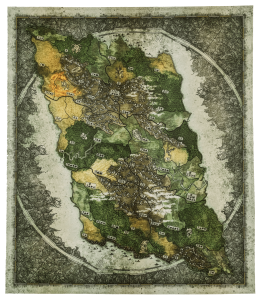
Spirit Island: Expansion Playmat
2017
A full-color island map that expands Spirit Island for 5–6 players.
120
minutes
Heavy
View expansion
Spirit Island: Unterirdisch lauernde Reißzähne
2023
A low-complexity spirit built to confront fewer, larger threats.
120
minutes
Heavy
View expansion
Spirit Island: Sonnenheller Wirbelwind
2023
Clear newly-Explored lands of Invaders before they can Build there.
120
minutes
Heavy
View expansion
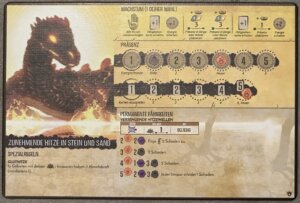
Spirit Island: Zunehmende Hitze in Stein und Sand
2023
A low-complexity spirit that turns Sacred Sites into centers of destruction.
120
minutes
Heavy
View expansion
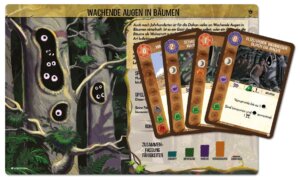
Spirit Island: Wachende Augen in Bäumen
2023
Defend against Ravages and turn gathered Dahan into a powerful counterattack.
120
minutes
Medium Heavy

View expansion
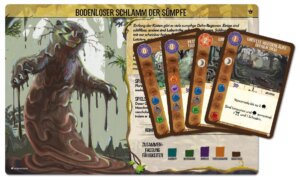
Spirit Island: Bodenloser Schlamm der Sümpfe
2023
Ooze outward, disrupt Inland expansion, and cause unpleasant Fear.
120
minutes
Heavy
View expansion
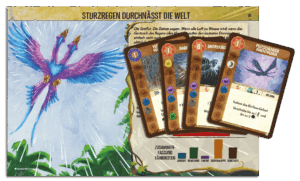
Spirit Island: Sturzregen durchnässt die Welt
2022
A 2022 German release of the Downpour Drenches the World spirit.
Medium Heavy
View expansion

Spirit Island: Finder unsichtbarer Wege
2021
Reshape the island with an enigmatic spirit of movement and isolation.
120
minutes
Medium Heavy
View expansion

Spirit Island: Seele des Flächenbrands
2019
A joyous blaze of destruction that spreads with extreme offense—and blight.
Heavy
View expansion

Spirit Island: Unter der Insel schlummernde Schlange
2018
A slow-awakening primal Spirit with immense late-game potential.
120
minutes
Medium Heavy
View expansion

Spirit Island: Promo Pack 2
2020
Expand your Spirit Island collection with new spirits, cards, an adversary, and scenarios.
120
minutes
Heavy
View expansion

Spirit Island: Promo Pack 1
2017
Two high-complexity spirits bring fiery offense and deep-earth power.
120
minutes
Heavy
View expansion

Spirit Island: Feather & Flame
2022
Fire, flood, flame, and feather answer the call against invading ships.
120
minutes
Heavy
View expansion

Spirit Island: Branch & Claw
2017
Expand every turn with new Spirits, tokens, Events, and challenges.
120
minutes
Heavy
View expansion

Spirit Island: Jagged Earth
2020
Expand the island’s defense with new Spirits, threats, powers, and hard choices.
120
minutes
Heavy
View expansion
