
Terraforming Mars
2016
Develop projects, improve Mars’s temperature, oxygen, and oceans, and compete for milestones, awards, and victory points.
120
minutes
1 - 5
player(s)
12+
Medium Heavy


About this board game
Terraforming Mars is a competitive strategy game for 1–5 players that takes about 120 minutes, set in the 2400s as corporations work to make Mars habitable.
Each player leads a corporation sponsored by the World Government on Earth. You acquire project cards from a pool of more than 200 unique designs, then balance the cost of buying them with the resources needed to put them into play. Cards may provide immediate bonuses, increase production, or require specific levels of temperature, oxygen, or ocean coverage before they can be played.
Although players cooperate to complete the planet’s transformation, they compete for victory points. Your Terraform Rating determines your basic income and score, while production, project cards, infrastructure, milestones, awards, and other accomplishments can provide additional points.
- Manage MegaCredits, Steel, Titanium, Plants, Energy, and Heat.
- Build cities, oceans, and greenery on the shared Mars board.
- Claim Milestones and fund Awards for valuable victory points.
- Use cards, Standard Projects, and resource conversions to advance terraforming.
Each generation moves through player order, research, action, and production phases. During the action phase, players take turns performing one or two actions, such as playing a card, claiming a Milestone, using a Standard Project, converting Plants into greenery, raising temperature with Heat, or activating a card already in play. Turns continue until everyone has passed.
Terraforming Mars ends after the generation in which the temperature, oxygen, and ocean requirements are all reached. Add each corporation’s Terraform Rating to its other victory points to determine the winner.
Thematics
Mechanics
Designer
Illustrators
/pic7182955.jpg)

Board Game Rules for
Terraforming Mars

The Terraforming Announcement:
“Since its inception in 2174, the World Government has continually strived for global unity and peace. Our mission is to be humanity’s shared tool for shaping a better future.
Earth is overpopulated and resources are dwindling. We now face the choice either to recede, or to expand into space to find new homes for humanity. For this reason, we need to turn Mars into a habitable planet.
The terraforming of Mars is an endeavor so great that it will take the united effort of mankind to accomplish. The World Government will therefore inaugurate a Terraforming Committee, and instate a universal tax for this purpose. Any corporation or enterprise contributing to the terraforming process will be generously rewarded by the Committee. We believe that these measures will, eventually, result in a habitable planet for our descendants.
Thank you for your attention!”
— Levi Uken, World Government communicator, January 16, 2315 AD.
Background
Humanity has begun to spread throughout the solar system. On Mars, a few small colonies have been built. These offer protection from the environment, from a planet which is terribly cold, dry, and with almost no atmosphere.
To be able to increase immigration from Earth, Mars needs to be terraformed by altering its environment until humans can live there without expensive protective gear, and without even minor accidents becoming lethal. Therefore the World Government has decided to support any organization that contributes to this vast undertaking.
The generous funding attracts gigantic corporations that compete to expand their businesses and emerge as the most influential force behind the terraforming. In this era, great opportunities lie in the taming of the Red Planet.
Components List
- 1 Rules Booklet
- 1 Game Board
- 5 Player Boards
- 17 Corporation Cards
- 208 Project Cards
- 8 Reference Cards
- 200 Player Markers (transparent plastic cubes in 5 colors)
- 200 Resource Markers (opaque plastic cubes in gold, silver, and copper)
- 3 Game Board Markers (white cubes)
- 9 Ocean Tiles
- 60 Greenery/City Tiles
- 11 Special Tiles
- 1 First Player Marker
Markers & Cubes
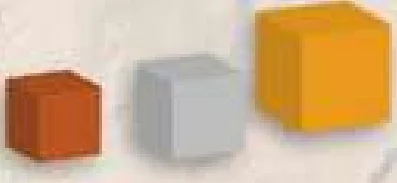
Resource Cubes
Denominations:
- Bronze = 1
- Silver = 5
- Gold = 10
These represent all resource types depending on which box or card they reside in.

Player Markers
Used in the player’s chosen color to mark TR, ownership of tiles on the board, production levels on the player board, and to track used actions on blue cards.

Track Markers
Large white cubes used to track Temperature, Oxygen, and Generations.
First Player Marker
Passed clockwise to the next player at the start of each generation.
Overview
In Terraforming Mars, you control a corporation, and you buy and play cards describing different projects. The projects often directly or indirectly contribute to the terraforming process, but can also consist of business enterprises of different kinds. In order to win, you have to accumulate a good terraform rating (TR) and many victory points (VPs).
- Terraform Rating (TR): Increased each time you raise a global parameter (temperature, oxygen, or ocean). Your TR determines your basic income as well as your basic score.
- Projects: As terraforming proceeds, more projects become feasible.
- Victory Points: Awarded for anything enhancing mankind’s grip on the solar system, from founding cities to building infrastructure or protecting the environment.
Time is measured in generations. Each generation consists of four sequential phases:
- Turn Order phase
- Research phase: Players access new cards.
- Action phase: Players take turns performing 1 or 2 actions, continuing clockwise around the table until everyone passes.
- Production phase: All players produce resources according to their production parameters on their player boards and gain income from their TR.
Game End: The game ends when all three global parameters reach their goals:
- Oxygen reaches 14%
- Oceans reach 9 tiles
- Temperature reaches +8 °C
Winner: The player with the most Victory Points (VPs) at the end of the game wins. VPs come from TR, tiles on the board, won awards, claimed milestones, and cards played.
Global Parameters
- Temperature, oxygen, and ocean are the three global parameters.
- Whenever you raise a global parameter, your Terraform Rating increases by that much, boosting both income and final score.
- Once a global parameter has reached its maximum goal, it cannot be raised further and no longer increases TR (cards and actions increasing it can still be played, but the parameter increase is ignored).
- When all three global parameters reach their target, the game ends after completing that generation (following the production phase).
A Terraformed Mars (Thematic Notes)
- Oceans: Each tile represents 1% of the Martian surface. 9 ocean tiles equal 9% coverage, sufficient to enable stable hydrological cycles, air moisture, and weather moderation.
- Temperature: To enable liquid oceans, the equator must maintain a positive mean temperature above freezing (+8 °C target).
- Oxygen: The most crucial parameter for human life. 14% corresponds to Earth’s atmospheric pressure at an altitude of approximately 3,000 meters.
- Atmospheric Pressure & Magnetosphere: Represented through project cards granting TR rather than direct tracks.
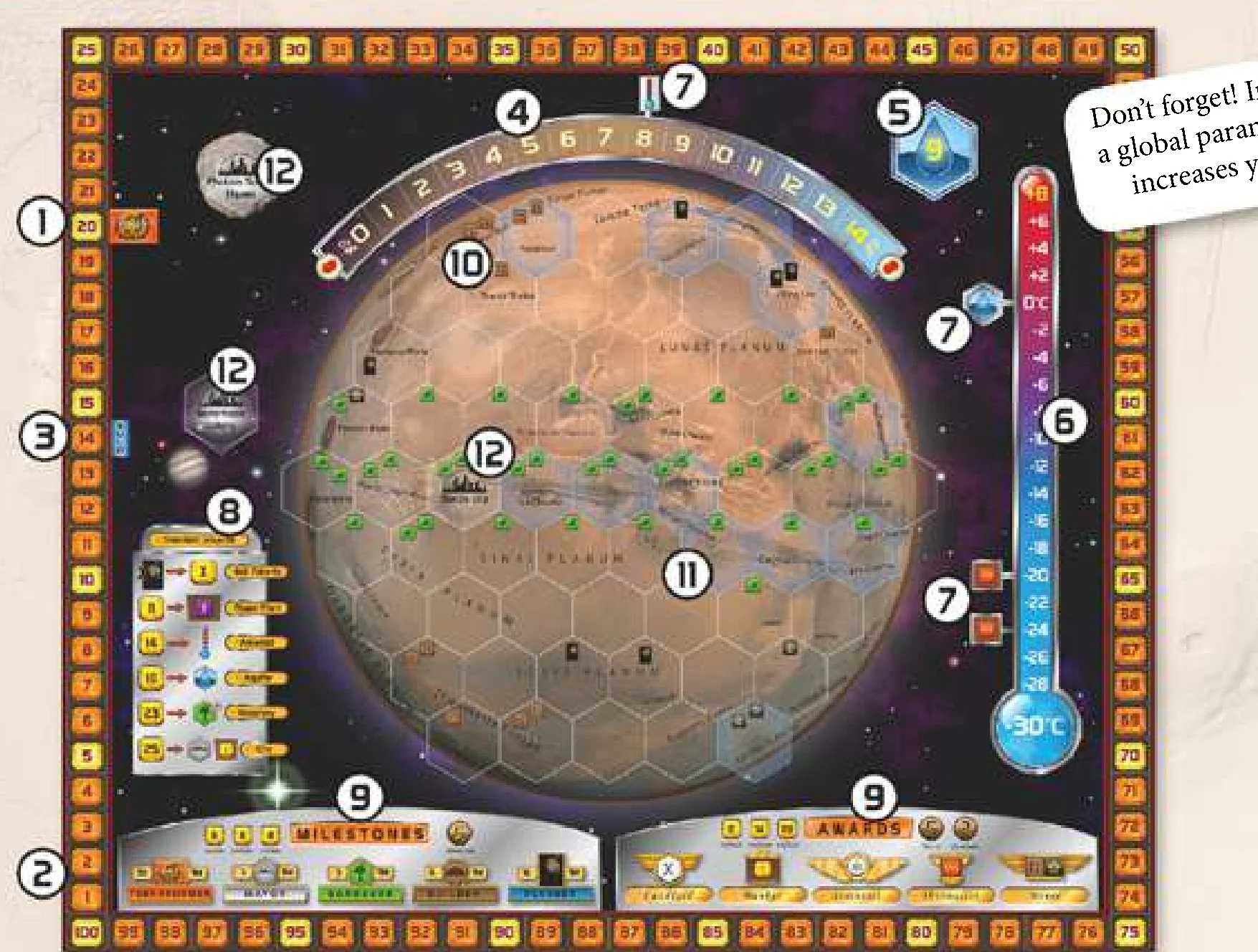
Game Board Elements
The central game board features:
- Tracks for temperature, oxygen level, terraform rating, and generations.
- A surface map where players place ocean, greenery, and city tiles.
- A list of standard projects accessible to all players.
- Milestones and awards that players can compete for.
- Terraform rating (TR) track: All players start at 20. TR represents your basic income and basic VPs. Increase it every time you terraform.
- Generation track: Measures game rounds, starting at 1 and moving up along the TR track.
- Solo games: Starts with TR at 14 and concludes after generation 14.
- Oxygen track: Starts at 0% and maxes out at 14%.
- Ocean tiles: Starts with 9 tiles stacked on the reserve area to be placed during the game.
- Temperature track: Starts at -30 °C and maxes out at +8 °C (equatorial mean temperature).
- Bonus steps: Reaching specific threshold steps on the tracks immediately grants bonuses:
- 8% Oxygen: Temperature increases by 1 step.
- -24 °C and -20 °C: Increases heat production by 1 step each.
- 0 °C: Places 1 ocean tile for free.
- Standard Projects: Actions always available to any player (see page 10).
- Milestones / Awards: Optional goals offering bonus VPs.
- Placement bonuses: Printed icons on map hexes granted immediately when covered by a tile.
- Ocean-reserved areas: Designated blue areas where only ocean tiles can be placed.
- Special reserved areas: Three areas reserved exclusively for specific cities (e.g., Noctis City).
The Map
The map depicts the Tharsis region of Mars, including Valles Marineris and major volcanoes. Low-elevation basins are designated for oceans, equatorial hexes offer plant bonuses, mountain ridges offer steel and titanium, and historic sites (like the Viking lander site) offer card draw bonuses.
Player Boards
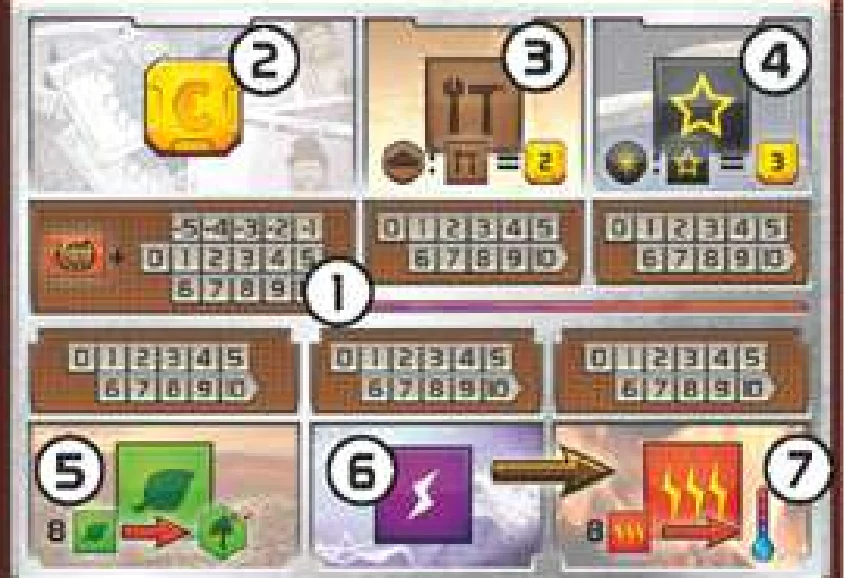
Player boards track stored resources (cubes placed in resource boxes) and production rates (markers on production tracks). Brown boxes indicate production of that resource.
- Production Tracks: Track production amounts. When exceeding 10, multiple markers are used (e.g., markers on ’10’ and ‘2’ represent a production of 12). During the Production Phase, cubes equal to production are added to storage.
- MegaCredits (M€): General currency. Income equals TR + M€ production. M€ production is the only track allowed to be negative (minimum: -5).
- Steel: Used exclusively to pay for cards with a Building tag, valued at 2 M€ per cube. Overpaying gives no change.
- Titanium: Used exclusively to pay for cards with a Space tag, valued at 3 M€ per cube. Overpaying gives no change.
- Plants: 8 plants can be converted into a greenery tile via a standard action.
- Energy: Used by cards. All unspent energy automatically converts into heat at the start of every production phase.
- Heat: 8 heat can be converted to raise temperature 1 step via a standard action.
Card Types
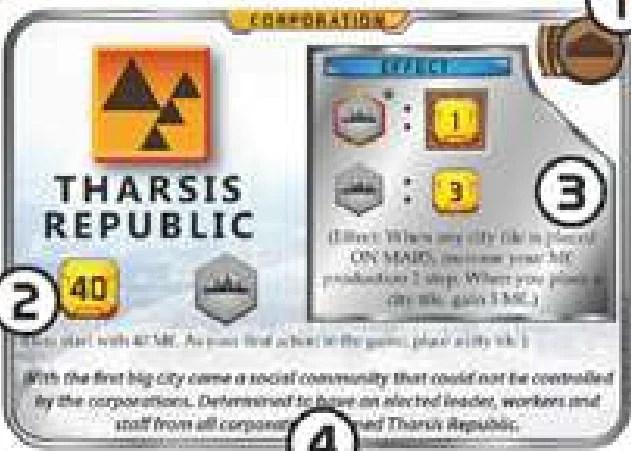
Players begin with a corporation card and purchase project cards categorized as:
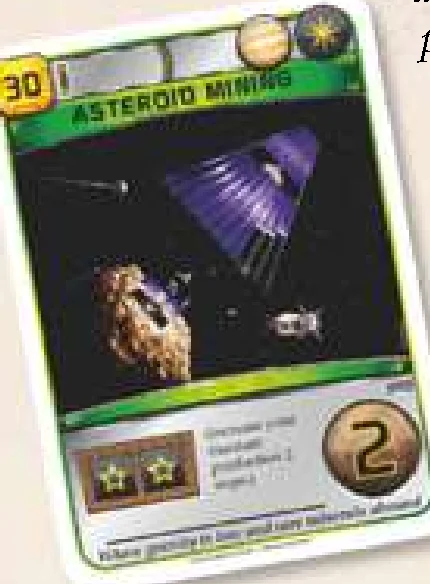
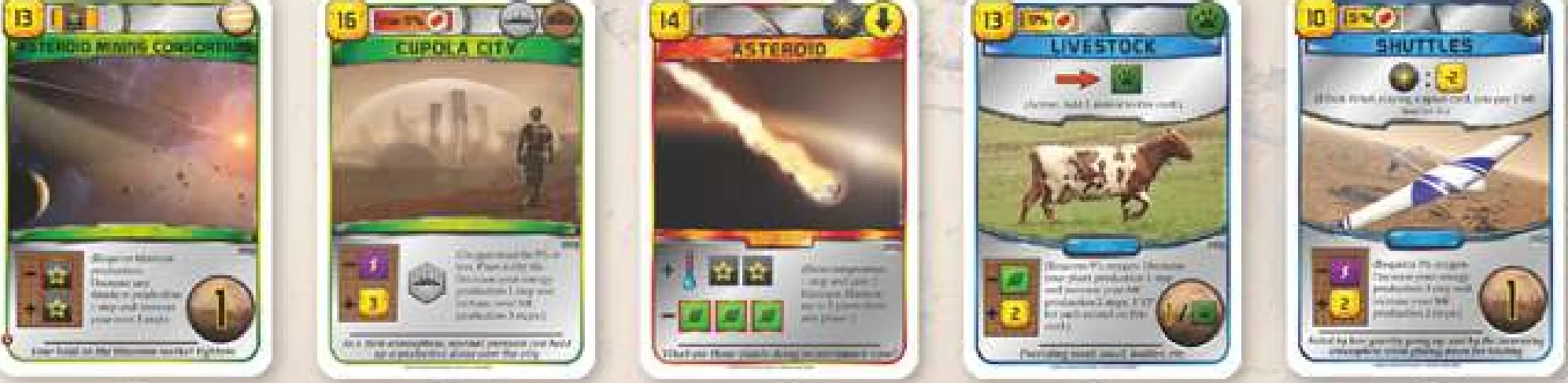
- Active cards (Blue frame): Provide ongoing effects or actions.
- Automated cards (Green frame): Provide one-time effects when played, kept stacked face up for their tags.
- Event cards (Red frame): Provide one-time events, placed face down in a personal discard pile after resolving.
Card Anatomy
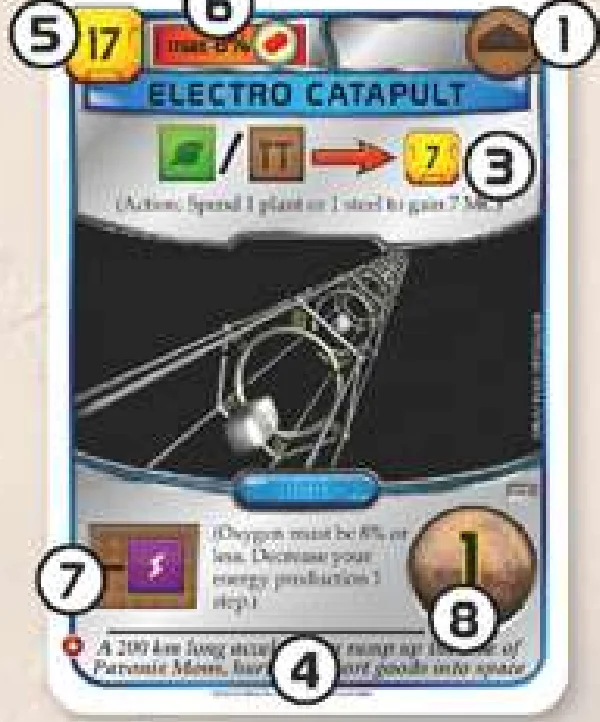
- Tag: Indicates thematic category and enables synergies (e.g., building, space, power, plant).
- Starting Conditions: (Corporations only) Starting money, resources, production, and initial abilities.
- Effect / Action: Blue ribbon indicates ongoing abilities or actions usable once per generation.
- Flavor Text: Thematic narrative background.
- Cost: M€ required to play the card from hand.
- Requirement: Conditions that must be met to play the card (e.g., minimum or maximum parameter values, tags, or production). Only checked when played.
- Immediate Effects: Resource adjustments, production changes, tile placements, etc.
- Victory Points (VPs): Points awarded at the end of the game.
Setup (Standard Game for 2–5 Players)
- Game Board: Place the board in the center of the table. Place the 9 ocean tiles on their reserved stack. Set the temperature marker (-30 °C), oxygen marker (0%), and generation marker (1) on their starting track spaces.
- Supplies: Place resource cubes and remaining tiles within easy reach of all players.
- Project Deck: Ensure Corporate Era cards (red-and-white icon in lower-left) are removed for standard play. Shuffle the project cards and place the deck beside the board with space for a discard pile.
- Player Setup: The player who most recently won Terraforming Mars receives the first player marker. Each player selects a color, taking the matching player markers and a player board. Set starting production on all 6 tracks to 1 (standard game only). Place one marker at 20 TR.
- Corporations: New players receive a Beginner Corporation (starts with 42 M€ and 10 free project cards). Experienced players are dealt 2 corporation cards each, choosing 1 and discarding the other face down.
- Project Cards: Deal 10 project cards to each experienced player.
- Starting Conditions: Players choose which project cards to keep from the dealt hand, paying 3 M€ per card kept, and discard the remainder face down.
- Start the Game: Generation 1 begins immediately with the Action phase, skipping the Turn Order and Research phases.
Each generation represents an extended time span and consists of four phases:
1) Player Order Phase
The first player marker rotates one position clockwise, and the generation counter moves up 1 step. (Skipped in generation 1).
2) Research Phase
Each player draws 4 project cards from the deck and may purchase any number of them (0 to 4 cards) into their hand for 3 M€ each. Unpurchased cards are discarded face down. There is no hand limit. (Skipped in generation 1).
3) Action Phase
Players take turns performing 1 or 2 actions, or passing. Play proceeds clockwise around the table for multiple cycles until all players have passed. Once a player passes, they cannot take any more actions for the rest of that generation.
Available actions:
- A) Play a card from hand
- B) Use a standard project
- C) Claim a milestone
- D) Fund an award
- E) Use the action on a blue card
- F) Convert 8 plants into a greenery tile (+1 oxygen and +1 TR)
- G) Convert 8 heat into a temperature increase (+1 temperature and +1 TR)
4) Production Phase
All players resolve this phase simultaneously:
- Energy to Heat: Move all remaining cubes from the Energy storage box directly to the Heat storage box.
- Resource Income: Receive MegaCredits equal to your Terraform Rating + M€ production (which may reduce income if negative). Collect all other resources according to their production tracks.
- Reset Actions: Remove player markers from used blue action cards to make them available for the next generation.
A) Play a Card from Your Hand
- Check Requirements: Ensure you meet all global parameter conditions, tag thresholds, and production requirements. You must be able to perform the card’s effects, with three exceptions:
- Raising parameters that are already maxed out (allowed; TR increase is ignored).
- Adding non-standard resources you cannot collect (allowed; ignored).
- Removing opponents’ resources marked with red borders (optional; you may remove fewer or none).
- Pay the Cost & Execute Immediate Effects: Pay the card’s M€ cost (using steel for building cards or titanium for space cards as applicable). Execute immediate benefits in any order chosen. Brown production boxes must be applied. Red-bordered icons affect any chosen player (including yourself); unbordered icons affect only yourself.
- Place the Card:
- Event (Red): Placed in a face-down personal pile. Tags only trigger when played.
- Automated (Green): Placed face up in a stack showing only the top banner with tags.
- Active (Blue): Kept face up with the top panel and action/effect visible.
B) Use a Standard Project
Standard projects are always available on the game board and can be used multiple times in the same generation:
- Sell Patents (Free): Discard any number of cards from hand to gain 1 M€ per discarded card.
- Power Plant (11 M€): Increase your energy production by 1 step.
- Asteroid (14 M€): Increase temperature 1 step (+1 TR).
- Aquifer (18 M€): Place an ocean tile (+1 TR and any placement bonus).
- Greenery (23 M€): Place a greenery tile (+1 oxygen step, +1 TR, and any placement bonus).
- City (25 M€): Place a city tile and increase M€ production by 1 step.
C) Claim a Milestone
A player meeting a milestone’s criteria may claim it as an action by paying 8 M€ and placing their marker on it. Only 3 of the 5 milestones can be claimed per game. Claimed milestones cannot be stolen and are worth 5 VPs at game end.
- Terraformer: Have a Terraform Rating of at least 35.
- Mayor: Own at least 3 city tiles.
- Gardener: Own at least 3 greenery tiles.
- Builder: Have at least 8 building tags in play.
- Planner: Have at least 16 cards in hand when claiming the milestone.
D) Fund an Award
Any player may fund an award during the Action phase without meeting prerequisites. Only 3 awards can be funded per game, each only once:
- 1st award funded costs: 8 M€
- 2nd award funded costs: 14 M€
- 3rd award funded costs: 20 M€
Scoring at game end: The winner of each funded category scores 5 VPs; second place scores 2 VPs (no second place in 2-player games). Ties award full points to all tied players.
- Landlord: Owns the most tiles on the board.
- Banker: Highest M€ production.
- Scientist: Most science tags in play.
- Thermalist: Most heat resource cubes stored.
- Miner: Most steel and titanium resource cubes stored combined.
E) Use the Action on a Blue Card
Blue cards and corporations featuring a red arrow denote actions usable once per generation. Pay the cost to the left of the arrow, take the benefit, and mark the card with a player marker.
F) Convert Plants into Greenery
Spend 8 plant cubes to place 1 greenery tile on the board, raising oxygen 1 step (+1 TR). Must be placed adjacent to your existing tiles if possible.
G) Convert Heat into Temperature
Spend 8 heat cubes to raise the temperature 1 step (+1 TR).
General Placement Rules
When placing any tile on the map:
- Check for placement restrictions (printed on cards or specific tile rules).
- Receive any placement bonuses printed on that map hex.
- Receive a placement bonus of 2 M€ for each adjacent ocean tile already placed.
Tile Types

Ocean Tiles
- Can only be placed on reserved ocean areas.
- Increases TR by 1 step.
- Are unowned (no player marker).
- Grants 2 M€ to any player subsequently placing any tile adjacent to them.
Greenery Tiles
- Must be placed adjacent to a tile you already own, if possible. If you own no tiles or no adjacent spaces are available, it may be placed on any legal empty space.
- Place a player marker on it to indicate ownership.
- Increases the oxygen level by 1 step (and thereby increases your TR by 1). If oxygen is already maxed out, no TR is gained.
- Worth 1 VP at game end, and provides 1 VP to each adjacent city tile.

City Tiles
- May not be placed adjacent to another city tile (exception: Noctis City must always go on its reserved space).
- Place a player marker on it to indicate ownership.
- Worth 1 VP for each adjacent greenery tile (regardless of who owns the greenery) at game end.
- Capital City Tile: Unique city placed by the Capital card; scores like a normal city, plus 1 VP per adjacent ocean tile.
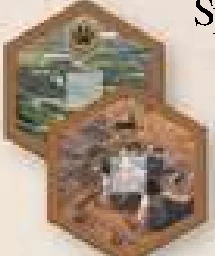
Special Tiles
- Granted by specific project cards. Specific placement restrictions and special abilities are described directly on the card. Place your player marker on the tile.
Game End
When all three global parameters (oceans, temperature, oxygen) reach their targets, the game concludes at the end of the current generation. After the generation’s normal production phase, players get one final opportunity to convert plants into greenery tiles in turn order (which may earn placement bonuses and adjacent city VPs, but does not increase oxygen or TR).
Final Scoring
Calculate final scores in the following order:
- Terraform Rating (TR): Basic score starting point.
- Awards: 5 VPs for 1st place, 2 VPs for 2nd place (ties award equal points).
- Milestones: 5 VPs per claimed milestone.
- Game Board Tiles:
- 1 VP for each greenery tile owned.
- 1 VP for each greenery tile adjacent to each city tile owned (regardless of who owns the greenery).
- Cards: VPs from resource-collecting cards, plus all printed VPs on face-up project cards and face-down event cards.
Tie-breaker: Highest stored M€ wins.


Corporate Era (Extended Game)
Adds economy- and technology-focused project cards and 2 corporations marked with a red-and-white icon.
- Players start with 0 production on all resource tracks instead of 1.
- Creates a deeper, longer, and more strategic game.
Solo Variant for Corporate Era
Standard rules apply with the following adjustments:
- Board Setup: Place 2 neutral cities with 1 adjacent neutral greenery each by flipping the top 4 project cards from the deck and using their printed costs to determine coordinate positions.
- Starting Conditions: Start at 14 TR and 0 production. (If playing Tharsis Republic, gain M€ production for the two neutral cities).
- Milestones and Awards are not used.
- You have a neutral opponent from whom you can reduce/steal resources and production.
- Goal: Complete all three global parameters before the end of Generation 14 to win. Calculate final score in VPs.
Draft Variant
During the Research Phase (starting in Generation 2):
- Deal 4 cards to each player. Each player drafts 1 card and passes the remaining 3 cards (clockwise on even generations, counter-clockwise on odd generations).
- Repeat until 4 cards are drafted per player.
- Each player then decides which of their 4 drafted cards to purchase for 3 M€ each.
Parameters
- TR (Terraform Rating): Starts at 20. Each step earned equals 1 VP and increases income by 1 M€.
- Temperature: Raised in 2 °C increments from -30 °C to +8 °C.
- Oxygen: Raised in 1% increments from 0% to 14%.
- Oceans: 9 tiles to be placed on designated blue areas.
Resources & Production
- MegaCredits (M€): Main currency for actions and cards.
- Steel: 2 M€ value toward cards with Building tag.
- Titanium: 3 M€ value toward cards with Space tag.
- Plants: 8 plants convert to 1 Greenery tile.
- Energy: Powers actions; unused energy turns into Heat during production.
- Heat: 8 heat converts to 1 Temperature step.
- Production Symbol: Any resource icon inside a brown square increases that track’s generation yield.
Card Tags
- Building: Construction projects payable with steel.
- Space: Space technology payable with titanium.
- Power: Energy infrastructure.
- Science: Research and scientific knowledge.
- Jovian: Outer solar system infrastructure.
- Earth: Activities based on Earth.
- Plant: Vegetation and flora.
- Microbe: Microscopic life forms.
- Animal: Complex life; generally generates VPs.
- City: Colony and urban infrastructure.
- Event: One-time immediate effects (red cards).
Red Border on Icons
- Indicates that the effect targets any player (self or opponent).
- Red-bordered resource removal is optional and targets a single player.
- Red-bordered production reduction must be fulfilled (if no opponent can be targeted, you must target yourself or not play the card).
Credits
- Game Design: Jacob Fryxelius
- Graphic Design: Isaac Fryxelius
- Assistant Design: FryxGames
- Publisher: FryxGames / Stronghold Games LLC
Introduction & Background
The Terraforming Announcement:
“Since its inception in 2174, the World Government has continually strived for global unity and peace. Our mission is to be humanity’s shared tool for shaping a better future.
Earth is overpopulated and resources are dwindling. We now face the choice either to recede, or to expand into space to find new homes for humanity. For this reason, we need to turn Mars into a habitable planet.
The terraforming of Mars is an endeavor so great that it will take the united effort of mankind to accomplish. The World Government will therefore inaugurate a Terraforming Committee, and instate a universal tax for this purpose. Any corporation or enterprise contributing to the terraforming process will be generously rewarded by the Committee. We believe that these measures will, eventually, result in a habitable planet for our descendants.
Thank you for your attention!”
— Levi Uken, World Government communicator, January 16, 2315 AD.
Background
Humanity has begun to spread throughout the solar system. On Mars, a few small colonies have been built. These offer protection from the environment, from a planet which is terribly cold, dry, and with almost no atmosphere.
To be able to increase immigration from Earth, Mars needs to be terraformed by altering its environment until humans can live there without expensive protective gear, and without even minor accidents becoming lethal. Therefore the World Government has decided to support any organization that contributes to this vast undertaking.
The generous funding attracts gigantic corporations that compete to expand their businesses and emerge as the most influential force behind the terraforming. In this era, great opportunities lie in the taming of the Red Planet.
Components
Components List
- 1 Rules Booklet
- 1 Game Board
- 5 Player Boards
- 17 Corporation Cards
- 208 Project Cards
- 8 Reference Cards
- 200 Player Markers (transparent plastic cubes in 5 colors)
- 200 Resource Markers (opaque plastic cubes in gold, silver, and copper)
- 3 Game Board Markers (white cubes)
- 9 Ocean Tiles
- 60 Greenery/City Tiles
- 11 Special Tiles
- 1 First Player Marker
Markers & Cubes
Resource Cubes
Denominations:
- Bronze = 1
- Silver = 5
- Gold = 10
These represent all resource types depending on which box or card they reside in.
Player Markers
Used in the player’s chosen color to mark TR, ownership of tiles on the board, production levels on the player board, and to track used actions on blue cards.
Track Markers
Large white cubes used to track Temperature, Oxygen, and Generations.
First Player Marker
Passed clockwise to the next player at the start of each generation.
Game Overview & Global Parameters
Overview
In Terraforming Mars, you control a corporation, and you buy and play cards describing different projects. The projects often directly or indirectly contribute to the terraforming process, but can also consist of business enterprises of different kinds. In order to win, you have to accumulate a good terraform rating (TR) and many victory points (VPs).
- Terraform Rating (TR): Increased each time you raise a global parameter (temperature, oxygen, or ocean). Your TR determines your basic income as well as your basic score.
- Projects: As terraforming proceeds, more projects become feasible.
- Victory Points: Awarded for anything enhancing mankind’s grip on the solar system, from founding cities to building infrastructure or protecting the environment.
Time is measured in generations. Each generation consists of four sequential phases:
- Turn Order phase
- Research phase: Players access new cards.
- Action phase: Players take turns performing 1 or 2 actions, continuing clockwise around the table until everyone passes.
- Production phase: All players produce resources according to their production parameters on their player boards and gain income from their TR.
Game End: The game ends when all three global parameters reach their goals:
- Oxygen reaches 14%
- Oceans reach 9 tiles
- Temperature reaches +8 °C
Winner: The player with the most Victory Points (VPs) at the end of the game wins. VPs come from TR, tiles on the board, won awards, claimed milestones, and cards played.
Global Parameters
- Temperature, oxygen, and ocean are the three global parameters.
- Whenever you raise a global parameter, your Terraform Rating increases by that much, boosting both income and final score.
- Once a global parameter has reached its maximum goal, it cannot be raised further and no longer increases TR (cards and actions increasing it can still be played, but the parameter increase is ignored).
- When all three global parameters reach their target, the game ends after completing that generation (following the production phase).
A Terraformed Mars (Thematic Notes)
- Oceans: Each tile represents 1% of the Martian surface. 9 ocean tiles equal 9% coverage, sufficient to enable stable hydrological cycles, air moisture, and weather moderation.
- Temperature: To enable liquid oceans, the equator must maintain a positive mean temperature above freezing (+8 °C target).
- Oxygen: The most crucial parameter for human life. 14% corresponds to Earth’s atmospheric pressure at an altitude of approximately 3,000 meters.
- Atmospheric Pressure & Magnetosphere: Represented through project cards granting TR rather than direct tracks.
Game Board & Map
Game Board Elements
The central game board features:
- Tracks for temperature, oxygen level, terraform rating, and generations.
- A surface map where players place ocean, greenery, and city tiles.
- A list of standard projects accessible to all players.
- Milestones and awards that players can compete for.
- Terraform rating (TR) track: All players start at 20. TR represents your basic income and basic VPs. Increase it every time you terraform.
- Generation track: Measures game rounds, starting at 1 and moving up along the TR track.
- Solo games: Starts with TR at 14 and concludes after generation 14.
- Oxygen track: Starts at 0% and maxes out at 14%.
- Ocean tiles: Starts with 9 tiles stacked on the reserve area to be placed during the game.
- Temperature track: Starts at -30 °C and maxes out at +8 °C (equatorial mean temperature).
- Bonus steps: Reaching specific threshold steps on the tracks immediately grants bonuses:
- 8% Oxygen: Temperature increases by 1 step.
- -24 °C and -20 °C: Increases heat production by 1 step each.
- 0 °C: Places 1 ocean tile for free.
- Standard Projects: Actions always available to any player (see page 10).
- Milestones / Awards: Optional goals offering bonus VPs.
- Placement bonuses: Printed icons on map hexes granted immediately when covered by a tile.
- Ocean-reserved areas: Designated blue areas where only ocean tiles can be placed.
- Special reserved areas: Three areas reserved exclusively for specific cities (e.g., Noctis City).
The Map
The map depicts the Tharsis region of Mars, including Valles Marineris and major volcanoes. Low-elevation basins are designated for oceans, equatorial hexes offer plant bonuses, mountain ridges offer steel and titanium, and historic sites (like the Viking lander site) offer card draw bonuses.
Player Boards & Resources
Player Boards
Player boards track stored resources (cubes placed in resource boxes) and production rates (markers on production tracks). Brown boxes indicate production of that resource.
- Production Tracks: Track production amounts. When exceeding 10, multiple markers are used (e.g., markers on ’10’ and ‘2’ represent a production of 12). During the Production Phase, cubes equal to production are added to storage.
- MegaCredits (M€): General currency. Income equals TR + M€ production. M€ production is the only track allowed to be negative (minimum: -5).
- Steel: Used exclusively to pay for cards with a Building tag, valued at 2 M€ per cube. Overpaying gives no change.
- Titanium: Used exclusively to pay for cards with a Space tag, valued at 3 M€ per cube. Overpaying gives no change.
- Plants: 8 plants can be converted into a greenery tile via a standard action.
- Energy: Used by cards. All unspent energy automatically converts into heat at the start of every production phase.
- Heat: 8 heat can be converted to raise temperature 1 step via a standard action.
Cards & Card Anatomy
Card Types
Players begin with a corporation card and purchase project cards categorized as:
- Active cards (Blue frame): Provide ongoing effects or actions.
- Automated cards (Green frame): Provide one-time effects when played, kept stacked face up for their tags.
- Event cards (Red frame): Provide one-time events, placed face down in a personal discard pile after resolving.
Card Anatomy
- Tag: Indicates thematic category and enables synergies (e.g., building, space, power, plant).
- Starting Conditions: (Corporations only) Starting money, resources, production, and initial abilities.
- Effect / Action: Blue ribbon indicates ongoing abilities or actions usable once per generation.
- Flavor Text: Thematic narrative background.
- Cost: M€ required to play the card from hand.
- Requirement: Conditions that must be met to play the card (e.g., minimum or maximum parameter values, tags, or production). Only checked when played.
- Immediate Effects: Resource adjustments, production changes, tile placements, etc.
- Victory Points (VPs): Points awarded at the end of the game.
Setup
Setup (Standard Game for 2–5 Players)
- Game Board: Place the board in the center of the table. Place the 9 ocean tiles on their reserved stack. Set the temperature marker (-30 °C), oxygen marker (0%), and generation marker (1) on their starting track spaces.
- Supplies: Place resource cubes and remaining tiles within easy reach of all players.
- Project Deck: Ensure Corporate Era cards (red-and-white icon in lower-left) are removed for standard play. Shuffle the project cards and place the deck beside the board with space for a discard pile.
- Player Setup: The player who most recently won Terraforming Mars receives the first player marker. Each player selects a color, taking the matching player markers and a player board. Set starting production on all 6 tracks to 1 (standard game only). Place one marker at 20 TR.
- Corporations: New players receive a Beginner Corporation (starts with 42 M€ and 10 free project cards). Experienced players are dealt 2 corporation cards each, choosing 1 and discarding the other face down.
- Project Cards: Deal 10 project cards to each experienced player.
- Starting Conditions: Players choose which project cards to keep from the dealt hand, paying 3 M€ per card kept, and discard the remainder face down.
- Start the Game: Generation 1 begins immediately with the Action phase, skipping the Turn Order and Research phases.
Structure of a Generation
Each generation represents an extended time span and consists of four phases:
1) Player Order Phase
The first player marker rotates one position clockwise, and the generation counter moves up 1 step. (Skipped in generation 1).
2) Research Phase
Each player draws 4 project cards from the deck and may purchase any number of them (0 to 4 cards) into their hand for 3 M€ each. Unpurchased cards are discarded face down. There is no hand limit. (Skipped in generation 1).
3) Action Phase
Players take turns performing 1 or 2 actions, or passing. Play proceeds clockwise around the table for multiple cycles until all players have passed. Once a player passes, they cannot take any more actions for the rest of that generation.
Available actions:
- A) Play a card from hand
- B) Use a standard project
- C) Claim a milestone
- D) Fund an award
- E) Use the action on a blue card
- F) Convert 8 plants into a greenery tile (+1 oxygen and +1 TR)
- G) Convert 8 heat into a temperature increase (+1 temperature and +1 TR)
4) Production Phase
All players resolve this phase simultaneously:
- Energy to Heat: Move all remaining cubes from the Energy storage box directly to the Heat storage box.
- Resource Income: Receive MegaCredits equal to your Terraform Rating + M€ production (which may reduce income if negative). Collect all other resources according to their production tracks.
- Reset Actions: Remove player markers from used blue action cards to make them available for the next generation.
Actions in Detail
A) Play a Card from Your Hand
- Check Requirements: Ensure you meet all global parameter conditions, tag thresholds, and production requirements. You must be able to perform the card’s effects, with three exceptions:
- Raising parameters that are already maxed out (allowed; TR increase is ignored).
- Adding non-standard resources you cannot collect (allowed; ignored).
- Removing opponents’ resources marked with red borders (optional; you may remove fewer or none).
- Pay the Cost & Execute Immediate Effects: Pay the card’s M€ cost (using steel for building cards or titanium for space cards as applicable). Execute immediate benefits in any order chosen. Brown production boxes must be applied. Red-bordered icons affect any chosen player (including yourself); unbordered icons affect only yourself.
- Place the Card:
- Event (Red): Placed in a face-down personal pile. Tags only trigger when played.
- Automated (Green): Placed face up in a stack showing only the top banner with tags.
- Active (Blue): Kept face up with the top panel and action/effect visible.
B) Use a Standard Project
Standard projects are always available on the game board and can be used multiple times in the same generation:
- Sell Patents (Free): Discard any number of cards from hand to gain 1 M€ per discarded card.
- Power Plant (11 M€): Increase your energy production by 1 step.
- Asteroid (14 M€): Increase temperature 1 step (+1 TR).
- Aquifer (18 M€): Place an ocean tile (+1 TR and any placement bonus).
- Greenery (23 M€): Place a greenery tile (+1 oxygen step, +1 TR, and any placement bonus).
- City (25 M€): Place a city tile and increase M€ production by 1 step.
C) Claim a Milestone
A player meeting a milestone’s criteria may claim it as an action by paying 8 M€ and placing their marker on it. Only 3 of the 5 milestones can be claimed per game. Claimed milestones cannot be stolen and are worth 5 VPs at game end.
- Terraformer: Have a Terraform Rating of at least 35.
- Mayor: Own at least 3 city tiles.
- Gardener: Own at least 3 greenery tiles.
- Builder: Have at least 8 building tags in play.
- Planner: Have at least 16 cards in hand when claiming the milestone.
D) Fund an Award
Any player may fund an award during the Action phase without meeting prerequisites. Only 3 awards can be funded per game, each only once:
- 1st award funded costs: 8 M€
- 2nd award funded costs: 14 M€
- 3rd award funded costs: 20 M€
Scoring at game end: The winner of each funded category scores 5 VPs; second place scores 2 VPs (no second place in 2-player games). Ties award full points to all tied players.
- Landlord: Owns the most tiles on the board.
- Banker: Highest M€ production.
- Scientist: Most science tags in play.
- Thermalist: Most heat resource cubes stored.
- Miner: Most steel and titanium resource cubes stored combined.
E) Use the Action on a Blue Card
Blue cards and corporations featuring a red arrow denote actions usable once per generation. Pay the cost to the left of the arrow, take the benefit, and mark the card with a player marker.
F) Convert Plants into Greenery
Spend 8 plant cubes to place 1 greenery tile on the board, raising oxygen 1 step (+1 TR). Must be placed adjacent to your existing tiles if possible.
G) Convert Heat into Temperature
Spend 8 heat cubes to raise the temperature 1 step (+1 TR).
Tiles & Map Placement Rules
General Placement Rules
When placing any tile on the map:
- Check for placement restrictions (printed on cards or specific tile rules).
- Receive any placement bonuses printed on that map hex.
- Receive a placement bonus of 2 M€ for each adjacent ocean tile already placed.
Tile Types
Ocean Tiles
- Can only be placed on reserved ocean areas.
- Increases TR by 1 step.
- Are unowned (no player marker).
- Grants 2 M€ to any player subsequently placing any tile adjacent to them.
Greenery Tiles
- Must be placed adjacent to a tile you already own, if possible. If you own no tiles or no adjacent spaces are available, it may be placed on any legal empty space.
- Place a player marker on it to indicate ownership.
- Increases the oxygen level by 1 step (and thereby increases your TR by 1). If oxygen is already maxed out, no TR is gained.
- Worth 1 VP at game end, and provides 1 VP to each adjacent city tile.
City Tiles
- May not be placed adjacent to another city tile (exception: Noctis City must always go on its reserved space).
- Place a player marker on it to indicate ownership.
- Worth 1 VP for each adjacent greenery tile (regardless of who owns the greenery) at game end.
- Capital City Tile: Unique city placed by the Capital card; scores like a normal city, plus 1 VP per adjacent ocean tile.
Special Tiles
- Granted by specific project cards. Specific placement restrictions and special abilities are described directly on the card. Place your player marker on the tile.
Game End & Final Scoring
Game End
When all three global parameters (oceans, temperature, oxygen) reach their targets, the game concludes at the end of the current generation. After the generation’s normal production phase, players get one final opportunity to convert plants into greenery tiles in turn order (which may earn placement bonuses and adjacent city VPs, but does not increase oxygen or TR).
Final Scoring
Calculate final scores in the following order:
- Terraform Rating (TR): Basic score starting point.
- Awards: 5 VPs for 1st place, 2 VPs for 2nd place (ties award equal points).
- Milestones: 5 VPs per claimed milestone.
- Game Board Tiles:
- 1 VP for each greenery tile owned.
- 1 VP for each greenery tile adjacent to each city tile owned (regardless of who owns the greenery).
- Cards: VPs from resource-collecting cards, plus all printed VPs on face-up project cards and face-down event cards.
Tie-breaker: Highest stored M€ wins.
Game Variants
Corporate Era (Extended Game)
Adds economy- and technology-focused project cards and 2 corporations marked with a red-and-white icon.
- Players start with 0 production on all resource tracks instead of 1.
- Creates a deeper, longer, and more strategic game.
Solo Variant for Corporate Era
Standard rules apply with the following adjustments:
- Board Setup: Place 2 neutral cities with 1 adjacent neutral greenery each by flipping the top 4 project cards from the deck and using their printed costs to determine coordinate positions.
- Starting Conditions: Start at 14 TR and 0 production. (If playing Tharsis Republic, gain M€ production for the two neutral cities).
- Milestones and Awards are not used.
- You have a neutral opponent from whom you can reduce/steal resources and production.
- Goal: Complete all three global parameters before the end of Generation 14 to win. Calculate final score in VPs.
Draft Variant
During the Research Phase (starting in Generation 2):
- Deal 4 cards to each player. Each player drafts 1 card and passes the remaining 3 cards (clockwise on even generations, counter-clockwise on odd generations).
- Repeat until 4 cards are drafted per player.
- Each player then decides which of their 4 drafted cards to purchase for 3 M€ each.
Symbols & Reference
Parameters
- TR (Terraform Rating): Starts at 20. Each step earned equals 1 VP and increases income by 1 M€.
- Temperature: Raised in 2 °C increments from -30 °C to +8 °C.
- Oxygen: Raised in 1% increments from 0% to 14%.
- Oceans: 9 tiles to be placed on designated blue areas.
Resources & Production
- MegaCredits (M€): Main currency for actions and cards.
- Steel: 2 M€ value toward cards with Building tag.
- Titanium: 3 M€ value toward cards with Space tag.
- Plants: 8 plants convert to 1 Greenery tile.
- Energy: Powers actions; unused energy turns into Heat during production.
- Heat: 8 heat converts to 1 Temperature step.
- Production Symbol: Any resource icon inside a brown square increases that track’s generation yield.
Card Tags
- Building: Construction projects payable with steel.
- Space: Space technology payable with titanium.
- Power: Energy infrastructure.
- Science: Research and scientific knowledge.
- Jovian: Outer solar system infrastructure.
- Earth: Activities based on Earth.
- Plant: Vegetation and flora.
- Microbe: Microscopic life forms.
- Animal: Complex life; generally generates VPs.
- City: Colony and urban infrastructure.
- Event: One-time immediate effects (red cards).
Red Border on Icons
- Indicates that the effect targets any player (self or opponent).
- Red-bordered resource removal is optional and targets a single player.
- Red-bordered production reduction must be fulfilled (if no opponent can be targeted, you must target yourself or not play the card).
Credits
Credits
- Game Design: Jacob Fryxelius
- Graphic Design: Isaac Fryxelius
- Assistant Design: FryxGames
- Publisher: FryxGames / Stronghold Games LLC
Expansions for
Terraforming Mars
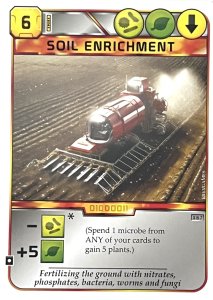
Terraforming Mars: Soil Enrichment Promo Card
2024
Turn one microbe into five plants with this focused promo event.
Heavy

View expansion
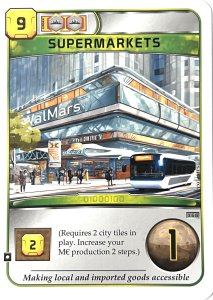
Terraforming Mars: Supermarkets Promo Card
2024
A 9 MC promo card that boosts M€ production and awards 1 VP.
Heavy
View expansion
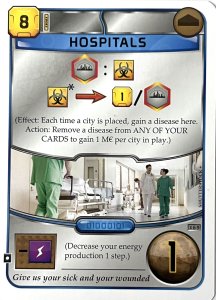
Terraforming Mars: Hospitals Promo Card
2024
Turn disease into income with this city-triggered building card.
Medium Heavy
View expansion
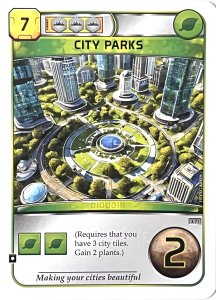
Terraforming Mars: City Parks Promo Card
2024
A green project card rewarding three cities with plants and endgame points
Medium Heavy
View expansion
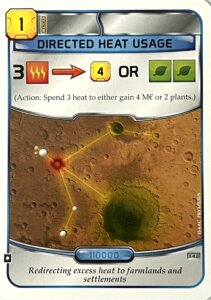
Terraforming Mars: Directed Heat Usage Promo Card
2023
Turn 3 heat into 4 M€ or 2 plants with this blue project promo.
180
minutes
Medium Heavy
View expansion
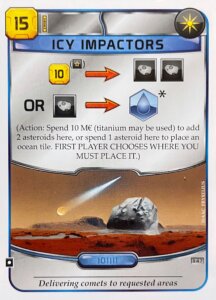
Terraforming Mars: Icy Impactors Promo Card
2023
A strategic promo card where asteroids can become oceans—but placement is decided by the first player.
Medium Heavy
View expansion
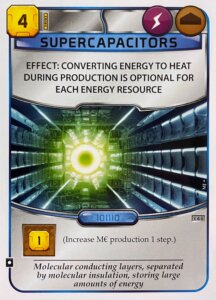
Terraforming Mars: Supercapacitors Promo Card
2023
Optional energy-to-heat conversion and a boost to Megacredit production.
180
minutes
Medium Heavy
View expansion
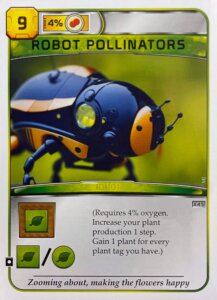
Terraforming Mars: Robot Pollinators Promo Card
2023
A green automated card that rewards plant tags with extra greenery.
180
minutes
Heavy
View expansion
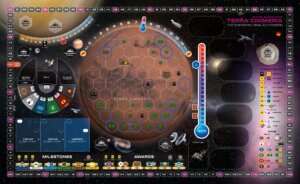
Terraforming Mars: Terra Cimmeria – Big Board Edition
2022
A fan-made Terraforming Mars board with fresh milestones and awards
Medium Heavy
View expansion
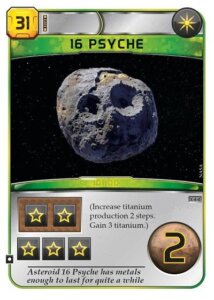
Terraforming Mars: 16 Psyche Promo Card
2023
A green promo card that boosts titanium production and resources
120
minutes
Medium Heavy
View expansion
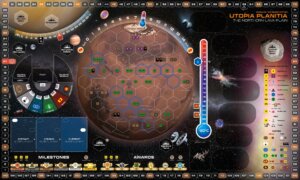
Terraforming Mars: Utopia Planitia – Big Board Edition
2022
A fan-made Terraforming Mars map with distinct milestones and awards
Medium Heavy
View expansion
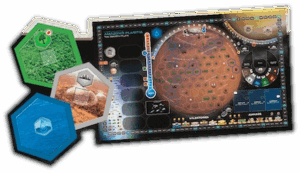
Terraforming Mars: Amazonis Planitia – Big Board Edition
2024
A fan-made board with extra tiles for more engaging 4–5 player games.
Medium Heavy
View expansion
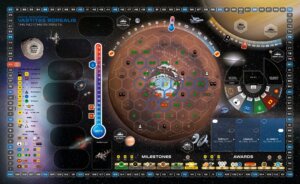
Terraforming Mars: Vastitas Borealis – Big Board Edition
2022
A fan-made Terraforming Mars board with fresh goals, awards, and rules
Medium Heavy
View expansion
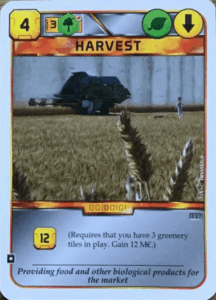
Terraforming Mars: Harvest Promo Card
2021
A red promo card requiring 3 greenery tiles to gain 12 M€.
180
minutes
Medium Heavy
View expansion
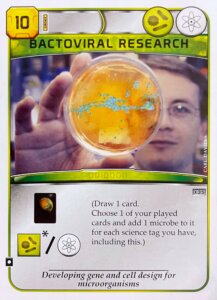
Terraforming Mars: Bactoviral Research Promo Card
2021
Draw a card, then add microbes based on your science tags.
120
minutes
Medium Heavy
View expansion
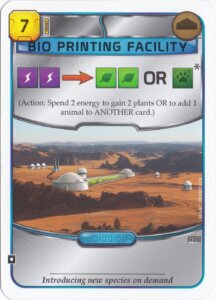
Terraforming Mars: Bio Printing Facility Promo Card
2021
A flexible promo card that converts energy into plants or animal support.
120
minutes
Medium Heavy
View expansion
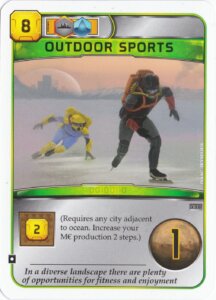
Terraforming Mars: Outdoor Sports Promo Card
2021
A compact project that rewards coastal city development with more M€ production.
180
minutes
Medium Heavy
View expansion
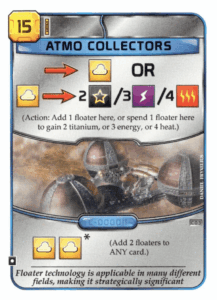
Terraforming Mars: Atmo Collectors Promo Card
2018
Store floaters and convert them into titanium, energy, or heat.
120
minutes
Medium Heavy
View expansion
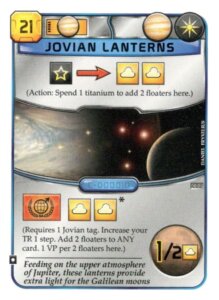
Terraforming Mars: Jovian Lanterns Promo Card
2018
Add floaters by spending titanium with this Terraforming Mars promo card.
120
minutes
Medium Heavy
View expansion
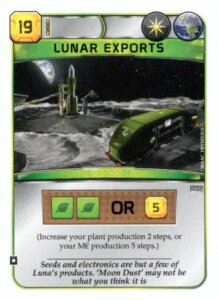
Terraforming Mars: Lunar Exports Promo Card
2018
Choose a major boost: plant production or MegaCredit production.
120
minutes
Medium Heavy
View expansion
Terraforming Mars: Prelude 2 Kickstarter Promo Pack
2024
Add 20 Kickstarter promo cards to your Terraforming Mars collection.
120
minutes
Medium Heavy
View expansion
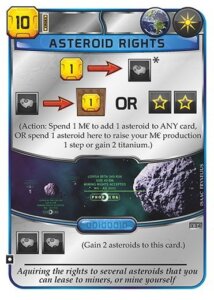
Terraforming Mars: Asteroid Rights Promo Card
2021
A strategic promo card that turns asteroids into production or titanium
120
minutes
Medium Heavy
View expansion
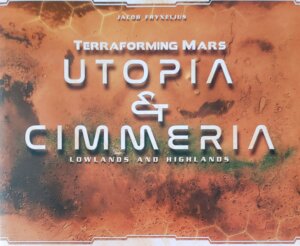
Terraforming Mars: Utopia & Cimmeria
2024
Explore two new Martian maps with fresh milestones and awards.
Medium

View expansion

Terraforming Mars: Amazonis & Vastitas
2024
Two new Mars maps for larger games and northern-waste terraforming.
Medium
View expansion
